
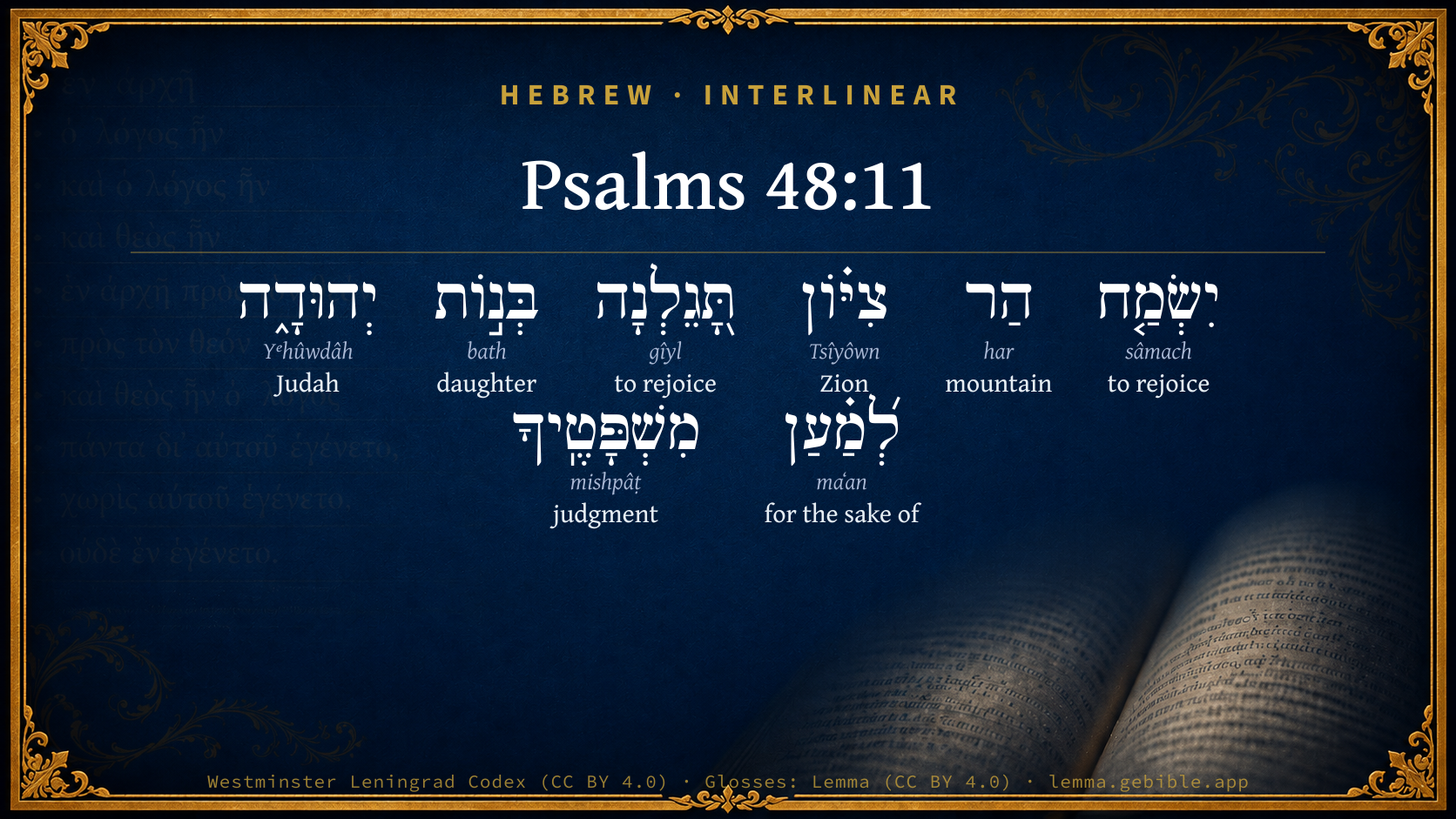
Psalms 48:11

Hebrew (Westminster Leningrad Codex) Psalms 48:11 appears in the Hebrew Old Testament. The text above is from the Westminster Leningrad Codex. Each word links to its Strong’s number, a concise gloss, and parsing drawn from the Open Scriptures Hebrew Bible morphology. Click any word for its full Brown-Driver-Briggs (BDB) entry.
Download image
Cite this verse

Psalms 48:11 (World English Bible). Public Domain. Lemma interlinear Bible study tool, https://lemma.gebible.app/v/psalms/48/11.

Show BibTeX & RIS
BibTeX
RIS
English Translation
Let Mount Zion be glad! Let the daughters of Judah rejoice, Because of your judgments.
World English Bible · Public Domain
Download a study sheet

One document with this verse’s original text, its word-by-word gloss line, the meaning frame, cross-references with their text, attributed commentary, and full source and license credits — printable, and it pastes into notes with its structure intact.

This verse Autodidact and up

Study sheet (.html) Plain text (.txt)

A passage Seminary Student

Up to 50 verses in one chapter. A passage sheet keeps up to 6 commentary sources and 12 cross-references per verse, in the order this page ranks them, and says so on the sheet whenever that leaves anything out. Ask for a single verse and you get the Autodidact verse sheet above.

Everything on this page stays free to read, with no account — the sheet is a download of what is already on screen, not access to it.

Want to remove ads? Support Godless Engineer
Compare translations 3

The same verse in 3 English versions, stacked beneath the original-language interlinear above. Click any original word for its lexicon entry.

Each is an independent rendering of the whole verse — the interlinear is not word-aligned to these translations.

Highlighted words mark where these versions differ — a whole-verse word diff, not a word-by-word alignment.

  • World English Bible Public Domain
    Let Mount Zion be glad! Let the daughters of Judah rejoice, Because of your judgments.
  • King James Version Public Domain
    Let mount Zion rejoice, let the daughters of Judah be glad, because of thy judgments.
  • unfoldingWord Literal Text CC BY-SA 4.0
    Let Mount Zion rejoice, let the daughters of Judah be glad, because of your judgments.

unfoldingWord Literal Text — © unfoldingWord, licensed CC BY-SA 4.0. Word-aligned USFM3 via Door43 (git.door43.org/unfoldingWord/en_ult).

Versions to compare (up to 4)

3 of 4 selected

Show all 18 translations

Every available English version of this verse, each an independent rendering of the whole verse.

  • World English Bible Public Domain
    Let Mount Zion be glad! Let the daughters of Judah rejoice, Because of your judgments.
  • Berean Standard Bible Public Domain
    Mount Zion is glad, the daughters of Judah rejoice, on account of Your judgments.
  • Majority Standard Bible Public Domain
    Mount Zion is glad, the daughters of Judah rejoice, on account of Your judgments.
  • King James Version Public Domain
    Let mount Zion rejoice, let the daughters of Judah be glad, because of thy judgments.
  • American Standard Version (1901) Public Domain
    Let mount Zion be glad, Let the daughters of Judah rejoice, Because of thy judgments.
  • Revised Version (1885) Public Domain
    Let mount Zion be glad, let the daughters of Judah rejoice, because of thy judgments.
  • Geneva Bible (1599) Public Domain
    Let mount Zion reioyce, and the daughters of Iudah be glad, because of thy iudgements.
  • Douay-Rheims (1899) Public Domain
    According to thy name, O God, so also is thy praise unto the ends of the earth: thy right hand is full of justice.
  • Young's Literal Translation Public Domain
    Rejoice doth Mount Zion, The daughters of Judah are joyful, For the sake of Thy judgments.
  • Literal Standard Version CC BY-SA 4.0
    Mount Zion rejoices, || The daughters of Judah are joyful, || For the sake of Your judgments.
  • Unlocked Literal Bible CC BY-SA 4.0
    Let Mount Zion be glad, let the daughters of Judah rejoice because of your righteous decrees.
  • unfoldingWord Literal Text CC BY-SA 4.0
    Let Mount Zion rejoice, let the daughters of Judah be glad, because of your judgments.
  • Darby Bible Public Domain
    Let mount Zion rejoice, let the daughters of Judah be glad, because of thy judgments.
  • World Messianic Bible Public Domain
    Let Mount Zion be glad! Let the daughters of Judah rejoice because of your judgments.
  • Webster's Bible Public Domain
    \\48:10\\According to thy name, O God, so is thy praise to the ends of the earth: thy right hand is full of righteousness.
  • Free Bible Version CC BY-SA 4.0
    Let the people of Mount Zion be glad; let the people of Judah celebrate because your judgments are always fair!
  • Bible in Basic English Public Domain
    Let there be joy in the mountain of Zion, and let the daughters of Judah be glad, because of your wise decisions.
  • JPS Tanakh (1917) Public Domain
    (48-12) Let mount Zion be glad, let the daughters of Judah rejoice, because of Thy judgments.

Literal Standard Version (2020), Covenant Press — licensed CC BY-SA 4.0. Text via the HelloAO Bible API (eBible.org). Unlocked Literal Bible (unfoldingWord) — licensed CC BY-SA 4.0. Text via the HelloAO Bible API (eBible.org). unfoldingWord Literal Text — © unfoldingWord, licensed CC BY-SA 4.0. Word-aligned USFM3 via Door43 (git.door43.org/unfoldingWord/en_ult). Free Bible Version, Dr. Jonathan Gallagher — licensed CC BY-SA 4.0. Text via the HelloAO Bible API (eBible.org).

Word by word

More ways to search: Search by grammar → Find every occurrence → Compare this word →

Practice this passage: Drill this verse → Learn its vocabulary →

About this verse

These counts appear in no published source. They are computed here, from the morphology-tagged text and Lemma’s own curated glosses. What Lemma adds →

8
words
8
distinct lemmas
Wisdom
section

Shared distinctive vocabulary

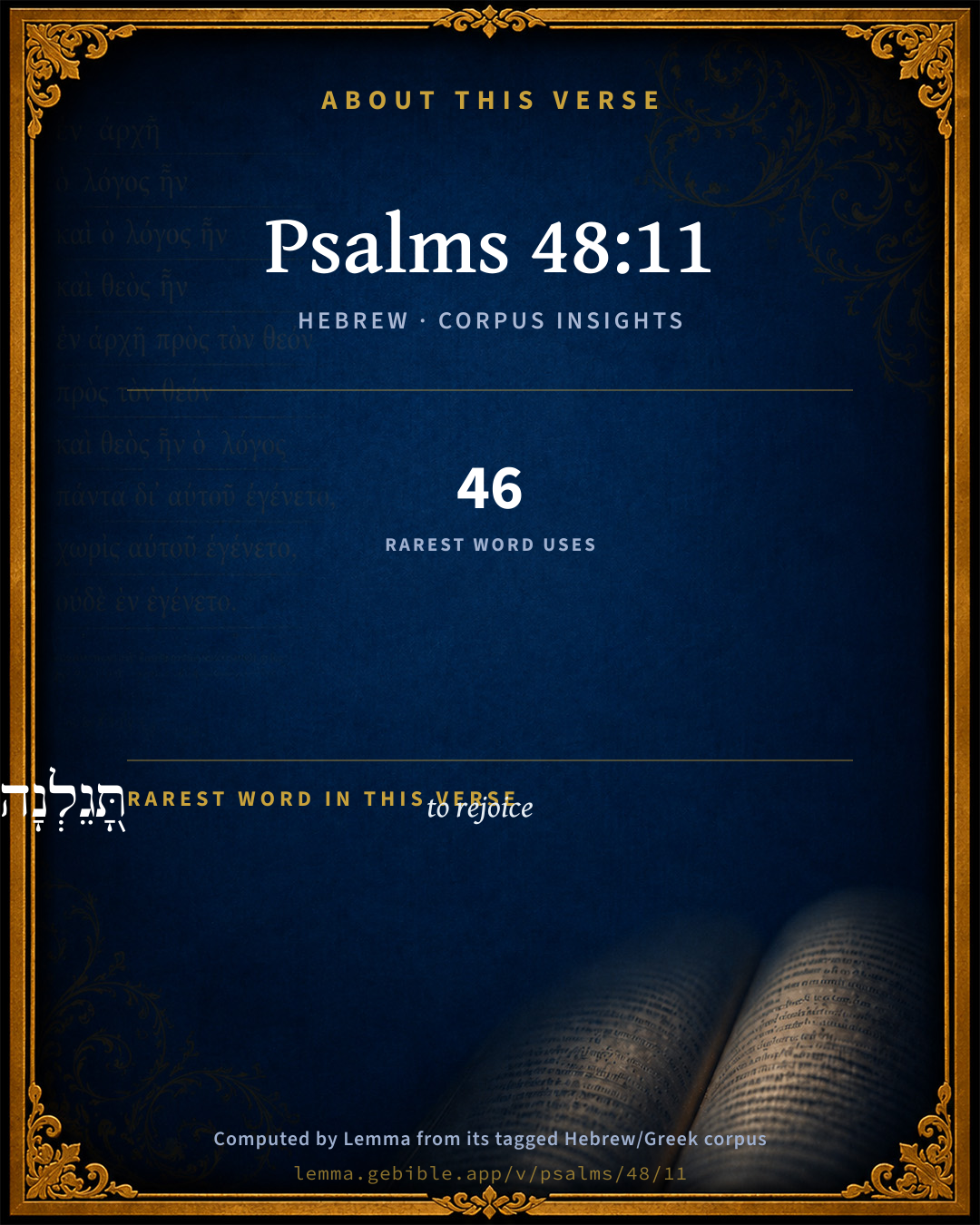
תָּ֭גֵלְנָה to rejoice H1523 occurs in 44 verses of the Hebrew Bible. Also found in:

Grammatical profile

  • 2 verbs
  • 5 nouns
  • 1 preposition

Verb forms

  • יִשְׂמַ֤ח Qal · Imperfect
  • תָּ֭גֵלְנָה Qal · Imperfect

Hebrew & Septuagint length

In English translation the verse runs 15 words from the Hebrew and 16 from the Septuagint (LXX English) — closely comparable.

A rough comparison of the two English renderings, which tokenize alike — not a word-level alignment.

Word counts can differ between the Hebrew and the Greek without any difference in meaning — e.g. the Hebrew direct-object marker אֵת has no separate Greek word, and Greek often adds the article ὁ.

Cross-references

16

Topical passages linked to Psalms 48:11 in the Treasury of Scripture Knowledge — connected by theme and wording, ordered by reader-vote popularity; previews shown in the World English Bible.

  • Psalms 97:8 Zion heard and was glad. The daughters of Judah rejoiced, Because of your judgments, Yahweh.
  • Revelation 18:20 Rejoice over her, O heaven, you saints, apostles, and prophets; for God has judged your judgment on her."
  • Revelation 15:4 Who wouldn't fear you, Lord, And glorify your name? For you only are holy. For all the nations will come and worship before you. For your righteous acts have been revealed."
  • Revelation 16:5–7 I heard the angel of the waters saying, "You are righteous, who are and who were, you Holy One, because you have judged these things.
  • Revelation 19:1–3 After these things I heard something like a loud voice of a great multitude in heaven, saying, "Hallelujah! Salvation, power, and glory belong to our God:
  • Zechariah 9:9 Rejoice greatly, daughter of Zion! Shout, daughter of Jerusalem! Behold, your king comes to you! He is righteous, and having salvation; Lowly, and riding on a donkey, Even on a colt, the foal of a donkey.
  • Luke 23:28 But Jesus, turning to them, said, "Daughters of Jerusalem, don't weep for me, but weep for yourselves and for your children.
  • Judges 5:31 So let all your enemies perish, Yahweh: But let those who love him be as the sun when he goes forth in his might. The land had rest forty years.
  • 2 Chronicles 20:26–27 On the fourth day they assembled themselves in the valley of Beracah; for there they blessed Yahweh: therefore the name of that place was called The valley of Beracah to this day.
  • Psalms 58:10 The righteous shall rejoice when he sees the vengeance. He shall wash his feet in the blood of the wicked;
  • Psalms 137:8–9 Daughter of Babylon, doomed to destruction, He will be happy who rewards you, As you have served us.
  • Song of Solomon 1:5 I am dark, but lovely, You daughters of Jerusalem, Like Kedar's tents, Like Solomon's curtains.
  • Song of Solomon 2:7 I adjure you, daughters of Jerusalem, By the roes, or by the hinds of the field, That you not stir up, nor awaken love, Until it so desires.
  • Song of Solomon 3:5 I adjure you, daughters of Jerusalem, By the roes, or by the hinds of the field, That you not stir up, nor awaken love, Until it so desires.
  • Song of Solomon 5:16 His mouth is sweetness; Yes, he is altogether lovely. This is my beloved, and this is my friend, Daughters of Jerusalem. Friends
  • Isaiah 37:22 this is the word which Yahweh has spoken concerning him: The virgin daughter of Zion has despised you and ridiculed you; the daughter of Jerusalem has shaken her head at you.

Cross-references courtesy of OpenBible.info (CC BY 4.0).

Hebrew and Greek witnesses Masoretic Hebrew ↔ Greek Septuagint

The same verse in the two great witnesses to the Old Testament, shown verse-for-verse.

You’re reading Greek Psalm 47 (Hebrew Psalm 48). The Septuagint counts the superscription, so verse numbers can differ from the Hebrew — chapter-level alignment, not verse-by-verse. Numbering follows Rahlfs.

These are two independent witnesses, not word-aligned to each other, and the Septuagint is shown in lemma (dictionary) form.

Hebrew Psalms 48:11 Masoretic · Westminster Leningrad Codex

יִשְׂמַ֤ח הַר צִיּ֗וֹן תָּ֭גֵלְנָה בְּנ֣וֹת יְהוּדָ֑ה לְ֝מַ֗עַן מִשְׁפָּטֶֽיךָ

Let Mount Zion be glad! Let the daughters of Judah rejoice, Because of your judgments.

World English Bible · Public Domain

Greek LXX Greek Psalm 47:11 Septuagint · lemma form

κατά ὁ ὄνομα σύ ὁ θεός οὕτως καί ὁ αἴνεσις σύ ἐπί ὁ πέρας ὁ γῆ δικαιοσύνη πλήρης ὁ δεξιός σύ

Let mount Sion rejoice, let the daughters of Judaea exult, because of your judgments, O Lord.

LXX2012 (modern English Septuagint) · Public Domain

Hebrew: Westminster Leningrad Codex (CC BY 4.0). Greek: Septuagint (public domain); English from LXX2012 (modern English Septuagint) (Public Domain). How the Septuagint differs from the Hebrew →

Commentary

Notes on Psalms 48:11 from classic Christian and Jewish commentators (each source and its license shown beneath its notes). The classic Christian expositions comment on the surrounding passage and are grouped to its opening verse, so a note may address several verses; the Jewish commentaries on the Tanakh (Rashi and others) are per-verse, so they appear only where the commentator wrote on this verse.

Lemma curates 59 commentaries, every one of them public domain or Creative Commons licensed, each selected and text-cleaned for this edition rather than reprinted as found. About our sources →

Trapp's Complete Commentary

John Trapp

Psa 48:11 Let mount Zion rejoice, let the daughters of Judah be glad, because of thy judgments.

Ver. 11. Let mount Zion rejoice, let the daughters, &c.] Let the Church catholic, and each particular member thereof: give God the glory of his justice, and see that their joy be spiritual.

John Trapp, A Commentary or Exposition upon All the Books of the Old and New Testament (1647–1656) — public domain. Text from a community e-Sword module.

Joseph Benson's Commentary

Psa 48:11. Let mount Zion rejoice — That is, Jerusalem; let the daughters of Judah — The other lesser cities, towns, and villages; be glad, because of thy judgments — Upon thy and their enemies. Let the mother city give an example of joy and thankfulness to all the smaller places, and to the whole kingdom, and let them unanimously join together, with the greatest gladness, to express how sensible they are of thy power and goodness in the wonderful deliverance granted them. Just so, “the church and all her children ought to rejoice with joy unspeakable, on account of the manifestation of divine power on her behalf against her enemies. Thus, at the fall of mystic Babylon, it is said, Rejoice over her, thou heaven, and ye holy apostles and prophets, for God hath avenged you on her, Rev 18:20.” — Horne.

Joseph Benson's Commentary on the Old and New Testaments (1811–1818) — public domain. Text from a community e-Sword module.

J. A. Alexander on Psalms

Joseph Addison Alexander

12. (Psa 48:11). Rejoice shall Mount Zion, exult shall the daughters of Judah, because of thy judgments. According to a very ancient usage, which is found even in the prose of technical geography (Jos 15:45; Jos 15:47), the daughters of Judah may be the minor towns dependent on Jerusalem. The more obvious sense is that of female inhabitants, who, as the weaker sex, had particular occasion to rejoice in the deliverance of the country from its barbarous invaders. The verbs may be understood as expressive of a wish or prayer (let mount Zion rejoice, etc.). But the proper future sense agrees better with what immediately precedes, as the declaration of the glory, which has already redounded to the name of God from this exhibition of his power and faithfulness, is then followed up by a declaration, that the same effect shall be continued. For the sake (or on account) of thy judgments, these experimental proofs of thy righteousness, afforded by its actual exercise.

Joseph Addison Alexander, The Psalms Translated and Explained (1850) — public domain. Text from a community e-Sword module.

Geneva Bible (1599)

Geneva Bible translators

Let Jerusalem and the cities of Judea rejoice, for thy just judgments against thine enemies.

Geneva Bible (1599) marginal notes — public domain. Text via Bolls.life.

Jamieson, Fausset & Brown

Robert Jamieson, A. R. Fausset & David Brown

the daughters, &c.--the small towns, or the people, with the chief city, or rulers of the Church.

judgments--decisions and acts of right government.

Jamieson, Fausset & Brown — Commentary Critical and Explanatory on the Whole Bible (1871) — public domain (CC PDM 1.0). Text via the HelloAO Bible API.

Adam Clarke's Commentary

Verse 11. Let Mount Zion rejoice] The temple is restored in majesty, which was threatened with total destruction; it is again repaired.

Let the daughters of Judah be glad] That thou hast turned her captivity, and poured out thy judgments upon her oppressors.

Adam Clarke's Commentary on the Bible (1810–1826) — public domain. Text from a community e-Sword/MySword module.

John Calvin's Commentaries

11 Mount Zion shall rejoice The Psalmist now concludes his exhortation to rejoicing, telling us that Jerusalem and the other cities of Judea shall have cause to commend the righteousness of God, because they had found from undoubted experience that he was the protector of their welfare. He here makes use of the word judgment, because God, who undertook the cause of his Church, openly showed that he was the enemy of her oppressors, and that he would repress their presumption and audacity.

John Calvin's Commentaries (1540-1563) — public domain. Text from the Calvin Translation Society English edition (1840s-50s) via the Christian Classics Ethereal Library (ccel.org). Calvin's coverage is partial (roughly two-thirds of the Bible); uncommented books and verses are honest gaps, never fabricated. The 19th-century editor's footnotes and remarks are omitted so the notes are faithfully Calvin's own voice.

Ellicott's Commentary for English Readers

(11) Daughters of Judah.—Not the maidens of Jerusalem, but the towns and villages of Judah.

Judgments.—Perhaps here, as in Psa_119:132, with prominent idea of God’s customary dealings with His people.

A Bible Commentary for English Readers, edited by Charles John Ellicott (1878–1897) — public domain. Text from a community e-Sword module.

The Cambridge Bible for Schools and Colleges

gen. ed. J. J. S. Perowne

11. The R.V. assimilates the rendering to that of Psa_97:8, where the same words recur:

Let mount Zion be glad,

Let the daughters of Judah rejoice.

The daughters of Judah are not the maidens of Judah, though the fact that women were wont to celebrate victories with dance and song may have suggested the use of the expression, but the cities of Judah, which had been captured by Sennacherib (Isa_36:1), and therefore had special cause for rejoicing at his overthrow. Country towns are regarded as ‘daughters’ of the metropolis. Cp. Num_21:25; Jos_17:11; Jos_17:16; the word for towns in both cases literally means daughters.

12ff. The inhabitants of Jerusalem had been confined within its walls during the siege: now they can freely walk round, and thankfully contemplate the safety of the walls and towers and palaces so lately menaced with destruction. Cp. Isa_33:20.

tell] I.e. count, as in Psa_22:17; Gen_15:5. The retention of the archaism in R.V. is justifiable for the sake of the connexion with Psa_48:13, where the same word is used for tell = narrate. But lately the towers had been counted with a very different object by the Assyrian officers reconnoitring the city in preparation for the siege (Isa_33:18).

The Cambridge Bible for Schools and Colleges (gen. ed. J. J. S. Perowne; Cambridge University Press, 1878–1918) — public domain. Text from a community e-Sword module.

John Gill's Exposition

Mark ye well her bulwarks,.... Such as the free favour of God in Christ; which is not only as a shield, but as a bulwark to the church; his everlasting love, electing grace, the covenant of grace, with its blessings and promises, all which are more immovable than rocks and mountains; and especially the power of God, which surrounds his church, as the mountains did Jerusalem; and by which they are kept and preserved as in a garrison, Psa 125:2. Also salvation by Christ; his righteousness, sacrifice, and satisfaction, which God has appointed for walls and bulwarks, and which make the city, the church, a strong and impregnable one, Isa 26:1. Likewise the Spirit of God, and his operations and influences, which are a standard against the enemy's flood of opposition and persecution; and who being in his church and people, is greater than he that is in the world, Isa 59:19, Jo1 4:4. Some render the words, set "your hearts on her strength", as the Vulgate Latin version; that is, on Christ, who is the strength of the poor and needy in their distress; the strength of their hearts, of their lives, and of their salvation, and the security of the church. Others readier them, "set your hearts on her armies"; as the Targum is; her volunteers, her soldiers, who endure hardness as good soldiers of Christ, fight the Lord's battles, and are more than conquerors through him; and a lovely sight it is to behold them, with Christ at the head of them; see Rev 19:14;

consider her palaces; for Jehovah, Father, Son, and Spirit, have their dwelling places in Zion; and here, besides apostles, prophets, evangelists, and ordinary ministers of the word, who are rulers and officers set in the first place, every saint is a prince and a king; and has a place and a name here, better than that of sons and daughters of the greatest potentate on earth; every dwelling place in Mount Zion is a palace.

that ye may tell it to the generation following: that is, the beauty and glory, strength and safety of the church; and even all that is spoken of her in this psalm, as well as what follows: this is the end proposed by taking a circuit round Zion, and making the above observations on it.

John Gill's Exposition of the Whole Bible (1746–1763) — public domain (CC PDM 1.0). Text via the HelloAO Bible API.

Albert Barnes' Notes on the Bible

Let mount Zion rejoice - Let Jerusalem, the holy city, rejoice or be glad. Mount Zion is evidently used here to designate the city; and the idea is, that the city of God - the holy city - had occasion for joy and gladness in view of the manifestation of the divine favor.

Let the daughters of Judah be glad - The phrase “daughters of Judah” “may” denote the smaller cities in the tribe of Judah, that surrounded Jerusalem as the “mother” city - in accordance with an usage quite common in the Hebrew Scriptures. See the notes at Isa 1:8. Perhaps, however, the more obvious interpretation is the correct one, as meaning that the women of Judah had special occasion to rejoice on account of their deliverance from so great danger, and from the horrors which usually attended the siege or the conquest of the city - the atrocities which commonly befall the female sex when a city is captured in war. The “daughters of Judah” are those descended from Judah, or connected with the tribe of Judah. Jerusalem was in the bounds of that tribe, and the name Judah was given to all those that remained after the removal of the ten tribes.

Because of thy judgments - Thy righteous interposition in delivering the city and people.

Albert Barnes' Notes on the Bible (1834–1885) — public domain. Text from a community e-Sword/MySword module.

Matthew Poole's English Annotations

Mount Zion; synecdochically put for Jerusalem. The daughters of Judah, i.e. the other and lesser cities and towns or villages (i.e. all the people) of Judah; for such are commonly called daughters in respect of the mother city, to which they are subjects: see Jos 15:45; 17:16; Psa 45:12; 137:8. He mentions Judah only, and not all Israel; partly because they were more immediately and eminently concerned in Jerusalem’s deliverance; and principally because ten of the tribes of Israel were now cut off from Jerusalem, and from the kingdom of David’s house, and possibly carried away captive, 2Ki 18:9-11.

Because of thy judgments upon thine and their enemies; at which they were glad, not simply, but because it was highly conducible to God’s honour, and to the preservation and enlargement of God’s church in the world.

Matthew Poole's English Annotations on the Holy Bible (1683–1685) — public domain. Text from a community e-Sword/MySword module.

The Treasury of David

Charles H. Spurgeon

Ver. 11. Let mount Zion rejoice. As the first of the cities of Judah, and the main object of the enemies' attack, let her lead the song. Let the daughters of Judah be glad, let the smaller towns join the chorus, for they join in the common victory. Let the women, who fare worst in the havoc of war, be among the gladdest of the glad, now that the spoilers have fled. All the church, and each individual member, should rejoice in the Lord, and magnify his name. Because of thy judgments. The righteous acts of the Lord are legitimate subjects for joyful praise. However it may appear on earth, yet in heaven the eternal ruin of the wicked will be the theme of adoring song. Re 19:1, 3: "Alleluia; salvation, and glory, and honour, and power, unto the Lord our God. For true and righteous are his judgments; for he hath judged the great whore which did corrupt the earth with her fornication, and hath avenged the blood of his servants at her hand. And again they said, Alleluia, and her smoke rose up for ever and ever." Justice which to our poor optics now seems severe, will then be perceived to be perfectly consistent with God's name of love, and to be one of the brightest jewels of his crown.

None.

Ver. 11.

1. The subjects of his peoples' joy. Not mercies merely, but judgments

2. Reasons:

1. Because they are holyneedful to the purity of moral government

2. Justneedful to vindicate law.

3. Goodneedful for the greatest amount of good.

Psalms 48:12*

Charles H. Spurgeon's The Treasury of David (1869–1885) — public domain. Psalms only. Text from a community e-Sword/MySword module.

The Pulpit Commentary

Let Mount Zion rejoice, let the daughters of Judah be glad; i.e. let there be a chorus of joyful thanks over the length and breadth of the land, not only in Jerusalem, but in every city of Judah (Jos_15:45) equally. Because of thy judgments. Because thou hast vindicated thy people, and executed judgment on their enemies.

The Pulpit Commentary (1880–1919), ed. H.D.M. Spence-Jones & Joseph S. Exell — public domain. Text from a community e-Sword module.

John Wesley's Explanatory Notes

Judgments - Upon thine and their enemies.

John Wesley, Explanatory Notes Upon the Whole Bible (1754–1765) — public domain. Text via the GEBible commentary corpus.

unfoldingWord translationNotes

Door43 World Missions Community

Let Mount Zion be glad

The writer speaks of Mount Zion as if it were a person who could be glad. The phrase refers to the people who live in Jerusalem. AT: "Let those who live on Mount Zion be glad" (See: Personification and Metonymy)

let the daughters of Judah rejoice

The writer speaks of the towns in Judah as if they were Judah's children. The phrase refers to the people who live in those towns. AT: "let the people who live in the cities of Judah rejoice" (See: Metaphor and Metonymy)

translationWords

Zion

Judah

joy

righteous

decree

unfoldingWord translationNotes — © Distant Shores Media and the Door43 World Missions Community, licensed CC BY-SA 4.0. Source: git.door43.org/Door43/en_tn.

Rashi

Rabbi Shlomo Yitzchaki (Rashi)

As is Your name, O God, so is Your praise Just as Your name is great, so is Your praise great in everyone’s mouth.

Rashi on the Tanakh — English translations: “The Judaica Press complete Tanach with Rashi, translated by A. J. Rosenberg” (CC BY 4.0); “Pentateuch with Rashi's commentary by M. Rosenbaum and A.M. Silbermann, 1929-1934” (public domain); “The Metsudah Tanach series, Lakewood, N.J” (CC BY 4.0); and “The Book of Joshua, Metsudah Publications, 1997” (CC BY 4.0). Text via Sefaria.

Lesson kit

Teaching starters — assembled from the data on this page, not authored interpretation. Every prompt links to the verse data it draws on. Edit before teaching.

Psalms, in the Wisdom, opens this verse with 8 words (8 distinct Hebrew lemmas). Its most distinctive word is gîyl (“to rejoice”). A historical commentator’s framing appears above. Read the whole chapter for the surrounding context.

Discussion questions

  1. The word gîyl carries the sense “to rejoice.” How does it shape the verse?
  2. 1 Chronicles 16:31 shares the word «to rejoice» with this verse. How do the two illuminate each other?
  3. The verb «יִשְׂמַ֤ח» is Qal Imperfect. How does its form color the action?
  4. Reading how Trapp's Complete Commentary and Joseph Benson's Commentary read this verse, where do the two commentators agree and where do they part?

Reading settings

Reading text

Shown beneath each verse's original-language words.

Old Testament
Old Testament edition

Read the OT as the Masoretic Hebrew (MT) or the Greek Septuagint (LXX).

English shown for the Greek Septuagint (in the Hebrew ↔ Greek comparison).

Comparing translations? Open the Compare panel on any verse page to stack up to four side by side.