Jeremiah 50:5

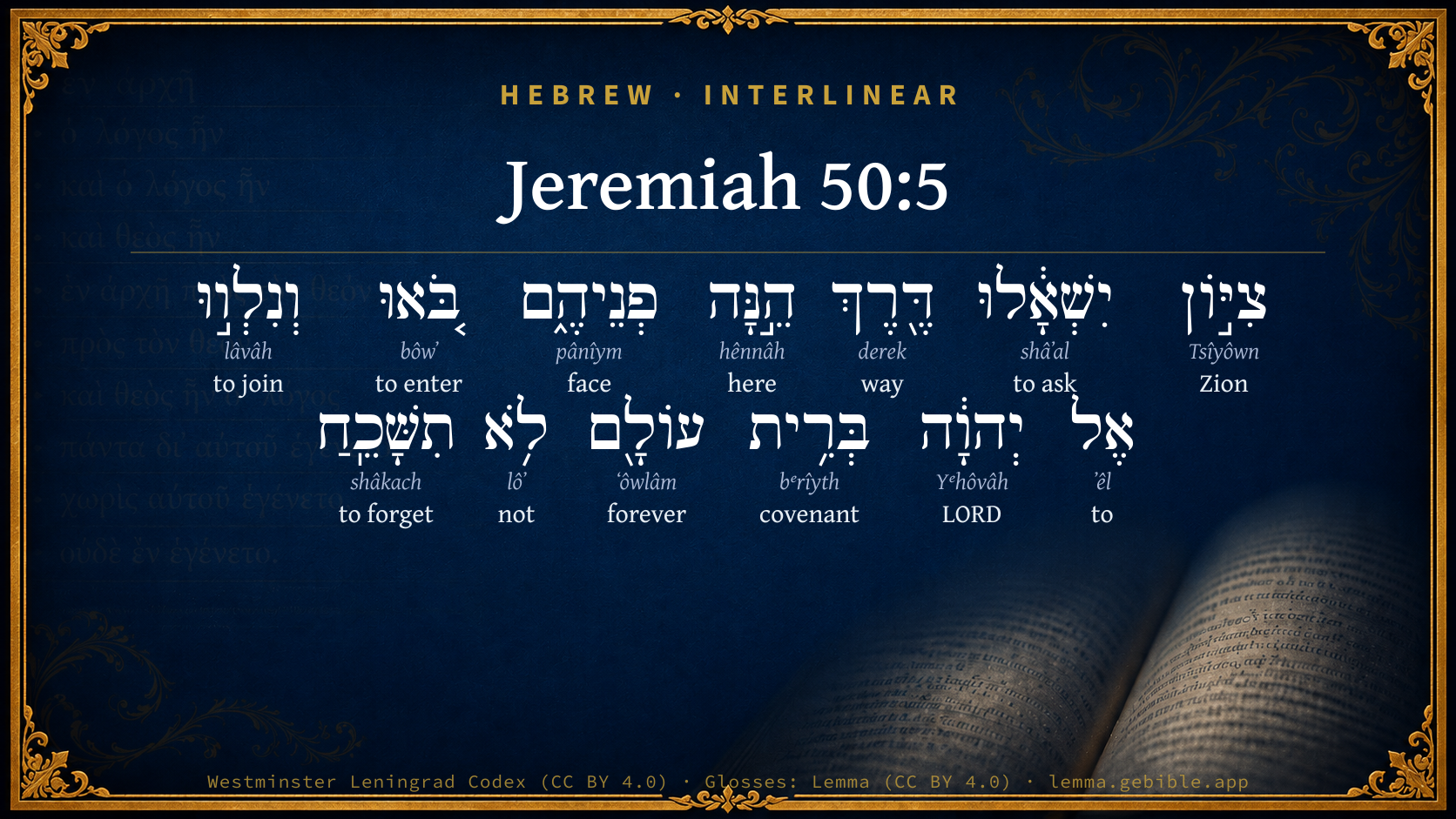
Hebrew (Westminster Leningrad Codex) Jeremiah 50:5 appears in the Hebrew Old Testament. The text above is from the Westminster Leningrad Codex. Each word links to its Strong’s number, a concise gloss, and parsing drawn from the Open Scriptures Hebrew Bible morphology. Click any word for its full Brown-Driver-Briggs (BDB) entry.
Download image
Cite this verse

Jeremiah 50:5 (World English Bible). Public Domain. Lemma interlinear Bible study tool, https://lemma.gebible.app/v/jeremiah/50/5.

Show BibTeX & RIS
BibTeX
RIS
English Translation
They shall inquire concerning Zion with their faces turned toward it, [saying], Come you, and join yourselves to Yahweh in an everlasting covenant that shall not be forgotten.
World English Bible · Public Domain
Download a study sheet

One document with this verse’s original text, its word-by-word gloss line, the meaning frame, cross-references with their text, attributed commentary, and full source and license credits — printable, and it pastes into notes with its structure intact.

This verse Autodidact and up

Study sheet (.html) Plain text (.txt)

A passage Seminary Student

Up to 50 verses in one chapter. A passage sheet keeps up to 6 commentary sources and 12 cross-references per verse, in the order this page ranks them, and says so on the sheet whenever that leaves anything out. Ask for a single verse and you get the Autodidact verse sheet above.

Everything on this page stays free to read, with no account — the sheet is a download of what is already on screen, not access to it.

Want to remove ads? Support Godless Engineer
Compare translations 3

The same verse in 3 English versions, stacked beneath the original-language interlinear above. Click any original word for its lexicon entry.

Each is an independent rendering of the whole verse — the interlinear is not word-aligned to these translations.

Highlighted words mark where these versions differ — a whole-verse word diff, not a word-by-word alignment.

  • World English Bible Public Domain
    They shall inquire concerning Zion with their faces turned toward it, [saying], Come you, and join yourselves to Yahweh in an everlasting covenant that shall not be forgotten.
  • King James Version Public Domain
    They shall ask the way to Zion with their faces thitherward, saying, Come, and let us join ourselves to the LORD in a perpetual covenant that shall not be forgotten.
  • unfoldingWord Literal Text CC BY-SA 4.0
    They will ask the way to Zion and will set off toward it, saying, We will go and join ourselves to Yahweh in an everlasting covenant that will not be forgotten.”

unfoldingWord Literal Text — © unfoldingWord, licensed CC BY-SA 4.0. Word-aligned USFM3 via Door43 (git.door43.org/unfoldingWord/en_ult).

Versions to compare (up to 4)

3 of 4 selected

Show all 18 translations

Every available English version of this verse, each an independent rendering of the whole verse.

  • World English Bible Public Domain
    They shall inquire concerning Zion with their faces turned toward it, [saying], Come you, and join yourselves to Yahweh in an everlasting covenant that shall not be forgotten.
  • Berean Standard Bible Public Domain
    They will ask the way to Zion and turn their faces toward it. They will come and join themselves to the LORD in an everlasting covenant that will never be forgotten.
  • Majority Standard Bible Public Domain
    They will ask the way to Zion and turn their faces toward it. They will come and join themselves to the LORD in an everlasting covenant that will never be forgotten.
  • King James Version Public Domain
    They shall ask the way to Zion with their faces thitherward, saying, Come, and let us join ourselves to the LORD in a perpetual covenant that shall not be forgotten.
  • American Standard Version (1901) Public Domain
    They shall inquire concerning Zion with their faces thitherward, `saying', Come ye, and join yourselves to Jehovah in an everlasting covenant that shall not be forgotten.
  • Revised Version (1885) Public Domain
    They shall inquire concerning Zion with their faces thitherward, saying, Come ye, and join yourselves to the LORD in an everlasting covenant that shall not be forgotten.
  • Geneva Bible (1599) Public Domain
    They shall aske the way to Zion, with their faces thitherward, saying, Come, and let vs cleaue to the Lord in a perpetuall couenant that shall not be forgotten.
  • Douay-Rheims (1899) Public Domain
    They shall ask the way to Sion, their faces are hitherward. They shall come, and shall be joined to the Lord by an everlasting covenant, which shall never be forgotten.
  • Young's Literal Translation Public Domain
    `To' Zion they ask the way, Thitherward `are' their faces: Come in, and we are joined unto Jehovah, A covenant age-during -- not forgotten.
  • Literal Standard Version CC BY-SA 4.0
    They ask the way [to] Zion, || Their faces [are] toward that place: Come in, and we are joined to YHWH, || A perpetual covenant—never forgotten.
  • Unlocked Literal Bible CC BY-SA 4.0
    They will ask the way to Zion and will set off toward it, saying, We will go and join ourselves to Yahweh in an everlasting covenant that will not be forgotten.”
  • unfoldingWord Literal Text CC BY-SA 4.0
    They will ask the way to Zion and will set off toward it, saying, We will go and join ourselves to Yahweh in an everlasting covenant that will not be forgotten.”
  • Darby Bible Public Domain
    They shall inquire concerning Zion, with their faces thitherward, [saying,] Come, and let us join ourselves to Jehovah, in an everlasting covenant that shall not be forgotten.
  • World Messianic Bible Public Domain
    They will inquire concerning Zion with their faces turned toward it, saying, ‘Come, and join yourselves to the LORD in an everlasting covenant that will not be forgotten.’
  • Webster's Bible Public Domain
    They shall ask the way to Zion with their faces towards it, saying, Come, and let us join ourselves to the LORD in a perpetual covenant that shall not be forgotten.
  • Free Bible Version CC BY-SA 4.0
    They will ask the way to Zion, and start going in that direction. They will arrive and commit themselves to the Lord in an everlasting agreement that won't ever be forgotten.
  • Bible in Basic English Public Domain
    They will be questioning about the way to Zion, with their faces turned in its direction, saying, Come, and be united to the Lord in an eternal agreement which will be kept in mind for ever.
  • JPS Tanakh (1917) Public Domain
    They shall inquire concerning Zion with their faces hitherward: 'Come ye, and join yourselves to the LORD in an everlasting covenant that shall not be forgotten.'

Literal Standard Version (2020), Covenant Press — licensed CC BY-SA 4.0. Text via the HelloAO Bible API (eBible.org). Unlocked Literal Bible (unfoldingWord) — licensed CC BY-SA 4.0. Text via the HelloAO Bible API (eBible.org). unfoldingWord Literal Text — © unfoldingWord, licensed CC BY-SA 4.0. Word-aligned USFM3 via Door43 (git.door43.org/unfoldingWord/en_ult). Free Bible Version, Dr. Jonathan Gallagher — licensed CC BY-SA 4.0. Text via the HelloAO Bible API (eBible.org).

Word by word

More ways to search: Search by grammar → Find every occurrence → Compare this word →

Practice this passage: Drill this verse → Learn its vocabulary →

וְנִלְו֣וּ
lâvâh
H3867
“and · to join”
Conjunction + Verb, Niphal, Sequential Perfect, 3rd Person, Common, Plural
Part of Speech
Conjunction + Verb
Stem
Niphal
Form
Sequential Perfect
Person
3rd Person
Gender
Common
Number
Plural
Full BDB Definition

Origin: a primitive root

TWOT: 1087 , 1088

to join, be joined - (Qal) to join, be joined, attend - (Niphal) to join oneself to, be joined unto - to borrow, lend - (Qal) to borrow - (Hiphil) to cause to borrow, lend to
  1. צִיּ֣וֹן Tsîyôwn H6726 “Zion” Noun, Proper
  2. יִשְׁאָ֔לוּ shâʼal H7592 “to ask” Verb, Qal, Imperfect, 3rd Person, Masculine, Plural
  3. דֶּ֖רֶךְ derek H1870 “way” Noun, Common, Both, Singular, Absolute
  4. הֵ֣נָּה hênnâh H2008 “here” Adverb
  5. פְנֵיהֶ֑ם pânîym H6440 “face(s) · their” Noun, Common, Both, Plural, Construct + Suffix, Personal, 3rd Person, Masculine, Plural
  6. בֹּ֚אוּ bôwʼ H935 “enter” Verb, Qal, Imperative, 2nd Person, Masculine, Plural
  7. אֶל ʼêl H413 “to” Preposition
  8. יְהוָ֔ה Yᵉhôvâh H3068 “LORD” Noun, Proper
  9. בְּרִ֥ית bᵉrîyth H1285 “covenant of” Noun, Common, Feminine, Singular, Construct
  10. עוֹלָ֖ם ʻôwlâm H5769 “forever” Noun, Common, Masculine, Singular, Absolute
  11. לֹ֥א lôʼ H3808 “not” Particle, Negative
  12. תִשָּׁכֵֽחַ shâkach H7911 “to forget” Verb, Niphal, Imperfect, 3rd Person, Feminine, Singular

About this verse

These counts appear in no published source. They are computed here, from the morphology-tagged text and Lemma’s own curated glosses. What Lemma adds →

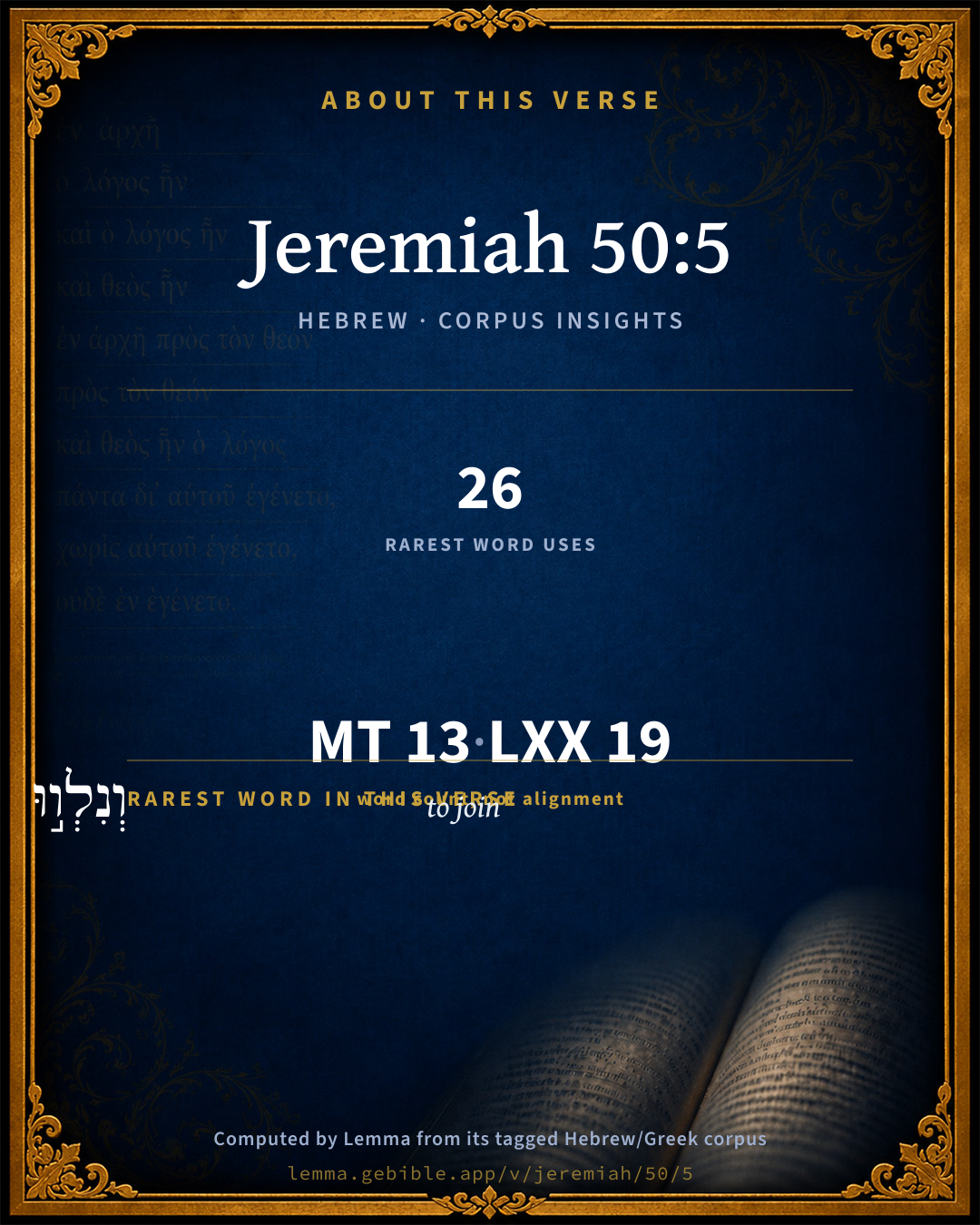
13
words
13
distinct lemmas
Prophets
section

Shared distinctive vocabulary

וְנִלְו֣וּ to join H3867 occurs in 22 verses of the Hebrew Bible. Also found in:

Grammatical profile

  • 4 verbs
  • 6 nouns
  • 1 preposition
  • 1 adverb
  • 1 particle

Verb forms

  • יִשְׁאָ֔לוּ Qal · Imperfect
  • בֹּ֚אוּ Qal · Imperative
  • וְנִלְו֣וּ Niphal · Sequential Perfect
  • תִשָּׁכֵֽחַ Niphal · Imperfect

Hebrew & Septuagint length

In the original languages it is 13 Hebrew tokens and 19 Greek tokens — but the two are counted differently (Hebrew bundles its prefixes and suffixes into one token; the Greek is in lemma form), so that isn’t a like-for-like length.

Cross-references

18

Topical passages linked to Jeremiah 50:5 in the Treasury of Scripture Knowledge — connected by theme and wording, ordered by reader-vote popularity; previews shown in the World English Bible.

  • Jeremiah 32:40 and I will make an everlasting covenant with them, that I will not turn away from following them, to do them good; and I will put my fear in their hearts, that they may not depart from me.
  • Isaiah 35:8 A highway shall be there, and a way, and it shall be called The way of holiness. The unclean shall not pass over it, but is shall be for for him who walks in the Way. Wicked fools will not go there.
  • Jeremiah 6:16 Thus says Yahweh, Stand you in the ways and see, and ask for the old paths, where is the good way; and walk therein, and you shall find rest for your souls: but they said, We will not walk [therein].
  • Hebrews 8:6–10 But now he has obtained a more excellent ministry, by so much as he is also the mediator of a better covenant, which has been enacted on better promises.
  • Psalms 84:7 They go from strength to strength. Everyone of them appears before God in Zion.
  • Isaiah 2:3–5 Many peoples shall go and say, "Come, let's go up to the mountain of Yahweh, To the house of the God of Jacob; And he will teach us of his ways, And we will walk in his paths. For out of Zion the law shall go forth, And the word of Yahweh from Jerusalem.
  • Isaiah 55:3 Turn your ear, and come to me; hear, and your soul shall live: and I will make an everlasting covenant with you, even the sure mercies of David.
  • Isaiah 56:6–7 Also the foreigners who join themselves to Yahweh, to minister to him, and to love the name of Yahweh, to be his servants, everyone who keeps the Sabbath from profaning it, and holds fast my covenant;
  • Micah 4:1–2 But in the latter days, It will happen that the mountain of Yahweh's temple will be established on the top of the mountains, And it will be exalted above the hills; And peoples will stream to it.
  • Genesis 17:7 I will establish my covenant between me and you and your seed after you throughout their generations for an everlasting covenant, to be a God to you and to your seed after you.
  • 2 Samuel 23:5 Most assuredly my house is not so with God; Yet he has made with me an everlasting covenant, Ordered in all things, and sure: For it is all my salvation, and all [my] desire, Although he doesn't make it grow.
  • 1 Kings 19:10 He said, I have been very jealous for Yahweh, the God of hosts; for the children of Israel have forsaken your covenant, thrown down your altars, and slain your prophets with the sword: and I, even I only, am left; and they seek my life, to take it away.
  • 1 Kings 19:14 He said, I have been very jealous for Yahweh, the God of hosts; for the children of Israel have forsaken your covenant, thrown down your altars, and slain your prophets with the sword; and I, even I only, am left; and they seek my life, to take it away.
  • Psalms 25:8–9 Good and upright is Yahweh, Therefore he will instruct sinners in the way.
  • Jeremiah 31:31–36 Behold, the days come, says Yahweh, that I will make a new covenant with the house of Israel, and with the house of Judah:
  • John 7:17 If anyone desires to do his will, he will know about the teaching, whether it is from God, or if I am speaking from myself.
  • Acts 11:23 who, when he had come, and had seen the grace of God, was glad. He exhorted them all, that with purpose of heart they should remain near to the Lord.
  • 2 Corinthians 8:5 This was not as we had hoped, but first they gave their own selves to the Lord, and to us through the will of God.

Cross-references courtesy of OpenBible.info (CC BY 4.0).

Hebrew and Greek witnesses Masoretic Hebrew ↔ Greek Septuagint

The same verse in the two great witnesses to the Old Testament, shown verse-for-verse.

These are two independent witnesses, not word-aligned to each other, and the Septuagint is shown in lemma (dictionary) form.

Hebrew Jeremiah 50:5 Masoretic · Westminster Leningrad Codex

צִיּ֣וֹן יִשְׁאָ֔לוּ דֶּ֖רֶךְ הֵ֣נָּה פְנֵיהֶ֑ם בֹּ֚אוּ וְנִלְו֣וּ אֶל יְהוָ֔ה בְּרִ֥ית עוֹלָ֖ם לֹ֥א תִשָּׁכֵֽחַ

They shall inquire concerning Zion with their faces turned toward it, [saying], Come you, and join yourselves to Yahweh in an everlasting covenant that shall not be forgotten.

World English Bible · Public Domain

Greek LXX Structure differs

In the Septuagint, Jeremiah is about an eighth shorter than the Hebrew and arranges its material differently — the Oracles Against the Nations (Hebrew chapters 46–51) appear in the middle of the Greek book, after 25:13. Because the chapter and verse boundaries do not line up, a verse-for-verse comparison with the Hebrew is not shown.

A verse-for-verse comparison isn’t shown here because the chapters and verses don’t line up. Switch to the LXX edition with the MT / LXX toggle above to read the Greek directly.

Hebrew: Westminster Leningrad Codex (CC BY 4.0). Greek: Septuagint (public domain); English from a public-domain English Septuagint. How the Septuagint differs from the Hebrew →

Targum (Aramaic paraphrase)

1

The Targum is the ancient Jewish Aramaic paraphrase of the Hebrew Scriptures — an interpretive translation, not the Hebrew text itself. Onkelos (literal) and Pseudo-Jonathan (expansive) render the Torah, and Jonathan the Prophets. Coverage is partial: where no permissively-licensed English translation exists for a verse, only the Aramaic is shown. This is verse-level text, not a word-by-word alignment to the Hebrew.

  1. Targum Jonathan Prophets (Joshua–Malachi)
    לְצִיוֹן יִשְׁאָלוּן לְמֵיזַל אוֹרְחָא מְכַבְּשָׁא קֳדָמֵיהוֹן יֵיתוּן וִיתּוֹסְפוּן עַל עַמֵיהּ דַייָ וְיַגְזַר לְהוֹן קַיָם עֲלָם דְלָא יִפְסוֹק:

    (no public-domain English translation for this verse)

    Targum Jonathan — Aramaic: “Mikraot Gedolot” (public domain). English: “Sefaria Community Translation” (CC0 1.0 (public-domain dedication)); “London "Chaldee Paraphrase," 1871” (public domain). Text via Sefaria.

Commentary

Notes on Jeremiah 50:5 from classic Christian and Jewish commentators (each source and its license shown beneath its notes). The classic Christian expositions comment on the surrounding passage and are grouped to its opening verse, so a note may address several verses; the Jewish commentaries on the Tanakh (Rashi and others) are per-verse, so they appear only where the commentator wrote on this verse.

Lemma curates 59 commentaries, every one of them public domain or Creative Commons licensed, each selected and text-cleaned for this edition rather than reprinted as found. About our sources →

Trapp's Complete Commentary

John Trapp

Jer 50:5 They shall ask the way to Zion with their faces thitherward, [saying], Come, and let us join ourselves to the LORD in a perpetual covenant [that] shall not be forgotten.

Ver. 5. They shall ask the way to Zion with their faces thitherward,] {a} As intent upon it, and minding nothing else in comparison. It is good for a man to have his face set towards heaven, and to make religion his business, looking at other things by the by, and out at the eye’s end, as it were.

Come and let us join ourselves to the Lord.] Be so joined to the Lord, so glued unto him, as to be one spirit with him in a conjugal perpetual covenant. {b}

{a} Accurate sciscitabuntur.

{b} Indivulse adhaerebunt Domino.

John Trapp, A Commentary or Exposition upon All the Books of the Old and New Testament (1647–1656) — public domain. Text from a community e-Sword module.

Tyndale Open Study Notes

Tyndale Open Resources

50:5 an eternal covenant: See 31:23-34.

Tyndale Open Study Notes — © Tyndale Open Resources, licensed CC BY-SA 4.0. Text via the HelloAO Bible API.

Jamieson, Fausset & Brown

Robert Jamieson, A. R. Fausset & David Brown

thitherward--rather, "hitherward," Jeremiah's prophetical standpoint being at Zion. "Faces hitherward" implies their steadfastness of purpose not to be turned aside by any difficulties on the way.

perpetual covenant--in contrast to the old covenant "which they brake" (Jer 31:31, &c.; Jer 32:40). They shall return to their God first, then to their own land.

Jamieson, Fausset & Brown — Commentary Critical and Explanatory on the Whole Bible (1871) — public domain (CC PDM 1.0). Text via the HelloAO Bible API.

Adam Clarke's Commentary

Verse 5. Let us join ourselves to the Lord in a perpetual covenant] All our former covenants have been broken; let us now make one that shall last for ever. He shall be the LORD OUR GOD, and WE will no more worship idols. This covenant they have kept to the present day; whatever their present moral and spiritual state may be, they are no idolaters, in the gross sense of the term.

The description that is here given of the state of this people, their feelings and their conduct, finely exhibit the state of real penitents, who are fervently seeking the salvation of their souls.

1. In those days, when Jesus Christ is manifested in the flesh; and in that time, when through him is preached the remission of sins, and the people who hear are pricked in their conscience.

2. The children of Israel and the children of Judah together. - No distinctions being then felt or attended to; for all feel themselves sinners, who have come short of the glory of God. Even national distinctions and religious differences, which bind men fastest, and hold them longest, are absorbed in the deep and overpowering concern they feel for their eternal interests.

3. Going and weeping shall they go. - Religious sorrow does not preclude activity and diligence. While they are weeping for their sins, they are going on in the path of duty, seeking the Lord while he may be found, and calling upon him while he is near.

4. They shall ask the way to Zion. - Real penitents are the most inquisitive of all mortals; but their inquiries are limited to one object, they ask the way to Zion. What shall we do to be saved? How shall we shun the perdition of ungodly men, c.

5. With their faces thitherward. - They have turned FROM sin, and turned TO God. They have left the paths of the destroyer, and their hearts are towards God, and the remembrance of his name. Thus they are profiting by that light which has convinced them of sin, righteousness, and judgment.

6. Come, and let us join ourselves to the Lord. - Religion is a social principle, and begets a social feeling in the soul. No man who feels his own sore, and the plague of his heart, wishes to venture alone in the way to heaven. He feels he wants counsel, support, comfort, and the company of those who will watch over him in love. Like David, the true penitent is a companion of all those who fear the Lord. These heavenly feelings come from one and the same Spirit, and lead to the same end hence they say, -

7. Let us join ourselves to the Lord in a perpetual covenant. It is said, that to be undecided, is to be decided. They who are not determined to go to heaven, will never reach it. If the heart be not laid under obligation, it will do nothing. "I hope I am in earnest; I trust I shall be in earnest about the salvation of my soul, it is very proper I should be so;" and such like, show an irresolute soul. Such persons are ever learning, and never able to come to the knowledge of the truth.

Let us therefore bind ourselves. We have trifled too long; been indecisive too long; have halted too long between two opinions. We know now that Jehovah is God; let us, therefore, enter into a covenant with him. Let this covenant be a perpetual one: let us not make it for a day, for any particular time, but for ever; and let it never be broken. Let our part be kept inviolable: we ARE and WILL BE thy people; and God's part will never fail, I AM and WILL BE your God.

The covenant requires a sacrifice. - Hence ברית berith signifies both. Christ crucified is the great covenant sacrifice. By him God becomes united to us, and through him we become united to God.

Adam Clarke's Commentary on the Bible (1810–1826) — public domain. Text from a community e-Sword/MySword module.

John Calvin's Commentaries

He explains himself more at large, that they would ask those they met the way, that their faces would be towards Sion, that they would also exhort one another to seek God and join themselves to him by a perpetual covenant. The Prophet includes here all the tribes, and says that the Jews and the Israelites would not only return into their own country, to partake of the produce of that rich and fruitful land, but that they would also render to God the worship due to him, and then that nothing would be so vexatious to them but that they would be able to overcome all difficulties and all obstacles.

He says first, that they would ask the way — a proof of perseverance; that they would ask the way to Sion, that is, ask how they were to proceed that they might come to Sion. By these words, the Prophet, as I have just said, denotes their constancy and indefatigable resolution, as though he had said, that though they journeyed through unknown lands, yea, through many devious places, they would yet be in no way disheartened so as not to inquire of those they met with until they came to Sion. This is one thing. Then he adds to the same purpose, Thither their faces We indeed know, that plans are often changed when adverse events impede us; for he who undertakes an expedition, when he sees his course very difficult, turns back again. But the Prophet declares here that there would be no change of mind that would cause the Jews to relinquish their purpose of returning, because their faces would be towards Sion, that is, they would turn their eyes thither, so that nothing would be able to turn them elsewhere. There is added, in the third place, an exhortation, Come ye; and they shall join themselves to Jehovah their God, by a perpetual covenant Here the Prophet first shews, that the Jews would be so encouraged as to add stimulants to one another; and hence it is said, Come ye; and, secondly, he adds, they shall cleave (there is here a change of person) to Jehovah by a perpetual covenant which shall not by oblivion be obliterated

He again repeats what he had said, that the exiles would not return to their own country, that they might there only indulge themselves, but he mentions another end, even that they might join themselves to God. He means, in short, that God would do for them something better and more excellent than to allure them by earthly pleasures.

But we must notice the words, they shall cleave (so it is literally) to Jehovah by a perpetual covenant; for there is an implied contrast between the covenant they had made void and the new covenant which God would make with them, of which Jeremiah spoke in Jeremiah 31. God’s covenant was, indeed, ever inviolable; for God did not promise to be the God of Abraham for a certain term of years; but the adoption, as Paul testifies, remains fixed, and can never be changed. (Romans 11:29.) Then on God’s part it is eternal. But as the Jews had become covenant-breakers, that covenant is called, on this account, weak and evanescent: and for this reason the Prophet said,

“In the last days I will make a covenant with you, not such as I made with your fathers, for they have broken, he said, that covenant.” (Jeremiah 31:31, 32)

Jeremiah now repeats the same thing, though more briefly, that the Jews would return to favor with God, not only for a moment, but that his covenant might continue and remain valid; and the way by which this would be done is expressed in Jeremiah 21, even because God would inscribe his law on their inward parts, and engrave it on their hearts. For it is not in man’s power to continue so constant as that God’s covenant should never fail; but what the Prophet omits here must be supplied from the former passage, that when the Jews returned, God’s covenant would again become so valid and fixed, that it would never fail, even because their hearts would be renewed, so that they would be faithful to God, and never become apostates any more like their fathers.

He then adds, This covenant shall not be forgotten. We hence conclude, that the perpetuity of which he speaks, was founded rather on the mere benevolence of God than on the virtue of the people. He calls then the covenant which God would never forget, perpetual, because he would remember his mercy towards the chosen people; and though they were unworthy to receive such a favor, yet he would continue perpetually his mercy towards them to the coming of Christ; for the passage clearly shows that this prophecy cannot be otherwise explained than of Christ’s spiritual kingdom. The Jews indeed returned to their own country, but it was only a small number; and besides, they were harassed by many troubles; God also visited their land with sterility, and they were lessened by various slaughters in wars: how then came the prophets thus to extol in such high terms the favor of God, which yet did not appear among the people? even because they included the kingdom of Christ; for whenever they spoke of the return of the people, they ascended, as we have said, to the chief deliverance. I do not yet follow our interpreters, who explain these prophecies concerning the spiritual kingdom of Christ allegorically; for simply, or as they say, literally, ought these words to be taken, — that God would never forget his covenant, so as to retain the Jews in the possession of the land. But this would have been a very small thing, had not Christ come forth, in whom is founded the real perpetuity of the covenant, because God’s covenant cannot be separated from a state of happiness; for blessed are the people, as the Psalmist says, to whom God shows himself to be their God. (Psalm 144:15.) Now, then, as the Jews were so miserable, it follows that God’s covenant did not openly appear or was not conspicuous; we must therefore come necessarily to Christ, as we have elsewhere seen, that this was commonly done by the Prophets. The Prophet now enters on a new argument, —

John Calvin's Commentaries (1540-1563) — public domain. Text from the Calvin Translation Society English edition (1840s-50s) via the Christian Classics Ethereal Library (ccel.org). Calvin's coverage is partial (roughly two-thirds of the Bible); uncommented books and verses are honest gaps, never fabricated. The 19th-century editor's footnotes and remarks are omitted so the notes are faithfully Calvin's own voice.

Ellicott's Commentary for English Readers

(5) They shall ask the way to Zion with their faces thitherward.—Literally, hitherward. The correction is not without significance, as showing that the prophecy was written in Judah, and therefore as far as that fact goes, as being in favour of Jeremiah’s authorship.

A perpetual covenant.—The prophet may have had the promise of the new covenant of Jer_31:31 in his thoughts, as being about to receive at least a partial fulfilment. In Ezr_8:21-23; Ezr_10:3 we find what we may look on as an effort of the people to enter into such a covenant.

A Bible Commentary for English Readers, edited by Charles John Ellicott (1878–1897) — public domain. Text from a community e-Sword module.

The Cambridge Bible for Schools and Colleges

gen. ed. J. J. S. Perowne

5. thitherward] Heb. hitherward, shewing that the writer was himself in Palestine.

The Cambridge Bible for Schools and Colleges (gen. ed. J. J. S. Perowne; Cambridge University Press, 1878–1918) — public domain. Text from a community e-Sword module.

John Gill's Exposition

They shall ask the way to Zion with their faces thitherward,.... Either to Jerusalem, near to which Mount Zion was; or to the land of Israel, so called, from a principal part of it: and this also is not to be understood of their return thither, upon the taking of Babylon by Cyrus, and the liberty he gave them; for they had no need to inquire their way thither, nor do we find any where that they did; for though there might be many among them born in the captivity, who knew not the way; yet there were others that did, and could direct and go before them, even such who had seen the former temple, Ezr 3:12; but this suits better with the Jews in the latter day, upon the fall of mystical Babylon, when they shall be converted and return to their own land, and shall ask their way thither; being under a strong impulse of mind, and being bent upon it, and having full resolution to go thither: or else by Zion may be meant the church of God in Gospel times, as it often is; the way into which the converted Jews will ask, being deter mined to give up themselves to it, and become members of it; which way is not a religious education, mere morality, or a bare attendance on worship; but faith in Christ, and a profession of it, and submission to the ordinance of baptism;

saying, come, and let us join ourselves unto the Lord in a perpetual covenant that shall not be forgotten; and then may they be said to "join themselves to the Lord", when, under a divine influence, they shall give up themselves to Christ, to be saved by him; when they shall lay hold on him, embrace him, and believe in him; when they shall follow him in his own ways, and cleave unto him with full purpose of heart; and also when they shall join themselves to his people, to the churches of Christ, and abide by his truths and ordinances; to all which they shall stir up and encourage one another; either laying hold on the covenant of grace, which is an everlasting one, and will never be forgotten by the Lord; he is ever mindful of it, and keeps it; which is done when men join themselves to the Lord, Isa 56:6; or making an agreement or covenant with one another, and the churches to which they join themselves, to walk together in all the ways, ordinances, and commandments of the Lord; which agreement or covenant ought to be perpetually observed, and never forgotten. Kimchi owns that this part of the verse belongs to the days of the Messiah. The Targum is,

"they shall come and be added unto the people of the Lord, and he shall make with them an everlasting covenant, which shall not cease.''

John Gill's Exposition of the Whole Bible (1746–1763) — public domain (CC PDM 1.0). Text via the HelloAO Bible API.

Albert Barnes' Notes on the Bible

Thitherward - Hereward; the writer evidently was at Jerusalem.

Albert Barnes' Notes on the Bible (1834–1885) — public domain. Text from a community e-Sword/MySword module.

Haydock's Catholic Bible Commentary

Covenant. They renewed the old one under Nehemias, and never publicly broke it, as they had done. Yet the covenant of Christ is more properly meant.

George Leo Haydock (1774–1849), Haydock's Catholic Family Bible and Commentary, 1859 edition — public domain. Excludes Psalms (Douay-Rheims chapter numbering differs from Protestant) and Deuterocanonical books (Catholic canon only).

Matthew Poole's English Annotations

That is, those of Judah and Israel that fear the Lord shall seriously and steadily seek the true God, and the true way of his worship; and, being sensible that they had broken the covenant which their fathers had formerly made with God, with a desire to renew their covenant, and that not for a time, but for ever. See Jer 31:31. The only question is, whether this promise be yet accomplished or no, or when it was or shall be fulfilled?,

Answ. It was without doubt in a great measure fulfilled upon the Jews coming out of the captivity of Babylon, when those of the kingdom of Judah returned to Jerusalem, and were very zealous for restoring the true worship of God, and renewed their covenant with God (as we read in the books of Ezra and Nehemiah); but Mr. Calvin thinks it was more eminently fulfilled under the kingdom of the Messiah, when, though many believed not, yet many others did believe, and were added to the church, and whether a further fulfilling of it be not yet to come time must show.

Matthew Poole's English Annotations on the Holy Bible (1683–1685) — public domain. Text from a community e-Sword/MySword module.

Whedon's Commentary on the Bible

Daniel D. Whedon

5. Thitherward — Rather, hither-ward, showing the standpoint.

Perpetual covenant that shall not be forgotten — A repetition which suggests the contrast between this new covenant and the old one which they had broken.

Daniel D. Whedon (gen. ed.), Commentary on the Old and New Testaments (1874–1909) — public domain. Text from a community e-Sword module.

The Pulpit Commentary

Thitherward; rather, hitherward: The prophet is evidently writing from Jerusalem. (comp. Jer_51:50) Let us join ourselves. A conjectural emendation (nilveh for nilvu, a difficult reading, meaning, perhaps, "join yourselves"). A perpetual covenant. The same phrase occurs in Jer_32:40. The addition, "that shall not be forgotten," reminds us of "the ark of the covenant," which was "not to be remembered". (Jer_3:16)

The Pulpit Commentary (1880–1919), ed. H.D.M. Spence-Jones & Joseph S. Exell — public domain. Text from a community e-Sword module.

Rashi

Rabbi Shlomo Yitzchaki (Rashi)

are directed hitherward Toward this place, Jerusalem, they shall direct their faces when Babylon will be destroyed and they will leave it with the sanction of Cyrus, king of Persia.

Rashi on the Tanakh — English translations: “The Judaica Press complete Tanach with Rashi, translated by A. J. Rosenberg” (CC BY 4.0); “Pentateuch with Rashi's commentary by M. Rosenbaum and A.M. Silbermann, 1929-1934” (public domain); “The Metsudah Tanach series, Lakewood, N.J” (CC BY 4.0); and “The Book of Joshua, Metsudah Publications, 1997” (CC BY 4.0). Text via Sefaria.

Lesson kit

Teaching starters — assembled from the data on this page, not authored interpretation. Every prompt links to the verse data it draws on. Edit before teaching.

Jeremiah, in the Prophets, opens this verse with 13 words (13 distinct Hebrew lemmas). Its most distinctive word is lâvâh (“to join”). A historical commentator’s framing appears above. Read the whole chapter for the surrounding context.

Discussion questions

  1. What does “to join” (lâvâh) contribute to the verse as a whole?
  2. How does Genesis 29:34, which shares the word «to join», read alongside this verse?
  3. The translations on this page render this verse differently — a whole-verse word diff, not a word-by-word alignment. What might account for the different wordings?
  4. «יִשְׁאָ֔לוּ» is a Qal Imperfect verb. How does that grammatical form shape the action described?
  5. Compare how Trapp's Complete Commentary and Tyndale Open Study Notes read this verse. Where do they agree or differ?

Things to notice

Reading settings

Reading text

Shown beneath each verse's original-language words.

Old Testament
Old Testament edition

Read the OT as the Masoretic Hebrew (MT) or the Greek Septuagint (LXX).

English shown for the Greek Septuagint (in the Hebrew ↔ Greek comparison).

Comparing translations? Open the Compare panel on any verse page to stack up to four side by side.