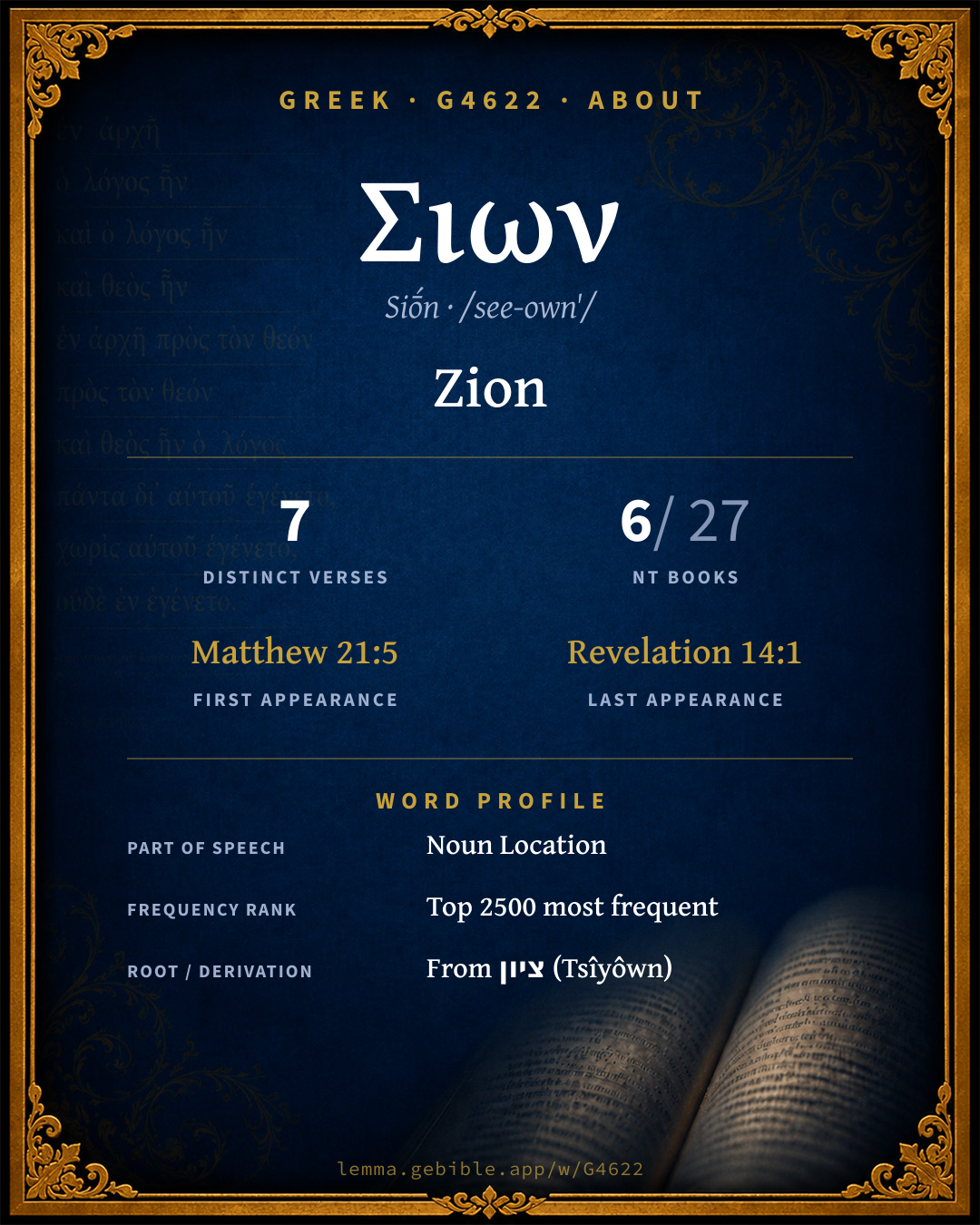
Σιών
Zion
Thayer's lists 4 entries for ‘Zion’ fuller range ↓
Full lexicon entry — Thayer's Greek Lexicon
From Thayer's Greek Lexicon
Where this word appears
Every verse where G4622 appears — 7 distinct verses across 6 books. Click any verse to open its interlinear word-by-word view. Verse text shown in the World English Bible for context — . Each verse’s Greek form is shown with its reference; the English is not keyword-highlighted, since the data carries no word-level English alignment. Use “Compare translations” on any verse to read it across multiple English versions. This concordance covers the Greek New Testament; Septuagint (Greek Old Testament) occurrences of this word are not indexed here.
Matthew 1 verse
John 1 verse
Romans 2 verses
- Romans 9:33 Σιὼν n proper indecl even as it is written, "Behold, I lay in Zion a stumbling stone and a rock of offense; And no one who believes in him will be disappointed."
- Romans 11:26 Σιὼν n proper indecl and so all Israel will be saved. Even as it is written, "There will come out of Zion the Deliverer, And he will turn away ungodliness from Jacob.
Hebrews 1 verse
1 Peter 1 verse
Revelation 1 verse
About this entry
At a glance — auto-summarized from this page’s data, not written by a person. Every figure links to its source below. This summary describes the numbers; it doesn’t interpret them.
At its core, Σιων (Siṓn) means “Zion.” First canonically at Matthew 21:5, it enters the text early. It appears 7 verses across 6 books of the Greek New Testament, among its uncommon vocabulary. The word gravitates to Romans (29%), then Matthew and John. Dig into 7-verse concordance and the renderings breakdown below.
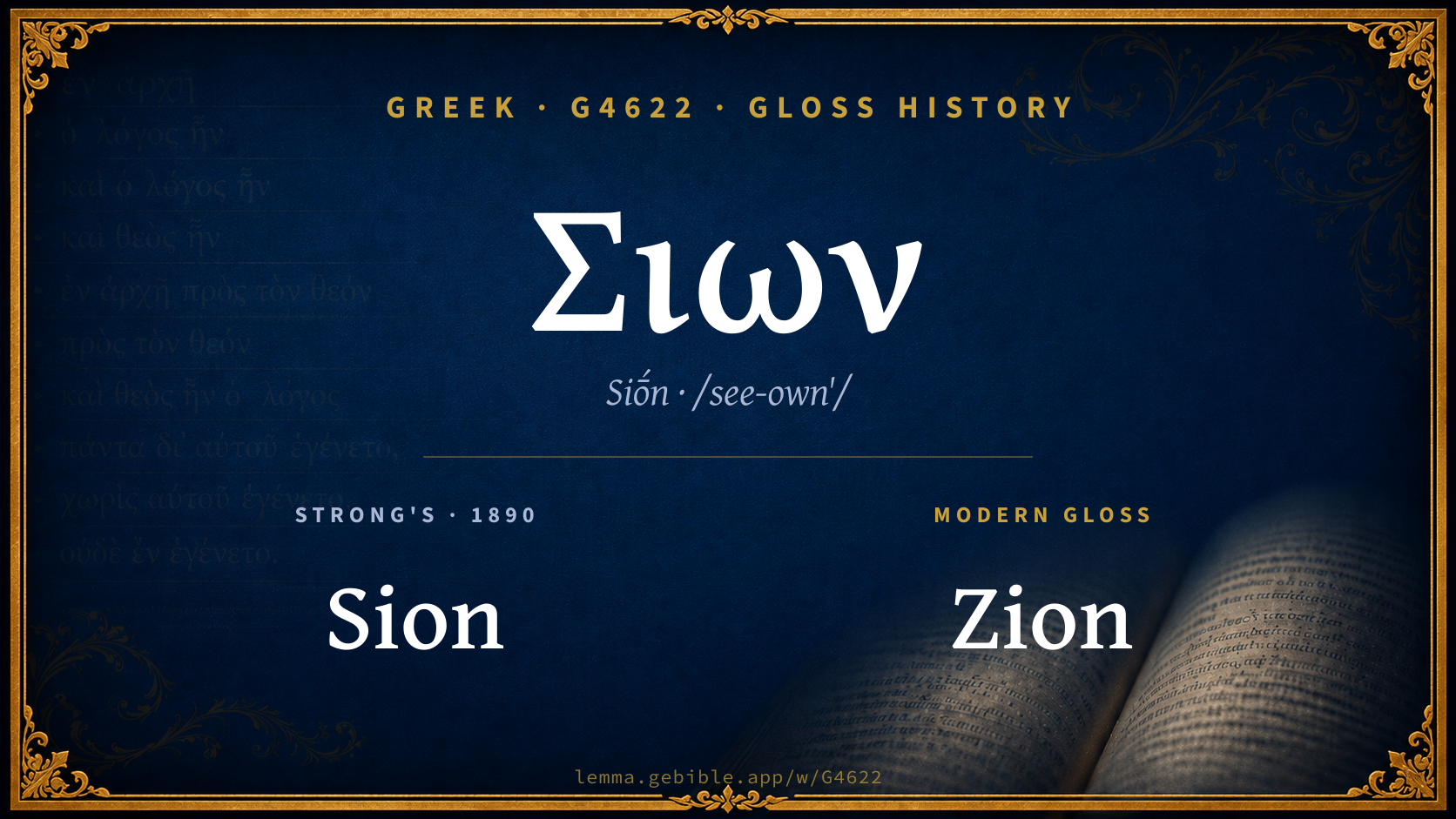
Gloss history
Strong's 1890 vs modern scholarship
About this word
Strong's G4622 catalogs a Greek word from the Greek New Testament.
These counts are not copied from any lexicon or concordance. They are computed here, from the morphology-tagged Greek New Testament. What Lemma adds →
- 7
- distinct verses
- The word appears in 7 distinct verses.
- 6 / 27
- NT books
- The word appears in 6 of 27 New Testament books.
- #1,358
- by frequency
- Top 2500 most frequent Greek words (rank 1,358 of 5,347 Greek words by occurrence).
View all 7 occurrences in the concordance →
By section of the New Testament
By traditional corpus
Conventional, traditional groupings — biblical authorship is debated, so this is a traditional corpus grouping, not an authorship claim. Some books belong to more than one corpus (Luke is in both the Gospels and the Lukan corpus, and so on), so these shares overlap and need not total 100%. Each figure is a share of the word’s 7 distinct verses.
- Gospels 2 verses · 29%
- Johannine 2 verses · 29%
- Pauline corpus 2 verses · 29%
- Hebrews 1 verse · 14%
- General (Catholic) Epistles 1 verse · 14%
- Revelation 1 verse · 14%
How translations render this word
Counts come from each version’s own published word-to-Strong’s tagging or interlinear alignment — an approximate guide to how each version renders this word, not a word-level alignment the data otherwise carries. Because each total is that version’s own tagged count, the per-version totals vary from one another and need not match the appearance or distinct-verse counts above. These counts may also differ from a printed concordance because Lemma counts each distinctly tagged rendering and does not collapse phrase taggings into a single head-word total. This is a fixed set of word-tagged versions (KJV, ASV, BSB, ULT) and does not change with the reading translation you choose elsewhere. Each version’s license is shown beside its name below (and on Sources).
- King James Version: Sion 7×
- American Standard Version: Zion 7×
- Berean Standard Bible: Zion 7×
- unfoldingWord Literal Text: Zion 7×
King James Version Public Domain
Renders G4622 across 7 tagged occurrences — most commonly:
American Standard Version Public Domain
Renders G4622 across 7 tagged occurrences — most commonly:
Berean Standard Bible Public Domain
Renders G4622 across 7 tagged occurrences — most commonly:
unfoldingWord Literal Text CC BY-SA 4.0
Renders G4622 across 7 tagged occurrences — most commonly:
Senses in Thayer's
The 4 senses Thayer's distinguishes for this word, in lexicon order (not ranked by frequency or importance). The full entry — with sub-senses — is in the Lexicon Entry tab.
- Sion or Zion = "a parched place"
- the hill on which the higher and more ancient part of Jerusalem was built
- often used of the entire city of Jerusalem
- since Jerusalem because the temple stood there, was called the dwelling place of God
Word origin
Derived from ציון (Tsîyôwn) (H6726) — Zion.
Of hebrew origin [ H6726 ]; Sion (that is Tsijon ) a hill of Jerusalem; figuratively the Church (militant or triumphant): - Sion.
— Strong’s Exhaustive Concordance (1890), public domain.
Forms in the corpus
The 2 distinct written forms G4622 takes in the Greek New Testament, most frequent first — each parse links to that case’s occurrences in the concordance.
| Form | Parsing | Example | Uses |
|---|---|---|---|
| Σιὼν Siṑn | Noun, Proper, indeclinable | Romans 9:33 | 4 |
| Σιών Siṓn | Noun, Proper, indeclinable | Matthew 21:5 | 3 |
Bible dictionary
Public-domain dictionary articles matched to this entry by name (Zion). A biblical name can be shared by more than one person or place, so an article may treat several.
Easton's Bible Dictionary · M. G. Easton, 1897
Sunny; height, one of the eminences on which Jerusalem was built. It was surrounded on all sides, except the north, by deep valleys, that of the Tyropoeon (q.v.) separating it from Moriah (q.v.), which it surpasses in height by 105 feet. It was the south-eastern hill of Jerusalem.
When David took it from the Jebusites (Josh. 15:63; 2 Sam. 5:7) he built on it a citadel and a palace, and it became "the city of David" (1 Kings 8:1; 2 Kings 19:21, 31; 1 Chr. 11:5). In the later books of the Old Testament this name was sometimes used (Ps. 87:2; 149:2; Isa. 33:14; Joel 2:1) to denote Jerusalem in general, and sometimes God's chosen Israel (Ps. 51:18; 87:5).
In the New Testament (see SION) it is used sometimes to denote the Church of God (Heb. 12:22), and sometimes the heavenly city (Rev. 14:1).
Smith's Bible Dictionary · William Smith, 1863
[Jerusalem]
Hitchcock's Bible Names Dictionary · Roswell D. Hitchcock, 1869
monument; raised up; sepulcher
Classic public-domain reference works; full attribution on Sources.
Septuagint usage
The same Greek word Σιων appears 166 times in the Greek Old Testament (Septuagint), across 164 verses in 17 books.
- 166
- LXX occurrences
- Tagged occurrences of this Greek word in the Septuagint.
- 164
- verses
- Distinct Septuagint verses containing this word.
- 17 / 39
- OT books
- The word appears in 17 of the 39 Old Testament books.
Sample Septuagint occurrences
- Joshua 19:26 σιων
- 2 Samuel 5:7 σιων
- 1 Kings 3:15 σιων
- 2 Kings 19:21 σιων
- 1 Chronicles 11:5 σιων
- 2 Chronicles 5:2 σιων
- Psalms 2:6 σιων
- Isaiah 1:8 σιων
- Jeremiah 3:14 σιων
- Lamentations 1:4 σιων
- Daniel 9:19 σιων
- Joel 2:1 σιων
Septuagint occurrences (same lexeme)
Every verse where the same Strong’s number (G4622) appears in the Greek Septuagint — showing the first 50 of 164. Verse text shown in the World English Bible for context; the Greek form is the matched word — the English is not keyword-highlighted.
- Joshua 19:26 σιων and Allammelech, and Amad, and Mishal; and it reached to Carmel westward, and to Shihorlibnath;
- 2 Samuel 5:7 σιων Nevertheless David took the stronghold of Zion; the same is the city of David.
- 1 Kings 3:15 σιων Solomon awoke; and, behold, it was a dream: and he came to Jerusalem, and stood before the ark of the covenant of Yahweh, and offered up burnt offerings, and offered peace-offerings, and made a feast to all his servants.
- 1 Kings 8:1 σιων Then Solomon assembled the elders of Israel, and all the heads of the tribes, the princes of the fathers' [houses] of the children of Israel, to king Solomon in Jerusalem, to bring up the ark of the covenant of Yahweh out of the city of David, which is Zion.
- 2 Kings 19:21 σιων This is the word that Yahweh has spoken concerning him: The virgin daughter of Zion has despised you and ridiculed you; the daughter of Jerusalem has shaken her head at you.
- 2 Kings 19:31 σιων For out of Jerusalem shall go forth a remnant, and out of Mount Zion those who shall escape: the zeal of Yahweh shall perform this.
- 1 Chronicles 11:5 σιων The inhabitants of Jebus said to David, You shall not come in here. Nevertheless David took the stronghold of Zion; the same is the city of David.
- 2 Chronicles 5:2 σιων Then Solomon assembled the elders of Israel, and all the heads of the tribes, the princes of the fathers' [houses] of the children of Israel, to Jerusalem, to bring up the ark of the covenant of Yahweh out of the city of David, which is Zion.
- Psalms 2:6 σιων "Yet I have set my king on my holy hill of Zion."
- Psalms 9:12 σιων For he who avenges blood remembers them. He doesn't forget the cry of the afflicted.
- Psalms 9:15 σιων The nations have sunk down in the pit that they made; In the net which they hid, their own foot is taken.
- Psalms 13:7 σιων
- Psalms 19:3 σιων There is no speech nor language, Where their voice is not heard.
- Psalms 47:3 σιων He subdues nations under us, And peoples under our feet.
- Psalms 47:12 σιων
- Psalms 47:13 σιων
- Psalms 49:2 σιων Both low and high, Rich and poor together.
- Psalms 50:20 σιων You sit and speak against your brother. You slander your own mother's son.
- Psalms 52:7 σιων "Behold, this is the man who didn't make God his strength, But trusted in the abundance of his riches, And strengthened himself in his wickedness."
- Psalms 64:2 σιων Hide me from the conspiracy of the wicked, From the noisy crowd of the ones doing evil;
- Psalms 68:36 σιων
- Psalms 72:28 σιων
- Psalms 73:2 σιων But as for me, my feet were almost gone. My steps had nearly slipped.
- Psalms 75:3 σιων The earth and all its inhabitants quake. I firmly hold its pillars. Selah.
- Psalms 77:68 σιων
- Psalms 83:8 σιων Assyria also is joined with them. They have helped the children of Lot. Selah.
- Psalms 86:2 σιων Preserve my soul, for I am godly. You, my God, save your servant who trusts in you.
- Psalms 86:5 σιων For you, Lord, are good, and ready to forgive; Abundant in loving kindness to all those who call on you.
- Psalms 96:8 σιων Ascribe to Yahweh the glory due to his name. Bring an offering, and come into his courts.
- Psalms 98:2 σιων Yahweh has made known his salvation. He has openly shown his righteousness in the sight of the nations.
- Psalms 101:14 σιων
- Psalms 101:17 σιων
- Psalms 101:22 σιων
- Psalms 109:2 σιων For they have opened the mouth of the wicked and the mouth of deceit against me. They have spoken to me with a lying tongue.
- Psalms 124:1 σιων If it had not been Yahweh who was on our side, Let Israel now say,
- Psalms 125:1 σιων Those who trust in Yahweh are as Mount Zion, Which can't be moved, but remains forever.
- Psalms 127:5 σιων Happy is the man who has his quiver full of them. They won't be disappointed when they speak with their enemies in the gate.
- Psalms 128:5 σιων May Yahweh bless you out of Zion, And may you see the good of Jerusalem all the days of your life.
- Psalms 131:13 σιων
- Psalms 132:3 σιων "Surely I will not come into the structure of my house, Nor go up into my bed;
- Psalms 133:3 σιων Like the dew of Hermon, That comes down on the hills of Zion: For there Yahweh gives the blessing, Even life forevermore.
- Psalms 134:21 σιων
- Psalms 136:1 σιων Give thanks to Yahweh, for he is good; For his loving kindness endures forever.
- Psalms 136:3 σιων Give thanks to the Lord of lords; For his loving kindness endures forever:
- Psalms 145:10 σιων All your works will give thanks to you, Yahweh. Your saints will extol you.
- Psalms 147:1 σιων Praise Yah, For it is good to sing praises to our God; For it is pleasant and fitting to praise him.
- Psalms 149:2 σιων Let Israel rejoice in him who made them. Let the children of Zion be joyful in their King.
- Isaiah 1:8 σιων The daughter of Zion is left like a shelter in a vineyard, Like a hut in a field of melons, Like a besieged city.
- Isaiah 1:21 σιων How the faithful city has become a prostitute! She was full of justice; righteousness lodged in her, But now murderers.
- Isaiah 1:26 σιων I will restore your judges as at the first, And your counselors as at the beginning. Afterward you shall be called 'The city of righteousness, A faithful town.'
These are occurrences of the same Greek lexeme (G4622) in the Septuagint — not a translation of any one Hebrew word. The store carries no word-level Hebrew↔Greek alignment, so no Hebrew original is asserted here. Counts come from the recovered LXX Strong's tagging — high-frequency vocabulary is well covered, while rare or late forms may be untagged — so they reflect tagged occurrences and may slightly undercount.