
Jeremiah 3:14

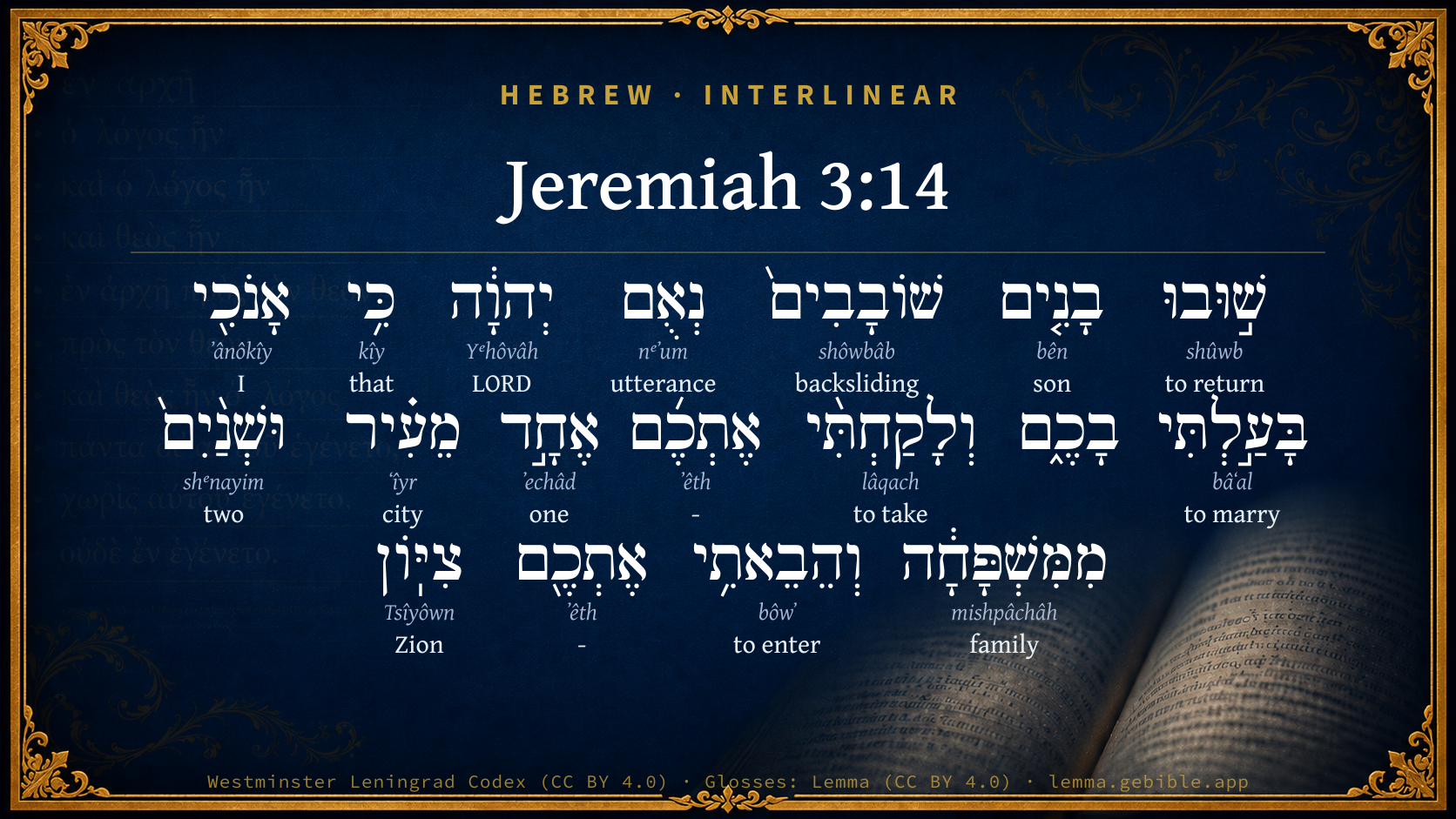
Hebrew (Westminster Leningrad Codex) Jeremiah 3:14 appears in the Hebrew Old Testament. The text above is from the Westminster Leningrad Codex. Each word links to its Strong’s number, a concise gloss, and parsing drawn from the Open Scriptures Hebrew Bible morphology. Click any word for its full Brown-Driver-Briggs (BDB) entry.
Download image
Cite this verse

Jeremiah 3:14 (World English Bible). Public Domain. Lemma interlinear Bible study tool, https://lemma.gebible.app/v/jeremiah/3/14.

Show BibTeX & RIS
BibTeX
RIS
English Translation
Return, backsliding children, says Yahweh; for I am a husband to you: and I will take you one of a city, and two of a family, and I will bring you to Zion:
World English Bible · Public Domain
Download a study sheet

One document with this verse’s original text, its word-by-word gloss line, the meaning frame, cross-references with their text, attributed commentary, and full source and license credits — printable, and it pastes into notes with its structure intact.

This verse Autodidact and up

Study sheet (.html) Plain text (.txt)

A passage Seminary Student

Up to 50 verses in one chapter. A passage sheet keeps up to 6 commentary sources and 12 cross-references per verse, in the order this page ranks them, and says so on the sheet whenever that leaves anything out. Ask for a single verse and you get the Autodidact verse sheet above.

Everything on this page stays free to read, with no account — the sheet is a download of what is already on screen, not access to it.

Want to remove ads? Support Godless Engineer
Compare translations 3

The same verse in 3 English versions, stacked beneath the original-language interlinear above. Click any original word for its lexicon entry.

Each is an independent rendering of the whole verse — the interlinear is not word-aligned to these translations.

Highlighted words mark where these versions differ — a whole-verse word diff, not a word-by-word alignment.

  • World English Bible Public Domain
    Return, backsliding children, says Yahweh; for I am a husband to you: and I will take you one of a city, and two of a family, and I will bring you to Zion:
  • King James Version Public Domain
    Turn, O backsliding children, saith the LORD; for I am married unto you: and I will take you one of a city, and two of a family, and I will bring you to Zion:
  • unfoldingWord Literal Text CC BY-SA 4.0
    Turn back, apostatizing sons!—the declaration of Yahweh—for I myself am your husband, and I shall take you, one from a city and two from a clan, and I shall bring you Zion!

unfoldingWord Literal Text — © unfoldingWord, licensed CC BY-SA 4.0. Word-aligned USFM3 via Door43 (git.door43.org/unfoldingWord/en_ult).

Versions to compare (up to 4)

3 of 4 selected

Show all 18 translations

Every available English version of this verse, each an independent rendering of the whole verse.

  • World English Bible Public Domain
    Return, backsliding children, says Yahweh; for I am a husband to you: and I will take you one of a city, and two of a family, and I will bring you to Zion:
  • Berean Standard Bible Public Domain
    “Return, O faithless children,” declares the LORD, “for I am your master, and I will take you—one from a city and two from a family—and bring you to Zion.
  • Majority Standard Bible Public Domain
    “Return, O faithless children,” declares the LORD, “for I am your master, and I will take you—one from a city and two from a family—and bring you to Zion.
  • King James Version Public Domain
    Turn, O backsliding children, saith the LORD; for I am married unto you: and I will take you one of a city, and two of a family, and I will bring you to Zion:
  • American Standard Version (1901) Public Domain
    Return, O backsliding children, saith Jehovah; for I am a husband unto you: and I will take you one of a city, and two of a family, and I will bring you to Zion:
  • Revised Version (1885) Public Domain
    Return, O backsliding children, saith the LORD; for I am a husband unto you: and I will take you one of a city, and two of a family, and I will bring you to Zion:
  • Geneva Bible (1599) Public Domain
    O yee disobedient children, turne againe, sayeth the Lord, for I am your Lord, and I will take you one of a citie, and two of a tribe and wil bring you to Zion,
  • Douay-Rheims (1899) Public Domain
    Return, O ye revolting children, saith the Lord: for I am your husband: and I will take you, one of a city, and two of a kindred, and will bring you into Sion.
  • Young's Literal Translation Public Domain
    Turn back, O backsliding sons, An affirmation of Jehovah. For I have ruled over you, And taken you one of a city, and two of a family, And have brought you to Zion,
  • Literal Standard Version CC BY-SA 4.0
    “Return, O backsliding sons,” || A declaration of YHWH. “For I have ruled over you, || And taken you—one from a city, and two from a family, || And have brought you to Zion,
  • Unlocked Literal Bible CC BY-SA 4.0
    Return, faithless people!—this is Yawheh's declaration—I am your husband! I will take you, one from a city and two from a family, and I will bring you to Zion!
  • unfoldingWord Literal Text CC BY-SA 4.0
    Turn back, apostatizing sons!—the declaration of Yahweh—for I myself am your husband, and I shall take you, one from a city and two from a clan, and I shall bring you Zion!
  • Darby Bible Public Domain
    Return, backsliding children, saith Jehovah; for I am a husband unto you, and I will take you, one of a city, and two of a family, and I will bring you to Zion.
  • World Messianic Bible Public Domain
    “Return, backsliding children,” says the LORD, “for I am a husband to you. I will take one of you from a city, and two from a family, and I will bring you to Zion.
  • Webster's Bible Public Domain
    Turn, O backsliding children, saith the LORD; for I am married to you: and I will take you one of a city, and two of a family, and I will bring you to Zion:
  • Free Bible Version CC BY-SA 4.0
    Come back, unfaithful children, declares the Lord, because I am married to you. I will take you, one from a town and two from a family, and bring you to Zion.
  • Bible in Basic English Public Domain
    Come back, O children who are turned away, says the Lord; for I am a husband to you, and I will take you, one from a town and two from a family, and will make you come to Zion;
  • JPS Tanakh (1917) Public Domain
    Return, O backsliding children, saith the LORD; for I am a lord unto you, and I will take you one of a city, and two of a family, and I will bring you to Zion;

Literal Standard Version (2020), Covenant Press — licensed CC BY-SA 4.0. Text via the HelloAO Bible API (eBible.org). Unlocked Literal Bible (unfoldingWord) — licensed CC BY-SA 4.0. Text via the HelloAO Bible API (eBible.org). unfoldingWord Literal Text — © unfoldingWord, licensed CC BY-SA 4.0. Word-aligned USFM3 via Door43 (git.door43.org/unfoldingWord/en_ult). Free Bible Version, Dr. Jonathan Gallagher — licensed CC BY-SA 4.0. Text via the HelloAO Bible API (eBible.org).

Word by word

More ways to search: Search by grammar → Find every occurrence → Compare this word →

Practice this passage: Drill this verse → Learn its vocabulary →

שׁוֹבָבִים֙
shôwbâb
H7726
“backsliding”
Adjective, Adjective, Masculine, Plural, Absolute
Part of Speech
Adjective
Type
Adjective
Gender
Masculine
Number
Plural
State
Absolute
Full BDB Definition

Origin: from H7725

TWOT: 2340c

backsliding, backturning, apostate, recusant
  1. שׁ֣וּבוּ shûwb H7725 “return” Verb, Qal, Imperative, 2nd Person, Masculine, Plural
  2. בָנִ֤ים bên H1121 “sons” Noun, Common, Masculine, Plural, Absolute
  3. נְאֻם nᵉʼum H5002 “utterance of” Noun, Common, Masculine, Singular, Construct
  4. יְהוָ֔ה Yᵉhôvâh H3068 “LORD” Noun, Proper
  5. כִּ֥י kîy H3588 “that” Conjunction
  6. אָנֹכִ֖י ʼânôkîy H595 “I” Pronoun, Personal, 1st Person, Common, Singular
  7. בָּעַ֣לְתִּי bâʻal H1166 “to marry” Verb, Qal, Perfect, 1st Person, Common, Singular
  8. וְלָקַחְתִּ֨י lâqach H3947 “and · to take” Conjunction + Verb, Qal, Sequential Perfect, 1st Person, Common, Singular
  9. אֶתְכֶ֜ם ʼêth H853 “- · you” Particle, Direct Object + Suffix, Personal, 2nd Person, Masculine, Plural
  10. אֶחָ֣ד ʼechâd H259 “one” Adjective, Cardinal number, Masculine, Singular, Absolute
  11. מֵעִ֗יר ʻîyr H5892 “from · city” Preposition + Noun, Common, Feminine, Singular, Absolute
  12. וּשְׁנַ֨יִם֙ shᵉnayim H8147 “and · two” Conjunction + Adjective, Cardinal number, Masculine, Dual, Absolute
  13. מִמִּשְׁפָּחָ֔ה mishpâchâh H4940 “from · family” Preposition + Noun, Common, Feminine, Singular, Absolute
  14. וְהֵבֵאתִ֥י bôwʼ H935 “and · to enter” Conjunction + Verb, Hiphil, Sequential Perfect, 1st Person, Common, Singular
  15. אֶתְכֶ֖ם ʼêth H853 “- · you” Particle, Direct Object + Suffix, Personal, 2nd Person, Masculine, Plural
  16. צִיּֽוֹן Tsîyôwn H6726 “Zion” Noun, Proper

About this verse

These counts appear in no published source. They are computed here, from the morphology-tagged text and Lemma’s own curated glosses. What Lemma adds →

18
words
16
distinct lemmas
Prophets
section

Notable vocabulary

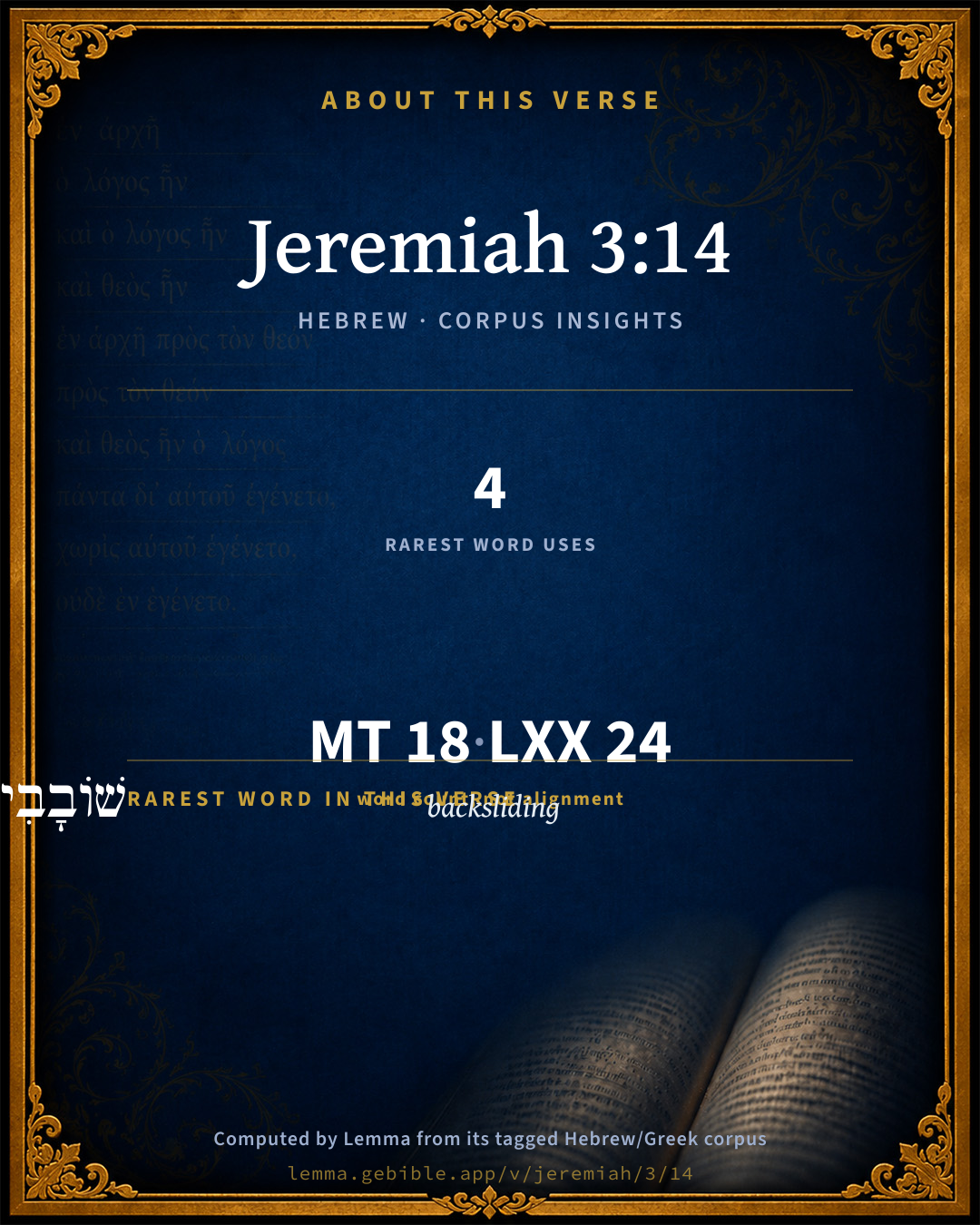
The rarest word here is שׁוֹבָבִים֙ backsliding H7726 — appearing just 4 times in the whole Hebrew Bible.

Shared distinctive vocabulary

שׁוֹבָבִים֙ backsliding H7726 occurs in 4 verses of the Hebrew Bible. Also found in:

Grammatical profile

  • 4 verbs
  • 6 nouns
  • 3 adjectives
  • 1 pronoun
  • 1 preposition
  • 1 conjunction
  • 2 particles

Verb forms

  • שׁ֣וּבוּ Qal · Imperative
  • בָּעַ֣לְתִּי Qal · Perfect
  • וְלָקַחְתִּ֨י Qal · Sequential Perfect
  • וְהֵבֵאתִ֥י Hiphil · Sequential Perfect

Hebrew & Septuagint length

In the original languages it is 18 Hebrew tokens and 24 Greek tokens — but the two are counted differently (Hebrew bundles its prefixes and suffixes into one token; the Greek is in lemma form), so that isn’t a like-for-like length.

Cross-references

19

Topical passages linked to Jeremiah 3:14 in the Treasury of Scripture Knowledge — connected by theme and wording, ordered by reader-vote popularity; previews shown in the World English Bible.

  • Hosea 2:19–20 I will betroth you to me forever. Yes, I will betroth you to me in righteousness, in justice, in loving kindness, and in compassion.
  • Jeremiah 2:19 Your own wickedness shall correct you, and your backsliding shall reprove you: know therefore and see that it is an evil thing and a bitter, that you have forsaken Yahweh your God, and that my fear is not in you, says the Lord, Yahweh of Hosts.
  • Jeremiah 31:32 not according to the covenant that I made with their fathers in the day that I took them by the hand to bring them out of the land of Egypt; which my covenant they broke, although I was a husband to them, says Yahweh.
  • Isaiah 54:5 For your Maker is your husband; Yahweh of Hosts is his name: and the Holy One of Israel is your Redeemer; the God of the whole earth shall he be called.
  • Jeremiah 31:8–10 Behold, I will bring them from the north country, and gather them from the uttermost parts of the earth, [and] with them the blind and the lame, the woman with child and her who travails with child together: a great company shall they return here.
  • Ezekiel 34:11–14 For thus says the Lord Yahweh: Behold, I myself, even I, will search for my sheep, and will seek them out.
  • Zechariah 13:7–9 "Awake, sword, against my shepherd, And against the man who is close to me," says Yahweh of Hosts. Strike the shepherd, and the sheep will be scattered; And I will turn my hand against the little ones.
  • Isaiah 6:13 If there are yet a tenth in it, It also shall in turn be eaten up: As a terebinth, and as an oak, whose stock remains, when they are felled; So the holy seed is its stock."
  • Isaiah 10:22 For though your people, Israel, be as the sand of the sea, [only] a remnant of them shall return: a destruction [is] determined, overflowing with righteousness.
  • Isaiah 11:11–12 It shall happen in that day, that the Lord will set his hand again the second time to recover the remnant of his people, who shall remain, from Assyria, and from Egypt, and from Pathros, and from Cush, and from Elam, and from Shinar, and from Hamath, and from the islands of the sea.
  • Jeremiah 2:2 Go, and cry in the ears of Jerusalem, saying, Thus says Yahweh, I remember for you the kindness of your youth, the love of your weddings; how you went after me in the wilderness, in a land that was not sown.
  • Jeremiah 3:8 I saw, when, for this very cause that backsliding Israel had committed adultery, I had put her away and given her a bill of divorce, yet treacherous Judah, her sister, didn't fear; but she also went and played the prostitute.
  • Jeremiah 23:3 I will gather the remnant of my flock out of all the countries where I have driven them, and will bring them again to their folds; and they shall be fruitful and multiply.
  • Isaiah 1:9 Unless Yahweh of hosts had left to us a very small remnant, We would have been as Sodom; We would have been like Gomorrah.
  • Isaiah 17:6 Yet there shall be left therein gleanings, as the shaking of an olive tree, two or three berries in the top of the uppermost bough, four or five in the outmost branches of a fruitful tree, says Yahweh, the God of Israel.
  • Isaiah 24:13–15 For thus shall it be in the midst of the earth among the peoples, as the shaking of an olive tree, as the gleanings when the vintage is done.
  • Jeremiah 3:1 They say, If a man put away his wife, and she go from him, and become another man's, will he return to her again? Won't that land be greatly polluted? But you have played the prostitute with many lovers; yet return again to me, says Yahweh.
  • Romans 9:27 Isaiah cries concerning Israel, "If the number of the children of Israel are as the sand of the sea, It is the remnant who will be saved;
  • Romans 11:4–6 But how does God answer him? "I have reserved for myself seven thousand men, who have not bowed the knee to Baal."

Cross-references courtesy of OpenBible.info (CC BY 4.0).

Hebrew and Greek witnesses Masoretic Hebrew ↔ Greek Septuagint

The same verse in the two great witnesses to the Old Testament, shown verse-for-verse.

These are two independent witnesses, not word-aligned to each other, and the Septuagint is shown in lemma (dictionary) form.

Hebrew Jeremiah 3:14 Masoretic · Westminster Leningrad Codex

שׁ֣וּבוּ בָנִ֤ים שׁוֹבָבִים֙ נְאֻם יְהוָ֔ה כִּ֥י אָנֹכִ֖י בָּעַ֣לְתִּי בָכֶ֑ם וְלָקַחְתִּ֨י אֶתְכֶ֜ם אֶחָ֣ד מֵעִ֗יר וּשְׁנַ֨יִם֙ מִמִּשְׁפָּחָ֔ה וְהֵבֵאתִ֥י אֶתְכֶ֖ם צִיּֽוֹן

Return, backsliding children, says Yahweh; for I am a husband to you: and I will take you one of a city, and two of a family, and I will bring you to Zion:

World English Bible · Public Domain

Greek LXX Structure differs

In the Septuagint, Jeremiah is about an eighth shorter than the Hebrew and arranges its material differently — the Oracles Against the Nations (Hebrew chapters 46–51) appear in the middle of the Greek book, after 25:13. Because the chapter and verse boundaries do not line up, a verse-for-verse comparison with the Hebrew is not shown.

A verse-for-verse comparison isn’t shown here because the chapters and verses don’t line up. Switch to the LXX edition with the MT / LXX toggle above to read the Greek directly.

On this verse, Jamieson, Fausset & Brown discusses the Septuagint’s reading. Read the note in Commentary ↓

Hebrew: Westminster Leningrad Codex (CC BY 4.0). Greek: Septuagint (public domain); English from a public-domain English Septuagint. How the Septuagint differs from the Hebrew →

Targum (Aramaic paraphrase)

1

The Targum is the ancient Jewish Aramaic paraphrase of the Hebrew Scriptures — an interpretive translation, not the Hebrew text itself. Onkelos (literal) and Pseudo-Jonathan (expansive) render the Torah, and Jonathan the Prophets. Coverage is partial: where no permissively-licensed English translation exists for a verse, only the Aramaic is shown. This is verse-level text, not a word-by-word alignment to the Hebrew.

  1. Targum Jonathan Prophets (Joshua–Malachi)
    תּוּבוּ בָנַיָא דְמִתְחַסְנִין לְמֵיתַב אֲמַר יְיָ אֲנָא אִתְרְעֵיתִי בְּכוֹן וֶאֱקָרֵיב יַתְכוֹן כְּאִלּוּ אַתּוּן מִשְׁתָּאֲרוּן חָד מִקַרְתָּא וּתְרֵין מִזַרְעִיתָא וְאָעֵיל יַתְכוֹן לְצִיּוֹן:

    (no public-domain English translation for this verse)

    Targum Jonathan — Aramaic: “Mikraot Gedolot” (public domain). English: “Sefaria Community Translation” (CC0 1.0 (public-domain dedication)); “London "Chaldee Paraphrase," 1871” (public domain). Text via Sefaria.

Commentary

Notes on Jeremiah 3:14 from classic Christian and Jewish commentators (each source and its license shown beneath its notes). The classic Christian expositions comment on the surrounding passage and are grouped to its opening verse, so a note may address several verses; the Jewish commentaries on the Tanakh (Rashi and others) are per-verse, so they appear only where the commentator wrote on this verse.

Lemma curates 59 commentaries, every one of them public domain or Creative Commons licensed, each selected and text-cleaned for this edition rather than reprinted as found. About our sources →

The Cambridge Bible for Schools and Colleges

gen. ed. J. J. S. Perowne

14. one of … family] Very small places were called “cities,” while “family” must mean a considerable number, a clan, or even a larger group. Cp. Jer_8:3, Jer_25:9.

14–18. Much here is probably a later editorial insertion (see Intr. iv. § 8), for (i) the picture (Jer_3:14) of a very limited number of the captives returning from Assyria, and settling in Jerusalem, while afterwards (Jer_3:16) spreading over the land, is inconsistent with Jer_31:7 ff., (ii) we have no warrant for thinking that Jeremiah (Jer_3:17) expected all nations to gather at Jerusalem to worship, (iii) Jer_3:18 contemplates a return of Judah and Israel together from exile, but the earlier part of the ch. emphasizes the difference of treatment to be accorded to the two. Is the reference to the Ark (Jer_3:16) also late? After Solomon’s time its history is obscure. Was it carried off by Shishak (1Ki_14:26), or removed by Manasseh (as suggested by 2Ch_33:7) to be replaced, according to the Chronicler’s tradition (2Ch_35:3), by Josiah, though there is no confirmation of this in the parallel account in 2 Kings 23. We therefore cannot be sure that it existed in Jeremiah’s time. The post-exilic Temple had no Ark (Josephus, Wars, V. Jer_3:5). But whether the Ark was still in existence or not, this part of Jer_3:16 is probably a genuine fragment, though displaced, for the prophet’s attitude towards the Ark, as symbolical of the old Covenant which was destined to yield to the new one for which he looked (Jer_31:31 ff.), is paralleled by his view as to the Temple (Jer_7:4).

The Cambridge Bible for Schools and Colleges (gen. ed. J. J. S. Perowne; Cambridge University Press, 1878–1918) — public domain. Text from a community e-Sword module.

Trapp's Complete Commentary

John Trapp

Jer 3:14 Turn, O backsliding children, saith the LORD; for I am married unto you: and I will take you one of a city, and two of a family, and I will bring you to Zion:

Ver. 14. Turn, O backsliding children.] See on Zec 1:3.

For I am married unto you.] And, as "I hate putting away," {Mal 2:16} so I can receive to favour a wife that hath been disloyal, {Jer 3:1} and after a divorce.

And I will take you one of a city,] i.e., Though but a few, {Isa 10:11-12; Isa 17:6; Isa 24:3} all the rest hardening their hearts by unbelief. This hath been principally fulfilled in the days of the gospel.

John Trapp, A Commentary or Exposition upon All the Books of the Old and New Testament (1647–1656) — public domain. Text from a community e-Sword module.

Joseph Benson's Commentary

Jer 3:14. Turn, for I am married unto you — I am in covenant with you, and this covenant, notwithstanding all your unfaithfulness, I am ready to renew with you. Hebrew, בעלתי בכם, which Blaney translates, I have been a husband among you; observing, that God hereby “means to remind them that he had fulfilled the covenant on his part, by protecting and blessing them, as he had promised when he engaged to be their God: and therefore, as they had never any reason to complain of him, he urges them to return to their duty, and promises, in that case, to be still kinder to them than before.” I will take you one of a city, &c. — Some interpret these words thus: “I will receive you, though there should be but one from a city willing to return, and two from a province, or tribe.” This prophecy was accomplished in the letter, after the edict of Cyrus, when several of the Israelites returned to Palestine, but only by little and little, and, as it were, one by one. But undoubtedly it was intended to be understood chiefly, in a spiritual sense, of their conversion to Christianity, and their reception into the gospel church, into which they partly have been, and probably hereafter in greater numbers will be admitted, “not all at a time, or in a national capacity, but severally, as individuals, here and there one.” See Isa 27:12.

Joseph Benson's Commentary on the Old and New Testaments (1811–1818) — public domain. Text from a community e-Sword module.

Tyndale Open Study Notes

Tyndale Open Resources

3:14 Return home: The Lord had spoken to all Israel as a husband to an adulterous wife, but now he refers to Israel as wayward children. The Lord would bring selected exiles back to the Promised Land (31:6, 32; Hos 2:19-20; Rom 11:5). • to the land of Israel: Hebrew to Zion.

Tyndale Open Study Notes — © Tyndale Open Resources, licensed CC BY-SA 4.0. Text via the HelloAO Bible API.

Jamieson, Fausset & Brown

Robert Jamieson, A. R. Fausset & David Brown

I am married--literally, "I am Lord," that is, husband to you (so Jer 31:32; compare Hos 2:19-20; Isa 54:5). GESENIUS, following the Septuagint version of Jer 31:32, and Paul's quotation of it (Heb 8:9), translates, "I have rejected you"; so the corresponding Arabic, and the idea of lordship, may pass into that of looking down upon, and so rejecting. But the Septuagint in this passage translates, "I will be Lord over you." And the "for" has much more force in English Version than in that of GESENIUS. The Hebrew hardly admits the rendering though [HENGSTENBERG].

take you one of a city--Though but one or two Israelites were in a (foreign) city, they shall not be forgotten; all shall be restored (Amo 9:9). So, in the spiritual Israel, God gathers one convert here, another there, into His Church; not the least one is lost (Mat 18:14; Rom 11:5; compare Jer 24:5-7).

family--a clan or tribe.

Jamieson, Fausset & Brown — Commentary Critical and Explanatory on the Whole Bible (1871) — public domain (CC PDM 1.0). Text via the HelloAO Bible API.

Adam Clarke's Commentary

Verse 14. I will take you one of a city, and two of a family] If there should be but one of a city left, or one willing to return, and two only of a whole tribe, yet will I receive these, and bring them back from captivity into their own land. I have heard these words most sinfully applied to show the nature of a fancied eternal decree of election, that has appointed in several cases one only out of a whole city, and two out of a whole family, to be eternally saved, leaving the rest, according to the decree of reprobation, to perish everlastingly! And yet these persons, who spoke thus of the Fountain of eternal goodness and mercy, professed to believe in Him who by the grace of God tasted death for every man.

Adam Clarke's Commentary on the Bible (1810–1826) — public domain. Text from a community e-Sword/MySword module.

John Calvin's Commentaries

Jeremiah repeats the same thing in other words; but God by so many words shews clearer how ready he would be to grant pardon, provided the Israelites really repented. It would have been enough for God to testify once, that he would be reconcilable, but seeing that they were slow and hard to believe, he proceeds in the same strain. It is a wonderful forbearance and kindness that God, finding his favor neglected, and as it were rejected through the sloth of men, should yet persevere, and invite them again and again. What man would thus patiently bear the loathing of his favor and kindness? But we see that God does not immediately reject the tardy and the slothful, but adds new stimulants that he might at length move them, though this may seem more than necessary. How great is our torpidity? Were not God daily to urge us, how little attention would any of us give to his admonitions? It is, therefore, no wonder that he, pardoning our tardiness, should again and again invite us to repentance; which we find is done continually in the Church.

This, then, is the reason why the Prophet now repeats the same thing, Return, now, ye rebellious children; for he had said before, “Return, thou rebellious Israel.” He then adds, For I am a husband to you Some regard בעל bol, in the sense of being wearied, when found as here, בעלתי בכם bolti bekem, “I have been wearied by you:” but this meaning does not comport with this passage. More correctly, then, have others rendered the words, “I am lord to you: “but this lord is not to be taken indefinitely as in Latin, for it properly means a husband, who is a lord to his wife. God, then, no doubt, continues the same comparison, that of a marriage, which has already been often mentioned; for he charges the Israelites with adultery, because they had departed from him. Hence it is that he says, I am your husband He had previously said, “Though a person, when he repudiates his wife, and she be married to another, will never again be reconciled to her; yet I am ready to forgive your perfidy and wantonness: only observe chastity hereafter, and I will deal kindly with you.” Similar is this passage, “I am your husband,” though I have repudiated you. He had, indeed, said, that he had given them a bill of divorce, and thus testified, as by a public document, that there was no longer any connection between him and that people, for exile was a kind of divorce; but he says now, “I am your husband; for though I have been grievously offended with you, because you have broken your pledged faith, I yet remain in the same mind, so as to be ready to be your husband.”

We now, then, perceive the real meaning of the Prophet: despair might have laid hold on the Israelites so as to dread that access to which the Prophet had invited them; but that no terror might hinder them to repent, God here declares that he would become their husband, and that he had not forgotten that relationship with which he had once favored them. The sum of what he says is, “I have once embraced you with the love of a husband; ye have, indeed, become alienated from me, but return, and I am ready to forgive and to receive you, as though ye had always been faithful to me.”

Again will I take you, he says; and then he adds, one from a city, two from a family Deserving of especial notice is this passage; for God shews that they were not to wait for one another, and also, that though the whole body of the people rotted in their sins, yet a few would return to him, and that he would be reconciled to them. This was a point most necessary to be taught; for God’s covenant was in common with the whole seed of Abraham; they might then have concluded that the covenant was extinct, except he gathered together the whole people; for he had not chosen one or two or a hundred or a thousand, but all the seed of Abraham. Since then the promise, without exception, was common, to all, any one might thus reason, “What connection have I with God, except as one born of the race of Abraham? but I am not alone, for we are all the children of Abraham: yet I see that none turn to God, so I must perish with the rest of the people.” Now, that this thought should not hinder the godly, he says, “I will take one from a city, two from a family;” that is, “If one only come to me from a city he shall find an open door; if two only from a tribe come to me, I shall receive them.” We now apprehend the design of the Prophet.

Interpreters, indeed, explain one from a city as meaning, that though the multitude should perish, yet God would not deny forgiveness to three or four; but they teach not what is especially worthy of notice, that two or three are mentioned, because this thought, as it has been said, might have perplexed them, that is, that they had been all in common chosen as a holy people.

What is here taught may be useful to us in the present day. For we see many foolishly excluding themselves from the hope of salvation, and seeking no access to God, because they have a regard to one another, and the great mass hold them entangled. How is it under the Papacy, that so many pertinaciously resist God? even because they think themselves safely hid in the multitude. We also find among us that some are an hindrance to others. Let this truth be ever remembered, that when God stretches forth his arms, he is ready to receive, not only all, were they with one consent to come to him, but also two or three, even from one city, or from a whole people.

He adds, I will cause you to come to Zion. This had been once said before: God intimates that their exile would be temporary, that the Israelites would again be made partakers of his inheritance, if they returned to God in sincerity and truth. It follows —

John Calvin's Commentaries (1540-1563) — public domain. Text from the Calvin Translation Society English edition (1840s-50s) via the Christian Classics Ethereal Library (ccel.org). Calvin's coverage is partial (roughly two-thirds of the Bible); uncommented books and verses are honest gaps, never fabricated. The 19th-century editor's footnotes and remarks are omitted so the notes are faithfully Calvin's own voice.

Ellicott's Commentary for English Readers

(14) Turn, O backsliding children.—In his desire to individualise his call to repentance, the prophet drops his parable, or rather combines the sign and the thing signified, with the same assonance as before—turn back, ye children who have turned away.

I am married unto you.—The tender pity of Jehovah leads Him to offer pardon even to the adulterous wife. Jeremiah had learned, in all their fulness, the lessons of Hosea 1-3.

One of a city, and two of a family.—The latter word is the wider in its range of the two—a clan, or tribe, that might embrace many cities. The limitation to the “one” and the “two” is after the manner of Isaiah’s reference (Isa_1:9) to the “remnant” that should be saved, and reminds of the “ten righteous men” who might have saved the cities of the plain (Gen_18:32).

A Bible Commentary for English Readers, edited by Charles John Ellicott (1878–1897) — public domain. Text from a community e-Sword module.

John Gill's Exposition

Turn, O backsliding children, saith the Lord,.... All of them were children by national adoption, and some by special grace, and yet "backsliders", O monstrous ingratitude! "backsliders", and yet "children", still the relation continues, O marvellous grace! God's own children may backslide, and often do; either in heart, when love waxes cold, faith declines, zeal wanting; when they get into a carnal sleepy frame of spirit, and have not that quick sense of sin, and of duty, as heretofore: or in practice, when private prayer is restrained; public worship is neglected; get into bad company, and fall into gross sins; all which is owing to the prevalence of indwelling sin, the force of Satan's temptations, and the enticing snares of the world; but God will not leave them, he calls unto them again and again to turn unto him by repentance, and to doing their first works; which calls, at length, through powerful grace, become effectual; see Jer 3:22 and the arguments used to engage to it follow,

for I am married unto you; in a civil sense as a nation, Jer 31:32, and in a spiritual sense to a remnant of them; Christ is the bridegroom, the church is the bride, which he has secretly betrothed to himself in eternity; openly in time, at the conversion of everyone of them; and will more publicly at the last day, when all are gathered in and prepared for him. This relation, as it is a very near one, so it is very astonishing, considering the disparity between the two parties, and it always continues; love, the bond of it, never alters; the covenant, in which this transaction is carried on, is ever sure; and Christ always behaves agreeably to it; wherefore it is base ingratitude to backslide; and reason there is sufficient why his backsliding spouse should return to him. The Septuagint version is, "because I will rule over you." agreeable to which is Jarchi's note,

"because I am your Lord, and it is not for my glory, (or honour) to leave you in the hand of enemies.''

Kimchi's father interprets the word used by "I loath you", or I am weary of you; the reverse of which is the Targum,

"for I am well pleased with you;''

and so the Syriac version, "I delight in you"; which carries in it a much more engaging argument to return, and agrees with what follows:

and I will take you one of a city, and two of a family: or tribe, or country; for sometimes a whole country is called a family, as in Jer 1:15 and here it must design more than a city; for otherwise there are many families in a city; the meaning is, according to Kimchi, that though there may be but one Jew in a city of the Gentiles, or two only in a nation, the Lord would take them from thence; and, according to others, that though one or two, or a few, here and there one of the backsliders, should return to him by true repentance, he would receive them graciously; the smallness of their number would be no objection to him; which is a sense not to be despised: but the phrase seems to denote the distinguishing grace of God to his people; which appears in the choice of them in his Son; the redemption of them by him; and the sanctification of them by his Spirit; and very few are the objects of his grace, as it were one of a city, and two of a tribe; however, they shall none of them be lost, notwithstanding their backslidings, to which they are bent: for it is added,

and I will bring you to Zion; to the church of God here, a Gospel church state, whither to come is the great privilege of the saints, Heb 12:22 and to the Zion above, the heavenly state, where all the chosen and ransomed, and sanctified ones, shall come, with songs, and everlasting joy upon their heads, Isa 35:10 and all as the fruit of distinguishing and efficacious grace.

John Gill's Exposition of the Whole Bible (1746–1763) — public domain (CC PDM 1.0). Text via the HelloAO Bible API.

Albert Barnes' Notes on the Bible

Children ... married - The twofold relationship gives a double certainty of acceptance. As children, they were sure of a father’s love, as a wife they might hope for a revival of past affection from the husband of their youth.

One of a city, and two of a family - The family (in Hebrew) is far larger than a city, as it embraces all the descendants of a common ancestor. Thus, the tribe of Judah was divided into only four or five families. However national the apostasy, it does not involve in its guilt the few who are faithful, and the promises are still their rightful possession.

To Zion - To the true Church. The fulfillment of the promise began with the return to Palestine after the Babylonian exile, but is complete only in Christianity.

Albert Barnes' Notes on the Bible (1834–1885) — public domain. Text from a community e-Sword/MySword module.

Haydock's Catholic Bible Commentary

Kindred. Only few Israelites returned under Cyrus. The rest came by degrees, though it was more fully accomplished by the conversion of the Gentiles.

George Leo Haydock (1774–1849), Haydock's Catholic Family Bible and Commentary, 1859 edition — public domain. Excludes Psalms (Douay-Rheims chapter numbering differs from Protestant) and Deuterocanonical books (Catholic canon only).

Matthew Poole's English Annotations

Turn, O backsliding children; for I am married unto you; I am in covenant with you, Deu 29:1,10-12, &c., and this covenant, notwithstanding all your unfaithfulness, I am ready to renew with you, Hos 2:19,20.

One of a city, and two of a family: this word family is not always to be taken strictly for a household; for then the expression would seem to imply more in a family than in a city; but frequently for a country or nation; compare Gen 12:3, with Gen 22:18; see Jer 1:15; or for a tribe; and this may partly respect the fewness of those that will be found penitents and return. God will have a sprinkling in every city, and in every family, or tribe, or country. But chiefly it respects God’s exact care of them, that being now married to them, there shall not be one in a city, or two in a country or tribe, but he will find them out; if there be but one or two, he will not overlook them: this seems to be intimated Isa 27:12, a text that points at the same thing.

I will bring you to Zion, i.e. to JerusaLem, a type of the church; a double metonymy of the subject. It is the manner of the prophets, when they are treating of temporal deliverances, especially from Babylon, frequently to break out abruptly into the spiritual deliverance by Christ, and so probably he doth here; and therefore bringing them to Zion must be understood, either of joining them to his church under the Messiah, or bringing them again to worship with Judah at Jerusalem; as may seem to be intimated, Jer 31:6; but the ten tribes did never return into their own land, and therefore that text must be understood of a spiritual going up to Zion, viz. when all Israel shall be saved, Rom 11:26. See Isa 56:7,8; 66:20; and this chapter, Jer 3:18. Thus we may look upon this part of the prophecy to have respect, partly to what God was at that time about to do, in this verse; and partly what he would hereafter do, when they should be again settled in their own land, under the Messiah, Jer 3:16-19.

Matthew Poole's English Annotations on the Holy Bible (1683–1685) — public domain. Text from a community e-Sword/MySword module.

Whedon's Commentary on the Bible

Daniel D. Whedon

14. I am married unto you — A divine tenderness breathes in these words. God still remembers the sacred covenant between himself and his faithless people; and, in spite of their infidelities, looks upon their miseries with sincere and yearning pity. He even turns suppliant himself, and pleads with them to return. The mingling of metaphor in this passage, which starts with the parental and then introduces the conjugal relation, is not a blemish, but reveals the warm feeling which underlies the passage; a feeling that struggles in vain for adequate expression. The two most expressive figures which human experience furnishes are here blended in a way that leaves the impression of an unfathomable depth of meaning behind.

One of a city, and two of a family — The word rendered “family” is of broad import, and answers in a general way to stock or tribe. If but “one of a city,” or “two of a tribe,” (evidently a larger term than city,) shall turn to me, I will be careful to save even them. This promise is full and absolute.

Though not exclusively Messianic and spiritual, yet, on the other hand, it is not limited to any material restoration. It is one of those broad predictive promises which sweep over the centuries, and are being constantly and everywhere fulfilled. And yet its highest force and significance belong to the highest things, and so the promise contains the glory of the Messianic revelation.

Daniel D. Whedon (gen. ed.), Commentary on the Old and New Testaments (1874–1909) — public domain. Text from a community e-Sword module.

The Pulpit Commentary

Turn, O backsliding children. There is a play upon words, or rather upon senses, in the original, "Turn, ye turned away ones" (comp. ver. 12). To whom is this addressed? To the Israelites in the narrower sense, for there is nothing to indicate a transition. Long as they have been removed from the paternal hearth, they are still "sons." For I am married unto you. The same Hebrew phrase occurs in Jer_31:32. Its signification has been a subject of dispute. From the supposed necessities of exegesis in Jer_31:32, some (e.g. Pococke and Gesenins) have translated, "for I have rejected you," but the connection requires not "for" but "though," which, however, is an inadmissible rendering; besides, the Hebrew verb in question nowhere has the sense of "reject" elsewhere. (yet the Septuagint already has it, virtually at least, in Jer_31:32, q.v.) The literal meaning is for I have been a lord over you, i.e. a husband. Israel is despondent, and fears to return. Jehovah repeats his invitation, assuring Israel that he does not regard the marriage bond as broken. He is still (in spite of ver. 8) the husband, and Israel the bride. (comp. Ho 2 Isa_1:1 Isa_54:6, etc.) One of a city, and two of a family. The promises of God are primarily to communities, but this does not prevent him from devoting the most special care to individuals. "One of a city, and two of a family," even though there should be but one faithful Lot in a city, and two such in a family (larger than a city, a single tribe containing only a few mishpa-khoth, or clans), yet I will admit these few to the promised blessings." Calvin"s remark is worth noticing: "Hie locus dignus est observatu, quia ostendit Deus non esse, cur alii alios expectent; deinde etiam si corpus ipsum populi putreseat in suis peccatis, tamen si pauci ad ipsum redeant, se illis etiam fore placabilem." The historical facts to which the prophecy corresponds are variously regarded. Theodoret, Grotius, etc., suppose it to have been fulfilled exclusively in the return from Babylon; St. Jerome and others think rather of the Messianic period. Hengstenberg finds a continuous fulfillment, beginning at the time of Cyrus, when many belonging to the ten tribes joined themselves to the returning Judahites. He finds a further continuation in the times of the Maccabees, and in fact a continually growing fulfillment in preparation for that complete one brought in by Christ, when the premised blessings were poured out upon the whole dwdekafulon . (Luk_2:36) "Zion and the holy land were at that time the seat of the kingdom of God, so that the return to the latter was inseparable from the return to the former." Dr. Guthe, however, the latest critical commentator on Jeremiah, thinks that the passage can be explained otherwise, viz." from each city one by one, and from each family two by two." This gives a more obvious explanation; but the ordinary rendering is more natural, and the explanation based upon it is in the highest degree worthy of the Divine subject. The doubt, of course, is whether in the Old Testament a special providence is extended elsewhere so distinctly to the individual. But Jeremiah is pre-eminently an individualizing prophet; he feels the depth and reality of individual as opposed to corporate life as no one else among the prophets. (At any rate, one point is clear, that the prophet foresees that the number of the exiles who return will be but small compared with the increase to be divinely vouchsafed to them; see ver. 16)

Ver. 14 (second clause, "and I will take you," etc.). Religious individualism.

I BY NATURE MEN LIVE SEPARATE, INDIVIDUAL LIVES. Man is social, yet he is personal.

1. Each soul has its own personality, separate from that of every other soul by immeasurable oceans. Sympathy unites souls, but does not destroy this individuality of being. Each soul has its own secret life, and the deeper the spiritual experience is the more lonely, hidden, and incommunicable will it be. There are dark recesses of consciousness in the shallowest heart which no stranger can fathom. (Pro_14:10)

2. Each soul has its own separate course to live, its peculiar privileges and privations, blessings and trials, its duties which no other soul can fulfill, its reserved heritage, its vast destiny. Starting from near points, our lives may branch out in all directions till they are utterly isolated in the lonely solitudes of the infinite possibilities of being.

3. Each soul has its own necessary Variety of nature. No two are alike. The unity of mankind is a oneness, not of unison, but of harmony.

II GOD DEALS WITH MEN SEPARATELY AND INDIVIDUALLY.

1. His love is towards men as individuals. The size of the human family is no impediment to this with an Infinite Being who possesses infinite capacities of thought and affection. Even among men the parent of a large family has as individual a love for each of his children as the parent of a small family.

2. God approaches man individually. The outward voice of invitation is general: "whosoever will" is invited. But the inward voice, in conscience and spiritual communion, is private. Yet this fact is not a restriction on our enjoyment of God"s favors, for he speaks thus inwardly to all who will listen to him.

III MEN MUST RETURN TO GOD SEPARATELY AND INDIVIDUALLY. Each must repent, trust, pray for himself. A nation can only return as the units return, "one of a city, and two of a family." We must enter the "wicket-gate" in single file. No association with Christendom, a Christian nation, a Church, a Christian family, will secure our personal redemption. Even families are divided here. Each must say for himself in the singular, "will arise;" "My Father; My God." Still:

(1) We may help one another, and owing to the influence of sympathy there may be "two of a family," while perhaps there is only "one of a city;

(2) after we return to God we may naturally unite in his service as his family, his Church, the one body of which Christ is the Head; and

(3) though a few may return at first, it is to be the work of these few to increase their number till the whole apostate family is reconciled to God.

Married to God.

"Turn, O backsliding children, saith the Lord; for I am married unto you.

I THIS SEEMS AN INCREDIBLE STATEMENT. Had it been spoken of angels, or of unfallen man, or of eminent saints, it would have been more easy of belief. But it is of men desperately wicked, and to such, that God says, "I am married unto you." What infinite condescension and love!

II BUT NEVERTHELESS IT IS TRUE. For:

1. We have the marriage lines, the record of the transaction, the very words of the covenant deed. (cf. Psa_89:3, 28 Heb 8 Jer_32:38-40) In all these God declares that he has taken us to be his forever: "They shall be my people, and I will be their God.

2. Our children are his. He bids them all call him by the blessed name of Father.

3. He repeatedly declares that we were the objects of his choice. Cf. Ephesians 1, "He took not on him the nature of angels, but he took on him the seed of Abraham." And this because we "were partakers of flesh and blood, he himself also took part in the same;" "God so loved the world;" "He came to seek and to save that which was lost". (cf. also Eph_5:25-27)

4. He has given us the sign and token of our being his in the sacrament of our baptism. That which the wedding ring is to the wife, baptism is to us: it declares the blessed fact that we are God"s, and separates us for his Name, the Name of the Father, the Son, and the Holy Ghost.

5. He has endowed us with his goods: "All things are yours... the world, or life, or death, or things present, or things to come; all are yours". (1Co_3:22)

6. He is always with us: "In him we live and move," etc. He is not far from any one of us: "I will never leave thee nor forsake thee.

7. He is jealous of our love: "I the Lord thy God am a jealous God." What is the Bible but one long record of the disquiet of the heart of God? When the love of those to whom he is "married" is turned from him? Hence the eternal law, "Thou shalt have no other gods before me;" Thou shalt love the Lord thy God with all thy heart." A man has a right to claim that she whom he has married should love him. He has no such claim on any other. And so because the Lord God condescends to hold this relationship towards us, he too claims our love: "Thou shalt love the Lord thy God.

8. We are on the way to dwell with him in his eternal home. We are not there yet, but we are on the way. "We are coming up from the wilderness," and if we faithfully recognize our relationship to God, we shall be "leaning upon our beloved". (Son_8:5)

9. He has done for us, and does for us still, what only such a near and dear relationship can account for. Even the compassionate friend will not feel himself bound, though he will minister relief, to go and share the very same lot as that of those whom he compassionates. And the father of the prodigal did not make himself poor as that prodigal was. He lifted him up, but he did not himself stoop down. To; that which the Lord God has done is more than the love of friend, brother, father; it is the love of the husband alone. For the husband, if he be worthy of the name, will sly. are the lot of the wife. And if she must suffer hardship, he will share it with her. If she dwell in mean abode, he will not be happy to dwell elsewhere. But does not all this describe what the Lord God hath done? "He, though he was rich, yet for our sakes became poor." The word "married" is not a mere metaphor, it is the alone explanation of the Incarnation and of the Atonement. The general benevolence of God, not even the fatherhood of God, will adequately tell wherefore he so humbled himself and lived here "as a poor meek man upon earth," and then died for us; but the husbandhood of God, the fact that he declares when he says, "I am married unto you," will account for it and explain all. We have to live here in this wilderness world, to be tried, tempted, troubled, and at length to die, and we have also to resist even unto blood, striving against sin; and therefore he himself- also took part in the same. Then if this statement of the text be true

III VAST CONSEQUENCES FOLLOW.

1. Forgetfulness or disregard of this relationship in which we stand to God must be utter misery. Perhaps hell is never so nearly brought up and made known in all its hideous wretchedness here on earth as by means of a marriage in which one side has lost all love for the other. Oh, the drag of the marriage bond then! What an iron chain; what a fetter it is! How it frets! How it galls! How simply horrible it has become! Penal servitude for life is but a mild description of it. From ever knowing it by experience, may God deliver us all! But such things, alas, are, and between men and women who have vowed to love and cherish each other "until death do them part." But we do not recognize so readily that well-nigh all the sorrow of this life of ours is because we have forgotten or disregarded our relationship to God. That marriage also is a bond which can never be severed. And if we have no love to God, no delight in him, no trust or confidence, oh, how that bond will gall, will irritate, will fret, and so become the very "strength of sin!" The unrest, the distress, the wild attempts to win happiness in lawless ways, the sting of conscience, the inward remorse, are all accounted for by the consciousness that men have of their obligation to God whilst that obligation is being grievously disregarded. On the other hand:

2. Due response rendered to the love of God towards us must be our deep, our indestructible, our ever-advancing joy. See the proofs of this in the return of the prodigal: "They began to be merry." Listen to David: "O God, thou art my God," etc. "I will go unto the altar of God, unto God my exceeding joy." Behold the martyrs. Rather than be severed from God by denial of him, let what shame, agony, loss, death, that might come upon them. Ask those who know what the love of God is, if it be not as we say. That pure joy which a true wife has in the husband she loves and reveres, that is the type of the joy in God which we may have and should have, and to which even the worst of us, the miserable backsliders, are by God himself entreated to return. How happy in his protection! How certain that he will be prompt to help in all peril and emergency! How free the outpouring of the heart in loving confidence! How sure of his love always! no doubt ever clouding that certainty. And how sure, too, of his sympathy, his wise counsel, his constant support! And to all this God invites us, yea, he by this word of his bids us claim it as our right a right he will at once recognize. It is wonderful; the condescension and the love of it are so marvelous that we are slow to comprehend, slower still to believe it, and slowest of all to realize and rejoice in it. But yet it is most assuredly true. Therefore, Lord, increase our faith; we believe, but help thou our unbelief. C.

The Pulpit Commentary (1880–1919), ed. H.D.M. Spence-Jones & Joseph S. Exell — public domain. Text from a community e-Sword module.

John Wesley's Explanatory Notes

I am married - I am in covenant with you, and this covenant notwithstanding all your unfaithfulness, I am ready to renew with you. Family - This word is taken frequently for a country or nation, and this may partly respect the fewness of those that will return. But chiefly it respects God's exact care of them, that being now married to them, there shall not be one in a city, or two in a country or tribe, but he will find them out. Zion - The ten tribes did never return into their own land, therefore this must be understood of a spiritual going up to Zion, when all Israel shall be saved, Rom. xi, 26.

John Wesley, Explanatory Notes Upon the Whole Bible (1754–1765) — public domain. Text via the GEBible commentary corpus.

Rashi

Rabbi Shlomo Yitzchaki (Rashi)

backsliding children (Envasec in O.F.) That you perverted your way because of much good, that you enjoyed tranquility and pleasure, as Scripture states: They hum snatches of song to the tune of the lute (Amos 6:5), those who drink from bowls of wine (v. 6).

for I possessed you and you are called by My name, that I am your Master, and it is not honorable for Me to leave you in the hands of My enemies.

Rashi on the Tanakh — English translations: “The Judaica Press complete Tanach with Rashi, translated by A. J. Rosenberg” (CC BY 4.0); “Pentateuch with Rashi's commentary by M. Rosenbaum and A.M. Silbermann, 1929-1934” (public domain); “The Metsudah Tanach series, Lakewood, N.J” (CC BY 4.0); and “The Book of Joshua, Metsudah Publications, 1997” (CC BY 4.0). Text via Sefaria.

Lesson kit

Teaching starters — assembled from the data on this page, not authored interpretation. Every prompt links to the verse data it draws on. Edit before teaching.

Jeremiah, in the Prophets, opens this verse with 18 words (16 distinct Hebrew lemmas). Its most distinctive word is shôwbâb (“backsliding”). A historical commentator’s framing appears above. Read the whole chapter for the surrounding context.

Discussion questions

  1. What does “backsliding” (shôwbâb) contribute to the verse as a whole?
  2. How does Isaiah 57:17, which shares the word «backsliding», read alongside this verse?
  3. These translations render this verse differently. What is at stake in choosing one wording over another?
  4. «שׁ֣וּבוּ» is a Qal Imperative verb. How does that grammatical form shape the action described?
  5. Compare how The Cambridge Bible for Schools and Colleges and Trapp's Complete Commentary read this verse. Where do they agree or differ?

Things to notice

Reading settings

Reading text

Shown beneath each verse's original-language words.

Old Testament
Old Testament edition

Read the OT as the Masoretic Hebrew (MT) or the Greek Septuagint (LXX).

English shown for the Greek Septuagint (in the Hebrew ↔ Greek comparison).

Comparing translations? Open the Compare panel on any verse page to stack up to four side by side.