
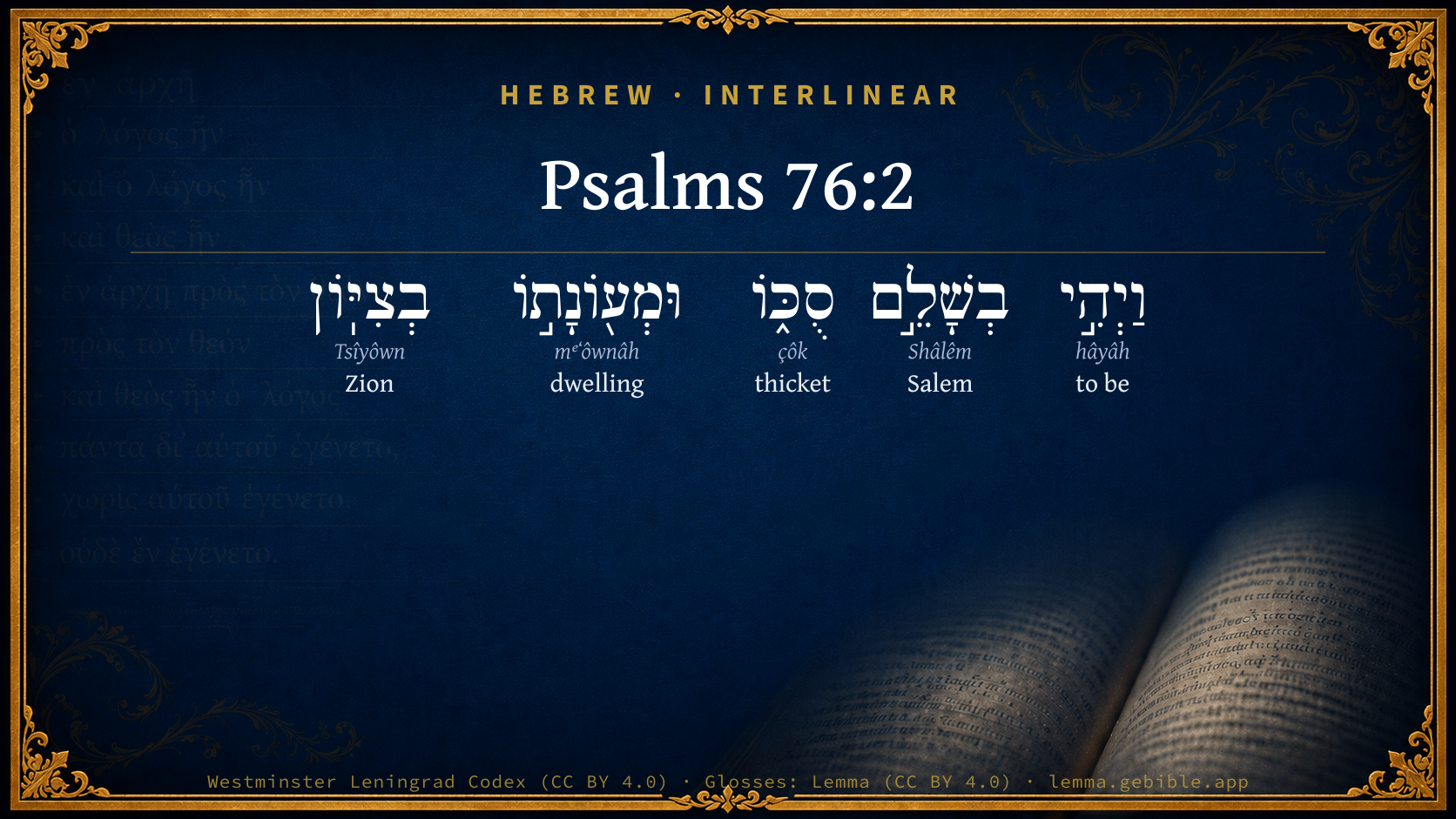
Psalms 76:2

Hebrew (Westminster Leningrad Codex) Psalms 76:2 appears in the Hebrew Old Testament. The text above is from the Westminster Leningrad Codex. Each word links to its Strong’s number, a concise gloss, and parsing drawn from the Open Scriptures Hebrew Bible morphology. Click any word for its full Brown-Driver-Briggs (BDB) entry.
Download image
Cite this verse

Psalms 76:2 (World English Bible). Public Domain. Lemma interlinear Bible study tool, https://lemma.gebible.app/v/psalms/76/2.

Show BibTeX & RIS
BibTeX
RIS
English Translation
His tent is also in Salem; His dwelling place in Zion.
World English Bible · Public Domain
Download a study sheet

One document with this verse’s original text, its word-by-word gloss line, the meaning frame, cross-references with their text, attributed commentary, and full source and license credits — printable, and it pastes into notes with its structure intact.

This verse Autodidact and up

Study sheet (.html) Plain text (.txt)

A passage Seminary Student

Up to 50 verses in one chapter. A passage sheet keeps up to 6 commentary sources and 12 cross-references per verse, in the order this page ranks them, and says so on the sheet whenever that leaves anything out. Ask for a single verse and you get the Autodidact verse sheet above.

Everything on this page stays free to read, with no account — the sheet is a download of what is already on screen, not access to it.

Want to remove ads? Support Godless Engineer
Compare translations 3

The same verse in 3 English versions, stacked beneath the original-language interlinear above. Click any original word for its lexicon entry.

Each is an independent rendering of the whole verse — the interlinear is not word-aligned to these translations.

Highlighted words mark where these versions differ — a whole-verse word diff, not a word-by-word alignment.

  • World English Bible Public Domain
    His tent is also in Salem; His dwelling place in Zion.
  • King James Version Public Domain
    In Salem also is his tabernacle, and his dwelling place in Zion.
  • unfoldingWord Literal Text CC BY-SA 4.0
    And his abode is in Salem, and his dwelling place is in Zion.

unfoldingWord Literal Text — © unfoldingWord, licensed CC BY-SA 4.0. Word-aligned USFM3 via Door43 (git.door43.org/unfoldingWord/en_ult).

Versions to compare (up to 4)

3 of 4 selected

Show all 18 translations

Every available English version of this verse, each an independent rendering of the whole verse.

  • World English Bible Public Domain
    His tent is also in Salem; His dwelling place in Zion.
  • Berean Standard Bible Public Domain
    His tent is in Salem, His dwelling place in Zion.
  • Majority Standard Bible Public Domain
    His tent is in Salem, His dwelling place in Zion.
  • King James Version Public Domain
    In Salem also is his tabernacle, and his dwelling place in Zion.
  • American Standard Version (1901) Public Domain
    In Salem also is his tabernacle, And his dwelling-place in Zion.
  • Revised Version (1885) Public Domain
    In Salem also is his tabernacle, and his dwelling place in Zion.
  • Geneva Bible (1599) Public Domain
    For in Shalem is his Tabernacle, and his dwelling in Zion.
  • Douay-Rheims (1899) Public Domain
    In Judea God is known: his name is great in Israel.
  • Young's Literal Translation Public Domain
    And His tabernacle is in Salem, And His habitation in Zion.
  • Literal Standard Version CC BY-SA 4.0
    And His dwelling place is in Salem, || And His habitation in Zion.
  • Unlocked Literal Bible CC BY-SA 4.0
    His tent is in Salem; his dwelling place is in Zion.
  • unfoldingWord Literal Text CC BY-SA 4.0
    And his abode is in Salem, and his dwelling place is in Zion.
  • Darby Bible Public Domain
    And in Salem is his tent, and his dwelling-place in Zion.
  • World Messianic Bible Public Domain
    His tabernacle is also in Salem. His dwelling place in Zion.
  • Webster's Bible Public Domain
    \\76:1\\To the chief Musician on Neginoth, A Psalm or Song of Asaph. In Judah is God known: his name is great in Israel.
  • Free Bible Version CC BY-SA 4.0
    He lives in Jerusalem; his home is in Zion.
  • Bible in Basic English Public Domain
    In Salem is his tent, his resting-place in Zion.
  • JPS Tanakh (1917) Public Domain
    (76-3) In Salem also is set His tabernacle, and His dwelling-place in Zion.

Literal Standard Version (2020), Covenant Press — licensed CC BY-SA 4.0. Text via the HelloAO Bible API (eBible.org). Unlocked Literal Bible (unfoldingWord) — licensed CC BY-SA 4.0. Text via the HelloAO Bible API (eBible.org). unfoldingWord Literal Text — © unfoldingWord, licensed CC BY-SA 4.0. Word-aligned USFM3 via Door43 (git.door43.org/unfoldingWord/en_ult). Free Bible Version, Dr. Jonathan Gallagher — licensed CC BY-SA 4.0. Text via the HelloAO Bible API (eBible.org).

Word by word

More ways to search: Search by grammar → Find every occurrence → Compare this word →

Practice this passage: Drill this verse → Learn its vocabulary →

About this verse

These counts appear in no published source. They are computed here, from the morphology-tagged text and Lemma’s own curated glosses. What Lemma adds →

5
words
5
distinct lemmas
Wisdom
section

Notable vocabulary

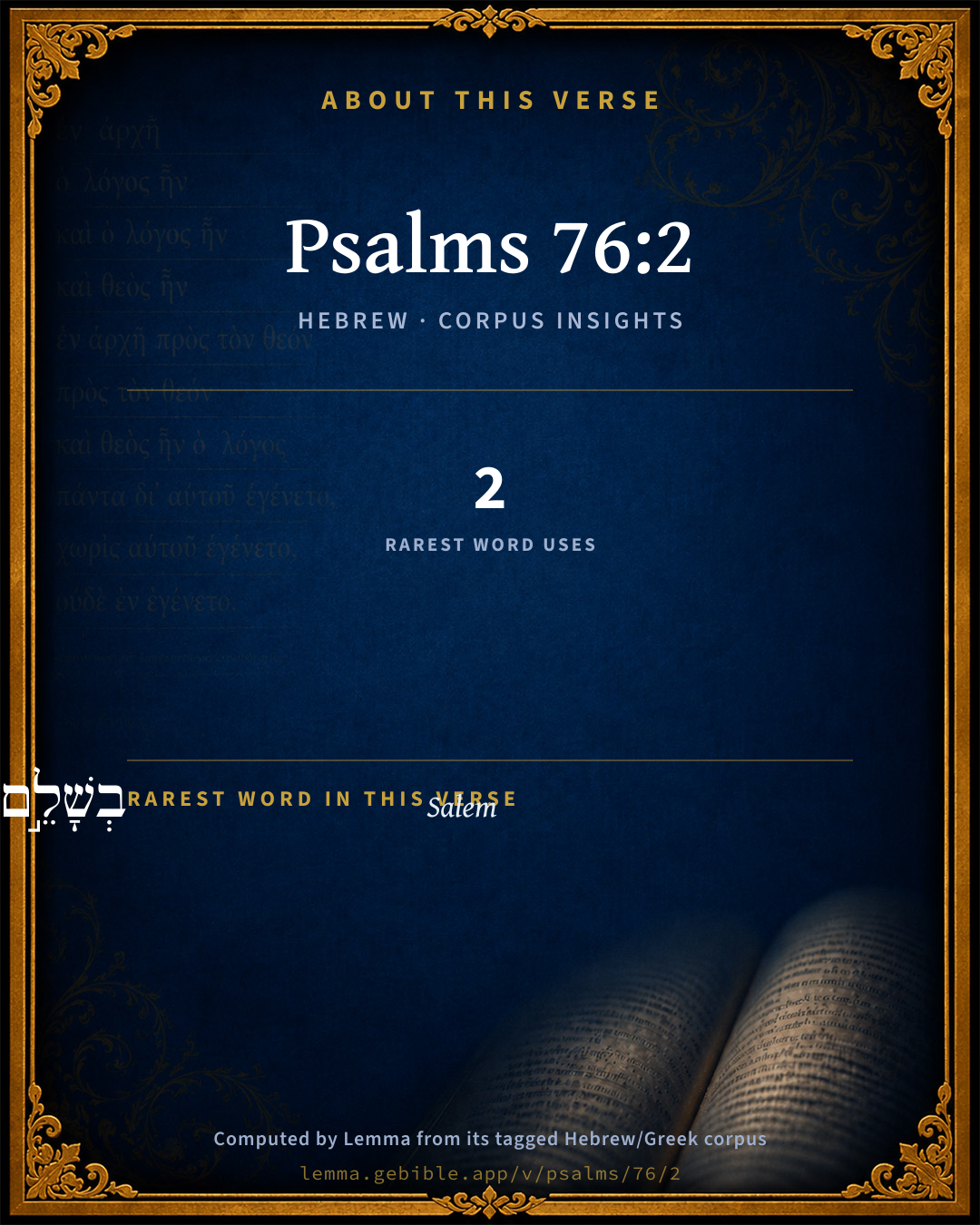
The rarest word here is בְשָׁלֵ֣ם Salem H8004 — appearing just 2 times in the whole Hebrew Bible.

Shared distinctive vocabulary

בְשָׁלֵ֣ם Salem H8004 occurs in 2 verses of the Hebrew Bible. Also found in:

Grammatical profile

  • 1 verb
  • 4 nouns

Verb forms

  • וַיְהִ֣י Qal · Sequential Imperfect

Hebrew & Septuagint length

In English translation the verse runs 11 words from the Hebrew and 12 from the Septuagint (LXX English) — closely comparable.

A rough comparison of the two English renderings, which tokenize alike — not a word-level alignment.

Word counts can differ between the Hebrew and the Greek without any difference in meaning — e.g. the Hebrew direct-object marker אֵת has no separate Greek word, and Greek often adds the article ὁ.

Cross-references

8

Topical passages linked to Psalms 76:2 in the Treasury of Scripture Knowledge — connected by theme and wording, ordered by reader-vote popularity; previews shown in the World English Bible.

  • Genesis 14:18 Melchizedek king of Salem brought forth bread and wine: and he was priest of God Most High.
  • Isaiah 12:6 Cry aloud and shout, you inhabitant of Zion; for great in the midst of you is the Holy One of Israel!"
  • 2 Chronicles 6:6 but I have chosen Jerusalem, that my name might be there; and have chosen David to be over my people Israel.
  • Psalms 132:13–14 For Yahweh has chosen Zion. He has desired it for his habitation.
  • Psalms 9:11 Sing praises to Yahweh, who dwells in Zion, And declare among the people what he has done.
  • Psalms 27:5 For in the day of trouble he will keep me secretly in his pavilion. In the covert of his tent he will hide me. He will lift me up on a rock.
  • Lamentations 2:6 He has violently taken away his tent, as if it were of a garden; he has destroyed his place of assembly: Yahweh has caused solemn assembly and Sabbath to be forgotten in Zion, Has despised in the indignation of his anger the king and the priest.
  • Hebrews 7:1–2 For this Melchizedek, king of Salem, priest of God Most High, who met Abraham returning from the slaughter of the kings and blessed him,

Cross-references courtesy of OpenBible.info (CC BY 4.0).

Hebrew and Greek witnesses Masoretic Hebrew ↔ Greek Septuagint

The same verse in the two great witnesses to the Old Testament, shown verse-for-verse.

You’re reading Greek Psalm 75 (Hebrew Psalm 76). The Septuagint counts the superscription, so verse numbers can differ from the Hebrew — chapter-level alignment, not verse-by-verse. Numbering follows Rahlfs.

These are two independent witnesses, not word-aligned to each other, and the Septuagint is shown in lemma (dictionary) form.

Hebrew Psalms 76:2 Masoretic · Westminster Leningrad Codex

וַיְהִ֣י בְשָׁלֵ֣ם סֻכּ֑וֹ וּמְע֖וֹנָת֣וֹ בְצִיּֽוֹן

His tent is also in Salem; His dwelling place in Zion.

World English Bible · Public Domain

Greek LXX Greek Psalm 75:2 Septuagint · lemma form

γνωστός ἐν ὁ ἰουδαία ὁ θεός ἐν ὁ ἰσραήλ μέγας ὁ ὄνομα αὐτός

And his place has been in peace, and his dwelling-place in Sion.

LXX2012 (modern English Septuagint) · Public Domain

On this verse, Ellicott's Commentary for English Readers discusses the Septuagint’s reading. Read the note in Commentary ↓

Hebrew: Westminster Leningrad Codex (CC BY 4.0). Greek: Septuagint (public domain); English from LXX2012 (modern English Septuagint) (Public Domain). How the Septuagint differs from the Hebrew →

Commentary

Notes on Psalms 76:2 from classic Christian and Jewish commentators (each source and its license shown beneath its notes). The classic Christian expositions comment on the surrounding passage and are grouped to its opening verse, so a note may address several verses; the Jewish commentaries on the Tanakh (Rashi and others) are per-verse, so they appear only where the commentator wrote on this verse.

Lemma curates 59 commentaries, every one of them public domain or Creative Commons licensed, each selected and text-cleaned for this edition rather than reprinted as found. About our sources →

Trapp's Complete Commentary

John Trapp

Psa 76:2 In Salem also is his tabernacle, and his dwelling place in Zion.

Ver. 2. In Salem also is his tabernacle] i.e. In Jerusalem, which was first called Salem, Gen 14:18 Heb 7:1. Secondly, Jebus, 1Ch 11:4 Jos 15:8; Jos 18:28. Thirdly, Jerusalem, Jos 15:63 2Sa 5:6, not as if ιερον Sολυμων, or Sολομωντος, Solomon’s temple (as Hegesippus would have it, and hence likely came the aspiration Hierusalem), but from that famous Jehovahjireh, Gen 22:14; Gen 22:2; which Jireh being added to Salem, maketh it Jerusalem, the vision of peace. Here God was pleased to pitch his tabernacle, movable, and mean, in respect of God’s greatness, 1Ki 8:27.

And his dwellingplace in Zion] Which therefore will save and see to, as every man doth to the place of his habitation. Lustrum eius, q.d. In Zion desidet ut leo ad praedam paratus (Metaph.).

John Trapp, A Commentary or Exposition upon All the Books of the Old and New Testament (1647–1656) — public domain. Text from a community e-Sword module.

J. A. Alexander on Psalms

Joseph Addison Alexander

3. (Psa 76:2). And in Salem was his tabernacle, and his home in Zion. This is explanatory of the first verse(Psa 76:1). He was best known there because it was his chosen earthly residence. Salem is evidently used poetically for Jerusalem. The former name means peaceful and secure, and some suppose it to be one of the elements of which the other name is composed, so as to signify a peaceful or secure possession. The same interpreters identify the Salem of Gen 14:18 with Jerusalem. The word translated tabernacle properly means a booth or shed composed of leaves and branches, in allusion to the moveable and temporary form of the first sanctuary.

Joseph Addison Alexander, The Psalms Translated and Explained (1850) — public domain. Text from a community e-Sword module.

Geneva Bible (1599)

Geneva Bible translators

Which afterward was called Jerusalem.

Geneva Bible (1599) marginal notes — public domain. Text via Bolls.life.

Adam Clarke's Commentary

Verse 2. In Salem also is his tabernacle] Salem was the ancient name of Jebus, afterward called Jerusalem. Here was the tabernacle set up; but afterwards, when the temple was built on Mount Zion, there was his habitation. The Psalm was evidently composed after the building of Solomon's temple.

Adam Clarke's Commentary on the Bible (1810–1826) — public domain. Text from a community e-Sword/MySword module.

John Calvin's Commentaries

2. And his tabernacle was in Salem Here the reason is assigned why God, putting the Assyrians to flight, vouchsafed to deliver the city of Jerusalem, and to take it under his protection. The reason is, because he had there chosen for himself a dwelling-place, in which his name was to be called upon. The amount, in short, is, first, that men had no ground to arrogate to themselves any share in the deliverance of the city here portrayed, God having strikingly showed that all the glory was his own, by displaying from heaven his power in the sight of all men; and, secondly, that he was induced to oppose his enemies from no other consideration but that of his free choice of the Jewish nation. God having, by this example, testified that his power is invincible for preserving his Church, it is a call and an encouragement to all the faithful to repose with confidence under his shadow. If his name is precious to himself, it is no ordinary pledge and security which he gives to our faith when he assures us that it is his will that the greatness of his power should be known in the preservation of his Church. Moreover, as the Church is a distinguished theater on which the Divine glory is displayed, we must always take the greatest care not to shroud or bury in forgetfulness, by our ingratitude, the benefits which have been bestowed upon it, and especially those which ought to be held in remembrance in all ages. Farther, although God is not now worshipped in the visible tabernacle, yet as by Christ he still dwells in the midst of us, yea even within us, we will doubtless experience, whenever we are exposed to danger, that under his protection we are in perfect safety. If the earthly sanctuary of Jerusalem afforded to God’s ancient people succor while it stood, we may rest assured that he will have no less care of us who live in the present day, when we consider that he has vouchsafed to choose us as his temples in which he may dwell by his Holy Spirit. Here the prophet, in speaking of Jerusalem, uses merely the name of Salem, which was the simple and uncompounded name of the city, and had been applied to it very anciently, as appears from Genesis 14:18. Some think that the name in the course of time assumed its compound form, by having Jebus prefixed to Salem; for Jebus was the name by which it was afterwards known in the intervening period, as we learn from the Book of Judges, Judges 19:10, it being so called because it was inhabited by the Jebusites. But we will be more correct as to the etymology of the word, if we derive it from the verb יראה, yereh, which signifies will see, because Abraham said,

“God will look out for himself a lamb for a burnt-offering,” (Genesis 22:8.)

John Calvin's Commentaries (1540-1563) — public domain. Text from the Calvin Translation Society English edition (1840s-50s) via the Christian Classics Ethereal Library (ccel.org). Calvin's coverage is partial (roughly two-thirds of the Bible); uncommented books and verses are honest gaps, never fabricated. The 19th-century editor's footnotes and remarks are omitted so the notes are faithfully Calvin's own voice.

Ellicott's Commentary for English Readers

(2) Salem.—The LXX. and Vulgate translate “his place was in peace,” and possibly the poet may use the word Salem with the thought in his mind of the peace won by God for Judah, or, again, it may be only a poet’s preference for an ancient over a modern name; but the identification of the Salem of Gen_14:18 with Jerusalem is too doubtful to allow much weight to this view. (See the whole question discussed in Sir G. Grove’s article on “Salem,” in Smith’s Bibl. Dict.)

Tabernacle . . . dwelling-place.—These renderings quite obliterate the image, which is that of a beast of prey crouching ready for its spring. Translate,

“In Salem is his covert,

And his lair in Sion.”

and for these meanings of the Hebrew words sokh and meônah comp. Psa_10:9; Jer_25:38; Psa_104:22; Amo_3:4.

A Bible Commentary for English Readers, edited by Charles John Ellicott (1878–1897) — public domain. Text from a community e-Sword module.

The Cambridge Bible for Schools and Colleges

gen. ed. J. J. S. Perowne

2. And he hath set his pavilion in Salem,

And his habitation in Zion.

For the words pavilion and habitation applied to the Temple see Psa_27:5; Psa_68:5. The words may however mean the covert and lair of a lion (Psa_10:9; Psa_104:22; Amo_3:4); and it is possible that the Psalmist intends to describe God as the lion of Judah, who has issued forth from His lair, and seized His prey. Cp. Psa_76:4, and the simile in Isa_31:4.

Salem is either an old name for Jerusalem (Gen_14:18), or a poetical abbreviation. The name means ‘unharmed,’ ‘at peace,’ and it is doubtless used with allusion to the recent escape of Zion from destruction (Isa_33:20).

The Cambridge Bible for Schools and Colleges (gen. ed. J. J. S. Perowne; Cambridge University Press, 1878–1918) — public domain. Text from a community e-Sword module.

John Gill's Exposition

In Salem also is his tabernacle,.... That is, in Jerusalem, as the Targum expresses it, where the tabernacle of Moses and the ark of the covenant were, and afterwards the temple of Solomon, which the Targum here calls the house of the sanctuary; and may be interpreted of the human nature of Christ, the true tabernacle which God pitched, and not man, in which the divine word when he was made flesh dwelt or tabernacled among the Jews at Jerusalem, and in other parts of Judea, Heb 8:2. Salem or Jerusalem often signifies the church of God in Gospel times, in the midst of which Christ resides, and where he grants his gracious presence, Heb 12:22 and in the New Jerusalem the tabernacle of God will be with men, and he will dwell among them, Rev 21:2. The Septuagint translate the word, and render it, "in peace", as in Heb 7:2, the God of peace dwells among those that live in peace, Co2 13:11,

and his dwelling place in Zion; where the ark was brought by David, and the temple was built by Solomon, into which, as rebuilt by Zerubbabel, Christ came, and here he preached; a figure of the church, which is his habitation.

John Gill's Exposition of the Whole Bible (1746–1763) — public domain (CC PDM 1.0). Text via the HelloAO Bible API.

Albert Barnes' Notes on the Bible

In Salem also - This was the ancient name for Jerusalem, and is evidently so used here. It continued to be given to the town until the time of David, when it was called “Jerusalem.” See the notes at Isa 1:1. The word properly means “peace,” and is so rendered here by the Septuagint, ἐν εἰρήνῃ ὁ τόπος αύτοῦ en eirēnē ho topos autou - “his place is in peace.” There may have been an allusion here to that ancient signification of the name, as being more poetical, and as suggesting the fact that God had restored peace to the city and nation when invaded.

Is his tabernacle - The tent, or sacred place where he is worshipped. Salem or Jerusalem was made the place of public worship, and the ark removed there by David, 2Sa 6:17.

And his dwelling-place in Zion - That is, on Mount Zion - the portion of Jerusalem in which David built his own palace, and which he made the place of public worship. This remained so until the temple was built on Mount Moriah; see the notes at Psa 2:6; compare Psa 9:11; Psa 48:12; Psa 65:1.

Albert Barnes' Notes on the Bible (1834–1885) — public domain. Text from a community e-Sword/MySword module.

Matthew Poole's English Annotations

In Salem; in Jerusalem, which was anciently called Salem, Gen 14:18; Heb 7:1.

Zion; largely so called, as it includes Moriah, an adjoining hill, or another branch of the same hill.

Matthew Poole's English Annotations on the Holy Bible (1683–1685) — public domain. Text from a community e-Sword/MySword module.

The Treasury of David

Charles H. Spurgeon

Ver. 2. In Salem also is his tabernacle. In the peaceful city he dwells, and the peace is perpetuated, because there his sacred tent is pitched. The church of God is the place where the Lord abides and he is to her the Lord and giver of peace.

And his dwelling place in Zion. Upon the chosen hill was the palace of Israel's Lord. It is the glory of the church that the Redeemer inhabits her by his Holy Spirit. Vain are the assaults of the enemy, for they attack not us alone, but the Lord himself. Immanuel, God with us, finds a home among his people, who then shall work us ill?

Whole Psalm. No Psalm has a greater right to follow Psalm 75 than this, which is inscribed To the Precentor, with accompaniment of stringed instruments (vid. 4,1), a Psalm by Asaph, a song. Similar expressions (God of Jacob, Ps 75:10 77:7; saints, wicked of the earth, Ps 75:9 76:10), and the same impress throughout speak in favour of unity of authorship. In other respects too, they form a pair: Psalm 75 prepares the way for the divine deed of judgments as imminent, which Psalm 76 celebrates as having taken place. Franz Delitzsch.

Ver. 2. In Salem also is his tabernacle. It is not without meaning that Jerusalem has the appellation of Salem; for it is thereby insinuated that the tabernacle of God, notwithstanding the assault of foes, in the very heart of the tumults of war remained in peace. How much more now that the invaders had been overthrown, would prosperity be enjoyed? Hermann Venema.

Ver. 2. In Salem also is his tabernacle. God the Holy Ghost is a spirit of peace, he is the comforter; he seals up peace (2Co 1:22). This blessed dove brings the olive branch of peace in his mouth: now a peaceable disposition evidences something of God in a man, therefore God loves to dwell there. "In Salem is God's tabernacle:" Salem signifies peace; God dwells in a peaceable spirit. Thomas Watson.

Ver. 2. In Salem also is his tabernacle, etc. All the old versions, as well as the two English ones, have missed one especial force of this passage. There is no direct reference in words to any human habitation, but to the lair of the Lion of Judah. The word wkm does not only mean his tabernacle, but his covert, and is so translated in another place (Jer 25:38): "He hath forsaken his covert, as the lion; "and the vaguer word wtgwem which succeeds may well be translated by "den, "or some equivalent phrase. Ps 10:9. Simon De Muis.

Ver. 2-3. The care of Salem, or Zion, lies at the bottom of all God's powerful acting and workings among the sons of men. Every mighty work of God throughout the world may be prefaced with these two verses. The whole course of affairs in the world in steered by Providence in reference to the good of Salem. John Owen.

Ver. 2. The peculiar relation of God to his church.

Ver. 2. (first clause). A peaceful church the tabernacle of God. The benefits peace confers, the evils of strife, the causes of dissension, and the means of promoting unity.

Psalms 76:3*

Ver. 2-3. The care of Salem, or Zion, lies at the bottom of all God's powerful acting and workings among the sons of men. Every mighty work of God throughout the world may be prefaced with these two verses. The whole course of affairs in the world in steered by Providence in reference to the good of Salem. John Owen.

Charles H. Spurgeon's The Treasury of David (1869–1885) — public domain. Psalms only. Text from a community e-Sword/MySword module.

Whedon's Commentary on the Bible

Daniel D. Whedon

2. Salem—The ancient name of Jerusalem, here poetically recalled.

Gen_14:18; Heb_7:1.

His tabernacle—Such only it was when David first removed the ark to Mount Zion, (2Sa_6:17; and such was God’s dwelling place during David’s life.

Daniel D. Whedon (gen. ed.), Commentary on the Old and New Testaments (1874–1909) — public domain. Text from a community e-Sword module.

The Pulpit Commentary

In Salem; i.e. Jerusalem. "Salem" was probably a shortened form of the full and complete name, like "Peer" for "Baalpeor," "Maachah" for "Aram-Maa-chah," "El Kuds" for "Beit-el-Kuds," and the like. (So Professor Cheyne.) "Salem" is the peaceful place, the place where God"s presence breathed peace and tranquillity. It is only used here and in Gen_14:11. Is his tabernacle; literally, his tent. (comp. Psa_15:1 Psa_27:5, 6 61:4) The temple is meant, as even Professor Cheyne sees. It took the place of the original "tabernacle," and was modelled upon it. And his dwelling place in Zion; or, his lair". (comp. Psa_104:22)

The localization of God.

"In Salem also is his covert, and his dwelling place in Zion". (comp. Jer_25:38, "He hath forsaken his covert as the lion The poetical figure is the likening of God to a lion the Lion of the tribe of Judah who leaves his covert in Salem, and his lair in Zion, to spoil the enemy. There is now evidence that the holy city was known as Salem long before the time of Joshua, but the special Divine association with it dates from the time when David brought back the ark, and found for it a resting place in the new tabernacle on Mount Zion. That ark was the symbol of abiding Divine presence. The poet can only liken the sudden and overwhelming destruction of the Assyrian army to the springing of a lion on his prey. Then it was easy to conceive of the holy place at Jerusalem as the den or covert where the lion abode, and out of which he sprang. In treating such poetical figures, we should remember that Easterns allowed themselves a freer poetical licence than we do; and we should treat their extravagant figures with great care and becoming reverence. First recall to mind that God is everywhere present. We must never prison the thought of God to any time or any place. "The heaven is my throne, and the earth is my footstool: where is the house that ye build unto me? and where is the place of my rest?". (Isa_66:1) But, keeping that as our primary thought of God, we may realize helpful associations of God with places and persons.

I GOD MAY BE THOUGHT OF AS THE GOD OF A NATION. "Elohim" for all the world, God was "Jehovah" for Israel by virtue of special relations and revelations, the "God of Israel." So there is a proper sense in which God may be spoken of as the "God of England;" and we rightly realize the unique relations in which he stands to us. Impress that effective education of the rising race includes the teaching of this special relation of God to our nation.

II GOD MAY BE THOUGHT OF AS THE GOD OF A BUILDING. In the wilderness we read of "God"s tabernacle;" in the later history we read of God"s "dwelling place in Zion." So now we properly speak of God"s house," and understand certain buildings to be consecrated to him. There he is pleased to manifest himself.

III GOD MAY BE THOUGHT OF AS THE GOD OF A PERSON. God was, in a sense, in Moses, with Moses. God"s Spirit dwelt "without measure" in Christ. Still God works through his ministers, making of them his earthly dwelling place.

IV GOD MAY BE THOUGHT OF AS THE GOD OF A SYMBOL. As in the Shechinah-cloud, and as in the Holy Sacrament. God is everywhere. God is here. R.T.

The Pulpit Commentary (1880–1919), ed. H.D.M. Spence-Jones & Joseph S. Exell — public domain. Text from a community e-Sword module.

John Wesley's Explanatory Notes

Salem - In Jerusalem, which was anciently called Salem. Zion - Largely so called, as it includes Moriah, an adjoining hill.

John Wesley, Explanatory Notes Upon the Whole Bible (1754–1765) — public domain. Text via the GEBible commentary corpus.

Lesson kit

Teaching starters — assembled from the data on this page, not authored interpretation. Every prompt links to the verse data it draws on. Edit before teaching.

Psalms, in the Wisdom, opens this verse with 5 words (5 distinct Hebrew lemmas). Its most distinctive word is Shâlêm (“Salem”). A historical commentator’s framing appears above. Read the whole chapter for the surrounding context.

Discussion questions

  1. The word Shâlêm carries the sense “Salem.” How does it shape the verse?
  2. How does Genesis 14:18, which shares the word «Salem», read alongside this verse?
  3. The translations on this page render this verse differently — a whole-verse word diff, not a word-by-word alignment. What might account for the different wordings?
  4. «וַיְהִ֣י» is a Qal Sequential Imperfect verb. How does that grammatical form shape the action described?
  5. Compare how Trapp's Complete Commentary and J. A. Alexander on Psalms read this verse. Where do they agree or differ?

Things to notice

Reading settings

Reading text

Shown beneath each verse's original-language words.

Old Testament
Old Testament edition

Read the OT as the Masoretic Hebrew (MT) or the Greek Septuagint (LXX).

English shown for the Greek Septuagint (in the Hebrew ↔ Greek comparison).

Comparing translations? Open the Compare panel on any verse page to stack up to four side by side.