
Jeremiah 26:18

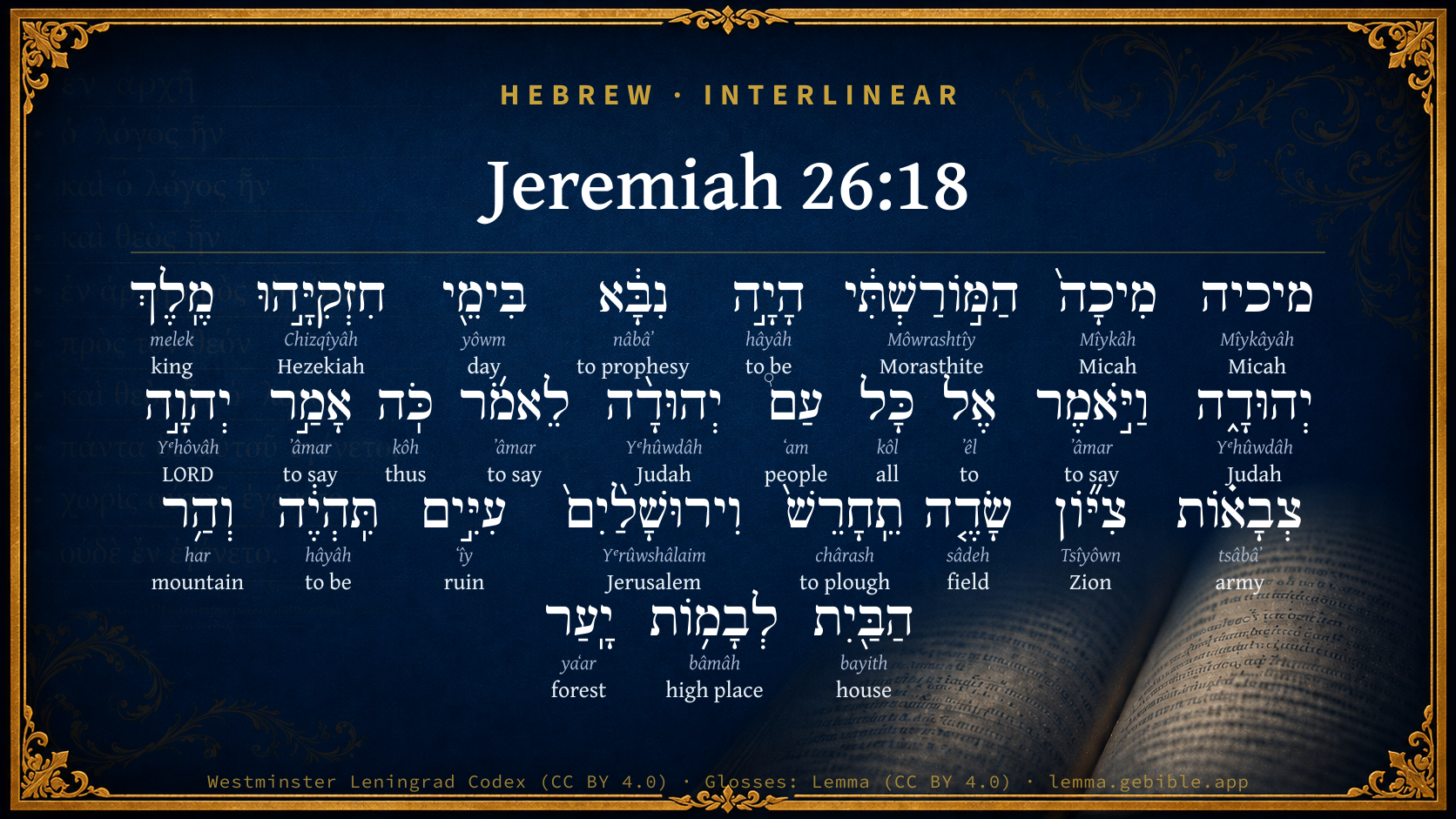
Hebrew (Westminster Leningrad Codex) Jeremiah 26:18 appears in the Hebrew Old Testament. The text above is from the Westminster Leningrad Codex. Each word links to its Strong’s number, a concise gloss, and parsing drawn from the Open Scriptures Hebrew Bible morphology. Click any word for its full Brown-Driver-Briggs (BDB) entry.
Download image
Cite this verse

Jeremiah 26:18 (World English Bible). Public Domain. Lemma interlinear Bible study tool, https://lemma.gebible.app/v/jeremiah/26/18.

Show BibTeX & RIS
BibTeX
RIS
English Translation
Micah the Morashtite prophesied in the days of Hezekiah king of Judah; and he spoke to all the people of Judah, saying, Thus says Yahweh of Hosts: Zion shall be plowed as a field, and Jerusalem shall become heaps, and the mountain of the house as the high places of a forest.
World English Bible · Public Domain
Highlights
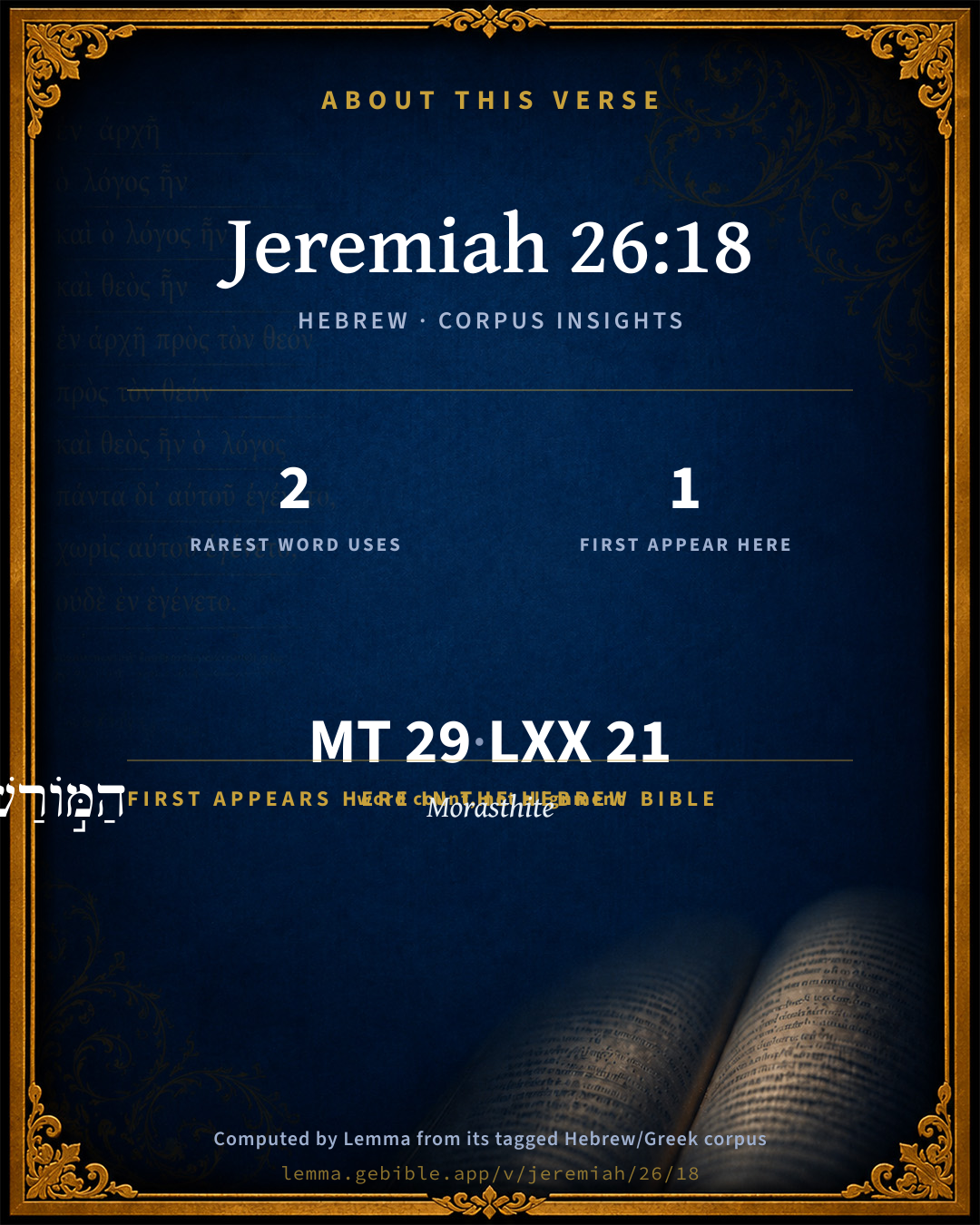
  • 1 first appearance in the Hebrew Bible
Full analysis ↓
Download a study sheet

One document with this verse’s original text, its word-by-word gloss line, the meaning frame, cross-references with their text, attributed commentary, and full source and license credits — printable, and it pastes into notes with its structure intact.

This verse Autodidact and up

Study sheet (.html) Plain text (.txt)

A passage Seminary Student

Up to 50 verses in one chapter. A passage sheet keeps up to 6 commentary sources and 12 cross-references per verse, in the order this page ranks them, and says so on the sheet whenever that leaves anything out. Ask for a single verse and you get the Autodidact verse sheet above.

Everything on this page stays free to read, with no account — the sheet is a download of what is already on screen, not access to it.

Want to remove ads? Support Godless Engineer
Compare translations 3

The same verse in 3 English versions, stacked beneath the original-language interlinear above. Click any original word for its lexicon entry.

Each is an independent rendering of the whole verse — the interlinear is not word-aligned to these translations.

Highlighted words mark where these versions differ — a whole-verse word diff, not a word-by-word alignment.

  • World English Bible Public Domain
    Micah the Morashtite prophesied in the days of Hezekiah king of Judah; and he spoke to all the people of Judah, saying, Thus says Yahweh of Hosts: Zion shall be plowed as a field, and Jerusalem shall become heaps, and the mountain of the house as the high places of a forest.
  • King James Version Public Domain
    Micah the Morasthite prophesied in the days of Hezekiah king of Judah, and spake to all the people of Judah, saying, Thus saith the LORD of hosts; Zion shall be plowed like a field, and Jerusalem shall become heaps, and the mountain of the house as the high places of a forest.
  • unfoldingWord Literal Text CC BY-SA 4.0
    “Micah the Morashtite was prophesying in the days of Hezekiah king of Judah, and he said to all the people of Judah, saying, ‘Thus says Yahweh of Armies: Zion, a field will be plowed, and Jerusalem will become heaps, and the mountain of the house to high places of a forest.’

unfoldingWord Literal Text — © unfoldingWord, licensed CC BY-SA 4.0. Word-aligned USFM3 via Door43 (git.door43.org/unfoldingWord/en_ult).

Versions to compare (up to 4)

3 of 4 selected

Show all 18 translations

Every available English version of this verse, each an independent rendering of the whole verse.

  • World English Bible Public Domain
    Micah the Morashtite prophesied in the days of Hezekiah king of Judah; and he spoke to all the people of Judah, saying, Thus says Yahweh of Hosts: Zion shall be plowed as a field, and Jerusalem shall become heaps, and the mountain of the house as the high places of a forest.
  • Berean Standard Bible Public Domain
    “Micah the Moreshite prophesied in the days of Hezekiah king of Judah and told all the people of Judah that this is what the LORD of Hosts says: ‘Zion will be plowed like a field, Jerusalem will become a heap of rubble, and the temple mount a wooded ridge.’
  • Majority Standard Bible Public Domain
    “Micah the Moreshite prophesied in the days of Hezekiah king of Judah and told all the people of Judah that this is what the LORD of Hosts says: ‘Zion will be plowed like a field, Jerusalem will become a heap of rubble, and the temple mount a wooded ridge.’
  • King James Version Public Domain
    Micah the Morasthite prophesied in the days of Hezekiah king of Judah, and spake to all the people of Judah, saying, Thus saith the LORD of hosts; Zion shall be plowed like a field, and Jerusalem shall become heaps, and the mountain of the house as the high places of a forest.
  • American Standard Version (1901) Public Domain
    Micah the Morashtite prophesied in the days of Hezekiah king of Judah; and he spake to all the people of Judah, saying, Thus saith Jehovah of hosts: Zion shall be plowed as a field, and Jerusalem shall become heaps, and the mountain of the house as the high places of a forest.
  • Revised Version (1885) Public Domain
    Micaiah the Morashtite prophesied in the days of Hezekiah king of Judah; and he spake to all the people of Judah, saying, Thus saith the LORD of hosts: Zion shall be plowed as a field, and Jerusalem shall become heaps, and the mountain of the house as the high places of a forest.
  • Geneva Bible (1599) Public Domain
    Michah the Morashite prophecied in the dayes of Hezekiah king of Iudah, and spake to al the people of Iudah, saying, Thus saith the Lord of hostes, Zion shall be plowed like a fielde, and Ierusalem shalbe an heape, and the mountaine of the House shalbe as the hie places of the forest.
  • Douay-Rheims (1899) Public Domain
    Micheas of Morasthi was a prophet in the days of Ezechias king of Juda, and he spoke to all the people of Juda, saying: Thus saith the Lord of hosts: Sion shall be ploughed like a field, and Jerusalem shall be a heap of stones: and the mountain of the house the high places of woods.
  • Young's Literal Translation Public Domain
    `Micah the Morashtite hath been prophesying in the days of Hezekiah king of Judah, and he saith unto all the people of Judah, saying: Thus said Jehovah of Hosts: Zion is a plowed field, and Jerusalem is heaps, And the mountain of the house is for high places of a forest.
  • Literal Standard Version CC BY-SA 4.0
    “Micah the Morashtite has been prophesying in the days of Hezekiah king of Judah, and he says to all the people of Judah, saying, Thus said YHWH of Hosts: Zion is a plowed field, and Jerusalem is heaps, || And the mountain of the house is for high places of a forest.
  • Unlocked Literal Bible CC BY-SA 4.0
    They said, “Micah the Morashite was prophesying in the days of Hezekiah king of Judah. He spoke to all the people of Judah and said, 'Yahweh of hosts says this: Zion will become a plowed field, Jerusalem will become a heap of rubble, and the hill of the temple will become a thicket.'
  • unfoldingWord Literal Text CC BY-SA 4.0
    “Micah the Morashtite was prophesying in the days of Hezekiah king of Judah, and he said to all the people of Judah, saying, ‘Thus says Yahweh of Armies: Zion, a field will be plowed, and Jerusalem will become heaps, and the mountain of the house to high places of a forest.’
  • Darby Bible Public Domain
    Micah the Morasthite prophesied in the days of Hezekiah king of Judah, and spoke to all the people of Judah, saying, Thus saith Jehovah of hosts: Zion shall be ploughed [as] a field, and Jerusalem shall become heaps, and the mountain of the house as the high places of a forest.
  • World Messianic Bible Public Domain
    “Micah the Morashtite prophesied in the days of Hezekiah king of Judah; and he spoke to all the people of Judah, saying, ‘The LORD of Hosts says: “‘Zion will be plowed as a field, and Jerusalem will become heaps, and the mountain of the house as the high places of a forest.’
  • Webster's Bible Public Domain
    Micah the Morasthite prophesied in the days of Hezekiah king of Judah, and spoke to all the people of Judah, saying, Thus saith the LORD of hosts; Zion shall be plowed like a field, and Jerusalem shall become heaps, and the mountain of the house as the high places of the forest.
  • Free Bible Version CC BY-SA 4.0
    “Micah of Moresheth prophesied during the reign of Hezekiah king of Judah. He told all the people of Judah that this is what the Lord Almighty says: ‘Zion will become like a plowed field; Jerusalem will end up a pile of rubble; and the Temple mount will be overgrown with trees.’
  • Bible in Basic English Public Domain
    Micah the Morashtite, who was a prophet in the days of Hezekiah, king of Judah, said to all the people of Judah, This is what the Lord of armies has said: Zion will become like a ploughed field, and Jerusalem will become a mass of broken walls, and the mountain of the house like the high places of the woodland.
  • JPS Tanakh (1917) Public Domain
    'Micah the Morashtite prophesied in the days of Hezekiah king of Judah; and he spoke to all the people of Judah, saying: Thus saith the LORD of hosts: Zion shall be plowed as a field, and Jerusalem shall become heaps, and the mountain of the house as the high places of a forest.

Literal Standard Version (2020), Covenant Press — licensed CC BY-SA 4.0. Text via the HelloAO Bible API (eBible.org). Unlocked Literal Bible (unfoldingWord) — licensed CC BY-SA 4.0. Text via the HelloAO Bible API (eBible.org). unfoldingWord Literal Text — © unfoldingWord, licensed CC BY-SA 4.0. Word-aligned USFM3 via Door43 (git.door43.org/unfoldingWord/en_ult). Free Bible Version, Dr. Jonathan Gallagher — licensed CC BY-SA 4.0. Text via the HelloAO Bible API (eBible.org).

Word by word

More ways to search: Search by grammar → Find every occurrence → Compare this word →

Practice this passage: Drill this verse → Learn its vocabulary →

הַמּ֣וֹרַשְׁתִּ֔י
Môwrashtîy
H4183
“the · Morasthite”
Particle, Definite Article + Noun, Gentilic, Masculine, Singular, Absolute
Part of Speech
Particle + Noun
Type
Gentilic
Gender
Masculine
Number
Singular
State
Absolute
Full BDB Definition

Origin: patrial from H4182

TWOT: None

Morasthite see Moreshethgath = "possession of Gath" - an inhabitant of Moresheth - the prophet Micah
  1. מיכיה Mîykâyâh H4320 “Micah” Noun, Proper
  2. מִיכָה֙ Mîykâh H4318 “Micah” Noun, Proper
  3. הָיָ֣ה hâyâh H1961 “to be” Verb, Qal, Perfect, 3rd Person, Masculine, Singular
  4. נִבָּ֔א nâbâʼ H5012 “prophesying” Verb, Niphal, Participle Active, Masculine, Singular, Absolute
  5. בִּימֵ֖י yôwm H3117 “in/at · days of” Preposition + Noun, Common, Masculine, Plural, Construct
  6. חִזְקִיָּ֣הוּ Chizqîyâh H2396 “Hezekiah” Noun, Proper
  7. מֶֽלֶךְ melek H4428 “king of” Noun, Common, Masculine, Singular, Construct
  8. יְהוּדָ֑ה Yᵉhûwdâh H3063 “Judah” Noun, Proper
  9. וַיֹּ֣אמֶר ʼâmar H559 “and · to say” Conjunction + Verb, Qal, Sequential Imperfect, 3rd Person, Masculine, Singular
  10. אֶל ʼêl H413 “to” Preposition
  11. כָּל kôl H3605 “all of” Noun, Common, Masculine, Singular, Construct
  12. עַם֩ ʻam H5971 “people of” Noun, Common, Masculine, Singular, Construct
  13. יְהוּדָ֨ה Yᵉhûwdâh H3063 “Judah” Noun, Proper
  14. לֵאמֹ֜ר ʼâmar H559 “to say” Preposition + Verb, Qal, Infinitive Construct
  15. כֹּֽה kôh H3541 “thus” Adverb
  16. אָמַ֣ר ʼâmar H559 “to say” Verb, Qal, Perfect, 3rd Person, Masculine, Singular
  17. יְהוָ֣ה Yᵉhôvâh H3068 “LORD” Noun, Proper
  18. צְבָא֗וֹת tsâbâʼ H6635 “armies” Noun, Common, Both, Plural, Absolute
  19. צִיּ֞וֹן Tsîyôwn H6726 “Zion” Noun, Proper
  20. שָׂדֶ֤ה sâdeh H7704 “field” Noun, Common, Masculine, Singular, Absolute
  21. תֵֽחָרֵשׁ֙ chârash H2790 “to plough” Verb, Niphal, Imperfect, 3rd Person, Feminine, Singular
  22. וִירוּשָׁלַ֨יִם֙ Yᵉrûwshâlaim H3389 “and · Jerusalem” Conjunction + Noun, Proper
  23. עִיִּ֣ים ʻîy H5856 “ruins” Noun, Common, Masculine, Plural, Absolute
  24. תִּֽהְיֶ֔ה hâyâh H1961 “to be” Verb, Qal, Imperfect, 3rd Person, Feminine, Singular
  25. וְהַ֥ר har H2022 “and · mountain of” Conjunction + Noun, Common, Masculine, Singular, Construct
  26. הַבַּ֖יִת bayith H1004 “the · house” Particle, Definite Article + Noun, Common, Masculine, Singular, Absolute
  27. לְבָמ֥וֹת bâmâh H1116 “to/for · high places of” Preposition + Noun, Common, Feminine, Plural, Construct
  28. יָֽעַר yaʻar H3293 “forest” Noun, Common, Masculine, Singular, Absolute

About this verse

These counts appear in no published source. They are computed here, from the morphology-tagged text and Lemma’s own curated glosses. What Lemma adds →

29
words
25
distinct lemmas
Prophets
section

Notable vocabulary

The rarest word here is הַמּ֣וֹרַשְׁתִּ֔י Morasthite H4183 — appearing just 2 times in the whole Hebrew Bible.

First appearance in Scripture

This word makes its first canonical appearance in the Hebrew Bible here:

  • הַמּ֣וֹרַשְׁתִּ֔י Morasthite H4183

Shared distinctive vocabulary

הַמּ֣וֹרַשְׁתִּ֔י Morasthite H4183 occurs in 2 verses of the Hebrew Bible. Also found in:

Grammatical profile

  • 7 verbs
  • 20 nouns
  • 1 preposition
  • 1 adverb

Verb forms

  • הָיָ֣ה Qal · Perfect
  • נִבָּ֔א Niphal · Participle Active
  • וַיֹּ֣אמֶר Qal · Sequential Imperfect
  • לֵאמֹ֜ר Qal · Infinitive Construct
  • אָמַ֣ר Qal · Perfect
  • תֵֽחָרֵשׁ֙ Niphal · Imperfect
  • תִּֽהְיֶ֔ה Qal · Imperfect

Repetition

Words recur within this verse — often emphatic in Hebrew:

  • וַיֹּ֣אמֶר to say H559 ×3
  • הָיָ֣ה to be H1961 ×2
  • יְהוּדָ֑ה Judah H3063 ×2

Hebrew & Septuagint length

In the original languages it is 29 Hebrew tokens and 21 Greek tokens — but the two are counted differently (Hebrew bundles its prefixes and suffixes into one token; the Greek is in lemma form), so that isn’t a like-for-like length.

Cross-references

10

Topical passages linked to Jeremiah 26:18 in the Treasury of Scripture Knowledge — connected by theme and wording, ordered by reader-vote popularity; previews shown in the World English Bible.

  • Nehemiah 4:2 He spoke before his brothers and the army of Samaria, and said, What are these feeble Jews doing? will they fortify themselves? will they sacrifice? will they make an end in a day? will they revive the stones out of the heaps of rubbish, seeing they are burned?
  • Micah 1:1 The word of Yahweh that came to Micah the Morashtite in the days of Jotham, Ahaz, and Hezekiah, kings of Judah, which he saw concerning Samaria and Jerusalem.
  • Zechariah 8:3 Thus says Yahweh: "I have returned to Zion, and will dwell in the midst of Jerusalem. Jerusalem shall be called 'The City of Truth;' and the mountain of Yahweh of Hosts, 'The Holy Mountain.'"
  • Jeremiah 17:3 My mountain in the field, I will give your substance and all your treasures for a spoil, [and] your high places, because of sin, throughout all your borders.
  • Micah 3:12–4:1 Therefore Zion for your sake will be plowed like a field, And Jerusalem will become heaps of rubble, And the mountain of the temple like the high places of a forest.
  • Psalms 79:1 God, the nations have come into your inheritance. They have defiled your holy temple. They have laid Jerusalem in heaps.
  • Isaiah 2:2–3 It shall happen in the latter days, that the mountain of Yahweh's house shall be established on the top of the mountains, And shall be raised above the hills; And all nations shall flow to it.
  • 2 Kings 19:25 Haven't you heard how I have done it long ago, and formed it of ancient times? now have I brought it to pass, that it should be yours to lay waste fortified cities into ruinous heaps.
  • Jeremiah 9:11 I will make Jerusalem heaps, a dwelling-place of jackals; and I will make the cities of Judah a desolation, without inhabitant.
  • Jeremiah 51:37 Babylon shall become heaps, a dwelling-place for jackals, an astonishment, and a hissing, without inhabitant.

Cross-references courtesy of OpenBible.info (CC BY 4.0).

Hebrew and Greek witnesses Masoretic Hebrew ↔ Greek Septuagint

The same verse in the two great witnesses to the Old Testament, shown verse-for-verse.

These are two independent witnesses, not word-aligned to each other, and the Septuagint is shown in lemma (dictionary) form.

Hebrew Jeremiah 26:18 Masoretic · Westminster Leningrad Codex

מיכיה מִיכָה֙ הַמּ֣וֹרַשְׁתִּ֔י הָיָ֣ה נִבָּ֔א בִּימֵ֖י חִזְקִיָּ֣הוּ מֶֽלֶךְ יְהוּדָ֑ה וַיֹּ֣אמֶר אֶל כָּל עַם֩ יְהוּדָ֨ה לֵאמֹ֜ר כֹּֽה אָמַ֣ר יְהוָ֣ה צְבָא֗וֹת צִיּ֞וֹן שָׂדֶ֤ה תֵֽחָרֵשׁ֙ וִירוּשָׁלַ֨יִם֙ עִיִּ֣ים תִּֽהְיֶ֔ה וְהַ֥ר הַבַּ֖יִת לְבָמ֥וֹת יָֽעַר

Micah the Morashtite prophesied in the days of Hezekiah king of Judah; and he spoke to all the people of Judah, saying, Thus says Yahweh of Hosts: Zion shall be plowed as a field, and Jerusalem shall become heaps, and the mountain of the house as the high places of a forest.

World English Bible · Public Domain

Greek LXX Structure differs

In the Septuagint, Jeremiah is about an eighth shorter than the Hebrew and arranges its material differently — the Oracles Against the Nations (Hebrew chapters 46–51) appear in the middle of the Greek book, after 25:13. Because the chapter and verse boundaries do not line up, a verse-for-verse comparison with the Hebrew is not shown.

A verse-for-verse comparison isn’t shown here because the chapters and verses don’t line up. Switch to the LXX edition with the MT / LXX toggle above to read the Greek directly.

Hebrew: Westminster Leningrad Codex (CC BY 4.0). Greek: Septuagint (public domain); English from a public-domain English Septuagint. How the Septuagint differs from the Hebrew →

Targum (Aramaic paraphrase)

1

The Targum is the ancient Jewish Aramaic paraphrase of the Hebrew Scriptures — an interpretive translation, not the Hebrew text itself. Onkelos (literal) and Pseudo-Jonathan (expansive) render the Torah, and Jonathan the Prophets. Coverage is partial: where no permissively-licensed English translation exists for a verse, only the Aramaic is shown. This is verse-level text, not a word-by-word alignment to the Hebrew.

  1. Targum Jonathan Prophets (Joshua–Malachi)
    מִיכָה דְמִמָרֵישָׁא הֲוָה מִתְנַבֵּי בְּיוֹמֵי חִזְקִיָה מְלַךְ שִׁבְטָא דְבֵית יְהוּדָה וַאֲמַר לְכָל עַמָא דְבֵית יְהוּדָה לְמֵימָר כִּדְנַן אֲמַר יְיָ צְבָאוֹת צִיוֹן חֲקַל תִּתְרְדֵי וִירוּשְׁלֵם לְיַגְרִין תְּהֵי וְטוּר בֵּית מַקְדְשָׁא דַייָ לְחִישַׁת חוּרְשָׁא:

    (no public-domain English translation for this verse)

    Targum Jonathan — Aramaic: “Mikraot Gedolot” (public domain). English: “Sefaria Community Translation” (CC0 1.0 (public-domain dedication)); “London "Chaldee Paraphrase," 1871” (public domain). Text via Sefaria.

Commentary

Notes on Jeremiah 26:18 from classic Christian and Jewish commentators (each source and its license shown beneath its notes). The classic Christian expositions comment on the surrounding passage and are grouped to its opening verse, so a note may address several verses; the Jewish commentaries on the Tanakh (Rashi and others) are per-verse, so they appear only where the commentator wrote on this verse.

Lemma curates 59 commentaries, every one of them public domain or Creative Commons licensed, each selected and text-cleaned for this edition rather than reprinted as found. About our sources →

Trapp's Complete Commentary

John Trapp

Jer 26:18 Micah the Morasthite prophesied in the days of Hezekiah king of Judah, and spake to all the people of Judah, saying, Thus saith the LORD of hosts; Zion shall be plowed [like] a field, and Jerusalem shall become heaps, and the mountain of the house as the high places of a forest.

Ver. 18. Micah the Morashite.] See on Mic 1:1.

Zion shall be ploughed like a field.] See Mic 3:3.

John Trapp, A Commentary or Exposition upon All the Books of the Old and New Testament (1647–1656) — public domain. Text from a community e-Sword module.

Geneva Bible (1599)

Geneva Bible translators

That is, of the House of the Lord, to wit, Zion, and these examples the godly alleged to deliver Jeremiah out of the Priests’ hands, whose rage else would not have been satisfied but by his death.

Geneva Bible (1599) marginal notes — public domain. Text via Bolls.life.

Jamieson, Fausset & Brown

Robert Jamieson, A. R. Fausset & David Brown

(Mic 3:12).

Morasthite--called so from a village of the tribe Judah.

Hezekiah--The precedent in the reign of such a good king proved that Jeremiah was not the only prophet, or the first, who threatened the city and the temple without incurring death.

mountain of the house--Moriah, on which stood the temple (peculiarly called "the house") shall be covered with woods instead of buildings. Jeremiah, in quoting previous prophecies, never does so without alteration; he adapts the language to his own style, showing thereby his authority in his treatment of Scripture, as being himself inspired.

Jamieson, Fausset & Brown — Commentary Critical and Explanatory on the Whole Bible (1871) — public domain (CC PDM 1.0). Text via the HelloAO Bible API.

Adam Clarke's Commentary

Verse 18. Micah the Morasthite] The same as stands among the prophets. Now all these prophesied as hard things against the land as Jeremiah has done; yet they were not put to death, for the people saw that they were sent of God.

Adam Clarke's Commentary on the Bible (1810–1826) — public domain. Text from a community e-Sword/MySword module.

John Calvin's Commentaries

We ought to notice the time, for it might seem strange, that when that holy king was anxiously engaged in promoting the true worship of God, things were in so disordered a state as to call for so severe a denunciation. If there ever was a king really and seriously devoted to the cause of religion, doubtless he was the first and chief exemplar; he spared no labor, he never seemed to shun any danger or trouble, whenever religion required this; but we find that however strenuously he labored, he could not by his zeal and perseverance succeed in making the whole people to follow him as their leader. What then must happen, when those who ought to shew the right way to others are indifferent and slothful? In the meantime the good princes were confirmed by the example of Hezekiah, so that they did not faint or fail in their minds when they saw that success did not immediately follow his labors, nor any fruit. For it is a grievous trial, and what shakes even the most courageous, when they think that their efforts are vain, that their labors are useless, yea, that they spend their time to no purpose, and thus it happens that many retrograde. But this example of Hezekiah ought to be remembered by them, so that they may still go on, though no hope of a prosperous issue appears; for Hezekiah did not desist, though Satan in various ways put many hinderances in the way, and even apparently upset all his labors, so that they produced no fruit. So much as to the time that is mentioned.

The elders said, that Micah had spoken to the whole people, saying, Thus saith Jehovah, Sion, shall be plowed as a field, We have already seen on what occasion it was that Micah spoke with so much severity; it was when hypocrites set up their false confidence and falsely assumed the name of God, as though they held him bound to themselves. For you, he said, Sion shall be plowed as a field He began with the temple, and then he added, and Jerusalem shall be in heaps, or a solitude; and lastly, he said, and the mountain, of the house, that is, of the temple, etc. He repeated what he had just said, for what else was the mountain of the temple but Sion? But as this prediction could have hardly been believed by the Jews, the Prophet, for the sake of confirmation, said the same thing twice. We hence conclude that it was not a superfluous repetition, but that he might shake with terror the hypocrites, who had hardened themselves against God’s threatenings, and thought themselves safe, though the whole world went to ruin.

John Calvin's Commentaries (1540-1563) — public domain. Text from the Calvin Translation Society English edition (1840s-50s) via the Christian Classics Ethereal Library (ccel.org). Calvin's coverage is partial (roughly two-thirds of the Bible); uncommented books and verses are honest gaps, never fabricated. The 19th-century editor's footnotes and remarks are omitted so the notes are faithfully Calvin's own voice.

Ellicott's Commentary for English Readers

(18) Micah the Morasthite.—On the general history and work of this prophet, see Introduction to Micah. The Hebrew text gives Micaiah, the two forms being (as in Jdg_17:1; Jdg_17:4, compared with 5, 12), in the Hebrew interchangeable. The epithet indicated his birth in Moresheth-gath in Philistia (Mic_1:14). As Micah had prophesied under Jotham and Ahaz (Mic_1:1), the prediction here referred to must have been delivered towards the close of his ministry. The words cited are from Mic_3:12, and immediately precede the prediction of an ultimate restoration of Judah in the last days in Mic_4:1-2, which we find in identical terms in Isa_2:2-3. Here, then, was a case, is the implied argument of the elders, in which a threat did its work, and therefore was not fulfilled. It did good, and not evil. The phrase “mountain of the house” is not found elsewhere in Jeremiah as a description of the Temple.

A Bible Commentary for English Readers, edited by Charles John Ellicott (1878–1897) — public domain. Text from a community e-Sword module.

The Cambridge Bible for Schools and Colleges

gen. ed. J. J. S. Perowne

18. Micaiah] So MT. reads in its text. Micah in its mg. is of course the Minor Prophet.

Morashtite] native of Morésheth, a small town near Gath, about 23 miles S.W. of Jerusalem.

Zion shall be plowed, etc.] Mic_3:12; the only citation by name of another prophet’s utterance in the whole of prophetic literature.

the mountain of the house] i.e. the Temple, as standing on Mount Moriah.

as the high places of a forest] better, wooded heights. “The temple mount shall be overgrown with low brushwood.” C.B. (Cheyne) on Micah, l.c.

The Cambridge Bible for Schools and Colleges (gen. ed. J. J. S. Perowne; Cambridge University Press, 1878–1918) — public domain. Text from a community e-Sword module.

John Gill's Exposition

Micah the Morasthite prophesied in the days of Hezekiah king of Judah,.... Or, Micah of Maresha, as the Targum. Mareshah was a city of the tribe of Judah, Jos 15:44; the native place, of this prophet; who appears, by the following quotation, to be the same Micah that stands among the minor prophets; and who is also so called, and lived in the times of Hezekiah, Mic 1:1;

and spake to all the people of Judah; very openly and publicly, and just as Jeremiah had done, Jer 26:2;

saying, thus saith the Lord of hosts, Zion shall be ploughed like a field, and Jerusalem shall become heaps; Mount Zion, on part of which the temple was built, and on the other the city of David, together with the city of Jerusalem, should be so demolished, as that they might be ploughed, and become a tillage; as the Jews say they were by Terentius, or Turnus Rufus, as they call him, after their last destruction by the Romans:

and the mountain of the house as the high places of the forest; covered with grass and shrubs, and thorns and briers; even Mount Moriah, on which the temple stood, which is designed by the house; and so the Targum calls it the house of the sanctuary. Now this was saying as much against the city and temple as Jeremiah did; and was said in the days of a good king too, who encouraged a reformation, and carried it to a great pitch. See Mic 3:12.

John Gill's Exposition of the Whole Bible (1746–1763) — public domain (CC PDM 1.0). Text via the HelloAO Bible API.

Haydock's Catholic Bible Commentary

Mountain. Sion, on which the house of the Lord was built. Conquerors have sometimes ploughed up cities. (Calmet) --- Jam seges est ubi Troja fuit. (Ovid, ep. i.)

George Leo Haydock (1774–1849), Haydock's Catholic Family Bible and Commentary, 1859 edition — public domain. Excludes Psalms (Douay-Rheims chapter numbering differs from Protestant) and Deuterocanonical books (Catholic canon only).

Matthew Poole's English Annotations

This was that

Micah whose prophecies are part of holy writ, as appeareth by Mic 1:1; 3:12, where are the very words of the prophecy here mentioned. The substance of that prophecy was the same with this of Jeremiah, that Zion should be ploughed up, and the place where the temple stood should become so desolate that trees should grow there, as in a wood or forest.

Matthew Poole's English Annotations on the Holy Bible (1683–1685) — public domain. Text from a community e-Sword/MySword module.

Whedon's Commentary on the Bible

Daniel D. Whedon

18. Micah the Morasthite — See Mic_3:12. The name stands in the original in its full form, Micajah — who is like God? He is called the “Morasthite” from the place of his residence, Morasheth. The pertinence of the reference consists in this, that predictions of evil against the holy place are not without distinguished precedent, and even good Hezekiah was not above taking warning from them.

Daniel D. Whedon (gen. ed.), Commentary on the Old and New Testaments (1874–1909) — public domain. Text from a community e-Sword module.

The Pulpit Commentary

Vers. 18, 19. Micah the Morasthite, etc. The "elders" appeal for a precedent to the case of Micah (called after his native place, Moresheth-Gath, to distinguish him from other Micahs), who had been equally explicit in his declarations of woe to Jerusalem, without incurring the charge of blasphemy. The prediction referred to is in Mic_3:12, the form of which agrees verbally with our passage.

The Pulpit Commentary (1880–1919), ed. H.D.M. Spence-Jones & Joseph S. Exell — public domain. Text from a community e-Sword module.

John Wesley's Explanatory Notes

Micah - This was that Micah, whose prophecies are part of holy writ, as appears by Micah i, 1; iii, 12, where are the very words of the prophecy here mentioned, the substance of whose prophecy was the same with this, that Zion should be plowed up, and the place where the temple stood, should become so desolate that trees should grow there, as in a forest.

John Wesley, Explanatory Notes Upon the Whole Bible (1754–1765) — public domain. Text via the GEBible commentary corpus.

unfoldingWord translationNotes

Door43 World Missions Community

General Information:

See: How to Translate Names

Morashite

a person from the town or region of Moresheth

Yahweh of hosts says this

Jeremiah often uses these words to introduce an important message from Yahweh. See how you translated this in Jeremiah 6:6.

Zion will become a plowed field ... and the hill of the temple will become a thicket

"Zion" and "the hill of the temple" refer to the same place. When a farmer plows a field, he turns over all the dirt and uproots all the plants that are growing there. A thicket is so full of bushes that no one can use it for anything. These two metaphors cannot be literally true at the same time, but they emphasize that Yahweh will allow the invaders to completely destroy the temple area. (See: Metaphor)

Did Hezekiah ... put him to death?

The speakers are trying to get the hearers to agree with what they are saying. AT: "You know very well that Hezekiah ... did not put him to death." (See: Rhetorical Question)

all of Judah

The land is a metonym for the people who live there. AT: "all the people of Judah" (See: Metonymy)

Did he not fear Yahweh and appease the face of Yahweh ... them?

The speakers are trying to get the hearers to agree with what they are saying. AT: "You know very well that he feared Yahweh and appeased the face of Yahweh so that Yahweh ... them."

appease the face of Yahweh

The face is a synecdoche for the whole person. AT: "cause Yahweh to be less angry" (See: Synecdoche)

So will we do greater evil against our own lives?

The speakers are trying to get the hearers to agree with what they are saying. The word "lives" is a metonym for the people. AT: "If we kill Jeremiah, we will do greater evil against our own lives." or "We do not want to do worse things to ourselves." (See: Rhetorical Question)

translationWords

Micah

Hezekiah

king

Judah

Yahweh of hosts

Zion

Jerusalem

die

fear

face

life

unfoldingWord translationNotes — © Distant Shores Media and the Door43 World Missions Community, licensed CC BY-SA 4.0. Source: git.door43.org/Door43/en_tn.

Rashi

Rabbi Shlomo Yitzchaki (Rashi)

Micah the Morashtite Who was from Maresha.

heaps עִיִּים, heaps.

Rashi on the Tanakh — English translations: “The Judaica Press complete Tanach with Rashi, translated by A. J. Rosenberg” (CC BY 4.0); “Pentateuch with Rashi's commentary by M. Rosenbaum and A.M. Silbermann, 1929-1934” (public domain); “The Metsudah Tanach series, Lakewood, N.J” (CC BY 4.0); and “The Book of Joshua, Metsudah Publications, 1997” (CC BY 4.0). Text via Sefaria.

Lesson kit

Teaching starters — assembled from the data on this page, not authored interpretation. Every prompt links to the verse data it draws on. Edit before teaching.

Jeremiah, in the Prophets, opens this verse with 29 words (25 distinct Hebrew lemmas). Its most distinctive word is Môwrashtîy (“Morasthite”). A historical commentator’s framing appears above. Read the whole chapter for the surrounding context.

Discussion questions

  1. What does “Morasthite” (Môwrashtîy) contribute to the verse as a whole?
  2. The word “Morasthite” first appears here in Scripture. What is being introduced at this debut?
  3. Micah 1:1 shares the word «Morasthite» with this verse. How do the two illuminate each other?
  4. “to say” occurs 3× in this one verse. What is the effect of the repetition?
  5. The translations on this page render this verse differently — a whole-verse word diff, not a word-by-word alignment. What might account for the different wordings?
  6. The verb «הָיָ֣ה» is Qal Perfect. How does its form color the action?
  7. Reading how Trapp's Complete Commentary and Geneva Bible (1599) read this verse, where do the two commentators agree and where do they part?

Things to notice

Reading settings

Reading text

Shown beneath each verse's original-language words.

Old Testament
Old Testament edition

Read the OT as the Masoretic Hebrew (MT) or the Greek Septuagint (LXX).

English shown for the Greek Septuagint (in the Hebrew ↔ Greek comparison).

Comparing translations? Open the Compare panel on any verse page to stack up to four side by side.