Jeremiah 4:6

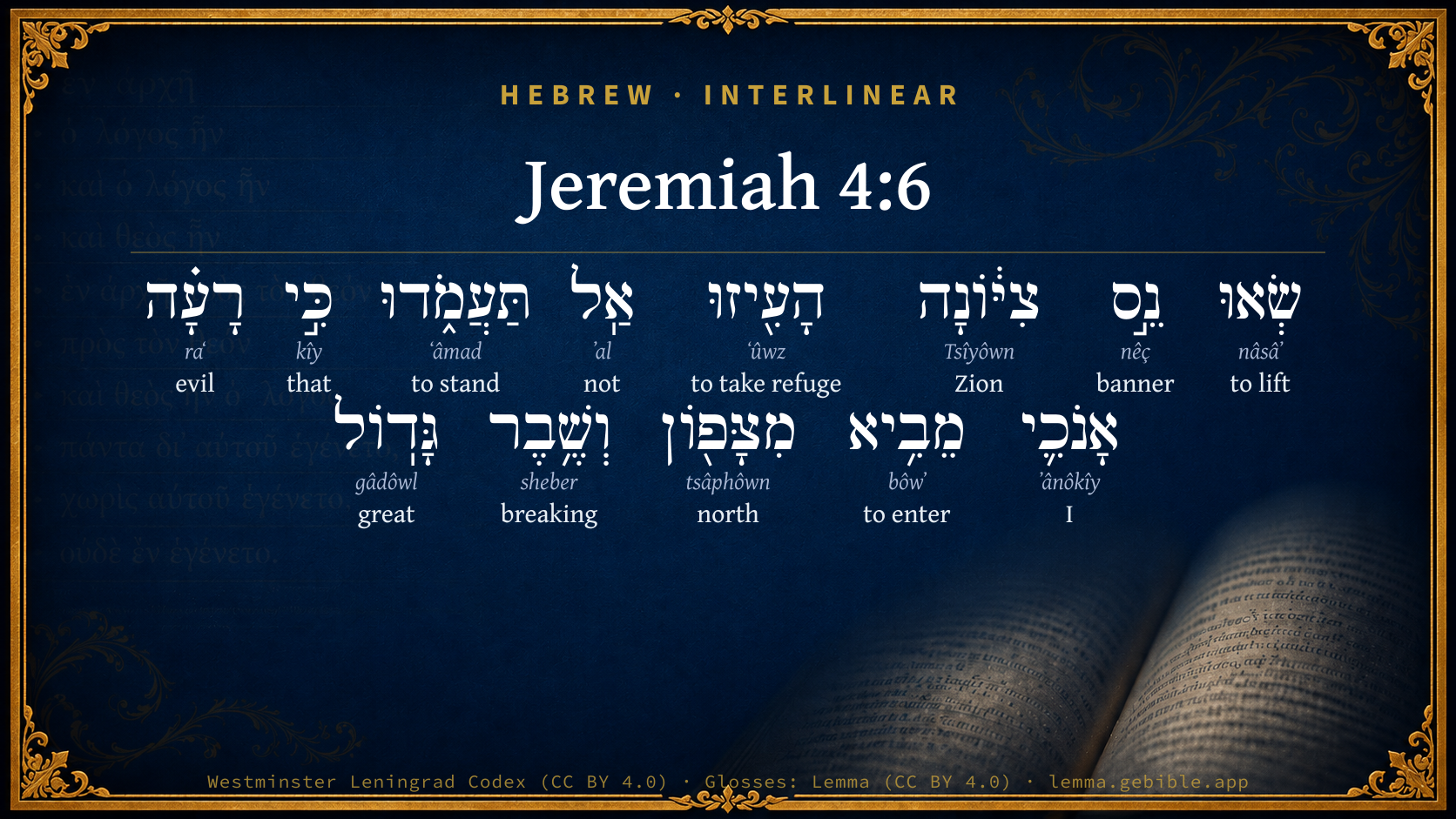
Hebrew (Westminster Leningrad Codex) Jeremiah 4:6 appears in the Hebrew Old Testament. The text above is from the Westminster Leningrad Codex. Each word links to its Strong’s number, a concise gloss, and parsing drawn from the Open Scriptures Hebrew Bible morphology. Click any word for its full Brown-Driver-Briggs (BDB) entry.
Download image
Cite this verse

Jeremiah 4:6 (World English Bible). Public Domain. Lemma interlinear Bible study tool, https://lemma.gebible.app/v/jeremiah/4/6.

Show BibTeX & RIS
BibTeX
RIS
English Translation
Set up a standard toward Zion: flee for safety, don't stay; for I will bring evil from the north, and a great destruction.
World English Bible · Public Domain
Download a study sheet

One document with this verse’s original text, its word-by-word gloss line, the meaning frame, cross-references with their text, attributed commentary, and full source and license credits — printable, and it pastes into notes with its structure intact.

This verse Autodidact and up

Study sheet (.html) Plain text (.txt)

A passage Seminary Student

Up to 50 verses in one chapter. A passage sheet keeps up to 6 commentary sources and 12 cross-references per verse, in the order this page ranks them, and says so on the sheet whenever that leaves anything out. Ask for a single verse and you get the Autodidact verse sheet above.

Everything on this page stays free to read, with no account — the sheet is a download of what is already on screen, not access to it.

Want to remove ads? Support Godless Engineer
Compare translations 3

The same verse in 3 English versions, stacked beneath the original-language interlinear above. Click any original word for its lexicon entry.

Each is an independent rendering of the whole verse — the interlinear is not word-aligned to these translations.

Highlighted words mark where these versions differ — a whole-verse word diff, not a word-by-word alignment.

  • World English Bible Public Domain
    Set up a standard toward Zion: flee for safety, don't stay; for I will bring evil from the north, and a great destruction.
  • King James Version Public Domain
    Set up the standard toward Zion: retire, stay not: for I will bring evil from the north, and a great destruction.
  • unfoldingWord Literal Text CC BY-SA 4.0
    Lift up a banner toward Zion, and bring yourself to safety, do not stand still! For I am bringing disaster from the north and a great collapse. ts\*

unfoldingWord Literal Text — © unfoldingWord, licensed CC BY-SA 4.0. Word-aligned USFM3 via Door43 (git.door43.org/unfoldingWord/en_ult).

Versions to compare (up to 4)

3 of 4 selected

Show all 18 translations

Every available English version of this verse, each an independent rendering of the whole verse.

  • World English Bible Public Domain
    Set up a standard toward Zion: flee for safety, don't stay; for I will bring evil from the north, and a great destruction.
  • Berean Standard Bible Public Domain
    Raise a signal flag toward Zion. Seek refuge! Do not delay! For I am bringing disaster from the north, and terrible destruction.
  • Majority Standard Bible Public Domain
    Raise a signal flag toward Zion. Seek refuge! Do not delay! For I am bringing disaster from the north, and terrible destruction.
  • King James Version Public Domain
    Set up the standard toward Zion: retire, stay not: for I will bring evil from the north, and a great destruction.
  • American Standard Version (1901) Public Domain
    Set up a standard toward Zion: flee for safety, stay not; for I will bring evil from the north, and a great destruction.
  • Revised Version (1885) Public Domain
    Set up a standard toward Zion: flee for safety, stay not: for I will bring evil from the north, and a great destruction.
  • Geneva Bible (1599) Public Domain
    Set vp the standart in Zion: prepare to flee, and stay not: for I will bring a plague from the North, and a great destruction.
  • Douay-Rheims (1899) Public Domain
    Set up the standard in Sion. Strengthen yourselves, stay not: for I bring evil from the north, and great destruction.
  • Young's Literal Translation Public Domain
    Lift up an ensign Zionward, Strengthen yourselves, stand not still, For evil I am bringing in from the north, And a great destruction.
  • Literal Standard Version CC BY-SA 4.0
    Lift up an ensign toward Zion, || Strengthen yourselves, do not stand still, || For I am bringing evil in from the north, || And a great destruction.”
  • Unlocked Literal Bible CC BY-SA 4.0
    Lift up the signal flag and point it toward Zion, and run for safety! Do not stay, for I am bringing disaster from the north and a great collapse.
  • unfoldingWord Literal Text CC BY-SA 4.0
    Lift up a banner toward Zion, and bring yourself to safety, do not stand still! For I am bringing disaster from the north and a great collapse. ts\*
  • Darby Bible Public Domain
    Set up a banner toward Zion; take to flight, stay not! For I am bringing evil from the north, and a great destruction.
  • World Messianic Bible Public Domain
    Set up a standard toward Zion. Flee for safety! Don’t wait; for I will bring evil from the north, and a great destruction.”
  • Webster's Bible Public Domain
    Set up the standard towards Zion: retire, stay not: for I will bring evil from the north, and a great destruction.
  • Free Bible Version CC BY-SA 4.0
    Raise the danger flag; go to Zion! Find somewhere safe! Don't hesitate! I'm bringing enemies from the north who will cause terrible destruction.
  • Bible in Basic English Public Domain
    Put up a flag for a sign to Zion: go in flight so that you may be safe, waiting no longer: for I will send evil from the north, and a great destruction.
  • JPS Tanakh (1917) Public Domain
    Set up a standard toward Zion; put yourselves under covert, stay not; for I will bring evil from the north, and a great destruction.

Literal Standard Version (2020), Covenant Press — licensed CC BY-SA 4.0. Text via the HelloAO Bible API (eBible.org). Unlocked Literal Bible (unfoldingWord) — licensed CC BY-SA 4.0. Text via the HelloAO Bible API (eBible.org). unfoldingWord Literal Text — © unfoldingWord, licensed CC BY-SA 4.0. Word-aligned USFM3 via Door43 (git.door43.org/unfoldingWord/en_ult). Free Bible Version, Dr. Jonathan Gallagher — licensed CC BY-SA 4.0. Text via the HelloAO Bible API (eBible.org).

Word by word

More ways to search: Search by grammar → Find every occurrence → Compare this word →

Practice this passage: Drill this verse → Learn its vocabulary →

הָעִ֖יזוּ
ʻûwz
H5756
“take refuge”
Verb, Hiphil, Imperative, 2nd Person, Masculine, Plural
Part of Speech
Verb
Stem
Hiphil
Form
Imperative
Person
2nd Person
Gender
Masculine
Number
Plural
Full BDB Definition

Origin: a primitive root

TWOT: 1578

(Hiphil) to take refuge, bring to refuge, seek refuge
  1. שְׂאוּ nâsâʼ H5375 “lift” Verb, Qal, Imperative, 2nd Person, Masculine, Plural
  2. נֵ֣ס nêç H5251 “banner” Noun, Common, Masculine, Singular, Absolute
  3. צִיּ֔וֹנָה Tsîyôwn H6726 “Zion · toward” Noun, Proper + Suffix, Demonstrative
  4. אַֽל ʼal H408 “not” Particle, Negative
  5. תַּעֲמֹ֑דוּ ʻâmad H5975 “to stand” Verb, Qal, Jussive, 2nd Person, Masculine, Plural
  6. כִּ֣י kîy H3588 “that” Conjunction
  7. רָעָ֗ה raʻ H7451 “evil” Noun, Common, Feminine, Singular, Absolute
  8. אָנֹכִ֛י ʼânôkîy H595 “I” Pronoun, Personal, 1st Person, Common, Singular
  9. מֵבִ֥יא bôwʼ H935 “entering” Verb, Hiphil, Participle Active, Masculine, Singular, Absolute
  10. מִצָּפ֖וֹן tsâphôwn H6828 “from · north” Preposition + Noun, Common, Feminine, Singular, Absolute
  11. וְשֶׁ֥בֶר sheber H7667 “and · breaking” Conjunction + Noun, Common, Masculine, Singular, Absolute
  12. גָּדֽוֹל gâdôwl H1419 “great” Adjective, Adjective, Masculine, Singular, Absolute

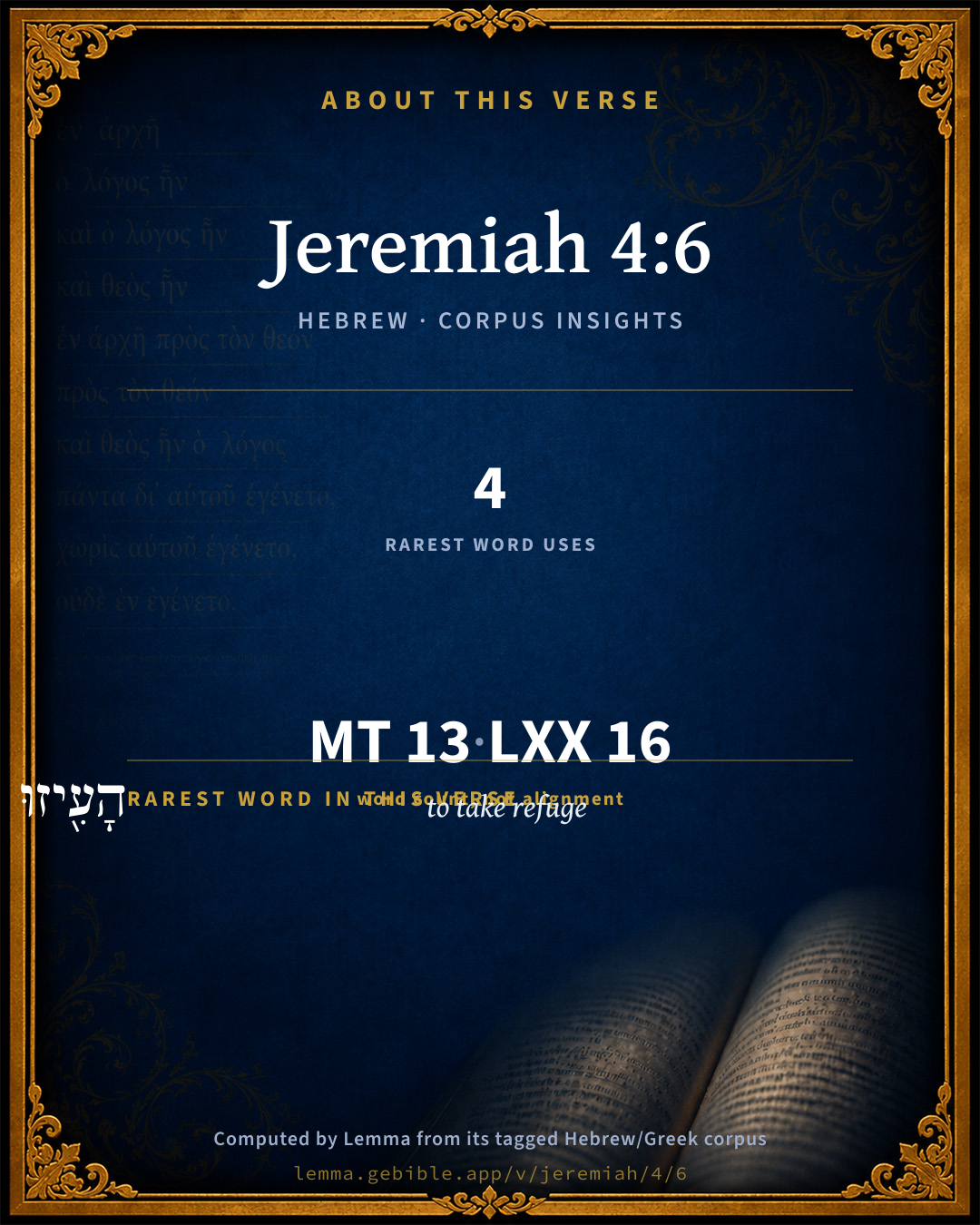
About this verse

These counts appear in no published source. They are computed here, from the morphology-tagged text and Lemma’s own curated glosses. What Lemma adds →

13
words
13
distinct lemmas
Prophets
section

Notable vocabulary

The rarest word here is הָעִ֖יזוּ to take refuge H5756 — appearing just 4 times in the whole Hebrew Bible.

Shared distinctive vocabulary

הָעִ֖יזוּ to take refuge H5756 occurs in 4 verses of the Hebrew Bible. Also found in:

Grammatical profile

  • 4 verbs
  • 5 nouns
  • 1 adjective
  • 1 pronoun
  • 1 conjunction
  • 1 particle

Verb forms

  • שְׂאוּ Qal · Imperative
  • הָעִ֖יזוּ Hiphil · Imperative
  • תַּעֲמֹ֑דוּ Qal · Jussive
  • מֵבִ֥יא Hiphil · Participle Active

Hebrew & Septuagint length

In the original languages it is 13 Hebrew tokens and 16 Greek tokens — but the two are counted differently (Hebrew bundles its prefixes and suffixes into one token; the Greek is in lemma form), so that isn’t a like-for-like length.

Cross-references

13

Topical passages linked to Jeremiah 4:6 in the Treasury of Scripture Knowledge — connected by theme and wording, ordered by reader-vote popularity; previews shown in the World English Bible.

  • Jeremiah 1:13–15 The word of Yahweh came to me the second time, saying, What see you? I said, I see a boiling caldron; and the face of it is from the north.
  • Jeremiah 50:2 Declare you among the nations and publish, and set up a standard; publish, and don't conceal: say, Babylon is taken, Bel is disappointed, Merodach is dismayed; her images are disappointed, her idols are dismayed.
  • Jeremiah 51:27 Set up a standard in the land, blow the trumpet among the nations, prepare the nations against her, call together against her the kingdoms of Ararat, Minni, and Ashkenaz: appoint a marshal against her; cause the horses to come up as the rough canker-worm.
  • Isaiah 62:10 Go through, go through the gates; prepare you the way of the people; cast up, cast up the highway; gather out the stones; lift up an ensign for the peoples.
  • Jeremiah 4:21 How long shall I see the standard, and hear the sound of the trumpet?
  • Jeremiah 6:1 Flee for safety, you children of Benjamin, out of the midst of Jerusalem, and blow the trumpet in Tekoa, and raise up a signal on Beth Haccherem; for evil looks forth from the north, and a great destruction.
  • Jeremiah 6:22 Thus says Yahweh, Behold, a people comes from the north country; and a great nation shall be stirred up from the uttermost parts of the earth.
  • Jeremiah 25:9 behold, I will send and take all the families of the north, says Yahweh, and [I will send] to Nebuchadrezzar the king of Babylon, my servant, and will bring them against this land, and against the inhabitants of it, and against all these nations round about; and I will utterly destroy them, and make them an astonishment, and a hissing, and perpetual desolations.
  • Jeremiah 51:12 Set up a standard against the walls of Babylon, make the watch strong, set the watchmen, prepare the ambushes; for Yahweh has both purposed and done that which he spoke concerning the inhabitants of Babylon.
  • Jeremiah 21:7 Afterward, says Yahweh, I will deliver Zedekiah king of Judah, and his servants, and the people, even such as are left in this city from the pestilence, from the sword, and from the famine, into the hand of Nebuchadrezzar king of Babylon, and into the hand of their enemies, and into the hand of those who seek their life: and he shall strike them with the edge of the sword; he shall not spare them, neither have pity, nor have mercy.
  • Jeremiah 50:22 A sound of battle is in the land, and of great destruction.
  • Jeremiah 51:54 The sound of a cry from Babylon, and of great destruction from the land of the Chaldeans!
  • Zephaniah 1:10 In that day, says Yahweh, there will be the noise of a cry from the fish gate, a wailing from the second quarter, and a great crashing from the hills.

Cross-references courtesy of OpenBible.info (CC BY 4.0).

Hebrew and Greek witnesses Masoretic Hebrew ↔ Greek Septuagint

The same verse in the two great witnesses to the Old Testament, shown verse-for-verse.

These are two independent witnesses, not word-aligned to each other, and the Septuagint is shown in lemma (dictionary) form.

Hebrew Jeremiah 4:6 Masoretic · Westminster Leningrad Codex

שְׂאוּ נֵ֣ס צִיּ֔וֹנָה הָעִ֖יזוּ אַֽל תַּעֲמֹ֑דוּ כִּ֣י רָעָ֗ה אָנֹכִ֛י מֵבִ֥יא מִצָּפ֖וֹן וְשֶׁ֥בֶר גָּדֽוֹל

Set up a standard toward Zion: flee for safety, don't stay; for I will bring evil from the north, and a great destruction.

World English Bible · Public Domain

Greek LXX Structure differs

In the Septuagint, Jeremiah is about an eighth shorter than the Hebrew and arranges its material differently — the Oracles Against the Nations (Hebrew chapters 46–51) appear in the middle of the Greek book, after 25:13. Because the chapter and verse boundaries do not line up, a verse-for-verse comparison with the Hebrew is not shown.

A verse-for-verse comparison isn’t shown here because the chapters and verses don’t line up. Switch to the LXX edition with the MT / LXX toggle above to read the Greek directly.

Hebrew: Westminster Leningrad Codex (CC BY 4.0). Greek: Septuagint (public domain); English from a public-domain English Septuagint. How the Septuagint differs from the Hebrew →

Targum (Aramaic paraphrase)

1

The Targum is the ancient Jewish Aramaic paraphrase of the Hebrew Scriptures — an interpretive translation, not the Hebrew text itself. Onkelos (literal) and Pseudo-Jonathan (expansive) render the Torah, and Jonathan the Prophets. Coverage is partial: where no permissively-licensed English translation exists for a verse, only the Aramaic is shown. This is verse-level text, not a word-by-word alignment to the Hebrew.

  1. Targum Jonathan Prophets (Joshua–Malachi)
    זְקוּפוּ אָתָא עַל צִיּוֹן גָלוֹ לָא תִתְעַכְּבוּן אֲרֵי בִישְׁתָא אֲנָא מַיְתֵי מִצִפּוּנָא וּתְבִירָא רַבָּא:

    (no public-domain English translation for this verse)

    Targum Jonathan — Aramaic: “Mikraot Gedolot” (public domain). English: “Sefaria Community Translation” (CC0 1.0 (public-domain dedication)); “London "Chaldee Paraphrase," 1871” (public domain). Text via Sefaria.

Commentary

Notes on Jeremiah 4:6 from classic Christian and Jewish commentators (each source and its license shown beneath its notes). The classic Christian expositions comment on the surrounding passage and are grouped to its opening verse, so a note may address several verses; the Jewish commentaries on the Tanakh (Rashi and others) are per-verse, so they appear only where the commentator wrote on this verse.

Lemma curates 59 commentaries, every one of them public domain or Creative Commons licensed, each selected and text-cleaned for this edition rather than reprinted as found. About our sources →

Trapp's Complete Commentary

John Trapp

Jer 4:6 Set up the standard toward Zion: retire, stay not: for I will bring evil from the north, and a great destruction.

Ver. 6. Set up the standard towards Zion.] All this seemeth to be ironically spoken. {as Jer 4:5}

For I will bring evil from the north,] i.e., From Babylon. Ab aquilone nihil boni. There is also another Babylon spoken of in the Revelation, which to the true Church hath of long time been lerna malorum; and so the poor persecuted Protestants in Poland feel at this day. Roma radix omnium malorum.

John Trapp, A Commentary or Exposition upon All the Books of the Old and New Testament (1647–1656) — public domain. Text from a community e-Sword module.

Geneva Bible (1599)

Geneva Bible translators

He speaketh this to admonish them of the great danger when every man shall prepare to save himself, but it shall be too late, 2 Kings 25:4.

Geneva Bible (1599) marginal notes — public domain. Text via Bolls.life.

Jamieson, Fausset & Brown

Robert Jamieson, A. R. Fausset & David Brown

Zion--The standard toward Zion intimated that the people of the surrounding country were to fly to it, as being the strongest of their fortresses.

Jamieson, Fausset & Brown — Commentary Critical and Explanatory on the Whole Bible (1871) — public domain (CC PDM 1.0). Text via the HelloAO Bible API.

Adam Clarke's Commentary

Verse 6. I will bring evil from the north] From the land of Chaldea.

Adam Clarke's Commentary on the Bible (1810–1826) — public domain. Text from a community e-Sword/MySword module.

John Calvin's Commentaries

The words אל-תעמדו, al-tomedu, may be explained in two ways, — “Stand not,” that is, “Hasten quickly,” as it is the case with those in extreme fear; or, “Ye shall not stand,” that is, “Though ye may seek a firm position on Mount Sion, ye shall not yet be able to continue there.” The first exposition appears to me the best, as it is more suitable to the context.

John Calvin's Commentaries (1540-1563) — public domain. Text from the Calvin Translation Society English edition (1840s-50s) via the Christian Classics Ethereal Library (ccel.org). Calvin's coverage is partial (roughly two-thirds of the Bible); uncommented books and verses are honest gaps, never fabricated. The 19th-century editor's footnotes and remarks are omitted so the notes are faithfully Calvin's own voice.

Ellicott's Commentary for English Readers

(6) Set up the standard toward Zion.—Still the language of alarm. The words are as a command, “Raise the signal which shall point to Zion as a place of refuge from the foe, by whom the rest of the country is laid waste.”

Retire.—Withdraw, in the transitive sense, “gather, with a view to removing” (as in Exo_9:19), and this is followed by “stay not,” linger not, be quick. The call to retreat was urgent.

I will bring.—Literally, I am bringing.

From the north.—The Chaldæan, and possibly the Scythian, invasion, as in Jer_1:14.

A Bible Commentary for English Readers, edited by Charles John Ellicott (1878–1897) — public domain. Text from a community e-Sword module.

The Cambridge Bible for Schools and Colleges

gen. ed. J. J. S. Perowne

6. Set up a standard] to guide those who were seeking to attain the shelter of the walls of Jerusalem.

flee] rather, make (your households) flee. Cp. mg. in Isa_10:31; and Exo_9:19 (“hasten in”).

from the north] See introd. note to the section.

destruction] For the alarm caused by the Scythians, see Introd. i. § 3.

The Cambridge Bible for Schools and Colleges (gen. ed. J. J. S. Perowne; Cambridge University Press, 1878–1918) — public domain. Text from a community e-Sword module.

John Gill's Exposition

Set up the standard toward Zion,.... Not on the tower of Zion, as Kimchi interprets it; but on some high place, pointing to Zion, and directing the country people to flee thither for safety; for the setting up of the standard here is not for enlisting of soldiers in order to fight, but as a sign of danger, and a direction where to flee from it:

retire; gather yourselves together in order to flee, as the word (p) is rendered in Isa 10:31, though some render it, "be ye strengthened" (q); take heart, and play the man; but this does not seem so agreeable to the context:

stay not; or, "stand not"; stand not in the place ye are in, but move from it in all haste, because of present danger:

for I will bring evil from the north; from Babylon, as Kimchi interprets it; which lay north to the land of Israel; and so designs the captivity Judah should be brought into there:

and a great destruction or, "breach" (r); which the Babylonians should make on the inhabitants of Judea and Jerusalem.

(p) "congregate vos, sub. ad fugiendum", Vatablus; "confirmate vos ad fugiendum", Piscator. (q) "Confortamini", V. L. "corroboramiui", Castalio; "agite viriliter", Munster. (r) "contritionem", Junius & Tremellius, Piscator; "confractionem", Cocceius.

John Gill's Exposition of the Whole Bible (1746–1763) — public domain (CC PDM 1.0). Text via the HelloAO Bible API.

Albert Barnes' Notes on the Bible

The standard - A flag or signal, to which the people were to rally.Retire, stay not - Rather, gather your goods together: linger not; “for I” (emphatic, Yahweh) am bringing at this very time etc.

Albert Barnes' Notes on the Bible (1834–1885) — public domain. Text from a community e-Sword/MySword module.

Matthew Poole's English Annotations

Set up the standard, i.e. for them to resort to, as is usual in war; and it is therefore said to he towards Zion or Jerusalem, as being a signal to show them whither they should repair; see Jer 1:5; Jerusalem being their principal place of strength, and Zion the strongest part of it, 2Sa 5:6,7.

Retire; or, strengthen; fortify or strengthen yourselves for the fight. Or rather, make haste away, as men use to do in a great fight, viz. for your security: such a use there is of the word Isa 10:31; Jer 6:1, which sense is confirmed by the next words,

stay not, or, as some, stay not yourselves in sin, where you promise yourselves security.

I will bring evil from the north, and a great destruction, i.e. I am about to bring a great destruction upon you from Chaldea, Jer 1:13-15. Some take this and the former verse to be spoken ironically.

Matthew Poole's English Annotations on the Holy Bible (1683–1685) — public domain. Text from a community e-Sword/MySword module.

Whedon's Commentary on the Bible

Daniel D. Whedon

6. Set up the standard — Making it point toward Zion, to show the route to a place of safety.

Daniel D. Whedon (gen. ed.), Commentary on the Old and New Testaments (1874–1909) — public domain. Text from a community e-Sword module.

The Pulpit Commentary

Set up the standard. The "standard" was a tall pole with a flag, pointing in the direction of Zion, for the guidance of fugitives. Retire, stay not; rather, save your goods by flight; linger not. The former verb occurs again in the same sense in Exo_9:19 Isa_10:31. From the north. The expression suits either the Scythians or the Chaldeans. (see Jer_1:14)

The Pulpit Commentary (1880–1919), ed. H.D.M. Spence-Jones & Joseph S. Exell — public domain. Text from a community e-Sword module.

John Wesley's Explanatory Notes

Retire - Make haste away.

John Wesley, Explanatory Notes Upon the Whole Bible (1754–1765) — public domain. Text via the GEBible commentary corpus.

Rashi

Rabbi Shlomo Yitzchaki (Rashi)

Raise a standard to flee to Zion.

assemble Heb. העיזו. Comp. “Send, gather (העז)” (Exodus 9:19).

Rashi on the Tanakh — English translations: “The Judaica Press complete Tanach with Rashi, translated by A. J. Rosenberg” (CC BY 4.0); “Pentateuch with Rashi's commentary by M. Rosenbaum and A.M. Silbermann, 1929-1934” (public domain); “The Metsudah Tanach series, Lakewood, N.J” (CC BY 4.0); and “The Book of Joshua, Metsudah Publications, 1997” (CC BY 4.0). Text via Sefaria.

Lesson kit

Teaching starters — assembled from the data on this page, not authored interpretation. Every prompt links to the verse data it draws on. Edit before teaching.

Jeremiah, in the Prophets, opens this verse with 13 words (13 distinct Hebrew lemmas). Its most distinctive word is ʻûwz (“to take refuge”). A historical commentator’s framing appears above. Read the whole chapter for the surrounding context.

Discussion questions

  1. The word ʻûwz carries the sense “to take refuge.” How does it shape the verse?
  2. How does Exodus 9:19, which shares the word «to take refuge», read alongside this verse?
  3. The translations on this page render this verse differently — a whole-verse word diff, not a word-by-word alignment. What might account for the different wordings?
  4. «שְׂאוּ» is a Qal Imperative verb. How does that grammatical form shape the action described?
  5. Compare how Trapp's Complete Commentary and Geneva Bible (1599) read this verse. Where do they agree or differ?

Things to notice

Reading settings

Reading text

Shown beneath each verse's original-language words.

Old Testament
Old Testament edition

Read the OT as the Masoretic Hebrew (MT) or the Greek Septuagint (LXX).

English shown for the Greek Septuagint (in the Hebrew ↔ Greek comparison).

Comparing translations? Open the Compare panel on any verse page to stack up to four side by side.