
Joel 3:21

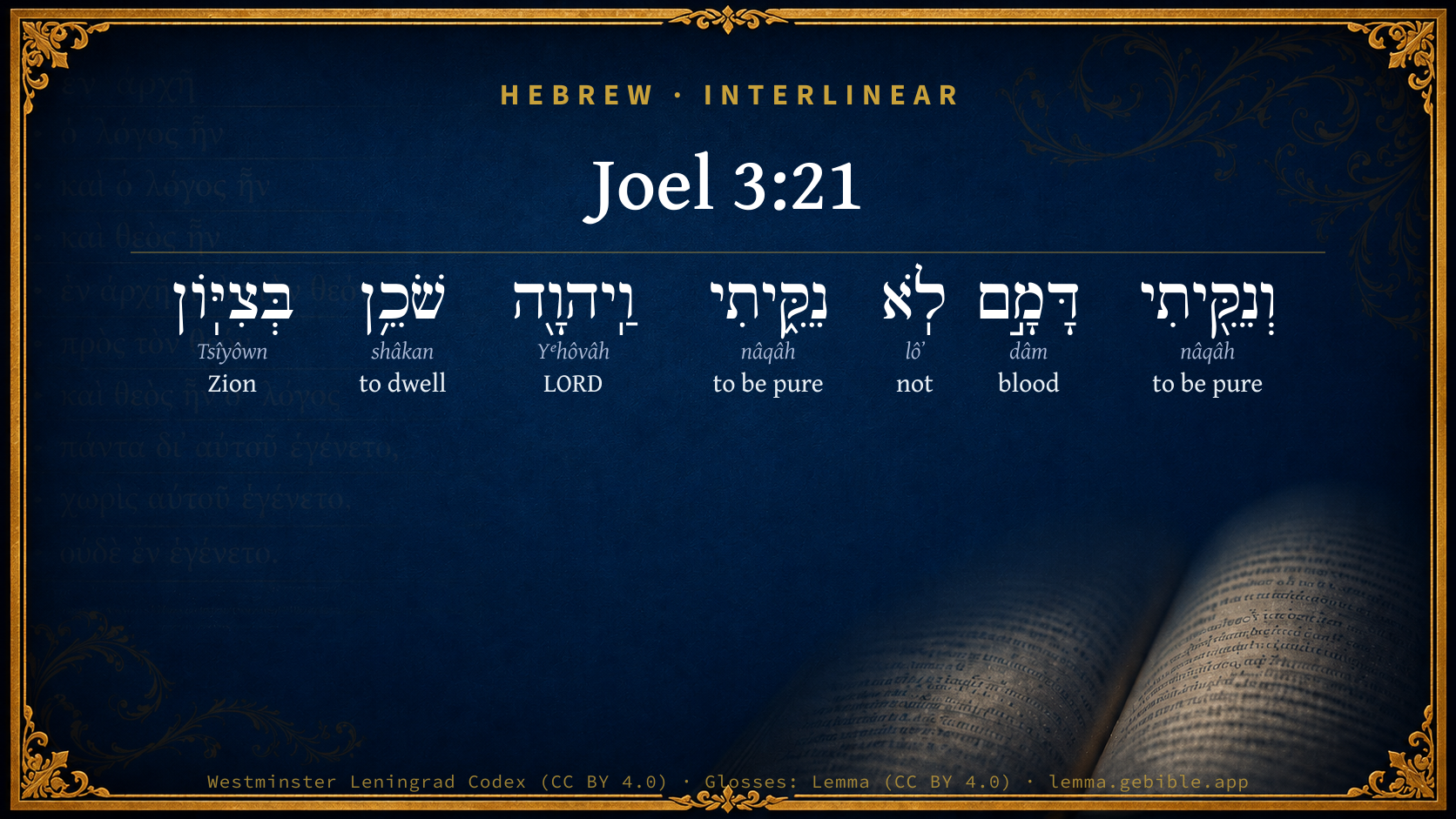
Hebrew (Westminster Leningrad Codex) Joel 3:21 appears in the Hebrew Old Testament. The text above is from the Westminster Leningrad Codex. Each word links to its Strong’s number, a concise gloss, and parsing drawn from the Open Scriptures Hebrew Bible morphology. Click any word for its full Brown-Driver-Briggs (BDB) entry.
Download image
Cite this verse

Joel 3:21 (World English Bible). Public Domain. Lemma interlinear Bible study tool, https://lemma.gebible.app/v/joel/3/21.

Show BibTeX & RIS
BibTeX
RIS
English Translation
I will cleanse their blood, That I have not cleansed: For Yahweh dwells in Zion."
World English Bible · Public Domain
Download a study sheet

One document with this verse’s original text, its word-by-word gloss line, the meaning frame, cross-references with their text, attributed commentary, and full source and license credits — printable, and it pastes into notes with its structure intact.

This verse Autodidact and up

Study sheet (.html) Plain text (.txt)

A passage Seminary Student

Up to 50 verses in one chapter. A passage sheet keeps up to 6 commentary sources and 12 cross-references per verse, in the order this page ranks them, and says so on the sheet whenever that leaves anything out. Ask for a single verse and you get the Autodidact verse sheet above.

Everything on this page stays free to read, with no account — the sheet is a download of what is already on screen, not access to it.

Want to remove ads? Support Godless Engineer
Compare translations 3

The same verse in 3 English versions, stacked beneath the original-language interlinear above. Click any original word for its lexicon entry.

Each is an independent rendering of the whole verse — the interlinear is not word-aligned to these translations.

Highlighted words mark where these versions differ — a whole-verse word diff, not a word-by-word alignment.

  • World English Bible Public Domain
    I will cleanse their blood, That I have not cleansed: For Yahweh dwells in Zion."
  • King James Version Public Domain
    For I will cleanse their blood that I have not cleansed: for the LORD dwelleth in Zion.
  • unfoldingWord Literal Text CC BY-SA 4.0
    And I will acquit their blood I have not acquitted, for Yahweh dwelling in Zion.”

unfoldingWord Literal Text — © unfoldingWord, licensed CC BY-SA 4.0. Word-aligned USFM3 via Door43 (git.door43.org/unfoldingWord/en_ult).

Versions to compare (up to 4)

3 of 4 selected

Show all 18 translations

Every available English version of this verse, each an independent rendering of the whole verse.

  • World English Bible Public Domain
    I will cleanse their blood, That I have not cleansed: For Yahweh dwells in Zion."
  • Berean Standard Bible Public Domain
    For I will avenge their blood, which I have not yet avenged.” For the LORD dwells in Zion.
  • Majority Standard Bible Public Domain
    For I will avenge their blood, which I have not yet avenged.” For the LORD dwells in Zion.
  • King James Version Public Domain
    For I will cleanse their blood that I have not cleansed: for the LORD dwelleth in Zion.
  • American Standard Version (1901) Public Domain
    And I will cleanse their blood, that I have not cleansed: for Jehovah dwelleth in Zion.
  • Revised Version (1885) Public Domain
    And I will cleanse their blood that I have not cleansed: for the LORD dwelleth in Zion.
  • Geneva Bible (1599) Public Domain
    For I will clense their blood, that I haue not clensed, and the Lord will dwell in Zion.
  • Douay-Rheims (1899) Public Domain
    And I will cleanse their blood which I had not cleansed: and the Lord will dwell in Sion.
  • Young's Literal Translation Public Domain
    And I have declared their blood innocent, `That' I did not declare innocent, And Jehovah is dwelling in Zion!
  • Literal Standard Version CC BY-SA 4.0
    And I have declared their blood innocent, || [That] I did not declare innocent, || And YHWH is dwelling in Zion!”
  • Unlocked Literal Bible CC BY-SA 4.0
    I will avenge their blood that I have not yet avenged, for Yahweh lives in Zion.”
  • unfoldingWord Literal Text CC BY-SA 4.0
    And I will acquit their blood I have not acquitted, for Yahweh dwelling in Zion.”
  • Darby Bible Public Domain
    And I will purge them from the blood from which I had not purged them: for Jehovah dwelleth in Zion.
  • World Messianic Bible Public Domain
    I will cleanse their blood that I have not cleansed, for the LORD dwells in Zion.”
  • Webster's Bible Public Domain
    \\3:16\\The LORD also will roar out of Zion, and utter his voice from Jerusalem; and the heavens and the earth shall shake; but the LORD will be the hope of his people, and the strength of the children of Israel.
  • Free Bible Version CC BY-SA 4.0
    Will I pardon and leave unpunished the shedding of innocent blood? The Lord lives in Zion!”
  • Bible in Basic English Public Domain
    And the Lord will be thundering from Zion, and his voice will be sounding from Jerusalem; and the heavens and the earth will be shaking: but the Lord will be a breastplate for his people and a strong place for the children of Israel.
  • JPS Tanakh (1917) Public Domain
    (4-21) And I will hold as innocent their blood that I have not held as innocent; and the LORD dwelleth in Zion.

Literal Standard Version (2020), Covenant Press — licensed CC BY-SA 4.0. Text via the HelloAO Bible API (eBible.org). Unlocked Literal Bible (unfoldingWord) — licensed CC BY-SA 4.0. Text via the HelloAO Bible API (eBible.org). unfoldingWord Literal Text — © unfoldingWord, licensed CC BY-SA 4.0. Word-aligned USFM3 via Door43 (git.door43.org/unfoldingWord/en_ult). Free Bible Version, Dr. Jonathan Gallagher — licensed CC BY-SA 4.0. Text via the HelloAO Bible API (eBible.org).

Word by word

More ways to search: Search by grammar → Find every occurrence → Compare this word →

Practice this passage: Drill this verse → Learn its vocabulary →

וְנִקֵּ֖יתִי
nâqâh
H5352
“and · to be pure”
Conjunction + Verb, Piel, Sequential Perfect, 1st Person, Common, Singular
Part of Speech
Conjunction + Verb
Stem
Piel
Form
Sequential Perfect
Person
1st Person
Gender
Common
Number
Singular
Full BDB Definition

Origin: a primitive root

TWOT: 1412

to be empty, be clear, be pure, be free, be innocent, be desolate, be cut off - (Qal) to be empty, be clean, be pure - (Niphal) - to be cleaned out, be purged out - to be clean, be free from guilt, be innocent - to be free, be exempt from punishment - to be free, be exempt from obligation - (Piel) - to hold innocent, acquit - to leave unpunished
  1. דָּמָ֣ם dâm H1818 “blood · their” Noun, Common, Masculine, Singular, Construct + Suffix, Personal, 3rd Person, Masculine, Plural
  2. לֹֽא lôʼ H3808 “not” Particle, Negative
  3. נִקֵּ֑יתִי nâqâh H5352 “to be pure” Verb, Piel, Perfect, 1st Person, Common, Singular
  4. וַֽיהוָ֖ה Yᵉhôvâh H3068 “and · LORD” Conjunction + Noun, Proper
  5. שֹׁכֵ֥ן shâkan H7931 “dwelling” Verb, Qal, Participle Active, Masculine, Singular, Absolute
  6. בְּצִיּֽוֹן Tsîyôwn H6726 “in/at · Zion” Preposition + Noun, Proper

About this verse

These counts appear in no published source. They are computed here, from the morphology-tagged text and Lemma’s own curated glosses. What Lemma adds →

7
words
6
distinct lemmas
Prophets
section

Shared distinctive vocabulary

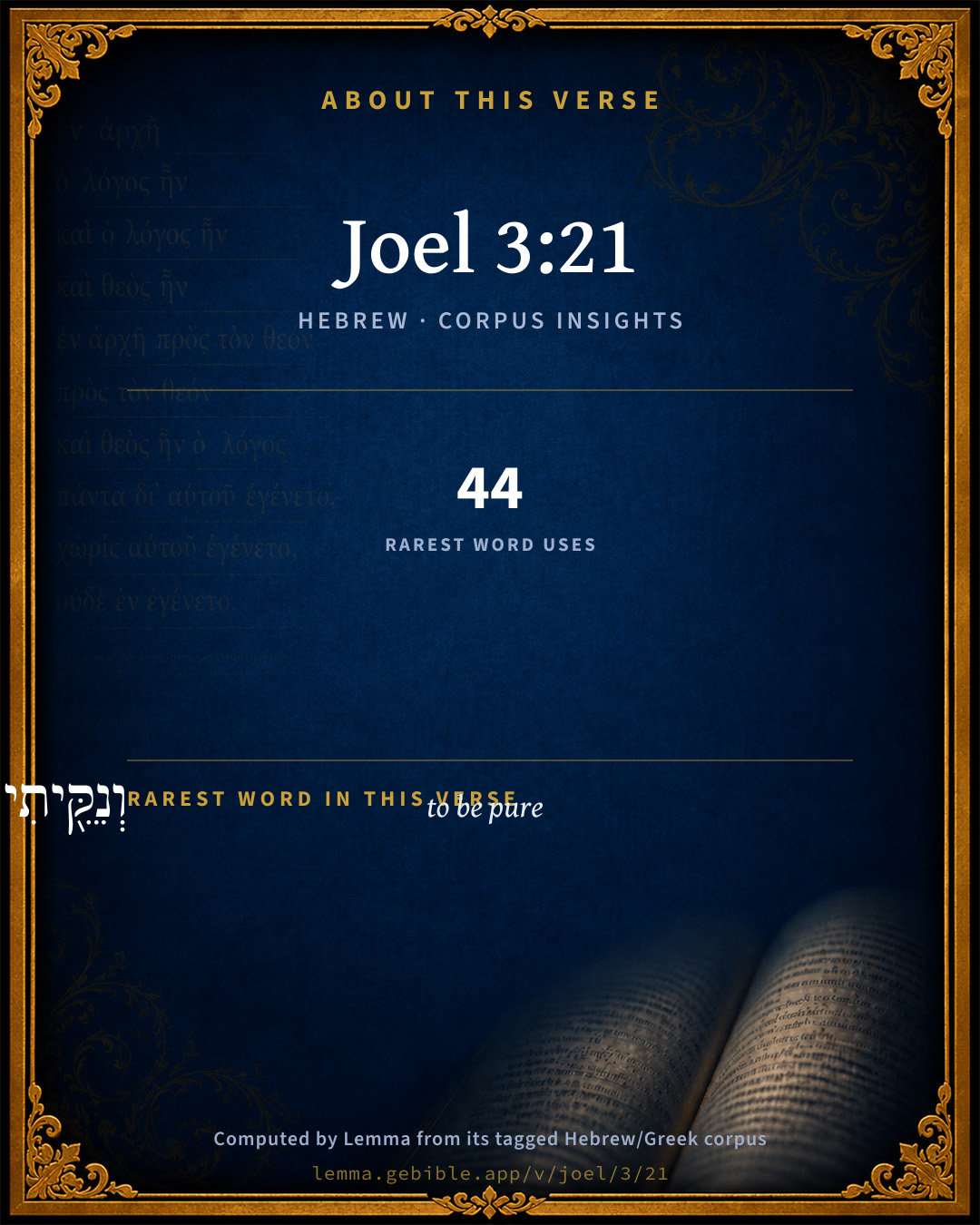
וְנִקֵּ֖יתִי to be pure H5352 occurs in 33 verses of the Hebrew Bible. Also found in:

Grammatical profile

  • 3 verbs
  • 3 nouns
  • 1 particle

Verb forms

  • וְנִקֵּ֖יתִי Piel · Sequential Perfect
  • נִקֵּ֑יתִי Piel · Perfect
  • שֹׁכֵ֥ן Qal · Participle Active

Repetition

A word recurs within this verse — often emphatic in Hebrew:

  • וְנִקֵּ֖יתִי to be pure H5352 ×2

Hebrew & Septuagint length

In English translation the verse runs 15 words from the Hebrew and 23 from the Septuagint (LXX English) — the Septuagint runs noticeably longer here. See the side-by-side →

A rough comparison of the two English renderings, which tokenize alike — not a word-level alignment.

Word counts can differ between the Hebrew and the Greek without any difference in meaning — e.g. the Hebrew direct-object marker אֵת has no separate Greek word, and Greek often adds the article ὁ.

Cross-references

6

Topical passages linked to Joel 3:21 in the Treasury of Scripture Knowledge — connected by theme and wording, ordered by reader-vote popularity; previews shown in the World English Bible.

  • Isaiah 4:4 when the Lord shall have washed away the filth of the daughters of Zion, and shall have purged the blood of Jerusalem from its midst, by the spirit of justice, and by the spirit of burning.
  • Ezekiel 36:25 I will sprinkle clean water on you, and you shall be clean: from all your filthiness, and from all your idols, will I cleanse you.
  • Revelation 21:3 I heard a loud voice out of heaven saying, "Behold, God's dwelling is with people, and he will dwell with them, and they will be his people, and God himself will be with them as their God.
  • Ezekiel 36:29 I will save you from all your uncleanness: and I will call for the grain, and will multiply it, and lay no famine on you.
  • Ezekiel 48:35 It shall be eighteen thousand [reeds] round about: and the name of the city from that day shall be, Yahweh is there.
  • Joel 3:17 "So you will know that I am Yahweh, your God, Dwelling in Zion, my holy mountain. Then Jerusalem will be holy, And no strangers will pass through her any more.

Cross-references courtesy of OpenBible.info (CC BY 4.0).

Hebrew and Greek witnesses Masoretic Hebrew ↔ Greek Septuagint

The same verse in the two great witnesses to the Old Testament, shown verse-for-verse.

Here the Septuagint runs noticeably longer than the Hebrew — LXX2012 (modern English Septuagint) 23 words vs World English Bible 15. A rough length comparison of the two English translations, not a word-level alignment — read both below.

These are two independent witnesses, not word-aligned to each other, and the Septuagint is shown in lemma (dictionary) form.

Hebrew Joel 3:21 Masoretic · Westminster Leningrad Codex

וְנִקֵּ֖יתִי דָּמָ֣ם לֹֽא נִקֵּ֑יתִי וַֽיהוָ֖ה שֹׁכֵ֥ן בְּצִיּֽוֹן

I will cleanse their blood, That I have not cleansed: For Yahweh dwells in Zion."

World English Bible · Public Domain

Greek LXX Joel 3:21 Septuagint · lemma form
And I will make inquisition for their blood, and will by no means leave it unavenged: and the Lord shall dwell in Sion.

LXX2012 (modern English Septuagint) · Public Domain

On this verse, Ellicott's Commentary for English Readers discusses the Septuagint’s reading. Read the note in Commentary ↓

Hebrew: Westminster Leningrad Codex (CC BY 4.0). Greek: Septuagint (public domain); English from LXX2012 (modern English Septuagint) (Public Domain). How the Septuagint differs from the Hebrew →

Commentary

Notes on Joel 3:21 from classic Christian and Jewish commentators (each source and its license shown beneath its notes). The classic Christian expositions comment on the surrounding passage and are grouped to its opening verse, so a note may address several verses; the Jewish commentaries on the Tanakh (Rashi and others) are per-verse, so they appear only where the commentator wrote on this verse.

Lemma curates 59 commentaries, every one of them public domain or Creative Commons licensed, each selected and text-cleaned for this edition rather than reprinted as found. About our sources →

Trapp's Complete Commentary

John Trapp

Joe 3:21 For I will cleanse their blood [that] I have not cleansed: for the LORD dwelleth in Zion.

Ver. 21. For I will cleanse their blood that I have not cleansed] i.e. I will clear their consciences from dead works, from the stain and sting of all sin, that they may not question their right to these precious promises, but boldly take the comfort of them. I will say unto them, Such were some of you, but ye are washed, but ye are justified, but ye are sanctified. Be of good cheer, therefore, since your sins, your bloody sins, are forgiven you. Or thus, "I will cleanse their blood," that is, I will declare that the blood of the godly, which the world thought to have been justly spilt, was indeed innocent blood, and that they were slain without cause. This I will do, partly by rooting out and damning their enemies, and partly by clearing their innocence, and crowning their constancy. Thus Mercer, Levely, &c.

For the Lord dwelleth in Zion] This is the last promise, but not the least. It referreth, saith Danaeus, to Christ taking our flesh, by the which he dwelt among us, being God manifest in the flesh, 1Ti 3:16 Joh 1:14, "The Word was made flesh, and dwelt among us, and we saw the glory thereof," &c. This is reserved to the last place, as the causa et cumulus felicitatis, especially since he dwelleth with his Church for ever, as it is in the precedent verse, and maketh her a true Jehovah Shammah, as she is called Eze 48:35.

John Trapp, A Commentary or Exposition upon All the Books of the Old and New Testament (1647–1656) — public domain. Text from a community e-Sword module.

Joseph Benson's Commentary

Joe 3:21. I will cleanse their blood, &c. — The word blood seems here to signify pollution in general; and the promise implies, that God would perfectly purge away the guilt and defilement of all the sins of his people, by a free pardon and entire sanctification. Calmet, who applies this to the times of the gospel, thus interprets the verse: “Jesus Christ cleanses, by the new law, the blood which remained unclean under the old. We find in the sacrament of the new law that real purity, of which the legal ceremonies and purifications were only a figure.” For the Lord dwelleth in Zion —

And his presence shall be a source of purity, as well as of consolation to his people. “It is uncertain,” says Archbishop Newcome, “whether we have the key to this difficult chapter; which may not be fully understood till Jerusalem is rebuilt, and till the prophecies, Eze 39:5; Eze 39:11; Rev 20:8-9, are accomplished.”

Joseph Benson's Commentary on the Old and New Testaments (1811–1818) — public domain. Text from a community e-Sword module.

Geneva Bible (1599)

Geneva Bible translators

He had suffered his Church hitherto to lie in their filthiness, but now he promiseth to cleanse them and to make them pure unto him.

Geneva Bible (1599) marginal notes — public domain. Text via Bolls.life.

Jamieson, Fausset & Brown

Robert Jamieson, A. R. Fausset & David Brown

cleanse . . . blood . . . not cleansed--I will purge away from Judah the extreme guilt (represented by "blood," the shedding of which was the climax of her sin, Isa 1:15) which was for long not purged away, but visited with judgments (Isa 4:4). Messiah saves from guilt, in order to save from punishment (Mat 1:21).

Next: Amos Introduction

Jamieson, Fausset & Brown — Commentary Critical and Explanatory on the Whole Bible (1871) — public domain (CC PDM 1.0). Text via the HelloAO Bible API.

Adam Clarke's Commentary

Verse 21. For I will cleanse their blood] נקיתי nikkeythi, I will avenge the slaughter and martyrdom of my people, which I have not yet avenged. Persecuting nations and persecuting Churches shall all come, sooner or later, under the stroke of vindictive justice.

For the Lord dwelleth in Zion.] He shall be the life, soul, spirit, and defense of his Church for ever.

THIS prophet, who has many things similar to Ezekiel, ends his prophecy nearly in the same way:

Ezekiel says of the glory of the Church, יהוה שמה Yehovah shammah, THE LORD IS THERE.

Joel says, יהוה שכן בציון Yehovah shochen betsiyon, THE LORD DWELLETH IN ZION.

Both point out the continued indwelling of Christ among his people.

Adam Clarke's Commentary on the Bible (1810–1826) — public domain. Text from a community e-Sword/MySword module.

John Calvin's Commentaries

The beginning of the verse is in various ways explained. Some make a stop after cleanse thus, “I will cleanse, yet their blood I will not cleanse;” as though God had said, that he would forgive heathen nations all their other wrongs, but could not forgive them the great cruelty they had exercised against his elect. So the sense would be, “Avarice may be borne, I could pass by robberies; but, since they slew my people, I am in this case wholly unforgiving.” Hence, according to this view, God shows how precious to him is the life of his saints, inasmuch as he says, that he will not be pacified towards those ungodly men who have shed innocent blood. But this sense seems rather too forced. Others render thus, “Their blood will I cleanse, and will not cleanse,” that is, “I will cleanse the Jews from their defilements, but I will not use extreme severity;” as he says also in Isaiah 48, ‘I will not refine thee as gold or silver, for thou wouldest turn all into dross.’ They hence think that God promises here such a cleansing of the Church, as that he would not use extreme rigor, but moderate his cleansing, as it is needful with regard to our defilements, of which we are all so full.

But this sense seems to me more simple, — that God would cleanse the blood which he had not cleansed; as though he said, “I have not hitherto cleansed the pollutions of my people; they are then become, as it were, putrid in their sins; but now I will begin to purify all their wickedness, that they may shine pure before me.” There is a relative understood as is often the case in Hebrew. But נקה neke is taken in Jeremiah 30:11, in another sense, that God will exterminate his Church: but we cannot in this place elicit any other meaning than that God will cleanse his Church from pollutions; for the Prophet, no doubt, means the defilements of which the people were full. They will not, then, be able to enjoy the favor of God while lying in their filth. Now God, in promising to be a Redeemer, comes to the very fountain and the first thing, — that he will wash away their filth; for how could God be the Redeemer of the people, except he blotted out their sins? For as long as he imputes sins to us, he must necessarily be angry with us, we must be necessarily altogether alienated from him and deprived of his blessing. He then does not say in vain that he will be a purifier; for when pollutions are cleansed, there follows another thing, which we have already noticed as to this, future redemption, and with this —

He at last concludes and says And Jehovah shall dwell in Zion. The Prophet recalls again the attention of the people to the covenant; as though he said, “God has willingly and bountifully promised all that has been mentioned, not because the people have deserved this, but because God has deigned long ago to adopt the children of Abraham, and has chosen mount Zion as his habitation.” He shows then this to be the reason why God was now inclined to mercy, and would save a people, who had a hundred times destroyed themselves by their sins.

John Calvin's Commentaries (1540-1563) — public domain. Text from the Calvin Translation Society English edition (1840s-50s) via the Christian Classics Ethereal Library (ccel.org). Calvin's coverage is partial (roughly two-thirds of the Bible); uncommented books and verses are honest gaps, never fabricated. The 19th-century editor's footnotes and remarks are omitted so the notes are faithfully Calvin's own voice.

Ellicott's Commentary for English Readers

(21) I will cleanse . . .—The LXX. translate this sentence, “I will avenge their blood, and not leave it unavenged”—i.e., the “innocent blood” mentioned in Joe_3:19; but the promise seems rather to indicate, as in the English Version, the extension of God’s pardon to those hitherto unpardoned.

The Lord dwelleth in Zion—i.e., over a raging and swelling world, probably unconscious of Him, the Lord nevertheless reigns in the heavenly Jerusalem, and all His redeemed shall dwell securely under His eternal rule. “And the name of the city from that day shall be Jehovah Shammah, the LORD IS THERE (Eze_48:35).

A Bible Commentary for English Readers, edited by Charles John Ellicott (1878–1897) — public domain. Text from a community e-Sword module.

The Cambridge Bible for Schools and Colleges

gen. ed. J. J. S. Perowne

21. And I will hold as innocent (R.V. marg.) their blood which I have not held as innocent] By the desolation of Egypt and Edom, Jehovah will shew openly that the murdered Judahites (Joe_3:19 b) had suffered innocently. So long, namely, as He permitted their blood to remain unavenged, it might be supposed that they had not been slain unjustly: but by the punishment of the murderers (i.e. here, by the desolation of their country) Jehovah declares (implicitly), what He had not declared before, that their blood was innocent (Joe_3:19 b), and had been unjustly shed. Niḳḳâh, to hold or declare innocent (Exo_20:7; Job_9:28 al.), is chosen on account of nâḳî’, innocent, in Joe_3:19.

and Jehovah dwelleth in Zion] and is here almost equivalent to as truly as: in corroboration of the promise made in the preceding clause, the prophet appeals to the indisputable truth that Jehovah’s dwelling-place is in Zion. So Hos_12:5 “and (= as truly as) Jehovah is the God of Hosts, Jehovah is his memorial (= name).”

The Cambridge Bible for Schools and Colleges (gen. ed. J. J. S. Perowne; Cambridge University Press, 1878–1918) — public domain. Text from a community e-Sword module.

John Gill's Exposition

For I will cleanse their blood which I have not cleansed,.... Which some understand, as the Targum, of the Lord's, inflicting further punishments on the, enemies of his people, for shedding their innocent blood; and that he will not expiate their sins, nor hold them guiltless, or suffer them to go unpunished; but rather this is to be interpreted in a way of grace and mercy, as a benefit bestowed on Judah and Jerusalem, who are the immediate antecedents to the relative here; and in the words a reason is given why they should dwell safely and peaceably for ever, because the Lord will justify them from their sins; forgive their iniquities; cleanse them from all their pollution, signified by blood; of which grace they will have had no application made to them till this time; but now all their guilt and faith will be removed; and particularly God will forgive, and declare to be forgiven their sin of crucifying Christ; whose blood they had imprecated upon themselves and their children, and which has remained on them; but now will be removed, with all the sad effects of it. Though this may also refer to the conversion of the Gentiles, and the pardon of their sins, and the sanctification of their persons, in such places and parts of the world, where such blessings of grace have not been bestowed in times past for many ages, if ever;

for the Lord dwelleth in Zion; and therefore will diffuse his grace, and spread the blessings of it all around: or "even the Lord that dwelleth in Zion" (d); he will do what is before promised; being the Lord, he can do it; and dwelling in Zion his church, it may be believed he will do it; and this will be for ever, when his Shechinah shall return thither in the days of the Messiah, as Kimchi observes.

(d) "even I the Lord", margin of our Bibles.

Next: Amos Introduction

John Gill's Exposition of the Whole Bible (1746–1763) — public domain (CC PDM 1.0). Text via the HelloAO Bible API.

Albert Barnes' Notes on the Bible

For I will cleanse her blood that I have not cleansed - The word rendered “cleansed” is not used of natural cleansing, nor is the image taken from the cleansing of the body. The word signifies only to pronounce innocent, or to free from guilt. Nor is “blood” used of sinfulness generally, but only of the actual guilt of shedding blood. The whole then cannot be an image taken from the cleansing of physical defilement, like the words in the prophet Ezekiel, “then washed I thee with water; yea, I thoroughly washed away thy blood from thee” Eze 16:9. Nor again can it mean the forgiveness of sins generally, but only the pronouncing innocent the blood which had been shed. This, the only meaning of the words, fall in with the mention of the “innocent blood,” for shedding which, Egypt and Edom had been condemned. The words are the same. There it was said, “because they have shed innocent blood; dam naki;” here, “I will pronounce innocent their blood, nikkethi damam.” “How,” it is not said. But the sentence on Egypt and Edom explains how God would do it, by punishing those who shed it. For in that He punishes the shedding of it, He declared the “blood” innocent, whose shedding He punished. So in the Revelation it is said, “I saw under the altar the souls of them that were slain for the word of God, and for the testimony which they held, and they cried with a loud voice, saying, How long, O Lord, holy and true, dost Thou not judge and avenge our blood on them that dwell on the earth?” Rev 6:10-11. : “Then, at the last judgment, when the truth in all things shall be made manifest, He shall “declare the blood” of His people, who clave to Him and His truth, which blood their enemies thought they had shed justly and deservedly as the blood of guilty persons, to have indeed been innocent, by absorbing them from eternal destruction to which He shall then adjudge their enemies for shedding of it.”

For - (literally and) the Lord dwelleth in Zion He closes with the promise of God’s abiding dwelling. He speaks, not simply of a future, but of an ever-abiding present. He who is, the unchangeable God , “the Lord, infinite in power and of eternal Being, who gives necessary being to all His purposes and promises,” dwelleth now in “Mount Zion, the city of the living God, the heavenly Jerusalem” (Heb 12:22; add Gal 4:26; Rev 3:12; Rev 14:1; Rev 21:2, Rev 21:10), now by grace and the presence of His Holy Spirit, hereafter in glory. Both of the Church militant on earth and that triumphant in heaven, it is truly to be said, that the Lord dwelleth in them, and that, perpetually. Of the Church on earth will be verified what our Saviour Christ saith, “lo I am with you always, even unto the end of the world” Mat 28:20; and of its members Paul saith, that “they” are “of the household of God, an holy temple in the Lord, in whom they are builded together for an habitation of God through the Spirit” Eph 2:19, Eph 2:21-22. Of the Church triumphant, there is no doubt, that “He” doth and will there dwell, and manifest His glorious presence forever, “in” whose “presence is the fullness of joy, and at His Right Hand” there are “pleasures for evermore” Psa 16:1-11 :12. It is an eternal dwelling of the Eternal, varied as to the way and degree of His presence by our condition, now imperfect, there perfected in Him; but He Himself dwelleth on for ever. He, the Unchangeable, dwelleth unchangeably; the Eternal, eternally.

: “Glorious things are spoken of thee, thou city of God” Psa 87:3 Jerusalem, our mother, we thy children now groan and weep in this valley of tears, hanging between hope and fear, and, amid toil and conflicts, “lifting up our eyes” to thee and greeting thee from far. Truly “glorious things are spoken of thee.” But whatever can be said, since it is said to people and in the words of people, is too little for the “good things” in thee, which “neither eye hath seen, nor ear heard, nor hath entered into the heart of man” 1Co 2:9. Great to us seem the things which we suffer; but one of thy most illustrious citizens, placed amid those sufferings, who knew something of thee, hesitated not to say, “Our light affliction, which is but for a moment, worketh out for us a far more exceeding and eternal weight of glory” 2Co 4:17. We will then “rejoice in hope,” and “by the waters of Babylon,” even while “we sit and weep,” we will “remember thee, O Zion. If I forget thee, O Jerusalem, may my right hand forget” her cunning. “Let my tongue cleave to the roof of my mouth, I do not remember thee, if I prefer not Jerusalem above my chief joy” Psa 137:1-9.

O blessed longed-for day, when we shall enter into the city of the saints, ‘whose light is the Lamb,’ where ‘the King is seen in His beauty,’ where ‘all tears are wiped off from the eyes’ of the saints, ‘and there shall be no more death neither sorrow nor pain, for the former things have passed away Rev 21:23; Isa 33:17; Rev 21:4. “How amiable are Thy tabernacle, O Lord of Hosts! My soul longeth, yea fainteth for the courts of the Lord; my heart and my flesh crieth out for the living God” Psa 84:1-2. “When shall I come and appear before God?” Psa 42:2, when shall I see that Father, whom I ever long for and never see, to whom out of this exile, I cry out, “Our Father, which art in heaven?” O true Father, “Father of our Lord Jesus Christ” (Rom 15:6, ...), “Father of mercies and God of all comfort!” 2Co 1:3. When shall ‘I see the Word, who was in the beginning with God,’ and who ‘is God?’ Joh 1:1. When may I kiss His sacred Feet, pierced for me, put my mouth to His sacred Side, sit at His Feet, never to depart from them? O Face, more Glorious than the sun! Blessed is he, who beholdeth Thee, who hath never ceased to say, ‘I shall see Him, but not now; I shall behold Him, but not nigh’ Num 24:17. When will the day come, when, cleansed from the defilement of my sins, I shall, ‘with unveiled face, behold the glory of the Lord’ 2Co 3:18, and see the sanctifying Spirit, the Author of all good, through whose sanctifying we are cleansed, that ‘we may be like Him, and see Him as He is?’ 1Jo 3:2. ‘Blessed are all they that dwell in Thy house,’ O Lord, ‘they shall ever praise Thee’ Psa 84:4; forever shall they behold Thee and love Thee.”

Albert Barnes' Notes on the Bible (1834–1885) — public domain. Text from a community e-Sword/MySword module.

Haydock's Catholic Bible Commentary

Which must be supplied in Hebrew. The Idumeans had been spared for a long time. But they shall not escape. (Chaldean, &c.) (Calmet) --- The rites of the law could not purify, as the sacraments of Christ do. (St. Jerome) --- God will cleanse his people, and will chastise the Ammonites, &c., who had injured them. Septuagint, "I will seek (or avenge) their blood, and will not pronounce innocent;" Greek: athooso. (Haydock) --- Sion, in heaven, (Menochius) and in the tabernacles of the Catholic Church, from the beginning of the world unto eternity. (Haydock)

George Leo Haydock (1774–1849), Haydock's Catholic Family Bible and Commentary, 1859 edition — public domain. Excludes Psalms (Douay-Rheims chapter numbering differs from Protestant) and Deuterocanonical books (Catholic canon only).

Matthew Poole's English Annotations

For, Heb. And.

Cleanse; purge away, both by the Spirit of sanctification, and by free pardon in the blood of the Redeemer; by their sufferings also, by the waters of affliction, as well as by the washing of regeneration and renewing of the Holy Ghost.

Their blood; their moral pollutions and sinfulness, compared here unto blood, as also Eze 16:6,9; and so men in sinful state are called flesh and blood, Mat 16:17; Gal 1:16. God will pardon and purify believers, and when they are pardoned and purified, nothing attempted against them shall succeed. That I have not cleansed; which before I had not taken away; what was wanting in their sanctification, or justification and reconciliation, I will make up in them and to them.

For the Lord dwelleth in Zion; and I am Jehovah dwelling in Zion, whence the law of grace was published, where the wonders of pardoning and sanctifying grace are wrought, that Israel might be a people with whom the holy God might dwell. Now whereas this can be done but in part here on earth, there is a Zion above, whither Jehovah who dwells there will take every saint after the day of judgment, having first vindicated, acquitted, and pronounced them holy and meet for enjoyment of the Holy One.

Matthew Poole's English Annotations on the Holy Bible (1683–1685) — public domain. Text from a community e-Sword/MySword module.

Whedon's Commentary on the Bible

Daniel D. Whedon

21. For I will cleanse their blood that I have not cleansed — The meaning is expressed more clearly in margin of R.V., “And I will hold (or, declare) as innocent their blood, that I have not declared innocent.” For [“And”]-Better, And so, that is, by the execution of judgment upon Edom and Egypt and the showering of abundant blessings upon Judah and Jerusalem. “I will declare as innocent” — The Hebrew is chosen with reference to the expression “innocent blood” in Joe_3:19 (compare Exo_20:7; Job_9:28). So long as Jehovah permitted the Jews to suffer and their enemies to prosper it might be supposed that the former had deserved all their afflictions; but the judgment sent as punishment upon the oppressors is decisive proof of the latter’s guilt, and so implies the innocence of the Jewish victims. The emendation of Nowack, “and I will avenge their blood, nor will I suffer (the enemies) to go unpunished,” is unnecessary. Jehovah dwelleth in Zion (Joe_2:27; Joe_3:17) — This clause does not state the reason why all the promises will be fulfilled — namely, because Jehovah is in Zion; nor is it a corroboration of the preceding promise: this shall come to pass as truly as Zion is the habitation of Jehovah; rather a reiteration of the greatest of all promises: The judgment executed, Jehovah will establish himself in Zion forever; never again will he forsake his people so that they become a reproach among their enemies.

The prophecy of Joel opens with a picture of utter hopelessness and despair; it closes with the promise that even the highest hopes of the most optimistic Jews shall be realized in all their fullness.

Daniel D. Whedon (gen. ed.), Commentary on the Old and New Testaments (1874–1909) — public domain. Text from a community e-Sword module.

John Wesley's Explanatory Notes

And I will cleanse - Purge away both by the spirit of sanctification and by free pardon in the blood of the redeemer. Their blood - Their sinfulness, which before I had not taken away.

John Wesley, Explanatory Notes Upon the Whole Bible (1754–1765) — public domain. Text via the GEBible commentary corpus.

Lesson kit

Teaching starters — assembled from the data on this page, not authored interpretation. Every prompt links to the verse data it draws on. Edit before teaching.

Joel, in the Prophets, opens this verse with 7 words (6 distinct Hebrew lemmas). Its most distinctive word is nâqâh (“to be pure”). The Greek Septuagint runs longer here. A historical commentator’s framing appears above. Read the whole chapter for the surrounding context.

Discussion questions

  1. The word nâqâh carries the sense “to be pure.” How does it shape the verse?
  2. Genesis 24:8 shares the word «to be pure» with this verse. How do the two illuminate each other?
  3. “to be pure” occurs 2× in this one verse. What is the effect of the repetition?
  4. Compared with the Hebrew, the Septuagint runs longer here. What questions does that raise?
  5. These translations render this verse differently; the difference is in the English rendering, not the original. What questions does that raise?
  6. The verb «וְנִקֵּ֖יתִי» is Piel Sequential Perfect. How does its form color the action?
  7. Reading how Trapp's Complete Commentary and Joseph Benson's Commentary read this verse, where do the two commentators agree and where do they part?

Things to notice

  • These translations choose different wording for 9 words in this verse.
  • “to be pure” occurs 2× in this single verse.
  • 6 distinct Hebrew lemmas span 7 words in this verse.

Reading settings

Reading text

Shown beneath each verse's original-language words.

Old Testament
Old Testament edition

Read the OT as the Masoretic Hebrew (MT) or the Greek Septuagint (LXX).

English shown for the Greek Septuagint (in the Hebrew ↔ Greek comparison).

Comparing translations? Open the Compare panel on any verse page to stack up to four side by side.