
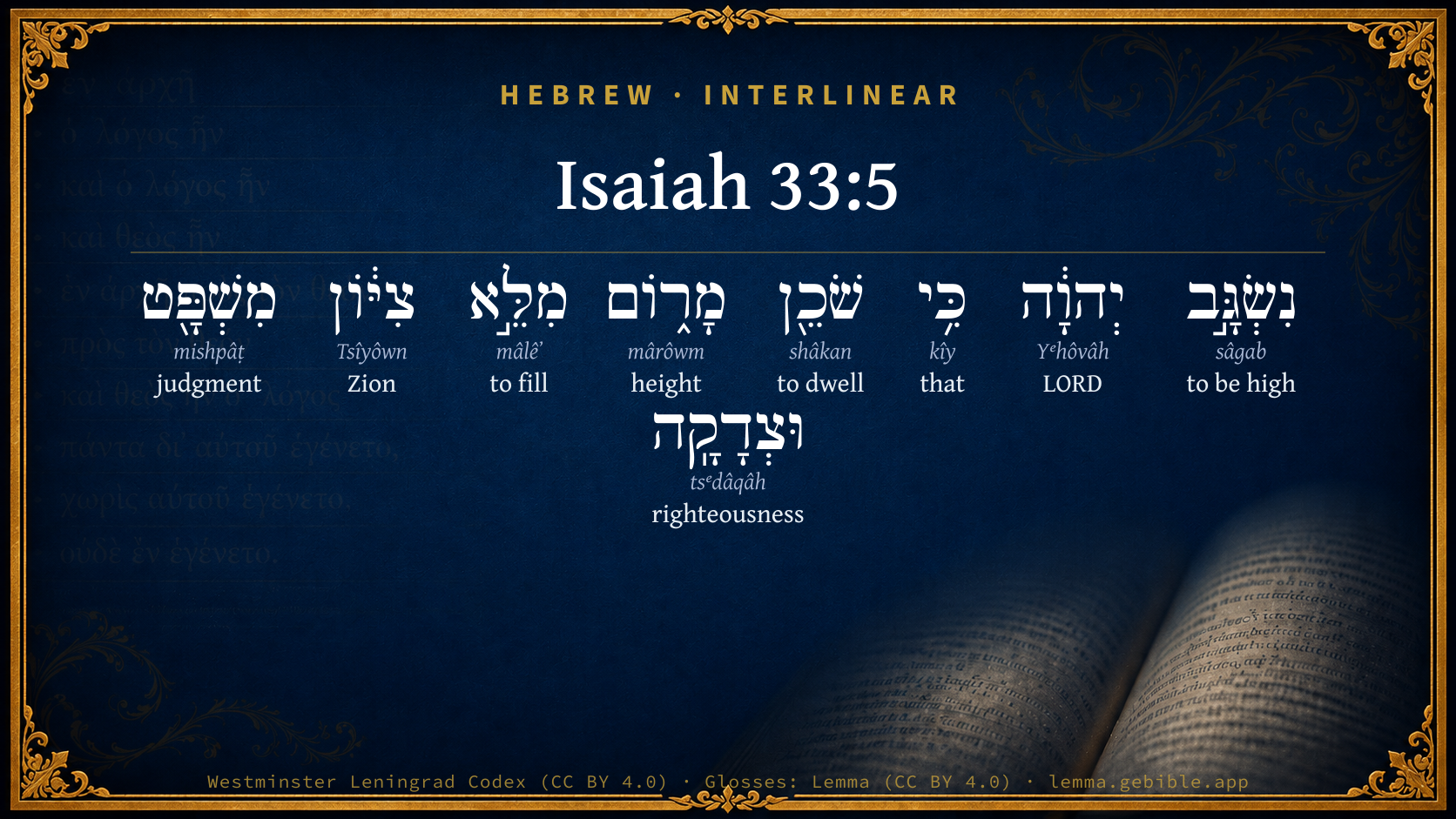
Isaiah 33:5

Hebrew (Westminster Leningrad Codex) Isaiah 33:5 appears in the Hebrew Old Testament. The text above is from the Westminster Leningrad Codex. Each word links to its Strong’s number, a concise gloss, and parsing drawn from the Open Scriptures Hebrew Bible morphology. Click any word for its full Brown-Driver-Briggs (BDB) entry.
Download image
Cite this verse

Isaiah 33:5 (World English Bible). Public Domain. Lemma interlinear Bible study tool, https://lemma.gebible.app/v/isaiah/33/5.

Show BibTeX & RIS
BibTeX
RIS
English Translation
Yahweh is exalted; for he dwells on high: he has filled Zion with justice and righteousness.
World English Bible · Public Domain
Download a study sheet

One document with this verse’s original text, its word-by-word gloss line, the meaning frame, cross-references with their text, attributed commentary, and full source and license credits — printable, and it pastes into notes with its structure intact.

This verse Autodidact and up

Study sheet (.html) Plain text (.txt)

A passage Seminary Student

Up to 50 verses in one chapter. A passage sheet keeps up to 6 commentary sources and 12 cross-references per verse, in the order this page ranks them, and says so on the sheet whenever that leaves anything out. Ask for a single verse and you get the Autodidact verse sheet above.

Everything on this page stays free to read, with no account — the sheet is a download of what is already on screen, not access to it.

Want to remove ads? Support Godless Engineer
Compare translations 3

The same verse in 3 English versions, stacked beneath the original-language interlinear above. Click any original word for its lexicon entry.

Each is an independent rendering of the whole verse — the interlinear is not word-aligned to these translations.

Highlighted words mark where these versions differ — a whole-verse word diff, not a word-by-word alignment.

  • World English Bible Public Domain
    Yahweh is exalted; for he dwells on high: he has filled Zion with justice and righteousness.
  • King James Version Public Domain
    The LORD is exalted; for he dwelleth on high: he hath filled Zion with judgment and righteousness.
  • unfoldingWord Literal Text CC BY-SA 4.0
    Yahweh is exalted, for he inhabits the height; he fills Zion justice and righteousness.

unfoldingWord Literal Text — © unfoldingWord, licensed CC BY-SA 4.0. Word-aligned USFM3 via Door43 (git.door43.org/unfoldingWord/en_ult).

Versions to compare (up to 4)

3 of 4 selected

Show all 18 translations

Every available English version of this verse, each an independent rendering of the whole verse.

  • World English Bible Public Domain
    Yahweh is exalted; for he dwells on high: he has filled Zion with justice and righteousness.
  • Berean Standard Bible Public Domain
    The LORD is exalted, for He dwells on high; He has filled Zion with justice and righteousness.
  • Majority Standard Bible Public Domain
    The LORD is exalted, for He dwells on high; He has filled Zion with justice and righteousness.
  • King James Version Public Domain
    The LORD is exalted; for he dwelleth on high: he hath filled Zion with judgment and righteousness.
  • American Standard Version (1901) Public Domain
    Jehovah is exalted; for he dwelleth on high: he hath filled Zion with justice and righteousness.
  • Revised Version (1885) Public Domain
    The LORD is exalted; for he dwelleth on high: he hath filled Zion with judgment and righteousness.
  • Geneva Bible (1599) Public Domain
    The Lord is exalted: for hee dwelleth on hie: he hath filled Zion with iudgement and iustice.
  • Douay-Rheims (1899) Public Domain
    The Lord is magnified, for he hath dwelt on high: he hath filled Sion with judgment and justice.
  • Young's Literal Translation Public Domain
    Set on high is Jehovah, for He is dwelling on high, He filled Zion `with' judgment and righteousness,
  • Literal Standard Version CC BY-SA 4.0
    YHWH is set on high, for He is dwelling on high, || He filled Zion [with] judgment and righteousness,
  • Unlocked Literal Bible CC BY-SA 4.0
    Yahweh is exalted. He lives in a high place. He will fill Zion with justice and righteousness.
  • unfoldingWord Literal Text CC BY-SA 4.0
    Yahweh is exalted, for he inhabits the height; he fills Zion justice and righteousness.
  • Darby Bible Public Domain
    Jehovah is exalted; for he dwelleth on high: he hath filled Zion with justice and righteousness;
  • World Messianic Bible Public Domain
    The LORD is exalted, for he dwells on high. He has filled Zion with justice and righteousness.
  • Webster's Bible Public Domain
    The LORD is exalted; for he dwelleth on high: he hath filled Zion with judgment and righteousness.
  • Free Bible Version CC BY-SA 4.0
    The Lord is praised for he lives in highest heaven; he has filled Zion with justice and right.
  • Bible in Basic English Public Domain
    The Lord is lifted up; his place is on high: he has made Zion full of righteousness and true religion.
  • JPS Tanakh (1917) Public Domain
    The LORD is exalted, for He dwelleth on high; He hath filled Zion with justice and righteousness.

Literal Standard Version (2020), Covenant Press — licensed CC BY-SA 4.0. Text via the HelloAO Bible API (eBible.org). Unlocked Literal Bible (unfoldingWord) — licensed CC BY-SA 4.0. Text via the HelloAO Bible API (eBible.org). unfoldingWord Literal Text — © unfoldingWord, licensed CC BY-SA 4.0. Word-aligned USFM3 via Door43 (git.door43.org/unfoldingWord/en_ult). Free Bible Version, Dr. Jonathan Gallagher — licensed CC BY-SA 4.0. Text via the HelloAO Bible API (eBible.org).

Word by word

More ways to search: Search by grammar → Find every occurrence → Compare this word →

Practice this passage: Drill this verse → Learn its vocabulary →

נִשְׂגָּ֣ב
sâgab
H7682
“being high”
Verb, Niphal, Participle Active, Masculine, Singular, Absolute
Part of Speech
Verb
Stem
Niphal
Form
Participle Active
Gender
Masculine
Number
Singular
State
Absolute
Full BDB Definition

Origin: a primitive root

TWOT: 2234

to be high, be inaccessibly high - (Qal) - to be (too) high (for capture) - to be high (of prosperity) - (Niphal) - to be high - to be set on high, be (safely) set on high - to be exalted (of God) - (Piel) - to set on high, set (securely) on high - to exalt, exalt (in effective hostility) - (Pual) to be set (securely) on high - (Hiphil) to act exaltedly
  1. יְהוָ֔ה Yᵉhôvâh H3068 “LORD” Noun, Proper
  2. כִּ֥י kîy H3588 “that” Conjunction
  3. שֹׁכֵ֖ן shâkan H7931 “dwelling” Verb, Qal, Participle Active, Masculine, Singular, Absolute
  4. מָר֑וֹם mârôwm H4791 “height” Noun, Common, Masculine, Singular, Absolute
  5. מִלֵּ֣א mâlêʼ H4390 “to fill” Verb, Piel, Perfect, 3rd Person, Masculine, Singular
  6. צִיּ֔וֹן Tsîyôwn H6726 “Zion” Noun, Proper
  7. מִשְׁפָּ֖ט mishpâṭ H4941 “judgment” Noun, Common, Masculine, Singular, Absolute
  8. וּצְדָקָֽה tsᵉdâqâh H6666 “and · righteousness” Conjunction + Noun, Common, Feminine, Singular, Absolute

About this verse

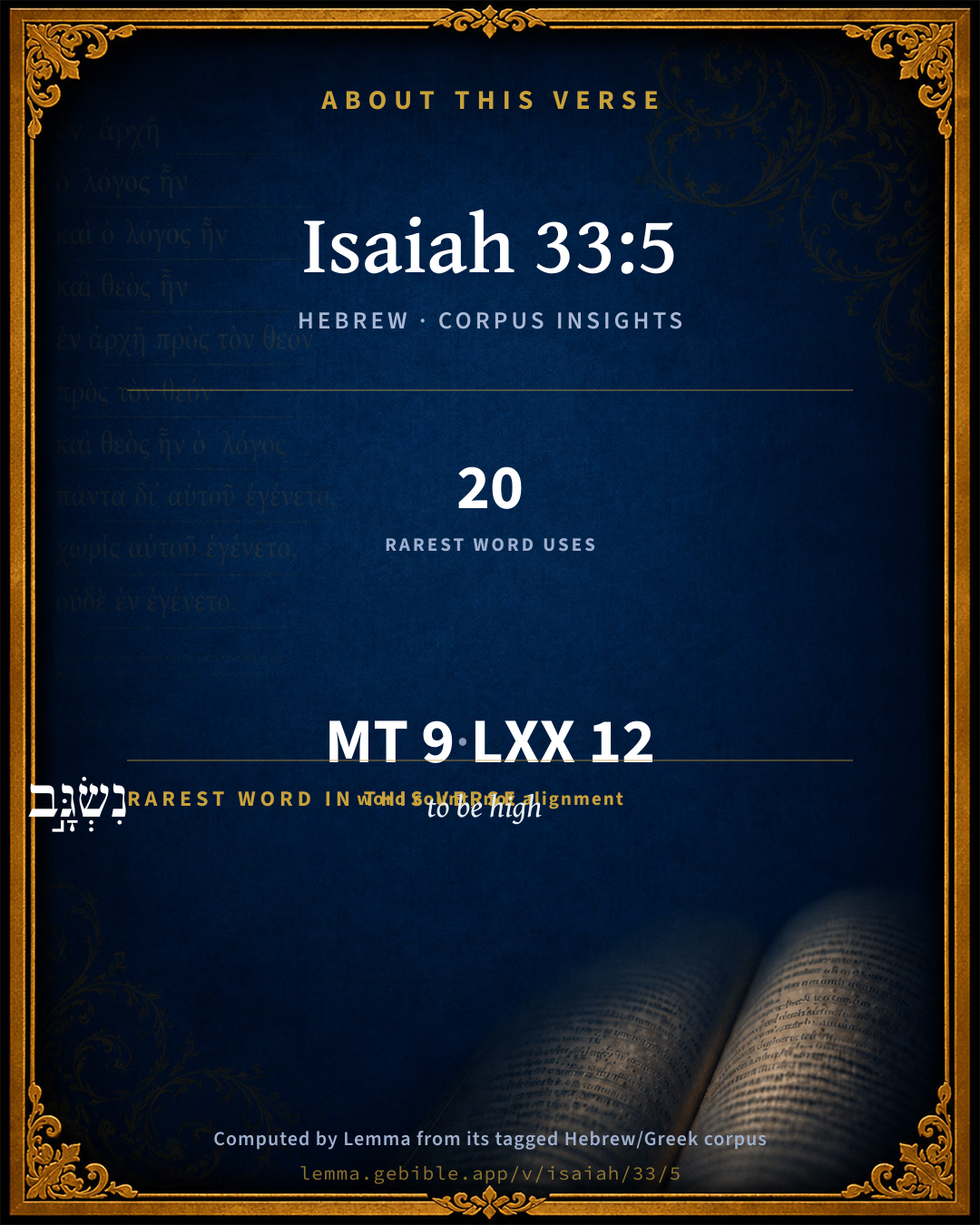
These counts appear in no published source. They are computed here, from the morphology-tagged text and Lemma’s own curated glosses. What Lemma adds →

9
words
9
distinct lemmas
Prophets
section

Notable vocabulary

The rarest word here is נִשְׂגָּ֣ב to be high H7682 — appearing just 20 times in the whole Hebrew Bible.

Shared distinctive vocabulary

נִשְׂגָּ֣ב to be high H7682 occurs in 20 verses of the Hebrew Bible. Also found in:

Grammatical profile

  • 3 verbs
  • 5 nouns
  • 1 conjunction

Verb forms

  • נִשְׂגָּ֣ב Niphal · Participle Active
  • שֹׁכֵ֖ן Qal · Participle Active
  • מִלֵּ֣א Piel · Perfect

Hebrew & Septuagint length

In English translation the verse runs 16 words from the Hebrew and 15 from the Septuagint (LXX English) — closely comparable.

A rough comparison of the two English renderings, which tokenize alike — not a word-level alignment.

Word counts can differ between the Hebrew and the Greek without any difference in meaning — e.g. the Hebrew direct-object marker אֵת has no separate Greek word, and Greek often adds the article ὁ.

In the original languages it is 9 Hebrew tokens and 12 Greek tokens — but the two are counted differently (Hebrew bundles its prefixes and suffixes into one token; the Greek is in lemma form), so that isn’t a like-for-like length.

Cross-references

35

Topical passages linked to Isaiah 33:5 in the Treasury of Scripture Knowledge — connected by theme and wording, ordered by reader-vote popularity; previews shown in the World English Bible.

  • Isaiah 2:17 The loftiness of man shall be bowed down, And the haughtiness of men shall be brought low; And Yahweh alone shall be exalted in that day.
  • Isaiah 32:15–18 until the Spirit be poured on us from on high, and the wilderness become a fruitful field, and the fruitful field be esteemed as a forest.
  • Daniel 4:37 Now I, Nebuchadnezzar, praise and extol and honor the King of heaven; for all his works are truth, and his ways justice; and those who walk in pride he is able to abase.
  • Romans 11:26 and so all Israel will be saved. Even as it is written, "There will come out of Zion the Deliverer, And he will turn away ungodliness from Jacob.
  • Ephesians 1:20–21 which he worked in Christ, when he raised him from the dead, and made him to sit at his right hand in the heavenly places,
  • Revelation 19:2–6 for true and righteous are his judgments. For he has judged the great prostitute, who corrupted the earth with her sexual immorality, and he has avenged the blood of his servants at her hand."
  • Exodus 9:16–17 but indeed for this cause I have made you stand: to show you my power, and that my name may be declared throughout all the earth;
  • Exodus 15:1 Then Moses and the children of Israel sang this song to Yahweh, and said, "I will sing to Yahweh, for he has triumphed gloriously: The horse and his rider he has thrown into the sea.
  • Exodus 15:6 Your right hand, Yahweh, is glorious in power, Your right hand, Yahweh, dashes the enemy in pieces.
  • Exodus 18:11 Now I know that Yahweh is greater than all gods because of the thing in which they dealt arrogantly against them."
  • 2 Chronicles 31:20–21 Thus did Hezekiah throughout all Judah; and he worked that which was good and right and faithful before Yahweh his God.
  • Job 40:9–14 Or have you an arm like God? Can you thunder with a voice like him?
  • Psalms 21:11–13 For they intended evil against you. They plotted evil against you which cannot succeed.
  • Psalms 46:9–10 He makes wars cease to the end of the earth. He breaks the bow, and shatters the spear. He burns the chariots in the fire.
  • Psalms 97:8–9 Zion heard and was glad. The daughters of Judah rejoiced, Because of your judgments, Yahweh.
  • Psalms 113:5–6 Who is like Yahweh, our God, Who has his seat on high,
  • Psalms 115:1–2 Not to us, Yahweh, not to us, But to your name give glory, For your loving kindness, and for your truth's sake.
  • Psalms 118:16 The right hand of Yahweh is exalted! The right hand of Yahweh does valiantly!"
  • Psalms 123:1 To you I do lift up my eyes, You who sit in the heavens.
  • Isaiah 1:26–27 I will restore your judges as at the first, And your counselors as at the beginning. Afterward you shall be called 'The city of righteousness, A faithful town.'
  • Isaiah 2:11 The lofty looks of man will be brought low, The haughtiness of men will be bowed down, And Yahweh alone will be exalted in that day.
  • Isaiah 4:2–4 In that day, Yahweh's branch will be beautiful and glorious, and the fruit of the land will be the beauty and glory of the survivors of Israel.
  • Isaiah 12:4 In that day you will say, "Give thanks to Yahweh! Call on his name. Declare his doings among the peoples. Proclaim that his name is exalted!
  • Isaiah 28:6 and a spirit of justice to him who sits in judgment, and strength to those who turn back the battle at the gate.
  • Isaiah 32:1 Behold, a king shall reign in righteousness, and princes shall rule in justice.
  • Isaiah 33:10 Now will I arise, says Yahweh; now will I lift up myself; now will I be exalted.
  • Isaiah 37:20 Now therefore, Yahweh our God, save us from his hand, that all the kingdoms of the earth may know that you are Yahweh, even you only.
  • Isaiah 54:11–14 you afflicted, tossed with tempest, and not comforted, behold, I will set your stones in beautiful colors, and lay your foundations with sapphires.
  • Isaiah 57:15 For thus says the high and lofty One who inhabits eternity, whose name is Holy: I dwell in the high and holy place, with him also who is of a contrite and humble spirit, to revive the spirit of the humble, and to revive the heart of the contrite.
  • Isaiah 60:21 Your people also shall be all righteous; they shall inherit the land forever, the branch of my planting, the work of my hands, that I may be glorified.
  • Isaiah 61:3 to appoint to those who mourn in Zion, to give to them a garland for ashes, the oil of joy for mourning, the garment of praise for the spirit of heaviness; that they may be called trees of righteousness, the planting of Yahweh, that he may be glorified.
  • Isaiah 61:11–62:1 For as the earth brings forth its bud, and as the garden causes the things that are sown in it to spring forth; so the Lord Yahweh will cause righteousness and praise to spring forth before all the nations.
  • Isaiah 66:1 Thus says Yahweh, heaven is my throne, and the earth is my footstool: what manner of house will you build to me? and what place shall be my rest?
  • Romans 3:26 to demonstrate his righteousness at this present time; that he might himself be just, and the justifier of him who has faith in Jesus.
  • Isaiah 52:1 Awake, awake, put on your strength, Zion; put on your beautiful garments, Jerusalem, the holy city: for henceforth there shall no more come into you the uncircumcised and the unclean.

Cross-references courtesy of OpenBible.info (CC BY 4.0).

Hebrew and Greek witnesses Masoretic Hebrew ↔ Greek Septuagint

The same verse in the two great witnesses to the Old Testament, shown verse-for-verse.

These are two independent witnesses, not word-aligned to each other, and the Septuagint is shown in lemma (dictionary) form.

Hebrew Isaiah 33:5 Masoretic · Westminster Leningrad Codex

נִשְׂגָּ֣ב יְהוָ֔ה כִּ֥י שֹׁכֵ֖ן מָר֑וֹם מִלֵּ֣א צִיּ֔וֹן מִשְׁפָּ֖ט וּצְדָקָֽה

Yahweh is exalted; for he dwells on high: he has filled Zion with justice and righteousness.

World English Bible · Public Domain

Greek LXX Isaiah 33:5 Septuagint · lemma form

ἅγιος ὁ θεός ὁ καταοἱκέω ἐν ὑψηλός ἐνπίμπλημι σιων κρίσις καί δικαιοσύνη

The God who dwells on high is holy: Sion is filled with judgment and righteousness.

LXX2012 (modern English Septuagint) · Public Domain

Hebrew: Westminster Leningrad Codex (CC BY 4.0). Greek: Septuagint (public domain); English from LXX2012 (modern English Septuagint) (Public Domain). How the Septuagint differs from the Hebrew →

Targum (Aramaic paraphrase)

1

The Targum is the ancient Jewish Aramaic paraphrase of the Hebrew Scriptures — an interpretive translation, not the Hebrew text itself. Onkelos (literal) and Pseudo-Jonathan (expansive) render the Torah, and Jonathan the Prophets. Coverage is partial: where no permissively-licensed English translation exists for a verse, only the Aramaic is shown. This is verse-level text, not a word-by-word alignment to the Hebrew.

  1. Targum Jonathan Prophets (Joshua–Malachi)
    תַּקִיף יְיָ דְאַשְׁרֵי שְׁכִינְתֵּהּ בִּשְׁמֵי מְרוֹמָא דַאֲמַר לְמִמְלֵי צִיוֹן עָבְדֵי דִין דִקְשׁוֹט וּזְכוּ:

    Mighty is the Lord who maketh His Shekinah to dwell in the highest heavens, who hath promised to fill Zion with them that do true justice and righteousness.

    Targum Jonathan — Aramaic: “Mikraot Gedolot” (public domain). English: “Sefaria Community Translation” (CC0 1.0 (public-domain dedication)); “London "Chaldee Paraphrase," 1871” (public domain). Text via Sefaria.

Commentary

Notes on Isaiah 33:5 from classic Christian and Jewish commentators (each source and its license shown beneath its notes). The classic Christian expositions comment on the surrounding passage and are grouped to its opening verse, so a note may address several verses; the Jewish commentaries on the Tanakh (Rashi and others) are per-verse, so they appear only where the commentator wrote on this verse.

Lemma curates 59 commentaries, every one of them public domain or Creative Commons licensed, each selected and text-cleaned for this edition rather than reprinted as found. About our sources →

Trapp's Complete Commentary

John Trapp

Isa 33:5 The LORD is exalted; for he dwelleth on high: he hath filled Zion with judgment and righteousness.

Ver. 5. The Lord is exalted.] He hath made him a name, gained abundance of honour.

For he dwelleth on high.] Whence he can pour down plagues at his pleasure on his proud enemies, and fill Zion with judgment and righteousness.

John Trapp, A Commentary or Exposition upon All the Books of the Old and New Testament (1647–1656) — public domain. Text from a community e-Sword module.

Joseph Benson's Commentary

Isa 33:5-6. The Lord is exalted — By the destruction of so potent an army, and by the defence of his people. For he dwelleth on high — He is, and will appear to be, superior to his enemies, both in place and power. He dwelleth in heaven, whence he can easily and irresistibly pour down judgments upon his enemies. He hath fulfilled — Or, he will fill Zion —

Or Jerusalem; with judgment and righteousness — That is, either, 1st, With a glorious instance of his just judgment against the Assyrians; or, 2d, With the execution of justice by good Hezekiah, and the practice of righteousness among the people, as before the same city was filled with impiety and injustice under Ahaz. The city shall not only be delivered from that wicked enemy, but shall also be established and blessed with true religion and righteousness; which was a great addition to that mercy. And wisdom and knowledge — To govern thyself and the people well. The words seem to be addressed to Hezekiah, either by the prophet, or, as Bishop Lowth thinks, by a chorus of the Jews. Shall be the stability of thy times — Of thy reign; times being often put for the things done in those times, The sense is, thy throne shall be established upon the sure foundations of wisdom and justice; and strength of salvation — Thy saving strength, or thy strong and mighty salvation. The fear of the Lord is his treasure — Thy chief treasure and delight shall be in promoting the fear and worship of God, which shall be a great honour and safeguard to thyself and people.

Joseph Benson's Commentary on the Old and New Testaments (1811–1818) — public domain. Text from a community e-Sword module.

Keil & Delitzsch

C. F. Keil & F. Delitzsch

The prophet sees this as he prays, and now feasts himself on the consequences of this victory of Jehovah, prophesying in Isa 33:5, Isa 33:6 : "Jehovah is exalted; for, dwelling on high, He has filled Zion with justice and righteousness. And there will be security of thy times, riches of salvation, of wisdom, and knowledge. Fear of Jehovah is then the treasure of Judah." Exalted: for though highly exalted in Himself, He has performed an act of justice and righteousness, with the sight and remembrance of which Zion is filled as with an overflowing rich supply of instruction and praise. A new time has dawned for the people of Judah. The prophet addresses them in Isa 33:6; for there is nothing to warrant us in regarding the words as addressed to Hezekiah. To the times succeeding this great achievement there would belong 'emūnâh, i.e., (durability (Exo 17:12) - a uniform and therefore trustworthy state of things (compare Isa 39:8, "peace and truth"). Secondly, there would also belong to them חסן, a rich store of salvation, wisdom, and knowledge (compare the verb in Isa 23:18). We regard these three ideas as all connected with chōsen. The prophet makes a certain advance towards the unfolding of the seven gifts in Isa 11:2, which are implied in "salvation;" but he hurries at once to the lowest of them, which forms the groundwork of all the rest, when he says, thirdly, that the fear of Jehovah will be the people's treasure. The construct form, chokhmath, instead of chokhmâh, is a favourite one, which Isaiah employs, even apart from the genitive relation of the words, for the purpose of securing a closer connection, as Isa 35:2; Isa 51:21 (compare pârash in Eze 26:10), clearly show. In the case before us, it has the further advantage of consonance in the closing sound.

Keil & Delitzsch — Biblical Commentary on the Old Testament (1861–1891) — public domain (CC PDM 1.0). Text via the HelloAO Bible API. (Old Testament only.)

Ellicott's Commentary for English Readers

(5) The Lord is exalted . . .—The vision of the seer takes in the ideal city of God, Jehovah dwelling on high in His holy Temple, the city at last filled with “judgment and righteousness.”

A Bible Commentary for English Readers, edited by Charles John Ellicott (1878–1897) — public domain. Text from a community e-Sword module.

The Cambridge Bible for Schools and Colleges

gen. ed. J. J. S. Perowne

5. judgment and righteousness can mean nothing else than personal and civic virtues in the inhabitants of the city. Isaiah could not have written thus of the Jerusalem he knew (cf. Isa_1:21); if he is the author the words must express a vivid anticipation of the great change in the national character which is now on the eve of accomplishment.

5, 6. The writer draws encouragement from two thoughts: (1) from the nature of Israel’s God; He is a spiritual Being, dwelling on high, beyond the reach of His enemies: (2) from the spiritual blessings He has conferred on His people. The connexion of these two may be gathered from ch. Isa_32:15; it is the outpouring of “spirit from on high” that has produced the fruit of righteousness in the state. That Israel possesses a religion which is essentially spiritual appears to be the ultimate ground on which the expectation of deliverance is based.

The Cambridge Bible for Schools and Colleges (gen. ed. J. J. S. Perowne; Cambridge University Press, 1878–1918) — public domain. Text from a community e-Sword module.

John Gill's Exposition

The Lord is exalted,.... These are the words of the church, or of true believers, setting the praise and glory of God, on account of the victory and spoil of their enemies; by which the Lord is exalted, magnified, and honoured, as he will be in the hearts and mouths of his people when these times shall come; see Rev 11:15 this will be true of Christ, and indeed this will be the time when he, and he alone, shall be exalted, Isa 2:17,

for he dwelleth on high; in the highest heaven, and is above his greatest enemies, and can, and will, pour down his wrath and vengeance on them:

he hath filled Zion with judgment and righteousness; the church of God, where Christ her King will reign in righteousness, and when all the administrations of his kingly power and government will appear to be just and true; where his word shall be faithfully preached, and his ordinances duly administered; and when all his subjects and people shall be righteous, and live soberly and righteously. The Targum is,

"with those that do true judgment and righteousness.''

John Gill's Exposition of the Whole Bible (1746–1763) — public domain (CC PDM 1.0). Text via the HelloAO Bible API.

Albert Barnes' Notes on the Bible

The Lord is exalted - (compare Psa 97:9). The prophet here introduces a chorus of the Jews, celebrating the praises of God for delivering them from the Assyrian.

He hath filled Zion with judgment - That is, the effect of his destroying his enemies will be to fill Jerusalem with reverence for his name. The deliverance would be so signal, and the manifestation of the divine mercy so great, that the effect would be that the nation would turn to God, and acknowledge his gracious interposition (see Isa 30:22-26, Isa 30:29; Isa 31:6; Isa 32:15-18).

Albert Barnes' Notes on the Bible (1834–1885) — public domain. Text from a community e-Sword/MySword module.

Matthew Poole's English Annotations

Is exalted; will get great glory by the marvellous deduction of so proud and potent an army, and by the defence of his people.

For he dwelleth on high; for he is and will appear to be superior to his enemies, both in place and power. He dwelleth in the heaven, whence he can easily and irresistibly pour down judgments upon his enemies. Although these words may be, and by some are, joined with those that follow, thus, for he that dwelleth on high hath filled, &c. He hath filled Zion, he will fill Jerusalem, with judgment and righteousness; either,

1. With a glorious instance of his just judgment against the Assyrians. Or,

2. With the execution of justice by good Hezekiah, as before it was filled with impiety and injustice under Ahaz. The city shall not only be delivered from that wicked enemy, but shall also be established and blessed with true religion and righteousness; which was a great addition to that mercy.

Matthew Poole's English Annotations on the Holy Bible (1683–1685) — public domain. Text from a community e-Sword/MySword module.

Whedon's Commentary on the Bible

Daniel D. Whedon

5, 6. The Lord is exalted — A paean of joy. It suits the connexion well to regard these verses as forming a chorus opened by the Jews. They praise Jehovah for their remarkable deliverance.

Filled Zion with judgment — Destroying the Assyrian is the same as to fill Jerusalem with reverence for His name.

Thy times — Is supposed by some to mean the time of Hezekiah; by others, that of the Messiah; and by still others, the sincere believer’s times. It matters little which, as in any case the sense is quite the same.

Daniel D. Whedon (gen. ed.), Commentary on the Old and New Testaments (1874–1909) — public domain. Text from a community e-Sword module.

The Pulpit Commentary

The Lord is exalted. His destruction of the Assyrian host is an exaltation of God; i.e. it causes him to be exalted in the thoughts of those who have cognizance of the fact. (comp. Exo_15:14-16 Psa_96:3-10, etc.) It is an indication to them that he has his dwelling on high, and is the true King of heaven. He hath filled Zion with judgment, etc. (Isa_32:15-17) The destruction is, in part, the result, in part the cause, of the Jews once more turning to God, putting away their iniquities, and establishing the reign of justice and righteousness in the land. (Isa_1:26)

Vers. 5, 6. A wise nation (Church).

These verses supply us with three features by which a nation or Church that is possessed of true wisdom will be characterized.

I A PERVADING SENSE OF GOD of his greatness, his power, his righteousness. "The Lord is exalted; he dwelleth on high; he hath filled Zion with judgment and righteousness." The result of the deliverance wrought by Jehovah would be the creation of this devout sentiment. The holy nation, the Church after the heart of its Divine Author, will strive to maintain this as an abiding, religious sense; it will cherish that feeling of reverential awe which fills the heart when the greatness of the Exalted One is realized, when the power of him that makes his judgments to be known is felt, when the righteousness of him who overturns iniquity is present to the mind. Well does it speak for the community, civil or sacred, when this sacred sense of God "hath filled" it from end to end, from the least to the greatest. This pervading conviction is, indeed, an essential thing; without it the most vehement protestations, the most honored creeds, the most ecstatic fervors, will soon be found to be as "sounding brass or a tinkling cymbal.

II A DEEP SENSE OF THE TRUE SOURCE OF STABILITY AND STRENGTH. "Wisdom and knowledge," etc. It has always been the case that communities have imagined that their stability and strength rested in things material and visible in seas and mountains, in armies and navies, in lands and houses, in large numbers of men and women, in goods and grants. But all these things prove to be of no avail when there is inward rottenness, when disunion has crept into the state or into the Church, when the process of demoralization has set in so that it cannot be arrested. No external resources of any kind, however numerous or strong they may be, will save a society that is giving itself up to that which is false and foul. Its defeat and dissolution are only a question of years or days. The true source of stability and of strength is in heavenly wisdom that "knowledge" of God which means, not only a perception of the truth but a love of it, a delight in it, an acceptance of it as the one thing that will cleanse the heart, and that should regulate the life.

III A RIGHT ESTIMATE OF PROSPERITY. "The fear of the Lord is his treasure." What is it that constitutes wealth or prosperity? According to the answer which we give to this question our spiritual position may be well determined. If we are indulging the illusion that our prosperity consists mainly in money, or in stocks, or in mines, or in acres; or if we seek for it in numbers, or in reputations, or in the patronage of the titled, and the strong, we are living in a "paradise of fools." "Surely our riches are not where we think, and the kind heart is more than all our store." Yes! and not simply the kind heart, but the pure heart, the heart

(1) that has been purified of the love and tolerance of sin by the truth and by the Spirit of God;

(2) that has been led to hide itself in the Divine mercy, and to lose itself in the love of a Divine Friend and Lord;

(3) that lives to bear witness to his truth, and to magnify his holy Name. That Christian Church that holds itself rich, that finds its treasure in the fear of the Lord, in the consequent and complementary love of Jesus Christ, is the Church that is divinely wise. The fear of the Lord is the beginning and a very large part also wisdom. C.

The Pulpit Commentary (1880–1919), ed. H.D.M. Spence-Jones & Joseph S. Exell — public domain. Text from a community e-Sword module.

John Wesley's Explanatory Notes

Exalted - By the destruction of so potent an army; and by the defense of this people.

John Wesley, Explanatory Notes Upon the Whole Bible (1754–1765) — public domain. Text via the GEBible commentary corpus.

J. A. Alexander on Isaiah

Joseph Addison Alexander

“Exalted is Jehovah because dwelling on high (or inhabiting a high place); He fills (or has filled) Zion with judgment and righteousness.” The first word, being a passive participle, seems to denote not merely a condition but a change. High place denotes a lofty and commanding position.

Joseph Addison Alexander, The Prophecies of Isaiah (1846–1847; New York: Scribner, 1870–1878) — public domain. Text from a community e-Sword module.

unfoldingWord translationNotes

Door43 World Missions Community

General Information:

Isaiah speaks to the people of Judah.

Yahweh is exalted

This can be stated in active form. AT: "Yahweh is greater than anyone else" (See: Active or Passive)

He will fill Zion with justice and righteousness

This speaks of Yahweh ruling Zion with his justice and righteousness as if he were filling Zion with justice and righteousness. AT: "He will rule Zion with justice and righteousness" (See: Metaphor)

He will be the stability in your times

This speaks of Yahweh causing his people to be secure as if he were the stability himself. The phrase "your times" refers to their lives. AT: "He will make you secure all your lives" (See: Metaphor and Metonymy)

abundance of salvation, wisdom, and knowledge

This refers to the things that Yahweh will give to them. The abstract noun "salvation" can be expressed with the verb "save." The abstract nouns "wisdom" and "knowledge" can be expressed with adjectives. AT: "and he will give you an abundance of salvation, wisdom, and knowledge" or "he will save you and cause you to be very wise and knowledgeable" (See: Ellipsis and Abstract Nouns)

the fear of Yahweh is his treasure

This speaks of fearing Yahweh as if it were a treasure that Yahweh gives his people. AT: "revering Yahweh will be like a valuable treasure that he will give to you" or "to fear Yahweh will be as valuable to you as a treasure" (See: Metaphor)

translationWords

Yahweh

exalt

Zion

just

righteous

save

wise

know

fear

unfoldingWord translationNotes — © Distant Shores Media and the Door43 World Missions Community, licensed CC BY-SA 4.0. Source: git.door43.org/Door43/en_tn.

Rashi

Rabbi Shlomo Yitzchaki (Rashi)

for He dwells on high He demonstrated His might, that He is exalted above all, and He has the upper hand.

Rashi on the Tanakh — English translations: “The Judaica Press complete Tanach with Rashi, translated by A. J. Rosenberg” (CC BY 4.0); “Pentateuch with Rashi's commentary by M. Rosenbaum and A.M. Silbermann, 1929-1934” (public domain); “The Metsudah Tanach series, Lakewood, N.J” (CC BY 4.0); and “The Book of Joshua, Metsudah Publications, 1997” (CC BY 4.0). Text via Sefaria.

Ibn Ezra

Rabbi Abraham ibn Ezra

The Lord, etc. The divine glory, that revealeth itself in Zion.

Ibn Ezra on the Tanakh — English translations: “Sefaria Community Translation” (CC0 1.0 (public-domain dedication)); “Yalkut, Sifsei Chachomim Chumash, Metsudah Publications, 2009” (CC BY 4.0); and “Commentary of Ibn Ezra on Isaiah - trans. by M. Friedlander, 1873” (public domain). Text via Sefaria.

Lesson kit

Teaching starters — assembled from the data on this page, not authored interpretation. Every prompt links to the verse data it draws on. Edit before teaching.

Isaiah, in the Prophets, opens this verse with 9 words (9 distinct Hebrew lemmas). Its most distinctive word is sâgab (“to be high”). A historical commentator’s framing appears above. Read the whole chapter for the surrounding context.

Discussion questions

  1. How does “to be high” (sâgab) shape what this verse is saying?
  2. Deuteronomy 2:36 shares the word «to be high» with this verse. How do the two illuminate each other?
  3. These translations render this verse differently. What is at stake in choosing one wording over another?
  4. The verb «נִשְׂגָּ֣ב» is Niphal Participle Active. How does its form color the action?
  5. Reading how Trapp's Complete Commentary and Joseph Benson's Commentary read this verse, where do the two commentators agree and where do they part?

Things to notice

Reading settings

Reading text

Shown beneath each verse's original-language words.

Old Testament
Old Testament edition

Read the OT as the Masoretic Hebrew (MT) or the Greek Septuagint (LXX).

English shown for the Greek Septuagint (in the Hebrew ↔ Greek comparison).

Comparing translations? Open the Compare panel on any verse page to stack up to four side by side.