
Lamentations 1:6

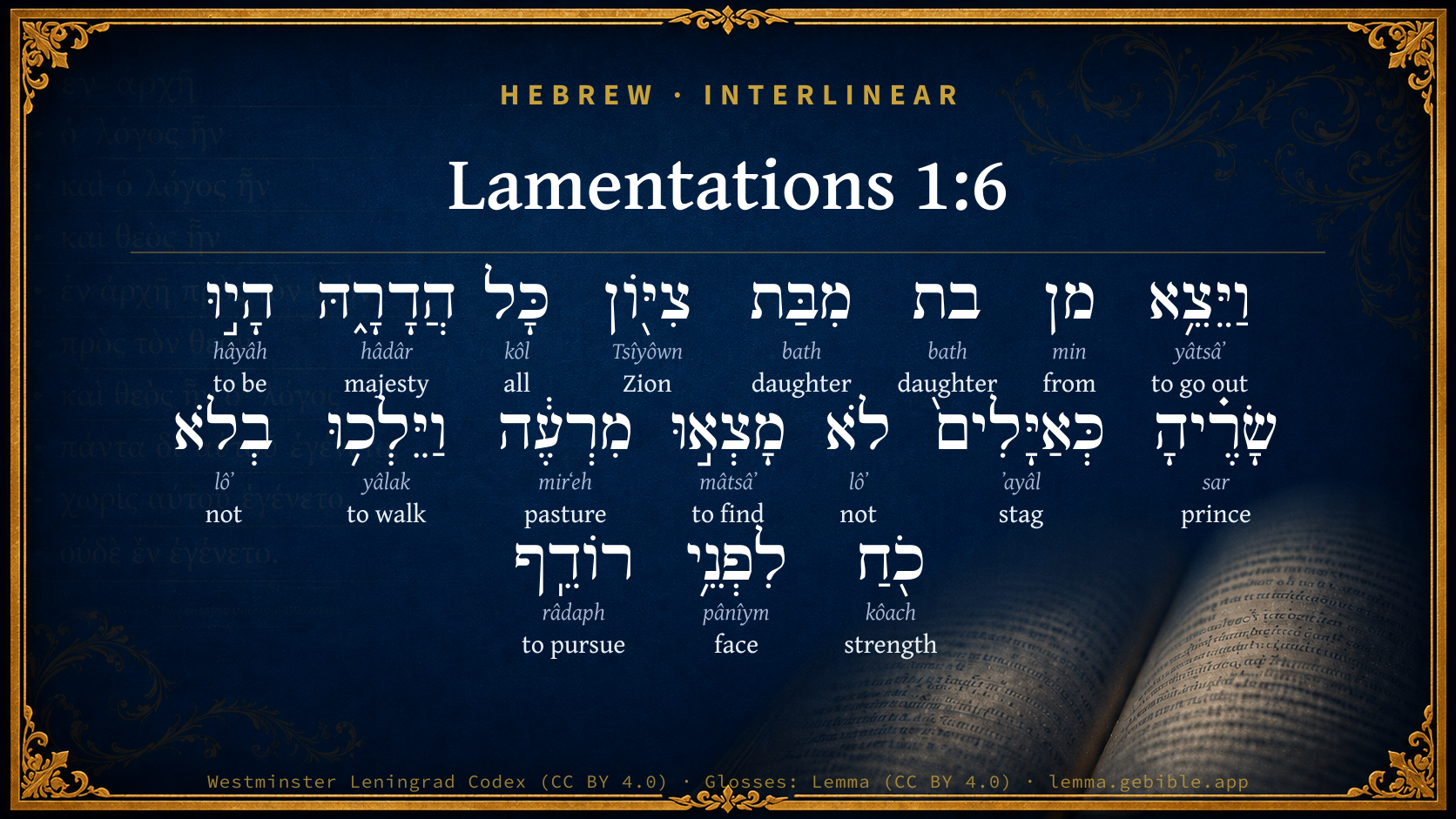
Hebrew (Westminster Leningrad Codex) Lamentations 1:6 appears in the Hebrew Old Testament. The text above is from the Westminster Leningrad Codex. Each word links to its Strong’s number, a concise gloss, and parsing drawn from the Open Scriptures Hebrew Bible morphology. Click any word for its full Brown-Driver-Briggs (BDB) entry.
Download image
Cite this verse

Lamentations 1:6 (World English Bible). Public Domain. Lemma interlinear Bible study tool, https://lemma.gebible.app/v/lamentations/1/6.

Show BibTeX & RIS
BibTeX
RIS
English Translation
From the daughter of Zion all her majesty is departed: Her princes are become like harts that find no pasture, They are gone without strength before the pursuer.
World English Bible · Public Domain
Download a study sheet

One document with this verse’s original text, its word-by-word gloss line, the meaning frame, cross-references with their text, attributed commentary, and full source and license credits — printable, and it pastes into notes with its structure intact.

This verse Autodidact and up

Study sheet (.html) Plain text (.txt)

A passage Seminary Student

Up to 50 verses in one chapter. A passage sheet keeps up to 6 commentary sources and 12 cross-references per verse, in the order this page ranks them, and says so on the sheet whenever that leaves anything out. Ask for a single verse and you get the Autodidact verse sheet above.

Everything on this page stays free to read, with no account — the sheet is a download of what is already on screen, not access to it.

Want to remove ads? Support Godless Engineer
Compare translations 3

The same verse in 3 English versions, stacked beneath the original-language interlinear above. Click any original word for its lexicon entry.

Each is an independent rendering of the whole verse — the interlinear is not word-aligned to these translations.

Highlighted words mark where these versions differ — a whole-verse word diff, not a word-by-word alignment.

  • World English Bible Public Domain
    From the daughter of Zion all her majesty is departed: Her princes are become like harts that find no pasture, They are gone without strength before the pursuer.
  • King James Version Public Domain
    And from the daughter of Zion all her beauty is departed: her princes are become like harts that find no pasture, and they are gone without strength before the pursuer.
  • unfoldingWord Literal Text CC BY-SA 4.0
    And from the daughter of Zion all her majesty has departed. Her princes have become like deer that have found no pasture. And they have walked without strength before the pursuer. ZAYIN

unfoldingWord Literal Text — © unfoldingWord, licensed CC BY-SA 4.0. Word-aligned USFM3 via Door43 (git.door43.org/unfoldingWord/en_ult).

Versions to compare (up to 4)

3 of 4 selected

Show all 18 translations

Every available English version of this verse, each an independent rendering of the whole verse.

  • World English Bible Public Domain
    From the daughter of Zion all her majesty is departed: Her princes are become like harts that find no pasture, They are gone without strength before the pursuer.
  • Berean Standard Bible Public Domain
    All the splendor has departed from the Daughter of Zion. Her princes are like deer that find no pasture; they lack the strength to flee in the face of the hunter.
  • Majority Standard Bible Public Domain
    All the splendor has departed from the Daughter of Zion. Her princes are like deer that find no pasture; they lack the strength to flee in the face of the hunter.
  • King James Version Public Domain
    And from the daughter of Zion all her beauty is departed: her princes are become like harts that find no pasture, and they are gone without strength before the pursuer.
  • American Standard Version (1901) Public Domain
    And from the daughter of Zion all her majesty is departed: Her princes are become like harts that find no pasture, And they are gone without strength before the pursuer.
  • Revised Version (1885) Public Domain
    And from the daughter of Zion all her majesty is departed: her princes are become like harts that find no pasture, and they are gone without strength before the pursuer.
  • Geneva Bible (1599) Public Domain
    And from the daughter of Zion all her beautie is departed: her princes are become like harts that finde no pasture, and they are gone without strength before the pursuer.
  • Douay-Rheims (1899) Public Domain
    Vau. And from the daughter of Sion all her beauty is departed: her princes are become like rams that find no pastures: and they are gone away without strength before the face of the pursuer.
  • Young's Literal Translation Public Domain
    And go out from the daughter of Zion doth all her honour, Her princes have been as harts -- They have not found pasture, And they go powerless before a pursuer.
  • Literal Standard Version CC BY-SA 4.0
    And all her honor goes out from the daughter of Zion, || Her princes have been as harts—They have not found pasture, || And they go powerless before a pursuer.
  • Unlocked Literal Bible CC BY-SA 4.0
    Beauty has left the daughter of Zion. Her princes have become like deer that cannot find pasture, and they go without strength before their pursuer.
  • unfoldingWord Literal Text CC BY-SA 4.0
    And from the daughter of Zion all her majesty has departed. Her princes have become like deer that have found no pasture. And they have walked without strength before the pursuer. ZAYIN
  • Darby Bible Public Domain
    And from the daughter of Zion all her splendour is departed: her princes are become like harts that find no pasture; and they are gone without strength before the pursuer.
  • World Messianic Bible Public Domain
    All majesty has departed from the daughter of Zion. Her princes have become like deer that find no pasture. They have gone without strength before the pursuer.
  • Webster's Bible Public Domain
    And from the daughter of Zion all her beauty hath departed: her princes are become like harts that find no pasture, and they are gone without strength before the pursuer.
  • Free Bible Version CC BY-SA 4.0
    All the glory has left the Daughter of Zion. Her leaders are like deer that can't find any grass to eat. They don't even have the strength to run away when the hunter comes after them!
  • Bible in Basic English Public Domain
    And all her glory has gone from the daughter of Zion: her rulers have become like harts with no place for food, and they have gone in flight without strength before the attacker.
  • JPS Tanakh (1917) Public Domain
    And gone is from the daughter of Zion all her splendour; her princes are become like harts that find no pasture, and they are gone without strength before the pursuer.

Literal Standard Version (2020), Covenant Press — licensed CC BY-SA 4.0. Text via the HelloAO Bible API (eBible.org). Unlocked Literal Bible (unfoldingWord) — licensed CC BY-SA 4.0. Text via the HelloAO Bible API (eBible.org). unfoldingWord Literal Text — © unfoldingWord, licensed CC BY-SA 4.0. Word-aligned USFM3 via Door43 (git.door43.org/unfoldingWord/en_ult). Free Bible Version, Dr. Jonathan Gallagher — licensed CC BY-SA 4.0. Text via the HelloAO Bible API (eBible.org).

Word by word

More ways to search: Search by grammar → Find every occurrence → Compare this word →

Practice this passage: Drill this verse → Learn its vocabulary →

כְּאַיָּלִים֙
ʼayâl
H354
“like/as · stags”
Preposition + Noun, Common, Both, Plural, Absolute
Part of Speech
Preposition + Noun
Type
Common
Gender
Both
Number
Plural
State
Absolute
Full BDB Definition

Origin: an intensive form of H352 (in the sense of ram)

TWOT: 45k

stag, deer, hart
  1. וַיֵּצֵ֥א yâtsâʼ H3318 “and · to go out” Conjunction + Verb, Qal, Sequential Imperfect, 3rd Person, Masculine, Singular
  2. מן min H4480 “from” Preposition
  3. בת bath H1323 “daughter of” Noun, Common, Feminine, Singular, Construct
  4. מִבַּת bath H1323 “from · daughter of” Preposition + Noun, Common, Feminine, Singular, Construct
  5. צִיּ֖וֹן Tsîyôwn H6726 “Zion” Noun, Proper
  6. כָּל kôl H3605 “all of” Noun, Common, Masculine, Singular, Construct
  7. הֲדָרָ֑הּ hâdâr H1926 “majesty · her” Noun, Common, Masculine, Singular, Construct + Suffix, Personal, 3rd Person, Feminine, Singular
  8. הָי֣וּ hâyâh H1961 “to be” Verb, Qal, Perfect, 3rd Person, Common, Plural
  9. שָׂרֶ֗יהָ sar H8269 “princes · her” Noun, Common, Masculine, Plural, Construct + Suffix, Personal, 3rd Person, Feminine, Singular
  10. לֹא lôʼ H3808 “not” Particle, Negative
  11. מָצְא֣וּ mâtsâʼ H4672 “to find” Verb, Qal, Perfect, 3rd Person, Common, Plural
  12. מִרְעֶ֔ה mirʻeh H4829 “pasture” Noun, Common, Masculine, Singular, Absolute
  13. וַיֵּלְכ֥וּ yâlak H3212 “and · to walk” Conjunction + Verb, Qal, Sequential Imperfect, 3rd Person, Masculine, Plural
  14. בְלֹא lôʼ H3808 “in/at · not” Preposition + Particle, Negative
  15. כֹ֖חַ kôach H3581 “strength” Noun, Common, Masculine, Singular, Absolute
  16. לִפְנֵ֥י pânîym H6440 “to/for · face(s) of” Preposition + Noun, Common, Both, Plural, Construct
  17. רוֹדֵֽף râdaph H7291 “pursuing” Verb, Qal, Participle Active, Masculine, Singular, Absolute

About this verse

These counts appear in no published source. They are computed here, from the morphology-tagged text and Lemma’s own curated glosses. What Lemma adds →

18
words
16
distinct lemmas
Prophets
section

Notable vocabulary

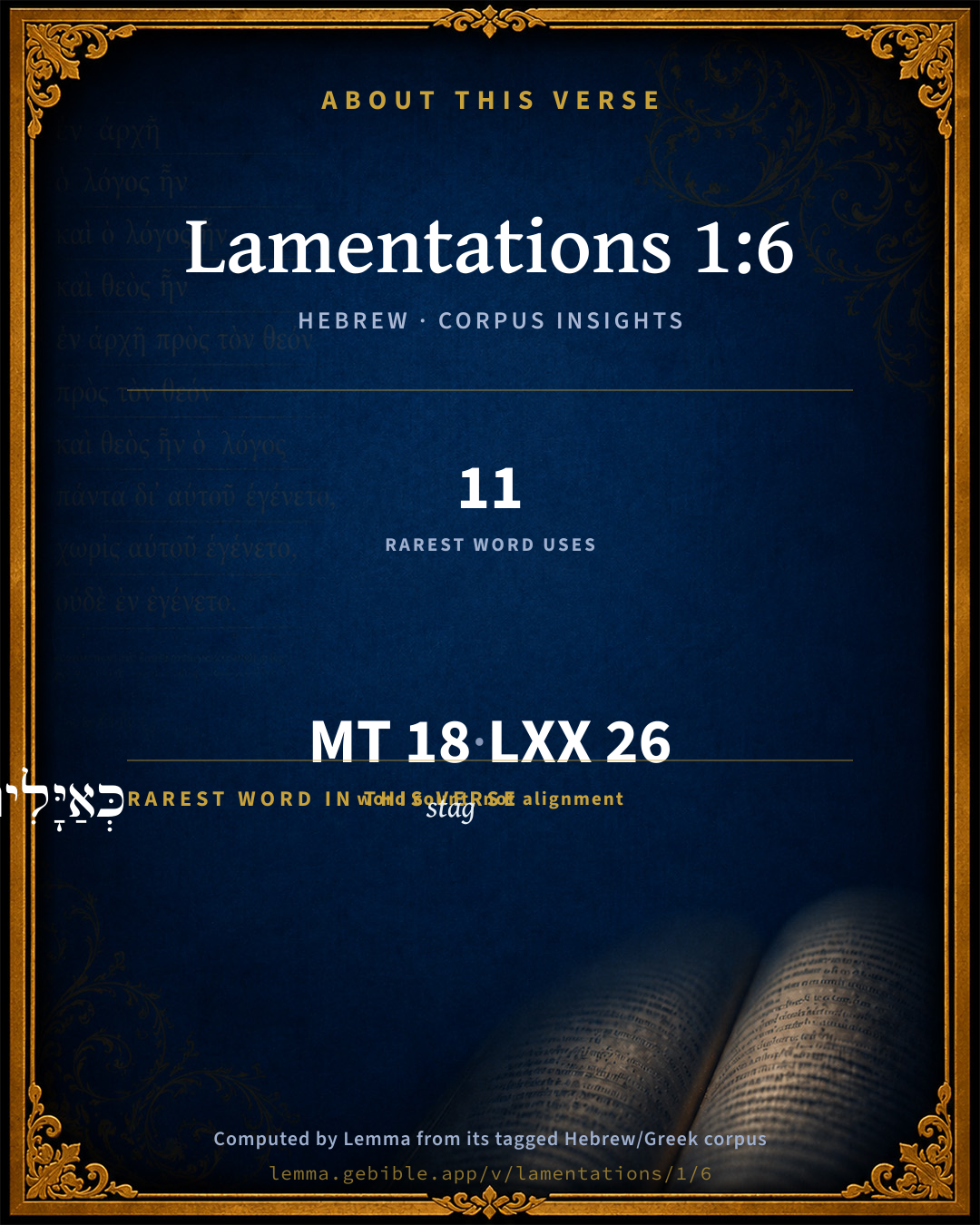
The rarest word here is כְּאַיָּלִים֙ stag H354 — appearing just 11 times in the whole Hebrew Bible.

Shared distinctive vocabulary

כְּאַיָּלִים֙ stag H354 occurs in 11 verses of the Hebrew Bible. Also found in:

Grammatical profile

  • 5 verbs
  • 10 nouns
  • 1 preposition
  • 2 particles

Verb forms

  • וַיֵּצֵ֥א Qal · Sequential Imperfect
  • הָי֣וּ Qal · Perfect
  • מָצְא֣וּ Qal · Perfect
  • וַיֵּלְכ֥וּ Qal · Sequential Imperfect
  • רוֹדֵֽף Qal · Participle Active

Repetition

Words recur within this verse — often emphatic in Hebrew:

Hebrew & Septuagint length

In English translation the verse runs 28 words from the Hebrew and 34 from the Septuagint (LXX English) — closely comparable.

A rough comparison of the two English renderings, which tokenize alike — not a word-level alignment.

Word counts can differ between the Hebrew and the Greek without any difference in meaning — e.g. the Hebrew direct-object marker אֵת has no separate Greek word, and Greek often adds the article ὁ.

In the original languages it is 18 Hebrew tokens and 26 Greek tokens — but the two are counted differently (Hebrew bundles its prefixes and suffixes into one token; the Greek is in lemma form), so that isn’t a like-for-like length.

Cross-references

29

Topical passages linked to Lamentations 1:6 in the Treasury of Scripture Knowledge — connected by theme and wording, ordered by reader-vote popularity; previews shown in the World English Bible.

  • Ezekiel 24:25 You, son of man, shall it not be in the day when I take from them their strength, the joy of their glory, the desire of their eyes, and that whereupon they set their heart, their sons and their daughters,
  • Leviticus 26:36–37 "'As for those of you who are left, I will send a faintness into their hearts in the lands of their enemies: and the sound of a driven leaf will put them to flight; and they shall flee, as one flees from the sword; and they will fall when no one pursues.
  • Deuteronomy 28:25 Yahweh will cause you to be struck before your enemies; you shall go out one way against them, and shall flee seven ways before them: and you shall be tossed back and forth among all the kingdoms of the earth.
  • Deuteronomy 32:30 How should one chase a thousand, Two put ten thousand to flight, Except their Rock had sold them, Yahweh had delivered them up?
  • Joshua 7:12–13 Therefore the children of Israel can't stand before their enemies; they turn their backs before their enemies, because they are become accursed: I will not be with you any more, except you destroy the devoted thing from among you.
  • 2 Samuel 4:11–12 How much more, when wicked men have slain a righteous person in his own house on his bed, shall I not now require his blood of your hand, and take you away from the earth?
  • 2 Kings 19:21 This is the word that Yahweh has spoken concerning him: The virgin daughter of Zion has despised you and ridiculed you; the daughter of Jerusalem has shaken her head at you.
  • Psalms 44:9–11 But now you rejected us, and brought us to dishonor, And don't go out with our armies.
  • Psalms 48:2–3 Beautiful in elevation, the joy of the whole earth, Is Mount Zion, on the north sides, The city of the great King.
  • Psalms 50:2 Out of Zion, the perfection of beauty, God shines forth.
  • Psalms 96:9 Worship Yahweh in holy array. Tremble before him, all the earth.
  • Psalms 132:12–13 If your children will keep my covenant, My testimony that I will teach them, Their children also will sit on your throne forevermore."
  • Isaiah 1:21 How the faithful city has become a prostitute! She was full of justice; righteousness lodged in her, But now murderers.
  • Isaiah 4:5 Yahweh will create over the whole habitation of Mount Zion, and over her assemblies, a cloud and smoke by day, and the shining of a flaming fire by night; for over all the glory will be a canopy.
  • Isaiah 12:6 Cry aloud and shout, you inhabitant of Zion; for great in the midst of you is the Holy One of Israel!"
  • Jeremiah 13:18 Say you to the king and to the queen-mother, Humble yourselves, sit down; for your headdresses are come down, even the crown of your glory.
  • Jeremiah 14:5–6 Yes, the hind also in the field calves, and forsakes [her young], because there is no grass.
  • Jeremiah 29:4 Thus says Yahweh of Hosts, the God of Israel, to all the captivity, whom I have caused to be carried away captive from Jerusalem to Babylon:
  • Jeremiah 47:3 At the noise of the stamping of the hoofs of his strong ones, at the rushing of his chariots, at the rumbling of his wheels, the fathers don't look back to their children for feebleness of hands;
  • Jeremiah 48:41 Kerioth is taken, and the strongholds are seized, and the heart of the mighty men of Moab at that day shall be as the heart of a woman in her pangs.
  • Jeremiah 51:30–32 The mighty men of Babylon have forborne to fight, they remain in their strongholds; their might has failed; they are become as women: her dwelling-places are set on fire; her bars are broken.
  • Jeremiah 52:7–8 Then a breach was made in the city, and all the men of war fled, and went forth out of the city by night by the way of the gate between the two walls, which was by the king's garden; (now the Chaldeans were against the city round about;) and they went toward the Arabah.
  • Jeremiah 52:11 He put out the eyes of Zedekiah; and the king of Babylon bound him in fetters, and carried him to Babylon, and put him in prison until the day of his death.
  • Jeremiah 52:13 and he burned the house of Yahweh, and the king's house; and all the houses of Jerusalem, even every great house, burned he with fire.
  • Lamentations 2:1–7 How has the Lord covered the daughter of Zion with a cloud in his anger! He has cast down from heaven to the earth the beauty of Israel, And hasn't remembered his footstool in the day of his anger.
  • Ezekiel 7:20–22 As for the beauty of his ornament, he set it in majesty; but they made the images of their abominations [and] their detestable things therein: therefore have I made it to them as an unclean thing.
  • Ezekiel 11:22–23 Then did the cherubim lift up their wings, and the wheels were beside them; and the glory of the God of Israel was over them above.
  • Ezekiel 24:21 Speak to the house of Israel, Thus says the Lord Yahweh: Behold, I will profane my sanctuary, the pride of your power, the desire of your eyes, and that which your soul pities; and your sons and your daughters whom you have left behind shall fall by the sword.
  • Zephaniah 3:14–17 Sing, daughter of Zion! Shout, Israel! Be glad and rejoice with all your heart, daughter of Jerusalem.

Cross-references courtesy of OpenBible.info (CC BY 4.0).

Hebrew and Greek witnesses Masoretic Hebrew ↔ Greek Septuagint

The same verse in the two great witnesses to the Old Testament, shown verse-for-verse.

These are two independent witnesses, not word-aligned to each other, and the Septuagint is shown in lemma (dictionary) form.

Hebrew Lamentations 1:6 Masoretic · Westminster Leningrad Codex

וַיֵּצֵ֥א מן בת מִבַּת צִיּ֖וֹן כָּל הֲדָרָ֑הּ הָי֣וּ שָׂרֶ֗יהָ כְּאַיָּלִים֙ לֹא מָצְא֣וּ מִרְעֶ֔ה וַיֵּלְכ֥וּ בְלֹא כֹ֖חַ לִפְנֵ֥י רוֹדֵֽף

From the daughter of Zion all her majesty is departed: Her princes are become like harts that find no pasture, They are gone without strength before the pursuer.

World English Bible · Public Domain

Greek LXX Lamentations 1:6 Septuagint · lemma form

καί ἐκἔρχομαι ἐκ θυγάτηρ σιων πᾶς ὁ εὐπρέπεια αὐτός γίγνομαι ὁ ἄρχων αὐτός ὡς κριός οὐ εὑρίσκω νομή καί πορεύομαι ἐν οὐ ἰσχύς κατά πρόσωπον διώκω

VAU. And all her beauty has been taken away from the daughter of Sion: her princes were as rams finding no pasture, and are gone away in weakness before the face of the pursuer.

LXX2012 (modern English Septuagint) · Public Domain

On this verse, The Cambridge Bible for Schools and Colleges discusses the Septuagint’s reading. Read the note in Commentary ↓

Hebrew: Westminster Leningrad Codex (CC BY 4.0). Greek: Septuagint (public domain); English from LXX2012 (modern English Septuagint) (Public Domain). How the Septuagint differs from the Hebrew →

Commentary

Notes on Lamentations 1:6 from classic Christian and Jewish commentators (each source and its license shown beneath its notes). The classic Christian expositions comment on the surrounding passage and are grouped to its opening verse, so a note may address several verses; the Jewish commentaries on the Tanakh (Rashi and others) are per-verse, so they appear only where the commentator wrote on this verse.

Lemma curates 59 commentaries, every one of them public domain or Creative Commons licensed, each selected and text-cleaned for this edition rather than reprinted as found. About our sources →

Trapp's Complete Commentary

John Trapp

Lam 1:6 And from the daughter of Zion all her beauty is departed: her princes are become like harts [that] find no pasture, and they are gone without strength before the pursuer.

Ver. 6. And from the daughter of Zion all her beauty is departed.] Her glory, {as Isa 5:14} that is chiefly the temple, and the service of God in it. It is now Ichabod with her. The beauty and bulwark of a nation are God’s holy ordinances.

Her princes are become like harts,] i.e., Heartless, bereft of courage. They dare not make headway against an enemy.

Before the pursuer.] R. Solomon here observeth that the Hebrew word רורף is written in full, {Hebrew Text Note} so as it is scarcely anywhere else, to note the fulness of the persecution.

John Trapp, A Commentary or Exposition upon All the Books of the Old and New Testament (1647–1656) — public domain. Text from a community e-Sword module.

The Biblical Illustrator

Joseph S. Exell

Lam_1:6

And from the daughter of Zion all her beauty is departed.

Departing glory

1. The Church of God doth esteem the exercises of religion e most excellent and glorious thing that can be had in this life.

(1) They are notable signs of Gods favour and presence.

(2) There is more true comfort in them than in the whole world besides.

2. The weakening of the rulers is the height of misery upon the rest of the members of that body.

3. That people hath a heavy judgment upon them whose guides are destitute and deprived of necessary courage.

4. They that have the greatest outward privilege do often come the soonest into distress when God punisheth for sin (Amo_6:7). (J. Udall.)

Sin ruinous and destructive

We do our utmost to protect great buildings from fire and tempest, and yet all the time those buildings are liable to another peril not less severe--the subtle decay of the very framework of the structure itself. The tissue of the wood silently and mysteriously deteriorates, and calamity as dire as a conflagration is precipitated. The whole of the magnificent roofing of the church of St. Paul in Rome had to be taken out at enormous expense because of the dry rot. Scientific men, by microscopic and chemical methods, have investigated the causes of this premature decay, and after patient search they have discovered not only the fungi which destroy the wood tissue, but also the spore that acts as the seed of the fungus. So this obscure, malign vegetation goes on in the heart of the wood, destroying the glory and strength of minister and palace. Character is liable to a similar danger. All evils do not come from the outside. Some of the worst possibilities of loss, weakness, and ruin emerge from within; the destroying agents work obscurely and stealthily, and are almost unsuspected until they nave wrought fatal mischief.

The Biblical Illustrator, edited by Joseph S. Exell (c. 1880s–1900s) — public domain. Text from a community e-Sword module.

Geneva Bible (1599)

Geneva Bible translators

As men pined away with sorrow and that have no courage.

Geneva Bible (1599) marginal notes — public domain. Text via Bolls.life.

Jamieson, Fausset & Brown

Robert Jamieson, A. R. Fausset & David Brown

beauty . . . departed--her temple, throne, and priesthood.

harts that find no pasture--an animal timid and fleet, especially when seeking and not able to "find pasture."

Jamieson, Fausset & Brown — Commentary Critical and Explanatory on the Whole Bible (1871) — public domain (CC PDM 1.0). Text via the HelloAO Bible API.

John Calvin's Commentaries

He continues the same subject. He says here that the daughter of Sion was denuded of all her ornaments. Now, we know what was the honor or dignity of that people; for Moses, in order to set forth the greatness of God’s grace, exclaims,

“What nation so illustrious under heaven!” (Deuteronomy 4:7.)

As, then, the singular gifts of God had been conferred on that people, it was a very sad spectacle to see that city, which once possessed the highest glory, robbed of all its honor and covered with disgrace, as we shall hereafter see. He then says that all her glory was taken away from the daughter of Sion.

Now, there is no need to enumerate all the kinds of honor or glory which belonged to the city Jerusalem. But it may be said first, that God had chosen there a habitation for himself; and then a sacerdotal kingdom was there, — the people were holy to God — they were his heritage, — there God had deposited his covenant, — he deemed all the Jews his children, and his will was that they should in return count him as their Father. As, then, they had been enriched with so many ornaments and so superior, it is no wonder that the Prophet deplored the state of the city when stripped of all its glory.

He then adds, that her princes were like famished harts for harts, as they are by nature swift, when pressed by want run as though they were flying. Since then the swiftness of that animal is so great, the Prophet says that the princes, who were wont to walk with so much gravity and to carry the appearance of great authority, had become swift, like harts oppressed with hunger; for they also labored under the want of everything. He adds that at length they went away, that is, they fled before their pursuers without strength. He intimates by these words that they dared not to contend with their enemies, but that they were so frightened that they fled, and thus proved that they were wholly disheartened and lifeless. It follows, —

John Calvin's Commentaries (1540-1563) — public domain. Text from the Calvin Translation Society English edition (1840s-50s) via the Christian Classics Ethereal Library (ccel.org). Calvin's coverage is partial (roughly two-thirds of the Bible); uncommented books and verses are honest gaps, never fabricated. The 19th-century editor's footnotes and remarks are omitted so the notes are faithfully Calvin's own voice.

Ellicott's Commentary for English Readers

(6) Her princes are become like harts . . .—Probably a reference to the flight and capture of Zedekiah (2Ki_25:5; Jer_39:5), who, with his sons and princes, fell into the hands of the Chaldæans, like fainting and stricken deer.

A Bible Commentary for English Readers, edited by Charles John Ellicott (1878–1897) — public domain. Text from a community e-Sword module.

The Cambridge Bible for Schools and Colleges

gen. ed. J. J. S. Perowne

6. majesty] mg. less well, beauty. Exhaustion from hunger and fatigue has taken the place of dignity and wealth.

Her princes are become like harts] The most natural reference is to the flight and capture of Zedekiah and his princes, Jer_39:4 f. Cp. Jer_52:10. The LXX and Vulg. for “harts” read (with different vowel punctuation) rams, a word used elsewhere (e.g. Exo_15:15; see mg.) for leaders. But the figure needs an animal which is hunted. Budde therefore accepts the Targ. “stags.”

The Cambridge Bible for Schools and Colleges (gen. ed. J. J. S. Perowne; Cambridge University Press, 1878–1918) — public domain. Text from a community e-Sword module.

John Gill's Exposition

And from the daughter of Zion all her beauty is departed,.... The kingdom removed; the priesthood ceased; the temple, their beautiful house, burnt; the palaces of their king and nobles demolished; and everything in church and state that was glorious were now no more:

her princes are become like harts that find no pasture; that are heartless and without courage, fearful and timorous, as harts are, especially when destitute of food. The Targum is

"her princes run about for food, as harts run about in the wilderness, and find no place fit for pasture:''

and they are gone without strength before the pursuer; having no spirit nor courage to oppose the enemy, nor strength to flee from him, they fell into his hands, and so were carried captive; see Jer 52:8. Jarchi observes, that the word for "pursuer" has here all its letters, and nowhere else; and so denotes the full pursuit of the enemy, and the complete victory obtained by him.

John Gill's Exposition of the Whole Bible (1746–1763) — public domain (CC PDM 1.0). Text via the HelloAO Bible API.

Albert Barnes' Notes on the Bible

Her princes ... - Jeremiah had before his mind the sad flight of Zedekiah and his men of war, and their capture within a few miles of Jerusalem Jer 39:4-5.

Albert Barnes' Notes on the Bible (1834–1885) — public domain. Text from a community e-Sword/MySword module.

Haydock's Catholic Bible Commentary

Beauty; princes’ palaces, but particularly the temple, ver. 10. (Calmet) --- Rams, fleeing from place to place to seek relief. (Worthington)

George Leo Haydock (1774–1849), Haydock's Catholic Family Bible and Commentary, 1859 edition — public domain. Excludes Psalms (Douay-Rheims chapter numbering differs from Protestant) and Deuterocanonical books (Catholic canon only).

Matthew Poole's English Annotations

All the inhabitants of Zion have lost their former beauty; whatsoever splendour the city had, whether from the multitude or gallantry of her inhabitants, it is all gone; her nobles are become thin and ill-favoured, like beasts almost starved, their enemies pursue them to destroy them, and they have no strength to oppose or resist them.

Matthew Poole's English Annotations on the Holy Bible (1683–1685) — public domain. Text from a community e-Sword/MySword module.

Whedon's Commentary on the Bible

Daniel D. Whedon

6. Like harts — Like helpless, frightened deer, they flee exhausted before the pursuer in a desert land where they find no pasture.

Daniel D. Whedon (gen. ed.), Commentary on the Old and New Testaments (1874–1909) — public domain. Text from a community e-Sword module.

The Pulpit Commentary

Beauty; rather, glory. Like harts that find no pasture; and therefore have no strength left to flee. An allusion to the attempted flight of Zedekiah and his companions. (Jer_39:4, Jer_39:5)

Her beauty departed from Zion.

I ZION HAD A BEAUTY OF HER OWN. The dwellings of Zion shone splendid in cedar and gold. A softer beauty was shed over her from old memories and tender associations. The spiritual Zion has her beauty. It is not the magnificence of marble columns and gilded decorations. The beauty of Zion is the beauty of her worship and life.

1. The beauty of holiness. Purity is beautiful as impurity is ugly. This high spiritual loveliness is like the glory of God.

2. The beauty of love. Zion was the place where the tribes assembled. Here all jealousies were to be laid aside and all quarrels healed. What is more beautiful than concession and forgiveness? This beauty should characterize the Church of Christ. "Behold, how good and how pleasant it is for brethren to dwell together in unity!" etc. (Psalm 133).

3. The beauty of joy. Zion was the centre of festive gatherings. The sacred hill used to echo with shouts of gladness; it was enlivened with the timbrel and song of happy maidens. The joy of Divine grace imparts a sweetness to the very countenance of the faithful servant of God.

II ZION LOST HER BEAUTY. The fine city was sacked by ruthless soldiers; the splendid edifices rifled or fired; the pomp and pageantry dissipated by sword and axe. But the higher beauty of Zion was also lost, and lost before she was robbed of her external grandeur. Her holiness was corrupted. Sin destroys the spiritual beauty of the Christian. His white priestly garments are defiled when he descends into the mire of moral degradation. It is not only that sin will be visited with certain definite pains and penalties. Before that happens there is an indescribable loss in the tarnished character and marred beauty of the soul which, to one who is awake to the evil condition into which he has fallen, must be a shame and grief.

III THE LOSS OF THE BEAUTY OF ZION WAS A MOURNFUL CALAMITY. This beauty is no idle ornament, to be put off and on at the caprice of the wearer and for objects of idle display. It is the pledge of her King"s favour, the inspiration of her own best life, and the secret of her influence.

1. Health is lost. As when the sunlight which flashes on silvery lakes and mountain snows fades away, the chills and mists of night creep over the valley, so, when the glory of God departs from a soul, coldness, darkness, and death take its place.

2. Influence is lost. Christians are to be the light of the world. Losing their brightness, they cease to draw others to Christ. The fair countenance of the bride of Christ wins many guests to the wedding feast. Let her see that it is not marred, lest her Lord be dishonoured.

The Pulpit Commentary (1880–1919), ed. H.D.M. Spence-Jones & Joseph S. Exell — public domain. Text from a community e-Sword module.

unfoldingWord translationNotes

Door43 World Missions Community

General Information:

The city of Zion is spoken of as if it were a woman. In Lamentations, Zion and Jerusalem are names used to refer to the same city. (See: Personification)

Beauty has left the daughter of Zion

This speaks of everything beautiful in Zion being destroyed as if "beauty" were a person that left Zion. AT: "Everything that was beautiful about the daughter of Zion is destroyed"

daughter of Zion

This is a poetic name for Jerusalem, which is spoken of here as if it were a woman. (See: Personification)

Her princes have become like deer that cannot find pasture

This speaks of Zion's princes having nothing to eat like deer that cannot find grass to eat. AT: "Her princes are starving, they are like deer that cannot find grass to eat" (See: Simile)

deer

A deer is a medium-sized, grass-eating animal that is often hunted by humans for food. It is also a beautiful animal to look at.

they go without strength before

"they are not strong enough to run away from" or "they are very weak before"

their pursuer

"the person that is pursuing them"

translationWords

daughter of Zion

prince

unfoldingWord translationNotes — © Distant Shores Media and the Door43 World Missions Community, licensed CC BY-SA 4.0. Source: git.door43.org/Door43/en_tn.

Rashi

Rabbi Shlomo Yitzchaki (Rashi)

like harts who did not find pasture like harts who did not find pasture, who have no strength to flee, for their strength has been weakened by hunger.

pursuer Heb. רוֹדֵף. Every רֹדֵף in Scripture is defective (רֹדֵף), but this one is full (רוֹדֵף), for they were pursued with a full pursuit. Therefore the paytan composed “I was fully pursued, but the year of my redemption is missing, (גְאֻלַי).” (Isa. 63: 4): “The year of my redemption (גְאֻלַי) has arrived” is spelled defectively.

Rashi on the Tanakh — English translations: “The Judaica Press complete Tanach with Rashi, translated by A. J. Rosenberg” (CC BY 4.0); “Pentateuch with Rashi's commentary by M. Rosenbaum and A.M. Silbermann, 1929-1934” (public domain); “The Metsudah Tanach series, Lakewood, N.J” (CC BY 4.0); and “The Book of Joshua, Metsudah Publications, 1997” (CC BY 4.0). Text via Sefaria.

Ibn Ezra

Rabbi Abraham ibn Ezra

It is missing the word "asher" (אשר) after "ke'ilim," and similarly, "kamayim layam makhisim" (כמים לים מכסים) means "like waters cover the sea."

Ibn Ezra on the Tanakh — English translations: “Sefaria Community Translation” (CC0 1.0 (public-domain dedication)); “Yalkut, Sifsei Chachomim Chumash, Metsudah Publications, 2009” (CC BY 4.0); and “Commentary of Ibn Ezra on Isaiah - trans. by M. Friedlander, 1873” (public domain). Text via Sefaria.

Lesson kit

Teaching starters — assembled from the data on this page, not authored interpretation. Every prompt links to the verse data it draws on. Edit before teaching.

Lamentations, in the Prophets, opens this verse with 18 words (16 distinct Hebrew lemmas). Its most distinctive word is ʼayâl (“stag”). A historical commentator’s framing appears above. Read the whole chapter for the surrounding context.

Discussion questions

  1. The word ʼayâl carries the sense “stag.” How does it shape the verse?
  2. Deuteronomy 12:15 shares the word «stag» with this verse. How do the two illuminate each other?
  3. “daughter” occurs 2× in this one verse. What is the effect of the repetition?
  4. These translations render this verse differently; the difference is in the English rendering, not the original. What questions does that raise?
  5. The verb «וַיֵּצֵ֥א» is Qal Sequential Imperfect. How does its form color the action?
  6. Reading how Trapp's Complete Commentary and The Biblical Illustrator read this verse, where do the two commentators agree and where do they part?

Things to notice

Reading settings

Reading text

Shown beneath each verse's original-language words.

Old Testament
Old Testament edition

Read the OT as the Masoretic Hebrew (MT) or the Greek Septuagint (LXX).

English shown for the Greek Septuagint (in the Hebrew ↔ Greek comparison).

Comparing translations? Open the Compare panel on any verse page to stack up to four side by side.