
Isaiah 31:4

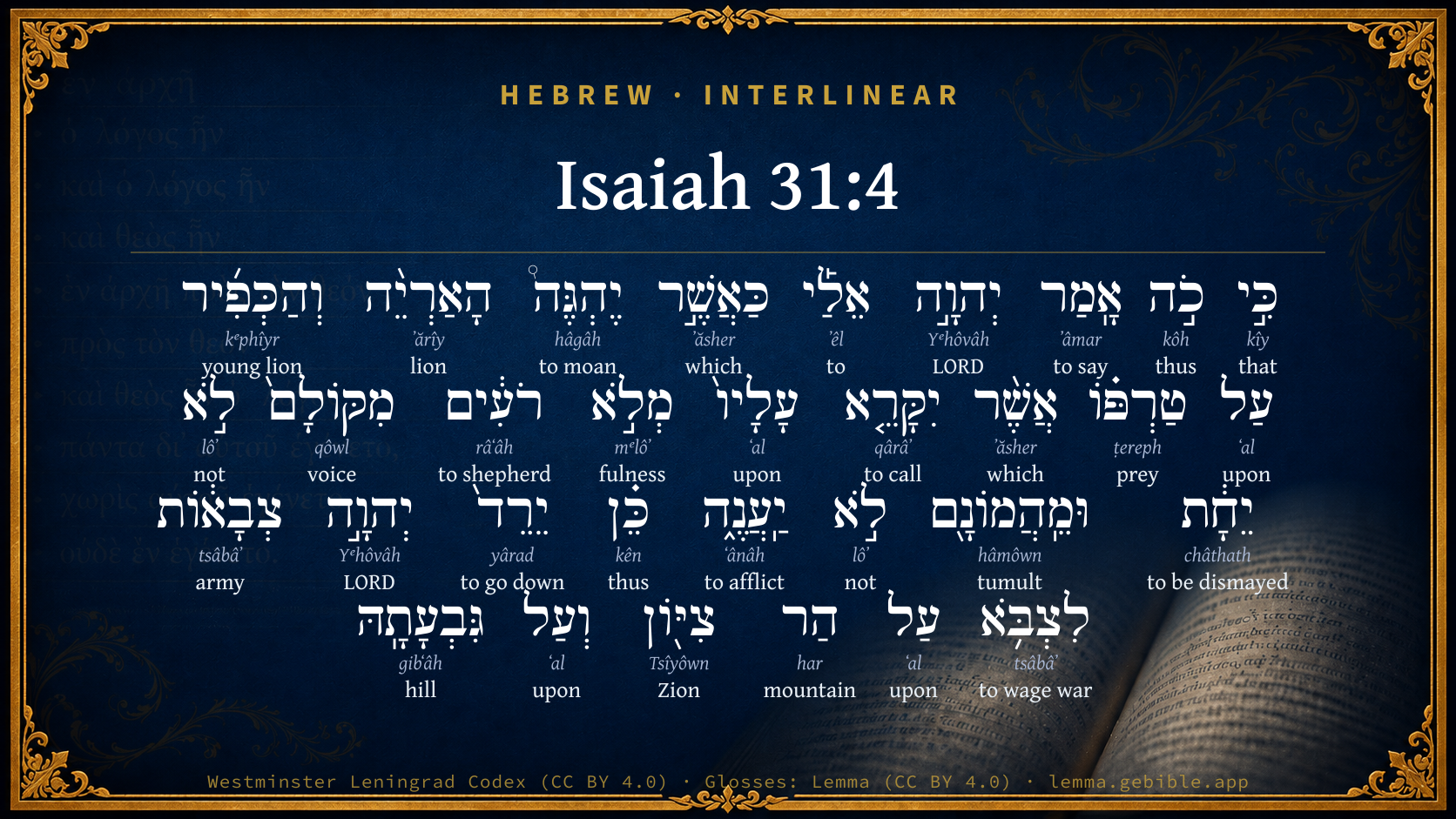
Hebrew (Westminster Leningrad Codex) Isaiah 31:4 appears in the Hebrew Old Testament. The text above is from the Westminster Leningrad Codex. Each word links to its Strong’s number, a concise gloss, and parsing drawn from the Open Scriptures Hebrew Bible morphology. Click any word for its full Brown-Driver-Briggs (BDB) entry.
Download image
Cite this verse

Isaiah 31:4 (World English Bible). Public Domain. Lemma interlinear Bible study tool, https://lemma.gebible.app/v/isaiah/31/4.

Show BibTeX & RIS
BibTeX
RIS
English Translation
For thus says Yahweh to me, As the lion and the young lion growling over his prey, if a multitude of shepherds are called forth against him, will not be dismayed at their voice, nor abase himself for the noise of them: so will Yahweh of Hosts come down to fight on Mount Zion, and on the hill of it.
World English Bible · Public Domain
Download a study sheet

One document with this verse’s original text, its word-by-word gloss line, the meaning frame, cross-references with their text, attributed commentary, and full source and license credits — printable, and it pastes into notes with its structure intact.

This verse Autodidact and up

Study sheet (.html) Plain text (.txt)

A passage Seminary Student

Up to 50 verses in one chapter. A passage sheet keeps up to 6 commentary sources and 12 cross-references per verse, in the order this page ranks them, and says so on the sheet whenever that leaves anything out. Ask for a single verse and you get the Autodidact verse sheet above.

Everything on this page stays free to read, with no account — the sheet is a download of what is already on screen, not access to it.

Want to remove ads? Support Godless Engineer
Compare translations 3

The same verse in 3 English versions, stacked beneath the original-language interlinear above. Click any original word for its lexicon entry.

Each is an independent rendering of the whole verse — the interlinear is not word-aligned to these translations.

Highlighted words mark where these versions differ — a whole-verse word diff, not a word-by-word alignment.

  • World English Bible Public Domain
    For thus says Yahweh to me, As the lion and the young lion growling over his prey, if a multitude of shepherds are called forth against him, will not be dismayed at their voice, nor abase himself for the noise of them: so will Yahweh of Hosts come down to fight on Mount Zion, and on the hill of it.
  • King James Version Public Domain
    For thus hath the LORD spoken unto me, Like as the lion and the young lion roaring on his prey, when a multitude of shepherds is called forth against him, he will not be afraid of their voice, nor abase himself for the noise of them: so shall the LORD of hosts come down to fight for mount Zion, and for the hill thereof.
  • unfoldingWord Literal Text CC BY-SA 4.0
    For thus Yahweh said to me, “As a lion growls, or a young lion, over its prey, when a fullness of shepherds is called out against it, it is not frightened by their voice, and it does not respond to their noise— thus Yahweh of Armies will descend to war on Mount Zion and on its hill.

unfoldingWord Literal Text — © unfoldingWord, licensed CC BY-SA 4.0. Word-aligned USFM3 via Door43 (git.door43.org/unfoldingWord/en_ult).

Versions to compare (up to 4)

3 of 4 selected

Show all 18 translations

Every available English version of this verse, each an independent rendering of the whole verse.

  • World English Bible Public Domain
    For thus says Yahweh to me, As the lion and the young lion growling over his prey, if a multitude of shepherds are called forth against him, will not be dismayed at their voice, nor abase himself for the noise of them: so will Yahweh of Hosts come down to fight on Mount Zion, and on the hill of it.
  • Berean Standard Bible Public Domain
    For this is what the LORD has said to me: “Like a lion roaring or a young lion over its prey—and though a band of shepherds is called out against it, it is not terrified by their shouting or subdued by their clamor—so the LORD of Hosts will come down to do battle on Mount Zion and its heights.
  • Majority Standard Bible Public Domain
    For this is what the LORD has said to me: “Like a lion roaring or a young lion over its prey—and though a band of shepherds is called out against it, it is not terrified by their shouting or subdued by their clamor—so the LORD of Hosts will come down to do battle on Mount Zion and its heights.
  • King James Version Public Domain
    For thus hath the LORD spoken unto me, Like as the lion and the young lion roaring on his prey, when a multitude of shepherds is called forth against him, he will not be afraid of their voice, nor abase himself for the noise of them: so shall the LORD of hosts come down to fight for mount Zion, and for the hill thereof.
  • American Standard Version (1901) Public Domain
    For thus saith Jehovah unto me, As the lion and the young lion growling over his prey, if a multitude of shepherds be called forth against him, will not be dismayed at their voice, nor abase himself for the noise of them: so will Jehovah of hosts come down to fight upon mount Zion, and upon the hill thereof.
  • Revised Version (1885) Public Domain
    For thus saith the LORD unto me, Like as when the lion growleth and the young lion over his prey, if a multitude of shepherds be called forth against him, he will not be dismayed at their voice, nor abase himself for the noise of them: so shall the LORD of hosts come down to fight upon mount Zion, and upon the hill thereof.
  • Geneva Bible (1599) Public Domain
    For thus hath the Lord spoken vnto me, As the lyon or lyons whelpe roareth vpon his praye, against whom if a multitude of shepheards be called, hee will not be afraide at their voyce, neither will humble him selfe at their noise: so shall the Lord of hostes come downe to fight for mount Zion, and for the hill thereof.
  • Douay-Rheims (1899) Public Domain
    For thus saith the Lord to me: Like as the lion roareth, and the lion's whelp upon his prey, and when a multitude of shepherds shall come against him, he will not fear at their voice, nor be afraid of their multitude: so shall the Lord of hosts come down to fight upon mount Sion, and upon the hill thereof.
  • Young's Literal Translation Public Domain
    For thus said Jehovah unto me: `As growl doth the lion and the young lion over his prey, Called against whom is a multitude of shepherds, From their voice he is not affrighted, And from their noise he is not humbled; So come down doth Jehovah of Hosts To war on mount Zion, and on her height.
  • Literal Standard Version CC BY-SA 4.0
    For thus said YHWH to me: “As the lion and the young lion growl over his prey, || Against whom a multitude of shepherds is called, || He is not frightened from their voice, || And he is not humbled from their noise; So YHWH of Hosts comes down || To war on Mount Zion, and on her height.
  • Unlocked Literal Bible CC BY-SA 4.0
    This is what Yahweh says to me, “As a lion, even a young lion, growls over its torn prey, when a group of shepherds is called out against it, but it does not tremble at their voices, nor creep away from their sound; thus Yahweh of hosts will descend to fight on Mount Zion, on that hill.
  • unfoldingWord Literal Text CC BY-SA 4.0
    For thus Yahweh said to me, “As a lion growls, or a young lion, over its prey, when a fullness of shepherds is called out against it, it is not frightened by their voice, and it does not respond to their noise— thus Yahweh of Armies will descend to war on Mount Zion and on its hill.
  • Darby Bible Public Domain
    For thus hath Jehovah said unto me: Like as the lion and the young lion growling over his prey, when a multitude of shepherds is called forth against him, is not afraid of their voice, nor giveth way before the multitude of them; so will Jehovah of hosts come down to war upon mount Zion, and on the hill thereof.
  • World Messianic Bible Public Domain
    For the LORD says to me, “As the lion and the young lion growling over his prey, if a multitude of shepherds is called together against him, will not be dismayed at their voice, nor abase himself for their noise, so the LORD of Hosts will come down to fight on Mount Zion and on its heights.
  • Webster's Bible Public Domain
    For thus hath the LORD spoken to me, As the lion and the young lion roaring on his prey, when a multitude of shepherds is called forth against him, he will not be afraid of their voice, nor abase himself for the noise of them: so will the LORD of hosts come down to fight for mount Zion, and for the hill thereof.
  • Free Bible Version CC BY-SA 4.0
    This is what the Lord told me: It's like a young lion growling as it stands over its prey. Even though a lot of shepherds come to protest, it's not frightened off by their shouting or intimidated by all their noise. In the same way the Lord Almighty will come down to fight on Mount Zion.
  • Bible in Basic English Public Domain
    For the Lord has said to me, As a lion, or a young lion, makes an angry noise over his food, and if a band of herdsmen come out against him, he will not be in fear of their voices, or give up his food for their noise: so the Lord of armies will come down to make war against Mount Zion and its hill.
  • JPS Tanakh (1917) Public Domain
    For thus saith the LORD unto me: Like as the lion, or the young lion, growling over his prey, though a multitude of shepherds be called forth against him, will not be dismayed at their voice, nor abase himself for the noise of them; so will the LORD of hosts come down to fight upon mount Zion, and upon the hill thereof.

Literal Standard Version (2020), Covenant Press — licensed CC BY-SA 4.0. Text via the HelloAO Bible API (eBible.org). Unlocked Literal Bible (unfoldingWord) — licensed CC BY-SA 4.0. Text via the HelloAO Bible API (eBible.org). unfoldingWord Literal Text — © unfoldingWord, licensed CC BY-SA 4.0. Word-aligned USFM3 via Door43 (git.door43.org/unfoldingWord/en_ult). Free Bible Version, Dr. Jonathan Gallagher — licensed CC BY-SA 4.0. Text via the HelloAO Bible API (eBible.org).

Word by word

More ways to search: Search by grammar → Find every occurrence → Compare this word →

Practice this passage: Drill this verse → Learn its vocabulary →

לִצְבֹּ֥א
tsâbâʼ
H6633
“to wage war”
Preposition + Verb, Qal, Infinitive Construct
Part of Speech
Preposition + Verb
Stem
Qal
Form
Infinitive Construct
Full BDB Definition

Origin: a primitive root

TWOT: 1865

to go forth, wage war, fight, serve - (Qal) - to wage war, fight, go forth to war - to serve (at sacred tent) - (Hiphil) to cause to go forth, muster
  1. כִּ֣י kîy H3588 “that” Conjunction
  2. כֹ֣ה kôh H3541 “thus” Adverb
  3. אָֽמַר ʼâmar H559 “to say” Verb, Qal, Perfect, 3rd Person, Masculine, Singular
  4. יְהוָ֣ה Yᵉhôvâh H3068 “LORD” Noun, Proper
  5. אֵלַ֡י ʼêl H413 “to · me” Preposition + Suffix, Personal, 1st Person, Common, Singular
  6. כַּאֲשֶׁ֣ר ʼăsher H834 “like/as · which” Preposition + Particle, Relative
  7. יֶהְגֶּה֩ hâgâh H1897 “to moan” Verb, Qal, Imperfect, 3rd Person, Masculine, Singular
  8. הָאַרְיֵ֨ה ʼărîy H738 “the · lion” Particle, Definite Article + Noun, Common, Masculine, Singular, Absolute
  9. וְהַכְּפִ֜יר kᵉphîyr H3715 “and · the · young lion” Conjunction + Particle, Definite Article + Noun, Common, Masculine, Singular, Absolute
  10. עַל ʻal H5921 “upon” Preposition
  11. טַרְפּ֗וֹ ṭereph H2964 “prey · his” Noun, Common, Masculine, Singular, Construct + Suffix, Personal, 3rd Person, Masculine, Singular
  12. אֲשֶׁ֨ר ʼăsher H834 “which” Particle, Relative
  13. יִקָּרֵ֤א qârâʼ H7121 “to call” Verb, Niphal, Imperfect, 3rd Person, Masculine, Singular
  14. עָלָיו֙ ʻal H5921 “upon · him” Preposition + Suffix, Personal, 3rd Person, Masculine, Singular
  15. מְלֹ֣א mᵉlôʼ H4393 “fulness of” Noun, Common, Masculine, Singular, Construct
  16. רֹעִ֔ים râʻâh H7462 “shepherding” Verb, Qal, Participle Active, Masculine, Plural, Absolute
  17. מִקּוֹלָם֙ qôwl H6963 “from · voice · their” Preposition + Noun, Common, Masculine, Singular, Construct + Suffix, Personal, 3rd Person, Masculine, Plural
  18. לֹ֣א lôʼ H3808 “not” Particle, Negative
  19. יֵחָ֔ת châthath H2865 “to be dismayed” Verb, Niphal, Imperfect, 3rd Person, Masculine, Singular
  20. וּמֵֽהֲמוֹנָ֖ם hâmôwn H1995 “and · from · tumult · their” Conjunction + Preposition + Noun, Common, Masculine, Singular, Construct + Suffix, Personal, 3rd Person, Masculine, Plural
  21. לֹ֣א lôʼ H3808 “not” Particle, Negative
  22. יַֽעֲנֶ֑ה ʻânâh H6031 “to afflict” Verb, Qal, Imperfect, 3rd Person, Masculine, Singular
  23. כֵּ֗ן kên H3651 “thus” Particle, Demonstrative
  24. יֵרֵד֙ yârad H3381 “to go down” Verb, Qal, Imperfect, 3rd Person, Masculine, Singular
  25. יְהוָ֣ה Yᵉhôvâh H3068 “LORD” Noun, Proper
  26. צְבָא֔וֹת tsâbâʼ H6635 “armies” Noun, Common, Both, Plural, Absolute
  27. עַל ʻal H5921 “upon” Preposition
  28. הַר har H2022 “mountain of” Noun, Common, Masculine, Singular, Construct
  29. צִיּ֖וֹן Tsîyôwn H6726 “Zion” Noun, Proper
  30. וְעַל ʻal H5921 “and · upon” Conjunction + Preposition
  31. גִּבְעָתָֽהּ gibʻâh H1389 “hill · her” Noun, Common, Feminine, Singular, Construct + Suffix, Personal, 3rd Person, Feminine, Singular

About this verse

These counts appear in no published source. They are computed here, from the morphology-tagged text and Lemma’s own curated glosses. What Lemma adds →

32
words
26
distinct lemmas
Prophets
section

Notable vocabulary

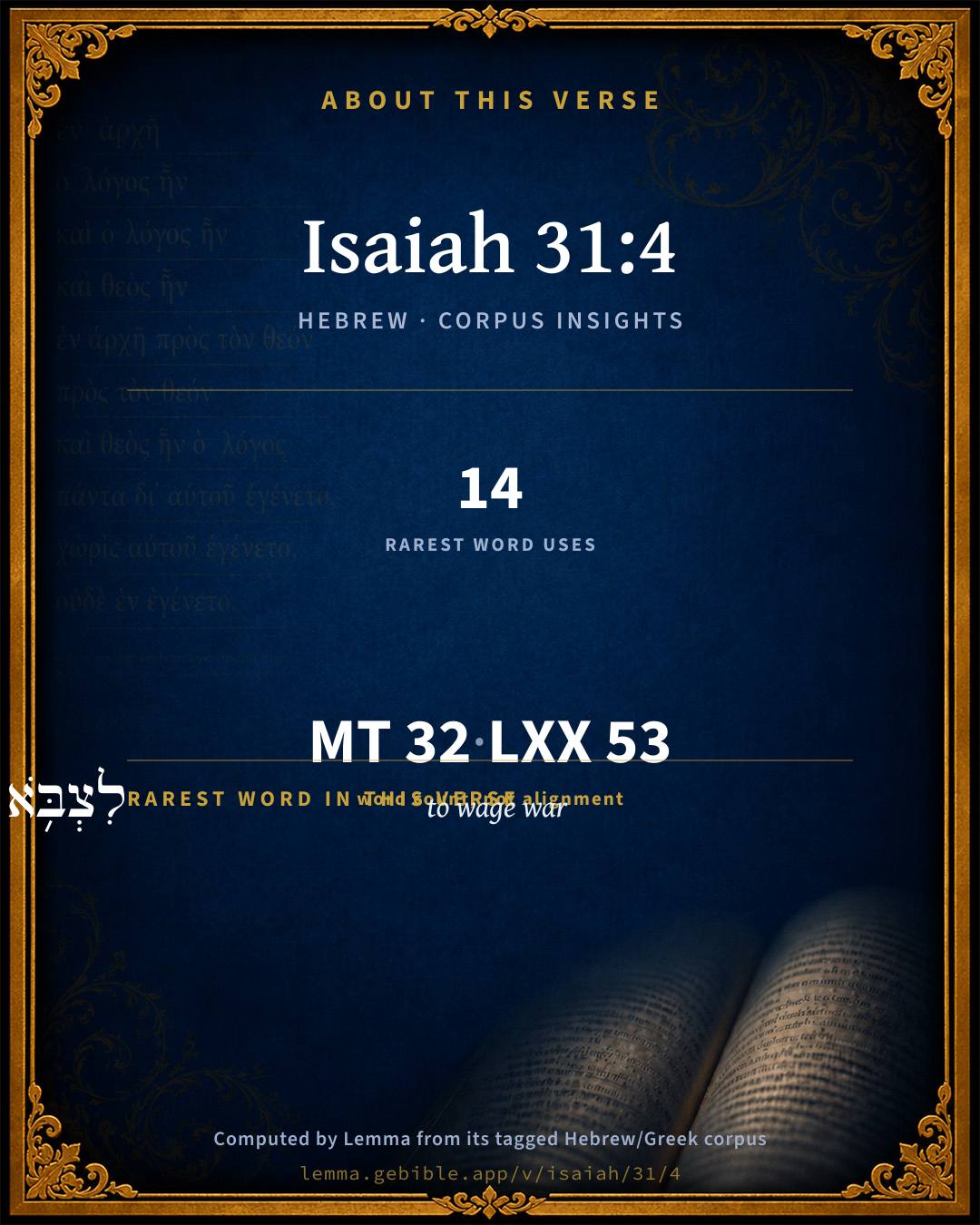
The rarest word here is לִצְבֹּ֥א to wage war H6633 — appearing just 14 times in the whole Hebrew Bible.

Shared distinctive vocabulary

לִצְבֹּ֥א to wage war H6633 occurs in 12 verses of the Hebrew Bible. Also found in:

Grammatical profile

  • 8 verbs
  • 12 nouns
  • 5 prepositions
  • 1 conjunction
  • 1 adverb
  • 5 particles

Verb forms

  • אָֽמַר Qal · Perfect
  • יֶהְגֶּה֩ Qal · Imperfect
  • יִקָּרֵ֤א Niphal · Imperfect
  • רֹעִ֔ים Qal · Participle Active
  • יֵחָ֔ת Niphal · Imperfect
  • יַֽעֲנֶ֑ה Qal · Imperfect
  • יֵרֵד֙ Qal · Imperfect
  • לִצְבֹּ֥א Qal · Infinitive Construct

Repetition

Words recur within this verse — often emphatic in Hebrew:

  • עַל upon H5921 ×4
  • יְהוָ֣ה LORD H3068 ×2
  • כַּאֲשֶׁ֣ר which H834 ×2
  • לֹ֣א not H3808 ×2

Hebrew & Septuagint length

In English translation the verse runs 60 words from the Hebrew and 64 from the Septuagint (LXX English) — closely comparable.

A rough comparison of the two English renderings, which tokenize alike — not a word-level alignment.

Word counts can differ between the Hebrew and the Greek without any difference in meaning — e.g. the Hebrew direct-object marker אֵת has no separate Greek word, and Greek often adds the article ὁ.

In the original languages it is 32 Hebrew tokens and 53 Greek tokens — but the two are counted differently (Hebrew bundles its prefixes and suffixes into one token; the Greek is in lemma form), so that isn’t a like-for-like length.

Cross-references

16

Topical passages linked to Isaiah 31:4 in the Treasury of Scripture Knowledge — connected by theme and wording, ordered by reader-vote popularity; previews shown in the World English Bible.

  • Hosea 11:10 They will walk after Yahweh, Who will roar like a lion; For he will roar, and the children will come trembling from the west.
  • Amos 3:8 The lion has roared. Who will not fear? The Lord Yahweh has spoken. Who can but prophesy?
  • Isaiah 42:13 Yahweh will go forth as a mighty man; he will stir up [his] zeal like a man of war: he will cry, yes, he will shout aloud; he will do mightily against his enemies.
  • Zechariah 2:5 For I,' says Yahweh, 'will be to her a wall of fire around it, and I will be the glory in the midst of her.
  • Zechariah 12:8 In that day Yahweh will defend the inhabitants of Jerusalem. He who is feeble among them at that day will be like David, and the house of David will be like God, like the angel of Yahweh before them.
  • Zechariah 14:3 Then Yahweh will go out and fight against those nations, as when he fought in the day of battle.
  • Revelation 5:5 One of the elders said to me, "Don't weep. Behold, the Lion who is of the tribe of Judah, the Root of David, has overcome; he who opens the book and its seven seals."
  • Numbers 24:8–9 God brings him forth out of Egypt; He has as it were the strength of the wild-ox: He shall eat up the nations his adversaries, Shall break their bones in pieces, Smite [them] through with his arrows.
  • 2 Chronicles 20:15 and he said, Listen you, all Judah, and you inhabitants of Jerusalem, and you king Jehoshaphat: Thus says Yahweh to you, Don't be afraid you, neither be dismayed by reason of this great multitude; for the battle is not yours, but God's.
  • Psalms 125:1–2 Those who trust in Yahweh are as Mount Zion, Which can't be moved, but remains forever.
  • Isaiah 10:16 Therefore will the Lord, Yahweh of Hosts, send among his fat ones leanness; and under his glory there shall be kindled a burning like the burning of fire.
  • Isaiah 12:6 Cry aloud and shout, you inhabitant of Zion; for great in the midst of you is the Holy One of Israel!"
  • Isaiah 37:35–36 For I will defend this city to save it, for my own sake, and for my servant David's sake.
  • Jeremiah 50:44 Behold, [the enemy] shall come up like a lion from the pride of the Jordan against the strong habitation: for I will suddenly make them run away from it; and whoever is chosen, him will I appoint over it: for who is like me? and who will appoint me a time? and who is the shepherd who can stand before me?
  • Zechariah 9:8 I will encamp around my house against the army, That none pass through or return; And no oppressor will pass through them any more: For now I have seen with my eyes.
  • Zechariah 9:15 Yahweh of Hosts will defend them; And they will destroy and overcome with sling-stones; And they will drink, and roar as through wine; And they will be filled like bowls, Like the corners of the altar.

Cross-references courtesy of OpenBible.info (CC BY 4.0).

Hebrew and Greek witnesses Masoretic Hebrew ↔ Greek Septuagint

The same verse in the two great witnesses to the Old Testament, shown verse-for-verse.

These are two independent witnesses, not word-aligned to each other, and the Septuagint is shown in lemma (dictionary) form.

Hebrew Isaiah 31:4 Masoretic · Westminster Leningrad Codex

כִּ֣י כֹ֣ה אָֽמַר יְהוָ֣ה אֵלַ֡י כַּאֲשֶׁ֣ר יֶהְגֶּה֩ הָאַרְיֵ֨ה וְהַכְּפִ֜יר עַל טַרְפּ֗וֹ אֲשֶׁ֨ר יִקָּרֵ֤א עָלָיו֙ מְלֹ֣א רֹעִ֔ים מִקּוֹלָם֙ לֹ֣א יֵחָ֔ת וּמֵֽהֲמוֹנָ֖ם לֹ֣א יַֽעֲנֶ֑ה כֵּ֗ן יֵרֵד֙ יְהוָ֣ה צְבָא֔וֹת לִצְבֹּ֥א עַל הַר צִיּ֖וֹן וְעַל גִּבְעָתָֽהּ

For thus says Yahweh to me, As the lion and the young lion growling over his prey, if a multitude of shepherds are called forth against him, will not be dismayed at their voice, nor abase himself for the noise of them: so will Yahweh of Hosts come down to fight on Mount Zion, and on the hill of it.

World English Bible · Public Domain

Greek LXX Isaiah 31:4 Septuagint · lemma form

ὅτι οὕτως εἶπον ἐγώ κύριος ὅς τρόπος ἐάν βοάω ὁ λέων ἤ ὁ σκύμνος ἐπί ὁ θήρα ὅς λαμβάνω καί κράζω ἐπί αὐτός ἕως ἄν ἐνπίμπλημι ὁ ὄρος ὁ φωνή αὐτός καί ἡττάω καί ὁ πλῆθος ὁ θυμός πτοέω οὕτως καταβαίνω κύριος σαβαωθ ἐπιστρατεύω ἐπί ὁ ὄρος ὁ σιων ἐπί ὁ ὄρος αὐτός

For thus said the Lord to me, As a lion would roar, or a lion's whelp over prey which he has taken, and cry over it, until the mountains are filled with his voice, and the animals are awe-struck and tremble at the fierceness of his wrath: so the Lord of hosts shall descend to fight upon the mount Sion, even upon her mountains.

LXX2012 (modern English Septuagint) · Public Domain

Hebrew: Westminster Leningrad Codex (CC BY 4.0). Greek: Septuagint (public domain); English from LXX2012 (modern English Septuagint) (Public Domain). How the Septuagint differs from the Hebrew →

Targum (Aramaic paraphrase)

1

The Targum is the ancient Jewish Aramaic paraphrase of the Hebrew Scriptures — an interpretive translation, not the Hebrew text itself. Onkelos (literal) and Pseudo-Jonathan (expansive) render the Torah, and Jonathan the Prophets. Coverage is partial: where no permissively-licensed English translation exists for a verse, only the Aramaic is shown. This is verse-level text, not a word-by-word alignment to the Hebrew.

  1. Targum Jonathan Prophets (Joshua–Malachi)
    אֲרֵי כִדְנַן אֲמַר יְיָ לִי כְּמָא דְמַכְלֵי אַרְיָא בַּר אַרְיָוָן עַל צֵידֵיהּ דְמִזְדַמְנִין עֲלוֹהִי דִיר רַעֲיָן מִקָלְהוֹן לָא אִתְבַּר וּמֵאִתְרְגוּשְׁתְּהוֹן לָא מִזְדַעְזַע כֵּן תִּתְגְלֵי מַלְכוּתָא דַייָ צְבָאוֹת לְמִשְׁרֵי עַל טוּרָא דְצִיוֹן וְעַל רָמָתָהּ:

    For thus the Lord hath said unto me: Like as the lion and the lion's whelp roar over their prey, when a multitude of shepherds are come together, he will not be afraid of their voice, neither be terrified at their tumult; thus shall the kingdom of the Lord of hosts be revealed encamping? upon the mountain of Zion, and upon its hill.

    Targum Jonathan — Aramaic: “Mikraot Gedolot” (public domain). English: “Sefaria Community Translation” (CC0 1.0 (public-domain dedication)); “London "Chaldee Paraphrase," 1871” (public domain). Text via Sefaria.

Commentary

Notes on Isaiah 31:4 from classic Christian and Jewish commentators (each source and its license shown beneath its notes). The classic Christian expositions comment on the surrounding passage and are grouped to its opening verse, so a note may address several verses; the Jewish commentaries on the Tanakh (Rashi and others) are per-verse, so they appear only where the commentator wrote on this verse.

Lemma curates 59 commentaries, every one of them public domain or Creative Commons licensed, each selected and text-cleaned for this edition rather than reprinted as found. About our sources →

The Cambridge Bible for Schools and Colleges

gen. ed. J. J. S. Perowne

4. The verse reads: As the lion growls, and the young lion over his prey, against whom the whole band of shepherds has been called out—he is not terrified by their cry, nor dismayed at their shouting—so Jehovah of Hosts will come down, &c. Compare with this truly Homeric simile Il. 18:161 f., 12:299 ff. It is unfortunate that so graphic an image should be thought capable of two diametrically opposite interpretations. According to many commentators it expresses Jehovah’s determination to defend Jerusalem against the Assyrians. But the figure would certainly be “ill-chosen” if the lion were represented as protecting his prey and the shepherds as anxious to destroy it. The only natural construction is that Jehovah (through the Assyrians, as in Isa_29:3-4) will hold Jerusalem helpless in His power as the lion holds his prey; though the noisy crowd of shepherds (the Egyptians) try to scare him away. The only advantage of the other view is that the transition from threatening to promise would be somewhat less abrupt at the beginning of Isa_31:4 than at the beginning of Isa_31:5; but that is not a sufficient reason for straining the figure in the way proposed.

to fight for mount Zion, and for] Render: to fight against … and against, as in every other case where the phrase occurs (ch. Isa_29:7-8; Num_31:7; Zec_14:12). The translation “upon mount Zion and upon” is only adopted in order to maintain the favourable construction of the verse.

The Cambridge Bible for Schools and Colleges (gen. ed. J. J. S. Perowne; Cambridge University Press, 1878–1918) — public domain. Text from a community e-Sword module.

Trapp's Complete Commentary

John Trapp

Isa 31:4 For thus hath the LORD spoken unto me, Like as the lion and the young lion roaring on his prey, when a multitude of shepherds is called forth against him, [he] will not be afraid of their voice, nor abase himself for the noise of them: so shall the LORD of hosts come down to fight for mount Zion, and for the hill thereof.

Ver. 4. Like as the lion and the young lion.] That they may trust in God, and not in the arm of flesh, the prophet setteth before them under two fit similitudes, the power of God, {Isa 31:4} and the mercy of God. {Isa 31:5} These are the Jakin and the Boaz, the two main pillars and supports of trust in God. Procopius here noteth that the lion, when he preyeth, first roareth so terribly, that he thereby amazeth both the cattle and their keepers, and then he falleth upon them and teareth them in pieces; so doth God first roar, that is, threaten by his prophets, and then he destroyeth such as obstinate themselves in a sinful course.

John Trapp, A Commentary or Exposition upon All the Books of the Old and New Testament (1647–1656) — public domain. Text from a community e-Sword module.

The Biblical Illustrator

Joseph S. Exell

Isa_31:4

Like as the lion and the young lion roaring on his prey

A Homeric passage

There is no passage in Isaiah which is so Homeric in ring as this; cf.

Iliad, 18.161 f., 12.299 ft. (F. Delitzsch.)

The lion and the shepherds

Is it an unworthy figure of the Divine Claimant for this city, who kept unceasing hold upon her after His own manner, mysterious and lionlike to men, undisturbed by the screams, formulas, and prayers of her mob of politicians and treaty-mongers? For these are the shepherds Isaiah means--sham shepherds, the shrieking crew of politicians, with their treaties and military display. God will save and carry Jerusalem His own way, paying no heed to such. (Prof. G. A. Smith, D. D.)

The lionlike mercies of God

If it is God who is the lion, then it is for the best. For though He slay me, yet will I trust Him; and, after all, it is safer to rely on the mercies of God, lionlike though they be, than on the weak benevolenees and officious pities of the best of human advisers. (Prof. G. A. Smith, D. D.)

The Biblical Illustrator, edited by Joseph S. Exell (c. 1880s–1900s) — public domain. Text from a community e-Sword module.

Joseph Benson's Commentary

Isa 31:4-5. For, or but or, nevertheless, thus hath the Lord spoken — That is, although you have done evil in sending to Egypt for help, and they will not be able to help you, yet the Lord will of his own grace, and for the glory of his own name, give you that help and deliverance which you do not deserve, and had no reason to expect from him. Like as the lion roaring on his prey — When he is ready to seize upon and devour it; he will not be afraid, nor abase himself — So as to be in the least moved, either to quit his prey, or to make any more haste than otherwise he would do in seizing it. So shall the Lord of hosts fight for mount Zion — With such an unshaken and undaunted resolution, not to be moved by any opposition: and he will as easily and irresistibly destroy the Assyrian army, as a lion tears a lamb in pieces. As birds flying, &c. — Which come from above, and so cannot be kept off; which fly swiftly, and engage themselves readily and resolutely, when they perceive their young ones are in danger. Bishop Lowth renders the clause, As the mother birds hovering over their young; so shall Jehovah, God of hosts, protect Jerusalem — With such care and compassion, such swiftness and resolution. Defending also he will deliver it — That is, he will so defend it as to secure the continuance of its safety, and not suffer it to fall into the enemy’s hand. And passing over he will preserve it — The word פסוח, here rendered passing over, is the word constantly used of the destroying angel’s passing over the houses of the Israelites, when he slew all the firstborn of the Egyptians, (Exodus 12.,) to which history the prophet seems here to refer. The destroying angel was to pass over Jerusalem, and leave it untouched, although it deserved to be destroyed, and was only to smite the Assyrian army. The besiegers were to be slain by the pestilence, but none of the besieged were to take the infection.

Joseph Benson's Commentary on the Old and New Testaments (1811–1818) — public domain. Text from a community e-Sword module.

Tyndale Open Study Notes

Tyndale Open Resources

31:4-9 This prophecy concerned God’s protection of Jerusalem and its rescue from the Assyrians.

Tyndale Open Study Notes — © Tyndale Open Resources, licensed CC BY-SA 4.0. Text via the HelloAO Bible API.

Geneva Bible (1599)

Geneva Bible translators

He showeth the Jews, that if they would put their trust in him, he is so able, that none can resist his power: and so careful over them, as a bird over her young, which ever flieth about them for their defense: which similitude the scripture useth in divers places, as Deut. 32:11; Matt. 23:37.

Geneva Bible (1599) marginal notes — public domain. Text via Bolls.life.

Jamieson, Fausset & Brown

Robert Jamieson, A. R. Fausset & David Brown

(Isa 42:13; Hos 11:10).

roaring on--"growling over" his prey.

abase himself--be disheartened or frightened.

Jamieson, Fausset & Brown — Commentary Critical and Explanatory on the Whole Bible (1871) — public domain (CC PDM 1.0). Text via the HelloAO Bible API.

Adam Clarke's Commentary

Verse 4. Like as the lion] This comparison is exactly in the spirit and manner, and very nearly approaching to the expression, of Homer.

Βη ρ' ιμεν, ὡστε λεων ορεσιτροφος, ὁστ' επιδευης

Δηρον εῃ κρειων, κελεται δε ἑ θυμος αγηνωρ,

Μηλων πειρησοντα, και ες πυκινον δομον ελθειν·

Ειπερ γαρ χ' εὑρῃσι παρ' αυτοψι βωτορας ανδρας

Συν κυσι και δουρεσσι φυλασσοντας περι μηλα,

Ου ρα τ' απειρητος μεμονε σταθμοιο διεσθαι.

Αλλ' ὁγ' αῥ η ἡρπαξε μεταλμενος, ηε και αυτος

Εβλητ' εν πρωτοισι θοης απο χειρος ακοντι.

Iliad xii. 299.

As the bold lion, mountain-bred, now long

Famished, with courage and with hunger stung

Attempts the thronged fold: him nought appals,

Though dogs and armed shepherds stand in guard

Collected; he nathless undaunted springs

O'er the high fence, and rends the trembling prey;

Or, rushing onward, in his breast receives

The well-aimed spear.

Of metaphors, allegories, and comparisons of the Hebrew poets, in which the Divine nature and attributes are represented under images taken from brutes and other low objects; of their effect, their sublimity, and the causes of it; see De Sac. Poes. Heb., Praelect. xvi. sub. fin.

Adam Clarke's Commentary on the Bible (1810–1826) — public domain. Text from a community e-Sword/MySword module.

Ellicott's Commentary for English Readers

(4) Like as the lion . . .—The similitude is note worthy, as for its fulness and vividness, so also for the fact that the lion is made the symbol, not of destruction, but protection. As the king of beasts stands haughtily defiant over the prey which he has made his own against the shepherds who seek to rob him of it, so will Jehovah, in His character as the Lord of hosts, refuse to surrender Jerusalem, His peculiar possession, to the armies of the Assyrians. (Comp. Homer, Il., 18:161.)

To fight for Mount Zion.—The preposition has been differently rendered as for, on, against. The lion in the last case is claiming the sheep as his own prey, and will not suffer interference from without. Jehovah, using the Assyrian armies as His instruments, will fight against Jerusalem, and will not allow the Egyptian allies to interfere with His chastisements. (Comp. Isa_29:7-8.) The second clause simply marks Jerusalem as the scene of the conflict, but agrees in substance with the first. Looking to the verse that follows, the idea of protection seems more natural than that of hostility. The thought of supreme ownership, however, includes both; Jerusalem belonged to Jehovah to protect or to chastise.

A Bible Commentary for English Readers, edited by Charles John Ellicott (1878–1897) — public domain. Text from a community e-Sword module.

John Gill's Exposition

For thus hath the Lord spoken unto me,.... The prophet Isaiah, who had heard and received what follows from the Lord, and therefore it might be depended upon; and they are words of grace and mercy, promising preservation and deliverance; and therefore it was a foolish thing to send to Egypt for help:

Like as the lion, and the young lion roaring on his prey; or "muttering", or "growling over his prey" (r); for the lion roars when he is hungry, and wants a prey, and not when he has got one; but when he has one, and is tearing it in pieces, and feeding upon it, he makes a lower noise, a growling one, especially when he apprehends anyone near to disturb him:

when a multitude of shepherds is called forth against him; or, "a fulness of shepherds" (s); the whole posse of them, all that are in the towns and villages, or fields adjacent: who, when a lion has got a lamb or sheep out of the flock, are alarmed and called together, to deliver it, if possible, out of his hands; one not daring to venture, or being not sufficient to disturb him, or drive him away: or, "when a multitude of shepherds meet him" (t); with the prey in his jaws; or rather "call to him", make a noise, in hopes to frighten him, and cause him to drop his prey, that being all they can do, not daring to go near him; which sense is confirmed by what follows:

he will not be afraid of their voice, nor abase himself for the noise of them; he will not leave and lose his prey, or flee from it or them, for the yell and confused noise they make; nor move at all the faster for them, not being in the least intimidated by them:

so shall the Lord of hosts come down to fight for Mount Zion, and for the hill thereof; that is, he shall come down from heaven by his angel, or in the display of his mighty power, and fight against the Assyrian army, in favour of his people, the inhabitants of Zion or Jerusalem, and deliver them; and there will be no more withstanding him, or putting him off from his purpose, or preventing his good designs and resolutions, than the shepherds are able to divert a lion from his prey. The simile is expressive of the power of God, and of his certain accomplishment of his purposes and promises.

(r) "ab" "mussitare." (s) "plenitudo pastorum", Montanus, De Dieu, Cocceius. A collection of them, as Ben Melech. (t) "quando in occursum illius venit", Munster.

John Gill's Exposition of the Whole Bible (1746–1763) — public domain (CC PDM 1.0). Text via the HelloAO Bible API.

Albert Barnes' Notes on the Bible

For thus hath the Lord spoken - The design of this verse and the following is to assure the Jews of the certain protection of Yahweh, and thus to induce them to put their trust in him rather than to seek the alliance with Egypt. To do this the prophet makes use of two striking illustrations, the first of which is, that Yahweh would be no more alarmed at the number and power of their enemies than a fierce lion would be that was intent on his prey, and could not be frightened from it by any number of men that should come against him. The “point” of this comparison is, that as the lion that “was intent on his purpose” could not be frightened from it by numbers, so it would be with Yahweh, who “was equally intent on his purpose” - the defense of the city of Jerusalem. It does not mean, of course, that the purpose of God and of the lion resembled each other, but merely that there was similar “intensity of purpose,” and similar adherence to it notwithstanding all opposition. The figure is one that denotes the highest vigilance, firmness, steadiness, and a determination on the part of Yahweh that Jerusalem should not fall into the hands of the Assyrians.

Like as the lion - The divine nature and purposes are often represented in the Scriptures by metaphors, allegories, and comparisons taken from animals, and especially from the lion (see Deu 33:20; Job 10:16; Psa 7:2; Hos 11:10).

And the young lion - The vigorous, strong, fierce lion. The use of the two here, gives intensity and strength to the comparison. It is observable that the lion is seldom mentioned alone in the Scriptures.

Roaring on his prey - Roaring as he seizes on his prey. This is the moment of the greatest intensity of purpose in the lion, and it is therefore used by Isaiah to denote the intense purpose of Yahweh to defend Jerusalem, and not to be deterred by any number of enemies.

When a multitude of shepherds is called forth - When the neighborhood is alarmed, and all the inhabitants turn out to destroy him. This comparison is almost exactly in the spirit and language of Homer, “Il.” xii. 209, following:

So pressed with hunger from the mountain’s brow,

Descends a lion on the flocks below;

So stalks the lordly savage o’er the plain,

In sullen majesty and stern disdain:

In vain loud mastiffs bay him from afar,

And shepherds gall him with an iron war;

Regardless, furious, he pursues his way;

He foams, he roars, he rends the panting prey.

Pope

So also Il. xviii. 161, 162:

- But checked he turns; repulsed attacks again.

With fiercer shouts his lingering troops he fires

Nor yields a step, nor from his post retires;

So watchful shepherds strive to force in vain,

The hungry lion from the carcass slain.

Pope

He will not be afraid - He will be so intent on his prey that he will not heed their shouting.

Nor abase himself - That is, he will not be frightened, or disheartened.

So shall the Lord of hosts - That is, with the same intensity of purpose; with the same fixedness of design. He will be as little dismayed and diverted from his purpose by the number, the designs, and the war shout of the Assyrian armies.

Albert Barnes' Notes on the Bible (1834–1885) — public domain. Text from a community e-Sword/MySword module.

Haydock's Catholic Bible Commentary

Thereof. He will thence hurl destruction on the distant enemy. (Calmet) --- He had destroyed Sennacherib’s army, 4 Kings xix. Yet they forgot this and other proofs of God’s power and love. (Worthington)

George Leo Haydock (1774–1849), Haydock's Catholic Family Bible and Commentary, 1859 edition — public domain. Excludes Psalms (Douay-Rheims chapter numbering differs from Protestant) and Deuterocanonical books (Catholic canon only).

Matthew Poole's English Annotations

For; or, but; or, nevertheless, as this particle is elsewhere used, as hath been proved before. Although you have done evil in sending to Egypt for help, and they shall not be able to help you; yet the Lord himself will, of his own grace, and for the glory of his own name, give you that help and deliverance which you do not deserve, and have no reason to expect from him. And therefore desist from those evil courtels and courses, as those which are both unnecessary and pernicious.

Roaring on his prey; when he is ready to seize upon it, and devour it.

He will not be afraid of their voice, nor abase himself: it hath been observed of lions, that when they are pursued, they do not run away with all speed, as other creatures do, but march away slowly, and make an honourable retreat. For: although this Hebrew particle might be rendered against, and so this place might be understood of God’s fighting against the Jews and Egyptians, of which he speaks Isa 31:3; yet it is better rendered for, as it is taken in many other places, as is manifest from the following similitude and verse.

Matthew Poole's English Annotations on the Holy Bible (1683–1685) — public domain. Text from a community e-Sword/MySword module.

Whedon's Commentary on the Bible

Daniel D. Whedon

4, 5. The prophet, as if from a new assurance from Heaven, reasserts Jehovah as their only protector. He illustrates by two comparisons worthy of Homer. (See HOMER’S Iliad, 18:161, 162.) In quite close rendering Isaiah says: “As a lion growls, and a young lion, over his prey, against whom a multitude of shepherds is called forth, at their cry is not frightened, and at their noise is not humbled, so will Jehovah of hosts come down to fight upon (or over, or in behalf of) Mount Zion, and upon his hill.” Just so cool and unconcerned will Jehovah be at the loud threats and dashing movements of the approaching Assyrian army upon Mount Zion. Another kind of protection is implied in the other simile: “Like fluttering birds, so will Jehovah of hosts screen Jerusalem, screening and delivering, sparing and setting free.” The weak bird defends its young with courage to the death ere surrendering them. How infinitely more will God defend his people.

Daniel D. Whedon (gen. ed.), Commentary on the Old and New Testaments (1874–1909) — public domain. Text from a community e-Sword module.

The Pulpit Commentary

Vers. 4-9. A PROMISE OF PROTECTION, AND OF THE DISCOMFITURE OF ASSYRIA. In the promise of protection (vers. 4, 5) there is nothing new but the imagery, which is of remarkable beauty. The promise is followed by a brief exhortation (vers. 6, 7); and then the discomfiture of Assyria is declared in the plainest terms, and her flight before the avenging sword of God (vers. 8, 9).

Like as the lion, etc. The resemblance of this simile to Hem., "Iliad," 18:11. 161, 162, has been often noticed. In both, the lion has seized his prey, and is crouching over it; the shepherds gather themselves together against him, and seek to scare him away; but he remains firm, undaunted by their threats and cries, never for a moment relinquishing the body of which he has made himself the master. The image is best explained as representing Jehovah, standing over and keeping guard on Jerusalem, which he will allow, no one to rend from him. And the young lion; rather, even the young lion (Lowth). A single animal must be intended. Roaring on his prey; rather, growleth over his prey . So shall the Lord of hosts come down to fight for Mount Zion; rather, so shall the Lord of hosts descend, to fight, on Mount Zion. If we connect the concluding words of the clause with tsaba, to fight, the meaning must be "fight against," as Delitzsch shows conclusively. But we may connect them with the more distant yered, will descend, in which case they will mean "on," or upon Mount Zion". (comp. Exo_19:18 Psa_133:3) The best commentators are of opinion that this must be the sense. The words are a promise, not a threat.

Vers. 4-6. Similes of the nature and power of Jehovah.

I THE LION. He is pictured watching over the holy city, the "peculiar treasure," the invisible Sanctuary of the religion and the people, as a lion over its prey, in the presence of threatening shepherds. "As from a carcase herdsmen strive in vain To scare a tawny lion, hunger-pinch"d; Ev"n so th" Ajaces, mail-clad warriors, faird The son of Priam from the corse to scare." ("Iliad," 18:161.)

It is a fine image found twice in Homer of the undaunted prowess of the bold and steadfast warrior. Invincible towards his foes, what is Jehovah towards his friends, the people of his choice and love?

II THE BIRD. Infinite tenderness mingles with irresistible might in the nature of God. It is no narrow view of the Divine attributes which the Bible gives. All that we see of nobility in living creatures, all traits of courage and of love, may be borrowed to enrich our representations of that nature which includes all other nature within its scope and grasp. Thus the magnificent queen of birds, no less than the magnificent king of beasts, supplies in its actions and habits a parable of eternal providence. The eagle fluttering over her young, spreading her wide wings and bearing them thereon, was a type of Jehovah"s conduct to his people in the desert. (Deu_32:10) So does he now hover over the city, protecting, rescuing. Nor was it otherwise in the days of the Savior, who employs also the simile of the maternal bird. Every ideal of lionhearted hero, of father, strong yet tender, of all-brooding mother, of living creatures inspired by mysterious and mighty instincts of love, helps to bring into momentary clearness some feature of the nature of him whose being is only "dark from excess of light." His voice, pleading with youth and innocence, with the unsophisticated conscience, says, "Come!" and with the sinner and the sophist, "Return! J.

God unhindered by fears of man.

We fear and tremble before boastful words and a great show of force, but we may well remember that God does not. He reckons it all at its true worth, and goes on with his Divine working quite unmoved by all the rage. The figure in this verse needs careful explanation. The allusion is to the boastings and threatenings of Sennacherib. God has undertaken to defend the city of Jerusalem. As the lion will not give up his prey, so Jehovah will not allow the Assyrians to rob him of his "peculiar treasure," Jerusalem. The vast armies of the Assyrians were as nothing in the estimation of Jehovah. He viewed unperturbed their attempt to seize the locality which he had chosen as his special residence. Matthew Henry, with quaint force, says, Whoever appear against God, they are but like a multitude of poor simple shepherds shouting at a lion, who scorns to take notice of them, or so much as to alter his pace for them." Taking an illustration from another sphere of nature, the Divine calmness under excitement that alarms men may be illustrated by the following passage from Gosse: "There was a heavy swell from the westward, which, coming on in broadly heaving undulations, gave the idea of power indeed, but of power m repose, as when a lion crouches in his lair with sheathed talons and smoothed mane and half-closed eyes. But no sooner does each broad swell, dark and polished, come into contact with these walls and towers of solid rock, than its aspect is instantly changed. It rears itself in fury, dashes with hoarse roar, and apparently resistless might, against the opposition, breaks in a cloud of snowy foam, which hides the rocky eminence, and makes us for a moment think the sea has conquered. But the next, the baffled assailant is recoiling in a hundred cascades, or writhing and groveling in swirls around the feet of those strong pillars which still stand in their majesty, unmoved, immovable, ready to receive and to repel the successive assaults of wave after wave with ever the same result." There is a quality or power in man, which we call in a good sense sang-froid a power of keeping calm in times of excitement, which we are accustomed to admire, and which may help us to realize the figure of God given in this passage. A remarkable story is told in connection with Prince Bismarck, who is a striking example of persistent keeping on at his designs, however loud may be the howlings around him. It is said that he wears an iron ring, on which is inscribed the Russian word "Nitschewo," or "It does not matter." In the winter of 1862 he was hurriedly journeying in Russia, and in answer to various appeals to his driver, he could get nothing from him save this one word, "Nitschewo." At last the sledge was upset, and taking an iron bar which had become detached from the sledge, Bismarck, in his annoyance, thought of striking the man, but feeling he had learned a life-lesson from the frequent repetition of this word, he kept the bar, and had a ring made of it to remind him, in the worryful times of life that "it does not matter." Consider

I THE THINGS WHICH GOD DOES NOT HEED. They go under this heading the boasts of the proud. Empty words. Noisy deeds. The material forces which lie at the command of men. These greatly alarm us. Let but a sound of threatening rise into the air, and we cry in our fright, "The Church is in danger!" God is not disturbed. His Church is safe; the "gates of hell shall not prevail against her." Let but the nations unite for some act of violence towards the Lord"s Jerusalem, and in fright her statesmen run off to Egypt for help. Jerusalem is in no real danger a wall of Divine guardian fire is all round about her, and God will defend his own.

II THE THINGS WHICH GOD DOES HEED. These will go under the heading the cry of the humble. He who is best beard by man when he speaks with a "still, small voice," best hears man when he speaks to him with a "still, small voice." Not the thunder of men"s anger, but the quiet evening breeze of men"s humble prayer, goes right in to the throne of God. We may learn from this figure of God"s patient indifference to what seems so alarming, how we may rightly estimate opposing forces and persons who show enmity to us. Most of such forces and persons had better just be passed by, left alone. Nitschewo does not matter." We all of us make too much of evil things and noisy oppositions. We magnify them until they fret and weary and hinder us. Would that we were more like God, whoR.T. "Moves on his undisturbed affairs!

The Pulpit Commentary (1880–1919), ed. H.D.M. Spence-Jones & Joseph S. Exell — public domain. Text from a community e-Sword module.

John Wesley's Explanatory Notes

For - Although you have done evil in sending to Egypt for help, yet the Lord himself will, of his own grace, give you that help which you do not deserve.

John Wesley, Explanatory Notes Upon the Whole Bible (1754–1765) — public domain. Text via the GEBible commentary corpus.

Keil & Delitzsch

C. F. Keil & F. Delitzsch

And things of this kind would occur. "For thus hath Jehovah spoken to me, As the lion growls, and the young lion over its prey, against which a whole crowd of shepherds is called together; he is not alarmed at their cry, and does not surrender at their noise; so will Jehovah of hosts descend to the campaign against the mountain of Zion, and against their hill." There is no other passage in the book of Isaiah which sounds so Homeric as this (vid., Il. xviii. 161, 162, xii. 299ff.). It has been misunderstood by Knobel, Umbreit, Drechsler, and others, who suppose על לצבּא to refer to Jehovah's purpose to fight for Jerusalem: Jehovah, who would no more allow His city to be taken from Him, than a lion would give up a lamb that it had taken as its prey. But how could Jerusalem be compared to a lamb which a lion holds in its claws as tereph? (Isa 5:29). We may see, even from Isa 29:7, what construction is meant to be put upon על צבא. Those sinners and their protectors would first of all perish; for like a fierce indomitable lion would Jehovah advance against Jerusalem, and take it as His prey, without suffering Himself to be thwarted by the Judaeans and Egyptians, who set themselves in opposition to His army (The Assyrians). The mountain of Zion was the citadel and temple; the hill of Zion the city of Jerusalem (Isa 10:32). They would both be given up to the judgment of Jehovah, without any possibility of escape. The commentators have been misled by the fact, that a simile of a promising character follows immediately afterwards, without anything to connect the one with the other. But this abrupt μετάβασις was intended as a surprise, and was a true picture of the actual fulfilment of the prophecy; for in the moment of the greatest distress, when the actual existence of Jerusalem was in question (cf., Isa 10:33-34), the fate of Ariel took suddenly and miraculously a totally different turn (Isa 29:2). In this sense, a pleasant picture is placed side by side with the terrible one (compare Mic 5:6-7).

Keil & Delitzsch — Biblical Commentary on the Old Testament (1861–1891) — public domain (CC PDM 1.0). Text via the HelloAO Bible API. (Old Testament only.)

J. A. Alexander on Isaiah

Joseph Addison Alexander

“For thus saith Jehovah unto me, As a lion growls, and a young lion, over his prey, against whom a multitude of shepherds is called forth, at their voice he is not frightened, and at their noise he is not humbled, so will Jehovah of Hosts come down, to fight upon Mount Zion and upon her kill.” This is still another form of the same contrast. The comparison is a favorite one with Homer, and occurs in the eighteenth book of the Iliad, in terms almost identical. ‘Growl’ is to be preferred to roar, because the Hebrew word more properly denotes a suppressed or feeble sound. Most interpreters have ‘for Mount Zion’. Others regard this as a threatening that God will take part with the Assyrians against Jerusalem, the promise of deliverance beginning with the next verse. By supposing the particle to mean ‘concerning’, we can explain its use both in a hostile and a favorable sense. The ‘for’ at the beginning of this verse introduces the ground or reason of the declaration that the seeking of foreign aid was both unlawful and unnecessary The hill is by some supposed to be Moriah, as an appendage of Mount Zion; but it may just as well be simply parallel to mountain, the mountain of Zion and the hill thereof.

Joseph Addison Alexander, The Prophecies of Isaiah (1846–1847; New York: Scribner, 1870–1878) — public domain. Text from a community e-Sword module.

unfoldingWord translationNotes

Door43 World Missions Community

General Information:

Yahweh speaks to Isaiah.

As a lion ... thus Yahweh of hosts

"A lion ... in the same way Yahweh of hosts." Here Yahweh speaks of how he will defend the people who belong to him and not be scared away by comparing himself to a lion who guards it's prey. (See: Simile)

thus Yahweh of hosts will descend ... that hill

It may be more clear if you move the last line to before the first line: "Yahweh of hosts will descend to fight on Mount Zion, on that hill, as a lion, even a young lion"

a lion, even a young lion

"a female lion or killer lion." This is a doublet with both phrase referring to a fierce lion. AT: "a lion" (See: Doublet)

growls

warns others to stay away

when a group of shepherds is called out against it

The phrase "called out against it" means to be sent out to chase the lion away. This can be stated in active form. AT: "when someone sends shepherds to chase the lion away" (See: Idiom or Active or Passive)

from their sound

The shepherds would make loud noises to try and chase away the lion. AT: "from the loud noises that they make" (See: Assumed Knowledge and Implicit Information)

will descend

"will come down." This refers to descending from heaven. AT: "will come down from heaven" (See: Assumed Knowledge and Implicit Information)

on Mount Zion, on that hill

Both of the phrases refer to Mount Zion. AT: "on Mount Zion" (See: Parallelism)

translationWords

Yahweh

lions

shepherd

voice

Yahweh of hosts

Zion

unfoldingWord translationNotes — © Distant Shores Media and the Door43 World Missions Community, licensed CC BY-SA 4.0. Source: git.door43.org/Door43/en_tn.

Rashi

Rabbi Shlomo Yitzchaki (Rashi)

As...growls (יֶהְגֶּה) a roaring sound. Comp. (infra 59:11) “And like doves we will moan (הָגֹה נֶהְגֶּה).”

although a band of shepherds gather against him (יִקָּרֵא, lit., will be called.) They will gather upon him with a stirring shout.

band of shepherds (מְלֹא) a gathering of shepherds. Comp. (Jer. 12:6) “They called after you a band (מָלֵא).” Comp. also (Job 16:10) “Together they gather (יִתְמַלָּאוּן) against me.” All of these are expressions of gathering.

he is not subdued (יַעֲנֶה) he will not humble himself, he will not make himself as a poor man. Comp. (Exodus 10:3) “To humble yourself (לֵעָנוֹת) from before Me.” Comp. also (Hosea 5:5) “And the pride of Israel shall be humbled (וְעָנָה).”

so shall...descend (This intimates that God will descend) and will not be afraid of the stirring (or the multitude) of the nations.

Rashi on the Tanakh — English translations: “The Judaica Press complete Tanach with Rashi, translated by A. J. Rosenberg” (CC BY 4.0); “Pentateuch with Rashi's commentary by M. Rosenbaum and A.M. Silbermann, 1929-1934” (public domain); “The Metsudah Tanach series, Lakewood, N.J” (CC BY 4.0); and “The Book of Joshua, Metsudah Publications, 1997” (CC BY 4.0). Text via Sefaria.

Ibn Ezra

Rabbi Abraham ibn Ezra

יהגה He roareth. It is the same in meaning as ישאג.

יקרא עליו מלא רעים אשר When all shepherds are called, one by the other, to join in the fight against the lion.

מלא The full number, all of them, that not one shepherd shall fail to come.

לא יענה He will not abase himself. Root ענה to be poor. Comp. עני poor (Deut. 24:12); לענות to be humble (Ex. 10:3); יענה shall be brought low (25:5).

So shall the Lord of hosts come down, etc. The angel coming down to smite the Assyrian army is meant.

Ibn Ezra on the Tanakh — English translations: “Sefaria Community Translation” (CC0 1.0 (public-domain dedication)); “Yalkut, Sifsei Chachomim Chumash, Metsudah Publications, 2009” (CC BY 4.0); and “Commentary of Ibn Ezra on Isaiah - trans. by M. Friedlander, 1873” (public domain). Text via Sefaria.

Lesson kit

Teaching starters — assembled from the data on this page, not authored interpretation. Every prompt links to the verse data it draws on. Edit before teaching.

Isaiah, in the Prophets, opens this verse with 32 words (26 distinct Hebrew lemmas). Its most distinctive word is tsâbâʼ (“to wage war”). A historical commentator’s framing appears above. Read the whole chapter for the surrounding context.

Discussion questions

  1. How does “to wage war” (tsâbâʼ) shape what this verse is saying?
  2. How does Exodus 38:8, which shares the word «to wage war», read alongside this verse?
  3. What does the repetition of “upon” (4× in this one verse) do in this verse?
  4. These translations render this verse differently. What is at stake in choosing one wording over another?
  5. «אָֽמַר» is a Qal Perfect verb. How does that grammatical form shape the action described?
  6. Compare how The Cambridge Bible for Schools and Colleges and Trapp's Complete Commentary read this verse. Where do they agree or differ?

Things to notice

Reading settings

Reading text

Shown beneath each verse's original-language words.

Old Testament
Old Testament edition

Read the OT as the Masoretic Hebrew (MT) or the Greek Septuagint (LXX).

English shown for the Greek Septuagint (in the Hebrew ↔ Greek comparison).

Comparing translations? Open the Compare panel on any verse page to stack up to four side by side.