
Jeremiah 8:19

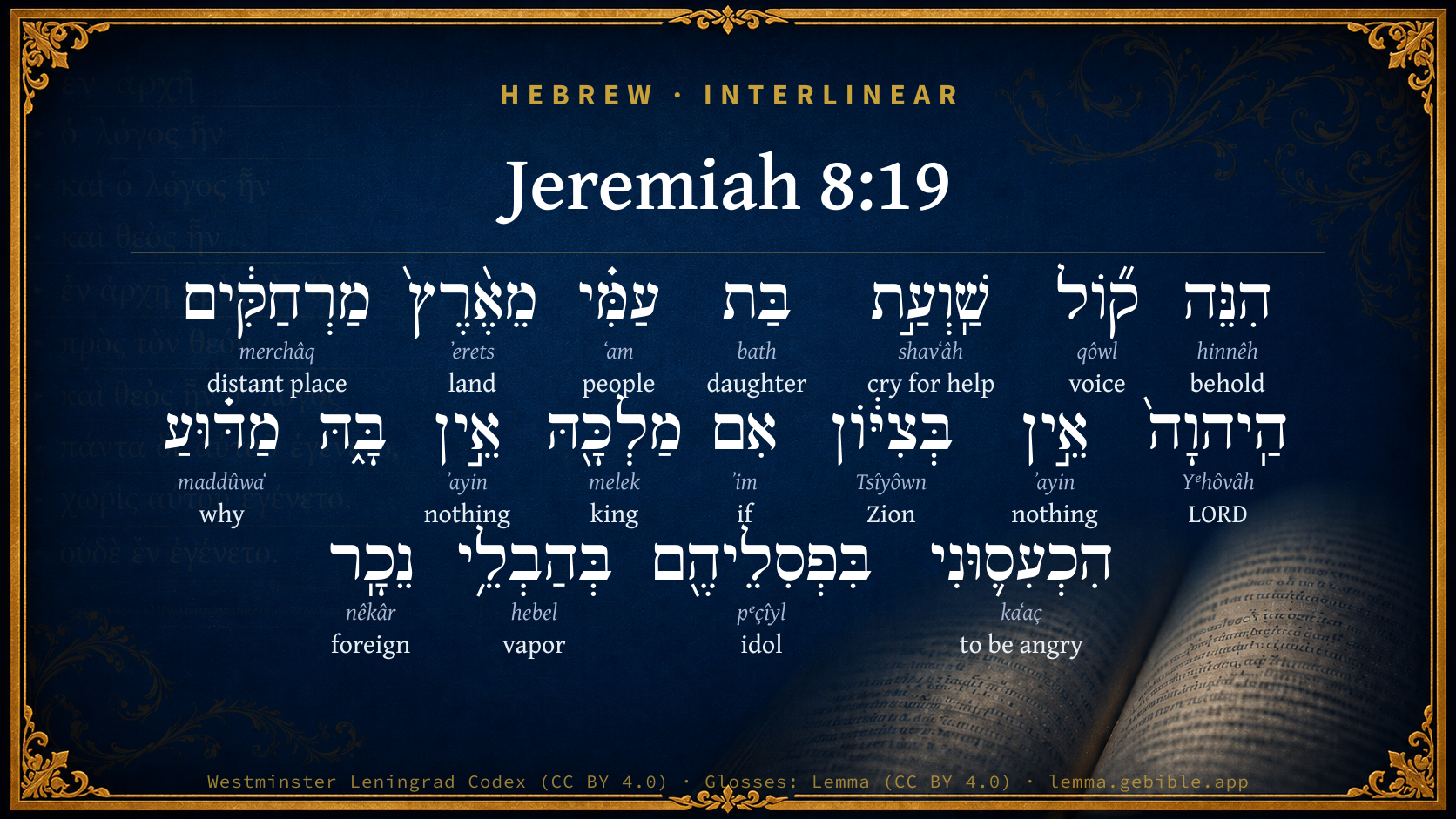
Hebrew (Westminster Leningrad Codex) Jeremiah 8:19 appears in the Hebrew Old Testament. The text above is from the Westminster Leningrad Codex. Each word links to its Strong’s number, a concise gloss, and parsing drawn from the Open Scriptures Hebrew Bible morphology. Click any word for its full Brown-Driver-Briggs (BDB) entry.
Download image
Cite this verse

Jeremiah 8:19 (World English Bible). Public Domain. Lemma interlinear Bible study tool, https://lemma.gebible.app/v/jeremiah/8/19.

Show BibTeX & RIS
BibTeX
RIS
English Translation
Behold, the voice of the cry of the daughter of my people from a land that is very far off: isn't Yahweh in Zion? Isn't her King in her? Why have they provoked me to anger with their engraved images, and with foreign vanities?
World English Bible · Public Domain
Download a study sheet

One document with this verse’s original text, its word-by-word gloss line, the meaning frame, cross-references with their text, attributed commentary, and full source and license credits — printable, and it pastes into notes with its structure intact.

This verse Autodidact and up

Study sheet (.html) Plain text (.txt)

A passage Seminary Student

Up to 50 verses in one chapter. A passage sheet keeps up to 6 commentary sources and 12 cross-references per verse, in the order this page ranks them, and says so on the sheet whenever that leaves anything out. Ask for a single verse and you get the Autodidact verse sheet above.

Everything on this page stays free to read, with no account — the sheet is a download of what is already on screen, not access to it.

Want to remove ads? Support Godless Engineer
Compare translations 3

The same verse in 3 English versions, stacked beneath the original-language interlinear above. Click any original word for its lexicon entry.

Each is an independent rendering of the whole verse — the interlinear is not word-aligned to these translations.

Highlighted words mark where these versions differ — a whole-verse word diff, not a word-by-word alignment.

  • World English Bible Public Domain
    Behold, the voice of the cry of the daughter of my people from a land that is very far off: isn't Yahweh in Zion? Isn't her King in her? Why have they provoked me to anger with their engraved images, and with foreign vanities?
  • King James Version Public Domain
    Behold the voice of the cry of the daughter of my people because of them that dwell in a far country: Is not the LORD in Zion? is not her king in her? Why have they provoked me to anger with their graven images, and with strange vanities?
  • unfoldingWord Literal Text CC BY-SA 4.0
    Behold! The sound of the cry of the daughter of my people from a far away land! Is Yahweh not in Zion? Is her king no longer in her? Why have they provoked me to anger with their idols, with vain foreign things?

unfoldingWord Literal Text — © unfoldingWord, licensed CC BY-SA 4.0. Word-aligned USFM3 via Door43 (git.door43.org/unfoldingWord/en_ult).

Versions to compare (up to 4)

3 of 4 selected

Show all 18 translations

Every available English version of this verse, each an independent rendering of the whole verse.

  • World English Bible Public Domain
    Behold, the voice of the cry of the daughter of my people from a land that is very far off: isn't Yahweh in Zion? Isn't her King in her? Why have they provoked me to anger with their engraved images, and with foreign vanities?
  • Berean Standard Bible Public Domain
    Listen to the cry of the daughter of my people from a land far away: “Is the LORD no longer in Zion? Is her King no longer there?” “Why have they provoked Me to anger with their carved images, with their worthless foreign idols?”
  • Majority Standard Bible Public Domain
    Listen to the cry of the daughter of my people from a land far away: “Is the LORD no longer in Zion? Is her King no longer there?” “Why have they provoked Me to anger with their carved images, with their worthless foreign idols?”
  • King James Version Public Domain
    Behold the voice of the cry of the daughter of my people because of them that dwell in a far country: Is not the LORD in Zion? is not her king in her? Why have they provoked me to anger with their graven images, and with strange vanities?
  • American Standard Version (1901) Public Domain
    Behold, the voice of the cry of the daughter of my people from a land that is very far off: is not Jehovah in Zion? is not her King in her? Why have they provoked me to anger with their graven images, and with foreign vanities?
  • Revised Version (1885) Public Domain
    Behold, the voice of the cry of the daughter of my people from a land that is very far off: Is not the LORD in Zion? is not her King in her? Why have they provoked me to anger with their graven images, and with strange vanities?
  • Geneva Bible (1599) Public Domain
    Behold, the voice of the cry of the daughter of my people for feare of them of a farre countrey, Is not the Lord in Zion? is not her king in her? Why haue they prouoked mee to anger with their grauen images, and with the vanities of a strange god?
  • Douay-Rheims (1899) Public Domain
    Behold the voice of the daughter my people from a far country: Is not the Lord in Sion, or is not her king in her? why then have they provoked me to wrath with their idols, and strange vanities?
  • Young's Literal Translation Public Domain
    Lo, the voice of a cry of the daughter of my people from a land afar off, Is Jehovah not in Zion? is her king not in her? Wherefore have they provoked Me with their graven images, With the vanities of a foreigner?
  • Literal Standard Version CC BY-SA 4.0
    Behold, the voice of a cry of the daughter of my people from a far-off land, || Is YHWH not in Zion? Is her King not in her? “Why have they provoked Me with their carved images, || With the vanities of a foreigner?”
  • Unlocked Literal Bible CC BY-SA 4.0
    Behold! The screaming voice of the daughter of my people from a land far away! Is Yahweh not in Zion? Is her king no longer there? Why then do they provoke me to anger with their carved figures and their worthless foreign idols?
  • unfoldingWord Literal Text CC BY-SA 4.0
    Behold! The sound of the cry of the daughter of my people from a far away land! Is Yahweh not in Zion? Is her king no longer in her? Why have they provoked me to anger with their idols, with vain foreign things?
  • Darby Bible Public Domain
    Behold the voice of the cry of the daughter of my people, from a very far country: Is not Jehovah in Zion? Is not her king in her? Why have they provoked me to anger with their graven images, with foreign vanities?
  • World Messianic Bible Public Domain
    Behold, the voice of the cry of the daughter of my people from a land that is very far off: “Isn’t the LORD in Zion? Isn’t her King in her?” “Why have they provoked me to anger with their engraved images, and with foreign idols?”
  • Webster's Bible Public Domain
    Behold the voice of the cry of the daughter of my people because of them that dwell in a distant country: Is not the LORD in Zion? is not her king in her? Why have they provoked me to anger with their graven images, and with strange vanities?
  • Free Bible Version CC BY-SA 4.0
    Listen to my people crying out for help from a distant land, asking “Isn't the Lord present in Zion anymore? Has her King left?” Why have they made me angry, worshiping their carved images and their useless foreign idols?
  • Bible in Basic English Public Domain
    The voice of the cry of the daughter of my people comes from a far land: Is the Lord not in Zion? is not her King in her? Why have they made me angry with their images and their strange gods which are no gods?
  • JPS Tanakh (1917) Public Domain
    Behold the voice of the cry of the daughter of my people from a land far off: 'Is not the LORD in Zion? Is not her King in her?' — 'Why have they provoked Me with their graven images, and with strange vanities?' —

Literal Standard Version (2020), Covenant Press — licensed CC BY-SA 4.0. Text via the HelloAO Bible API (eBible.org). Unlocked Literal Bible (unfoldingWord) — licensed CC BY-SA 4.0. Text via the HelloAO Bible API (eBible.org). unfoldingWord Literal Text — © unfoldingWord, licensed CC BY-SA 4.0. Word-aligned USFM3 via Door43 (git.door43.org/unfoldingWord/en_ult). Free Bible Version, Dr. Jonathan Gallagher — licensed CC BY-SA 4.0. Text via the HelloAO Bible API (eBible.org).

Word by word

More ways to search: Search by grammar → Find every occurrence → Compare this word →

Practice this passage: Drill this verse → Learn its vocabulary →

שַֽׁוְעַ֣ת
shavʻâh
H7775
“cry for help of”
Noun, Common, Feminine, Singular, Construct
Part of Speech
Noun
Type
Common
Gender
Feminine
Number
Singular
State
Construct
Full BDB Definition

Origin: from H7773

TWOT: 2348c

cry for help
  1. הִנֵּה hinnêh H2009 “behold” Particle, Demonstrative
  2. ק֞וֹל qôwl H6963 “voice of” Noun, Common, Masculine, Singular, Construct
  3. בַּת bath H1323 “daughter of” Noun, Common, Feminine, Singular, Construct
  4. עַמִּ֗י ʻam H5971 “people · my” Noun, Common, Masculine, Singular, Construct + Suffix, Personal, 1st Person, Common, Singular
  5. מֵאֶ֨רֶץ֙ ʼerets H776 “from · land of” Preposition + Noun, Common, Both, Singular, Construct
  6. מַרְחַקִּ֔ים merchâq H4801 “distant places” Noun, Common, Masculine, Plural, Absolute
  7. הַֽיהוָה֙ Yᵉhôvâh H3068 “LORD” Particle, Interrogative + Noun, Proper
  8. אֵ֣ין ʼayin H369 “nothing” Particle, Negative
  9. בְּצִיּ֔וֹן Tsîyôwn H6726 “in/at · Zion” Preposition + Noun, Proper
  10. אִם ʼim H518 “if” Conjunction
  11. מַלְכָּ֖הּ melek H4428 “king · her” Noun, Common, Masculine, Singular, Construct + Suffix, Personal, 3rd Person, Feminine, Singular
  12. אֵ֣ין ʼayin H369 “nothing” Particle, Negative
  13. מַדּ֗וּעַ maddûwaʻ H4069 “why” Particle, Interrogative
  14. הִכְעִס֛וּנִי kaʻaç H3707 “to be angry · me” Verb, Hiphil, Perfect, 3rd Person, Common, Plural + Suffix, Personal, 1st Person, Common, Singular
  15. בִּפְסִלֵיהֶ֖ם pᵉçîyl H6456 “in/at · idols · their” Preposition + Noun, Common, Masculine, Plural, Construct + Suffix, Personal, 3rd Person, Masculine, Plural
  16. בְּהַבְלֵ֥י hebel H1892 “in/at · vanities of” Preposition + Noun, Common, Masculine, Plural, Construct
  17. נֵכָֽר nêkâr H5236 “foreign” Noun, Common, Masculine, Singular, Absolute

About this verse

These counts appear in no published source. They are computed here, from the morphology-tagged text and Lemma’s own curated glosses. What Lemma adds →

19
words
17
distinct lemmas
Prophets
section

Notable vocabulary

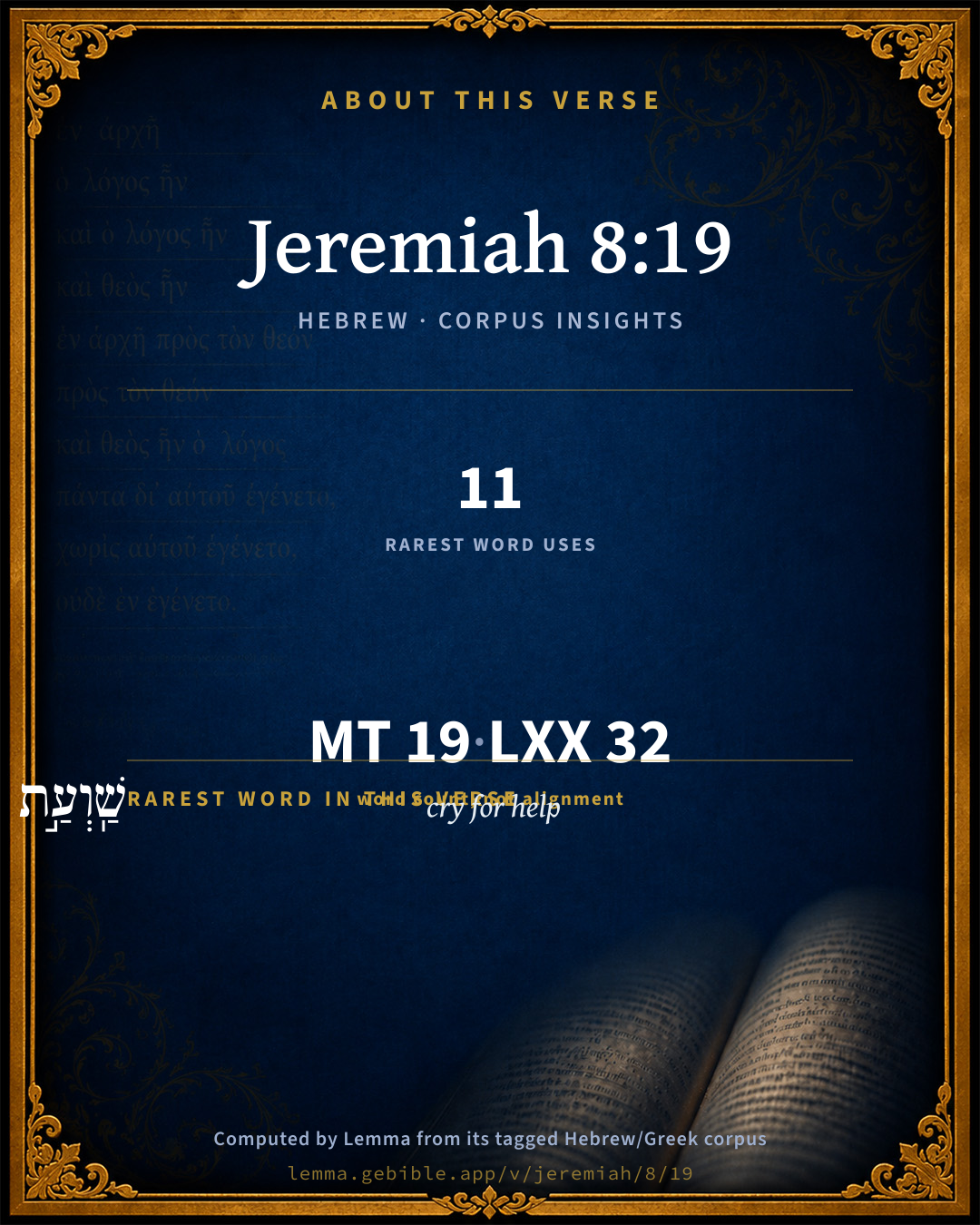
The rarest word here is שַֽׁוְעַ֣ת cry for help H7775 — appearing just 11 times in the whole Hebrew Bible.

Shared distinctive vocabulary

שַֽׁוְעַ֣ת cry for help H7775 occurs in 11 verses of the Hebrew Bible. Also found in:

Grammatical profile

  • 1 verb
  • 12 nouns
  • 1 preposition
  • 1 conjunction
  • 4 particles

Verb forms

  • הִכְעִס֛וּנִי Hiphil · Perfect

Repetition

A word recurs within this verse — often emphatic in Hebrew:

  • אֵ֣ין nothing H369 ×2

Hebrew & Septuagint length

In the original languages it is 19 Hebrew tokens and 32 Greek tokens — but the two are counted differently (Hebrew bundles its prefixes and suffixes into one token; the Greek is in lemma form), so that isn’t a like-for-like length.

Cross-references

20

Topical passages linked to Jeremiah 8:19 in the Treasury of Scripture Knowledge — connected by theme and wording, ordered by reader-vote popularity; previews shown in the World English Bible.

  • Isaiah 39:3 Then came Isaiah the prophet to king Hezekiah, and said to him, What said these men? and from whence came they to you? Hezekiah said, They are come from a far country to me, even from Babylon.
  • Isaiah 13:5 They come from a far country, from the uttermost part of heaven, even Yahweh, and the weapons of his indignation, to destroy the whole land.
  • Revelation 2:1 To the angel of the assembly in Ephesus write: "He who holds the seven stars in his right hand, he who walks among the seven golden lampstands says these things:
  • Deuteronomy 32:16–21 They moved him to jealousy with strange [gods]; With abominations provoked they him to anger.
  • Psalms 135:21 Blessed be Yahweh from Zion, Who dwells at Jerusalem. Praise Yah!
  • Psalms 146:10 Yahweh will reign forever; Your God, O Zion, to all generations. Praise Yah!
  • Psalms 149:2 Let Israel rejoice in him who made them. Let the children of Zion be joyful in their King.
  • Isaiah 1:4 Ah sinful nation, A people loaded with iniquity, A seed of evil-doers, Children who deal corruptly! They have forsaken Yahweh. They have despised the Holy One of Israel. They are estranged and backward.
  • Isaiah 12:6 Cry aloud and shout, you inhabitant of Zion; for great in the midst of you is the Holy One of Israel!"
  • Isaiah 33:22 For Yahweh is our judge, Yahweh is our lawgiver, Yahweh is our king; he will save us.
  • Isaiah 52:1 Awake, awake, put on your strength, Zion; put on your beautiful garments, Jerusalem, the holy city: for henceforth there shall no more come into you the uncircumcised and the unclean.
  • Jeremiah 4:16–17 make you mention to the nations; behold, publish against Jerusalem, [that] watchers come from a far country, and give out their voice against the cities of Judah.
  • Jeremiah 4:30–31 You, when you are made desolate, what will you do? Though you clothe yourself with scarlet, though you deck you with ornaments of gold, though you enlarge your eyes with paint, in vain do you make yourself beautiful; [your] lovers despise you, they seek your life.
  • Jeremiah 8:5–6 Why then is this people of Jerusalem slidden back by a perpetual backsliding? they hold fast deceit, they refuse to return.
  • Jeremiah 14:19 Have you utterly rejected Judah? has your soul loathed Zion? why have you struck us, and there is no healing for us? We looked for peace, but no good came; and for a time of healing, and, behold, dismay!
  • Jeremiah 31:6 For there shall be a day, that the watchmen on the hills of Ephraim shall cry, Arise you, and let us go up to Zion to Yahweh our God.
  • Joel 2:32 It will happen that whoever will call on the name of Yahweh shall be saved; For in Mount Zion and in Jerusalem there will be those who escape, As Yahweh has said, And among the remnant, those whom Yahweh calls.
  • Joel 3:21 I will cleanse their blood, That I have not cleansed: For Yahweh dwells in Zion."
  • Obadiah 1:17 But in Mount Zion, there will be those who escape, and it will be holy. The house of Jacob will possess their possessions.
  • Jeremiah 9:16 I will scatter them also among the nations, whom neither they nor their fathers have known; and I will send the sword after them, until I have consumed them.

Cross-references courtesy of OpenBible.info (CC BY 4.0).

Hebrew and Greek witnesses Masoretic Hebrew ↔ Greek Septuagint

The same verse in the two great witnesses to the Old Testament, shown verse-for-verse.

These are two independent witnesses, not word-aligned to each other, and the Septuagint is shown in lemma (dictionary) form.

Hebrew Jeremiah 8:19 Masoretic · Westminster Leningrad Codex

הִנֵּה ק֞וֹל שַֽׁוְעַ֣ת בַּת עַמִּ֗י מֵאֶ֨רֶץ֙ מַרְחַקִּ֔ים הַֽיהוָה֙ אֵ֣ין בְּצִיּ֔וֹן אִם מַלְכָּ֖הּ אֵ֣ין בָּ֑הּ מַדּ֗וּעַ הִכְעִס֛וּנִי בִּפְסִלֵיהֶ֖ם בְּהַבְלֵ֥י נֵכָֽר

Behold, the voice of the cry of the daughter of my people from a land that is very far off: isn't Yahweh in Zion? Isn't her King in her? Why have they provoked me to anger with their engraved images, and with foreign vanities?

World English Bible · Public Domain

Greek LXX Structure differs

In the Septuagint, Jeremiah is about an eighth shorter than the Hebrew and arranges its material differently — the Oracles Against the Nations (Hebrew chapters 46–51) appear in the middle of the Greek book, after 25:13. Because the chapter and verse boundaries do not line up, a verse-for-verse comparison with the Hebrew is not shown.

A verse-for-verse comparison isn’t shown here because the chapters and verses don’t line up. Switch to the LXX edition with the MT / LXX toggle above to read the Greek directly.

Hebrew: Westminster Leningrad Codex (CC BY 4.0). Greek: Septuagint (public domain); English from a public-domain English Septuagint. How the Septuagint differs from the Hebrew →

Targum (Aramaic paraphrase)

1

The Targum is the ancient Jewish Aramaic paraphrase of the Hebrew Scriptures — an interpretive translation, not the Hebrew text itself. Onkelos (literal) and Pseudo-Jonathan (expansive) render the Torah, and Jonathan the Prophets. Coverage is partial: where no permissively-licensed English translation exists for a verse, only the Aramaic is shown. This is verse-level text, not a word-by-word alignment to the Hebrew.

  1. Targum Jonathan Prophets (Joshua–Malachi)
    הָא קַל צַוְחַת כְּנִשְׁתָּא דְעַמִי מֵאַרְעָא רְחִיקָא נְבִיַיָא אוֹכַח יַתְהוֹן הַשְׁכִינְתָּא דַייָ לֵית בְּצִיּוֹן אִם מַלְכָּא לֵית בָּה מָא דֵין מַרְגְזִין קָדָמַי בְּצַלְמָנֵיהוֹן בְּפוּלְחַן טַעֲוָתָא:

    (no public-domain English translation for this verse)

    Targum Jonathan — Aramaic: “Mikraot Gedolot” (public domain). English: “Sefaria Community Translation” (CC0 1.0 (public-domain dedication)); “London "Chaldee Paraphrase," 1871” (public domain). Text via Sefaria.

Commentary

Notes on Jeremiah 8:19 from classic Christian and Jewish commentators (each source and its license shown beneath its notes). The classic Christian expositions comment on the surrounding passage and are grouped to its opening verse, so a note may address several verses; the Jewish commentaries on the Tanakh (Rashi and others) are per-verse, so they appear only where the commentator wrote on this verse.

Lemma curates 59 commentaries, every one of them public domain or Creative Commons licensed, each selected and text-cleaned for this edition rather than reprinted as found. About our sources →

Trapp's Complete Commentary

John Trapp

Jer 8:19 Behold the voice of the cry of the daughter of my people because of them that dwell in a far country: [Is] not the LORD in Zion? [is] not her king in her? Why have they provoked me to anger with their graven images, [and] with strange vanities?

Ver. 19. Behold, the voice of the cry.] This was it that broke the good prophet’s heart, the shrieks of his people.

Is not the Lord in Zion?] {a} Thus in their distress they leaned upon the Lord, {as Mic 3:11} and inquired after him, whom in their prosperity they made little reckoning of.

Why have they provoked me to anger?] q.d., The fault is merely in themselves, who have driven me out from among them by their idolatries.

{a} Haec est querela hypocritarum. This is the complain of the hypocrites - Oecol.

John Trapp, A Commentary or Exposition upon All the Books of the Old and New Testament (1647–1656) — public domain. Text from a community e-Sword module.

The Biblical Illustrator

Joseph S. Exell

Jer_8:19-20

Is not the Lord in Zion?

A discourse for a revival season

These words, as they stand in the Book of Jeremiah, were probably meant to set forth the sin of Israel. The prophets heart is very full of sadness; he can hear the cries of the people in the streets of Jerusalem. They are moaning for sorrow, because of the oppression of the Chaldeans--the nation that dwelt afar off; and in the midst of their bitterness they remember the God whom they had forgotten in their prosperity: but this remembrance is not a gracious one; they do not remember Him to humble themselves, but to bring accusations against Him. They inquire, Is not the Lord in Zion? is not her King in her? As if they felt, The people of the Lord, the people of the Lord are we, and therefore He is bound to send us a deliverance. They accuse the faithfulness of Jehovah, because He greatly suitors them to be downtrodden for their sins. Then the Lord, speaking by the prophet, tells them the reason why, although present among them, he did not help them: Why have they provoked Me to anger with their graven images, and with strange vanities? If they believed Him to be present, why did they set up false gods?

I. We have in the text a cry.

1. Observe the word Behold. The behold here is the mark of astonishment. We are to Behold the voice of the cry of the daughter of My people as an unusual thing. So seldom does Israel cry unto the Lord, she is so negligent of prayer, she is so silent when she ought to be incessant in her petitions, that when at last she does cry, her voice is a wonder in Gods ears. And yet it ought not to be a wonder, it ought not to be a strange thing for Gods people to be in earnest, or for sinners to feel brokenness of heart. If prayer be the Christians breath, why then, to see a multitude breathing, should never be a spectacle. If to pray unto God be the Christians daffy privilege, then to approach the throne of God with prevalent earnestness, should never be looked upon with astonishment.

2. Notice how this prayer is described. It is a cry: Behold the cry. A cry is the most natural form of utterance. It is a natural expression made up of pain and desire for relief. When a brother merely prays what we call prayer, he stands up and utters very proper words, very edifying, very suitable, no doubt, and then he has done. Another brother comes forward; he wants a blessing, he tells the Lord what he desires; he takes the promises, he wrestles with God, and then he seems to say, I will not let Thee go except Thou bless me. He cannot be satisfied till, with the cry of Abba, Father, he has come before the throne and really obtained an audience with the Most High.

3. Note again, for every word of our text is suggestive, it is Behold the voice of the cry of the daughter of My people. It is not enough to be earnest, you must know what you are earnest about; the cry must have a voice which is as far as possible understood by yourself, and a voice which has a meaning in it before God. I must direct my prayer unto God, as David says, pull my bow, direct the arrow, take aim at the centre of the target, and then when the arrow flies it is likely to reach its place.

4. Further, study the matter of the voice--it was for them that dwell in a far country. In what a far country does every sinner dwell! Now, the prayers, I hope, of Gods people, have been going up for all the far-off ones, that infinite mercy would make them nigh by the blood of Christ.

5. Remark another word in the text--for those that dwell in a far country: there are some of you who make a long abode in a far country. The fact is, you have taken up your dwellings; you have made a settlement in one of the parishes of the city of destruction; you are making out a claim to be enrolled in the devils register; you dwell in the far-off land. If you were uneasy and felt yourselves to be strangers and foreigners in the land of destruction, how would I clap my hands for joy; for you would soon be rid of your old master if you once felt sick of him.

6. The cry is The cry of the daughter of My people. Oh, it is so sweet to think that our prayers, poor as they are, are the prayers of Gods own people, and therefore they must be heard. You are the Lords children, therefore He will hear you. Would you let your child constantly cry to you and not answer Him?

II. We will now turn to the question: Is not the Lord in Zion? is not her King in her? I will answer that question at once in the affirmative. The Lord is in Zion: her King is in the midst of her. Having answered this question, it suggests many more.

1. If the Lord be indeed in Zion, and the King he in the midst of her, why do we pray as if He were not? He is with you, ready to answer by fire, if, like Elias, you have but faith with which to challenge His promise and His power.

2. Why do you despond because of your own weakness? We have not a sufficient number of ministers; we have little wealth; we have few places of public worship; we have few gifted members, and so on. So some unbelievingly talk. Is not the Lord in Zion? is not her King in her? What more do you want? Oh! we would like to be strong. Why would you be strong? That you must be disqualified to be used by God? Why, any fool can kill the enemy with a cannon, but it takes a Samson to smite them with the jawbone of an ass. And so, when God has the choice of weapons, and He always has, He chooses the weaker weapon, that He may get to Himself the greater renown.

3. If God be with us, why these great fears about the prosperity of the Church? The God of Zion is here, the King of Zion is here. I grant you, we do not sufficiently recognise His presence; we are not, as we should be, obedient to His commands but I charge you, O ye soldiers of the Cross, believe in the presence of your Captain, and press where ye see His helmet amidst the din of war. His Cross is the great emblazoned banner which leads you on to glory. Press forward! to suffer, to deny yourselves, to bear witness for Christ; for the battle is the Lords, and the King Himself fights in the van.

III. Another question. Why have they provoked Me to anger with their graven images and with strange vanities?

1. Here is a question for the Lords people. It becomes a very solemn thing when God is in His Church how that Church behaves herself. Suppose that Church to set up false principles: if her King were not there she might take the kings of the earth to be her head. But dare she do that when her King Himself is there?

2. This text has a particular voice to sinners. You have been saying, God is in the midst of His people--how is it I have not had a blessing? I will ask you this question, Why have they provoked Me to anger with their graven images and with strange vanities? Do not ask why the Word is not blessed to you; do not ask why you do not enjoy the prayer meeting: answer my question first. Why hast thou provoked Me to anger with thy tricks in trade, with thy Sabbathbreaking, with thy lying, with thy loose songs, with thy miring up with worldly company, with thy profanity?

IV. Another cry. I wish I might hear this cry this morning, for then I should not hear it in the world to come, The harvest is past, the summer is ended, and we are not saved. (C. H. Spurgeon.)

Manifestations of the presence of God

The ancient polity of the Jewish nation was a pure and splendid theocracy. Jehovah was their King. He gave them their laws, selected their judges, appointed their prophets, and He reigned the Lord supreme, having chosen them to be His peculiar people, and special possession.

I. It is possible for the members of a professing Church to be deceived concerning the presence of God, and conclude that he is with them, when in reality he is far from them.

1. Deceived on this important point are those who conclude God is with them because they have imposing forms and splendid places of worship. If pompous forms of worship and gorgeous temples marked the presence of God with men, the evidence would go to show that God was more with the ancient heathen than with the ancient Jews. It would exalt Mahomet and Mohammedanism over Christ and Christianity.

2. Deceived on this important point are those professing churches who conclude God is with them, because they have creeds and councils in their favour. Were, however, this conclusion correct, it would prove that the presence of God might be found with the mere letter of truth, or even error.

3. Deceived on this important point are those professing churches who conclude God is with them because they have extensive knowledge and numerous gifts. In danger of this error were many who were members of the Church of God at Corinth. An error St. Paul fully exposed, showing that those things which they so highly valued were worthless in comparison with sacred charity, true love to God, and pure love to man.

4. Deceived also on this important point are those churches and individuals who conclude God is with them because He was once with them. Who will question the truth, that He was with the Jews as a people, when Moses sang (Exo_15:13)? But is He with them now as a nation, as the rod of His inheritance, the Zion wherein He delighteth to dwell? Has not the evil He warned them against come upon them (Jer_6:8)? Then in reference unto individuals, having once been with them, is no certainty that He abides with them. Was He not with Saul when chosen of God to be the King of Israel (1Sa_10:7)? Was He not with Solomon when he devoutly dedicated the temple to the Lord, and prayed (2Ch_6:41)? Was He not with Judas when called to the apostleship? Now to say nothing concerning the hour of death, was His presence perpetually with these through life? Then let us net, neither as churches nor as individual members, depend on the past, nor be satisfied with anything short of having God indisputably with us now; bearing in remembrance that His presence is conditional (2Ch_15:2).

II. It is possible for the members of a professing Church to be fully assured of the presence of God among them--King in Zion.

1. God is where the Word of truth is faithfully preached and believingly received.

2. God is where the ministry of the Gospel is effectual to accomplish the purposes for which it is proclaimed.

3. God is where the members of the Church grow in sacred knowledge, and increase in holiness of heart and life.

4. God is where the discipline of Christ is scripturally observed and maintained.

5. God is where a professing people dwell together in the bonds of Christian charity. To this Christians are called by their name, their profession, and hope of eternal life.

III. It behoves the members of a professing Christian Church frequently and faithfully to press on themselves the solemn, weighty inquiry, is the Lord in our Zion, is her King with us? Have we the marks of the Divine presence already stated? Let us examine ourselves as a Christian community on this subject, and that with the sincerity of those who would not be deceived.

1. Is the Word of truth faithfully preached by us as ministers?

2. Is the ministry of the Gospel among us successful to accomplish its gracious designs?

3. Are we as people wise in sacred knowledge and intent on full conformity of the will and image of God?

4. Have we a wholesome scriptural discipline?

5. Are we as a professing Church united in the bonds of Christian charity?

IV. It becomes a Christian Church, sensible of the Divine presence but desirous of a more special manifestation of God with them and to them, to employ those means which are calculated to promote His more glorious abode in Zion.

1. This they should do by a full and constant acknowledgment of the sovereign authority and rule of Christ (Eph_1:22). His kingship in Zion is not a supposed character, but a positive possessed office; and weighty must be the guilt and condemnation of these who deny His claim, and reject His rule.

2. This they should do by diligently seeking an increase of personal holiness (Psa_132:14; Psa_132:16).

3. The more glorious presence of God should also be sought by the members of the Church, in the exercise of fervent, persevering prayer. (W. Naylor.)

The royal presence

The great thing is to ascertain the fact of the Lords presence with His people. Now, where the Lords presence is, there are tokens special, peculiar, and infallible, by which it is evidenced. Where the Lord is, everything will go well: the Gospel will triumph, and the righteous will be glad. On the contrary, the Lords absence is marked by wickedness, carnality, darkness, and dissolution.

1. An indispensable evidence that God is in the churches, we think to be a united, loving people. The Spirit is the source of love; and it is His first fruit.

2. Where this love is present, and in powerful operation, it will produce another evidence--a consistent, holy deportment. Love and purity are inseparable; but purity of heart will be indicated by purity of life.

3. The Lords presence is always accompanied by special zeal for His glory: a desire to promote His honour, and to extend His kingdom.

4. An invariable accompaniment of the Kings presence is liberality in the disposition of worldly substance. His people realise the fact that they are not proprietors, but stewards, to whom is committed treasure, which is exclusively His own.

5. The spirit of humble wailing at His footstool, for the lessons of His wisdom, is another indication of His presence. The churches will be teachable, devout, and obedient in all things.

6. A further evidence of the royal presence is, the possession of high attainments in spiritual things: the citizens of Zion will largely enjoy the comfort of love, the patience of hope, and every blessing provided for them.

7. As a rule, another token of the Lords presence will be, that while His people walk in His fear, and in the comfort of the Holy Ghost, they will be multiplied. The message of love, spoken in love, will operate with melting power on the hearts of men. (The Christian Witness.)

The Biblical Illustrator, edited by Joseph S. Exell (c. 1880s–1900s) — public domain. Text from a community e-Sword module.

Geneva Bible (1599)

Geneva Bible translators

Thus the Lord speaketh.

Geneva Bible (1599) marginal notes — public domain. Text via Bolls.life.

Jamieson, Fausset & Brown

Robert Jamieson, A. R. Fausset & David Brown

The prophet in vision hears the cry of the exiled Jews, wondering that God should have delivered them up to the enemy, seeing that He is Zion's king, dwelling in her (Mic 3:11). In the latter half of the verse God replies that their own idolatry, not want of faithfulness on His part, is the cause.

because of them that dwell in a far country--rather, "from a land of distances," that is, a distant land (Isa 39:3). English Version understands the cry to be of the Jews in their own land, because of the enemy coming from their far-off country.

strange vanities--foreign gods.

Jamieson, Fausset & Brown — Commentary Critical and Explanatory on the Whole Bible (1871) — public domain (CC PDM 1.0). Text via the HelloAO Bible API.

John Calvin's Commentaries

The Prophet in this verse assumes different characters: he first denounces ruin, which, though near, was not yet dreaded by the people; he then represents the people, and relates what they would say; in the third place, he adds an answer in God’s name to check the clamors of the people.

When he says that the daughter of his people uttered a cry, he is to be understood as referring to a future time; for the Jews as yet continued perversely in their sins, and ridiculed all threatenings, and regarded as nothing what was said by the prophets. Jeremiah then does not mean that his own nation cried, as though they dreaded future calamities, (for they were heedlessly secure;) but he condemns their indifference, as though he had said, “Ye indeed do now indulge your own delusions, and think that your felicity is to be perpetual; but in a short time your cry will be heard.” The words, From a distant land, interpreters apply to the Chaldeans and Assyrians, as though the Prophet had said, “Ye hope for a perpetual rest, because your enemies are far from you; hence distance and delay in marching produce this security in you; for it seems not to you credible that your enemies shall make such a journey, except with much expense and much trouble; but in this opinion you are deceived; for though the Chaldeans and the Assyrians are far distant from you, yet they shall soon come and constrain you to utter a cry: ye cannot now bear the warnings of the prophets, my voice ye cannot endure; but God will constrain you to utter a different voice, for ye shall cry, but without any avail.”

This meaning is not without reason on its side: if then the Prophet’s words be thus taken, I offer no objection; for hypocrites derive confidence from the present appearance of things; when they see that there is quietness on every side, they fear no danger; when God threatens them, and shews not immediately his rods, they ridicule or despise them.: thus have we seen in other places.

But another meaning is not unsuitable, — that Jeremiah describes the lamentations of the people in exile, after having been driven into Chaldea and Assyria: The voice, then, of the daughter of my people from a distant land; that is, after having been deprived of their country, they will then begin to cry, and for this reason, because they wished the prophets to give them rest, and refused to bear any reproofs. Appropriate also is this view; but I prefer the former, — that the people would shortly find out how foolishly they deluded themselves, when God by his servants threatened them with ruin and destruction: and hence he uses the demonstrative particle, “Behold:” Behold, he says, the voice of crying; and yet great was the silence then at Jerusalem: for though in their pleasure they uttered some voices, yet as to weepings and lamentations the whole city was silent. The Prophet then refers to what was hidden. But God usually acts in this way, as he afterwards executes suddenly his judgment; for when the wicked say, Peace, peace, destruction comes and suddenly overwhelms them. (1 Thessalonians 5:8.)

He adds in the second place, Is not Jehovah in Sion? Is not her king in her? The Prophet no doubt expresses here the complaints of the people on finding themselves overwhelmed with so many and so great evils, without receiving any aid from heaven. For hypocrites ever expostulate with God; and as they consider that they are unjustly chastised, they reject every instruction, and avoid it as much as they can; in short, they seek stupidity, that they may deceive themselves with vain delusions. As then it is usual with hypocrites to reject every apprehension of God’s wrath, Jeremiah strikingly describes their contumacy, “Is not Jehovah in Sion? Is not her king in her?” For they accused God of falsehood, as though he had deceived them, since he had promised to be the defender of the city, and of the whole land. As then they thought that God was bound to them by this promise, they daringly raged against him, “What means this? for God has chosen this place, where Abraham’s race might worship him; it has been as it were his earthly kingdom: but now what can this mean, that enemies are coming here? Can God ever permit them to do so? This is not possible, except God himself be overcome.”

We hence see the import of the Prophet’s words; for he here imitates the perverse language of the people, and recites the words which he knew most of them used. We have before found him addressing them,

“Trust not in words of falsehood, saying, The temple of Jehovah, the temple of Jehovah, the temple of Jehovah,” (Jeremiah 7:4;)

for they were wont perversely to allege against God, the temple, and to regard it as a shield to ward off every evil. In the same way the Prophet says now, “Is not God in Sion?” and then, “Is not her king in her?” The Jews were not only persuaded that God would be propitious to them, but they doubted not of their own safety, while they could turn their eyes to their king. They therefore uttered these words, as though they were beyond the chance of danger: for we know what God had declared respecting the kingdom, that it would continue for ever: So long as the sun and moon shall be in heaven, shall remain the seat of David, and his posterity flourish. (Psalm 89:36, 37.) Hence they connected the king with God; as though they had said, “Here is God worshipped, and his power dwells in the temple; the king also, whom he has set over us, is a sure pledge of his favor; and the perpetuity of his kingdom has been promised to us: it then follows, that either God is untrue, and that we have been deceived with vain promises, or that our enemies will come in vain; for when they shall make every effort, God, who is the guardian of our safety, will easily drive them away.”

At the first view this seems to be an evidence of faith, as the people seemed persuaded that they should be safe and secure under the protection of God, and as they turned their eyes to that kingdom, which was a remarkable exhibition of God’s presence: for as David was a type of Christ, and also his posterity, no other refuge could have been sought by the faithful than that which is here described. But we know how hypocrites swell with vain confidence, while yet they are wholly destitute of faith, and how they become wantonly insolent whenever God threatens them, as though they held him bound at their will. As then the ungodly are wont thus to abuse the name of God, it is no wonder that they imitate the language of his true servants: but yet they are wholly different. How so? They lay hold on the promises, but they have no faith nor repentance. “This is my rest for ever: it then follows that we shall be ever safe, for God cannot be overcome by any force of arms, by any onset of enemies; since he has taken us under his protection, what have we to fear?” But, at the same time, they despised God and all his teaching.

We hence see how foolish was the boasting of that people, since they wholly despised the holy name of God, and did swell only with wind, inasmuch as they were altogether destitute of faith and piety. We must also ever keep in mind what I have already said, — that the Jews not only entertained this vain confidence, but also presumptuously rose up against God, as though he had deceived them, having promised that Sion would be his perpetual rest: they now ask him, why he did not defend the city, as he dwelt in Sion? and why was not the king their protection, since it had been said, “So long as the sun and moon shall be in heaven, shall remain the throne of David?” Now follows God’s answer.

Why then have they provoked me with their carvings, and the vanities of the foreigner? Here God retorts their false complaints. We hence learn, that in the last clause the contumacy of the people is what is set forth by Jeremiah: they raged against God, because he did not aid them in time. God shews how absurdly they complained against him, and accused him: Why, he says, have they provoked me? “They say now that they are forsaken, because there is no faithfulness in me: I have not betrayed them, nor forsaken them, but they have forsaken me ” We now perceive the meaning of the Prophet. We observe, indeed, that the passage is abrupt, for the Prophet assumes different characters; but as to what is meant there is nothing doubtful.

God says, that he was provoked with carvings: it hence follows, that the temple was polluted. God had indeed promised to dwell in the temple, but on a certain condition, provided he was faithfully, and in a legitimate manner, worshipped there; but the people with their pollutions had defiled the temple. God then shews that there was a just cause why he had departed, according to what is set forth more fully in the tenth chapter of Ezekiel: God shews to his servant in that vision that he had left the temple, and for this reason, — because his holiness could not be blended with ungodly and filthy profanations. He first mentions carvings generally, and then he adds, the vanities of the foreigner: and here he amplifies the sin of the people, because they borrowed here and there from foreigners such superstitions as were unknown to their fathers, as though they wished to banish God from the temple, and from the whole land. It follows —

John Calvin's Commentaries (1540-1563) — public domain. Text from the Calvin Translation Society English edition (1840s-50s) via the Christian Classics Ethereal Library (ccel.org). Calvin's coverage is partial (roughly two-thirds of the Bible); uncommented books and verses are honest gaps, never fabricated. The 19th-century editor's footnotes and remarks are omitted so the notes are faithfully Calvin's own voice.

Ellicott's Commentary for English Readers

(19) Because of them that dwell . . .—The verse should read thus: Behold, the voice of the cry for help of the daughter of my people from the land of those that are far off. The prophet, dramatising the future, as before, in Jer_8:14, hears the cry of the exiles in a far-off land, and that which they ask is this—“Is not Jehovah in Zion? Is not her king in her?” That question is asked half in despair, and half in murmuring complaint. But Jehovah himself returns the answer, and it comes in the form of another question, “Why have they provoked me to anger . . .?” They had forsaken Him before. He forsook them now and left them, for a time, to their own ways.

A Bible Commentary for English Readers, edited by Charles John Ellicott (1878–1897) — public domain. Text from a community e-Sword module.

The Cambridge Bible for Schools and Colleges

gen. ed. J. J. S. Perowne

19. from (mg. because of) a land that is very far off] There is no need to suspect the genuineness of the clause. Jeremiah is in thought anticipating the captivity, and the distressful cries of the exiles in the direction of their home.

Is not … in her?] the words of the exiles.

Why have they, etc.] This is the Lord’s reply.

strange] foreign.

The Cambridge Bible for Schools and Colleges (gen. ed. J. J. S. Perowne; Cambridge University Press, 1878–1918) — public domain. Text from a community e-Sword module.

John Gill's Exposition

The harvest is past,.... Which was in the month of Ijar, as Jarchi observes, and answers to part of April and May:

the summer is ended; which was in the month Tammuz, and answers to part of June and July:

and we are not saved; delivered from the siege of the Chaldeans; and harvest and summer being over, there were no hopes of the Egyptians coming to their relief; seeing winter was approaching; and it may be observed, that it was in the month of Ab, which answers to part of July and August, that the city and temple were burnt. These are the words of the people of the Jews, despairing of help and salvation. So the Targum,

"the congregation of Israel said, the time is passed, the end is up, and we are not redeemed.''

John Gill's Exposition of the Whole Bible (1746–1763) — public domain (CC PDM 1.0). Text via the HelloAO Bible API.

Albert Barnes' Notes on the Bible

Or, “Behold the voice of the cry for help of the daughter of my people from a distant land: Is not Yahweh in Zion? Is not her king there? Why have they provoked Me to anger with their carved images, with foreign vanities?” Their complaint, “Is there no Jehovah in Zion?” is met by God demanding of them the reason why instead of worshipping Him they have set up idols.

Albert Barnes' Notes on the Bible (1834–1885) — public domain. Text from a community e-Sword/MySword module.

Haydock's Catholic Bible Commentary

Sion. Thus the people complain, (Menochius) or God answers them that they had no reason to have recourse to idols for protection. (Calmet)

George Leo Haydock (1774–1849), Haydock's Catholic Family Bible and Commentary, 1859 edition — public domain. Excludes Psalms (Douay-Rheims chapter numbering differs from Protestant) and Deuterocanonical books (Catholic canon only).

Matthew Poole's English Annotations

The voice of the cry, i.e. the, greatness of their cry, the bitter cries, and screeches, and complaints that methinks I hear: the words are abrupt, because the prophet is to represent several persons speaking; himself, the people, and God.

Of the daughter of my people; see Jer 4:11; possibly because Jeremiah loved them, instructed them, admonished them as a daughter.

Them that dwell in afar country, viz. their enemies the Babylonians, that were to come against them from a far country, Jer 6:22; or the voice of them that were captives under those of a far country; now they begin to cry, which would not be persuaded to it before: the first is most to be approved of.

In Zion, viz. in Jerusalem, a metonymy of the subject.

Is not her king in her; or, as King in Zion; or, have we not a king of the seed of David, to whom the kingdom was granted to be perpetual? Either the words of God: q. d. Was not I among you, to provide for you, and protect you, but you must needs repair to idols? The like kind of speech is in 2Ki 1:3, and the close of the verse seems to favour this. Or, as others, an expostulatory lamentation of the people, that the cruel adversary should prevail over a people that had God so near them, Psa 48:2,3; 76:1,2; Hath God now left us? and is the promise of his continuance here at an end? Psa 89:36-38.

Why have they provoked me with strange vanities? as if God should seem to reply here, Let them not think it strange, seeing they have turned their backs upon me, and trusted to idols, which are but vanity, Jer 2:11,13; called vanity, not only because idols are as nothing, but because all the confidence that is put them is vain, and because idolaters are vain in their minds, and want understanding. I have not forsaken them, but they me.

Matthew Poole's English Annotations on the Holy Bible (1683–1685) — public domain. Text from a community e-Sword/MySword module.

Whedon's Commentary on the Bible

Daniel D. Whedon

19. Because of them that dwell in a far country — Rather, from out of a far country, namely, the land of their captivity. The words which follow are spoken by the exiled Jews.

Daniel D. Whedon (gen. ed.), Commentary on the Old and New Testaments (1874–1909) — public domain. Text from a community e-Sword module.

The Pulpit Commentary

Because of them that dwell in, etc. The Hebrew simply has "from them," etc. The prophet is transported in imam-nation to the time of the fulfillment of his prophecies. He hears the lamentation of his countrymen, who are languishing in captivity. Is not the Lord in Zion, etc.? is the burden of their sad complaints; "king" is a familiar synonym for "God". (comp. Isa_8:21 Isa_33:22; but not Psa_89:18, which is certainly mistranslated in Authorized Version) But why" in Zion?" "Zion" was properly the name of the eastward hill at Jerusalem, where lay the oldest part of the city (called "the city of David"), and the highest portion of which was crowned by the temple. Why have they provoked me to anger, etc.? is the reply of Jehovah, pointing out that their sufferings were but an exact retribution for their infidelity. (comp. Jer_5:19)

The Pulpit Commentary (1880–1919), ed. H.D.M. Spence-Jones & Joseph S. Exell — public domain. Text from a community e-Sword module.

John Wesley's Explanatory Notes

Why - As if God should seem to reply; let them not think it strange, seeing they have turned their backs upon me, and trusted to idols.

John Wesley, Explanatory Notes Upon the Whole Bible (1754–1765) — public domain. Text via the GEBible commentary corpus.

Rashi

Rabbi Shlomo Yitzchaki (Rashi)

Hark the voice...the cry of the daughter of My people I hear that eventually they will cry from a distant land, but why is all this necessary? Is not the Lord in Zion? If they return to Him, He will allow Himself to be found by them.

Rashi on the Tanakh — English translations: “The Judaica Press complete Tanach with Rashi, translated by A. J. Rosenberg” (CC BY 4.0); “Pentateuch with Rashi's commentary by M. Rosenbaum and A.M. Silbermann, 1929-1934” (public domain); “The Metsudah Tanach series, Lakewood, N.J” (CC BY 4.0); and “The Book of Joshua, Metsudah Publications, 1997” (CC BY 4.0). Text via Sefaria.

Lesson kit

Teaching starters — assembled from the data on this page, not authored interpretation. Every prompt links to the verse data it draws on. Edit before teaching.

Jeremiah, in the Prophets, opens this verse with 19 words (17 distinct Hebrew lemmas). Its most distinctive word is shavʻâh (“cry for help”). A historical commentator’s framing appears above. Read the whole chapter for the surrounding context.

Discussion questions

  1. How does “cry for help” (shavʻâh) shape what this verse is saying?
  2. How does Exodus 2:23, which shares the word «cry for help», read alongside this verse?
  3. What does the repetition of “nothing” (2× in this one verse) do in this verse?
  4. The translations on this page render this verse differently — a whole-verse word diff, not a word-by-word alignment. What might account for the different wordings?
  5. «הִכְעִס֛וּנִי» is a Hiphil Perfect verb. How does that grammatical form shape the action described?
  6. Compare how Trapp's Complete Commentary and The Biblical Illustrator read this verse. Where do they agree or differ?

Things to notice

Reading settings

Reading text

Shown beneath each verse's original-language words.

Old Testament
Old Testament edition

Read the OT as the Masoretic Hebrew (MT) or the Greek Septuagint (LXX).

English shown for the Greek Septuagint (in the Hebrew ↔ Greek comparison).

Comparing translations? Open the Compare panel on any verse page to stack up to four side by side.