
Lamentations 5:11

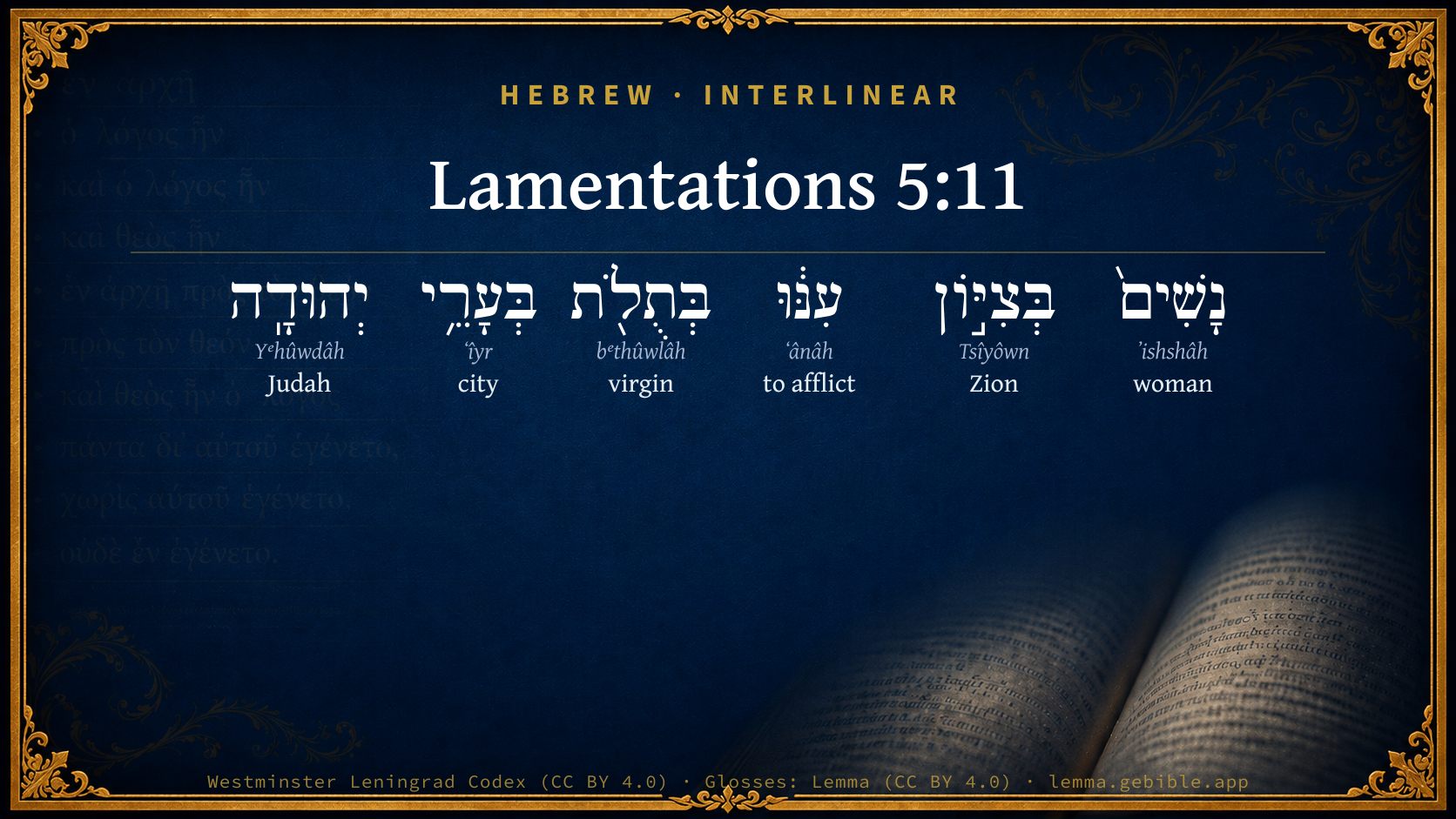
Hebrew (Westminster Leningrad Codex) Lamentations 5:11 appears in the Hebrew Old Testament. The text above is from the Westminster Leningrad Codex. Each word links to its Strong’s number, a concise gloss, and parsing drawn from the Open Scriptures Hebrew Bible morphology. Click any word for its full Brown-Driver-Briggs (BDB) entry.
Download image
Cite this verse

Lamentations 5:11 (World English Bible). Public Domain. Lemma interlinear Bible study tool, https://lemma.gebible.app/v/lamentations/5/11.

Show BibTeX & RIS
BibTeX
RIS
English Translation
They ravished the women in Zion, The virgins in the cities of Judah.
World English Bible · Public Domain
Download a study sheet

One document with this verse’s original text, its word-by-word gloss line, the meaning frame, cross-references with their text, attributed commentary, and full source and license credits — printable, and it pastes into notes with its structure intact.

This verse Autodidact and up

Study sheet (.html) Plain text (.txt)

A passage Seminary Student

Up to 50 verses in one chapter. A passage sheet keeps up to 6 commentary sources and 12 cross-references per verse, in the order this page ranks them, and says so on the sheet whenever that leaves anything out. Ask for a single verse and you get the Autodidact verse sheet above.

Everything on this page stays free to read, with no account — the sheet is a download of what is already on screen, not access to it.

Want to remove ads? Support Godless Engineer
Compare translations 3

The same verse in 3 English versions, stacked beneath the original-language interlinear above. Click any original word for its lexicon entry.

Each is an independent rendering of the whole verse — the interlinear is not word-aligned to these translations.

Highlighted words mark where these versions differ — a whole-verse word diff, not a word-by-word alignment.

  • World English Bible Public Domain
    They ravished the women in Zion, The virgins in the cities of Judah.
  • King James Version Public Domain
    They ravished the women in Zion, and the maids in the cities of Judah.
  • unfoldingWord Literal Text CC BY-SA 4.0
    They violate women in Zion, virgins in the cities of Judah.

unfoldingWord Literal Text — © unfoldingWord, licensed CC BY-SA 4.0. Word-aligned USFM3 via Door43 (git.door43.org/unfoldingWord/en_ult).

Versions to compare (up to 4)

3 of 4 selected

Show all 18 translations

Every available English version of this verse, each an independent rendering of the whole verse.

  • World English Bible Public Domain
    They ravished the women in Zion, The virgins in the cities of Judah.
  • Berean Standard Bible Public Domain
    Women have been ravished in Zion, virgins in the cities of Judah.
  • Majority Standard Bible Public Domain
    Women have been ravished in Zion, virgins in the cities of Judah.
  • King James Version Public Domain
    They ravished the women in Zion, and the maids in the cities of Judah.
  • American Standard Version (1901) Public Domain
    They ravished the women in Zion, The virgins in the cities of Judah.
  • Revised Version (1885) Public Domain
    They ravished the women in Zion, the maidens in the cities of Judah.
  • Geneva Bible (1599) Public Domain
    They defiled the women in Zion, and the maydes in the cities of Iudah.
  • Douay-Rheims (1899) Public Domain
    They oppressed the women in Sion, and the virgins in the cities of Juda.
  • Young's Literal Translation Public Domain
    Wives in Zion they have humbled, Virgins -- in cities of Judah.
  • Literal Standard Version CC BY-SA 4.0
    Wives in Zion they have humbled, || Virgins—in cities of Judah.
  • Unlocked Literal Bible CC BY-SA 4.0
    Women are raped in Zion, and virgins in the cities of Judah.
  • unfoldingWord Literal Text CC BY-SA 4.0
    They violate women in Zion, virgins in the cities of Judah.
  • Darby Bible Public Domain
    They have ravished the women in Zion, the maids in the cities of Judah.
  • World Messianic Bible Public Domain
    They ravished the women in Zion, the virgins in the cities of Judah.
  • Webster's Bible Public Domain
    They ravished the women in Zion, and the maids in the cities of Judah.
  • Free Bible Version CC BY-SA 4.0
    They raped women in Zion, virgins in the towns of Judah.
  • Bible in Basic English Public Domain
    They took by force the women in Zion, the virgins in the towns of Judah.
  • JPS Tanakh (1917) Public Domain
    They have ravished the women in Zion, the maidens in the cities of Judah.

Literal Standard Version (2020), Covenant Press — licensed CC BY-SA 4.0. Text via the HelloAO Bible API (eBible.org). Unlocked Literal Bible (unfoldingWord) — licensed CC BY-SA 4.0. Text via the HelloAO Bible API (eBible.org). unfoldingWord Literal Text — © unfoldingWord, licensed CC BY-SA 4.0. Word-aligned USFM3 via Door43 (git.door43.org/unfoldingWord/en_ult). Free Bible Version, Dr. Jonathan Gallagher — licensed CC BY-SA 4.0. Text via the HelloAO Bible API (eBible.org).

Word by word

More ways to search: Search by grammar → Find every occurrence → Compare this word →

Practice this passage: Drill this verse → Learn its vocabulary →

About this verse

These counts appear in no published source. They are computed here, from the morphology-tagged text and Lemma’s own curated glosses. What Lemma adds →

6
words
6
distinct lemmas
Prophets
section

Shared distinctive vocabulary

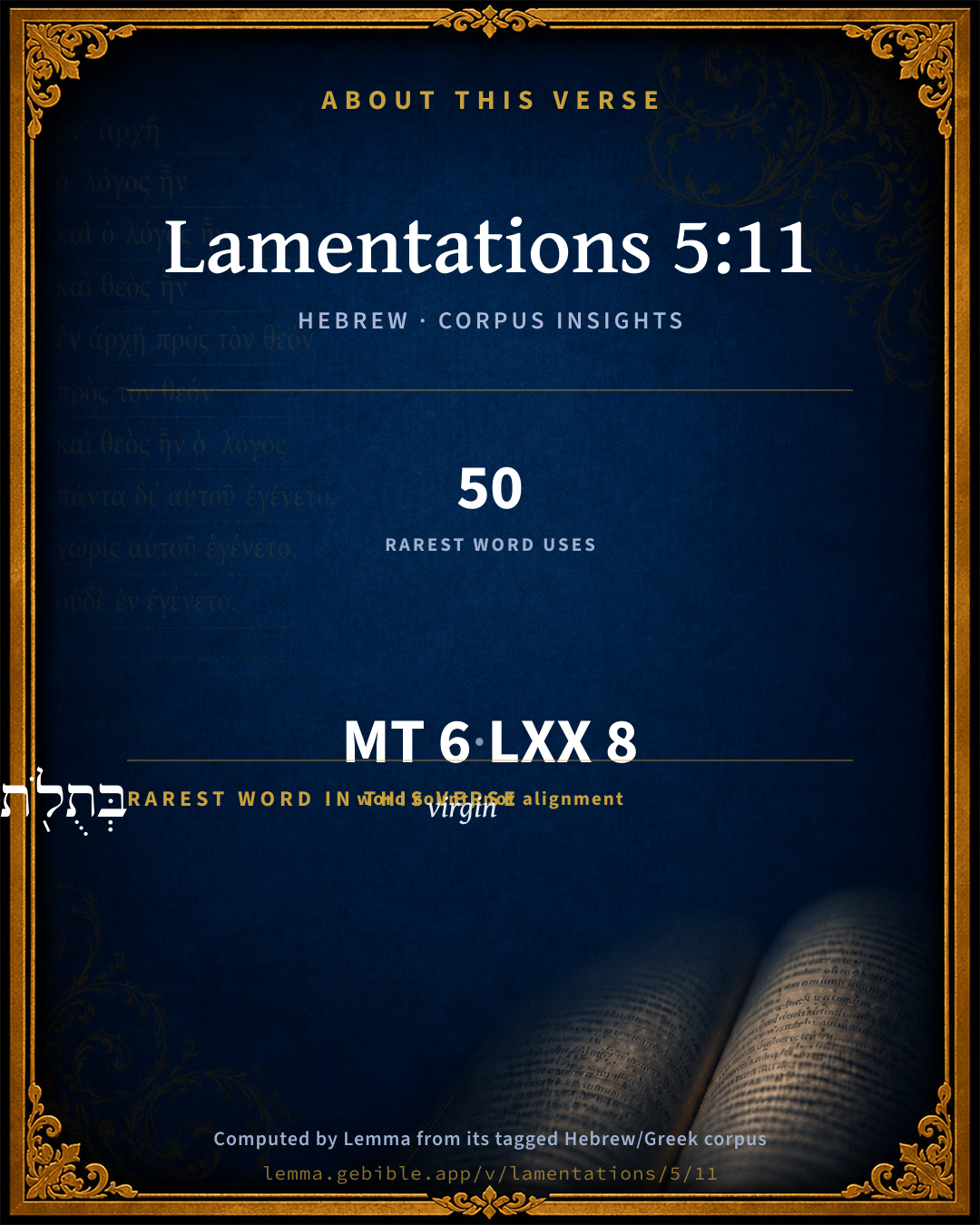
בְּתֻלֹ֖ת virgin H1330 occurs in 50 verses of the Hebrew Bible. Also found in:

Grammatical profile

  • 1 verb
  • 5 nouns

Verb forms

  • עִנּ֔וּ Piel · Perfect

Hebrew & Septuagint length

In English translation the verse runs 13 words from the Hebrew and 13 from the Septuagint (LXX English) — the same length.

A rough comparison of the two English renderings, which tokenize alike — not a word-level alignment.

Word counts can differ between the Hebrew and the Greek without any difference in meaning — e.g. the Hebrew direct-object marker אֵת has no separate Greek word, and Greek often adds the article ὁ.

In the original languages it is 6 Hebrew tokens and 8 Greek tokens — but the two are counted differently (Hebrew bundles its prefixes and suffixes into one token; the Greek is in lemma form), so that isn’t a like-for-like length.

Cross-references

3

Topical passages linked to Lamentations 5:11 in the Treasury of Scripture Knowledge — connected by theme and wording, ordered by reader-vote popularity; previews shown in the World English Bible.

  • Isaiah 13:16 Their infants also shall be dashed in pieces before their eyes; their houses shall be rifled, and their wives ravished.
  • Zechariah 14:2 For I will gather all nations against Jerusalem to battle; and the city will be taken, the houses rifled, and the women ravished. half of the city will go out into captivity, and the rest of the people will not be cut off from the city.
  • Deuteronomy 28:30 You shall betroth a wife, and another man shall lie with her: you shall build a house, and you shall not dwell therein: you shall plant a vineyard, and shall not use the fruit of it.

Cross-references courtesy of OpenBible.info (CC BY 4.0).

Hebrew and Greek witnesses Masoretic Hebrew ↔ Greek Septuagint

The same verse in the two great witnesses to the Old Testament, shown verse-for-verse.

These are two independent witnesses, not word-aligned to each other, and the Septuagint is shown in lemma (dictionary) form.

Hebrew Lamentations 5:11 Masoretic · Westminster Leningrad Codex

נָשִׁים֙ בְּצִיּ֣וֹן עִנּ֔וּ בְּתֻלֹ֖ת בְּעָרֵ֥י יְהוּדָֽה

They ravished the women in Zion, The virgins in the cities of Judah.

World English Bible · Public Domain

Greek LXX Lamentations 5:11 Septuagint · lemma form

γυνή ἐν σιων ταπεινόω παρθένος ἐν πόλις ιουδα

They humbled the women in Sion, the virgins in the cities of Juda.

LXX2012 (modern English Septuagint) · Public Domain

Hebrew: Westminster Leningrad Codex (CC BY 4.0). Greek: Septuagint (public domain); English from LXX2012 (modern English Septuagint) (Public Domain). How the Septuagint differs from the Hebrew →

Commentary

Notes on Lamentations 5:11 from classic Christian and Jewish commentators (each source and its license shown beneath its notes). The classic Christian expositions comment on the surrounding passage and are grouped to its opening verse, so a note may address several verses; the Jewish commentaries on the Tanakh (Rashi and others) are per-verse, so they appear only where the commentator wrote on this verse.

Lemma curates 59 commentaries, every one of them public domain or Creative Commons licensed, each selected and text-cleaned for this edition rather than reprinted as found. About our sources →

Trapp's Complete Commentary

John Trapp

Lam 5:11 They ravished the women in Zion, [and] the maids in the cities of Judah.

Ver. 11. They ravished the women in Zion.] Heb., They humbled, i.e., they dishonested: although Virgo invita vexari quidem potest, violari non potest. The Chaldee paraphraseth thus, The wives were ravished by the Romans, and the maids by the Chaldees; for the Jewish doctors do understand this book of the Lamentations concerning both the destructions of Jerusalem.

John Trapp, A Commentary or Exposition upon All the Books of the Old and New Testament (1647–1656) — public domain. Text from a community e-Sword module.

The Expositor's Bible

SIN AND SHAME

Lam_5:11-18

THE keynote of the fifth elegy is struck in its opening verse when the poet calls upon God to remember the reproach that has been cast upon His people. The preceding poems dwelt on the sufferings of the Jews; here the predominant thought is that of the humiliations to which they have been subjected. The shame of Israel and the sin which had brought it on are now set forth with point and force. If, as some think, the literary grace of the earlier compositions is not fully sustained in the last chapter of Lamentations-although in parts of it the feeling and imagination and art all touch the high-water mark-it cannot be disputed that the spiritual tone of this elegy indicates an advance on the four earlier poems. We have sometimes met with wild complaints, fierce recriminations, deep and terrible curses that seem to require some apology if they are to be justified. Nothing of the kind ruffles the course of this faultless meditation. There is not a single jarring note from beginning to end, not one phrase calling for explanation by reference to the limited ideas of Old Testament times or to the passion excited by cruelty, insult, and tyranny, not a line that reads painfully even in the clear light of the teachings of Jesus Christ. The vilest outrages are deplored; and yet, strange to say, no word of vindictiveness towards the perpetrators escapes the lips of the mourning patriot! How is this? The sin of the people has been confessed before as the source of all their misery; but since with it shame is now associated as the principal item in their affliction, we can see in this fresh development a decided advance towards higher views of the whole position.

May we not take this characteristic of the concluding chapter of the Book of Lamentations to be an indication of progress in the spiritual experience of its author? Perhaps it is to be partially explained by the fact that the poem throughout consists of a prayer addressed directly to God. The wildest, darkest passions of the soul cannot live in the atmosphere of prayer. When men say of the persecutor, "Behold he prayeth," it is certain that he cannot any longer be "breathing threatening and slaughter." Even the feelings of the persecuted must be calmed in the presence of God. The serenity of the surroundings of the mercy-seat cannot but communicate itself to the feverish soul of the suppliant. To draw near to God is to escape from the tumults of earth and breathe the still, pure air of heaven. He is Himself so calm and strong, so completely sufficient forevery emergency, that we begin to enter into His rest as soon as we approach His presence. All unawares, perhaps unsought, the peace of God steals into the heart of the man who brings his troubles to his Father in prayer.

Then the reflections that accompany prayer tend in the same direction. In the light of God things begin to assume their true proportions. We discover that our first fierce outcries were unreasonable, that we had been simply maddened by pain so that our judgment had been confused. A psalmist tells us how he understood the course of events which had previously perplexed him by taking his part in the worship of the sanctuary, when referring to his persecutors, the prosperous wicked, he exclaims, "Then understood I their end Psa_73:13." In drawing near to God we learn that vengeance is Gods prerogative, that He will repay; therefore we can venture to be still and leave the vindication of our cause in His unerring hands. But, further, the very thirst for revenge is extinguished in the presence of God, and that in several ways: we see that the passion is wrong in itself; we begin to make some allowance for the offender; we learn to own kinship with the man while condemning his wickedness; above all, we awake to a keen consciousness of our own guilt.

This, however, is not a sufficient explanation of the remarkable change in tone that we have observed in the fifth elegy. The earlier poems contain prayers, one of which degenerates into a direct imprecation. {Lam_3:65} If the poet had wholly given himself to prayer in that case as he has done here, very possibly his tone would have been mollified. Still, we must look to other factors for a complete explanation. The writer is himself one of the suffering people. In describing their wrongs he is narrating his own, for he is "the man who has seen affliction." Thus he has long been a pupil in the school of adversity. There is no school at which a docile pupil learns so much. This man has graduated in sorrow. It is not surprising that he is not just what he was-when he matriculated. We must not press the analogy too far, because, as we have seen, there is good reason to believe that none of the elegies were written until some time after the occurrence of the calamities to which they refer, that therefore they all represent the fruit of long brooding over their theme. And yet we may allow an interval to have elapsed between the composition of the earlier ones and that of the poem with which the book closes. This period of longer continued reflection may have been utilised in the process of clearing and refining the ideas of the poet. It is not merely that the lessons of adversity impart fresh knowledge or a truer way of looking at life and its fortunes. They do the higher work of education-they develop culture. This, indeed, is the greatest advantage to be gained by the stern discipline of sorrow. The soul that has the grace to use it aright is purged and pruned, chastened and softened, lifted to higher views, and at the same time brought down from self-esteem to deep humiliation. Here we have a partial explanation of the mystery of suffering. This poem throws light on the terrible problem by its very existence, by the spirit and character which it exhibits. The calmness and self-restraint of the elegy, while they deepen the pathos of the whole scene, help us to see as no direct statement would do, that the chastisement of Israel has not been inflicted in vain. There must be good even in the awful miseries here described in such patient language.

The connection of shame with sin in this poem is indirect and along a line which is the reverse of the normal course of experience. The poet does not pass from sin to shame; he proceeds from the thought of shame to that of sin. It is the humiliating condition in which the Jews are found that awakens the idea of the shocking guilt of which this is the consequence. We often have occasion to acknowledge the fatal hindrance of pride to the right working of conscience. A lofty conception of ones own dignity is absolutely inconsistent with a due feeling of guilt. A man cannot be both elated and cast down at the same moment. If his elation is sufficiently sustained from within it will effectually bar the door to the entrance of those humbling thoughts which cannot but accompany an admission of sin. Therefore when this barrier is first removed, and the man is thoroughly humbled, he is open to receive the accusations of conscience. All his fortifications have been flung down. There is nothing to prevent the invading army of accusing thoughts from marching straight in and taking possession of the citadel of his heart.

The elegy takes a turn at the eleventh verse. Up to this point it describes the state of the people generally in their sufferings from the siege and its consequences. But now the poet directs attention to separate classes of people and the different forms of cruelty to which they are severally subjected in a series of intensely vivid pictures. We see the awful fate of matrons and maidens, princes and elders, young men and children. Women are subjected to the vilest abuse, neither reverence for motherhood nor pity for innocence affording the least protection. Men of royal blood and noble birth are killed and their corpses hung up in ignominy-perhaps impaled or crucified in accordance with the vile Babylonian custom. There is no respect for age or office. Neither is there any mercy for youth. In the East grinding is womens work; but, like Samson among the Philistines, the young men of the Jews are put in charge of the mills. The poet seems to indicate that they have to carry the heavy millstones in the march of the returning army with the spoils of the sacked city. The children are set to the slave task of Gibeonites. The Hebrew word here translated children might stand for young people who had reached adult years. {Lam_5:13} But in the present case the condition is that of immature strength, for the burden of wood they are required to bear is too heavy for them and they stumble under it. This is the scene-outrage for the girls and women, slaughter for the leading men, harsh slavery for the children.

Next, passing from these exact details, the poet again describes the condition of the people more generally, and this time under the image of an interrupted feast, which is introduced by one more reference to the changes that have come upon certain classes. The elders are no longer to be seen at the gate administering the primitive forms of law entrusted to them. The young men are no longer to be heard performing on their musical instruments. {Lam_5:14} Still speaking for the people, the poet declares that the joy of their heart has ceased. Then the aspect of all life must be changed to them. Instead of the gay pictures of dancers in their revelry we have the waiting of mourners. The guest at a feast would be crowned with a garland of flowers. Such was once the appearance of Jerusalem in her merry festivities. But now the garland has fallen from her head. {Lam_5:15-16}

This imagery is a relief after the terrible realism of the immediately preceding pictures. We cannot bear to look continuously at scenes of agony, nor is it well that we should attempt to do so, because if we could succeed it would only be by becoming callous. Then the final result would be not to excite deeper sympathy, but the very reverse, and at the same time a distinctly lowering and coarsening effect would be produced in us. And yet we may not smother up abuses in order to spare our own feelings. There are evils that must be dragged out to the light in order that they may be execrated, punished, and destroyed. "Uncle Toms Cabin" broke the back of American slavery before President Lincoln attacked it. Where, then, shall we find the middle position between repulsive realism and guilty negligence? We have the model for this in the Biblical treatment of painful subjects. Scripture never gloats over the details of crimes and vices; yet Scripture never flinches from describing such things in the plainest possible terms. If these subjects are ever to become the theme of art-and art claims the whole of life for her domain-imagination must carry us away to the secondary effects rather than vivify the hideous occurrences themselves. The passage before us affords an excellent illustration of this method. With a few keen, clear strokes the poet sketches in the exact situation. But he shows no disposition to linger on ghastly details. Though he does not shrink from setting them before us in unmistakable truth of form and colour, he hastens to a more ideal treatment of the subject, and relieves us with the imaginary picture of the spoiled banquet. Even Spenser sometimes excites a feeling of positive nausea when he enlarges on some most loathsome picture. It would be unendurable except that the great Elizabethan poet has woven the witchery of his dainty fancy into the fabric of his verse. Thus things can be said in poetry which would be unbearable in prose, because poetry refines with the aid of imagination the tale that it does not shrink from telling quite truly and most forcibly.

The change in the poets style prepares for another effect. While we are contemplating the exact details of the sufferings of the different classes of outraged citizens, the insult and cruelty and utter abomination of these scenes rouse our indignation against the perpetrators of the foulest crimes, and leave nothing but pity for the victims. It is not in the presence of such events that the sins of Israel can be brought home to the people or even called to mind. The attempt to introduce the thought of them there would seem to be a piece of heartless officiousness. And yet it is most important to perceive the connection between all this misery and the previous misconduct of the Jews which was its real cause. Accordingly intermediate reflections, while they let the scenes of blood and terror recede, touch on the general character of the whole in a way that permits of more heart-searching self-examination. Thus out of the brooding melancholy of this secondary grief we are led to a distinct confession of sin on the part of the people. {Lam_5:16}

This is the main result aimed at throughout the whole course of chastisement. Until it has been reached little good can be effected. When it is attained the discipline has already wrought its greatest work. As we saw at the outset, it is the shame of the situation that awakens a consciousness of guilt. Humbled and penitent, the chastened people are just in the position at which God can meet them in gracious pardon. Strictly speaking, perhaps we should say that this is the position to which the elegist desires to lead them by thus appearing as their spokesman. And yet we should not make too sharp a distinction between the poet and his people. The elegy is not a didactic work; the flavour of its gentle lines would be lost directly they lent themselves to pedagogic ends. It is only just to take the words before us quite directly, as they are written in the first person plural, for a description of the thoughts of at least the group of Jews with whom their author associated.

The confession of sin implies in the first place a recognition of its existence. This is more than a bare, undeniable recollection that the deed was done. It is possible by a kind of intellectual jugglery even to come to a virtual denial of this fact in ones own consciousness. But to admit the deed is not to admit the sin. The casuistry of self-defence before the court of self-judgment is more subtle than sound, as every one who has found out his own heart must be aware. In this matter, "the heart is deceitful above all things." {Jer_17:9} Now it is not difficult to take part in a decorous service where all the congregation are expected to denominate themselves miserable offenders, but it is an entirely different thing to retreat into the silent chamber of our own thought, and there calmly and deliberately, with full consciousness of what the words mean, confess to ourselves, "We have sinned." The sinking of heart, the stinging humiliation, the sense of self-loathing which such an admission produces, are the most miserable experiences in life. The wretchedness of it all is that there is no possibility of escaping the accuser when he is self. We can do nothing but let the shame of the deed burn in the conscience without any mollifying salve-until the healing of Divine forgiveness is received.

But, in the second place, confession of sin goes beyond the secret admisison of it by the conscience, as in a case heard in camera. Chiefly it is a frank avowal of guilt before God. This is treated by St. John as an essential condition of forgiveness by God, when He says, "If we confess our sins, He is faithful and righteous to forgive us our sins, and to cleanse us from all unrighteousness." {1Jn_1:9} How far confession should also be made to our fellow men is a difficult question. In bidding us confess our "faults one to another," {Jam_5:16} St. James may be simply requiring that when we have done anybody a wrong we should own it to the injured person. The harsh discipline of the white sheet is not found in apostolic times, the brotherly spirit of which is seen in the charity which "covereth a multitude of sins." {1Pe_4:8} And yet, on the other hand, the true penitent will always shrink from sailing under false colours. Certainly public offences call for public acknowledgment, and all sin should be so far owned that whether the details are known or not there is no actual deception, no hypocritical pretence at a virtue that is not possessed, no willingness to accept honours that are quite unmerited. Let a man never pretend to be sinless, nay, let him distinctly own himself a sinner, and, in particular, let him not deny or excuse any specific wickedness with which he is justly accused; and then for the rest, "to his own Lord he standeth or falleth.". {Rom_14:4}

When the elegist follows his confession of sin with the words, "For this our heart is faint," etc., {Lam_5:17} it is plain that he attributes the sense of failure and impotence to the guilt that has led to the chastisement. This faintness of heart and the dimness of sight that accompanies it, like the condition of a swooning person, suggests a very different situation from that of the hero struggling against a mountain of difficulties, or that of the martyr triumphing over torture and death. The humiliation is now accounted for, and the explanation of it tears to shreds the last rag of pride with which the fallen people might have attempted to hide it. The abject wretchedness of the Jews is admitted to be the effect of their own sins. No thought can be more depressing. The desolation of Mount Zion, where jackals prowl undisturbed as though it were the wilderness, is a standing testimony to the sin of Israel. Such is the degradation to which the people whom the elegist here represents are reduced. It is a condition of utter helplessness; and yet in it will rise the dawn of hope; for when man is most empty of self he is most ready to receive God. Thus it is that from the deepest pit of humiliation there springs the prayer of trust and hope with which the Book of Lamentations closes.

William Robertson Nicoll, ed., The Expositor's Bible (London: Hodder & Stoughton, 1887–1910) — public domain. 65 of 66 books (1 Corinthians is not separately keyed, as that volume carries no machine-parseable verse references); section-level commentary keyed to the opening verse. Introductory and overview sections not keyed to a specific passage are excluded.

Jamieson, Fausset & Brown

Robert Jamieson, A. R. Fausset & David Brown

So in just retribution Babylon itself should fare in the end. Jerusalem shall for the last time suffer these woes before her final restoration (Zac 14:2).

Jamieson, Fausset & Brown — Commentary Critical and Explanatory on the Whole Bible (1871) — public domain (CC PDM 1.0). Text via the HelloAO Bible API.

Adam Clarke's Commentary

Verse 11. They ravished the women in Zion, and the maids in the cities of Judah.] The evil mentioned here was predicted by Moses, De 28:30; De 28:32, and by Jeremiah, Jer 6:12.

Adam Clarke's Commentary on the Bible (1810–1826) — public domain. Text from a community e-Sword/MySword module.

John Calvin's Commentaries

He mentions here another kind of reproach, that women had been ravished in Jerusalem, and in other cities. God had commanded chastity to be observed among his people. When, therefore, virgins and women were thus defiled, it was a thing extremely disgraceful. But the Prophet mentioned this also, in order that God might at length show himself propitious to his people after having been entreated. (Deuteronomy 22:21-24.)

And he mentioned Sion rather than Jerusalem, — it was indeed to state a part for the whole; but that place, we know, had been chosen by God that his name might be there worshipped. Sion, then, was a holy place above any other; it was, in a word, the earthly dwelling of God. As, then, God had there his palace, that he might dwell in the midst of his people, it was a disgraceful sight in the extreme to see women ravished there, for the temple of God was thus violated. It was not only a thing disgraceful to the people, that women were thus ravished, but it was a filthy profanation of God’s worship, and therefore sacrilegious. We now see the design of the Prophet. He mentions also the cities of Judah, but with reference to the same thing. It follows —

John Calvin's Commentaries (1540-1563) — public domain. Text from the Calvin Translation Society English edition (1840s-50s) via the Christian Classics Ethereal Library (ccel.org). Calvin's coverage is partial (roughly two-thirds of the Bible); uncommented books and verses are honest gaps, never fabricated. The 19th-century editor's footnotes and remarks are omitted so the notes are faithfully Calvin's own voice.

The Cambridge Bible for Schools and Colleges

gen. ed. J. J. S. Perowne

11, 12. We notice the sudden harking back to incidents connected immediately with the capture of the city.

The Cambridge Bible for Schools and Colleges (gen. ed. J. J. S. Perowne; Cambridge University Press, 1878–1918) — public domain. Text from a community e-Sword module.

John Gill's Exposition

They ravished the women in Zion,.... Or "humbled" them (w); an euphemism; the women that were married to men in Zion, as the Targum; and if this wickedness was committed in the holy mountain of Zion, it was still more abominable and afflicting, and to be complained of; and if by the servants before mentioned, as Aben Ezra interprets it, it is another aggravating circumstance of it; for this was done not in Babylon when captives there; but at the taking of the city of Jerusalem, and by the common soldiers, as is too often practised:

and the maids in the cities of Judah; in all parts of the country, where the Chaldean army ravaged, there they ravished the maids. The Targum is,

"the women that were married to men in Zion were humbled by strangers; (the Targum in the king of Spain's Bible is, by the Romans;) and virgins in the cities of Judah by the Chaldeans;''

suggesting that this account has reference to both destructions of the city, and the concomitants and consequences thereof.

(w) Sept. "humiliaverunt", V. L. Munster.

John Gill's Exposition of the Whole Bible (1746–1763) — public domain (CC PDM 1.0). Text via the HelloAO Bible API.

Albert Barnes' Notes on the Bible

They ravished - They humbled.

Albert Barnes' Notes on the Bible (1834–1885) — public domain. Text from a community e-Sword/MySword module.

Haydock's Catholic Bible Commentary

Oppressed. Hebrew, "afflicted." Brutal insolence prevailed. (Calmet)

George Leo Haydock (1774–1849), Haydock's Catholic Family Bible and Commentary, 1859 edition — public domain. Excludes Psalms (Douay-Rheims chapter numbering differs from Protestant) and Deuterocanonical books (Catholic canon only).

Matthew Poole's English Annotations

Usual outrages of barbarous soldiers. The Hebrew is, They humbled, a modest term to express these actions by.

Matthew Poole's English Annotations on the Holy Bible (1683–1685) — public domain. Text from a community e-Sword/MySword module.

Whedon's Commentary on the Bible

Daniel D. Whedon

11-13. Ravished the women — In those verses we have individualizing illustrations of the unhappy lot of the people. The women are dishonoured, (literally, humbled;) princes are put to death and their dead bodies hanged up by their hand to expose them to public contumely.

The… elders were not honoured — An utter violation of all that is most sacred in oriental life; and young men and children are put to the most servile work, literally, they bear the mill and fall under the wood.

Daniel D. Whedon (gen. ed.), Commentary on the Old and New Testaments (1874–1909) — public domain. Text from a community e-Sword module.

unfoldingWord translationNotes

Door43 World Missions Community

Women are raped in Zion, and virgins in the cities of Judah

These two phrases have similar meaning and emphasize that the women are being violated. The words "are raped" are understood in the second part of this sentence and can be repeated. AT: "Women are raped in Zion, and virgins are raped in the cities of Judah" (See: Parallelism and Ellipsis)

Women are raped ... and virgins

This can be stated in active form. AT: "Our enemies have raped the women ... and the virgins" or "Our enemies have violated the women ... and the virgins" (See: Active or Passive)

Princes are hung up by their own hands

Possible meanings are 1) the word "their" refers to their enemies. AT: "With their own hands, they hung princes" or 2) they tied each prince's hands together with one end of a rope and tied the other end so the prince's feet could not touch the ground.

no honor is shown to the elders

This can be stated in active form. AT: "they have shown no honor to the elders" (See: Active or Passive)

translationWords

Zion

virgin

kingdom of Judah

prince

honor

elder

unfoldingWord translationNotes — © Distant Shores Media and the Door43 World Missions Community, licensed CC BY-SA 4.0. Source: git.door43.org/Door43/en_tn.

Lesson kit

Teaching starters — assembled from the data on this page, not authored interpretation. Every prompt links to the verse data it draws on. Edit before teaching.

Lamentations, in the Prophets, opens this verse with 6 words (6 distinct Hebrew lemmas). Its most distinctive word is bᵉthûwlâh (“virgin”). A historical commentator’s framing appears above. Read the whole chapter for the surrounding context.

Discussion questions

  1. The word bᵉthûwlâh carries the sense “virgin.” How does it shape the verse?
  2. Genesis 24:16 shares the word «virgin» with this verse. How do the two illuminate each other?
  3. These translations render this verse differently. What is at stake in choosing one wording over another?
  4. The verb «עִנּ֔וּ» is Piel Perfect. How does its form color the action?
  5. Reading how Trapp's Complete Commentary and The Expositor's Bible read this verse, where do the two commentators agree and where do they part?

Things to notice

Reading settings

Reading text

Shown beneath each verse's original-language words.

Old Testament
Old Testament edition

Read the OT as the Masoretic Hebrew (MT) or the Greek Septuagint (LXX).

English shown for the Greek Septuagint (in the Hebrew ↔ Greek comparison).

Comparing translations? Open the Compare panel on any verse page to stack up to four side by side.