
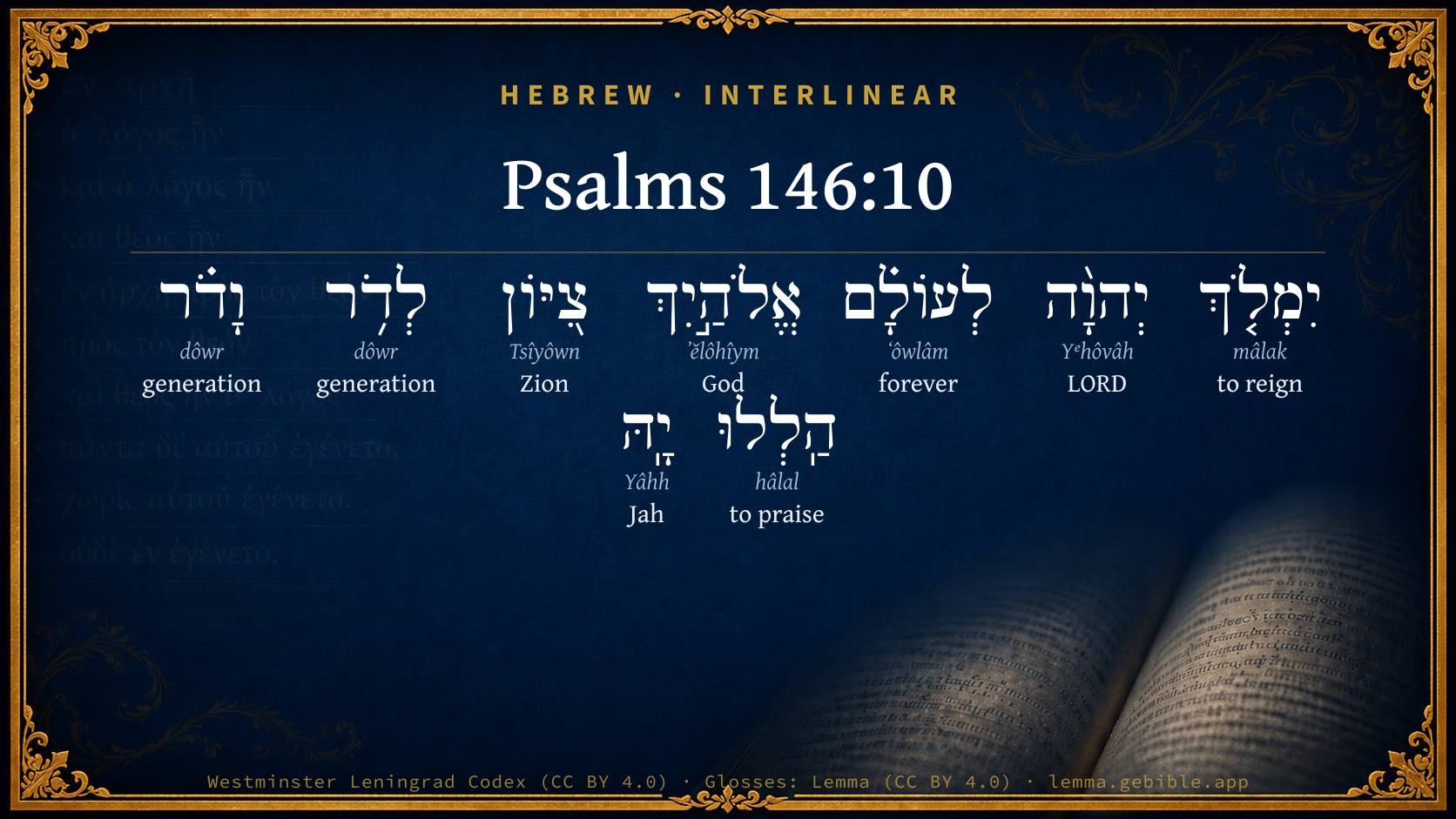
Psalms 146:10

Hebrew (Westminster Leningrad Codex) Psalms 146:10 appears in the Hebrew Old Testament. The text above is from the Westminster Leningrad Codex. Each word links to its Strong’s number, a concise gloss, and parsing drawn from the Open Scriptures Hebrew Bible morphology. Click any word for its full Brown-Driver-Briggs (BDB) entry.
Download image
Cite this verse

Psalms 146:10 (World English Bible). Public Domain. Lemma interlinear Bible study tool, https://lemma.gebible.app/v/psalms/146/10.

Show BibTeX & RIS
BibTeX
RIS
English Translation
Yahweh will reign forever; Your God, O Zion, to all generations. Praise Yah!
World English Bible · Public Domain
Download a study sheet

One document with this verse’s original text, its word-by-word gloss line, the meaning frame, cross-references with their text, attributed commentary, and full source and license credits — printable, and it pastes into notes with its structure intact.

This verse Autodidact and up

Study sheet (.html) Plain text (.txt)

A passage Seminary Student

Up to 50 verses in one chapter. A passage sheet keeps up to 6 commentary sources and 12 cross-references per verse, in the order this page ranks them, and says so on the sheet whenever that leaves anything out. Ask for a single verse and you get the Autodidact verse sheet above.

Everything on this page stays free to read, with no account — the sheet is a download of what is already on screen, not access to it.

Want to remove ads? Support Godless Engineer
Compare translations 3

The same verse in 3 English versions, stacked beneath the original-language interlinear above. Click any original word for its lexicon entry.

Each is an independent rendering of the whole verse — the interlinear is not word-aligned to these translations.

Highlighted words mark where these versions differ — a whole-verse word diff, not a word-by-word alignment.

  • World English Bible Public Domain
    Yahweh will reign forever; Your God, O Zion, to all generations. Praise Yah!
  • King James Version Public Domain
    The LORD shall reign for ever, even thy God, O Zion, unto all generations. Praise ye the LORD.
  • unfoldingWord Literal Text CC BY-SA 4.0
    Yahweh reigns forever; your God, Zion, to generation and generation. Hallelu Yah!

unfoldingWord Literal Text — © unfoldingWord, licensed CC BY-SA 4.0. Word-aligned USFM3 via Door43 (git.door43.org/unfoldingWord/en_ult).

Versions to compare (up to 4)

3 of 4 selected

Show all 18 translations

Every available English version of this verse, each an independent rendering of the whole verse.

  • World English Bible Public Domain
    Yahweh will reign forever; Your God, O Zion, to all generations. Praise Yah!
  • Berean Standard Bible Public Domain
    The LORD reigns forever, your God, O Zion, for all generations. Hallelujah!
  • Majority Standard Bible Public Domain
    The LORD reigns forever, your God, O Zion, for all generations. Hallelujah!
  • King James Version Public Domain
    The LORD shall reign for ever, even thy God, O Zion, unto all generations. Praise ye the LORD.
  • American Standard Version (1901) Public Domain
    Jehovah will reign for ever, Thy God, O Zion, unto all generations. Praise ye Jehovah.
  • Revised Version (1885) Public Domain
    The LORD shall reign for ever, thy God, O Zion, unto all generations. Praise ye the LORD.
  • Geneva Bible (1599) Public Domain
    The Lord shall reigne for euer: O Zion, thy God endureth from generation to generation. Prayse ye the Lord.
  • Douay-Rheims (1899) Public Domain
    Let all thy works, O lord, praise thee: and let thy saints bless thee.
  • Young's Literal Translation Public Domain
    Jehovah doth reign to the age, Thy God, O Zion, to generation and generation, Praise ye Jah!
  • Literal Standard Version CC BY-SA 4.0
    YHWH reigns for all time, || Your God, O Zion, to generation and generation, || Praise YAH!
  • Unlocked Literal Bible CC BY-SA 4.0
    Yahweh will reign forever, your God, Zion, for all generations. Praise Yahweh.
  • unfoldingWord Literal Text CC BY-SA 4.0
    Yahweh reigns forever; your God, Zion, to generation and generation. Hallelu Yah!
  • Darby Bible Public Domain
    Jehovah will reign for ever, [even] thy God, O Zion, from generation to generation. Halleluiah!
  • World Messianic Bible Public Domain
    The LORD will reign forever; your God, O Zion, to all generations. Praise the LORD!
  • Webster's Bible Public Domain
    The LORD will reign for ever, even thy God, O Zion, to all generations. Praise ye the LORD.
  • Free Bible Version CC BY-SA 4.0
    The Lord will reign forever. Zion, he will be your God for all generations. Praise the Lord!
  • Bible in Basic English Public Domain
    The Lord will be King for ever; your God, O Zion, will be King through all generations. Praise be to the Lord.
  • JPS Tanakh (1917) Public Domain
    The LORD will reign for ever, Thy God, O Zion, unto all generations. Hallelujah.

Literal Standard Version (2020), Covenant Press — licensed CC BY-SA 4.0. Text via the HelloAO Bible API (eBible.org). Unlocked Literal Bible (unfoldingWord) — licensed CC BY-SA 4.0. Text via the HelloAO Bible API (eBible.org). unfoldingWord Literal Text — © unfoldingWord, licensed CC BY-SA 4.0. Word-aligned USFM3 via Door43 (git.door43.org/unfoldingWord/en_ult). Free Bible Version, Dr. Jonathan Gallagher — licensed CC BY-SA 4.0. Text via the HelloAO Bible API (eBible.org).

Word by word

More ways to search: Search by grammar → Find every occurrence → Compare this word →

Practice this passage: Drill this verse → Learn its vocabulary →

About this verse

These counts appear in no published source. They are computed here, from the morphology-tagged text and Lemma’s own curated glosses. What Lemma adds →

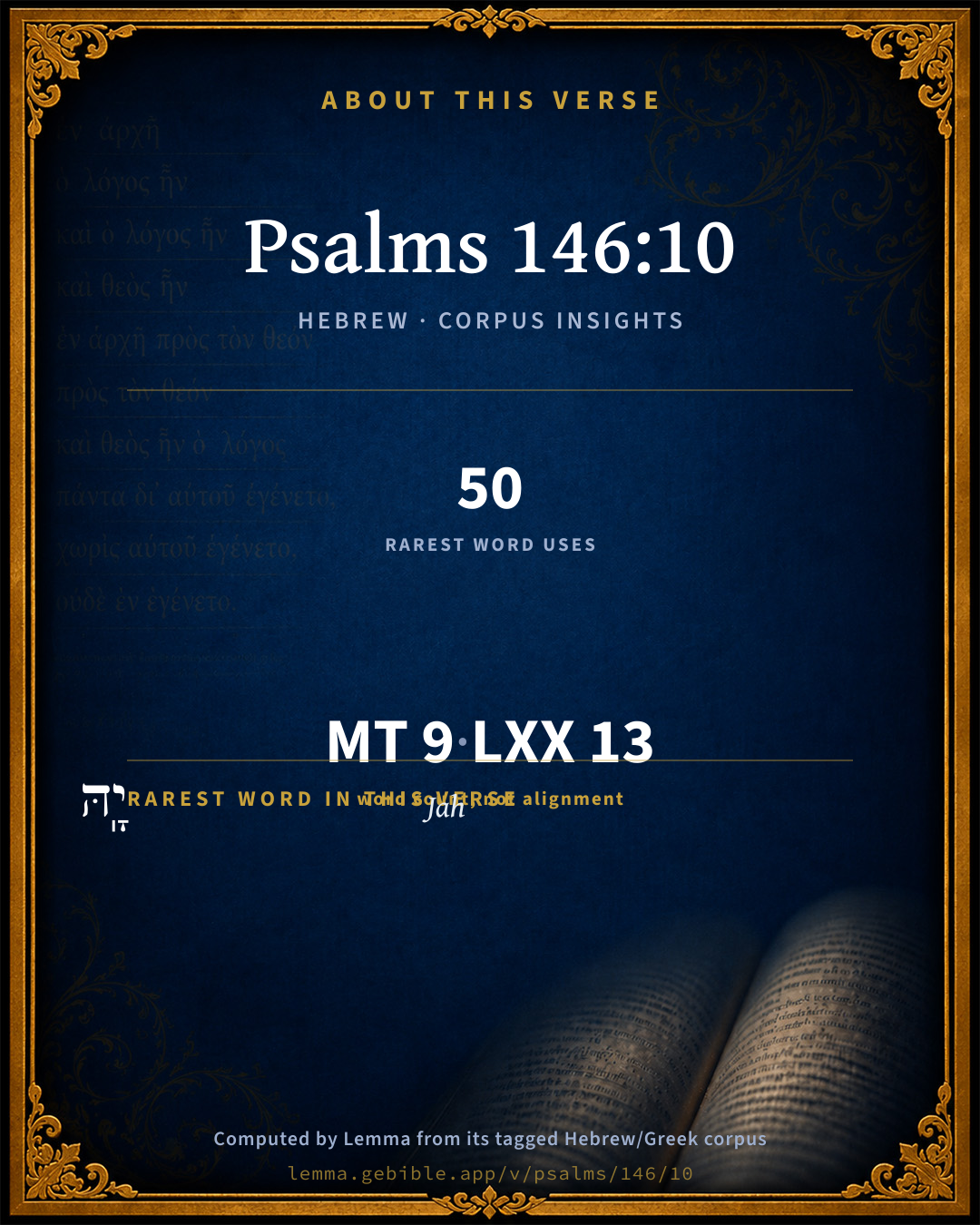
9
words
8
distinct lemmas
Wisdom
section

Shared distinctive vocabulary

יָֽהּ Jah H3050 occurs in 46 verses of the Hebrew Bible. Also found in:

Grammatical profile

  • 2 verbs
  • 7 nouns

Verb forms

  • יִמְלֹ֤ךְ Qal · Imperfect
  • הַֽלְלוּ Piel · Imperative

Repetition

A word recurs within this verse — often emphatic in Hebrew:

  • לְדֹ֥ר generation H1755 ×2

Hebrew & Septuagint length

In English translation the verse runs 13 words from the Hebrew and 14 from the Septuagint (LXX English) — closely comparable.

A rough comparison of the two English renderings, which tokenize alike — not a word-level alignment.

Word counts can differ between the Hebrew and the Greek without any difference in meaning — e.g. the Hebrew direct-object marker אֵת has no separate Greek word, and Greek often adds the article ὁ.

In the original languages it is 9 Hebrew tokens and 13 Greek tokens — but the two are counted differently (Hebrew bundles its prefixes and suffixes into one token; the Greek is in lemma form), so that isn’t a like-for-like length.

Cross-references

13

Topical passages linked to Psalms 146:10 in the Treasury of Scripture Knowledge — connected by theme and wording, ordered by reader-vote popularity; previews shown in the World English Bible.

  • Psalms 10:16 Yahweh is King forever and ever! The nations will perish out of his land.
  • Exodus 15:18 Yahweh shall reign forever and ever."
  • Revelation 11:15 The seventh angel sounded, and great voices in heaven followed, saying, "The kingdom of the world has become the Kingdom of our Lord, and of his Christ. He will reign forever and ever!"
  • Isaiah 12:6 Cry aloud and shout, you inhabitant of Zion; for great in the midst of you is the Holy One of Israel!"
  • Daniel 6:26 I make a decree, that in all the dominion of my kingdom men tremble and fear before the God of Daniel; for he is the living God, and steadfast forever, His kingdom that which shall not be destroyed; and his dominion shall be even to the end.
  • Daniel 7:14 There was given him dominion, and glory, and a kingdom, that all the peoples, nations, and languages should serve him: his dominion is an everlasting dominion, which shall not pass away, and his kingdom that which shall not be destroyed.
  • Isaiah 9:7 Of the increase of his government and of peace there shall be no end, on the throne of David, and on his kingdom, to establish it, and to uphold it with justice and with righteousness from henceforth even forever. The zeal of Yahweh of Hosts will perform this.
  • Joel 3:17 "So you will know that I am Yahweh, your God, Dwelling in Zion, my holy mountain. Then Jerusalem will be holy, And no strangers will pass through her any more.
  • Isaiah 40:9 You who tell good news to Zion, go up on a high mountain; you who tell good news to Jerusalem, lift up your voice with strength; lift it up, don't be afraid; say to the cities of Judah, Behold, your God!
  • Daniel 2:44 In the days of those kings shall the God of heaven set up a kingdom which shall never be destroyed, nor shall the sovereignty of it be left to another people; but it shall break in pieces and consume all these kingdoms, and it shall stand forever.
  • Psalms 145:13 Your kingdom is an everlasting kingdom. Your dominion endures throughout all generations.
  • Isaiah 52:7 How beautiful on the mountains are the feet of him who brings good news, who publishes peace, who brings good news of good, who publishes salvation, who says to Zion, Your God reigns!
  • Psalms 147:12 Praise Yahweh, Jerusalem! Praise your God, Zion!

Cross-references courtesy of OpenBible.info (CC BY 4.0).

Hebrew and Greek witnesses Masoretic Hebrew ↔ Greek Septuagint

The same verse in the two great witnesses to the Old Testament, shown verse-for-verse.

You’re reading Greek Psalm 145 (Hebrew Psalm 146). The Septuagint counts the superscription, so verse numbers can differ from the Hebrew — chapter-level alignment, not verse-by-verse. Numbering follows Rahlfs.

These are two independent witnesses, not word-aligned to each other, and the Septuagint is shown in lemma (dictionary) form.

Hebrew Psalms 146:10 Masoretic · Westminster Leningrad Codex

יִמְלֹ֤ךְ יְהוָ֨ה לְעוֹלָ֗ם אֱלֹהַ֣יִךְ צִ֭יּוֹן לְדֹ֥ר וָדֹ֗ר הַֽלְלוּ יָֽהּ

Yahweh will reign forever; Your God, O Zion, to all generations. Praise Yah!

World English Bible · Public Domain

Greek LXX Greek Psalm 145:10 Septuagint · lemma form

βασιλεύω κύριος εἰς ὁ αἰών ὁ θεός σύ σιων εἰς γενεά καί γενεά

The Lord shall reign for ever, even your God, O Sion, to all generations.

LXX2012 (modern English Septuagint) · Public Domain

Hebrew: Westminster Leningrad Codex (CC BY 4.0). Greek: Septuagint (public domain); English from LXX2012 (modern English Septuagint) (Public Domain). How the Septuagint differs from the Hebrew →

Commentary

Notes on Psalms 146:10 from classic Christian and Jewish commentators (each source and its license shown beneath its notes). The classic Christian expositions comment on the surrounding passage and are grouped to its opening verse, so a note may address several verses; the Jewish commentaries on the Tanakh (Rashi and others) are per-verse, so they appear only where the commentator wrote on this verse.

Lemma curates 59 commentaries, every one of them public domain or Creative Commons licensed, each selected and text-cleaned for this edition rather than reprinted as found. About our sources →

Trapp's Complete Commentary

John Trapp

Psa 146:10 The LORD shall reign for ever, [even] thy God, O Zion, unto all generations. Praise ye the LORD.

Ver. 10. The Lord shall reign for ever] Non sibi, sed in salutem nostram, for our sakes he reigneth, that he may execute judgment, give food, loose prisoners, open eyes, &c.

Supplices idem, timidosque terra

Erigit vultus, et honore donat.

Therefore trust in him, and him alone, and that way praise him

John Trapp, A Commentary or Exposition upon All the Books of the Old and New Testament (1647–1656) — public domain. Text from a community e-Sword module.

The Biblical Illustrator

Joseph S. Exell

Psa_146:10

The Lord shall reign for ever.

The eternal reign of Zions King

I. The King to be proclaimed--Jehovah, the Triune God.

1. The Three Persons of the Deity are included and pointed out as the joint-covenanters for Zions salvation.

2. He is the avenger of Zion, and the judge of their cause.

3. He is endeared to Zion by His signify.

4. The union is eternal. I want a Christianity that not only brings me to heaven at last, but that brings heaven down to my soul now, that I may gain the foretaste of eternal bliss even in a world of sorrows. Blessed be God, I know something about it.

II. The interests of His kingdom.

1. The safety of all His subjects, because they are His own peculiar care.

2. The undivided allegiance of His subjects.

3. The statutes and laws of His kingdom are inimitable and immutable.

III. Its never-ending duration. The King eternal, immortal, hatch spoiled death, and taken away his sting; and He has removed its terrors, and for ever put away the second death, so that none of His subjects can by any possibility enter upon it; for on such the second death hath no power. They are blessed and holy, having been made partakers of the first resurrection from the death of sin to a life of righteousness. And because our King is immortal, and dieth no more, and lives for ever--cannot grow old--without beginning of days, or end of years, so are all His subjects; for I hear Him thus proclaim for their encouragement, Because I live, ye shall live also.

IV. Hallelujah. Oh for more exalted strains! Oh for stronger language! Oh for a fuller vocabulary, and boundless ideas to be thrown forth as with a cataract, and without reserve, to glorify, and honour, and exalt the precious name of Jesus; for all the voices in heaven are thus employed. And how should this encourage the subjects of His grace on earth! (J. Irons.)

.

Psa_147:1-20

The Biblical Illustrator, edited by Joseph S. Exell (c. 1880s–1900s) — public domain. Text from a community e-Sword module.

Joseph Benson's Commentary

Psa 146:10. The Lord shall reign for ever — His kingdom shall continue throughout all the revolutions of time, and to the remotest ages of eternity; even thy God, O Zion, unto all generations — Christ is set as King on the holy hill of Zion, and his kingdom shall continue in a glory that shall know no period. It cannot be destroyed by an invader: it shall not be left to a successor; either to a succeeding monarch, or to a succeeding monarchy, but shall stand for ever. It is matter of unspeakable comfort that the Lord reigns, as Zion’s God, and as Zion’s King, that the Messiah is head over all things to the church, and will be so while the world stands.

Joseph Benson's Commentary on the Old and New Testaments (1811–1818) — public domain. Text from a community e-Sword module.

Geneva Bible (1599)

Geneva Bible translators

He assureth the Church that God reigneth forever for the preservation of the same.

Geneva Bible (1599) marginal notes — public domain. Text via Bolls.life.

Adam Clarke's Commentary

Verse 10. The Lord shall reign for ever] Therefore he can never fail; and he is thy God, O Zion. Hitherto he has helped you and your fathers; and has extended that help from generation to generation. Therefore trust in him and bless the Lord.

ANALYSIS OF THE HUNDRED AND FORTY-SIXTH PSALM

The subject of this Psalm is the same with the former.

It is divided into four parts: -

I. An exhortation to praise God, Ps 146:1. Which the psalmist resolves to do, Ps 146:2.

II. A dehortation from confidence in man, Ps 146:3-4.

III. He pronounces them happy who trust in God, Ps 146:5.

IV. And to persuade to this he uses every reason, Ps 146:6-10.

I. He begins with a dialogism.

1. "He speaks to all: "Praise ye the Lord."

2. Then by an apostrophe he turns to himself: "Praise the Lord, O my soul."

3. And his soul answers: "While I live," c. While I am, while I shall be.

II. But the prophet, for fear men should trust too much in the great, and not rely wholly upon God, exhorts them: "Put not your trust in princes," &c.

He gives his reasons for the warning: -

1. Because of their impotency: "There is no help in them," &c.

2. Because of their mortality: "Their breath goeth forth," &c.

III. If a man will be happy, the prophet shows him that he must rely upon God alone for,

1. "Happy is he that hath," &c. Him in whom Jacob trusted.

2. "And whose hope," &c. Not in short-lived man.

And this he confirms by many reasons: -

I. From his omnipotence: "He is God the Creator," &c.

II. From his veracity: "Who keeps truth for ever," &c. His word is passed for our protection, and he can and will keep it.

III. From his justice: "He executeth judgment," &c.

IV. From his mercy.

1. "He giveth food," &c. Relieves men in their necessities.

2. "The Lord looseth the prisoner." Another act of grace, again.

3. "The Lord openeth the eyes," &c. Whether spiritually or corporeally.

4. "The Lord raiseth them that are bowed down," &c. By sin or misery.

V. From his love: "The Lord loveth," &c. Of which the effects are: -

1. "The Lord preserveth," &c.

2. "He delivereth the fatherless," &c.

3. But the ungodly find a far different effect: "But the way of the wicked," &c. He makes their glory to perish utterly.

Adam Clarke's Commentary on the Bible (1810–1826) — public domain. Text from a community e-Sword/MySword module.

John Calvin's Commentaries

10. Jehovah shall reign, etc. He directs his discourse to the Church, that he may more effectually persuade all God’s people of their really finding him to be such as he had just described. When he says that God is king for ever, we are to remember at the same time the purpose for which he reigns — taking our definition of it from the preceding ascription’s. It follows that, whether living or dying, we shall be safe under the keeping of a king who reigns expressly for our salvation. Had he said no more than that Jehovah reigned for ever, we would have been ready to object the distance between us and his inconceivable greatness. He states, therefore, in express terms, his being bound by sacred covenant to his chosen people.

John Calvin's Commentaries (1540-1563) — public domain. Text from the Calvin Translation Society English edition (1840s-50s) via the Christian Classics Ethereal Library (ccel.org). Calvin's coverage is partial (roughly two-thirds of the Bible); uncommented books and verses are honest gaps, never fabricated. The 19th-century editor's footnotes and remarks are omitted so the notes are faithfully Calvin's own voice.

Ellicott's Commentary for English Readers

(10) Comp. Exo_15:18; Psa_99:1.

A Bible Commentary for English Readers, edited by Charles John Ellicott (1878–1897) — public domain. Text from a community e-Sword module.

The Cambridge Bible for Schools and Colleges

gen. ed. J. J. S. Perowne

10. Cp. Exo_15:18. Such is Jehovah, Zion’s God: and His reign is eternal, not transitory, like the dominion of earthly princes (Psa_146:3-4). Cp. Psa_145:13.

The Cambridge Bible for Schools and Colleges (gen. ed. J. J. S. Perowne; Cambridge University Press, 1878–1918) — public domain. Text from a community e-Sword module.

John Gill's Exposition

The Lord shall reign for ever,.... The Messiah, who is King of kings and Lord of lords; and in this he is superior to, them, they reign but for a while, but he for evermore; the throne of majesty and glory on which he sits is for ever and ever; his kingdom is an everlasting kingdom; of his government, and the peace of it, there will be no end; he is King of saints now, and reigns in their hearts, and in his churches, and in the world; and he will reign with his people, and they with him, a thousand years on earth; and then they will reign together to all eternity; see Psa 14:6. Both Jarchi and Kimchi refer this to the Messiah and his kingdom; the note of the former is,

"he shall confirm his kingdom in the redemption or salvation of his children;''

and of the latter,

"it shall be said he is King over all, after he has executed judgment on the wicked in the valley of Jehoshaphat;''

even thy God, O Zion, unto, all generations; he who is Zion's God is Zion's King, head over all things to the church; and this is her joy and comfort in every age, that her God and her King reigns, and will reign for evermore; and especially in a glorious manner in the latter day; see Isa 52:7; and as all this is a solid ground and foundation of truth in the Lord, and serves to encourage saints to make him their help and hope; and shows how happy they are that have him as such; so it is matter of praise and thanksgiving: hence it follows,

praise ye the Lord; or "hallelujah"; and so the psalm ends as it began.

Next: Psalms Chapter 147

John Gill's Exposition of the Whole Bible (1746–1763) — public domain (CC PDM 1.0). Text via the HelloAO Bible API.

Albert Barnes' Notes on the Bible

The Lord shall reign for ever - See the notes at Psa 10:16 : “The Lord is King forever and ever” Compare Exo 15:18.

Even thy God, O Zion, unto all generations - As long as the world shall endure. There shall be no change of dynasty as there is in human governments; but the same King shall reign from age to age.

Praise ye the Lord - Hallelu-jah. The psalm closes as it commences. It is a call on all persons to unite in the praise of Yahweh.

Albert Barnes' Notes on the Bible (1834–1885) — public domain. Text from a community e-Sword/MySword module.

The Treasury of David

Charles H. Spurgeon

Ver. 10. The LORD shall reign for ever. Jehovah is King, and his kingdom can never come to an end. Neither does he die, nor abdicate, nor lose his crown by force. Glory be to his name, his throne is never in jeopardy. As the Lord ever liveth, so he ever reigneth.

Even thy God, O Zion, unto all generations. Zion's God, the God of his worshipping people, is he who in every age shall reign. There will always be a Zion; Zion will always have Jehovah for her King; for her he will always prove himself to be reigning in great power. What should we do in the presence of so great a King, but enter into his courts with praise, and pay to him our joyful homage?

Praise ye the LORD. Again they said Hallelujah. Again the sweet perfume arose from the golden vials full of sweet odours. Are we not prepared for an outburst of holy song? Do not we also say Hallelujah? Here endeth this happy Psalm. Here endeth not the praise of the Lord, which shall ascend for ever and ever. Amen.

Ver. 10.

1. A cause for praise"The Lord shall reign for ever."

2. A centre of praise: "O Zion."

3. A cycle of praise: "all generations."

4. A call to praise; "Praise ye the Lord."

Charles H. Spurgeon's The Treasury of David (1869–1885) — public domain. Psalms only. Text from a community e-Sword/MySword module.

Whedon's Commentary on the Bible

Daniel D. Whedon

10. The Lord shall reign for ever—Israel had seen kings and dynasties come and go, while Jehovah, the God of their fathers, was the same, and his years and power did not fail. He is now anew recognised as the God of this mountain, Mount Zion, which, therefore, cannot be removed, and he that trusteth in him shall, like Zion, abide for ever.

Daniel D. Whedon (gen. ed.), Commentary on the Old and New Testaments (1874–1909) — public domain. Text from a community e-Sword module.

The Pulpit Commentary

The Lord shall reign forever. (comp. Psa_10:16 Psa_145:13) Even thy God, O Zion, unto all generations. On the restoration of Israel to its own land, Jehovah becomes emphatically once more "the God of Zion". (see Zec_2:10 Zec_8:3) And this he remains "to all generations," since the Church of Christ is now the true Zion. (Heb_12:22) Praise ye the Lord (see ver. 1).

The Pulpit Commentary (1880–1919), ed. H.D.M. Spence-Jones & Joseph S. Exell — public domain. Text from a community e-Sword module.

Rashi

Rabbi Shlomo Yitzchaki (Rashi)

The Lord will reign forever He will perpetuate His kingdom with the redemption of His children.

Rashi on the Tanakh — English translations: “The Judaica Press complete Tanach with Rashi, translated by A. J. Rosenberg” (CC BY 4.0); “Pentateuch with Rashi's commentary by M. Rosenbaum and A.M. Silbermann, 1929-1934” (public domain); “The Metsudah Tanach series, Lakewood, N.J” (CC BY 4.0); and “The Book of Joshua, Metsudah Publications, 1997” (CC BY 4.0). Text via Sefaria.

Ibn Ezra

Rabbi Abraham ibn Ezra

"May he reign" - If God is so, he is fitting to be king and only for Him is the indulgence of kingship, and the poet concludes as he began [with הללויה].

Ibn Ezra on the Tanakh — English translations: “Sefaria Community Translation” (CC0 1.0 (public-domain dedication)); “Yalkut, Sifsei Chachomim Chumash, Metsudah Publications, 2009” (CC BY 4.0); and “Commentary of Ibn Ezra on Isaiah - trans. by M. Friedlander, 1873” (public domain). Text via Sefaria.

Lesson kit

Teaching starters — assembled from the data on this page, not authored interpretation. Every prompt links to the verse data it draws on. Edit before teaching.

Psalms, in the Wisdom, opens this verse with 9 words (8 distinct Hebrew lemmas). Its most distinctive word is Yâhh (“Jah”). A historical commentator’s framing appears above. Read the whole chapter for the surrounding context.

Discussion questions

  1. The word Yâhh carries the sense “Jah.” How does it shape the verse?
  2. Exodus 15:2 shares the word «Jah» with this verse. How do the two illuminate each other?
  3. “generation” occurs 2× in this one verse. What is the effect of the repetition?
  4. The translations on this page render this verse differently — a whole-verse word diff, not a word-by-word alignment. What might account for the different wordings?
  5. The verb «יִמְלֹ֤ךְ» is Qal Imperfect. How does its form color the action?
  6. Reading how Trapp's Complete Commentary and The Biblical Illustrator read this verse, where do the two commentators agree and where do they part?

Things to notice

Reading settings

Reading text

Shown beneath each verse's original-language words.

Old Testament
Old Testament edition

Read the OT as the Masoretic Hebrew (MT) or the Greek Septuagint (LXX).

English shown for the Greek Septuagint (in the Hebrew ↔ Greek comparison).

Comparing translations? Open the Compare panel on any verse page to stack up to four side by side.