
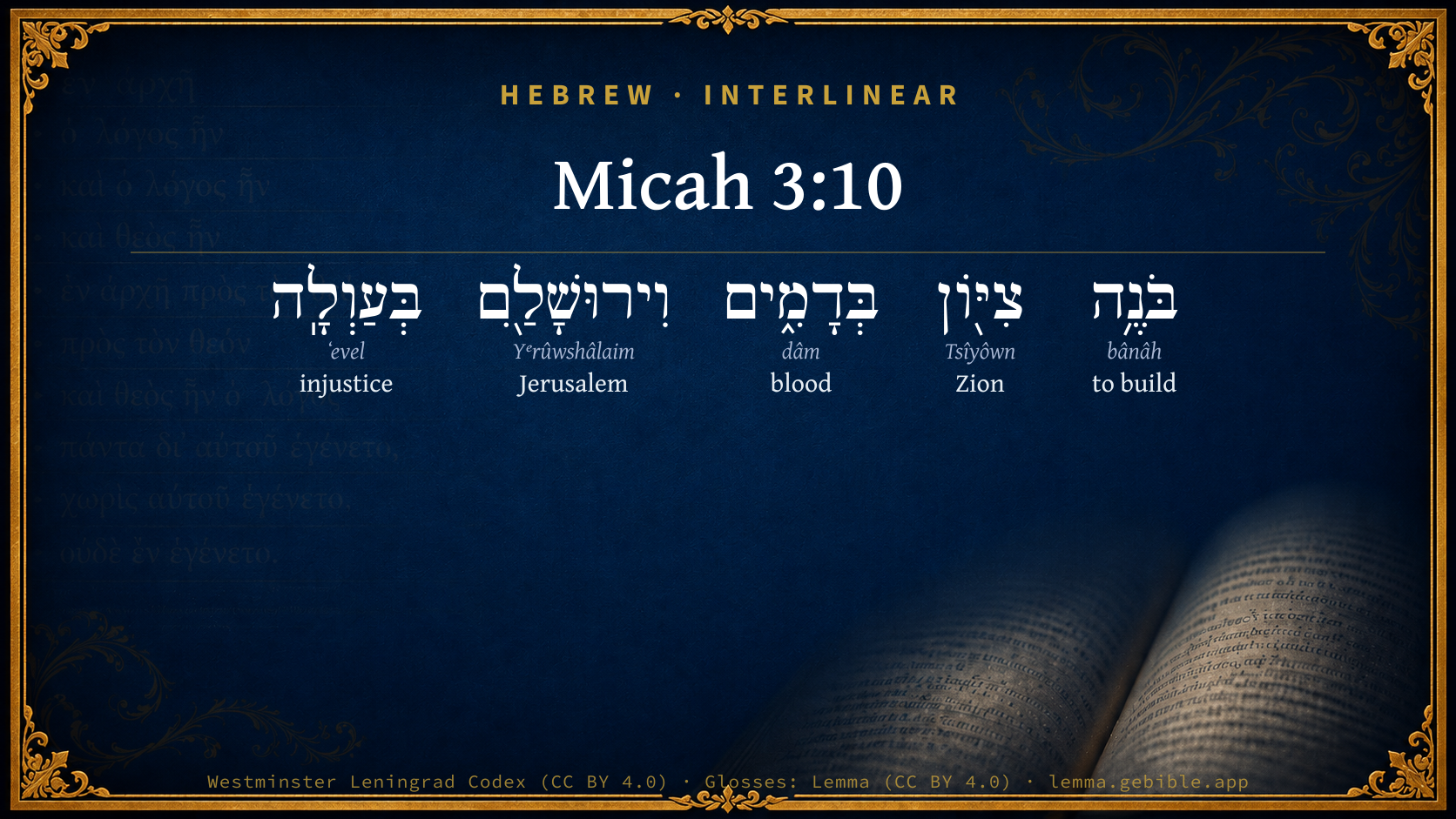
Micah 3:10

Hebrew (Westminster Leningrad Codex) Micah 3:10 appears in the Hebrew Old Testament. The text above is from the Westminster Leningrad Codex. Each word links to its Strong’s number, a concise gloss, and parsing drawn from the Open Scriptures Hebrew Bible morphology. Click any word for its full Brown-Driver-Briggs (BDB) entry.
Download image
Cite this verse

Micah 3:10 (World English Bible). Public Domain. Lemma interlinear Bible study tool, https://lemma.gebible.app/v/micah/3/10.

Show BibTeX & RIS
BibTeX
RIS
English Translation
They build up Zion with blood, And Jerusalem with iniquity.
World English Bible · Public Domain
Download a study sheet

One document with this verse’s original text, its word-by-word gloss line, the meaning frame, cross-references with their text, attributed commentary, and full source and license credits — printable, and it pastes into notes with its structure intact.

This verse Autodidact and up

Study sheet (.html) Plain text (.txt)

A passage Seminary Student

Up to 50 verses in one chapter. A passage sheet keeps up to 6 commentary sources and 12 cross-references per verse, in the order this page ranks them, and says so on the sheet whenever that leaves anything out. Ask for a single verse and you get the Autodidact verse sheet above.

Everything on this page stays free to read, with no account — the sheet is a download of what is already on screen, not access to it.

Want to remove ads? Support Godless Engineer
Compare translations 3

The same verse in 3 English versions, stacked beneath the original-language interlinear above. Click any original word for its lexicon entry.

Each is an independent rendering of the whole verse — the interlinear is not word-aligned to these translations.

Highlighted words mark where these versions differ — a whole-verse word diff, not a word-by-word alignment.

  • World English Bible Public Domain
    They build up Zion with blood, And Jerusalem with iniquity.
  • King James Version Public Domain
    They build up Zion with blood, and Jerusalem with iniquity.
  • unfoldingWord Literal Text CC BY-SA 4.0
    building Zion with bloodshed and Jerusalem with injustice.

unfoldingWord Literal Text — © unfoldingWord, licensed CC BY-SA 4.0. Word-aligned USFM3 via Door43 (git.door43.org/unfoldingWord/en_ult).

Versions to compare (up to 4)

3 of 4 selected

Show all 18 translations

Every available English version of this verse, each an independent rendering of the whole verse.

  • World English Bible Public Domain
    They build up Zion with blood, And Jerusalem with iniquity.
  • Berean Standard Bible Public Domain
    who build Zion with bloodshed and Jerusalem with iniquity.
  • Majority Standard Bible Public Domain
    who build Zion with bloodshed and Jerusalem with iniquity.
  • King James Version Public Domain
    They build up Zion with blood, and Jerusalem with iniquity.
  • American Standard Version (1901) Public Domain
    They build up Zion with blood, and Jerusalem with iniquity.
  • Revised Version (1885) Public Domain
    They build up Zion with blood, and Jerusalem with iniquity.
  • Geneva Bible (1599) Public Domain
    They build vp Zion with blood, and Ierusalem with iniquitie.
  • Douay-Rheims (1899) Public Domain
    You that build up Sion with blood, and Jerusalem with iniquity.
  • Young's Literal Translation Public Domain
    Building up Zion with blood, And Jerusalem with iniquity.
  • Literal Standard Version CC BY-SA 4.0
    Building up Zion with blood, || And Jerusalem with iniquity.
  • Unlocked Literal Bible CC BY-SA 4.0
    You build Zion with blood and Jerusalem with iniquity.
  • unfoldingWord Literal Text CC BY-SA 4.0
    building Zion with bloodshed and Jerusalem with injustice.
  • Darby Bible Public Domain
    that build up Zion with blood, and Jerusalem with unrighteousness.
  • World Messianic Bible Public Domain
    who build up Zion with blood, and Jerusalem with iniquity.
  • Webster's Bible Public Domain
    They build up Zion with blood, and Jerusalem with iniquity.
  • Free Bible Version CC BY-SA 4.0
    You are building Zion with blood, and Jerusalem with evil.
  • Bible in Basic English Public Domain
    They are building up Zion with blood, and Jerusalem with evil-doing.
  • JPS Tanakh (1917) Public Domain
    That build up Zion with blood, and Jerusalem with iniquity.

Literal Standard Version (2020), Covenant Press — licensed CC BY-SA 4.0. Text via the HelloAO Bible API (eBible.org). Unlocked Literal Bible (unfoldingWord) — licensed CC BY-SA 4.0. Text via the HelloAO Bible API (eBible.org). unfoldingWord Literal Text — © unfoldingWord, licensed CC BY-SA 4.0. Word-aligned USFM3 via Door43 (git.door43.org/unfoldingWord/en_ult). Free Bible Version, Dr. Jonathan Gallagher — licensed CC BY-SA 4.0. Text via the HelloAO Bible API (eBible.org).

Word by word

More ways to search: Search by grammar → Find every occurrence → Compare this word →

Practice this passage: Drill this verse → Learn its vocabulary →

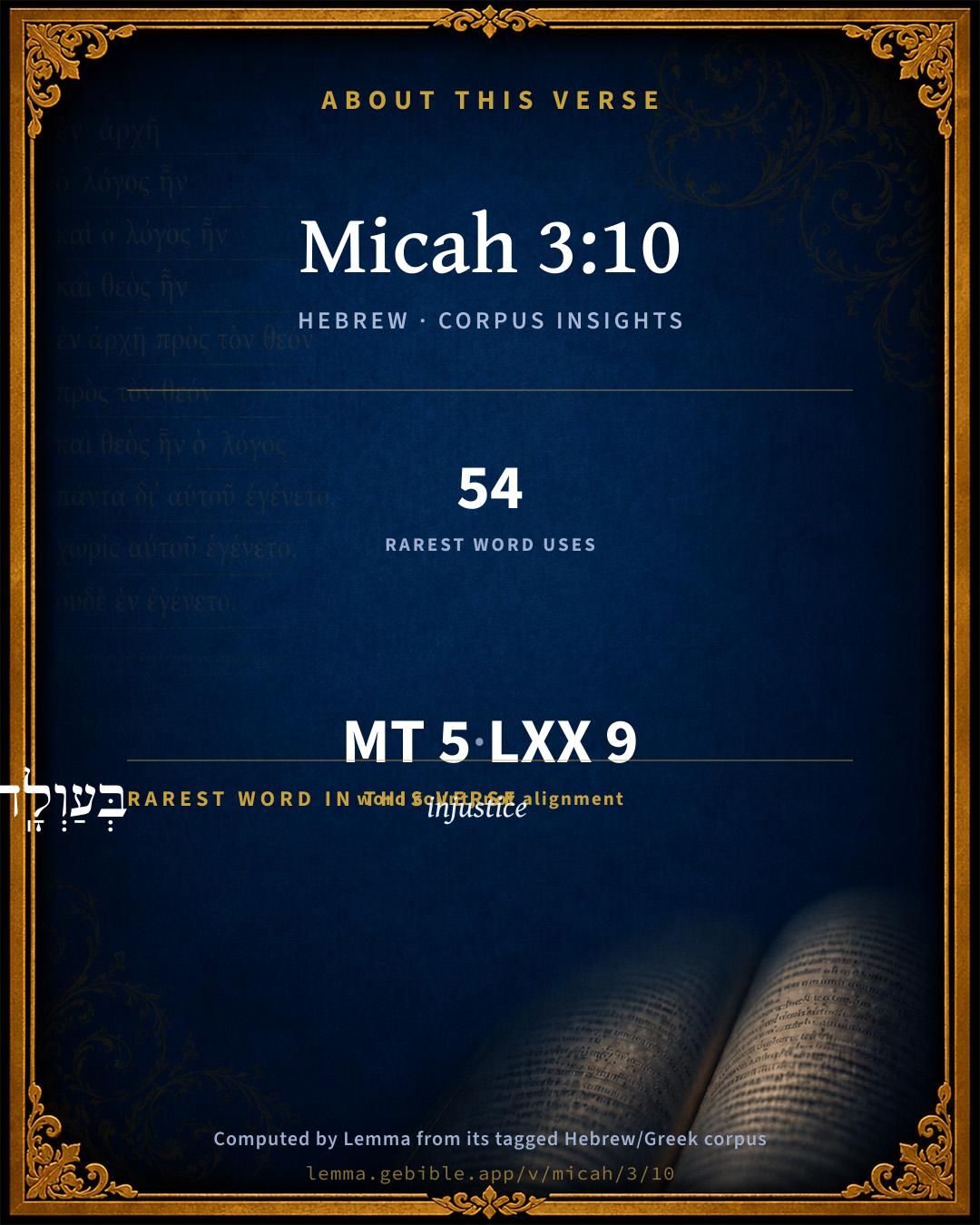
About this verse

These counts appear in no published source. They are computed here, from the morphology-tagged text and Lemma’s own curated glosses. What Lemma adds →

5
words
5
distinct lemmas
Prophets
section

Shared distinctive vocabulary

בְּעַוְלָֽה injustice H5766 occurs in 51 verses of the Hebrew Bible. Also found in:

Grammatical profile

  • 1 verb
  • 4 nouns

Verb forms

  • בֹּנֶ֥ה Qal · Participle Active

Hebrew & Septuagint length

In English translation the verse runs 10 words from the Hebrew and 10 from the Septuagint (LXX English) — the same length.

A rough comparison of the two English renderings, which tokenize alike — not a word-level alignment.

Word counts can differ between the Hebrew and the Greek without any difference in meaning — e.g. the Hebrew direct-object marker אֵת has no separate Greek word, and Greek often adds the article ὁ.

In the original languages it is 5 Hebrew tokens and 9 Greek tokens — but the two are counted differently (Hebrew bundles its prefixes and suffixes into one token; the Greek is in lemma form), so that isn’t a like-for-like length.

Cross-references

6

Topical passages linked to Micah 3:10 in the Treasury of Scripture Knowledge — connected by theme and wording, ordered by reader-vote popularity; previews shown in the World English Bible.

  • Habakkuk 2:9–12 Woe to him who gets an evil gain for his house, that he may set his nest on high, that he may be delivered from the hand of evil!
  • Jeremiah 22:13–17 Woe to him who builds his house by unrighteousness, and his chambers by injustice; who uses his neighbor's service without wages, and doesn't give him his hire;
  • Matthew 27:25 All the people answered, "May his blood be on us, and on our children!"
  • Ezekiel 22:25–28 There is a conspiracy of her prophets in the midst of it, like a roaring lion ravening the prey: they have devoured souls; they take treasure and precious things; they have made her widows many in the midst of it.
  • Zephaniah 3:3 Her princes in the midst of her are roaring lions. Her judges are evening wolves. They leave nothing until the next day.
  • John 11:50 nor do you consider that it is advantageous for us that one man should die for the people, and that the whole nation not perish."

Cross-references courtesy of OpenBible.info (CC BY 4.0).

Hebrew and Greek witnesses Masoretic Hebrew ↔ Greek Septuagint

The same verse in the two great witnesses to the Old Testament, shown verse-for-verse.

These are two independent witnesses, not word-aligned to each other, and the Septuagint is shown in lemma (dictionary) form.

Hebrew Micah 3:10 Masoretic · Westminster Leningrad Codex

בֹּנֶ֥ה צִיּ֖וֹן בְּדָמִ֑ים וִירוּשָׁלִַ֖ם בְּעַוְלָֽה

They build up Zion with blood, And Jerusalem with iniquity.

World English Bible · Public Domain

Greek LXX Micah 3:10 Septuagint · lemma form

ὁ οἰκοδομέω σιων ἐν αἷμα καί ἰερουσαλήμ ἐν ἀδικία

who build up Sion with blood, and Jerusalem with iniquity.

LXX2012 (modern English Septuagint) · Public Domain

Hebrew: Westminster Leningrad Codex (CC BY 4.0). Greek: Septuagint (public domain); English from LXX2012 (modern English Septuagint) (Public Domain). How the Septuagint differs from the Hebrew →

Targum (Aramaic paraphrase)

1

The Targum is the ancient Jewish Aramaic paraphrase of the Hebrew Scriptures — an interpretive translation, not the Hebrew text itself. Onkelos (literal) and Pseudo-Jonathan (expansive) render the Torah, and Jonathan the Prophets. Coverage is partial: where no permissively-licensed English translation exists for a verse, only the Aramaic is shown. This is verse-level text, not a word-by-word alignment to the Hebrew.

  1. Targum Jonathan Prophets (Joshua–Malachi)
    דְבָנָן בָּתֵּיהוֹן בְּצִיוֹן בְּדַם אֲשִׁיד וִירוּשְׁלֵם בְּנִכְלִין:

    (no public-domain English translation for this verse)

    Targum Jonathan — Aramaic: “Mikraot Gedolot” (public domain). English: “Sefaria Community Translation” (CC0 1.0 (public-domain dedication)); “London "Chaldee Paraphrase," 1871” (public domain). Text via Sefaria.

Commentary

Notes on Micah 3:10 from classic Christian and Jewish commentators (each source and its license shown beneath its notes). The classic Christian expositions comment on the surrounding passage and are grouped to its opening verse, so a note may address several verses; the Jewish commentaries on the Tanakh (Rashi and others) are per-verse, so they appear only where the commentator wrote on this verse.

Lemma curates 59 commentaries, every one of them public domain or Creative Commons licensed, each selected and text-cleaned for this edition rather than reprinted as found. About our sources →

Trapp's Complete Commentary

John Trapp

Mic 3:10 They build up Zion with blood, and Jerusalem with iniquity.

Ver. 10. They build up Zion with blood] Heb. bloods, that is, with goods gotten by rapine and robbery, to the utter undoing of many poor oppressed, whose livelihood is their life, Mar 12:44 Luk 8:43. How much better Selimus, the Great Turk, who, being upon his death bed moved by Pyrrhus, the basha, to bestow the great wealth taken by him from the Persian merchants upon some notable hospital for relief of the poor, took order that those evil gotten goods should be forthwith restored again to the right owners, to the shame of many Christians who will not be drawn to do so. Our Henry VII, indeed, in his last will and testament, devised and willed restitution should be made of all such moneys as had unjustly been levied by his officers. But how few such princes are to be found! It is held a goodly thing to build Zion, though it be with blood, and Jerusalem with iniquity. But God, as he will not have ex rapina holocaustum, so he infinitely abhorreth all those who, under pretext of religion in building some poor hospital with the fragments of their accursed wealth, seek to make him a party, a partaker of their cruelty, as those did, Isa 66:8; Isa 66:4 Mar 7:11 Mat 23:14. Our Henry III, when he had, after his many great exactions, sent the friar minors a load of frieze {a} to clothe them, had the same sent back again with this message, That he ought not to give alms of what he had rent from the poor, neither would they accept of that abominable gift. Zion is not to be builded or beautified with bloods.

{a} A kind of coarse woollen cloth, with a nap, usually on one side only ŒD

John Trapp, A Commentary or Exposition upon All the Books of the Old and New Testament (1647–1656) — public domain. Text from a community e-Sword module.

The Biblical Illustrator

Joseph S. Exell

Mic_3:10-11

Hear this . . . ye heads of the house of Jacob . . . that abhor judgment, and pervert all equity

Rectitude

I.

There is an eternal law of right that should govern man in all his relations. Right, as a sentiment, is one of the deepest, most ineradicable and operative sentiments in humanity. All men feel that there is such a thing as right. What the right is is a subject on which there has been and is a variety of opinion. Right implies a standard, and men differ about the standard. Some say the law of your country is the standard; some say public sentiment is the standard; some say temporal expediency is the standard. All these are fearfully mistaken. Philosophy and the Bible teach that there is but one standard, that is the will of the Creator. That will He reveals in many ways--in nature, in history, in conscience, in Christ. Conformity to that will is right.

1. The law of Christ should govern man in his relations with God. Thou shalt love the Lord thy God, etc.

2. The law of right should govern man in his relation to his fellow men--Whatsoever ye would that men should do unto you, do ye even so unto them. This law of right is immutable. It admits of no modification. It is universal. It is binding alike on all moral beings in the universe. It is benevolent. It seeks the happiness of all.

II. That a practical disregard of this law leads to fraud and violence. For they know not to do right, saith the Lord, who store up violence and robbery in their palaces. The magnates of Samaria had no respect for the practice of right, hence they stored up violence and robbery in their palaces. Fraud and violence are the two great primary crimes in all social life.

III. That fraud and violence must ultimately meet with condign punishment. Therefore thus saith the Lord God: An adversary there shall be even round about the land; and he shall bring down thy strength from thee, and thy palaces shall be spoiled. How was this realised? Against him came up Shalmaneser, king of Assyria; and Hoshea became his servant, and gave him presents. In the ninth year of Hoshea the king of Assyria took Samaria and carried Israel away into Assyria, and placed them in Halah and in Habor by the river of Gozan and in the cities of the Medes (2Ki_17:3; 2Ki_17:6; 2Ki_18:9-11). The cheats and murderers of mankind will, as sure as there is justice in the world, meet with a terrible doom. Punishment is the recoil of crime; and the strength of the backstroke is in proportion to the original blow. (Homilist.)

.

The Biblical Illustrator, edited by Joseph S. Exell (c. 1880s–1900s) — public domain. Text from a community e-Sword module.

Geneva Bible (1599)

Geneva Bible translators

They build them houses by bribery, which he calleth blood and iniquity.

Geneva Bible (1599) marginal notes — public domain. Text via Bolls.life.

Jamieson, Fausset & Brown

Robert Jamieson, A. R. Fausset & David Brown

They--change of person from "ye" (Mic 3:9); the third person puts them to a greater distance as estranged from Him. It is, literally, "Whosoever builds," singular.

build up Zion with blood--build on it stately mansions with wealth obtained by the condemnation and murder of the innocent (Jer 22:13; Eze 22:27; Hab 2:12).

Jamieson, Fausset & Brown — Commentary Critical and Explanatory on the Whole Bible (1871) — public domain (CC PDM 1.0). Text via the HelloAO Bible API.

Adam Clarke's Commentary

Verse 10. They build up Zion with blood] They might cry out loudly against that butchery practised by Pekah, king of Israel, and Pul coadjutor of Rezie, against the Jews. See on Mic 2:9. But these were by no means clear themselves; for if they strengthened the city, or decorated the temple, it was by the produce of their exactions and oppressions of the people.

I do not know a text more applicable than this to slave-dealers; or to any who have made their fortunes by such wrongs as affect the life of man; especially the former, who by the gains of this diabolic traffic have built houses, c. for, following up the prophet's metaphor, the timbers, c., are the bones of the hapless Africans and the mortar, the blood of the defenceless progeny of Ham. What an account must all those who have any hand in or profit from this detestable, degrading, and inhuman traffic, give to Him who will shortly judge the quick and dead!

Adam Clarke's Commentary on the Bible (1810–1826) — public domain. Text from a community e-Sword/MySword module.

John Calvin's Commentaries

Then when he says, that Zion was built by blood, and Jerusalem by iniquity, it is the same as though the Prophet had said, that whatever the great men expended on their palaces had been procured, and, as it were, scraped together from blood and plunder. The judges could not have possibly seized on spoils on every side, without being bloody, that is, without pillaging the poor: for the judges were for the most part corrupted by the rich and the great; and then they destroyed the miserable and the innocent. He then who is corrupted by money will become at the same time a thief; and he will not only extort money, but will also shed blood. There is then no wonder that Micah says, that Zion was built by blood He afterwards extends wider his meaning and mentions iniquity, as he wished to cast off every excuse from hypocrites. The expression is indeed somewhat strong, when he says, that Zion was built by blood. They might have objected and said, that they were not so cruel, though they could not wholly clear themselves from the charge of avarice. “When I speak of blood,” says the Prophet, “there is no reason that we should contend about a name; for all iniquity is blood before God: if then your houses have been built by plunder, your cruelty is sufficiently proved; it is as though miserable and innocent men had been slain by your own hands.” The words, Zion and Jerusalem, enhance their sin; for they polluted the holy city and the mount on which the temple was built by the order and command of God.

John Calvin's Commentaries (1540-1563) — public domain. Text from the Calvin Translation Society English edition (1840s-50s) via the Christian Classics Ethereal Library (ccel.org). Calvin's coverage is partial (roughly two-thirds of the Bible); uncommented books and verses are honest gaps, never fabricated. The 19th-century editor's footnotes and remarks are omitted so the notes are faithfully Calvin's own voice.

Ellicott's Commentary for English Readers

(10) They build up Zion with blood—i.e., they acquire money for the erection of splendid buildings by spoliation and robbery, not stopping short of murder. So also Habakkuk (Mic_2:12) denounces the king of Babylon for the bloody wars with which he obtained wealth for the enlargement of the city.

A Bible Commentary for English Readers, edited by Charles John Ellicott (1878–1897) — public domain. Text from a community e-Sword module.

John Gill's Exposition

They build up Zion with blood, and Jerusalem with iniquity. Or, "O thou that buildest up" (g), &c. or "everyone of them that buildeth up" (h), &c. for the word is in the singular number; but, be fire words rendered either of these ways, they respect the heads and princes of the people; who either repaired the temple on Zion, or ornamented the king's palace, or built themselves fine stately houses in Jerusalem, or large streets there, by money they took of murderers to save them, as Kimchi; or by money got by rapine and oppression, by spoiling the poor of their goods and their livelihood, for them and their families, which was all one as shedding innocent blood; and by money obtained by bribes, for the perversion of justice, and such like illegal proceedings, truly called iniquity. The Targum is,

"who build their houses in Zion with bloodshed, and Jerusalem with deceits.''

(g) "aedificans", Montanus, Munster, Burkius. (h) "Quisque eorum aedificat", Vatablus, Piscator, Drusius.

John Gill's Exposition of the Whole Bible (1746–1763) — public domain (CC PDM 1.0). Text via the HelloAO Bible API.

Albert Barnes' Notes on the Bible

They build up - (literally, building, sing.) Zion with blood This may be taken literally on both sides, that, the rich built their palaces, “with wealth gotten by bloodshed , by rapine of the poor, by slaughter of the saints,” as Ezekiel says, ‘her princes in the midst thereof are like wolves, to shed blood, to destroy souls, to get dishonest gain’ Eze 22:27. Or by blood he may mean that they indirectly took away life, in that, through wrong judgments, extortion, usury, fraud, oppression, reducing wages or detaining them, they took away what was necessary to support life. So it is said; ‘The bread of the needy is their life, he that defraudeth him thereof is a man of blood. He that taketh away his neighbor’s living slayeth him, and he that defraudeth the laborer of his hire is a bloodshedder’ (Ecclus. 34:21, 22). Or it may be, that as David prayed to God, ‘Build Thou the walls of Jerusalem, asking Him thereby to maintain or increase its well-being’ Psa 51:18, so these men thought to promote the temporal prosperity of Jerusalem by doings which were unjust, oppressive, crushing to their inferiors.

So Solomon, in His degenerate days, made the yoke upon his people and his service grievious 1Ki 12:4. So ambitious monarchs by large standing-armies or filling their exchequers drain the life-blood of their people. The physical condition and stature of the poorer population in much of France was lowered permanently by the conscriptions under the first Emperor. In our wealthy nation, the term poverty describes a condition of other days. We have had to coin a new name to designate the misery, offspring of our material prosperity. From our wealthy towns, (as from those of Flanders,) ascends to heaven against us , “the cry of ‘pauperism’ that is, the cry of distress, arrived at a condition of system and of power, and, by an unexpected curse, issuing from the very development of wealth. The political economy of unbelief has been crushed by facts on all the theaters of human activity and industry.”

Truly we “build up Zion with blood,” when we cheapen luxuries and comforts at the price of souls, use Christian toil like brute strength, tempt men to dishonesty and women to other sin, to eke out the scanty wages which alone our selfish thirst for cheapness allows, heedless of every thing save of our individual gratification, or the commercial prosperity, which we have made our god. Most awfully was “Zion built with blood,” when the Jews shed the innocent Blood, that Joh 11:48 the Romans might not take away their place and nation. But since He has said, “Inasmuch as ye did it not unto one of the least of these My brethren, ye did it not unto Me” Mat 25:45, and, “Saul, Saul, why persecutest thou Me?” Act 9:4, when Saul was persecuting Christ’s members, then, in this waste of lives and of souls, we are not only wasting the Price of His Blood in ourselves and others, but are slaying Christ anew, and that, from the same motives as those who crucified Him 1Co 8:12. When ye sin (against the members, ye sin against Christ. Our commercial greatness is the Price of His Blood Mat 27:6. In the judgments on the Jews, we may read our own national future; in the woe on those through whom the weak brother perishes for whom Christ died 1Co 8:11, we, if we partake or connive at it, may read our own.

Albert Barnes' Notes on the Bible (1834–1885) — public domain. Text from a community e-Sword/MySword module.

Haydock's Catholic Bible Commentary

Iniquity. You offer victims unjustly procured, or build your palaces with what belongs to the poor.

George Leo Haydock (1774–1849), Haydock's Catholic Family Bible and Commentary, 1859 edition — public domain. Excludes Psalms (Douay-Rheims chapter numbering differs from Protestant) and Deuterocanonical books (Catholic canon only).

Matthew Poole's English Annotations

They; heads, princes, judges, and great ones among them.

Build up; enlarge or beautify, and fortify.

Zion; the houses in Zion, or perhaps may be meant the temple and its buildings, and the royal palace of the kings of Judah.

With blood; with wealth and gifts which these builders made themselves masters of by violence, taking away the life of the owners, or else fining and amercing them. By this course they wrested part of their estates from them, by the other they seized all; they also for gain sometimes acquitted the guilty, and freed them in capital cases, and so sold the blood of the innocent.

And Jerusalem with iniquity; by such injustice Jerusalem was brought to ruin at last, though some particular persons and families did raise themselves, their houses and palaces, to a present largeness and stateliness.

Matthew Poole's English Annotations on the Holy Bible (1683–1685) — public domain. Text from a community e-Sword/MySword module.

The Pulpit Commentary

They build up Zion with blood. Blood is, as it were, the cement that binds the building together. They raise palaces with money gained by extortion, rapine, and judicial murders like that of Naboth. (1Ki 21; comp. Jer_22:13, etc.; Eze_22:27 Hab_2:12) Cheyne thinks this to be a too dark view of the state of public morals, and would therefore consider "blood" to be used for violent conduct leading to ruin of others, comparing Isa_1:15 Isa_59:3 Pro_1:11. In these passages, however, actual bloodshed may be meant; and we know too little of the moral condition of Judaea at this time to be able to decide against the darker view.

National stability.

I THE ENDEAVOUR TO SECURE NATIONAL STABILITY IS LAUDABLE AND TO BE COMMENDED. Princes, nobles, leaders of the people of all classes, ought to seek to build up Zion and Jerusalem; and earnest, enthusiastic effort directed to this end is honourable and worthy of all praise.

II THIS RESULT CAN ALONE BE GAINED BY RIGHTEOUS MEANS. National strength and stability has its very foundations in truth, rectitude, justice, and goodness.

III THE ADOPTION OF ANY OTHER METHODS MUST INEVITABLY RESULT IN DISGRACE AND DECAY. These rulers built up Zion with "blood," i.e. oppression, wrong, cruelty; and Jerusalem with "iniquity," perverting all that was true and right; and hence, despite the semblance of outward prosperity, the process of decay and dissolution was going on, and became at length completed in the ruin of the nation (ver. 12).

IV THEY ARE THE TRUE PATRIOTS WHO LIFT UP THE VOICE OF WARNING, AND WHO EXPOUND AND ENFORCE THE PRINCIPLES OF RIGHTEOUSNESS. To adopt this course specially in a worldly, self-indulgent age is sure

(1) to render the teacher unpopular with many;

(2) hence it requires holy courage and daring;

(3) which will be possessed in proportion as the man is moved by the Holy Ghost. "

The Pulpit Commentary (1880–1919), ed. H.D.M. Spence-Jones & Joseph S. Exell — public domain. Text from a community e-Sword module.

John Wesley's Explanatory Notes

They - The heads and great ones enlarge, beautify, and fortify, the house in Zion, particularly the temple and the royal palace. Blood - With wealth, which they made themselves masters of by violence, taking away the life of the owners.

John Wesley, Explanatory Notes Upon the Whole Bible (1754–1765) — public domain. Text via the GEBible commentary corpus.

Lesson kit

Teaching starters — assembled from the data on this page, not authored interpretation. Every prompt links to the verse data it draws on. Edit before teaching.

Micah, in the Prophets, opens this verse with 5 words (5 distinct Hebrew lemmas). Its most distinctive word is ʻevel (“injustice”). A historical commentator’s framing appears above. Read the whole chapter for the surrounding context.

Discussion questions

  1. What does “injustice” (ʻevel) contribute to the verse as a whole?
  2. Leviticus 19:15 shares the word «injustice» with this verse. How do the two illuminate each other?
  3. These translations render this verse differently. What is at stake in choosing one wording over another?
  4. The verb «בֹּנֶ֥ה» is Qal Participle Active. How does its form color the action?
  5. Reading how Trapp's Complete Commentary and The Biblical Illustrator read this verse, where do the two commentators agree and where do they part?

Things to notice

Reading settings

Reading text

Shown beneath each verse's original-language words.

Old Testament
Old Testament edition

Read the OT as the Masoretic Hebrew (MT) or the Greek Septuagint (LXX).

English shown for the Greek Septuagint (in the Hebrew ↔ Greek comparison).

Comparing translations? Open the Compare panel on any verse page to stack up to four side by side.