Psalms 137:3

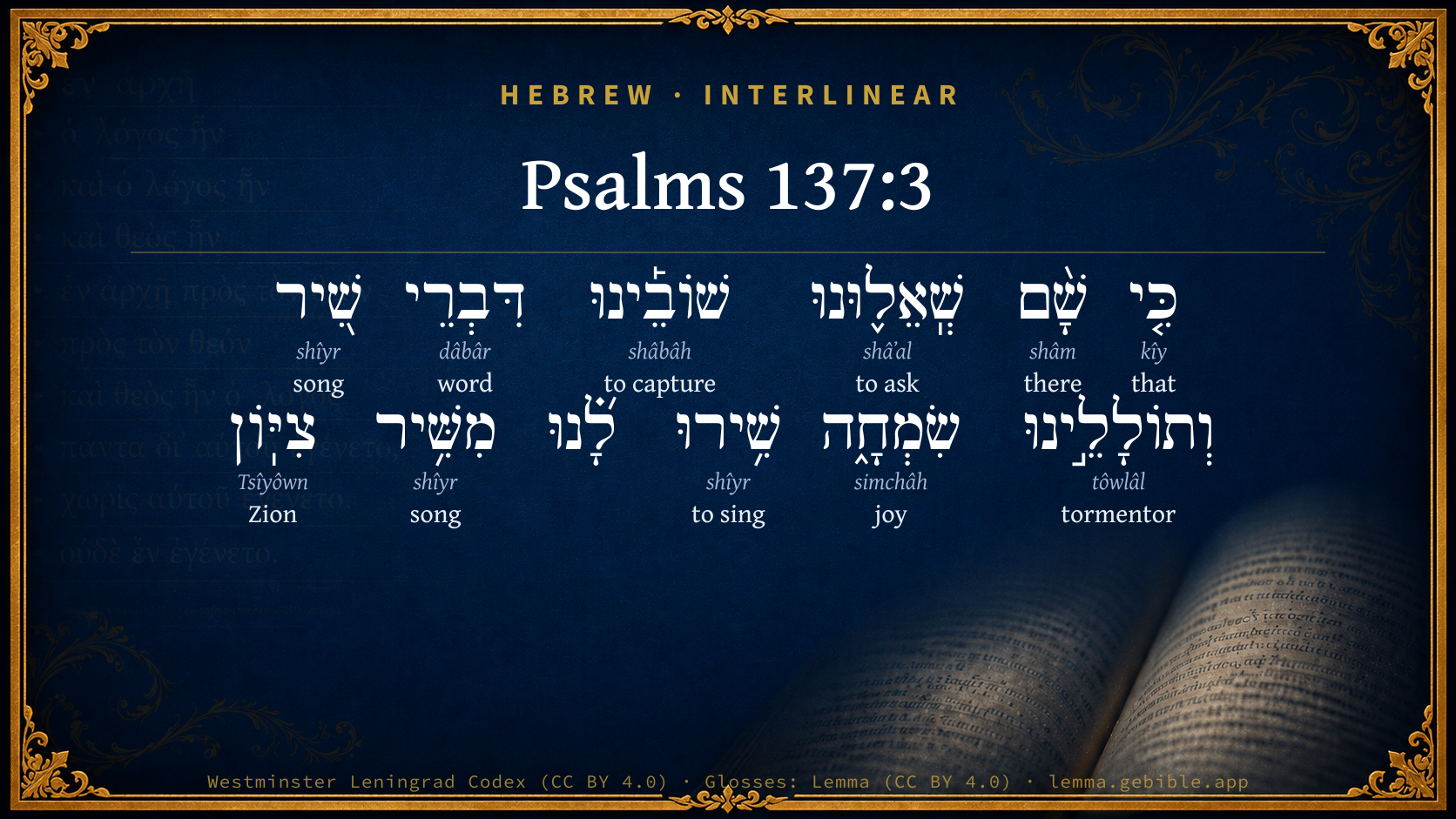
Hebrew (Westminster Leningrad Codex) Psalms 137:3 appears in the Hebrew Old Testament. The text above is from the Westminster Leningrad Codex. Each word links to its Strong’s number, a concise gloss, and parsing drawn from the Open Scriptures Hebrew Bible morphology. Click any word for its full Brown-Driver-Briggs (BDB) entry.
Download image
Cite this verse

Psalms 137:3 (World English Bible). Public Domain. Lemma interlinear Bible study tool, https://lemma.gebible.app/v/psalms/137/3.

Show BibTeX & RIS
BibTeX
RIS
English Translation
For there, those who led us captive asked us for songs. Those who tormented us demanded songs of joy: "Sing us one of the songs of Zion!"
World English Bible · Public Domain
Highlights
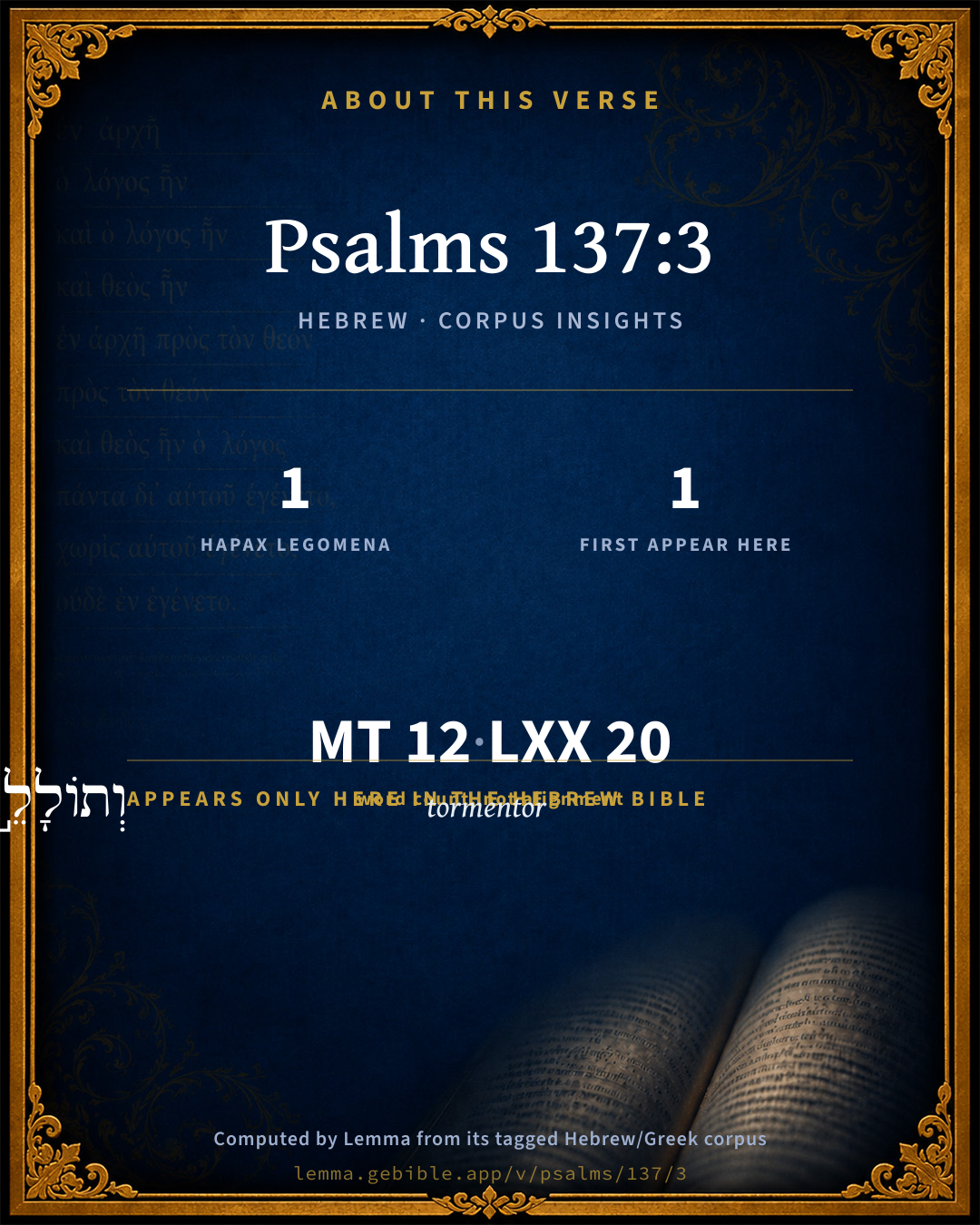
  • 1 hapax legomenon — only here in the Hebrew Bible
  • 1 first appearance in the Hebrew Bible
Full analysis ↓
Download a study sheet

One document with this verse’s original text, its word-by-word gloss line, the meaning frame, cross-references with their text, attributed commentary, and full source and license credits — printable, and it pastes into notes with its structure intact.

This verse Autodidact and up

Study sheet (.html) Plain text (.txt)

A passage Seminary Student

Up to 50 verses in one chapter. A passage sheet keeps up to 6 commentary sources and 12 cross-references per verse, in the order this page ranks them, and says so on the sheet whenever that leaves anything out. Ask for a single verse and you get the Autodidact verse sheet above.

Everything on this page stays free to read, with no account — the sheet is a download of what is already on screen, not access to it.

Want to remove ads? Support Godless Engineer
Compare translations 3

The same verse in 3 English versions, stacked beneath the original-language interlinear above. Click any original word for its lexicon entry.

Each is an independent rendering of the whole verse — the interlinear is not word-aligned to these translations.

Highlighted words mark where these versions differ — a whole-verse word diff, not a word-by-word alignment.

  • World English Bible Public Domain
    For there, those who led us captive asked us for songs. Those who tormented us demanded songs of joy: "Sing us one of the songs of Zion!"
  • King James Version Public Domain
    For there they that carried us away captive required of us a song; and they that wasted us required of us mirth, saying, Sing us one of the songs of Zion.
  • unfoldingWord Literal Text CC BY-SA 4.0
    For there our captors requested of us words of a song, and our tormentors, joy: “Sing for us from a song of Zion.”

unfoldingWord Literal Text — © unfoldingWord, licensed CC BY-SA 4.0. Word-aligned USFM3 via Door43 (git.door43.org/unfoldingWord/en_ult).

Versions to compare (up to 4)

3 of 4 selected

Show all 18 translations

Every available English version of this verse, each an independent rendering of the whole verse.

  • World English Bible Public Domain
    For there, those who led us captive asked us for songs. Those who tormented us demanded songs of joy: "Sing us one of the songs of Zion!"
  • Berean Standard Bible Public Domain
    for there our captors requested a song; our tormentors demanded songs of joy: “Sing us a song of Zion.”
  • Majority Standard Bible Public Domain
    for there our captors requested a song; our tormentors demanded songs of joy: “Sing us a song of Zion.”
  • King James Version Public Domain
    For there they that carried us away captive required of us a song; and they that wasted us required of us mirth, saying, Sing us one of the songs of Zion.
  • American Standard Version (1901) Public Domain
    For there they that led us captive required of us songs, And they that wasted us `required of us' mirth, `saying', Sing us one of the songs of Zion.
  • Revised Version (1885) Public Domain
    For there they that led us captive required of us songs, and they that wasted us required of us mirth, saying, Sing us one of the songs of Zion.
  • Geneva Bible (1599) Public Domain
    Then they that ledde vs captiues, required of vs songs and mirth, when wee had hanged vp our harpes, saying, Sing vs one of the songs of Zion.
  • Douay-Rheims (1899) Public Domain
    Praise ye the Lord of lords: for his mercy endureth for ever.
  • Young's Literal Translation Public Domain
    For there our captors asked us the words of a song, And our spoilers -- joy: `Sing ye to us of a song of Zion.'
  • Literal Standard Version CC BY-SA 4.0
    For there our captors asked us the words of a song, || And our spoilers—joy: “Sing to us of a song of Zion.”
  • Unlocked Literal Bible CC BY-SA 4.0
    There our captors required songs from us, and those who mocked us required us to be happy, saying, “Sing us one of the songs of Zion.”
  • unfoldingWord Literal Text CC BY-SA 4.0
    For there our captors requested of us words of a song, and our tormentors, joy: “Sing for us from a song of Zion.”
  • Darby Bible Public Domain
    For there they that carried us away captive required of us a song; and they that made us wail [required] mirth, [saying,] Sing us [one] of the songs of Zion.
  • World Messianic Bible Public Domain
    For there, those who led us captive asked us for songs. Those who tormented us demanded songs of joy: “Sing us one of the songs of Zion!”
  • Webster's Bible Public Domain
    For there they that carried us away captive required of us a song; and they that wasted us required of us mirth, saying, Sing us one of the songs of Zion.
  • Free Bible Version CC BY-SA 4.0
    For those who had taken us captive asked us for a song—our tormentors wanted us to sing a happy song from Jerusalem.
  • Bible in Basic English Public Domain
    For there those who had taken us prisoners made request for a song; and those who had taken away all we had gave us orders to be glad, saying, Give us one of the songs of Zion.
  • JPS Tanakh (1917) Public Domain
    For there they that led us captive asked of us words of song, and our tormentors asked of us mirth: 'Sing us one of the songs of Zion.'

Literal Standard Version (2020), Covenant Press — licensed CC BY-SA 4.0. Text via the HelloAO Bible API (eBible.org). Unlocked Literal Bible (unfoldingWord) — licensed CC BY-SA 4.0. Text via the HelloAO Bible API (eBible.org). unfoldingWord Literal Text — © unfoldingWord, licensed CC BY-SA 4.0. Word-aligned USFM3 via Door43 (git.door43.org/unfoldingWord/en_ult). Free Bible Version, Dr. Jonathan Gallagher — licensed CC BY-SA 4.0. Text via the HelloAO Bible API (eBible.org).

Word by word

More ways to search: Search by grammar → Find every occurrence → Compare this word →

Practice this passage: Drill this verse → Learn its vocabulary →

וְתוֹלָלֵ֣ינוּ
tôwlâl
H8437
“and · tormentors · our”
Conjunction + Noun, Common, Masculine, Plural, Construct + Suffix, Personal, 1st Person, Common, Plural
Part of Speech
Conjunction + Noun
Type
Common
Gender
Masculine
Number
Plural
State
Construct
Full BDB Definition

Origin: from H3213

TWOT: 868c

tormentor, plunderer - meaning doubtful
  1. כִּ֤י kîy H3588 “that” Conjunction
  2. שָׁ֨ם shâm H8033 “there” Adverb
  3. שְֽׁאֵל֪וּנוּ shâʼal H7592 “to ask · us” Verb, Qal, Perfect, 3rd Person, Common, Plural + Suffix, Personal, 1st Person, Common, Plural
  4. שׁוֹבֵ֡ינוּ shâbâh H7617 “capturing · us” Verb, Qal, Participle Active, Masculine, Plural, Construct + Suffix, Personal, 1st Person, Common, Plural
  5. דִּבְרֵי dâbâr H1697 “words of” Noun, Common, Masculine, Plural, Construct
  6. שִׁ֭יר shîyr H7892 “song” Noun, Common, Both, Singular, Absolute
  7. שִׂמְחָ֑ה simchâh H8057 “joy” Noun, Common, Feminine, Singular, Absolute
  8. שִׁ֥ירוּ shîyr H7891 “sing” Verb, Qal, Imperative, 2nd Person, Masculine, Plural
  9. מִשִּׁ֥יר shîyr H7892 “from · song of” Preposition + Noun, Common, Both, Singular, Construct
  10. צִיּֽוֹן Tsîyôwn H6726 “Zion” Noun, Proper

About this verse

These counts appear in no published source. They are computed here, from the morphology-tagged text and Lemma’s own curated glosses. What Lemma adds →

12
words
10
distinct lemmas
Wisdom
section

Notable vocabulary

1 hapax legomenon — a word that appears only here in the entire Hebrew Bible:

  • וְתוֹלָלֵ֣ינוּ tormentor H8437

First appearance in Scripture

This word makes its first canonical appearance in the Hebrew Bible here:

  • וְתוֹלָלֵ֣ינוּ tormentor H8437

Shared distinctive vocabulary

שׁוֹבֵ֡ינוּ to capture H7617 occurs in 42 verses of the Hebrew Bible. Also found in:

Grammatical profile

  • 3 verbs
  • 6 nouns
  • 1 preposition
  • 1 conjunction
  • 1 adverb

Verb forms

  • שְֽׁאֵל֪וּנוּ Qal · Perfect
  • שׁוֹבֵ֡ינוּ Qal · Participle Active
  • שִׁ֥ירוּ Qal · Imperative

Repetition

A word recurs within this verse — often emphatic in Hebrew:

  • שִׁ֭יר song H7892 ×2

Hebrew & Septuagint length

In English translation the verse runs 27 words from the Hebrew and 35 from the Septuagint (LXX English) — closely comparable.

A rough comparison of the two English renderings, which tokenize alike — not a word-level alignment.

Word counts can differ between the Hebrew and the Greek without any difference in meaning — e.g. the Hebrew direct-object marker אֵת has no separate Greek word, and Greek often adds the article ὁ.

In the original languages it is 12 Hebrew tokens and 20 Greek tokens — but the two are counted differently (Hebrew bundles its prefixes and suffixes into one token; the Greek is in lemma form), so that isn’t a like-for-like length.

Cross-references

17

Topical passages linked to Psalms 137:3 in the Treasury of Scripture Knowledge — connected by theme and wording, ordered by reader-vote popularity; previews shown in the World English Bible.

  • Luke 21:6 "As for these things which you see, the days will come, in which there will not be left here one stone on another that will not be thrown down."
  • Psalms 9:14 That I may show forth all your praise. In the gates of the daughter of Zion, I will rejoice in your salvation.
  • Lamentations 2:15–16 All that pass by clap their hands at you; They hiss and wag their head at the daughter of Jerusalem, [saying], Is this the city that men called The perfection of beauty, The joy of the whole earth?
  • Micah 3:12 Therefore Zion for your sake will be plowed like a field, And Jerusalem will become heaps of rubble, And the mountain of the temple like the high places of a forest.
  • 1 Chronicles 16:7 Then on that day David first ordained to give thanks to Yahweh, by the hand of Asaph and his brothers.
  • Nehemiah 4:2 He spoke before his brothers and the army of Samaria, and said, What are these feeble Jews doing? will they fortify themselves? will they sacrifice? will they make an end in a day? will they revive the stones out of the heaps of rubbish, seeing they are burned?
  • Psalms 65:1 Praise waits for you, God, in Zion. To you shall vows be performed.
  • Psalms 79:1 God, the nations have come into your inheritance. They have defiled your holy temple. They have laid Jerusalem in heaps.
  • Psalms 80:6 You make us a source of contention to our neighbors. Our enemies laugh among themselves.
  • Psalms 123:3–4 Have mercy on us, Yahweh, have mercy on us, For we have endured much contempt.
  • Isaiah 35:10 and the ransomed of Yahweh shall return, and come with singing to Zion; and everlasting joy shall be on their heads: they shall obtain gladness and joy, and sorrow and sighing shall flee away.
  • Jeremiah 9:11 I will make Jerusalem heaps, a dwelling-place of jackals; and I will make the cities of Judah a desolation, without inhabitant.
  • Jeremiah 26:18 Micah the Morashtite prophesied in the days of Hezekiah king of Judah; and he spoke to all the people of Judah, saying, Thus says Yahweh of Hosts: Zion shall be plowed as a field, and Jerusalem shall become heaps, and the mountain of the house as the high places of a forest.
  • Jeremiah 31:12–13 They shall come and sing in the height of Zion, and shall flow to the goodness of Yahweh, to the grain, and to the new wine, and to the oil, and to the young of the flock and of the herd: and their soul shall be as a watered garden; and they shall not sorrow any more at all.
  • Revelation 14:1–3 I saw, and behold, the Lamb standing on Mount Zion, and with him a number, one hundred forty-four thousand, having his name, and the name of his Father, written on their foreheads.
  • 1 Chronicles 15:27 David was clothed with a robe of fine linen, and all the Levites who bore the ark, and the singers, and Chenaniah the master of the song [with] the singers: and David had on him an ephod of linen.
  • Isaiah 51:11 The ransomed of Yahweh shall return, and come with singing to Zion; and everlasting joy shall be on their heads: they shall obtain gladness and joy; [and] sorrow and sighing shall flee away.

Cross-references courtesy of OpenBible.info (CC BY 4.0).

Hebrew and Greek witnesses Masoretic Hebrew ↔ Greek Septuagint

The same verse in the two great witnesses to the Old Testament, shown verse-for-verse.

You’re reading Greek Psalm 136 (Hebrew Psalm 137). The Septuagint counts the superscription, so verse numbers can differ from the Hebrew — chapter-level alignment, not verse-by-verse. Numbering follows Rahlfs.

These are two independent witnesses, not word-aligned to each other, and the Septuagint is shown in lemma (dictionary) form.

Hebrew Psalms 137:3 Masoretic · Westminster Leningrad Codex

כִּ֤י שָׁ֨ם שְֽׁאֵל֪וּנוּ שׁוֹבֵ֡ינוּ דִּבְרֵי שִׁ֭יר וְתוֹלָלֵ֣ינוּ שִׂמְחָ֑ה שִׁ֥ירוּ לָ֝֗נוּ מִשִּׁ֥יר צִיּֽוֹן

For there, those who led us captive asked us for songs. Those who tormented us demanded songs of joy: "Sing us one of the songs of Zion!"

World English Bible · Public Domain

Greek LXX Greek Psalm 136:3 Septuagint · lemma form

ὅτι ἐκεῖ ἐπιἐρωτάω ἐγώ ὁ αἰχμαλωτεύω ἐγώ λόγος ᾠδή καί ὁ ἀποἄγω ἐγώ ὕμνος ᾄδω ἐγώ ἐκ ὁ ᾠδή σιων

For there they that had taken us captive asked of us the words of a song; and they that had carried us away asked a hymn, saying, Sing us one of the songs of Sion.

LXX2012 (modern English Septuagint) · Public Domain

On this verse, Albert Barnes' Notes on the Bible discusses the Septuagint’s reading. Read the note in Commentary ↓

Hebrew: Westminster Leningrad Codex (CC BY 4.0). Greek: Septuagint (public domain); English from LXX2012 (modern English Septuagint) (Public Domain). How the Septuagint differs from the Hebrew →

Commentary

Notes on Psalms 137:3 from classic Christian and Jewish commentators (each source and its license shown beneath its notes). The classic Christian expositions comment on the surrounding passage and are grouped to its opening verse, so a note may address several verses; the Jewish commentaries on the Tanakh (Rashi and others) are per-verse, so they appear only where the commentator wrote on this verse.

Lemma curates 59 commentaries, every one of them public domain or Creative Commons licensed, each selected and text-cleaned for this edition rather than reprinted as found. About our sources →

Trapp's Complete Commentary

John Trapp

Psa 137:3 For there they that carried us away captive required of us a song; and they that wasted us [required of us] mirth, [saying], Sing us [one] of the songs of Zion.

Ver. 3. For there … they required of us a song] sc. In disdain and derision of our religion; q.d. Will ye sing no more holy songs in honour of your God? hath he utterly cast away all care of your welfare, and you the like of his service? Have you never a black sanctus to sing us? or cannot you sing care away? &c.; where are your wonted ditties, the words of a song? Ehodum, bellos nobis illos vestrae Sionis modulos cantillate (Beza).

And they that wasted us] Cumulatorcs nostri, vel concumulatores nostri, vel homines eiulatuum nostrorum, they that made us howl singing, as Isa 52:5. Or, In suspensionibus nostris, after that we had hanged up our harps, as Psa 137:2, το ακαιρον πανταχου λυπηρον (Isocr.).

Sing us one of the songs of Zion] Wherewith ye were wont to praise God. So Belshazzar abused the bowls of the sanctuary. So the bloody persecutors at Orleans, as they murdercd the Protestants, required them to sing, Judge and revenge my cause, O Lord; and have mercy on us, Lord, &c.

John Trapp, A Commentary or Exposition upon All the Books of the Old and New Testament (1647–1656) — public domain. Text from a community e-Sword module.

Albert Barnes' Notes on the Bible

For there they that carried us away captive - The Babylonians.

Required of us a song - Asked of us a song. The word does not express the idea of compulsion or force. Margin, as in Hebrew, words of a song. Perhaps the idea is that they did not merely ask music, but they wished to hear the words - the songs themselves - in which they were accustomed to praise God. This may have been a taunt, and the request may have been in derision; or it may have been seriously, and with no desire to reproach them, or to add to their sorrows. We are not to impute bad motives to others where there is no evidence that there are any, and where the supposition of good motives will answer just as well; and the expression here may have been a kind and natural wish to hear the songs of these foreigners - songs of which they might have heard much by report; perhaps songs which they had overheard them singing when they were in a less desponding state of mind, and when they sought to comfort themselves by these ancient national melodies. As the only reason assigned for not complying with this request was that they could not “sing the Lord’s song in a strange land” Psa 137:3, we are rather led to infer that there was no bad motive - no disposition to taunt and ridicule them by the request that was made.

And they that wasted us - Margin, laid us on heaps. The Hebrew word means a tormentor; properly, one who extorts lamentation from others, or who causes them to howl - to wit, under oppression or wrong. The Septuagint and Latin Vulgate render it, “They who led us away.” The general idea is, those under whom they were then suffering; or, who had caused these trials to come upon them.

Required of us mirth - literally, “Our tormentors, joy.” The Hebrew word means joy; and the sense is, that they asked them to give the usual indications of joy and happiness - to wit, a song. The language means, “Cheer up; be happy; give us one of the beautiful songs which you were accustomed to sing in your own land.” It may, indeed, have been in derision; but there is no proof that it was.

Saying, Sing us one of the songs of Zion - The songs - the sacred hymns - which you were accustomed to sing in worship in your own land.

Albert Barnes' Notes on the Bible (1834–1885) — public domain. Text from a community e-Sword/MySword module.

The Biblical Illustrator

Joseph S. Exell

Psa_137:3

Sing us one of the songs of Zion.

The phases of psalmody

The noblest employment of which the nature of man is capable is the worship of his Maker. One of the elements of the worship is the rendition of praise, and in the songs of Zion we are amply provided with material for this purpose.

I. The song of the pardoned penitent. This song can be sung by him who no longer looks to his own righteousness for salvation, but whose desire is to be found in Christ as the righteousness of God.

II. The song of the adoring creature. This song is sung not for any special gift received, but in contemplation of the great acts of God--His past acts in the Church and in the world--for the laws of nature--for all those marvellous exhibitions of power and wisdom that are before our eyes.

III. The song of the recipient of mercy. This is well brought out in Psa_103:1-22. The mercies that are renewed to us daily are not to be taken as a matter of course. Count up your daily mercies and sing.

IV. The song of the Heaven-round pilgrim, Thy statutes have been my songs, etc. Gods people should not go on their way as if to be a Christian were the most gloomy thing hi the world. They are commanded to rejoice. Let us attain to the apostolic stand and come to Zion with songs.

V. The song of the sorrower. He giveth songs in the night. Where sufferings abound, consolations abound. God never lays one hand on us but He lays the other hand under us. Paul and Silas sang in prison in the night.

VI. The song of the sanctuary. The service of song in public worship was very prominent under the old dispensation. Music should be edifying; not a sensuous enjoyment, but a part--a noble part--of the worship of God.

VII. The song of Zion which is to be sung by the glorified above. That song is to be the utterance--the ceaseless utterings--of their gratitude and praise for all the eternal love wherewith they were loved, for the grace by which they were redeemed, kept there, sanctified there, brought there--Salvation to God and to the Lamb. Are you in training for that choir which is in heaven--for exchanging the songs which we sung in a strange land for the songs of the New Jerusalem and all her beauty? (J. C. Miller, D. D.)

Babylonian captivity

1. Certainly there are many men and women to whom this psalm will be full of a touching significance if they look back on the time when they first found themselves alone in London. A young man, after being brought up with loving care in the country, is sent with a book of the Lords songs packed by his mother in his trunk to serve his time at some business in our modern Babylon. Will he not be ready to shed tears on his first Sundays spent in town when he thinks of friends at home singing one of the songs of Zion, in which he can no longer join, deterred perhaps by the ridicule or want of sympathy of strangers? And the very desire of others that he should keep up his spirits and be a jolly fellow--such jarring requests will only increase his heaviness. What should such a young man do? Let him, before his better feelings grow cold, resolve rather to forget the cunning of his hand if he be an artisan, or the cunning of his business faculty if he be in a merchants or lawyers office; let him resolve to forget these or never to acquire them at all rather than to forget the love of his home and the worship of his mothers God--in one word, Jerusalem.

2. When travelling abroad did Englishmen remember Jerusalem, and prefer her above their chief joy, they would realize the presence of One who could dispel the loneliness of a strange land, and deliver them from the many temptations of friendlessness.

3. Again, there are many generous souls whose best impulses are imprisoned by circumstances over which they have no control. Bound men have got into square holes, and find no scope for the best energies of their nature. Children long to help their parents; but they are far from home, or their desire is in captivity, by reason of poverty, ill-health, or anything else. Parents cannot do all they desire for their children. Let these, and all who find themselves in adverse circumstances, think of Israel weeping on the banks of the Euphrates--let them think of how she waited patiently on the Lord in poverty, in humiliation, in a strange land, full of sin and scoffing; and of how He delivered her from Babylon in His own good time, as of old He delivered the same Israel out of bondage in Egypt. (E. J. Hardy, M. A.)

The Biblical Illustrator, edited by Joseph S. Exell (c. 1880s–1900s) — public domain. Text from a community e-Sword module.

Joseph Benson's Commentary

Psa 137:3. There they that carried us away — Our new masters, who had made us their slaves, and carried us captives out of our own land; required of us a song — דברי שׁיר, the words of a song: in the LXX., λογους ωδων, words of songs. They required us to entertain them with our music and singing. And they that wasted us — Hebrew, ותוללינו, contumulatores nostri, they that laid us on heaps, namely, that laid Jerusalem and the temple in ruins, required of us mirth, שׁמחה, joy, or gladness; saying, Sing us of the songs (so it is in the Hebrew) of Zion — Sing us some of those songs which were wont to be sung in the temple on occasions of public joy. This they required, probably partly out of curiosity, and partly by way of scoffing and insult over them and their temple and worship, not without “a tacit reflection on their God, who could not protect his favoured people against their enemies. Thus the faithful have been, and thus they will be insulted over in the day of their calamity.”

Joseph Benson's Commentary on the Old and New Testaments (1811–1818) — public domain. Text from a community e-Sword module.

J. A. Alexander on Psalms

Joseph Addison Alexander

3. (Psa 137:3) For there our captors asked of us the words of a song, and our spoilers mirth, (saying) Sing to us from a song of Zion. Words of a song may either be an idiomatic pleonasm meaning simply song itself, or denote, as in English, the words sung as distinguished from the music. Our spoilers is bysome taken in a passive sense, our spoiled or plundered ones; but the usual explanation is favoured by tradition and analogy. One of the Songs can hardly be the meaning of the Hebrew phrase, in which the noun is singular. The literal translation above given yields a perfectly good sense. A Song of Zion is a psalm, a religious lyric, such as many of the heathen knew to be employed in the temple worship atlerusalem. Many interpreters suppose the object of this request to be contempt or ridicule; but the words themselves necessarily suggest nothing more than curiosity.

Joseph Addison Alexander, The Psalms Translated and Explained (1850) — public domain. Text from a community e-Sword module.

Geneva Bible (1599)

Geneva Bible translators

The Babylonians speak thus in mocking us, as though by our silence we should signify that we hoped no more in God.

Geneva Bible (1599) marginal notes — public domain. Text via Bolls.life.

Adam Clarke's Commentary

Verse 3. They that carried us away captive required of us a song] This was as unreasonable as it was insulting. How could they who had reduced us to slavery, and dragged us in chains from our own beautiful land and privileges, expect us to sing a sacred ode to please them, who were enemies both to us and to our God? And how could those who wasted us expect mirth from people in captivity, deprived of all their possessions, and in the most abject state of poverty and oppression?

Adam Clarke's Commentary on the Bible (1810–1826) — public domain. Text from a community e-Sword/MySword module.

John Calvin's Commentaries

3. Then they that carried us away captive, etc. We may be certain that the Israelites were treated with cruel severity under this barbarous tyranny to which they were subjected. And the worst affliction of all was, that their conquerors reproachfully insulted them, and even mocked them, their design being less to wound the hearts of these miserable exiles, than to cast blasphemies upon their God. The Babylonians had no desire to hear their sacred songs, and very likely would not have suffered them to engage in the public praises of God, but they speak ironically, and insinuate it as a reproach upon the Levites that they should be silent, when it was their custom formerly to sing sacred songs. Is your God dead, as if they had said, to whom your praises were formerly addressed? Or if he delights in your songs, why do you not sing them? The last clause of the verse has been variously rendered by interpreters. Some derive תוללינו, tholalenu, from the verb ללי, yalal, to howl, reading — they required mirth in our howlings. Others translate it suspensions of mirth. “Others have it from. תלה, he suspended, as thought, they demanded joy on our suspended ones, i.e., harps which we had suspended from the willows.” — Bythner.

John Calvin's Commentaries (1540-1563) — public domain. Text from the Calvin Translation Society English edition (1840s-50s) via the Christian Classics Ethereal Library (ccel.org). Calvin's coverage is partial (roughly two-thirds of the Bible); uncommented books and verses are honest gaps, never fabricated. The 19th-century editor's footnotes and remarks are omitted so the notes are faithfully Calvin's own voice.

Ellicott's Commentary for English Readers

(3) A song.—See margin. The expression is generally regarded as pleonastic, but may be explained as in Psa_105:27, where see Note. Perhaps “some lyric thing” would express the original. No doubt it is a Levite who is requested to sing.

They that wasted us.—A peculiar Hebrew word which the LXX. and Vulg. take as synonymous with the verb in the first clause. The modern explanation, “they that make us howl,” is far preferable. Those whose oppression had raised the wild Oriental scream of lamentation, now asked for mirth.

Songs of Zion—or, as in the next verse, songs of Jehovah, were of course the liturgical hymns. Nothing is more characteristic than this of the Hebrew feeling. The captors asked for a national song, as the Philistines asked for sport from Samson, to amuse them. The Hebrew can think only of one kind of song, that to which the genius of the race was dedicated.

A Bible Commentary for English Readers, edited by Charles John Ellicott (1878–1897) — public domain. Text from a community e-Sword module.

The Cambridge Bible for Schools and Colleges

gen. ed. J. J. S. Perowne

3. For there &c.] The reason why their harps were silent. It might have been expected that they would soothe their sorrow with plaintive music; but the heartless demand of their captors made it impossible.

asked of us songs] Lit. words of song.

they that wasted us] The exact meaning is doubtful. The A.V. marg. ‘Heb. laid us on heaps’ rests on an impossible derivation, and the R.V. marg. our tormentors on an improbable one. Perhaps with the change of a single letter shôlelçnu, ‘our spoilers,’should be read instead of the obscure tôlâlçnu.

Coverdale’s rendering in the P.B.V., and melody in our heaviness, comes from Luther, ‘und in unserm Heulen ein fröhlich Gesang.’

one of the songs of Zion] Or, some of the songs. As these songs are called in the next verse Jehovah’s songs, it is clear that it is not secular songs that are meant, but the sacred hymns of the Temple worship (2Ch_29:27). To sing these for the amusement of their conquerors would have been the grossest profanation of all that they held most dear; an act comparable to Belshazzar’s use of the consecrated vessels at his feast (Dan_5:2). Cp. Mat_7:6.

The Cambridge Bible for Schools and Colleges (gen. ed. J. J. S. Perowne; Cambridge University Press, 1878–1918) — public domain. Text from a community e-Sword module.

John Gill's Exposition

For there they that carried us away captive required of us a song,.... Or, "words of a song" (z). To repeat the words of one of the songs of Zion, as it is afterwards expressed: this the Babylonians did, as the Targum; who were they that carried the Jews into captivity; and this is given as a reason why they hung their harps on willows, and were so sorrowful, because such a request as this was made;

and they that wasted us required of us mirth: the Chaldeans, who plundered them of their substance, and reduced their city and temple to heaps of rubbish, as the word (a) used signifies; or who heaped reproaches upon them, as Jarchi: these insisted not only on having the words of a song repeated to them, but that they should be set to some tune and sung in a manner expressing mirth, or would provoke unto it: or "our lamentations", according to Kimchi; that is, the authors of them (b), so barbarous were they;

saying, sing us one of the songs of Zion; which used to be sung in Zion in the temple, called the songs of the temple, Amo 8:3; this demand they made either out of curiosity, that they might know something of the temple songs and music they had heard of; or rather as jeering at and insulting the poor Jews in their miserable and melancholy circumstances; as if they had said, now sing your songs if you can: or in order to make themselves sport and diversion with them, as the Philistines with Samson. The spiritual songs of Zion are the songs of electing, redeeming, calling, pardoning, and justifying grace; which natural men neither understand, nor can learn, but scoff at and despise.

(z) "verba cantici", Pagninus, Montanus, Musculus, Piscator, Gejerus, Michaelis; "verba earminis", Cocceius. (a) "qui veluti in acervos nos redegerunt", Tigurine version, Grotius. (b) Vid. Stockium, p. 447.

John Gill's Exposition of the Whole Bible (1746–1763) — public domain (CC PDM 1.0). Text via the HelloAO Bible API.

Matthew Poole's English Annotations

Such songs as you used to sing in the temple at Zion; which they required either out of curiosity, or to delight their ears, or rather by way of scoffing and insultation over them, and their temple and religion.

Matthew Poole's English Annotations on the Holy Bible (1683–1685) — public domain. Text from a community e-Sword/MySword module.

The Treasury of David

Charles H. Spurgeon

Ver. 3. For there they that carried us away captive required of us a song. It was ill to be a singer at all when it was demanded that this talent should go into bondage to an oppressor's will. Better be dumb than be forced to please an enemy with forced song. What cruelty to make a people sigh, and then require them to sing! Shall men be carried away from home and all that is dear to them, and yet chant merrily for the pleasure of their unfeeling captors? This is studied torture: the iron enters into the soul. It is indeed "woe to the conquered" when they are forced to sing to increase the triumph of their conquerors. Cruelty herein reached a refinement seldom thought of. We do not wonder that the captives sat them down to weep when thus insulted. "And they that wasted us required of us mirth." The captives must not only sing but smile, and add merriment to their music. Blind Samson in former days must be brought forth to make sport for Philistines, and now the Babylonians prove themselves to be loaves of the same leaven. Plundered, wounded, fettered, carried into captivity and poverty, yet must the people laugh as if it were all a play, and they must sport as if they felt no sorrow. This was worm wood and gall to the true lovers of God and his chosen land. "Saying, Sing us one of the songs of Zion." Nothing would serve their turn but a holy hymn, and a tune sacred to the worship of Jehovah. Nothing will content the Babylonian mockers but one of israel's Psalms when in her happiest days she sang unto the Lord whose mercy endureth for ever: this would make rare fun for their persecutors, who would deride their worship and ridicule their faith in Jehovah. In this demand there was an insult to their God as well as a mockery of themselves, and this made it the more intensely cruel. Nothing could have been more malicious, nothing more productive of grief. These wanton persecutors had followed the captives into their retirement, and had remarked upon their sorrowful appearance, and "there" and then they bade the mourners make mirth for them. Could they not let the sufferers alone? Were the exiles to have no rest? The daughter of Babylon seemed determined to fill up her cup of iniquity, by torturing the Lord's people. Those who had been the most active agents of Israel's undoing must needs follow up their ferocities by mockeries. "The tender mercies of the wicked are cruel." Worse than the Egyptians, they asked not labour which their victims could have rendered, but they demanded mirth which they could not give, and holy songs which they dared not profane to such a purpose, sufferings of the weary and oppressed exiles by their mirth and their indecency. We are sorry to say that the resemblance still holds betwixt the Jews in a state of captivity and the Christians in the state of their pilgrimage. We have also to sustain the mockery of the profane and the unthinking. Ridicule and disdain are often the fate of sincere piety in this world. Fashion and frivolity and false philosophy have made a formidable combination against us; and the same truth, the same honesty, the same integrity of principle, which in any other cause would be esteemed as manly and respectable, is despised and laughed at when attached to the cause of the gospel and its sublime interests. Thomas Chalmers.

Ver. 3-4. St. John Chrysostom observes the improvement such tribulation effected in the Jews, who previously derided, nay, even put to death, some of the prophets; but now that they were captives in a foreign land, they would not attempt to expose their sacred hymns to the ridicule of the Gentiles. Robert Bellarmine.

Ver. 3. "They that carried us away captive required of us a song; " or rather, as it should be rendered, "the words of a song." They see no inconsistancy in a religion which freely mixes with the world. In their ignorance they only require "the words of a song; "its heavenly strain they have never caught. "They that wasted us" required of us mirth." Remember, it is this worldly element which wasteth, or lays on heaps, whether so far as our own hearts of the church of God is concerned. But, true to his spiritual instincts, the child of God replies, "How shall we sing Jehovah's song in the land of a stranger?" and then, so far from being utterly cast down or overcome, rises with fresh outburst or resolution and intenseness of new vigour, to utter the vows of verses 5 and 6. For, after having passed through such a spiritual conflict, we come forth, not wearied, but refreshed; not weaker, but stronger. It is one of the seeming contradictions of the gospel, that the cure of weariness, and the relief of heavy-ladenness, lies in thisto take the cross upon ourselves. After the night long conflict of Israel, "as he passed over Peniel, the sun rose upon him, "and that though "he halted upon his thigh." Alfred Edersheim.

Ver. 3. "Sing us one of the songs of Zion." No music will serve the epicures in the prophet but temple music: Am 6:5, "They invent to themselves instruments of music like David." As choice and excellent as David was in the service of the temple, so would they be in their private feasts. Belshazzar's draughts are not half so sweet in other vessels as in the utensils of the temple: Da 5:2, "He commanded to bring forth the golden and silver vessels that were taken out of the house of God." So the Babylonian humour is pleased with nothing so much as with one of the songs of Zion; not an ordinary song, but "Sing us one of your songs of Zion." No jest relisheth with a profane spirit so well as when Scripture is abused, and anmde to lackey to their sportive jollity. Vain man thinketh he can never put hunour upon his pleasures, and scorn enough upon God and holy things. Thomas Manton.

Ver. 3. "Sing us one of the songs of Zion." The insulting nature of the demand will become the more conspicuous, if we consider, that the usual subjects of these songs were the omnipotence of Jehovah, and his love towards his chosen people. William Keatinge Clay, 1839.

Ver. 3. The Babylonians asked them in derision for one of the songs of Zion. They loaded with ridicule their pure and venerable religion, and aggravated the sufferings of the weary and oppressed exiles by their mirth and their indecency. We are sorry to say that the resemblence still holds betwixt the Jews in a state of captivity and the Christians in the state of their pilgrimage. We have also to sustain the mockery of the profane and the unthinking. Ridicule and disdain are often the fate of sincere piety in this world. Fashion and frivolity and false philosophy have made a formidable combination against us; and the same truth, the same honesty, the same integrity of principle, which in any other cause would be exteemed as manly and respectable, is despised and laughed at when attached to the cause of the gospel and its sublime interests. Thomas Chalmers.

Ver. 3, 4. St. John Chrysostom observes the improvement such tribulation effected in the Jews, who previously derided, nay, even put to death, some of the prophets; but now that they were captives in a foreign land, they would not attempt to expose their sacred hymns to the ridicule of the Gentiles. Robert Bellarmine.

Ver. 3. (last clause). Taken away from the text this is a very pleasant and praiseworthy request. Why do we wish for such a song?

1. It is sure to be pure.

2. It will certainly be elevating.

3. It will probably be glad some.

4. It will comfort and enliven us.

5. It will help to express our gratitude.

Ver. 3-4.

1. The cruel demand.

a) A song when we are captives.

b) A song to please our adversaries.

c) A holy song for unholy purposes.

2. The motive for it. Sometimes mere ridicule; at others, mistaken kindness seeking by sharpness to arouse us from despondency; often mere levity.

3. The answer to it, "How can?" etc.

Ver. 3-4.

1. When God calls for joy we ought not to sorrow. The songs of Zion should be sung in Zion.

2. When God calls for sorrow we ought not to rejoice. "How shall we sing?" etc. See Isa 5:12. G. R.

Ver. 3-4.

1. The unreasonable request: "Sing us one of the songs of Zion." This was

a) A striking testimony to the joyful character of Jehovah's worship. Even the heathen had heard of "the songs of Zion."

b) A severe trial of the fidelity of captive Israel. It might have been to their present advantage to have complied with the request.

c) A cruel taunt of the sad and desponding condition of the captives.

2. The indignant refusal. "How shall we sing the Lord's song in a strange land?" There is no singing this song by true Israelites

a) When the heart is out of tune, as it must necessarily be when in "a strange land."

b) In uncongenial societyamongst unsympathetic strangers.

3. For unsanctified purposesto make mirth for the heathen. Many so called sacred concerts pain devout Christians as much as the demand to sing the Lord's song did the devout Israelites. The Lord's song must be sung only "to the Lord." W. H. J. P.

Ver. 3-4. The burlesque of holy things.

1. The servants of God are in an unsympathetic world.

2. The demand to be amused and entertained. Temple songs to pass an idle hour! Such the popular demand today. Men would have us burlesque religion to tickle them.

3. The justly indignant reply of all true men, "How shall we?" Christian workers have more serious if less popular business on hand. W. B. H.

Psalms 137:4*

Charles H. Spurgeon's The Treasury of David (1869–1885) — public domain. Psalms only. Text from a community e-Sword/MySword module.

Whedon's Commentary on the Bible

Daniel D. Whedon

3. Required of us a song—Urgently requested the words of a song. It does not appear that they enforced the request, but only pressed it earnestly. Neither is it necessary to suppose they made the request in derision, or to aggravate the sorrows of the captives. The Hebrew poetry was majestic and solemn, and their music earnest and reverent, superior to anything known to their heathen captors, who might naturally desire, on that account, to hear not only their music but the words of a song, as the Hebrew reads: and the Hebrew poetry, with its elevated themes, far surpassed all that heathen history or mythology could boast.

Daniel D. Whedon (gen. ed.), Commentary on the Old and New Testaments (1874–1909) — public domain. Text from a community e-Sword module.

The Pulpit Commentary

For there they that carried us away captive required of us a song; literally, words of song. The oppressors break into the retired gathering of their captives, and "require of them a song demand roughly and rudely to be entertained with the foreign music, which is perhaps sweeter than their own, or at any rate more of a novelty. And they that wasted us required us mirth. Not only was "a song" wanted but a joyous song-one that would wake feelings of mirth and gladness in those who heard it. Saying, sing us one of the songs of Zion; literally, sing us frown a song of Zion. The captives had, no doubt, spoken of the joyous strains which they had been wont to pour forth in their own city upon festive occasions. Their conquerors demand a specimen, but are repulsed with the words of the next verse.

A reasonable call for songs.

We fix attention on the fact that the people of Babylon expected the religion of Jehovah to be a joyous religion. They may have asked for a song partly as a taunt, but below the taunt must have been the association of the Jehovah-religion with harp and song. And men were right in this. The religion of Jehovah, and of Jehovah-Jesus, ought to make hearts glad: we should "sing on our heavenward way." Dr. Barry thinks the call for a song may have meant "an exhortation to forget a lost home, and make the best of a new country;" but the psalmist was in no mood to respond to such an exhortation.

I THE CAPTIVES MIGHT HAVE SUNG EVEN IN CAPTIVITY. They would if their faith in God had mastered their circumstances. It is not much to say for them that they were so overwhelmed by their sorrows, and so crushed by their humiliations, that they could not even sing a song. True, their Zion was a desolation; but God, their God, still lived. True, they were under his chastening hand; but then he only chastens for our profit. True, a long waiting-time was before them; but then God"s promises never fail. It was not praiseworthy that they should hang up their harps on the willows for the wind to make melancholy music through them. They had better have kept them in their hands, and cheered each other with enlivening strains of trust and hope. And as to the people of Babylon, they would have honored God much more if they had responded to the request brightly and cheerfully, put their own feelings aside, and sung them songs of high confidence and joy and hope. These captives who refused a reasonable request did nothing praiseworthy. A Christian"s harp has no business on the willows.

II THE CAPTIVES WOULD HAVE BEEN ABLE TO SING IF THEY HAD THOUGHT LESS OF THEIR OWN AFFAIRS. Their patriotism was self-centeredness; and that always makes people feel weak and miserable. It led these captives to neglect their duty. They were put in Babylon to witness for God to the Babylonians; and instead, they made themselves miserable and helpless by brooding over their miseries, so that when a song was asked for in honor of Jehovah, they could not sing. If they had thought about God, and less about themselves and about their country, they would have found the joy of serving even by "singing the Lord"s song in a strange land. R.T.

The Pulpit Commentary (1880–1919), ed. H.D.M. Spence-Jones & Joseph S. Exell — public domain. Text from a community e-Sword module.

John Wesley's Explanatory Notes

A song - Such songs as you used to sing in the temple of Zion.

John Wesley, Explanatory Notes Upon the Whole Bible (1754–1765) — public domain. Text via the GEBible commentary corpus.

unfoldingWord translationNotes

Door43 World Missions Community

our captors required songs from us

"our captors required us to sing"

required us to be happy

"made us pretend to be happy"

one of the songs of Zion

This probably refers to songs that the Israelites had used in worship at the temple in Jerusalem.

translationWords

captive

mock

Zion

Yahweh

alien

unfoldingWord translationNotes — © Distant Shores Media and the Door43 World Missions Community, licensed CC BY-SA 4.0. Source: git.door43.org/Door43/en_tn.

Rashi

Rabbi Shlomo Yitzchaki (Rashi)

and our tormentors mirth Heb. ותוללינו, kinds of musical instruments that they hang up. This is how Menachem interpreted it (p. 184): וְתוֹלָלֵינוּ שמחה, and our musical instruments of joy. וְתוֹלָלֵינוּ can also be interpreted as: our enemies who would scorn and mock and joke with us, an expression of (102: 9): “those who scorn me (מהוללי) swear by me.”

Rashi on the Tanakh — English translations: “The Judaica Press complete Tanach with Rashi, translated by A. J. Rosenberg” (CC BY 4.0); “Pentateuch with Rashi's commentary by M. Rosenbaum and A.M. Silbermann, 1929-1934” (public domain); “The Metsudah Tanach series, Lakewood, N.J” (CC BY 4.0); and “The Book of Joshua, Metsudah Publications, 1997” (CC BY 4.0). Text via Sefaria.

Lesson kit

Teaching starters — assembled from the data on this page, not authored interpretation. Every prompt links to the verse data it draws on. Edit before teaching.

Psalms, in the Wisdom, opens this verse with 12 words (10 distinct Hebrew lemmas). Its most distinctive word is tôwlâl (“tormentor”). A historical commentator’s framing appears above. Read the whole chapter for the surrounding context.

Discussion questions

  1. How does “tormentor” (tôwlâl) shape what this verse is saying?
  2. This verse holds 1 word here found nowhere else in the Hebrew Bible. What might the rare word draw attention to?
  3. The word “tormentor” first appears here in Scripture. What is being introduced at this debut?
  4. Genesis 14:14 shares the word «to capture» with this verse. How do the two illuminate each other?
  5. “song” occurs 2× in this one verse. What is the effect of the repetition?
  6. These translations render this verse differently; the difference is in the English rendering, not the original. What questions does that raise?
  7. The verb «שְֽׁאֵל֪וּנוּ» is Qal Perfect. How does its form color the action?
  8. Reading how Trapp's Complete Commentary and Albert Barnes' Notes on the Bible read this verse, where do the two commentators agree and where do they part?

Things to notice

  • 1 word in this verse appears nowhere else in the Hebrew Bible.
  • 1 word makes its first canonical appearance in Scripture here.
  • This verse counts 12 Hebrew ↔ 20 Greek words.
  • These translations choose different wording for 20 words in this verse.
  • “song” occurs 2× in this single verse.

Reading settings

Reading text

Shown beneath each verse's original-language words.

Old Testament
Old Testament edition

Read the OT as the Masoretic Hebrew (MT) or the Greek Septuagint (LXX).

English shown for the Greek Septuagint (in the Hebrew ↔ Greek comparison).

Comparing translations? Open the Compare panel on any verse page to stack up to four side by side.