
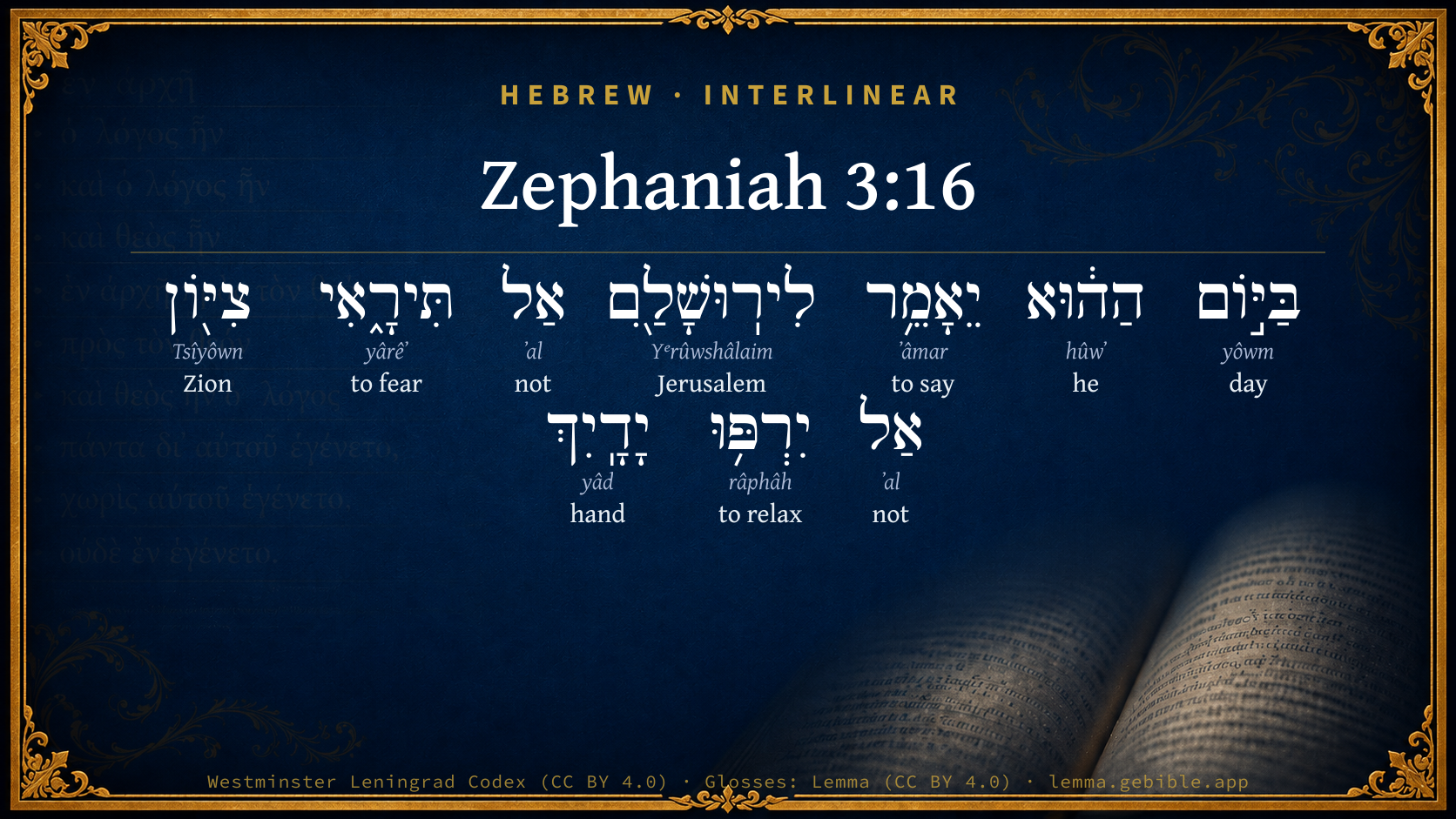
Zephaniah 3:16

Hebrew (Westminster Leningrad Codex) Zephaniah 3:16 appears in the Hebrew Old Testament. The text above is from the Westminster Leningrad Codex. Each word links to its Strong’s number, a concise gloss, and parsing drawn from the Open Scriptures Hebrew Bible morphology. Click any word for its full Brown-Driver-Briggs (BDB) entry.
Download image
Cite this verse

Zephaniah 3:16 (World English Bible). Public Domain. Lemma interlinear Bible study tool, https://lemma.gebible.app/v/zephaniah/3/16.

Show BibTeX & RIS
BibTeX
RIS
English Translation
In that day, it will be said to Jerusalem, "Don't be afraid, Zion. Don't let your hands be slack."
World English Bible · Public Domain
Download a study sheet

One document with this verse’s original text, its word-by-word gloss line, the meaning frame, cross-references with their text, attributed commentary, and full source and license credits — printable, and it pastes into notes with its structure intact.

This verse Autodidact and up

Study sheet (.html) Plain text (.txt)

A passage Seminary Student

Up to 50 verses in one chapter. A passage sheet keeps up to 6 commentary sources and 12 cross-references per verse, in the order this page ranks them, and says so on the sheet whenever that leaves anything out. Ask for a single verse and you get the Autodidact verse sheet above.

Everything on this page stays free to read, with no account — the sheet is a download of what is already on screen, not access to it.

Want to remove ads? Support Godless Engineer
Compare translations 3

The same verse in 3 English versions, stacked beneath the original-language interlinear above. Click any original word for its lexicon entry.

Each is an independent rendering of the whole verse — the interlinear is not word-aligned to these translations.

Highlighted words mark where these versions differ — a whole-verse word diff, not a word-by-word alignment.

  • World English Bible Public Domain
    In that day, it will be said to Jerusalem, "Don't be afraid, Zion. Don't let your hands be slack."
  • King James Version Public Domain
    In that day it shall be said to Jerusalem, Fear thou not: and to Zion, Let not thine hands be slack.
  • unfoldingWord Literal Text CC BY-SA 4.0
    In that day it will be said to Jerusalem, “Do not fear, Zion! Do not slacken your hands!

unfoldingWord Literal Text — © unfoldingWord, licensed CC BY-SA 4.0. Word-aligned USFM3 via Door43 (git.door43.org/unfoldingWord/en_ult).

Versions to compare (up to 4)

3 of 4 selected

Show all 18 translations

Every available English version of this verse, each an independent rendering of the whole verse.

  • World English Bible Public Domain
    In that day, it will be said to Jerusalem, "Don't be afraid, Zion. Don't let your hands be slack."
  • Berean Standard Bible Public Domain
    On that day they will say to Jerusalem: “Do not fear, O Zion; do not let your hands fall limp.
  • Majority Standard Bible Public Domain
    On that day they will say to Jerusalem: “Do not fear, O Zion; do not let your hands fall limp.
  • King James Version Public Domain
    In that day it shall be said to Jerusalem, Fear thou not: and to Zion, Let not thine hands be slack.
  • American Standard Version (1901) Public Domain
    In that day it shall be said to Jerusalem, Fear thou not; O Zion, let not thy hands be slack.
  • Revised Version (1885) Public Domain
    In that day it shall be said to Jerusalem, Fear thou not: O Zion, let not thine hands be slack.
  • Geneva Bible (1599) Public Domain
    In that day it shalbe said to Ierusalem, Feare thou not, O Zion: let not thine handes be faint.
  • Douay-Rheims (1899) Public Domain
    In that day it shall be said to Jerusalem: Fear not: to Sion: Let not thy hands be weakened.
  • Young's Literal Translation Public Domain
    In that day it is said to Jerusalem, `Fear not, O Zion, let not thy hands be feeble.
  • Literal Standard Version CC BY-SA 4.0
    In that day it is said to Jerusalem, || “Do not fear, O Zion, || Do not let your hands be feeble.
  • Unlocked Literal Bible CC BY-SA 4.0
    In that day they will say to Jerusalem, “Do not fear, Zion. Do not let your hands falter.
  • unfoldingWord Literal Text CC BY-SA 4.0
    In that day it will be said to Jerusalem, “Do not fear, Zion! Do not slacken your hands!
  • Darby Bible Public Domain
    In that day it shall be said to Jerusalem, Fear not; Zion, let not thy hands be slack.
  • World Messianic Bible Public Domain
    In that day, it will be said to Jerusalem, “Don’t be afraid, Zion. Don’t let your hands be weak.”
  • Webster's Bible Public Domain
    In that day it shall be said to Jerusalem, Fear thou not: and to Zion, Let not thy hands be slack.
  • Free Bible Version CC BY-SA 4.0
    On that day the message to the people of Jerusalem will be, “Don't be afraid; don't be discouraged!”
  • Bible in Basic English Public Domain
    In that day it will be said to Jerusalem, Have no fear: O Zion, let not your hands be feeble.
  • JPS Tanakh (1917) Public Domain
    In that day it shall be said to Jerusalem: 'Fear thou not; O Zion, let not thy hands be slack.

Literal Standard Version (2020), Covenant Press — licensed CC BY-SA 4.0. Text via the HelloAO Bible API (eBible.org). Unlocked Literal Bible (unfoldingWord) — licensed CC BY-SA 4.0. Text via the HelloAO Bible API (eBible.org). unfoldingWord Literal Text — © unfoldingWord, licensed CC BY-SA 4.0. Word-aligned USFM3 via Door43 (git.door43.org/unfoldingWord/en_ult). Free Bible Version, Dr. Jonathan Gallagher — licensed CC BY-SA 4.0. Text via the HelloAO Bible API (eBible.org).

Word by word

More ways to search: Search by grammar → Find every occurrence → Compare this word →

Practice this passage: Drill this verse → Learn its vocabulary →

יִרְפּ֥וּ
râphâh
H7503
“to relax”
Verb, Qal, Jussive, 3rd Person, Masculine, Plural
Part of Speech
Verb
Stem
Qal
Form
Jussive
Person
3rd Person
Gender
Masculine
Number
Plural
Full BDB Definition

Origin: a primitive root

TWOT: 2198

to sink, relax, sink down, let drop, be disheartened - (Qal) - to sink down - to sink, drop - to sink, relax, abate - to relax, withdraw - (Niphal) idle (participle) - (Piel) to let drop - (Hiphil) - to let drop, abandon, relax, refrain, forsake - to let go - to refrain, let alone - to be quiet - (Hithpael) to show oneself slack
  1. בַּיּ֣וֹם yôwm H3117 “in/at the · day” Preposition, Determined + Noun, Common, Masculine, Singular, Absolute
  2. הַה֔וּא hûwʼ H1931 “the · he” Particle, Definite Article + Pronoun, Personal, 3rd Person, Masculine, Singular
  3. יֵאָמֵ֥ר ʼâmar H559 “to say” Verb, Niphal, Imperfect, 3rd Person, Masculine, Singular
  4. לִירֽוּשָׁלִַ֖ם Yᵉrûwshâlaim H3389 “to/for · Jerusalem” Preposition + Noun, Proper
  5. אַל ʼal H408 “not” Particle, Negative
  6. תִּירָ֑אִי yârêʼ H3372 “to fear” Verb, Qal, Jussive, 2nd Person, Feminine, Singular
  7. צִיּ֖וֹן Tsîyôwn H6726 “Zion” Noun, Proper
  8. אַל ʼal H408 “not” Particle, Negative
  9. יָדָֽיִךְ yâd H3027 “hands · your” Noun, Common, Both, Dual, Construct + Suffix, Personal, 2nd Person, Feminine, Singular

About this verse

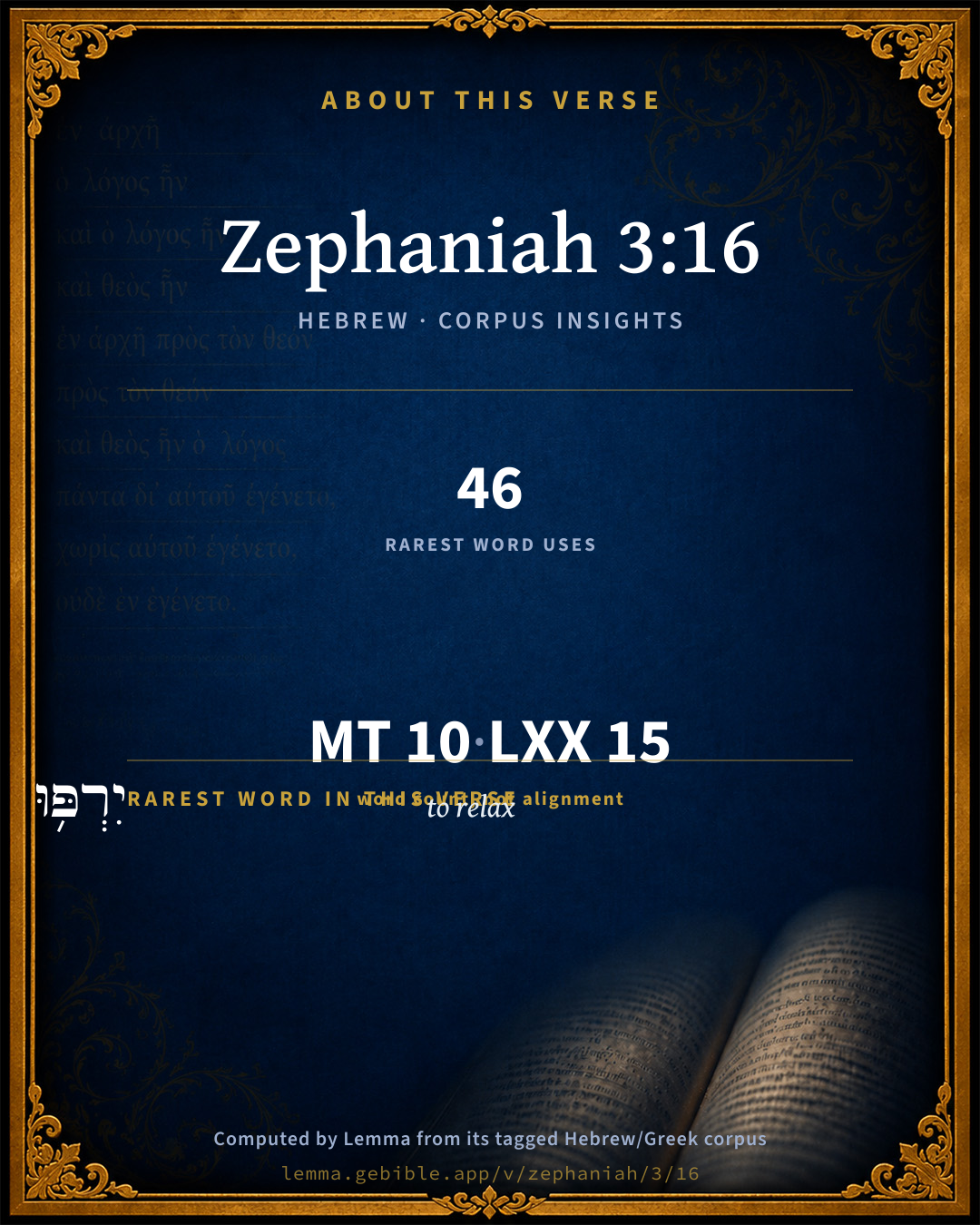
These counts appear in no published source. They are computed here, from the morphology-tagged text and Lemma’s own curated glosses. What Lemma adds →

10
words
9
distinct lemmas
Prophets
section

Shared distinctive vocabulary

יִרְפּ֥וּ to relax H7503 occurs in 45 verses of the Hebrew Bible. Also found in:

Grammatical profile

  • 3 verbs
  • 4 nouns
  • 1 pronoun
  • 2 particles

Verb forms

  • יֵאָמֵ֥ר Niphal · Imperfect
  • תִּירָ֑אִי Qal · Jussive
  • יִרְפּ֥וּ Qal · Jussive

Repetition

A word recurs within this verse — often emphatic in Hebrew:

  • אַל not H408 ×2

Hebrew & Septuagint length

In English translation the verse runs 19 words from the Hebrew and 20 from the Septuagint (LXX English) — closely comparable.

A rough comparison of the two English renderings, which tokenize alike — not a word-level alignment.

Word counts can differ between the Hebrew and the Greek without any difference in meaning — e.g. the Hebrew direct-object marker אֵת has no separate Greek word, and Greek often adds the article ὁ.

In the original languages it is 10 Hebrew tokens and 15 Greek tokens — but the two are counted differently (Hebrew bundles its prefixes and suffixes into one token; the Greek is in lemma form), so that isn’t a like-for-like length.

Cross-references

18

Topical passages linked to Zephaniah 3:16 in the Treasury of Scripture Knowledge — connected by theme and wording, ordered by reader-vote popularity; previews shown in the World English Bible.

  • Hebrews 12:12 Therefore, lift up the hands that hang down and the feeble knees,
  • Isaiah 35:3–4 Strengthen you the weak hands, and confirm the feeble knees.
  • Isaiah 41:10 Don't you be afraid, for I am with you; don't be dismayed, for I am your God; I will strengthen you; yes, I will help you; yes, I will uphold you with the right hand of my righteousness.
  • Ephesians 3:13 Therefore I ask that you may not lose heart at my troubles for you, which are your glory.
  • Galatians 6:9 Let us not be weary in doing good, for we will reap in due season, if we don't give up.
  • Isaiah 44:2 Thus says Yahweh who made you, and formed you from the womb, who will help you: Don't be afraid, Jacob my servant; and you, Jeshurun, whom I have chosen.
  • 2 Corinthians 4:1 Therefore seeing we have this ministry, even as we obtained mercy, we don't faint.
  • Revelation 2:3 You have perseverance and have endured for my name's sake, and have not grown weary.
  • Job 4:3 Behold, you have instructed many, You have strengthened the weak hands.
  • Isaiah 40:9 You who tell good news to Zion, go up on a high mountain; you who tell good news to Jerusalem, lift up your voice with strength; lift it up, don't be afraid; say to the cities of Judah, Behold, your God!
  • Isaiah 41:13–14 For I, Yahweh your God, will hold your right hand, saying to you, Don't be afraid; I will help you.
  • Isaiah 43:1–2 But now thus says Yahweh who created you, Jacob, and he who formed you, Israel: Don't be afraid, for I have redeemed you; I have called you by your name, you are mine.
  • Jeremiah 46:27–28 But don't be afraid you, Jacob my servant, neither be dismayed, Israel: for, behold, I will save you from afar, and your seed from the land of their captivity; and Jacob shall return, and shall be quiet and at ease, and none shall make him afraid.
  • Zechariah 8:15 so again have I thought in these days to do good to Jerusalem and to the house of Judah. Don't be afraid.
  • John 12:12 On the next day a great multitude had come to the feast. When they heard that Jesus was coming to Jerusalem,
  • Hebrews 12:3–5 For consider him who has endured such contradiction of sinners against himself, that you don't grow weary, fainting in your souls.
  • Isaiah 54:4 Don't be afraid; for you shall not be ashamed: neither be confounded; for you shall not be disappointed: for you shall forget the shame of your youth; and the reproach of your widowhood shall you remember no more.
  • Haggai 2:4–5 Yet now be strong, Zerubbabel,' says Yahweh. 'Be strong, Joshua, son of Jehozadak, the high priest. Be strong, all you people of the land,' says Yahweh, 'and work, for I am with you,' says Yahweh of Hosts.

Cross-references courtesy of OpenBible.info (CC BY 4.0).

Hebrew and Greek witnesses Masoretic Hebrew ↔ Greek Septuagint

The same verse in the two great witnesses to the Old Testament, shown verse-for-verse.

These are two independent witnesses, not word-aligned to each other, and the Septuagint is shown in lemma (dictionary) form.

Hebrew Zephaniah 3:16 Masoretic · Westminster Leningrad Codex

בַּיּ֣וֹם הַה֔וּא יֵאָמֵ֥ר לִירֽוּשָׁלִַ֖ם אַל תִּירָ֑אִי צִיּ֖וֹן אַל יִרְפּ֥וּ יָדָֽיִךְ

In that day, it will be said to Jerusalem, "Don't be afraid, Zion. Don't let your hands be slack."

World English Bible · Public Domain

Greek LXX Zephaniah 3:16 Septuagint · lemma form

ἐν ὁ καιρός ἐκεῖνος εἶπον κύριος ὁ ἰερουσαλήμ θαρρέω σιων μή παραἵημι ὁ χείρ σύ

At that time the Lord shall say to Jerusalem, Be of good courage, Sion; let not your hands be slack.

LXX2012 (modern English Septuagint) · Public Domain

On this verse, John Gill's Exposition discusses the Septuagint’s reading. Read the note in Commentary ↓

Hebrew: Westminster Leningrad Codex (CC BY 4.0). Greek: Septuagint (public domain); English from LXX2012 (modern English Septuagint) (Public Domain). How the Septuagint differs from the Hebrew →

Targum (Aramaic paraphrase)

1

The Targum is the ancient Jewish Aramaic paraphrase of the Hebrew Scriptures — an interpretive translation, not the Hebrew text itself. Onkelos (literal) and Pseudo-Jonathan (expansive) render the Torah, and Jonathan the Prophets. Coverage is partial: where no permissively-licensed English translation exists for a verse, only the Aramaic is shown. This is verse-level text, not a word-by-word alignment to the Hebrew.

  1. Targum Jonathan Prophets (Joshua–Malachi)
    בְּעִדָנָא הַהִיא יִתְאַמַר לִירוּשְׁלֵם לָא תִדְחֲלוּן צִיוֹן לָא יִתְרַשְׁלָן יְדָךְ:

    (no public-domain English translation for this verse)

    Targum Jonathan — Aramaic: “Mikraot Gedolot” (public domain). English: “Sefaria Community Translation” (CC0 1.0 (public-domain dedication)); “London "Chaldee Paraphrase," 1871” (public domain). Text via Sefaria.

Commentary

Notes on Zephaniah 3:16 from classic Christian and Jewish commentators (each source and its license shown beneath its notes). The classic Christian expositions comment on the surrounding passage and are grouped to its opening verse, so a note may address several verses; the Jewish commentaries on the Tanakh (Rashi and others) are per-verse, so they appear only where the commentator wrote on this verse.

Lemma curates 59 commentaries, every one of them public domain or Creative Commons licensed, each selected and text-cleaned for this edition rather than reprinted as found. About our sources →

Trapp's Complete Commentary

John Trapp

Zep 3:16 In that day it shall be said to Jerusalem, Fear thou not: [and to] Zion, Let not thine hands be slack.

Ver. 16. Fear thou not] Why shouldest thou while the King of Israel is in the midst of thee? Be of good cheer, said Caesar to the ferryman in a storm, thou canst not miscarry: Casarem enim fers et fortunam Caesaris, for you carry Caesar and luck of Caesar, so long as Caesar is in the same bottom with thee. May not the Church much more gather comfort, having God in her company; and so many of his servants to say to her, Fear thou not? True faith quelleth and killeth distrustful fear; but awful dread it breedeth, feedeth, fostereth, and cherisheth.

And to Zion, Let not thine hands be slack] Remollescant. Let not thy fears weaken, but rather waken thy diligence in well doing; lift up the hands which hang down, and the feeble knees, Heb 12:12. Up and be active; pluck up your good hearts, and buckle close to your business; your task is long, your time short; your master urgent, your wages inconceivable. It troubled a martyr at the stake, that he should then go to a place where he should ever be receiving wages, and do no more work. Up, therefore, and be doing. "Be not slothful, but followers of them who through faith and patience inherit the promises," Heb 6:12. Spontaneae lassitudines morbos loquuntur, faithlessness argueth a diseased soul.

John Trapp, A Commentary or Exposition upon All the Books of the Old and New Testament (1647–1656) — public domain. Text from a community e-Sword module.

The Biblical Illustrator

Joseph S. Exell

Zep_3:16

Let not thine hands be slack.

The Church of Christ exhorted to diligence

I. These words suggest to the Church of Christ that there is a work to be performed. The caution not to be slack implies an injunction to be diligent, and is supposed to refer first to the rebuilding of the temple, and then to the spread of the Church of Christ in Gospel days. To assertain the special work to be performed we have only to acquaint ourselves with the sacred character and required employment of the persons addressed. A people of holy character are called to exertion, and their work must be in unison with their character. The work to be accomplished by the inhabitants of Zion is a work of grace. As such--

1. The work to be performed is spiritual in its nature. Being a spiritual work, it has special regard to the interests of the souls of men, and embraces every duty calculated to promote the purity and happiness, the present and eternal salvation, of intelligent beings. The inhabitants of Zion, collectively or individually, ii they would promote the happiness of men, must lead them to an acquaintance with that Saviour, whom to know is life eternal.

2. The work to be performed is beneficial in its operations. Contemplate the effects in their immediate subjects. The dark mind is enlightened, the hard heart is softened, the perverse will is subjected, the drowsy conscience is roused, the inverted affections are rightly directed, the carnal nature regenerated, and the profligate life is changed into purity of deportment. Contemplate the effects in their direct tendency. The operations of grace are visible in all the kindred relations of life, and in all the relations of society. Contemplate the effects in their extended influence.

3. The work to be performed is important in its character. This is seen if we reflect on the exalted interest which it engages. The spiritual interest of man engages all the perfections of God, and all the persons of the sacred Trinity. Reflect also on the honour it secures to man.

4. The work to be performed is indispensable in its obligations. These arc numerous, powerful, and binding. The obligation arises from mans misery, through sin, and should be felt and acknowledged by all who have found mercy in God.

II. The words under consideration also suggest unto the Church a power to be exerted. Hands, in Scripture, signify power. They are also expressive of an agent employed. Zion should employ--

1. The mighty power of truth.

2. The necessary power of union.

3. The extensive power of influence.

4. The consecrated power of wealth.

5. The prevailing power of prayer.

III. By this scripture we are further instructed that supineness of spirit must be avoided. Slackness of hands indicates a disposition that is most enervating in its influence.

1. Supineness of spirit is unworthy of a work of grace.

2. It is unequal to a work of grace.

3. It would fail to accomplish the work of grace.

4. It is very offensive to the God of Grace.

IV. From these words we are taught that an exhortation is to be given.

1. This is the voice of God from His sovereign throne.

2. This is the voice of ministers from the towers of Zion.

3. This is the voice of thousands whose state demands assistance.

In conclusion--

1. The work of grace is the work of Zion.

2. The members of Zion have a hand, a power for this work.

3. The members of Zion are called to unwearied exertions. (William Naylor.)

The Biblical Illustrator, edited by Joseph S. Exell (c. 1880s–1900s) — public domain. Text from a community e-Sword module.

Joseph Benson's Commentary

Zep 3:16-17. In that day — Or, time of restitution, when the captives shall return and be settled in their own land; it shall be said to Jerusalem — By prophets, or by friends congratulating and encouraging them; Fear thou not — Disquiet not yourselves with unnecessary fears, though you may apprehend some danger from Sanballat, Tobiah, and the Samaritans: see Neh 4:1-2; and though you shall have troublesome times, Dan 9:25. Let not thy hands be slack — In the work of the Lord, in rebuilding the city and temple, and restoring the worship of God. The Lord — Hebrew, Jehovah; thy God — Thine in a covenant never to be repealed or forgotten; in the midst of thee is mighty — He can and will restrain and destroy thine enemies, and support and defend his own people. He will save, &c. — Will deliver thee from thy fears, and thine enemies’ rage. Will rejoice over thee with joy — Will greatly rejoice in thee, and take pleasure in blessing and doing thee good. He will rest in his love — Will continue peculiarly to love thee, and will take satisfaction in so doing. These promises also, in their full sense, belong only to the Christian Church, composed of converted Jews and Gentiles, and shall be completely fulfilled during the millennium, when believers will have, as it were, a heaven on earth.

Joseph Benson's Commentary on the Old and New Testaments (1811–1818) — public domain. Text from a community e-Sword module.

Jamieson, Fausset & Brown

Robert Jamieson, A. R. Fausset & David Brown

Let not thine hands be slack-- (Heb 12:12). Do not faint in the work of the Lord.

Jamieson, Fausset & Brown — Commentary Critical and Explanatory on the Whole Bible (1871) — public domain (CC PDM 1.0). Text via the HelloAO Bible API.

Adam Clarke's Commentary

Verse 16. Fear thou not] Thou shalt have no more captivities nor national afflictions.

Let not thine hands be slack.] This may refer, first, to the rebuilding of the temple of God, after the return from Babylon; and, secondly, to their diligence and zeal in the Christian Church.

Adam Clarke's Commentary on the Bible (1810–1826) — public domain. Text from a community e-Sword/MySword module.

John Calvin's Commentaries

The Prophet proceeds still to confirm the same truth, but employs a different mode of speaking. It shall, he says, be then said everywhere to Zion, Fear not, let not thine hands be let down, etc. For these words may no less suitably be applied to the common report or applause of all men, then to the prophetic declaration; so that the expression, It shall be said, may be the common congratulation, which all would vie to offer. The import of the whole is, that Jerusalem would be so tranquil that either the Prophets, or all with common consent would say, “Thou enjoyest thy rest: for God really shows that he cares for thee; there is therefore no cause for thee hereafter to fear.” For there is expressed here a real change: since the Jews had been before in daily fear, the Prophet intimates, that they would be so safe from every danger, as to be partakers of the long-wished-for rest, with the approbation even of the whole world. Hence, it shall be said—by whom? either by the Prophets, or by common report: it makes no great difference, whether there would be teachers to announce their state joyful and prosperous, or whether all men would, by common consent, applaud God’s favor, when he had removed from his people all wars, troubles, and fears, so as to make them live in quietness.

It shall then be said to Jerusalem, fear not; Sion! let not thine hands be relaxed. By saying Fear not, and let not thine hands be relaxed, he intimates, that all vigor is so relaxed by fear, that no member can perform its function. But by taking a part for the whole, he understands by the word hands, every other part of the body; for by the hands men perform their works. Hence in Scripture the hands often signify the works of men. The meaning then is—that God’s Church would then be in such a state of quietness as to be able to discharge all its duties and transact its concerns peaceably and orderly. And it is what we also know by experience, that when fear prevails in our hearts we are as it were lifeless, so that we cannot raise even a finger to do anything: but when hope animates us, there is a vigor in the whole body, so that alacrity appears everywhere. The Prophet, no doubt, means here, that God thus succors his elect, not that they may indulge in pleasures, as is too often the case, but that they may, on the contrary, strenuously devote themselves to the performance of their duties. We ought therefore to notice the connection between a tranquil state and diligent hands; for, as I have said, God does not free us from all trouble and fear, that we may grow torpid in our pleasures, but that we may, on the contrary, be more attentive to our duty. Sion, then! let thine hands be no more torpid —Why?

Jehovah, he says, in the midst of thee strong, will save. He repeats what he had said, but more fully expresses what might have appeared obscure on account of its brevity. He therefore shows here more at large the benefit of God’s presence—that God will not dwell idly in his Church, but will be accompanied with his power. For what end? To save. We hence see that the word גבור, gebur, ascribed to God, is very emphatical; as though he had said, that God would not be idle while residing in the midst of his Church, but would become its evident strength. And it is worthy of notice, that God exhibits not himself as strong that he may terrify his elect, but only that he may become their preserver.

He afterwards adds, He will rejoice over thee with gladness. This must be referred to the gratuitous love of God, by which he embraces and cherishes his Church, as a husband his wife whom he most tenderly loves. Such feelings, we know, belong not to God; but this mode of speaking, which often occurs in Scripture, is thus to be understood by us; for as God cannot otherwise show his favor towards us and the greatness of his love, he compares himself to a husband, and us to a wife. He means in short—that God is most highly pleased when he can show himself kind to his Church.

He confirms and shows again the same thing more clearly, He will be at rest (or silent) in his love. The proper meaning of חרש, charesh, is to be silent, but it means here to be at rest. The import is, that God will be satisfied, as we say in French, Il prendra tout son contentement; as though he had said that God wished nothing more than sweetly and quietly to cherish his Church. As I have already said, this feeling is indeed ascribed to God with no strict correctness; for we know that he can instantly accomplish whatever it pleases him: but he assumes the character of men; for except he thus speaks familiarly with us, he cannot fully show how much he loves us. God then shall be at rest in his love; that is, “It will be his great delight, it will be the chief pleasure of thy God when he cherishes thee: as when one cherishes a wife most dear to him, so God will then rest in his love.” He then says, He will exult over thee with joy

These hyperbolic terms seem indeed to set forth something inconsistent, for what can be more alien to God’s glory than to exult like man when influenced by joy arising from love? It seems then that the very nature of God repudiates these modes of speaking, and the Prophet appears as though he had removed God from his celestial throne to the earth. A heathen poet says,—

Not well do agree, nor dwell on the same throne, Majesty and love. (Ovid. Met. Lib. 2: 816-7.)

God indeed represents himself here as a husband, who burns with the greatest love towards his wife; and this does not seem, as we have said, to be suitable to his glory; but whatever tends to this end—to convince us of God’s ineffable love towards us, so that we may rest in it, and being weaned as it were from the world, may seek this one thing only, that he may confer on us his favor—whatever tends to this, doubtless illustrates the glory of God, and derogates nothing from his nature. We at the same time see that God, as it were, humbles himself; for if it be asked whether these things are suitable to the nature of God, we must say, that nothing is more alien to it. It may then appear by no means congruous, that God should be described by us as a husband who burns with love to his wife: but we hence more fully learn, as I have already said, how great is God’s favor towards us, who thus humbles himself for our sake, and in a manner transforms himself, while he puts on the character of another. Let every one of us come home also to himself, and acknowledge how deep is the root of unbelief; for God cannot provide for our good and correct this evil, to which we are all subject, without departing as it were from himself, that he might come nigher to us.

And whenever we meet with this mode of speaking, we ought especially to remember, that it is not without reason that God labors so much to persuade us of his love, because we are not only prone by nature to unbelief, but exposed to the deceits of Satan, and are also inconstant and easily drawn away from his word: hence it is that he assumes the character of man. We must, at the same time, observe what I have before stated—that whatever is calculated to set forth the love of God, does not derogate from his glory; for his chief glory is that vast and ineffable goodness by which he has once embraced us, and which he will show us to the end.

What the Prophet says of that day is to be extended to the whole kingdom of Christ. He indeed speaks of the deliverance of the people; but we must ever bear in mind what I have already stated—that it is not one year, or a few years, which are intended, when the Prophets speak of future redemption; for the time which is now mentioned began when the people were restored from the Babylonian captivity, and continues its course to the final advent of Christ. And hence also we learn that these hyperbolic expressions are not extravagant, when the Prophets say, Thou shalt not afterwards fear, nor see evil: for if we regard the dispersion of that people, doubtless no trial, however heavy, can happen to us, which is not moderate, when we compare our lot with the state of the ancient people; for the land of Canaan was then the only pledge of God’s favor and love. When, therefore, the Jews were ejected from their inheritance, it was, as we have said elsewhere, a sort of repudiation; it was the same as if a father were to eject from his house a son, and to repudiate him. Christ was not as yet manifested to the world. The miserable Jews had an evidence, in figures and shadows, of that future favor which was afterwards manifested by the gospel. Since, then, God gave them so small an evidence of his love, how could it be otherwise but that they must have fainted, when driven far away from their land? Though the Church is now scattered and torn, and seems little short of being ruined, yet God is ever present with us in his only-begotten Son: we have also the gate of the celestial kingdom fully opened. There is, therefore, administered to us at all times more abundant reasons for joy than formerly to the ancient people, especially when they seemed to have been rejected by God. This is the reason why the Prophet says, that the Church would be lessened by calamities, when God again gathered it. But that redemption of the people of Israel ought at this day to be borne in mind by us; for it was a memorable work of God, by which he intended to afford a perpetual testimony that he is the deliverer of all those who hope in him. It follows—

John Calvin's Commentaries (1540-1563) — public domain. Text from the Calvin Translation Society English edition (1840s-50s) via the Christian Classics Ethereal Library (ccel.org). Calvin's coverage is partial (roughly two-thirds of the Bible); uncommented books and verses are honest gaps, never fabricated. The 19th-century editor's footnotes and remarks are omitted so the notes are faithfully Calvin's own voice.

Ellicott's Commentary for English Readers

(16) Compare Isa_35:3-4; Isa_62:11, et seq.

A Bible Commentary for English Readers, edited by Charles John Ellicott (1878–1897) — public domain. Text from a community e-Sword module.

The Cambridge Bible for Schools and Colleges

gen. ed. J. J. S. Perowne

16. Let not thine hands be slack] that is, hang down, in terror or paralysis. Jer_6:24; Heb_12:12.

The Cambridge Bible for Schools and Colleges (gen. ed. J. J. S. Perowne; Cambridge University Press, 1878–1918) — public domain. Text from a community e-Sword module.

John Gill's Exposition

In that day it shall be said to Jerusalem, fear thou not, &c.] Do not be afraid of any enemies; neither outward ones, the armies of Gog and Magog, the Turk, who will threaten, and will attempt to dispossess them of their land, now returned to it; nor inward and spiritual enemies, sin, Satan, death, and hell, being all vanquished and subdued by Christ: this will be said, not by the enemies themselves, who will confess they have no power to stand before the mighty God, as Aben Ezra; but either by the prophets of the Lord, or by the people themselves, encouraging one another, every man his neighbour, as Kimchi; or rather by the Lord himself, as the Septuagint and Arabic versions supply it, ``the Lord shall say to Jerusalem;'' this will be said at the time of the Jews' conversion, when reinstated in their own land, and shall be threatened with another remove from it, which they will have no reason to fear: [and to] Zion, Let not thine hands be slack; weak, remiss, hang down through fear of mind, and fainting of spirit; and so unfit to meet the enemy, or perform duty; but, on the contrary, pluck up a good heart, be of good courage, fear not the enemy, be vigorous, active, and diligent, in the performance of the service of the Lord, animated by the following considerations:

John Gill's Exposition of the Whole Bible (1746–1763) — public domain (CC PDM 1.0). Text via the HelloAO Bible API.

Albert Barnes' Notes on the Bible

In that day it shall be said to Jerusalem, Fear thou not - For “perfect love casteth out fear” Joh 4:18; from where he saith, “Fear not, little flock; it is your Father’s good pleasure to give you the kingdom” Luk 12:32. Who then and what should the Church or the faithful soul fear, since “mightier is He that is in her, than he that is in the world? And to Zion, Let not thine hands be slack,” through faint-heartedness (see Heb 12:12), but work with all thy might; be ready to do or bear anything; since Christ worketh with, in, by thee, and “in due time we shall reap, if we faint not” Gal 6:9.

Albert Barnes' Notes on the Bible (1834–1885) — public domain. Text from a community e-Sword/MySword module.

Matthew Poole's English Annotations

In that day; the day or time of restitution, when the captivity returned shall be settled in their land.

It shall be said; by prophets, or by friends, congratulating them, or by each to other.

To Jerusalem; inhabitants of Jerusalem, the place being put for the people.

Fear thou not; disquiet not yourselves with fears, though you may apprehend some dangers from Sanballat and Tobiah, &c., though troublous times. as Neh 4:1,2; Da 9:25.

Let not thine hands be slack, in the work of the Lord, building the city and temple, and restoring the worship of God; take heart, O ye returned captives, for God your King is with you.

Matthew Poole's English Annotations on the Holy Bible (1683–1685) — public domain. Text from a community e-Sword/MySword module.

The Pulpit Commentary

It shall be said. So obvious to all men shall be the happy and secure, position of Zion under God"s favour and rule, that they shall join in bidding her east away fear and exult in the Divine protection. Fear thou not. (comp. Mat_14:27 Mat_28:5, 10 Luk_12:7, Luk_12:32) And to Zion. Probably vocative, O Zion. Let not thine hands be slack. Be not despairing or faint hearted, but work with energy and confidence; (comp. Isa_13:7 Heb_12:12) or the sentence may be rendered, "Jerusalem will be called Fear not, and Zion, Let not thine hands be slack. " In this case we may compare the names Hephzibah and Beulah given to Jerusalem, (Isa_62:4) and Jehovah-Tsidkenu. (Jer_33:16)

The Pulpit Commentary (1880–1919), ed. H.D.M. Spence-Jones & Joseph S. Exell — public domain. Text from a community e-Sword module.

Lesson kit

Teaching starters — assembled from the data on this page, not authored interpretation. Every prompt links to the verse data it draws on. Edit before teaching.

Zephaniah, in the Prophets, opens this verse with 10 words (9 distinct Hebrew lemmas). Its most distinctive word is râphâh (“to relax”). A historical commentator’s framing appears above. Read the whole chapter for the surrounding context.

Discussion questions

  1. What does “to relax” (râphâh) contribute to the verse as a whole?
  2. Exodus 4:26 shares the word «to relax» with this verse. How do the two illuminate each other?
  3. “not” occurs 2× in this one verse. What is the effect of the repetition?
  4. These translations render this verse differently. What is at stake in choosing one wording over another?
  5. The verb «יֵאָמֵ֥ר» is Niphal Imperfect. How does its form color the action?
  6. Reading how Trapp's Complete Commentary and The Biblical Illustrator read this verse, where do the two commentators agree and where do they part?

Things to notice

Reading settings

Reading text

Shown beneath each verse's original-language words.

Old Testament
Old Testament edition

Read the OT as the Masoretic Hebrew (MT) or the Greek Septuagint (LXX).

English shown for the Greek Septuagint (in the Hebrew ↔ Greek comparison).

Comparing translations? Open the Compare panel on any verse page to stack up to four side by side.