Psalms 48:2

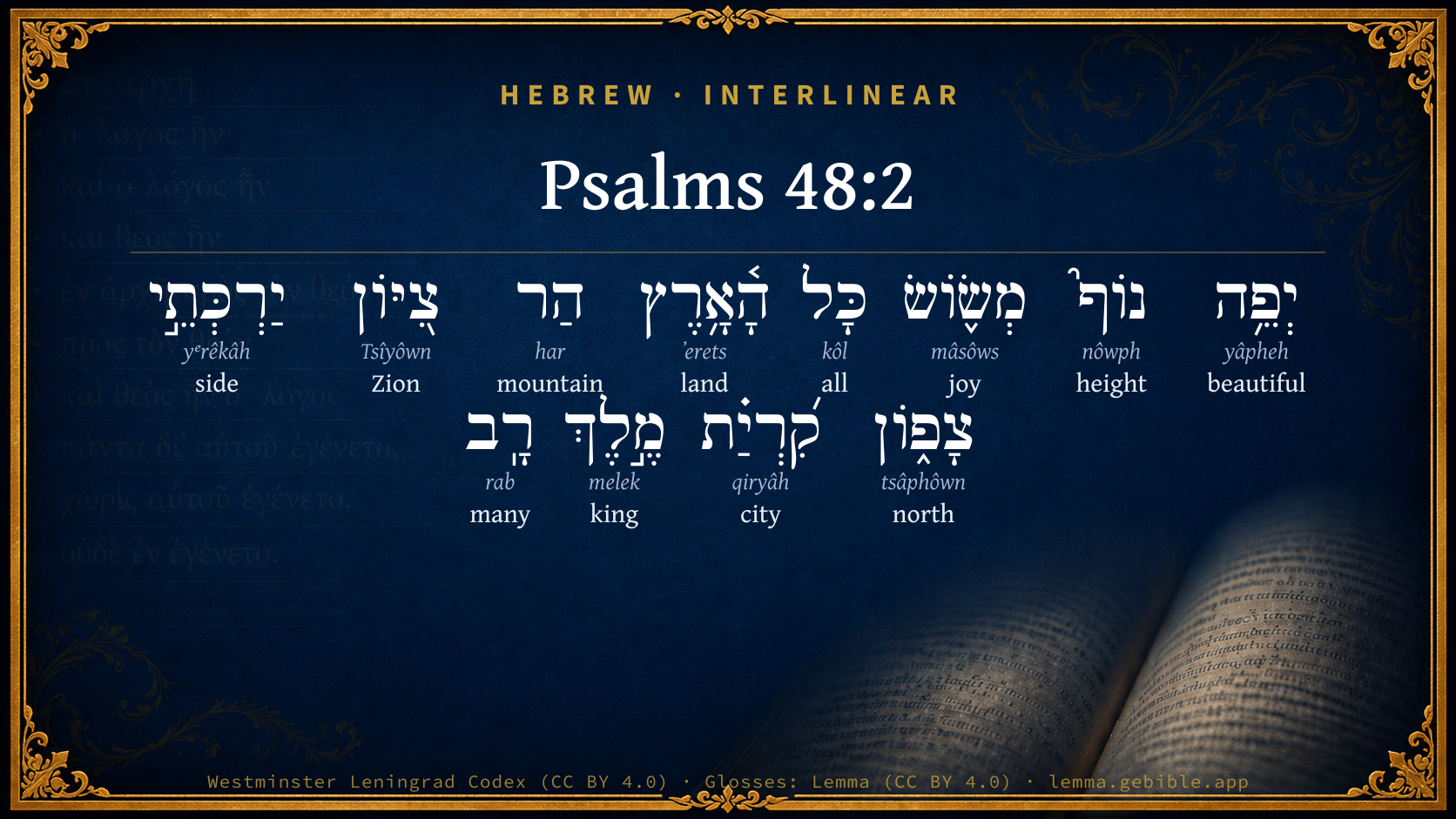
Hebrew (Westminster Leningrad Codex) Psalms 48:2 appears in the Hebrew Old Testament. The text above is from the Westminster Leningrad Codex. Each word links to its Strong’s number, a concise gloss, and parsing drawn from the Open Scriptures Hebrew Bible morphology. Click any word for its full Brown-Driver-Briggs (BDB) entry.
Download image
Cite this verse

Psalms 48:2 (World English Bible). Public Domain. Lemma interlinear Bible study tool, https://lemma.gebible.app/v/psalms/48/2.

Show BibTeX & RIS
BibTeX
RIS
English Translation
Beautiful in elevation, the joy of the whole earth, Is Mount Zion, on the north sides, The city of the great King.
World English Bible · Public Domain
Highlights
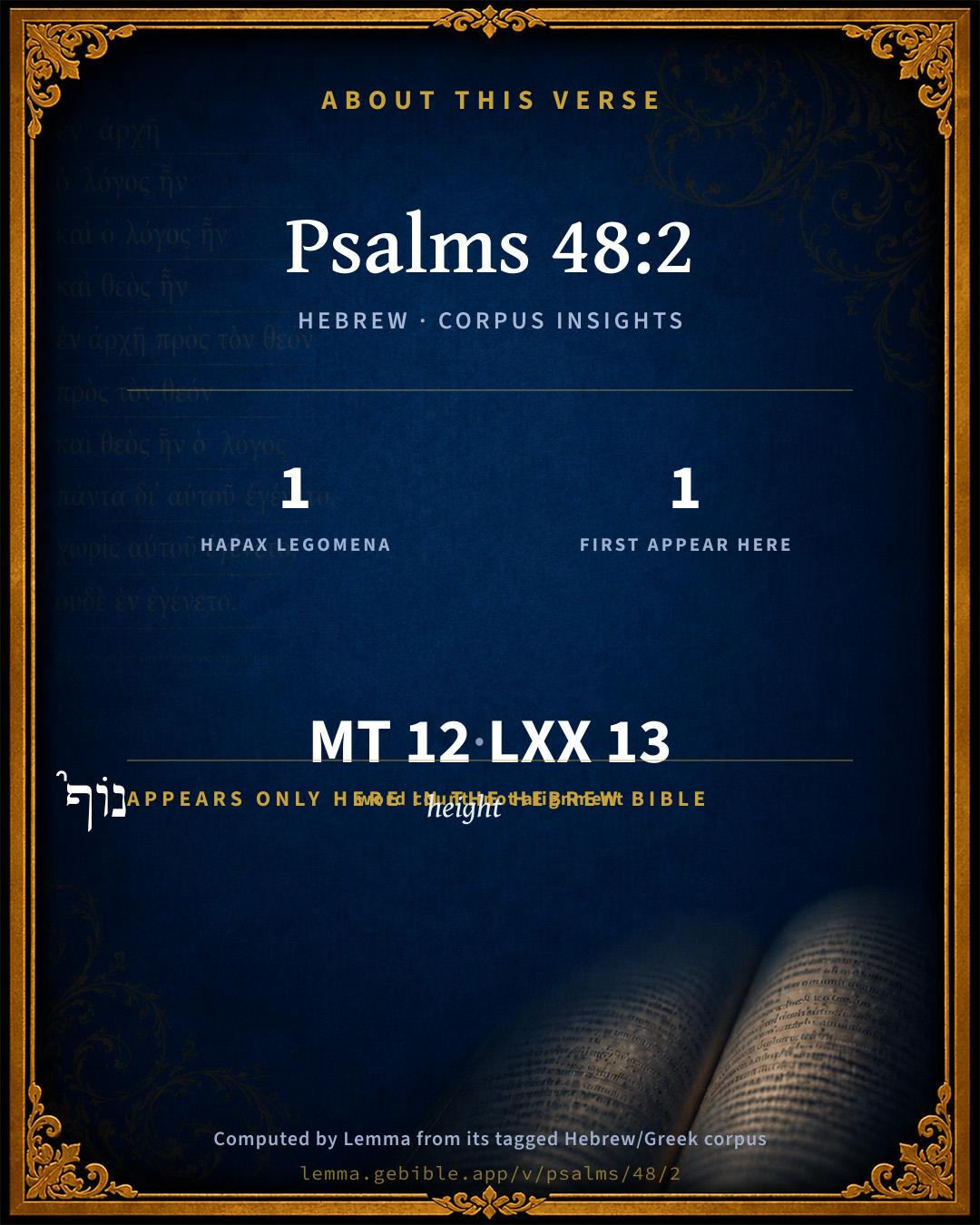
  • 1 hapax legomenon — only here in the Hebrew Bible
  • 1 first appearance in the Hebrew Bible
Full analysis ↓
Download a study sheet

One document with this verse’s original text, its word-by-word gloss line, the meaning frame, cross-references with their text, attributed commentary, and full source and license credits — printable, and it pastes into notes with its structure intact.

This verse Autodidact and up

Study sheet (.html) Plain text (.txt)

A passage Seminary Student

Up to 50 verses in one chapter. A passage sheet keeps up to 6 commentary sources and 12 cross-references per verse, in the order this page ranks them, and says so on the sheet whenever that leaves anything out. Ask for a single verse and you get the Autodidact verse sheet above.

Everything on this page stays free to read, with no account — the sheet is a download of what is already on screen, not access to it.

Want to remove ads? Support Godless Engineer
Compare translations 3

The same verse in 3 English versions, stacked beneath the original-language interlinear above. Click any original word for its lexicon entry.

Each is an independent rendering of the whole verse — the interlinear is not word-aligned to these translations.

Highlighted words mark where these versions differ — a whole-verse word diff, not a word-by-word alignment.

  • World English Bible Public Domain
    Beautiful in elevation, the joy of the whole earth, Is Mount Zion, on the north sides, The city of the great King.
  • King James Version Public Domain
    Beautiful for situation, the joy of the whole earth, is mount Zion, on the sides of the north, the city of the great King.
  • unfoldingWord Literal Text CC BY-SA 4.0
    Beautiful of elevation, the joy of all of the earth, Mount Zion the recesses of the north, the city of the great king.

unfoldingWord Literal Text — © unfoldingWord, licensed CC BY-SA 4.0. Word-aligned USFM3 via Door43 (git.door43.org/unfoldingWord/en_ult).

Versions to compare (up to 4)

3 of 4 selected

Show all 18 translations

Every available English version of this verse, each an independent rendering of the whole verse.

  • World English Bible Public Domain
    Beautiful in elevation, the joy of the whole earth, Is Mount Zion, on the north sides, The city of the great King.
  • Berean Standard Bible Public Domain
    Beautiful in loftiness, the joy of all the earth, like the peaks of Zaphon is Mount Zion, the city of the great King.
  • Majority Standard Bible Public Domain
    Beautiful in loftiness, the joy of all the earth, like the peaks of Zaphon is Mount Zion, the city of the great King.
  • King James Version Public Domain
    Beautiful for situation, the joy of the whole earth, is mount Zion, on the sides of the north, the city of the great King.
  • American Standard Version (1901) Public Domain
    Beautiful in elevation, the joy of the whole earth, Is mount Zion, `on' the sides of the north, The city of the great King.
  • Revised Version (1885) Public Domain
    Beautiful in elevation, the joy of the whole earth, is mount Zion, on the sides of the north, the city of the great King.
  • Geneva Bible (1599) Public Domain
    Mount Zion, lying Northwarde, is faire in situation: it is the ioy of the whole earth, and the Citie of the great King.
  • Douay-Rheims (1899) Public Domain
    Great is the Lord, and exceedingly to be praised in the city of our God, in his holy mountain.
  • Young's Literal Translation Public Domain
    Beautiful `for' elevation, A joy of all the land, `is' Mount Zion, The sides of the north, the city of a great king.
  • Literal Standard Version CC BY-SA 4.0
    Beautiful [for] elevation, || A joy of all the land, [is] Mount Zion, || The sides of the north, the city of [the] great King.
  • Unlocked Literal Bible CC BY-SA 4.0
    Beautiful in elevation, the joy of the whole earth, is Mount Zion, on the sides of the north, the city of the great King.
  • unfoldingWord Literal Text CC BY-SA 4.0
    Beautiful of elevation, the joy of all of the earth, Mount Zion the recesses of the north, the city of the great king.
  • Darby Bible Public Domain
    Beautiful in elevation, the joy of the whole earth, is mount Zion, [on] the sides of the north, the city of the great King.
  • World Messianic Bible Public Domain
    Beautiful in elevation, the joy of the whole earth, is Mount Zion, on the north sides, the city of the great King.
  • Webster's Bible Public Domain
    \\48:1\\A Song and Psalm for the sons of Korah. Great is the LORD, and greatly to be praised in the city of our God, in the mountain of his holiness.
  • Free Bible Version CC BY-SA 4.0
    Mount Zion is high and beautiful, bringing happiness to all the earth; on the northern side is the city of the great King.
  • Bible in Basic English Public Domain
    Beautiful in its high position, the joy of all the earth, is the mountain of Zion, the mountain of God, the town of the great King.
  • JPS Tanakh (1917) Public Domain
    (48-3) Fair in situation, the joy of the whole earth; even mount Zion, the uttermost parts of the north, the city of the great King.

Literal Standard Version (2020), Covenant Press — licensed CC BY-SA 4.0. Text via the HelloAO Bible API (eBible.org). Unlocked Literal Bible (unfoldingWord) — licensed CC BY-SA 4.0. Text via the HelloAO Bible API (eBible.org). unfoldingWord Literal Text — © unfoldingWord, licensed CC BY-SA 4.0. Word-aligned USFM3 via Door43 (git.door43.org/unfoldingWord/en_ult). Free Bible Version, Dr. Jonathan Gallagher — licensed CC BY-SA 4.0. Text via the HelloAO Bible API (eBible.org).

Word by word

More ways to search: Search by grammar → Find every occurrence → Compare this word →

Practice this passage: Drill this verse → Learn its vocabulary →

About this verse

These counts appear in no published source. They are computed here, from the morphology-tagged text and Lemma’s own curated glosses. What Lemma adds →

12
words
12
distinct lemmas
Wisdom
section

Notable vocabulary

1 hapax legomenon — a word that appears only here in the entire Hebrew Bible:

  • נוֹף֮ height H5131

First appearance in Scripture

This word makes its first canonical appearance in the Hebrew Bible here:

  • נוֹף֮ height H5131

Shared distinctive vocabulary

מְשׂ֪וֹשׂ joy H4885 occurs in 16 verses of the Hebrew Bible. Also found in:

Grammatical profile

  • 10 nouns
  • 2 adjectives

Hebrew & Septuagint length

In English translation the verse runs 22 words from the Hebrew and 27 from the Septuagint (LXX English) — closely comparable.

A rough comparison of the two English renderings, which tokenize alike — not a word-level alignment.

Word counts can differ between the Hebrew and the Greek without any difference in meaning — e.g. the Hebrew direct-object marker אֵת has no separate Greek word, and Greek often adds the article ὁ.

In the original languages it is 12 Hebrew tokens and 13 Greek tokens — but the two are counted differently (Hebrew bundles its prefixes and suffixes into one token; the Greek is in lemma form), so that isn’t a like-for-like length.

Cross-references

14

Topical passages linked to Psalms 48:2 in the Treasury of Scripture Knowledge — connected by theme and wording, ordered by reader-vote popularity; previews shown in the World English Bible.

  • Psalms 50:2 Out of Zion, the perfection of beauty, God shines forth.
  • Matthew 5:35 nor by the earth, for it is the footstool of his feet; nor by Jerusalem, for it is the city of the great King.
  • Lamentations 2:15 All that pass by clap their hands at you; They hiss and wag their head at the daughter of Jerusalem, [saying], Is this the city that men called The perfection of beauty, The joy of the whole earth?
  • Hebrews 12:22 But you have come to Mount Zion, and to the city of the living God, the heavenly Jerusalem, and to innumerable hosts of angels,
  • Isaiah 14:13 You said in your heart, I will ascend into heaven, I will exalt my throne above the stars of God; and I will sit on the mountain of congregation, in the uttermost parts of the north;
  • Ezekiel 20:6 in that day I swore to them, to bring them forth out of the land of Egypt into a land that I had searched out for them, flowing with milk and honey, which is the glory of all lands.
  • Daniel 11:16 But he who comes against him shall do according to his own will, and none shall stand before him; and he shall stand in the glorious land, and in his hand shall be destruction.
  • Psalms 47:7–8 For God is the King of all the earth. Sing praises with understanding.
  • Isaiah 60:15–20 Whereas you have been forsaken and hated, so that no man passed through you, I will make you an eternal excellency, a joy of many generations.
  • Isaiah 66:10 Rejoice you with Jerusalem, and be glad for her, all you who love her: rejoice for joy with her, all you who mourn over her;
  • Daniel 8:9 Out of one of them came forth a little horn, which grew exceeding great, toward the south, and toward the east, and toward the glorious [land].
  • Malachi 1:14 "But the deceiver is cursed, who has in his flock a male, and vows, and sacrifices to the Lord a blemished thing; for I am a great King," says Yahweh of hosts, "and my name is awesome among the nations."
  • Jeremiah 3:19 But I said, How I will put you among the children, and give you a pleasant land, a goodly heritage of the hosts of the nations! and I said, You shall call me My Father, and shall not turn away from following me.
  • Malachi 3:12 "All nations shall call you blessed, for you will be a delightful land," says Yahweh of Hosts.

Cross-references courtesy of OpenBible.info (CC BY 4.0).

Hebrew and Greek witnesses Masoretic Hebrew ↔ Greek Septuagint

The same verse in the two great witnesses to the Old Testament, shown verse-for-verse.

You’re reading Greek Psalm 47 (Hebrew Psalm 48). The Septuagint counts the superscription, so verse numbers can differ from the Hebrew — chapter-level alignment, not verse-by-verse. Numbering follows Rahlfs.

These are two independent witnesses, not word-aligned to each other, and the Septuagint is shown in lemma (dictionary) form.

Hebrew Psalms 48:2 Masoretic · Westminster Leningrad Codex

יְפֵ֥ה נוֹף֮ מְשׂ֪וֹשׂ כָּל הָ֫אָ֥רֶץ הַר צִ֭יּוֹן יַרְכְּתֵ֣י צָפ֑וֹן קִ֝רְיַ֗ת מֶ֣לֶךְ רָֽב

Beautiful in elevation, the joy of the whole earth, Is Mount Zion, on the north sides, The city of the great King.

World English Bible · Public Domain

Greek LXX Greek Psalm 47:2 Septuagint · lemma form

μέγας κύριος καί αἰνετός σφόδρα ἐν πόλις ὁ θεός ἐγώ ὄρος ἅγιος αὐτός

The city of the great King is well planted on the mountains of Sion, with the joy of the whole earth, on the sides of the north.

LXX2012 (modern English Septuagint) · Public Domain

Hebrew: Westminster Leningrad Codex (CC BY 4.0). Greek: Septuagint (public domain); English from LXX2012 (modern English Septuagint) (Public Domain). How the Septuagint differs from the Hebrew →

Commentary

Notes on Psalms 48:2 from classic Christian and Jewish commentators (each source and its license shown beneath its notes). The classic Christian expositions comment on the surrounding passage and are grouped to its opening verse, so a note may address several verses; the Jewish commentaries on the Tanakh (Rashi and others) are per-verse, so they appear only where the commentator wrote on this verse.

Lemma curates 59 commentaries, every one of them public domain or Creative Commons licensed, each selected and text-cleaned for this edition rather than reprinted as found. About our sources →

Trapp's Complete Commentary

John Trapp

Psa 48:2 Beautiful for situation, the joy of the whole earth, [is] mount Zion, [on] the sides of the north, the city of the great King.

Ver. 2. Beautiful for situation] A beautiful nymph, so R. Solomon. Or, beautiful for the branch that droppeth balsam, saith Moller; Pulcher surculo, beautiful branch, that is, for the ark there seated. Or, for the tract and climate, as Jos 12:23, situated on the north side of Jerusalem, as Isa 14:13, in a cold, dry, and clear air, as Job 37:22. Sanantur illi, qui illic infirmi conveniunt, saith Kimchi, they which come thither weak are made well.

The joy of the whole earth] Not only of the whole land, because thither three times a year the tribes went up, the tribes of the Lord unto the testimony of Israel, to give thanks unto the name of the Lord, Psa 122:4, not only of the East, whereof Jerusalem was held and called the queen, Urbium totius Orientis clarissima, saith Pliny, see Lam 1:1, but also of the whole earth, Sumen totius orbis, as one calleth it, and Rabshakeh himself (in that more ingenuous than Strabo) confesseth Judea to be a land of grain and wine, of bread and vineyards, Isa 36:17. Hence it is called the excellency of Jacob, Psa 47:4, the goodness of the Lord for wheat and for wine, and for oil, and for the young of the flock and of the herd; for all which men should come to sing in the height of Zion; but especially for spiritual blessings, that their souls might be as watered gardens, and they not sorrow any more at all, Jer 31:12; but come to Zion with songs and everlasting joy upon their heads, Isa 35:10, for the grace of God, that bringeth salvation to all men, therehence appearing, Tit 2:11 Isa 2:3-4. If Plutarch could say of Rome in Numa’s time, that the neighbour villages, sucking in the air of that city, breathed righteousness; how much better might the same be said of this city of the great King, where God himself was resiant, and his sincere service was established! Psa 132:13.

John Trapp, A Commentary or Exposition upon All the Books of the Old and New Testament (1647–1656) — public domain. Text from a community e-Sword module.

The Biblical Illustrator

Joseph S. Exell

Psa_48:2-3

Beautiful for situation, the joy of the whole earth is Mount Zion.

Spiritual nationality

I. A rehearsal of Jewish history. This is necessary in order to understand the inner meaning of this psalm. Israels history begins with Abraham. His life nomadic, wandering, a wilderness life. And so with Israel for centuries it was a forced desert experience.

II. The divine philosophy of it. It was to make up the longing for rest, for a settled habitation and a national life. They had learned enough to know that cities enable men to unite, to concentrate for great material purposes. Cities not only symbolized but secured possession, fixity, safety, growth, nationality. Hence their joy in Jerusalem of which this psalm is an utterance.

III. And to all this the christian life correspends. Gods call separates, but ultimately unites. Let us anticipate our future in the city of habitation. (J. McDougall.)

The charm of Zion

(with Psa_12:1-8):--There is comfort for us in the thought that Zions beauty was spiritual; there is also warning. Wanting spiritual power, certain churches would have something left, a remaining charm. Their architectural monuments, their imposing ceremonies would still command a measure of deference and support, But wanting spiritual power, we are destitute indeed. Our Churches consist of persons who have made deliberate profession of faith in Christ; faith whereby they enter into spiritual union with Him. He is their Head, they are His members.

I. Charm in our church life must therefore ever be dependent, first, upon the actualizing of this relation, by real communion with Christ. The unreal has no charm for God, and He purposes that it should have none for man. The Bible makes this clear, and experience echoes Bible teaching. Real communion with Christ is not sentiment. It is the surrender and reinforcement of the will. It is obedience, love, self-sacrifice supernaturally sustained. It is sharing the spirit and life of Jesus.

II. Another essential to charm in the Church is sympathy. The New Testament incites to brotherly love, bearing one anothers burdens, looking on the things of others, and such like. In the first age, before the art of sublimating precepts into metaphors was discovered, these incitements found response; love was patent, sympathy flowed freely. The stream of sympathy flows still, but its course is often blocked by boulder-like conventionalities; and, where communion with Christ is defective, it fails at the spring. The social meeting, not unknown among us, merits study and development: the meeting in which our members get to know one another, discover that Christian fellowship is compatible with social friendship, and find opportunity for quiet natural speech upon the things of God.

III. This brings me to another matter which must contribute charm to our Church life, namely, the disclosure of joy in God. Our recoil from cant has silenced the sincere. Yet, doubtless, every Christian should reveal, in look and word, the wealth of joy he has discovered in the Gospel. Of course, it is bad form to be demonstrative; to advertise ones emotions. It may be. But the stony immobility that never calls attention with enthusiasm to marvels of nature or miracles of grace is insulting to God; a fraudulent witholding of His due praise.

IV. Something should be added about aggressive activity. If the Church is to maintain and increase her charm she must make it clear that she holds no truce with the giant wrongs under which men suffer. In warring against these the Church has done, and is doing, nobly. We claim, too, that she has supplied inspiration for humanitarian enterprise effected under other auspices. When our best men take their seats in Town Council, the Church is present in their persons, and is a good councillor. Yet her watchword must be Forward. The dullest scorner must be left without excuse for echoing the stupid libel that our churches are Pullman cars for heaven, the passengers caring only for their travelling comforts and safe arrival. (G. Hawker.)

The beauty of Christs Church

The situation (of Mount Zion) is, indeed, eminently adapted to be the platform of a magnificent citadel. Rising high above the deep Valley of Gihon and Hinnom on the West and South, and the scarcely less deep one of the Cheesemongers on the East, it could only be assailed from the Northwest; and then on the side of the North it was magnificently beautiful, and fortified by walls, towers and bulwarks, the wonder and terror of the nations. Alas her towers have long since fallen to the ground, her bulwarks have been overthrown, her palaces have crumbled to the dust, and we who now walk about Zion can tell no other story than this to the generation following. There is another Zion, however, whose towers are still more glorious and shall never be overthrown. (W. M. Thomson, D. D.)

The Biblical Illustrator, edited by Joseph S. Exell (c. 1880s–1900s) — public domain. Text from a community e-Sword module.

Joseph Benson's Commentary

Psa 48:2. Beautiful for situation is mount Zion — A beautiful place it is, which he hath chosen for his habitation; and that which especially renders it beautiful is, that it is the mountain of God’s holiness, the place where, in infinite wisdom, he hath fixed his sanctuary. The joy of the whole earth — For the law was to go forth out of Zion, and the word of the Lord from Jerusalem; the joyful doctrine of the gospel, the glad tidings of salvation, were to go out from thence unto all nations. The words however may be rendered, The joy of the, or this, whole land: for God’s sanctuary, the solemn feasts kept there, and the vast multitudes of people who from time to time assembled at them, rendered it a most desirable place. On the sides of the north — It lies on the north side of Jerusalem; the city of the great King — Of Jehovah, the King of heaven and earth. Zion, however, is thought by some to have been situated on the south side of the mountain; but the temple stood on the north side of it, and was its peculiar honour and distinction.

Joseph Benson's Commentary on the Old and New Testaments (1811–1818) — public domain. Text from a community e-Sword module.

J. A. Alexander on Psalms

Joseph Addison Alexander

3. (Psa 48:2). Beautiful for elevation, the joy of the whole earth, Mount Zion, (on) the sides of the north, the city of the great king. The common version, situation, although not erroneous, is too vague. The reference is to the lofty site of Jerusalem, as seen from the surrounding country. It is called the joy of the whole earth, as a source of spiritual blessings to all nations. The sides of the north may mean the northern division of the city, and be joined with Zion, which was in the southern part, in order to express the whole. Or as the word here rendered sides always denotes the extreme edge or frontier, it may here be used to describe the appearance of the Holy City, as it rose upon the view of the army returning from the south. Either of these is a more natural interpretation than the modern one, which supposes an allusion to the heathen notion of a mountain in the extreme north, where the gods resided, to which belief there is supposed to be a reference in Isa 13:14.

Joseph Addison Alexander, The Psalms Translated and Explained (1850) — public domain. Text from a community e-Sword module.

Geneva Bible (1599)

Geneva Bible translators

Because the word of salvation came thence to all them that should believe.

Geneva Bible (1599) marginal notes — public domain. Text via Bolls.life.

Jamieson, Fausset & Brown

Robert Jamieson, A. R. Fausset & David Brown

situation--literally, "elevation."

joy of, &c.--source of joy.

sides of the north--poetically for eminent, lofty, distinguished, as the ancients believed the north to be the highest part of the earth (compare Isa 14:13).

Jamieson, Fausset & Brown — Commentary Critical and Explanatory on the Whole Bible (1871) — public domain (CC PDM 1.0). Text via the HelloAO Bible API.

Adam Clarke's Commentary

Verse 2. The joy of the whole earth] Commentators have been greatly puzzled to show in what sense Zion, or the temple, could be said to be the joy of the whole earth. If we take the earth here for the habitable globe, there is no sense in which it ever was the joy of the whole earth; but If we take כל הארץ col haarets, as signifying the whole of this land, (and it has no other meaning,) the assertion is plain and easy to be understood, for the temple was considered the ornament and glory of the whole land of Judea.

Adam Clarke's Commentary on the Bible (1810–1826) — public domain. Text from a community e-Sword/MySword module.

John Calvin's Commentaries

2. Beautiful for situation, the joy of the whole earth, is mount Zion For the confirmation of the statement made in the preceding sentence, the prophet celebrates the excellencies for which mount Zion was at that time renowned; and in them was to be seen the glory of God, of which I have just now spoken. The beauty of its situation, which he mentions in the first place, was indeed natural; but by it he gives us to understand, that from the very commencement the agreeable appearance of the city had engraven upon it marks of the favor of God, so that the sight of it alone showed that God had in a special manner adorned and enriched that place, with the view of its being, at some future period, consecrated to sacred purposes. I do not, however, think that the situation is called beautiful and pleasant, merely because it was unequalled in the country of Judea; for there were other cities, as is well known, which were in no respect inferior to Jerusalem, either as to fertility or pleasantness of situation, and other advantages. In my opinion, along with the situation of the city, the Psalmist comprehends the glory which it derived from another source — from the circumstance that the temple of God was built there. When, therefore, we hear the beauty of the city here celebrated, let us call to our remembrance that spiritual beauty which was added to the natural beauty of the place, after the prophecy was given forth that the ark would there abide for ever. With respect to the word נופ, noph, which I have translated situation, commentators are not agreed. Some understand it as meaning height or elevation, as if it had been said that Jerusalem was situated on high and elevated ground. Others render it climate because the Jews metaphorically call climates branches, on account of the extent to which they are spread out. In a matter like this, which is of no great consequence, I am not disposed to be so very critical. Only I have selected that translation which seemed to me the most probable, namely, that the country in its appearance was pre-eminently pleasant and delightful. When the Psalmist speaks of mount Zion being on the sides of the north, it is doubtful whether he lays it down as a commendation of mount Zion, that it lay or looked towards the north; or whether we should explain the sentence thus: Although mount Zion looks towards the north, that does not in any degree diminish its beauty. The former interpretation, however, seems to me to give the more natural meaning. We find the prophet Isaiah, with the view also of touching upon the excellence of this mountain, applying to it the very expression which is here employed. In the 14th chapter of his Prophecies, at the 13th verse, he represents Sennacherib as speaking thus: “I will ascend into heaven, I will exalt my throne above the stars of God: I will sit also upon the mount of the congregation, in the sides of the north.”

The Psalmist, in the next place, calls mount Zion the joy of the whole earth And he thus describes it, not only because, as the Jews foolishly talk, that country was healthy on account of the mildness of the climate; or because it produced sweet and excellent fruits, which might gratify ard yield delight to foreign nations — for this also is a cold and unsatisfactory speculation; — but because from thence salvation was to issue forth to the whole world, even as all nations have borrowed from thence the light of life, and the testimony of heavenly grace. If the joy which men experience and cherish is without God, the issue of their joy at length will be destruction, and their laughter will be turned into gnashing of teeth. But Christ appeared with his Gospel out of Zion, to fill the world with true joy and everlasting felicity. In the time of the prophet, the knowledge of the Gospel, it is true, had not yet reached foreign nations; but he makes use of this manner of expression with the highest propriety, to teach the Jews that true blessedness was to be sought for only from the gracious covenant of God, which was deposited in that holy place. At the same time also, he has foretold that which was at length fulfilled in the last time by the coming of Christ. From this we may learn, that to cause the hearts of the godly to rejoice, the favor of God alone abundantly suffices; as, on the contrary, when it is withdrawn, all men must inevitably be thrown into a state of wretchedness and sorrow. What is added immediately after, concerning the city of the great King, is intended to show, that mount Zion was not only holy itself, but that this high prerogative had been conferred upon it to render sacred the whole city, where God had chosen his seat, that he might rule over all people.

John Calvin's Commentaries (1540-1563) — public domain. Text from the Calvin Translation Society English edition (1840s-50s) via the Christian Classics Ethereal Library (ccel.org). Calvin's coverage is partial (roughly two-thirds of the Bible); uncommented books and verses are honest gaps, never fabricated. The 19th-century editor's footnotes and remarks are omitted so the notes are faithfully Calvin's own voice.

Ellicott's Commentary for English Readers

(2) Situation.—Heb., nôph. A word only found here, but explained from a cognate Arabic word to mean elevation. And this feature is quite distinctive enough of Jerusalem to lend confirmation to this explanation—“Its elevation is remarkable.” (See Stanley, Sinai and Palestine, p. 170.)

On the other hand, an adverbial use—highly beautiful or supremely beautiful (comp. Lam_2:15, “The perfection of beauty, the joy of the whole earth”) may be all that the poet intends.

Sides of the north.—A common phrase, generally taken to mean the quarter or region of the north (see Eze_38:6; Eze_38:15; Eze_39:2; Isa_14:13), but which, from the various uses of two words making it up, might mean northern recesses or secret recesses, according as we adopt the derived or the original meaning of tsâphôn.

With the former of the two meanings we should see a reference to the relative position of the Temple and its precincts to the rest of the city. For the identification of the ancient Zion (not to be confounded with the modern Zion) with the hill on which the Temple stood, see Smith’s Bib. Dict., art. “Jerusalem.”(Comp. Stanley, Sinai and Palestine, p. 171.)

If, on the other hand, we elect to render secret, or hidden, or secure recesses, we have a figure quite intelligible of the security and peace to be found in God’s holy city:

Beautiful for elevation,

The whole earth’s joy;

Mount Zion, a secure recess,

City of the great King.

And the thought is taken up in the word refuge in the next verse. (Comp. Eze_7:22, where the Temple is actually called “Jehovah’s secret place.”)

A Bible Commentary for English Readers, edited by Charles John Ellicott (1878–1897) — public domain. Text from a community e-Sword module.

The Cambridge Bible for Schools and Colleges

gen. ed. J. J. S. Perowne

2. Beautiful for situation] Rather, as R.V., beautiful in elevation. Cp. Psa_50:2. “Its elevation,” writes Dean Stanley, “is remarkable; occasioned not from its being on the summit of one of the numerous hills of Judaea, like most of the towns and villages, but because it is on the edge of one of the highest tablelands of the country.… To the traveller approaching Jerusalem from the west or east, it must always have presented the appearance … of a mountain city; breathing, as compared with the plains of Jordan, a mountain air; enthroned, as compared with Jericho and Damascus, Gaza or Tyre, on a mountain fastness” (Sinai and Palestine: pp. 170, 171). May not the poet also have in mind that ‘ideal’ elevation of which the prophets speak? e.g. Isa_2:2; Mic_4:1.

the joy of the whole earth] Lam_2:15 combines this phrase with that of Psa_50:2. “Is this the city that men called, The perfection of beauty, The joy of the whole earth?” Cp. Isa_60:15.

on the sides of the north] Thus rendered, the words appear to be a topographical description of the situation of Mount Zion to the north of the city; or, if we render, on the sides of the north is the citadel of the great King, a description of the position of the Temple. But ‘Mount Zion’ in this Psalm is not a part of the city but the whole city (Psa_48:11-12); a merely topographical description would be frigid in the extreme; the rendering involves a doubtful construction; and it gives a very inadequate meaning to the phrase the sides of the north. This phrase occurs elsewhere in Isa_14:13; Eze_38:6; Eze_38:15; Eze_39:2; and in all these passages it means the recesses or remotest quarters of the north. In Isa_14:13 “the uttermost parts of the north” (R.V.) are mentioned as the locality of the sacred mountain, which according to Asiatic mythology was the abode of the gods. This mountain, corresponding to the Olympus of the Greeks, was the Meru of the Indians, the Alborg of the Persians, the Arâlu of the Assyrians and Babylonians. It would seem that the Psalmist boldly calls Mount Zion the uttermost parts of the north with reference to this mythological idea. According to this interpretation Psa_48:1-2 may be rendered as follows:

Great Is Jehovah, and exceeding worthy to be praised,

In the city of our God is his holy mountain.

Beautiful in elevation, a Joy of the whole earth, is mount Zion,

The uttermost parts of the north, the citadel of the great King.

The sacred mountain of our God is not in the remote recesses of the north, but in the very midst of the city of His choice. Zion is in reality all that the Assyrians claim for their fabled mount of the gods. Their king too may style himself ‘great,’ but Zion is the citadel of One Who is in truth the great King, for He is the King of all the earth (Psa_47:2; Psa_47:7). “The great king” was a title claimed by the king of Assyria (Isa_36:4); and the word for ‘great’ is not that used in Psa_48:1 (gâdôl) but rab, which corresponds to the Assyrian title sarru rabbu (Schrader, Cuneif. Inser. p. 320). ‘City’ (citadel) is not the same word as in Psa_48:1 (‘îr), but ḳiryâh, a word which does not occur again in the Psalter, but is found several times in Isaiah (Isa_22:2; Isa_29:1; Isa_33:20). To many commentators it seems inconceivable that the Psalmist should allude to Assyrian mythology. But a writer of Isaiah’s time might easily have become acquainted with the religious ideas of the Assyrians, and the author of the Book of Job does not hesitate to introduce popular mythological ideas. See Prof. Davidson’s note on Job_26:12 : and cp. Isa_27:1.

The Cambridge Bible for Schools and Colleges (gen. ed. J. J. S. Perowne; Cambridge University Press, 1878–1918) — public domain. Text from a community e-Sword module.

John Gill's Exposition

Beautiful for situation,.... This, and what follows, are said of the city of God, the city of Jerusalem, which was delightfully situated on an eminence, in a wholesome air; the brook Kidron gliding by it, the water of Siloah running through it or at least through some parts of it; fields and gardens adjoining to it, and mountains all around it: and so the church of Christ is built upon him, the Rock; the river of divine love runs by it, the streams whereof make it glad; the green pastures of the word and ordinances are in it; and salvation is as walls and bulwarks about it; and so healthful is it, that the inhabitants have no reason to say they are sick, since the people that dwell therein have their iniquities forgiven, Isa 33:24;

the joy of the whole earth: that is, the city of Jerusalem, Lam 2:15; especially it was so when Christ, whose birth near it was matter of great joy to all people; when he who is the desire of all nations was in it; and when the Gospel went out from it unto the whole earth, and caused joy wherever it came in power, and with the Holy Ghost: and the church of Christ, particularly in the latter day, will be an eternal excellency, and a joy of many generations, Isa 60:15; and even now the whole world has reason to rejoice and be glad, because of the church of Christ in it, who are the light of the world and the salt of the earth, and on whose account the world continues, and the men of it enjoy the blessings they do;

is Mount Zion; or "by Mount Zion": Jerusalem was near it, and beautifully situated by it;

on the sides of the north; Jerusalem was north of Zion, as Zion was south of Jerusalem; likewise the temple was on the north part of Mount Zion, Isa 14:13; the altar and altar gate were on the north side at the temple, and there were the tables on which the sacrifices were slain, Eze 8:5; and on the north side of the altar was the creature to be offered killed, Lev 1:11; and perhaps some reference is here had to the church of Christ in the latter day, which for many years past has been chiefly in our northern part of the world: hence the Protestant doctrine is by the Papists called the Northern Heresy; and it will be "tidings out of the north" that shall trouble the man of sin, or some agent of his, to come forth with fury, and plant the tabernacles of his palace between the seas, in the glorious holy mountain, Dan 11:44;

the city of the great King; of Christ the King of kings; See Gill on Psa 47:2; and See Gill on Psa 48:1.

John Gill's Exposition of the Whole Bible (1746–1763) — public domain (CC PDM 1.0). Text via the HelloAO Bible API.

Albert Barnes' Notes on the Bible

Beautiful for situation - The word rendered “situation” - נוף nôph - means properly “elevation, height,” (Ges. Lexicon); and the idea here is, that the mountain referred to is “beautiful for elevation;” that is, it rises gracefully. The allusion here is to Jerusalem as it would appear to one approaching it, and especially as it appeared to the “kings” Psa 48:4 who came to invest it, and who were so impressed with its marvelous beauty and strength, that they were afraid to attack it, and turned away Psa 48:5.

The joy of the whole earth - Either the whole “land” of Palestine, or the whole world. Most probably the former is the meaning; and the idea is that, as a place of beauty and strength, and as a place where the worship of God was celebrated, and where the people of the land were accustomed to assemble, it was a source of national joy.

Is Mount Zion - The term used here would seem to denote the whole city, Jerusalem, as it often does. Mount Zion was the most conspicuous object in the city, the residence of the king, and for a long time, until the temple was built, the place where the ark reposed, and where the worship of God was celebrated, and hence, the term came to be used to denote the whole city.

On the sides of the north - That is, probably, the houses, the palaces, on the north sides of the Mount Zion. These were eminently beautiful; they struck one in approaching the city from that quarter, as impressive and grand. The natural and usual approach to the city was from the north, or the northwest. On the west was the valley of Gihon, on the south the valley of Hinnom; and on the east the valley of Jehoshaphat and of the brook Kidron; and it was only as the city was approached from the north that there would be a complete view of it; or, that was the only quarter from which it could be assailed. The “kings,” therefore Psa 48:8, may be supposed to have approached it from that quarter; and thus approaching it, they would have a clear and impressive view of its beauty, and of the sources of its strength - of the walls, towers, and bulwarks which defended it, and of the magnificence of the buildings on Mount Zion. Dr. Thomson (Land and the Book, vol. ii., p. 476), says of the situation of Mount Zion, “What is there or was there about Zion to justify the high eulogium of David: “Beautiful for situation, the joy of the whole earth, is Mount Zion, on the sides of the north, the city of the great King?” The situation is indeed eminently adapted to be the platform of a magnificent citadel.

Rising high above the deep valley of Gihon and Hinnom on the west and south, and the scarcely less deep one of the Cheesemongers on the east, it could only be assailed from the northwest; and then “on the sides of the north” it was magnificently beautiful, and fortified by walls, towers, and bulwarks, the wonder and terror of the nations: “For the kings were assembled; they passed by together. They saw it, and so they marveled; they were troubled, and hasted away.” At the thought of it the royal psalmist again bursts forth in triumph: “Walk about Zion, and go round about her; tell the towers thereof; mark ye well her bulwarks; consider her palaces, that ye may tell it to the generation following.” Alas! her towers have long since fallen to the ground, her bulwarks have been overthrown, her palaces have crumbled to dust, and we who now walk about Zion can tell no other story than this to the generation following.” It was actually on the northern side of Mount Zion that most of the edifices of the city were erected. (Reland, Pales., p. 847.)

The city of the great King - That is, of God; the place where he has taken up his abode. Compare the notes at Psa 46:4.

Albert Barnes' Notes on the Bible (1834–1885) — public domain. Text from a community e-Sword/MySword module.

Matthew Poole's English Annotations

The joy of the whole earth: Jerusalem may be so called here, as it is also Lam 2:15, not actually, as if all people did rejoice in it, or for it; but,

1. Fundamentally or causally, because here was very great cause or ground or rejoicing for the Gentile world, if they had understood themselves, or their true interest; because here God was graciously present and ready to hear and answer the just desires and prayers, not only of the Israelites, but of any stranger, of what nation soever, according to Solomon’s prayer, 1Ki 8:41, &c.; and here the Gentiles might find that God, whom like blind men they groped for, as the Greek phrase implies, Act 17:27; and here they might be informed of the nature and properties, as also of the mind and will, of the almighty and everlasting God, of which they were so grossly ignorant, and of that Messias who was the desire of (and consequently matter of great joy unto) all nations, Hag 2:7. And,

2. Prophetically, because the joyful doctrine of the gospel was to go from thence unto all nations; of which see Isa 2:2,3; Mic 4:1,2. Yet these words may be and are by others rendered and understood thus, the joy of the, or this, (for here is an emphatical article,) whole land.

On the sides of the north, i.e. which is on the northern part of Jerusalem. But because Josephus and some others affirm that Mount Zion stood southward from Jerusalem, this clause possibly may be added to signify that Zion is not here to be understood strictly and properly for that mountain, or part of the mountain so called, but for that other mountain, or part of the same mountain upon which the temple was built, which was strictly called Moriah, but is here called Zion, because that name was far better known in Scripture, as being oft put for the temple, as Psa 137:3; Isa 18:7; Jer 51:10; Lam 5:18, and for the whole city, and for the church of God, in a multitude of places of Scripture.

The city of the great King, i.e. the city of God, as it was now called, Psa 48:1, who justly calls himself a great King, Mal 1:14, as being King of kings, and Lord of lords, Rev 19:16.

Matthew Poole's English Annotations on the Holy Bible (1683–1685) — public domain. Text from a community e-Sword/MySword module.

The Treasury of David

Charles H. Spurgeon

Ver. 2. Beautiful for situation. Jerusalem was so naturally, she was styled the Queen of the East; the church is so spiritually, being placed near God's heart, within the mountain of his power, upon the hills of his faithfulness, in the centre of providential operations. The elevation of the church is her beauty. The more she is above the world the fairer she is. The joy of the whole earth is Mount Zion. Jerusalem was the world's star; whatever light lingered on earth was borrowed from the oracles preserved by Israel. An ardent Israelite would esteem the holy city as the eye of the nations, the most precious pearl of all lands. Certainly the church of God, though despised of men, is the true joy and hope of the world. On the sides of the north, the city of the great King. Either meaning that Jerusalem was in the northern extremity of Judah, or it may denote that part of the city that lay to the north of Mount Zion. It was the glory of Jerusalem to be God's city, the place of his regal dwelling, and it is the joy of the church that God is in her midst. The great God is the great King of the church, and for her sake he rules all the nations. The people among whom the Lord deigns to dwell are privileged above all others; the lines have fallen unto them in pleasant places, and they have a goodly heritage. We who dwell in Great Britain in the sides of the north, have this for our chief glory, that the Lord is known in our land, and the abode of his love is among us.

Ver. 2. Beautiful for situation, the joy of the whole earth, is mount Zion, on the sides of the north, the city of the great King. What is there, or was there, about Zion to justify the high eulogium of David? The situation is indeed eminently adapted to be the platform of a magnificent citadel. Rising high above the deep valley of Gihon and Hinnom, on the west and south, and the scarcely less deep one of the Cheesemongers on the east, it could only be assailed from the northwest; and then on the sides of the north it was magnificently beautiful, and fortified by walls, towers, and bulwarks, the wonder and terror of the nations: "For the kings were assembled, they passed by together. They saw it, and so they marvelled; they were troubled, and hasted away." At the thought of it the royal psalmist again bursts forth in triumph: "Walk about Zion, and go round about her: tell the towers thereof. Mark ye well her bulwarks, consider her palaces; that ye may tell it to the generation following." Alas! her towers have long since fallen to the ground, her bulwarks have been overthrown, her palaces have crumbled to dust, and we who now walk about Zion can tell no other story than this to the generation following. There is another Zion, however, whose towers are still more glorious, and shall never be overthrown. "God is known in her palaces for a refuge." And "this God is our God for ever and ever." How often is this name synonymous with the church of the living God! and no other spot but one can divide with it the affection of his peopleno other name but one can awaken such joyful hopes in the Christian's heart. The temporal Zion is now in the dust, but the true Zion is rising and shaking herself from it, and putting on her beautiful garments to welcome her King when he comes to reign over the whole earth. W. M. Thompson, D.D.

Ver. 2. When I stood that morning on the brow of Olivet, and looked down on the city, crowning those battlemented heights, encircled by those deep and dark ravines, I involuntarily exclaimed, Beautiful for situation, the joy of the whole earth, is mount Zion, on the sides of the north, the city of the great King. And as I gazed, the red rays of the rising sun shed a halo round the top of the castle of David; then they tipped with gold each tapering minaret, and gilded each dome of mosque and church, and at length, bathed in one flood of ruddy light the terraced roofs of the city, and the grass and foliage, the cupolas, pavements, and colossal walls of the Haram. No human being could be disappointed who first saw Jerusalem from Olivet. J. L. Porter.

Ver. 2. (first clause). Beautiful in climate, that is, Mount Zion is situated in a fair and lovely climate. This is the view taken by Montanus and Ainsworth. Bate and Parkhurst read, "Beautiful in extension, i.e., in the prospect which it extends to the eye." Editorial Note to Calvin in loc.

Ver. 2. Beautiful for situation. This earth is, by sin, covered with deformity, and therefore justly might that spot of ground, which was thus beautified with holiness, be called the joy of the whole earth, i.e., what the whole earth had reason to rejoice in, because God would thus in very deed dwell with man upon the earth. Matthew Henry.

Ver. 2. Beautiful for situation.

Fair Jerusalem

The holy city, lifted high her towers,

And higher yet the glorious temple reared

Her pile, far off appearing like a mount

Of alabaster, topped with golden spires.

John Milton in "Paradise Regained."

Ver. 2. On the sides of the north. Jerusalem, that is the upper and best part of it, was built on the north side of Mount Zion. Hadrian Reland, 1676-1718.

Ver. 2. Jerusalem lay to the north of Sion, and this circumstance is mentioned as a proof of Mount Zion's greatest security, for it was almost inaccessible on any other side except the north, and there is was defended by Jerusalem, which was very strong. Samuel Burder.

Ver. 2. The great King. God is named the great King in opposition to the kings in Ps 48:4. E. W. Hengstenberg.

Ver. 2.

1. Was the ancient Zion beautiful for situation? So is the New Testament church founded upon a rock, upon eternal purpose and grace.

2. Was it the joy of the whole earth? So the New Testament church will become.

3. Was it the special joy of the tribes of Israel that were almost entirely to the north of Jerusalem? So the church is to the saints.

4. Was it a royal as well as a holy city? So is the church. "Yet I have set, "etc.

Psalms 48:3*

Charles H. Spurgeon's The Treasury of David (1869–1885) — public domain. Psalms only. Text from a community e-Sword/MySword module.

The Pulpit Commentary

Beautiful for situation; literally, for elevation; i.e. in respect of its lofty position. "Jerusalem, above all other great capitals," says Professor Cheyne, "is a mountain city." "It is a glorious burst," says Canon Tristram, "as the traveller rounds the shoulder of Mount Olivet, and the Haram wall starts up before him from the deep gorge of the Kedron, with its domes and crescents sparkling in the sunlight a royal city" ("Land of Israel," pp. 111, 112). The joy of the whole earth, is Mount Zion. (comp. Rom_2:15) The psalmist writes as a devout Israelite. To him there is nothing in the world so lovely, nothing so gladdening, as Mount Zion and the holy city seated on it. He does not mean to say that all the earth felt as he did; though he may have thought that, if men were wise, they would so feel. On the sides of the north. Professor Cheyne regards this clause as a gloss which has crept into the text. Others give a mystical interpretation founded on Isa_14:15. But the simplest explanation seems to be the best. Zion, the city of David, lay to the north of the temple, and abutted on the city"s northern wall. The city of the great King (comp. ver. 1, "the city of our God").

The Pulpit Commentary (1880–1919), ed. H.D.M. Spence-Jones & Joseph S. Exell — public domain. Text from a community e-Sword module.

John Wesley's Explanatory Notes

The joy - This is spoken prophetically, because the joyful doctrine of the gospel was to go from thence to all nations. The city - Of God, who justly calls himself a great king.

John Wesley, Explanatory Notes Upon the Whole Bible (1754–1765) — public domain. Text via the GEBible commentary corpus.

Rashi

Rabbi Shlomo Yitzchaki (Rashi)

in the city of our God In the future, when He builds His city, He will be great and praised because of it.

Rashi on the Tanakh — English translations: “The Judaica Press complete Tanach with Rashi, translated by A. J. Rosenberg” (CC BY 4.0); “Pentateuch with Rashi's commentary by M. Rosenbaum and A.M. Silbermann, 1929-1934” (public domain); “The Metsudah Tanach series, Lakewood, N.J” (CC BY 4.0); and “The Book of Joshua, Metsudah Publications, 1997” (CC BY 4.0). Text via Sefaria.

Lesson kit

Teaching starters — assembled from the data on this page, not authored interpretation. Every prompt links to the verse data it draws on. Edit before teaching.

Psalms, in the Wisdom, opens this verse with 12 words (12 distinct Hebrew lemmas). Its most distinctive word is nôwph (“height”). A historical commentator’s framing appears above. Read the whole chapter for the surrounding context.

Discussion questions

  1. What does “height” (nôwph) contribute to the verse as a whole?
  2. This verse holds 1 word here found nowhere else in the Hebrew Bible. What might the rare word draw attention to?
  3. The word “height” first appears here in Scripture. What is being introduced at this debut?
  4. Job 8:19 shares the word «joy» with this verse. How do the two illuminate each other?
  5. These translations render this verse differently. What is at stake in choosing one wording over another?
  6. Reading how Trapp's Complete Commentary and The Biblical Illustrator read this verse, where do the two commentators agree and where do they part?

Things to notice

Reading settings

Reading text

Shown beneath each verse's original-language words.

Old Testament
Old Testament edition

Read the OT as the Masoretic Hebrew (MT) or the Greek Septuagint (LXX).

English shown for the Greek Septuagint (in the Hebrew ↔ Greek comparison).

Comparing translations? Open the Compare panel on any verse page to stack up to four side by side.