
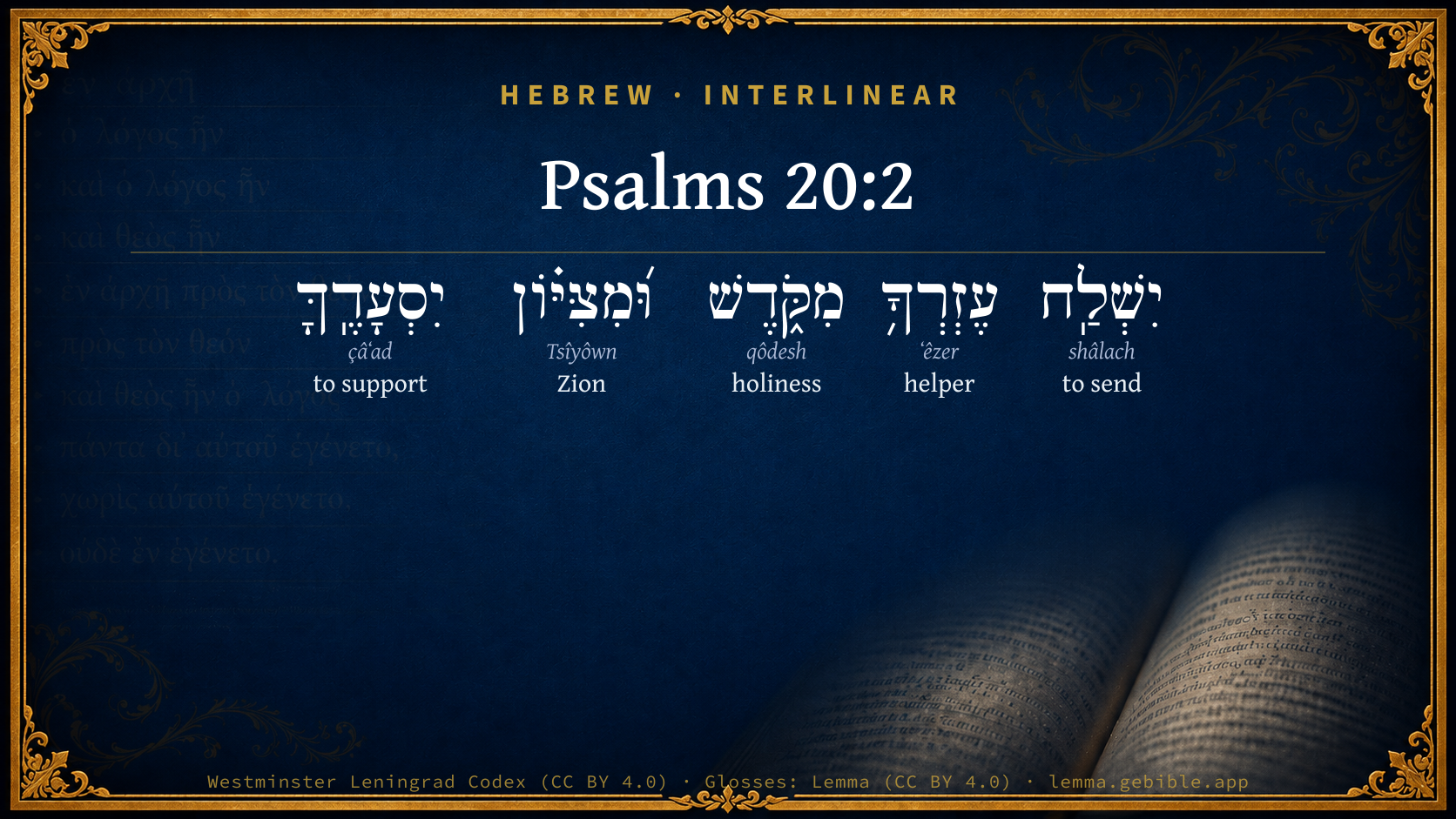
Psalms 20:2

Hebrew (Westminster Leningrad Codex) Psalms 20:2 appears in the Hebrew Old Testament. The text above is from the Westminster Leningrad Codex. Each word links to its Strong’s number, a concise gloss, and parsing drawn from the Open Scriptures Hebrew Bible morphology. Click any word for its full Brown-Driver-Briggs (BDB) entry.
Download image
Cite this verse

Psalms 20:2 (World English Bible). Public Domain. Lemma interlinear Bible study tool, https://lemma.gebible.app/v/psalms/20/2.

Show BibTeX & RIS
BibTeX
RIS
English Translation
Send you help from the sanctuary, Grant you support from Zion,
World English Bible · Public Domain
Download a study sheet

One document with this verse’s original text, its word-by-word gloss line, the meaning frame, cross-references with their text, attributed commentary, and full source and license credits — printable, and it pastes into notes with its structure intact.

This verse Autodidact and up

Study sheet (.html) Plain text (.txt)

A passage Seminary Student

Up to 50 verses in one chapter. A passage sheet keeps up to 6 commentary sources and 12 cross-references per verse, in the order this page ranks them, and says so on the sheet whenever that leaves anything out. Ask for a single verse and you get the Autodidact verse sheet above.

Everything on this page stays free to read, with no account — the sheet is a download of what is already on screen, not access to it.

Want to remove ads? Support Godless Engineer
Compare translations 3

The same verse in 3 English versions, stacked beneath the original-language interlinear above. Click any original word for its lexicon entry.

Each is an independent rendering of the whole verse — the interlinear is not word-aligned to these translations.

Highlighted words mark where these versions differ — a whole-verse word diff, not a word-by-word alignment.

  • World English Bible Public Domain
    Send you help from the sanctuary, Grant you support from Zion,
  • King James Version Public Domain
    Send thee help from the sanctuary, and strengthen thee out of Zion;
  • unfoldingWord Literal Text CC BY-SA 4.0
    May he send you help from the sanctuary and support you from Zion.

unfoldingWord Literal Text — © unfoldingWord, licensed CC BY-SA 4.0. Word-aligned USFM3 via Door43 (git.door43.org/unfoldingWord/en_ult).

Versions to compare (up to 4)

3 of 4 selected

Show all 18 translations

Every available English version of this verse, each an independent rendering of the whole verse.

  • World English Bible Public Domain
    Send you help from the sanctuary, Grant you support from Zion,
  • Berean Standard Bible Public Domain
    May He send you help from the sanctuary and sustain you from Zion.
  • Majority Standard Bible Public Domain
    May He send you help from the sanctuary and sustain you from Zion.
  • King James Version Public Domain
    Send thee help from the sanctuary, and strengthen thee out of Zion;
  • American Standard Version (1901) Public Domain
    Send thee help from the sanctuary, And strengthen thee out of Zion;
  • Revised Version (1885) Public Domain
    Send thee help from the sanctuary, and strengthen thee out of Zion;
  • Geneva Bible (1599) Public Domain
    Send thee helpe from the Sanctuarie, and strengthen thee out of Zion.
  • Douay-Rheims (1899) Public Domain
    May the Lord hear thee in the day of tribulation: may the name of the God of Jacob protect thee.
  • Young's Literal Translation Public Domain
    He doth send thy help from the sanctuary, And from Zion doth support thee,
  • Literal Standard Version CC BY-SA 4.0
    He sends your help from the sanctuary, || And supports you from Zion,
  • Unlocked Literal Bible CC BY-SA 4.0
    and send help from the holy place to support you from Zion.
  • unfoldingWord Literal Text CC BY-SA 4.0
    May he send you help from the sanctuary and support you from Zion.
  • Darby Bible Public Domain
    May he send thee help from the sanctuary, and strengthen thee out of Zion;
  • World Messianic Bible Public Domain
    send you help from the sanctuary, grant you support from Zion,
  • Webster's Bible Public Domain
    \\20:1\\To the chief Musician, A Psalm of David. The LORD hear thee in the day of trouble; the name of the God of Jacob defend thee.
  • Free Bible Version CC BY-SA 4.0
    May the Lord send you help from the sanctuary, and may he support you from Zion.
  • Bible in Basic English Public Domain
    May he send you help from the holy place, and give you strength from Zion;
  • JPS Tanakh (1917) Public Domain
    (20-3) Send forth thy help from the sanctuary, and support thee out of Zion;

Literal Standard Version (2020), Covenant Press — licensed CC BY-SA 4.0. Text via the HelloAO Bible API (eBible.org). Unlocked Literal Bible (unfoldingWord) — licensed CC BY-SA 4.0. Text via the HelloAO Bible API (eBible.org). unfoldingWord Literal Text — © unfoldingWord, licensed CC BY-SA 4.0. Word-aligned USFM3 via Door43 (git.door43.org/unfoldingWord/en_ult). Free Bible Version, Dr. Jonathan Gallagher — licensed CC BY-SA 4.0. Text via the HelloAO Bible API (eBible.org).

Word by word

More ways to search: Search by grammar → Find every occurrence → Compare this word →

Practice this passage: Drill this verse → Learn its vocabulary →

About this verse

These counts appear in no published source. They are computed here, from the morphology-tagged text and Lemma’s own curated glosses. What Lemma adds →

5
words
5
distinct lemmas
Wisdom
section

Notable vocabulary

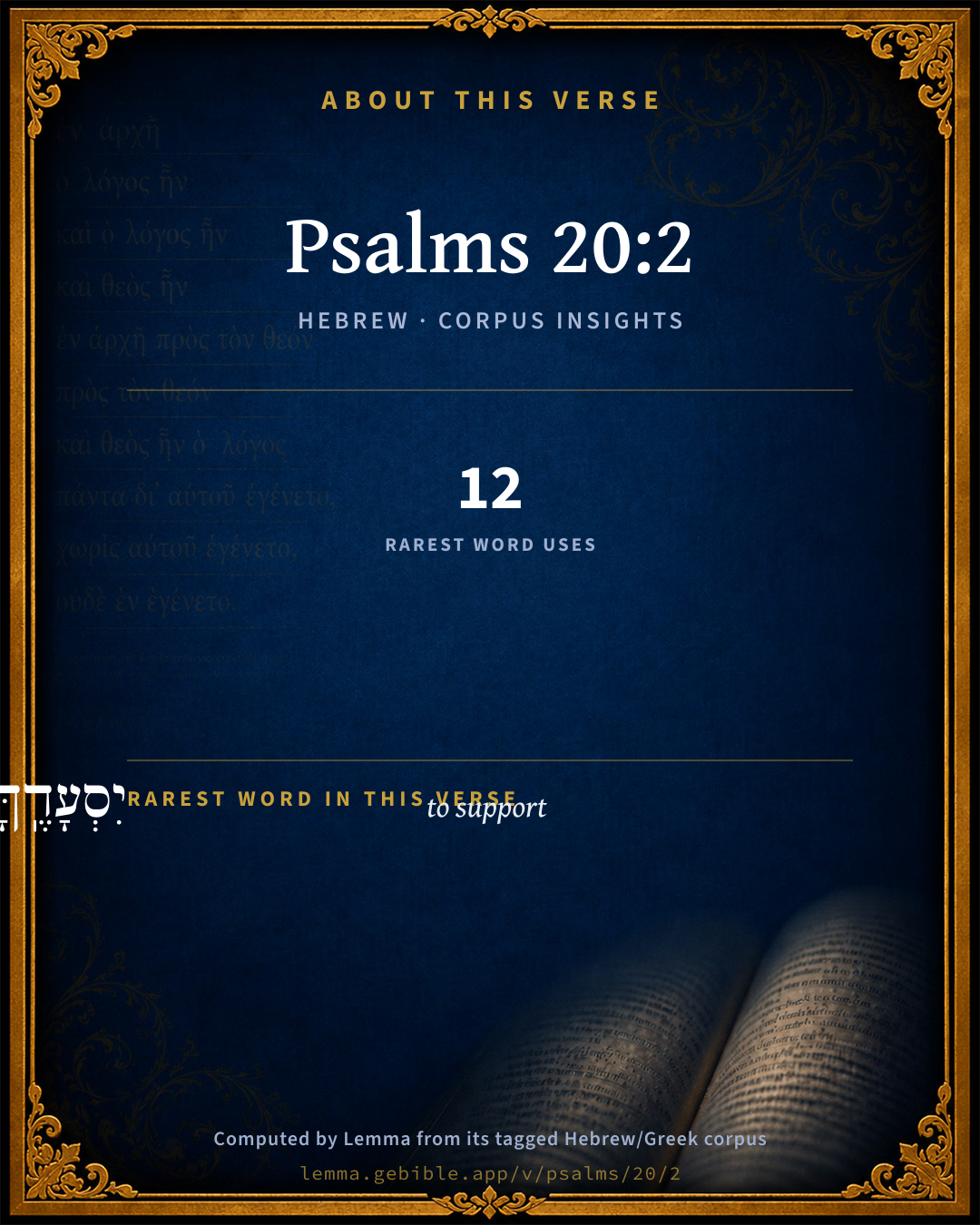
The rarest word here is יִסְעָדֶֽךָּ to support H5582 — appearing just 12 times in the whole Hebrew Bible.

Shared distinctive vocabulary

יִסְעָדֶֽךָּ to support H5582 occurs in 12 verses of the Hebrew Bible. Also found in:

Grammatical profile

  • 2 verbs
  • 3 nouns

Verb forms

  • יִשְׁלַֽח Qal · Imperfect
  • יִסְעָדֶֽךָּ Qal · Imperfect

Hebrew & Septuagint length

In English translation the verse runs 11 words from the Hebrew and 12 from the Septuagint (LXX English) — closely comparable.

A rough comparison of the two English renderings, which tokenize alike — not a word-level alignment.

Word counts can differ between the Hebrew and the Greek without any difference in meaning — e.g. the Hebrew direct-object marker אֵת has no separate Greek word, and Greek often adds the article ὁ.

Cross-references

10

Topical passages linked to Psalms 20:2 in the Treasury of Scripture Knowledge — connected by theme and wording, ordered by reader-vote popularity; previews shown in the World English Bible.

  • 1 Kings 8:44–45 If your people go out to battle against their enemy, by whatever way you shall send them, and they pray to Yahweh toward the city which you have chosen, and toward the house which I have built for your name;
  • 1 Kings 6:16 He built twenty cubits on the hinder part of the house with boards of cedar from the floor to the walls [of the ceiling]: he built [them] for it within, for an oracle, even for the most holy place.
  • 2 Chronicles 20:8–9 They lived therein, and have built you a sanctuary therein for your name, saying,
  • Isaiah 12:6 Cry aloud and shout, you inhabitant of Zion; for great in the midst of you is the Holy One of Israel!"
  • Isaiah 14:32 What then shall one answer the messengers of the nation? That Yahweh has founded Zion, and in her shall the afflicted of his people take refuge.
  • Psalms 3:4 I cry to Yahweh with my voice, And he answers me out of his holy hill. Selah.
  • 2 Samuel 5:7 Nevertheless David took the stronghold of Zion; the same is the city of David.
  • 2 Samuel 6:17 They brought in the ark of Yahweh, and set it in its place, in the midst of the tent that David had pitched for it; and David offered burnt offerings and peace-offerings before Yahweh.
  • Psalms 73:17 Until I entered God's sanctuary, And considered their latter end.
  • Isaiah 37:34–35 By the way that he came, by the same shall he return, and he shall not come to this city, says Yahweh.

Cross-references courtesy of OpenBible.info (CC BY 4.0).

Hebrew and Greek witnesses Masoretic Hebrew ↔ Greek Septuagint

The same verse in the two great witnesses to the Old Testament, shown verse-for-verse.

You’re reading Greek Psalm 19 (Hebrew Psalm 20). The Septuagint counts the superscription, so verse numbers can differ from the Hebrew — chapter-level alignment, not verse-by-verse. Numbering follows Rahlfs.

These are two independent witnesses, not word-aligned to each other, and the Septuagint is shown in lemma (dictionary) form.

Hebrew Psalms 20:2 Masoretic · Westminster Leningrad Codex

יִשְׁלַֽח עֶזְרְךָ֥ מִקֹּ֑דֶשׁ וּ֝מִצִּיּ֗וֹן יִסְעָדֶֽךָּ

Send you help from the sanctuary, Grant you support from Zion,

World English Bible · Public Domain

Greek LXX Greek Psalm 19:2 Septuagint · lemma form

ἐπιἀκούω σύ κύριος ἐν ἡμέρα θλῖψις ὑπερἀσπίζω σύ ὁ ὄνομα ὁ θεός ἰακώβ

Send you help from the sanctuary, and aid you out of Sion.

LXX2012 (modern English Septuagint) · Public Domain

Hebrew: Westminster Leningrad Codex (CC BY 4.0). Greek: Septuagint (public domain); English from LXX2012 (modern English Septuagint) (Public Domain). How the Septuagint differs from the Hebrew →

Commentary

Notes on Psalms 20:2 from classic Christian and Jewish commentators (each source and its license shown beneath its notes). The classic Christian expositions comment on the surrounding passage and are grouped to its opening verse, so a note may address several verses; the Jewish commentaries on the Tanakh (Rashi and others) are per-verse, so they appear only where the commentator wrote on this verse.

Lemma curates 59 commentaries, every one of them public domain or Creative Commons licensed, each selected and text-cleaned for this edition rather than reprinted as found. About our sources →

Trapp's Complete Commentary

John Trapp

Psa 20:2 Send thee help from the sanctuary, and strengthen thee out of Zion;

Ver. 2. Send thee help from the sanctuary] Or, from his holy heaven, saith Tremellius; without which vain is the help of man. God is all the doer in battles; and whencesoever the sword comes, it is bathed in heaven, Isa 34:5, whatsoever Ajax, Timotheus Atheniensis, and other atheists think to the contrary: God will send from heaven and save me, saith holy David.

And strengthen thee out of Zion] i.e. Out of the assemblies of the saints, where they are praying hard for thy welfare. See Psa 76:2-3, {See Trapp on "Psa 76:2"} {See Trapp on "Psa 76:3"}

John Trapp, A Commentary or Exposition upon All the Books of the Old and New Testament (1647–1656) — public domain. Text from a community e-Sword module.

The Biblical Illustrator

Joseph S. Exell

Psa_20:2

Send thee help from the sanctuary.

The sanctuary

I. It is the place where Gods honour dwells. When Israel would have the help and guidance of Jehovah, they made application at the temple where His glory was seen in the holy place, and where He had appointed to respond to their supplications.

II. The house of God is the place of united and fervent prayer. The increased efficacy of prayer when united and fervent, and the assurance that it will have unity and fervency in the sanctuary, point out that place as the source of their help in the hour of danger and of suffering.

III. The house of God is the radiant point of sanctifying truth. From the lips of the living preacher go out those doctrines that operate to sanctify the hearts of men. And who dare hope that society can prosper where no hearts are sanctified?

VI. The instruction of Gods house is the grand agent in the formation of public sentiment. An influence goes out from the holy place to affect all men, whether they will or will not be controlled by the influence. To the ungodly, public sentiment is an irresistible law. There is no means powerful like the house of God in the formation of public opinion and sentiment.

V. The house of God sustains all the other civilising and healthful influences. Identified with it are a preached Gospel and the ministry of reconciliation. These all sustain each other.

VI. From the house of God are selected the subjects of His grace. Those only who frequent the sanctuary are at all likely to be regenerated. It is in the lips of a living ministry that God has pledged Himself to bless. Men bring misery on themselves when--

1. There is a satiety of hearing the Word of God.

2. When the spirit of decay esteems the support of Gospel institutions a burden.

3. When there is a disrespect for the ministry of the reconciliation. (D. A. Clark.)

Help from the sanctuary

The name sanctuary means the holy place, and sometimes refers only to that which was the most holy place, but at other times to the tabernacle generally. It was made holy by Gods dwelling there, and specially by the manifestation of His grace through mediation and sacrifice. To the sanctuary the pious Israelites turned when in trouble and in great emergency, specially besought the Divine protection by clinging to the horns of the altar. Something of the same kind we find in mediaeval Christian times in connection with particular churches. In the Chapter House of Westminster there is a beautiful picture depicting a scene which was often witnessed at the abbey porch. The venerable abbot, with the elevated host in his hand, is staying the progress of a strong angry warrior, while behind him a woman and her children, with terror in their faces, are clinging to his vestments and claiming his protection. But we take the word sanctuary as in its common meaning amongst us today; as the house of God, the place of worship. Help from the sanctuary, therefore, suggests the spiritual strength obtained through the observances of the religious ordinances connected with the day and the house of the Lord. Christ blesses us through them. They are no charms or talisman, but simply channels of His blessing.

I. We all need help. Every soul has its own sadness. Some spiritual, through the conflict with sin. Others temporal, through the difficulties of life.

II. It is a comfort to know that there is help from the sanctuary. For in the sanctuary we draw near to God as the Father of our Lord Jesus Christ, and as we appropriate Him to ourselves as our own God we find ourselves strengthened and encouraged. We are in our lives like a schoolboy learning to write, and every week is a page in our copy book, and every day a line. On the first line, and in the sanctuary, Christ has set before us His own beautiful example, and we start out to imitate it. But as we go down line after line we too largely lose sight of that which He has written, and when we get to the bottom our work is all irregular and blotted, and the paper, mayhap, also blistered with our tears. Then comes the first day of the week again, and when we enter into the sanctuary Jesus speaks to us words of cheer and sets us a new copy, and so we begin again. Thus page after page is covered. It is poor work enough, but it improves a little every time, and it is much better at the end of the book than it was at the beginning, for at the bottom of the last page the Master writes, Well done! Thus the sanctuary counteracts the evil influences of the week. And there have been special blessings coming to earnest Christians through some particular portion of the service of Gods house. The Lord guides His Word to the hearts of His people. He knows how to direct the minister to preach aright. See how minute are the directions given by which Cornelius was to find Peter and Ananias to find Saul of Tarsus in Damascus. And the Holy Spirit acts in like manner still.

III. To get this help we must come to the sanctuary. I do not deny that we can get to God in Christ anywhere. But a particular promise is made in connection with the sanctuary. Where two or three, etc. It may be difficult to analyse this special blessing, but it is reality. How lamentable, then, that so many stay away, and on such slight pretexts.

IV. If he would be the means of conveying this help the minister must keep close to Christ. For it is the Christ of the sanctuary that constitutes its value, and if he, on whom most of all the character and quality of the services depend, loses sight of Him, then the Church is reduced at once to the level of the Lyceum, and all spiritual power is gone. The soul of a saint cannot be nourished by a scientific disquisition. The best way to defend the truth is to expound it. Above all, must they know Christ experimentally. (W. M. Taylor, D. D.)

The Biblical Illustrator, edited by Joseph S. Exell (c. 1880s–1900s) — public domain. Text from a community e-Sword module.

Joseph Benson's Commentary

Psa 20:2-4. Send thee help from the sanctuary — Either from heaven, as it is expressed Psa 20:6; or, rather, from the tabernacle in Zion, where the ark then was; toward which the Israelites directed their prayers, and from which God heard and answered them. Thus it is explained in the next clause. Remember — Namely, with acceptance, as it follows; all thy offerings — Offered either by thee, or by us thy people in thy behalf. And accept thy burnt-sacrifice — Hebrew, ידשׁנה, jedasheneh, turn to ashes, by fire sent from heaven in token of acceptance, as was usual. Grant thee according to thy own heart — That is, that good success which thy heart desires; and fulfil all thy counsels — Thy present designs for the glory of God and the good of his and thy people.

Joseph Benson's Commentary on the Old and New Testaments (1811–1818) — public domain. Text from a community e-Sword module.

J. A. Alexander on Psalms

Joseph Addison Alexander

3. (Psa 20:2). (May Jehovah) send thee help from (his) sanctuary, and from Zion sustain thee. The mention of Zion and the sanctuary shows that Jehovah s appealed to as the king of his people, and as such not only able but bound by covenant to afford them aid. See below, on Psa 20:10 (9.) Sustain thee, hold thee up, the same verb that is used in Psa 18:36 (35). Both verbs may also be translated as simple futures, will send, will sustain; but see below.

Joseph Addison Alexander, The Psalms Translated and Explained (1850) — public domain. Text from a community e-Sword module.

Jamieson, Fausset & Brown

Robert Jamieson, A. R. Fausset & David Brown

strengthen thee--sustain in conflict; even physical benefits may be included, as courage for war, &c., as such may proceed from a sense of divine favor, secured in the use of spiritual privileges.

Jamieson, Fausset & Brown — Commentary Critical and Explanatory on the Whole Bible (1871) — public domain (CC PDM 1.0). Text via the HelloAO Bible API.

Adam Clarke's Commentary

Verse 2. Send thee help from the sanctuary] This was the place where God recorded his name; the place where he was to be sought, and the place where he manifested himself. He dwelt between the cherubim over the mercy-seat. He is now in Christ, reconciling the world to himself. This is the true sanctuary where God must be sought.

Strengthen thee out of Zion] The temple or tabernacle where his prayers and sacrifices were to be offered.

Adam Clarke's Commentary on the Bible (1810–1826) — public domain. Text from a community e-Sword/MySword module.

John Calvin's Commentaries

2. May he send thee help. That is to say, may he succor thee out of mount Sion, where he commanded the ark of the covenant to be placed, and chose for himself a dwelling-place. The weakness of the flesh will not suffer men to soar up to heaven, and, therefore, God comes down to meet them, and by the external means of grace shows that he is near them. Thus the ark of the covenant was to his ancient people a pledge of his presence, and the sanctuary an image of heaven. But as God, by appointing mount Sion to be the place where the faithful should continually worship him, had joined the kingdom and priesthood together, David, in putting into the lips of the people a prayer for help out of Sion, doubtless had an eye to this sacred bond of union. Hence I conjecture that this psalm was composed by David in his old age, and about the close of his life. Some think he spake of Sion by the Spirit of prophecy before it had been appointed that the ark should be placed there; but this opinion seems strained, and to have little probability.

John Calvin's Commentaries (1540-1563) — public domain. Text from the Calvin Translation Society English edition (1840s-50s) via the Christian Classics Ethereal Library (ccel.org). Calvin's coverage is partial (roughly two-thirds of the Bible); uncommented books and verses are honest gaps, never fabricated. The 19th-century editor's footnotes and remarks are omitted so the notes are faithfully Calvin's own voice.

The Cambridge Bible for Schools and Colleges

gen. ed. J. J. S. Perowne

2. the sanctuary] Here, as the parallel out of Zion shews, the earthly sanctuary is meant. See notes on Psa_3:4, Psa_14:7; and cp. Psa_20:6.

strengthen] Lit. support; the same word as hath holden me up in Psa_18:35.

The Cambridge Bible for Schools and Colleges (gen. ed. J. J. S. Perowne; Cambridge University Press, 1878–1918) — public domain. Text from a community e-Sword module.

John Gill's Exposition

Send thee help from the sanctuary,.... Meaning either from the tabernacle, the holy place, where was the ark, the symbol of the divine Presence; or rather heaven, the habitation of God's holiness unless the same is meant by it as by Zion, in the next clause, the church of God, from whence he sends the rod of his strength;

and strengthen thee out of Zion; and the "help" and "strength" prayed for are not to be understood of that assistance and support, which Christ, as man, had from his Father, at the time of his sufferings, which were promised him, and he believed he should have, and had, Psa 89:21; since these petitions follow that which relates to his exaltation; but of the help and strength afforded to the apostles and ministers of Christ, after they had received the commission from him to preach the Gospel to every creature; when, as a full answer to these petitions, God worked with them, greatly assisted them, strengthened them with strength in their souls; confirmed the word with signs and wonders following; made it the power of God to salvation to multitudes; and so strengthened the cause, interest, and kingdom of the Redeemer.

John Gill's Exposition of the Whole Bible (1746–1763) — public domain (CC PDM 1.0). Text via the HelloAO Bible API.

Albert Barnes' Notes on the Bible

Send thee help - Margin, thy help. So the Hebrew. The idea is, such help as he needed; such as would make him safe.

From the sanctuary - From the tabernacle, or the holy place where God was worshipped, and where he was supposed to reside, Exo 28:43; Exo 29:30; Exo 35:19; Exo 39:1. This was his seat; his throne; where he abode among the people. Here, too, it would seem that he had been worshipped, and his aid implored, in view of this expedition; here the royal psalmist had sought to secure the divine favor by the presentation of appropriate sacrifices and offerings Psa 20:3. The prayer here is, that God would accept those offerings, and hear those supplications, and would now send the desired help from the sanctuary where he resided; that is, that he would grant his protection and aid.

And strengthen thee - Margin, as in Hebrew, support thee. The idea is, that he would grant his upholding hand in the day of peril.

Out of Zion - The place where God was worshipped; the place where the tabernacle was reared. See the note at Psa 2:6.

Albert Barnes' Notes on the Bible (1834–1885) — public domain. Text from a community e-Sword/MySword module.

Matthew Poole's English Annotations

From the sanctuary; either,

1. From heaven, as it is expressed, Psa 20:6. Or rather,

2. From the tabernacle in Zion, as it is explained in the next words, where the ark then was; toward which the Israelites directed their prayers, and from which God heard and answered them.

Matthew Poole's English Annotations on the Holy Bible (1683–1685) — public domain. Text from a community e-Sword/MySword module.

The Treasury of David

Charles H. Spurgeon

Ver. 2. Send thee help from the sanctuary. Out of heaven's sanctuary came the angel to strengthen our Lord, and from the precious remembrance of God's doings in his sanctuary our Lord refreshed himself when on the tree. There is no help like that which is of God's sending, and no deliverance like that which comes out of his sanctuary. The sanctuary to us is the person of our blessed Lord, who was typified by the temple, and is the true sanctuary which God has pitched, and not man: let us fly to the cross for shelter in all times of need and help will be sent to us. Men of the world despise sanctuary help, but our hearts have learned to prize it beyond all material aid. They seek help out of the armoury, or the treasury, or the buttery, but we turn to the sanctuary.

And strengthen thee out of Zion. Out of the assemblies of the pleading saints who had for ages prayed for their Lord, help might well result to the despised sufferer, for praying breath is never spent in vain. To the Lord's mystical body the richest comes in answer to the pleadings of his saints assembled for holy worship as his Zion. Certain advertisers recommend a strengthening plaster, but nothing can give such strength to the loins of a saint as waiting upon God in the assemblies of his people. This verse is a benediction befitting a Sabbath morning, and may be the salutation either of a pastor to his people, or of a church to its minister. God in the sanctuary of his dear Son's person, and in the city of his chosen church is the proper object of his people's prayers, and under such a character may they confidently look to him for his promised aid.

Ver. 2. Send thee help from the sanctuary. Here we see the nature of true faith, that it causeth us to see help in heaven, and so to pray for it when there is none to be seen in the earth. And this is the difference between faith and unbelief; that the very unbelievers can by reason conceive of help, so long as they have any means to help them; but if they fail they can see none at all; so they are like unto those that are purblind, who can see nothing but near at hand. But faith seeth afar off, even into heaven, so that it is "the evidence of things that are not seen; "for it looketh unto the power of God, who hath all means in his hand, or can work without them, who made all of nothing, and "calleth the things that be not, as though they were." So that as the holy martyr Stephen, when his enemies were ready to burst for anger, and gnash at him with their teeth, looked steadfastly into heaven, and saw Christ standing at the right hand of God ready to defend him; so faith in the promises of the word doth see help in heaven ready for us, when there are no means in earth, Nicholas Bownd.

Ver. 2. Send thee help from the sanctuary. Why "from the sanctuary, "but because the Lord presented himself there as upon the mercyseat! The sanctuary was in Zion, the mercyseat was in the sanctuary, the Lord was in the mercyseat; he would have himself set forth as residing there. Herein they pray, and pray in faith, for help and strength. David Clarkson.

Ver. 2. Strengthen thee out of Zion. That is, out of the assemblies of the saints, where they are praying hard for thy welfare. John Trapp.

Ver. 2. Sanctuary helpa suggestive topic.

Psalms 20:3*

Charles H. Spurgeon's The Treasury of David (1869–1885) — public domain. Psalms only. Text from a community e-Sword/MySword module.

Whedon's Commentary on the Bible

Daniel D. Whedon

2. Help from the sanctuary—The holy of holies of the tabernacle, where were the symbols of God, where the national expiation was made, and from whence the lively oracles proceeded.

Daniel D. Whedon (gen. ed.), Commentary on the Old and New Testaments (1874–1909) — public domain. Text from a community e-Sword module.

The Pulpit Commentary

Send thee help from the sanctuary. "The sanctuary" here is undoubtedly the holy place which David had established on Mount Zion, and in which he had placed the ark of the covenant. God"s help was always regarded as coming especially from the place where he had "set his Name." In the original it is, "Send thy help the help thou needest and prayest for. And strengthen thee out of Zion; rather, support thee.

The Pulpit Commentary (1880–1919), ed. H.D.M. Spence-Jones & Joseph S. Exell — public domain. Text from a community e-Sword module.

John Wesley's Explanatory Notes

Sanctuary - From the tabernacle in Zion, where the ark then was; toward which the Israelites directed their prayers.

John Wesley, Explanatory Notes Upon the Whole Bible (1754–1765) — public domain. Text via the GEBible commentary corpus.

Scofield Reference Notes

C. I. Scofield

sanctuary

Heb. qodesh (tr. "holy,") Psa 20:6

The Scofield Reference Bible (1917 edition), notes by C. I. Scofield — public domain. Text from a community e-Sword module.

Rashi

Rabbi Shlomo Yitzchaki (Rashi)

May the Lord answer you on a day of distress This psalm was [composed] because he [David] would send Joab and all Israel to war, and he would stand in Jerusalem and pray for them, as the matter is stated (in II Sam. 18:3): “It is better that you be for us from the city as aid.” Were it not for David, Joab would not have succeeded in battle.

the name of the God of Jacob Who promised him [Jacob] when he went to Haran and kept His promise; therefore, it is stated: “the God of Jacob.”

Rashi on the Tanakh — English translations: “The Judaica Press complete Tanach with Rashi, translated by A. J. Rosenberg” (CC BY 4.0); “Pentateuch with Rashi's commentary by M. Rosenbaum and A.M. Silbermann, 1929-1934” (public domain); “The Metsudah Tanach series, Lakewood, N.J” (CC BY 4.0); and “The Book of Joshua, Metsudah Publications, 1997” (CC BY 4.0). Text via Sefaria.

Lesson kit

Teaching starters — assembled from the data on this page, not authored interpretation. Every prompt links to the verse data it draws on. Edit before teaching.

Psalms, in the Wisdom, opens this verse with 5 words (5 distinct Hebrew lemmas). Its most distinctive word is çâʻad (“to support”). A historical commentator’s framing appears above. Read the whole chapter for the surrounding context.

Discussion questions

  1. What does “to support” (çâʻad) contribute to the verse as a whole?
  2. Genesis 18:5 shares the word «to support» with this verse. How do the two illuminate each other?
  3. These translations render this verse differently. What is at stake in choosing one wording over another?
  4. The verb «יִשְׁלַֽח» is Qal Imperfect. How does its form color the action?
  5. Reading how Trapp's Complete Commentary and The Biblical Illustrator read this verse, where do the two commentators agree and where do they part?

Things to notice

Reading settings

Reading text

Shown beneath each verse's original-language words.

Old Testament
Old Testament edition

Read the OT as the Masoretic Hebrew (MT) or the Greek Septuagint (LXX).

English shown for the Greek Septuagint (in the Hebrew ↔ Greek comparison).

Comparing translations? Open the Compare panel on any verse page to stack up to four side by side.