
Lamentations 5:18

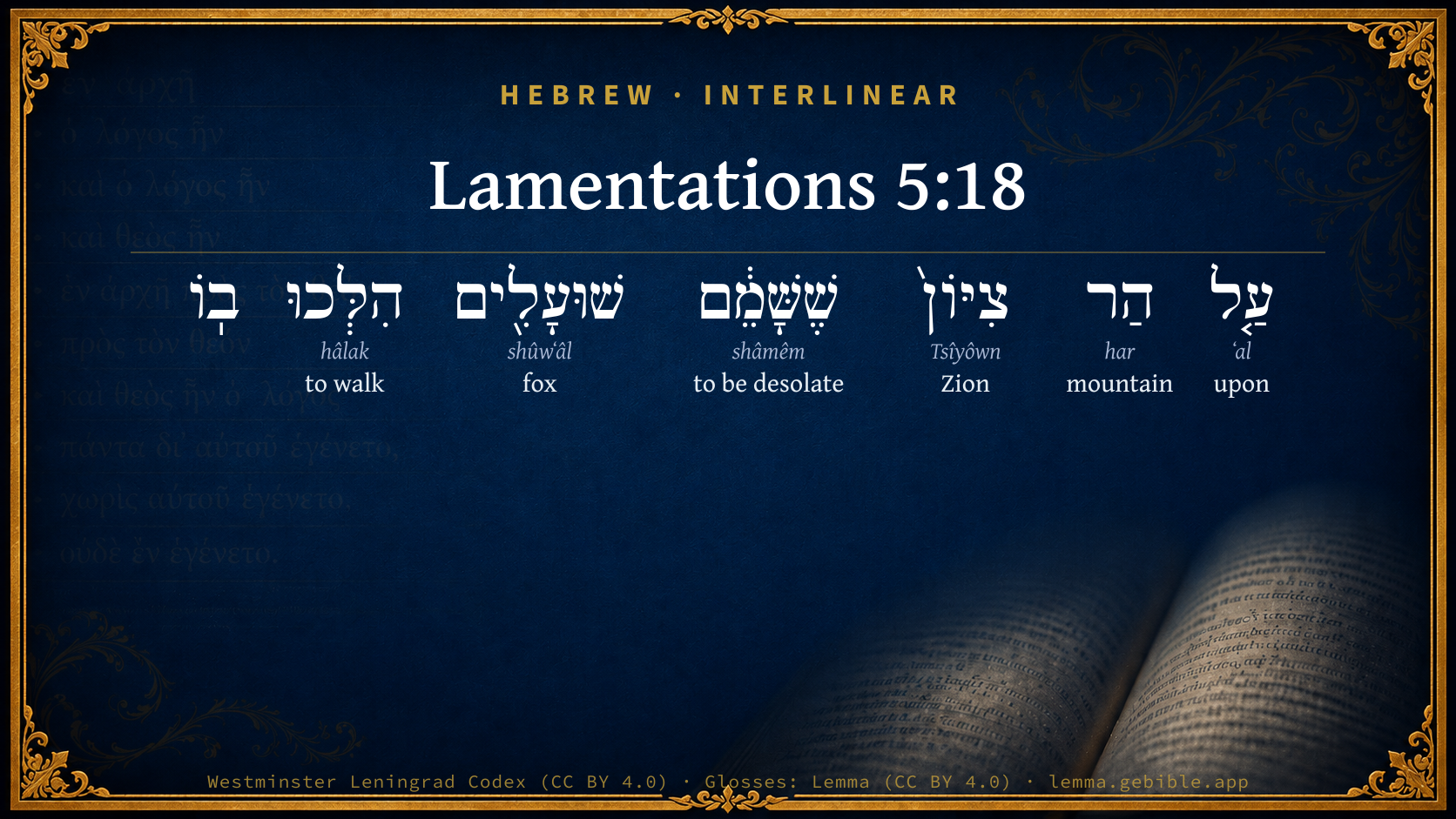
Hebrew (Westminster Leningrad Codex) Lamentations 5:18 appears in the Hebrew Old Testament. The text above is from the Westminster Leningrad Codex. Each word links to its Strong’s number, a concise gloss, and parsing drawn from the Open Scriptures Hebrew Bible morphology. Click any word for its full Brown-Driver-Briggs (BDB) entry.
Download image
Cite this verse

Lamentations 5:18 (World English Bible). Public Domain. Lemma interlinear Bible study tool, https://lemma.gebible.app/v/lamentations/5/18.

Show BibTeX & RIS
BibTeX
RIS
English Translation
For the mountain of Zion, which is desolate: The foxes walk on it.
World English Bible · Public Domain
Download a study sheet

One document with this verse’s original text, its word-by-word gloss line, the meaning frame, cross-references with their text, attributed commentary, and full source and license credits — printable, and it pastes into notes with its structure intact.

This verse Autodidact and up

Study sheet (.html) Plain text (.txt)

A passage Seminary Student

Up to 50 verses in one chapter. A passage sheet keeps up to 6 commentary sources and 12 cross-references per verse, in the order this page ranks them, and says so on the sheet whenever that leaves anything out. Ask for a single verse and you get the Autodidact verse sheet above.

Everything on this page stays free to read, with no account — the sheet is a download of what is already on screen, not access to it.

Want to remove ads? Support Godless Engineer
Compare translations 3

The same verse in 3 English versions, stacked beneath the original-language interlinear above. Click any original word for its lexicon entry.

Each is an independent rendering of the whole verse — the interlinear is not word-aligned to these translations.

Highlighted words mark where these versions differ — a whole-verse word diff, not a word-by-word alignment.

  • World English Bible Public Domain
    For the mountain of Zion, which is desolate: The foxes walk on it.
  • King James Version Public Domain
    Because of the mountain of Zion, which is desolate, the foxes walk upon it.
  • unfoldingWord Literal Text CC BY-SA 4.0
    On account of Mount Zion, which is desolate, foxes walk on it.

unfoldingWord Literal Text — © unfoldingWord, licensed CC BY-SA 4.0. Word-aligned USFM3 via Door43 (git.door43.org/unfoldingWord/en_ult).

Versions to compare (up to 4)

3 of 4 selected

Show all 18 translations

Every available English version of this verse, each an independent rendering of the whole verse.

  • World English Bible Public Domain
    For the mountain of Zion, which is desolate: The foxes walk on it.
  • Berean Standard Bible Public Domain
    because of Mount Zion, which lies desolate, patrolled by foxes.
  • Majority Standard Bible Public Domain
    because of Mount Zion, which lies desolate, patrolled by foxes.
  • King James Version Public Domain
    Because of the mountain of Zion, which is desolate, the foxes walk upon it.
  • American Standard Version (1901) Public Domain
    For the mountain of Zion, which is desolate: The foxes walk upon it.
  • Revised Version (1885) Public Domain
    For the mountain of Zion, which is desolate; the foxes walk upon it.
  • Geneva Bible (1599) Public Domain
    Because of the mountaine of Zion which is desolate: the foxes runne vpon it.
  • Douay-Rheims (1899) Public Domain
    For mount Sion, because it is destroyed, foxes have walked upon it.
  • Young's Literal Translation Public Domain
    For the mount of Zion -- that is desolate, Foxes have gone up on it.
  • Literal Standard Version CC BY-SA 4.0
    For the Mount of Zion—that is desolate, || Foxes have gone up on it.
  • Unlocked Literal Bible CC BY-SA 4.0
    for Mount Zion lies desolate, with jackals prowling over it.
  • unfoldingWord Literal Text CC BY-SA 4.0
    On account of Mount Zion, which is desolate, foxes walk on it.
  • Darby Bible Public Domain
    Because of the mountain of Zion, which is desolate: foxes walk over it.
  • World Messianic Bible Public Domain
    for the mountain of Zion, which is desolate. The foxes walk on it.
  • Webster's Bible Public Domain
    Because of the mountain of Zion, which is desolate, the foxes walk upon it.
  • Free Bible Version CC BY-SA 4.0
    Because of Mount Zion, which has been abandoned, and where only foxes roam.
  • Bible in Basic English Public Domain
    Because of the mountain of Zion which is a waste; jackals go over it.
  • JPS Tanakh (1917) Public Domain
    For the mountain of Zion, which is desolate, the foxes walk upon it.

Literal Standard Version (2020), Covenant Press — licensed CC BY-SA 4.0. Text via the HelloAO Bible API (eBible.org). Unlocked Literal Bible (unfoldingWord) — licensed CC BY-SA 4.0. Text via the HelloAO Bible API (eBible.org). unfoldingWord Literal Text — © unfoldingWord, licensed CC BY-SA 4.0. Word-aligned USFM3 via Door43 (git.door43.org/unfoldingWord/en_ult). Free Bible Version, Dr. Jonathan Gallagher — licensed CC BY-SA 4.0. Text via the HelloAO Bible API (eBible.org).

Word by word

More ways to search: Search by grammar → Find every occurrence → Compare this word →

Practice this passage: Drill this verse → Learn its vocabulary →

About this verse

These counts appear in no published source. They are computed here, from the morphology-tagged text and Lemma’s own curated glosses. What Lemma adds →

7
words
6
distinct lemmas
Prophets
section

Notable vocabulary

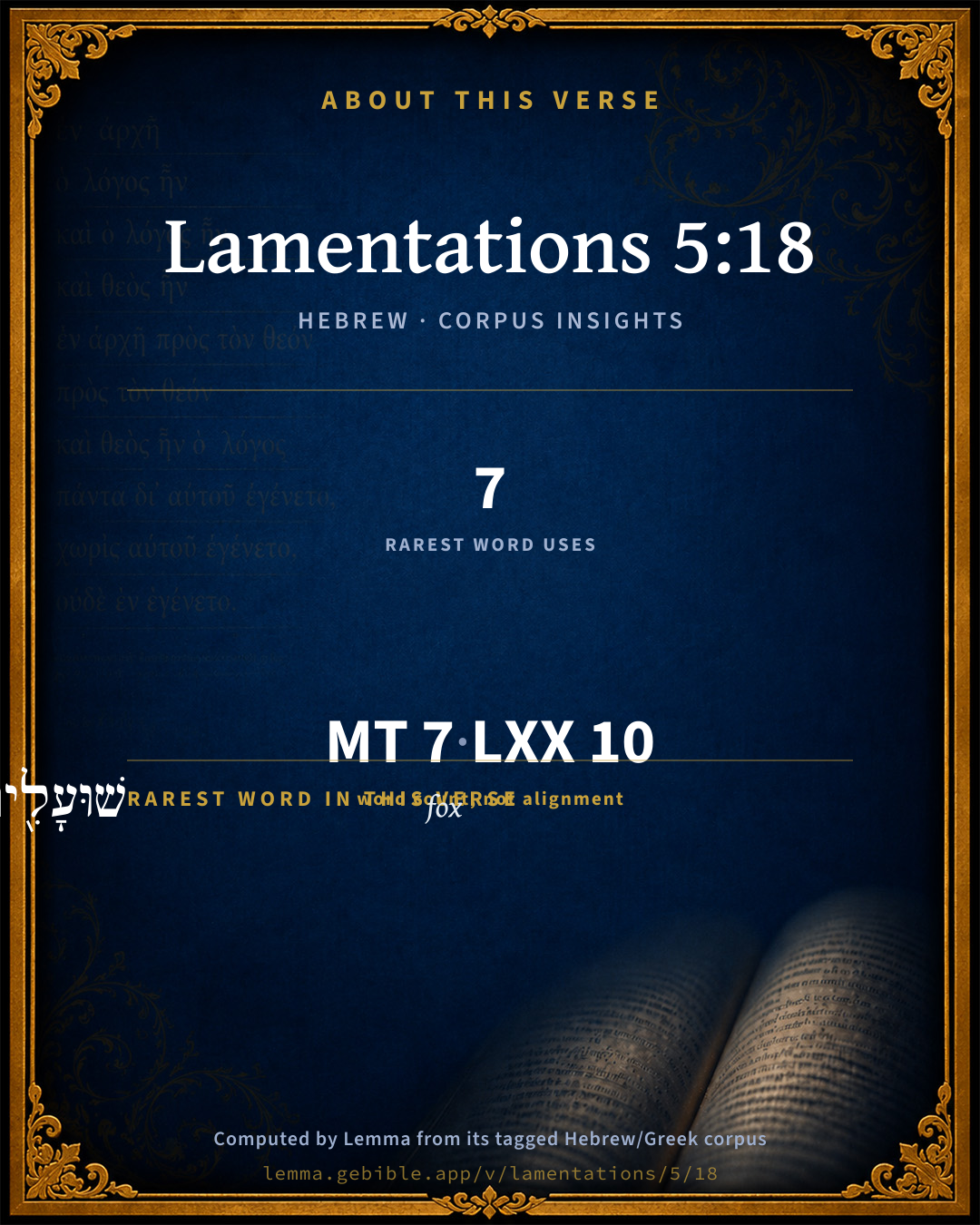
The rarest word here is שׁוּעָלִ֖ים fox H7776 — appearing just 7 times in the whole Hebrew Bible.

Shared distinctive vocabulary

שׁוּעָלִ֖ים fox H7776 occurs in 6 verses of the Hebrew Bible. Also found in:

Grammatical profile

  • 2 verbs
  • 3 nouns
  • 2 prepositions

Verb forms

  • שֶׁשָּׁמֵ֔ם Qal · Perfect
  • הִלְּכוּ Piel · Perfect

Hebrew & Septuagint length

In English translation the verse runs 13 words from the Hebrew and 14 from the Septuagint (LXX English) — closely comparable.

A rough comparison of the two English renderings, which tokenize alike — not a word-level alignment.

Word counts can differ between the Hebrew and the Greek without any difference in meaning — e.g. the Hebrew direct-object marker אֵת has no separate Greek word, and Greek often adds the article ὁ.

In the original languages it is 7 Hebrew tokens and 10 Greek tokens — but the two are counted differently (Hebrew bundles its prefixes and suffixes into one token; the Greek is in lemma form), so that isn’t a like-for-like length.

Cross-references

9

Topical passages linked to Lamentations 5:18 in the Treasury of Scripture Knowledge — connected by theme and wording, ordered by reader-vote popularity; previews shown in the World English Bible.

  • Micah 3:12 Therefore Zion for your sake will be plowed like a field, And Jerusalem will become heaps of rubble, And the mountain of the temple like the high places of a forest.
  • Jeremiah 9:11 I will make Jerusalem heaps, a dwelling-place of jackals; and I will make the cities of Judah a desolation, without inhabitant.
  • 1 Kings 9:7–8 then will I cut off Israel out of the land which I have given them; and this house, which I have made holy for my name, will I cast out of my sight; and Israel shall be a proverb and a byword among all peoples.
  • Psalms 74:2–3 Remember your congregation, which you purchased of old, Which you have redeemed to be the tribe of your inheritance; Mount Zion, in which you have lived.
  • Isaiah 32:13–14 On the land of my people shall come up thorns and briers; yes, on all the houses of joy in the joyous city.
  • Jeremiah 17:3 My mountain in the field, I will give your substance and all your treasures for a spoil, [and] your high places, because of sin, throughout all your borders.
  • Jeremiah 26:9 Why have you prophesied in the name of Yahweh, saying, This house shall be like Shiloh, and this city shall be desolate, without inhabitant? All the people were gathered to Jeremiah in the house of Yahweh.
  • Jeremiah 52:13 and he burned the house of Yahweh, and the king's house; and all the houses of Jerusalem, even every great house, burned he with fire.
  • Lamentations 2:8–9 Yahweh has purposed to destroy the wall of the daughter of Zion; He has stretched out the line, he has not withdrawn his hand from destroying; He has made the rampart and wall to lament; they languish together.

Cross-references courtesy of OpenBible.info (CC BY 4.0).

Hebrew and Greek witnesses Masoretic Hebrew ↔ Greek Septuagint

The same verse in the two great witnesses to the Old Testament, shown verse-for-verse.

These are two independent witnesses, not word-aligned to each other, and the Septuagint is shown in lemma (dictionary) form.

Hebrew Lamentations 5:18 Masoretic · Westminster Leningrad Codex

עַ֤ל הַר צִיּוֹן֙ שֶׁשָּׁמֵ֔ם שׁוּעָלִ֖ים הִלְּכוּ בֽוֹ

For the mountain of Zion, which is desolate: The foxes walk on it.

World English Bible · Public Domain

Greek LXX Lamentations 5:18 Septuagint · lemma form

ἐπί ὄρος σιων ὅτι ἀπο ἀναἵζω ἀλώπηξ διαἔρχομαι ἐν αὐτός

Over the mountain of Sion, because it is made desolate, foxes have walked therein.

LXX2012 (modern English Septuagint) · Public Domain

Hebrew: Westminster Leningrad Codex (CC BY 4.0). Greek: Septuagint (public domain); English from LXX2012 (modern English Septuagint) (Public Domain). How the Septuagint differs from the Hebrew →

Commentary

Notes on Lamentations 5:18 from classic Christian and Jewish commentators (each source and its license shown beneath its notes). The classic Christian expositions comment on the surrounding passage and are grouped to its opening verse, so a note may address several verses; the Jewish commentaries on the Tanakh (Rashi and others) are per-verse, so they appear only where the commentator wrote on this verse.

Lemma curates 59 commentaries, every one of them public domain or Creative Commons licensed, each selected and text-cleaned for this edition rather than reprinted as found. About our sources →

Trapp's Complete Commentary

John Trapp

Lam 5:18 Because of the mountain of Zion, which is desolate, the foxes walk upon it.

Ver. 18. Because of the mountain of Zion, which is desolate,] q.d., Next unto our sins (which are our greatest sorrow), nothing troubleth us more than this, that the public exercises of piety are put down; Zion, the seat of God’s sanctuary, is desolate.

John Trapp, A Commentary or Exposition upon All the Books of the Old and New Testament (1647–1656) — public domain. Text from a community e-Sword module.

Tyndale Open Study Notes

Tyndale Open Resources

5:18 haunted by jackals: Cp. Isa 13:22; 34:13; Jer 9:11; 10:22; Mal 1:3.

Tyndale Open Study Notes — © Tyndale Open Resources, licensed CC BY-SA 4.0. Text via the HelloAO Bible API.

Jamieson, Fausset & Brown

Robert Jamieson, A. R. Fausset & David Brown

foxes--They frequent desolate places where they can freely and fearlessly roam.

Jamieson, Fausset & Brown — Commentary Critical and Explanatory on the Whole Bible (1871) — public domain (CC PDM 1.0). Text via the HelloAO Bible API.

Adam Clarke's Commentary

Verse 18. The foxes walk upon it.] Foxes are very numerous in Palestine, see on Jdg 15:4. It was usual among the Hebrews to consider all desolated land to be the resort of wild beasts; which is, in fact, the case every where when the inhabitants are removed from a country.

Adam Clarke's Commentary on the Bible (1810–1826) — public domain. Text from a community e-Sword/MySword module.

John Calvin's Commentaries

Though he had in general included all kinds of evils, he yet mentions now the principal cause of sorrow, that mount Sion had lost its beauty and its excellency. For that place had been chosen by God, as though he had descended there from heaven, that he might dwell there; and we know also that its beauty is spoken of in high terms. For there the face of God shone forth, as Moses and the Prophets often speak. It was then an extremely sad change, that as God had dwelt in mount Sion, foxes should lodge there as in a deserted cave. For on mount Sion was the tabernacle or the sanctuary; and God says that it was the tabernacle of meeting, מועד, moud, because there he wished to hold intercourse with his people. As, then, that place included God and his Church, it was, as I have said, a dreadful and monstrous thing, that it had become so desolate, that foxes succeeded in the place of God and the faithful. It was not, then, without reason that Jeremiah, after having spoken of so many and so bitter calamities, mentioned this as the chief, that mount Sion was reduced to desolation, so that foxes ran there hither and thither

For as it is the principal thing, and as it were the chief of all blessings, to be counted God’s people, and to have a familiar access to him, so in adversities nothing is so sad as to be deprived of God’s presence. When David testified his gratitude to God, because he had been enriched by every kind of blessing, he added this,

“I shall dwell in the house of God.” (Psalm 23:6.)

For though he had spoken of wealth and riches and of the abundance of all things, yet he saw that his chief happiness was to call on God together with the faithful, and to be deemed one of his people. So, also, on the other hand, the Prophet here shews that nothing can be sadder to the godly than when God leaves his dwelling and makes it desolate, in order to terrify all who may see it.

This had been predicted to them by Jeremiah himself, as we have seen in the seventh chapter of his prophecies, “Go ye to Shiloh,” he said, where the ark of the covenant had long been; though that place had been a long time the habitation of God, yet it was afterwards rejected with great disdain. Jeremiah then declared to the Jews, while they were yet in safety, that such would be the condition of Jerusalem; but his prophecy was not believed. He now, then, confirms, by the event, what he had predicted by God’s command, when he says that mount Sion was become the den of foxes. It follows, —

John Calvin's Commentaries (1540-1563) — public domain. Text from the Calvin Translation Society English edition (1840s-50s) via the Christian Classics Ethereal Library (ccel.org). Calvin's coverage is partial (roughly two-thirds of the Bible); uncommented books and verses are honest gaps, never fabricated. The 19th-century editor's footnotes and remarks are omitted so the notes are faithfully Calvin's own voice.

Ellicott's Commentary for English Readers

(18) Foxes.—Better, jackals, who are thought of as haunting the ruins of Jerusalem. (Comp. Psa_63:10.)

A Bible Commentary for English Readers, edited by Charles John Ellicott (1878–1897) — public domain. Text from a community e-Sword module.

The Cambridge Bible for Schools and Colleges

gen. ed. J. J. S. Perowne

18. foxes] mg. jackals. The words imply that a considerable time has passed since the overthrow of the Temple.

The Cambridge Bible for Schools and Colleges (gen. ed. J. J. S. Perowne; Cambridge University Press, 1878–1918) — public domain. Text from a community e-Sword module.

John Gill's Exposition

Because of the mountain of Zion, which is desolate,.... Meaning either the city of Jerusalem in general, or the temple in particular, which both lay in ruins: but the latter gave the truly godly the greatest concern; that the seat of divine Majesty should be in such a condition; that the public exercises of religion should cease, and there be no more opportunities of waiting upon God, and worshipping him as heretofore; their civil interest, and the loss of that did not so much affect them as the interest of religion, and what that suffered:

the foxes walk upon it: as they do in desolate places, shunning the company of men; but here they walked in common, and as freely as in the woods and deserts: this was fulfilled in the destruction of the second temple, as well as the first. R. Akiba (c) and his companions were walking together; they saw a fox come out of the holy of holies; they wept, but he laughed or rejoiced; they wept, that in the place where the stranger that drew near should die, now foxes walked upon it; he laughed or rejoiced, because, as this prophecy was fulfilled, so would others that predicted good things.

(c) T. Bab. Maccot, fol. 24. 1. 2.

John Gill's Exposition of the Whole Bible (1746–1763) — public domain (CC PDM 1.0). Text via the HelloAO Bible API.

Albert Barnes' Notes on the Bible

The foxes - Or, jackals. As these animals live among ruins, and shun the presence of man, it shows that Zion is laid waste and deserted.

Albert Barnes' Notes on the Bible (1834–1885) — public domain. Text from a community e-Sword/MySword module.

Haydock's Catholic Bible Commentary

Foxes, which were very common, Judges xv. 4. Thus, Horace says: Agros atque lares patrios, habitandaque fana

Apris relinquet et edacibus lupis. (Epod. 16.)

George Leo Haydock (1774–1849), Haydock's Catholic Family Bible and Commentary, 1859 edition — public domain. Excludes Psalms (Douay-Rheims chapter numbering differs from Protestant) and Deuterocanonical books (Catholic canon only).

Matthew Poole's English Annotations

Foxes and other wild beasts, which flee from places inhabited for fear of men inhabiting, and are much in desolate places. The mountain of Zion, where the temple once stood, and people met to worship God, was now a desolate, unfrequented place, so as will beasts ran up and down there.

Matthew Poole's English Annotations on the Holy Bible (1683–1685) — public domain. Text from a community e-Sword/MySword module.

Whedon's Commentary on the Bible

Daniel D. Whedon

18. The foxes walk upon it — Jackals, who live among ruins and shun the presence of man. Hence there is in this a vivid suggestion of the utter desolation which had come to “Zion, the perfection of beauty.”

Daniel D. Whedon (gen. ed.), Commentary on the Old and New Testaments (1874–1909) — public domain. Text from a community e-Sword module.

Lesson kit

Teaching starters — assembled from the data on this page, not authored interpretation. Every prompt links to the verse data it draws on. Edit before teaching.

Lamentations, in the Prophets, opens this verse with 7 words (6 distinct Hebrew lemmas). Its most distinctive word is shûwʻâl (“fox”). A historical commentator’s framing appears above. Read the whole chapter for the surrounding context.

Discussion questions

  1. The word shûwʻâl carries the sense “fox.” How does it shape the verse?
  2. How does Judges 15:4, which shares the word «fox», read alongside this verse?
  3. These translations render this verse differently; the difference is in the English rendering, not the original. What questions does that raise?
  4. «שֶׁשָּׁמֵ֔ם» is a Qal Perfect verb. How does that grammatical form shape the action described?
  5. Compare how Trapp's Complete Commentary and Tyndale Open Study Notes read this verse. Where do they agree or differ?

Things to notice

Reading settings

Reading text

Shown beneath each verse's original-language words.

Old Testament
Old Testament edition

Read the OT as the Masoretic Hebrew (MT) or the Greek Septuagint (LXX).

English shown for the Greek Septuagint (in the Hebrew ↔ Greek comparison).

Comparing translations? Open the Compare panel on any verse page to stack up to four side by side.