
2 Kings 19:21

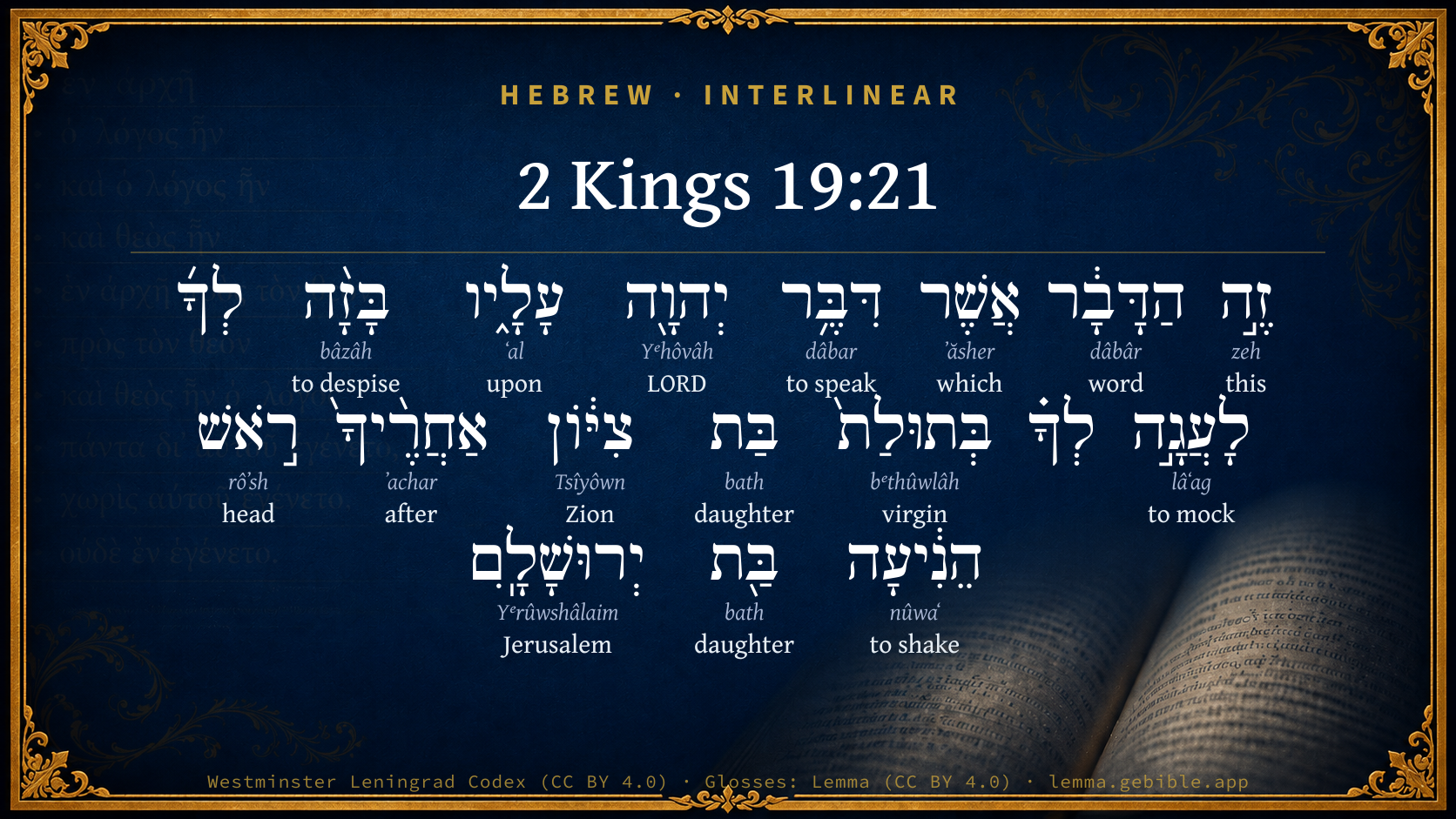
Hebrew (Westminster Leningrad Codex) 2 Kings 19:21 appears in the Hebrew Old Testament. The text above is from the Westminster Leningrad Codex. Each word links to its Strong’s number, a concise gloss, and parsing drawn from the Open Scriptures Hebrew Bible morphology. Click any word for its full Brown-Driver-Briggs (BDB) entry.
Download image
Cite this verse

2 Kings 19:21 (World English Bible). Public Domain. Lemma interlinear Bible study tool, https://lemma.gebible.app/v/2-kings/19/21.

Show BibTeX & RIS
BibTeX
RIS
English Translation
This is the word that Yahweh has spoken concerning him: The virgin daughter of Zion has despised you and ridiculed you; the daughter of Jerusalem has shaken her head at you.
World English Bible · Public Domain
Highlights
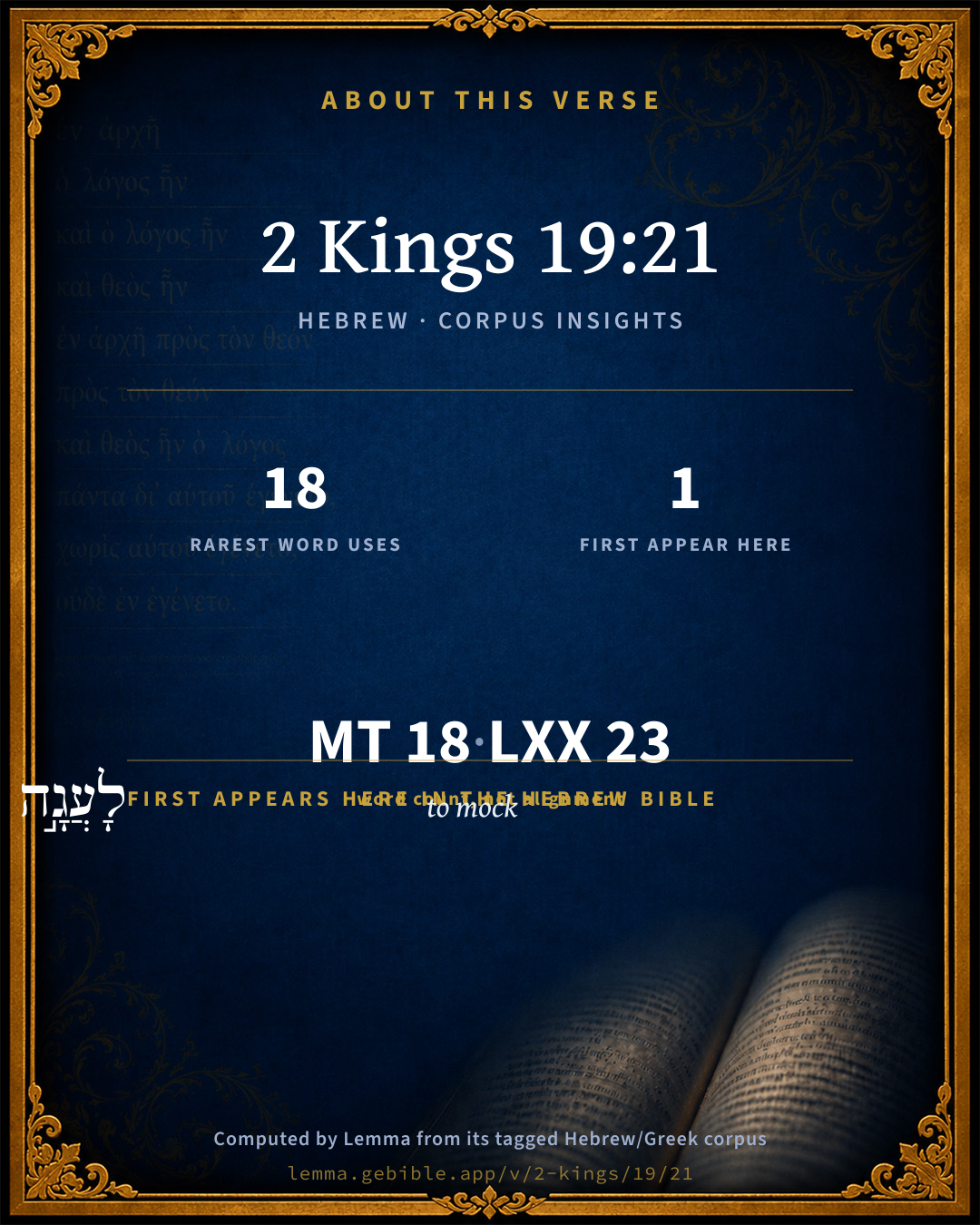
  • 1 first appearance in the Hebrew Bible
Full analysis ↓
Download a study sheet

One document with this verse’s original text, its word-by-word gloss line, the meaning frame, cross-references with their text, attributed commentary, and full source and license credits — printable, and it pastes into notes with its structure intact.

This verse Autodidact and up

Study sheet (.html) Plain text (.txt)

A passage Seminary Student

Up to 50 verses in one chapter. A passage sheet keeps up to 6 commentary sources and 12 cross-references per verse, in the order this page ranks them, and says so on the sheet whenever that leaves anything out. Ask for a single verse and you get the Autodidact verse sheet above.

Everything on this page stays free to read, with no account — the sheet is a download of what is already on screen, not access to it.

Want to remove ads? Support Godless Engineer
Compare translations 3

The same verse in 3 English versions, stacked beneath the original-language interlinear above. Click any original word for its lexicon entry.

Each is an independent rendering of the whole verse — the interlinear is not word-aligned to these translations.

Highlighted words mark where these versions differ — a whole-verse word diff, not a word-by-word alignment.

  • World English Bible Public Domain
    This is the word that Yahweh has spoken concerning him: The virgin daughter of Zion has despised you and ridiculed you; the daughter of Jerusalem has shaken her head at you.
  • King James Version Public Domain
    This is the word that the LORD hath spoken concerning him; The virgin the daughter of Zion hath despised thee, and laughed thee to scorn; the daughter of Jerusalem hath shaken her head at thee.
  • unfoldingWord Literal Text CC BY-SA 4.0
    This the word that Yahweh has spoken about him. ‘The virgin, the daughter of Zion, despises you, she derides you. The daughter of Jerusalem shakes a head after you.

unfoldingWord Literal Text — © unfoldingWord, licensed CC BY-SA 4.0. Word-aligned USFM3 via Door43 (git.door43.org/unfoldingWord/en_ult).

Versions to compare (up to 4)

3 of 4 selected

Show all 18 translations

Every available English version of this verse, each an independent rendering of the whole verse.

  • World English Bible Public Domain
    This is the word that Yahweh has spoken concerning him: The virgin daughter of Zion has despised you and ridiculed you; the daughter of Jerusalem has shaken her head at you.
  • Berean Standard Bible Public Domain
    This is the word that the LORD has spoken against him: ‘The Virgin Daughter of Zion despises you and mocks you; the Daughter of Jerusalem shakes her head behind you.
  • Majority Standard Bible Public Domain
    This is the word that the LORD has spoken against him: ‘The Virgin Daughter of Zion despises you and mocks you; the Daughter of Jerusalem shakes her head behind you.
  • King James Version Public Domain
    This is the word that the LORD hath spoken concerning him; The virgin the daughter of Zion hath despised thee, and laughed thee to scorn; the daughter of Jerusalem hath shaken her head at thee.
  • American Standard Version (1901) Public Domain
    This is the word that Jehovah hath spoken concerning him: The virgin daughter of Zion hath despised thee and laughed thee to scorn; the daughter of Jerusalem hath shaken her head at thee.
  • Revised Version (1885) Public Domain
    This is the word that the LORD hath spoken concerning him: The virgin daughter of Zion hath despised thee and laughed thee to scorn; the daughter of Jerusalem hath shaken her head at thee.
  • Geneva Bible (1599) Public Domain
    This is the worde that the Lord hath spoken against him, O Virgine, daughter of Zion, he hath despised thee, and laughed thee to scorne: O daughter of Ierusalem, he hath shaken his head at thee.
  • Douay-Rheims (1899) Public Domain
    This is the word, that the Lord hath spoken of him: The virgin the daughter of Sion hath despised thee, and laughed thee to scorn: the daughter of Jerusalem hath wagged her head behind thy back.
  • Young's Literal Translation Public Domain
    this `is' the word that Jehovah spake concerning him: `Trampled on thee -- laughed at thee, Hath the virgin daughter of Zion Behind thee shaken the head -- Hath the daughter of Jerusalem?
  • Literal Standard Version CC BY-SA 4.0
    this [is] the word that YHWH spoke concerning him: Trampled on you—laughed at you || Has the virgin daughter of Zion; Shaken the head behind you || Has the daughter of Jerusalem!
  • Unlocked Literal Bible CC BY-SA 4.0
    This is the word that Yahweh has spoken about him: “The virgin daughter of Zion despises you and laughs you to scorn. The daughter of Jerusalem shakes her head at you.
  • unfoldingWord Literal Text CC BY-SA 4.0
    This the word that Yahweh has spoken about him. ‘The virgin, the daughter of Zion, despises you, she derides you. The daughter of Jerusalem shakes a head after you.
  • Darby Bible Public Domain
    This is the word that Jehovah has spoken against him: The virgin-daughter of Zion despiseth thee, laugheth thee to scorn; The daughter of Jerusalem shaketh her head at thee.
  • World Messianic Bible Public Domain
    This is the word that the LORD has spoken concerning him: ‘The virgin daughter of Zion has despised you and ridiculed you. The daughter of Jerusalem has shaken her head at you.
  • Webster's Bible Public Domain
    This is the word that the LORD hath spoken concerning him; The virgin the daughter of Zion hath despised thee, and laughed thee to scorn; the daughter of Jerusalem hath shaken her head at thee.
  • Free Bible Version CC BY-SA 4.0
    This is the word the Lord condemning him: The virgin daughter of Zion scorns you and mocks you; the daughter of Jerusalem shakes her head as you run away.
  • Bible in Basic English Public Domain
    This is the word which the Lord has said about him: In the eyes of the virgin daughter of Zion you are shamed and laughed at; the daughter of Jerusalem has made sport of you.
  • JPS Tanakh (1917) Public Domain
    This is the word that the LORD hath spoken concerning him: The virgin daughter of Zion hath despised thee and laughed thee to scorn; the daughter of Jerusalem hath shaken her head at thee.

Literal Standard Version (2020), Covenant Press — licensed CC BY-SA 4.0. Text via the HelloAO Bible API (eBible.org). Unlocked Literal Bible (unfoldingWord) — licensed CC BY-SA 4.0. Text via the HelloAO Bible API (eBible.org). unfoldingWord Literal Text — © unfoldingWord, licensed CC BY-SA 4.0. Word-aligned USFM3 via Door43 (git.door43.org/unfoldingWord/en_ult). Free Bible Version, Dr. Jonathan Gallagher — licensed CC BY-SA 4.0. Text via the HelloAO Bible API (eBible.org).

Word by word

More ways to search: Search by grammar → Find every occurrence → Compare this word →

Practice this passage: Drill this verse → Learn its vocabulary →

לָעֲגָ֣ה
lâʻag
H3932
“to mock”
Verb, Qal, Perfect, 3rd Person, Feminine, Singular
Part of Speech
Verb
Stem
Qal
Form
Perfect
Person
3rd Person
Gender
Feminine
Number
Singular
Full BDB Definition

Origin: a primitive root

TWOT: 1118

to mock, deride, ridicule - (Qal) to mock, deride, have in derision - (Niphal) to stammer - (Hiphil) to mock, deride
  1. זֶ֣ה zeh H2088 “this” Pronoun, Demonstrative, Masculine, Singular
  2. הַדָּבָ֔ר dâbâr H1697 “the · word” Particle, Definite Article + Noun, Common, Masculine, Singular, Absolute
  3. אֲשֶׁר ʼăsher H834 “which” Particle, Relative
  4. דִּבֶּ֥ר dâbar H1696 “to speak” Verb, Piel, Perfect, 3rd Person, Masculine, Singular
  5. יְהוָ֖ה Yᵉhôvâh H3068 “LORD” Noun, Proper
  6. עָלָ֑יו ʻal H5921 “upon · him” Preposition + Suffix, Personal, 3rd Person, Masculine, Singular
  7. בָּזָ֨ה bâzâh H959 “to despise” Verb, Qal, Perfect, 3rd Person, Feminine, Singular
  8. בְּתוּלַת֙ bᵉthûwlâh H1330 “virgin of” Noun, Common, Feminine, Singular, Construct
  9. בַּת bath H1323 “daughter of” Noun, Common, Feminine, Singular, Construct
  10. צִיּ֔וֹן Tsîyôwn H6726 “Zion” Noun, Proper
  11. אַחֲרֶ֨יךָ֙ ʼachar H310 “after · you” Preposition + Suffix, Personal, 2nd Person, Masculine, Singular
  12. רֹ֣אשׁ rôʼsh H7218 “head” Noun, Common, Masculine, Singular, Absolute
  13. הֵנִ֔יעָה nûwaʻ H5128 “to shake” Verb, Hiphil, Perfect, 3rd Person, Feminine, Singular
  14. בַּ֖ת bath H1323 “daughter of” Noun, Common, Feminine, Singular, Construct
  15. יְרוּשָׁלִָֽם Yᵉrûwshâlaim H3389 “Jerusalem” Noun, Proper

About this verse

These counts appear in no published source. They are computed here, from the morphology-tagged text and Lemma’s own curated glosses. What Lemma adds →

18
words
15
distinct lemmas
Historical
section

Notable vocabulary

The rarest word here is לָעֲגָ֣ה to mock H3932 — appearing just 18 times in the whole Hebrew Bible.

First appearance in Scripture

This word makes its first canonical appearance in the Hebrew Bible here:

  • לָעֲגָ֣ה to mock H3932

Shared distinctive vocabulary

לָעֲגָ֣ה to mock H3932 occurs in 18 verses of the Hebrew Bible. Also found in:

Grammatical profile

  • 4 verbs
  • 8 nouns
  • 1 pronoun
  • 4 prepositions
  • 1 particle

Verb forms

  • דִּבֶּ֥ר Piel · Perfect
  • בָּזָ֨ה Qal · Perfect
  • לָעֲגָ֣ה Qal · Perfect
  • הֵנִ֔יעָה Hiphil · Perfect

Repetition

A word recurs within this verse — often emphatic in Hebrew:

  • בַּת daughter H1323 ×2

Hebrew & Septuagint length

In English translation the verse runs 31 words from the Hebrew and 34 from the Septuagint (LXX English) — closely comparable.

A rough comparison of the two English renderings, which tokenize alike — not a word-level alignment.

Word counts can differ between the Hebrew and the Greek without any difference in meaning — e.g. the Hebrew direct-object marker אֵת has no separate Greek word, and Greek often adds the article ὁ.

In the original languages it is 18 Hebrew tokens and 23 Greek tokens — but the two are counted differently (Hebrew bundles its prefixes and suffixes into one token; the Greek is in lemma form), so that isn’t a like-for-like length.

Cross-references

23

Topical passages linked to 2 Kings 19:21 in the Treasury of Scripture Knowledge — connected by theme and wording, ordered by reader-vote popularity; previews shown in the World English Bible.

  • Lamentations 2:13 What shall I testify to you? what shall I liken to you, daughter of Jerusalem? What shall I compare to you, that I may comfort you, virgin daughter of Zion? For your breach is great like the sea: who can heal you?
  • Job 16:4 I also could speak as you do. If your soul were in my soul's place, I could join words together against you, And shake my head at you.
  • Jeremiah 14:17 You shall say this word to them, Let my eyes run down with tears night and day, and let them not cease; for the virgin daughter of my people is broken with a great breach, with a very grievous wound.
  • Matthew 27:39 Those who passed by blasphemed him, wagging their heads,
  • Psalms 22:7–8 All those who see me mock me. They insult me with their lips. They shake their heads, saying,
  • Psalms 109:25 I have also become a reproach to them. When they see me, they shake their head.
  • Isaiah 37:21–35 Then Isaiah the son of Amoz sent to Hezekiah, saying, Thus says Yahweh, the God of Israel, Whereas you have prayed to me against Sennacherib king of Assyria,
  • Lamentations 2:15 All that pass by clap their hands at you; They hiss and wag their head at the daughter of Jerusalem, [saying], Is this the city that men called The perfection of beauty, The joy of the whole earth?
  • Psalms 9:14 That I may show forth all your praise. In the gates of the daughter of Zion, I will rejoice in your salvation.
  • Psalms 137:8 Daughter of Babylon, doomed to destruction, He will be happy who rewards you, As you have served us.
  • Isaiah 1:8 The daughter of Zion is left like a shelter in a vineyard, Like a hut in a field of melons, Like a besieged city.
  • Isaiah 23:10 Pass through your land as the Nile, daughter of Tarshish; there is no restraint any more.
  • Isaiah 23:12 He said, You shall no more rejoice, you oppressed virgin daughter of Sidon: arise, pass over to Kittim; even there shall you have no rest.
  • Isaiah 47:1 Come down, and sit in the dust, virgin daughter of Babylon; sit on the ground without a throne, daughter of the Chaldeans: for you shall no more be called tender and delicate.
  • Isaiah 47:5 Sit you silent, and get you into darkness, daughter of the Chaldeans; for you shall no more be called The mistress of kingdoms.
  • Jeremiah 18:13 Therefore thus says Yahweh: Ask you now among the nations, who has heard such things; the virgin of Israel has done a very horrible thing.
  • Jeremiah 31:4 Again will I build you, and you shall be built, O virgin of Israel: again shall you be adorned with your tambourines, and shall go forth in the dances of those who make merry.
  • Jeremiah 46:11 Go up into Gilead, and take balm, virgin daughter of Egypt: in vain do you use many medicines; there is no healing for you.
  • Lamentations 1:15 The Lord has set at nothing all my mighty men in the midst of me; He has called a solemn assembly against me to crush my young men: The Lord has trodden as in a winepress the virgin daughter of Judah.
  • Lamentations 4:21 Rejoice and be glad, daughter of Edom, that dwell in the land of Uz: The cup shall pass through to you also; you shall be drunken, and shall make yourself naked.
  • Amos 5:2 "The virgin of Israel has fallen; She shall rise no more. She is cast down on her land; There is no one to raise her up."
  • Micah 4:8 You, tower of the flock, the hill of the daughter of Zion, To you it will come, Yes, the former dominion will come, The kingdom of the daughter of Jerusalem.
  • Zechariah 9:9 Rejoice greatly, daughter of Zion! Shout, daughter of Jerusalem! Behold, your king comes to you! He is righteous, and having salvation; Lowly, and riding on a donkey, Even on a colt, the foal of a donkey.

Cross-references courtesy of OpenBible.info (CC BY 4.0).

Hebrew and Greek witnesses Masoretic Hebrew ↔ Greek Septuagint

The same verse in the two great witnesses to the Old Testament, shown verse-for-verse.

These are two independent witnesses, not word-aligned to each other, and the Septuagint is shown in lemma (dictionary) form.

Hebrew 2 Kings 19:21 Masoretic · Westminster Leningrad Codex

זֶ֣ה הַדָּבָ֔ר אֲשֶׁר דִּבֶּ֥ר יְהוָ֖ה עָלָ֑יו בָּזָ֨ה לְךָ֜ לָעֲגָ֣ה לְךָ֗ בְּתוּלַת֙ בַּת צִיּ֔וֹן אַחֲרֶ֨יךָ֙ רֹ֣אשׁ הֵנִ֔יעָה בַּ֖ת יְרוּשָׁלִָֽם

This is the word that Yahweh has spoken concerning him: The virgin daughter of Zion has despised you and ridiculed you; the daughter of Jerusalem has shaken her head at you.

World English Bible · Public Domain

Greek LXX 2 Kings 19:21 Septuagint · lemma form

οὗτος ὁ λόγος ὅς λαλέω κύριος ἐπί αὐτός ἐκοὐδενέω σύ καί μυκτηρίζω σύ παρθένος θυγάτηρ σιων ἐπί σύ κεφαλή αὐτός κινέω θυγάτηρ ἰερουσαλήμ

This is the word which the Lord has spoken against him; The virgin daughter of Sion has made light of you, and mocked you; the daughter of Jerusalem has shaken her head at you.

LXX2012 (modern English Septuagint) · Public Domain

Hebrew: Westminster Leningrad Codex (CC BY 4.0). Greek: Septuagint (public domain); English from LXX2012 (modern English Septuagint) (Public Domain). How the Septuagint differs from the Hebrew →

Targum (Aramaic paraphrase)

1

The Targum is the ancient Jewish Aramaic paraphrase of the Hebrew Scriptures — an interpretive translation, not the Hebrew text itself. Onkelos (literal) and Pseudo-Jonathan (expansive) render the Torah, and Jonathan the Prophets. Coverage is partial: where no permissively-licensed English translation exists for a verse, only the Aramaic is shown. This is verse-level text, not a word-by-word alignment to the Hebrew.

  1. Targum Jonathan Prophets (Joshua–Malachi)
    דֵין פִּתְגָמָא דִי גְזַר יְיָ עֲלוֹהִי מְבַסְרָא לָךְ מְעִיקָא עֲלָךְ מַלְכוּת כְּנִשְׁתָּא דְצִיוֹן בַּתְרָךְ רֵישֵׁיהוֹן מְנִידִין עַמָא דִירוּשְׁלֵם:

    (no public-domain English translation for this verse)

    Targum Jonathan — Aramaic: “Mikraot Gedolot” (public domain). English: “Sefaria Community Translation” (CC0 1.0 (public-domain dedication)); “London "Chaldee Paraphrase," 1871” (public domain). Text via Sefaria.

Commentary

Notes on 2 Kings 19:21 from classic Christian and Jewish commentators (each source and its license shown beneath its notes). The classic Christian expositions comment on the surrounding passage and are grouped to its opening verse, so a note may address several verses; the Jewish commentaries on the Tanakh (Rashi and others) are per-verse, so they appear only where the commentator wrote on this verse.

Lemma curates 59 commentaries, every one of them public domain or Creative Commons licensed, each selected and text-cleaned for this edition rather than reprinted as found. About our sources →

Trapp's Complete Commentary

John Trapp

2Ki 19:21 This [is] the word that the LORD hath spoken concerning him; The virgin the daughter of Zion hath despised thee, [and] laughed thee to scorn; the daughter of Jerusalem hath shaken her head at thee.

Ver. 21. The virgin, the daughter of Zion.] A weak virgin she may seem; but she hath a strong champion who will maintain her cause and quarrel, and hence it is that she thus outfaceth so formidable an enemy.

John Trapp, A Commentary or Exposition upon All the Books of the Old and New Testament (1647–1656) — public domain. Text from a community e-Sword module.

Albert Barnes' Notes on the Bible

Concerning him - i. e., “concerning Sennacherib.” 2Ki 19:21-28 are addressed to the great Assyrian monarch himself, and are God’s reply to his proud boastings.

The virgin, the daughter of Zion, - Rather, holy eastern city, is here distinguished from Jerusalem, the western one, and is given the remarkable epithet “virgin,” which is not applied to her sister; probably because the true Zion, the city of David, had remained inviolable from David’s time, having never been entered by an enemy. Jerusalem, on the other hand, had been taken, both by Shishak 1Ki 14:26 and by Jehoash 2Ki 14:13. The personification of cities as females is a common figure (compare marginal references).

Hath shaken her head at thee - This was a gesture of scorn with the Hebrews (compare the marginal references; Mat 27:39).

Albert Barnes' Notes on the Bible (1834–1885) — public domain. Text from a community e-Sword/MySword module.

Joseph Benson's Commentary

2Ki 19:21. The daughter of Zion — That is, Jerusalem; which is called the daughter of Zion, say some, because the hill of Zion, as being the strongest and safest part, was first inhabited, and by the increase of inhabitants, Jerusalem arising around, as it were, sprang from it, and might therefore properly enough be termed its daughter. But it is more probable that the people of Zion, or of Jerusalem, (Zion, an eminent part of the city, being put for the whole,) are here termed its daughter, cities and countries being often called mothers, and their inhabitants daughters. Thus we read of the daughter of Babylon, the daughter of Tyre, &c., Psa 137:8; Psa 45:13. Zion or Jerusalem is termed a virgin, because she was pure in good measure from that gross idolatry wherewith other people were defiled, which is called spiritual whoredom; and to signify that God would defend her from the rape which Sennacherib intended to commit upon her, with no less care than parents do their virgin daughters from those who seek to force and deflour them. The image is extremely fine, whereby the contempt of Sennacherib’s threats is expressed.

Joseph Benson's Commentary on the Old and New Testaments (1811–1818) — public domain. Text from a community e-Sword module.

Tyndale Open Study Notes

Tyndale Open Resources

19:21-28 The phrase virgin daughter is often used regarding civic identity (Isa 23:12; 37:22; 47:1; Jer 18:13). Here, the metaphor implies that as a young maiden is rescued from her attacker, so God will rescue Jerusalem. The Lord’s answer was delivered as a “taunt song,” a common literary form in the ancient Near East that rejoiced over an enemy’s humiliation (cp. Isa 14:3-20).

Tyndale Open Study Notes — © Tyndale Open Resources, licensed CC BY-SA 4.0. Text via the HelloAO Bible API.

Geneva Bible (1599)

Geneva Bible translators

Because as yet Jerusalem had not been taken by the enemy, therefore he calleth her virgin.

Geneva Bible (1599) marginal notes — public domain. Text via Bolls.life.

Adam Clarke's Commentary

Verse 21. The virgin the daughter of Zion hath despised thee, and laughed thee to scorn; the daughter of Jerusalem hath shaken her head at thee.] "So truly contemptible is thy power, and empty thy boasts, that even the young women of Jerusalem, under the guidance of Jehovah, shall be amply sufficient to discomfit all thy forces, and cause thee to return with shame to thy own country, where the most disgraceful death awaits thee."

When Bishop Warburton had published his Doctrine of Grace, and chose to fall foul on some of the most religious people of the land, a young woman of the city of Gloucester exposed his graceless system in a pamphlet, to which she affixed the above words as a motto!

Adam Clarke's Commentary on the Bible (1810–1826) — public domain. Text from a community e-Sword/MySword module.

Ellicott's Commentary for English Readers

(21) This is the word . . .—The prophecy which follows is well characterised by Cheyne as one “of striking interest, and both in form and matter stamped with the mark of Isaiah.”

Concerning him.—Or, against him.

The virgin the daughter of Zion.—A poetic personification of place. Zion here, as Jerusalem in the next line, is regarded as mother of the people dwelling there. (Comp. 2Sa_20:19.) The term Virgin naturally denotes the inviolable security of the citadel of Jehovah.

Hath shaken her head at thee.—Or, hath nodded behind thee. (Comp. Psa_22:8.) The people of Jerusalem nod in scorn at the retiring envoys of Sennacherib.

A Bible Commentary for English Readers, edited by Charles John Ellicott (1878–1897) — public domain. Text from a community e-Sword module.

The Cambridge Bible for Schools and Colleges

gen. ed. J. J. S. Perowne

21. The virgin the [R.V. omits the] daughter of Zion hath despised thee] The first part of the prophetic word is addressed to Sennacherib. Jerusalem is called ‘daughter of Sion’ because her inhabitants may be counted poetically as the offspring of Sion. She is also called ‘virgin’ because hitherto, since David’s time, when the chosen people first obtained complete possession of the place, it had never been conquered. And by opening the prophecy with this word it seems to be foretold that it shall still he saved from conquest. Some have preferred to take the three words as all in apposition, rendering ‘The virgin-daughter Sion’, with much the same sense. In the original the first two words are both in the construct form, but instances are found of such forms standing as if only in apposition.

The daughter of Jerusalem] i.e. The people dwelling in the city.

hath shaken her head at thee] This was a gesture of scorn. Cf. Job_16:4, ‘I could heap up words against you and shake mine head at you’. See also Psa_22:7; Psa_44:15; Psa_109:25 and other parallel passages.

The Cambridge Bible for Schools and Colleges (gen. ed. J. J. S. Perowne; Cambridge University Press, 1878–1918) — public domain. Text from a community e-Sword module.

Haydock's Catholic Bible Commentary

Virgin. The few who adhere to the Lord despise all idols and their votaries. (Worthington) --- Of Sion and of Jerusalem may denote those places. Towns and provinces are often represented as women: the daughter of Babylon, the daughter of the sea, mean Babylon and a maritime town. Perhaps this comparison is used through tenderness and affection for a place. (Calmet) --- Even the most timid female would shortly despise the fallen tyrant. (Haydock) --- Wagged, out of contempt, or in a threatening manner, Psalm xxi. 8., and Matthew xxvii. 39. (Menochius)

George Leo Haydock (1774–1849), Haydock's Catholic Family Bible and Commentary, 1859 edition — public domain. Excludes Psalms (Douay-Rheims chapter numbering differs from Protestant) and Deuterocanonical books (Catholic canon only).

Matthew Poole's English Annotations

The virgin; so he calls Zion, or Jerusalem; partly, because she was pure in good measure from that gross idolatry wherewith other people were defiled, which is called spiritual whoredom; partly, to signify that God would defend her from that rape which Sennacherib intended to commit upon her, with no less care and zeal than parents do their virgin daughters from those who seek to force and deflour them; and partly, to intimate, that as she had not yet been forced and taken by her barbarous enemies, so she should still retain her virginity, in spite of his attempts against her.

The daughter of Zion, i.e. the people of Zion, i.e. as it follows, of Jerusalem; so called synecdochically from the mountain and city of Zion, which was an eminent part of it. Cities and countries are oft called mothers, as 2Sa 20:19; and their inhabitants daughters, as Num 21:25; Jos 17:16; Jdg 1:27; Psa 45:13; Psa 137:8.

Hath shaken her head at thee; laughed at all thy proud and impotent threatenings. This is a gesture of contempt and derision; of which see Psa 22:7; 44:14; Jer 18:16; Mat 27:39.

Matthew Poole's English Annotations on the Holy Bible (1683–1685) — public domain. Text from a community e-Sword/MySword module.

Whedon's Commentary on the Bible

Daniel D. Whedon

21. The virgin the daughter of Zion — Better, the virgin daughter Zion. Zion, the chief mountain on which the Jewish metropolis stood, is metaphorically represented as a virgin daughter, and thus becomes a personification of Jerusalem and its inhabitants. These are collectively called in the next line of the parallelism daughter of Jerusalem. Jerusalem is called a virgin, because yet unconquered and inviolate. Compare Isa_23:12; Isa_47:1; Jer_46:11; Lam_1:15.

Despised — A very appropriate word to express the feelings of a virgin towards one who aims to destroy her honour.

Laughed thee to scorn — As one conscious of impregnability.

Hath shaken her head at thee — Literally, after thee the head she has shaken. Jerusalem shakes her head as a gesture of triumphant derision after Sennacherib, as after a smitten and flying foe.

Daniel D. Whedon (gen. ed.), Commentary on the Old and New Testaments (1874–1909) — public domain. Text from a community e-Sword module.

The Pulpit Commentary

This is the word that the Lord hath spoken concerning him. "Him" is, of course, Sennacherib. It adds great liveliness and force to the opening portion of the oracle, that it should be addressed directly by Jehovah to Sennacherib, as an answer to his bold challenge. The only address at all similar in Scripture is that to Nebuchadnezzar, (Dan_4:31, Dan_4:32) spoken by "a voice from heaven" But the present passage is one of far greater force and beauty. The virgin the daughter of Zion; rather, the virgin daughter of Zion, or the virgin daughter, Zion. Cities were commonly personified by the sacred writers, and represented as "daughters". (see Isa_23:10, 12 47:1, 5, etc.) "Virgin daughter" here may perhaps represent "the consciousness of impregnability" (Drechsler); but the phrase seems to have been used rhetorically or poetically, to heighten the beauty or pathos of the picture (Isa_23:12; Jer_46:11; Lam_2:13) without any reference to the question whether the particular city had or had not been previously taken. Jerusalem certainly had been taken by Shishak, (1Ki_14:26) and by Joash; (2Ki_14:13) but Zion, if it be taken as the name of the eastern city (Bishop Patrick, ad lee.), may have been still a "virgin fortress." Hath despised thee, and laughed thee to scorn; or, despises thee and laughs thee to scorn. The Hebrew preterite has often a present sense. Whatever was the case a little while ago, (see Isa_22:1-14) the city now laughs at thy threats. The daughter of Jerusalem hath shaken her head at thee; or, wags her head at thee in scorn and ridicule. (Psa_22:7)

The Pulpit Commentary (1880–1919), ed. H.D.M. Spence-Jones & Joseph S. Exell — public domain. Text from a community e-Sword module.

John Wesley's Explanatory Notes

Virgin - So he calls Zion, or Jerusalem; because she was pure in good measure from that gross idolatry wherewith other people were defiled, which is called spiritual whoredom: and to signify, that God would defend her from the rape which Sennacherib intended to commit upon her with no less care than parents do their virgin daughters from those who seek to force and deflower them.

John Wesley, Explanatory Notes Upon the Whole Bible (1754–1765) — public domain. Text via the GEBible commentary corpus.

Lesson kit

Teaching starters — assembled from the data on this page, not authored interpretation. Every prompt links to the verse data it draws on. Edit before teaching.

2 Kings, in the Historical, opens this verse with 18 words (15 distinct Hebrew lemmas). Its most distinctive word is lâʻag (“to mock”). A historical commentator’s framing appears above. Read the whole chapter for the surrounding context.

Discussion questions

  1. The word lâʻag carries the sense “to mock.” How does it shape the verse?
  2. This is the first place “to mock” appears in Scripture (first appears here). What does its debut here establish?
  3. How does 2 Chronicles 30:10, which shares the word «to mock», read alongside this verse?
  4. What does the repetition of “daughter” (2× in this one verse) do in this verse?
  5. The translations on this page render this verse differently — a whole-verse word diff, not a word-by-word alignment. What might account for the different wordings?
  6. «דִּבֶּ֥ר» is a Piel Perfect verb. How does that grammatical form shape the action described?
  7. Compare how Trapp's Complete Commentary and Albert Barnes' Notes on the Bible read this verse. Where do they agree or differ?

Things to notice

Reading settings

Reading text

Shown beneath each verse's original-language words.

Old Testament
Old Testament edition

Read the OT as the Masoretic Hebrew (MT) or the Greek Septuagint (LXX).

English shown for the Greek Septuagint (in the Hebrew ↔ Greek comparison).

Comparing translations? Open the Compare panel on any verse page to stack up to four side by side.