
Psalms 132:13

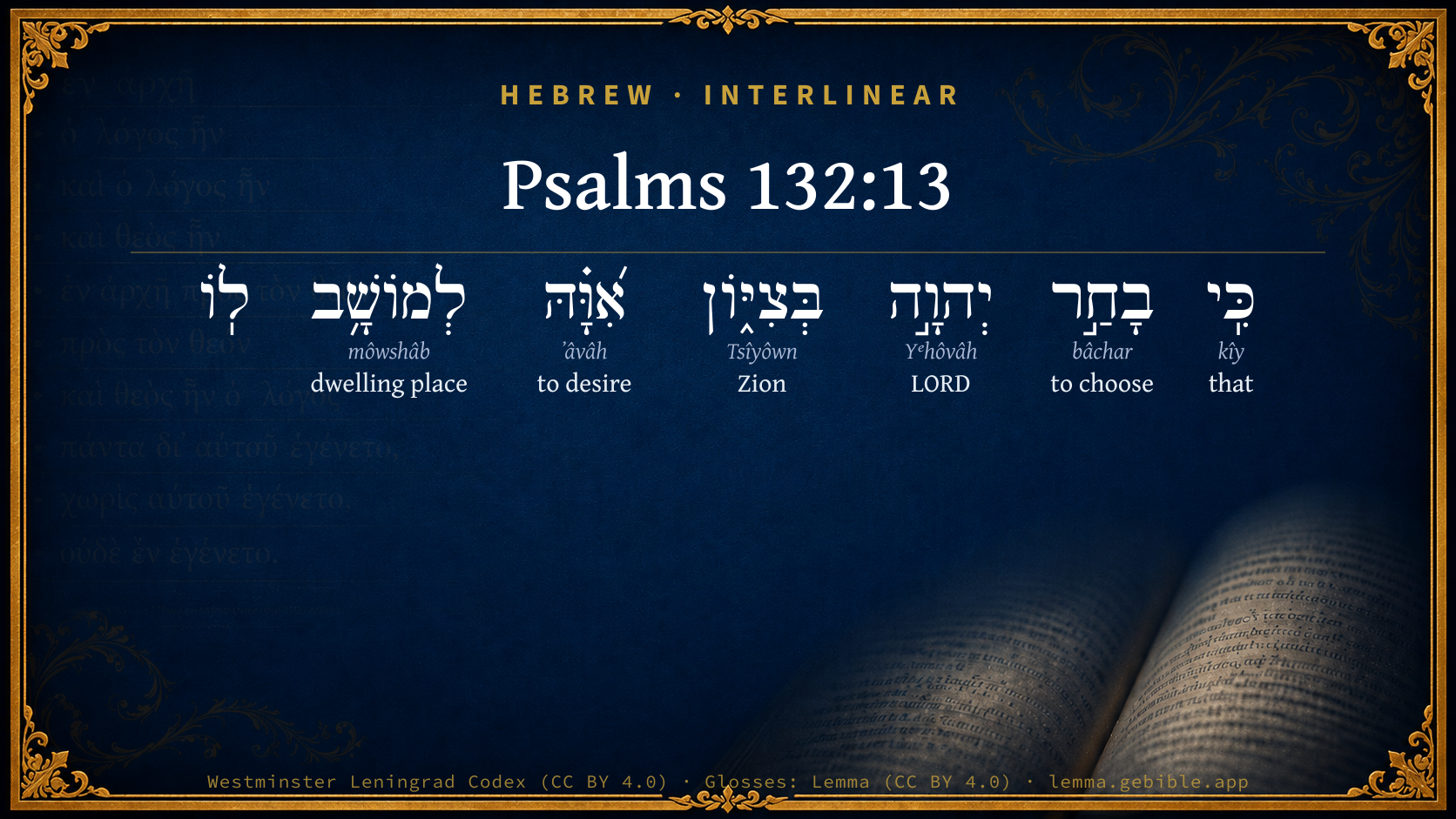
Hebrew (Westminster Leningrad Codex) Psalms 132:13 appears in the Hebrew Old Testament. The text above is from the Westminster Leningrad Codex. Each word links to its Strong’s number, a concise gloss, and parsing drawn from the Open Scriptures Hebrew Bible morphology. Click any word for its full Brown-Driver-Briggs (BDB) entry.
Download image
Cite this verse

Psalms 132:13 (World English Bible). Public Domain. Lemma interlinear Bible study tool, https://lemma.gebible.app/v/psalms/132/13.

Show BibTeX & RIS
BibTeX
RIS
English Translation
For Yahweh has chosen Zion. He has desired it for his habitation.
World English Bible · Public Domain
Download a study sheet

One document with this verse’s original text, its word-by-word gloss line, the meaning frame, cross-references with their text, attributed commentary, and full source and license credits — printable, and it pastes into notes with its structure intact.

This verse Autodidact and up

Study sheet (.html) Plain text (.txt)

A passage Seminary Student

Up to 50 verses in one chapter. A passage sheet keeps up to 6 commentary sources and 12 cross-references per verse, in the order this page ranks them, and says so on the sheet whenever that leaves anything out. Ask for a single verse and you get the Autodidact verse sheet above.

Everything on this page stays free to read, with no account — the sheet is a download of what is already on screen, not access to it.

Want to remove ads? Support Godless Engineer
Compare translations 3

The same verse in 3 English versions, stacked beneath the original-language interlinear above. Click any original word for its lexicon entry.

Each is an independent rendering of the whole verse — the interlinear is not word-aligned to these translations.

Highlighted words mark where these versions differ — a whole-verse word diff, not a word-by-word alignment.

  • World English Bible Public Domain
    For Yahweh has chosen Zion. He has desired it for his habitation.
  • King James Version Public Domain
    For the LORD hath chosen Zion; he hath desired it for his habitation.
  • unfoldingWord Literal Text CC BY-SA 4.0
    For Yahweh has chosen Zion; he desired for a dwelling for himself.

unfoldingWord Literal Text — © unfoldingWord, licensed CC BY-SA 4.0. Word-aligned USFM3 via Door43 (git.door43.org/unfoldingWord/en_ult).

Versions to compare (up to 4)

3 of 4 selected

Show all 17 translations

Every available English version of this verse, each an independent rendering of the whole verse.

  • World English Bible Public Domain
    For Yahweh has chosen Zion. He has desired it for his habitation.
  • Berean Standard Bible Public Domain
    For the LORD has chosen Zion; He has desired it for His home:
  • Majority Standard Bible Public Domain
    For the LORD has chosen Zion; He has desired it for His home:
  • King James Version Public Domain
    For the LORD hath chosen Zion; he hath desired it for his habitation.
  • American Standard Version (1901) Public Domain
    For Jehovah hath chosen Zion; He hath desired it for his habitation.
  • Revised Version (1885) Public Domain
    For the LORD hath chosen Zion; he hath desired it for his habitation.
  • Geneva Bible (1599) Public Domain
    For the Lord hath chosen Zion, and loued to dwell in it, saying,
  • Young's Literal Translation Public Domain
    For Jehovah hath fixed on Zion, He hath desired `it' for a seat to Himself,
  • Literal Standard Version CC BY-SA 4.0
    For YHWH has fixed on Zion, || He has desired [it] for a seat to Himself,
  • Unlocked Literal Bible CC BY-SA 4.0
    Certainly Yahweh has chosen Zion, he has desired her for his seat.
  • unfoldingWord Literal Text CC BY-SA 4.0
    For Yahweh has chosen Zion; he desired for a dwelling for himself.
  • Darby Bible Public Domain
    For Jehovah hath chosen Zion; he hath desired it for his dwelling:
  • World Messianic Bible Public Domain
    For the LORD has chosen Zion. He has desired it for his habitation.
  • Webster's Bible Public Domain
    For the LORD hath chosen Zion; he hath desired it for his habitation.
  • Free Bible Version CC BY-SA 4.0
    For the Lord has chosen Zion, wanting to make his home there, saying:
  • Bible in Basic English Public Domain
    For the Lord's heart is on Zion, desiring it for his resting-place.
  • JPS Tanakh (1917) Public Domain
    For the LORD hath chosen Zion; He hath desired it for His habitation:

Literal Standard Version (2020), Covenant Press — licensed CC BY-SA 4.0. Text via the HelloAO Bible API (eBible.org). Unlocked Literal Bible (unfoldingWord) — licensed CC BY-SA 4.0. Text via the HelloAO Bible API (eBible.org). unfoldingWord Literal Text — © unfoldingWord, licensed CC BY-SA 4.0. Word-aligned USFM3 via Door43 (git.door43.org/unfoldingWord/en_ult). Free Bible Version, Dr. Jonathan Gallagher — licensed CC BY-SA 4.0. Text via the HelloAO Bible API (eBible.org).

Word by word

More ways to search: Search by grammar → Find every occurrence → Compare this word →

Practice this passage: Drill this verse → Learn its vocabulary →

אִ֝וָּ֗הּ
ʼâvâh
H183
“to desire · her”
Verb, Piel, Perfect, 3rd Person, Masculine, Singular + Suffix, Personal, 3rd Person, Feminine, Singular
Part of Speech
Verb
Stem
Piel
Form
Perfect
Person
3rd Person
Gender
Masculine
Number
Singular
Full BDB Definition

Origin: a primitive root

TWOT: 40

desire, incline, covet, wait longingly, wish, sigh, want, be greedy, prefer - (Piel) to desire, crave (food and drink) - (Hithpael) to desire, long for, lust after (of bodily appetites)
  1. כִּֽי kîy H3588 “that” Conjunction
  2. בָחַ֣ר bâchar H977 “to choose” Verb, Qal, Perfect, 3rd Person, Masculine, Singular
  3. יְהוָ֣ה Yᵉhôvâh H3068 “LORD” Noun, Proper
  4. בְּצִיּ֑וֹן Tsîyôwn H6726 “in/at · Zion” Preposition + Noun, Proper
  5. לְמוֹשָׁ֥ב môwshâb H4186 “to/for · dwelling place” Preposition + Noun, Common, Masculine, Singular, Absolute

About this verse

These counts appear in no published source. They are computed here, from the morphology-tagged text and Lemma’s own curated glosses. What Lemma adds →

7
words
6
distinct lemmas
Wisdom
section

Shared distinctive vocabulary

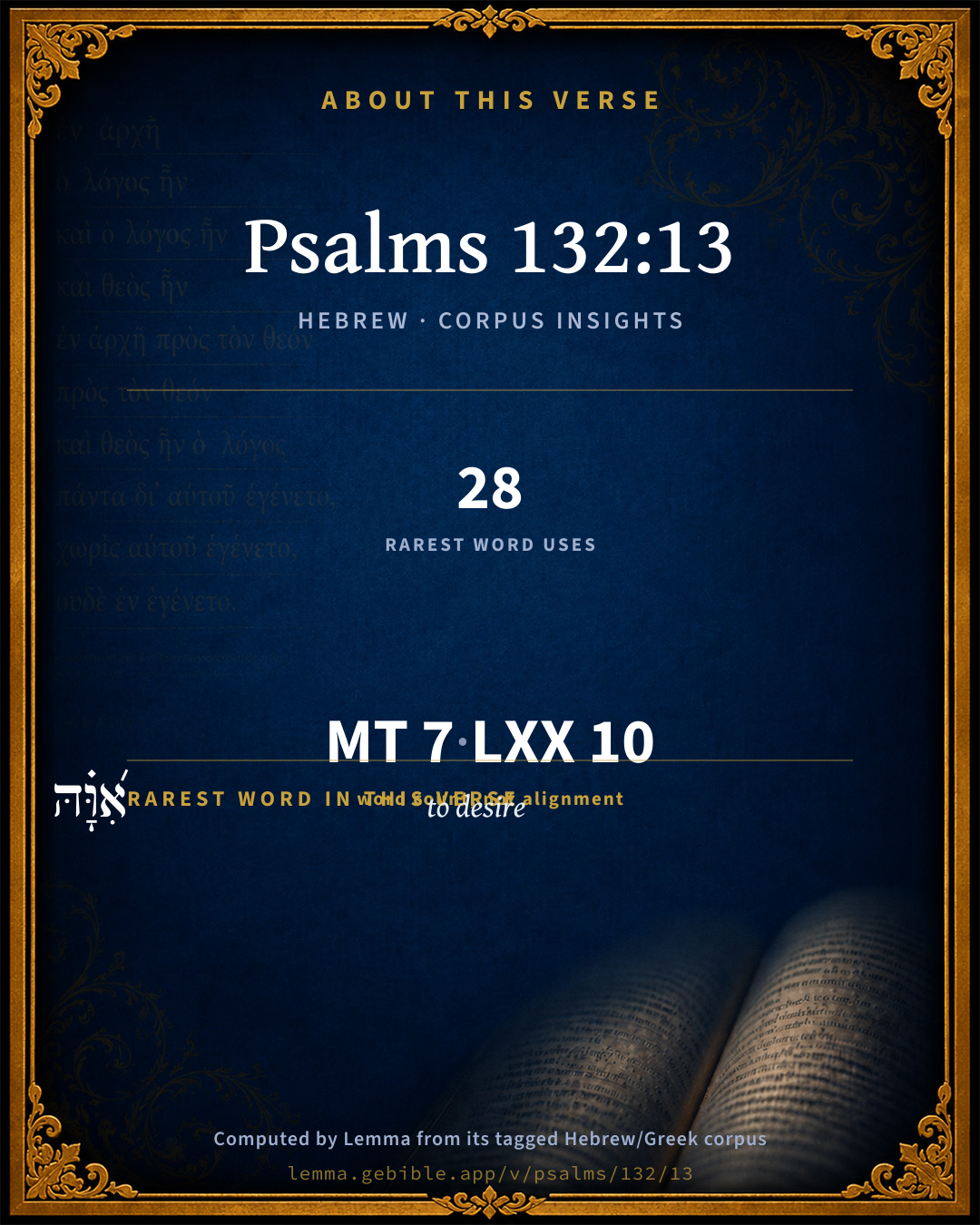
אִ֝וָּ֗הּ to desire H183 occurs in 25 verses of the Hebrew Bible. Also found in:

Grammatical profile

  • 2 verbs
  • 3 nouns
  • 1 preposition
  • 1 conjunction

Verb forms

  • בָחַ֣ר Qal · Perfect
  • אִ֝וָּ֗הּ Piel · Perfect

Hebrew & Septuagint length

In English translation the verse runs 12 words from the Hebrew and 16 from the Septuagint (LXX English) — closely comparable.

A rough comparison of the two English renderings, which tokenize alike — not a word-level alignment.

Word counts can differ between the Hebrew and the Greek without any difference in meaning — e.g. the Hebrew direct-object marker אֵת has no separate Greek word, and Greek often adds the article ὁ.

In the original languages it is 7 Hebrew tokens and 10 Greek tokens — but the two are counted differently (Hebrew bundles its prefixes and suffixes into one token; the Greek is in lemma form), so that isn’t a like-for-like length.

Cross-references

7

Topical passages linked to Psalms 132:13 in the Treasury of Scripture Knowledge — connected by theme and wording, ordered by reader-vote popularity; previews shown in the World English Bible.

  • Psalms 78:68–69 But chose the tribe of Judah, Mount Zion which he loved.
  • Hebrews 12:22 But you have come to Mount Zion, and to the city of the living God, the heavenly Jerusalem, and to innumerable hosts of angels,
  • Psalms 68:16 Why do you look in envy, you rugged mountains, At the mountain where God chooses to reign? Yes, Yahweh will dwell there forever.
  • Psalms 87:2 Yahweh loves the gates of Zion more than all the dwellings of Jacob.
  • Psalms 76:1–2 In Judah, God is known. His name is great in Israel.
  • Psalms 48:1–3 Great is Yahweh, and greatly to be praised, In the city of our God, in his holy mountain.
  • Isaiah 14:32 What then shall one answer the messengers of the nation? That Yahweh has founded Zion, and in her shall the afflicted of his people take refuge.

Cross-references courtesy of OpenBible.info (CC BY 4.0).

Hebrew and Greek witnesses Masoretic Hebrew ↔ Greek Septuagint

The same verse in the two great witnesses to the Old Testament, shown verse-for-verse.

You’re reading Greek Psalm 131 (Hebrew Psalm 132). The Septuagint counts the superscription, so verse numbers can differ from the Hebrew — chapter-level alignment, not verse-by-verse. Numbering follows Rahlfs.

These are two independent witnesses, not word-aligned to each other, and the Septuagint is shown in lemma (dictionary) form.

Hebrew Psalms 132:13 Masoretic · Westminster Leningrad Codex

כִּֽי בָחַ֣ר יְהוָ֣ה בְּצִיּ֑וֹן אִ֝וָּ֗הּ לְמוֹשָׁ֥ב לֽוֹ

For Yahweh has chosen Zion. He has desired it for his habitation.

World English Bible · Public Domain

Greek LXX Greek Psalm 131:13 Septuagint · lemma form

ὅτι ἐκλέγω κύριος ὁ σιων αἱρετίζω αὐτός εἰς κατοικία ἑαυτοῦ

For the Lord has elected Sion, he has chosen her for a habitation for himself, saying,

LXX2012 (modern English Septuagint) · Public Domain

Hebrew: Westminster Leningrad Codex (CC BY 4.0). Greek: Septuagint (public domain); English from LXX2012 (modern English Septuagint) (Public Domain). How the Septuagint differs from the Hebrew →

Commentary

Notes on Psalms 132:13 from classic Christian and Jewish commentators (each source and its license shown beneath its notes). The classic Christian expositions comment on the surrounding passage and are grouped to its opening verse, so a note may address several verses; the Jewish commentaries on the Tanakh (Rashi and others) are per-verse, so they appear only where the commentator wrote on this verse.

Lemma curates 59 commentaries, every one of them public domain or Creative Commons licensed, each selected and text-cleaned for this edition rather than reprinted as found. About our sources →

Trapp's Complete Commentary

John Trapp

Psa 132:13 For the LORD hath chosen Zion; he hath desired [it] for his habitation.

Ver. 13. For the Lord hath chosen Zion] He chose it for his love; and loved it for his choice.

John Trapp, A Commentary or Exposition upon All the Books of the Old and New Testament (1647–1656) — public domain. Text from a community e-Sword module.

The Biblical Illustrator

Joseph S. Exell

Psa_132:13-16

For the Lord hath chosen Zion.

Gods choice of Zion

He giveth a reason for the absolute promise of Christs coming to rule the spiritual kingdom of Israel, or the Church, because the Lord had chosen Zion in the type, and the universal Church under the figure, to be His chosen Temple and habitation, wherein He delighted. Whence learn--

1. Where God will settle His sanctuary, there tie will settle His kingdom also: Zion must not want a king; for the reason here, why the Lord will with an oath set up one who shall be the fruit of Davids body upon the throne, is because He hath chosen Zion.

2. The Lords pitching upon any place to dwell in, or persons to dwell among, cometh not of the worthiness of the place or persons, but from Gods good pleasure alone.

3. The Lord resteth in His love towards His Church, accepting the persons, prayers, and service of His chosen people; lie smelleth a sweet savour in Christ here, and His love maketh His seat among His people steadfast.

4. What is promised under typical figures is really everlasting, not in regard of the figure, but in regard of the signification: For this is my rest for ever, is true only in respect of the Church, represented by Zion.

5. No reason is to be craved for Gods everlasting good will to any person or incorporation; His pleasure may suffice for a cause. (D. Dickson.)

Zion and her provision

I. Gods choice of His Zion.

1. The sovereignty of God, which is exercised towards His creatures.

2. This choice is a choice of love (Eph_2:4-5; Jer_31:3).

II. The purposes for which God has chosen Zion. God desires Zion--

1. For His habitation.

2. For His rest. Where He takes up His abode, it is for ever.

III. The blessings promised. In 1Jn_2:12-13, you have the family of God set forth from infancy to manhood; from weakness itself, to perfect strength; from sins dominion and degradation, to salvations honours and glories; from the captivity of Satan, to a full victory over him; from the love, power, and guilt of sin, to the enjoyment of all the Gospel blessings, promises, and treasures in Christ. (C. Parvey.)

The Biblical Illustrator, edited by Joseph S. Exell (c. 1880s–1900s) — public domain. Text from a community e-Sword module.

Joseph Benson's Commentary

Psa 132:13-16. For the Lord hath chosen Zion — Taken either for the whole mountain, whereof Zion and Moriah were two parts, or for Jerusalem, which was, in a great part, built upon mount Zion, whence it is often called Zion, as has been frequently observed. This is my rest for ever — Not my residence only for a short time, as Shiloh was; here will I dwell — Here will I statedly manifest the tokens of my presence. Zion must be here considered as a type of the gospel church, which is called mount Zion, Heb 12:18. And in it, what is here said of Zion has its full accomplishment. Zion was long since ploughed as a field, but the church of Christ is still, and always will be, the house of the living God, 1Ti 3:15. It is his rest for ever and shall be blessed with his presence, even to the end of the world. I will abundantly bless her provision — I will plentifully provide for Jerusalem, and all that live in her, or resort to her for worship: nor shall they seek my face in vain. I will satisfy her poor with bread — I will make such liberal provision for her by fruitful years, that the poorest person there shall be satisfied with food: see note on 2Ch 7:13-14. I will also, &c. — To the blessings of life I will add those pertaining to godliness; clothe her priests with salvation — With my saving graces and blessings, with righteousness, as requested Psa 132:9; and, moreover, with that protection and benediction, which, by my promise, belongs to righteous persons. Her saints shall shout aloud for joy — The delight God takes in his church, the continuance of his presence with it, and with his ministers, and their being clothed with graces and virtues, wisdom and holiness, are the comfort and joy of all its members.

Joseph Benson's Commentary on the Old and New Testaments (1811–1818) — public domain. Text from a community e-Sword module.

J. A. Alexander on Psalms

Joseph Addison Alexander

13. (Psa 132:13) For Jehovah has chosen Zion, has desired (it) for a dwelling for him. Besides the oath and promise made directly to David, the petition of the psalm is here enforced by the divine choice of Zion, which was inseparably connected with the exaltation of the family of David. See the same thing asserted or implied, Psa 43:1; Psa 65:1; Psa 125:2. As in Psa 132:11-12, the last words in Hebrew may be also rendered to him, belonging to him, his dwelling.

Joseph Addison Alexander, The Psalms Translated and Explained (1850) — public domain. Text from a community e-Sword module.

Tyndale Open Study Notes

Tyndale Open Resources

132:13-17 The psalmist recounts the selection of Jerusalem and of the priests.

Tyndale Open Study Notes — © Tyndale Open Resources, licensed CC BY-SA 4.0. Text via the HelloAO Bible API.

Adam Clarke's Commentary

Verse 13. The Lord hath chosen Zion] Therefore neither Shiloh nor Kirjath-jearim is the place of his rest.

Adam Clarke's Commentary on the Bible (1810–1826) — public domain. Text from a community e-Sword/MySword module.

John Calvin's Commentaries

13. Seeing that Jehovah has chosen Zion. By coupling the kingdom with the priesthood and sanctuary service, he declares it still more emphatically to have been of divine and not human appointment. The connection is not to be overlooked, on another account. The true strength and stability of that kingdom were in Christ, and Christ’s kingdom is inseparable from his priesthood. This may explain why mention is made of Zion being chosen. God decreed nothing in relation to the kingdom, but what had a certain connection with the sanctuary, the more perfectly to prefigure the Mediator who was to come, and who was both priest and king, after the order of Melchizedek. The kingdom and tabernacle were, therefore, closely allied. Notice is taken of the reason upon which the choice proceeded — that mount Zion was not chosen for any excellency belonging to it, as we have seen, (Psalm 68:16,) but because such was the will of God. His good pleasure is specified in contrast with any merit in the place itself. This is another proof of what we have already stated — that the covenant made by God with David proceeded from his mere goodness.

John Calvin's Commentaries (1540-1563) — public domain. Text from the Calvin Translation Society English edition (1840s-50s) via the Christian Classics Ethereal Library (ccel.org). Calvin's coverage is partial (roughly two-thirds of the Bible); uncommented books and verses are honest gaps, never fabricated. The 19th-century editor's footnotes and remarks are omitted so the notes are faithfully Calvin's own voice.

Ellicott's Commentary for English Readers

(13) Zion.—The dynasty of David and the location of the sanctuary at Zion are intimately associated, as in Psa_78:67-68. (Comp. Psa_122:4-5.)

A Bible Commentary for English Readers, edited by Charles John Ellicott (1878–1897) — public domain. Text from a community e-Sword module.

The Cambridge Bible for Schools and Colleges

gen. ed. J. J. S. Perowne

13. For the Lord hath chosen Zion] The permanence of the Davidic kingdom is based upon the Divine choice of Zion. Here, as in Psa_78:67 ff., the choice of Zion is regarded as antecedent to the choice of David. To the community of the Restoration this thought must have been a comfort: they felt that Jehovah had returned to dwell in Zion, and this was a pledge to them that He would in some way fulfil His promises to the house of David. Cp. Zec_2:12.

The Cambridge Bible for Schools and Colleges (gen. ed. J. J. S. Perowne; Cambridge University Press, 1878–1918) — public domain. Text from a community e-Sword module.

John Gill's Exposition

I will abundantly bless her provision,.... The provision of Zion, the church of God, the word and ordinances, of which Christ is the sum and substance; the Gospel is milk for babes, and meat for strong men; the ordinances are a feast of fat things; Christ's flesh is meat indeed, and his blood drink deed; the whole provision is spiritual, savoury, salutary, strengthening, satisfying, and nourishing, when the Lord blesses it; as he does to those who hunger and thirst after it, and feed upon it by faith; so that their souls grow thereby, and they become fat and flourishing; grace increases in them, and they are fruitful in every good work: and this the Lord promises to do "abundantly", in a very large way and manner; or "certainly", for it is, in the original text, (y) "in blessing I will bless", that is, will surely bless, as this phrase is sometimes rendered. Arama observes that the second blessing is because of the greatness of it; and says, that their Rabbin's understand it of the fertility of the land of Israel in the time to come, when there will be no poor in it; but all is to be understood spiritually of the church in Gospel times;

I will satisfy her poor with bread; Zion has her poor; persons may be poor and yet belong to Zion, belong to Zion and yet be poor; there are poor in all the churches of Christ: our Lord told his disciples that they had the poor, and might expect to have them always with them; and particular directions are given to take care of Zion's poor under the Gospel dispensation, that they may not want bread in a literal sense: though by the "poor" are chiefly designed the Lord's afflicted and distressed ones; or who in a spiritual sense are poor, and sensible of their spiritual poverty, and seek after the true riches; or are poor in spirit, to whom the kingdom of heaven belongs: these the Lord promises to satisfy, to fill them to the full with the bread of the Gospel, made of the finest of the wheat, of which there is enough and to spare in his house; and with Christ the bread of life, of which those that eat shall never die, but live for ever.

(y) "benedicendo benedicam", V. L. Pagninus, Montanus, Musculus, Cocceius, Gejerus.

John Gill's Exposition of the Whole Bible (1746–1763) — public domain (CC PDM 1.0). Text via the HelloAO Bible API.

Albert Barnes' Notes on the Bible

For the Lord hath chosen Zion - He has selected it as the place where he will abide; the seat of his religion. This is a new plea or argument, and shows that the psalm had reference to Zion or Jerusalem, as then in danger, or as having been in danger. See the notes at Psa 48:1-2.

He hath desired it for his habitation - A place where to abide. Its had selected this as the permanent place of his worship.

Albert Barnes' Notes on the Bible (1834–1885) — public domain. Text from a community e-Sword/MySword module.

Matthew Poole's English Annotations

Zion; not strictly, but largely taken; either for the whole mountain, whereof Zion and Moriah were two parts or tops; or for Jerusalem, which was in a great part built upon Mount Zion, whence it is oft called Zion, as hath been noted again and again. For he speaks here of that place which he chose to be his rest for ever, as it follows, Psa 132:14, which unquestionably was the temple; whence also it appears that this Psalm was not written by David, nor before the building of the temple.

Matthew Poole's English Annotations on the Holy Bible (1683–1685) — public domain. Text from a community e-Sword/MySword module.

The Treasury of David

Charles H. Spurgeon

Ver. 13. For the LORD hath chosen Zion. It was no more than any other Canaanite town till God chose it, David captured it, Solomon built it, and the Lord dwelt in it. So was the church a mere Jebusite stronghold till grace chose it, conquered it, rebuilt it, and dwelt in it. Jehovah has chosen his people, and hence they are his people. He has chosen the church, and hence it is what it is. Thus in the covenant David and Zion, Christ and his people, go together. David is for Zion, and Zion for David: the interests of Christ and his people are mutual. He hath desired it for his habitation. David's question is answered. The Lord has spoken: the site of the temple is fixed: the place of the divine manifestation is determined. Indwelling follows upon election, and arises out of it: Zion is chosen, chosen for a habitation of God. The desire of God to dwell among the people whom he has chosen for himself is very gracious and yet very natural: his love will not rest apart from those upon whom he has placed it. God desires to abide with those whom he has loved with an everlasting love; and we do not wonder that it should be so, for we also desire the company of our beloved ones. It is a double marvel, that the Lord should choose and desire such poor creatures as we are: the indwelling of the Holy Ghost in believers is a wonder of grace parallel to the incarnation of the Son of God. God in the church is the wonder of heaven, the miracle of eternity, the glory of infinite love.

Ver. 13. For the LORD hath chosen Zion, etc. The Lord's pitching upon any place to dwell there cometh not of the worthiness of the place, or persons, but from God's good pleasure alone. The Lord having chosen his church, resteth in his love to her: he smelleth a sweet savour of Christ, and this maketh his seat among his people steadfast. David Dickson.

Ver. 13. For the LORD hath chosen Zion. Here, of a singular purpose, he useth the same word which Moses used (De 16:6): "As the place which the Lord thy God shall choose to place his name in." For at the beginning there was no certain place appointed wherein the tabernacle should remain; but it wandered, not only from place to place, but also from tribe to tribe, as Ephraim, Manasseh, Dan, etc.

Moreover, by the word, "hath chosen", he overthroweth all kinds of worship and religion of men's own devising and choosing, whereof there was an infinite number among the Jews. Election or choice belongeth not unto us; but we must yield obedience to the voice of the Lord. Else shall that happen unto us which Jeremiah threatens: "That they have chosen will I reject." These things destroy and confound the inventions, the devices and devotions, the false and counterfeit religions, which we have seen in the papacy... God is not served but when that is done which he hath commanded. Wherefore election or choice pertaineth not to us, so that what God hath commanded, that we must do. Martin Luther.

Ver. 13.

1. Sovereign choice.

2. Condescending indwelling.

3. Eternal rest.

4. Gracious reason"I have desired it."

Psalms 132:14*

Charles H. Spurgeon's The Treasury of David (1869–1885) — public domain. Psalms only. Text from a community e-Sword/MySword module.

Whedon's Commentary on the Bible

Daniel D. Whedon

13. Zion—On “Zion” as the chosen place for Jehovah’s dwelling and ark, see on Psa_78:9-10; Psa_78:60-69

Daniel D. Whedon (gen. ed.), Commentary on the Old and New Testaments (1874–1909) — public domain. Text from a community e-Sword module.

The Pulpit Commentary

For the Lord hath chosen Zion; he hath desired it for his habitation. Here we are brought back again to the temple. Zion, the city of David, was also "the city of the great King" (Psa_48:2) the place where he had "set his Name which he was bound to protect and cherish. "As truly as God had chosen Zion, and made his habitation there, so certainly must he also raise up for David a branch, through which to his people concentrated there he will impart salvation" (Hengstenberg).

Vers. 13-15. "Zion of the Lord beloved.

I SHE IS THE OBJECT OF THE LORD"S CHOICE.

1. We cannot get rid of the truth of Gods election. Many would like to do so. It calls up in their minds thoughts of a very painful kind. It clouds for them and to them the face of God.

2. But we see it everywhere. Are not we ourselves a chosen people? With whom hath God dealt, in the way of privilege, as with us?

3. And we act upon the principle ourselves. If we want some work to be done, we elect the best instruments we can find for it. We do not send just anybody, but we choose whom we shall send.

4. And this fact shows us how to regard the doctrine of election. The election is to service for the sake of others, not to their exclusion, as is so commonly thought; for their good, and not for their ill. Thus God chose Abraham and Israel, that his "way may be known upon earth, and his," etc. (Psalm 67). Not that others may be left out of the Divine blessing, but brought into it. If we are rendering no service to our brethren, then we are not of God"s elect, for all his elect serve.

II SHE IS HIS REST AND DESIRED HABITATION FOREVER.

1. Allusion is, no doubt, made to the ark of the covenant. Its shiftings and migrations had been many ere it was finally fixed at Jerusalem. It went from Shiloh to Bethel; (Jud_1:20:27) then to Mizpeh; (Jud_1:21:5) then, for twenty years, it was at Kirjath-jearim, in "the fields of the wood;" then, for three months, in the house of Obed-Edom; and finally at Zion, where the psalmist thought it would rest for evermore.

2. But what was not strictly true of the ark and Zion is true of God and his Church. He ever dwells there; for his people have been chosen in Christ from the foundation of the world. He has already done so much for them, both in providence and in grace. Amongst ourselves nothing so hinds us over to render further help as help we have already given. And certainly it is so with God. He begins his good work, and therefore he goes on. (Php_1:6) Then, God has promised to be ever with his people. (see Joh_14:16-23 Eph_2:21, Eph_2:22) Amid his people only is he honored, loved, and obeyed; other men grieve, dishonor, and despise him and his Law; but his people count him their "exceeding Joy." And then he is beginning already to reap his blessed harvest in them. Our Lord himself was the Sower who went "forth weeping, bearing," etc.; (Psa_126:6) and already he is beginning to "come again with rejoicing," etc. For amid his people he finds even here and now how much more by-and-by! sympathy, love, holiness, devotion, those things in which he delights because they are of and like himself.

3. And what is true of the Church at large is true of the individual soul. Are we, then, members of God"s Zion, enrolled in the fellowship of his Church?

III THE PROVISION SHALL BE ABUNDANTLY BLESSED. Her praises, her prayers, her instructions, her ministers, her sacraments, her assemblies, these are her provisions; and God shall, does, abundantly bless them to the securing of those happy results for which they were designed.

IV THE POOR SHALL BE SATISFIED WITH BREAD. In his Church the poor are the rich, and the rich the poor. For the poor are those who know it and long for the Bread of life, and so get it and are rich. But the rich desire not, and so have not and are poor. And Zion"s poor shall be satisfied. Oh to be of these poor! S.C.

The Pulpit Commentary (1880–1919), ed. H.D.M. Spence-Jones & Joseph S. Exell — public domain. Text from a community e-Sword module.

unfoldingWord translationNotes

Door43 World Missions Community

General Information:

"He", "my" and "I" refer to Yahweh and "her" refers to Zion. (See: Pronouns)

Zion ... her ... her

The author writes as though the city of Zion were a woman. (See: Personification)

he has desired her for his seat

Here "seat" represents either 1) his throne where he would rule, or 2) the place where he would stay. (See: Metonymy)

he has desired her for his seat

"Yahweh has desired Zion for Yahweh's seat." This shows the actual participants.

my resting place

The place God chose for people to worship him is spoken of as if it were a place where he rests or lives eternally. AT: "the place where I stay" or "my tabernacle" (See: Metaphor)

translationWords

Zion

rest

life

unfoldingWord translationNotes — © Distant Shores Media and the Door43 World Missions Community, licensed CC BY-SA 4.0. Source: git.door43.org/Door43/en_tn.

Lesson kit

Teaching starters — assembled from the data on this page, not authored interpretation. Every prompt links to the verse data it draws on. Edit before teaching.

Psalms, in the Wisdom, opens this verse with 7 words (6 distinct Hebrew lemmas). Its most distinctive word is ʼâvâh (“to desire”). A historical commentator’s framing appears above. Read the whole chapter for the surrounding context.

Discussion questions

  1. What does “to desire” (ʼâvâh) contribute to the verse as a whole?
  2. Numbers 11:4 shares the word «to desire» with this verse. How do the two illuminate each other?
  3. These translations render this verse differently. What is at stake in choosing one wording over another?
  4. The verb «בָחַ֣ר» is Qal Perfect. How does its form color the action?
  5. Reading how Trapp's Complete Commentary and The Biblical Illustrator read this verse, where do the two commentators agree and where do they part?

Things to notice

Reading settings

Reading text

Shown beneath each verse's original-language words.

Old Testament
Old Testament edition

Read the OT as the Masoretic Hebrew (MT) or the Greek Septuagint (LXX).

English shown for the Greek Septuagint (in the Hebrew ↔ Greek comparison).

Comparing translations? Open the Compare panel on any verse page to stack up to four side by side.