
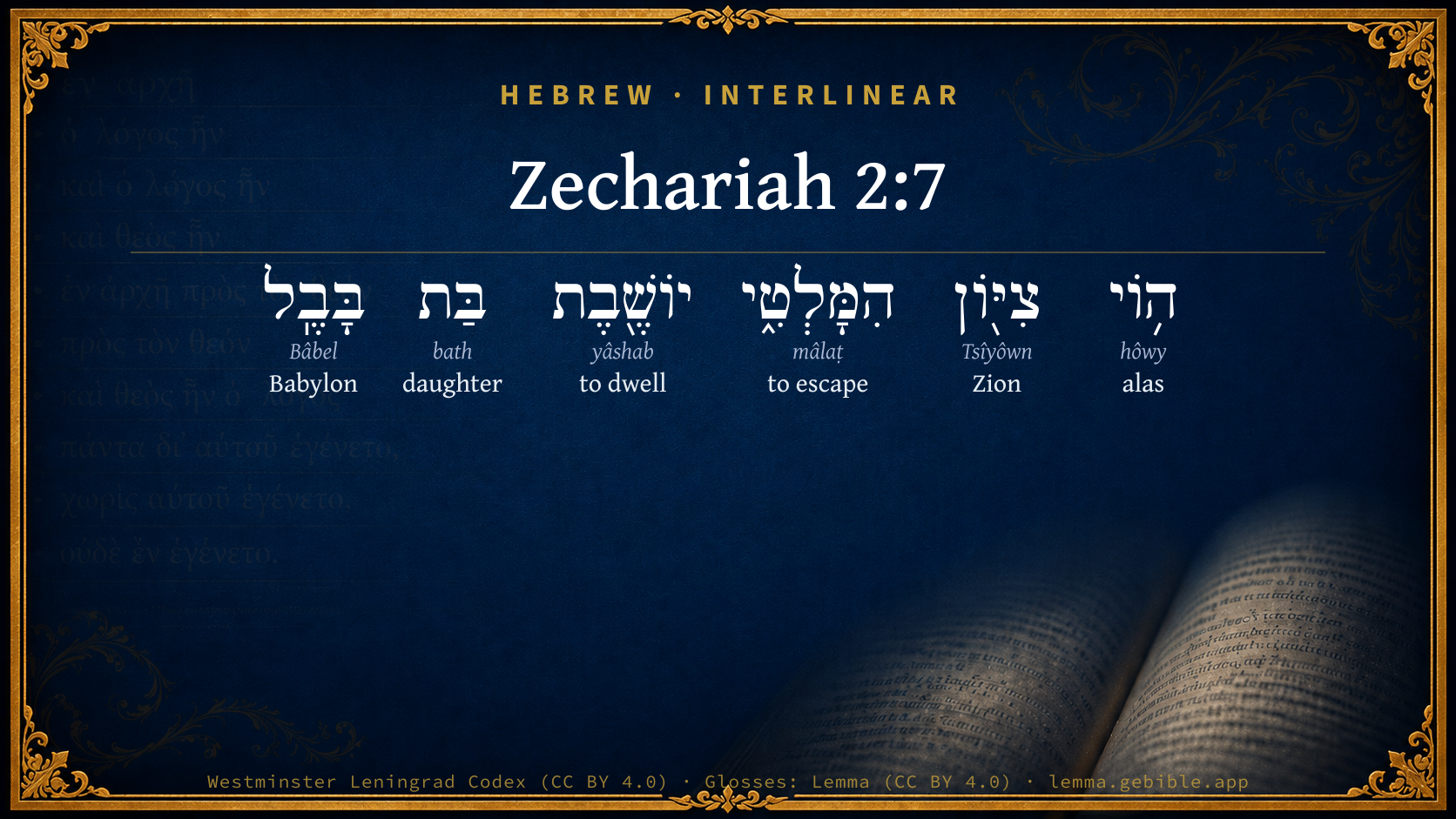
Zechariah 2:7

Hebrew (Westminster Leningrad Codex) Zechariah 2:7 appears in the Hebrew Old Testament. The text above is from the Westminster Leningrad Codex. Each word links to its Strong’s number, a concise gloss, and parsing drawn from the Open Scriptures Hebrew Bible morphology. Click any word for its full Brown-Driver-Briggs (BDB) entry.
Download image
Cite this verse

Zechariah 2:7 (World English Bible). Public Domain. Lemma interlinear Bible study tool, https://lemma.gebible.app/v/zechariah/2/7.

Show BibTeX & RIS
BibTeX
RIS
English Translation
'Come, Zion! Escape, you who dwell with the daughter of Babylon.'
World English Bible · Public Domain
Download a study sheet

One document with this verse’s original text, its word-by-word gloss line, the meaning frame, cross-references with their text, attributed commentary, and full source and license credits — printable, and it pastes into notes with its structure intact.

This verse Autodidact and up

Study sheet (.html) Plain text (.txt)

A passage Seminary Student

Up to 50 verses in one chapter. A passage sheet keeps up to 6 commentary sources and 12 cross-references per verse, in the order this page ranks them, and says so on the sheet whenever that leaves anything out. Ask for a single verse and you get the Autodidact verse sheet above.

Everything on this page stays free to read, with no account — the sheet is a download of what is already on screen, not access to it.

Want to remove ads? Support Godless Engineer
Compare translations 3

The same verse in 3 English versions, stacked beneath the original-language interlinear above. Click any original word for its lexicon entry.

Each is an independent rendering of the whole verse — the interlinear is not word-aligned to these translations.

Highlighted words mark where these versions differ — a whole-verse word diff, not a word-by-word alignment.

  • World English Bible Public Domain
    'Come, Zion! Escape, you who dwell with the daughter of Babylon.'
  • King James Version Public Domain
    Deliver thyself, O Zion, that dwellest with the daughter of Babylon.
  • unfoldingWord Literal Text CC BY-SA 4.0
    “Woe, Zion! Escape, who are dwelling the daughter of Babylon!”

unfoldingWord Literal Text — © unfoldingWord, licensed CC BY-SA 4.0. Word-aligned USFM3 via Door43 (git.door43.org/unfoldingWord/en_ult).

Versions to compare (up to 4)

3 of 4 selected

Show all 18 translations

Every available English version of this verse, each an independent rendering of the whole verse.

  • World English Bible Public Domain
    'Come, Zion! Escape, you who dwell with the daughter of Babylon.'
  • Berean Standard Bible Public Domain
    “Get up, O Zion! Escape, you who dwell with the Daughter of Babylon!”
  • Majority Standard Bible Public Domain
    “Get up, O Zion! Escape, you who dwell with the Daughter of Babylon!”
  • King James Version Public Domain
    Deliver thyself, O Zion, that dwellest with the daughter of Babylon.
  • American Standard Version (1901) Public Domain
    Ho Zion, escape, thou that dwellest with the daughter of Babylon.
  • Revised Version (1885) Public Domain
    Ho Zion, escape, thou that dwellest with the daughter of Babylon.
  • Geneva Bible (1599) Public Domain
    Saue thy selfe, O Zion, that dwellest with the daughter of Babel.
  • Douay-Rheims (1899) Public Domain
    O Sion, flee, thou that dwellest with the daughter of Babylon:
  • Young's Literal Translation Public Domain
    Ho, Zion, be delivered who art dwelling `with' the daughter of Babylon.
  • Literal Standard Version CC BY-SA 4.0
    Behold, Zion, be delivered who are dwelling [with] the daughter of Babylon.
  • Unlocked Literal Bible CC BY-SA 4.0
    Up! Escape to Zion, you who live with the daughter of Babylon!'”
  • unfoldingWord Literal Text CC BY-SA 4.0
    “Woe, Zion! Escape, who are dwelling the daughter of Babylon!”
  • Darby Bible Public Domain
    Ho! escape, Zion, that dwellest with the daughter of Babylon.
  • World Messianic Bible Public Domain
    ‘Come, Zion! Escape, you who dwell with the daughter of Babylon.’
  • Webster's Bible Public Domain
    \\2:3\\And behold, the angel that talked with me went forth, and another angel went out to meet him,
  • Free Bible Version CC BY-SA 4.0
    Run away, people of Zion! All of you who live in Babylon must escape.
  • Bible in Basic English Public Domain
    And the angel who was talking to me went out, and another angel went out, and, meeting him,
  • JPS Tanakh (1917) Public Domain
    (2-11) Ho, Zion, escape, thou that dwellest with the daughter of Babylon.'

Literal Standard Version (2020), Covenant Press — licensed CC BY-SA 4.0. Text via the HelloAO Bible API (eBible.org). Unlocked Literal Bible (unfoldingWord) — licensed CC BY-SA 4.0. Text via the HelloAO Bible API (eBible.org). unfoldingWord Literal Text — © unfoldingWord, licensed CC BY-SA 4.0. Word-aligned USFM3 via Door43 (git.door43.org/unfoldingWord/en_ult). Free Bible Version, Dr. Jonathan Gallagher — licensed CC BY-SA 4.0. Text via the HelloAO Bible API (eBible.org).

Word by word

More ways to search: Search by grammar → Find every occurrence → Compare this word →

Practice this passage: Drill this verse → Learn its vocabulary →

About this verse

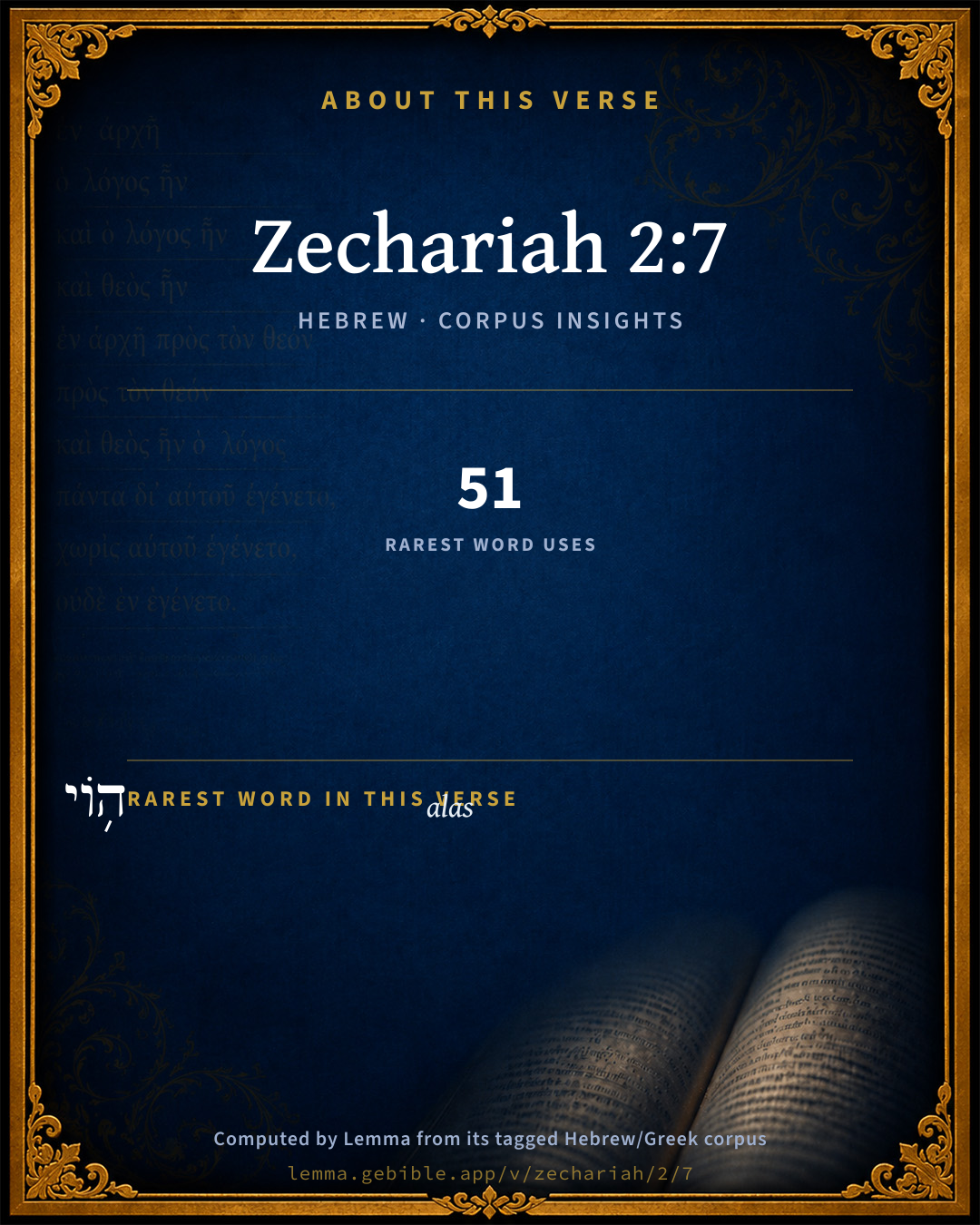
These counts appear in no published source. They are computed here, from the morphology-tagged text and Lemma’s own curated glosses. What Lemma adds →

6
words
6
distinct lemmas
Prophets
section

Shared distinctive vocabulary

ה֥וֹי alas H1945 occurs in 47 verses of the Hebrew Bible. Also found in:

Grammatical profile

  • 2 verbs
  • 3 nouns
  • 1 particle

Verb forms

  • הִמָּלְטִ֑י Niphal · Imperative
  • יוֹשֶׁ֖בֶת Qal · Participle Active

Hebrew & Septuagint length

In English translation the verse runs 11 words from the Hebrew and 13 from the Septuagint (LXX English) — closely comparable.

A rough comparison of the two English renderings, which tokenize alike — not a word-level alignment.

Word counts can differ between the Hebrew and the Greek without any difference in meaning — e.g. the Hebrew direct-object marker אֵת has no separate Greek word, and Greek often adds the article ὁ.

Cross-references

12

Topical passages linked to Zechariah 2:7 in the Treasury of Scripture Knowledge — connected by theme and wording, ordered by reader-vote popularity; previews shown in the World English Bible.

  • Isaiah 48:20 Go you forth from Babylon, flee you from the Chaldeans; with a voice of singing declare you, tell this, utter it even to the end of the earth: say you, Yahweh has redeemed his servant Jacob.
  • Genesis 19:17 It came to pass, when they had taken them out, that he said, "Escape for your life! Don't look behind you, neither stay anywhere in the plain. Escape to the mountain, lest you be consumed!"
  • Isaiah 52:11 Depart you, depart you, go you out from there, touch no unclean thing; go you out of the midst of her; cleanse yourselves, you who bear the vessels of Yahweh.
  • Jeremiah 51:6 Flee out of the midst of Babylon, and save every man his life; don't be cut off in her iniquity: for it is the time of Yahweh's vengeance; he will render to her a recompense.
  • Acts 2:40 With many other words he testified, and exhorted them, saying, "Save yourselves from this crooked generation!"
  • Revelation 18:4 I heard another voice from heaven, saying, "Come out of her, my people, that you have no participation in her sins, and that you don't receive of her plagues,
  • Numbers 16:34 All Israel that were round about them fled at the cry of them; for they said, Lest the earth swallow us up.
  • Isaiah 52:2 Shake yourself from the dust; arise, sit [on your throne], Jerusalem: loose yourself from the bonds of your neck, captive daughter of Zion.
  • Jeremiah 50:8 Flee out of the midst of Babylon, and go forth out of the land of the Chaldeans, and be as the male goats before the flocks.
  • Jeremiah 51:45 My people, go you out of the midst of her, and save yourselves every man from the fierce anger of Yahweh.
  • Micah 4:10 Be in pain, and labor to bring forth, daughter of Zion, Like a woman in travail; For now you will go forth out of the city, And will dwell in the field, And will come even to Babylon. There you will be rescued. There Yahweh will redeem you from the hand of your enemies.
  • Numbers 16:26 He spoke to the congregation, saying, Depart, I pray you, from the tents of these wicked men, and touch nothing of theirs, lest you be consumed in all their sins.

Cross-references courtesy of OpenBible.info (CC BY 4.0).

Hebrew and Greek witnesses Masoretic Hebrew ↔ Greek Septuagint

The same verse in the two great witnesses to the Old Testament, shown verse-for-verse.

These are two independent witnesses, not word-aligned to each other, and the Septuagint is shown in lemma (dictionary) form.

Hebrew Zechariah 2:7 Masoretic · Westminster Leningrad Codex

ה֥וֹי צִיּ֖וֹן הִמָּלְטִ֑י יוֹשֶׁ֖בֶת בַּת בָּבֶֽל

'Come, Zion! Escape, you who dwell with the daughter of Babylon.'

World English Bible · Public Domain

Greek LXX Zechariah 2:7 Septuagint · lemma form

καί ἰδού ὁ ἄγγελος ὁ λαλέω ἐν ἐγώ ἵστημι καί ἄγγελος ἕτερος ἐκπορεύομαι εἰς συνάντησις αὐτός

even to Sion: deliver yourselves, you⌃ that dwell with the daughter of Babylon.

LXX2012 (modern English Septuagint) · Public Domain

On this verse, Ellicott's Commentary for English Readers discusses the Septuagint’s reading. Read the note in Commentary ↓

Hebrew: Westminster Leningrad Codex (CC BY 4.0). Greek: Septuagint (public domain); English from LXX2012 (modern English Septuagint) (Public Domain). How the Septuagint differs from the Hebrew →

Targum (Aramaic paraphrase)

1

The Targum is the ancient Jewish Aramaic paraphrase of the Hebrew Scriptures — an interpretive translation, not the Hebrew text itself. Onkelos (literal) and Pseudo-Jonathan (expansive) render the Torah, and Jonathan the Prophets. Coverage is partial: where no permissively-licensed English translation exists for a verse, only the Aramaic is shown. This is verse-level text, not a word-by-word alignment to the Hebrew.

  1. Targum Jonathan Prophets (Joshua–Malachi)
    וְהָא מַלְאֲכָא דְמַלֵיל עִמִי נָפִיק וּמַלְאֲכָא אוֹחֲרָנָא נָפֵיק לָקֳדָמוּתֵיהּ:

    (no public-domain English translation for this verse)

    Targum Jonathan — Aramaic: “Mikraot Gedolot” (public domain). English: “Sefaria Community Translation” (CC0 1.0 (public-domain dedication)); “London "Chaldee Paraphrase," 1871” (public domain). Text via Sefaria.

Commentary

Notes on Zechariah 2:7 from classic Christian and Jewish commentators (each source and its license shown beneath its notes). The classic Christian expositions comment on the surrounding passage and are grouped to its opening verse, so a note may address several verses; the Jewish commentaries on the Tanakh (Rashi and others) are per-verse, so they appear only where the commentator wrote on this verse.

Lemma curates 59 commentaries, every one of them public domain or Creative Commons licensed, each selected and text-cleaned for this edition rather than reprinted as found. About our sources →

Trapp's Complete Commentary

John Trapp

Zec 2:7 Deliver thyself, O Zion, that dwellest [with] the daughter of Babylon.

Ver. 7. Deliver thyself, O Zion, that dwellest with the daughter of Babylon] q.d. Is Babylon a fit place for thee to abide in? what comfort canst thou take in such lewd company? Save thyself from this untoward generation, Act 2:40 "Flee out of the midst of Babylon, and deliver every man his soul: be not cut off in her iniquity; for this is the time of the Lord’s vengeance; he will render unto her a recompense," Jer 51:6-7. Shortly after this exhortation to the sons of Zion Babylon revolted from the Persians, and was taken and sacked by Darius in the fourth year of his reign (that is, two years after this prophecy was uttered) by the help of his friend Zopyrus. Two things should prevail with the people of God to shun the society of the ungodly. 1. Infection of sin, which is more contagious and catching than the plague. Though Lot learned not the evil manners of Sodom, yet his daughters did. 2. Infliction of punishment, Zec 9:2; Zec 9:4. Hamath lay so nigh Damascus in places that she fared the worse for her neighbourhood. See for both these, Rev 18:4, and say, if at any time forced to be in bad company, "Oh that I had wings of a dove: for then would I flee away, and be at rest," Psa 55:6. Or, if this "Oh" will not set thee at liberty, take up that "Woe" to express thy misery, "Woe is me that I sojourn in Meshech."

John Trapp, A Commentary or Exposition upon All the Books of the Old and New Testament (1647–1656) — public domain. Text from a community e-Sword module.

The Biblical Illustrator

Joseph S. Exell

Zec_2:7

Deliver thyself, O Zion, that dwellest with the daughter Babylon

Separation from the world, the duty and privilege of a Christian

Zechariah prophesied at Jerusalem after the return of the Jews from their captivity in Babylon; and one great object of his ministry was to stir them up to a more lively sense of the peculiar duties and privileges which their deliverance brought with it.

In the text he is addressing that part of the nation which were still remaining in the land of Chaldea. As their dispersion had been the effect of Gods righteous displeasure, so the way now opened for their return was no less clearly an evidence of His returning mercy and favour. But many were unwilling to return; the real cause of their so deciding was their indifference to religion, their distrust of Gods Word, and their backwardness to obey Him and to show themselves His servants. To them came the admonition of the text. Can we make application of this passage to present times, and point out its spiritual sense? The world is now, to Christians, what Babylon was then to the Jews. By the world, is meant this world, in respect to its moral state; to its habits, maxims, and practices; to its principles, fashions, and ways: the world as it is now corrupted through the depravity of man. By Christians is meant all who are so called; all who, by name and profession, are Christians. They are born and grow up in the midst of the worlds sin and iniquity. From their earliest infancy they are surrounded by its examples, exposed to its allurements, and made familiar with its practices. What they are taught to admire and covet most, are the things of the world. But they belong, not to the world, but to Christ. They are professedly the subjects of that spiritual kingdom which Christ has established in the world. They cannot possess and enjoy their privileges while living in the world. The Jews must return home to Judea before they could rejoice as Jews. And what must Christians do, if they would rejoice as Christians? They must arise, and turning their backs on the world, must comply with the proclamation of the Gospel. Come out and be separate. It is one part of the salvation of the Gospel, that it delivers us from this present evil world. If persons would sincerely come to Christ for deliverance, He would surely set them free. The persons with whom we would plead are those who, under the garb of a Christian profession, manifestly retain a worldly spirit, and by their conformity to the fashions and follies of the world, betray its influence over their hearts. Consider--

1. The inconsistency of such a state with your profession of Christianity.

2. The shamefulness of it.

3. The danger of your present state. If you walk not as a Christian now, you will never be owned as a Christian at last.

4. The happiness which will result from complying with the admonition in the text. (E. Cooper.)

The Biblical Illustrator, edited by Joseph S. Exell (c. 1880s–1900s) — public domain. Text from a community e-Sword module.

Geneva Bible (1599)

Geneva Bible translators

By fleeing from Babylon, and coming to the Church.

Geneva Bible (1599) marginal notes — public domain. Text via Bolls.life.

Jamieson, Fausset & Brown

Robert Jamieson, A. R. Fausset & David Brown

O Zion . . . daughter of Babylon--Thou whose only sure dwelling is "Zion," inseparably connected with the temple, art altogether out of thy place in "dwelling with the daughter of Babylon" (that is, Babylon and her people, Psa 137:8; Isa 1:8).

After the glory--After restoring the "glory" (Zac 2:5; Isa 4:5; Rom 9:4) of Jehovah's presence to Jerusalem, He (God the Father) hath commissioned ME (God the Son, Isa 48:16, the Divine Angel: God thus being at once the Sender and the Sent) to visit in wrath "the nations which spoiled you." Messiah's twofold office from the Father is: (1) to glorify His Church; (2) to punish its foes (Th2 1:7-10). Both offices manifest His glory (Pro 16:4).

toucheth . . . the apple of his eye--namely, of Jehovah's eye (Deu 32:10; Psa 17:8; Pro 7:2). The pupil, or aperture, through which rays pass to the retina, is the tenderest part of the eye; the member which we most sedulously guard from hurt as being the dearest of our members; the one which feels most acutely the slightest injury, and the loss of which is irreparable.

Jamieson, Fausset & Brown — Commentary Critical and Explanatory on the Whole Bible (1871) — public domain (CC PDM 1.0). Text via the HelloAO Bible API.

John Calvin's Commentaries

The Prophet repeats the same thing, though briefly, and in other words: but while he briefly touches on what he meant to say, he confirms and renders more plain the contents of the former verse. He shows that it was a very great disgrace that Babylon should become as it were the grave of Sion; for God had chosen that mount as the place where he was to be worshipped. Babylon, we know, was a filthy cavern, accursed by God. It was therefore to subvert, as it were, the order of nature, for the Jews to bury, so to speak, the holy mount of God in that infernal region. This mode of speaking appears on the first view somewhat harsh, but it is yet most suitable; for by Sion the Prophet means the Jews, who were still dispersed in Chaldea. The temple had not indeed been moved from its place, but only burnt and destroyed by the Chaldeans, and there was no other temple built among the Babylonians. What then does the Prophet mean by saying, O Sion, who dwellest with the daughter of Babylon, return to thine own place? He even reminds the Jews that they were bound, as it were, to the temple; for it was a sacred and an indissoluble bond of mutual union between God and them. (1 Kings 6:13.) For when God proposed that a temple should be built for him on mount Sion, he at the same time added,

“I will dwell among you; this is my rest.” (Psalm 132:14.)

Since the Jews, then, became united to their God, the temple ass introduced as a pledge of this sacred union. Thus justly and fitly does the Prophet give the name of Sion to the Jews; for they were, as it has been said, tied as it were to the temple, except they meant to deny God. Hence he says, “Is it right that you should dwell among the Chaldeans? for ye are as it were the stones of God’s temple. There is therefore for you no fixed and permanent abode except on mount Sion, as you are in a sense that very mount itself.” Therefore he says, “Sion, hasten and return to thine own place; for it is strange and preposterous that thou shouldest dwell with the daughter of Babylon.”

In short, the Prophet shows that God’s favor ought not to have been rejected, when he stretched forth his hand, and gave them a free liberty to return. As then God thus appeared as the deliverer of his people, the Jews ought not to have remained exiles, but immediately to ascend to Jerusalem, that they might again worship God. And why did the Prophet mention this? that the Jews might know that they had nothing to fear, though surrounded with dangers; that though Satan suggested many perils, many difficulties, many troubles, yet the grace of God would not be defective, or evanescent, or fallacious, but that he would complete his work, and not disappoint those to whom he had once testified, that there would be to them again a quiet habitation in the land of Judah. It now follows —

John Calvin's Commentaries (1540-1563) — public domain. Text from the Calvin Translation Society English edition (1840s-50s) via the Christian Classics Ethereal Library (ccel.org). Calvin's coverage is partial (roughly two-thirds of the Bible); uncommented books and verses are honest gaps, never fabricated. The 19th-century editor's footnotes and remarks are omitted so the notes are faithfully Calvin's own voice.

Ellicott's Commentary for English Readers

(7) Daughter of Babylon means inhabitants of Babylon, as (Zec_2:10) “daughter of Zion” means inhabitants of Zion. (With the whole passage comp. Isa_48:20; Jer_51:6; Jer_51:9; Jer_51:45.) LXX. for “O Zion,” εὶς Σιῶν—comp. a somewhat similar mistake in Eze_21:15 (Zec_2:10, LXX.).

A Bible Commentary for English Readers, edited by Charles John Ellicott (1878–1897) — public domain. Text from a community e-Sword module.

The Cambridge Bible for Schools and Colleges

gen. ed. J. J. S. Perowne

7. Deliver thyself] Lit. “Ho, Zion, deliver thyself: thou that dwellest with, &c.” The reason for this urgent call to escape, viz. the impending judgment upon Babylon, follows immediately, Zec_2:8-9. In like manner Jeremiah (Jer_50:8; Jer_50:10; Jer_51:6; Jer_51:45), and before him Isaiah (Jer_48:14; Jer_48:20), connects the punishment of Babylon with the escape of Israel. The immediate reference of those prophecies is to the taking of Babylon by Cyrus, which preceded and led to the return from the 70 years’ captivity. But the prophecies reach on, in the largeness of their terms, to the final and utter destruction of Babylon, and include such later calls to escape as that of Zechariah here. The immediate reference here would appear to be to one or both of those occasions in the reign of Darius, on which Babylon “had risen against the Persians and made an effort to regain its independence”. “What these dangers were may be seen from the great inscription of Darius cut into the rock at Behistun, and supposed by Sir H. Rawlinson to have been executed in the fifth year of the reign of Darius (two or three years after this prophecy was uttered). That inscription records two great rebellions in Babylonia, and two captures of the city of Babylon, one effected by Darius in person, the other by one of his generals. The Jews in Babylon who did not listen to the prophetic warning suffered no doubt severely in the confusions of that period; while those who returned to Palestine, and obeyed the command to flee out of Babylon, delivered their souls, that is their lives, and were not cut off in her iniquity.” Rev. C. H. H. Wright, Bampton Lectures, 1878.

The Cambridge Bible for Schools and Colleges (gen. ed. J. J. S. Perowne; Cambridge University Press, 1878–1918) — public domain. Text from a community e-Sword module.

John Gill's Exposition

Deliver thyself, O Zion,.... Or make thy escape, you that belong to Mount Zion, the city of the living God, and ought to have your abode there, and not in Babylon: flee from thence,

that dwelleth with the daughter of Babylon; in any of the antichristian states, who are the daughters of Babylon, the mother of harlots, Rev 17:5 so it may be rendered, "that inhabits the daughter of Babylon" (k); dwells in any of the cities, towns, and villages, belonging to it.

(k) , , Sept.; "habitatrix filiae Babel", Pagninus, Montanus, Drusius; "vel inhabitans filiam Babel", De Dieu.

John Gill's Exposition of the Whole Bible (1746–1763) — public domain (CC PDM 1.0). Text via the HelloAO Bible API.

Albert Barnes' Notes on the Bible

Dwellest with the daughter of Babylon - The unusual idiom is perhaps chosen as expressive of God’s tenderness, even to the people who were to be destroyed, from which Israel was to escape.

Albert Barnes' Notes on the Bible (1834–1885) — public domain. Text from a community e-Sword/MySword module.

Matthew Poole's English Annotations

Deliver thyself: the proclamation for free return is published; up, then, and be gone.

O Zion; O ye people who should dwell in Zion, ye daughters of Zion.

Dwellest; keepest in Babylon when thou mightest go to Jerusalem.

With the daughter of Babylon: perhaps this intimates that which kept many Jews in Babylon, wives or mistresses.

Matthew Poole's English Annotations on the Holy Bible (1683–1685) — public domain. Text from a community e-Sword/MySword module.

The Pulpit Commentary

Deliver thyself. Escape from the danger. O Zion. The exiled Jews are thus designated. Septuagint, Eiv Siwzesye "Go to Zion, and save yourselves." That dwellest (thou that dwellest) with the daughter of Babylon. The inhabitants of Babylon are called "the daughter of Babylon," in analogy with the common phrases, "the daughter of Zion," "the daughter of Jerusalem". (comp. Jer_46:19) There is soma reproach implied in the clause, as if these Jews were content to dwell and remain in this heathen city. The immediate danger that menaced Babylon arose from two severe rebellions, in the course of which the city was twice taken. The first revolt was headed by Nidinta-Bel, B.C. 519, who was slain by Darius at Babylon. The second took place under Arakha, B.C. 514; he was defeated by a general of Darius, named Intaphernes, taken prisoner and crucified. A record of these occurrences is found in Darius"s inscription on the rock at Behlstun, translated in "Records of the Past," vol. 1. The merciless Persians would doubtless treat the inhabitants of the captured city with their wonted cruelty.

The Pulpit Commentary (1880–1919), ed. H.D.M. Spence-Jones & Joseph S. Exell — public domain. Text from a community e-Sword module.

John Wesley's Explanatory Notes

Deliver thyself - Accept of thy deliverance.

John Wesley, Explanatory Notes Upon the Whole Bible (1754–1765) — public domain. Text via the GEBible commentary corpus.

Rashi

Rabbi Shlomo Yitzchaki (Rashi)

And behold, the angel who was speaking with me was coming forth He is the one with the measuring line in his hand.

Rashi on the Tanakh — English translations: “The Judaica Press complete Tanach with Rashi, translated by A. J. Rosenberg” (CC BY 4.0); “Pentateuch with Rashi's commentary by M. Rosenbaum and A.M. Silbermann, 1929-1934” (public domain); “The Metsudah Tanach series, Lakewood, N.J” (CC BY 4.0); and “The Book of Joshua, Metsudah Publications, 1997” (CC BY 4.0). Text via Sefaria.

Lesson kit

Teaching starters — assembled from the data on this page, not authored interpretation. Every prompt links to the verse data it draws on. Edit before teaching.

Zechariah, in the Prophets, opens this verse with 6 words (6 distinct Hebrew lemmas). Its most distinctive word is hôwy (“alas”). A historical commentator’s framing appears above. Read the whole chapter for the surrounding context.

Discussion questions

  1. The word hôwy carries the sense “alas.” How does it shape the verse?
  2. 1 Kings 13:30 shares the word «alas» with this verse. How do the two illuminate each other?
  3. These translations render this verse differently; the difference is in the English rendering, not the original. What questions does that raise?
  4. The verb «הִמָּלְטִ֑י» is Niphal Imperative. How does its form color the action?
  5. Reading how Trapp's Complete Commentary and The Biblical Illustrator read this verse, where do the two commentators agree and where do they part?

Things to notice

Reading settings

Reading text

Shown beneath each verse's original-language words.

Old Testament
Old Testament edition

Read the OT as the Masoretic Hebrew (MT) or the Greek Septuagint (LXX).

English shown for the Greek Septuagint (in the Hebrew ↔ Greek comparison).

Comparing translations? Open the Compare panel on any verse page to stack up to four side by side.