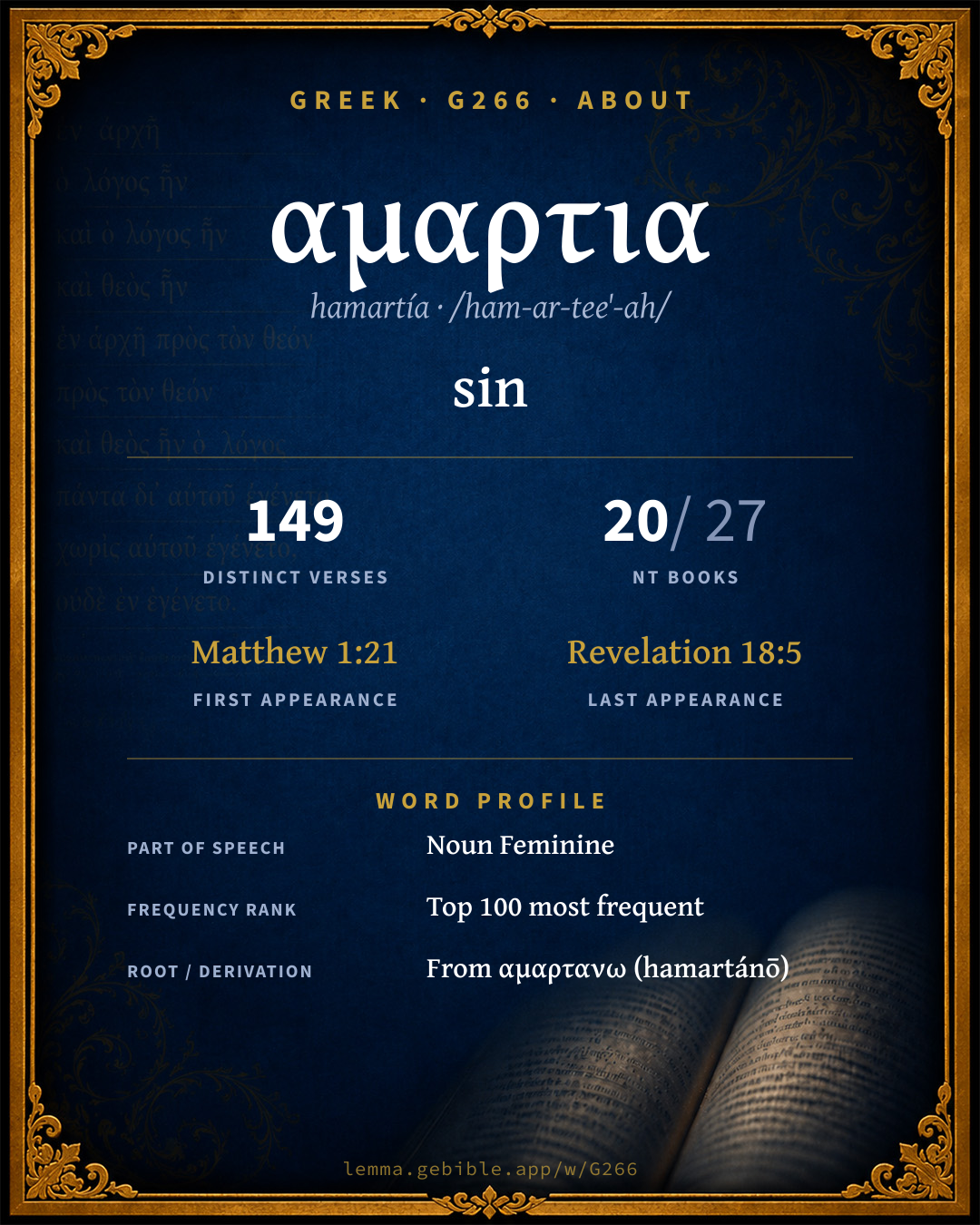
ἁμαρτία
sin
‘sin’ is one of 3 main senses fuller range ↓
Full lexicon entry — Thayer's Greek Lexicon
From Thayer's Greek Lexicon
Where this word appears
See every Genitive-case word in the Greek New Testament →
Grammar key — what these labels mean
Part of speech
- Noun
- A naming word — a person, place, thing, or idea.
Case
- Genitive
- The case of source, possession, or “of” — answers “whose / from what.”
- Nominative
- The case of the subject (and the predicate nominative).
- Accusative
- The case of the direct object and of extent.
- Dative
- The case of the indirect object, means, or location — “to / for / with / in.”
Gender
- Feminine
- Grammatically feminine.
Number
- Singular
- One.
- Plural
- More than one.
Grammatical forms
- Noun, Genitive, Singular, Feminine 34 times (20%)
- Noun, Genitive, Plural, Feminine 31 times (18%)
- Noun, Nominative, Singular, Feminine 28 times (16%)
- Noun, Accusative, Singular, Feminine 27 times (16%)
- Noun, Accusative, Plural, Feminine 24 times (14%)
- Noun, Nominative, Plural, Feminine 12 times (7%)
- Noun, Dative, Plural, Feminine 9 times (5%)
- Noun, Dative, Singular, Feminine 7 times (4%)
Parsed forms decoded from the imported morphology (Robinson–Tischendorf, public domain), counted across 172 parsed occurrences — not distinct verses.
Every verse where G266 appears — 149 distinct verses across 20 books. Click any verse to open its interlinear word-by-word view. Verse text shown in the World English Bible for context — . Each verse’s Greek form is shown with its reference; the English is not keyword-highlighted, since the data carries no word-level English alignment. Use “Compare translations” on any verse to read it across multiple English versions. This concordance covers the Greek New Testament; Septuagint (Greek Old Testament) occurrences of this word are not indexed here.
Matthew 7 verses
- Matthew 1:21 ἁμαρτιῶν n gen pl fem She shall bring forth a son. You shall call his name Jesus, for it is he who shall save his people from their sins."
- Matthew 3:6 ἁμαρτίας n acc pl fem They were baptized by him in the Jordan, confessing their sins.
- Matthew 9:2 ἁμαρτίαι n nom pl fem Behold, they brought to him a man who was paralyzed, lying on a bed. Jesus, seeing their faith, said to the paralytic, "Son, cheer up! Your sins are forgiven you."
- Matthew 9:5 ἁμαρτίαι n nom pl fem For which is easier, to say, 'Your sins are forgiven;' or to say, 'Get up, and walk?'
- Matthew 9:6 ἁμαρτίας n acc pl fem But that you may know that the Son of Man has authority on earth to forgive sins..." (then he said to the paralytic), "Get up, and take up your mat, and go up to your house."
- Matthew 12:31 ἁμαρτία n nom sg fem Therefore I tell you, every sin and blasphemy will be forgiven men, but the blasphemy against the Spirit will not be forgiven men.
- Matthew 26:28 ἁμαρτιῶν n gen pl fem for this is my blood of the new covenant, which is poured out for many for the remission of sins.
Mark 6 verses
- Mark 1:4 ἁμαρτιῶν n gen pl fem John came baptizing in the wilderness and preaching the baptism of repentance for forgiveness of sins.
- Mark 1:5 ἁμαρτίας n acc pl fem All the country of Judea and all those of Jerusalem went out to him. They were baptized by him in the Jordan river, confessing their sins.
- Mark 2:5 ἁμαρτίαι n nom pl fem Jesus, seeing their faith, said to the paralytic, "Son, your sins are forgiven you."
- Mark 2:7 ἁμαρτίας n acc pl fem "Why does this man speak blasphemies like that? Who can forgive sins but God alone?"
- Mark 2:9 ἁμαρτίαι n nom pl fem Which is easier, to tell the paralytic, 'Your sins are forgiven;' or to say, 'Arise, and take up your bed, and walk?'
- Mark 2:10 ἁμαρτίας n acc pl fem But that you may know that the Son of Man has authority on earth to forgive sins"--he said to the paralytic--
Luke 11 verses
- Luke 1:77 ἁμαρτιῶν n gen pl fem To give knowledge of salvation to his people by the remission of their sins,
- Luke 3:3 ἁμαρτιῶν n gen pl fem He came into all the region around the Jordan, preaching the baptism of repentance for remission of sins.
- Luke 5:20 ἁμαρτίαι n nom pl fem Seeing their faith, he said to him, "Man, your sins are forgiven you."
- Luke 5:21 ἁμαρτίας n acc pl fem The scribes and the Pharisees began to reason, saying, "Who is this that speaks blasphemies? Who can forgive sins, but God alone?"
- Luke 5:23 ἁμαρτίαι n nom pl fem Which is easier to say, 'Your sins are forgiven you;' or to say, 'Arise and walk?'
- Luke 5:24 ἁμαρτίας n acc pl fem But that you may know that the Son of Man has authority on earth to forgive sins" (he said to the paralyzed man), "I tell you, arise, and take up your cot, and go to your house."
- Luke 7:47 ἁμαρτίαι n nom pl fem Therefore I tell you, her sins, which are many, are forgiven, for she loved much. But to whom little is forgiven, the same loves little."
- Luke 7:48 ἁμαρτίαι n nom pl fem He said to her, "Your sins are forgiven."
- Luke 7:49 ἁμαρτίας n acc pl fem Those who sat at the table with him began to say to themselves, "Who is this who even forgives sins?"
- Luke 11:4 ἁμαρτίας n acc pl fem Forgive us our sins, For we ourselves also forgive everyone who is indebted to us. Bring us not into temptation, But deliver us from the evil one.'"
- Luke 24:47 ἁμαρτιῶν n gen pl fem and that repentance and remission of sins should be preached in his name to all the nations, beginning at Jerusalem.
John 13 verses
- John 1:29 ἁμαρτίαν n acc sg fem The next day, he saw Jesus coming to him, and said, "Behold, the Lamb of God, who takes away the sin of the world!
- John 8:21 ἁμαρτίᾳ n dat sg fem Jesus said therefore again to them, "I am going away, and you will seek me, and you will die in your sins. Where I go, you can't come."
- John 8:24 ἁμαρτίαις ἁμαρτίαις n dat pl fem n dat pl fem I said therefore to you that you will die in your sins; for unless you believe that I am he, you will die in your sins."
- John 8:34 ἁμαρτίαν ἁμαρτίας n acc sg fem n gen sg fem Jesus answered them, "Most assuredly I tell you, everyone who commits sin is the bondservant of sin.
- John 8:46 ἁμαρτίας n gen sg fem Which of you convicts me of sin? If I tell the truth, why do you not believe me?
- John 9:34 ἁμαρτίαις n dat pl fem They answered him, "You were altogether born in sins, and do you teach us?" They threw him out.
- John 9:41 ἁμαρτίαν ἁμαρτία n acc sg fem n nom sg fem Jesus said to them, "If you were blind, you would have no sin; but now you say, 'We see.' Therefore your sin remains.
- John 15:22 ἁμαρτίαν ἁμαρτίας n acc sg fem n gen sg fem If I had not come and spoken to them, they would not have had sin; but now they have no excuse for their sin.
- John 15:24 ἁμαρτίαν n acc sg fem If I hadn't done among them the works which no one else did, they wouldn't have had sin. But now have they seen and also hated both me and my Father.
- John 16:8 ἁμαρτίας n gen sg fem When he has come, he will convict the world about sin, about righteousness, and about judgment;
- John 16:9 ἁμαρτίας n gen sg fem about sin, because they don't believe in me;
- John 19:11 ἁμαρτίαν n acc sg fem Jesus answered, "You would have no power at all against me, unless it were given to you from above. Therefore he who delivered me to you has greater sin."
- John 20:23 ἁμαρτίας n acc pl fem Whoever's sins you forgive, they are forgiven them. Whoever's sins you retain, they have been retained."
Acts 8 verses
- Acts 2:38 ἁμαρτιῶν n gen pl fem Peter said to them, "Repent, and be baptized, everyone of you, in the name of Jesus Christ for the forgiveness of sins, and you will receive the gift of the Holy Spirit.
- Acts 3:19 ἁμαρτίας n acc pl fem "Repent therefore, and turn again, that your sins may be blotted out, so that there may come times of refreshing from the presence of the Lord,
- Acts 5:31 ἁμαρτιῶν n gen pl fem God exalted him with his right hand to be a Prince and a Savior, to give repentance to Israel, and remission of sins.
- Acts 7:60 ἁμαρτίαν n acc sg fem He kneeled down, and cried with a loud voice, "Lord, don't hold this sin against them!" When he had said this, he fell asleep.
- Acts 10:43 ἁμαρτιῶν n gen pl fem All the prophets testify about him, that through his name everyone who believes in him will receive remission of sins."
- Acts 13:38 ἁμαρτιῶν n gen pl fem Be it known to you therefore, brothers, that through this man is proclaimed to you remission of sins,
- Acts 22:16 ἁμαρτίας n acc pl fem Now why do you wait? Arise, be baptized, and wash away your sins, calling on the name of the Lord.'
- Acts 26:18 ἁμαρτιῶν n gen pl fem to open their eyes, that they may turn from darkness to light and from the power of Satan to God, that they may receive remission of sins and an inheritance among those who are sanctified by faith in me.'
Romans 39 verses
- Romans 3:9 ἁμαρτίαν n acc sg fem What then? Are we better than they? No, in no way. For we previously charged both Jews and Greeks, that they are all under sin.
- Romans 3:20 ἁμαρτίας n gen sg fem Because by the works of the law, no flesh will be justified in his sight. For through the law comes the knowledge of sin.
- Romans 4:7 ἁμαρτίαι n nom pl fem "Blessed are they whose iniquities are forgiven, Whose sins are covered.
- Romans 4:8 ἁμαρτίαν n acc sg fem Blessed is the man whom the Lord will by no means charge with sin."
- Romans 5:12 ἁμαρτία ἁμαρτίας n nom sg fem n gen sg fem Therefore, as sin entered into the world through one man, and death through sin; and so death passed to all men, because all sinned.
- Romans 5:13 ἁμαρτία ἁμαρτία n nom sg fem n nom sg fem For until the law, sin was in the world; but sin is not charged when there is no law.
- Romans 5:20 ἁμαρτία n nom sg fem The law came in besides, that the trespass might abound; but where sin abounded, grace did abound more exceedingly;
- Romans 5:21 ἁμαρτία n nom sg fem that as sin reigned in death, even so might grace reign through righteousness to eternal life through Jesus Christ our Lord.
- Romans 6:1 ἁμαρτίᾳ n dat sg fem What shall we say then? Shall we continue in sin, that grace may abound?
- Romans 6:2 ἁμαρτίᾳ n dat sg fem May it never be! We who died to sin, how could we live in it any longer?
- Romans 6:6 ἁμαρτίας ἁμαρτίᾳ n gen sg fem n dat sg fem knowing this, that our old man was crucified with him, that the body of sin might be done away with, so that we would no longer be in bondage to sin.
- Romans 6:7 ἁμαρτίας n gen sg fem For he who has died has been freed from sin.
- Romans 6:10 ἁμαρτίᾳ n dat sg fem For the death that he died, he died to sin one time; but the life that he lives, he lives to God.
- Romans 6:11 ἁμαρτίᾳ n dat sg fem Thus also consider yourselves also to be dead to sin, but alive to God in Christ Jesus our Lord.
- Romans 6:12 ἁμαρτία n nom sg fem Therefore don't let sin reign in your mortal body, that you should obey it in its lusts.
- Romans 6:13 ἁμαρτίᾳ n dat sg fem Neither present your members to sin as instruments of unrighteousness, but present yourselves to God, as alive from the dead, and your members as instruments of righteousness to God.
- Romans 6:14 ἁμαρτία n nom sg fem For sin will not have dominion over you. For you are not under law, but under grace.
- Romans 6:16 ἁμαρτίας n gen sg fem Don't you know that to whom you present yourselves as servants to obedience, his servants you are whom you obey; whether of sin to death, or of obedience to righteousness?
- Romans 6:17 ἁμαρτίας n gen sg fem But thanks be to God, that, whereas you were bondservants of sin, you became obedient from the heart to that form of teaching whereunto you were delivered.
- Romans 6:18 ἁμαρτίας n gen sg fem Being made free from sin, you became bondservants of righteousness.
- Romans 6:20 ἁμαρτίας n gen sg fem For when you were servants of sin, you were free in regard to righteousness.
- Romans 6:22 ἁμαρτίας n gen sg fem But now, being made free from sin, and having become servants of God, you have your fruit of sanctification, and the result of eternal life.
- Romans 6:23 ἁμαρτίας n gen sg fem For the wages of sin is death, but the free gift of God is eternal life in Christ Jesus our Lord.
- Romans 7:5 ἁμαρτιῶν n gen pl fem For when we were in the flesh, the sinful passions which were through the law, worked in our members to bring forth fruit to death.
- Romans 7:7 ἁμαρτία ἁμαρτίαν n nom sg fem n acc sg fem What shall we say then? Is the law sin? May it never be! However, I wouldn't have known sin, except through the law. For I wouldn't have known coveting, unless the law had said, "You shall not covet."
- Romans 7:8 ἁμαρτία ἁμαρτία n nom sg fem n nom sg fem But sin, finding occasion through the commandment, produced in me all kinds of coveting. For apart from the law, sin is dead.
- Romans 7:9 ἁμαρτία n nom sg fem I was alive apart from the law once, but when the commandment came, sin revived, and I died.
- Romans 7:11 ἁμαρτία n nom sg fem for sin, finding occasion through the commandment, deceived me, and through it killed me.
- Romans 7:13 ἁμαρτία ἁμαρτία ἁμαρτία n nom sg fem n nom sg fem n nom sg fem Did then that which is good become death to me? May it never be! But sin, that it might be shown to be sin, by working death to me through that which is good; that through the commandment sin might become exceeding sinful.
- Romans 7:14 ἁμαρτίαν n acc sg fem For we know that the law is spiritual, but I am fleshly, sold under sin.
- Romans 7:17 ἁμαρτία n nom sg fem So now it is no more I that do it, but sin which dwells in me.
- Romans 7:20 ἁμαρτία n nom sg fem But if what I don't desire, that I do, it is no more I that do it, but sin which dwells in me.
- Romans 7:23 ἁμαρτίας n gen sg fem but I see a different law in my members, warring against the law of my mind, and bringing me into captivity under the law of sin which is in my members.
- Romans 7:25 ἁμαρτίας n gen sg fem I thank God through Jesus Christ, our Lord! So then with the mind, I myself serve God's law, but with the flesh, the sin's law.
- Romans 8:2 ἁμαρτίας n gen sg fem For the law of the Spirit of life in Christ Jesus made me free from the law of sin and of death.
- Romans 8:3 ἁμαρτίας ἁμαρτίας ἁμαρτίαν n gen sg fem n gen sg fem n acc sg fem For what the law couldn't do, in that it was weak through the flesh, God did, sending his own Son in the likeness of sinful flesh and for sin, he condemned sin in the flesh;
- Romans 8:10 ἁμαρτίαν n acc sg fem If Christ is in you, the body is dead because of sin, but the spirit is alive because of righteousness.
- Romans 11:27 ἁμαρτίας n acc pl fem This is my covenant to them, When I will take away their sins."
- Romans 14:23 ἁμαρτία n nom sg fem But he who doubts is condemned if he eats, because it isn't of faith; and whatever is not of faith is sin. (14:24) Now to him who is able to establish you according to my Gospel and the preaching of Jesus Christ, according to the revelation of the mystery which has been kept secret through long ages, (14:25) but now is revealed, and by the Scriptures of the prophets, according to the commandment of the eternal God, is made known for obedience of faith to all the nations; (14:26) to the only wise God, through Jesus Christ, to whom be the glory forever! Amen.
1 Corinthians 3 verses
- 1 Corinthians 15:3 ἁμαρτιῶν n gen pl fem For I delivered to you first of all that which I also received: that Christ died for our sins according to the Scriptures,
- 1 Corinthians 15:17 ἁμαρτίαις n dat pl fem If Christ has not been raised, your faith is vain; you are still in your sins.
- 1 Corinthians 15:56 ἁμαρτία ἁμαρτίας n nom sg fem n gen sg fem The sting of death is sin, and the power of sin is the law.
2 Corinthians 2 verses
- 2 Corinthians 5:21 ἁμαρτίαν ἁμαρτίαν n acc sg fem n acc sg fem For him who knew no sin he made to be sin on our behalf; so that in him we might become the righteousness of God.
- 2 Corinthians 11:7 ἁμαρτίαν n acc sg fem Or did I commit a sin in humbling myself that you might be exalted, because I preached to you God's Gospel free of charge?
Galatians 3 verses
- Galatians 1:4 ἁμαρτιῶν n gen pl fem who gave himself for our sins, that he might deliver us out of this present evil age, according to the will of our God and Father--
- Galatians 2:17 ἁμαρτίας n gen sg fem But if, while we sought to be justified in Christ, we ourselves also were found sinners, is Christ a servant of sin? Certainly not!
- Galatians 3:22 ἁμαρτίαν n acc sg fem But the Scriptures shut up all things under sin, that the promise by faith in Jesus Christ might be given to those who believe.
Ephesians 1 verse
Colossians 1 verse
1 Thessalonians 1 verse
1 Timothy 2 verses
2 Timothy 1 verse
Hebrews 24 verses
- Hebrews 1:3 ἁμαρτιῶν n gen pl fem His Son is the radiance of his glory, the very image of his substance, and upholding all things by the word of his power, when he had by himself made purification for our sins, sat down on the right hand of the Majesty on high;
- Hebrews 2:17 ἁμαρτίας n acc pl fem Therefore he was obligated in all things to be made like his brothers, that he might become a merciful and faithful high priest in things pertaining to God, to make atonement for the sins of the people.
- Hebrews 3:13 ἁμαρτίας n gen sg fem but exhort one another day by day, so long as it is called "today;" lest any one of you be hardened by the deceitfulness of sin.
- Hebrews 4:15 ἁμαρτίας n gen sg fem For we don't have a high priest who can't be touched with the feeling of our infirmities, but one who has been in all points tempted like we are, yet without sin.
- Hebrews 5:1 ἁμαρτιῶν n gen pl fem For every high priest, being taken from among men, is appointed for men in things pertaining to God, that he may offer both gifts and sacrifices for sins.
- Hebrews 5:3 ἁμαρτιῶν n gen pl fem Because of this, he must offer sacrifices for sins for the people, as well as for himself.
- Hebrews 7:27 ἁμαρτιῶν n gen pl fem who doesn't need, like those high priests, to daily offer up sacrifices, first for his own sins, and then for the sins of the people. For this he did once for all, when he offered up himself.
- Hebrews 8:12 ἁμαρτιῶν n gen pl fem For I will be merciful to their unrighteousness. I will remember their sins and lawless deeds no more."
- Hebrews 9:26 ἁμαρτίας n gen sg fem or else he must have suffered often since the foundation of the world. But now once at the end of the ages, he has been revealed to put away sin by the sacrifice of himself.
- Hebrews 9:28 ἁμαρτίας ἁμαρτίας n acc pl fem n gen sg fem so Christ also, having been once offered to bear the sins of many, will appear a second time, without sin, to those who are eagerly waiting for him for salvation.
- Hebrews 10:2 ἁμαρτιῶν n gen pl fem Or else wouldn't they have ceased to be offered, because the worshippers, having been once cleansed, would have had no more consciousness of sins?
- Hebrews 10:3 ἁμαρτιῶν n gen pl fem But in those sacrifices there is yearly reminder of sins.
- Hebrews 10:4 ἁμαρτίας n acc pl fem For it is impossible that the blood of bulls and goats should take away sins.
- Hebrews 10:6 ἁμαρτίας n gen sg fem In whole burnt offerings and sacrifices for sin you had no pleasure.
- Hebrews 10:8 ἁμαρτίας n gen sg fem Previously saying, "Sacrifices and offerings and whole burnt offerings and sacrifices for sin you didn't desire, neither had pleasure in them" (those which are offered according to the law),
- Hebrews 10:11 ἁμαρτίας n acc pl fem Every priest indeed stands day by day ministering and often offering the same sacrifices, which can never take away sins,
- Hebrews 10:12 ἁμαρτιῶν n gen pl fem but he, when he had offered one sacrifice for sins for ever, sat down on the right hand of God;
- Hebrews 10:17 ἁμαρτιῶν n gen pl fem "I will remember their sins and their iniquities no more."
- Hebrews 10:18 ἁμαρτίας n gen sg fem Now where remission of these is, there is no more offering for sin.
- Hebrews 10:26 ἁμαρτιῶν n gen pl fem For if we sin willfully after we have received the knowledge of the truth, there remains no more a sacrifice for sins,
- Hebrews 11:25 ἁμαρτίας n gen sg fem choosing rather to share ill treatment with God's people, than to enjoy the pleasures of sin for a time;
- Hebrews 12:1 ἁμαρτίαν n acc sg fem Therefore let us also, seeing we are surrounded by so great a cloud of witnesses, lay aside every weight and the sin which so easily entangles us, and let us run with patience the race that is set before us,
- Hebrews 12:4 ἁμαρτίαν n acc sg fem You have not yet resisted to blood, striving against sin;
- Hebrews 13:11 ἁμαρτίας n gen sg fem For the bodies of those animals, whose blood is brought into the holy place by the high priest as an offering for sin, are burned outside of the camp.
James 6 verses
- James 1:15 ἁμαρτίαν ἁμαρτία n acc sg fem n nom sg fem Then the lust, when it has conceived, bears sin; and the sin, when it is full grown, brings forth death.
- James 2:9 ἁμαρτίαν n acc sg fem But if you show partiality, you commit sin, being convicted by the law as transgressors.
- James 4:17 ἁμαρτία n nom sg fem To him therefore who knows to do good, and doesn't do it, to him it is sin.
- James 5:15 ἁμαρτίας n acc pl fem and the prayer of faith will heal him who is sick, and the Lord will raise him up. If he has committed sins, he will be forgiven.
- James 5:16 ἁμαρτίας n acc pl fem Confess your offenses to one another, and pray one for another, that you may be healed. The effective, earnest prayer of a righteous man is powerfully effective.
- James 5:20 ἁμαρτιῶν n gen pl fem let him know that he who turns a sinner from the error of his way will save a soul from death, and will cover a multitude of sins.
1 Peter 5 verses
- 1 Peter 2:22 ἁμαρτίαν n acc sg fem who did not sin, "neither was deceit found in his mouth."
- 1 Peter 2:24 ἁμαρτίας ἁμαρτίαις n acc pl fem n dat pl fem who his own self bore our sins in his body on the tree, that we, having died to sins, might live to righteousness; by whose stripes you were healed.
- 1 Peter 3:18 ἁμαρτιῶν n gen pl fem Because Christ also suffered for sins once, the righteous for the unrighteous, that he might bring you to God; being put to death in the flesh, but made alive in the spirit;
- 1 Peter 4:1 ἁμαρτίας n gen sg fem Forasmuch then as Christ suffered for us in the flesh, arm yourselves also with the same mind; for he who has suffered in the flesh has ceased from sin;
- 1 Peter 4:8 ἁμαρτιῶν n gen pl fem And above all things be earnest in your love among yourselves, for love covers a multitude of sins.
2 Peter 1 verse
1 John 12 verses
- 1 John 1:7 ἁμαρτίας n gen sg fem But if we walk in the light, as he is in the light, we have fellowship with one another, and the blood of Jesus Christ, his Son, cleanses us from all sin.
- 1 John 1:8 ἁμαρτίαν n acc sg fem If we say that we have no sin, we deceive ourselves, and the truth is not in us.
- 1 John 1:9 ἁμαρτίας ἁμαρτίας n acc pl fem n acc pl fem If we confess our sins, he is faithful and righteous to forgive us the sins, and to cleanse us from all unrighteousness.
- 1 John 2:2 ἁμαρτιῶν n gen pl fem And he is the atoning sacrifice for our sins, and not for ours only, but also for the whole world.
- 1 John 2:12 ἁμαρτίαι n nom pl fem I write to you, little children, because your sins are forgiven you for his name's sake.
- 1 John 3:4 ἁμαρτίαν ἁμαρτία n acc sg fem n nom sg fem Everyone who sins also commits lawlessness. Sin is lawlessness.
- 1 John 3:5 ἁμαρτίας ἁμαρτία n acc pl fem n nom sg fem You know that he was revealed to take away our sins, and in him is no sin.
- 1 John 3:8 ἁμαρτίαν n acc sg fem He who sins is of the devil, for the devil has been sinning from the beginning. To this end the Son of God was revealed, that he might destroy the works of the devil.
- 1 John 3:9 ἁμαρτίαν n acc sg fem Whoever is born of God doesn't commit sin, because his seed remains in him; and he can't sin, because he is born of God.
- 1 John 4:10 ἁμαρτιῶν n gen pl fem In this is love, not that we loved God, but that he loved us, and sent his Son as the atoning sacrifice for our sins.
- 1 John 5:16 ἁμαρτίαν ἁμαρτία n acc sg fem n nom sg fem If anyone sees his brother sinning a sin not leading to death, he shall ask, and God will give him life for those who sin not leading to death. There is a sin leading to death. I don't say that he should make a request concerning this.
- 1 John 5:17 ἁμαρτία ἁμαρτία n nom sg fem n nom sg fem All unrighteousness is sin, and there is a sin not leading to death.
Revelation 3 verses
- Revelation 1:5 ἁμαρτιῶν n gen pl fem and from Jesus Christ, the faithful witness, the firstborn of the dead, and the ruler of the kings of the earth. To him who loves us, and washed us from our sins by his blood;
- Revelation 18:4 ἁμαρτίαις n dat pl fem I heard another voice from heaven, saying, "Come out of her, my people, that you have no participation in her sins, and that you don't receive of her plagues,
- Revelation 18:5 ἁμαρτίαι n nom pl fem for her sins have reached to the sky, and God has remembered her iniquities.
About this entry
At a glance — auto-summarized from this page’s data, not written by a person. Every figure links to its source below. This summary describes the numbers; it doesn’t interpret them.
The Greek noun αμαρτια centers on the idea of “sin.” Its earliest occurrence is Matthew 1:21. Spanning 149 verses in 20 books, it ranks among the common words of the Greek New Testament. Romans dominates its distribution — 39 of 149 verses. Lexicons map it across 3 senses. For the data behind this summary, explore the sense tree and the renderings breakdown below.
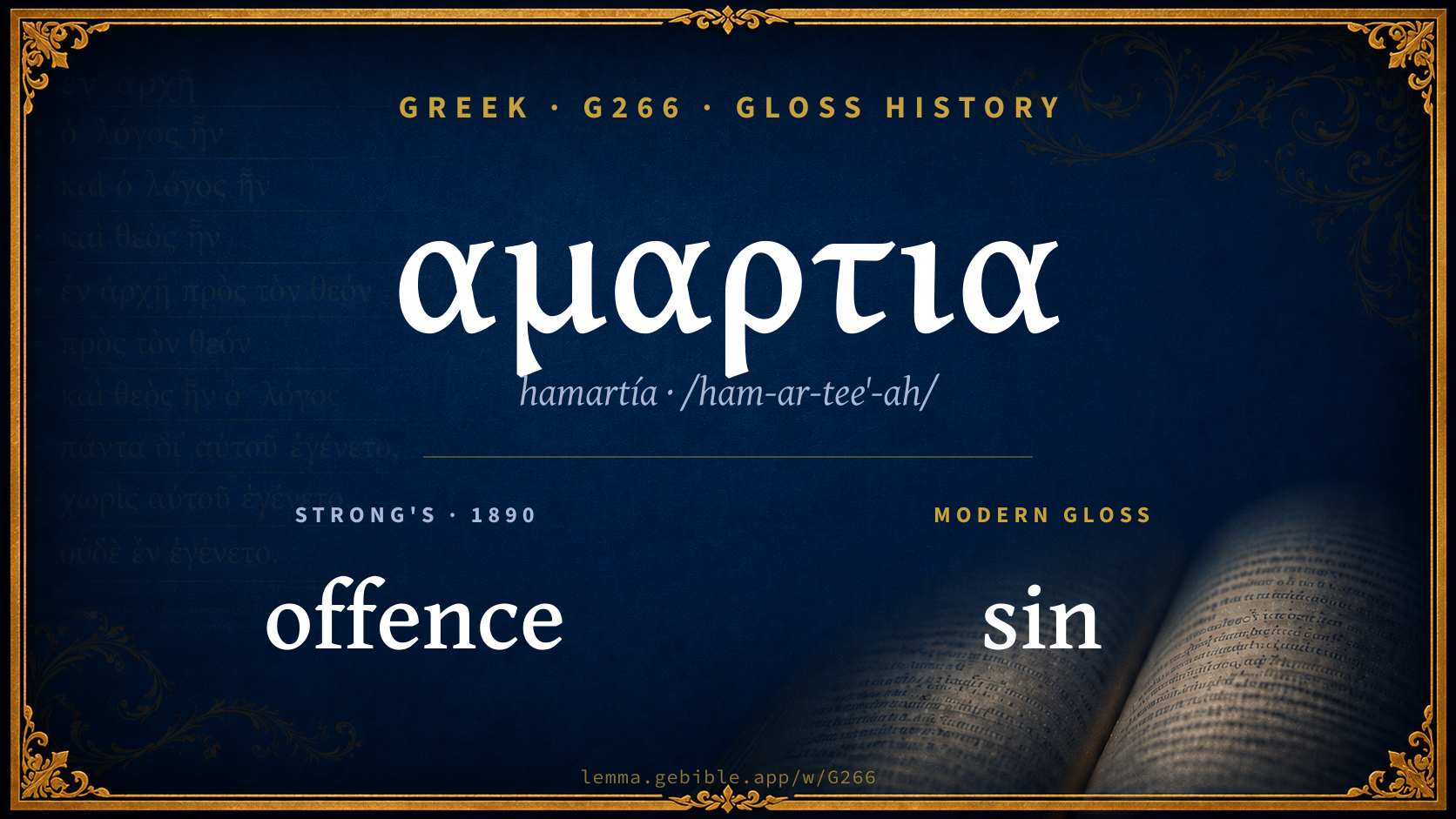
Gloss history
Strong's 1890 vs modern scholarship
About this word
Strong's G266 catalogs a Greek word from the Greek New Testament.
These counts are not copied from any lexicon or concordance. They are computed here, from the morphology-tagged Greek New Testament. What Lemma adds →
- 149
- distinct verses
- The word appears in 149 distinct verses.
- 20 / 27
- NT books
- The word appears in 20 of 27 New Testament books.
- #93
- by frequency
- Top 100 most frequent Greek words (rank 93 of 5,347 Greek words by occurrence).
View all 149 occurrences in the concordance →
By section of the New Testament
By traditional corpus
Conventional, traditional groupings — biblical authorship is debated, so this is a traditional corpus grouping, not an authorship claim. Some books belong to more than one corpus (Luke is in both the Gospels and the Lukan corpus, and so on), so these shares overlap and need not total 100%. Each figure is a share of the word’s 149 distinct verses.
- Pauline corpus 53 verses · 36%
- Gospels 37 verses · 25%
- Johannine 28 verses · 19%
- Hebrews 24 verses · 16%
- General (Catholic) Epistles 24 verses · 16%
- Lukan (Luke–Acts) 19 verses · 13%
- Revelation 3 verses · 2%
How translations render this word
Counts come from each version’s own published word-to-Strong’s tagging or interlinear alignment — an approximate guide to how each version renders this word, not a word-level alignment the data otherwise carries. Because each total is that version’s own tagged count, the per-version totals vary from one another and need not match the appearance or distinct-verse counts above. These counts may also differ from a printed concordance because Lemma counts each distinctly tagged rendering and does not collapse phrase taggings into a single head-word total. This is a fixed set of word-tagged versions (KJV, ASV, BSB, ULT) and does not change with the reading translation you choose elsewhere. Each version’s license is shown beside its name below (and on Sources).
- King James Version: Sin 91×, Sins 76×
- American Standard Version: Sin 86×, Sins 70×, 's sins 2×
- Berean Standard Bible: Sin 88×, Sins 72×, Guilty of sin 2×
- unfoldingWord Literal Text: Sin 93×, Sins 76×, Of 3×
King James Version Public Domain
Renders G266 across 174 tagged occurrences — most commonly:
Plus 7 renderings that appear only once — usually multi-word phrases or single function words the recovered tagging swept in, not distinct renderings.
American Standard Version Public Domain
Renders G266 across 170 tagged occurrences — most commonly:
Plus 10 renderings that appear only once — usually multi-word phrases or single function words the recovered tagging swept in, not distinct renderings.
Berean Standard Bible Public Domain
Renders G266 across 168 tagged occurrences — most commonly:
Plus 4 renderings that appear only once — usually multi-word phrases or single function words the recovered tagging swept in, not distinct renderings. Not rendered by a distinct English word in 5 further occurrences.
unfoldingWord Literal Text CC BY-SA 4.0
Renders G266 across 180 tagged occurrences — most commonly:
Plus 4 renderings that appear only once — usually multi-word phrases or single function words the recovered tagging swept in, not distinct renderings.
Senses in Thayer's
The 3 senses Thayer's distinguishes for this word, in lexicon order (not ranked by frequency or importance). The full entry — with sub-senses — is in the Lexicon Entry tab.
- equivalent to 264
- that which is done wrong, sin, an offence, a violation of the divine law in thought or in act
- collectively, the complex or aggregate of sins committed either by a single person or by many
Word origin
Derived from αμαρτανω (hamartánō) (G264) — to sin.
From G264 ; sin (properly abstract): - offence sin (-ful).
— Strong’s Exhaustive Concordance (1890), public domain.
Forms in the corpus
The 7 distinct written forms G266 takes in the Greek New Testament, most frequent first — each parse links to that case’s occurrences in the concordance.
| Form | Parsing | Example | Uses |
|---|---|---|---|
| ἁμαρτίας hamartías | Noun, Genitive, Singular, Feminine | John 8:34 | 58 |
| ἁμαρτιῶν hamartiō̂n | Noun, Genitive, Plural, Feminine | Matthew 1:21 | 31 |
| ἁμαρτία hamartía | Noun, Nominative, Singular, Feminine | Matthew 12:31 | 28 |
| ἁμαρτίαν hamartían | Noun, Accusative, Singular, Feminine | John 1:29 | 27 |
| ἁμαρτίαι hamartíai | Noun, Nominative, Plural, Feminine | Matthew 9:2 | 12 |
| ἁμαρτίαις hamartíais | Noun, Dative, Plural, Feminine | John 8:24 | 9 |
| ἁμαρτίᾳ hamartía | Noun, Dative, Singular, Feminine | John 8:21 | 7 |
Same root — word family
Other Thayer's entries built from the same root as G266, grouped by Strong’s listed origin. These share a root / origin per the lexicon — not necessarily a shared meaning. Each links to that word’s own entry.
Derives from
Shares the same root
Compare all same-root words → They share a root, not necessarily a meaning.
Septuagint usage
The same Greek word αμαρτια appears 413 times in the Greek Old Testament (Septuagint), across 378 verses in 25 books.
- 413
- LXX occurrences
- Tagged occurrences of this Greek word in the Septuagint.
- 378
- verses
- Distinct Septuagint verses containing this word.
- 25 / 39
- OT books
- The word appears in 25 of the 39 Old Testament books.
Sample Septuagint occurrences
- Genesis 15:16 ἁμαρτία
- Exodus 10:17 ἁμαρτία
- Leviticus 4:3 ἁμαρτία
- Numbers 5:6 ἁμαρτία
- Deuteronomy 5:9 ἁμαρτία
- Joshua 22:20 ἁμαρτία
- 1 Samuel 2:17 ἁμαρτία
- 1 Kings 8:34 ἁμαρτία
- 2 Kings 1:18 ἁμαρτία
- 1 Chronicles 21:3 ἁμαρτία
- 2 Chronicles 6:25 ἁμαρτία
- Ezra 6:17 ἁμαρτία
Septuagint occurrences (same lexeme)
Every verse where the same Strong’s number (G266) appears in the Greek Septuagint — showing the first 50 of 378. Verse text shown in the World English Bible for context; the Greek form is the matched word — the English is not keyword-highlighted.
- Genesis 15:16 ἁμαρτία In the fourth generation they will come here again, for the iniquity of the Amorite is not yet full."
- Genesis 18:20 ἁμαρτία Yahweh said, "Because the cry of Sodom and Gomorrah is great, and because their sin is very grievous,
- Genesis 20:9 ἁμαρτία Then Abimelech called Abraham, and said to him, "What have you done to us? How have I sinned against you, that you have brought on me and on my kingdom a great sin? You have done deeds to me that ought not to be done!"
- Genesis 41:9 ἁμαρτία Then the chief cupbearer spoke to Pharaoh, saying, "I remember my faults today.
- Genesis 42:21 ἁμαρτία They said one to another, "We are most assuredly guilty concerning our brother, in that we saw the distress of his soul, when he begged us, and we wouldn't listen. Therefore this distress has come on us."
- Genesis 50:17 ἁμαρτία "So you shall tell Joseph, 'Now please forgive the disobedience of your brothers, and their sin, because they did evil to you.' Now, please forgive the disobedience of the servants of the God of your father." Joseph wept when they spoke to him.
- Exodus 10:17 ἁμαρτία Now therefore please forgive my sin again, and pray to Yahweh your God, that he may also take away from me this death."
- Exodus 20:5 ἁμαρτία you shall not bow yourself down to them, nor serve them, for I, Yahweh your God, am a jealous God, visiting the iniquity of the fathers on the children, on the third and on the fourth generation of those who hate me,
- Exodus 28:43 ἁμαρτία They shall be on Aaron, and on his sons, when they go in to the tent of meeting, or when they come near to the altar to minister in the holy place; that they don't bear iniquity, and die: it shall be a statute forever to him and to his descendants after him.
- Exodus 29:14 ἁμαρτία But the flesh of the bull, and its skin, and its dung, you shall burn with fire outside of the camp: it is a sin-offering.
- Exodus 29:36 ἁμαρτία Every day shall you offer the bull of sin-offering for atonement: and you shall cleanse the altar, when you make atonement for it; and you shall anoint it, to sanctify it.
- Exodus 30:10 ἁμαρτία Aaron shall make atonement on its horns once in the year; with the blood of the sin offering of atonement once in the year he shall make atonement for it throughout your generations. It is most holy to Yahweh."
- Exodus 32:21 ἁμαρτία Moses said to Aaron, "What did these people do to you, that you have brought a great sin on them?"
- Exodus 32:30 ἁμαρτία It happened on the next day, that Moses said to the people, "You have sinned a great sin. Now I will go up to Yahweh. Perhaps I shall make atonement for your sin."
- Exodus 32:31 ἁμαρτία Moses returned to Yahweh, and said, "Oh, this people have sinned a great sin, and have made themselves gods of gold.
- Exodus 32:32 ἁμαρτία Yet now, if you will, forgive their sin-- and if not, please blot me out of your book which you have written."
- Exodus 32:34 ἁμαρτία Now go, lead the people to the place of which I have spoken to you. Behold, my angel shall go before you. Nevertheless in the day when I punish, I will punish them for their sin."
- Exodus 34:7 ἁμαρτία keeping loving kindness for thousands, forgiving iniquity and disobedience and sin; and that will by no means clear the guilty, visiting the iniquity of the fathers on the children, and on the children's children, on the third and on the fourth generation."
- Exodus 34:9 ἁμαρτία He said, "If now I have found favor in your sight, Lord, please let the Lord go in the midst of us; although this is a stiff-necked people; pardon our iniquity and our sin, and take us for your inheritance."
- Leviticus 4:3 ἁμαρτία if the anointed priest sins so as to bring guilt on the people, then let him offer for his sin, which he has sinned, a young bull without blemish to Yahweh for a sin offering.
- Leviticus 4:8 ἁμαρτία He shall take all the fat of the bull of the sin offering off of it; the fat that covers the innards, and all the fat that is on the innards,
- Leviticus 4:14 ἁμαρτία when the sin in which they have sinned is known, then the assembly shall offer a young bull for a sin offering, and bring it before the Tent of Meeting.
- Leviticus 4:20 ἁμαρτία Thus shall he do with the bull; as he did with the bull of the sin offering, so shall he do with this; and the priest shall make atonement for them, and they shall be forgiven.
- Leviticus 4:21 ἁμαρτία He shall carry forth the bull outside the camp, and burn it as he burned the first bull. It is the sin offering for the assembly.
- Leviticus 4:23 ἁμαρτία if his sin, in which he has sinned, is made known to him, he shall bring as his offering a goat, a male without blemish.
- Leviticus 4:24 ἁμαρτία He shall lay his hand on the head of the goat, and kill it in the place where they kill the burnt offering before Yahweh. It is a sin offering.
- Leviticus 4:25 ἁμαρτία The priest shall take some of the blood of the sin offering with his finger, and put it on the horns of the altar of burnt offering. He shall pour out the rest of its blood at the base of the altar of burnt offering.
- Leviticus 4:26 ἁμαρτία All its fat he shall burn on the altar, like the fat of the sacrifice of peace offerings; and the priest shall make atonement for him concerning his sin, and he will be forgiven.
- Leviticus 4:28 ἁμαρτία if his sin, which he has sinned, is made known to him, then he shall bring for his offering a goat, a female without blemish, for his sin which he has sinned.
- Leviticus 4:29 ἁμαρτία He shall lay his hand on the head of the sin offering, and kill the sin offering in the place of burnt offering.
- Leviticus 4:32 ἁμαρτία "'If he brings a lamb as his offering for a sin offering, he shall bring a female without blemish.
- Leviticus 4:33 ἁμαρτία He shall lay his hand on the head of the sin offering, and kill it for a sin offering in the place where they kill the burnt offering.
- Leviticus 4:34 ἁμαρτία The priest shall take some of the blood of the sin offering with his finger, and put it on the horns of the altar of burnt offering; and all the rest of its blood he shall pour out at the base of the altar.
- Leviticus 4:35 ἁμαρτία All its fat he shall take away, like the fat of the lamb is taken away from the sacrifice of peace offerings; and the priest shall burn them on the altar, on the offerings of Yahweh made by fire; and the priest shall make atonement for him concerning his sin that he has sinned, and he will be forgiven.
- Leviticus 5:1 ἁμαρτία "'If anyone sins, in that he hears the voice of adjuration, he being a witness, whether he has seen or known, if he doesn't report it, then he shall bear his iniquity.
- Leviticus 5:5 ἁμαρτία It shall be, when he is guilty of one of these, he shall confess that in which he has sinned:
- Leviticus 5:6 ἁμαρτία and he shall bring his trespass offering to Yahweh for his sin which he has sinned, a female from the flock, a lamb or a goat, for a sin offering; and the priest shall make atonement for him concerning his sin.
- Leviticus 5:7 ἁμαρτία "'If he can't afford a lamb, then he shall bring his trespass offering for that in which he has sinned, two turtledoves, or two young pigeons, to Yahweh; one for a sin offering, and the other for a burnt offering.
- Leviticus 5:8 ἁμαρτία He shall bring them to the priest, who shall first offer the one which is for the sin offering, and wring off its head from its neck, but shall not sever it completely.
- Leviticus 5:9 ἁμαρτία He shall sprinkle some of the blood of the sin offering on the side of the altar; and the rest of the blood shall be drained out at the base of the altar. It is a sin offering.
- Leviticus 5:10 ἁμαρτία He shall offer the second for a burnt offering, according to the ordinance; and the priest shall make atonement for him concerning his sin which he has sinned, and he shall be forgiven.
- Leviticus 5:11 ἁμαρτία "'But if he can't afford two turtledoves, or two young pigeons, then he shall bring his offering for that in which he has sinned, the tenth part of an ephah of fine flour for a sin offering. He shall put no oil on it, neither shall he put any frankincense on it, for it is a sin offering.
- Leviticus 5:12 ἁμαρτία He shall bring it to the priest, and the priest shall take his handful of it as the memorial portion, and burn it on the altar, on the offerings of Yahweh made by fire. It is a sin offering.
- Leviticus 5:13 ἁμαρτία The priest shall make atonement for him concerning his sin that he has sinned in any of these things, and he will be forgiven; and the rest shall be the priest's, as the meal offering.'"
- Leviticus 5:17 ἁμαρτία "If anyone sins, and does any of the things which Yahweh has commanded not to be done; though he didn't know it, yet he is guilty, and shall bear his iniquity.
- Leviticus 6:10 ἁμαρτία The priest shall put on his linen garment, and he shall put on his linen breeches upon his body; and he shall remove the ashes from where the fire has consumed the burnt offering on the altar, and he shall put them beside the altar.
- Leviticus 6:18 ἁμαρτία Every male among the children of Aaron shall eat of it, as their portion forever throughout your generations, from the offerings of Yahweh made by fire. Whoever touches them shall be holy.'"
- Leviticus 6:23 ἁμαρτία Every meal offering of a priest shall be wholly burned. It shall not be eaten."
- Leviticus 7:7 ἁμαρτία "'As is the sin offering, so is the trespass offering; there is one law for them. The priest who makes atonement with them shall have it.
- Leviticus 7:18 ἁμαρτία If any of the flesh of the sacrifice of his peace offerings is eaten on the third day, it will not be accepted, neither shall it be imputed to him who offers it. It will be an abomination, and the soul who eats any of it will bear his iniquity.
These are occurrences of the same Greek lexeme (G266) in the Septuagint — not a translation of any one Hebrew word. The store carries no word-level Hebrew↔Greek alignment, so no Hebrew original is asserted here. Counts come from the recovered LXX Strong's tagging — high-frequency vocabulary is well covered, while rare or late forms may be untagged — so they reflect tagged occurrences and may slightly undercount.