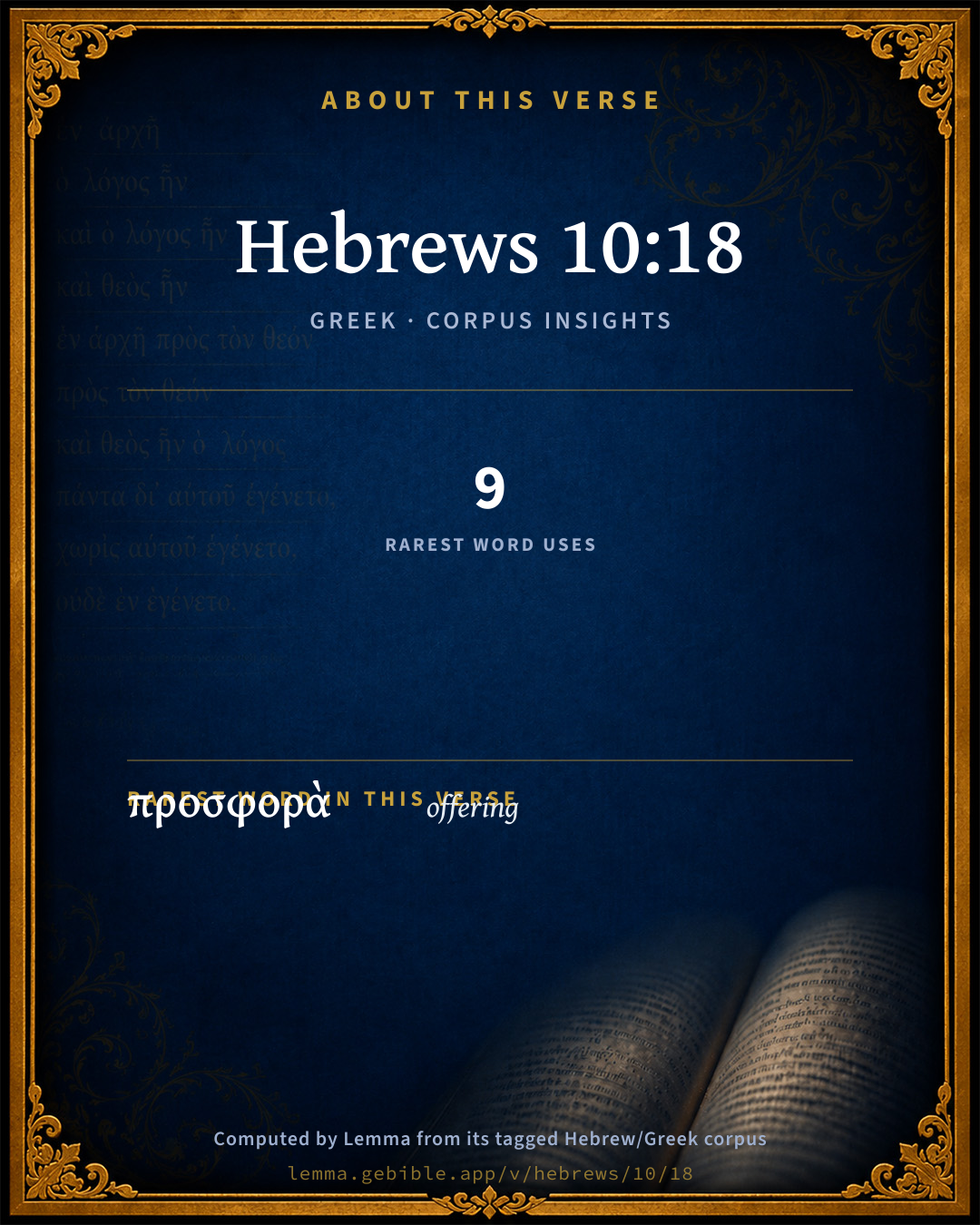
Hebrews 10:18

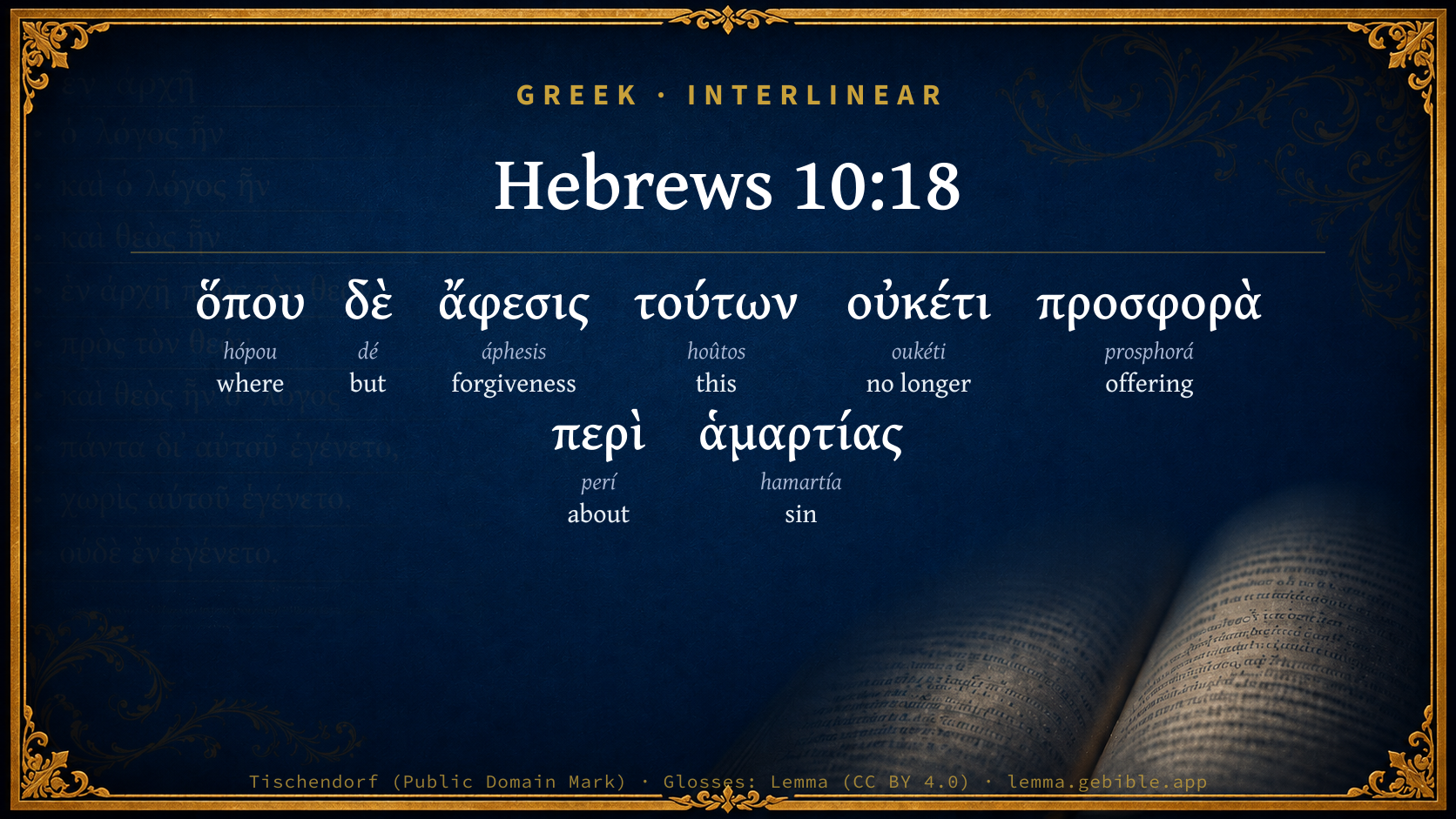
Greek (Tischendorf 8th ed.) Hebrews 10:18 appears in the Greek New Testament. The text above is from the Tischendorf 8th edition. Each word links to its Strong’s number and a concise gloss. Click any word for its full Thayer’s Greek Lexicon entry.
Download image
Cite this verse

Hebrews 10:18 (World English Bible). Public Domain. Lemma interlinear Bible study tool, https://lemma.gebible.app/v/hebrews/10/18.

Show BibTeX & RIS
BibTeX
RIS
English Translation
Now where remission of these is, there is no more offering for sin.
World English Bible · Public Domain
Download a study sheet

One document with this verse’s original text, its word-by-word gloss line, the meaning frame, cross-references with their text, attributed commentary, and full source and license credits — printable, and it pastes into notes with its structure intact.

This verse Autodidact and up

Study sheet (.html) Plain text (.txt)

A passage Seminary Student

Up to 50 verses in one chapter. A passage sheet keeps up to 6 commentary sources and 12 cross-references per verse, in the order this page ranks them, and says so on the sheet whenever that leaves anything out. Ask for a single verse and you get the Autodidact verse sheet above.

Everything on this page stays free to read, with no account — the sheet is a download of what is already on screen, not access to it.

Want to remove ads? Support Godless Engineer
Compare translations 3

The same verse in 3 English versions, stacked beneath the original-language interlinear above. Click any original word for its lexicon entry.

Each is an independent rendering of the whole verse — the interlinear is not word-aligned to these translations.

Highlighted words mark where these versions differ — a whole-verse word diff, not a word-by-word alignment.

  • World English Bible Public Domain
    Now where remission of these is, there is no more offering for sin.
  • King James Version Public Domain
    Now where remission of these is, there is no more offering for sin.
  • unfoldingWord Literal Text CC BY-SA 4.0
    Now where forgiveness these things, no longer sacrifice on behalf of sin.

unfoldingWord Literal Text — © unfoldingWord, licensed CC BY-SA 4.0. Word-aligned USFM3 via Door43 (git.door43.org/unfoldingWord/en_ult).

Versions to compare (up to 4)

3 of 4 selected

Show all 19 translations

Every available English version of this verse, each an independent rendering of the whole verse.

  • World English Bible Public Domain
    Now where remission of these is, there is no more offering for sin.
  • Berean Standard Bible Public Domain
    And where these have been forgiven, an offering for sin is no longer needed.
  • Majority Standard Bible Public Domain
    And where these have been forgiven, an offering for sin is no longer needed.
  • King James Version Public Domain
    Now where remission of these is, there is no more offering for sin.
  • American Standard Version (1901) Public Domain
    Now where remission of these is, there is no more offering for sin.
  • Revised Version (1885) Public Domain
    Now where remission of these is, there is no more offering for sin.
  • Geneva Bible (1599) Public Domain
    Nowe where remission of these things is, there is no more offering for sinne.
  • Douay-Rheims (1899) Public Domain
    Now where there is a remission of these, there is no more an oblation for sin.
  • Young's Literal Translation Public Domain
    and where forgiveness of these `is', there is no more offering for sin.
  • Literal Standard Version CC BY-SA 4.0
    and where [there is] forgiveness of these, there is no longer offering for sin.
  • Unlocked Literal Bible CC BY-SA 4.0
    Now where there is forgiveness for these, there is no longer any sacrifice for sin.
  • unfoldingWord Literal Text CC BY-SA 4.0
    Now where forgiveness these things, no longer sacrifice on behalf of sin.
  • Darby Bible Public Domain
    But where there [is] remission of these, [there is] no longer a sacrifice for sin.
  • World Messianic Bible Public Domain
    Now where remission of these is, there is no more offering for sin.
  • Webster's Bible Public Domain
    Now where remission of these is, there is no more offering for sin.
  • Free Bible Version CC BY-SA 4.0
    Once free from such things, sin offerings are no longer needed.
  • Bible in Basic English Public Domain
    Now where there is forgiveness of these, there is no more offering for sin.
  • Text-Critical English NT CC BY 4.0
    Now where there is remission of these, an offering for sin is no longer needed.
  • Tyndale New Testament (1534) Public Domain
    And where remission of these thinges is there is no moare offerynge for synne.

Literal Standard Version (2020), Covenant Press — licensed CC BY-SA 4.0. Text via the HelloAO Bible API (eBible.org). Unlocked Literal Bible (unfoldingWord) — licensed CC BY-SA 4.0. Text via the HelloAO Bible API (eBible.org). unfoldingWord Literal Text — © unfoldingWord, licensed CC BY-SA 4.0. Word-aligned USFM3 via Door43 (git.door43.org/unfoldingWord/en_ult). Free Bible Version, Dr. Jonathan Gallagher — licensed CC BY-SA 4.0. Text via the HelloAO Bible API (eBible.org).

Word by word

More ways to search: Search by grammar → Find every occurrence → Compare this word →

Practice this passage: Drill this verse → Learn its vocabulary →

About this verse

These counts appear in no published source. They are computed here, from the morphology-tagged text and Lemma’s own curated glosses. What Lemma adds →

8
words
8
distinct lemmas
General Epistles
section

Notable vocabulary

The rarest word here is προσφορὰ offering G4376 — appearing just 9 times in the whole Greek New Testament.

Shared distinctive vocabulary

προσφορὰ offering G4376 occurs in 9 verses of the Greek New Testament. Also found in:

Cross-references

2

Topical passages linked to Hebrews 10:18 in the Treasury of Scripture Knowledge — connected by theme and wording, ordered by reader-vote popularity; previews shown in the World English Bible.

  • Hebrews 10:2 Or else wouldn't they have ceased to be offered, because the worshippers, having been once cleansed, would have had no more consciousness of sins?
  • Hebrews 10:14 For by one offering he has perfected forever those who are being sanctified.

Cross-references courtesy of OpenBible.info (CC BY 4.0).

Commentary

Notes on Hebrews 10:18 from classic Christian and Jewish commentators (each source and its license shown beneath its notes). The classic Christian expositions comment on the surrounding passage and are grouped to its opening verse, so a note may address several verses; the Jewish commentaries on the Tanakh (Rashi and others) are per-verse, so they appear only where the commentator wrote on this verse.

Lemma curates 59 commentaries, every one of them public domain or Creative Commons licensed, each selected and text-cleaned for this edition rather than reprinted as found. About our sources →

Jamieson, Fausset & Brown

Robert Jamieson, A. R. Fausset & David Brown

where remission of these is--as there is under the Gospel covenant (Heb 10:17). "Here ends the finale (Heb. 10:1-18) of the great tripartite arrangement (Heb. 7:1-25; 7:26-9:12; 9:13-10:18) of the middle portion of the Epistle. Its great theme was Christ a High Priest for ever after the order of Melchisedec. What it is to be a high priest after the order of Melchisedec is set forth, Heb. 7:1-25, as contrasted with the Aaronic order. That Christ, however, as High Priest, is Aaron's antitype in the true holy place, by virtue of His self-sacrifice here on earth, and Mediator of a better covenant, whose essential character the old only typified, we learn, Heb. 7:26-9:12. And that Christ's self-sacrifice, offered through the Eternal Spirit, is of everlasting power, as contrasted with the unavailing cycle of legal offerings, is established in the third part, Heb. 9:13-10:18; the first half of this last portion [Heb. 9:13-28], showing that both our present possession of salvation, and our future completion of it, are as certain to us as that He is with God, ruling as a Priest and reigning as a King, once more to appear, no more as a bearer of our sins, but in glory as a Judge. The second half, Heb. 10:1-18, reiterating the main position of the whole, the High Priesthood of Christ, grounded on His offering of Himself--its kingly character its eternal accomplishment of its end, confirmed by Psalms 40 and 110 and Jeremiah 31" [DELITZSCH in ALFORD].

Jamieson, Fausset & Brown — Commentary Critical and Explanatory on the Whole Bible (1871) — public domain (CC PDM 1.0). Text via the HelloAO Bible API.

The Cambridge Bible for Schools and Colleges

gen. ed. J. J. S. Perowne

18. there is no more offering for sin] Since the object of all sacrifices is the purging of the soul from guilt, sacrifices are no longer needed when sins have been annulled (Heb_9:26). Those words form the triumphant close of the argument. To revert to Judaism, to offer sacrifices, meant henceforth faithlessness as regards Christ’s finished work. And if sacrifices were henceforth abolished there was obviously an end of the Aaronic Priesthood, and therewith of the whole Old Covenant. The shadow had now been superseded by the substance, the sketch by the reality. And thus the writer has at last made good his opening words, that “at this end of the days God had revealed Himself to us by His Son,” and that the New Covenant thus revealed was superior to the First, alike in its Agent (Heb_7:1-25), its Priesthood (Heb_7:25 to Heb_9:12), its Tabernacle, and its sacrificial ordinances (Heb_9:13 to Heb_10:18).

The Cambridge Bible for Schools and Colleges (gen. ed. J. J. S. Perowne; Cambridge University Press, 1878–1918) — public domain. Text from a community e-Sword module.

Scofield Reference Notes

C. I. Scofield

offering

Sacrifice, Summary"

(1) The first intimation of sacrifice is Gen 3:21 the "coats of skins" having obviously come from slain animals. The first clear instance of sacrifice is Gen 4:4 explained in Heb 11:4. Abel’s righteousness was the result of his sacrifice, not of his character.

(2) Before the giving of the law the head of the family was the family priest. By the law an order of priests was established who alone could offer sacrifices. Those sacrifices were "shadows," types, expressing variously the guilt and need of the offerer in reference to God, and all pointing to Christ and fulfilled in Him.

(3) As foreshadowed by the types and explained by the N.T., the sacrifice of Christ is

penal Gal 3:13; 2Co 5:21

substitutional Lev 1:4; Isa 53:5; Isa 53:6; 2Co 5:21; 1Pe 2:24

voluntary Gen 22:9; Joh 10:18

redemptive Gal 3:13; Eph 1:7; 1Co 6:20

propitiatory Rom 3:25

reconciling 2Co 5:18; 2Co 5:19; Col 1:21; Col 1:22

efficacious Joh 12:32; Joh 12:33; Rom 5:9; Rom 5:10; 2Co 5:21; Eph 2:13; Heb 9:11; Heb 9:12; Heb 9:26; Heb 10:10-17; 1Jn 1:7; Rev 1:5

and revelatory Joh 3:16; 1Jn 4:9; 1Jn 4:10.

sin Sin. (See Scofield "Rom 3:23").

The Scofield Reference Bible (1917 edition), notes by C. I. Scofield — public domain. Text from a community e-Sword module.

Tyndale Open Study Notes

Tyndale Open Resources

10:18 The logical conclusion when sins have been forgiven—that is, when sins have been taken away completely and permanently (10:1-4, 11)—is that there is no need to offer any more sacrifices. Thus, the superior sacrifice of Christ has made the entire sacrificial system of the old covenant obsolete.

Tyndale Open Study Notes — © Tyndale Open Resources, licensed CC BY-SA 4.0. Text via the HelloAO Bible API.

Bengel's Gnomon

Johann Albrecht Bengel

Heb 10:18. Ἄφεσις, forgiveness) This is evident from Heb 10:17.

Bengel's Gnomon of the New Testament — English translation (T&T Clark, Edinburgh, 1860) — public domain. Text from a community e-Sword module.

Meyer's Critical & Exegetical Commentary

Heinrich August Wilhelm Meyer

Heb_10:18. Τούτων] is not a neuter (Böhme: ut, quicquid esset peccati, in universum designaretur), but feminine, inasmuch as it refers back to ἁμαρτιῶν and ἀνομιῶν, Heb_10:17.

οὐκέτι] sc. ἐστίν, there expiatory sacrifice no longer takes place, sc. because in connection with such a state it has become unnecessary.

Meyer — Critical and Exegetical Commentary on the New Testament — English translation by Peter Christie, edited by Frederick Crombie (T&T Clark, 1880) — public domain. Text from a community e-Sword module.

Cambridge Greek Testament for Schools and Colleges

18. οὐκέτι προσφορὰ περὶ ἁμαρτίας. Since the object of all sacrifices is the purging of the soul from guilt, sacrifices are no longer needed when sins have been annulled (Heb 9:26). Those words form the triumphant close of the argument. To revert to Judaism, to offer sacrifices, meant henceforth faithlessness as regards Christ’s finished work. And if sacrifices were henceforth abolished there was obviously an end of the Aaronic Priesthood, and therewith of the whole Covenant. The shadow had now been superseded by the substance, the sketch by the reality. And thus the writer has at last made good his opening words, that “at this end of the days God had revealed Himself to us by His Son,” and that the New Covenant thus revealed was superior to the First, alike in its Agent (Heb 7:1-25), its Priesthood (Heb 7:25 to Heb 9:12), its Tabernacle, and its sacrificial ordinances (Heb 9:13 to Heb 10:18).

Cambridge Greek Testament for Schools and Colleges (Cambridge University Press, 1896; 21 vols, various authors incl. Carr, Maclear, Plummer, Farrar, Lumby, Moule, M. R. James, Simcox) — public domain. Text from a community e-Sword module.

Alford’s Greek Testament

Henry Alford

18.] But (or, ‘now:’ it is the ‘but’ of the demonstration, referring to a well-known axiomatic fact as contrasting with the contrary hypothesis) where there is remission of these, there is no longer offering concerning sin.

“Here ends the finale (10:1-18) of the great tripartite arrangement (7:1-25; 7:26-9:12; 9:13-10:18) of the middle portion of the Epistle. ‘Christ a High Priest for ever after the order of Melchisedek,’ this was its great theme, now brought to a conclusion. That the Priesthood of Christ, as Melchisedekite, is as high above the Levitical as God’s heaven is above the earth,—that Christ, with His One High-priestly self-sacrifice, has accomplished that which the Levitical priesthood with its sacrifices was unable to accomplish,—that henceforth, both our present possession of salvation, and our future completion of salvation, are as certain to us as that He is with God, ruling as a priest and reigning as a king, once more to appear, no more as a bearer of our sins, but in glory as a Judge;—these are the three great fundamental thoughts, now brought to their full development. What it is, to be a High Priest after the order of Melchisedek and not of Aaron, is set forth, ch. 7:1-25. That Christ however as High Priest is Aaron’s antitype, ruling in the true holy place by virtue of His self-sacrifice here on earth,—and Mediator of a better covenant, whose essential character the old covenant only shadowed forth and typified, we learn, 7:26-9:12. And that the self-sacrifice of Christ, offered through the eternal Spirit, is of everlasting power, as contrasted with the unavailing cycle of legal offerings, is established in the third part, 9:13-10:18: the second half of this portion, 10:1-18, being devoted to a reiterated and conclusive treatment of the main position of the whole,—the High-priesthood of Christ, grounded on His offering of Himself,—its Kingly character, its eternal accomplishment of its end, confirmed by Psa_40, Psa 110, Jer_31” Delitzsch.

Henry Alford, The Greek Testament (1849–1861) — public domain. Text from a community e-Sword module.

Geneva Bible (1599)

Geneva Bible translators

He said well, for sin: for there remaineth another offering, to wit, of thanksgiving.

Geneva Bible (1599) marginal notes — public domain. Text via Bolls.life.

Adam Clarke's Commentary

Verse 18. Now where remission of these is] In any case, where sin is once pardoned, there is no farther need of a sin-offering; but every believer on Christ has his sin blotted out, and therefore needs no other offering for that sin.

"If," says Dr. Macknight, "after remission is granted to the sinner, there is no need of any more sacrifice for sin; and if Christ, by offering himself once, has perfected for ever the sanctified, Heb 10:14, the sacrifice of the mass, as it is called, about which the Romish clergy employ themselves so incessantly, and to which the papists trust for the pardon of their sins, has no foundation in Scripture. Nay, it is an evident impiety, as it proceeds upon the supposition that the offering of the body of Christ once is not sufficient to procure the pardon of sin, but must be frequently repeated. If they reply that their mass is only the representation and commemoration of the sacrifice of Christ, they give up the cause, and renounce an article of their faith, established by the council of Trent, which, in session xxii. can. 1, 3, declared the sacrifice of the mass to be a true and propitiatory sacrifice for sin. I say, give up the cause; for the representation and commemoration of a sacrifice is not a sacrifice. Farther, it cannot be affirmed that the body of Christ is offered in the mass, unless it can be said that, as often as it is offered, Christ has suffered death; for the apostle says expressly, Heb 9:25; Heb 9:26, that if Christ offered himself often, he must often have suffered since the foundation of the world." Let him disprove this who can.

Adam Clarke's Commentary on the Bible (1810–1826) — public domain. Text from a community e-Sword/MySword module.

Ellicott's Commentary for English Readers

(18) Now where.—Bather, But where remission (or forgiveness, see Heb_9:22) of these is, there is no longer offering for sin. Here the argument reaches its triumphant close.

At this point we enter on the last great division of the Epistle (Heb_10:19 to Heb_13:25), which is occupied with earnest exhortation, encouragement to perseverance alternating with solemn warning against apostasy. The first section of this main division extends to the end of this chapter.

A Bible Commentary for English Readers, edited by Charles John Ellicott (1878–1897) — public domain. Text from a community e-Sword module.

John Gill's Exposition

Having therefore, brethren,.... As they were to the apostle, in a natural and civil sense, being Hebrews, as well as in a spiritual relation, being believers in Christ; which is observed, to testify his affection to them, and to engage their regard to the duties hereafter urged, particularly brotherly love, and to signify their common and equal right to the privilege next mentioned, which is

boldness to enter into the holiest by the blood of Jesus: the place saints have boldness to enter into is heaven, called "the holiest", in reference to the holy of holies, in the tabernacle; which was a type of it, for the sacredness and invisibility of it, and for what was in it, went into it, or was brought thither; as the Shechinah, or divine Majesty, which resided there; the high priest who went into it once a year; the blood of sacrifices which was carried into it; the sweet incense; the ark of the testimony, in which was the law; and the mercy seat; all which were typical of Christ, his person, blood, sacrifice, righteousness, intercession, and the grace and mercy which come through him. Heaven was symbolically shut by the sin of man, when he was drove out of the garden of Eden; it was typically opened by the entrance of the high priest into the holy of holies, on the day of atonement; Christ has in person entered into it by his blood, and opened the way for his people; and believers in him may "enter" now, and they do, when they exercise grace on him, who is there, and when they come and present their prayers and praises to God by him; and they have now an actual right to enter into the place itself, and will hereafter enter in person: and the manner of their present entrance is, "with boldness"; which signifies their right unto it, the liberty granted them by God, and the liberty which they sometimes have in their own souls, and great courage and intrepidity of mind; which arises from a sense of remission of sins, as may be concluded from the connection of these words with the preceding; and is found to be true by experience; and such boldness is consistent with reverence, humility, and submission. The way of entrance is "by the blood of Jesus"; and which gives both entrance and boldness; for hereby sin is removed both from the sight of God, and the conscience of the believer; peace is made with God, and spoken to him; pardon is procured, law and justice satisfied, and neither to be feared, and the everlasting covenant confirmed.

John Gill's Exposition of the Whole Bible (1746–1763) — public domain (CC PDM 1.0). Text via the HelloAO Bible API.

Trapp's Complete Commentary

John Trapp

18 Now where remission of these is, there is no more offering for sin.

Ver. 18. Where remission of sin is] viz. An impletory remission, as now in the New Testament, not a promissory, as under the Old.

John Trapp, A Commentary or Exposition upon All the Books of the Old and New Testament (1647–1656) — public domain. Text from a community e-Sword module.

Albert Barnes' Notes on the Bible

Now where remission of these is - Remission or forgiveness of sins; that is, of the sins mentioned in the previous verse.

There is no more offering for sin - If those sins are wholly blotted out, there is no more need of sacrifice to atone for them, any more than there is need to pay a debt again which has been once paid. The idea of Paul is, that in the Jewish dispensation there was a constant repeating of the remembrance of sins by the sacrifices which were offered, but that in reference to the dispensation under the Messiah, sin would be entirely cancelled. There would be one great and all-sufficient sacrifice, and when there was faith in that offering, sin would be absolutely forgiven. If that was the case, there would be no occasion for any further sacrifice for it, and the offering need not be repeated. This circumstance, on which the apostle insists so much, made a very important difference between the new covenant and the old. In the one, sacrifices were offered every day; in the other, the sacrifice once made was final and complete; in the one case, there was no such forgiveness but that the offender was constantly reminded of his sins by the necessity of the repetition of sacrifice; in the other, the pardon was so complete that all dread of wrath was taken away, and the sinner might look up to God as calmly and joyfully as if he had never been guilty of transgression.

Albert Barnes' Notes on the Bible (1834–1885) — public domain. Text from a community e-Sword/MySword module.

Matthew Poole's English Annotations

The Spirit having cleared his assumption before, now concludes; Whereas perfect forgiveness of sins is from God’s grace, by the one sacrifice of his Son once offered, acquired and effected for penitent believers for ever, as the promise voucheth, Jer 31:34; For he will in no wise remember their sins, but will forgive them for ever; therefore there needs no repetition of that sacrifice again, or of any other for sin. But the Hebrews had the highest reason now to desert the legal sacrifices, and to rest upon and to cleave to his alone, any being, use, or consistency of such, after the effect of Christ’s one sacrifice, being vain; for all being completed in his, it is but just theirs should cease from them.

Matthew Poole's English Annotations on the Holy Bible (1683–1685) — public domain. Text from a community e-Sword/MySword module.

The Pulpit Commentary

Complete forgiveness through the perfect Sacrifice. Now where remission of these is, there is no more offering for sin." Our text authorizes three observations.

I THAT THE SAVIOR"S SACRIFICE FOR SIN WAS PERFECT. This is implied in the text. It is stated more than once in the preceding argument. To prove it was one of the great objects of the doctrinal portion of this letter. It has already come under our notice in several of our homilies. (see Heb_7:26-28 Heb_9:11, 12 9:13, 14 10:5-10)

II THAT THE FORGIVENESS OF SIN THROUGH THE SAVIOR"S SACRIFICE IS COMPLETE. This completeness is exhibited by the writer:

1. By comparing it with the partial putting away of sins obtained through the legal sacrifices. "Sacrifices which can never take away sins" (ver. 11). The word employed here signifies "to take clean away, (cf. Act_27:20) i.e. to put off like the garment which clings to the person, or the ring on the finger; as, for instance, the besetting sin of 12:1, or the besetting infirmity of ver. 3. The sacred writer does not mean to say that sins were not forgiven to sacrificial worshippers under the Law; but that the legal sacrifices had no inward spiritual power to give peace to the conscience, or any assured sense of pardon, purity to the heart, or any really new beginning of spiritual life. (Heb_9:9) With these in their subject-matter and their inadequacy, ever similar and oft-repeated sacrifices, he contrasts (ver. 12) the "one sacrifice for sins of Jesus Christ, which is no other than himself" (Delitzsch). And Alford, "The (legal) sacrifice might bring sense of partial forgiveness; but it could never denude the offerer of sinfulness strip off and take away his guilt." But through the sacrifice of the Christ sin is really taken away. He who heartily believes in him is reconciled unto God, receives absolute and full forgiveness of sins, and is inspired by a new and holy affection, even supreme love to God. And this affection is the mightiest antagonist of sin. He who is inspired by it is not overcome of evil, but overcomes evil with good.

2. By the expressions which are used to set it forth. "Their sins and their iniquities will I remember no more". (see our remarks on Heb_8:12) Here is the greatest encouragement to sinners to seek forgiveness from God. "There is forgiveness with thee, that thou mayest be feared. With the Lord there is mercy, and with him is plenteous redemption." "Let the wicked forsake his way," etc. (Isa_55:7)

III THAT THE SAVIOR"S SACRIFICE WILL NEVER BE REPEATED. "Now where remission of these is, there is no more offering for sin." Being perfect in itself and in its efficacy, his sacrifice needs no repetition. (see remarks on this in our homilies on Heb_7:26-28 Heb_9:27, 28 10:5-10) Learn the folly of looking for other and more effective means of salvation. The grandest and most convincing proof of the love that God hath to us has been given in the sacrifice of Christ. No greater sacrifice, no more constraining influence, is possible. Let us accept the perfect Sacrifice, and the all-sufficient Savior. W.J.

Heb 7:1-10:19) there were none, close and uninterrupted attention to the course of thought being then demanded. But now, the argument being completed, the previous exhortations are taken up again, and enforced in consequently fuller and deeper tones. The connection of thought between these final admonitions and those previously interposed is evident when we compare the very expressions in Heb_10:19-23 with those in Heb_4:14-16, and the warnings of Heb_10:26, etc., with those of Heb_6:4, etc. Thus appears, as in other ways also, the carefully arranged plan of the Epistle, different in this respect from the undoubted Epistles of St. Paul, in which the thoughts generally follow each other without great regard to artistic arrangement. This, however, is in itself by no means conclusive against St. Paul"s authorship, since there would be likely to be just this difference between a set treatise composed for a purpose, and a letter written currente calamo by the same author. It does, however, mark a different class of composition, and is suggestive, as far as it goes, of a different writer.

The Pulpit Commentary (1880–1919), ed. H.D.M. Spence-Jones & Joseph S. Exell — public domain. Text from a community e-Sword module.

The People's New Testament

B. W. Johnson

18. Where remission of these is. Hence, since there is complete remission, no more offering for sin is required.

B. W. Johnson's The People's New Testament with Notes (1889–1891) — public domain. Electronic text from the Christian Classics Ethereal Library (CCEL) ThML edition.

Vincent's Word Studies in the New Testament

Marvin R. Vincent

There is no more offering for sin. Forgiveness of sin is the characteristic of the new covenant. In Jer. complete pardon of sins is promised. If the pardon is complete, there is left no place for the Levitical sacrifices under the new covenant. At this point the doctrinal portion of the epistle ends.

Marvin R. Vincent, Word Studies in the New Testament (1887–1900) — public domain. Text from a community e-Sword/MySword module.

Westcott on Hebrews & the Epistles of John

Brooke Foss Westcott

18, ὅπου δὲ ἄφεσις τούτων] Now where there is remission Of these sins. For ἄφεσις see o. ix. 22 note. The consequences of ain are threofold: debt which requires forgiveness, bondage which requires redomption, alienation which requires reconciliation. Seo note on 1 John i. 9. The words ἄφεσις, ἀφιέναι oxpress the first idea : comp. Matt. xviii. 27, 32, 35.

These words are rare in the Epistles, more frequent in the Synoptic Gospels and (ἄφεσις ap.) Acta. The ‘remission’ of sinsis essentially a creative act: compare Matt. ix. 2 ff and parallels.

Contrast πάρεσις Rom, ii. 25.

The prophotic words show that under the Now Covenant no place is left for the Lovitical sacrifices. The Christian can thorefore dispense with them without any loss. To be forced to give up their shadowy consolation ia to be lod to realise more practically the work of Ohrist.

This is the last—tho decisive—word of the argument.

V. Tus APPROPRIATION AND VITAL APPLICATION oF tne Trurns LAID DOWN (x. 19—xiii. 25).

Having cstablished his theoretical view of the relation of Christianity to Judaism, as its completo fulfilment, the substanco answering to tho shadow, the writer of the Epistle at once goes on to onforco tho practical consequoncos of his conclusions. Tho priviloges must ho uso: the dntios must bo discharged. Tho faith is not for spoculation but for life. All the consoIntions of the Lovitical system can be surrendered without loss; and they must be surrendcred at once if they come in any way into competition with Christian obligation.

This main lino of thought is developed under four soctions. The writer first makes a direct application of his teaching to his readers, defining sharply their priviloges and perils and encouragements (x. 19--- 39). Having thus ‘insisted on the necossity of faith as an elomont in that patient endurance which God roquires in the discipline of His Pro-

vidence, he next shews that it was by faith the spiritual heroes of earlier times wrought their victories (c. xi). Such examples had an immediate application to the circumstances of the crisis in which the IIobrows were placed; and thoy wore sufficient to enable thom to realise the deur of tho rosponsibilitics and hopos which were given to them (c. xii). The last chapter (c. xiii) is a kind of appendix to the Epistle in which detailed instructions and personal notices find a place.

Thus we have:

i. The privileges, perils, encouragements of the Hebrews (x. 19—39).

fi. The past triumphe of Faith (xi. 1—40).

fii. The general application of the lessons of the past to the present season Of trial (xii. 1—29).

iv. Last words (xiii. 1—25).

i. The privileges, perils, encouragements of the Hebrews (x. 19—39).

Tho application of tho leasons to bo drawn from the view which the Apostle has givon of tho absolute supremacy of tho Christian Faith ovor the preparatory systom of Judaism begins with a vivid picture of tho position of tho Hebrews, (1) of their privileges and duties (19—25), (2) of their perils (26—31), and (3) of their encouragements (32—39). Each section has traits taken directly from scenes of persecution, from the isolation of proud or timid believers (d. 25), the abjuration of apostates (0. 29), the triumph of confessors (2. 34).

(1) ov. 19—25. The privileges and duties of Christians.

The section deals first with the personal privileges (19—22), and then with tho social duties of beliovers (23—25).

The privilege of direct access to

God is confirmed by general and personal considerations. We have a way of approach and an effective Mediator (19—21). And on our part certain conditions have to bo fulfilled porsonally. These are both subjective (sith a true heart, in fulness of faith), and objective (sprinkled in our hearts, washed in our body) (22).

Ὁ Having therefore, brethren, boldness to use the entrance into the Holy place in the blood of Jesus, the ontrance which He inaugurated for us, ~even afresh and living way through the veil, that is to say a way Of Llis flesh, ™and a great priest over the house of God, **let us come to God with a true heart in fulness of faith, having our hearts sprinkled from an evil conscience, and our body bathed with pure water. 33 Let us hold fast the confession Of our hope that it waver not, for He is faithful that promised. * And let us consider one another to provoke unto love and good works, snot forsaking thegathering Of ourselves together, as the custom of some is, but exhorting one another ; and so much the more as ye seo the day drawing nigh.

19—21. The writer sums up briefly the bleasings which he has shewn to belong to Ohristians. They have an entrance to the Divine Presence in virtue of Christ’s Blood, a way made by the Incarnation, and an availing personal Advocate, a Priest over the house of God.

Brooke Foss Westcott (1825–1901), The Epistle to the Hebrews (1889) and The Epistles of St John (1883) — public domain (pre-1929). Text recovered from Internet Archive / Google Books OCR scans. Westcott’s Gospel of John commentary is not included (its OCR lost the chapter running-heads required for reliable verse-keying). Some Greek quoted in the Hebrews volume is imperfectly rendered by the OCR.

Lesson kit

Teaching starters — assembled from the data on this page, not authored interpretation. Every prompt links to the verse data it draws on. Edit before teaching.

Hebrews, in the General Epistles, opens this verse with 8 words (8 distinct Greek lemmas). Its most distinctive word is prosphorá (“offering”). A historical commentator’s framing appears above. Read the whole chapter for the surrounding context.

Discussion questions

  1. What does “offering” (prosphorá) contribute to the verse as a whole?
  2. Acts 21:26 shares the word «offering» with this verse. How do the two illuminate each other?
  3. The translations on this page render this verse differently — a whole-verse word diff, not a word-by-word alignment. What might account for the different wordings?
  4. Reading how Jamieson, Fausset & Brown and The Cambridge Bible for Schools and Colleges read this verse, where do the two commentators agree and where do they part?

Things to notice

Reading settings

Reading text

Shown beneath each verse's original-language words.

Old Testament
Old Testament edition

Read the OT as the Masoretic Hebrew (MT) or the Greek Septuagint (LXX).

English shown for the Greek Septuagint (in the Hebrew ↔ Greek comparison).

Comparing translations? Open the Compare panel on any verse page to stack up to four side by side.