Leviticus 4:24

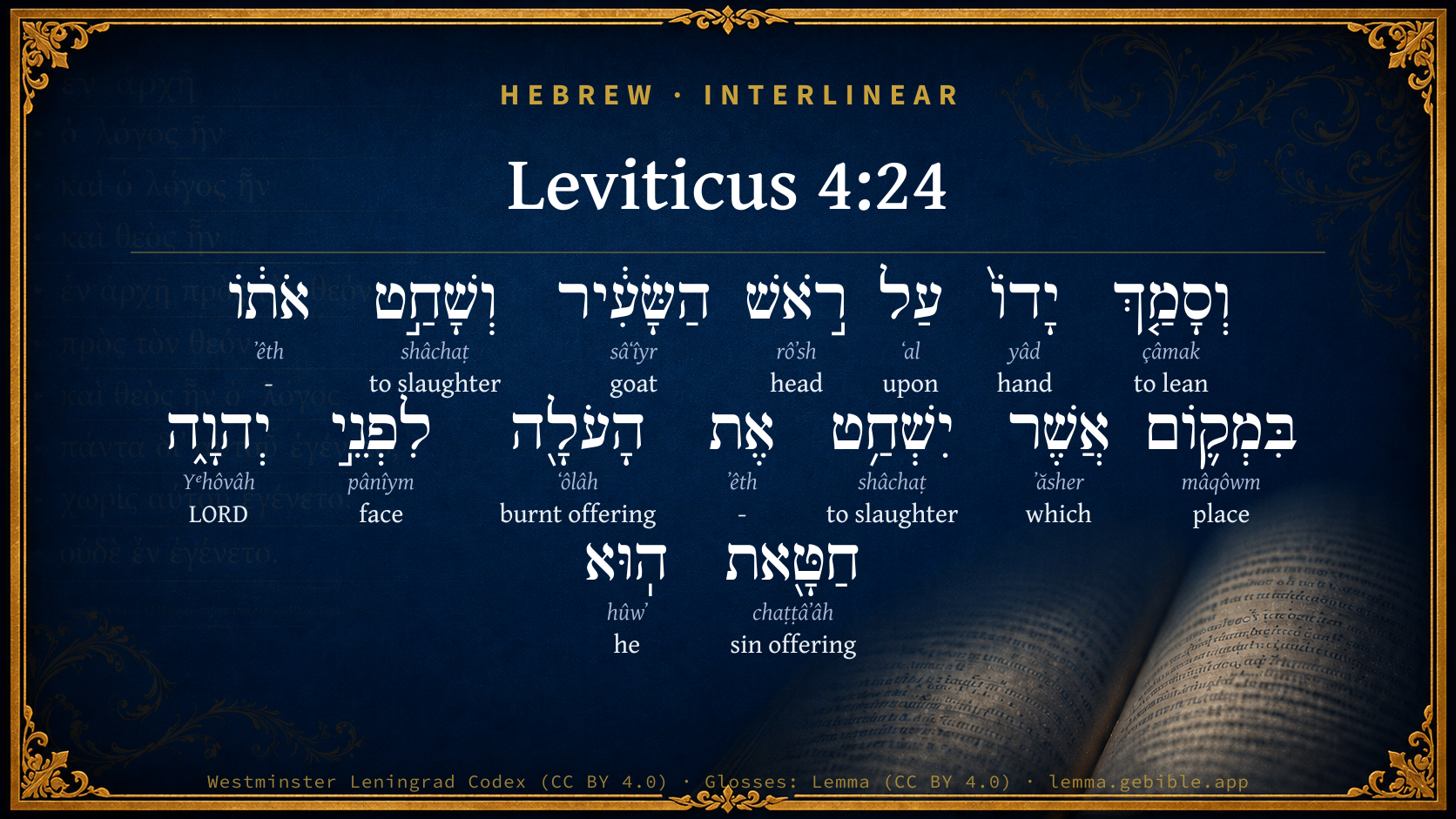
Hebrew (Westminster Leningrad Codex) Leviticus 4:24 appears in the Hebrew Old Testament. The text above is from the Westminster Leningrad Codex. Each word links to its Strong’s number, a concise gloss, and parsing drawn from the Open Scriptures Hebrew Bible morphology. Click any word for its full Brown-Driver-Briggs (BDB) entry.
Download image
Cite this verse

Leviticus 4:24 (World English Bible). Public Domain. Lemma interlinear Bible study tool, https://lemma.gebible.app/v/leviticus/4/24.

Show BibTeX & RIS
BibTeX
RIS
English Translation
He shall lay his hand on the head of the goat, and kill it in the place where they kill the burnt offering before Yahweh. It is a sin offering.
World English Bible · Public Domain
Download a study sheet

One document with this verse’s original text, its word-by-word gloss line, the meaning frame, cross-references with their text, attributed commentary, and full source and license credits — printable, and it pastes into notes with its structure intact.

This verse Autodidact and up

Study sheet (.html) Plain text (.txt)

A passage Seminary Student

Up to 50 verses in one chapter. A passage sheet keeps up to 6 commentary sources and 12 cross-references per verse, in the order this page ranks them, and says so on the sheet whenever that leaves anything out. Ask for a single verse and you get the Autodidact verse sheet above.

Everything on this page stays free to read, with no account — the sheet is a download of what is already on screen, not access to it.

Want to remove ads? Support Godless Engineer
Compare translations 3

The same verse in 3 English versions, stacked beneath the original-language interlinear above. Click any original word for its lexicon entry.

Each is an independent rendering of the whole verse — the interlinear is not word-aligned to these translations.

Highlighted words mark where these versions differ — a whole-verse word diff, not a word-by-word alignment.

  • World English Bible Public Domain
    He shall lay his hand on the head of the goat, and kill it in the place where they kill the burnt offering before Yahweh. It is a sin offering.
  • King James Version Public Domain
    And he shall lay his hand upon the head of the goat, and kill it in the place where they kill the burnt offering before the LORD: it is a sin offering.
  • unfoldingWord Literal Text CC BY-SA 4.0
    And he shall lay his hand on the head of the buck and he shall slaughter it in the place where one slaughters the burnt offering to the face of Yahweh. It a sin offering.

unfoldingWord Literal Text — © unfoldingWord, licensed CC BY-SA 4.0. Word-aligned USFM3 via Door43 (git.door43.org/unfoldingWord/en_ult).

Versions to compare (up to 4)

3 of 4 selected

Show all 18 translations

Every available English version of this verse, each an independent rendering of the whole verse.

  • World English Bible Public Domain
    He shall lay his hand on the head of the goat, and kill it in the place where they kill the burnt offering before Yahweh. It is a sin offering.
  • Berean Standard Bible Public Domain
    He is to lay his hand on the head of the goat and slaughter it at the place where the burnt offering is slaughtered before the LORD. It is a sin offering.
  • Majority Standard Bible Public Domain
    He is to lay his hand on the head of the goat and slaughter it at the place where the burnt offering is slaughtered before the LORD. It is a sin offering.
  • King James Version Public Domain
    And he shall lay his hand upon the head of the goat, and kill it in the place where they kill the burnt offering before the LORD: it is a sin offering.
  • American Standard Version (1901) Public Domain
    And he shall lay his hand upon the head of the goat, and kill it in the place where they kill the burnt-offering before Jehovah: it is a sin-offering.
  • Revised Version (1885) Public Domain
    and he shall lay his hand upon the head of the goat, and kill it in the place where they kill the burnt offering before the LORD: it is a sin offering.
  • Geneva Bible (1599) Public Domain
    And shall lay his hand vpon the heade of the he goate, and kill it in the place where he should kill the burnt offring before the Lord: for it is a sinne offring.
  • Douay-Rheims (1899) Public Domain
    And he shall put his hand upon the head thereof: and when he hath immolated it in the place where the holocaust is wont to be slain before the Lord, because it is for sin,
  • Young's Literal Translation Public Domain
    and he hath laid his hand on the head of the goat, and hath slaughtered it in the place where he doth slaughter the burnt-offering before Jehovah; it `is' a sin-offering.
  • Literal Standard Version CC BY-SA 4.0
    and he has laid his hand on the head of the goat, and has slaughtered it in the place where he slaughters the burnt-offering before YHWH; it [is] a sin-offering.
  • Unlocked Literal Bible CC BY-SA 4.0
    He will lay his hand on the head of the goat and kill it in the place where they kill the burnt offering before Yahweh. This is a sin offering.
  • unfoldingWord Literal Text CC BY-SA 4.0
    And he shall lay his hand on the head of the buck and he shall slaughter it in the place where one slaughters the burnt offering to the face of Yahweh. It a sin offering.
  • Darby Bible Public Domain
    And he shall lay his hand on the head of the goat, and slaughter it at the place where they slaughter the burnt-offering before Jehovah: it is a sin-offering.
  • World Messianic Bible Public Domain
    He shall lay his hand on the head of the goat, and kill it in the place where they kill the burnt offering before the LORD. It is a sin offering.
  • Webster's Bible Public Domain
    And he shall lay his hand upon the head of the goat, and kill it in the place where they kill the burnt-offering before the LORD: it is a sin-offering.
  • Free Bible Version CC BY-SA 4.0
    He must put his hand on the head of the goat and kill it at the place where the burnt offering is killed before the Lord. It is a sin offering.
  • Bible in Basic English Public Domain
    And he is to put his hand on the head of the goat and put it to death in the place where they put to death the burned offering before the Lord: it is a sin-offering.
  • JPS Tanakh (1917) Public Domain
    And he shall lay his hand upon the head of the goat, and kill it in the place where they kill the burnt-offering before the LORD; it is a sin-offering.

Literal Standard Version (2020), Covenant Press — licensed CC BY-SA 4.0. Text via the HelloAO Bible API (eBible.org). Unlocked Literal Bible (unfoldingWord) — licensed CC BY-SA 4.0. Text via the HelloAO Bible API (eBible.org). unfoldingWord Literal Text — © unfoldingWord, licensed CC BY-SA 4.0. Word-aligned USFM3 via Door43 (git.door43.org/unfoldingWord/en_ult). Free Bible Version, Dr. Jonathan Gallagher — licensed CC BY-SA 4.0. Text via the HelloAO Bible API (eBible.org).

Word by word

More ways to search: Search by grammar → Find every occurrence → Compare this word →

Practice this passage: Drill this verse → Learn its vocabulary →

וְסָמַ֤ךְ
çâmak
H5564
“and · to lean”
Conjunction + Verb, Qal, Sequential Perfect, 3rd Person, Masculine, Singular
Part of Speech
Conjunction + Verb
Stem
Qal
Form
Sequential Perfect
Person
3rd Person
Gender
Masculine
Number
Singular
Full BDB Definition

Origin: a primitive root

TWOT: 1514

to lean, lay, rest, support, put, uphold, lean upon - (Qal) - to lean or lay upon, rest upon, lean against - to support, uphold, sustain - (Niphal) to support or brace oneself - (Piel) to sustain, refresh, revive
  1. יָדוֹ֙ yâd H3027 “hand · his” Noun, Common, Both, Singular, Construct + Suffix, Personal, 3rd Person, Masculine, Singular
  2. עַל ʻal H5921 “upon” Preposition
  3. רֹ֣אשׁ rôʼsh H7218 “head of” Noun, Common, Masculine, Singular, Construct
  4. הַשָּׂעִ֔יר sâʻîyr H8163 “the · goat” Particle, Definite Article + Noun, Common, Masculine, Singular, Absolute
  5. וְשָׁחַ֣ט shâchaṭ H7819 “and · to slaughter” Conjunction + Verb, Qal, Sequential Perfect, 3rd Person, Masculine, Singular
  6. אֹת֔וֹ ʼêth H853 “- · him” Particle, Direct Object + Suffix, Personal, 3rd Person, Masculine, Singular
  7. בִּמְק֛וֹם mâqôwm H4725 “in/at · place of” Preposition + Noun, Common, Masculine, Singular, Construct
  8. אֲשֶׁר ʼăsher H834 “which” Particle, Relative
  9. יִשְׁחַ֥ט shâchaṭ H7819 “to slaughter” Verb, Qal, Imperfect, 3rd Person, Masculine, Singular
  10. אֶת ʼêth H853 “-” Particle, Direct Object
  11. הָעֹלָ֖ה ʻôlâh H5930 “the · burnt offering” Particle, Definite Article + Noun, Common, Feminine, Singular, Absolute
  12. לִפְנֵ֣י pânîym H6440 “to/for · face(s) of” Preposition + Noun, Common, Both, Plural, Construct
  13. יְהוָ֑ה Yᵉhôvâh H3068 “LORD” Noun, Proper
  14. חַטָּ֖את chaṭṭâʼâh H2403 “sin offering” Noun, Common, Feminine, Singular, Absolute
  15. הֽוּא hûwʼ H1931 “he” Pronoun, Personal, 3rd Person, Masculine, Singular

About this verse

These counts appear in no published source. They are computed here, from the morphology-tagged text and Lemma’s own curated glosses. What Lemma adds →

16
words
14
distinct lemmas
Pentateuch
section

Shared distinctive vocabulary

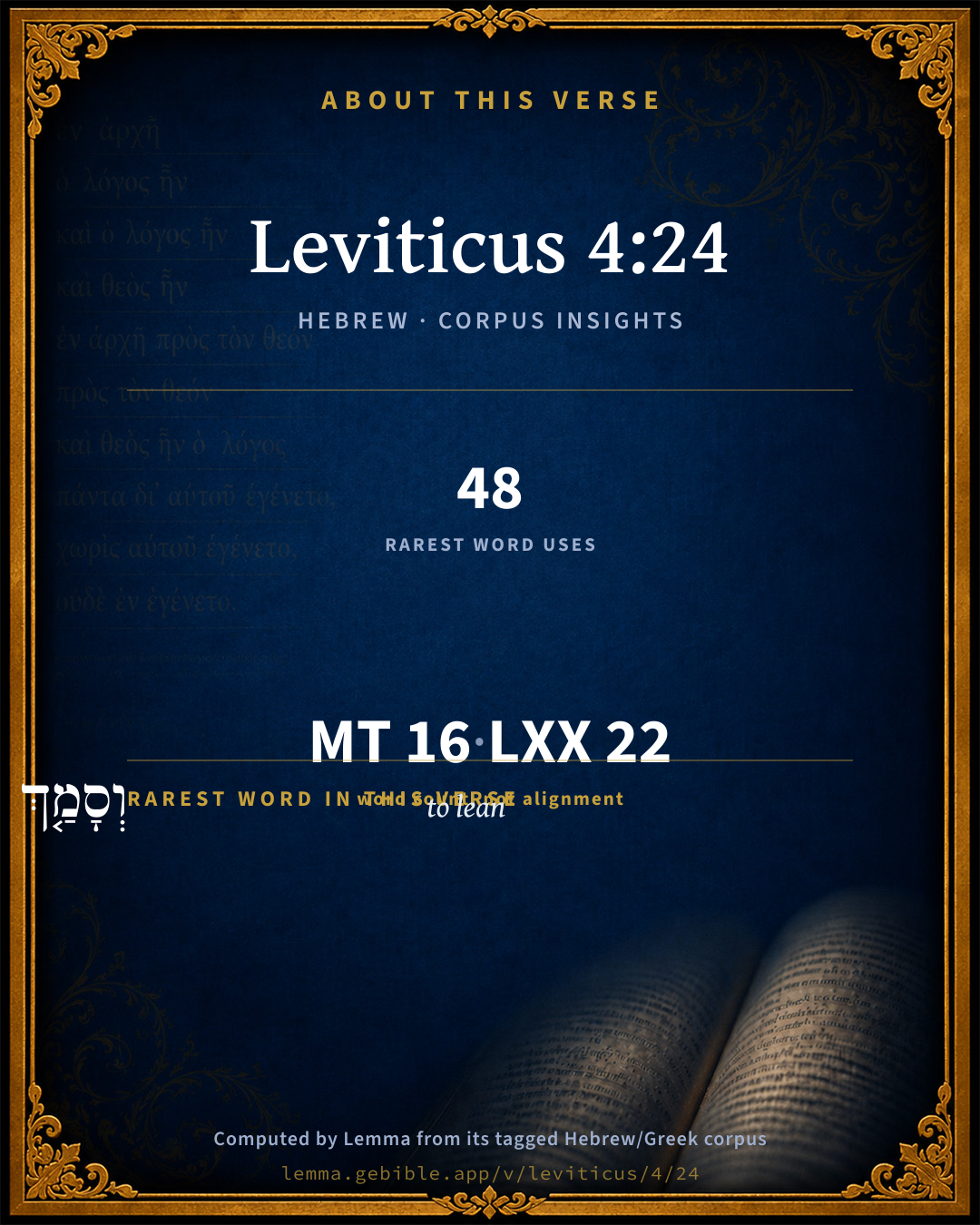
וְסָמַ֤ךְ to lean H5564 occurs in 47 verses of the Hebrew Bible. Also found in:

Grammatical profile

  • 3 verbs
  • 8 nouns
  • 1 pronoun
  • 1 preposition
  • 3 particles

Verb forms

  • וְסָמַ֤ךְ Qal · Sequential Perfect
  • וְשָׁחַ֣ט Qal · Sequential Perfect
  • יִשְׁחַ֥ט Qal · Imperfect

Repetition

A word recurs within this verse — often emphatic in Hebrew:

  • וְשָׁחַ֣ט to slaughter H7819 ×2

Hebrew & Septuagint length

In English translation the verse runs 30 words from the Hebrew and 36 from the Septuagint (LXX English) — closely comparable.

A rough comparison of the two English renderings, which tokenize alike — not a word-level alignment.

Word counts can differ between the Hebrew and the Greek without any difference in meaning — e.g. the Hebrew direct-object marker אֵת has no separate Greek word, and Greek often adds the article ὁ.

In the original languages it is 16 Hebrew tokens and 22 Greek tokens — but the two are counted differently (Hebrew bundles its prefixes and suffixes into one token; the Greek is in lemma form), so that isn’t a like-for-like length.

Cross-references

11

Topical passages linked to Leviticus 4:24 in the Treasury of Scripture Knowledge — connected by theme and wording, ordered by reader-vote popularity; previews shown in the World English Bible.

  • Exodus 29:38 "Now this is that which you shall offer on the altar: two lambs a year old day by day continually.
  • Leviticus 1:5 He shall kill the bull before Yahweh. Aaron's sons, the priests, shall present the blood and sprinkle the blood around on the altar that is at the door of the Tent of Meeting.
  • Leviticus 1:11 He shall kill it on the north side of the altar before Yahweh. Aaron's sons, the priests, shall sprinkle its blood around on the altar.
  • Leviticus 3:2 He shall lay his hand on the head of his offering, and kill it at the door of the tent of meeting: and Aaron's sons the priests shall sprinkle the blood on the altar round about.
  • Leviticus 3:8 and he shall lay his hand on the head of his offering, and kill it before the tent of meeting: and Aaron's sons shall sprinkle its blood on the altar round about.
  • Leviticus 3:13 and he shall lay his hand on its head, and kill it before the tent of meeting; and the sons of Aaron shall sprinkle its blood on the altar round about.
  • Leviticus 4:3–35 if the anointed priest sins so as to bring guilt on the people, then let him offer for his sin, which he has sinned, a young bull without blemish to Yahweh for a sin offering.
  • Leviticus 6:25 "Speak to Aaron and to his sons, saying, 'This is the law of the sin offering: in the place where the burnt offering is killed, the sin offering shall be killed before Yahweh. It is most holy.
  • Leviticus 7:2 In the place where they kill the burnt offering, he shall kill the trespass offering; and its blood he shall sprinkle on the altar round about.
  • Leviticus 16:15 "Then he shall kill the goat of the sin offering, that is for the people, and bring his blood within the veil, and do with his blood as he did with the blood of the bull, and sprinkle it on the mercy seat, and before the mercy seat:
  • Isaiah 53:6 All we like sheep have gone astray; everyone has turned to his own way; and Yahweh has laid on him the iniquity of us all.

Cross-references courtesy of OpenBible.info (CC BY 4.0).

Hebrew and Greek witnesses Masoretic Hebrew ↔ Greek Septuagint

The same verse in the two great witnesses to the Old Testament, shown verse-for-verse.

These are two independent witnesses, not word-aligned to each other, and the Septuagint is shown in lemma (dictionary) form.

Hebrew Leviticus 4:24 Masoretic · Westminster Leningrad Codex

וְסָמַ֤ךְ יָדוֹ֙ עַל רֹ֣אשׁ הַשָּׂעִ֔יר וְשָׁחַ֣ט אֹת֔וֹ בִּמְק֛וֹם אֲשֶׁר יִשְׁחַ֥ט אֶת הָעֹלָ֖ה לִפְנֵ֣י יְהוָ֑ה חַטָּ֖את הֽוּא

He shall lay his hand on the head of the goat, and kill it in the place where they kill the burnt offering before Yahweh. It is a sin offering.

World English Bible · Public Domain

Greek LXX Leviticus 4:24 Septuagint · lemma form

καί ἐπιτίθημι ὁ χείρ ἐπί ὁ κεφαλή ὁ χίμαρος καί σφάζω αὐτός ἐν τόπος οὗ σφάζω ὁ ὁλοκαύτωμα ἐνώπιον κύριος ἁμαρτία εἰμί

And he shall lay his hand on the head of the kid, and they shall kill it in the place where they kill the victims for whole burnt offerings before the Lord; it is a sin-offering.

LXX2012 (modern English Septuagint) · Public Domain

On this verse, Haydock's Catholic Bible Commentary discusses the Septuagint’s reading. Read the note in Commentary ↓

Hebrew: Westminster Leningrad Codex (CC BY 4.0). Greek: Septuagint (public domain); English from LXX2012 (modern English Septuagint) (Public Domain). How the Septuagint differs from the Hebrew →

Targum (Aramaic paraphrase)

2

The Targum is the ancient Jewish Aramaic paraphrase of the Hebrew Scriptures — an interpretive translation, not the Hebrew text itself. Onkelos (literal) and Pseudo-Jonathan (expansive) render the Torah, and Jonathan the Prophets. Coverage is partial: where no permissively-licensed English translation exists for a verse, only the Aramaic is shown. This is verse-level text, not a word-by-word alignment to the Hebrew.

  1. Targum Onkelos Torah (Genesis–Deuteronomy)
    וְיִסְמוֹךְ יְדֵהּ עַל רֵישָׁא דִצְפִירָא וְיִכּוֹס יָתֵהּ בַּאֲתַר דְיִכּוֹס יָת עֲלָתָא לָקֳדָם יְיָ חַטָאתָא הוּא

    (no public-domain English translation for this verse)

    Targum Onkelos — Aramaic: “Onkelos Genesis” (public domain); “Onkelos Exodus” (public domain); “Onkelos Leviticus” (public domain); “Onkelos Numbers” (public domain); “Onkelos Deuteronomy” (public domain). English: “Sefaria Community Translation” (CC0 1.0 (public-domain dedication)); “J.W. Etheridge. The Targums of Onkelos and Jonathan Ben Uzziel on the Pentateuch. London: Longmans, Green, 1862” (public domain). Text via Sefaria.

  2. Targum Pseudo-Jonathan Torah (Genesis–Deuteronomy)
    וְיִסְמוֹךְ בְּתוּקְפָּא יַד יְמִינֵיהּ עַל רֵישׁ צְפִירָא וְיִכּוֹס יָתֵיהּ טַבְּחָא בַּאֲתַר דְיִכּוֹס יַת עֲלָתָא קֳדָם יְיָ חַטָאתָא הוּא

    and he shall lay his right hand firmly upon the head of the goat, and the slayer shall kill him at the place of the sacrifice of the burnt offering before the Lord. It is a sin offering.

    Targum Pseudo-Jonathan — Aramaic: “Targum Jonathan on Genesis” (public domain); “Targum Jonathan on Exodus” (public domain); “Targum Jonathan on Leviticus” (public domain); “Targum Jonathan on Numbers” (public domain); “Targum Jonathan on Deuteronomy” (public domain). English: “The Targum of Jonathan ben Uzziel, trans. J. W. Etheridge, London, 1862” (public domain). Text via Sefaria.

Commentary

Notes on Leviticus 4:24 from classic Christian and Jewish commentators (each source and its license shown beneath its notes). The classic Christian expositions comment on the surrounding passage and are grouped to its opening verse, so a note may address several verses; the Jewish commentaries on the Tanakh (Rashi and others) are per-verse, so they appear only where the commentator wrote on this verse.

Lemma curates 59 commentaries, every one of them public domain or Creative Commons licensed, each selected and text-cleaned for this edition rather than reprinted as found. About our sources →

Trapp's Complete Commentary

John Trapp

Lev 4:24 And he shall lay his hand upon the head of the goat, and kill it in the place where they kill the burnt offering before the LORD: it [is] a sin offering.

Ver. 24. Lay his hand.] {See Trapp on "Lev 4:4"}

John Trapp, A Commentary or Exposition upon All the Books of the Old and New Testament (1647–1656) — public domain. Text from a community e-Sword module.

Tyndale Open Study Notes

Tyndale Open Resources

4:24 at the place where burnt offerings are slaughtered: See 1:3-5.

Tyndale Open Study Notes — © Tyndale Open Resources, licensed CC BY-SA 4.0. Text via the HelloAO Bible API.

Geneva Bible (1599)

Geneva Bible translators

That is, the Priest shall kill it; for it was not lawful for any out of that office to kill the beast.

Geneva Bible (1599) marginal notes — public domain. Text via Bolls.life.

Ellicott's Commentary for English Readers

(24) And kill it in the place where they kill the burnt offering.—See Lev_1:5.

A Bible Commentary for English Readers, edited by Charles John Ellicott (1878–1897) — public domain. Text from a community e-Sword module.

The Cambridge Bible for Schools and Colleges

gen. ed. J. J. S. Perowne

24. where they kill the burnt offering] Cp. Lev_1:5; Lev_1:11; on the side of the altar northward.

The Heb. word for ‘ruler’ is nâsî’, and is used of the princes of the tribes in Num_1:16; Num_2:3; Num_2:5 etc., Num_2:7, Num_34:18. Each of the spies sent in Numbers 13 was a nâsî’. The same word is used of the heads of the Gershonites, Kohathites, and Merarites, Num_3:24; Num_3:30; Num_3:35. A.V. has ‘captain’ in ch. 2, ‘chief’ in ch. 3, ‘prince’ in chs. 1, 7 and 34, ‘ruler’ in ch. 13. R.V. has ‘prince’ throughout. The word denotes one in authority over a tribe or over a portion of it. Comparing Eze_34:24 ‘my servant David prince’ (nâsî’ Heb.) with Eze_37:24 ‘my servant David shall be king,’ Jewish tradition infers that a king is meant in this passage.

The Cambridge Bible for Schools and Colleges (gen. ed. J. J. S. Perowne; Cambridge University Press, 1878–1918) — public domain. Text from a community e-Sword module.

John Gill's Exposition

And the priest shall take of the blood of the sin offering with his finger,.... With the finger of his right hand, as the Talmudists (n) observe, and Gersom on the place; the priest first received the blood into a basin or ministering vessel, and then dipped the finger of his right hand into it, that next the thumb:

and put it upon the horns of the altar of burnt offering; the four horns of it; in this there was a difference between the sacrifice of the anointed priest and of the congregation, and this of the ruler; the blood of the former was put upon the horns of the altar of incense, this upon the horns of the altar of burnt offering:

and shall pour out his blood at the bottom of the altar of burnt offering; the South bottom of it; the order of the priest's proceeding in putting the blood was different from that used in putting it on the horns of the altar of incense; here he first put the blood upon the southeast horn, then upon the northeast, next upon the northwest, and then upon the southwest; and upon the bottom of that horn where he finished, he poured the remainder of the blood, which was the southern bottom (o).

(n) T. Bab. Zebachim, fol. 24. 1. (o) Maimon. Hilchot Maaseh Hakorbanot, c. 5. sect. 10.

John Gill's Exposition of the Whole Bible (1746–1763) — public domain (CC PDM 1.0). Text via the HelloAO Bible API.

Albert Barnes' Notes on the Bible

See Lev 1:11.

Albert Barnes' Notes on the Bible (1834–1885) — public domain. Text from a community e-Sword/MySword module.

Haydock's Catholic Bible Commentary

He. Samaritan and Septuagint read, "they shall have," referring it to the priests.

George Leo Haydock (1774–1849), Haydock's Catholic Family Bible and Commentary, 1859 edition — public domain. Excludes Psalms (Douay-Rheims chapter numbering differs from Protestant) and Deuterocanonical books (Catholic canon only).

Matthew Poole's English Annotations

The burnt-offering is so called by way of eminency, to wit, the daily burnt-offering, of which Exo 29:38, of which place see Lev 1:11. It is a sin-offering, and therefore to be killed where the burnt-offering is killed, as is expressed Lev 6:25; Lev 7:2; whereby it is distinguished from the peace-offerings, which were killed elsewhere, Lev 3:2.

Matthew Poole's English Annotations on the Holy Bible (1683–1685) — public domain. Text from a community e-Sword/MySword module.

John Wesley's Explanatory Notes

The burnt-offering - So called by way of eminency, to wit, the daily burnt-offering. It is a sin-offering - And therefore to be killed where the burnt-offering is killed; whereby it is distinguished from the peace-offering, which were killed elsewhere.

John Wesley, Explanatory Notes Upon the Whole Bible (1754–1765) — public domain. Text via the GEBible commentary corpus.

unfoldingWord translationNotes

Door43 World Missions Community

He will lay

"The ruler will lay"

lay his hand on the head

This is a symbolic action that identifies the person with the animal he is offering. In this way the person is offering himself to Yahweh through the animal. See how you translated this in Leviticus 1:4. (See: Symbolic Action)

where they kill

"where the priests kill"

before Yahweh

"in the presence of Yahweh" or "to Yahweh"

The priest will take the blood

It is implied that the priest will catch the blood in a bowl as the blood drains from the goat. (See: Assumed Knowledge and Implicit Information)

horns of the altar

This refers to the corners of the altar. They are shaped like the horns of an ox. See how you translated this in Leviticus 4:7.

translationWords

goat

burnt offering

Yahweh

sin offering

priest

blood

unfoldingWord translationNotes — © Distant Shores Media and the Door43 World Missions Community, licensed CC BY-SA 4.0. Source: git.door43.org/Door43/en_tn.

Rashi

Rabbi Shlomo Yitzchaki (Rashi)

במקום אשר ישחט את העלה [AND HE SHALL SLAUGHTER IT] IN THE PLACE WHERE THEY SLAUGHTER THE BURNT-OFFERING — on the north side of the altar which is expressly mentioned in the case of the burnt-offering (Leviticus 1:11) (Sifra, Vayikra Dibbura d'Chovah, Chapter 8 5).

חטאת הוא IT IS [TO BE] A SIN-OFFERING — Consequently, if he slaughtered it for the purpose of (i. e. having in mind that it is) a sin-offering it is valid, but if it is not done for this purpose (i. e. that the officiating priest had another sacrifice in mind) it is invalid (Sifra, Vayikra Dibbura d'Chovah, Chapter 8 6; Zevachim 10b; cf. also Rashi and Zevachim 5b).

Rashi on the Tanakh — English translations: “The Judaica Press complete Tanach with Rashi, translated by A. J. Rosenberg” (CC BY 4.0); “Pentateuch with Rashi's commentary by M. Rosenbaum and A.M. Silbermann, 1929-1934” (public domain); “The Metsudah Tanach series, Lakewood, N.J” (CC BY 4.0); and “The Book of Joshua, Metsudah Publications, 1997” (CC BY 4.0). Text via Sefaria.

Lesson kit

Teaching starters — assembled from the data on this page, not authored interpretation. Every prompt links to the verse data it draws on. Edit before teaching.

Leviticus, in the Pentateuch, opens this verse with 16 words (14 distinct Hebrew lemmas). Its most distinctive word is çâmak (“to lean”). A historical commentator’s framing appears above. Read the whole chapter for the surrounding context.

Discussion questions

  1. What does “to lean” (çâmak) contribute to the verse as a whole?
  2. Genesis 27:37 shares the word «to lean» with this verse. How do the two illuminate each other?
  3. “to slaughter” occurs 2× in this one verse. What is the effect of the repetition?
  4. These translations render this verse differently. What is at stake in choosing one wording over another?
  5. The verb «וְסָמַ֤ךְ» is Qal Sequential Perfect. How does its form color the action?
  6. Reading how Trapp's Complete Commentary and Tyndale Open Study Notes read this verse, where do the two commentators agree and where do they part?

Things to notice

Reading settings

Reading text

Shown beneath each verse's original-language words.

Old Testament
Old Testament edition

Read the OT as the Masoretic Hebrew (MT) or the Greek Septuagint (LXX).

English shown for the Greek Septuagint (in the Hebrew ↔ Greek comparison).

Comparing translations? Open the Compare panel on any verse page to stack up to four side by side.