
Romans 7:14

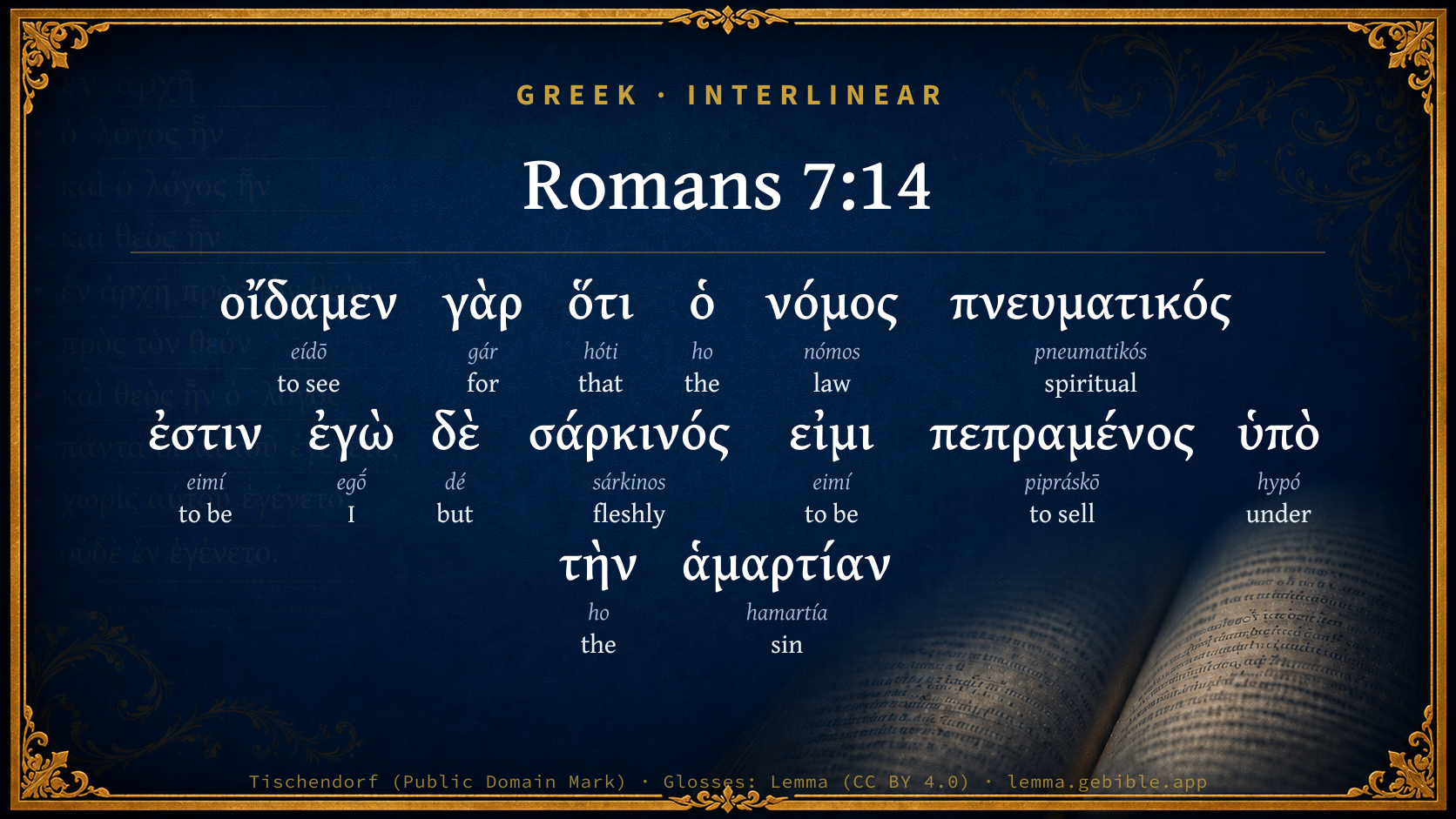
Greek (Tischendorf 8th ed.) Romans 7:14 appears in the Greek New Testament. The text above is from the Tischendorf 8th edition. Each word links to its Strong’s number and a concise gloss. Click any word for its full Thayer’s Greek Lexicon entry.
Download image
Cite this verse

Romans 7:14 (World English Bible). Public Domain. Lemma interlinear Bible study tool, https://lemma.gebible.app/v/romans/7/14.

Show BibTeX & RIS
BibTeX
RIS
English Translation
For we know that the law is spiritual, but I am fleshly, sold under sin.
World English Bible · Public Domain
Highlights
  • 1 first appearance in the Greek New Testament
Full analysis ↓
Download a study sheet

One document with this verse’s original text, its word-by-word gloss line, the meaning frame, cross-references with their text, attributed commentary, and full source and license credits — printable, and it pastes into notes with its structure intact.

This verse Autodidact and up

Study sheet (.html) Plain text (.txt)

A passage Seminary Student

Up to 50 verses in one chapter. A passage sheet keeps up to 6 commentary sources and 12 cross-references per verse, in the order this page ranks them, and says so on the sheet whenever that leaves anything out. Ask for a single verse and you get the Autodidact verse sheet above.

Everything on this page stays free to read, with no account — the sheet is a download of what is already on screen, not access to it.

Want to remove ads? Support Godless Engineer
Compare translations 3

The same verse in 3 English versions, stacked beneath the original-language interlinear above. Click any original word for its lexicon entry.

Each is an independent rendering of the whole verse — the interlinear is not word-aligned to these translations.

Highlighted words mark where these versions differ — a whole-verse word diff, not a word-by-word alignment.

  • World English Bible Public Domain
    For we know that the law is spiritual, but I am fleshly, sold under sin.
  • King James Version Public Domain
    For we know that the law is spiritual: but I am carnal, sold under sin.
  • unfoldingWord Literal Text CC BY-SA 4.0
    For we know that the law is spiritual, but I myself am fleshly, sold into slavery under sin.

unfoldingWord Literal Text — © unfoldingWord, licensed CC BY-SA 4.0. Word-aligned USFM3 via Door43 (git.door43.org/unfoldingWord/en_ult).

Versions to compare (up to 4)

3 of 4 selected

Show all 19 translations

Every available English version of this verse, each an independent rendering of the whole verse.

  • World English Bible Public Domain
    For we know that the law is spiritual, but I am fleshly, sold under sin.
  • Berean Standard Bible Public Domain
    We know that the law is spiritual; but I am unspiritual, sold as a slave to sin.
  • Majority Standard Bible Public Domain
    We know that the law is spiritual; but I am unspiritual, sold as a slave to sin.
  • King James Version Public Domain
    For we know that the law is spiritual: but I am carnal, sold under sin.
  • American Standard Version (1901) Public Domain
    For we know that the law is spiritual: but I am carnal, sold under sin.
  • Revised Version (1885) Public Domain
    For we know that the law is spiritual: but I am carnal, sold under sin.
  • Geneva Bible (1599) Public Domain
    For we knowe that the Law is spirituall, but I am carnall, solde vnder sinne.
  • Douay-Rheims (1899) Public Domain
    For we know that the law is spiritual; but I am carnal, sold under sin.
  • Young's Literal Translation Public Domain
    for we have known that the law is spiritual, and I am fleshly, sold by the sin;
  • Literal Standard Version CC BY-SA 4.0
    For we have known that the Law is spiritual, and I am fleshly, sold by sin;
  • Unlocked Literal Bible CC BY-SA 4.0
    For we know that the law is spiritual, but I am of the flesh. I have been sold under slavery to sin.
  • unfoldingWord Literal Text CC BY-SA 4.0
    For we know that the law is spiritual, but I myself am fleshly, sold into slavery under sin.
  • Darby Bible Public Domain
    For we know that the law is spiritual: but *I* am fleshly, sold under sin.
  • World Messianic Bible Public Domain
    For we know that the law is spiritual, but I am fleshly, sold under sin.
  • Webster's Bible Public Domain
    For we know that the law is spiritual: but I am carnal, sold under sin.
  • Free Bible Version CC BY-SA 4.0
    We realize that the law is spiritual; but I'm all-too-human, a slave to sin.
  • Bible in Basic English Public Domain
    For we are conscious that the law is of the spirit; but I am of the flesh, given into the power of sin.
  • Text-Critical English NT CC BY 4.0
    For we know that the law is spiritual, but I am of the flesh, sold as a slave to sin.
  • Tyndale New Testament (1534) Public Domain
    For we knowe that the lawe is spirituall: but I am carnall solde vnder synne

Literal Standard Version (2020), Covenant Press — licensed CC BY-SA 4.0. Text via the HelloAO Bible API (eBible.org). Unlocked Literal Bible (unfoldingWord) — licensed CC BY-SA 4.0. Text via the HelloAO Bible API (eBible.org). unfoldingWord Literal Text — © unfoldingWord, licensed CC BY-SA 4.0. Word-aligned USFM3 via Door43 (git.door43.org/unfoldingWord/en_ult). Free Bible Version, Dr. Jonathan Gallagher — licensed CC BY-SA 4.0. Text via the HelloAO Bible API (eBible.org).

Word by word

More ways to search: Search by grammar → Find every occurrence → Compare this word →

Practice this passage: Drill this verse → Learn its vocabulary →

σάρκινός
sárkinos
G4560
“fleshly”
Adjective, Nominative, Singular, Masculine
Part of Speech
Adjective
Case
Nominative
Number
Singular
Gender
Masculine
Full Thayer's Definition

Origin: from G4561

TDNT: 08:38,1

1. fleshly, consisting of flesh, composed of flesh 2. pertaining to the body (as earthly and perishable material) 3. wholly given up to the flesh, rooted in the flesh as it were
  1. οἴδαμεν eídō G1492 “to see” Verb, Perfect, Active, Indicative, 1st person, Plural
  2. γὰρ gár G1063 “for” Conjunction
  3. ὅτι hóti G3754 “that” Conjunction
  4. ὁ ho G3588 “the” Article, Nominative, Singular, Masculine
  5. νόμος nómos G3551 “law” Noun, Nominative, Singular, Masculine
  6. πνευματικός pneumatikós G4152 “spiritual” Adjective, Nominative, Singular, Masculine
  7. ἐστιν eimí G1510 “to be” Verb, Present, Active, Indicative, 3rd person, Singular
  8. ἐγὼ egṓ G1473 “I” Personal pronoun, 1st person, Nominative, Singular
  9. δὲ dé G1161 “but” Conjunction
  10. εἰμι eimí G1510 “to be” Verb, Present, Active, Indicative, 1st person, Singular
  11. πεπραμένος pipráskō G4097 “to sell” Verb, Perfect, Passive, Participle, Nominative, Singular, Masculine
  12. ὑπὸ hypó G5259 “under” Preposition
  13. τὴν ho G3588 “the” Article, Accusative, Singular, Feminine
  14. ἁμαρτίαν hamartía G266 “sin” Noun, Accusative, Singular, Feminine

About this verse

These counts appear in no published source. They are computed here, from the morphology-tagged text and Lemma’s own curated glosses. What Lemma adds →

15
words
13
distinct lemmas
Pauline Epistles
section

Notable vocabulary

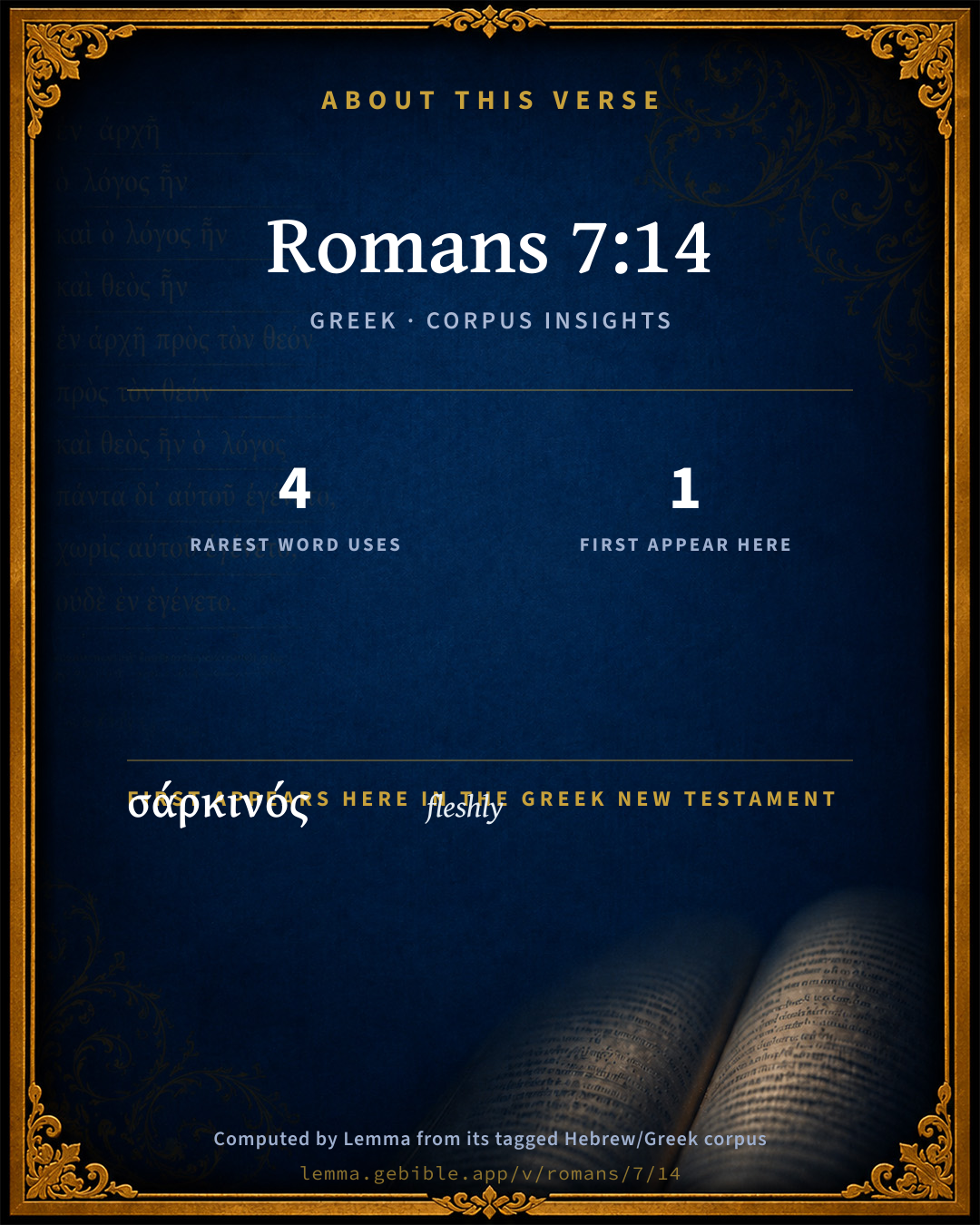
The rarest word here is σάρκινός fleshly G4560 — appearing just 4 times in the whole Greek New Testament.

First appearance in Scripture

This word makes its first canonical appearance in the Greek New Testament here:

  • σάρκινός fleshly G4560

Shared distinctive vocabulary

σάρκινός fleshly G4560 occurs in 4 verses of the Greek New Testament. Also found in:
Repetition

Words recur within this verse:

Cross-references

33

Topical passages linked to Romans 7:14 in the Treasury of Scripture Knowledge — connected by theme and wording, ordered by reader-vote popularity; previews shown in the World English Bible.

  • 1 Kings 21:25 (But there was none like Ahab, who did sell himself to do that which was evil in the sight of Yahweh, whom Jezebel his wife stirred up.
  • 2 Kings 17:17 They caused their sons and their daughters to pass through the fire, and used divination and enchantments, and sold themselves to do that which was evil in the sight of Yahweh, to provoke him to anger.
  • 1 Kings 21:20 Ahab said to Elijah, Have you found me, my enemy? He answered, I have found you, because you have sold yourself to do that which is evil in the sight of Yahweh.
  • Isaiah 52:3 For thus says Yahweh, You were sold for nothing; and you shall be redeemed without money.
  • Romans 7:18 For I know that in me, that is, in my flesh, dwells no good thing. For desire is present with me, but I don't find it doing that which is good.
  • Psalms 119:25 My soul is laid low in the dust. Revive me according to your word!
  • Proverbs 30:5 "Every word of God is flawless. He is a shield to those who take refuge in him.
  • Isaiah 50:1 Thus says Yahweh, Where is the bill of your mother's divorce, with which I have put her away? or which of my creditors is it to whom I have sold you? Behold, for your iniquities were you sold, and for your transgressions was your mother put away.
  • Matthew 5:22 But I tell you, that everyone who is angry with his brother without a cause shall be in danger of the judgment; and whoever shall say to his brother, 'Raca!' shall be in danger of the council; and whoever shall say, 'You fool!' shall be in danger of the fire of Gehenna.
  • Romans 7:22–24 For I delight in God's law after the inward man,
  • Ephesians 3:8 To me, the very least of all saints, was this grace given, to preach to the Gentiles the unsearchable riches of Christ,
  • Psalms 51:6 Behold, you desire truth in the inward parts. You teach me wisdom in the inmost place.
  • Proverbs 30:2 "Surely I am the most ignorant man, And don't have a man's understanding.
  • Isaiah 6:5 Then I said, "Woe is me! For I am undone, because I am a man of unclean lips, and I dwell in the midst of a people of unclean lips: for my eyes have seen the King, Yahweh of Hosts!"
  • Isaiah 64:5–6 You meet him who rejoices and works righteousness, those who remember you in your ways: behold, you were angry, and we sinned: in them [have we been] of long time; and shall we be saved?
  • Amos 2:6 Thus says Yahweh: "For three transgressions of Israel, yes, for four, I will not turn away its punishment; Because they have sold the righteous for silver, And the needy for a pair of shoes;
  • Matthew 5:28 but I tell you that everyone who gazes at a woman to lust after her has committed adultery with her already in his heart.
  • Matthew 16:23 But he turned, and said to Peter, "Get behind me, Satan! You are a stumbling-block to me, for you are not setting your mind on the things of God, but on the things of men."
  • Matthew 18:25 But because he couldn't pay, his lord commanded him to be sold, with his wife, his children, and all that he had, and payment to be made.
  • Matthew 22:37–40 Jesus said to him, "'You shall love the Lord your God with all your heart, and with all your soul, and with all your mind.'
  • Luke 5:8 But Simon Peter, when he saw it, fell down at Jesus' knees, saying, "Depart from me, for I am a sinful man, Lord."
  • Luke 7:6 Jesus went with them. When he was now not far from the house, the centurion sent friends to him, saying to him, "Lord, don't trouble yourself, for I am not worthy for you to come under my roof.
  • Luke 18:11–14 The Pharisee stood and prayed to himself like this: 'God, I thank you, that I am not like the rest of men, extortioners, unrighteous, adulterers, or even like this tax collector.
  • Genesis 37:27 Come, and let's sell him to the Ishmaelites, and not let our hand be on him; for he is our brother, our flesh." His brothers listened to him.
  • Genesis 37:36 The Midianites sold him into Egypt to Potiphar, an officer of Pharaoh's, the captain of the guard.
  • Genesis 40:15 For indeed, I was stolen away out of the land of the Hebrews, and here also have I done nothing that they should put me into the dungeon."
  • Exodus 21:2–6 If you buy a Hebrew servant, he shall serve six years and in the seventh he shall go out free without paying anything.
  • Exodus 22:3 If the sun has risen on him, there shall be guilt of bloodshed for him; he shall make restitution. If he has nothing, then he shall be sold for his theft.
  • Leviticus 19:18 You shall not take vengeance, nor bear any grudge against the children of your people; but you shall love your neighbor as yourself. I am Yahweh.
  • Deuteronomy 6:5 and you shall love Yahweh your God with all your heart, and with all your soul, and with all your might.
  • Job 42:6 Therefore I abhor myself, And repent in dust and ashes."
  • 1 Corinthians 3:1–3 Brothers, I couldn't speak to you as to spiritual, but as to fleshly, as to babies in Christ.
  • Hebrews 4:12 For the word of God is living, and active, and sharper than any two-edged sword, and piercing even to the dividing of soul and spirit, of both joints and marrow, and is able to discern the thoughts and intentions of the heart.

Cross-references courtesy of OpenBible.info (CC BY 4.0).

Commentary

Notes on Romans 7:14 from classic Christian and Jewish commentators (each source and its license shown beneath its notes). The classic Christian expositions comment on the surrounding passage and are grouped to its opening verse, so a note may address several verses; the Jewish commentaries on the Tanakh (Rashi and others) are per-verse, so they appear only where the commentator wrote on this verse.

Lemma curates 59 commentaries, every one of them public domain or Creative Commons licensed, each selected and text-cleaned for this edition rather than reprinted as found. About our sources →

Matthew Henry's Commentary

Here is a description of the conflict between grace and corruption in the heart, between the law of God and the law of sin. And it is applicable two ways: - 1. To the struggles that are in a convinced soul, but yet unregenerate, in the person of whom it is supposed, by some, that Paul speaks. 2. To the struggles that are in a renewed sanctified soul, but yet in a state of imperfection; as other apprehend. And a great controversy there is of which of these we are to understand the apostle here. So far does the evil prevail here, when he speaks of one sold under sin, doing it, not performing that which is good, that it seems difficult to apply it to the regenerate, who are described to walk not after the flesh, but after the Spirit; and yet so far does the good prevail in hating sin, consenting to the law, delighting in it, serving the law of God with the mind, that it is more difficult to apply it to the unregenerate that are dead in trespasses and sins.

I. Apply it to the struggles that are felt in a convinced soul, that is yet in a state of sin, knows his Lord's will, but does it not, approves the things that are more excellent, being instructed out of the law, and yet lives in the constant breach of it, Rom 2:17-23. Though he has that within him that witnesses against the sin he commits, and it is not without a great deal of reluctancy that he does commit it, the superior faculties striving against it, natural conscience warning against it before it is committed and smiting for it afterwards, yet the man continues a slave to his reigning lusts. It is not thus with every unregenerate man, but with those only that are convinced by the law, but not changed by the gospel. The apostle had said (Rom 6:14), Sin shall not have dominion, because you are not under the law, but under grace, for the proof of which he here shows that a man under the law, and not under grace, may be, and is, under the dominion of sin. The law may discover sin, and convince of sin, but it cannot conquer and subdue sin, witness the predominancy of sin in many that are under very strong legal convictions. It discovers the defilement, but will not wash it off. It makes a man weary and heavy laden (Mat 11:28), burdens him with his sin; and yet, if rested in, it yields no help towards the shaking off of that burden; this is to be had only in Christ. The law may make a man cry out, O wretched man that I am! who shall deliver me? and yet leave him thus fettered and captivated, as being too weak to deliver him (Rom 8:3), give him a spirit of bondage to fear, Rom 8:15. Now a soul advanced thus far by the law is in a fair way towards a state of liberty by Christ, though many rest here and go no further. Felix trembled, but never came to Christ. It is possible for a man to go to hell with his eyes open (Num 24:3, Num 24:4), illuminated with common convictions, and to carry about with him a self-accusing conscience, even in the service of the devil. He may consent to the law that it is good, delight to know God's ways (as they, Isa 58:2), may have that within him that witnesses against sin and for holiness; and yet all this overpowered by the reigning love of sin. Drunkards and unclean persons have some faint desires to leave off their sins, and yet persist in them notwithstanding, such is the impotency and such the insufficiency of their convictions. Of such as these there are many that will needs have all this understood, and contend earnestly for it: though it is very hard to imagine why, if the apostle intended this, he should speak all along in his own person; and not only so, but in the present tense. Of his own state under conviction he had spoken at large, as of a thing past (Rom 7:7, etc.): I died; the commandment I found to be unto death; and if here he speaks of the same state as his present state, and the condition he was now in, surely he did not intend to be so understood: and therefore,

II. It seems rather to be understood of the struggles that are maintained between grace and corruption in sanctified souls. That there are remainders of indwelling corruption, even where there is a living principle of grace, is past dispute; that this corruption is daily breaking forth in sins of infirmity (such as are consistent with a state of grace) is no less certain. If we say that we have no sin, we deceive ourselves, Jo1 1:8, Jo1 1:10. That true grace strives against these sins and corruptions, does not allow of them, hates them, mourns over them, groans under them as a burden, is likewise certain (Gal 5:17): The flesh lusteth against the spirit, and the spirit against the flesh; and these are contrary the one to the other, so that you cannot do the things that you would. These are the truths which, I think, are contained in this discourse of the apostle. And his design is further to open the nature of sanctification, that it does not attain to a sinless perfection in this life; and therefore to quicken us to, and encourage us in, our conflicts with remaining corruptions. Our case is not singular, that which we do sincerely strive against, shall not be laid to our charge, and through grace the victory is sure at last. The struggle here is like that between Jacob and Esau in the womb, between the Canaanites and Israelites in the land, between the house of Saul and the house of David; but great is the truth and will prevail. Understanding it thus, we may observe here,

1. What he complains of - the remainder of indwelling corruptions, which he here speaks of, to show that the law is insufficient to justify even a regenerate man, that the best man in the world hath enough in him to condemn him, if God should deal with him according to the law, which is not the fault of the law, but of our own corrupt nature, which cannot fulfil the law. The repetition of the same things over and over again in this discourse shows how much Paul's heart was affected with what he wrote, and how deep his sentiments were. Observe the particulars of this complaint. (1.) I am carnal, sold under sin, Rom 7:14. He speaks of the Corinthians as carnal, Co1 3:1. Even where there is spiritual life there are remainders of carnal affections, and so far a man may be sold under sin; he does not sell himself to work wickedness, as Ahab did (Kg1 21:25), but he was sold by Adam when he sinned and fell - sold, as a poor slave that does his master's will against his own will - sold under sin, because conceived in iniquity and born in sin. (2.) What I would, that I do not; but what I hate, that do I, Rom 7:15. And to the same purport, Rom 7:19, Rom 7:21, When I would do good, evil is present with me. Such was the strength of corruptions, that he could not attain that perfection in holiness which he desired and breathed after. Thus, while he was pressing forward towards perfection, yet he acknowledges that he had not already attained, neither was already perfect, Phi 3:12. Fain he would be free from all sin, and perfectly do the will of God, such was his settled judgment; but his corrupt nature drew him another way: it was like a clog, that checked and kept him down when he would have soared upward, like the bias in a bowl, which, when it is thrown straight, yet draws it aside. (3.) In me, that is in my flesh, dwelleth no good, Rom 7:18. Here he explains himself concerning the corrupt nature, which he calls flesh; and as far as that goes there is no good to be expected, any more than one would expect good corn growing upon a rock, or on the sand which is by the sea-side. As the new nature, as far as that goes, cannot commit sin (Jo1 3:9), so the flesh, the old nature, as far as that goes, cannot perform a good duty. How should it? For the flesh serveth the law of sin (Rom 7:25), it is under the conduct and government of that law; and, while it is so, it is not likely to do any good. The corrupt nature is elsewhere called flesh (Gen 6:3, Joh 3:6); and, though there may be good things dwelling in those that have this flesh, yet, as far as the flesh goes, there is no good, the flesh is not a subject capable of any good. (4.) I see another law in my members warring against the law of my mind, Rom 7:23. The corrupt and sinful inclination is here compared to a law, because it controlled and checked him in his good motions. It is said to be seated in his members, because, Christ having set up his throne in his heart, it was only the rebellious members of the body that were the instruments of sin - in the sensitive appetite; or we may take it more generally for all that corrupt nature which is the seat not only of sensual but of more refined lusts. This wars against the law of the mind, the new nature; it draws the contrary way, drives on a contrary interest, which corrupt disposition and inclination are as great a burden and grief to the soul as the worst drudgery and captivity could be. It brings me into captivity. To the same purport (Rom 7:25), With the flesh I serve the law of sin; that is, the corrupt nature, the unregenerate part, is continually working towards sin. (5.) His general complaint we have in Rom 7:24, O wretched man that I am! who shall deliver me from the body of this death? The thing he complains of is a body of death; either the body of flesh, which is a mortal dying body (while we carry this body about with us, we shall be troubled with corruption; when we are dead, we shall be freed from sin, and not before), or the body of sin, the old man, the corrupt nature, which tends to death, that is, to the ruin of the soul. Or, comparing it to a dead body, the touch of which was by the ceremonial law defiling, if actual transgressions be dead works (Heb 9:14), original corruption is a dead body. It was as troublesome to Paul as if he had had a dead body tied to him, which he must have carried about with him. This made him cry out, O wretched man that I am! A man that had learned in every state to be content yet complains thus of his corrupt nature. Had I been required to speak of Paul, I should have said, "O blessed man that thou art, an ambassador of Christ, a favourite of heaven, a spiritual father of thousands!" But in his own account he was a wretched man, because of the corruption of nature, because he was not so good as he fain would be, had not yet attained, neither was already perfect. Thus miserably does he complain. Who shall deliver me? He speaks like one that was sick of it, that would give any thing to be rid of it, looks to the right hand and to the left for some friend that would part between him and his corruptions. The remainders of indwelling sin are a very grievous burden to a gracious soul.

2. What he comforts himself with. The case was sad, but there were some allays. Three things comforted him: -

(1.) That his conscience witnessed for him that he had a good principle ruling and prevailing in him, notwithstanding. It is well when all does not go one way in the soul. The rule of this good principle which he had was the law of God, to which he here speaks of having a threefold regard, which is certainly to be found in all that are sanctified, and no others. [1.] I consent unto the law that it is good, Rom 7:16, sumphēmi - I give my vote to the law; here is the approbation of the judgment. Wherever there is grace there is not only a dread of the severity of the law, but a consent to the goodness of the law. "It is a good in itself, it is good for me." This is a sign that the law is written in the heart, that the soul is delivered into the mould of it. To consent to the law is so far to approve of it as not to wish it otherwise constituted than it is. The sanctified judgment not only concurs to the equity of the law, but to the excellency of it, as convinced that a conformity to the law is the highest perfection of human nature, and the greatest honour and happiness we are capable of. [2.] I delight in the law of God after the inward man, Rom 7:22. His conscience bore witness to a complacency in the law. He delighted not only in the promises of the word, but in the precepts and prohibitions of the word; sunēdomai expresses a becoming delight. He did herein concur in affection with all the saints. All that are savingly regenerate or born again do truly delight in the law of God, delight to know it, to do it - cheerfully submit to the authority of it, and take a complacency in that submission, never better pleased than when heart and life are in the strictest conformity to the law and will of God. After the inward man; that is, First, The mind or rational faculties, in opposition to the sensitive appetites and wills of the flesh. The soul is the inward man, and that is the seat of gracious delights, which are therefore sincere and serious, but secret; it is the renewing of the inward man, Co2 4:16. Secondly, The new nature. The new man is called the inner man (Eph 3:16), the hidden man of the heart, Pe1 3:4. Paul, as far as he was sanctified, had a delight in the law of God. [3.] With the mind I myself serve the law of God, Rom 7:25. It is not enough to consent to the law, and to delight in the law, but we must serve the law; our souls must be entirely delivered up into the obedience of it. Thus it was with Paul's mind; thus it is with every sanctified renewed mind; this is the ordinary course and way; thitherward goes the bent of the soul. I myself - autos egō, plainly intimating that he speaks in his own person, and not in the person of another.

(2.) That the fault lay in that corruption of his nature which he did really bewail and strive against: It is no more I that do it, but sin that dwelleth in me. This he mentions twice (Rom 7:17, Rom 7:20), not as an excuse for the guilt of his sin (it is enough to condemn us, if we were under the law, that the sin which does the evil dwelleth in us), but as a salvo for his evidences, that he might not sink in despair, but take comfort from the covenant of grace, which accepts the willingness of the spirit, and has provided pardon for the weakness of the flesh. He likewise herein enters a protestation against all that which this indwelling sin produced. Having professed his consent to the law of God, he here professes his dissent from the law of sin. "It is not I; I disown the fact; it is against my mind that it is done." As when in the senate the major part are bad, and carry every thing the wrong way, it is indeed the act of the senate, but the honest party strive against it, bewail what is done, and enter their protestation against it; so that it is no more they that do it. - Dwelleth in me, as the Canaanites among the Israelites, though they were put under tribute: dwelleth in me, and is likely to dwell there, while I live.

(3.) His great comfort lay in Jesus Christ (Rom 7:25): I thank God, through Jesus Christ our Lord. In the midst of his complaints he breaks out into praises. It is a special remedy against fears and sorrows to be much in praise: many a poor drooping soul hath found it so. And, in all our praises, this should be the burden of the son, "Blessed be God for Jesus Christ." Who shall deliver me? says he (Rom 7:24), as one at a loss for help. At length he finds an all-sufficient friend, even Jesus Christ. When we are under the sense of the remaining power of sin and corruption, we shall see reason to bless God through Christ (for, as he is the mediator of all our prayers, so he is of all our praises) - to bless God for Christ; it is he that stands between us and the wrath due to us for this sin. If it were not for Christ, this iniquity that dwells in us would certainly be our ruin. He is our advocate with the Father, and through him God pities, and spares, and pardons, and lays not our iniquities to our charge. It is Christ that has purchased deliverance for us in due time. Through Christ death will put an end to all these complaints, and waft us to an eternity which we shall spend without sin or sigh. Blessed be God that giveth us this victory through our Lord Jesus Christ!

Matthew Henry's Commentary on the Whole Bible (1708–1710) — public domain (CC PDM 1.0). Text via the HelloAO Bible API.

The Cambridge Bible for Schools and Colleges

gen. ed. J. J. S. Perowne

14. For we know] The “for” points to the fact just cleared up that sin, not the law, is the true cause of the soul’s misery; which results from the collision of sin with the law.—“We know;”—as an admitted foundation-truth among Christians; a truth not only implied by the whole drift and often by the words (e.g. Psa_19:7-8, and Psalms 119 passim,) of the Old Testament, but explicitly taught in the Sermon on the Mount.

spiritual] Coming from Him who is a Spirit, and addressed to man’s spirit. The practical force of the word here, is to shew the law as claiming internal as well as external obedience; that of thoughts as well as acts.

I am carnal] The pronoun is emphatic, and the form (in the best reading) of the Gr. word rendered “carnal” is emphatic too, as meaning that the very material (as it were) of the Ego was “flesh.” It is remarkable how on the other hand, in e.g. Rom_7:25, he distinguishes the Ego from the flesh. But the contradiction is in form only. In the present verse he contrasts Paul with the Law. In Rom_7:25 he contrasts the “mind” of Paul with his “flesh;” and views the “mind” as influenced by Divine grace. Paul, as in contrast with the absolutely spiritual Law, is in his own view emphatically carnal; falling as he does (because of the element of the “flesh” still clinging to him) far indeed below its holy ideal. But Paul’s will, in the regenerate state, (and the will is the essence of the person,) is, in contrast with the same element of the “flesh” still encumbering it, not carnal. In view of the Law, he speaks of the whole state of self as, by contrast, fleshly. In view of the “flesh” he speaks of his self, his rectified will, as not fleshly.

We here remark on the general question whether he means the veritable Paul, and Paul in the regenerate state, in this passage. (See on Rom_7:7 for some previous remarks to the point.)

It is held (a) by some expositors, that the “I” is purely general; a human soul relating a conceivable experience. But such a reference is so extremely artificial as to be not only unlike St Paul’s manner, but à priori unlikely in any informal composition.

It has been held again (b) that he speaks as Paul, but as Paul quite unregenerate: or again (c) as Paul in the first stage of spiritual change, struggling through a crisis to spiritual peace; having seen the holiness of the Law, but not yet the bliss of redemption. As regards (b), this surely contradicts St Paul’s doctrine of grace; for he views the soul, before special grace, as (not without the witness of conscience, which is another matter, but) “alienated and hostile as to the mind” towards the true God. (See Col_1:21; Rom_5:10; Rom_8:7-8, &c.) But the “I” of this passage “hates” sin, (Rom_7:15,) and “delights in the Law of God” (Rom_7:22; see note below). As regards (c), the same remarks in great measure apply. In St Paul’s view elsewhere hostility and reconcilement are the only alternatives in the relations of the soul and God. But the “I” of this passage is not hostile to God.

The primâ facie view of the passage, certainly, is that by the first person and the present tense St Paul points to (one aspect of) his own then present experience. And is not this view confirmed by what we know of his experience elsewhere? See 1Co_9:27 : “I buffet my body and drive it as a slave;” words which, on reflection, imply a conflict of self with self, just such as depicted here. See too Gal_5:17; where the conflict of regenerate souls is evidently treated of. The language of 1Co_15:10, ad fin., must also be compared.

The records of Christian experience, and particularly of the experience of those saints who, like St Augustine, have been specially schooled in spiritual conflict, surely confirm this natural view of the passage. It is recorded of one aged and holy disciple that he quoted Romans 7 as the passage which had rescued him from repeated personal despondency. It would be a very shallow criticism here to object that the Paul of ch. 8 could not be, in the same part of his history, the Paul of ch. 7.

The language of the present passage is indeed strong; but it is the strength of profound spiritual insight. The man who here “does what he hates” is one who has so felt the absolute sanctity of God and of His law as to see sin in the slightest deviations of will and affection from its standard. Such penitence, for such sin, is not only possible in a life of Christian rectitude, but may be said to be a natural element in it[37].

[37] See further remarks on this whole passage in Appendix E.

sold under sin] i.e. so as to be under its influence. The metaphor is from the slave-market; a recurrence to the topics of ch. 6. But the difference here is that the redeemed and regenerate man is now in question, and the slavery is therefore a far more limited metaphor. He is now only so far under the mastership of sin as that he is still in the body, which is, by reason of sin, still mortal and still a stronghold of temptation. As regards a claim on the soul to condemnation, he is free from sin; as regards its influence, its temptations, he is liable. And such is now his view of holiness that the presence of these, and the least yielding to them, is to him a heavy servitude.—To the question, When was he thus sold? we answer, At the Fall and in Adam.

E. THE STATE DESCRIBED IN Ch. Rom_7:14-24

The controversy over this profound passage is far too wide to allow of full treatment here. It is scarcely needful to say that conclusions very different from those in the notes have been drawn by many most able and most devout expositors, ancient and modern. Very earnest convictions, mainly based on St Paul’s general teaching, and that of Scripture, alone could justify us in the positive statement of another view.

Here we offer only a few further general remarks.

(1) On the question what St Paul here meant very little certain light is thrown by quotations from pagan writers describing an inner conflict. For in the great majority of such passages the language manifestly describes the conflict of conscience and will; and the confusion of the voice of conscience with the far different voice of personal will is so easy,—and no wonder, if Scripture truly describes the state of the human mind (cp. Eph_2:3; Eph_4:17-18) as to spiritual truth,—that we believe that even the grandest utterances of pagan thought on this subject must yet be explained of a conflict not so much of will with will, as of will with conscience.

A careful collection of such passages (from Thucydides, Xenophon, Euripides, Epictetus, Plautus, both the Senecas, and Ovid) is given by Tholuck[56], on Rom_7:15. And our conviction on the whole, from these and similar passages, is that either they do not mean to describe a conflict of will with will, or that they betray the illusions to which the mind, unvisited by special grace, must surely be liable regarding the conditions of the soul’s action; illusions which this chapter, among other passages of Revelation, tends to dispel.

[56] Whose conclusions are very different from ours.

(2) Suppose the person described in ch. Rom_7:14-25 to be not regenerate, not a recipient of the Holy Spirit; and compare the case thus supposed with the language of ch. Rom_8:5-9. The consequence must be that one who is “in the flesh” (for St Paul recognizes neither here nor elsewhere an intermediate or semi-spiritual condition,) and who as such “cannot please God,” can vet truly say, “It is no more I that do it, but sin that dwelleth in me;” and, “I delight in the law of God after the inward man;” and, “With the mind I myself serve the law of God.”

Now is this possible, from the point of view of St Paul’s teaching? For consider what he means by the law: not man’s subjective view of moral truth and right, but the absolute and profoundly spiritual demands of the True God upon not the approval of man but his whole will.

Surely when Divine grace makes plain to the man the width and depth of those demands, he needs a “renewing of the mind” (Rom_12:2) if he is to say with truth, “I delight[57] in the Law;” “I myself with my mind serve it.”

[57] A word which it is impossible to explain away.

(3) The supposed impossibility of assigning the language of this passage to one who is meanwhile “in Christ” and “has peace with God” will at least seem less impossible if we remember St Paul’s manner of isolating a special aspect of truth. May he not, out of his profound, intense, and subtle spiritual experience, have chosen for a special purpose to look on one aspect only as if it were the whole? on his consciousness of the element which still called for “mortification,” hanging on “a cross,” “buffeting,” “groans,” “fear and trembling,” (Rom_8:13; Rom_8:23; 1Co_9:27; Col_3:5; Php_2:12, &c.;) almost as if he had no other consciousness?

(4) It is often assumed that ch. 8 is an express contrast to ch. Rom_7:14-25. But it is far more likely that it is written to sum up the whole previous Epistle. (See note on Rom_8:1.) If it is designed as a contrast to ch. 7, surely such words as those of Rom_8:13; Rom_8:23, are out of place.

With this view of ch. 8 there is less likelihood of our taking ch. 7 to describe a state antecedent to the experience of ch. 8. But however, if we are right in our remarks in (3), any view of ch. 8 still leaves ch. 7 quite free to be a description of (one side of) regenerate experience.

(5) Tholuck (on Rom_7:15) quotes from Grotius the remark that “it would be a sad thing, indeed, if the Christian, as such, could apply these sayings” (those of the pagan writers who describe an inner conflict) “to himself.” But those who interpret ch. 7 of the experience of a Christian take it to describe not his experience as a Christian, but his experience as a man still in the body, but who, as a Christian, has been illuminated truly to apprehend that infinite Holiness which can only cease to conflict with a part of his condition when at length his trial-time is over.

The Cambridge Bible for Schools and Colleges (gen. ed. J. J. S. Perowne; Cambridge University Press, 1878–1918) — public domain. Text from a community e-Sword module.

Albert Barnes' Notes on the Bible

The remainder of this chapter has been the subject of no small degree of controversy. The question has been whether it describes the state of Paul before his conversion, or afterward. It is not the purpose of these notes to enter into controversy, or into extended discussion. But after all the attention which I have been able to give to this passage, I regard it as describing the state of a man under the gospel, as descriptive of the operations of the mind of Paul subsequent to his conversion. This interpretation is adopted for the following reasons:

(1) Because it seems to me to be the most obvious. It is what will strike plain people as being the natural meaning; people who do not have a theory to support, and who understand language in its usual sense.

(2) Because it agrees with the design of the apostle, which is to show that the Law is not adapted to produce sanctification and peace. This he had done in regard to a man before he was converted. If this relates to the same period, then it is a useless discussion of a point already discussed, If it relates to that period also, then there is a large field of action, including the whole period after a man’s conversion to Christianity, in which the question might still be unsettled, whether the Law there might not be adapted to sanctify. The apostle therefore makes thorough work with the argument, and shows that the operation of the Law is everywhere the same.

(3) Because the expressions which occur are such as cannot be understood of an impenitent sinner; see the notes at Rom 7:15, Rom 7:21.

(4) Because it accords with parallel expressions in regard to the state of the conflict in a Christian’s mind.

(5) Because there is a change made here from the past tense to the present. In Rom 7:7, etc. he had used the past tense, evidently describing some former state. In Rom 7:14 there is a change to the present, a change inexplicable, except on the supposition that he meant to describe some state different from that before described. That could be no other than to carry his illustration forward in showing the inefficacy of the Law on a man in his renewed state; or to show that such was the remaining depravity of the man, that it produced substantially the same effects as in the former condition.

(6) Because it accords with the experience of Christians, and not with sinners. It is just such language as plain Christians, who are acquainted with their own hearts, use to express their feelings. I admit that this last consideration is not by itself conclusive; but if the language did not accord with the experience of the Christian world, it would be a strong circumstance against any proposed interpretation. The view which is here expressed of this chapter, as supposing that the previous part Rom 7:7-13 refers to a man in his unregenerate state, and that the remainder describes the effect of the Law on the mind of a renewed man, was adopted by studying the chapter itself, without aid from any writer. I am happy, however, to find that the views thus expressed are in accordance with those of the late Dr. John P. Wilson, than whom, perhaps, no man was ever better quailfled to interpret the Scriptures. He says, “In the fourth verse, he (Paul) changes to the first person plural, because he intended to speak of the former experience of Christians, who had been Jews. In the seventh verse, he uses the first person singular, but speaks in the past tense, because he describes his own experience when he was an uncoverted Pharisee. In the fourteenth verse, and unto the end of the chapter, he uses the first person singular, and the present tense, because he exhibits his own experience since he became a Christian and an apostle.”

We know - We admit. It is a conceded, well understood point.

That the law is spiritual - This does not mean that the Law is designed to control the spirit, in contradistinction from the body, but it is a declaration showing that the evils of which he was speaking were not the fault of the Law. That was not, in its nature, sensual, corrupt, earthly, carnal; but was pure and spiritual. The effect described was not the fault of the Law, but of the man, who was sold under sin. The word “spiritual” is often thus used to denote what is pure and hoy, in opposition to that which is fleshly or carnal; Rom 8:5-6; Gal 5:16-23. The flesh is described as the source of evil passions and desires; The spirit as the source of purity; or as what is agreeable to the proper influences of the Holy Spirit.

But I am - The present tense shows that he is describing himself as he was at the time of writing. This is the natural and obvious construction, and if this be not the meaning, it is impossible to account for his having changed the past tense Rom 7:7 to the present.

Carnal - Fleshly; sensual; opposed to spiritual. This word is used because in the Scriptures the flesh is spoken of as the source of sensual passions and propensities, Gal 5:19-21. The sense is, that these corrupt passions still retained a strong and withering and distressing influence over the mind. The renewed man is exposed to temptations from his strong native appetites; and the power of these passions, strengthened by long habit before he was converted, has traveled over into religion, and they continue still to influence and distress him. It does not mean that he is wholly under their influence; but that the tendency of his natural inclinations is to indulgence.

Sold under sin - This expression is often adduced to show that it cannot be of a renewed man that the apostle is speaking. The argument is, that it cannot be affirmed of a Christian that he is sold under sin. A sufficient answer to this might be, that in fact, this is the very language which Christians often now adopt to express the strength of that native depravity against which they struggle, and that no language would better express it. It does not, mean that they choose or prefer sins. It strongly implies that the prevailing bent of their mind is against it, but that such is its strength that it brings them into slavery to it. The expression used here, “sold under sin,” is “borrowed from the practice of selling captives taken in war, as slaves.” (Stuart.) It hence, means to deliver into the power of anyone, so that he shall be dependent on his will and control. (Schleusner.) The emphasis is not on the word “sold,” as if any act of selling had taken place, but the effect was as if he had been sold; that is, he was subject to it, and under its control, and it means that sin, contrary to the prevailing inclination of his mind Rom 7:15-17, had such an influence over him as to lead him to commit it, and thus to produce a state of conflict and grief; Rom 7:19-24. The verses which follow this are an explanation of the sense, and of the manner in which he was “sold under sin.”

Albert Barnes' Notes on the Bible (1834–1885) — public domain. Text from a community e-Sword/MySword module.

Matthew Poole's English Annotations

He goes on to clear the law, and excuse it, giving it another commendation, that it is spiritual; i.e. it requires such obedience as is not only outward, but inward and spiritual; it forbids spiritual as well as fleshly sins. Read Christ’s exposition of it, in Mat 5:1-48.

I am carnal; i.e. in part, because of the remainders of sin and of the flesh that are still in me; in respect of which, those who are regenerated are said to be carnal. Compare 1Co 1:2, with 1Co 3:1.

Sold under sin: he did not actively sell himself to sin, or to commit sin, which is said of Ahab, 1Ki 21:20,25, and of the idolatrous Israelites, 2Ki 17:17. He was not sin’s servant or slave; but many times he was sin’s captive against his will; see Rom 7:23. Against his will and consent, he was still subject to the violent lusts and assaults of sin, and not able wholly to free himself: though he always made stout resistance, yet many times he was overcome. Hitherto the apostle hath spoken of the power of the law and sin in unregenerate persons, even as he himself had experienced whilst he was yet in such a state; but now he cometh to speak of himself as he then was, and to declare what power the remainders of sinful flesh had still in him, though regenerated, and in part renewed. That the following part of this chapter is to be applied to a regenerate person, is evident, because the apostle (speaking of himself in the former verses) uses the preter-perfect tense, or speaks of that which was past; but here he changeth the tense, and speaks of the present time. From Rom 7:7-14, he tells us how it had been with him formerly; and then from Rom 7:14-25, he relates how it was with him now; I was so and so, I am thus and thus. The changing of the tense and time doth plainly argue a change in the person. They that list to be further satisfied in this point, may find it fully discussed in our own language, by Mr. Anthony Burgess, in his excellent discourse of Original Sin, part iv. c. 3, and by Dr. Willet, in his Hexalta in locum; and they that understand the Latin tongue, may find it argued pro and con, in Synops. Critic. &c., and by Aug. Retractat. lib. i. c. 23; Contra Julian. lib. v. c. 11.

Matthew Poole's English Annotations on the Holy Bible (1683–1685) — public domain. Text from a community e-Sword/MySword module.

Joseph Benson's Commentary

Rom 7:14. For we know that the law is spiritual — Extending to the spirit of man; forbidding even the sins of the spirit; sins internal, committed merely in men’s minds, such as vain thoughts, foolish imaginations, carnal inclinations, pride, self-will, discontent, impatience, anger, malice, envy, revenge, and all other spiritual evils, in the commission of which the body has no concern: enjoining, at the same time, all spiritual graces and virtues, such as humility, resignation, patience, contentment, meekness, gentleness, long-suffering, benevolence; with all holy intentions, affections, and dispositions, included in loving God with all our heart, and our neighbour as ourselves, which the law especially enjoins: being intended, at the same time, to purify and exalt the spirit, and assert its superiority over the meaner part of our nature. But I am carnal — That is, man, considered in himself, as in a state of nature, and destitute of the regenerating grace of God, is carnal. See note on Rom 7:5, where to be in the flesh is evidently of the same import with the word carnal here, as are also similar expressions, Rom 8:5; Rom 8:8-9, &c., expressions which, all are agreed, solely respect the unregenerate; and in which the person that is in the flesh, or carnally minded, is represented as being in a state of death, and enmity against God. Very different, surely, from the spiritual man, whom this same apostle represents as living in a state of favour and friendship with God; minding chiefly the things of the Spirit; yea, having the Spirit of God dwelling in him, and giving him dominion over all fleshly lusts, which, through that Spirit, he is enabled to mortify; whose passions submit to the government of reason, and whose reason is itself under the influence of grace; whose enjoyments are chiefly of a spiritual nature, and his great employment to work out his salvation with fear and trembling. The Scriptures, therefore, place these two characters in direct opposition the one to the other; and the apostle begins this paragraph by informing us that it is his carnal state which he is about to describe, in opposition to the spirituality of God’s holy law, saying, But I am carnal; and adding, as a still more decisive proof that his meaning is as is here stated, sold under sin — That is, sold as a slave, to remain under the dominion of sin, and to be compelled to do those evil actions to which sinful inclinations prompt men. “In peccati potestatem, libidinis et concupiscentiæ predio redactus,” says Origen; brought under the power of sin by the enticement of lust and concupiscence. “So enslaved to it,” says Theophylact, ωστε μη αναβλεψαι δυνασθαι, as not to be able to look up: “a willing slave, who had sold himself to it,” says Theodoret. The meaning is, totally enslaved: slaves bought with money being absolutely at their master’s disposal. In this sense, the phrase is continually used in the Old Testament, as the reader may see by consulting the texts referred to in the margin. By the addition of this clause, therefore, the apostle evidently shows that he does not here use the word carnal in the sense in which it is taken 1Co 3:1, namely, to denote only such a state of imperfection in knowledge and holiness, as persons may be in who are newly converted; but that he uses it in the worst sense, namely, in the same sense in which the expression, to be in the flesh, and carnally minded, is used; that is, to signify a state of death and enmity against God. Those commentators, therefore, who suppose that in this and what follows, to the end of the chapter, the apostle describes his own state, at the time he wrote this epistle, and consequently the state of every regenerated person, must be under a great mistake. Universally, indeed, in the Scriptures, man is said to be in this state of bondage to sin until the Son of God make him free; but in no part of the sacred writings is it ever said of the children of God, that they are sold under sin, or enslaved to it. The very reverse is the Holy Spirit’s description of Christians, for the Son of God makes them free, and therefore they are free indeed; free especially from the power of sin, which has no longer dominion over them. See notes on Rom 6:13-22; Rom 8:2. The truth is, through this whole paragraph the apostle, to wean the Jews from their attachment to the Mosaic law, is showing how little that dispensation, even the moral part of it, considered as a covenant of justice, independent of the covenant of grace, could do for them, or for any of the fallen offspring of Adam. It could convince them of sin, but not constitute them righteous. It could show them their guilt, depravity, and weakness, but could neither justify their persons, nor renew their nature, nor furnish them with power to do the will of God. As he expresses himself, Rom 8:3, It was weak through the flesh, or through the corruption and infirmity of human nature. In pursuance of his design, having compared together the past and present state of believers, that in the flesh, Rom 7:5, and that in the spirit, Rom 7:6. in answering two objections, (Is then the law sin? Rom 7:7, and, Is the law death? Rom 7:13,) he interweaves the whole process of a man reasoning, groaning, striving, and escaping from the legal to the evangelical state. This he does, from Rom 7:7 to the end of the chapter.

Joseph Benson's Commentary on the Old and New Testaments (1811–1818) — public domain. Text from a community e-Sword module.

The Preacher's Complete Homiletical Commentary

Joseph S. Exell (gen. ed.)

CRITICAL NOTES

Rom_7:14.—Rabbins: “The law, because of its spirituality, will dwell only in the soul that is free from dross.”

Rom_7:15.—I am blinded, I am hurried along and tripped up, I know not how. The “I” here not the complex responsible self by whom the deed is done and the guilt incurred, but the self of the will in its higher sense, the inner man. Quotations show that in all countries there is a struggle in the breast between conscience and carnal inclination. They also show how much alike men express themselves in relation to the struggle in question. They answer still another purpose—viz., to show that language of this nature is used and is to be understood in the popular sense, and in this only.

Rom_7:16.—οὐ θέλω, indicates, not necessity, but mere non-approbation of what is done.

Rom_7:17.—Proof that sin has come upon us as a power originally foreign to us. οἰκοῦσα ἐν ἑμοί, as a stranger or guest, or as one thing in another.

Rom_7:18.—More than ἐργάζεσθαι; to do the whole good I wish, and that perfectly.

Rom_7:22.—Not so much the mind itself as the man choosing the mind for his principle or standpoint.

Rom_7:23.—Rabbins: “We should be always stirring up the good principle against the evil one.” Genitive of connection, like ὁ νομ. τ. Θεοῦ, only the latter is without the individual—the former is most intimately within him: in the latter God tells him what He wants; the former the man gives to himself.

Rom_7:24.—The cry uttered in full consciousness of the deliverance effected by Christ.

Rom_7:25.—Χάρις τοῦ Θ., “the grace of God,” equal, if not preferable, as an answer to the question. The σάρξ (flesh), and, as necessarily connected with it, the ψυχή (animal soul), the whole inferior region of the life, remains still subject to the law of sin. The αὐτὸς ἑγώ is not to be construed “I myself,” but ego idem, “I, the one and the same, have in me a two-fold element.” To be sure αὐτός in this signification commonly has the article, but the ἐγώ supplies it here (Olshausen).

MAIN HOMILETICS OF THE PARAGRAPH.—Rom_7:14-25

Two men in one man.—The two men in the one man are the carnal man and the inward man. As we read the history of these two men we wonder at St. Paul’s power of mental analysis. He skillfully uses the pen and the discriminating power of the metaphysician. He has accurately read and studied the workings of human nature; and this result could only have been reached by the intense observation of the workings of his own nature. “Know thyself” is the old precept. Self-knowledge prepares the way for other-self knowledge. These verses, then, contain a record of the workings of St. Paul’s nature. He finds in himself two men, one low and the other noble; and he mourns that the lower man so often gains the mastery over the noble man. Let us look at:—

I. The two men.—The one man is carnal, sold under sin. This carnal man serves the law of sin. Thus he is base in the extreme. He is of the earth earthy, and does not strive upward towards the true and the good. The other man is spiritual—at least he is so far spiritual that he loves the law which is spiritual; for this inward man delights in the law of God, and consents unto the law that is good. How opposite the characters! How striking the contrast between the two men that dwell together in the one man! There is no need for us to ask the question whether St. Paul here speaks of the regenerate or the unregenerate man. This much may be safely affirmed, that every man who is candid to himself and his fellows must confess that ofttimes he sinks so low as to be compelled to ask, Is there in me any spiritual life? I profess Christianity, but what would my uncharitable neighbours say of my religion if all the secret workings and downfalls of my lower nature were proclaimed on the housetops? How often have we lamented the beastly which has shown itself? Is it possible that I am the same man who has stood on the mount of transfiguration—I who am now desiring to be fed with the husks the swine eat? Let us, then, be merciful in our judgments.

II. The two men in conflict.—The fight cannot be seen; the strain on the sinews cannot be observed; the sound of the struggle cannot be heard. But these unseen conflicts are oft the most real and the most severe. The one man desires to do good; the other man strives to prevent the accomplishment of the praiseworthy desire. How true to life and to all experience! A conflict goes on in all—perhaps even in those who may appear to have altogether destroyed the divine image and completely effaced the nobler part of human nature. The poor criminal has had a struggle—light and short it may be, still a struggle—before he did the fatal act which has led to his temporal ruin at least. And oh, what a conflict when the great man—great spiritually—has fallen from his eminence and has become as other men! “Let him that thinketh he standeth take heed, lest he fall.”

III. The lower man triumphant.—The lower man compels the spiritual man to do the thing which he hates. Is there a malicious leer on the countenance of the lower man as he forces the spiritual man to do the evil which he would not and which he abhors? Certainly he is not backward in feeling remorse. The spiritual man mourns, perhaps weeps; and the carnal man takes to himself no blame, and does not attempt to wipe away the tears. How wondrous strange that the lower man should be so often triumphant! And yet this takes place in the larger sphere of life. The wicked man spreads himself like a green bay tree; base men are exalted; the wicked are too oft in great prosperity; the carnal man rides rough-shod over the spiritual man. Sad that society should ever allow vile men to rule—sadder that the spiritual man should permit the lower to gain and keep the ascendency! But how is it to be helped? “O wretched man that I am! who shall deliver me from the body of this death?”

IV. The inward man can only win by the help of a second man, the man Christ Jesus.—Ethical systems cannot successfully help in this conflict. Philosophy is of no avail. Rhetorical phrases cannot nerve the nature, so as to enable us to gain moral victory. Music may inspire the soldier to deeds of daring; but what music hath charms sufficiently strong to enable the man always to perform that which is good? Reason may tell me that to follow and serve the good is a good in itself, that virtue is its own reward; but reason is soon dethroned by the power of the carnal man, vice wears an alluring mien, while virtue, with reward in its right hand, is not infrequently unattractive. Even when it is, the higher man is overridden by the lower man, if the former be not helped. The man Christ Jesus must be our helper. He allures by presenting vice in its true colours and virtue in its proper garb of attractiveness. He shows us that the higher man can be victorious by being Himself the example of unsullied holiness. He inspires with strength by the inspiration of His Holy Spirit. He removes moral weakness by cleansing us from our sins. The man forgiven is the man to fight; and though he fall beneath the adversary, yet he must in Christ’s strength gain the final victory. Let us learn not to attempt the conflict in our own strength. The question is not, Does this description apply to the regenerate or to the unregenerate? The practical and solemn truth is that “your adversary the devil goeth about as a roaring lion seeking whom he may devour,” that the spirit is willing, but the flesh is often sadly weak. Let us not despair when we are overcome by the lower man. Despair means ruin, while hope means salvation; and surely there is a large foundation for hope in the all-merciful High Priest, who is ready to help in every time of need. Nil desperandum must be the motto of the true soldier of Jesus Christ. Like brave English soldiers, he must never know when he is beaten. Let us try to feel that the conflict is worth pursuing, for final victory is sure in Christ Jesus, and final victory means the award of “the crown of glory that fadeth not away,” an inheritance incorruptible, a place where the carnal man shall no more molest.”

Rom_7:14-15. Believer’s conflict and victory.—This last verse of the chapter not only gives us the conclusion of the argument discussed in the preceding verses, but also helps us in the interpretation of the whole passage by supplying us with an answer to the disputed question whether the conflict here described is that of a regenerate or unregenerate man. The words “I myself” in this verse must mean St. Paul after his conversion; and he—the same Paul—in the process of his regeneration and of the working of the Holy Spirit in him, passed through this painful conflict, and found deliverance through the Lord Jesus Christ. Though speaking of himself and recording his own experience, St. Paul here is the representative of all true Christians, who with more or less distinctness and painfulness in individual cases have to pass through a similar conflict and to rejoice in the same deliverance. This scripture therefore is most instructive to all believers in Christ who desire to be established in the faith and to live the true Christian life. And in dwelling upon it we may profitably consider:

1. The conflict engaged in;

2. The deliverance obtained;

3. The practical lessons to be learned.

I. The conflict.—This is between the enlightened mind and conscience—“the inner man” of the believer acknowledging the excellence of the law of God—and on the other hand the evil propensities of the natural man—“the carnal man,” “the flesh,” as it is often termed in Scripture language, refusing to obey God’s law or to refrain from sin.

1. “The law of God is spiritual” in its essential moral nature, as it emanates from the Spirit of God. But the believer at the beginning of his regenerate life is still “carnal” (see 1Co_4:1-4)—not yet emancipated from the bondage of sin (Rom_7:14), which had held him under its dominion.

2. Hence he finds himself doing what he does not in his better mind approve of. He even hates his own sinful acts, especially after he has done them; and thus he testifies that the law is good, but sin too strong for him. Its reign is not yet overthrown.

3. Even when his will is expressly bent upon obeying God’s law he has not the power to carry out what he resolved to do. Indwelling sin has still the mastery of him; he does what he would not.

4. This is his unhappy state. He “delights in the law of God after the inward man”; but there is another law in his body—the law of sin with its lusts and passions—bringing him under its hateful power. Something of this miserable conflict was known even to heathen men, who have recorded that they knew and approved of what was good, yet did what they knew was evil. How much more wretched must such a state of moral bondage be in a Christian who has learned to delight in God’s law! Well may we assent to St. Paul’s vehement exclamation, “O wretched man that I am! who shall deliver from the body of this death?”

II. The deliverance obtained.—The joyful answer to the question “Who shall deliver me?” is here very briefly expressed: “I thank God through Jesus Christ our Lord.”

1. This happy result and the manner in which it is realised and carried out in the Christian life is explained and dwelt upon in the following chapter; but here even in this brief expression we have shown to us the source from which this blessing springs, the power by which the victory is gained. It is “Jesus Christ our Lord.”

2. The believer in Jesus Christ is not only delivered from, condemnation by his Lord’s atoning death (Gal_3:13), but in and through the same divine Saviour the Holy Spirit—the very Spirit of Christ and of God—comes and abides in him; and as his faith grows stronger and his surrender to the Spirit’s guidance becomes more complete, he is strengthened with might in the inner man. Christ dwells in his heart with His spiritual presence and power, and makes him victorious over the sin by which before he was overcome.

3. Thus the Lord Jesus, by our being united to Him, living unto Him, abiding in Him, and He in us, as our strength, our very life, is made unto us our sanctification (1Co_1:30). “The life which we now live in the flesh we live by faith in Him (Gal_2:20). “We can do all things through Christ which strengtheneth us” (Php_4:13).

III. The practical lessons to be learned.—“So then with the mind I myself serve the law of God, but with the flesh the law of sin.”

1. The happy deliverance from the bondage of sin by the Spirit of Christ in the Christian has not destroyed the law of sin. It has only restrained it under the force of a superior power. True “they that are Christ’s have crucified the flesh” (Gal_5:4), and “our old man was crucified with Christ” (Rom_6:6). But this “old man,” this “carnal mind,” the corrupt nature of fallen man, is not dead, nor is it improved, reformed, or changed. It is only overpowered and kept down and its evil working stopped in the true Christian life. An untamable wild animal, confined or chained by man’s power, cannot exercise its savage propensities; but those propensities are still there, and ready to break out if an opportunity were given. And so the carnal mind of man—the “infection of his nature remains, yea even in the regenerate” (Art. IX.), until at last it is annihilated in the Christian’s natural death.

2. Hence the Christian through the power of the same divine Spirit which gave him his freedom from the dominion of sin must continue to assert and maintain his liberty in Christ: “mortifying His members which are upon the earth” (Col_3:5), the workings and efforts of carnal mind, and keeping them in place of death.

3. The Christian constantly led by the Holy Spirit and persistently giving himself up to His divine guidance preserves his liberty from the dominion of sin. But any falling into unbelief, unwatchfulness, or carelessness of living will enable the law of sin in his members to rise up and reassert its power. Hence the needful admonition, “Work out your own salvation with fear and trembling” (Php_2:12). Hence St. Paul says of himself, “I keep under my body, and bring it into subjection: lest that by any means, when I have preached to others, I myself should be a castaway” (1Co_9:27). Thus the Lord Jesus is the author and finisher of our faith and of faith’s whole life. His death redeems us from the guilt of sin. His Spirit rescues us from sin’s dominion. Abiding in Him, we are kept safe unto the end.—Dr. Jacob.

Rom_7:14-25. The principle of progress through antagonism.—The soul is awakened through the law. This law work is a necessity of our times. The soul is kept awake by the antagonism going on within. For the gospel is not intended to promote at any time satisfaction with self. So far from this, it is a plan for subordinating self to its rightful sovereign, the Saviour. And so we are not only put out of conceit with ourselves in conviction and conversion, but kept out of self-conceit by the law of Christian progress. In this section, as in other portions of his epistles, the apostle reveals this law as that of antagonism. The imparted Spirit proves Himself a militant spirit. The special tendencies in the wild heart of man are met and controlled by the Holy Spirit, and to this war within the Christian has to reconcile himself. In fact, he is not right until this campaign of the spirit is begun. It will help us to the proper idea to look at the law of antagonism as it obtains in the larger sphere of Christianity. To special and undesirable tendencies on the part of men Christianity will be found to have presented such opposition as proved in due season victorious. A few leading illustrations must suffice. Take, for example, the case of those rude invaders who broke the power of imperial Rome to pieces. We call them “Vandals.” Now they were wandering soldiers who loved war but hated work. They were attached to military chiefs, and so were a constant menace to the peace of Europe. The problem for the Christianity of that early age was how to curb this wandering and idle disposition and settle the nomads in Europe. And the needful antagonism was supplied in feudalism, by which the soldiers were transformed into serfs and united to their chiefs by the mutual ownership of land. And it can be shown that from this feudalism modern patriotism properly so called has sprung. In Greece, for example, in pagan times all that passed for patriotism was love of a city. No man apparently had the comprehensive love which can embrace a whole land. They were Spartans or Athenians, but not patriots in the wider sense. But in the wake of feudalism true patriotism came, and vast nations were formed at last who were ready to die for their fatherlands. Thus Christianity antagonised the selfishness which was so rampant in pagan times. But under feudalism arose serfdom, which proved to be only a shade better than pagan slavery. How did Christianity antagonise these evils? Now the necessity for serfs under feudalism and of slavery under paganism arose from the mischievous and mistaken idea that work is degrading. Christianity, accordingly, in the dark ages—which were not nearly so dark as some men make them—set itself to consecrate manual labour by the example of the monks. Devoted men in religious houses made manual labour, agriculture, and work of all kinds a holy thing, and so prepared the way for the industrial movement of later times. Gradually it dawned upon the European mind that it is not a noble thing to have nothing in the world to do, that it is not a degrading thing to have to work, and that work may and ought to be a consecrated and noble thing. Having thus antagonised the natural indolence of men, Christianity had next to combat his unwillingness to think for himself, and this was through the Reformation of the sixteenth century under Luther. The problem of the sixteenth century was to get men, instead of leaving to others to think out the plan of salvation for them, and as priests to undertake their salvation, to think the question out for themselves, and to have as their advocate and mediator the one great high priest, Christ Jesus. Luther, in his stirring treatise on the freedom of a Christian man, brought out in his admirable way that every believing Christian is himself a priest; and so he enfranchised human minds and gave dignity to the race. Now this law of antagonism which we have seen on the larger scale in Christianity will be found in individual experience. This is evidently the idea of the present section of the epistle. And here let us notice:—

I. The law of God proving delightful to the converted soul.—God’s law is seen to enter into the very secrets of the renewed soul, to discern the desires and motives of the heart, and to furnish the perfect standard. It supplies the ideal.

II. The constant sense of falling short of the ideal.—The renewed soul feels that it somehow cannot do what it would.

III. The cause of the failure is found in the body of death.—What we have got to do is to fight the old self in the interests of God and of that “better self” which He has given us.

IV. In this holy war Jesus Christ is the only deliverer.—The more progress made, the more intense the antipathy to the evil nature within. But the deliverer is found in Jesus. He comes to dwell within us and be a “better self.” He dwells within us by His Holy Spirit; and this Spirit is not only militant, but victorious.—R. M. Edgar.

Rom_7:15-25. A disheartening discovery.—Some of us, when we find others failing just at the point where we should think them particularly strong, can hardly be surprised if we find that we too are failing. Paul, e.g., a pattern of Christian living; yet he laments the discovery of his shortcomings. And as for ourselves, we constantly regret the discovery of our weakness in face of temptation. We are not all tempted alike, but temptation of some sort is inevitable. Think of the various resolutions for good living by different men, and how they fail—the thief, drunkard, etc. The text lets in light on one of the saddest chapters in the world’s experiences. Somewhere or somehow we see the fruits of our weakness; we get daily evidence that there is “none righteous.” The whole thing is a matter of experience, and by no means a theological principle merely. Why are we so powerless? Because our temptations assail us at our weakest points. The man who has no love of money would never be tempted to miserliness. “Every man is tempted by his own lust”—i.e., by his own particular evil bent or propensity. Many examples in Bible: Solomon, drawn away by love of women; Lot, by love of strong drink; Balaam, by love of money.

Some lessons here suggested:—

I. Our pride receives a rebuff, and we are made to feel that we are dependants on God’s grace.—But the sense of humiliation is the only way to ultimate goodness. Moreover, only by our humiliation can we enrich our own lives and the lives of others. Paul’s disheartening discovery undoubtedly went far to make him the splendid man he was, and lent a throb of living life to what he said and did and wrote for men.

II. The text points out the need for confession.—Paul’s manliness in confessing: “In me dwelleth no good thing.” Could you imagine a finer specimen of Christianity than Paul?—and yet he felt his shortcomings. In general, taking our dealings with the world as a whole, we may be noble characters; but search will reveal grave offences—hastiness, pettishness, fretfulness, evil thoughts, etc.; and especially our offences against God—want of love and loyalty to Him. These offences drive us to confession that we are sinful and need forgiving grace.

III. A call for watchfulness.—“When I would do good,” etc. Watchfulness against a thousand things that may tend to draw us away from our true connection with Christ. Drifting is such a terrible possibility. What that means to us, and what it means to the Saviour: it is a stain on His government.

1. Christians scarcely go wrong from sheer wilfulness—rather through carelessness; therefore be watchful.

2. We must be watchful because of the judgment the world may form of religion. The world has no high law, no certain judgment, no pure righteousness, no favourable bias towards religion. Hence the possibilities of evil arising from a bad example—an unworthy display of life.

IV. No effort after the perfect life should be in our own strength.—The apostle, recognising his frailty, turns to God. Reliance on God never misplaced. “My grace is sufficient”; “As thy day”; “I will be with thee in six troubles,” etc.—Albert Lee.

Rom_7:18. Dualism in the life.—Who that knows anything of spiritual life does not know by experience how in every attempt one makes to worship or obey or keep pure and holy evil is at hand, “present with us”? How it thrusts itself into our most sacred moments, neutralises our best intentions, surprises us into a fault, or, overbearing our resistance, drags the reluctant Christian into unchristian sins? How often, when the mind seems to be bent wholly upon good, does a casual spectacle or a remote suggestion call up images of evil! How often, when no cause appears, do appetites leap forth in unexpected force, as if they rose out of some abyss of impurity within, at the bidding of some power of darkness! The inertia of the flesh may reduce, as Jesus hinted, the most willing spirit to inaction. As a watchful foe strongly posted in a troublesome position may neutralise a much stronger army which it dares not challenge on open ground, so this disinclination of fallen nature to what is spiritual keeps the life of the soul to some extent inoperative. The saint may long after communion with God in holy meditation and prayer; but no sooner does he set about it in earnest than he is made aware of an inexplicable sluggishness or positive backwardness to every pious exercise, which at first he hardly understands, and which he can never entirely overcome. What is this but the power of evil present with me? So always. It starts up a barrier in the path. It neutralises desire. It paralyses effort. One’s most serious intentions wither sometimes before they ripen into act, as buds never grow to fruit when spring winds are keen. It would be putting the case far too absolutely to say that the life of a good man is nothing but a contemptible series of barren wishes. A life of nothing but good intentions would not be a Christian life at all. It is not by the blossom, but by the harvest, that a man will in the end have to vindicate his Christian profession when the harvest day arrives. Still, no man with a Christian heart in him ever satisfies himself by the measure of his performance. He never is as good as he desires or means to be. There is always a gap—a disappointing and humbling gap—betwixt the ideal cherished and yearned after and the actual behaviour. So that the most literal interpretation of Paul’s passionate complaint does not seem too strong to the dissatisfied believer: “To will is present with me; but to do that which is good is not” (Rom_7:18). While others applaud his virtue, a saint knows how far his own aspirations outbid his poor achievements, and in his closet he lies groaning under the grief of failure. When the soul in her purer moments is beholding the beauty of God’s face in Christ, does she not reach out vague longings after such a spiritual temper as she hath not attained to? Do there not come over her visions, divinings of a moral sublimity, a serene equipoise in goodness, a restful perfectness of will, never yet realised? So often as the soul seeks to arise and possess that region of pure heavenliness which seems her own, is she not speedily aware that she is chained to a close and heavy burden of earthliness which weighs her down? The flesh shuts her in, and the sweet glimpse dies away, and her feet stumble in the clay, and the things she would she cannot do. Well for any one of us if we have not cause to understand a still more humbling confession than this.—Dr. Dykes.

Rom_7:19. The Christian conscience.—“The good that I would I do not: but the evil which I would not, that I do.” Who are these two—the I that desires, the I that acts? Not two persons; for it is one and the same Paul that both desires and acts. Nor can we say that both are the simple and consistent doings of one and the same person. There is a complication. A desire to act in one way arises within: this desire is thwarted, and action is hindered. A reluctance to act in another way is felt: the reluctance is overborne, and action takes place. And this is not as when the body refuses the bidding of the will—when energy is suspended by lassitude, or the desire of quiet broken by nervous excitement. Those conflicts, those defeats, are temporary; but this is enduring. Those are between the flesh and the will; this is within the will itself. For in this description there are two wills. We will one way; we act another way. But no man can be properly said to act without willing: the motion of conscious action is voluntary; abstinence from that motion is voluntary also. So that within the man is a will saying, “I will,” and protesting against the will which is carried out in action—sitting, so to speak, bound, and witnessing its own defeat. And when we come to inquire about this frustrated will, there can be no question that it is the higher of the two, though it be thus defeated. For it bears testimony for good and against evil; whereas its victorious adversary thwarts the good and carries out the evil. So then we find ourselves in the presence of these two phenomena in man: a higher will, a nobler consciousness, testifying to good, protesting against evil, but overborne; and a lower will, a less noble consciousness, putting aside the good, choosing the evil, and commonly prevailing. And we may observe that both these are residents in the inner man, not belonging the one to the inner, and the other to the outer. However the lower will may become entangled with and enslaved by the bodily emotions, it is yet a decision given, not in nor by the body, but in and by the mind.

But now let us go a step farther, and let us suppose that in some given case the higher will obtains the mastery, and that the word of command which the mind gives to the body to act or not to act proceeds, not from the lower will, but from the higher; or, if necessarily from the lower, then from the lower subordinated to and absorbed into the higher. Let us suppose, in other words, a state of things which would be expressed by “the good that I would do, that do I; and the evil which I would not do, that I do not.” Manifestly this is no impossible supposition, but one which is often, though not ordinarily, realised in fact. What have we now obtained? Why, this: that my practical will, the ruler of the acts which I do, and the non-acts which I refuse to do, lies open to two distinct influences—one drawing it upward in the direction of good and to the avoidance of evil, the other drawing it downwards in a direction which may lead to the adoption of evil and to the avoidance of good. And there can be no question that this my practical will emanates directly from and is the expression of my personality—that it is the exponent of myself. But let us advance a step farther in this preliminary examination. This practical will is the result of thought, is the issue of determination. Are thought and determination peculiar to man? Certainly not. Every kind of organised animal life, in its measure and after its kind, possesses them. The practical will may be as limited as in the oyster, or as free as in the eagle, but it is equally in obedience to it that conscious animal action takes place. In man, of all animals, its capacities are greatest; but its nature is not distinct. In man, with all its intellectual powers and wide-reaching susceptibilities, it is but the animal soul; in the lowest organised being, with all its narrowness and dulness, it is the animal soul still. The Greeks, in their wonderfully accurate language, expressed by the same term (ψυχή, psychç) the soul of man which he has to save, and the life of the reptile which man crushes under his foot. And it would have been immensely for our profit if we had done the same. For then we should have understood what very few now do understand—the true nature, the true place, of this our intellectual and emotional being. We hear frequently—in fact, it is the usual and still commonly received notion—that man is compounded of two parts,—the mortal body and the immortal soul.

Man is conscious of God, not by virtue of a higher degree of that which he possesses in common with the lower tribe of animal life, but by virtue of something which he alone is endowed with. No mere animal has a conscience. An animal may be trained, by hope of reward and fear of punishment, to simulate the possession of a conscience—to behave nearly as if conscious of right and wrong. An animal may be acted on by its affections—all situated in the animal soul—so as to lead it to consult, to be united to, even to anticipate, the wishes and feelings of another animal, or of a human master; but no animal ever knew wrong as wrong, or right as right—ever shrank from inflicting pain on principle, or practised self-denial except emotionally. Conscience, the source of the will that would do the good, that would not do the evil, is entirely a function of that nobler part, the spirit, which man possesses exclusively. How do we know this? What has enabled us to detect, to describe, to reason upon, this higher portion of the threefold nature of man? I answer, We know it by revelation. Holy Scripture has revealed to us, not God only, but our own nature. This its threefold division was not recognised, was not perceptible, by the Greek philosophers. Wonderfully accurate and keen as were their investigations, they could not attain to this discovery, for it was altogether above them. Neither, again, was it entirely made known in Old Testament days; nor could it be, in the gradual unfolding of God to man and of man to himself. It is matter of Christian revelation. We are first let into the secrets of our own nature when the entire redemption and renewal of that nature are disclosed. And in this disclosure the Christian Scriptures, as they stand entirely alone, so are they throughout consistent with themselves in asserting this triple nature of man. In fact, this consistency is kept in all the anticipatory notices in the Old Testament also. From the first description of man’s creation to the latest notice of his state by redemption, the Scripture account of him is one and the same, and is found nowhere else,—the body, created by the Almighty out of the dust of the earth; the divine nature breathed into this body, already organised, by God himself; the animal soul, common to man and the brute creation, expressed by the same term in speaking of the brutes and of man, carrying his personality, being that which he was made to be—“and man became a living soul.”

But we must not treat of man’s conscience, even in Christian countries, as being infallible or universally enlightened. It is clear in its testimony, it is trustworthy in its verdicts, only in proportion as men have become Christians. In every Christian land there are a certain number of persons, greater or less according to the purity or corruption of its Christianity, who form, as it were, the focus of the bright light of the Christian conscience. Sometimes they are banded together, and acting on the public; but this can only be where the utterance of opinion is free. And even in such lands the men of pure and clear Christian conscience often know not one another and work not together. They are separated by barriers of rank, or of sect, or of other circumstance; and it is not till God’s providence has made utterance inevitable that it is discovered how irresistible a power was gathering in secret. Thoughts that it would take a bold man to utter on a platform to-day may to-morrow be carried like a tide-wave over the land, and may the next day have become a confessed basis of national action. Of course in lands where utterance is not free the Christian conscience is repressed. But even there it is, in the long-run, repressed in vain. Like the up-bursting of the boiling granite from the central heat, it will find its way through the chinks of the tightest impost of artificial rule; or, if it cannot, it will end by upheaving and shattering in a moment the compacted crust of ancient and prescriptive wrong. All this I thankfully acknowledge; but I submit that these are only partial triumphs, only flashes in the midnight, compared with what ought to be the result of the spiritual life which is growing and bearing fruit among this great people. Whole realms of thought and action are as yet in utter darkness, as far as any illumination by the Christian conscience is concerned; and this with the light shining in the midst of them. Look at private life, look at public morality, and what a strange disparity appears. There is, thank God, no lack in our land of the pure, clear life of the spirit of man, led in the light of God’s countenance, guided by the gentle whisper of His Spirit.—Dean of Canterbury.

Rom_7:24-25. How to be delivered from the body of death.—In discoursing upon these words I shall endeavour to explain:—

I. What the apostle here means by this phrase, “the body of death.” The life of every living being in general, and of every rational being in particular, is the free gift of God, bestowed originally without any claim of right, continued all along by His mere good pleasure; and whensoever He pleases, who freely gave it, it may without any injustice be taken away. For God, who was under no obligation to give life to any being at all, is much less under any obligation of justice to make any creature immortal. The mere ending, therefore, of that life, which only by the free good pleasure of God ever began, is no wrong or injury to any, even the most innocent; and this would equally be so whether death were an entire ceasing to exist, or whether it be considered a translation only from one state or manner of being to another. But though death be in itself thus natural, considered barely as the bound or limit of a finite life, yet by the time or manner, and above all by the consequences of its being inflicted, it may very properly and frequently is appointed to be the just punishment of sin. Even by the laws of men, though they know it is in itself inevitable and after death they have nothing more that they can do, yet to the most capital crimes death is the punishment. Much more in the laws of God, in whose hands the consequences of death are, and who after death can continue what punishment He pleases—much more in His laws is the threatening of death justly terrible. Our first parent in paradise was in all probability created naturally, subject to mortality; yet the punishment threatened to his transgression was death. And what the consequence of this death might be in any future state was left uncertain. Since that God has now expressly threatened eternal death as the punishment of sin. To every presumptuous, to every act of known sin has God threatened this second death: how much more to those who are laden with iniquities is “the body of this death” justly terrible!

II. Wherein consists the wretchedness of those men who are under the unhappy circumstances of that state which the apostle here describes by the figurative expression of being subject to “the body of this death.” “O wretched man that I am!” The natural apprehension of death, considered barely in itself without any additional aggravation, is to every living being necessarily uneasy. The true sting of death, that which really and only makes the thoughts of it justly insupportable, is sin. To sinners the fear of death is what the apostle calls “being all their lifetime subject to bondage.” For so long as there is reasonable hope in a future state the spirit of a man will sustain his present infirmity, will bear the thoughts even of death itself with comfort; but a spirit wounded with the expectation of death being not the end but the beginning of sorrows, who can bear?

III. Wherein consists the difficulty here represented of men recovering themselves of this unhappy state.—“Who shall deliver me from the body of this death?” The manner of expression, “Who shall deliver me!” is such as usually denotes such a kind of difficulty as there is very little hope of overcoming. And the ground of this difficulty is twofold, partly arising from the appointment of God, and partly from the natural circumstances of the state wherein the persons themselves are involved. By the appointment of God dinners are under the just sentence of condemnation; and out of His hands no force, no fraud, no artifice, can deliver them. What expiation, what atonement, what intercession, will prevail with Him to reverse the sentence of death they cannot naturally know, and the inquiry after it is very apt to lead men into pernicious superstitions. Repentance itself is but a ground of hope and a probable motive of compassion. Without bringing forth fruit meet for repentance, the repentance is nothing; and to bring forth such fruits really and effectually is that other part of the difficulty wherein the persons here spoken of are involved. To an habitual sinner real amendment of life and manners, and acquiring the habits of the virtues contrary to the vices he has practised, is like plucking out a right eye or cutting off a right hand; it is like the Ethiopian changing his skin or the leopard his spots. This slavery to sin is with wonderful affection described through this whole chapter, of which my text is the conclusion.

IV. Here are the means suggested by which this difficulty, though naturally very great, may yet be overcome.—It may be done “through Jesus Christ our Lord.” He has given assurance of pardon upon condition of repentance and amendment of life. He has promised the assistance of His grace and the influences of His Holy Spirit to make effectual the endeavours of those who under great trials are sincerely desirous to obey Him. He has strengthened the motives of religion by appointing a day in the which He will judge the world in righteousness, and by bringing life and immortality more clearly to light. A firm persuasion and steadfast belief of these great truths will, with the divine assistance, effectually enable men to destroy the habit and the power of sin. And when once the habit of sin is rooted out, and the law of God becomes the governing principle and the real effectual rule of light and manners, the sting of death is then consequently taken away.

V. Here is expressed the great reason we have to be thankful to God for vouchsafing us this method of deliverance through Christ.—“I thank God through Jesus Christ our Lord.” He might very justly, and without impeachment of His goodness too, have suffered all those to perish who had wilfully and presumptuously transgressed His righteous commands, and could even “out of the stones,” as it is expressed, “have raised up children unto Abraham”—i.e., He could immediately have destroyed the wilful transgressors and have created others from whom He might have expected a better obedience. But when, instead of this, His compassion moved Him to grant repentance to sinners, to admit them to a further trial, and by His gracious promise in Christ to give power to as many as would embrace and obey the gospel—this is the highest possible obligation to thankfulness, and to the most diligent endeavours of future obedience.

VI. I propose in the last place to explain how and for what reason the apostle, in his representation of this whole matter, doth himself personate the sinner he would describe, and chooses to express the miserable state of the greatest sinner in words seemingly spoken as if it had been concerning himself. And this deserves to be the more carefully and distinctly cleared, because upon a wrong interpretation of these words has been founded a notion most pernicious to religion, than which nothing can be more absurd. The plain and certain meaning of these words, “I myself serve with the flesh the law of sin,” is not I, Paul, who wrote this epistle, but I, the sinner, I, the miserable person, all along described in this chapter. And the reason why the apostle chose to speak after this manner is because it carries with it more of tenderness and compassion, and is more moving and less offensive to express things of this kind in the first person, which is more general, than to apply them directly and more particularly to the person intended, who may usually, with better effect, be left to make the application for himself. By the same figure of speech in his discourse about the last judgment (not through any mistaken apprehension as if the world was then coming to an end, but by the same vulgar figure of speech which I am now explaining) does the apostle, speaking of those who shall be found alive at the day of judgment, say, “We shall all be changed,” and “We which are alive and remain unto the coming of the Lord.” No man while he lives in the habitual practice of any known vice can possibly be in a state of salvation. He is under the law of sin and death, wretched and miserable; nor can he by any other means be delivered from the body of this death but through Jesus Christ our Lord—i.e., by the gracious helps and assistances of the gospel working in him effectual amendment of life and manners, in expectation of the righteous judgment to come.—Clarke.

Rom_7:24-25. Man’s fallen and redeemed life.

I. Man’s fallen life.—There lived in the course of the last century a great satirist, unhappily a vowed minister of God, who loved to burn out the lines of the pictures which he drew of human nature, as it were, in vitriolic acid. He seemed to delight in exhibiting all the baseness, all the meanness, all the ugliness, all even of the physical repulsiveness, that there is in man. Sometimes he exhibited him under the microscope, sometimes under the magnifier, now on a liliputian scale—the word is his own—now upon a gigantic scale. Now, whatever men’s theological views may be, they shrink from these representations as a libel upon human nature. They will not allow that—

“Every heart when sifted well

Is but a clod of warmer dust

Mixed with cunning sparks from hell.”

There is a view of human nature which is exactly at the opposite pole to this. An eminent statesman, who died not many years ago in advanced old age, surrounded by the love of friends and the gratitude of his country, is reported to have said that we are all born very good. It was an easy, sunny, genial sort of exaggeration, and most people are content to refute it with a significant smile. There is, again, an intermediate view of human nature, which has been very ingeniously illustrated by a living poet. Human nature, he tells us, is like one of those glass balls or tops which may be seen in one of our philosophical toy shops. When it is in a state of quiescence, you can easily distinguish each tint—the bright tint on the one side, and the dark tint on the other side; but when you touch it with your finger and set it off spinning, you become completely perplexed; the darkness is suffused by the brightness, and the brightness is shaded by the darkness, till you do not well know what colour to call it. Something in the same way, in the incessant whirl and motion of this life of ours, men perplex you as to what judgment you shall pass upon them; there is so much goodness in those who seem worst, and so much that is bad in those who seem best. I wish you also to consider for one moment the strange and terrible possibilities of sin which unquestionably lurk in this human nature of ours. A work which was published not many years ago contains what are believed by the initiated to be the actual confessions of an unhappy man of genius. This man in the days of his youth, upon one summer evening, declared positively that he had seen suddenly the shape of a drunken man, runniffg past him at first, then turning to him and looking at him with a terrible glance of hatred. He knelt down for one moment to peruse his features, and then he knew that the form and figure and face which he saw were his own—his own twenty years later—his own when the long lines of excess, and lust, and passion, and care, and sickness had been ploughed down into it. Oh, who can measure the possible distance between himself now and himself twenty years hence—between the innocent babe in the cradle and the haggard and outcast Magdalen under the gaslights of some great city—between the glorious youth of the poet’s vision, riding on his winged steed to the castle gates, and the same man in after-life, when his animal nature is worn down to the very stump, a grey and gap-toothed old man, lean as death? Now, if we are asked to explain these terrible possibilities of sin, if we are asked to draw out a general view of human nature which shall harmonise and take up all that there is of truth in these discordant views, then we need but turn, thank God, to our own Bibles; we need but range upon one side those texts which tell us of the image of God that still remains in man through all the ruins of the Fall, and on the other those which tell us that the heart of man is “deceitful above all things and desperately wicked,” and that “out of the heart of man proceed evil thoughts, murders, adulteries, fornications, thefts, false witness, blasphemies.”

II. The redeemed life.—The redeemed life includes something more than even the forgiveness of sin, blessed though that be. It includes an emancipated will. Man’s will, as we have seen, is weak and sick. It is a universal law of our moral life that, when we go and seek for strength by trying to lay our weak will upon a stronger will, strength is almost invariably given. Nay, to seek the strength is to find it. Evermore, when the will is felt to be weakest, we go to the incarnate God by the means which He Himself has appointed; we go to that precious, loving, sympathising Lord; and the language of the poor soul, addressed to Him who has trodden the bitter grapes of our sins in the awful winepress, is practically just this: Thou art whiter than driven snow, immaculate Lamb of God, upon whose pure and perfect human will, upon the perfect will of whose superhuman humanity, all the shadows of temptation could no more leave an impression than the passing shadows upon the pillared alabaster—Thou art pure, and I come to Thee for strength because Thy will is perfect. I cry unto Thee from the ends of the earth, “Lead me to the Rock that is higher than I.” Take this weak will of mine and lift it up, and fold it with the unfoldings of that everlasting strength of Thine. May we not read in the light of these great truths the seventh and eighth chapters of St. Paul’s Epistle to the Romans? There seem to be three stages in the seventh chapter—man before the law, man under the law, man under grace; first, moral insensibility, then moral knowledge without moral power, then the great emancipation. First unconscious ignorance; then comes the law of God: for in the tenth commandment, “Thou shalt not covet,” the whole intense holiness and spirituality of the law seem to be concentrated, and that sword of God goes on and down, cutting deeper and deeper, until He has cleft and divided into twain on the one hand the decaying, decomposing body of moral and spiritual death, on the other hand the weak and fluttering will; and the last and lowest cry of the fallen life is, “O wretched man that I am! who shall deliver me from the body of this death?” while the first blessed cry of the redeemed life is even this, “I thank God through Jesus Christ our Lord.” It was said now many years ago by a writer who is very unjustly forgotten that history is like a pall covering dead men’s bones and all uncleanness, but that it covers them gracefully. So it does. It covers them gracefully enough. How different is it with God’s inspired history! If we had to frame a history which men should suppose to be God’s history, what would be its character? It should be a following on of saints and martyrs to the very throne of God. And yet how different is that divine history which we actually find in the Bible from these surmises! Turn to those chapters which record first the fall of man, then the sin of the whole world. We ask why these these things are there, why they are written. For our instruction. They justify and illustrate the Fall; and they explain that redemption which could only be wrought for sinners by the life and death, by the passion and resurrection, of our incarnate God. Yes, still as we think of the corruption and the fall of man, and of the redemption wrought by Christ, let us look at it as St. Paul looks at it in the fifth chapter of the Epistle to the Romans. Have you ever remarked how St. Paul begins there the comparison between the first and Second Adam in slow and measured lines, till, as he goes on, that great spirit of his catches fire, and there are parallel lines of light and darkness, and at last the delicate line of light broadens and deepens, shining more and more unto the perfect day? Yes, Christ our Lord, Christ the Second Adam, Christ in whom there is redemption, Christ into whom we are grafted by the baptism of the Spirit, Christ in whom we live by faith—Christ is our redemption.—W. Alexander, D.D.

SUGGESTIVE COMMENTS ON Rom_7:7-25

Pathology of sin.—So ends one of the most profound passages which ever proceeded from the inspired pen of the great apostle. Of its general drift no one can entertain a doubt; it describes the divided unhappy state into which sinful desires bring a man. It is the pathology of sin. It lays bare the symptoms of that inward leprosy, and tells us at last the name of the one Physician that can cure it. And many have imagined that St. Paul has done this by simply describing himself; that we are reading, not a general treatise, but a clinical lecture on a single case; that we are studying the nature of sin from the workings of the apostle’s own mind. The whole passage from the seventh verse thus becomes an account of what the law was meant to do for the people of God. It was to set a mark upon sin. It was to draw their attention to their own sinfulness. Holy and just and good in itself, it provoked the self-will of those that received it, and became the cause of their fall. But their fall was not meant to be final. It is no doubt a bold figure of speech that one man should speak thus in his own person for the whole race of mankind. Now, first, the consciousness of sin is so far a universal fact of human nature that, if any one of us is without it, it is because of some disease, a defect in his own mind. We know the better way, we choose the worse, and we are ashamed of it; these are three plain facts, which contain all that we contend for. Not those who sorrow for sin are deceiving themselves, but those who deny its existence. The consciousness of sin, then, is universal. And in what does it consist? It is the consciousness of division and strife within a man. His mind is not at peace with itself. First, that the consciousness of sin is not an exceptional state, but is as universal as the knowledge of right and wrong; secondly, that it consists in the feeling of a state of discord and division in the soul, which is represented in Holy Scripture as a war between spirit and flesh, the law of the mind and the law of the members, the soul and the body, the will and the desires; and thirdly, that such a condition must be one of misery, out of which it is natural to try to escape by that door of deliverance opened to us by Christ in His gospel. And all these belong, not to the nature of sin in itself, but only to our consciousness of it. Sin is the transgression of a law. Most of the names for sin in various languages bring out this view of its nature; it is the transgression or over-leaping of a line prescribed; it is the missing of our aim or the falling short of our duty. And so far as we have gone it appears that the consciousness of sin is possible for heathens as for Christians. Conscience is there, if its reproofs are more rare and its sensitiveness less; a higher law of life is there, though far from the highest. It is Cicero, and not a Christian, who speaks these words: “There is no conceivable evil that does not beset me; yet all are lighter than the pains of sin, for that, besides being the highest, is eternal.” Such words are a comment on those of St. Paul: “When the Gentiles, which have not the law, do by nature the things contained in the law, these, having not the law, are a law unto themselves.” Sin is disobedience to a known law of God. Without the Bible man could never have known why it is that conscience, which often has not the power to prevent sin, still preserves its authority to reprove it. The conscience is all that remains of God in the soul of the fallen man. Man is strong with God’s strength, rich with God’s abundance, intelligent with God’s light, and he was meant to be holy with His holiness. It is a defiance of the present God. It is the provoking to anger of One whose anger is death. And in the Bible this representation of sin overpowers all others. When we add to these passages those in which sin is spoken of as blindness, darkness, ignorance, foolishness, we see that sin is represented, not as something having a real existence, but as a privation of existence, a loss of life which the soul might have had. And a hundred passages might easily be cited from writers of every age to show how deeply this idea has sunk into the Christian mind. “We say,” to use the words of Origen, “that all those who do not live to God are dead, and that their life, being a life of sin, is, so to speak, a life of death.” It whispers to itself about the claims of my opinion, my ease, my special talent, my engrossing pleasure; it inclines to appeal from the law of duty to the decision of this selfish “I,” that is evermore trying to exalt itself into a god. But these selfish behests cannot be obeyed save at the cost of others, and hence we see the deep wisdom which makes our love of our neighbour a test of our condition as towards God. Every sin is an acted lie. It is a breach of an eternal law. It is a pursuit of an empty phantasm instead of real good. If our faculties are too low to know God as He is, at least we can know what He is not. He is not one that can love sin; and all that painful pilgrimage that ended in the cross was to witness to that truth. Sin is abomination to God. See what it needs to purge it away! Keep as your dearest possession the conviction of your guilt; it is the one link within your reach of a chain that hangs down from heaven. It leads you up to confession, to atonement, to reconciliation, to a new life unto righteousness, to a joy unspeakable and full of glory. The folly and restlessness and disappointment of sin are a part of that sore burden which we brought to the foot of the cross, and besought the Redeemer to bear. “Sin and grace,” says a great English writer, “cannot more stand together in their strength than life and death. In remiss degrees all contraries may be lodged together under one roof. St. Paul protests that he dies daily, yet he lives: so the best man sins hourly, even while he obeys; but the powerful and overruling sway of sin is incompatible with the truth of regeneration.” The pardon of sin, then, is accompanied by an inward gift; and the nature of this will be evident from what we have learnt of the nature of sin, of which it is the corrective. It was the sense of sin that sent you to the Redeemer; it is a knowledge that a relapse is possible that keeps you by His side. Fight the good fight set before you; count it all joy that you fall into divers temptations. It is your schooling in holiness. You are free from sin; you are no longer its slaves. Christ has made you free, and you shall have your fruit unto holiness, and the end everlasting life. “I had two wills,” says Augustine, “an old and a new, a carnal and a spiritual, which warred against each other, and by their discord scattered my soul.” “It is the soul’s sickness,” he says; “bowed down by evil custom, it cannot rise up whole and complete when the truth lifts it.” It is indeed a wonder. The serpent nature in us, with its head crushed under the heel of the Redeemer, wriggles and defiles, and will not die at once. The corruption in which we were born was great; but the second corruption, of a soul that has known the Lord, is still more terrible. We should watch and pray against the fatal relapse.—Archbishop Thomson.

Vain desire to reach the ideal.—The deception which was practised by the power of the hitherto slumbering but now rampant sinful desires consisted in this, that when the law in its glory, the moral archetype, first revealed itself to the higher nature of man, he was filled with earnest desire to seize the revealed ideal; but this desire only made him more painfully sensible of the chasm which separated him from the object after which he aspired. Thus what appeared at first a blissful ideal by the guilt of death-producing sin became changed into its opposite.—Neander.

Christian conquest over the body.—JEREMY TAYLOR (condensed from sermon on the Christian conquest over the body of sin—Rom_7:19): The evil natures, principles, and manners of the world are the causes of our imperfect willings and weaker actings in the things of God. Let no man please himself with perpetual pious conversation or ineffective desires of serving God; he that does not practise as well as talk, and do what he desires and ought to do, confesses himself to sin greatly against his conscience; and it is a prodigious folly to think that he is a good man because, though he does sin, it was yet against his mind to do so. Every good man can watch always; running from temptation is part of our watchfulness; every good employment is a second and great part of it; and laying in provisions of reason and religion beforehand is a third part of it; and the conversation of Christians is a fourth part of it.—MATTHEW HENRY on Rom_7:24-25 : When, under the sense of the remaining power of sin and corruption, we shall see reason to bless God through Christ and for Christ. Through Christ’s death an end will be put to all our complaints, and we shall be wafted to an eternity without sin or sigh. It is a special remedy against fears and sorrows to be much in praise.—SCOTT: A proper knowledge of the holy law of God is the two-edged sword which gives the death-wound to self-righteousness and to Antinomianism; for it is perfectly fit to be the rule of our duty, written in our hearts and obeyed in our lives.—CLARKE: We never find that true repentance takes place where the moral law is not preached and enforced. The law is the grand instrument, in the hands of a faithful minister, to alarm and awaken sinners; and he may safely show that every sinner is under the law, and consequently under the curse, who has not fled for refuge to the hope held out by the gospel.—HODGE: It is an evidence of an unrenewed heart to express or feel opposition to the. law of God, as though it were too strict; or to be disposed to throw the blame of our want of conformity to the divine will from ourselves upon the law as unreasonable. The Christian’s victory over sin cannot be achieved by the strength of his resolutions, nor by the plainness and force of moral motives, nor by any resources within himself. He looks to Jesus Christ, and conquers in His strength. The victory is not obtained by nature, but by grace.—Taken from Lange.

“I thank God,” etc.—As much as to say, Jesus Christ delivers me from this wretchedness and moral death. This was the logical conclusion of the whole chapter. Jesus could do what the law could not accomplish—put an end to the internal insurrection. But in exalting Christianity to the first place, we must remember that the law occupies the second place, and that it was a good schoolmaster to bring men to Christ. The chief scope of the law was conscience; the gospel came to include in its ample culture the heart, with all its boundless affections and aspirations. The last clause is but an enumeration of what had been expressed before. There are three principal forces or creators of character which at different periods have engaged the attention of mankind. They are all good, and there is need of them all to keep the whole man sound and morally healthy and growing; but the error has been that too exclusive devotion has been given to one, and the others have been neglected. These three are: wisdom, which answers to the mind; law, which refers to the conscience; and faith, which appeals to the heart. The three most eminent civilisations or refinements of human society have been based upon these three ideas: the Grecian upon wisdom, the Hebrew upon law, and the Christian upon faith; but the greatest of these is faith.—Livermore.

Comfort for weak Christians.—So ends this chapter, concerning which there has been much dispute. For some have contended that the apostle does not here speak of himself, but personates another. They suppose that he refers to a Jew, under the law, but not under grace; awakened, but not renewed; convinced, but not converted. Yet can any unregenerate person with truth say, not only “I consent to the law that it is good,” but “With my mind I serve the law of God”? and “I delight in the law of God after the inward man”?—an expression of godliness that characterised the very temper of the Messiah Himself. He could say nothing more than this, “I delight to do Thy will, O My God; yea, Thy law is within My heart.” At first view the language of complaint may seem much too strong to apply to the experience of a real Christian. But what real Christian would find it too much to utter when placed in the same state and occupied in the same way with the apostle? This chapter has been much perverted. There is no part of the Bible that Antinomians so much delight in, or which ungodly men who turn the grace of our God into lasciviousness so often quote. Such persons wrest also the other scriptures to their own destruction. And are we to argue against the use of a tiling from the abuse of it? What good thing is not abused? We do not refuse raiment to the naked because there are some who glory in what ought to remind us of our shame; nor food to the hungry because some make a god of their belly. And shall we refuse to sincere and humble souls mourning over the evils of their own heart the instruction and consolation here provided for them for fear the interpretation should be applied to an improper purpose? No one really taught of God will abuse it, nor can he be more reconciled to his corruptions or more satisfied with his deficiencies in consequence of being able to adopt the language as his own. For shall they continue in sin that grace may abound? God forbid! How can they who are dead to sin live any longer therein? We are not to make sad the hearts of God’s people, but to comfort them; for the joy of the Lord is their strength. And only the last day will show how much this section of Scripture has strengthened the weak hands and confirmed the feeble knees of those who were deeming their experience peculiar, and concluding that they had no part with the Israel of God till they heard Paul bewailing and encouraging himself thus: “For to will is present with me; but how to perform that which is good I find not. I find then a law, that, when I would do good, evil is present with me. O wretched man that I am! who shall deliver me from the body of this death? I thank God through Jesus Christ our Lord. So then with the mind I myself serve the law of God; but with the flesh the law of sin.”—W. Jay.

Similar language by heathen writers.—It has been objected that the language of this section is inapplicable to men not yet justified. But we find similar language on the lips of Greek and Roman pagans. Compare Seneca’sLetters, 52: “What is it that draws us in one direction while striving to go in another, and impels us towards that which we wish to avoid?” Euripides, Hippolytais, 379: “We understand and know the good things, but we do not work them out.” Xenophon, Cyropœdia, VI. 1:41: “I have evidently two souls, … for if I had only one it would not be at the same time good and bad, nor would it desire at the same time both honourable and dishonourable works, nor would it at the same time both wish and not wish to do the same things. But it is evident that there are two souls, and that when the good one is in power the honourable things are practised, but when the bad the dishonourable things are attempted.” Euripides, Medea, 1078: “I know what sort of bad things I am going to do, but passion is stronger than my purposes. And this is to mortals a cause of very great evils.” Ovid, Metamorphoses, 17:17: “I desire one thing, the mind persuades another; I see and approve better things, I follow worse things.” I do not say that these passages teach the great truth to prove which Paul quotes his own experience. Nor do they mention the law of God. But they prove that in many cases men are carried along against their better judgment to do bad things. From this Paul inferred that an inward but foreign power was the real author of his actions. And these passages also prove that even in pagans there is an inward man which approves what God’s law approves. Paul does not say here that the law gives him pleasure, but that what God wrote on the tables of stone He also wrote in Paul’s mind.—Beet.

Sensible of moral delinquencies.—

1. From this passage it may be remarked that those who consider the law of God only carelessly and superficially are apt to imagine that their conduct approaches so near to a conformity with it as to give them good cause to hope for divine favour? This is a very delusive mistake; for, unless we are properly sensible of our moral deficiency, what motive can we have to endeavour to amend our errors? To escape from this delusion we ought to contemplate the divine law in all its extent and in all its inflexible requirements, that, seeing how unspeakably we come short of our duty, we may rest all our hope of justification on that atonement which Christ hath made for the sins of the world.

2. When we contemplate our own utter inability to yield a perfect obedience to the divine law, let us not blame the law of God as if it were too pure and perfect for such frail creatures as we are. The law is holy and just and good. It is calculated, with unerring wisdom, for promoting the best interests of man. The fault lies solely in the degeneracy of our nature, a degeneracy which we have brought upon ourselves, and for which therefore the law of God is not answerable. Surely we cannot expect, because we have debased our nature so as to be unable to act up to the purity of the divine law, that the law of God should be debased also to adapt itself to our imperfect nature.

3. When we find how very imperfect our best endeavours are to keep ourselves from sin, let us give glory to God that in His infinite mercy He hath provided an atonement by means of which sin may be forgiven; and let it ever be our study to live as becomes those who are redeemed by the precious blood of Christ, that so we may have the reasonable hope of obtaining at last an inheritance among them that are sanctified.—Ritchie.

Law cannot sanctify.—But what follows from all this? Just what the writer set out to prove: viz.,

1. That the law of God, which has reason and conscience on its side, is not to be accused as being the efficient cause of sin; but that the indulgence of the sinner’s own evil passions is the direct cause of his guilt and misery.

2. That the law, with all its holiness and justice and goodness, and even with reason and conscience on its side, is unable to control the person who is yet under it and is destitute of the grace of the gospel. From all this follows the grand deduction which the apostle intends to make—viz., that we must be “under grace,” in order to subdue our sinful passions and desires. In other words, Christ is our ἁγιασμός as well as our δικαιοσύνη. And now, at the close of this whole representation, we may well ask: What stronger proof could the apostle produce than that which he has brought forward in order to show that the law is ineffectual as the means of subduing the power of sin and of sanctifying sinners? The law, with all its terrors and strictness, even when reason and conscience are on its side, cannot deliver ἐκ τοῦ σώματος τοῦ θανάτου τούτου. On the contrary, its very restraints are the occasion of the sinner’s guilt being aggravated, because his passions are excited by them to more vehement opposition. Does not all this fully and satisfactorily establish the assertion implied in Rom_7:5 : τὰ παθήματα τῶν ἁμαρτιῶν, τὰ διὰ τοῦ νόμου? And yet with what admirable caution and prudence is the whole of this nice and difficult discussion conducted! The law stands fully vindicated. Even the sinner himself, who abuses it to his own aggravated guilt and ruin, is obliged to concede that it is holy and just and good. But with all its excellence and glory, with all its promise and threatenings, it never did and never can redeem one soul from death, nor “hide a multitude of sins.” Christ is, after all, our only and all-sufficient Saviour; His is “the only name given under heaven among men whereby we can be saved.” He is “our wisdom, our justification, our sanctification, and our redemption.” What then becomes of all the vain and selfish hopes of the legalist? The apostle has scattered them to the winds, and showed that “no man can come unto the Father except by the Son.” That there is, after all, adequate help for the poor perishing sinner the apostle next proceeds to show. What the law could not accomplish Christ has effected. That control over the carnal passions and desires, which no legal penalties and no remonstrances of reason and conscience would give to him, the grace of the Holy Spirit, given through the gospel, does impart. No longer does he live to the flesh; no more does sin have a habitual and supreme control over him. Such is the happy state to which the perishing sinner comes by being brought ὑπὸ χάριν; and this, he has abundant assurance, will be a permanent state—i.e., his “grace will be crowned with glory.”—Stuart.

ILLUSTRATIONS TO CHAPTER 7

Rom_7:22-23. The law of sin.—The Rev. William Johnston, missionary in Africa, gives the following account: One woman was much distressed, and wept, and said that she had two hearts, which troubled her so much that she did not know what to do. One was the new heart, that told her all things that she had ever been doing. The same heart told her she must go to Jesus Christ and tell Him all her sins, as she had heard at church. But her old heart told her, “Never mind; God no save black man, but white man. How know He died for black man? New heart said, Go cry to Him and ask. Old heart tell me do my work first, fetch water, make fire, wash, and then go pray. When work done then me forget to pray. I don’t know what I do.” I read to her the seventh chapter to the Romans, and showed that the apostle Paul felt the same things, and spoke of two principles in man. When I came to the verse “O wretched man that I am! who shall deliver me from the body of this death?” she said, “Ah, massa, that me; me no know what to do.” I added the words of St. Paul, “I thank God through Jesus Christ,” and explained to her the love of Christ—how He died for sinners like her. she burst into tears; and has continued ever since, so far as I know, to follow her Saviour.

Rom_7:23. A wavering will.—

Oh, how my will is hurried to and fro,

And how my unresolved resolves do vary!

I know not where to fix: sometimes I go

This way, then that, and then the quite contrary;

I like, dislike; lament for what I could not;

I do, undo; yet still do what I should not,

And, at the selfsame instant, will the thing I would not.

Thus are my weather-beaten thoughts opprest

With th’ earth-bred winds of my prodigious will;

Thus am I hourly tost from east to west

Upon the rolling streams of good and ill;

Thus am I driven upon the slipp’ry suds

From real ills to false apparent goods:

My life’s a troubled sea, composed of ebbs and floods.

I know the nature of my wav’ring mind;

I know the frailty of my fleshly will;

My passion’s eagle-ey’d, my judgment blind;

I know what’s good, and yet make choice of ill.

When the ostrich wings of my desires shall be

So dull, they cannot mount the least degree,

Yet grant my sole desire, that of desiring

Thee.—Quarles’ “Emblems.”

Rom_7:23. St. Bern., Med. IX.—My heart is a vain heart, a vagabond and instable heart; while it is led by its own judgment, and wanting divine counsel, cannot subsist in itself; and whilst it divers ways seeketh rest, findeth none, but remaineth miserable through labour, and void of peace: it agreeth not with itself, it dissenteth from itself; it altereth resolutions, changeth the judgment, frameth new thoughts, pulleth down the old, and buildeth them up again; it willeth and willeth not, and never remaineth in the same state.

Rom_7:23. St. August., “De Verb. Apost.”—When it would, it cannot; because when it might, it would not: therefore by an evil will man lost his good power.

Rom_7:24. The dead body and the living man.—It is commonly supposed that here is a reference to a cruel usage sometimes practised by the tyrants of antiquity, and which is mentioned by Virgil and Cicero and Valerius Maximus. It consisted in fastening a dead carcass to a living man. Now suppose a dead body bound to your body, its hands to your hands, its face to your face, its lips to your lips! Here is not only a burden, but an offence. You cannot separate yourself from your hated companion. You cannot breathe without inhaling a kind of pestilence, and “Oh!” you would say, “oh how slowly the parts corrupt and fall off! Oh, how can I longer endure it? When shall I be free! O wretched man that I am! who shall deliver me from the body of this death!” This is very strong. Yet it comes not up to Paul’s case. He is speaking of such a wretchedness, not without him, but within.

Rom_7:25. Victory through Christ.—There is an affecting passage in Roman history which records the death of Manlius. At night, on the Capitol, he had expelled the Gauls and saved the city when all seemed lost. Afterwards he was accused, but the Capitol towered in sight of the Forum, where he was tried, and he pointed, weeping, to the scene of his triumph. At this the people burst into tears, and the judge could not pronounce sentence until they had removed Manlius to a low spot from which the Capitol was invisible. What the Capitol was to Manlius, the cross of Christ is to the Christian. While that is in view in vain will earth and sin seek to shake the Christian’s devotion—one look at that monument of a love which interposed for our rescue when all was dark and lost, and their efforts will be baffled.—Clerical Library.

The Preacher's Complete Homiletical Commentary (gen. ed. Joseph S. Exell; Funk & Wagnalls, c. 1892) — public domain (pre-1929). A full-Bible homiletical/sermon-outline anthology covering 65 of 66 books (2 John is absent from the source module). Text from a community e-Sword module.

Bengel's Gnomon

Johann Albrecht Bengel

Rom 7:14. Πνευματικός ἐστι, is spiritual) it requires, that every feeling of man should correspond to the feeling [i.e. the will] of God; but God is a Spirit.—σαρκικὸς, carnal) Rom 7:18.—εἰμὶ, I am) Paul, after he had compared together the twofold state of believers, the former in the flesh, Rom 7:5, and the present in the Spirit, Rom 7:6, proceeds in the next place from the description of the first to the description of the second, and does so with a view both to answer two objections, which, in consequence of that comparison might be framed in these words: therefore the law is sin, Rom 7:7, and, therefore the law is death, Rom 7:13; and to interweave in the solution of those objections the whole process of a man, in his transition from his state under the law to his state under grace, thinking, sighing, striving, and struggling forth, and to show the function of the law in this matter: this, I say, he does, Rom 7:7-25, until at ch. Rom 8:1, he proceeds to the topics, which are ulterior to these. Therefore in this 14th verse the particle for does not permit any leap at all, much less does the subject itself allow so great a leap to be made from the one state into the other; for Paul diametrically opposes to each other the carnal state in this verse, and the spiritual state, ch. Rom 8:4, as also slavery in this [“sold under sin”] and the 23d [“bringing me into captivity”] verse, and liberty, Rom 8:2, [“free from the law]. Moreover he uses, before the 14th verse, verbs in the preterite tense; then, for the sake of more ready expression [more vivid realization of a thing as present], verbs in the present tense, which are to be resolved into the preterite, just as he is accustomed to exchange cases, moods, etc., for the sake of imparting ease to his language; and as an example in ch. Rom 8:2; Rom 8:4, he passes from the singular to the plural number, and in the same chapter Rom 7:9, from the first to the second person. Also the discourse is the more conveniently turned from the past to the present time, inasmuch as a man can then, and then only, understand really the nature of that [his former] state under the law, as soon as he has come under grace; and from the present he can form a clearer judgment of the past. Finally, that state and process, though being but one and the same, has yet various degrees, which should be expressed either more or less in the preterite tense, and it is step by step that he sighs, strives eagerly, and struggles forth to liberty: The language of the apostle becomes by degrees more serene, as we shall see. Hence it is less to be wondered at, that interpreters take so widely different views. They seek the chief force [the sinews] of their arguments, some from the former, others from the latter part of this passage, and yet they endeavour to explain the whole section as referring to one simple condition, either that under sin, or that under grace. [We must observe in general, that Paul, as somewhat often elsewhere, so also in this verse, all along from Rom 7:7, is not speaking of his own character, but under the figure of a man, who is engaged in this contest. That contest is described here at great length, but the business itself, so far as concerns what may be considered the decisive point, is in many cases quickly accomplished; although believers must contend with the enemy, even till their deliverance is fully accomplished, Rom 7:24, ch. Rom 8:23, V. g.]—πεπραμένος, sold) A man, sold to be a slave, is more wretched, than he who was born in that condition, and he is said to be a man sold, because he was not originally a slave. The same word occurs in Jdg 3:8, 1Ki 21:25. Sold: Captive, Rom 7:23.

Bengel's Gnomon of the New Testament — English translation (T&T Clark, Edinburgh, 1860) — public domain. Text from a community e-Sword module.

Meyer's Critical & Exegetical Commentary

Heinrich August Wilhelm Meyer

Rom_7:14. Οἴδαμεν] Ὡσανεὶ ἔλεγεν ὡμολογημένον τοῦτο κ. δῆλόν ἐστι, Chrysostom. Comp. Rom_2:2, Rom_3:19. It is not to be written οἶδα μέν (Jerome, Estius, Semler, Koppe, Flatt, Reiche, Hofmann, Th. Schott), since the following δὲ would only correspond logically with the μέν, if Paul, with a view to contrast the character of the law with his own character (so Hofmann), had said: οἶδα γὰρ, ὅτι ὁ μὲν νόμος κ.τ.λ.; or, in case he had desired to contrast his character with his knowledge (so Schott): οἶδα μὲν γὰρ κ.τ.λ., σάρκινος δὲ εἰμὶ, or εἰμὶ δὲ σάρκινος, omitting the ἐγώ, which is the antithesis of the νόμος.

πνευματικός] obtains its definition through the contrasted σάρκινος. Now σάρξ is the material phenomenal nature of man opposed to the divine πνεῦμα, animated and determined by the ψυχή (comp. on Rom_4:1, Rom_6:19), and consequently σάρκινος (of flesh) affirms of the ἐγώ, that it is of such a non-pneumatic nature and quality. So πνευματικός must affirm regarding the law, that its essence (not the form in which it is given, according to which it appears as γράμμα) is divine = spiritual: its essential and characteristic quality is homogeneous with that of the Holy Spirit, who has made Himself known in the law. For believers no proof of this was needed (οἴδαμεν), because the νόμος, as νόμος Θεοῦ, must be a holy self-revelation of the Divine Spirit; comp. Rom_7:12; Act_7:38. In consequence of this pneumatic nature the law is certainly διδάσκαλος ἀρετῆς καὶ κακίας πολέμιος (Chrysostom), and its tenor, rooting in the Divine Spirit, is only fulfilled by those who have the πνεῦμα (Tholuck, with Calovius, joining together different references), as indeed the necessary presupposition is that it θείῳ ἐγράφη πνεύματι (Theodoret), and the consequence necessarily bound up with its spiritual nature is that there subsists no affinity between the law and death (Hofmann); but all this is not conveyed by the word itself, any more than is the impossibility of fulfilling the laws demands, based on its pneumatic nature (Calvin: Lex coelestem quandam et angelicam justitiam requirit). Following Oecumenius 2, and Beza, others (including Reiche, Köllner, and de Wette) have taken πνεῦμα of the higher spiritual nature of man (Rom_1:9; Mat_26:41), and hence have, according to this reference, explained πνευματικός very variously. E.g. Reiche: in so far as it does not hinder, but promotes, the development and expression of the πνεῦμα; de Wette: of spiritual tenor and character, in virtue of which it puts forward demands which can only be understood and fulfilled by the spiritual nature of man. So too, substantially, Rückert. But Rom_7:22; Rom_7:25 show that πνευματικός characterizes the law as νόμος Θεοῦ; consequently the πνεῦμα is just the divine, which the natural man, who knows and has nothing of the Spirit of God, resists in virtue of the heterogeneous tendency of his σάρξ.

ἐγὼ δέ] but I, i.e. according to the ἰδίωσις pervading the entire section: the man, not yet regenerate by the Holy Spirit, in his relation to the Mosaic law given to him,the still unredeemed ἐγέ, who, in the deep distress that oppresses him in the presence of the law, Rom_7:24, sighs after redemption. For the subject is in Rom_7:14-25 necessarily the sameand that, indeed, in its unredeemed conditionas previously gave its psychological history prior to and under the law (hence the preterites in Rom_7:7-13), and now depicts its position confronting (δέ) the pneumatic nature of the law (hence the presents in Rom_7:14 ff.), in order to convey the information (γάρ), that not the law, but the principle of sin mighty in man himself, has prepared death for him. It is true the situation, which the apostle thus exhibits in his own representative Ego, was for himself as an individual one long since past; but he realizes it as present and places it before the eyes like a picture, in which the standpoint of the happier present in which he now finds himself renders possible the perspective that lends to every feature of his portrait the light of clearness and truth.

σάρκινος, made of flesh, consisting of flesh, 2Co_3:3; 1Co_3:1; comp. Plat. Leg. x. p. 906 C; Theocrit. xxi. 66; LXX. 2Ch_32:8; Eze_11:19; Eze_36:26; Addit. Est_4:8 : βασιλέα σάρκινον. The signification fleshy, corpulentus, Polyb. xxxix. 2. 7, is here out of place. It is not equivalent to the qualitative σαρκικός, fleshly, (see Tittmanns Synon. p. 23), that is, affected with the quality that is determined by the σάρξ. The σάρκινος, as the expression of the substance, is far stronger; and while not including the negation of the moral will in man (see Rom_7:15 ff., Rom_7:15; Rom_7:22; Rom_7:25), indicates the σάρξthat unspiritual, material, phenomenal nature of man, serving by way of vehicle for sinas the element of his being which so preponderates and renders the moral will fruitless, that the apostle, transporting himself into his pre-Christian state, cannotin the mirror of this deeply earnest, and just as real as it was painful, self-contemplationset forth the moral nature of the natural man otherwise than by the collective judgment, I am of flesh; the σάρξ, my substantial element of being, prevails on me to such an extent that the predicate made of flesh cleaves to me as if to a nature consisting of mere σάρξ. This is the Pauline τὸ γεγεννημένον ἐκ τῆς σαρκὸς σάρξ ἐστιν (Joh_3:6). The Pauline τὸ γεγενν. ἐκ τοῦ πνεύματος πνεῦμά ἐστιν follows in chap. 8. Since the σάρξ is the seat of the sin-principle (see Rom_7:18, comp. Rom_7:23), there is connected with the σάρκινος also the πεπραμένος ὑπὸ τὴν ἁμαρτ., sold, as a slave, under the (dominion of) sin, i.e. as completely dependent on the power of the sin-principle as is a serf on the master to whom he is sold: ἡ πρᾶσις δοῦλον πάντως ποιεῖ τὸν πεπραμένον ὑπὸ τὴν τῆς ὑπηρεσίας καθιστάμενον ἀνάγκην, Theodore of Mopsuestia. Comp. 1Ki_21:20; 1Ki_21:25; 2Ki_17:17; 1Ma_1:15. The passive sense of πεπραμ. finds its elucidation in Rom_7:23. πιπράσκεσθαι, in Greek authors (Soph. Tr. 251; Dem. 1304. 8; Lucian, Asin. 32) with τινί (comp. also Lev_25:39; Deu_28:68; Isa_50:1; Bar_4:6), is here coupled with ὑπὸ (comp. Gal_4:3) for the more forcible indication of the relation. Compare πιπράσκειν εἰς τὰς χεῖρας 1Sa_23:7; Jdt_7:25; and on the matter itself, Seneca, de brev. vit. 3.

Rom_7:14-25. Proof not merely of the foregoing telic sentence (Th. Schott), but of the weighty main thought μὴ γένοιτο· ἀλλὰ ἡ ἁμαρτία. For the law is spiritual, but man (in his natural situation under the law, out of Christ) is of flesh and placed under the power of sin; against the moral will of his better self, he is carried away to evil by the power of the sinful principle dwelling in him.

Meyer — Critical and Exegetical Commentary on the New Testament — English translation by Peter Christie, edited by Frederick Crombie (T&T Clark, 1880) — public domain. Text from a community e-Sword module.

Expositor's Greek Testament

ed. W. Robertson Nicoll

Rom 7:14-25 . The last section of the chapter confirms the argument in which Paul has vindicated the law, by exhibiting the power of sin in the flesh. It is this which makes the law Weak, and defeats its good intention. “Hitherto he had contrasted himself, in respect of his whole being, with the Divine law; now, however, he begins to describe a discord which exists within himself” (Tholuck).

Rom 7:14 . ὁ νόμος πνευματικός : the law comes from God who is Spirit, and it shares His nature: its affinities are Divine, not human, ἐγὼ δὲ σάρκινός εἰμι , πεπραμένος ὑμὸ τὴν ἁμαρτίαν : I, as opposed to the law, am a creature of flesh, sold under sin, σάρκινος is properly material = carneus , consisting of flesh, as opposed to σαρκικός , which is ethical= carnalis . Paul uses it because he is thinking of human nature , rather than of human character ; as in opposition to the Divine law. He does not mean that there is no higher element in human nature having affinity to the law (against this see Rom 7:22-25 ), but that such higher elements are so depressed and impotent that no injustice is done in describing human nature as in his own person he describes it here. Flesh has such an exclusive preponderance that man can only be regarded as a being who has no affinity for the spiritual law of God, and necessarily kicks against it. Not that this is to be regarded as his essential nature. It describes him only as πεπραμένος ὑπὸ τὴν ἁμαρτίαν : the slave of sin. To speak of man as “flesh” is to speak of him as distinguished from God who is “Spirit”; but owing to the diffusion of sin in humanity, and the ascendency it has acquired, this mere distinction becomes an antagonism, and the mind of “the flesh” is enmity against God. In σάρκινος there is the sense of man’s weakness, and pity for it; σαρκικός would only have expressed condemnation, perhaps a shade of disgust or contempt. Weiss rightly remarks that the present tense εἰμι is determined simply by the ἐστιν preceding. Paul is contrasting the law of God and human nature, of course on the basis of his own experience; but the contrast is worked out ideally, or timelessly, as we might say, all the tenses being present; it is obvious, however, on reflection, that the experience described is essentially that of his pre-Christian days. It is the un-regenerate man’s experience, surviving at least in memory into regenerate days, and read with regenerate eyes.

The Expositor's Greek Testament, edited by W. Robertson Nicoll (1897–1910) — public domain. Text from a community e-Sword module.

International Critical Commentary

14. The section which follows explains more fully by a psychological analysis how it is that the Law is broken and that Sin works such havoc. There is a germ of good in human nature, a genuine desire to do what is right, but this is overborne by the force of temptation acting through the bodily appetites and passions.

πνευματικός. The Law is ‘spiritual,’ as the Manna and the Water from the Rock were ‘spiritual’ (1Co 10:3, 1Co 10:4) in the sense of being ‘Spirit-caused’ or ‘Spirit-given,’ but with the further connotation that the character of the Law is such as corresponds to its origin.

σάρκινος (σαρκικός אc L P al.) denotes simply the material of which human nature is composed, ‘made of flesh and blood’ (1Co 3:1; 2Co 3:3), and as such exposed to all the temptations which act through the body.

There has been considerable controversy as to the bearing of the antithesis in St. Paul between the σάρξ and πνεῦμα. It has been maintained that this antithesis amounts to dualism, that St. Paul regards the σάρξ as inherently evil and the cause of evil, and that this dualistic conception is Greek or Hellenistic and not Jewish in its origin. So, but with differences among themselves, Holsten (1855, 1868), Rich. Schmidt (1870), Lüdemann (1872), and to some extent Pfleiderer (1873). [In the second edition of his Paulinismus (1890), Pfleiderer refers so much of St. Paul’s teaching on this head as seems to go beyond the O. T. not to Hellenism, but to the later Jewish doctrine of the Fall, much as it has been expounded above, p. 136 ff. In this we need not greatly differ from him.] The most elaborate reply was that of H. H. Wendt, Die Begriffe Fleisch und Geist (Gotha, 1878), which was made the basis of an excellent treatise in English by Dr. W. P. Dickson, St. Paul’s Use of the Terms Flesh and Spirit, Glasgow, 1883. Reference may also be made to the well-considered statement of Dr. Gifford (Romans, pp. 48-52). The controversy may now be regarded as practically closed. Its result is summed up by Lipsius in these decisive words: ‘The Pauline anthropology rests entirely on an Old Testament base; the elements in it which are supposed to be derived from Hellenistic dualism must simply be denied (sind einfach zu bestreiten).’ The points peculiar to St. Paul, according to Lipsius, are the sharper contrast between the Divine πνεῦμα and the human ψυχή, and the reading of a more ethical sense into σάρξ, which was originally physical, so that in Gal 5:19 ff., Rom 8:4 ff. the σάρξ becomes a principle directly at war with the πνεῦμα. In the present passage (Rom 7:14-25) the opposing principle is ἁμαρτία, and the σάρξ is only the material medium (Substrat) of sensual impulses and desires. We may add that this is St. Paul’s essential view, of which all else is but the variant expression.

International Critical Commentary — older volumes (1896–1929), various authors — public domain. Text from a community e-Sword module.

Godet's Commentaries

Frédéric Louis Godet

Vv. 14-25.

It is from this Rom 7:14 especially that the difference between the two explanations of the passage comes out: that which applies it to the state of man regenerate, and that which regards it as depicting the impotent struggles of a sincere and serious man, but one still under the yoke of the law, and ignorant of deliverance by the Holy Spirit.

The principal reasons advanced in favor of the first opinion are the following (best developed perhaps by Hodge): 1. The transition from the past tense in the preceding passage to the present in this; 2. The impossibility of ascribing to unregenerate man sentiments so elevated in their nature as those which are here professed: cordial assent to the law, Rom 7:16; Rom 7:22, and profound hatred of evil, Rom 7:15; Rom 7:19, etc.; 3. Rom 7:25, where the apostle seems expressly to appropriate to himself at the present time the entire description which he has just traced: thus far the objections whose validity or groundlessness it belongs to exegesis alone to determine. The only side of the question which we can exhaust here is that of the connection of this passage with the preceding, and with the section to which it belongs taken as a whole.

1. Paul has just delineated, Rom 7:7-13, the deadly action of the law upon him, from the time it established its supremacy in his inmost soul, and from that period during the whole time of his Pharisaism. How should he now pass all at once from this description, to that of his inward struggles as a regenerate man? Hodge and Philippi explain this transition by an a fortiori. The law is powerless to regenerate the natural man, it only serves to increase the power of sin, Rom 7:7-13. And the proof is, that it does not act otherwise, even on the believer’s heart, when, forgetting his faith for the time, he finds himself as a naturally carnal man face to face with the law. Even with the profound sympathy which his renewed heart feels for the law, he cannot find in it the means of sanctification which he needs; how much less can it deliver from sin a heart still unregenerate? This attempt to construe the passage in keeping with what precedes is ingenious, but inadmissible. Exactly what it was most essential to say in this case, to make the argument intelligible, would be understood: “Even since I have become a new creature in Christ, I cannot find any assistance in the law; on the contrary, when I put myself under its yoke, it renders me worse.” This must have been said in order to be clear. Paul says nothing of the kind between Rom 7:13-14.

2. Another omission, not less inexplicable, would be his passing over the profound change which was effected in him by regeneration. He would pass from the period of his Pharisaism (Rom 7:7-13) to his Christian state, as it were on the same level, and without making the least allusion to the profound crisis which made all things, and the law in particular, new to him (2Co 5:17). And it would not be till chap. 8, and by an afterthought, that he would come to his experiences as a Christian. The author of the Epistle to the Romans has not accustomed us hitherto to a style of writing so far from clear. Hodge says no doubt that the apostle is here speaking of the believer from the viewpoint of his relations to the law, abstracting from his faith. But a believer, apart from his faith..., that surely resembles a non-believer. So understood the description of the miserable state, Rom 7:14-25, would be the demonstration not of the impotence of the law, but of that of the gospel.

3. How explain the contrast between the delineation of chap. 7 and that of chap. 8, a contrast infinitely sharper than we find between the section Rom 7:7-13 (description of Saul as a Pharisee) and Rom 7:14-25, a passage which they would refer to Paul the Christian? Is there, then, a greater difference between Christian and Christian, than between Pharisee and Christian? Philippi alleges that the apostle describes successively in the two passages, Rom 7:14-25 and Rom 8:1 et seq., the two opposite aspects of the Christian life, the believer without and the believer with the breath of the Spirit. But once again the great crisis would require to be put in this case, not in Rom 7:24-25, between the two aspects of the same state, but between Rom 7:13-14, where the new state is contrasted with the old, newness of spirit with oldness of the letter, to use Paul’s own words.

The direction of the apostle’s thought is clearly marked out by the section as a whole; it may serve as a guiding thread in all that follows. After showing that there is in faith a new principle of sanctification (Rom 6:1-14), which is a sufficiently firm standard for moral life (Rom 7:15-23), and which renders emancipation from the law possible and desirable (Rom 7:1-6), he explains what the intervention of the law produced in his own life (Rom 7:7-13), and the state in which, despite his sincere and persevering efforts, it left him (Rom 7:14-23), to issue in that desperate cry of distress in which this state of continual defeats finally expresses itself: Who shall deliver me? Of this liberator he does not know the name at the time when he utters the cry (a fact which proves that he is not yet in the faith); but he anticipates, he hopes for, he appeals to him without knowing him. And heaven gives him the answer. Chap. 8 contains this answer: The Spirit of Christ hath set me free, Rom 7:2; He it is who works in me all that the law demanded, without giving me power to do it (Rom 7:4).

This series of ideas is unimpeachable; it only remains to see whether in this way we shall account for all the details of the following passage, and succeed in overcoming the objections mentioned above, which have been raised in opposition to this view.

This passage seems to me to fall into three cycles, each of which closes with a sort of refrain. It is like a dirge; the most sorrowful elegy which ever proceeded from a human heart.

The first cycle embraces Rom 7:14-17. The second, which begins and ends almost in the same way as the first, is contained in Rom 7:18-20. The third differs from the first two in form, but is identical with them in substance; it is contained in Rom 7:21-23, and its conclusion, Rom 7:24-25, is at the same time that of the whole passage.

It has been sought to find a gradation between these three cycles. Lange thinks that the first refers rather to the understanding, the second to the feelings, the third to the conscience. But this distinction is artificial, and useless as well. For the power of this passage lies in its very monotony. The repetition of the same thoughts and expressions is, as it were, the echo of the desperate repetition of the same experiences, in that legal state wherein man can only shake his chains without succeeding in breaking them. Powerless he writhes to and fro in the prison in which sin and the law have confined him, and in the end of the day can only utter that cry of distress whereby, having exhausted his force for the struggle, he appeals, without knowing him, to the deliverer.

Conclusion regarding the passage Rom 7:14-25.

Before entering on the study of this passage, we had concluded from the context, and from the section taken as a whole, that this part could only refer to Paul’s state as a Pharisee. It was the natural consequence of the identity of the subject of the passage Rom 7:7-13 (on which all, or nearly all, are agreed) with that of the section Rom 7:14-25. This view seems to us to have been confirmed by the detailed study of the whole passage. Paul has avoided, with evident design, every expression specially belonging to the Christian sphere, and the term πνεῦμα, the Spirit, in particular, to make use only of terms denoting the natural faculties of the human soul, like that of νοῦς, the mind. The contrast in this respect with Rom 8:1-11 is striking. We can thus understand why this is the passage in all Paul’s Epistles which presents the most points of contact with profane literature. The state of the pious Jew under the law does not differ essentially from that of the sincere heathen seeking to practice goodness as it is revealed to him by conscience (Rom 2:14-15).

Neither has it seemed to us that the verbs in the present offer an insurmountable obstacle to this explanation. Not only did Rom 7:24 prove with what liveliness Paul in writing this passage recalled his impressions of former days. But it must also be remembered, and Paul cannot forget it, that what for him is a past, is a present for all his sincere fellow-countrymen of whom he is himself the normal representative. Finally, does he not feel profoundly, that as soon as he abstracts from Christ and his union with Him, he himself becomes the natural man, and consequently also the legal Jew, struggling with sin in his own strength, without other aid than the law, and consequently overcome by the evil instinct, the flesh? What he describes then is the law grappling with the evil nature, where these two adversaries encounter one another without the grace of the gospel interposing between them. No doubt this is what explains the analogy between this picture and so many Christian experiences, and which has misled so many excellent commentators. How often does it happen that the believer finds nothing more in the gospel than a law, and a law more burdensome still than that of Sinai! For the demands of the cross go infinitely deeper than those of the Israelitish law. They penetrate, as a sacred writer says, “even to the dividing asunder of soul and spirit, and of the joints and marrow, and discerning even the thoughts and intents of the heart” (Heb 4:12). Now as soon as the Christian has allowed the bond between Christ and his heart to be relaxed, however little, he finds himself face to face with the gospel, exactly like the Jew face to face with the law. Obliged to carry into effect the injunctions of Jesus and the apostles in his own strength, since Christ no longer lives in him, is it surprising that he should make the same, and even more bitter experiences, than the Jew under the yoke of the Decalogue? Faith in Christ is usually supposed to be a fact accomplished once for all, and which should necessarily and naturally display its consequences, as a tree produces its fruits. It is forgotten that in the spiritual domain nothing is done which does not require to be continually done again, and that what is not done again to-day, will to-morrow begin to be undone. Thus it is that the bond of the soul to Christ, whereby we have become His branches, relaxes the instant we do not re-form it with new active force and begins to break with every unpardoned act of infidelity. The branch becomes barren, and yet Christ’s law demanding its fruitfulness remains (John 15). Thus, then, he recommences the experience of the Jew. And this state is the more frequent and natural because we Christians of the present day have not passed, like Paul, from the law to faith through that profound and radical crisis which had made the one dispensation in him succeed to the other. From the fact of our Christian education, it happens rather that we learn to know the gospel at once as law and grace, and that we make, so to speak, the experiences of Jew and Christian simultaneously, and that very often (when there has been no marked conversion) to the end of our life. But we must beware of concluding therefrom that this state of half Jew half Christian is normal, and may be justified by the passage, Romans 7. It is against this enervating view, resting on a false interpretation of our chapter, that the most recent religious movement has just sought to protest. It has brought out forcibly the difference between the spiritual state described in chap. 7 and that which chap. 8 describes, and claimed for the latter only the name of Christian. Is not the one in fact what Paul calls oldness of the letter, the other, newness of Spirit (Rom 7:6)? These cannot be, as Philippi would have it, the two aspects of one and the same state; they are two opposite states. We ought to humble ourselves because of the last traces of the former, when we find them in ourselves, as for something abnormal, and aspire after the complete possession of the glorious privileges which constitute the second.

Of the various explanations mentioned above (pp. 15, 16), we therefore set aside the application of this passage: 1. To mankind in general; 2. To the Jewish people, considered in their external and national history; 3. To Paul, as the representative of regenerate Christians; 4 Neither can we share Hofmann’s opinion, who finds here only the entirely personal experiences of Paul. How would those experiences interest the Church, and deserve a place in the description of the method of salvation, given in the Epistle to the Romans, if they had not something of a prototypical character? Paul himself ascribes to them this character, Eph 3:8-10, and 1Ti 1:12-16. He regards himself as the normal example of what must happen to every man who, in ignorance of Christ, or thinking to dispense with Him, will yet take the law in earnest. It is only as such that he can think of presenting himself prominently in the pronoun I, in a work of supreme importance like our Epistle.

As little can we accept the explanation proposed in the treatise of Pearsall Smith: Bondage and Liberty. According to this writer, as we have said, the apostle is here giving the account of a sad experience through which he passed, some time after his conversion, by yielding to the attempt to “render himself perfect by his own efforts,” so that in consequence of this aberration sin recovered life in him; he saw himself deprived of his intimate communion with Christ, and consequently also of victory over sin (see p. 14). This idea assuredly does not merit refutation, especially when this example of the apostle’s alleged aberration is contrasted with that of an American preacher, who for forty years had known only the experience of chaps. 6 and 8 of the Romans, those of triumph, and never the experience of chap. 7, that of defeat (p. 28)! We cannot express our conclusion better than in these words of M. Bonnet (Comment. p. 85): “The apostle is speaking here neither of the natural man in his state of voluntary ignorance and sin, nor of the child of God, born anew, set free by grace, and animated by the Spirit of Christ; but of the man whose conscience, awakened by the law, has entered sincerely, with fear and trembling, but still in his own strength, into the desperate struggle against evil;”—merely adding that in our actual circumstances the law which thus awakens the conscience and summons it to the struggle against sin, is the law in the form of the Gospel, and of the example of Jesus Christ, taken apart from justification in Him and sanctification by Him.

Vv. 14. “For we know that the law is spiritual; but I am carnal, sold under the power of sin.”

We have in this cycle, Rom 7:14, an affirmation: “I acknowledge that the law...but I am captive;” then the demonstration of this fact (Rom 7:15-16); finally, Rom 7:17, the conclusion, which is merely the reaffirmation of the thesis now demonstrated.

The reading of some MSS. οἴδαμεν δέ, then, or but we know, has no meaning. We must read γάρ, for, with the majority of the Mjj. and versions. This for might signify: The case was really so; for witness my state as it resulted from this fatal crisis. The law slew me, and what proves it is the state of death in which I found myself involved from that time. But it is more natural to understand the transition from the preceding passage to this somewhat differently. Holstein seems to me to put it well when he says: From the historical phenomenon, described Rom 7:7-13, Paul now ascends to its real moral nature, which explains it: “The law produced on me the effect which I have just described, because there is an opposition between its nature which is holy, and mine which is corrupt.” This transition includes what we have presented in the first place, for the state in which the law involves us is only the continuation of that in which it had found us. It finds us diseased, and leaves us so. If this is the explanation of the for, we need not be surprised at the use of the present in the verbs which follow. We do not certainly say with Hodge: Paul speaks of the regenerate man abstractly from his faith for the time; but we say: Paul speaks of the unregenerate man without concerning himself with the question how far the unregenerate heart still remains in the regenerate believer. He describes man as he is by nature, man as he knew him, and still finds him in himself, every time that his natural character shows itself. Here is the permanent essence of human nature since the fall outside the action of faith. Thus is explained the use of the present, without our saying that Paul describes his present state.

Some commentators, such as Jerome, Hofm., Schott, write οἴδα μέν: I know undoubtedly. But after that should we not have had simply εἰμι δέ, but I am, instead of ἐγὼ δὲ...εἰμι: “but as for me, I am”...? In point of fact, this form implies a very marked contrast between the I thus emphasized, and some other subject in the preceding context. And this subject to which the I, ἐγώ, forms an antithesis, can only be the subject of the preceding verb we. We are thus led to regard the ordinary reading as necessary: οἴδαμεν, we know. In this we, Paul no doubt includes with himself all believers who have passed through the same experiences, and even the Jews who are at one with Christians regarding the truth affirmed by him.

The knowing, of which he here speaks, is more than a matter of understanding; the sequel shows that it implies a cordial adhesion to that truth (comp. the verbs σύμφημι, συνήδομαι, Rom 7:16; Rom 7:22): “We know and heartily own that the law is excellent.”

The epithet spiritual, applied to the law, has been understood by many, Beza for example, in this sense, that the law is suited to the spiritual nature of man (the πνεῦμα, the spirit, in man); whence it follows that it demands not only external observance, but also the obedience of the heart. But the term πνευματικός, spiritual, is usually connected with the idea of the Divine Spirit; and as in chap. Rom 8:4, Paul says himself that what is demanded by the law is wrought in them who walk after the Spirit (evidently God’s Spirit), it is more exact to understand here by spiritual: agreeable to the impulse or tendency of the Divine Spirit. What the law commands is nothing else than what the Holy Spirit works in the heart where He dwells. There is a complete identity between the external precept of the law and the internal working of the Spirit. The idea found here by Calvin, that the law cannot be fulfilled except through the Spirit, follows indeed from the expression used by Paul, but does not express its meaning.

But, says Paul, returning upon himself, of what avail practically is this knowledge which we all have of the holy spirituality of the law? By the use of the pronoun I, he here contrasts with this collective acknowledgment (we know) the wholly individual experience of his carnal state; and in this latter he finds the invincible obstacle to the fulfilment of the law, however it may be recognized, as perfect in theory. The reading of the T. R. and of the Byzs., σαρκικός, and that of the Mjj. of the two other families, σαρκινός, have almost the same meaning: carnal. But the first adjective denotes carnal activity, the second the carnal substance, and by metonymy the carnal nature. As the apostle in this passage is contrasting with the essentially good law not only his own sinful action, but his corrupt nature, the form σαρκινός is certainly preferable.

The notion flesh is here taken in its moral sense, and embraces, as it does in all cases where the flesh is opposed to God, or to what is divine, the whole human person. Paul feels his natural self controlled by the flesh, that is to say, by self-complacency, the inclination to seek self-satisfaction in everything. This tendency is what determines his natural will. And hence the incompatibility between his nature and that of the law, which demands absolute self-consecration.

He adds in explanation of the term carnal, the words: sold to sin, literally, “under sin.” Thereby he compares himself to a slave bought for money. The seller is the flesh, and the buyer, who has become his master, sin. In fact, a fatal contract, as it were, has taken effect on us, whereby the violence of the flesh has given over our will to the power of sin. The expression sold under is stronger than the usual form sold to; it includes the idea of the shameful state of servitude which has followed the act of sale.

Frédéric Louis Godet — Commentaries on Luke, John, Romans, and 1 Corinthians — English translation (T&T Clark, Edinburgh, 1870s–1890s) — public domain. Text from a community e-Sword module.

Hodge's Commentary on Romans, Ephesians & First Corinthians

Charles Hodge

Rom_7:14-25

Analysis

The apostle, having exhibited the operation of the law in producing conviction of sin, comes now to show its effect on the mind of the believer. It cannot secure his sanctification. The cause of this inability is not in the evil nature of the law, which is spiritual, Rom_7:14, but in the power of indwelling sin; I am carnal, says the apostle, sold under sin, Rom_7:14. As this is not only a strong, but an ambiguous expression, Paul immediately explains his meaning. He does not intend to say that he was given up to the willing service of sin; but that he was in the condition of a slave, whose acts are not always the evidence of his inclination. His will may be one way, but his master may direct him another. So it is with the believer. He does what he hates, and omits to do what he approves, Rom_7:15. This is a description of slavery, and a clear explanation of what is intended by the expression, sold under sin. There are two obvious inferences to be drawn from this fact. The one is, that the believer, while denying the sufficiency of the law, and maintaining the necessity of deliverance from it, bears an inward testimony to its excellence. He feels and admits that the law is good, Rom_7:16; for it is the law which he approves and the transgression of it he hates, as stated in the preceding verse. The second inference is, that acts thus performed are not the true criterion of character: Now then, it is no more I that do it, but sin that dwelleth in me, Rom_7:17. The acts of a slave are indeed his own acts; but not being performed with the full assent and consent of his soul, they are not fair tests of the real state of his feelings. The propriety and truth of this representation of the state of the believer, and of the influence of the law, is reasserted and confirmed in Rom_7:18-20. The law presents duty clearly: the heart and conscience of the believer assent to its excellence; but what can the law do in destroying the power of our inward corruptions? These evil principles remain, so far as the law is concerned, in full force. The authoritative declaration that a thing must not be done, does not destroy the inclination to do it.

The result, therefore, is, that notwithstanding the assent of the mind to the excellence of the law, the power of sin remains, so that when we would do good, evil is present with us, Rom_7:21. We delight in the law after the inward man, but this does not destroy the power of sin in our members, Rom_7:22, Rom_7:23. This inward conflict the law can never end. It only makes us sensible of our helpless and degraded condition, Rom_7:24; and drives us to seek victory, whence alone it can be obtained, i.e., as the gift of God through Jesus Christ our Lord, Rom_7:25.

Commentary

Rom_7:14

For we know that the law is spiritual; but I am carnal, sold under sin. The connection between this verse and the preceding passage seems to be this: It had been asserted in Rom_7:5, that the law was incidentally the cause of sin. This result, however, was no reflection on the law; for it was holy, just, and good, Rom_7:12. As the fact that the law excites sin is consistent with its being good, so is also the fact that it cannot destroy the power of sin. The law indeed is spiritual, but we are carnal. The fault is again in us. The γάρ thus introduces the confirmation of the whole preceding argument. If the connection is with Rom_7:13, the sense is substantially the same: sin, and not the law, works death; for the law is spiritual, but I am carnal. The apostle says, οἴδαμεν γάρ for we know. It is among Christians an acknowledged and obvious truth, that the law is spiritual. This is probably the reason that in this case he uses the plural we instead of the singular I, which occurs everywhere else in this connection. Semler, indeed, and others, to preserve uniformity, proposes to read οἶδα μὲν γάρ, I know indeed, instead of we know. But then there would be no δε& corresponding to the μέν. The ἐγὼ δέ is opposed to νόμος, and not to ἐγώ in οἶδα. The apostle would have said, The law indeed is spiritual, but I am carnal, and not, I indeed know, etc. The common division of the words is therefore almost universally adopted.

The law is said to be spiritual, not because it pertains to our spirits, reaching, as Beza says, to the interior man, (mentem et interiorem hominem respicit;) much less because it is reasonable, or in accordance with the pneu~ma as the higher faculty of our nature; nor because it was given by inspiration of the Spirit; but as expressing its nature. It is spiritual in the sense of being Divine, or as partaking of the nature of the Holy Spirit, its divine Author. This epithet includes, therefore, all that was before expressed, by saying that the law is holy, just, and good. But I am carnal. The word in the common text is σαρκικός. Griesbach, Lachmann, and Tischendorf, on the authority of the older manuscripts, and of the Fathers, read σάρκινος. The difference between these words, (when they are distinguished,) is, that the former expresses the nature, the latter the substance out of which a thing is made; so that σάρκινος means made of flesh, fleshy, corpulent. This is agreeable to the analogy of words σάρκινος, of flesh, fleshly; λίθινος, made of stone; ξύλινος, made of wood. This, however, is not an uniform rule, as ἀνθρώπινος means human. In 2Co_3:3, the word σάρκινος is used in its strict sense, where, ἐν πλαξὶ καρδίας σακρίναις (in tables of the heart made of flesh,) it is opposed to ἐν πλαξὶ λιθίναις (tables made of stone.) Even if σάρκινος, in this case, is the true reading, it must have the same sense as the more common word σαρκικός, which, for internal reasons, the majority of commentators prefer. As spiritual expresses the nature of the law, so carnal must express the nature, and not the material. I am carnal, means I am under the power of the flesh. And by flesh is meant not the body, not our sensuous nature merely, but our whole nature as fallen and corrupt. It includes all that belongs to men, apart from the Holy Spirit. In the language of the New Testament, the πνευματικοί, spiritual, are those who are under the control of the Spirit of God; and the σαρκικοί, are those who are under the control of their own nature. As, however, even in the renewed, this control of the Spirit is never perfect, as the flesh even in them retains much of its original power, they are forced to acknowledge that they too are carnal. There is no believer, however advanced in holiness, who cannot adopt the language here used by the apostle. In 1Co_3:3, in addressing believers, he says, Are ye not carnal? In the imperfection of human language the same word must be taken in different senses. Sometimes carnal means entirely or exclusively under the control of the flesh. It designates those in whom the flesh is the only principle of action. At other times it has a modified sense, and is applicable to those who, although under the dominion of the Spirit, are still polluted and influenced by the flesh. It is the same with all similar words. When we speak of saints and sinners we do not mean that saints, such as they are in this world, are not sinners. And thus when the Scriptures classify men as πνευματικοί and σαρκικοί, spiritual and carnal, they do not mean to teach that the spiritual are not carnal. It is, therefore, only by giving the words here used their extreme sense, a sense inconsistent with the context, that they can be regarded as inapplicable to the regenerated. The mystical writers, such as Olshausen, in accordance with the theory which so many of them adopt, that man consists of three subjects or substances, body, soul, and spirit, σῶμα, ψυχή and πνεῦμα, say that by σάρξ in such connections, we are to understand das ganze seelische Leben, the entire psychical life, which only, and not the πνεῦμα, (the spirit or higher element of our nature,) is in man the seat of sin. In angels, on the contrary, the πνεῦμα itself is the seat of sin, and they therefore are incapable of redemption. And in man, when sin invades the πνεῦμα, (spirit) then comes the sin against the Holy Ghost, and redemption becomes impossible. This is only a refined or mystical rationalism, as πνεῦμα is only another name for reason, and the conflict in man is reduced to the struggle between sense and reason, and redemption consists in giving the higher powers of our nature ascendancy over the lower. According to the Scriptures, the whole of our fallen nature is the seat of sin, and our subjective redemption from its power is effected, not by making reason predominant, but by the indwelling of the Holy Ghost. The conflicting elements are not sense and reason, the anima and animus; but the flesh and spirit, the human and divine, what we derive from Adam and what we obtain through Christ. That which is born of the flesh is flesh; that which is born of the Spirit is spirit. Joh_3:6.

The sense in which Paul says he was carnal, is explained by saying he was sold under sin, i.e., sold so as to be under the power of sin. This, of course, is an ambiguous expression. To say that a man is sold unto sin may mean, as in 1Ki_21:20, and 2Ki_17:17, that he is given up to its service. Sin is that which he has deliberately chosen for a master, and to which he is devoted. In this sense of the phrase it is equivalent to what is said of the unrenewed in the preceding chapter, that they are the δοῦλοι τῆς ἁμαρτίας, the slaves of sin. From this kind of bondage believers are redeemed, Rom_6:22. But there is another kind of bondage. A man may be subject to a power which, of himself, he cannot effectually resist; against which he may and does struggle, and from which he earnestly desires to be free; but which, notwithstanding all his efforts, still asserts its authority. This is precisely the bondage to sin of which every believer is conscious. He feels that there is a law in his members bringing him into subjection to the law of sin; that his distrust of God, his hardness of heart, his love of the world and of self, his pride, in short his indwelling sin, is a real power from which he longs to be free, against which he struggles, but from which he cannot emancipate himself. This is the kind of bondage of which the apostle here speaks, as is plain from the following verses, as well as from the whole context and from the analogy of Scripture.

Charles Hodge — Commentary on Romans (1835), First Corinthians (1857), and Ephesians (1856) — public domain. Text from a community e-Sword module.

Geneva Bible (1599)

Geneva Bible translators

The cause of this matter, is this: Because that the Law requireth a heavenly pureness, but men, such as they be born, are bondslaves of corruption, which they willingly serve.

Geneva Bible (1599) marginal notes — public domain. Text via Bolls.life.

Jamieson, Fausset & Brown

Robert Jamieson, A. R. Fausset & David Brown

For we know that the law is spiritual--in its demands.

but I am carnal--fleshly (see on Rom 7:5), and as such, incapable of yielding spiritual obedience.

sold under sin--enslaved to it. The "I" here, though of course not the regenerate, is neither the unregenerate, but the sinful principle of the renewed man, as is expressly stated in Rom 7:18.

Jamieson, Fausset & Brown — Commentary Critical and Explanatory on the Whole Bible (1871) — public domain (CC PDM 1.0). Text via the HelloAO Bible API.

Adam Clarke's Commentary

Verse 14. For, we know that the law is spiritual] This is a general proposition, and probably, in the apostle's autograph, concluded the above sentence. The law is not to be considered as a system of external rites and ceremonies; nor even as a rule of moral action: it is a spiritual system; it reaches to the most hidden purposes, thoughts, dispositions, and desires of the heart and soul; and it reproves and condemns every thing, without hope of reprieve or pardon, that is contrary to eternal truth and rectitude.

But I am carnal, sold under sin.] This was probably, in the apostle's letter, the beginning of a new paragraph. I believe it is agreed, on all hands, that the apostle is here demonstrating the insufficiency of the law in opposition to the Gospel. That by the former is the knowledge, by the latter the cure, of sin. Therefore by I here he cannot mean himself, nor any Christian believer: if the contrary could be proved, the argument of the apostle would go to demonstrate the insufficiency of the Gospel as well as the law.

It is difficult to conceive how the opinion could have crept into the Church, or prevailed there, that "the apostle speaks here of his regenerate state; and that what was, in such a state, true of himself, must be true of all others in the same state." This opinion has, most pitifully and most shamefully, not only lowered the standard of Christianity, but destroyed its influence and disgraced its character. It requires but little knowledge of the spirit of the Gospel, and of the scope of this epistle, to see that the apostle is, here, either personating a Jew under the law and without the Gospel, or showing what his own state was when he was deeply convinced that by the deeds of the law no man could be justified, and had not as yet heard those blessed words: Brother Saul, the Lord Jesus, that appeared unto thee in the way, hath sent me that thou mightest receive thy sight, and be filled with the Holy Ghost, Ac 9:17.

In this and the following verses he states the contrariety between himself, or any Jew while without Christ, and the law of God. Of the latter he says, it is spiritual; of the former, I am carnal, sold under sin. Of the carnal man, in opposition to the spiritual, never was a more complete or accurate description given. The expressions, in the flesh, and after the flesh, in Ro 7:5, and in Ro 8:5; Ro 8:8; Ro 8:9, c., are of the same import with the word carnal in this verse. To be in the flesh, or to be carnally minded, solely respects the unregenerate. While unregenerate, a man is in a state of death and enmity against God, Ro 8:6-9. This is St. Paul's own account of a carnal man. The soul of such a man has no authority over the appetites of the body and the lusts of the flesh: reason has not the government of passion. The work of such a person is to make provision for the flesh, to fulfil the lusts thereof, Ro 13:14. He minds the things of the flesh, Ro 8:5 he is at enmity with God. In all these things the spiritual man is the reverse; he lives in a state of friendship with God in Christ, and the Spirit of God dwells in him; his soul has dominion over the appetites of the body and the lusts of the flesh; his passions submit to the government of reason, and he, by the Spirit, mortifies the deeds of the flesh; he mindeth the things of the Spirit, Ro 8:5. The Scriptures, therefore, place these two characters in direct opposition to each other. Now the apostle begins this passage by informing us that it is his carnal state that he is about to describe, in opposition to the spirituality of God's holy law, saying, But I am carnal.

Those who are of another opinion maintain that by the word carnal here the apostle meant that corruption which dwelt in him after his conversion; but this opinion is founded on a very great mistake; for, although there may be, after justification, the remains of the carnal mind, which will be less or more felt till the soul is completely sanctified, yet the man is never denominated from the inferior principle, which is under control, but from the superior principle which habitually prevails. Whatever epithets are given to corruption or sin in Scripture, opposite epithets are given to grace or holiness. By these different epithets are the unregenerate and regenerate denominated. From all this it follows that the epithet carnal, which is the characteristic designation of an unregenerate man, cannot be applied to St. Paul after his conversion; nor, indeed, to any Christian in that state.

But the word carnal, though used by the apostle to signify a state of death and enmity against God, is not sufficient to denote all the evil of the state which he is describing; hence he adds, sold under sin. This is one of the strongest expressions which the Spirit of God uses in Scripture, to describe the full depravity of fallen man. It implies a willing slavery: Ahab had sold himself to work evil, 1Kgs 21:20. And of the Jews it is said, in their utmost depravity, Behold, for your iniquities have ye sold yourselves, Isa 50:1. They forsook the holy covenant, and joined themselves to the heathen, and WERE SOLD to do mischief, 1 Macc. i. 15. Now, if the word carnal, in its strongest sense, had been sufficiently significant of all he meant, why add to this charge another expression still stronger? We must therefore understand the phrase, sold under sin, as implying that the soul was employed in the drudgery of sin; that it was sold over to this service, and had no power to disobey this tyrant, until it was redeemed by another. And if a man be actually sold to another, and he acquiesce in the deed, then he becomes the legal property of that other person. This state of bondage was well known to the Romans. The sale of slaves they saw daily, and could not misunderstand the emphatical sense of this expression. Sin is here represented as a person; and the apostle compares the dominion which sin has over the man in question to that of a master over his legal slave. Universally through the Scriptures man is said to be in a state of bondage to sin until the Son of God make him free: but in no part of the sacred writings is it ever said that the children of God are sold under sin. Christ came to deliver the lawful captive, and take away the prey from the mighty. Whom the Son maketh free, they are free indeed. Then, they yield not up their members as instruments of unrighteousness unto sin; for sin shall not have the dominion over them, because the law of the Spirit of life in Christ Jesus has made them free from the law of sin and death, Ro 6:13; Ro 6:14; Ro 8:2. Anciently, when regular cartels were not known, the captives became the slaves of their victors, and by them were sold to any purchaser; their slavery was as complete and perpetual as if the slave had resigned his own liberty, and sold himself: the laws of the land secured him to his master; he could not redeem himself, because he had nothing that was his own, and nothing could rescue him from that state but a stipulated redemption. The apostle speaks here, not of the manner in which the person in question became a slave; he only asserts the fact, that sin had a full and permanent dominion over him.-Smith, on the carnal man's character.

I am carnal, sold under sin.] I have been the more particular in ascertaining the genuine sense of this verse, because it determines the general scope of the whole passage.

Adam Clarke's Commentary on the Bible (1810–1826) — public domain. Text from a community e-Sword/MySword module.

John Calvin's Commentaries

14. For we know that the law, etc. He now begins more closely to compare the law with what man is, that it may be more clearly understood whence the evil of death proceeds. He then sets before us an example in a regenerate man, in whom the remnants of the flesh are wholly contrary to the law of the Lord, while the spirit would gladly obey it. But first, as we have said, he makes only a comparison between nature and the law. Since in human things there is no greater discord than between spirit and flesh, the law being spiritual and man carnal, what agreement can there be between the natural man and the law? Even the same as between darkness and light. But by calling the law spiritual, he not only means, as some expound the passage, that it requires the inward affections of the heart; but that, by way of contrast, it has a contrary import to the word carnal These interpreters give this explanation, “The law is spiritual, that is, it binds not only the feet and hands as to external works, but regards the feelings of the heart, and requires the real fear of God.”

But here a contrast is evidently set forth between the flesh and the spirit. And further, it is sufficiently clear from the context, and it has been in fact already shown, that under the term flesh is included whatever men bring from the womb; and flesh is what men are called, as they are born, and as long as they retain their natural character; for as they are corrupt, so they neither taste nor desire anything but what is gross and earthly. Spirit, on the contrary, is renewed nature, which God forms anew after his own image. And this mode of speaking is adopted on this account — because the newness which is wrought in us is the gift of the Spirit.

The perfection then of the doctrine of the law is opposed here to the corrupt nature of man: hence the meaning is as follows, “The law requires a celestial and an angelic righteousness, in which no spot is to appear, to whose clearness nothing is to be wanting: but I am a carnal man, who can do nothing but oppose it.” But the exposition of Origen, which indeed has been approved by many before our time, is not worthy of being refuted; he says, that the law is called spiritual by Paul, because the Scripture is not to be understood literally. What has this to do with the present subject?

Sold under sin. By this clause he shows what flesh is in itself; for man by nature is no less the slave of sin, than those bondmen, bought with money, whom their masters ill treat at their pleasure, as they do their oxen and their asses. We are so entirely controlled by the power of sin, that the whole mind, the whole heart, and all our actions are under its influence. Compulsion I always except, for we sin spontaneously, as it would be no sin, were it not voluntary. But we are so given up to sin, that we can do willingly nothing but sin; for the corruption which bears rule within us thus drives us onward. Hence this comparison does not import, as they say, a forced service, but a voluntary obedience, which an inbred bondage inclines us to render.

John Calvin's Commentaries (1540-1563) — public domain. Text from the Calvin Translation Society English edition (1840s-50s) via the Christian Classics Ethereal Library (ccel.org). Calvin's coverage is partial (roughly two-thirds of the Bible); uncommented books and verses are honest gaps, never fabricated. The 19th-century editor's footnotes and remarks are omitted so the notes are faithfully Calvin's own voice.

Ellicott's Commentary for English Readers

(14) For we know.—There is no need to argue the question. We Christians all know that the Law is spiritual. It is divinely given and inspired. On the other hand, man, though capable of communion with God, is dominated by that part of his nature which is the direct opposite of divine, and is entirely earthly and sensual. This sensual part of his nature is the slave—and just as much the slave as if he had been sold in the auction mart—of Sin. (Comp. 1Ki_21:20; 1Ki_21:25.)

(14-25) Further and detailed proof why it was that though the Law appealed to all that was best in man, still he could not obey it.

A Bible Commentary for English Readers, edited by Charles John Ellicott (1878–1897) — public domain. Text from a community e-Sword module.

John Gill's Exposition

For we know that the law is spiritual,.... We who have a spiritual understanding of the law, who have been led into the true nature of it by the Spirit of God, know by experience that that itself is "spiritual"; and therefore can never be the cause of sin or death: the law may be said to be "spiritual", because it comes from the Spirit of God; and reaches to the spirit of man; it requires truth in the inward parts; spiritual service and obedience; a serving of it with our minds; a worshipping of God in spirit and truth; a loving of him with all our hearts and souls, as well as a performance of all the outward acts of religion and duty; and because it cannot be truly obeyed and conformed to without the assistance of the Spirit of God. To this spirituality of the law the apostle opposes himself,

but I am carnal, sold under sin: from hence to the end of the chapter many are of opinion, that the apostle speaks in the person of an unregenerate man, or of himself as unregenerate; but nothing is more clear, than that he speaks all along of himself in the first person, "I am carnal":, &c. , "I myself", as in Rom 7:25, and in the present tense of what he then was and found; whereas, when he speaks of his unregenerate state, and how it was with him under the first convictions of sin, he speaks of them as things past, Rom 7:5; besides, several things which are said by the apostle can neither agree with him, nor any other, but as regenerate; such as to "hate evil", "delight in the law of God", and "serve it with the mind", Rom 7:15. Moreover, the distinctions between flesh and spirit, the inward and the outward man, and the struggle there is between them, are to be found in none but regenerate persons; and to say no more, the thanksgiving for deliverance from sin by Christ can only come from such; nor are any of the things said inapplicable to men that are born again, as will appear by the consideration of them as they follow: for when the apostle says, "I am carnal"; his meaning is, either that he was so by nature, and as he saw himself when sin through the law became exceeding sinful to him; or as he might be denominated from the flesh or corruption of nature which was still in him, and from the infirmities of the flesh he was attended with; just as the Corinthians, though sanctified in Christ Jesus, and called to be saints, are said to be "carnal" on account of their envying, strife, and divisions, Co1 3:1, or in comparison of the "spiritual" law of God, which was now before him, and in which he was beholding his face as in a glass, and with which when compared, the holiest man in the world must be reckoned carnal. He adds, "sold under sin"; he did not "sell himself" to work wickedness, as Ahab, Kg1 21:25, and others; he was passive and not active in it; and when at any time he with his flesh served the law of sin, he was not a voluntary, but an involuntary servant; besides, this may be understood of his other I, his carnal I, his unrenewed self, the old man which is always under sin, when the spiritual I, the new man, is never under the law of sin, but under the governing influence of the grace of God.

John Gill's Exposition of the Whole Bible (1746–1763) — public domain (CC PDM 1.0). Text via the HelloAO Bible API.

Trapp's Complete Commentary

John Trapp

14 For we know that the law is spiritual: but I am carnal, sold under sin.

Ver. 14. Sold under sin] But yet ill paid of my slavery, and lusting after liberty.

John Trapp, A Commentary or Exposition upon All the Books of the Old and New Testament (1647–1656) — public domain. Text from a community e-Sword module.

Haydock's Catholic Bible Commentary

I am carnal, sold under sin, a slave subject to sinful inclinations, which are only properly sins when they are consented to by our free-will. There has been a great dispute both among the ancient and later interpreters, whether St. Paul from this verse to the end of the chapter speaks of a person remaining in sin, either under the law of nature or of the written law, (which was once the opinion of St. Augustine) or whether he speaks of a person regenerated by baptism, and in the state of grace in the new law, and even of himself when he was a faithful servant of God. This is the opinion of St. Augustine in many of his later writings against the Pelagians, for which he also cites St. Hilary, St. Gregory of Nazianzus, and St. Ambrose. It is also the opinion of St. Jerome, (Ep. ad Eustochium de custod. Virg.) of St. Gregory the great, of Ven. Bede, and the more approved opinion, according to which the apostle here by sin does not understand that which is properly speaking a sin, or sinful, but only speaks of sin improperly such, that is of a corrupt inclination, or a rebellious nature corrupted by original sin, of a strife betwixt the spirit and the flesh, which remains for a trial in the most virtuous persons: of which see again St. Paul, Galatians v. 17. We may take notice that the apostle before spoke of what he was and what he had been, but now speaks in the present time of what he is, and what he doth. (Witham) --- The law is styled spiritual: 1st, because it prescribes what appertains to the spirit, and to the spiritual man: i.e. to follow virtue and shun vice: 2nd, because it directs man to the worship of God, which is spirit and truth: 3rd, because it cannot be fulfilled by spiritual men, unless by spirit and grace: 4th, because it directs the spirit of man and disposes him properly towards God, towards his neighbour, and towards himself: and lastly, because the law, which is the law of grace and spirit. (Menochius)

George Leo Haydock (1774–1849), Haydock's Catholic Family Bible and Commentary, 1859 edition — public domain. Excludes Psalms (Douay-Rheims chapter numbering differs from Protestant) and Deuterocanonical books (Catholic canon only).

Whedon's Commentary on the Bible

Daniel D. Whedon

14. Spiritual—The law is not only to be vindicated but extolled, and extolled not only by the good, but even by the man whom it condemns.

Carnal—That is, in the flesh, (Rom_7:5,) that is, unregenerate.

Sold under sin—Not merely under the dominion of sin, (Rom_6:14,) although that is the sure and infallible characteristic of the unregenerate. The low regenerate state has sin rebellious within, the higher life has nature under foot; but though sin may win many masteries, it never holds permanent dominion over the regenerate man, for then he ceases to be regenerate. But this man is worse still, sold under sin, not only a subject but a slave. And it is not the base I, the lower self, but the higher I that utters this awful plaint. Reducing the hyperbole as much as we reasonably can, it is absolutely inadmissible to predicate this in any case of a regenerate man.

Dr. Hodge expresses the opinion that such is the ordinary language of Christian experience. It is so only, we reply, in accordance with and in consequence of a theological teaching that requires it. No such language, either doctrinal or practical, is found in the Christian writings of the first three centuries. Under such doctrinal instruction language of a hyperbolical “voluntary humility” is sometimes habitually uttered, utterly factitious in its character. This practice of factitious self-invective, both in language and cultivated thought, is repressive of the higher emotions of Christian life, and produces a dry, hard, and ungenial style of piety. it often produces in revivals also not a winning, but a menacing tone of preaching; and in the religious tone that results, much that is severe and unlovely.

Dr. Hodge is surprised that Tholuck should approve the declaration of Dr. Adam Clarke that the Augustinian interpretation of this passage tends to lower the Christian standard. He avers that Calvinists, who prefer this interpretation, may safely claim a superior piety over Socinians and Arminians, who take the reverse view. The so-called Arminian view, we again reply, was held in the earliest and best days of the Church. Nor do those who coincide with Mr. Wesley in this interpretation shrink from Dr. Hodge’s comparison as to piety; or hesitate the declaration that the spirit in which they read this passage, carried out in all directions, is the source of a large part of their spiritual life, joy, and efficiency. Oblige them to feel that this and cognate passages are a true view of Christian life, and their whole frame of piety would receive a lowering cheek.

Daniel D. Whedon (gen. ed.), Commentary on the Old and New Testaments (1874–1909) — public domain. Text from a community e-Sword module.

The Pulpit Commentary

For we know (we are all already aware of this; we recognize it as a principle; we can surely have no doubt of it; cf. Rom_2:2 Rom_3:10) that the Law is spiritual: but I am carnal, sold under sin. The statement of ver. 12 is here in effect repeated as being one that cannot be gainsaid with respect to the Law, but with use now of the epithet pneumatikov ; and this in opposition to myself being sarkinov . The new word, pneumatikov , is obviously meant to express a further idea with respect to law, suitable to the line of thought now about to be pursued. Without lingering to mention varying suggestions of various commentators as to the sense in which the Law is here called spiritual, we may offer the following considerations in elucidation. Pneuma and sarx are, as is well known, constantly contrasted in the New Testament. The former sometimes denotes the "Holy Spirit of God," and sometimes that highest part in ourselves which is in touch with the Divine Spirit. Sarx , though it may, in accordance with its original meaning, sometimes denote our mere bodily organization, is usually used to express our whole present human constitution, mental as well as bodily, considered as apart from the pneuma . When St. Paul in one place distinguishes the constituent elements of human nature, he speaks of pneuma quch , and swma . (1Th_5:23) There quch seems to denote the animal life or soul animating the swma for the purposes of mere human life, but distinguished from the pneuma , which associates him with the Divine life. Usually, however, pneuma and sarx alone are spoken of; so that the term sarx seems to include the quch , expressing our whole weak human nature now, apart from the pneuma , which connects us with God. (see Gal_5:17, etc.) That in this and other passages sarx does not mean our mere bodily organization only, is further evident from sins not due to mere bodily lusts such as want of affection, hatred, envy, pride being called "works of the flesh". (cf. Gal_5:19-22 1Co_3:3) What, then, is meant by the adjective pneumatikov ? Applied to man, it is, in 1Co_3:2, 1Co_3:3, opposed to sarkiko (or sarkinov), and 1Co_2:14, to qucikov ; (cf. Jud_1:19) the latter word apparently meaning one in whom the quch (as above understood), and not the pneuma , dominates. Further, St. Paul (1Co_15:44) speaks of a swma quciko and a pneumatikon , meaning by the former a tenement fitted for and adequate to the mere psychic life, and by the latter a new organism adapted for the higher life of the spirit, such as we hope to have hereafter; and in the same passage he uses the neuters, to quciko and to pneumatikon , with reference to "the first Adam," who was made, or became (egeneto) eiv quch , and "the last Adam," who was made eiv pneuma zwopoioun . Thus pmeuma , generally, denotes the Divine, which man apprehends and aspires to, nay, in which he has himself a part in virtue of the original breathing into him of the breath of life (pnoh) directly from God, (Gen_3:7) whereby he became a living soul (egeneto eiv quchn) for the purposes of his mundane life (itself above that of the brutes), but retained also a share of the Divine pneuma connecting him with God, and capable of being quickened so as to be the dominant principle of his being through contact with the pneuma zwopoioun . It would seem that the Law is here called pneumatikov , as belonging to the Divine sphere of things, and expressive of the Divine order. "The Law, both the moral law in the bosom of man, and the expression of that law in the Decalogue, is, as Augustine profoundly expresses it, a revelation of the higher order of things founded in the being of God. It is hence a pneumatikon" (Tholuck). But man (tegw de), though still able to admire, nay, to delight in and aspire to, this higher order, cannot yet conform himself to it because of the sarx , infected with sin, which at present enthrals him: Egw de sarkinonov upo than . Thus is fitly introduced the analysis of human consciousness with reference to law which follows. The word sarkino (which, rather than sarkikov , is the best-supported reading) may be used to express merely our present constitution our being of flesh so as to account for our inability, rather than our being fleshly, or carnally minded, as sarkikov would imply. In two other passages (1Co_3:1 and Heb_7:16) authority is also in favour of sarkino instead of sarkiko as in the Textus Receptus. Tholuck, however, doubts whether there was, in common usage, a distinction between the meaning of the two forms. The word pepramenov is significant. It denotes, not our having been originally slaves (vernae), but our having been sold into slavery (capri). Slavery to sin is not the rightful condition of our nature. We are as the Israelites in Egypt, or as the captives in Babylon who remembered Zion. Hence the possibility of deliverance, if we feel the burden of our slavery and long to be free, when the Deliverer comes.

Vers. 14-25. "Sold under sin!

Such is the deplorable result of the action of God"s Law on man: sin is made to stand out blackly, in all its hideous evil; nay, it seems even stimulated to increased malignity of working. How so? Because of the intense opposition between the holy Law and an unholy nature: "For we know that the Law is spiritual; but I am carnal, sold under sin." But man"s nature is not without its witness for the Divine; the spiritual is captive, but not destroyed; it is capable of apprehending and desiring, though not of really purposing and performing the good: and therefore, not merely is there a conflict between the spiritual Law and man"s carnal nature, as described above, but between the spiritual nature of man himself, when quickened by the spiritual Law, and that carnal nature to which it is enslaved. These verses depict this opposition, and we have therefore the desire for the good; the subjection to the evil; the hopeless conflict.

I THE DESIRE FOR THE GOOD. Repeatedly, through this whole passage, the apostle speaks of those who are touched by the quickening action of the Law as desiring, and half purposing, the good. Thus, "I consent unto the Law that it is good;" "To will is present with me;" "I delight in the Law of God after the inward man;" "With the mind I serve the Law of God." And is not this verified by our experience? Our very nature constrains us to approve, to admire, the good. We have the witness in ourselves. The spirit made after God"s image recognizes God. The light of conscience struggles upwards to its kindred light. Nay, more than this. If we do not stubbornly resist, the fair image of goodness commands, not merely our approval, but our desires. The will, bond-slave as it is, covets freedom. The subjected spirit craves to be once again in harmony with the spiritual Law. Is not this verified likewise by the history of mankind? In the ancient world, amid all the corruptions of heathendom, there were those who approved and desired the good. It shone before them in its fascinating beauty, and their eyes were fixed upon its fairness, and their souls were drawn in longing towards it. So is it still. Does not the Christ attract the gaze, the admiration even, of sinful men? And is there not stirred in many a sinful heart the longing to be at one with Christ? Yes; the spiritual Law attracts the approbation and desire of the spiritual in man. The Ego, the Self, the I, desires the good.

II THE SUBJECTION TO THE EVIL. But is the desire accomplished? Alas! to desire the good is only to realize more intensely the utter subjection to evil. Man"s spirit is enslaved to the flesh, and, through the flesh, to sin: "sold under sin." This thought also runs through the passage. And so abject is the enslavement, that the Ego is but the impotent instrument in the hands of sin. "It is no more I that do it, but sin which dwelleth in me," is the thrice-uttered plaint of the captive man. And thus the very motions of the will are made in blind submission: "that which I do I know not." Yea, even when the will would make some show of resistance, it is all in vain. For the rigid law which governs the whole nature, made to seem the more rigid in its defiance of that other holy Law of God, is me who would do good, evil is present;" yes, present always, as an absolute, a mocking lord. Has not the world"s history verified these things? Listen to its confessions: Video meliora proboque, deteriora sequor; Nitimur in vetitum semper, cupimusque negata ("I see the better things, and approve them; I follow the worse;" "We strive ever after what is forbidden, and desire the things denied to us"): so spake the heathen, in the ancient world. And is not this our experience still? We are "in the flesh," and in our flesh "dwelleth no good thing." Such is our natural state.

III THE HOPELESS CONFLICT. And, this being so, is not our condition one of wretchedness, of despair? Perpetual war between the law of the mind and the law of the members; between the spirit and the flesh. But hopeless war; sin, through the flesh, triumphant always, mockingly triumphant. Yes, we may look, we may writhe in our efforts to escape; but we are bound bound hand and foot. And so our own very body, intended to be the obedient instrument of the governing spirit, has become, by the supremacy of sin, a brute lord, and is a "body of death." Death unto death; darkness ever darker: is not the conflict hopeless? may we not well cry, "O wretched man that I am! who shall deliver me?

Yes, hopeless in itself; no victory in us. But, thanks be to God, there is a mightier One, even Jesus; and he is our Helper, "mighty to save"! T.F.L.

Vers. 14-25. The principle of progress through antagonism.

In last section we saw how the soul is awakened through the Law. This Law-work is a necessity of our times. And now we have to notice how the soul is kept awake by the antagonism going on within. For the gospel is not intended to promote at any time satisfaction with self. So far from this, it is a plan for subordinating self to its rightful Sovereign, the Saviour. And so we are not only put out of conceit with ourselves in conviction and conversion, but kept out of self-conceit by the law of Christian progress. In this section, as in other portions of his Epistles, the apostle reveals this law as that of antagonism. The impaired Spirit proves himself a militant Spirit. The special tendencies in the wild heart of man are met and controlled by the Holy Spirit, and to this war within the Christian has to reconcile himself. In fact, he is not right until this campaign of the Spirit is begun. It will help us to the proper idea to look at the law of antagonism as it obtains in the larger sphere of Christianity. To special and undesirable tendencies on the part of men, Christianity will be found to have presented such opposition as proved in due season victorious. A few leading illustrations must suffice. Take, for example, the case of those rude invaders who broke the power of imperial Rome to pieces. We call them "Vandals." Now, they were wandering soldiers, who loved war, but hated work. They were attached to military chiefs, and so were a constant menace to the peace of Europe. The problem for the Christianity of that early age was how to curb this wandering and idle disposition and settle the nomads in Europe. And the needful antagonism was supplied in feudalism, by which the soldiers were transformed into serfs and united to their chiefs by the mutual ownership of land. And it can be shown that from this feudalism modern patriotism properly so called has sprung. In Greece, for example, in pagan times all that passed for patriotism was love of a city. No man apparently had the comprehensive love which can embrace a whole land. They were Spartans, or Athenians, but not patriots in the wider sense. But in the wake of feudalism true patriotism came, and vast nations were formed at last who were ready to die for their fatherlands. Thus Christianity antagonized the selfishness which was so rampant in pagan times. But under feudalism arose serfdom, which proved to be only a shade better than pagan slavery.

How did Christianity antagonize these evils? Now, the necessity for serfs under feudalism and of slavery under paganism arose from the mischievous and mistaken idea that work is degrading. Christianity, accordingly, in the dark ages, which were not nearly so dark as some men make them, set itself to consecrate manual labour by the example of the monks. Devoted men in religious houses made manual labour, agriculture, and work of all kinds a holy thing, and so prepared the way for the industrial movement of later times. Gradually it dawned on the European mind that it is not a noble thing to have nothing in the world to do; that it is not a degrading thing to have to work; and that work may and ought to be a consecrated and noble thing. Having thus antagonized the natural indolence of men, Christianity had next to combat his unwillingness to think for himself, and this was through the Reformation of the sixteenth century under Luther. The problem of the sixteenth century was to get men, instead of leaving to others to think out the plan of salvation for them, and as priests to undertake their salvation, to think the question out for themselves, and to have as their Advocate and Mediator the one great High Priest, Christ Jesus. Luther, in his stirring treatise on the freedom of a Christian man ("Von der Freiheit einer Christen-Menschen"), brought out in his admirable way that every believing Christian is himself a priest; and so he enfranchised human minds and gave dignity to the race. Now, this law of antagonism, which we have seen on the larger scale in Christianity, will be found in individual experience. This is evidently the idea of the present section of the Epistle. And here let us notice

I THE LAW OF GOD PROVING DELIGHTFUL TO THE CONVERTED SOUL. (Vers. 14, 22) The apostle shows that he had attained to the conviction that "the Law is spiritual;" and he could say with simple truth, "I delight in the Law of God after the inward man. This is a grand attainment. The renewed soul alone can say so. God"s Law is seen to enter into the very secrets of the soul, to discern the desires and motives of the heart, and to furnish the perfect standard. It supplies the ideal. Like the copperplate copy at the head of the schoolboy"s writing-book, God"s Law is a perfect ideal set to each struggling soul to stimulate attainment. The secret of progress in penmanship is in having the perfect copy set, not in having the standard lowered. And so God supplies us in his Law with a perfect and ideal standard of attainment, and it is a great thing gained when we have been led to delight in the spirituality and thoroughness and perfection of God"s Law.

II THE CONSTANT SENSE OF FALLING SHORT OF THE IDEAL, The renewed soul feels that it somehow cannot do what it would. It never hits the bull"s-eye. The good that it had hoped to do is never reached; the evil it had hoped to avoid somehow gets accomplished. There is a sense of failure all through. To recur to the illustration from penmanship, the copy is found to be always very different indeed from the original. But the schoolboy does not, in consequence, insist on lowering the standard. He does not insist that the master will write him a head-line only a little better than he can write himself, and thus let him improve by easy stages. He wisely accepts the perfect pattern of what penmanship should be, and laments that he is coming towards it only by very tardy steps. In the same way, the wholesome sense of failure abides in the soul; the perfect Law antagonizes imperfect attainment, and the soul walks very softly before the Lord, and strives to please him.

III THE CAUSE OF THE FAILURE IS FOUND IN THE BODY OF DEATH. The delight in the perfect Law and the desire after it is accompanied by a painful sense of another law counter-working what is good. It is called "sin," that is, indwelling sin. It is called the "flesh," that carnal part of man which militates against what is spiritual. It is called "a law in our members warring against the law of our mind." It is called "the law of sin;" it is called "the body of this death," or "this body of death." Now, what a gain it is for us to rise against this old nature within, to take God"s side against it, to take the field against this old self! We are never right till by repentance we take God"s side against ourselves. The old nature has to be crucified, slain, overcome. Antagonism is thus begun. We find there is no use in blaming our progenitors, or circumstances, or environment. What we have got to do is to fight the old self in the interests of God and of that "better self" which he has given us.

IV IN THIS HOLY WAR JESUS CHRIST IS THE ONLY DELIVERER. The apostle was ready to cry in his antagonism to indwelling sin, "O wretched man that I am! who shall deliver me from the body of this death?" The more progress made, the more intense the antipathy to the evil nature within! But the Deliverer is found in Jesus. He comes to dwell within us and be a "better self." He dwells within us by his Holy Spirit, and this Spirit is not only militant, but victorious. The mind is reinforced, and the flesh is combated, and the result is progress through antagonism. We follow Christ to victory over ourselves. R.M.E.

The Pulpit Commentary (1880–1919), ed. H.D.M. Spence-Jones & Joseph S. Exell — public domain. Text from a community e-Sword module.

John Wesley's Explanatory Notes

I am carnal - St. Paul, having compared together the past and present state of believers, that "in the flesh," ver. 5, and that "in the spirit," ver. 6, in answering two objections, (Is then the law sin? ver. 7, and, Is the law death? ver. 13,) interweaves the whole process of a man reasoning, groaning, striving, and escaping from the legal to the evangelical state. This he does from ver. 7, to the end of this chapter. Sold under sin - Totally enslaved; slaves bought with money were absolutely at their master's disposal.

John Wesley, Explanatory Notes Upon the Whole Bible (1754–1765) — public domain. Text via the GEBible commentary corpus.

Scofield Reference Notes

C. I. Scofield

carnal

Cf. 1Co 3:1; 1Co 3:4. "Carnal" = "fleshly" is Paul’s word for the Adamic nature, and for the believer who "walks," i.e. lives, under the power of it. "Natural" is his characteristic word for the unrenewed man 1Co 2:14 as "spiritual" designates the renewed man who walks in the Spirit; 1Co 3:1; Gal 6:1.

sin Sin. (See Scofield "Rom 5:21").

The Scofield Reference Bible (1917 edition), notes by C. I. Scofield — public domain. Text from a community e-Sword module.

Burkitt's Expository Notes on the New Testament

William Burkitt

Still observe, How the apostle goes on to assert the purity and spirituality of the law of God: The law is spiritual; spiritual in the author of it, God, who is an Holy Spirit; spiritual in the matter of it, requiring perfect purity both of heart and life.

Learn hence, That the moral law of God is in the nature of it purely spiritual, perfectly holy, being breathed forth by the Holy Spirit of God, and requireth perfect purity both of heart and life, and perfect conformity to it, both in the inward and outward man.

Hence some derive the word which we translate law, from a root which signifies to behold and consider, to contemplate and look about: Intimating thereby that the holy and spiritual law of God is diligently to be observed and considered, looked into, and mediated upon; it being so perfectly pure and holy, that it requires not only the purity of our actions, but also the integrity of our very faculties, our hearts and natures.

So may, 1. every unregenerate man truly say, I am carnal, having not only flesh in me, but prevailing in me, sin having a regency and dominion over me: he fights under the banner of corrupt nature, acting in a willing, ready, and full subjection to sin, and compliance with it; he is carnal, being under the power and unbroken strength of carnal lusts, and sensual propensions, and following them in the daily course of his life.

2. I am carnal, may a regenerate person truly say,

1. With respect to that exact purity and spirituality both of heart and life; which the holy law of God requires; the law is spiritual, but I, alas! compared with the spiritual law, am but a lump of corruption, coming infinitely short, God knows, of that uprightness and spirituality which the law of God requires.

2. A regenerate person may truly say he is carnal, that is, in part, in part so, having much, too much carnality in his carnal affections found with him, and carnal infirmities cleaving to him:

Such as are truly acquainted with the spirituality of the word and law of God, and also well acquainted with their own hearts, do see sufficient cause to complain of carnal corruption abiding in them and cleaving to them. I am carnal, have said, and may say, the holiest of saints, with respect to the perfect measure and degrees of holiness.

Thus that holy and blessed martyr, Mr. Bradford, complains, styling himself the heard-hearted, unbelieving, earthly-minded Bradford; yet was a man of a very tender spirit, full of faith, fruitful in good works, and exceedingly mortified to the world. Dost thou groan under the burthen of indwelling corruption? know, that the whole spiritual creation groaneth, and travelleth in pain together with thee until now: But blessed be God for the hopes of a deliverer and a deliverance.

This phrase is borrowed from bondmen or capatives, some of which are sold, others sell themselves into captivity. The unregenerate man, with Ahab, sells himself to work wickedness. This denotes willfulness and obstinacy; such a person doth prostitute himself to the lust of Satan: A regenerate person doth not, with Ahab, sell himself, but is sold, like Joseph by his brethren, and Sampson by his wife; being rather passive than active: He is sometimes sin’s captive, but never sin’s slave; he is never sin’s willing servant, but sometimes its unwilling prisoner.

The holiest and best of saints, though not held in wilful slavery, thraldom and bondage unto sin, yet corruption holds them too much, though in part unwillingly, under the tyranny of sin; they do not yield to sin, as good subjects yield to their lawful prince, voluntary obedience; but as captives yield to a tyrant, paying him involuntary subjection. His soul is betrayed, says one, by corruption to temptation, and by temptation to corruption.

William Burkitt's Expository Notes on the New Testament (1700–1703) — public domain. Text from a community e-Sword module.

Godbey's Commentary on the New Testament

William B. Godbey

14. “But we know that the law is spiritual, but I am carnal, having been sold under sin.” The law is the very splendor radiating from the throne of God and revealing sin in its horrific deformity. Hence the law is perfectly pure and holy, and, of course, spiritual, i. e., consentaneous with the Holy Spirit. We have here carnal “I” and spiritual “I” used contrastively ever and anon. We must not identify them, for the one represents the old and the other the new man, different as sin is from holiness, and Satan from God. “Having been sold under sin,” an allusion to the Fall, when father Adam sold us all out for a mess of apples. The Greek is the perfect tense, as I here translate, involving the whole human race in original sin.

William B. Godbey, Commentary on the New Testament (1896–1900) — public domain. Text from a community e-Sword module.

McGarvey & Pendleton's Commentaries

J. W. McGarvey

For we know that the law is spiritual: but I am carnal, sold under sin .

J. W. McGarvey (with Philip Y. Pendleton), Commentaries on the New Testament (The Fourfold Gospel, 1914; Acts; and the epistles) — public domain. Text from a community e-Sword/MySword module.

The People's New Testament

B. W. Johnson

14–23. For we know that the law is spiritual. The apostle continues still further to show that, not the law, but sin is the source of death. The law is “spiritual,” that is, is divine and adapted to our spiritual nature. While there were “carnal ordinances,” its essential principles were spiritual. I am carnal. Paul describes his condition while under the law. It was spiritual; but he was carnal, and hence, there was a conflict. Sold under sin. Hence, in a state of slavery. Though Paul uses the present tense, in order to make the description more vivid, he describes his condition before he became a Christian.

B. W. Johnson's The People's New Testament with Notes (1889–1891) — public domain. Electronic text from the Christian Classics Ethereal Library (CCEL) ThML edition.

Cambridge Greek Testament for Schools and Colleges

14. οἴδαμεν γὰρ ὅτι. Appeal to acknowledged principle.

πνευματικός introduces the final description of the internal conflict: it is a struggle of πνεῦμα against ἁμαρτία to win the mastery of σάρξ. In this struggle law is on the side of πνεῦμα, but only as a standard and revelation of right, not as a spiritual power strengthening man’s will; that can only come from GOD, by an internal influence on man’s πνεῦμα.

σάρκινος. Fleshy, made of flesh, marks the substance or component part of substance; σαρκικός marks character. A πνεῦμα may be σαρκικόν but cannot be σάρκινον. Cf. λίθινος, Joh 2:6; 2Co 3:3; ξύλινος, 2Ti 2:20; see Westcott on Heb 7:16. Here the word is precise; his nature has in it a fleshy element; if this dominates the πνεῦμα, then the man is σαρκικός; if the πνεῦμα controls it, the man is πνευματικός. σάρξ describes the man in his natural state, including not merely his material body, but his mental and volitional operations so far as they are limited to or dominated by his earthly and temporal concerns. The evil belongs to σάρξ not in itself but in its wrong relation to spirit; so far as it is brought completely under the control of spirit, it too becomes πνευματική; hence explain 1Co 15:44 f. So πνεῦμα becomes σαρκικόν if it subordinates itself to σάρξ. Cf. 1Co 3:1; 1Co 3:3 ff.

πεπραμένος, ‘one that has sold himself under sin’ = ‘made a slave under sin,’ not explanatory of σάρκινος but a further determination of the condition. Before law came, man was σάρκινος, but not πεπρ. ὑ. ἁμ.; now he is both. Metaph. only here in N.T.

Cambridge Greek Testament for Schools and Colleges (Cambridge University Press, 1896; 21 vols, various authors incl. Carr, Maclear, Plummer, Farrar, Lumby, Moule, M. R. James, Simcox) — public domain. Text from a community e-Sword module.

Alford’s Greek Testament

Henry Alford

14.] On the change into the present tense here, see above in the remarks on the whole section. Hitherto has been historical: now the Apostle passes to the present time, keeping hold yet of the carnal ἐγώ of former days, whose remnants are still energizing in the renewed man. For (by way of explaining and setting in still clearer light the relative positions of sin and the law, and the state of inner conflict brought about by their working) we know (it is an acknowledged principle amongst us, see reff.) that the law is spiritual (sprung from God, who is a Spirit, and requiring of men spiritual purity. These meanings, which have been separately held by different Commentators, may, as Thol. and De W. observe, well be united): but I (see beginning of section) am carnal ([subject to the law of the flesh, and in bondage to it, see below] σάρκινος, stronger than σαρκικός; carneus rather than carnalis, but it is doubtful whether the two endings were not used indiscriminately: see Tholuck), sold (into slavery, see reff.; but the similitude must not be exacted in all particulars, for it is only the fact of slavery, as far as its victim, the man, is concerned, which is here prominent) under (to, and so as to be under the power of) sin.

Tholuck (who differs from the view of this section advocated above, yet) adds here: “The ἐγώ appears here in its totality as sinful, while in vv. 16, 20 it is distinguished from sin. That Paul does not here bear in mind this distinction, may be justified by the maxim, ‘à potiori fit denominatio;’ the ἐγώ is a slave, and has not his own will: as ver. 23 shews, the ἐγώ which is hostile to sin, the νόμος τοῦ νοός, is under coercion, and the man is a captive. So Arrian in Epict. ii. 22: ὅπου γὰρ τὸ ἐγὼ καὶ τὸ ἐμόν, ἐκεῖ ἀνάγκη ῥέπειν τὸ ζῶον, εἰ ἐν σαρκἰ, ἐκεῖ τὸ κυριεῦον εἶναι, εἰ ἐν προαιρέσει, ἐκεῖνο (qu. ἐκεῖ?) εἶναι.”

The latter clause of the verse is the very strongest assertion of man’s subjection to the slavery of sin in his carnal nature.

Henry Alford, The Greek Testament (1849–1861) — public domain. Text from a community e-Sword module.

Vincent's Word Studies in the New Testament

Marvin R. Vincent

We know [οιδαμεν] . Denoting something generally conceded.

Spiritual [πνευματικος] . The expression of the Holy Spirit.

Carnal [σαρκινος] . Lit., made of flesh. A very strong expression. "This unspiritual, material, phenomenal nature" so dominates the unrenewed man that he is described as consisting of flesh. Others read sarkikov having the nature of flesh.

Sold under sin. As a slave. The preposition uJpo under, with the accusative, implies direction; so as to be under the power of.

Marvin R. Vincent, Word Studies in the New Testament (1887–1900) — public domain. Text from a community e-Sword/MySword module.

Lesson kit

Teaching starters — assembled from the data on this page, not authored interpretation. Every prompt links to the verse data it draws on. Edit before teaching.

Romans, in the Pauline Epistles, opens this verse with 15 words (13 distinct Greek lemmas). Its most distinctive word is sárkinos (“fleshly”). A historical commentator’s framing appears above. Read the whole chapter for the surrounding context.

Discussion questions

  1. What does “fleshly” (sárkinos) contribute to the verse as a whole?
  2. The word “fleshly” first appears here in Scripture. What is being introduced at this debut?
  3. 1 Corinthians 3:1 shares the word «fleshly» with this verse. How do the two illuminate each other?
  4. “to be” occurs 2× in this one verse. What is the effect of the repetition?
  5. These translations render this verse differently. What is at stake in choosing one wording over another?
  6. Reading how Matthew Henry's Commentary and The Cambridge Bible for Schools and Colleges read this verse, where do the two commentators agree and where do they part?

Things to notice

  • 1 word makes its first canonical appearance in Scripture here.
  • These translations choose different wording for 5 words in this verse.
  • “to be” occurs 2× in this single verse.
  • 13 distinct Greek lemmas span 15 words in this verse.

Reading settings

Reading text

Shown beneath each verse's original-language words.

Old Testament
Old Testament edition

Read the OT as the Masoretic Hebrew (MT) or the Greek Septuagint (LXX).

English shown for the Greek Septuagint (in the Hebrew ↔ Greek comparison).

Comparing translations? Open the Compare panel on any verse page to stack up to four side by side.