John 8:46

Greek (Tischendorf 8th ed.) John 8:46 appears in the Greek New Testament. The text above is from the Tischendorf 8th edition. Each word links to its Strong’s number and a concise gloss. Click any word for its full Thayer’s Greek Lexicon entry.
Download image
Cite this verse

John 8:46 (World English Bible). Public Domain. Lemma interlinear Bible study tool, https://lemma.gebible.app/v/john/8/46.

Show BibTeX & RIS
BibTeX
RIS
English Translation
Which of you convicts me of sin? If I tell the truth, why do you not believe me?
World English Bible · Public Domain
Download a study sheet

One document with this verse’s original text, its word-by-word gloss line, the meaning frame, cross-references with their text, attributed commentary, and full source and license credits — printable, and it pastes into notes with its structure intact.

This verse Autodidact and up

Study sheet (.html) Plain text (.txt)

A passage Seminary Student

Up to 50 verses in one chapter. A passage sheet keeps up to 6 commentary sources and 12 cross-references per verse, in the order this page ranks them, and says so on the sheet whenever that leaves anything out. Ask for a single verse and you get the Autodidact verse sheet above.

Everything on this page stays free to read, with no account — the sheet is a download of what is already on screen, not access to it.

Want to remove ads? Support Godless Engineer
Compare translations 3

The same verse in 3 English versions, stacked beneath the original-language interlinear above. Click any original word for its lexicon entry.

Each is an independent rendering of the whole verse — the interlinear is not word-aligned to these translations.

Highlighted words mark where these versions differ — a whole-verse word diff, not a word-by-word alignment.

  • World English Bible Public Domain
    Which of you convicts me of sin? If I tell the truth, why do you not believe me?
  • King James Version Public Domain
    Which of you convinceth me of sin? And if I say the truth, why do ye not believe me?
  • unfoldingWord Literal Text CC BY-SA 4.0
    Which one of you convicts me concerning sin? If I speak the truth, why do you not believe me?

unfoldingWord Literal Text — © unfoldingWord, licensed CC BY-SA 4.0. Word-aligned USFM3 via Door43 (git.door43.org/unfoldingWord/en_ult).

Versions to compare (up to 4)

3 of 4 selected

Show all 19 translations

Every available English version of this verse, each an independent rendering of the whole verse.

  • World English Bible Public Domain
    Which of you convicts me of sin? If I tell the truth, why do you not believe me?
  • Berean Standard Bible Public Domain
    Which of you can prove Me guilty of sin? If I speak the truth, why do you not believe Me?
  • Majority Standard Bible Public Domain
    Which of you can prove Me guilty of sin? If I speak the truth, why do you not believe Me?
  • King James Version Public Domain
    Which of you convinceth me of sin? And if I say the truth, why do ye not believe me?
  • American Standard Version (1901) Public Domain
    Which of you convicteth me of sin? If I say truth, why do ye not believe me?
  • Revised Version (1885) Public Domain
    Which of you convicteth me of sin? If I say truth, why do ye not believe me?
  • Geneva Bible (1599) Public Domain
    Which of you can rebuke me of sinne? and if I say the trueth, why do ye not beleeue me?
  • Douay-Rheims (1899) Public Domain
    Which of you shall convince me of sin? If I say the truth to you, why do you not believe me?
  • Young's Literal Translation Public Domain
    Who of you doth convict me of sin? and if I speak truth, wherefore do ye not believe me?
  • Literal Standard Version CC BY-SA 4.0
    Who of you convicts Me of sin? And if I speak truth, why do you not believe Me?
  • Unlocked Literal Bible CC BY-SA 4.0
    Which one of you convicts me of sin? If I speak the truth, why do you not believe me?
  • unfoldingWord Literal Text CC BY-SA 4.0
    Which one of you convicts me concerning sin? If I speak the truth, why do you not believe me?
  • Darby Bible Public Domain
    Which of you convinces me of sin? If I speak truth, why do ye not believe me?
  • World Messianic Bible Public Domain
    Which of you convicts me of sin? If I tell the truth, why do you not believe me?
  • Webster's Bible Public Domain
    Which of you convicteth me of sin? And if I speak the truth, why do ye not believe me?
  • Free Bible Version CC BY-SA 4.0
    Can any one of you prove that I'm guilty of sin? If I'm telling you the truth, why don't you believe me?
  • Bible in Basic English Public Domain
    Which of you is able truly to say that I am a sinner? If I say what is true, why have you no belief in me?
  • Text-Critical English NT CC BY 4.0
    Which one of you can convict me of sin? If I am telling the truth, why do you not believe me?
  • Tyndale New Testament (1534) Public Domain
    Which of you can rebuke me of synne? If I saye the trueth why do not ye beleve me?

Literal Standard Version (2020), Covenant Press — licensed CC BY-SA 4.0. Text via the HelloAO Bible API (eBible.org). Unlocked Literal Bible (unfoldingWord) — licensed CC BY-SA 4.0. Text via the HelloAO Bible API (eBible.org). unfoldingWord Literal Text — © unfoldingWord, licensed CC BY-SA 4.0. Word-aligned USFM3 via Door43 (git.door43.org/unfoldingWord/en_ult). Free Bible Version, Dr. Jonathan Gallagher — licensed CC BY-SA 4.0. Text via the HelloAO Bible API (eBible.org).

Word by word

More ways to search: Search by grammar → Find every occurrence → Compare this word →

Practice this passage: Drill this verse → Learn its vocabulary →

ἐλέγχει
elénchō
G1651
“to convict”
Verb, Present, Active, Indicative, 3rd person, Singular
Part of Speech
Verb
Tense
Present
Voice
Active
Mood
Indicative
Person
3rd person
Number
Singular
Full Thayer's Definition

Origin: of uncertain affinity

TDNT: 09:53,2

1. to convict, refute, confute a. generally with a suggestion of shame of the person convicted b. by conviction to bring to the light, to expose 2. to find fault with, correct a. by word 1. to reprehend severely, chide, admonish, reprove 2. to call to account, show one his fault, demand an explanation b. by deed 1. to chasten, to punish
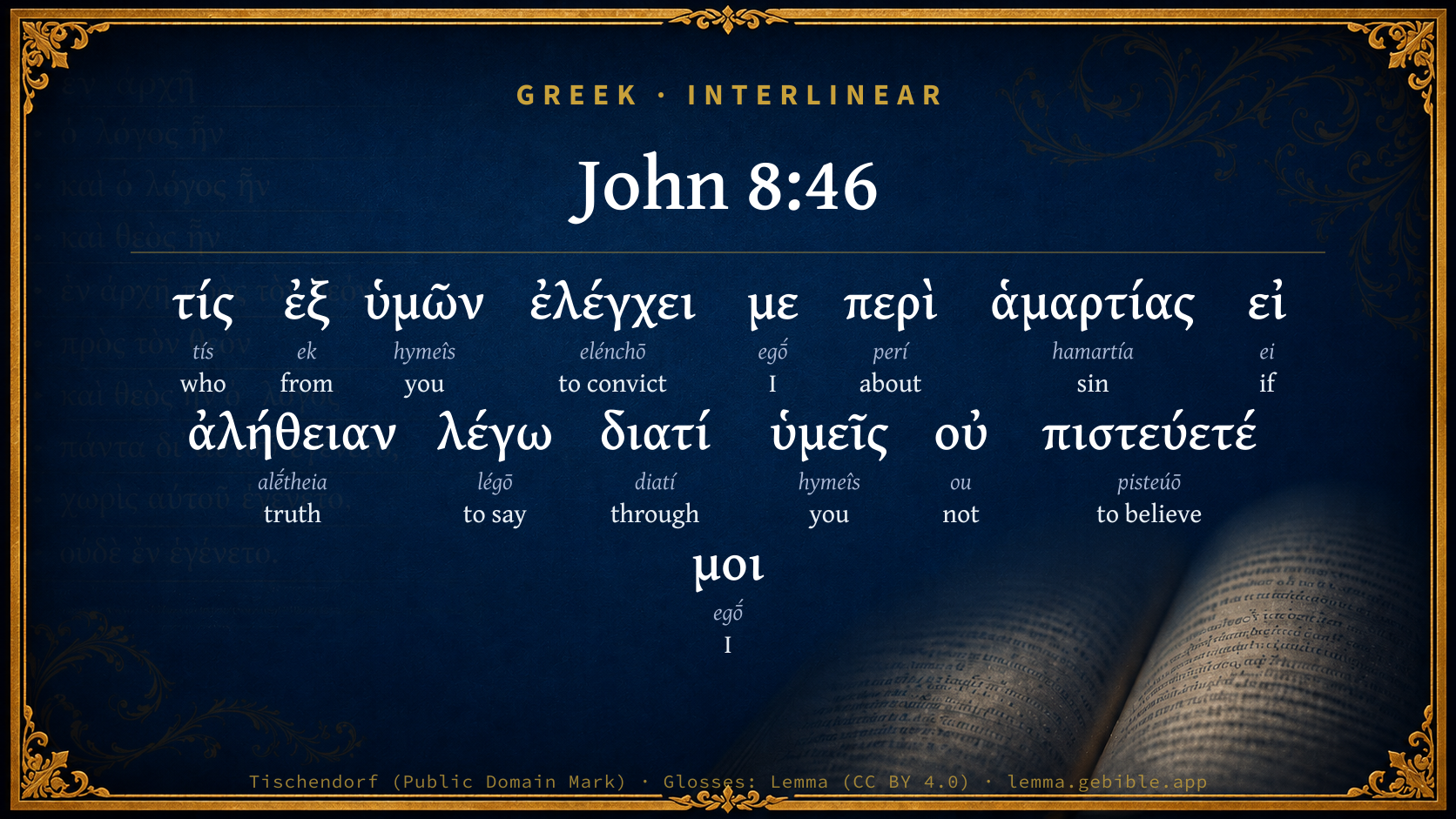
  1. τίς tís G5101 “who” Interrogative pronoun, Nominative, Singular, Masculine
  2. ἐξ ek G1537 “from” Preposition
  3. ὑμῶν hymeîs G5210 “you” Personal pronoun, 2nd person, Genitive, Plural
  4. με egṓ G1473 “I” Personal pronoun, 1st person, Accusative, Singular
  5. περὶ perí G4012 “about” Preposition
  6. ἁμαρτίας hamartía G266 “sin” Noun, Genitive, Singular, Feminine
  7. εἰ ei G1487 “if” Conditional
  8. ἀλήθειαν alḗtheia G225 “truth” Noun, Accusative, Singular, Feminine
  9. λέγω légō G3004 “to say” Verb, Present, Active, Indicative, 1st person, Singular
  10. διατί diatí G1302 “through” Particle, Interrogative
  11. ὑμεῖς hymeîs G5210 “you” Personal pronoun, 2nd person, Nominative, Plural
  12. οὐ ou G3756 “not” Particle, Negative
  13. πιστεύετέ pisteúō G4100 “to believe” Verb, Present, Active, Indicative, 2nd person, Plural
  14. μοι egṓ G1473 “I” Personal pronoun, 1st person, Dative, Singular

About this verse

These counts appear in no published source. They are computed here, from the morphology-tagged text and Lemma’s own curated glosses. What Lemma adds →

15
words
13
distinct lemmas
Gospels
section

Notable vocabulary

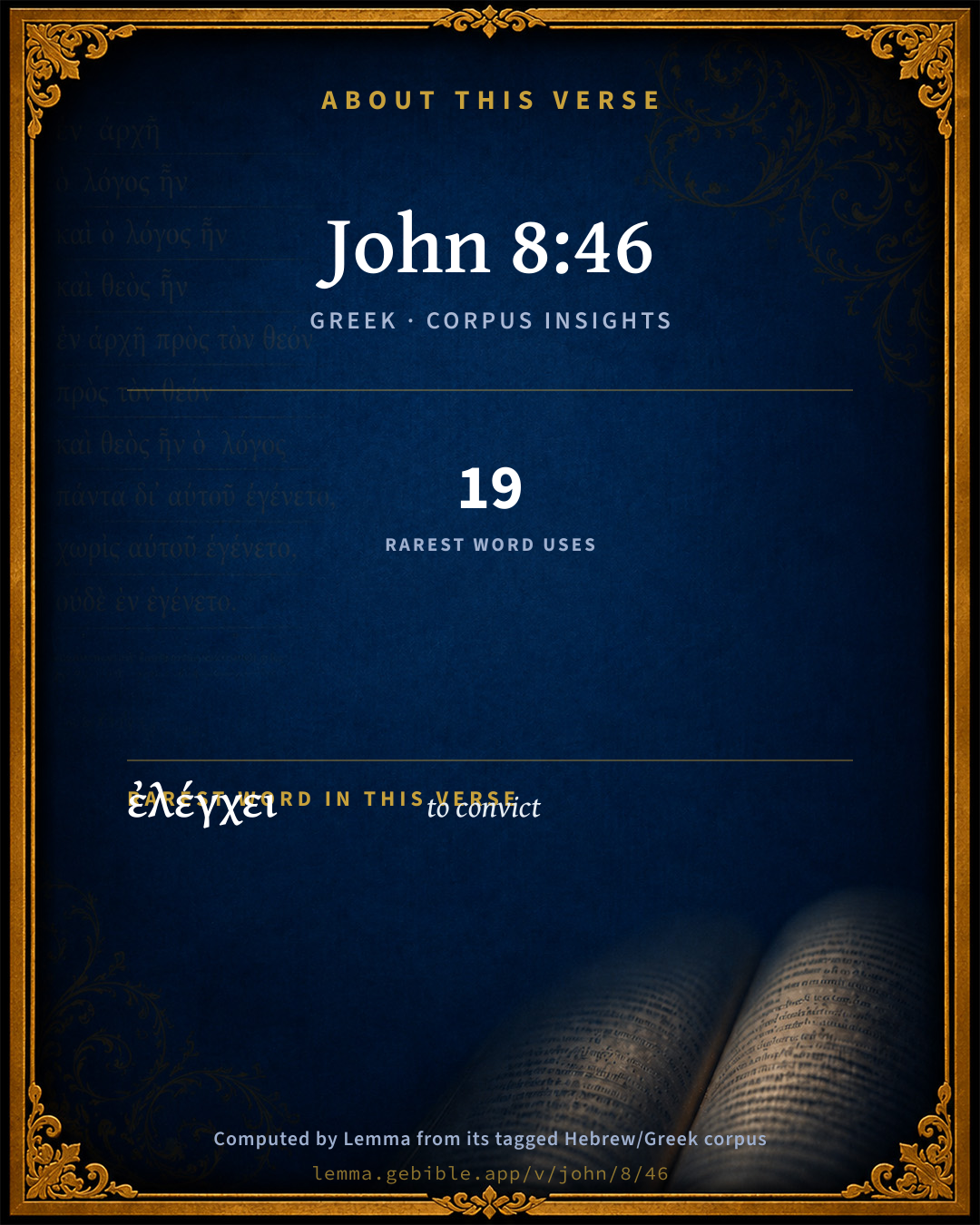
The rarest word here is ἐλέγχει to convict G1651 — appearing just 19 times in the whole Greek New Testament.

Shared distinctive vocabulary

ἐλέγχει to convict G1651 occurs in 19 verses of the Greek New Testament. Also found in:

Repetition

Words recur within this verse:

Cross-references

11

Topical passages linked to John 8:46 in the Treasury of Scripture Knowledge — connected by theme and wording, ordered by reader-vote popularity; previews shown in the World English Bible.

  • Hebrews 4:15 For we don't have a high priest who can't be touched with the feeling of our infirmities, but one who has been in all points tempted like we are, yet without sin.
  • John 16:8 When he has come, he will convict the world about sin, about righteousness, and about judgment;
  • Matthew 21:25 The baptism of John, where was it from? From heaven or from men?" They reasoned with themselves, saying, "If we say, 'From heaven,' he will ask us, 'Why then did you not believe him?'
  • Mark 11:31 They reasoned with themselves, saying, "If we should say, 'From heaven;' he will say, 'Why then did you not believe him?'
  • John 8:7 But when they continued asking him, he looked up and said to them, "He who is without sin among you, let him throw the first stone at her."
  • John 14:30 I will no more speak much with you, for the prince of the world comes, and he has nothing in me.
  • John 15:10 If you keep my commandments, you will remain in my love; even as I have kept my Father's commandments, and remain in his love.
  • 2 Corinthians 5:21 For him who knew no sin he made to be sin on our behalf; so that in him we might become the righteousness of God.
  • 1 Peter 2:22 who did not sin, "neither was deceit found in his mouth."
  • John 18:37 Pilate therefore said to him, "Are you a king then?" Jesus answered, "You say that I am a king. For this reason I have been born, and for this reason I have come into the world, that I should testify to the truth. Everyone who is of the truth listens to my voice."
  • Hebrews 7:26 For such a high priest was fitting for us: holy, guiltless, undefiled, separated from sinners, and made higher than the heavens;

Cross-references courtesy of OpenBible.info (CC BY 4.0).

Commentary

Notes on John 8:46 from classic Christian and Jewish commentators (each source and its license shown beneath its notes). The classic Christian expositions comment on the surrounding passage and are grouped to its opening verse, so a note may address several verses; the Jewish commentaries on the Tanakh (Rashi and others) are per-verse, so they appear only where the commentator wrote on this verse.

Lemma curates 59 commentaries, every one of them public domain or Creative Commons licensed, each selected and text-cleaned for this edition rather than reprinted as found. About our sources →

Bengel's Gnomon

Johann Albrecht Bengel

Joh 8:46. Ἑλέγχει, convicts) Jesus appeals to the conscience of all.—περὶ ἁμαρτίας, of sin) that is, that I am in error, and that I am away from the truth. What person dares to maintain this?—διατί, why) To this why, the word therefore in Joh 8:47 answers. Comp. the why, Joh 8:43, “Why do ye not understand my speech? Even because,” etc.

Bengel's Gnomon of the New Testament — English translation (T&T Clark, Edinburgh, 1860) — public domain. Text from a community e-Sword module.

Meyer's Critical & Exegetical Commentary

Heinrich August Wilhelm Meyer

Joh_8:46. Groundlessness of this unbelief. Εἰ μὴ, διότι τὴν ἀλήθειαν λέγω, ἀπιστεῖτέ μοι, εἴπατε, τίς ἐξ ὑμῶν ἐλέγχει με περὶ ἁμαρτίας ὑπʼ ἐμοῦ γενομένης, ἵνα δόξητε διʼ ἐκείνην ἀπιστεῖν; Euth. Zigabenus. Ἁμαρτία, fault, is not to be taken in the intellectual sense, as untruth, error (Origen, Cyril, Melancthon, Calvin, Beza, Bengel, Kypke, Tittmann, Kuinoel, Klee, and others), but, as it is employed without exception in the N. T., namely as equivalent to sin. Jesus boldly urges against His opponents His unassailable moral purityand how lofty a position of superiority does He thus assume above the saints of the Old Testament!the fact that against Him can be brought ἁμαρτίας ὄνειδος οὐδὲν (Soph. O. C. 971), as a guarantee that He speaks the truth; justly too, for according to Joh_8:44 ἀλήθεια must be regarded as the opposite of ψεῦδος, whereas a lie falls under the category of ἁμαρτία (comp. ἀδικία, Joh_7:18). The conclusion is from the genus to the species; hence also it is inadmissible to take ἁμαρτία in the special sense of fraus (qua divinam veritatem in mendacium converterim, Ch. F. Fritzsche in Fritzsch. Opusc. p. 99), wicked deception (B. Crusius), sin of word (Hofmann, Schriftbew. II. 1, p. 33 f.), false doctrine (Melancthon, Calvin), and so forth. Even in classical usage ἁμαρτία, in and by itself, would denote neither error nor deception, but only acquire this specific meaning through an addition more precisely determining its force.[34] Considered in itself it denotes fault, perversity, the opposite of ὀρθότης (Plat. Legg. i. p. 627 D, ii. p. 668 C). Comp. δόξης ἁμαρτία, Thuc. i. 32. 4; ΝΌΜΩΝ ἉΜΑΡΤΊΑ, Plat. Legg. i. p. 627 D; γνώμης ἁμάρτημα, Thuc. ii. 65. 7. Remark further, in connection with this important passage: (1) The argument is based, not upon the position that the sinless one is the purest and surest organ of the knowledge and communication of the truth (Lücke); or that the knowledge of the truth is grounded in the purity of the will (De Wette, comp. Ullmann); for this would presuppose in the consciousness in which the words are spoken, to wit, in the consciousness of Jesus, a knowledge of the truth obtained mediately, or, at all events, acquired first in His human state; whereas, on the contrary, especially according to Johns view, the knowledge of the truth possessed by Jesus was an intuitive one, one possessed by Him in His pre-human state, and preserved and continued during His human state by means of the constant intercourse between Himself and God. The reasoning proceeds rather in this way: Am I really without sin,and none of you is able to convict me of the contrary,then am I also without ψεῦδος; but am I without ΨΕῦΔΟς, then do I speak the truth, and you, on your part (ὑμεῖς), have no reason for not believing me. This reasoning, however, is abbreviated, in that Jesus passes at once from the denial of the possibility of charging Him with ἉΜΑΡΤΊΑ, to the positive, special contrary which follows therefrom,leaving out the middle link, that consequently no ΨΕῦΔΟς can be attributed to Him,and then continues: ΕἸ ἈΛΉΘ. ΛΈΓΩ (Lachmann and Tischendorf correctly without ΔΈ). Further, (2) the proof of the sinlessness of Jesus furnished by this passage is purely subjective, so far as it rests on the decided expression of His own moral consciousness in the presence of His enemies; but, at the same time, it is as such all the more striking in that the confirmation of His own testimony (comp. Joh_14:30) is added to the testimony of others, and to the necessity of His sinlessness for the work of redemption and for the function of judge. This self-witness of Jesus, on the one hand, bears on itself the seal of immediate truth (otherwise, namely, Jesus would have been chargeable with a καυχᾶθαι of self-righteousness or self-deception, which is inconceivable in Him); whilst, on the other hand, it is saved from the weakness attaching to other self-witnessings, both by the whole evangelical history, and by the fact of the work of reconciliation. (3) The sinlessness itself, to which Jesus here lays claim, is in so far relative, as it is not absolutely divine, but both is and must be divine-human, and was based on the human development of the Son of God.[35] He was actually tempted, and might have sinned; this abstract possibility, however, never became a reality. On the contrary, at every moment of His life it was raised into a practical impossibility.[36] Thus He learned obedience (Heb_5:8). Hence the sinlessness of Jesus, being the result of a normal development which, at every stage of His earthly existence, was in perfect conformity with the God-united ground of His inner life (comp. Luk_2:40; Luk_2:52), must always be regarded as conditioned, so far as the human manifestation of Jesus is concerned, by the entrance of the Logos into the relation of growth; whilst the unconditioned correlate thereto, namely, perfection, and accordingly absolute moral goodnessgoodness which is absolutely complete and above temptation at the very outsetbelongs alone, nay, belongs necessarily to God. In this way the apparent contradiction between this passage and Mar_10:18 may be resolved. For the rest, the notion of sin as a necessary transitional point in human development is shown to be groundless by the historic fact of the sinlessness of Jesus. See Ernesti, Ursprung der Sünde, I. p. 187 ff.

[34] Polyb. 16. 20, 6, is, without reason, adduced by Tholuck against this view. In the passage referred to, ἁμαρτίαι are faults, goings wrong in general. The sentence is a general maxim.

[35] Comp. Gess, Pers. Chr. p. 212. At the same time, the sinless development of Jesus is not to be subsumed under the conception of sanctification. See also Dorners Sinless Perfection of Jesus, and the striking remarks of Keim, Geschichtl. Chr. p. 109 ff., ed. 3, also p. 189 f.

[36] Any moral stain in Christ would have been a negation of His consciousness of being the Redeemer and Judge.

Meyer — Critical and Exegetical Commentary on the New Testament — English translation by Peter Christie, edited by Frederick Crombie (T&T Clark, 1880) — public domain. Text from a community e-Sword module.

Expositor's Greek Testament

ed. W. Robertson Nicoll

Joh 8:46 . τίς … ἁμαρτίας ; Alford, who represents a number of interpreters, says: “The question is an appeal to His sinlessness of life , as evident to them all, as a pledge for His truthfulness of word”. Calvin is better: “Haec defensio ad circumstantiam loci restringi debet, ac si quicquam sibi posse obiici negaret, quominus fidus esset Dei minister”. Similarly Bengel. εἰ δὲ … μοι ; “If I speak truth, why do you not believe me?” It follows from their inability to convict Him of sin, that He speaks what is true: if so, why do they not believe Him?

The Expositor's Greek Testament, edited by W. Robertson Nicoll (1897–1910) — public domain. Text from a community e-Sword module.

Geneva Bible (1599)

Geneva Bible translators

Christ did thoroughly execute the office, that his Father enjoined him.

Geneva Bible (1599) marginal notes — public domain. Text via Bolls.life.

Jamieson, Fausset & Brown

Robert Jamieson, A. R. Fausset & David Brown

Which of you convinceth me of sin--"Convicteth," bringeth home a charge of sin. Glorious dilemma! "Convict Me of sin, and reject Me: If not, why stand ye out against My claims?" Of course, they could only be supposed to impeach His life; but in One who had already passed through unparalleled complications, and had continually to deal with friends and foes of every sort and degree, such a challenge thrown wide among His bitterest enemies, can amount to nothing short of a claim to absolute sinlessness.

Jamieson, Fausset & Brown — Commentary Critical and Explanatory on the Whole Bible (1871) — public domain (CC PDM 1.0). Text via the HelloAO Bible API.

Adam Clarke's Commentary

Verse 46. Which of you convinceth me of sin?] Do you pretend to reject the truths which I announce, because my life does not correspond to the doctrines I have taught? But can any of you prove me guilty of any fault? You have maliciously watched all my steps; have you seen the smallest matter to reprove, in any part of my conduct?

But it is probable that αμαρτια, sin, is put here in opposition to αληθεια, truth, in the same verse, and then it should be rendered falsehood. The very best Greek writers use the word in the same sense: this, KYPKE proves by quotations from Polybius, Lucian, Dionysius Halicarnassensis, Plutarch, Thucydides, and Hippocrates. RAPHELIUS adds a pertinent quotation from Herodotus, and shows that the purest Latin writers have used the word peccatum, sin, in the sense of error or falsehood. See Clarke on Ge 13:13.

Adam Clarke's Commentary on the Bible (1810–1826) — public domain. Text from a community e-Sword/MySword module.

John Calvin's Commentaries

46. Which of you? This question proceeds from perfect confidence; for, knowing that they could not justly bring any reproach against him, he glories over his enemies, as having obtained a victory. And yet he does not say that he is free from their slanders; for, though they had no reason for reproaching, still they did not cease to pour out slanders on Christ; but he means that no crime dwells in him. And such is the import of the Greek word ἐλέγχειν, as the Latins use coarguere, (to convict,) when a person is held convicted of the fact. Which of you Convicteth me of sin? Yet those who think that Christ here asserts his complete innocence, because he alone surpassed all men, so far as he was the Son of God, are mistaken. For this defense must be restricted to what belongs to the passage, as if he had asserted that nothing could be brought forward to show that he was not a faithful servant of God. In like manner Paul also glories that he is not conscious of any crime (1 Corinthians 4:4;) for that does not extend to the whole life, but is only a defense of his doctrine and apostleship. It is away from the subject, therefore, to speculate, as some do, about the perfection of righteousness which belongs to the Son of God alone; since the only object which he has in view is, to give authority to his ministry, as appears more clearly from what follows; for he again adds immediately afterwards, If I speak truth, why do you not believe me? From which we infer that Christ is rather defending his doctrine than his person.

John Calvin's Commentaries (1540-1563) — public domain. Text from the Calvin Translation Society English edition (1840s-50s) via the Christian Classics Ethereal Library (ccel.org). Calvin's coverage is partial (roughly two-thirds of the Bible); uncommented books and verses are honest gaps, never fabricated. The 19th-century editor's footnotes and remarks are omitted so the notes are faithfully Calvin's own voice.

Ellicott's Commentary for English Readers

(46) Which of you convinceth me of sin?—He appeals to their knowledge of His sinless life, as in Joh_8:29. He asserted His own knowledge of entire conformity to His Father’s will. It is an appeal that spotless purity alone could make, and is His own testimony uttered in the dignity of certain knowledge. (Comp. Joh_14:30.)

If I say the truth, why do ye not believe me?—We may suppose that the last question was probably followed by a pause, during which any one might have answered the challenge. No one of all who had watched Him in Galilee and Judæa dared utter a syllable. Their silence is the seal to His own testimony. But if He is thought of by these as without sin, they cannot think of His words as untrue. They admit, then, that He speaks the truth, and yet they do not believe. On the absolute sinlessness of Christ, comp. 1Jn_3:5; 2Co_5:21; 1Pe_1:19; 1Pe_1:22.

A Bible Commentary for English Readers, edited by Charles John Ellicott (1878–1897) — public domain. Text from a community e-Sword module.

The Cambridge Bible for Schools and Colleges

gen. ed. J. J. S. Perowne

46. Which of you convinceth me of sin?] Or, convicteth Me of sin (see on Joh_3:20). Many rebuked Christ and laid sin to His charge: none brought sin home to His conscience. There is the majesty of Divinity in the challenge. What mortal man would dare to make it? See on Joh_8:29, and comp. Joh_14:30, and Joh_15:10; 1Jn_3:5; 1Pe_1:19; 1Pe_2:22. Note the implied connexion between sin generally and falsehood, as between righteousness and truth, Joh_7:18.

And if I say the truth] Better, If I say truth. No MSS. have the article, and the best MSS. omit the conjunction. ‘If I am free from sin (and none of you can convict Me of sin), I am free from falsehood and speak the truth. Why then do ye on your part refuse to believe Me?’ ‘Ye’ is emphatic.

The Cambridge Bible for Schools and Colleges (gen. ed. J. J. S. Perowne; Cambridge University Press, 1878–1918) — public domain. Text from a community e-Sword module.

John Gill's Exposition

Jesus answered, I have not a devil,.... He takes no notice of the first charge and scandalous character, that he was a Samaritan; it being so notorious to all the Jews, that he was not; but was, as they supposed, a Galilean, and of Nazareth; and besides, this was a term of reproach, which they gave to any man, that they had no good opinion of; just as we call a man a Turk, or a Jew; not meaning that he is in fact such an one, but behaves like one: to the other Christ replies, that he had not a devil, had no conversation with one, nor was he possessed or assisted by him, or was mad, and acted the part of a madman: in proof of which he observes,

but I honour my Father; by ascribing his doctrine and miracles to him, by doing his will, seeking his glory, and speaking well of him; all which he would not, had he been in confederacy with the devil; for no man can be familiar with him, or be assisted by him, and honour God; nor could a man out of his senses do all this:

and ye do dishonour me: by such wicked charges, and scandalous imputations: and Jews, who deny Jesus to be the Messiah, and treat him in this opprobrious manner, are not the only persons that dishonour Christ; there are many that are called by his name, who greatly dishonour him; some by their bad principles, and others by their evil practices: such highly reflect upon him, who deny his proper deity, and eternal sonship; who assert, that he is only God by office, and did not exist before his incarnation; who despise and reject his righteousness, submit not to it, but establish their own; who account his blood as common and useless, and speak disrespectfully of his sacrifice and satisfaction; and who consider his sufferings and death only as an example to men, and for the confirmation of his doctrine, but not as in the room and stead of his people, to answer and satisfy divine justice for them: and others they dishonour him, though they talk much of him, and pretend to faith in him, and love to him, and hope of eternal life by him, through their scandalous lives and conversations; dishonour his name and Gospel; give the enemy an occasion to reproach and blaspheme, and by reason of them, the ways and truths of Christ are evil spoken of.

John Gill's Exposition of the Whole Bible (1746–1763) — public domain (CC PDM 1.0). Text via the HelloAO Bible API.

Trapp's Complete Commentary

John Trapp

46 Which of you convinceth me of sin? And if I say the truth, why do ye not believe me?

Ver. 46. Which of you convinceth me of sin] q.d. Have you anything against my life, that ye thus stiffly refuse to receive my doctrine? Do not (as every minister should do) vivere concionibus, concionari moribus, live sermons, as well as preach them? Paul knew nothing by himself, 1Co 4:4. And Chrysostom saith that the souls and lives of ministers should be purer than the sunbeams.

John Trapp, A Commentary or Exposition upon All the Books of the Old and New Testament (1647–1656) — public domain. Text from a community e-Sword module.

Albert Barnes' Notes on the Bible

Which of you convinceth me? - To convince, with us, means to satisfy a man’s own mind of the truth of anything; but this is not its meaning here. It rather means to convict. Which of you can prove that I am guilty of sin?

Of sin - The word “sin” here evidently means “error, falsehood, or imposture.” It stands opposed to truth. The argument of the Saviour is this: A doctrine might be rejected if it could be proved that he that delivered it was an impostor; but as you cannot prove this of me, you are bound to receive my words.

Albert Barnes' Notes on the Bible (1834–1885) — public domain. Text from a community e-Sword/MySword module.

Matthew Poole's English Annotations

If any of you can prove that I have spoken to you any thing that is false, and not consonant to the will of my Father, do it; but which of you is able to charge me with any such thing? If there be no such thing, but I have told you what is the very truth, and the will of my Father, as to what you are to believe and do, why do you not believe me? For every reasonable soul is a debtor to truth.

Matthew Poole's English Annotations on the Holy Bible (1683–1685) — public domain. Text from a community e-Sword/MySword module.

Whedon's Commentary on the Bible

Daniel D. Whedon

46. Convinceth—Convicts or proves guilty of sin. This is a lofty appeal to their higher nature. For though men be full of falsehood, as Satan himself, yet, like Satan himself, there is the basis of a noble, a divine nature beneath all. Their very debasement is, that the divine vessel is filled with the infernal evil. To that divine in man, through the dense falsehood with which they are filled, Jesus now makes a divine appeal. Does not the transparent purity of his character, if they will give their own conscience fair play, prove that he is the reverse of Satan, the impersonation of Truth?

If I say the truth— As this is undeniable to your inmost conscience.

Why… not believe—Why not cast the body of falsity from out your souls, and bring your whole nature into harmony with that higher and clearly discerned truth? Thus will ye cease to be sons of the Liar and become sons of God.

Daniel D. Whedon (gen. ed.), Commentary on the Old and New Testaments (1874–1909) — public domain. Text from a community e-Sword module.

The Pulpit Commentary

Which of you convieteth me of sin? Elegcw is used in the sense of Joh_16:6-8 (see note) Which of you can justify a charge of sin against me? can bring it home to me or others? Sin (amartia) is not mere "error," as Erasmus and some others have urged, because the word throughout the New Testament (and in the classics when not accompanied by some explanatory term) always means "contrariety to the will of God," moral offence not intellectual defect (so Meyer, Luthardt, Godet, Westcott). Nor is it sound exegesis to limit amartia to one particular form of sin (such as "false doctrine," Calvin, Melancthon, Tholuck). There is no need to limit its reference; and in the unanswered query, while we cannot say that by itself this passage is sufficient to demonstrate the sinlessness of Christ, it reveals a sublime depth in his translucent consciousness that places him unless he were the most deluded or self-sufficient of human teachers on a different position from all other Divine messengers. In proportion as other great moral prophets have set their own standard high, they have become conscious of their own defects; and from Moses to St. Paul, from Augustine to St. Francis, the saintliest men have been the most alive to their own departures from their ideas of right. The standard of Jesus is higher than that of any other, and he appears nevertheless absolutely without need of repentance, above the power of temptation, beyond the range of conviction. True, the Jews brought a charge of madness and folly upon him immediately; but, so far from convincing him or mankind, they stand forever covered with the shame of their own incompetence to apprehend his message or himself. He being, then, without sin, and assuming that he stands in the eternal truth, and is the absolute Truth of things, and that he cannot from his moral purity deceive or misinform them, and that his testimony to himself is final, sufficient, and trustworthy, asks, If I say the truth without your having convicted me of sin or brought any moral obliquity or offence against meif I say (the) truth, why do ye not believe me? The reason is in them rather than in him. Their non-belief discloses no flaw in his revelation, but makes it evident that they and he are on different planes of being, with a discrepant, opposed, moral paternity. "Why do ye not believe me?" He marvelled at their unbelief! He is from God; they are from God"s great enemy. The moral perfection of Jesus as the God-Man is absolutely necessary to his character as "God"s Lamb," as "the Only Begotten," "the Son," and as "the Judge," of the human race. As he subsequently said, "The prince of this world cometh, and hath nothing fit me." To account for this sinless, perfect humanity, the entire conception of the Divine nature blended in indissoluble union with his own is found imperative at every epoch of Christ"s life. At every development of his official character, in every new combination of circumstance, in conflict and sorrow, when smarting from treachery and dying alone upon the cross, he is "perfect," he fulfils the perfect norm, he reaches the standard of Divine humanity. There is no discrepance here with even Mark"s account of his language to the young ruler, (Mar_10:18) for he does not there say that he is not good, nor does he do other than suggest that he is identified with the One who is good.

The sinlessness of Christ.

Had our Lord Jesus been guilty of sin (the very thought is to a Christian mind inexpressibly shocking!), he could not have been all that he actually is to us. As God manifest in the flesh, as the ideal Man, as the all-sufficient Saviour, Christ must needs have been without sin.

I THE WITNESS OF MEN TO OUR LORD"S SINLESSNESS.

1. That of his friends and apostles. Peter designated him "the Holy One and the Just," "who did no sin;" John, "Jesus Christ the righteous," of whom he says, "In him was no sin." Paul, writing to the Corinthians, speaks of Christ as of him "who knew no sin;" and the author of the Epistle to the Hebrews refers to him in these words, "Though without sin.

2. That of others. Thus Judas, his betrayer, spoke of the "innocent blood" he had been the means of shedding; Pilate found "no fault in him;" the centurion testified, "This was a righteous Man.

II OUR LORD"S OWN ASSERTIONS CLAIMING THE PREROGATIVE OF SINLESSNESS. Jesus said, "I have kept my Father"s commandments;" "The prince of this world cometh, and findeth nothing in me;" "Which of you convinceth me of sin?" If he were not sinless, either his hypocrisy must have been frightful, or he must have been the subject of the most monstrous delusion that ever possessed an egotistical fanatic.

III AS A MATTER OF FACT AND HISTORY, OUR LORD"S LIFE WAS SINLESS.

1. Regard the matter negatively. Was there one of the ten commandments which Jesus broke? From his temptation in the wilderness down to his death upon the cross, he eschewed every evil, and proved himself victorious over every instigation to sin to which others even good men would probably in some cases have yielded.

2. Regard the matter positively. There is often presented to men an alternative between vice and virtue, disobedience and obedience to God. Wherever an opportunity occurred for our Lord to do that which was best, he did it. There was unfailing consistency between his teaching and his life; he mixed with sinners, unharmed by the contact; he exhibited all moral excellences in his own character; in holiness he stands supreme and alone among the sons of men.

PRACTICAL LESSONS.

1. This fact points to, and agrees with, a belief in the Divinity of Jesus.

2. Here is a faultless, perfect Example for all men to study and copy.

3. Here is evidence of our Lord"s perfect qualification to be the Saviour and the Lord of man. T.

The Pulpit Commentary (1880–1919), ed. H.D.M. Spence-Jones & Joseph S. Exell — public domain. Text from a community e-Sword module.

John Wesley's Explanatory Notes

Which of you convicteth me of sin? - And is not my life as unreprovable as my doctrine? Does not my whole behaviour confirm the truth of what I teach?

John Wesley, Explanatory Notes Upon the Whole Bible (1754–1765) — public domain. Text via the GEBible commentary corpus.

Scofield Reference Notes

C. I. Scofield

sins

Sin. (See Scofield "Rom 3:23").

The Scofield Reference Bible (1917 edition), notes by C. I. Scofield — public domain. Text from a community e-Sword module.

The People's New Testament

B. W. Johnson

46. Which of you convinceth me of sin? He points to his sinless character as a proof that there can be no falsehood in his words.

B. W. Johnson's The People's New Testament with Notes (1889–1891) — public domain. Electronic text from the Christian Classics Ethereal Library (CCEL) ThML edition.

Cambridge Greek Testament for Schools and Colleges

46. τίς ἐξ ὑ. ἐλέγχει. Which of you convicteth Me of sin? See on Joh 3:20, Joh 16:8. For περὶ comp. Joh 10:33; 1Jn 2:2. Many rebuked Christ and laid sin to His charge: none brought sin home to His conscience. There is the majesty of Divinity in the challenge. What mortal man would dare to make it? See on Joh 8:29, and comp. Joh 14:30, Joh 15:10; 1Jn 3:5; 1Pe 1:19; 1Pe 2:22. Note the implied connexion between sin generally and falsehood, as between righteousness and truth, Joh 7:18. Perhaps we are to understand a pause in which He waits for their answer to His challenge. But they are as unable to charge Him with sin as to acquit themselves (Joh 8:7) of it: and he makes the admission implied by their silence the basis for a fresh question. ‘If I am free from sin (and none of you can convict Me of it), I am free from falsehood. Therefore, if I say truth why do ye on your part not believe Me?’

Cambridge Greek Testament for Schools and Colleges (Cambridge University Press, 1896; 21 vols, various authors incl. Carr, Maclear, Plummer, Farrar, Lumby, Moule, M. R. James, Simcox) — public domain. Text from a community e-Sword module.

Alford’s Greek Testament

Henry Alford

46.] ἁμαρτία here is strictly sin: not ‘error in argument,’ or ‘falsehood.’ These two latter meanings are found in classical Greek, but never in the N.T. or LXX. And besides, they would introduce in this most solemn part of our Lord’s discourse, a vapid tautology. The question is an appeal to His sinlessness of life, as evident to them all,—as a pledge for His truthfulness of word: which word asserted, be it remembered, that He was sent from God. And when we recollect that He who here challenges men to convict him of sin, never could have upheld outward spotlessness merely (see Mat 23:26-28), the words amount to a declaration of His absolute sinlessness, in thought, word, and deed. Or, the connexion may be as stated by Euthym.: εἰ μὴ διότι τὴν ἀλήθειαν λέγω ἀπιστεῖτέ μοι, εἴπατε, τίς ἐξ ὑμῶν ἐλέγχει με περὶ ἁμαρτίας ὑπʼ ἐμοῦ γενομένης, ἵνα δόξητε διʼ ἐκείνην ἀπιστεῖν;

εἰ ἀλ. λέγω] And if it be thence (from the impossibility of convicting me of sin) evident, that I speak the truth, why do ye not believe Me? (not πιστ. εἰς ἐμέ, but simply μοι, give credence to Me.)

Ver. 47 gives the answer to the διὰ τί, and concludes the discourse with the final disproof of their assertion, ver. 41,—with, as it were, a ‘quod erat demonstrandum.’ This verse is cited 1Jn 4:6.

Henry Alford, The Greek Testament (1849–1861) — public domain. Text from a community e-Sword module.

International Critical Commentary

46. τίς ἐξ ὑμῶν ἐλέγχει με περὶ ἁμαρτίας; No answer to this challenge is recorded. Probably no answer was attempted. His hearers did not understand, of course, that Jesus was literally χωρὶς ἁμαρτίας (Heb 4:15); but they could prove nothing to the contrary, and they knew it. The phrase ἐλέγχειν περὶ ἁμαρτίας occurs again 16:8, where see note.

After a pause, as we may suppose, Jesus then resumes the argument, “If I tell the truth (and none of you has accused me of being a liar), why do you not believe me?”

International Critical Commentary — older volumes (1896–1929), various authors — public domain. Text from a community e-Sword module.

Vincent's Word Studies in the New Testament

Marvin R. Vincent

Convinceth [ελεγχει] . See on 3 20. Rev., convicteth.

Sin [αμαρτιας] . Not fault or error, but sin in general, as everywhere in the New Testament.

The truth [αληθειαν] . Without the article, and therefore not the whole truth, but that which is true as to any part of divine revelation.

Marvin R. Vincent, Word Studies in the New Testament (1887–1900) — public domain. Text from a community e-Sword/MySword module.

Godet's Commentaries

Frédéric Louis Godet

Ver. 46. To justify their distrust with respect to His words, it would be necessary that they should at least be able to accuse Him of some fault in His actions; for holiness and truth are sisters. Can they do this? Let them do it. This defiance which Jesus hurls at His adversaries shows that He feels Himself fully cleared, by His defense in chap. 7, of the crime of which He had been accused in chap. 5 We must be careful, indeed, not to take ἁμαρτία, sin, in the sense of error (Calvin, Melanchthon) or of falsehood (Fritzsche). The thought is the same here as in Joh 7:18 : Jesus affirms that there absolutely does not arise from His moral conduct any ground of suspicion against the truth of His teaching. We must imagine this question as followed by a pause sufficient to give opportunity to whoever should wish to accuse Him to be heard....No one opens his mouth. The admission involved in this silence serves as a premise for the following argument: “Well, then, if (εἰ δέ, now if, or simply εἰ), as your silence proves, I teach the truth, why do you not believe?”

Here again a pause; He had invited them to judge Him; in the face of His innocence which has just been established, He leaves them a moment now to pass judgment on their conduct towards Him. After this silence, He pronounces the sentence: “You are not of God: herein is the true reason of your unbelief towards me.” The expression to be of God designates the state of a soul which has placed itself, and which now is, under the influence of divine action. It is the opposite of the οὐχ ἑστηκενaffirmed with regard to Satan. This state does not exclude, but implies, the free determination of the man. Otherwise, the tone of reproach which prevails in our verse would be unjust and even absurd. ᾿Ακούειν, properly, to hear, takes here, as often the French term does, the sense of intelligent hearing (hence the limiting word in the accusative). Comp. the manner in which the declaration of Jesus respecting the truth which gives freedom (Joh 8:32) had been received. The διὰ τοῦτο, for this cause, refers at once to the general principle laid down in the first part of the verse, and the following ὅτι : “It is for this cause..., that is to say, because...”

The perfect holiness of Christ is proved in this passage, not by the silence of the Jews, who might very well have ignored the sins of their interlocutor, but by the assurance with which Jesus lays this question before them. Without the immediate consciousness which Christ had of the perfect purity of His life, and on the supposition that He was only a more holy man than other men, a moral sense so delicate as that which such a state would imply, would not have suffered the least stain to pass unnoticed, either in His life, or in His heart; and what hypocrisy would there not have been in this case in addressing to others a question with the aim of causing them to give it a different answer from that which, in His inmost heart, He gave Himself! In other terms: to give a false proof whose want of soundness He hopes that no one will be able to prove.

Frédéric Louis Godet — Commentaries on Luke, John, Romans, and 1 Corinthians — English translation (T&T Clark, Edinburgh, 1870s–1890s) — public domain. Text from a community e-Sword module.

Lesson kit

Teaching starters — assembled from the data on this page, not authored interpretation. Every prompt links to the verse data it draws on. Edit before teaching.

John, in the Gospels, opens this verse with 15 words (13 distinct Greek lemmas). Its most distinctive word is elénchō (“to convict”). A historical commentator’s framing appears above. Read the whole chapter for the surrounding context.

Discussion questions

  1. What does “to convict” (elénchō) contribute to the verse as a whole?
  2. How does Matthew 18:15, which shares the word «to convict», read alongside this verse?
  3. What does the repetition of “you” (2× in this one verse) do in this verse?
  4. These translations render this verse differently; the difference is in the English rendering, not the original. What questions does that raise?
  5. Compare how Bengel's Gnomon and Meyer's Critical & Exegetical Commentary read this verse. Where do they agree or differ?

Things to notice

Reading settings

Reading text

Shown beneath each verse's original-language words.

Old Testament
Old Testament edition

Read the OT as the Masoretic Hebrew (MT) or the Greek Septuagint (LXX).

English shown for the Greek Septuagint (in the Hebrew ↔ Greek comparison).

Comparing translations? Open the Compare panel on any verse page to stack up to four side by side.