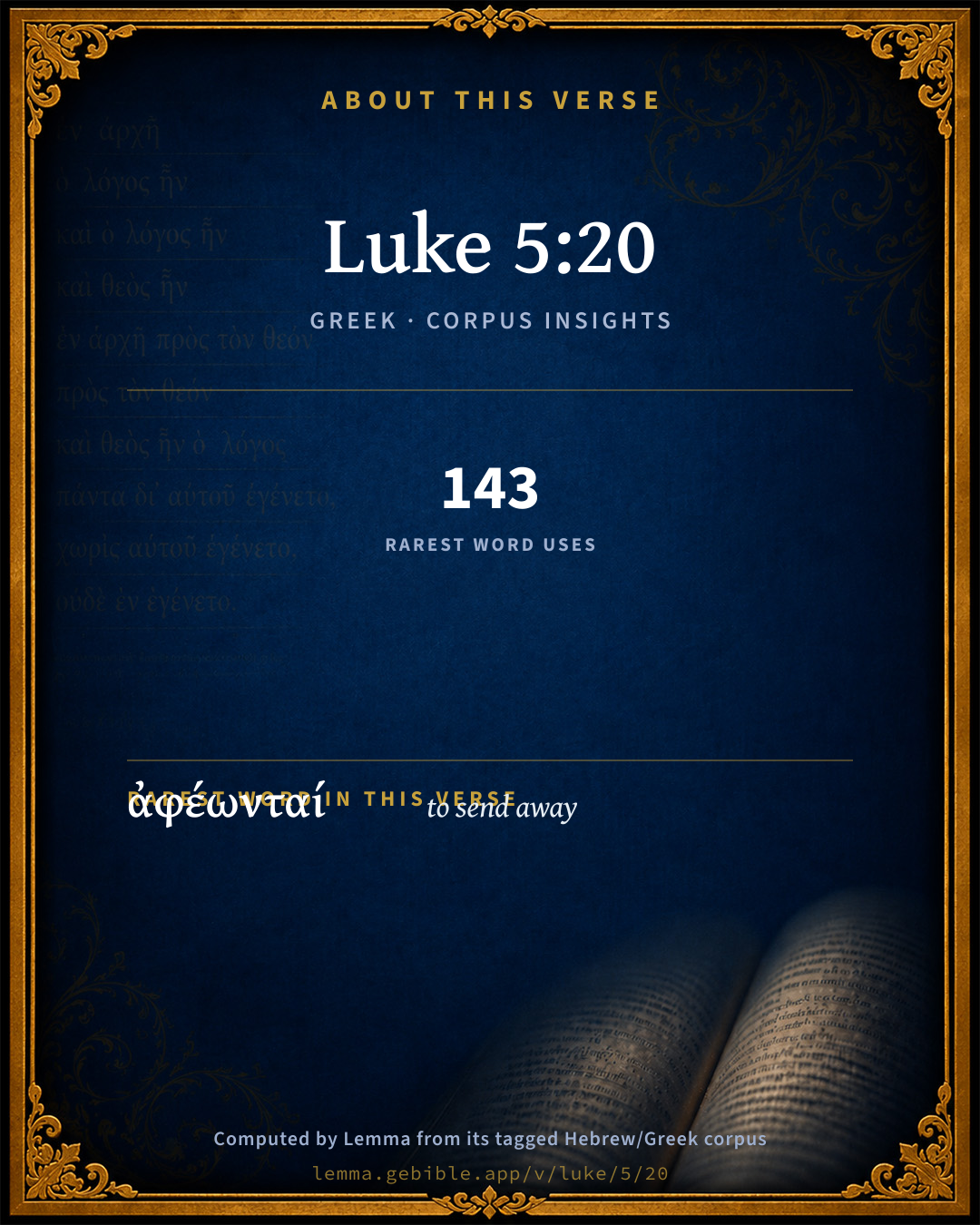
Luke 5:20

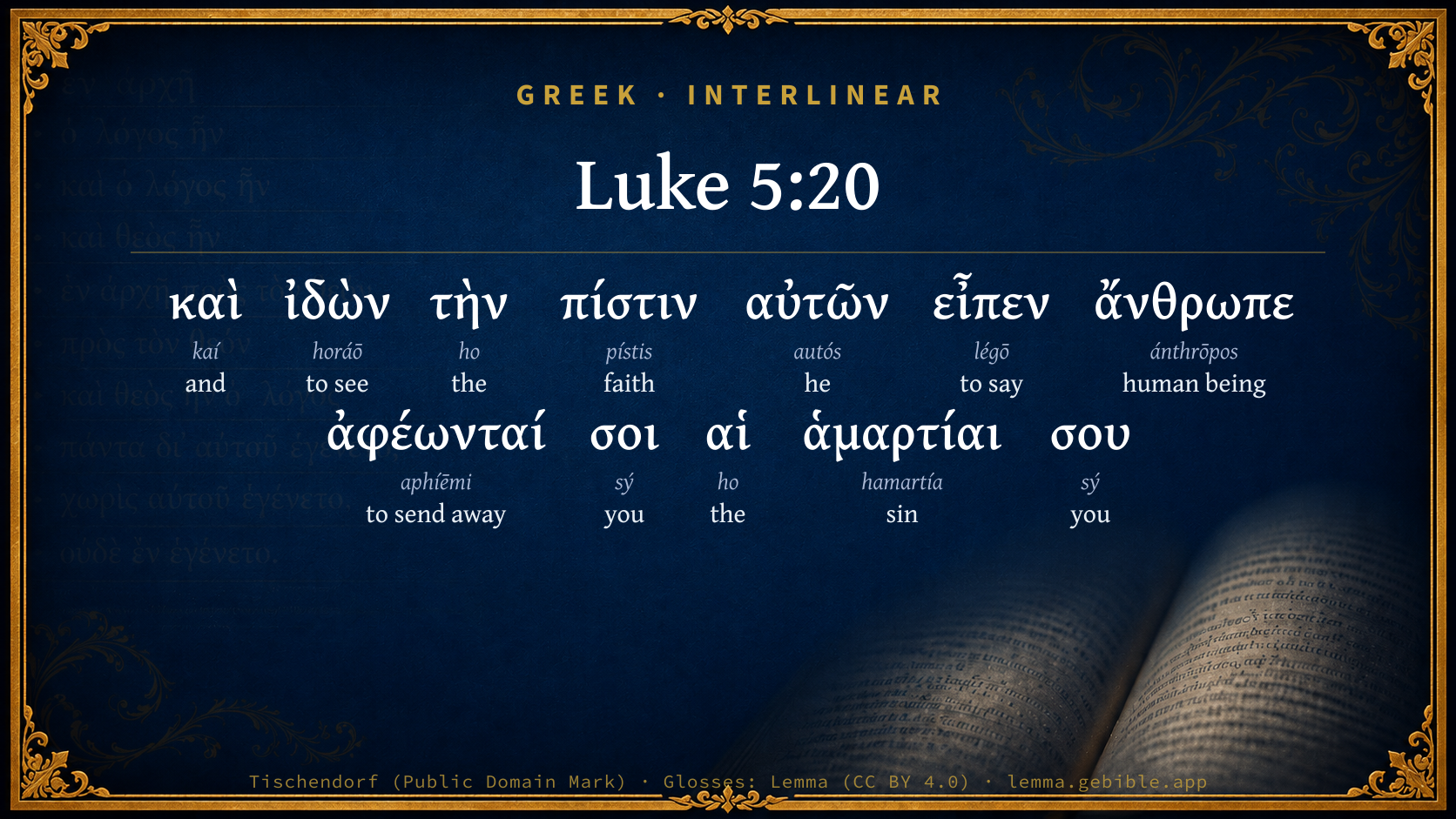
Greek (Tischendorf 8th ed.) Luke 5:20 appears in the Greek New Testament. The text above is from the Tischendorf 8th edition. Each word links to its Strong’s number and a concise gloss. Click any word for its full Thayer’s Greek Lexicon entry.
Download image
Cite this verse

Luke 5:20 (World English Bible). Public Domain. Lemma interlinear Bible study tool, https://lemma.gebible.app/v/luke/5/20.

Show BibTeX & RIS
BibTeX
RIS
English Translation
Seeing their faith, he said to him, "Man, your sins are forgiven you."
World English Bible · Public Domain
Download a study sheet

One document with this verse’s original text, its word-by-word gloss line, the meaning frame, cross-references with their text, attributed commentary, and full source and license credits — printable, and it pastes into notes with its structure intact.

This verse Autodidact and up

Study sheet (.html) Plain text (.txt)

A passage Seminary Student

Up to 50 verses in one chapter. A passage sheet keeps up to 6 commentary sources and 12 cross-references per verse, in the order this page ranks them, and says so on the sheet whenever that leaves anything out. Ask for a single verse and you get the Autodidact verse sheet above.

Everything on this page stays free to read, with no account — the sheet is a download of what is already on screen, not access to it.

Want to remove ads? Support Godless Engineer
Compare translations 3

The same verse in 3 English versions, stacked beneath the original-language interlinear above. Click any original word for its lexicon entry.

Each is an independent rendering of the whole verse — the interlinear is not word-aligned to these translations.

Highlighted words mark where these versions differ — a whole-verse word diff, not a word-by-word alignment.

  • World English Bible Public Domain
    Seeing their faith, he said to him, "Man, your sins are forgiven you."
  • King James Version Public Domain
    And when he saw their faith, he said unto him, Man, thy sins are forgiven thee.
  • unfoldingWord Literal Text CC BY-SA 4.0
    And having seen their faith, he said, “Man, your sins are forgiven you.”

unfoldingWord Literal Text — © unfoldingWord, licensed CC BY-SA 4.0. Word-aligned USFM3 via Door43 (git.door43.org/unfoldingWord/en_ult).

Versions to compare (up to 4)

3 of 4 selected

Show all 19 translations

Every available English version of this verse, each an independent rendering of the whole verse.

  • World English Bible Public Domain
    Seeing their faith, he said to him, "Man, your sins are forgiven you."
  • Berean Standard Bible Public Domain
    When Jesus saw their faith, He said, “Friend, your sins are forgiven.”
  • Majority Standard Bible Public Domain
    When Jesus saw their faith, He said to the man, “Friend, your sins are forgiven.”
  • King James Version Public Domain
    And when he saw their faith, he said unto him, Man, thy sins are forgiven thee.
  • American Standard Version (1901) Public Domain
    And seeing their faith, he said, Man, thy sins are forgiven thee.
  • Revised Version (1885) Public Domain
    And seeing their faith, he said, Man, thy sins are forgiven thee.
  • Geneva Bible (1599) Public Domain
    And when he sawe their faith, he sayd vnto him, Man, thy sinnes are forgiuen thee.
  • Douay-Rheims (1899) Public Domain
    Whose faith when he saw, he said: Man, thy sins are forgiven thee.
  • Young's Literal Translation Public Domain
    and he having seen their faith, said to him, `Man, thy sins have been forgiven thee.'
  • Literal Standard Version CC BY-SA 4.0
    and He having seen their faith, said to him, “Man, your sins have been forgiven you.”
  • Unlocked Literal Bible CC BY-SA 4.0
    Seeing their faith, Jesus said, “Man, your sins are forgiven you.”
  • unfoldingWord Literal Text CC BY-SA 4.0
    And having seen their faith, he said, “Man, your sins are forgiven you.”
  • Darby Bible Public Domain
    And seeing their faith, he said, Man, thy sins are forgiven thee.
  • World Messianic Bible Public Domain
    Seeing their faith, he said to him, “Man, your sins are forgiven you.”
  • Webster's Bible Public Domain
    And when he saw their faith, he said to him, Man, thy sins are forgiven thee.
  • Free Bible Version CC BY-SA 4.0
    When Jesus saw the trust they had in him, he said to the man, “Your sins are forgiven.”
  • Bible in Basic English Public Domain
    And seeing their faith he said, Man, you have forgiveness for your sins.
  • Text-Critical English NT CC BY 4.0
    When Jesus saw their faith, he said to the man, “Man, yoʋr sins are forgiven yoʋ.”
  • Tyndale New Testament (1534) Public Domain
    When he sawe their fayth he sayde vnto him: man thy synnes are forgeven the.

Literal Standard Version (2020), Covenant Press — licensed CC BY-SA 4.0. Text via the HelloAO Bible API (eBible.org). Unlocked Literal Bible (unfoldingWord) — licensed CC BY-SA 4.0. Text via the HelloAO Bible API (eBible.org). unfoldingWord Literal Text — © unfoldingWord, licensed CC BY-SA 4.0. Word-aligned USFM3 via Door43 (git.door43.org/unfoldingWord/en_ult). Free Bible Version, Dr. Jonathan Gallagher — licensed CC BY-SA 4.0. Text via the HelloAO Bible API (eBible.org).

Word by word

More ways to search: Search by grammar → Find every occurrence → Compare this word →

Practice this passage: Drill this verse → Learn its vocabulary →

ἀφέωνταί
aphíēmi
G863
“to send away”
Verb, Perfect, Passive, Indicative, 3rd person, Plural
Part of Speech
Verb
Tense
Perfect
Voice
Passive
Mood
Indicative
Person
3rd person
Number
Plural
Full Thayer's Definition

Origin: from G575 and hiemi (to send, an intens. form of eimi, to go)

TDNT: 09:29,9

1. to send away a. to bid going away or depart 1. of a husband divorcing his wife b. to send forth, yield up, to expire c. to let go, let alone, let be 1. to disregard 2. to leave, not to discuss now, (a topic) 1c 2. of teachers, writers and speakers 1. to omit, neglect a. to let go, give up a debt, forgive, to remit b. to give up, keep no longer 3. to permit, allow, not to hinder, to give up a thing to a person 4. to leave, go way from one a. in order to go to another place b. to depart from any one c. to depart from one and leave him to himself so that all mutual claims are abandoned d. to desert wrongfully e. to go away leaving something behind f. to leave one by not taking him as a companion g. to leave on dying, leave behind one h. to leave so that what is left may remain, leave remaining i. abandon, leave destitute
  1. καὶ kaí G2532 “and” Conjunction
  2. ἰδὼν horáō G3708 “to see” Verb, Aorist, Active, Participle, Nominative, Singular, Masculine
  3. τὴν ho G3588 “the” Article, Accusative, Singular, Feminine
  4. πίστιν pístis G4102 “faith” Noun, Accusative, Singular, Feminine
  5. αὐτῶν autós G846 “he” Personal pronoun, Genitive, Plural, Masculine
  6. εἶπεν légō G3004 “to say” Verb, Aorist, Active, Indicative, 3rd person, Singular
  7. ἄνθρωπε ánthrōpos G444 “human being” Noun, Vocative, Singular, Masculine
  8. σοι sý G4771 “you” Personal pronoun, 2nd person, Dative, Singular
  9. αἱ ho G3588 “the” Article, Nominative, Plural, Feminine
  10. ἁμαρτίαι hamartía G266 “sin” Noun, Nominative, Plural, Feminine
  11. σου sý G4771 “you” Personal pronoun, 2nd person, Genitive, Singular

About this verse

These counts appear in no published source. They are computed here, from the morphology-tagged text and Lemma’s own curated glosses. What Lemma adds →

12
words
10
distinct lemmas
Gospels
section

Repetition

Words recur within this verse:

Cross-references

14

Topical passages linked to Luke 5:20 in the Treasury of Scripture Knowledge — connected by theme and wording, ordered by reader-vote popularity; previews shown in the World English Bible.

  • Acts 14:9 He was listening to Paul speaking, who, fastening eyes on him, and seeing that he had faith to be made whole,
  • Matthew 9:2 Behold, they brought to him a man who was paralyzed, lying on a bed. Jesus, seeing their faith, said to the paralytic, "Son, cheer up! Your sins are forgiven you."
  • Mark 2:5 Jesus, seeing their faith, said to the paralytic, "Son, your sins are forgiven you."
  • Luke 7:48 He said to her, "Your sins are forgiven."
  • John 2:25 and because he didn't need for anyone to testify concerning man; for he himself knew what was in man.
  • Colossians 3:13 bearing with one another, and forgiving each other, if any man has a complaint against any; even as Christ forgave you, so you also do.
  • James 2:18 Yes, a man will say, "You have faith, and I have works." Show me your faith from your works, and I by my works will show you my faith.
  • Genesis 22:12 He said, "Don't lay your hand on the boy, neither do anything to him. For now I know that you fear God, seeing you have not withheld your son, your only son, from me."
  • 2 Corinthians 2:10 Now I also forgive whomever you forgive anything. For if indeed I have forgiven anything, I have forgiven that one for your sakes in the presence of Christ,
  • Psalms 90:7–8 For we are consumed in your anger. We are troubled in your wrath.
  • Psalms 107:17–18 Fools are afflicted because of their disobedience, And because of their iniquities.
  • Isaiah 38:17 Behold, [it was] for [my] peace [that] I had great bitterness: But you have in love to my soul delivered it from the pit of corruption; For you have cast all my sins behind your back.
  • John 5:14 Afterward Jesus found him in the temple, and said to him, "Behold, you are made well. Sin no more, so that nothing worse happens to you."
  • Acts 11:23 who, when he had come, and had seen the grace of God, was glad. He exhorted them all, that with purpose of heart they should remain near to the Lord.

Cross-references courtesy of OpenBible.info (CC BY 4.0).

Commentary

Notes on Luke 5:20 from classic Christian and Jewish commentators (each source and its license shown beneath its notes). The classic Christian expositions comment on the surrounding passage and are grouped to its opening verse, so a note may address several verses; the Jewish commentaries on the Tanakh (Rashi and others) are per-verse, so they appear only where the commentator wrote on this verse.

Lemma curates 59 commentaries, every one of them public domain or Creative Commons licensed, each selected and text-cleaned for this edition rather than reprinted as found. About our sources →

Joseph Benson's Commentary

Luk 5:20. They were all amazed — Greek, εκστασις ελαβεν απαντας, astonishment seized all, that is, the Pharisees and doctors of the law, as well as the people: and they glorified God — Matthew says, who had given such power unto men; power not only to heal diseases, but to forgive sins. For they could not but acknowledge the authority of Christ’s declaration, Thy sins be forgiven thee, when their eyes showed them the efficacy of his command, Arise and walk. And were filled with fear —

With a reverential kind of fear and dread, in consequence of this marvellous proof of the divine presence among them; saying, We have seen strange things to-day — Sins forgiven, miracles wrought. Greek, παραδοξα, paradoxes, or, incredible things, as Dr. Campbell renders it; things which we should think impossible to be performed, and should conclude to be tricks and illusions, had we not indisputable proofs of their reality. Indeed, “whether we examine the nature of this miracle, as being a perfect and instantaneous cure of an obstinate, universal palsy, under which a person advanced in years had laboured, it seems, for a long time, a perfect cure produced by the pronouncing of a single sentence; or whether we consider the number and quality of the witnesses present, Pharisees and doctors of the law from every town of Galilee, and Judea, and Jerusalem, together with a vast concourse of people; or whether we attend to the effect which the miracle had upon the witnesses; — namely, the Pharisees and doctors of the law, not able to find fault with it in any respect, though they had come with a design to confute our Lord’s pretensions as a miracle-worker, were astonished, and openly confessed that it was a strange thing which they had seen; the multitude glorified God who had given such power unto men; the person upon whom the miracle was wrought employed his tongue, the use of which he had just recovered, in celebrating the praises of God: in short, view it in whatever light we please, we find it a most illustrious miracle, highly worthy of our attention and admiration.” — Macknight. Still, however, it does not appear that these Pharisees and doctors of the law, though struck with amazement at this miracle, were convinced thereby of the divine mission of Jesus, or induced to lay aside their enmity against him.

Joseph Benson's Commentary on the Old and New Testaments (1811–1818) — public domain. Text from a community e-Sword module.

Expositor's Greek Testament

ed. W. Robertson Nicoll

Luk 5:20 . ἄνθρωπε , man , instead of Mk.’s more kindly τέκνον and Mt.’s still more sympathetic θάρσει τέκνον ; because (suggests J. Weiss) it was not deemed fitting that such a sinner should be addressed as son or child! This from Lk., the evangelist of grace! The substitution, from whatever reason proceeding, is certainly not an improvement. Possibly Lk. had a version of the story before him which used that word. Doubtless Jesus employed the kindlier expression.

The Expositor's Greek Testament, edited by W. Robertson Nicoll (1897–1910) — public domain. Text from a community e-Sword module.

The Cambridge Bible for Schools and Colleges

gen. ed. J. J. S. Perowne

20. Man] St Mark has “Son,” and St Matthew “Cheer up, son,” which were probably the exact words used by Christ.

are forgiven thee] Rather, have been forgiven thee, i. e. now and henceforth. In this instance our Lord’s power of reading the heart must have shewn Him that there was a connexion between past sin and present affliction. The Jews held it as an universal rule that suffering was always the immediate consequence of sin. The Book of Job had been directed against that hard, crude, Pharisaic generalisation. Since that time it had been modified by the view that a man might suffer, not for his own sins, but for those of his parents (Joh_9:3). These views were all the more dangerous because they were the distortion of half-truths. Our Lord, while he always left the individual conscience to read the connexion between its own sins and its sorrows (Joh_5:14), distinctly repudiated the universal inference (Luk_13:5; Joh_9:3).

The Cambridge Bible for Schools and Colleges (gen. ed. J. J. S. Perowne; Cambridge University Press, 1878–1918) — public domain. Text from a community e-Sword module.

John Gill's Exposition

And when he saw their faith,.... That is, Jesus, as the Syriac and Persic versions express it; when he saw the faith both of the paralytic man, and of the men that brought him, which was shown in the pains they took, and trouble they were at, in getting him to him;

he said unto him. The Vulgate Latin only reads, "he said"; but the Syriac, Arabic, and Persic versions, still more fully express the sense, rendering it, "he said to the paralytic man"; and the Ethiopic version, "he said to the infirm man"; as follows:

man, thy sins are forgiven thee. The other evangelists say, he said "son"; perhaps he used both words: however, all agree that he pronounced the forgiveness of sins, which were the cause of his disease; and which being removed, the effect must cease; so that he had healing both for soul and body; See Gill on Mat 9:2.

John Gill's Exposition of the Whole Bible (1746–1763) — public domain (CC PDM 1.0). Text via the HelloAO Bible API.

Trapp's Complete Commentary

John Trapp

20 And when he saw their faith, he said unto him, Man, thy sins are forgiven thee.

Ver. 20. Thy sins are forgiven thee] Let our sicknesses mind us of our sins, that we soon seek pardon.

John Trapp, A Commentary or Exposition upon All the Books of the Old and New Testament (1647–1656) — public domain. Text from a community e-Sword module.

Haydock's Catholic Bible Commentary

Great is the Lord, who pardons men on account of the merits of others. If you are diffident of the pardon of your grievous sins, have recourse to the Church. She will pray for you; and the Almighty, at her intercession, will grant you that pardon he might have denied to your prayers. (St. Ambrose, lib. v. in Luc.)

George Leo Haydock (1774–1849), Haydock's Catholic Family Bible and Commentary, 1859 edition — public domain. Excludes Psalms (Douay-Rheims chapter numbering differs from Protestant) and Deuterocanonical books (Catholic canon only).

The Pulpit Commentary

And when he saw their faith, he said unto him, Man, thy sins are forgiven thee. For a moment the great Physician gave place to the Heart-reader; and the Lord spoke those strange, grand words to give comfort and peace to the suffering, silent, sick man. Jesus read what was in the heart of the poor paralytic; his sins distressed him more than his malady; very possibly the sad infirmity had been brought about by his old dissolute life. The soul, then, must be healed first. It was for this, we believe, that the story of the man with the palsy was told and retold by the first Christian preachers, and so found a place in the three Gospel narratives this lofty claim of the Master to forgive sins; a claim so grandly supported by a miraculous act done in the open daylight in the presence of the people.

The Pulpit Commentary (1880–1919), ed. H.D.M. Spence-Jones & Joseph S. Exell — public domain. Text from a community e-Sword module.

Scofield Reference Notes

C. I. Scofield

sins

Sin. (See Scofield "Rom 3:23")

The Scofield Reference Bible (1917 edition), notes by C. I. Scofield — public domain. Text from a community e-Sword module.

unfoldingWord translationNotes

Door43 World Missions Community

Seeing their faith, Jesus said

It is understood that they believe Jesus can heal the paralyzed man. This can be stated. AT: "When Jesus perceived that they believed that he could heal the man, he said to him" (See: Ellipsis)

Man

This is a general word that people used when speaking to a man whose name they did not know. It was not rude, but it also did not show special respect. Some languages might use a word like "friend" or "sir."

your sins are forgiven you

This can be stated in active form. AT: "you are forgiven" or "I forgive your sins" (See: Active or Passive)

question this

"discuss this" or "reason about this." What they questioned can be stated. AT: "discuss whether or not Jesus had authority to forgive sins" (See: Ellipsis)

Who is this who speaks blasphemies?

This question shows how shocked and angry they were at what Jesus said. This can be written as a statement. AT: "This man is blaspheming God!" or "He blasphemes God by saying that!" (See: Rhetorical Question)

Who can forgive sins but God alone?

The implied information is that if a person claims to forgive sins he says he is God. This can be written as a clear statement. AT: "No one can forgive sins but God alone!" or "God is the only one who can forgive sins!" (See: Rhetorical Question and Assumed Knowledge and Implicit Information)

translationWords

faith

sin

forgive

scribe

Pharisee

blasphemy

God

unfoldingWord translationNotes — © Distant Shores Media and the Door43 World Missions Community, licensed CC BY-SA 4.0. Source: git.door43.org/Door43/en_tn.

Cambridge Greek Testament for Schools and Colleges

20. ἄνθρωπε. St Mark has “Son,” and St Matthew “Cheer up, son,” which were probably the exact words used by Christ.

ἀφέωνταί σοι. ‘Have been forgiven thee,’ i.e. now and henceforth. The form ἀφέωνται found in the four Evangelists (Mat 9:2; Mar 2:5; 1Jn 2:12) is according to Suidas a Doric form for the 3rd pers. plur. ἀφεῖνται of the perf. pass. ἀφεῖμαι after the analogy of the perf. ἀφέωκα. The Etym. Magnus calls it an Attic form. Hellenistic Greek has forms which have come to it from various dialects (see Winer, p. 96). In this instance our Lord’s power of reading the heart must have shewn Him that there was a connexion between past sin and present affliction. The Jews held it as an universal rule that suffering was always the immediate consequence of sin. The Book of Job had been directed against that hard, crude, Pharisaic generalisation. Since that time it had been modified by the view that a man might suffer, not for his own sins, but for those of his parents (Joh 9:3). These views were all the more dangerous because they were the distortion of half-truths. Our Lord, while He always left the individual conscience to read the connexion between its own sins and its sorrows (Joh 5:14), distinctly repudiated the universal inference (Luk 13:5; Joh 9:3).

Cambridge Greek Testament for Schools and Colleges (Cambridge University Press, 1896; 21 vols, various authors incl. Carr, Maclear, Plummer, Farrar, Lumby, Moule, M. R. James, Simcox) — public domain. Text from a community e-Sword module.

Alford’s Greek Testament

Henry Alford

20.] On ἡ πίστις αὐτ. see note on Matt. ver. 2; also on ἀφέωνται.

Henry Alford, The Greek Testament (1849–1861) — public domain. Text from a community e-Sword module.

International Critical Commentary

20. ἰδὼν τὴν πίστιν αὐτῶν. The faith of the man and of those who brought him. All three accounts have the words; but Mt. omits the persevering energy which proved how strong their faith was. We reed not assume the the paralytic himself did not share his friends! confidence.

For a fall discussion of the Meaning of “Faith” in the New Testament and in some Jewish Writings see detached note on Rom 1:17. Here it will suffice to point out its four main uses for (1) belief in God; (2) belief in His promises; (3) belief in Christ; (4) belief in some particular utterance or claim of God or of Christ. Of these four the last is the commonest use in the Synoptic Gospels, where it generally means belief in the power of Christ, or of God in Christ, to work miracles. The efficacy of Christ’s power is commonly dependent upon the faith of those who are to be benefited by its exercise, as here. Comp. 7:50, 8:48, 17:19, 18:42. By an easy transition this faith in the power of God or of Christ to work miracles becomes used of the conviction that the believer himself has received power to work miracles. Comp. 17:6. In 18:8 the faith to be found on earth means faith in the Son of Man.

Ἄνθρωπε, ἀφέωνταί σοι αἱ ἁμαρτίαι σου. Mk. has τέκνον, and Mt has θάρσει τέκνον. It is not likely that Lk., the writer of the Gospel of grace for all, has deliberately changed the more tender address, because it seemed to be unsuitable to one who must, as he thinks, have been a grievous sinner. Comp. 12:14 and 22:58. And we affirm more than we know, if we say that this absolution was necessary for the man’s cure, because otherwise he would not have believed that Jesus could heal him, and his faith was essential to the cure. He probably believed, and perhaps knew, that his malady was the direct consequence of his own sin (13:2; Joh 5:14, Joh 5:9:2; 1Co 11:30). But it does not follow from this that faith on his part was thus far absent.

Suidas seems to be right in regarding ἀφέωνται as a Doric form of the perf. indic. for ἀφεῖνται. But it was admitted rather freely, even by Attic writers. Comp. ἀνέωται (Hdt. ii. 165, I; but the reading is not certain) and εἴωθα from ἔθω (4:16). Win. 14:3. a, p. 96; Veitch, s.v. In Mt. and Mk. the true reading here is ἀφίενται: but ἀφέωνται occurs again 7:47, 48; 1Jn 2:12, and propably Joh 20:23. Some have regarded it as a subjunctive: remissa sunto. Fritzsche (on Mat 9:2) pertinently asks, Quo usu aut more subjunctivum in talibus locis absolute positum defendas?

International Critical Commentary — older volumes (1896–1929), various authors — public domain. Text from a community e-Sword module.

Godet's Commentaries

Frédéric Louis Godet

Vers. 20 and 21. The Offence.

The expression their faith, in Luke, applies evidently to the perseverance of the sick man and his bearers, notwithstanding the obstacles they encountered; it is the same in Mark. In Matthew, who has not mentioned these obstacles, but who nevertheless employs the same terms, and seeing their faith, this expression can only refer to the simple fact of the paralytic’s coming. The identical form of expression indicates a common source; but at the same time, the different sense put upon the common words by their entirely different reference to what precedes proves that this source was not written. The oral tradition had evidently so stereotyped this form of expression, that it is found in the narrative of Matthew, though separated from the circumstances to which it is applied in the two others. — Jesus could not repel such an act of faith. Seeing the persevering confidence of the sick man, recognising in him one of those whom His Father draws to Him (Joh 6:44), He receives him with open arms, by telling him that he is forgiven.

The three salutations differ in our Syn.: Man (Luke); My son (Mark); Take courage, my son (Matthew). Which of the evangelists was it that changed in this arbitrary and aimless manner the words of Jesus as recorded in his predecessor? ᾿Αφέωνται is an Attic form, either for the present ἀφίενται, or rather for the perf. ἀφεῖνται. It is not impossible that, by speaking in this way, Jesus intended to throw down the gauntlet to His inquisitors. They took it up. The scribes are put before the Pharisees; they were the experts. A blasphemy! How welcome to them! Nothing could have sounded more agreeably in their ears. We will not say, in regard to this accusation, with many orthodox interpreters, that, as God, Jesus had a right to pardon; for this would be to go directly contrary to the employment of the title Son of man, in virtue of which Jesus attributes to Himself, in Luk 5:24, this power. But may not God delegate His gracious authority to a man who deserves His confidence and who becomes, for the great work of salvation, His ambassador on earth? This is the position which Jesus takes. The only question is, whether this pretension is well founded; and it is the demonstration of this moral fact, already contained in His previous miracles, that He proceeds to give in a striking form to His adversaries.

Frédéric Louis Godet — Commentaries on Luke, John, Romans, and 1 Corinthians — English translation (T&T Clark, Edinburgh, 1870s–1890s) — public domain. Text from a community e-Sword module.

Lesson kit

Teaching starters — assembled from the data on this page, not authored interpretation. Every prompt links to the verse data it draws on. Edit before teaching.

Luke, in the Gospels, opens this verse with 12 words (10 distinct Greek lemmas). Its most distinctive word is aphíēmi (“to send away”). A historical commentator’s framing appears above. Read the whole chapter for the surrounding context.

Discussion questions

  1. The word aphíēmi carries the sense “to send away.” How does it shape the verse?
  2. Acts 14:9 shares this passage’s theme. How do the two illuminate each other?
  3. “the” occurs 2× in this one verse. What is the effect of the repetition?
  4. These translations render this verse differently; the difference is in the English rendering, not the original. What questions does that raise?
  5. Reading how Joseph Benson's Commentary and Expositor's Greek Testament read this verse, where do the two commentators agree and where do they part?

Things to notice

Reading settings

Reading text

Shown beneath each verse's original-language words.

Old Testament
Old Testament edition

Read the OT as the Masoretic Hebrew (MT) or the Greek Septuagint (LXX).

English shown for the Greek Septuagint (in the Hebrew ↔ Greek comparison).

Comparing translations? Open the Compare panel on any verse page to stack up to four side by side.