

Romans 6:22
Greek (Tischendorf 8th ed.) Romans 6:22 appears in the Greek New Testament. The text above is from the Tischendorf 8th edition. Each word links to its Strong’s number and a concise gloss. Click any word for its full Thayer’s Greek Lexicon entry.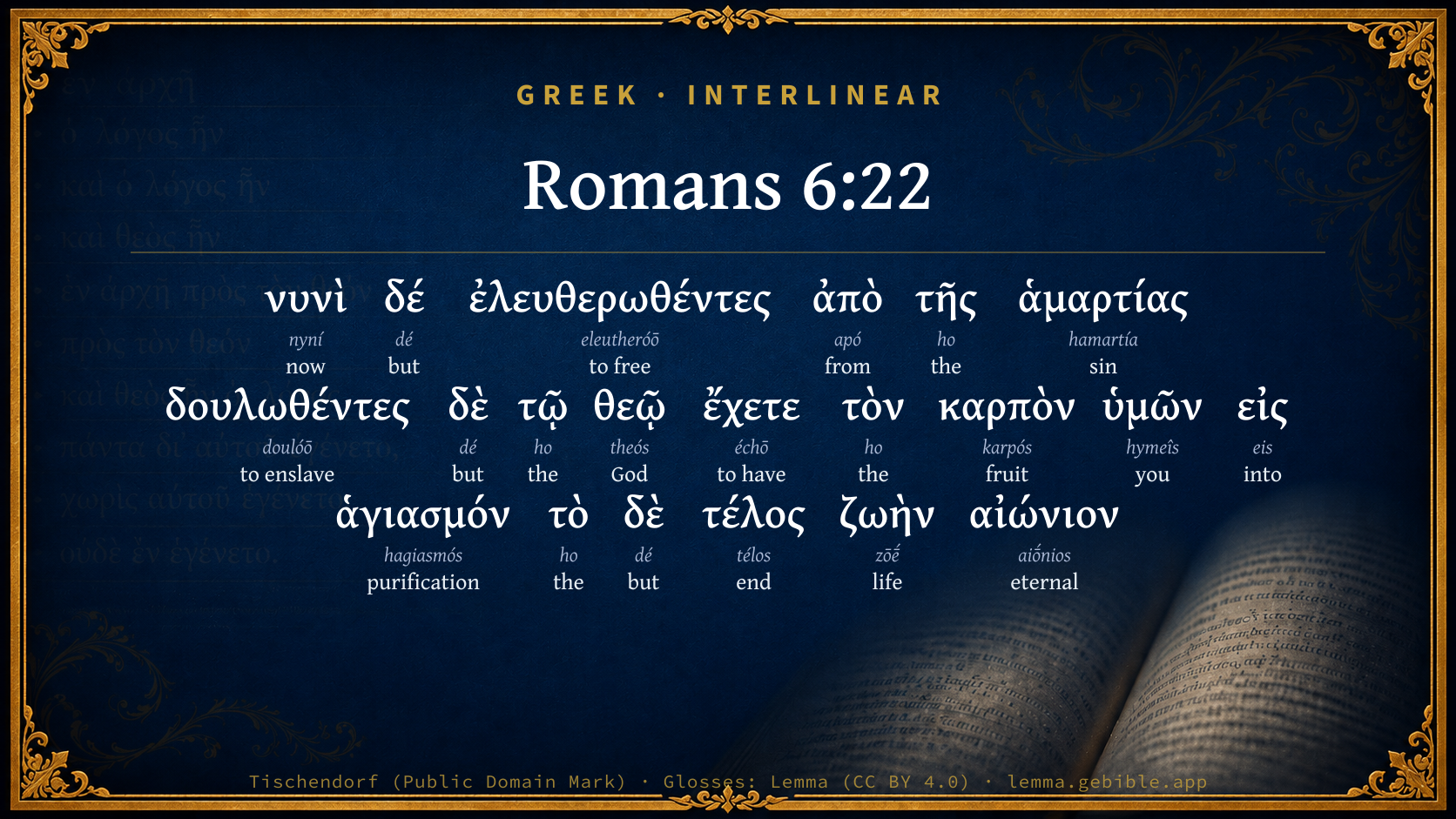
But now, being made free from sin, and having become servants of God, you have your fruit of sanctification, and the result of eternal life.
Download a study sheet
One document with this verse’s original text, its word-by-word gloss line, the meaning frame, cross-references with their text, attributed commentary, and full source and license credits — printable, and it pastes into notes with its structure intact.
This verse Autodidact and up
A passage Seminary Student
Up to 50 verses in one chapter. A passage sheet keeps up to 6 commentary sources and 12 cross-references per verse, in the order this page ranks them, and says so on the sheet whenever that leaves anything out. Ask for a single verse and you get the Autodidact verse sheet above.
Everything on this page stays free to read, with no account — the sheet is a download of what is already on screen, not access to it.
Compare translations 3
The same verse in 3 English versions, stacked beneath the original-language interlinear above. Click any original word for its lexicon entry.
Each is an independent rendering of the whole verse — the interlinear is not word-aligned to these translations.
Highlighted words mark where these versions differ — a whole-verse word diff, not a word-by-word alignment.
-
World English Bible Public Domain
But now, being made free from sin, and having become servants of God, you have your fruit of sanctification, and the result of eternal life.
-
King James Version Public Domain
But now being made free from sin, and become servants to God, ye have your fruit unto holiness, and the end everlasting life.
-
unfoldingWord Literal Text CC BY-SA 4.0
But now, having been freed from sin and having been enslaved to God, you have your fruit to sanctification, and the outcome eternal life.
unfoldingWord Literal Text — © unfoldingWord, licensed CC BY-SA 4.0. Word-aligned USFM3 via Door43 (git.door43.org/unfoldingWord/en_ult).
Show all 19 translations
Every available English version of this verse, each an independent rendering of the whole verse.
-
World English Bible Public Domain
But now, being made free from sin, and having become servants of God, you have your fruit of sanctification, and the result of eternal life.
-
Berean Standard Bible Public Domain
But now that you have been set free from sin and have become slaves to God, the fruit you reap leads to holiness, and the outcome is eternal life.
-
Majority Standard Bible Public Domain
But now that you have been set free from sin and have become slaves to God, the fruit you reap leads to holiness, and the outcome is eternal life.
-
King James Version Public Domain
But now being made free from sin, and become servants to God, ye have your fruit unto holiness, and the end everlasting life.
-
American Standard Version (1901) Public Domain
But now being made free from sin and become servants to God, ye have your fruit unto sanctification, and the end eternal life.
-
Revised Version (1885) Public Domain
But now being made free from sin, and become servants to God, ye have your fruit unto sanctification, and the end eternal life.
-
Geneva Bible (1599) Public Domain
But now being freed from sinne, and made seruants vnto God, ye haue your fruit in holines, and the end, euerlasting life.
-
Douay-Rheims (1899) Public Domain
But now being made free from sin, and become servants to God, you have your fruit unto sanctification, and the end life everlasting.
-
Young's Literal Translation Public Domain
And now, having been freed from the sin, and having become servants to God, ye have your fruit -- to sanctification, and the end life age-during;
-
Literal Standard Version CC BY-SA 4.0
And now, having been freed from sin, and having become servants to God, you have your fruit—to sanctification, and the end continuous life;
-
Unlocked Literal Bible CC BY-SA 4.0
But now that you have been made free from sin and are enslaved to God, you have your fruit for sanctification. The result is eternal life.
-
unfoldingWord Literal Text CC BY-SA 4.0
But now, having been freed from sin and having been enslaved to God, you have your fruit to sanctification, and the outcome eternal life.
-
Darby Bible Public Domain
But *now*, having got your freedom from sin, and having become bondmen to God, ye have your fruit unto holiness, and the end eternal life.
-
World Messianic Bible Public Domain
But now, being made free from sin and having become servants of God, you have your fruit of sanctification and the result of eternal life.
-
Webster's Bible Public Domain
But now being made free from sin, and having become servants to God, ye have your fruit to holiness, and the end everlasting life.
-
Free Bible Version CC BY-SA 4.0
But now that you're set free from sin, and have become God's slaves, the results will be a pure life—and in the end, eternal life.
-
Bible in Basic English Public Domain
But now, being free from sin, and having been made servants to God, you have your fruit in that which is holy, and the end is eternal life.
-
Text-Critical English NT CC BY 4.0
But now that you have been set free from sin and become slaves of God, you have fruit that leads to sanctification, and the end result is eternal life.
-
Tyndale New Testament (1534) Public Domain
But now are ye delivered from synne and made the servauntes of God and have youre frute that ye shuld be sanctifyed and the ende everlastinge lyfe.
Literal Standard Version (2020), Covenant Press — licensed CC BY-SA 4.0. Text via the HelloAO Bible API (eBible.org). Unlocked Literal Bible (unfoldingWord) — licensed CC BY-SA 4.0. Text via the HelloAO Bible API (eBible.org). unfoldingWord Literal Text — © unfoldingWord, licensed CC BY-SA 4.0. Word-aligned USFM3 via Door43 (git.door43.org/unfoldingWord/en_ult). Free Bible Version, Dr. Jonathan Gallagher — licensed CC BY-SA 4.0. Text via the HelloAO Bible API (eBible.org).
Word by word
More ways to search: Search by grammar → Find every occurrence → Compare this word →
Practice this passage: Drill this verse → Learn its vocabulary →
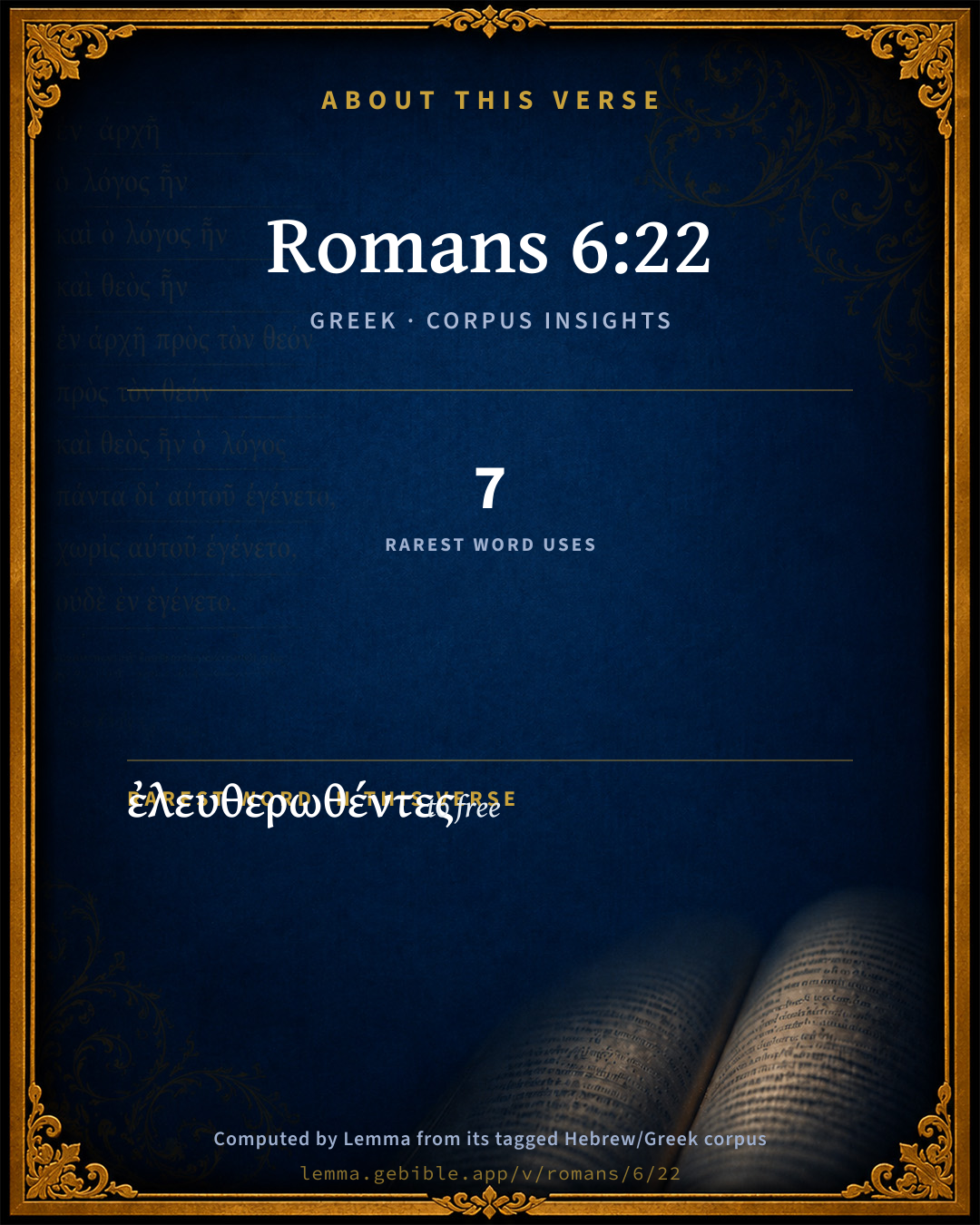
- Appears 7× in the Greek New Testament
- First appears at John 8:32
- Part of Speech
- Verb
- Tense
- Aorist
- Voice
- Passive
- Mood
- Participle
- Case
- Nominative
- Number
- Plural
- Gender
- Masculine
Full Thayer's Definition
- νυνὶ nyní G3570 “now” Adverb
- δέ dé G1161 “but” Conjunction
- ἐλευθερωθέντες eleutheróō G1659 “to free” Verb, Aorist, Passive, Participle, Nominative, Plural, Masculine
- ἀπὸ apó G575 “from” Preposition
- τῆς ho G3588 “the” Article, Genitive, Singular, Feminine
- ἁμαρτίας hamartía G266 “sin” Noun, Genitive, Singular, Feminine
- δουλωθέντες doulóō G1402 “to enslave” Verb, Aorist, Passive, Participle, Nominative, Plural, Masculine
- δὲ dé G1161 “but” Conjunction
- τῷ ho G3588 “the” Article, Dative, Singular, Masculine
- θεῷ theós G2316 “God” Noun, Dative, Singular, Masculine
- ἔχετε échō G2192 “to have” Verb, Present, Active, Indicative, 2nd person, Plural
- τὸν ho G3588 “the” Article, Accusative, Singular, Masculine
- καρπὸν karpós G2590 “fruit” Noun, Accusative, Singular, Masculine
- ὑμῶν hymeîs G5210 “you” Personal pronoun, 2nd person, Genitive, Plural
- εἰς eis G1519 “into” Preposition
- ἁγιασμόν hagiasmós G38 “purification” Noun, Accusative, Singular, Masculine
- τὸ ho G3588 “the” Article, Nominative, Singular, Neuter
- δὲ dé G1161 “but” Conjunction
- τέλος télos G5056 “end” Noun, Nominative, Singular, Neuter
- ζωὴν zōḗ G2222 “life” Noun, Accusative, Singular, Feminine
- αἰώνιον aiṓnios G166 “eternal” Adjective, Accusative, Singular, Feminine
About this verse
These counts appear in no published source. They are computed here, from the morphology-tagged text and Lemma’s own curated glosses. What Lemma adds →
- 21
- words
- 16
- distinct lemmas
- Pauline Epistles
- section
Cross-references
38Topical passages linked to Romans 6:22 in the Treasury of Scripture Knowledge — connected by theme and wording, ordered by reader-vote popularity; previews shown in the World English Bible.
- 1 Peter 2:16 as free, and not using your freedom for a cloak of wickedness, but as bondservants of God.
- Romans 6:18 Being made free from sin, you became bondservants of righteousness.
- Romans 8:2 For the law of the Spirit of life in Christ Jesus made me free from the law of sin and of death.
- Galatians 5:13 For you, brothers, were called for freedom. Only don't use your freedom for gain to the flesh, but through love be servants to one another.
- John 8:32 You will know the truth, and the truth will make you free."
- Isaiah 54:17 No weapon that is formed against you shall prosper; and every tongue that shall rise against you in judgment you shall condemn. This is the heritage of the servants of Yahweh, and their righteousness which is of me, says Yahweh.
- Romans 6:14 For sin will not have dominion over you. For you are not under law, but under grace.
- 1 Corinthians 7:22 For he who was called in the Lord being a bondservant is the Lord's free man. Likewise he who was called being free is Christ's bondservant.
- Galatians 5:22 But the fruit of the Spirit is love, joy, peace, patience, kindness, goodness, faithfulness,
- 1 Peter 1:9 receiving the result of your faith, the salvation of your souls.
- Galatians 1:10 For am I now seeking the favor of men, or of God? Or am I striving to please men? For if I were still pleasing men, I wouldn't be a servant of Christ.
- Romans 6:21 What fruit then did you have at that time in the things of which you are now ashamed? For the end of those things is death.
- Romans 7:4 Therefore, my brothers, you also were made dead to the law through the body of Christ, that you would be joined to another, to him who was raised from the dead, that we might bring forth fruit to God.
- Psalms 92:14 They will still bring forth fruit in old age. They will be full of sap and green,
- Psalms 143:12 In your loving kindness, cut off my enemies, And destroy all those who afflict my soul, For I am your servant.
- Daniel 3:26 Then Nebuchadnezzar came near to the mouth of the burning fiery furnace: he spoke and said, Shadrach, Meshach, and Abednego, you servants of the Most High God, come forth, and come here. Then Shadrach, Meshach, and Abednego came forth out of the midst of the fire.
- Matthew 25:46 These will go away into eternal punishment, but the righteous into eternal life."
- John 4:36 He who reaps receives wages, and gathers fruit to eternal life; that both he who sows and he who reaps may rejoice together.
- John 15:2 Every branch in me that doesn't bear fruit, he takes away. Every branch that bears fruit, he prunes, that it may bear more fruit.
- Genesis 50:17 "So you shall tell Joseph, 'Now please forgive the disobedience of your brothers, and their sin, because they did evil to you.' Now, please forgive the disobedience of the servants of the God of your father." Joseph wept when they spoke to him.
- Numbers 23:10 Who can count the dust of Jacob, Or number the fourth part of Israel? Let me die the death of the righteous, Let my last end be like his!
- Job 1:8 Yahweh said to Satan, "Have you considered my servant, Job? For there is none like him in the earth, a blameless and an upright man, one who fears God, and turns away from evil."
- Psalms 37:37–38 Mark the perfect man, and see the upright, For there is a future for the man of peace.
- Matthew 13:40 As therefore the darnel is gathered up and burned with fire; so will it be at the end of this age.
- Matthew 13:43 Then the righteous will shine forth like the sun in the Kingdom of their Father. He who has ears to hear, let him hear.
- Matthew 19:29 Everyone who has left houses, or brothers, or sisters, or father, or mother, or wife, or children, or lands, for my name's sake, will receive one hundred times, and will inherit eternal life.
- John 15:16 You didn't choose me, but I chose you, and appointed you, that you should go and bear fruit, and that your fruit should remain; that whatever you will ask of the Father in my name, he may give it to you.
- Romans 7:25 I thank God through Jesus Christ, our Lord! So then with the mind, I myself serve God's law, but with the flesh, the sin's law.
- 2 Corinthians 3:17 Now the Lord is the Spirit and where the Spirit of the Lord is, there is liberty.
- Ephesians 5:9 for the fruit of the Spirit is in all goodness and righteousness and truth,
- Philippians 1:11 being filled with the fruits of righteousness, which are through Jesus Christ, to the glory and praise of God.
- Philippians 4:17 Not that I seek for the gift, but I seek for the fruit that increases to your account.
- Colossians 1:10 that you may walk worthily of the Lord, to please him in all respects, bearing fruit in every good work, and increasing in the knowledge of God;
- Titus 1:1 Paul, a servant of God, and an apostle of Jesus Christ, according to the faith of God's chosen ones, and the knowledge of the truth which is according to godliness,
- Revelation 7:13 One of the elders answered, saying to me, "These who are arrayed in white robes, who are they, and from where did they come?"
- Psalms 86:2 Preserve my soul, for I am godly. You, my God, save your servant who trusts in you.
- Daniel 6:20 When he came near to the den to Daniel, he cried with a lamentable voice; the king spoke and said to Daniel, Daniel, servant of the living God, is your God, whom you serve continually, able to deliver you from the lions?
- James 1:1 James, a servant of God and of the Lord Jesus Christ, to the twelve tribes which are in the Dispersion: Greetings.
Cross-references courtesy of OpenBible.info (CC BY 4.0).
Lesson kit
Teaching starters — assembled from the data on this page, not authored interpretation. Every prompt links to the verse data it draws on. Edit before teaching.
Romans, in the Pauline Epistles, opens this verse with 21 words (16 distinct Greek lemmas). Its most distinctive word is eleutheróō (“to free”). A historical commentator’s framing appears above. Read the whole chapter for the surrounding context.
Discussion questions
- What does “to free” (eleutheróō) contribute to the verse as a whole?
- John 8:32 shares the word «to free» with this verse. How do the two illuminate each other?
- “the” occurs 4× in this one verse. What is the effect of the repetition?
- These translations render this verse differently; the difference is in the English rendering, not the original. What questions does that raise?
- Reading how The Biblical Illustrator and The Preacher's Complete Homiletical Commentary read this verse, where do the two commentators agree and where do they part?
Things to notice
- These translations choose different wording for 17 words in this verse.
- “the” occurs 4× in this single verse.
- 16 distinct Greek lemmas span 21 words in this verse.
Commentary
Notes on Romans 6:22 from classic Christian and Jewish commentators (each source and its license shown beneath its notes). The classic Christian expositions comment on the surrounding passage and are grouped to its opening verse, so a note may address several verses; the Jewish commentaries on the Tanakh (Rashi and others) are per-verse, so they appear only where the commentator wrote on this verse.
Lemma curates 59 commentaries, every one of them public domain or Creative Commons licensed, each selected and text-cleaned for this edition rather than reprinted as found. About our sources →
The Biblical Illustrator
Joseph S. Exell
The Biblical Illustrator, edited by Joseph S. Exell (c. 1880s–1900s) — public domain. Text from a community e-Sword module.
The Preacher's Complete Homiletical Commentary
Joseph S. Exell (gen. ed.)
The Preacher's Complete Homiletical Commentary (gen. ed. Joseph S. Exell; Funk & Wagnalls, c. 1892) — public domain (pre-1929). A full-Bible homiletical/sermon-outline anthology covering 65 of 66 books (2 John is absent from the source module). Text from a community e-Sword module.
Bengel's Gnomon
Johann Albrecht Bengel
Bengel's Gnomon of the New Testament — English translation (T&T Clark, Edinburgh, 1860) — public domain. Text from a community e-Sword module.
Hodge's Commentary on Romans, Ephesians & First Corinthians
Charles Hodge
Charles Hodge — Commentary on Romans (1835), First Corinthians (1857), and Ephesians (1856) — public domain. Text from a community e-Sword module.
Jamieson, Fausset & Brown
Robert Jamieson, A. R. Fausset & David Brown
Jamieson, Fausset & Brown — Commentary Critical and Explanatory on the Whole Bible (1871) — public domain (CC PDM 1.0). Text via the HelloAO Bible API.
Adam Clarke's Commentary
Adam Clarke's Commentary on the Bible (1810–1826) — public domain. Text from a community e-Sword/MySword module.
John Calvin's Commentaries
John Calvin's Commentaries (1540-1563) — public domain. Text from the Calvin Translation Society English edition (1840s-50s) via the Christian Classics Ethereal Library (ccel.org). Calvin's coverage is partial (roughly two-thirds of the Bible); uncommented books and verses are honest gaps, never fabricated. The 19th-century editor's footnotes and remarks are omitted so the notes are faithfully Calvin's own voice.
Ellicott's Commentary for English Readers
A Bible Commentary for English Readers, edited by Charles John Ellicott (1878–1897) — public domain. Text from a community e-Sword module.
The Cambridge Bible for Schools and Colleges
gen. ed. J. J. S. Perowne
The Cambridge Bible for Schools and Colleges (gen. ed. J. J. S. Perowne; Cambridge University Press, 1878–1918) — public domain. Text from a community e-Sword module.
John Gill's Exposition
John Gill's Exposition of the Whole Bible (1746–1763) — public domain (CC PDM 1.0). Text via the HelloAO Bible API.
Trapp's Complete Commentary
John Trapp
John Trapp, A Commentary or Exposition upon All the Books of the Old and New Testament (1647–1656) — public domain. Text from a community e-Sword module.
Albert Barnes' Notes on the Bible
Albert Barnes' Notes on the Bible (1834–1885) — public domain. Text from a community e-Sword/MySword module.
Matthew Poole's English Annotations
Matthew Poole's English Annotations on the Holy Bible (1683–1685) — public domain. Text from a community e-Sword/MySword module.
Scofield Reference Notes
C. I. Scofield
The Scofield Reference Bible (1917 edition), notes by C. I. Scofield — public domain. Text from a community e-Sword module.
Burkitt's Expository Notes on the New Testament
William Burkitt
William Burkitt's Expository Notes on the New Testament (1700–1703) — public domain. Text from a community e-Sword module.
Godbey's Commentary on the New Testament
William B. Godbey
William B. Godbey, Commentary on the New Testament (1896–1900) — public domain. Text from a community e-Sword module.
McGarvey & Pendleton's Commentaries
J. W. McGarvey
J. W. McGarvey (with Philip Y. Pendleton), Commentaries on the New Testament (The Fourfold Gospel, 1914; Acts; and the epistles) — public domain. Text from a community e-Sword/MySword module.
The People's New Testament
B. W. Johnson
B. W. Johnson's The People's New Testament with Notes (1889–1891) — public domain. Electronic text from the Christian Classics Ethereal Library (CCEL) ThML edition.
unfoldingWord translationNotes
Door43 World Missions Community
unfoldingWord translationNotes — © Distant Shores Media and the Door43 World Missions Community, licensed CC BY-SA 4.0. Source: git.door43.org/Door43/en_tn.
Cambridge Greek Testament for Schools and Colleges
Cambridge Greek Testament for Schools and Colleges (Cambridge University Press, 1896; 21 vols, various authors incl. Carr, Maclear, Plummer, Farrar, Lumby, Moule, M. R. James, Simcox) — public domain. Text from a community e-Sword module.
Alford’s Greek Testament
Henry Alford
Henry Alford, The Greek Testament (1849–1861) — public domain. Text from a community e-Sword module.
Godet's Commentaries
Frédéric Louis Godet
Frédéric Louis Godet — Commentaries on Luke, John, Romans, and 1 Corinthians — English translation (T&T Clark, Edinburgh, 1870s–1890s) — public domain. Text from a community e-Sword module.