Hebrews 10:2

Greek (Tischendorf 8th ed.) Hebrews 10:2 appears in the Greek New Testament. The text above is from the Tischendorf 8th edition. Each word links to its Strong’s number and a concise gloss. Click any word for its full Thayer’s Greek Lexicon entry.
Download image
Cite this verse

Hebrews 10:2 (World English Bible). Public Domain. Lemma interlinear Bible study tool, https://lemma.gebible.app/v/hebrews/10/2.

Show BibTeX & RIS
BibTeX
RIS
English Translation
Or else wouldn't they have ceased to be offered, because the worshippers, having been once cleansed, would have had no more consciousness of sins?
World English Bible · Public Domain
Download a study sheet

One document with this verse’s original text, its word-by-word gloss line, the meaning frame, cross-references with their text, attributed commentary, and full source and license credits — printable, and it pastes into notes with its structure intact.

This verse Autodidact and up

Study sheet (.html) Plain text (.txt)

A passage Seminary Student

Up to 50 verses in one chapter. A passage sheet keeps up to 6 commentary sources and 12 cross-references per verse, in the order this page ranks them, and says so on the sheet whenever that leaves anything out. Ask for a single verse and you get the Autodidact verse sheet above.

Everything on this page stays free to read, with no account — the sheet is a download of what is already on screen, not access to it.

Want to remove ads? Support Godless Engineer
Compare translations 3

The same verse in 3 English versions, stacked beneath the original-language interlinear above. Click any original word for its lexicon entry.

Each is an independent rendering of the whole verse — the interlinear is not word-aligned to these translations.

Highlighted words mark where these versions differ — a whole-verse word diff, not a word-by-word alignment.

  • World English Bible Public Domain
    Or else wouldn't they have ceased to be offered, because the worshippers, having been once cleansed, would have had no more consciousness of sins?
  • King James Version Public Domain
    For then would they not have ceased to be offered? because that the worshippers once purged should have had no more conscience of sins.
  • unfoldingWord Literal Text CC BY-SA 4.0
    Otherwise, would they not have ceased being offered, because the ones serving would no longer have consciousness of sins, having been cleansed once?

unfoldingWord Literal Text — © unfoldingWord, licensed CC BY-SA 4.0. Word-aligned USFM3 via Door43 (git.door43.org/unfoldingWord/en_ult).

Versions to compare (up to 4)

3 of 4 selected

Show all 19 translations

Every available English version of this verse, each an independent rendering of the whole verse.

  • World English Bible Public Domain
    Or else wouldn't they have ceased to be offered, because the worshippers, having been once cleansed, would have had no more consciousness of sins?
  • Berean Standard Bible Public Domain
    If it could, would not the offerings have ceased? For the worshipers would have been cleansed once for all, and would no longer have felt the guilt of their sins.
  • Majority Standard Bible Public Domain
    If it could, would not the offerings have ceased? For the worshipers would have been cleansed once for all, and would no longer have felt the guilt of their sins.
  • King James Version Public Domain
    For then would they not have ceased to be offered? because that the worshippers once purged should have had no more conscience of sins.
  • American Standard Version (1901) Public Domain
    Else would they not have ceased to be offered? because the worshippers, having been once cleansed, would have had no more consciousness of sins.
  • Revised Version (1885) Public Domain
    Else would they not have ceased to be offered, because the worshippers, having been once cleansed, would have had no more conscience of sins?
  • Geneva Bible (1599) Public Domain
    For would they not then haue ceased to haue bene offered, because that the offerers once purged, should haue had no more conscience of sinnes?
  • Douay-Rheims (1899) Public Domain
    For then they would have ceased to be offered: because the worshippers once cleansed should have no conscience of sin any longer:
  • Young's Literal Translation Public Domain
    since, would they not have ceased to be offered, because of those serving having no more conscience of sins, having once been purified?
  • Literal Standard Version CC BY-SA 4.0
    since, would they not have ceased to be offered, because of those serving having no more conscience of sins, having been purified once?
  • Unlocked Literal Bible CC BY-SA 4.0
    Otherwise, would the sacrifices not have ceased to be offered? For the worshipers would have been cleansed one time and would no longer have any consciousness of sin.
  • unfoldingWord Literal Text CC BY-SA 4.0
    Otherwise, would they not have ceased being offered, because the ones serving would no longer have consciousness of sins, having been cleansed once?
  • Darby Bible Public Domain
    Since, would they not indeed have ceased being offered, on account of the worshippers once purged having no longer any conscience of sins?
  • World Messianic Bible Public Domain
    Or else wouldn’t they have ceased to be offered, because the worshipers, having been once cleansed, would have had no more consciousness of sins?
  • Webster's Bible Public Domain
    For then would they not have ceased to be offered? because that the worshipers once cleansed, would have had no more conscience of sins.
  • Free Bible Version CC BY-SA 4.0
    Otherwise wouldn't the sacrifices have stopped being offered? If the worshipers had been made clean once and for all, they wouldn't have had guilty consciences any longer.
  • Bible in Basic English Public Domain
    For if this had been possible, would there not have been an end of those offerings, because the worshippers would have been made completely clean and would have been no longer conscious of sins?
  • Text-Critical English NT CC BY 4.0
    Otherwise, would they not have ceased to be offered, since the worshipers would have been purified once and for all, and would no longer have any consciousness of their sins?
  • Tyndale New Testament (1534) Public Domain
    For wolde not then those sacrifises have ceased to have bene offered because that the offerers once pourged shuld have had no moare conscieces of sinnes.

Literal Standard Version (2020), Covenant Press — licensed CC BY-SA 4.0. Text via the HelloAO Bible API (eBible.org). Unlocked Literal Bible (unfoldingWord) — licensed CC BY-SA 4.0. Text via the HelloAO Bible API (eBible.org). unfoldingWord Literal Text — © unfoldingWord, licensed CC BY-SA 4.0. Word-aligned USFM3 via Door43 (git.door43.org/unfoldingWord/en_ult). Free Bible Version, Dr. Jonathan Gallagher — licensed CC BY-SA 4.0. Text via the HelloAO Bible API (eBible.org).

Word by word

More ways to search: Search by grammar → Find every occurrence → Compare this word →

Practice this passage: Drill this verse → Learn its vocabulary →

ἅπαξ
hápax
G530
“once”
Adverb
Part of Speech
Adverb
Full Thayer's Definition

Origin: probably from G537

TDNT: 07:21,6

1. once, one time 2. once for all
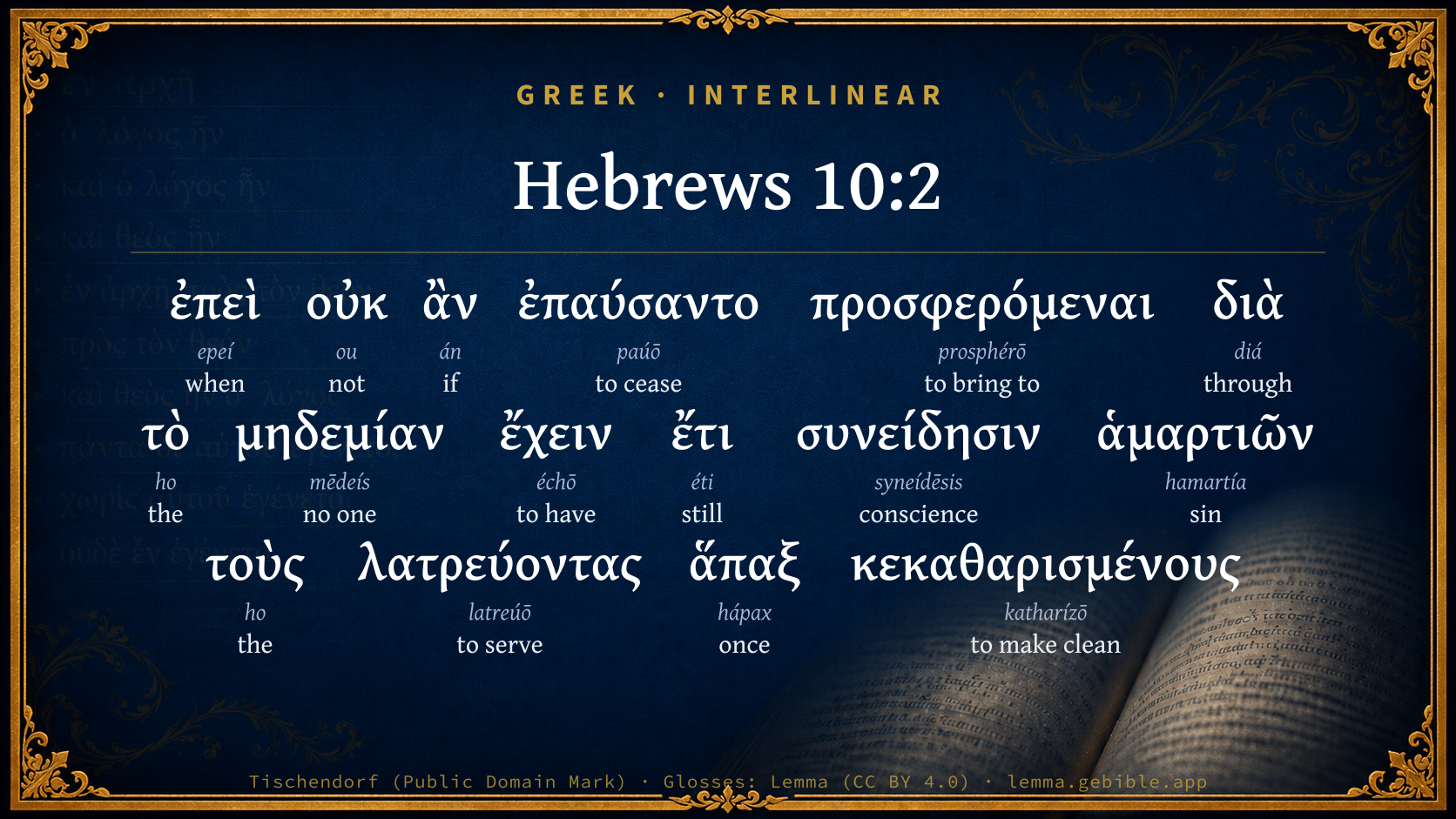
  1. ἐπεὶ epeí G1893 “when” Conjunction
  2. οὐκ ou G3756 “not” Particle, Negative
  3. ἂν án G302 “if” Particle
  4. ἐπαύσαντο paúō G3973 “to cease” Verb, Aorist, Middle, Indicative, 3rd person, Plural
  5. προσφερόμεναι prosphérō G4374 “to bring to” Verb, Present, Passive, Participle, Nominative, Plural, Feminine
  6. διὰ diá G1223 “through” Preposition
  7. τὸ ho G3588 “the” Article, Accusative, Singular, Neuter
  8. μηδεμίαν mēdeís G3367 “no one” Adjective, Accusative, Singular, Feminine, Negative
  9. ἔχειν échō G2192 “to have” Verb, Present, Active, Infinitive
  10. ἔτι éti G2089 “still” Adverb
  11. συνείδησιν syneídēsis G4893 “conscience” Noun, Accusative, Singular, Feminine
  12. ἁμαρτιῶν hamartía G266 “sin” Noun, Genitive, Plural, Feminine
  13. τοὺς ho G3588 “the” Article, Accusative, Plural, Masculine
  14. λατρεύοντας latreúō G3000 “to serve” Verb, Present, Active, Participle, Accusative, Plural, Masculine
  15. κεκαθαρισμένους katharízō G2511 “to make clean” Verb, Perfect, Passive, Participle, Accusative, Plural, Masculine

About this verse

These counts appear in no published source. They are computed here, from the morphology-tagged text and Lemma’s own curated glosses. What Lemma adds →

16
words
15
distinct lemmas
General Epistles
section

Notable vocabulary

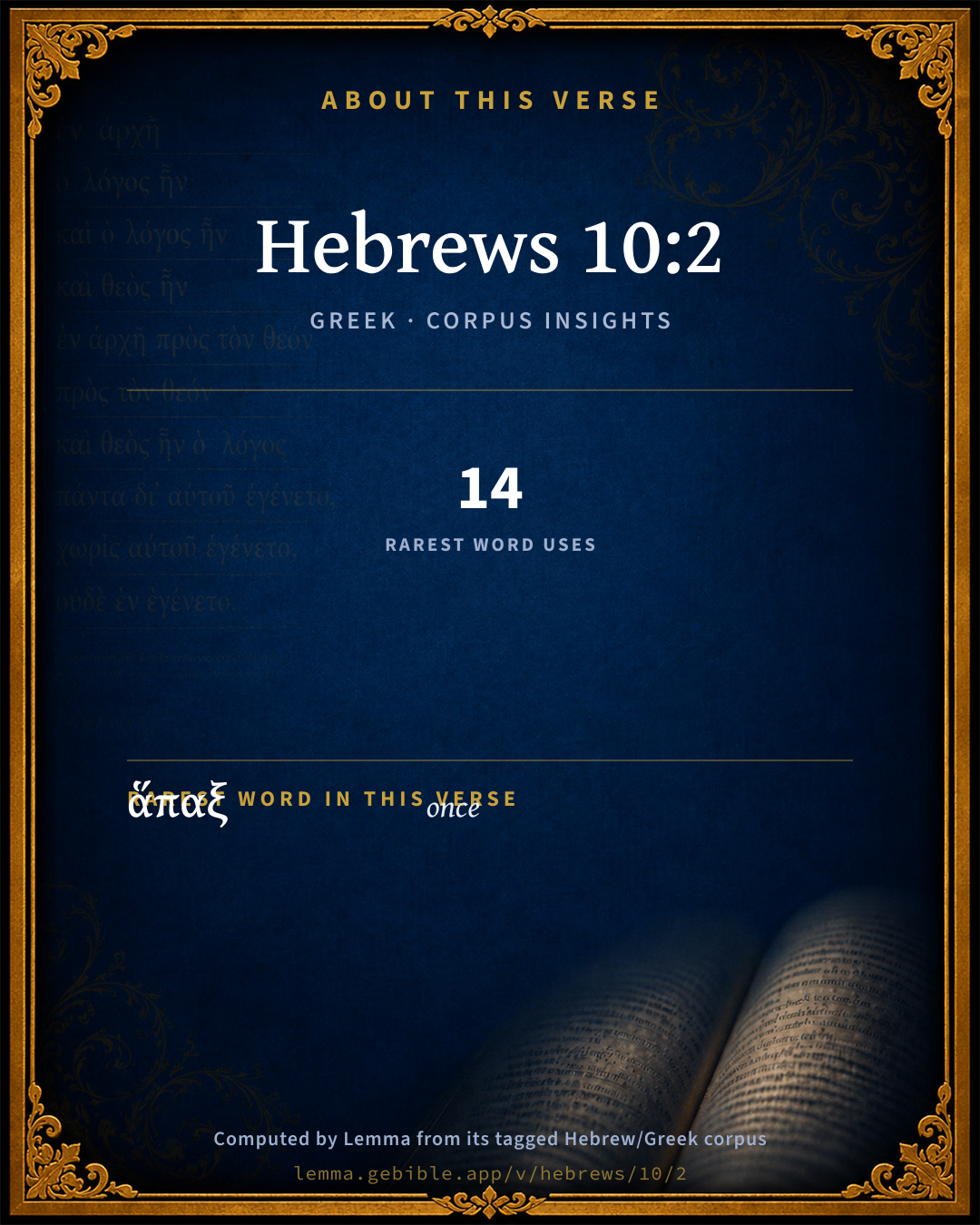
The rarest word here is ἅπαξ once G530 — appearing just 14 times in the whole Greek New Testament.

Shared distinctive vocabulary

ἅπαξ once G530 occurs in 14 verses of the Greek New Testament. Also found in:

Repetition

A word recurs within this verse:

Cross-references

6

Topical passages linked to Hebrews 10:2 in the Treasury of Scripture Knowledge — connected by theme and wording, ordered by reader-vote popularity; previews shown in the World English Bible.

  • Isaiah 43:25 I, even I, am he who blots out your transgressions for my own sake; and I will not remember your sins.
  • Micah 7:19 He will again have compassion on us. He will tread our iniquities under foot; And you will cast all their sins into the depths of the sea.
  • Psalms 103:12 As far as the east is from the west, So far has he removed our transgressions from us.
  • Isaiah 44:22 I have blotted out, as a thick cloud, your transgressions, and, as a cloud, your sins: return to me; for I have redeemed you.
  • Hebrews 9:13–14 For if the blood of goats and bulls, and the ashes of a heifer sprinkling those who have been defiled, sanctify to the cleanness of the flesh:
  • Hebrews 10:17 "I will remember their sins and their iniquities no more."

Cross-references courtesy of OpenBible.info (CC BY 4.0).

Where the printed editions differ

1 variant

Places in this verse where the major printed Greek editions disagree on the wording in a way that affects the translation — a comparison of editions, not a manuscript-by-manuscript collation. The editions are the modern critical texts (Nestlé-Aland 28/27, SBL, Westcott-Hort, Tregelles, Tyndale House) and the traditional texts behind the KJV (the Textus Receptus and the Byzantine/Majority text). It is not a claim about which reading is original.

  1. Different wording
    κεκαθαρισμένους.

    “cleansed!”

    In NA28NA27TynSBLWHTreg Not in TRByz

    κεκαθαρμένους (kekatharmenous) 'pruned' occurs in traditional manuscripts (TR+Byz) instead of κεκαθαρισμένους. (kekatharismenous) 'cleansed!' in older manuscripts (NA28+NA27+Tyn+SBL+WH+Treg)

Textual data: Translators Amalgamated Greek New Testament (STEPBible TAGNT) · CC BY 4.0.

Commentary

Notes on Hebrews 10:2 from classic Christian and Jewish commentators (each source and its license shown beneath its notes). The classic Christian expositions comment on the surrounding passage and are grouped to its opening verse, so a note may address several verses; the Jewish commentaries on the Tanakh (Rashi and others) are per-verse, so they appear only where the commentator wrote on this verse.

Lemma curates 59 commentaries, every one of them public domain or Creative Commons licensed, each selected and text-cleaned for this edition rather than reprinted as found. About our sources →

Joseph Benson's Commentary

Heb 10:2-3. For then would they not have ceased, &c. — There would not have been need to have offered them more than once: that is, if these sacrifices had made the worshippers perfect, in respect of pardon, they would have ceased to be offered; because the worshippers once purged — Or fully discharged from the guilt of their transgressions; should have had no more conscience of sin — There would have remained no more sense of guilt upon their consciences to have troubled them, and no more fear of future punishment in consequence thereof. But it was not so with them, as appears by the yearly repetition of these sacrifices, wherein there was a continual remembrance made of sin — A consciousness of their sins, as unpardoned, still remained even after those sacrifices were offered, as is evident from this, that in the annual repetition of their sacrifices, the people’s sins, for which atonement had formerly been made, were remembered; that is, confessed as needing a yet further expiation. And, though it is true we are daily to remember and confess our sins, yet that respects only the application of the virtue and efficacy of the atonement already made to our consciences, without the least desire or expectation of a new propitiation.

Joseph Benson's Commentary on the Old and New Testaments (1811–1818) — public domain. Text from a community e-Sword module.

Tyndale Open Study Notes

Tyndale Open Resources

10:2 The perpetual nature of the sacrifices demonstrates their inadequacy. If the sacrifices of the old covenant had offered true, lasting purity, they would have stopped. • their feelings of guilt would have disappeared: Cp. 9:9, 14; 10:22; 13:18.

Tyndale Open Study Notes — © Tyndale Open Resources, licensed CC BY-SA 4.0. Text via the HelloAO Bible API.

Bengel's Gnomon

Johann Albrecht Bengel

Heb 10:2. Ἐπεὶ) So, altogether, ἐπεὶ, with an interrogation, in ch. Heb 9:17, note.

Bengel's Gnomon of the New Testament — English translation (T&T Clark, Edinburgh, 1860) — public domain. Text from a community e-Sword module.

Meyer's Critical & Exegetical Commentary

Heinrich August Wilhelm Meyer

Heb_10:2. Proof for the κατʼ ἐνιαυτὸν ταῖς αὐτ. θυσ. οὐδέποτε δύναται τοὺς προσερχομένους τελειῶσαι in the form of a question: for otherwise would not their presentation have ceased? because the worshippers, so soon as they have once been really purged from sin, have no more consciousness of sins, and thus no more need of an expiatory sacrifice. In connection with the Recepta ἐπεὶ ἂν ἐπαύσαντο, the sense itself would remain unchanged, only the words would then have to be taken as an assertory statement (for their presentation would have come to an end, because, etc.); by which, however, the discourse would suffer in point of vivacity (observe also the ἀλλά, Heb_10:3, corresponding to the question of Heb_10:2). But the process is not a natural one, when Beza, edd. 1 and 2, Wetstein, Matthaei, Stein, and others (comp. already Theodoret) will have the proposition of Heb_10:2 regarded as an assertory statement, even with the retention of the οὐκ. They then explain either (and thus ordinarily): for otherwise their presentation would not have ceased, sc. by the coming in of the New Covenant (Beza: alioqui non desiissent offerri; Matthaei: non cessavissent, non sublata essent; comp. Theodoret: Διὰ τοῦτο τέλος ἐκεῖνα λαμβάνει, ὡς οὐ δυνάμενα συνείδησιν καθαρὰν ἀποφῆναι), or, in that ἐπεὶ … προσφερόμεναι, is closely attached to the main verb of Heb_10:1, and διὰ τὸ μηδεμίαν κ.τ.λ. is regarded as belonging to the whole proposition, Heb_10:1-2 : the law was not able by its sacrifices to lead to perfection, since their presentation was an endless one; because those who are once purified have no longer any consciousness of sins. So Wetstein, who, however, will writewhat in that case, no doubt, would be necessary and perfectly justified

οὐκ ἀνεπαύσαντο instead of οὐκ ἂν ἐπαύσαντο (… quum non cessarent offerri. Ita quidem, ut haec verba, sublata distinctione majori, jungantur iis, quae praecedunt, deinde sequatur totius sententiae confirmatio: quia sacrificantes, etc.). But against the last-mentioned mode of explanation it is decisive, that the relation of the members of the sentence to each other would become obscure, and the arrangement cumbrous; against the first-mentioned, the presupposition, underlying the ἃς προσφέρουσιν εἰς τὸ διηνεκές, Heb_10:1, as well as the epistle in general (Heb_9:9, al.), that the Jewish sacrificial ritual was still in continuance at the time of our authors writing.

ἐπαύσαντο προσφερόμεναι] sc. αἱ θυσίαι. The construction of παύεσθαι, with the participle is the ordinary one, in classic as well as in Hellenistic Greek. Comp. Eph_1:16; Col_1:9; Act_5:42, al.; Hermann, ad Viger. p. 771; Winer, Gramm., 7 Aufl. p. 323 f.

τοὺς λατρεύοντας] see at Heb_9:9.

Meyer — Critical and Exegetical Commentary on the New Testament — English translation by Peter Christie, edited by Frederick Crombie (T&T Clark, 1880) — public domain. Text from a community e-Sword module.

Jamieson, Fausset & Brown

Robert Jamieson, A. R. Fausset & David Brown

For--if the law could, by its sacrifices, have perfected the worshippers.

they--the sacrifices.

once purged--IF they were once for all cleansed (Heb 7:27).

conscience--"consciousness of sin" (Heb 9:9).

Jamieson, Fausset & Brown — Commentary Critical and Explanatory on the Whole Bible (1871) — public domain (CC PDM 1.0). Text via the HelloAO Bible API.

Adam Clarke's Commentary

Verse 2. Would they not have ceased to be offered?] Had they made an effectual reconciliation for the sins of the world, and contained in their once offering a plenitude of permanent merit, they would have ceased to be offered, at least in reference to any individual who had once offered them; because, in such a case, his conscience would be satisfied that its guilt had been taken away. But no Jew pretended to believe that even the annual atonement cancelled his sin before God; yet he continued to make his offerings, the law of God having so enjoined, because these sacrifices pointed out that which was to come. They were offered, therefore, not in consideration of their own efficacy, but as referring to Christ; See on "Heb 9:9".

Adam Clarke's Commentary on the Bible (1810–1826) — public domain. Text from a community e-Sword/MySword module.

Ellicott's Commentary for English Readers

(2) For then.—Better, otherwise. The very repetition of the annual ceremonial was a testimony to its imperfection. The idea of repetition has been very strikingly brought out in Heb_10:1.

Once purged.—Better, because the worshippers, having been once cleansed, would have no more consciousness of sins. “Worshippers,” not the same word as in Heb_10:1, but similarly used in Heb_9:9; Heb_9:14; Heb_12:28 (Php_3:3, et al.): in Heb_8:5; Heb_13:10, it is applied to priestly service.

A Bible Commentary for English Readers, edited by Charles John Ellicott (1878–1897) — public domain. Text from a community e-Sword module.

The Cambridge Bible for Schools and Colleges

gen. ed. J. J. S. Perowne

2. once purged] having been cleansed, by these sacrifices, once for all.

conscience] Rather, “consciousness.”

The Cambridge Bible for Schools and Colleges (gen. ed. J. J. S. Perowne; Cambridge University Press, 1878–1918) — public domain. Text from a community e-Sword module.

John Gill's Exposition

For then would they not have ceased to be offered,.... The Complutensian edition, and the Syriac and Vulgate Latin versions, leave out the word "not"; and the sense requires it should be omitted, for the meaning is, that if perfection had been by the legal sacrifices, they would have ceased to have been offered; for if the former ones had made perfect, there would have been no need of others, or of the repetition of the same; but because they did not make perfect, therefore they were yearly renewed; unless the words are read with an interrogation, as they are in the Arabic version, "for then would they not have ceased to be offered?" yes, they would; they are indeed ceased now, but this is owing to Christ and his sacrifice, and not to the efficacy of these sacrifices; for yearly sacrifices were offered for former sins, as well as for fresh ones, as appears from the following verse.

Because the worshippers, once purged, would have had no more conscience of sins; there are external and internal worshippers; the latter are such who worship God in Spirit and in truth: but here ceremonial worshippers are meant, who, if they had been really purged from sin by legal sacrifices, and purifications, would have had no more conscience of sins, and so have had no need to have repeated them; as such spiritual worshippers, who are once purged from sin by the blood and sacrifice of Christ; not that they have no sin, or no sense of sin, or that their consciences are seared, or that they never accuse for sin, or that they are to make no confession and acknowledgment of sin; but that they are discharged from the guilt of sin, and are not liable to condemnation for it; and through the application of the blood of Christ to them, have peace with God, and joy in the Holy Ghost.

John Gill's Exposition of the Whole Bible (1746–1763) — public domain (CC PDM 1.0). Text via the HelloAO Bible API.

Trapp's Complete Commentary

John Trapp

2 For then would they not have ceased to be offered? because that the worshippers once purged should have had no more conscience of sins.

Ver. 2. No more conscience of sin] Christ, though he took not away death, yet he did the sting of death; so though he took not away sin, yet he did the guilt of sin.

John Trapp, A Commentary or Exposition upon All the Books of the Old and New Testament (1647–1656) — public domain. Text from a community e-Sword module.

Albert Barnes' Notes on the Bible

For then would they not have ceased to be offered? - Margin, “Or they would have.” The sense is the same. The idea is, that the very fact that they were repeated showed that there was some deficiency in them as to the matter of cleansing the soul from sin. If they had answered all the purposes of a sacrifice in putting away guilt, there would have been no need of repeating them in this manner. They were in this respect like medicine. If what is given to a patient heals him, there is no need of repeating it; but if it is repeated often it shows that there was some deficiency in it, and if taken periodically through a man’s life, and the disease should still remain, it would show that it was not sufficient to effect his cure. So it was with the offerings made by the Jews. They were offered every year, and indeed every day, and still the disease of sin remained. The conscience was not satisfied; and the guilty felt that it was necessary that the sacrifice should be repeated again and again.

Because that the worshippers once purged should have had no more conscience of sin - That is, if their sacrifices had so availed as to remove their past sins, and to procure forgiveness, they would have had no more trouble of conscience on account of them. They would not have felt that it was necessary to make these sacrifices over and over again in order to find peace. When a man has full evidence that an atonement has been made which will meet all the demands of the Law, and which secures the remission of sin, he feels that it is enough. It is all that the case demands, and his conscience may have peace. But when he does “not” feel this, or has not evidence that his sins are all forgiven, those sins will rise to remembrance, and he will be alarmed. He may be punished for them after all. Thence it follows that if a man wants peace he should have good evidence that his sins are forgiven through the blood of the atonement.

No temporary expedient; no attempt to cover them up; no effort to forget them will answer the purpose. They “must be blotted out” if he will have peace - and that can be only through a perfect sacrifice. By the use of the word rendered “conscience” here, it is not meant that he who was pardoned would have no “consciousness” that he was a sinner, or that he would forget it, but that he would have no trouble of conscience; he would have no apprehension of future wrath. The pardon of sin does not cause it to cease to be remembered. He who is forgiven may have a deeper conviction of its evil than he had ever had before. But he will not be troubled or distressed by it as if it were to expose him to the wrath of God. The remembrance of it will humble him; it will serve to exalt his conceptions of the mercy of God and the glory of the atonement, but it will no longer overwhelm the mind with the dread of hell. This effect, the apostle says, was not produced on the minds of those who offered sacrifices every year. The very fact that they did it, showed that the conscience was not at peace.

Albert Barnes' Notes on the Bible (1834–1885) — public domain. Text from a community e-Sword/MySword module.

Haydock's Catholic Bible Commentary

Then they would have [2] ceased to be offered. That is, if they could have made the worshippers perfect; to wit, in such a manner as the one sacrifice of Christ, who was the Lamb of God that took away the sins of the world, by making a full reparation to the divine justice for the sin of Adam, and of all his offspring. For we must take notice that he compares the sacrifice of Christ, which wrought a general redemption, with the sacrifices of the former law, which could never make any sufficient atonement to the majesty of God offended by sin, and which, by the decree of heaven, were to cease as soon as Christ’s sacrifice of a general redemption was made: for then the worshippers would be so cleansed from sin, that they would stand in need of no more, but that the merits and satisfactions of Christ, their Redeemer, should be applied to them according to the order of God’s providence; that is, by faith in Christ, by his sacraments, by a true repentance, and the practice of virtue and good works. (Witham) --- If they had been of themselves perfect to all the intents of redemption and remission, as Christ’s death is, there would have been no occasion of so often repeating them; as there is no occasion for Christ’s dying any more for our sins. (Challoner)

===============================

[BIBLIOGRAPHY]

Alioquin cessassent offerri. In the ordinary Greek copies, Greek: epei an ouk epausanto prospheromenai; but in other manuscripts Greek: ouk is left out.

George Leo Haydock (1774–1849), Haydock's Catholic Family Bible and Commentary, 1859 edition — public domain. Excludes Psalms (Douay-Rheims chapter numbering differs from Protestant) and Deuterocanonical books (Catholic canon only).

Matthew Poole's English Annotations

For then would they not have ceased to be offered? for proves the weakness of that shadowy service under the law, because it never ceased, which it would if it had perfected its users; and having reached its end, and done that work, have ceased; for these sacrifices would not of right have been repeated, neither needed they, if they could have justified and sanctified souls for ever.

Because that the worshippers once purged should have had no more conscience of sins: for then this effect would have followed, the worshippers who were to be atoned for or expiated by these sacrifices, if they had perfected them, i.e. pardoned, justified, and acquitted them from guilt of sin and punishment, there would have nothing remained to have troubled, vexed, or tormented their souls, they being no further accused or condemned by their conscience about sin, God having justified and sanctified them, Heb 9:14,26,28; compare Rom 5:1,2,11.

Matthew Poole's English Annotations on the Holy Bible (1683–1685) — public domain. Text from a community e-Sword/MySword module.

Whedon's Commentary on the Bible

Daniel D. Whedon

2. Ceased to be offered—Had the law been able by a finished act, once for all, as Christ has performed, to finish men for glory, the continuity of the sacrifices would have been unnecessary. Their very continuous repetition, therefore, is the very demonstration of their inferiority.

Daniel D. Whedon (gen. ed.), Commentary on the Old and New Testaments (1874–1909) — public domain. Text from a community e-Sword module.

The Pulpit Commentary

Vers. 2, 3. For then (i.e. had it been so able) would they (the sacrifices) not have ceased to be offered, because that the worshippers, having been once purged, should have had no more conscience of sins? But (on the contrary) in those sacrifices there is a remembrance made of sins year by year. The very annual repetition of the same expiatory rites on the Day of Atonement expressed in itself the idea, not of the putting away (ayethsiv , Heb_9:26) or oblivion, (Heb_10:17) of sin, but a recalling to mind of its continual presence. In the following verse the reason of this is found in the nature of the sacrifices themselves; it being impossible for the blood of irrational animals to cleanse moral guilt: it could only avail for the "passing over" (paresin , Rom_3:25) of sins, as symbolizing an effectual atonement to come in the spiritual sphere of things.

The Pulpit Commentary (1880–1919), ed. H.D.M. Spence-Jones & Joseph S. Exell — public domain. Text from a community e-Sword module.

John Wesley's Explanatory Notes

They who had been once perfectly purged, would have been no longer conscious either of the guilt or power of their sins.

John Wesley, Explanatory Notes Upon the Whole Bible (1754–1765) — public domain. Text via the GEBible commentary corpus.

Scofield Reference Notes

C. I. Scofield

sins

Sin. (See Scofield "Rom 3:23").

The Scofield Reference Bible (1917 edition), notes by C. I. Scofield — public domain. Text from a community e-Sword module.

The People's New Testament

B. W. Johnson

2. For then would they not, etc. If the legal sacrifices secured complete forgiveness, they would not have been offered over and over. The fact that it was done showed that there was still a consciousness of sin.

B. W. Johnson's The People's New Testament with Notes (1889–1891) — public domain. Electronic text from the Christian Classics Ethereal Library (CCEL) ThML edition.

Cambridge Greek Testament for Schools and Colleges

2. κεκαθαρισμένους אDEK. The κεκαθερισμένους of A is probably a mere clerical error. The rec. has κεκαθαρμένους, L.

2. ἐπαύσαντο προσφερόμεναι. The participle is classically used after παύεσθαι, Winer, p. 323.

συνείδησιν. “Consciousness.”

κεκαθαρισμένους. “Having been cleansed,” by these sacrifices, once for all.

Cambridge Greek Testament for Schools and Colleges (Cambridge University Press, 1896; 21 vols, various authors incl. Carr, Maclear, Plummer, Farrar, Lumby, Moule, M. R. James, Simcox) — public domain. Text from a community e-Sword module.

Alford’s Greek Testament

Henry Alford

2.] For (if it were so, if the law were able to perfect the worshippers) would they (αἱ αὐταὶ θυσίαι) not have ceased being offered, on account of the worshippers (the servers in the service of the tabernacle, used here in a wide sense, including priests and people) having no longer any conscience of sins (for construction, see reff.: = guilt of sin on the conscience, consciousness of the guilt of sin), if once (for all) purified?

That this sentence is to be read ἐπεὶ οὐκ ἄν, and as a question, is pretty universally agreed.

Some, as Thdrt. (apparently: διὰ τοῦτο τέλος ἐκεῖνα λαμβάνει), D-lat. (“nam nec cessassent offerri”), Beza (edd. 1, 2, “alioqui non desiissent offerri”), Whitby, Valcknaer, read οὐκ, and yet no question; understanding, “for then they would not have ceased to be offered,” viz. on the coming in of the N. T. dispensation. But this is surely hardly worth refutation. The rec. not reading οὐκ, might indeed be well thus rendered, “for in that case they would have ceased to be offered.” But then ἀλλά comes in awkwardly, which, when as here without any emphasis, more naturally follows a negative sentence. The taking our verse interrogatively is as old as Œc.: ἐπεὶ οὐκ ἂν ἐπαύσαντο κατʼ ἐρώτησιν ἀνάγνωθι. So also Thl.

Henry Alford, The Greek Testament (1849–1861) — public domain. Text from a community e-Sword module.

Vincent's Word Studies in the New Testament

Marvin R. Vincent

To be offered [προσφερομεναι] . The present participle brings out more forcibly the continuous repetition : "Ceased being offered."

Marvin R. Vincent, Word Studies in the New Testament (1887–1900) — public domain. Text from a community e-Sword/MySword module.

Lesson kit

Teaching starters — assembled from the data on this page, not authored interpretation. Every prompt links to the verse data it draws on. Edit before teaching.

Hebrews, in the General Epistles, opens this verse with 16 words (15 distinct Greek lemmas). Its most distinctive word is hápax (“once”). A historical commentator’s framing appears above. Read the whole chapter for the surrounding context.

Discussion questions

  1. The word hápax carries the sense “once.” How does it shape the verse?
  2. How does 2 Corinthians 11:25, which shares the word «once», read alongside this verse?
  3. What does the repetition of “the” (2× in this one verse) do in this verse?
  4. These translations render this verse differently. What is at stake in choosing one wording over another?
  5. Compare how Joseph Benson's Commentary and Tyndale Open Study Notes read this verse. Where do they agree or differ?

Things to notice

Reading settings

Reading text

Shown beneath each verse's original-language words.

Old Testament
Old Testament edition

Read the OT as the Masoretic Hebrew (MT) or the Greek Septuagint (LXX).

English shown for the Greek Septuagint (in the Hebrew ↔ Greek comparison).

Comparing translations? Open the Compare panel on any verse page to stack up to four side by side.