Hebrews 10:3

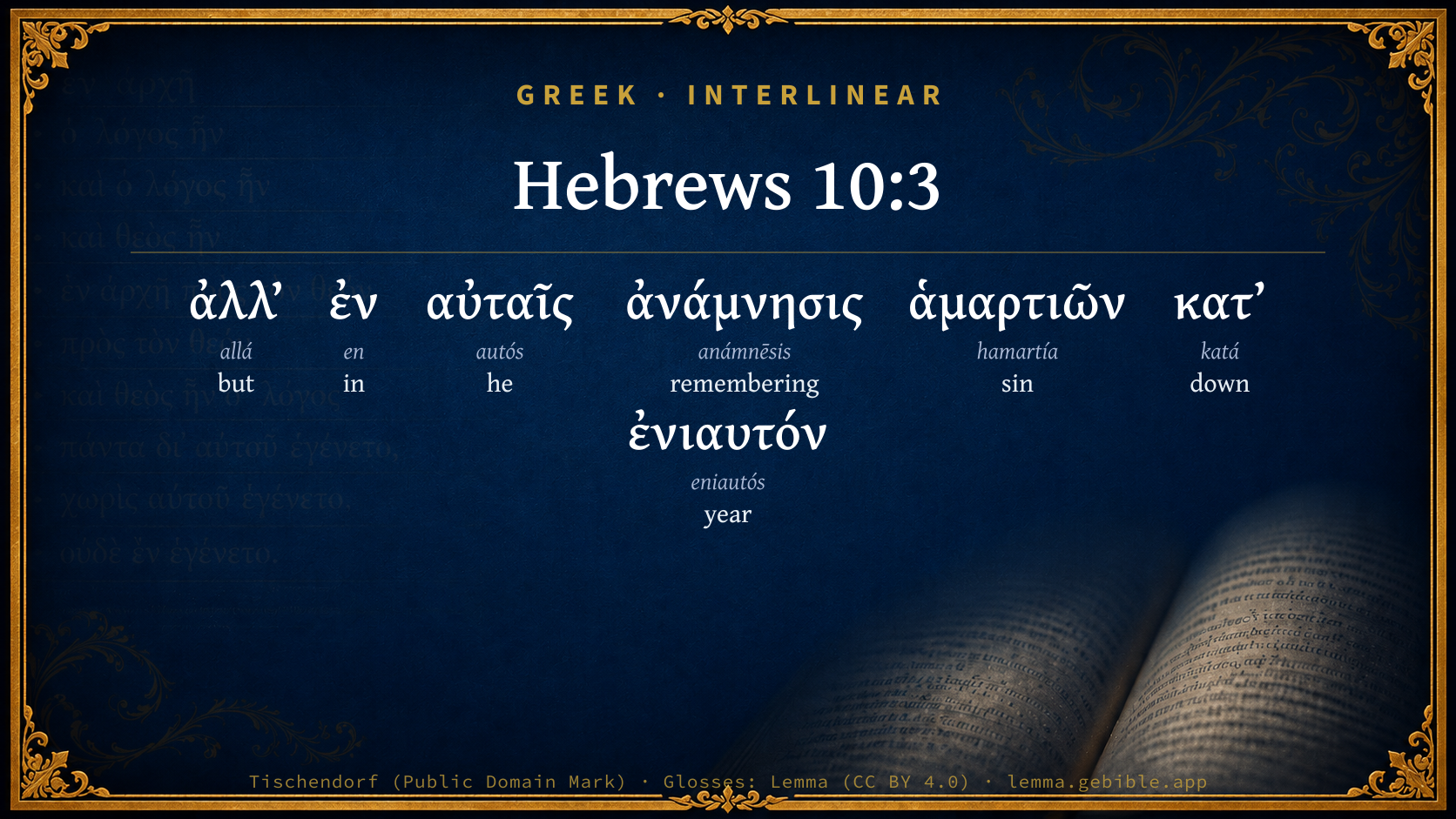
Greek (Tischendorf 8th ed.) Hebrews 10:3 appears in the Greek New Testament. The text above is from the Tischendorf 8th edition. Each word links to its Strong’s number and a concise gloss. Click any word for its full Thayer’s Greek Lexicon entry.
Download image
Cite this verse

Hebrews 10:3 (World English Bible). Public Domain. Lemma interlinear Bible study tool, https://lemma.gebible.app/v/hebrews/10/3.

Show BibTeX & RIS
BibTeX
RIS
English Translation
But in those sacrifices there is yearly reminder of sins.
World English Bible · Public Domain
Download a study sheet

One document with this verse’s original text, its word-by-word gloss line, the meaning frame, cross-references with their text, attributed commentary, and full source and license credits — printable, and it pastes into notes with its structure intact.

This verse Autodidact and up

Study sheet (.html) Plain text (.txt)

A passage Seminary Student

Up to 50 verses in one chapter. A passage sheet keeps up to 6 commentary sources and 12 cross-references per verse, in the order this page ranks them, and says so on the sheet whenever that leaves anything out. Ask for a single verse and you get the Autodidact verse sheet above.

Everything on this page stays free to read, with no account — the sheet is a download of what is already on screen, not access to it.

Want to remove ads? Support Godless Engineer
Compare translations 3

The same verse in 3 English versions, stacked beneath the original-language interlinear above. Click any original word for its lexicon entry.

Each is an independent rendering of the whole verse — the interlinear is not word-aligned to these translations.

Highlighted words mark where these versions differ — a whole-verse word diff, not a word-by-word alignment.

  • World English Bible Public Domain
    But in those sacrifices there is yearly reminder of sins.
  • King James Version Public Domain
    But in those sacrifices there is a remembrance again made of sins every year.
  • unfoldingWord Literal Text CC BY-SA 4.0
    But with those a reminder of sins every year.

unfoldingWord Literal Text — © unfoldingWord, licensed CC BY-SA 4.0. Word-aligned USFM3 via Door43 (git.door43.org/unfoldingWord/en_ult).

Versions to compare (up to 4)

3 of 4 selected

Show all 19 translations

Every available English version of this verse, each an independent rendering of the whole verse.

  • World English Bible Public Domain
    But in those sacrifices there is yearly reminder of sins.
  • Berean Standard Bible Public Domain
    Instead, those sacrifices are an annual reminder of sins,
  • Majority Standard Bible Public Domain
    Instead, those sacrifices are an annual reminder of sins,
  • King James Version Public Domain
    But in those sacrifices there is a remembrance again made of sins every year.
  • American Standard Version (1901) Public Domain
    But in those `sacrifices' there is a remembrance made of sins year by year.
  • Revised Version (1885) Public Domain
    But in those sacrifices there is a remembrance made of sins year by year.
  • Geneva Bible (1599) Public Domain
    But in those sacrifices there is a remembrance againe of sinnes euery yeere.
  • Douay-Rheims (1899) Public Domain
    But in them there is made a commemoration of sins every year.
  • Young's Literal Translation Public Domain
    but in those `sacrifices' is a remembrance of sins every year,
  • Literal Standard Version CC BY-SA 4.0
    But in those [sacrifices] is a remembrance of sins every year,
  • Unlocked Literal Bible CC BY-SA 4.0
    But with those sacrifices there is a reminder of sins year after year.
  • unfoldingWord Literal Text CC BY-SA 4.0
    But with those a reminder of sins every year.
  • Darby Bible Public Domain
    But in these [there is] a calling to mind of sins yearly.
  • World Messianic Bible Public Domain
    But in those sacrifices there is a yearly reminder of sins.
  • Webster's Bible Public Domain
    But in those sacrifices there is a remembrance again made of sins every year.
  • Free Bible Version CC BY-SA 4.0
    But in fact those sacrifices remind people of sins year after year,
  • Bible in Basic English Public Domain
    But year by year there is a memory of sins in those offerings.
  • Text-Critical English NT CC BY 4.0
    But year after year they are reminded of their sins by these sacrifices.
  • Tyndale New Testament (1534) Public Domain
    Neverthelesse in those sacrifises is ther mencion made of synnes every yeare.

Literal Standard Version (2020), Covenant Press — licensed CC BY-SA 4.0. Text via the HelloAO Bible API (eBible.org). Unlocked Literal Bible (unfoldingWord) — licensed CC BY-SA 4.0. Text via the HelloAO Bible API (eBible.org). unfoldingWord Literal Text — © unfoldingWord, licensed CC BY-SA 4.0. Word-aligned USFM3 via Door43 (git.door43.org/unfoldingWord/en_ult). Free Bible Version, Dr. Jonathan Gallagher — licensed CC BY-SA 4.0. Text via the HelloAO Bible API (eBible.org).

Word by word

More ways to search: Search by grammar → Find every occurrence → Compare this word →

Practice this passage: Drill this verse → Learn its vocabulary →

About this verse

These counts appear in no published source. They are computed here, from the morphology-tagged text and Lemma’s own curated glosses. What Lemma adds →

7
words
7
distinct lemmas
General Epistles
section

Notable vocabulary

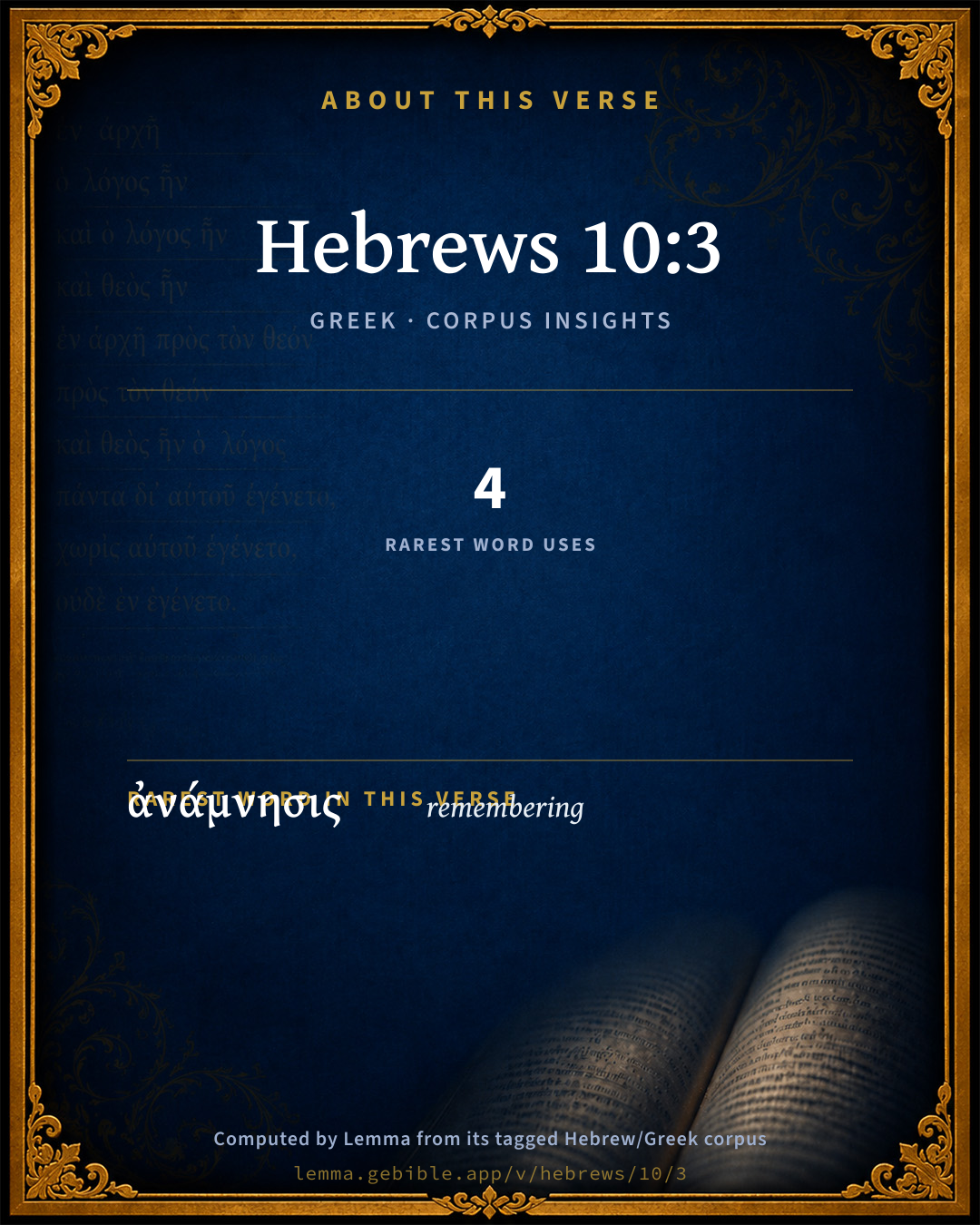
The rarest word here is ἀνάμνησις remembering G364 — appearing just 4 times in the whole Greek New Testament.

Shared distinctive vocabulary

ἀνάμνησις remembering G364 occurs in 4 verses of the Greek New Testament. Also found in:

Cross-references

10

Topical passages linked to Hebrews 10:3 in the Treasury of Scripture Knowledge — connected by theme and wording, ordered by reader-vote popularity; previews shown in the World English Bible.

  • Hebrews 9:7 but into the second the high priest alone, once in the year, not without blood, which he offers for himself, and for the errors of the people.
  • Exodus 30:10 Aaron shall make atonement on its horns once in the year; with the blood of the sin offering of atonement once in the year he shall make atonement for it throughout your generations. It is most holy to Yahweh."
  • Leviticus 16:6–11 "Aaron shall offer the bull of the sin offering, which is for himself, and make atonement for himself and for his house.
  • Leviticus 16:34 "This shall be an everlasting statute for you, to make atonement for the children of Israel once in the year because of all their sins." It was done as Yahweh commanded Moses.
  • Leviticus 23:27–28 "However on the tenth day of this seventh month is the day of atonement: it shall be a holy convocation to you, and you shall afflict yourselves; and you shall offer an offering made by fire to Yahweh.
  • Leviticus 16:21–22 Aaron shall lay both his hands on the head of the live goat, and confess over him all the iniquities of the children of Israel, and all their transgressions, even all their sins; and he shall put them on the head of the goat, and shall send him away into the wilderness by the hand of a man who is in readiness.
  • Leviticus 16:29–30 "It shall be a statute to you forever: in the seventh month, on the tenth day of the month, you shall afflict your souls, and shall do no manner of work, the native-born, or the stranger who lives as a foreigner among you:
  • Numbers 29:7–11 On the tenth day of this seventh month you shall have a holy convocation; and you shall afflict your souls: you shall do no manner of work;
  • 1 Kings 17:18 She said to Elijah, What have I to do with you, you man of God? You have come to me to bring my sin to memory, and to kill my son!
  • Matthew 26:28 for this is my blood of the new covenant, which is poured out for many for the remission of sins.

Cross-references courtesy of OpenBible.info (CC BY 4.0).

Commentary

Notes on Hebrews 10:3 from classic Christian and Jewish commentators (each source and its license shown beneath its notes). The classic Christian expositions comment on the surrounding passage and are grouped to its opening verse, so a note may address several verses; the Jewish commentaries on the Tanakh (Rashi and others) are per-verse, so they appear only where the commentator wrote on this verse.

Lemma curates 59 commentaries, every one of them public domain or Creative Commons licensed, each selected and text-cleaned for this edition rather than reprinted as found. About our sources →

The Biblical Illustrator

Joseph S. Exell

Heb_10:3

Remembrance again made of sins

Sin remembered no more:

Memory is the source both of sorrow and of joy: like the wind, which is laden both with frankincense and with unpleasant odours, which brings both pestilence and health, which both distributes genial warmth and circulates cold.

The effect of memory depends on the subject of a particular recollection. This faculty is directed to past events, and if those which memory embraces have been joyous, the effect is joyous; if they have been grievous, the effect, unless there be some counteracting influence, is grievous. Among the multitude of sorrows, which, memory awakens, none is so bitter as that which arises from the recollection of sin. The recollection of sin is in this world variously originated. Sometimes pride leads a man to dwell on his past errors. He has a very high estimate of himself, and his complacency has been disturbed by some act of transgression, upon which be is constantly looking back. Vanity moves men to remember their errors. The vain man is anxious that others should have a good opinion of him, and his mortified vanity occasions him to look back upon his past faults and failures. Or he has a selfish desire for his own happiness: he sees in the past actions which have interfered with his enjoyment, and he cherishes the remembrance of sin because sin has been drying up the fountain of his pleasures. But turning from the evil powers which originate such recollections, we may look at a broken and contrite heart. Contrition of spirit cherishes the memory of transgression. The recollection of sin is occasioned by various influences, and the effect of these remembrances is various. Sometimes the recollection of sin hardens a man; sometimes it produces strong rebellion. On other occasions it induces deep depression. The spirit of a man may sustain his infirmities, but a wounded spirit, who can bear? There is a provision for forgetting our sins. But there was no such provision under the Law, nor in any of the ceremonies that Moses ordained. On the contrary, in those sacrifices there is a remembrance again made of sins every year. That Jew would not be a true disciple to Moses and true child of Abraham who did not on the Day of Atonement call to mind his trespasses, although he had presented a trespass-offering, and all the sins he had committed, although he had presented his sin-offerings. If you look at the chapter, you will find that this passage is introduced for the sake of forming a contrast between the dispensation under Moses and the dispensation introduced by Christ. Now there is no remembrance again made of sins. We have had our day of atonement--the day upon which Christ hung on the Cross. We have had our sacrifice offered: it has been both offered and accepted. We have only to feel that it has been offered, and that it is accepted, and then the atonement which removes the outward guilt takes away also from the conscience the sense of guilt. In these sacrifices there is a remembrance again made of sins every year. But by this one offering He hath perfected for ever them that are sanctified. Here the writer penned these words for the sake of expressing something else which these words suggest to every Christian; such as these thoughts: First, God has made provision for the practical forgetting of sin in His own conduct towards a believing transgressor; and, secondly, the state of the penitents heart should respond to this provision. This provision is revealed to him on purpose that he may take advantage of it--that he may get all the peace and joy it is calculated to minister. Thou shalt not remember the reproach of thy widowhood any more. For a small moment have I forsaken thee, but with great mercies will I gather thee. For the sake of cherishing the spirit of humility, it is right to remember sin; for the sake of learning patience and forbearance and a kind and forgiving spirit towards each other; for the sake of increasing our sense of obligation to the atonement of Christ, and stimulating our gratitude for the everlasting mercy of God, it is right to remember sin; but sin should be forgotten when the remembrance of it would operate as a barrier to intercourse with God. Ye have not received the spirit of bondage again to fear, but ye have received the Spirit of adoption, whereby we cry, Abba, Father. Let us, therefore, come boldly unto the throne of grace; not with the sullenness of Cain--my punishment is greater than I can bear--but with all the loving reliance of Abel--come boldly unto the throne of grace, that we may obtain mercy, and find grace to help in time of need.

1. As an obstacle to hope, there is to be no remembrance of sins. The Lord is my light and my salvation; whom shall I fear? The Lord is the strength of my life; of whom shall I be afraid? Jehovah is the strength of my heart, and my portion for ever.

2. As a check to filial reliance, there is to be no remembrance of sin. Though He slay me, yet will I trust in Him.

3. As marring our complacency in God, there is to be no remembrance of sin. He hath reconciled us to Himself by Jesus Christ, and annihilated the distance. You who were far off are brought nigh by the blood of Christ.

4. As hindering our enjoyment in God, there is to be no remembrance of sin. You are not to ask, Whither shall I go from Thy Spirit, or whither shall I flee from Thy presence? as though you would go if you could, or as though it would be a relief to take your eye from Gods eye and your lip from Gods ear; but your resolve must be, I will go to the altar of my God, to God my exceeding joy.

5. As darkening our prospects, there is to be no remembrance of sin. He has blotted out as a thick cloud thy transgressions, and as a cloud thy sins. Why is it that some Christians do not realise all this? Why is it that sometimes fear gets the mastery over them? The answer is at hand. Many persons think that they are Christians when they are not. Their repentance has been a thoroughly selfish state of soul, and not a godly sorrow. (S. Martin.)

Reminders of sins:

As they in the time of the Law had many sacrifices to put them in remembrance of sin, so we in the time of the Gospel have many remembrancers of sin--sundry monitors to admonish us that we are sinners. The rainbow may be a remembrance of sin to us, that the world was once drowned for sin, and that it might be so still but for the goodness and mercy of God. Baptism daily ministered in the Church putteth us in mind of sin; for if we were not sinners we needed not to be baptized. The Lords Supper puts us in mind of sin: Do this in remembrance of Me, that My body was broken for you and My blood shed for you on the Cross. The immoderate showers that come oft in harvest and deprive us of the fruits of the earth may put us in mind of sin; for they be our sins that keep good things from us. Our moiling and toiling for the sustentation of ourselves with much care and wearisome labour; for if we had not sinned it should not have been so. The sicknesses and, diseases that be among us, the plague and pestilence that hath raged among us, the death of so many of our brethren and sisters continually before our eyes, &c., may put us in mind of sin; for if we had not sinned we should not have died. There be a number of things to put us in mind of sin; but there is nothing that can take away sin but Jesus Christ the Lamb of God that taketh away the sins of the world. Therefore let us all fly to this heavenly Physician for the curing of us. (W. Joules, D. D.)

The Biblical Illustrator, edited by Joseph S. Exell (c. 1880s–1900s) — public domain. Text from a community e-Sword module.

Tyndale Open Study Notes

Tyndale Open Resources

10:3 Instead of removing guilt, the ongoing sacrifices actually reminded those who wished to come near to God, year after year, that they were guilty before God.

Tyndale Open Study Notes — © Tyndale Open Resources, licensed CC BY-SA 4.0. Text via the HelloAO Bible API.

Bengel's Gnomon

Johann Albrecht Bengel

Heb 10:3. Ἐν αὐταῖς, in those) sacrifices.—ἀνάμνησις, a remembrance) public; comp. Heb 10:17.—ἁμαρτιῶν, of sins) viz. those of the last year, and of all years. The day of expiation was not on that day on which Christ was crucified, but on the tenth day of Tisri, of which see Ord. Temp., p. 22. The forgetting [the “remembering no more”] of sins is opposed to this admonitory remembrance: Heb 10:17.—κατʼ ἐνιαυτὸν, yearly) An Epanalepsis;[57] comp. Heb 10:1. He is speaking chiefly of the solemn yearly sacrifices.

[57] See Append. The same word in beginning of the preceding and in the end of the following member: or antecedent repeated after a parenthesis.—ED.

Bengel's Gnomon of the New Testament — English translation (T&T Clark, Edinburgh, 1860) — public domain. Text from a community e-Sword module.

Meyer's Critical & Exegetical Commentary

Heinrich August Wilhelm Meyer

Heb_10:3. Contrast to τὸ μηδεμίαν ἔχειν ἔτι συνείδησιν ἁμαρτιῶν τοὺς λατρεύοντας. In such wise, however, that the offerers should have no more consciousness of guilt, the matter does not stand; on the contrary, there lies in the yearly repetition of the sacrifices the yearly reminder that sins are still remaining, and have to be expiated.[97] Comp. Philo, de Victim. p. 841 A (with Mangey, II. p. 244): Εὔηθες γὰρ τὰς θυσίας μὴ λήθην ἁμαρτημάτων, ἀλλʼ ὑπόμνησιν αὐτῶν κατασκευάζειν.

De plantat. Noë, p. 229 B (I. p. 345): αἱ … θυσίαι … ὑπομιμνήσκουσαι τὰς ἑκάστων ἀγνοίας τε καὶ διαμαρτίας.

Vit. Mos. 3. p. 669 E (II. p. 151): Καὶ γὰρ ὁπότε γίνεσθαι δοκοῦσιν (sc. the θυσίαι, and ΕὐΧΑΊ of the impious), Οὐ ΛΎΣΙΝ ἉΜΑΡΤΗΜΆΤΩΝ ἈΛΛʼ ὙΠΌΜΝΗΣΙΝ ἘΡΓΆΖΟΝΤΑΙ.

ἘΝ ΑὐΤΑῖς] sc. ταῖς θυσίαις.

ἀνάμνησις] not: commemoratio (Vulgate, Calvin, Clarius, al.) or commemoratio publica (Bengel and others), so that we must think of the confession of sin (tract. Jom. iv. 2, iii. 8, vi. 2) which the high priest made on the great day of atonement with regard to himself and the whole people (Schlichting, Grotius, Braun, al.); but: reminding, recalling to memory. Comp. 1Co_11:24-25; Luk_22:19.

[97] To join on the words of ver. 3 to those of ver. 1, and then to look upon ver. 2 as a parenthesis (Kurtz, Hofmann), is inadmissible, evenapart from the ἀλλά, of frequent use after a questionbecause ἀνάμνησις ἁμαρτιῶν, ver. 3, points back to the kindred συνείδησιν ἁμαρτιῶν, ver. 2.

Meyer — Critical and Exegetical Commentary on the New Testament — English translation by Peter Christie, edited by Frederick Crombie (T&T Clark, 1880) — public domain. Text from a community e-Sword module.

Jamieson, Fausset & Brown

Robert Jamieson, A. R. Fausset & David Brown

But--so far from those sacrifices ceasing to be offered (Heb 10:2).

in, &c.--in the fact of their being offered, and in the course of their being offered on the day of atonement. Contrast Heb 10:17.

a remembrance--a recalling to mind by the high priest's confession, on the day of atonement, of the sins both of each past year and of all former years, proving that the expiatory sacrifices of former years were not felt by men's consciences to have fully atoned for former sins; in fact, the expiation and remission were only legal and typical (Heb 10:4, Heb 10:11). The Gospel remission, on the contrary, is so complete, that sins are "remembered no more" (Heb 10:17) by God. It is unbelief to "forget" this once-for-all purgation, and to fear on account of "former sins" (Pe2 1:9). The believer, once for all bathed, needs only to "wash" his hands and "feet" of soils, according as he daily contracts them, in Christ's blood (Joh 13:10).

Jamieson, Fausset & Brown — Commentary Critical and Explanatory on the Whole Bible (1871) — public domain (CC PDM 1.0). Text via the HelloAO Bible API.

John Calvin's Commentaries

3. A remembrance again, etc. Though the Gospel is a message of reconciliation with God, yet it is necessary that we should daily remember our sins; but what the Apostle means is, that sins were brought to remembrance that guilt might be removed by the means of the sacrifice then offered. It is not, then, any kind of remembrance that is here meant, but that which might lead to such a confession of guilt before God, as rendered a sacrifice necessary for its removal.

Such is the sacrifice of the mass with the Papists; for they pretend that by it the grace of God is applied to us in order that sins may be blotted out. But since the Apostle concludes that the sacrifices of the Law were weak, because they were every year repeated in order to obtain pardon, for the very same reason it may be concluded that the sacrifice of Christ was weak, if it must be daily offered, in order that its virtue may be applied to us. With whatever masks, then, they may cover their mass, they can never escape the charge of an atrocious blasphemy against Christ.

John Calvin's Commentaries (1540-1563) — public domain. Text from the Calvin Translation Society English edition (1840s-50s) via the Christian Classics Ethereal Library (ccel.org). Calvin's coverage is partial (roughly two-thirds of the Bible); uncommented books and verses are honest gaps, never fabricated. The 19th-century editor's footnotes and remarks are omitted so the notes are faithfully Calvin's own voice.

Ellicott's Commentary for English Readers

(3) There is a remembrance.—Better, a remembrance of sins is made year by year. In each of the three prayers of the high priest (see Heb_5:3) for himself and his house, for the priesthood, for the people, he made special acknowledgment of sin. “I have sinned, I and my house and the sons of Aaron: Thy people have done perversely.”

A Bible Commentary for English Readers, edited by Charles John Ellicott (1878–1897) — public domain. Text from a community e-Sword module.

The Cambridge Bible for Schools and Colleges

gen. ed. J. J. S. Perowne

3. there is a remembrance again made of sins] This view of sacrifices—that they are “a calling to mind of sins yearly”—is very remarkable. It seems to be derived from Num_5:15, where “the offering of jealousy” is called “an offering of memorial, bringing iniquity to remembrance.” Philo also speaks of sacrifices as providing “not an oblivion of sins, but a reminding of them.” De plant. Noe, § 25. De Vit. Mos. iii. § 10 (Opp. i. 345, ii. 246). But if the sacrifices thus called sins to remembrance, they also daily symbolised the means of their removal, so that when offered obediently with repentance and faith they became valid symbols.

The Cambridge Bible for Schools and Colleges (gen. ed. J. J. S. Perowne; Cambridge University Press, 1878–1918) — public domain. Text from a community e-Sword module.

John Gill's Exposition

But in those sacrifices,.... The Arabic version reads, "but in it"; that is, in the law; but the Syriac version reads, and supplies, as we do, , "in those sacrifices", which were offered every year on the day of atonement:

there is a remembrance of sins made again every year; of all the sins that were committed the year past, and even of those that were expiated typically by the daily sacrifice, and others that had been offered; which proves the imperfection and insufficiency of such sacrifices: there was a remembrance of sins by God, before whom the goats were presented, their blood was sprinkled, and the people cleansed, Lev 16:7 and there was a remembrance of them by the people, who, on that day, afflicted their souls for them, Lev 16:29 and there was a remembrance of them by the high priest, who confessed them over, and put them upon the head of the goat, Lev 16:21 by which it was owned, that these sins were committed; that they deserved death, the curse of the law; that the expiation of them was undertook by another, typified by the goat; that this was not yet done, and therefore there was no remission, but a typical one, by these sacrifices; but that sins remained, and required a more perfect sacrifice, which was yet to be offered up. Legal sacrifices were so far from inducing an oblivion of sins, that they themselves brought them to remembrance, and were so many acknowledgments of them. Though Philo the Jew thinks the contrary, and gives this as a reason why the heart and brain were not offered in sacrifice, because

"it would be foolish, that the sacrifices should cause, not a forgetfulness of sins, but a remembrance of them (q).''

(q) De Victimis, p. 841.

John Gill's Exposition of the Whole Bible (1746–1763) — public domain (CC PDM 1.0). Text via the HelloAO Bible API.

Trapp's Complete Commentary

John Trapp

3 But in those sacrifices there is a remembrance again made of sins every year.

Ver. 3. Made of sins every year] A solemn confession of them, and what great need they had of a Saviour to expiate them, laying their hands on the head of the sacrifice, in token that they had in like sort deserved to be destroyed.

John Trapp, A Commentary or Exposition upon All the Books of the Old and New Testament (1647–1656) — public domain. Text from a community e-Sword module.

Albert Barnes' Notes on the Bible

But in those sacrifices there is a remembrance again made of sins every year - The reference here is to the sacrifices made on the great day of atonement. This occurred once in a year. Of course as often as a sacrifice was offered, it was an acknowledgment of guilt on the part of those for whom it was made. As these sacrifices continued to be offered every year, they who made the offering were reminded of their guilt and their desert of punishment. All the efficacy which could be pretended to belong those sacrifices, was that they made expiation for the past year. Their efficacy did not extend into the future, nor did it embrace any but those who were engaged in offering them. These sacrifices, therefore, could not make the atonement which man needed. They could not make the conscience easy; they could not be regarded as a sufficient expiation for the time to come, so that the sinner at any time could plead an offering which was already made as a ground of pardon, and they could not meet the wants of all people in all lands and at all times. These things are to be found only in that great sacrifice made by the Redeemer on the cross.

Albert Barnes' Notes on the Bible (1834–1885) — public domain. Text from a community e-Sword/MySword module.

Haydock's Catholic Bible Commentary

But in them a remembrance of sins is made every year. For it is impossible that with the blood of oxen and goats sins should be taken way. The sacrifices of the former law, even that great sacrifice on the day of expiation, when victims were offered for the ignorances or sins of the priests, and of all the people, were only types and figures of Christ’s sacrifice upon the cross, it was impossible that they themselves should take away sins, like that one oblation of Christ, though in them was made a remembrance of sins, and of the same sins for which so many victims had been offered. (Witham)

George Leo Haydock (1774–1849), Haydock's Catholic Family Bible and Commentary, 1859 edition — public domain. Excludes Psalms (Douay-Rheims chapter numbering differs from Protestant) and Deuterocanonical books (Catholic canon only).

Matthew Poole's English Annotations

If the legal sacrifices could have perfected their offerers, there would have been no remembrance of sins; but there is a remembrance of sins yearly, therefore they are weak and cannot perfect. These shadowy-sacrifices yearly reiterated, still left sins in their guilt and killing power, loading and grinding the conscience by accusation and condemnation for them, as well as setting them in the light of God’s countenance. For in the expiation day Aaron was to remember and to confess over the head of the scape-goat, laying his hands on it, all the church’s sins of the past year and life, notwithstanding former expiatory sacrifices offered for them, Lev 16:22. For as soon as that was done, their expiating virtue vanished, and so they renewed sacrifices without any spiritual profit by them, the guilt of past and present sins remaining still: whereas Christians now renewing sin, do renew their faith and repentance, but not their sacrifice for it; the virtue of which, in a full and final absolution, applied to them by the Spirit, makes them to have, upon their final accounts, no conscience of sin for ever.

Matthew Poole's English Annotations on the Holy Bible (1683–1685) — public domain. Text from a community e-Sword/MySword module.

Whedon's Commentary on the Bible

Daniel D. Whedon

3. But these sacrifices, so far from being an abolition of sins, are a reminder and remembrance of sins, every year; namely, on the day of atonement.

Daniel D. Whedon (gen. ed.), Commentary on the Old and New Testaments (1874–1909) — public domain. Text from a community e-Sword module.

The Pulpit Commentary

Reminding men of sins.

I THE NEED OF SUCH A REMINDER. Men need to be impressed with the fact that sin is sin, something special, something done in defiance of God"s Law. If we do hurt to a fellow-man, even if he condone and excuse, that does not put things as they were before. God would have us to consider what a serious and terrible thing it is that we should do wrong at all. Then also we need to be reminded because of our liability to forget. Life is one long sin, made up of daily omissions and commissions in what are called little things. We see well enough as each day is passing over our heads what wrong words we have spoken, what evil thoughts we have had in our hearts; some days we feel deeply enough the sin of the day; but soon the impression is gone. The total of life"s sin, however, still remains, and it is above all things needful that we should not forget it. Then most important of all, perhaps, is it that we should be reminded how much of the trouble and misery of life comes from our ignorance. Sins of ignorance were specially provided for in the Mosaic economy. A man can hardly be blamed for what he does in ignorance, and certainly he is in a very different position from one who lets lust and pride lead him against truth and light. But the evil done in ignorance is evil none the less, and men need to be wakened up to consider how much truth and righteousness they are still ignorant of. The past is not done with because it is past. The future has its roots in the past, and this yearly reminder of sin among God"s people of old should teach us to desire reminders of the sin of life, not merely at particular seasons, but as often as possible.

II WE HAVE OUR REMINDERS OF SIN. Bodily reminders in the shape of disease and weakness consequent on evil courses of life. Reminders in the feelings of the heart consequent on disappointment and failure from selfish courses of action. Especially the Christian, the devout Christian, has his reminders at the Lord"s Supper. Jesus himself spoke of this institution as an anamnhsiv . It was to remind his people of himself, but this very reminding included many things beside. Jesus must be remembered with certain surroundings, and no sinner can remember him rightly without remembering his sins at the same time. Y.

The Pulpit Commentary (1880–1919), ed. H.D.M. Spence-Jones & Joseph S. Exell — public domain. Text from a community e-Sword module.

John Wesley's Explanatory Notes

There is a public commemoration of the sins both of the last and of all the preceding years; a clear proof that the guilt thereof is not perfectly purged away.

John Wesley, Explanatory Notes Upon the Whole Bible (1754–1765) — public domain. Text via the GEBible commentary corpus.

Scofield Reference Notes

C. I. Scofield

sins

Sin

(See Scofield Rom 3:23).

The Scofield Reference Bible (1917 edition), notes by C. I. Scofield — public domain. Text from a community e-Sword module.

The People's New Testament

B. W. Johnson

3. There is a remembrance, etc. Besides the daily sacrifices, and the individual sacrifices, there was repeated every year the atonement for the whole nation. There were daily, monthly, and yearly sacrifices.

B. W. Johnson's The People's New Testament with Notes (1889–1891) — public domain. Electronic text from the Christian Classics Ethereal Library (CCEL) ThML edition.

Cambridge Greek Testament for Schools and Colleges

3. ἀνάμνησις ἁμαρτιῶν. This view of sacrifices—that they are “a calling to mind of sins yearly”—is very remarkable. It seems to be derived from Num 5:15, where “the offering of jealousy” is called “an offering of memorial, bringing iniquity to remembrance.” Philo also speaks of sacrifices as providing “not an oblivion of sins, but a reminding of them.” De plant. Noe, § 25. De Vit. Mos. III. § 10 (Opp. I. 345, II. 246). But if the sacrifices thus called sins to remembrance, they also daily symbolised the means of their removal, so that when offered obediently with repentance and faith they became valid symbols.

Cambridge Greek Testament for Schools and Colleges (Cambridge University Press, 1896; 21 vols, various authors incl. Carr, Maclear, Plummer, Farrar, Lumby, Moule, M. R. James, Simcox) — public domain. Text from a community e-Sword module.

Alford’s Greek Testament

Henry Alford

3.] Which cessation is far from being the case, as is the having no more conscience of sin:—But (on the contrary: ἀλλά opposes the whole question of ver. 2, in both its clauses) in them (the sacrifices: not in the fact of their being offered, but in the course of their being offered on the day of atonement, see below) there is a recollection (‘recalling to mind;’ the usual meaning of ἀνάμνησις: better than “public mention,” as vulg., “commemoratio,” Calv., Bengel, al.: so also Schlichting, Grot., Jac. Cappell., al., thinking on the solemn confession of the sins of Israel made by the high priest, Lev 16:20 f. But the other is simpler, and suits the context better. Where sins are continually called to mind, there clearly the conscience is not clear from them. Several passages occur in Philo closely resembling this: e. g. De Plant. Noë, 25, vol. i. p. 345, βωμοῖς γὰρ ἀπύροις περὶ οὓς ἀρεταὶ χορεύουσι γέγηθεν ὁ θεός, ἀλλʼ οὐ πολλῷ πυρὶ φλέγουσιν, ὅπερ αἱ τῶν ἀνιέρων ἄθυτοι θυσίαι συνανέφλεξαν, ὑπομιμνήσκουσαι τὰς ἑκάστων ἀγνοίας τε καὶ διαμαρτίας. καὶ γὰρ εἶπέ που Μωυσῆς (Num 5:15, θυσία μνημοσύνου ἀναμιμνήσκουσα ἁμαρτίαν) θυσίαν ἀναμιμνήσκουσαν ἁμαρτίαν: De Victim. 7, vol. ii. p. 244, εὔηθες γάρ, τὰς θυσίας μὴ λήθην ἁμαρτημάτων, ἀλλʼ ὑπόμνησιν αὐτῶν κατασκευάζειν: and Vita Mos. iii. 10, p. 151, εἰ μὲν γὰρ ἀγνώμων καὶ ἄδικος, ἄθυτοι θυσίαι, καὶ ἀνίεροι ἱερουργίαι, καὶ εὐχαὶ παλίμφημοι, παντελῆ φθοραὶ ἐνδεχόμεναι. καὶ γὰρ ὁπότε γίνεσθαι δοκοῦσιν, οὐ λύσιν ἁμαρτημάτων, ἀλλʼ ὑπόμνησιν ἀργάζονται) of sins year by year:

Henry Alford, The Greek Testament (1849–1861) — public domain. Text from a community e-Sword module.

Vincent's Word Studies in the New Testament

Marvin R. Vincent

A remembrance of sins [αναμνησις αμαρτιων] . Each successive sacrifice was a fresh reminder of sins to be atoned for; so far were the sacrifices from satisfying the conscience of the worshipper. jAnamnhsiv, lit. a calling to mind. Comp. ver. 17, and see LXX, Num 5:15.

Marvin R. Vincent, Word Studies in the New Testament (1887–1900) — public domain. Text from a community e-Sword/MySword module.

Westcott on Hebrews & the Epistles of John

Brooke Foss Westcott

3. ἀλλ᾽ ἐν αὐτ.) But in them sins are called to remembrance... That is: ‘so fur from tho sacrifices being discontinued because they have fulfilled thoir work, thoy sorve in fact to keep alive the recolloction of sin as a present burdon.’ This seoms to be on the whole the simplest and most natural explanation of ἀλλά. It is however possible to take dwel...xexabapiσμένους as parenthetical, and to take ἀλλά a8 introducing a direct continua-

. ἀνάμνησις dy.] not simply ‘a remembrance’ or ‘a record mado’ of sins (Vulg. commemoratio peccatorum), but α calling to mind of sins, whereby men are put in remembrance of them by a divine institution. This is more than a public acknowledgmont and confeasion of sinus, such as at present (aud by immemorial usage) forms au important part of the synagogue sorvice for the Day of Atonoment.

So Philo speaks of sacrifices as a De vit. Dfos. iii. § 10), but when they are rightly offered he assigns to them real efficacy (de vict, § 7). Compare Num. v. 15 (LXxx.) θυσία μνημοσύνον ἀναμιμνήσκουσα ἁμαρτίαν, of which the opposite is expressed in »v. 17 (τών

xi. 24 f.), to bring to men’s minds the recollection of the redemption which He has accomplished. The word is not found elsewhere in the N.T. ᾿Αναμιμνήσκειν (act.) occurs 1 Cor. iv. 17; 2 Tim. i. 6.

In the Lxx. ἀνάμνησις is found Lev. xxiv. 7 (comp. fi. 2); Num. x. 10; Wied. xvi. 6. Oomp. [Sym.] Pa. vi. 6; exxxiv. 13.

κατ᾽ ἐνιαυτόν] The words arerepentod from ὁ. 1, Tho thought of sin is brought homo in various aspocts by the wholo system of sacrifice year by year.

Brooke Foss Westcott (1825–1901), The Epistle to the Hebrews (1889) and The Epistles of St John (1883) — public domain (pre-1929). Text recovered from Internet Archive / Google Books OCR scans. Westcott’s Gospel of John commentary is not included (its OCR lost the chapter running-heads required for reliable verse-keying). Some Greek quoted in the Hebrews volume is imperfectly rendered by the OCR.

Lesson kit

Teaching starters — assembled from the data on this page, not authored interpretation. Every prompt links to the verse data it draws on. Edit before teaching.

Hebrews, in the General Epistles, opens this verse with 7 words (7 distinct Greek lemmas). Its most distinctive word is anámnēsis (“remembering”). A historical commentator’s framing appears above. Read the whole chapter for the surrounding context.

Discussion questions

  1. What does “remembering” (anámnēsis) contribute to the verse as a whole?
  2. Luke 22:19 shares the word «remembering» with this verse. How do the two illuminate each other?
  3. These translations render this verse differently; the difference is in the English rendering, not the original. What questions does that raise?
  4. Reading how The Biblical Illustrator and Tyndale Open Study Notes read this verse, where do the two commentators agree and where do they part?

Things to notice

Reading settings

Reading text

Shown beneath each verse's original-language words.

Old Testament
Old Testament edition

Read the OT as the Masoretic Hebrew (MT) or the Greek Septuagint (LXX).

English shown for the Greek Septuagint (in the Hebrew ↔ Greek comparison).

Comparing translations? Open the Compare panel on any verse page to stack up to four side by side.