Luke 7:48

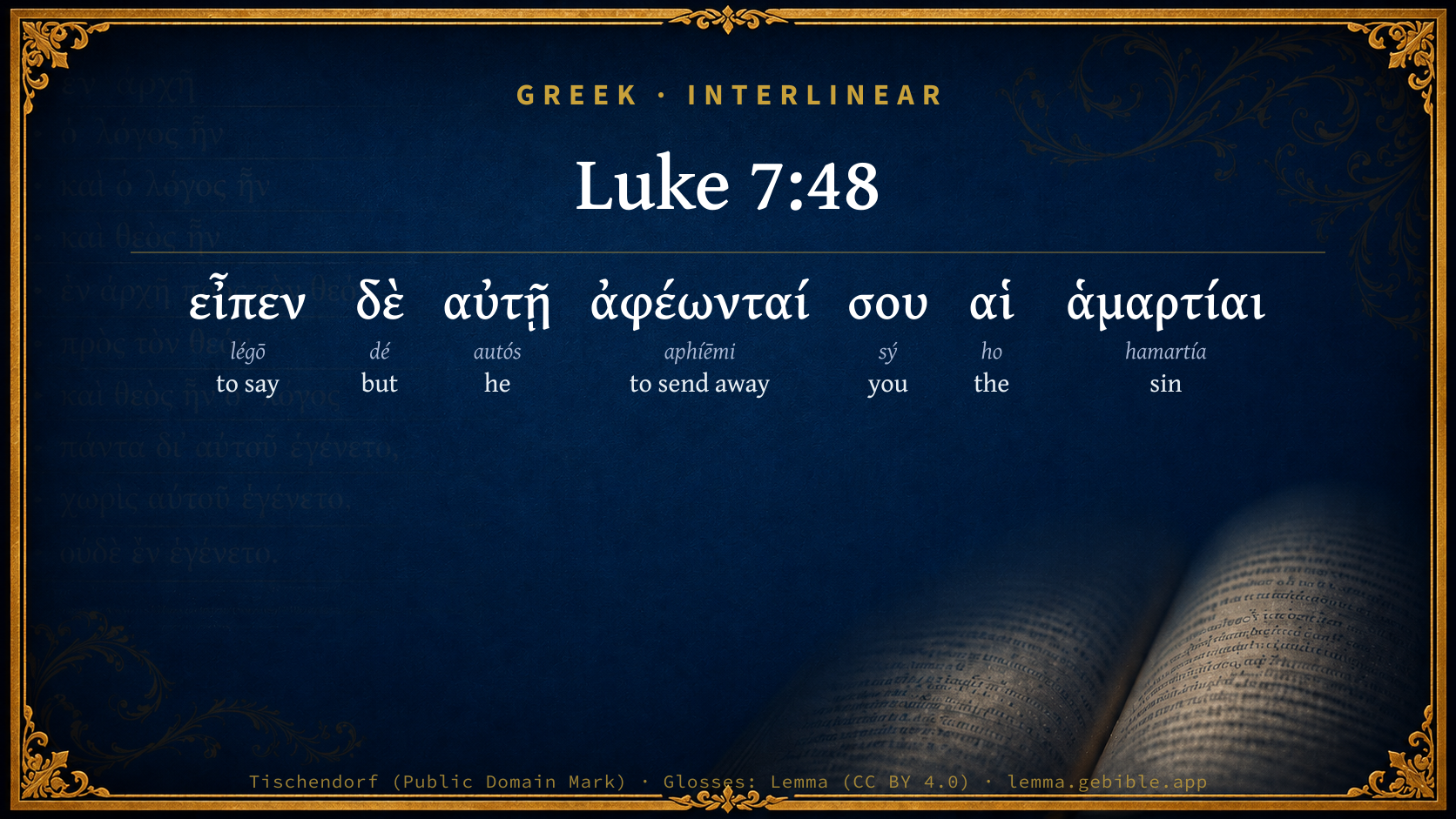
Greek (Tischendorf 8th ed.) Luke 7:48 appears in the Greek New Testament. The text above is from the Tischendorf 8th edition. Each word links to its Strong’s number and a concise gloss. Click any word for its full Thayer’s Greek Lexicon entry.
Download image
Cite this verse

Luke 7:48 (World English Bible). Public Domain. Lemma interlinear Bible study tool, https://lemma.gebible.app/v/luke/7/48.

Show BibTeX & RIS
BibTeX
RIS
English Translation
He said to her, "Your sins are forgiven."
World English Bible · Public Domain
Download a study sheet

One document with this verse’s original text, its word-by-word gloss line, the meaning frame, cross-references with their text, attributed commentary, and full source and license credits — printable, and it pastes into notes with its structure intact.

This verse Autodidact and up

Study sheet (.html) Plain text (.txt)

A passage Seminary Student

Up to 50 verses in one chapter. A passage sheet keeps up to 6 commentary sources and 12 cross-references per verse, in the order this page ranks them, and says so on the sheet whenever that leaves anything out. Ask for a single verse and you get the Autodidact verse sheet above.

Everything on this page stays free to read, with no account — the sheet is a download of what is already on screen, not access to it.

Want to remove ads? Support Godless Engineer
Compare translations 3

The same verse in 3 English versions, stacked beneath the original-language interlinear above. Click any original word for its lexicon entry.

Each is an independent rendering of the whole verse — the interlinear is not word-aligned to these translations.

Highlighted words mark where these versions differ — a whole-verse word diff, not a word-by-word alignment.

  • World English Bible Public Domain
    He said to her, "Your sins are forgiven."
  • King James Version Public Domain
    And he said unto her, Thy sins are forgiven.
  • unfoldingWord Literal Text CC BY-SA 4.0
    Then he said to her, “Your sins are forgiven.”

unfoldingWord Literal Text — © unfoldingWord, licensed CC BY-SA 4.0. Word-aligned USFM3 via Door43 (git.door43.org/unfoldingWord/en_ult).

Versions to compare (up to 4)

3 of 4 selected

Show all 19 translations

Every available English version of this verse, each an independent rendering of the whole verse.

  • World English Bible Public Domain
    He said to her, "Your sins are forgiven."
  • Berean Standard Bible Public Domain
    Then Jesus said to her, “Your sins are forgiven.”
  • Majority Standard Bible Public Domain
    Then Jesus said to her, “Your sins are forgiven.”
  • King James Version Public Domain
    And he said unto her, Thy sins are forgiven.
  • American Standard Version (1901) Public Domain
    And he said unto her, Thy sins are forgiven.
  • Revised Version (1885) Public Domain
    And he said unto her, Thy sins are forgiven.
  • Geneva Bible (1599) Public Domain
    And he saide vnto her, Thy sinnes are forgiuen thee.
  • Douay-Rheims (1899) Public Domain
    And he said to her: Thy sins are forgiven thee.
  • Young's Literal Translation Public Domain
    And he said to her, `Thy sins have been forgiven;'
  • Literal Standard Version CC BY-SA 4.0
    And He said to her, “Your sins have been forgiven”;
  • Unlocked Literal Bible CC BY-SA 4.0
    Then he said to her, “Your sins are forgiven.”
  • unfoldingWord Literal Text CC BY-SA 4.0
    Then he said to her, “Your sins are forgiven.”
  • Darby Bible Public Domain
    And he said to her, Thy sins are forgiven.
  • World Messianic Bible Public Domain
    He said to her, “Your sins are forgiven.”
  • Webster's Bible Public Domain
    And he said to her, Thy sins are forgiven.
  • Free Bible Version CC BY-SA 4.0
    Then Jesus said to the woman, “Your sins have been forgiven.”
  • Bible in Basic English Public Domain
    And he said to her, You have forgiveness for your sins.
  • Text-Critical English NT CC BY 4.0
    Then Jesus said to her, “Yoʋr sins are forgiven.”
  • Tyndale New Testament (1534) Public Domain
    And he sayde vnto her thy synnes are forgeven the.

Literal Standard Version (2020), Covenant Press — licensed CC BY-SA 4.0. Text via the HelloAO Bible API (eBible.org). Unlocked Literal Bible (unfoldingWord) — licensed CC BY-SA 4.0. Text via the HelloAO Bible API (eBible.org). unfoldingWord Literal Text — © unfoldingWord, licensed CC BY-SA 4.0. Word-aligned USFM3 via Door43 (git.door43.org/unfoldingWord/en_ult). Free Bible Version, Dr. Jonathan Gallagher — licensed CC BY-SA 4.0. Text via the HelloAO Bible API (eBible.org).

Word by word

More ways to search: Search by grammar → Find every occurrence → Compare this word →

Practice this passage: Drill this verse → Learn its vocabulary →

ἀφέωνταί
aphíēmi
G863
“to send away”
Verb, Perfect, Passive, Indicative, 3rd person, Plural
Part of Speech
Verb
Tense
Perfect
Voice
Passive
Mood
Indicative
Person
3rd person
Number
Plural
Full Thayer's Definition

Origin: from G575 and hiemi (to send, an intens. form of eimi, to go)

TDNT: 09:29,9

1. to send away a. to bid going away or depart 1. of a husband divorcing his wife b. to send forth, yield up, to expire c. to let go, let alone, let be 1. to disregard 2. to leave, not to discuss now, (a topic) 1c 2. of teachers, writers and speakers 1. to omit, neglect a. to let go, give up a debt, forgive, to remit b. to give up, keep no longer 3. to permit, allow, not to hinder, to give up a thing to a person 4. to leave, go way from one a. in order to go to another place b. to depart from any one c. to depart from one and leave him to himself so that all mutual claims are abandoned d. to desert wrongfully e. to go away leaving something behind f. to leave one by not taking him as a companion g. to leave on dying, leave behind one h. to leave so that what is left may remain, leave remaining i. abandon, leave destitute
  1. εἶπεν légō G3004 “to say” Verb, Aorist, Active, Indicative, 3rd person, Singular
  2. δὲ dé G1161 “but” Conjunction
  3. αὐτῇ autós G846 “he” Personal pronoun, Dative, Singular, Feminine
  4. σου sý G4771 “you” Personal pronoun, 2nd person, Genitive, Singular
  5. αἱ ho G3588 “the” Article, Nominative, Plural, Feminine
  6. ἁμαρτίαι hamartía G266 “sin” Noun, Nominative, Plural, Feminine

About this verse

These counts appear in no published source. They are computed here, from the morphology-tagged text and Lemma’s own curated glosses. What Lemma adds →

7
words
7
distinct lemmas
Gospels
section

Cross-references

3

Topical passages linked to Luke 7:48 in the Treasury of Scripture Knowledge — connected by theme and wording, ordered by reader-vote popularity; previews shown in the World English Bible.

  • Matthew 9:2 Behold, they brought to him a man who was paralyzed, lying on a bed. Jesus, seeing their faith, said to the paralytic, "Son, cheer up! Your sins are forgiven you."
  • Mark 2:5 Jesus, seeing their faith, said to the paralytic, "Son, your sins are forgiven you."
  • Luke 5:20 Seeing their faith, he said to him, "Man, your sins are forgiven you."

Cross-references courtesy of OpenBible.info (CC BY 4.0).

Commentary

Notes on Luke 7:48 from classic Christian and Jewish commentators (each source and its license shown beneath its notes). The classic Christian expositions comment on the surrounding passage and are grouped to its opening verse, so a note may address several verses; the Jewish commentaries on the Tanakh (Rashi and others) are per-verse, so they appear only where the commentator wrote on this verse.

Lemma curates 59 commentaries, every one of them public domain or Creative Commons licensed, each selected and text-cleaned for this edition rather than reprinted as found. About our sources →

The Biblical Illustrator

Joseph S. Exell

Luk_7:48

Thy sins are forgiven

Assurance of forgiveness

It is not enough that our sins are pardoned in heaven, but we are to endeavour and seek after the particular assurance of the pardon of them to our own consciences for our further comfort.

Unknown things are not desired. How, then, can they be rejoiced in? Say a man be in prison for treason fast bound, and that a pardon is granted to him, yet, till he knows thereof, he can rejoice no more in that his happiness than if he were to be executed the next day. (N. Rogers.)

Personal assurance

This serves to stir us up earnestly to seek after particular assurance of the remission of sins, as we desire true comfort to our souls. Let a man know never so much of God and of Christ His Son, yet the general apprehension of these things will but add a kind of vexation to his spirit, till he have assurance of some special interest he hath in Gods mercies. What a torment is it for a hunger-starved beggar to pass by a wedding-house, and smell good cheer, yet (Tantalus like) never taste of it? What a vexation to a poor man to see a great dole given, and multitudes relieved by it, yet he get nothing? So is it certainly in this case; the more any man knoweth of Christ, and of the plenteous redemption that is by Him purchased through His blood, the greater must the horror of his soul be when he findeth that he hath no part therein. (N. Rogers.)

The blessing of forgiveness

The text may suggest to us four subjects or heads of consideration.

1. The forgiveness of sin.

2. The forgiver of sin.

3. The means of forgiveness.

4. The blessed effect in the heart of man--Go in peace. (J. Slade, M. A.)

Pardon available for the greatest sinner

When the last war had passed, the Government of the United States made proclamation of pardon to the common soldiery in the Confederate army, but not to the chief soldiers. The gospel of Christ does not act in that way. It says pardon for all, but especially for the chief of sinners. I do not now think of a single passage that says a small sinner may be saved; but I do think of passages that say a great sinner may be saved. If there be sins only faintly hued, just a little tinged, so faintly coloured you can hardly see them, there is no special pardon promised in the Bible for those sins; but if they be glaring--red like crimson--then they shall be as snow. Now, my brethren, I do not state this to put a premium on great iniquity. I merely say this to encourage that man in this house who feels he is so far gone from God that there is no mercy for him. I want to tell him there is a good chance. (Dr. Talmage.)

The Biblical Illustrator, edited by Joseph S. Exell (c. 1880s–1900s) — public domain. Text from a community e-Sword module.

Bengel's Gnomon

Johann Albrecht Bengel

Luk 7:48. Ἀφέωνται, are forgiven) Forgiveness is not now for the first time given to the woman, but is confirmed to her. The greatest sinners often become the largest vessels of grace. Even at table the Saviour used “the power of the keys.”

Bengel's Gnomon of the New Testament — English translation (T&T Clark, Edinburgh, 1860) — public domain. Text from a community e-Sword module.

Meyer's Critical & Exegetical Commentary

Heinrich August Wilhelm Meyer

Luk_7:48. The Pharisee is dismissed, and now Jesus satisfies the womans need, and gives her the formal and direct assurance of her pardoned condition. Subjectively she was already in this condition through her faith (Luk_7:50), and her love was the result thereof (Luk_7:47); but the objective assurance, the declared absolution on the part of the forgiver, now completed the moral deliverance (Luk_7:50) which her faith had wrought.

Meyer — Critical and Exegetical Commentary on the New Testament — English translation by Peter Christie, edited by Frederick Crombie (T&T Clark, 1880) — public domain. Text from a community e-Sword module.

Expositor's Greek Testament

ed. W. Robertson Nicoll

Luk 7:48 . ἀφέωνται : direct assurance of forgiveness, for confirmation of her faith tried by an unsympathetic surrounding of frowning Pharisees.

The Expositor's Greek Testament, edited by W. Robertson Nicoll (1897–1910) — public domain. Text from a community e-Sword module.

Godet's Commentaries

Frédéric Louis Godet

Vers. 48-50. Conclusion.

Bleek has inferred from Luk 7:48, thy sins are forgiven thee, that until this moment the woman had not obtained forgiveness. This supposition is excluded by all that precedes. Bleek forgets that ἀφέωνται is a perfect indicating an actual state resulting from an act accomplished at some indefinite time in the past. Having regard to the pharisaical denials of the persons composing the assembly, and to the doubts which might arise in the heart of the sinning woman herself, Jesus renews to her the assurance of the divine fact of which she had within her the witness and warrant. This direct and personal declaration corresponds with the inward witness of the Divine Spirit in our own experience, after we have embraced the promises of the Word (Eph 1:13).

On the objection, Luk 7:49, comp. Luk 7:21. Καί, even; besides all the other extraordinary things He does.

Jesus continues as if He had not heard, but all the while taking account of what was being said around Him (εἶπε δέ, “but He said”). While addressing the woman, He shows the people assembled the firm foundation on which her forgiveness rests. She has the benefit of this decree: Whosoever believeth is saved. Let her go away, then, with her treasure, her peace, in spite of all their pharisaical murmurs! Εἰς εἰρήνην, in peace, and to enjoy peace.

This beautiful narrative, preserved by Luke alone, contains the two essential elements of what is called Paulinism—the freeness and universality of salvation. Does it follow from this that it was invented posterior to Paul in order to set forth these great principles? It simply proves that it was Luke’s intention, as he said at the beginning (Luk 1:4), to show by his Gospel, that the doctrine so clearly expressed and so earnestly preached by Paul was already contained in germ in all the acts and teaching of Jesus; that the gospel of Paul is nothing but the application of the principles previously laid down by the Lord Himself.

A very similar narrative to this is found in the other three Gospels, but assigned to a much later time—to the Passion week. Mary, a sister of Lazarus, anoints Jesus at a repast which is given Him by the people of Bethany (Mat 26:6 et seq.; Mar 14:3 et seq.; Joh 12:1 et seq.). A great number of interpreters agree that this incident is the same as that we have just been considering in Luke. They rely on the similarity of the act, on the circumstance that Luke does not relate the anointing at Bethany; and that, on the other hand, the three other evangelists do not mention this in Galilee; and lastly, on the fact that in both cases the owner of the house where the repast is given bears the name of Simon (Luk 7:40; Mat 26:6; Mar 14:3). These reasons, doubtless, have their weight; but they are not decisive. The act of anointing was associated with such a common usage on festive occasions (Luk 7:46; Psa 23:5), that there can be no difficulty in supposing that it was repeated. The causes of the omission of a narrative in one or two of the evangelists are too accidental for us to be able to base any solid conclusion upon it. We need only refer to the omission in Matthew of the healing of the possessed at Capernaum, and of the healing of the centurion’s servant in Mark, omissions which it is impossible to account for. As to the name Simon, it was so common, that out of the small number of persons designated by name in the N. T., there are no less than fifteen Simons! The reasons in favour of the difference of the two incidents are the following: 1 st. The difference of place

Galilee in Luke; in the other three, Judaea. This reason is of secondary value, it is true, because in chap. 10 Luke appears to place the visit of Jesus to Martha and Mary in the midst of the Galilean ministry. 2 d. The difference of time. 3 d. The difference of persons: the woman that was a sinner, in Luke, is a stranger in the house of the host (Luk 7:37, “a woman of the city”), and Simon himself regards her as such, and as altogether unknown to Jesus (Luk 7:39); Mary, on the contrary, belongs to a beloved family, which habitually received Jesus under their roof. Besides, we must always feel a repugnance to identify Mary, the sister of Lazarus, as we know her in John 1 and Luk 10:38-42, with a woman of ill fame. 4 th. The most important difference respects what was said: at Bethany, a complaint from Judas on behalf of the poor, and a reply from Jesus announcing His approaching death; in Galilee, the great evangelical declaration, that love is the fruit of forgiveness, which is bestowed on the simple condition of faith. What agreement can be discovered between these two conversations? We may conceive of very considerable alterations being made by tradition in the historical framework of a narrative. But by what marvellous process could one of these two conversations have been transformed into the other?

Frédéric Louis Godet — Commentaries on Luke, John, Romans, and 1 Corinthians — English translation (T&T Clark, Edinburgh, 1870s–1890s) — public domain. Text from a community e-Sword module.

Jamieson, Fausset & Brown

Robert Jamieson, A. R. Fausset & David Brown

said unto her, &c.--an unsought assurance, usually springing up unexpected in the midst of active duty and warm affections, while often it flies from those who mope and are paralyzed for want of it.

Jamieson, Fausset & Brown — Commentary Critical and Explanatory on the Whole Bible (1871) — public domain (CC PDM 1.0). Text via the HelloAO Bible API.

Adam Clarke's Commentary

Verse 48. Thy sins are forgiven.] He gave her the fullest assurance of what he had said before to Simon, (Lu 7:47), Thy sins are forgiven. While the Pharisee murmured, the poor penitent rejoiced.

Adam Clarke's Commentary on the Bible (1810–1826) — public domain. Text from a community e-Sword/MySword module.

Ellicott's Commentary for English Readers

(48) Thy sins are forgiven.—Better, as before, Thy sins have been forgiven. The words throw light upon the meaning and force of all like formulæ of absolution. It is, perhaps, matter for regret that any other formula, such as the Absolvo te, which dates, be it remembered, from the thirteenth century, has ever been substituted for them. They did not for the first time convey forgiveness. That had been, as the context indicates, sealed and assured before by an unspoken absolution. But they came as words of power from the great Absolver, to banish every lingering doubt or fear, to confirm every faint and trembling hope that had been kindled in the heart of the penitent. He knew the secrets of her soul, and could therefore affirm in the fulness of His knowledge that she fulfilled the conditions of forgiveness. Others, it is clear, can only so affirm in proportion as their insight approximates to His.

A Bible Commentary for English Readers, edited by Charles John Ellicott (1878–1897) — public domain. Text from a community e-Sword module.

The Cambridge Bible for Schools and Colleges

gen. ed. J. J. S. Perowne

48. are forgiven] Rather, have been forgiven. The is forgiven of the previous verse is in the present, “is being forgiven.” Both in the Old and New Testaments the readiness of God to forgive the deepest and most numerous sins is dwelt upon (Isa_1:18; Isa_55:7), and also the absoluteness of the forgiveness (Rom_5:20; 1Jn_4:10; 1Jn_4:19). There is an obvious analogy between the little parable of the debtors and that of the uncompassionate servant (Mat_18:23-27).

The Cambridge Bible for Schools and Colleges (gen. ed. J. J. S. Perowne; Cambridge University Press, 1878–1918) — public domain. Text from a community e-Sword module.

Trapp's Complete Commentary

John Trapp

48 And he said unto her, Thy sins are forgiven.

Ver. 48. Thy sins are forgiven thee] Melancthon makes mention of a godly woman, who having upon her death bed been much conflicted, and afterwards much comforted, brake out into these words, Now, and not till now, I understand the meaning of those words, Thy sins are forgiven. It is reported about another, that courting a courtesan, and understanding that her name was Mary; he remembered Mary Magdalen, and forbearing to commit that act of filthiness that he intended, became a sound convert.

John Trapp, A Commentary or Exposition upon All the Books of the Old and New Testament (1647–1656) — public domain. Text from a community e-Sword module.

Albert Barnes' Notes on the Bible

Thy sins are forgiven - What a gracious assurance to the weeping, loving penitent! How that voice, spoken to the troubled sinner, stills his anguish, allays his troubled feelings, and produces peace to the soul! And how manifest is it that he that could say thus “must” be God! No man has a “right” to forgive sin. No man “can” speak peace to the soul, and give assurance that its transgressions are pardoned: Here, then, Jesus gave indubitable proof that he was God as well as man; that he was Lord of the conscience as well as the pitying friend; and that he was as able to read the heart and give peace there, as he was to witness the external expression of sorrow for sin.

Albert Barnes' Notes on the Bible (1834–1885) — public domain. Text from a community e-Sword/MySword module.

Whedon's Commentary on the Bible

Daniel D. Whedon

48. He said unto her—She was before justified before God. The Lord has said this, and proved it from her deeds of love. He has justified her now before men. He has before this Pharisaic company, at once vindicated himself and her, by declaring what God had done, namely, forgiven her. But the climax of mercy needs to be completed. Dearer than all to her soul is the blessed music of that voice, pronouncing to her very heart of hearts that her previous joy and love were no self-deception, but that forgiveness of sin, even of sin like hers, is truly hers. Her previous faith had attained the prize; her present act of love had won its declaration. Justified before God, before man, and to her own heart, her bliss was perfect.

Daniel D. Whedon (gen. ed.), Commentary on the Old and New Testaments (1874–1909) — public domain. Text from a community e-Sword module.

The Pulpit Commentary

And he said unto her, Thy sins are forgiven. Then, turning again to the woman, in her deep penitence, and at the same time in her deep joy joy springing from her newly found peace he formally renews to her the assurance of that pardon which she already was conscious of; but in renewing it the Lord mentioned no more "her many sins," as in the first place (ver. 47), but simply, "thy sins," thus reducing, as Stier remarks, at last both her and Simon to a common level.

The Pulpit Commentary (1880–1919), ed. H.D.M. Spence-Jones & Joseph S. Exell — public domain. Text from a community e-Sword module.

unfoldingWord translationNotes

Door43 World Missions Community

Then he said to her

"Then he said to the woman"

Your sins are forgiven

"You are forgiven." This can be stated in active form. AT: "I forgive your sins" (See: Active or Passive)

reclining together

"reclining together around the table" or "eating together"

Who is this that even forgives sins?

The religious leaders knew that only God could forgive sins and did not believe that Jesus was God. This question was probably intended to be an accusation. AT: "Who does this man think he is? Only God can forgive sins!" or "Why is this man pretending to be God, who alone can forgive sins?" (See: Rhetorical Question and Assumed Knowledge and Implicit Information)

Your faith has saved you

"Because of your faith, you are saved." The abstract noun "faith" could be stated as an action. AT: "Because you believe, you are saved" (See: Abstract Nouns)

Go in peace

This is a way of saying good-bye while giving a blessing at the same time. AT: "As you go, do not worry anymore" or "May God give you peace as you go"

translationWords

sin

forgive

Jesus

faith

save

peace

unfoldingWord translationNotes — © Distant Shores Media and the Door43 World Missions Community, licensed CC BY-SA 4.0. Source: git.door43.org/Door43/en_tn.

Cambridge Greek Testament for Schools and Colleges

48. ἀφέωνται. ‘Have been forgiven.’ See note on Luk 5:20. The is forgiven of the previous verse is in the present, ‘is being forgiven.’ Both in the Old and New Testaments the readiness of God to forgive the deepest and most numerous sins is dwelt upon (Isa 1:18; Isa 55:7), and also the absoluteness of the forgiveness (Rom 5:20; 1Jn 4:10; 1Jn 4:19). There is an obvious analogy between this little parable of the debtors and that of the uncompassionate servant (Mat 18:23-27).

Cambridge Greek Testament for Schools and Colleges (Cambridge University Press, 1896; 21 vols, various authors incl. Carr, Maclear, Plummer, Farrar, Lumby, Moule, M. R. James, Simcox) — public domain. Text from a community e-Sword module.

International Critical Commentary

48. εἶπεν δὲ αὐτῇ. What He had to say to Simon (ver. 40) is finished: it is His true entertainer (44-46) who now occupies His attention.

ἀφέωνται. “Have been and remain forgiven”: see on 5:20. There is nothing either in the word or in the context to show that her sins were no forgiven until this moment: the context implies the opposite, and this is confirmed by the use of the perf. Augustine’s accessit ad Dominum immunda, ut rediret munda is in this respect misleading. The teaching of Christ had brought her to repentance and to assurance of forgiveness, and this assurance had inspired her with love and gratitude. Jesus now confirms her assurance and publicly declares her forgiveness. He thus lends His authority to rehabilitate her with society.

International Critical Commentary — older volumes (1896–1929), various authors — public domain. Text from a community e-Sword module.

Lesson kit

Teaching starters — assembled from the data on this page, not authored interpretation. Every prompt links to the verse data it draws on. Edit before teaching.

Luke, in the Gospels, opens this verse with 7 words (7 distinct Greek lemmas). Its most distinctive word is aphíēmi (“to send away”). A historical commentator’s framing appears above. Read the whole chapter for the surrounding context.

Discussion questions

  1. How does “to send away” (aphíēmi) shape what this verse is saying?
  2. Matthew 9:2 shares this passage’s theme. How do the two illuminate each other?
  3. Reading how The Biblical Illustrator and Bengel's Gnomon read this verse, where do the two commentators agree and where do they part?

Reading settings

Reading text

Shown beneath each verse's original-language words.

Old Testament
Old Testament edition

Read the OT as the Masoretic Hebrew (MT) or the Greek Septuagint (LXX).

English shown for the Greek Septuagint (in the Hebrew ↔ Greek comparison).

Comparing translations? Open the Compare panel on any verse page to stack up to four side by side.