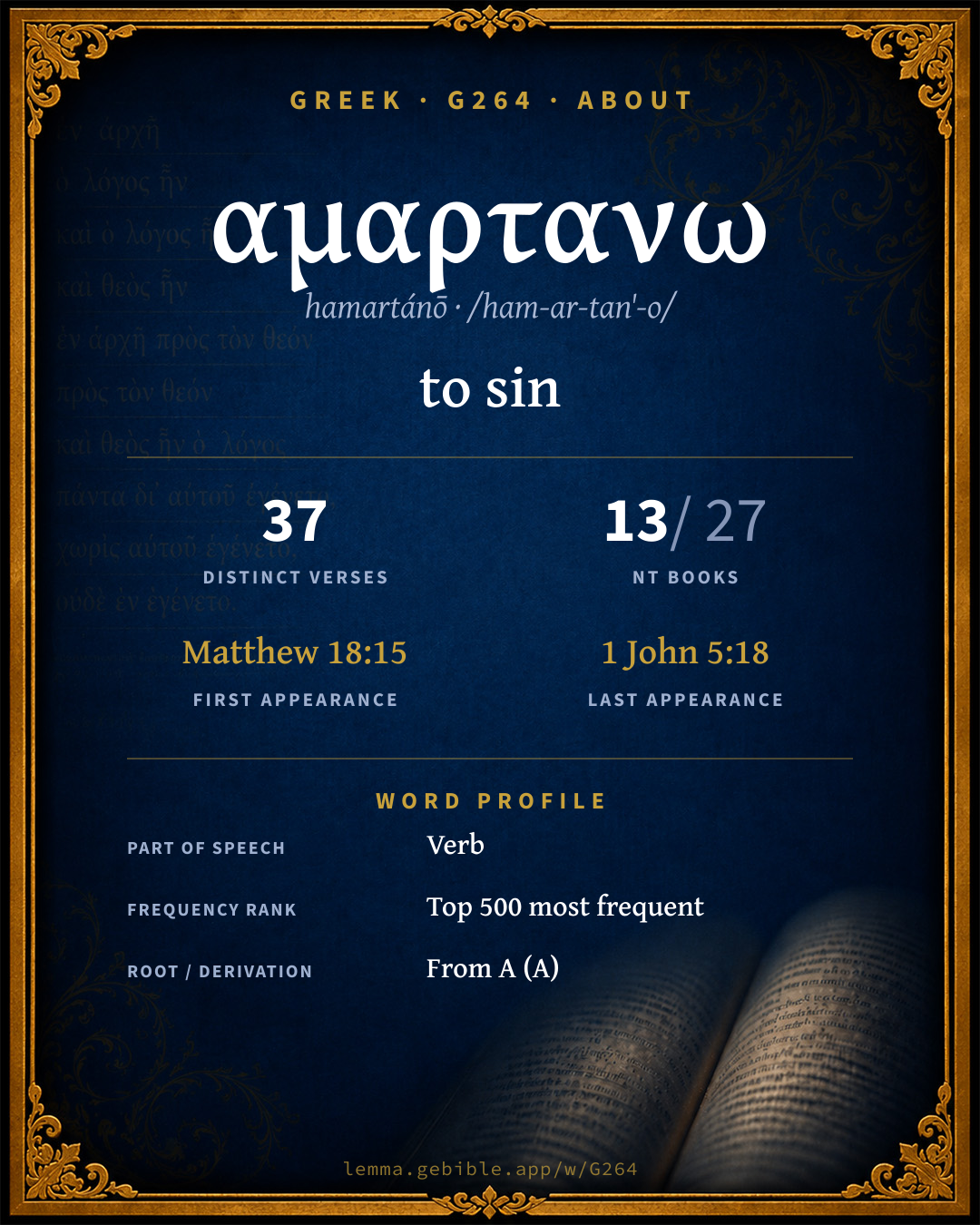
ἁμαρτάνω
to sin
‘to sin’ is one of 5 main senses fuller range ↓
Full lexicon entry — Thayer's Greek Lexicon
From Thayer's Greek Lexicon
Where this word appears
See every Aorist-tense verb in the Greek New Testament →
Grammar key — what these labels mean
Part of speech
- Verb
- An action or state-of-being word.
Tense
- Present
- Ongoing or general action in present time (imperfective aspect).
- Aorist
- Action viewed as a simple whole, without regard to duration — often past (perfective aspect).
- Future
- Action expected in future time.
- Perfect
- A completed past action with continuing present results.
Voice
- Active
- The subject performs the action.
Mood
- Indicative
- States a fact or asks a factual question (the mood of reality).
- Subjunctive
- Expresses probability, purpose, or possibility (the mood of contingency).
- Imperative
- Expresses a command or request.
- Participle
- A verbal adjective (“writing,” “having written”).
- Infinitive
- A verbal noun (“to write”), unmarked for person or number.
Case
- Nominative
- The case of the subject (and the predicate nominative).
- Accusative
- The case of the direct object and of extent.
- Dative
- The case of the indirect object, means, or location — “to / for / with / in.”
- Genitive
- The case of source, possession, or “of” — answers “whose / from what.”
Person
- 3rd person
- The one spoken about (“he / she / it / they”).
- 1st person
- The speaker (“I / we”).
- 2nd person
- The one addressed (“you”).
Gender
- Masculine
- Grammatically masculine.
Number
- Singular
- One.
- Plural
- More than one.
Grammatical forms 24 distinct
- Verb, Present, Active, Indicative, 3rd person, Singular 6 times (14%)
- Verb, Aorist, Active, Indicative, 1st person, Singular 4 times (9%)
- Verb, Aorist, Active, Indicative, 3rd person, Plural 4 times (9%)
- Verb, Aorist, Active, Subjunctive, 3rd person, Singular 4 times (9%)
- Verb, Aorist, Active, Indicative, 3rd person, Singular 3 times (7%)
- Verb, Present, Active, Imperative, 2nd person, Plural 2 times (5%)
- Verb, Present, Active, Imperative, 2nd person, Singular 2 times (5%)
- Verb, Present, Active, Participle, Nominative, Plural, Masculine 2 times (5%)
+16 more forms (16 occurrences)
Parsed forms decoded from the imported morphology (Robinson–Tischendorf, public domain), counted across 43 parsed occurrences — not distinct verses.
Every verse where G264 appears — 37 distinct verses across 13 books. Click any verse to open its interlinear word-by-word view. Verse text shown in the World English Bible for context — . Each verse’s Greek form is shown with its reference; the English is not keyword-highlighted, since the data carries no word-level English alignment. Use “Compare translations” on any verse to read it across multiple English versions. This concordance covers the Greek New Testament; Septuagint (Greek Old Testament) occurrences of this word are not indexed here.
Matthew 3 verses
- Matthew 18:15 ἁμαρτήσῃ aor act subj 3sg "If your brother sins against you, go, show him his fault between you and him alone. If he listens to you, you have gained back your brother.
- Matthew 18:21 ἁμαρτήσει fut act ind 3sg Then Peter came and said to him, "Lord, how often shall my brother sin against me, and I forgive him? Until seven times?"
- Matthew 27:4 ἥμαρτον aor act ind 1sg saying, "I have sinned in that I betrayed innocent blood." But they said, "What is that to us? You see to it."
Luke 4 verses
- Luke 15:18 ἥμαρτον aor act ind 1sg I will get up and go to my father, and will tell him, "Father, I have sinned against heaven, and in your sight.
- Luke 15:21 ἥμαρτον aor act ind 1sg The son said to him, 'Father, I have sinned against heaven, and in your sight. I am no longer worthy to be called your son.'
- Luke 17:3 ἁμάρτῃ aor act subj 3sg Be careful. If your brother sins against you, rebuke him. If he repents, forgive him.
- Luke 17:4 ἁμαρτήσῃ aor act subj 3sg If he sins against you seven times in the day, and seven times returns, saying, 'I repent,' you shall forgive him."
John 4 verses
- John 5:14 ἁμάρτανε pres act impv 2sg Afterward Jesus found him in the temple, and said to him, "Behold, you are made well. Sin no more, so that nothing worse happens to you."
- John 8:11 ἁμάρτανε pres act impv 2sg She said, "No one, Lord." Jesus said, "Neither do I condemn you. Go your way. From now on, sin no more."
- John 9:2 ἥμαρτεν aor act ind 3sg His disciples asked him, "Rabbi, who sinned, this man or his parents, that he was born blind?"
- John 9:3 ἥμαρτεν aor act ind 3sg Jesus answered, "Neither did this man sin, nor his parents; but, that the works of God might be revealed in him.
Acts 1 verse
Romans 6 verses
- Romans 2:12 ἥμαρτον ἥμαρτον aor act ind 3pl aor act ind 3pl For as many as have sinned without law will also perish without the law. As many as have sinned under the law will be judged by the law.
- Romans 3:23 ἥμαρτον aor act ind 3pl for all have sinned, and fall short of the glory of God;
- Romans 5:12 ἥμαρτον aor act ind 3pl Therefore, as sin entered into the world through one man, and death through sin; and so death passed to all men, because all sinned.
- Romans 5:14 ἁμαρτήσαντας aor act ptcp acc pl masc Nevertheless death reigned from Adam until Moses, even over those whose sins weren't like Adam's disobedience, who is a foreshadowing of him who was to come.
- Romans 5:16 ἁμαρτήσαντος aor act ptcp gen sg masc The gift is not as through one who sinned: for the judgment came by one to condemnation, but the free gift came of many trespasses to justification.
- Romans 6:15 ἁμαρτήσωμεν aor act subj 1pl What then? Shall we sin, because we are not under law, but under grace? May it never be!
1 Corinthians 5 verses
- 1 Corinthians 6:18 ἁμαρτάνει pres act ind 3sg Flee sexual immorality! "Every sin that a man does is outside the body," but he who commits sexual immorality sins against his own body.
- 1 Corinthians 7:28 ἥμαρτες ἥμαρτεν aor act ind 2sg aor act ind 3sg But if you marry, you have not sinned. If a virgin marries, she has not sinned. Yet such will have oppression in the flesh, and I want to spare you.
- 1 Corinthians 7:36 ἁμαρτάνει pres act ind 3sg But if any man thinks that he is behaving inappropriately toward his virgin, if she is past the flower of her age, and if need so requires, let him do what he desires. He doesn't sin. Let them marry.
- 1 Corinthians 8:12 ἁμαρτάνοντες ἁμαρτάνετε pres act ptcp nom pl masc pres act ind 2pl Thus, sinning against the brothers, and wounding their conscience when it is weak, you sin against Christ.
- 1 Corinthians 15:34 ἁμαρτάνετε pres act impv 2pl Wake up righteously, and don't sin, for some have no knowledge of God. I say this to your shame.
Ephesians 1 verse
1 Timothy 1 verse
Titus 1 verse
Hebrews 2 verses
- Hebrews 3:17 ἁμαρτήσασιν aor act ptcp dat pl masc With whom was he displeased forty years? Wasn't it with those who sinned, whose bodies fell in the wilderness?
- Hebrews 10:26 ἁμαρτανόντων pres act ptcp gen pl masc For if we sin willfully after we have received the knowledge of the truth, there remains no more a sacrifice for sins,
1 Peter 1 verse
2 Peter 1 verse
1 John 7 verses
- 1 John 1:10 ἡμαρτήκαμεν perf act ind 1pl If we say that we haven't sinned, we make him a liar, and his word is not in us.
- 1 John 2:1 ἁμάρτητε ἁμάρτῃ aor act subj 2pl aor act subj 3sg My little children, I write these things to you so that you may not sin. If anyone sins, we have a Counselor with the Father, Jesus Christ, the righteous.
- 1 John 3:6 ἁμαρτάνει ἁμαρτάνων pres act ind 3sg pres act ptcp nom sg masc Whoever remains in him doesn't sin. Whoever sins hasn't seen him, neither knows him.
- 1 John 3:8 ἁμαρτάνει pres act ind 3sg He who sins is of the devil, for the devil has been sinning from the beginning. To this end the Son of God was revealed, that he might destroy the works of the devil.
- 1 John 3:9 ἁμαρτάνειν pres act inf Whoever is born of God doesn't commit sin, because his seed remains in him; and he can't sin, because he is born of God.
- 1 John 5:16 ἁμαρτάνοντα ἁμαρτάνουσιν pres act ptcp acc sg masc pres act ptcp dat pl masc If anyone sees his brother sinning a sin not leading to death, he shall ask, and God will give him life for those who sin not leading to death. There is a sin leading to death. I don't say that he should make a request concerning this.
- 1 John 5:18 ἁμαρτάνει pres act ind 3sg We know that whoever is born of God doesn't sin, but he who was born of God keeps himself, and the evil one doesn't touch him.
About this entry
At a glance — auto-summarized from this page’s data, not written by a person. Every figure links to its source below. This summary describes the numbers; it doesn’t interpret them.
αμαρτανω — transliterated hamartánō — is a Greek verb carrying the sense “to sin.” Thayer's distinguishes 5 senses for it. The Greek New Testament uses it across 37 verses — moderately common. Debuting at Matthew 18:15, it then recurs through the corpus. It shares a root with Α, αβαρης and αβυσσος. See the sense tree, 37-verse concordance, and the renderings breakdown below.
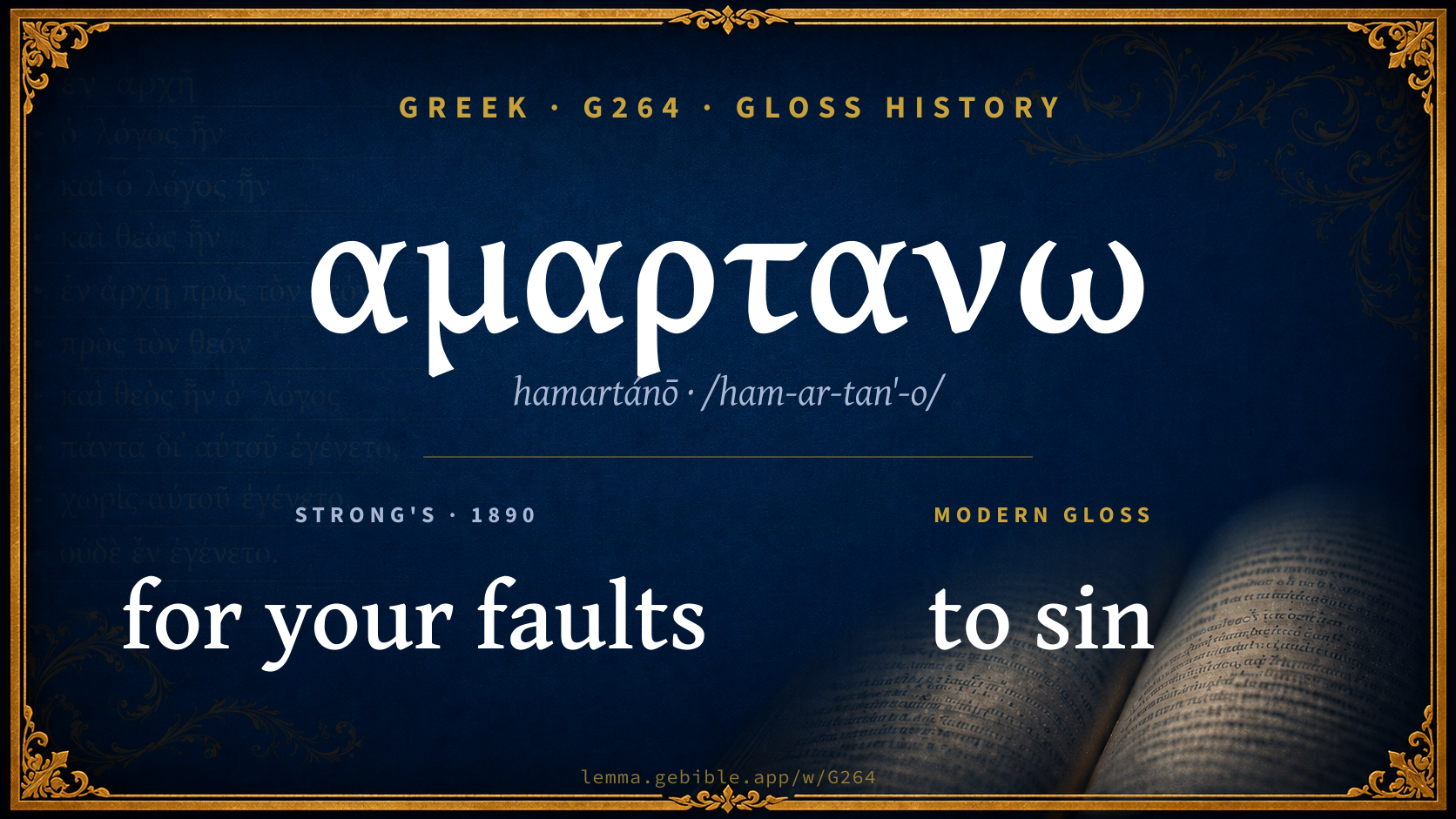
Gloss history
Strong's 1890 vs modern scholarship
About this word
Strong's G264 catalogs a Greek word from the Greek New Testament.
These counts are not copied from any lexicon or concordance. They are computed here, from the morphology-tagged Greek New Testament. What Lemma adds →
- 37
- distinct verses
- The word appears in 37 distinct verses.
- 13 / 27
- NT books
- The word appears in 13 of 27 New Testament books.
- #347
- by frequency
- Top 500 most frequent Greek words (rank 347 of 5,347 Greek words by occurrence).
View all 37 occurrences in the concordance →
Most concentrated in
- 1 John 7 verses 19%
- Romans 6 verses 16%
- 1 Corinthians 5 verses 14%
By section of the New Testament
By traditional corpus
Conventional, traditional groupings — biblical authorship is debated, so this is a traditional corpus grouping, not an authorship claim. Some books belong to more than one corpus (Luke is in both the Gospels and the Lukan corpus, and so on), so these shares overlap and need not total 100%. Each figure is a share of the word’s 37 distinct verses.
- Pauline corpus 14 verses · 38%
- Gospels 11 verses · 30%
- Johannine 11 verses · 30%
- General (Catholic) Epistles 9 verses · 24%
- Lukan (Luke–Acts) 5 verses · 14%
- Hebrews 2 verses · 5%
How translations render this word
Counts come from each version’s own published word-to-Strong’s tagging or interlinear alignment — an approximate guide to how each version renders this word, not a word-level alignment the data otherwise carries. Because each total is that version’s own tagged count, the per-version totals vary from one another and need not match the appearance or distinct-verse counts above. These counts may also differ from a printed concordance because Lemma counts each distinctly tagged rendering and does not collapse phrase taggings into a single head-word total. This is a fixed set of word-tagged versions (KJV, ASV, BSB, ULT) and does not change with the reading translation you choose elsewhere. Each version’s license is shown beside its name below (and on Sources).
- King James Version: Sin 11×, Sinned 7×, Sinneth 6×
- American Standard Version: Sin 12×, Sinned 8×, Sinneth 6×
- Berean Standard Bible: Sin 5×, Sinned 4×, Sins 4×
- unfoldingWord Literal Text: Sin 10×, Sinned 7×, Sinning 7×
King James Version Public Domain
Renders G264 across 48 tagged occurrences — most commonly:
Plus 14 renderings that appear only once — usually multi-word phrases or single function words the recovered tagging swept in, not distinct renderings.
American Standard Version Public Domain
Renders G264 across 50 tagged occurrences — most commonly:
Plus 16 renderings that appear only once — usually multi-word phrases or single function words the recovered tagging swept in, not distinct renderings.
Berean Standard Bible Public Domain
Renders G264 across 43 tagged occurrences — most commonly:
Plus 23 renderings that appear only once — usually multi-word phrases or single function words the recovered tagging swept in, not distinct renderings.
unfoldingWord Literal Text CC BY-SA 4.0
Renders G264 across 55 tagged occurrences — most commonly:
Plus 17 renderings that appear only once — usually multi-word phrases or single function words the recovered tagging swept in, not distinct renderings.
Senses in Thayer's
The 5 senses Thayer's distinguishes for this word, in lexicon order (not ranked by frequency or importance). The full entry — with sub-senses — is in the Lexicon Entry tab.
- to be without a share in
- to miss the mark
- to err, be mistaken
- to miss or wander from the path of uprightness and honour, to do or go wrong
- to wander from the law of God, violate God's law, sin
Word origin
Derived from Α (A) (G1) — alpha.
Forms in the corpus
The 23 distinct written forms G264 takes in the Greek New Testament, most frequent first — each parse links to that tense’s occurrences in the concordance.
Same root — word family
Other Thayer's entries built from the same root as G264, grouped by Strong’s listed origin. These share a root / origin per the lexicon — not necessarily a shared meaning. Each links to that word’s own entry.
Derives from
Shares the same root
- αβαρης abarḗs G4 light
- αβυσσος ábyssos G12 abyss
- αγαμος ágamos G22 unmarried
- αγενεαλογητος agenealógētos G35 without genealogy
- αγενης agenḗs G36 ignoble
- αγναφος ágnaphos G46 unprocessed
- αγνοεω agnoéō G50 to be ignorant
- αγνωσια agnōsía G56 ignorance
- αγνωστος ágnōstos G57 unknown
- αγραμματος agrámmatos G62 unlearned
- αγρυπνεω agrypnéō G69 to watch
- αδαπανος adápanos G77 free
- αδελφος adelphós G80 brother
- αδηλος ádēlos G82 obscure
- αδης háidēs G86 hell
- αδιακριτος adiákritos G87 clear
- αδιαλειπτος adiáleiptos G88 continual
- αδικος ádikos G94 unjust
- αδοκιμος adókimos G96 unapproved
- αδολος ádolos G97 guileless
- αδυνατος adýnatos G102 weak
- αζυμος ázymos G106 unleavened
- αθανασια athanasía G110 immortal
- αθεμιτος athémitos G111 unlawful
+149 more words share this root (not shown).
Derived from this word
Proper names from this root
People and places named from this root — a name, not an additional meaning of the word.
Compare all same-root words → Showing 4 of 179 — not the complete family. 1 of the same-root words is a proper name (a person or place). They share a root, not necessarily a meaning.
Septuagint usage
The same Greek word αμαρτανω appears 196 times in the Greek Old Testament (Septuagint), across 181 verses in 25 books.
- 196
- LXX occurrences
- Tagged occurrences of this Greek word in the Septuagint.
- 181
- verses
- Distinct Septuagint verses containing this word.
- 25 / 39
- OT books
- The word appears in 25 of the 39 Old Testament books.
Sample Septuagint occurrences
- Genesis 4:7 ἁμαρτάνω
- Exodus 9:27 ἁμαρτάνω
- Leviticus 4:2 ἁμαρτάνω
- Numbers 6:11 ἁμαρτάνω
- Deuteronomy 1:41 ἁμαρτάνω
- Joshua 7:11 ἁμαρτάνω
- Judges 10:10 ἁμαρτάνω
- 1 Samuel 2:25 ἁμαρτάνω
- 2 Samuel 12:13 ἁμαρτάνω
- 1 Kings 8:31 ἁμαρτάνω
- 2 Kings 17:7 ἁμαρτάνω
- 1 Chronicles 21:8 ἁμαρτάνω
Septuagint occurrences (same lexeme)
Every verse where the same Strong’s number (G264) appears in the Greek Septuagint — showing the first 50 of 181. Verse text shown in the World English Bible for context; the Greek form is the matched word — the English is not keyword-highlighted.
- Genesis 4:7 ἁμαρτάνω If you do well, will it not be lifted up? If you don't do well, sin crouches at the door. Its desire is for you, but you are to rule over it."
- Genesis 20:6 ἁμαρτάνω God said to him in the dream, "Yes, I know that in the integrity of your heart you have done this, and I also withheld you from sinning against me. Therefore I didn't allow you to touch her.
- Genesis 20:9 ἁμαρτάνω Then Abimelech called Abraham, and said to him, "What have you done to us? How have I sinned against you, that you have brought on me and on my kingdom a great sin? You have done deeds to me that ought not to be done!"
- Genesis 39:9 ἁμαρτάνω He isn't greater in this house than I, neither has he kept back anything from me but you, because you are his wife. How then can I do this great wickedness, and sin against God?"
- Genesis 40:1 ἁμαρτάνω It happened after these things, that the butler of the king of Egypt and his baker offended their lord, the king of Egypt.
- Genesis 43:9 ἁμαρτάνω I will be collateral for him. From my hand will you require him. If I don't bring him to you, and set him before you, then let me bear the blame forever,
- Genesis 44:32 ἁμαρτάνω For your servant became collateral for the boy to my father, saying, 'If I don't bring him to you, then I will bear the blame to my father forever.'
- Exodus 9:27 ἁμαρτάνω Pharaoh sent, and called for Moses and Aaron, and said to them, "I have sinned this time. Yahweh is righteous, and I and my people are wicked.
- Exodus 9:34 ἁμαρτάνω When Pharaoh saw that the rain and the hail and the thunders were ceased, he sinned yet more, and hardened his heart, he and his servants.
- Exodus 10:16 ἁμαρτάνω Then Pharaoh called for Moses and Aaron in haste, and he said, "I have sinned against Yahweh your God, and against you.
- Exodus 20:20 ἁμαρτάνω Moses said to the people, "Don't be afraid, for God has come to test you, and that his fear may be before you, that you won't sin."
- Exodus 23:33 ἁμαρτάνω They shall not dwell in your land, lest they make you sin against me, for if you serve their gods, it will surely be a snare to you."
- Exodus 32:30 ἁμαρτάνω It happened on the next day, that Moses said to the people, "You have sinned a great sin. Now I will go up to Yahweh. Perhaps I shall make atonement for your sin."
- Exodus 32:31 ἁμαρτάνω Moses returned to Yahweh, and said, "Oh, this people have sinned a great sin, and have made themselves gods of gold.
- Exodus 32:33 ἁμαρτάνω Yahweh said to Moses, "Whoever has sinned against me, him will I blot out of my book.
- Leviticus 4:2 ἁμαρτάνω "Speak to the children of Israel, saying, 'If anyone sins unintentionally, in any of the things which Yahweh has commanded not to be done, and does any one of them:
- Leviticus 4:3 ἁμαρτάνω if the anointed priest sins so as to bring guilt on the people, then let him offer for his sin, which he has sinned, a young bull without blemish to Yahweh for a sin offering.
- Leviticus 4:14 ἁμαρτάνω when the sin in which they have sinned is known, then the assembly shall offer a young bull for a sin offering, and bring it before the Tent of Meeting.
- Leviticus 4:22 ἁμαρτάνω "'When a ruler sins, and unwittingly does any one of all the things which Yahweh his God has commanded not to be done, and is guilty;
- Leviticus 4:23 ἁμαρτάνω if his sin, in which he has sinned, is made known to him, he shall bring as his offering a goat, a male without blemish.
- Leviticus 4:27 ἁμαρτάνω "'If anyone of the common people sins unwittingly, in doing any of the things which Yahweh has commanded not to be done, and is guilty;
- Leviticus 4:28 ἁμαρτάνω if his sin, which he has sinned, is made known to him, then he shall bring for his offering a goat, a female without blemish, for his sin which he has sinned.
- Leviticus 4:35 ἁμαρτάνω All its fat he shall take away, like the fat of the lamb is taken away from the sacrifice of peace offerings; and the priest shall burn them on the altar, on the offerings of Yahweh made by fire; and the priest shall make atonement for him concerning his sin that he has sinned, and he will be forgiven.
- Leviticus 5:1 ἁμαρτάνω "'If anyone sins, in that he hears the voice of adjuration, he being a witness, whether he has seen or known, if he doesn't report it, then he shall bear his iniquity.
- Leviticus 5:4 ἁμαρτάνω "'Or if anyone swears rashly with his lips to do evil, or to do good, whatever it is that a man might utter rashly with an oath, and it is hidden from him; when he knows of it, then he shall be guilty of one of these.
- Leviticus 5:5 ἁμαρτάνω It shall be, when he is guilty of one of these, he shall confess that in which he has sinned:
- Leviticus 5:6 ἁμαρτάνω and he shall bring his trespass offering to Yahweh for his sin which he has sinned, a female from the flock, a lamb or a goat, for a sin offering; and the priest shall make atonement for him concerning his sin.
- Leviticus 5:7 ἁμαρτάνω "'If he can't afford a lamb, then he shall bring his trespass offering for that in which he has sinned, two turtledoves, or two young pigeons, to Yahweh; one for a sin offering, and the other for a burnt offering.
- Leviticus 5:10 ἁμαρτάνω He shall offer the second for a burnt offering, according to the ordinance; and the priest shall make atonement for him concerning his sin which he has sinned, and he shall be forgiven.
- Leviticus 5:11 ἁμαρτάνω "'But if he can't afford two turtledoves, or two young pigeons, then he shall bring his offering for that in which he has sinned, the tenth part of an ephah of fine flour for a sin offering. He shall put no oil on it, neither shall he put any frankincense on it, for it is a sin offering.
- Leviticus 5:13 ἁμαρτάνω The priest shall make atonement for him concerning his sin that he has sinned in any of these things, and he will be forgiven; and the rest shall be the priest's, as the meal offering.'"
- Leviticus 5:15 ἁμαρτάνω "If anyone commits a trespass, and sins unwittingly, in the holy things of Yahweh; then he shall bring his trespass offering to Yahweh, a ram without blemish from the flock, according to your estimation in silver by shekels, after the shekel of the sanctuary, for a trespass offering.
- Leviticus 5:16 ἁμαρτάνω He shall make restitution for that which he has done wrong in the holy thing, and shall add a fifth part to it, and give it to the priest; and the priest shall make atonement for him with the ram of the trespass offering, and he will be forgiven.
- Leviticus 5:17 ἁμαρτάνω "If anyone sins, and does any of the things which Yahweh has commanded not to be done; though he didn't know it, yet he is guilty, and shall bear his iniquity.
- Leviticus 5:21 ἁμαρτάνω
- Leviticus 5:22 ἁμαρτάνω
- Leviticus 5:23 ἁμαρτάνω
- Leviticus 19:22 ἁμαρτάνω The priest shall make atonement for him with the ram of the trespass offering before Yahweh for his sin which he has committed: and the sin which he has committed shall be forgiven him.
- Numbers 6:11 ἁμαρτάνω The priest shall offer one for a sin offering, and the other for a burnt offering, and make atonement for him, because he sinned by reason of the dead, and shall make his head holy that same day.
- Numbers 12:11 ἁμαρτάνω Aaron said to Moses, Oh, my lord, please don't lay sin on us, for that we have done foolishly, and for that we have sinned.
- Numbers 14:40 ἁμαρτάνω They rose up early in the morning, and got them up to the top of the mountain, saying, Behold, we are here, and will go up to the place which Yahweh has promised: for we have sinned.
- Numbers 15:27 ἁμαρτάνω If one person sin unwittingly, then he shall offer a female goat a year old for a sin-offering.
- Numbers 15:28 ἁμαρτάνω The priest shall make atonement for the soul who errs, when he sins unwittingly, before Yahweh, to make atonement for him; and he shall be forgiven.
- Numbers 16:22 ἁμαρτάνω They fell on their faces, and said, God, the God of the spirits of all flesh, shall one man sin, and will you be angry with all the congregation?
- Numbers 21:7 ἁμαρτάνω The people came to Moses, and said, We have sinned, because we have spoken against Yahweh, and against you; pray to Yahweh, that he take away the serpents from us. Moses prayed for the people.
- Numbers 22:34 ἁμαρτάνω Balaam said to the angel of Yahweh, I have sinned; for I didn't know that you stood in the way against me: now therefore, if it displease you, I will get me back again.
- Numbers 32:23 ἁμαρτάνω But if you will not do so, behold, you have sinned against Yahweh; and be sure your sin will find you out.
- Deuteronomy 1:41 ἁμαρτάνω Then you answered and said to me, We have sinned against Yahweh, we will go up and fight, according to all that Yahweh our God commanded us. You girded on every man his weapons of war, and were forward to go up into the hill-country.
- Deuteronomy 9:16 ἁμαρτάνω I looked, and, behold, you had sinned against Yahweh your God; you had made you a molten calf: you had turned aside quickly out of the way which Yahweh had commanded you.
- Deuteronomy 9:18 ἁμαρτάνω I fell down before Yahweh, as at the first, forty days and forty nights; I did neither eat bread nor drink water; because of all your sin which you sinned, in doing that which was evil in the sight of Yahweh, to provoke him to anger.
These are occurrences of the same Greek lexeme (G264) in the Septuagint — not a translation of any one Hebrew word. The store carries no word-level Hebrew↔Greek alignment, so no Hebrew original is asserted here. Counts come from the recovered LXX Strong's tagging — high-frequency vocabulary is well covered, while rare or late forms may be untagged — so they reflect tagged occurrences and may slightly undercount.