
John 20:23

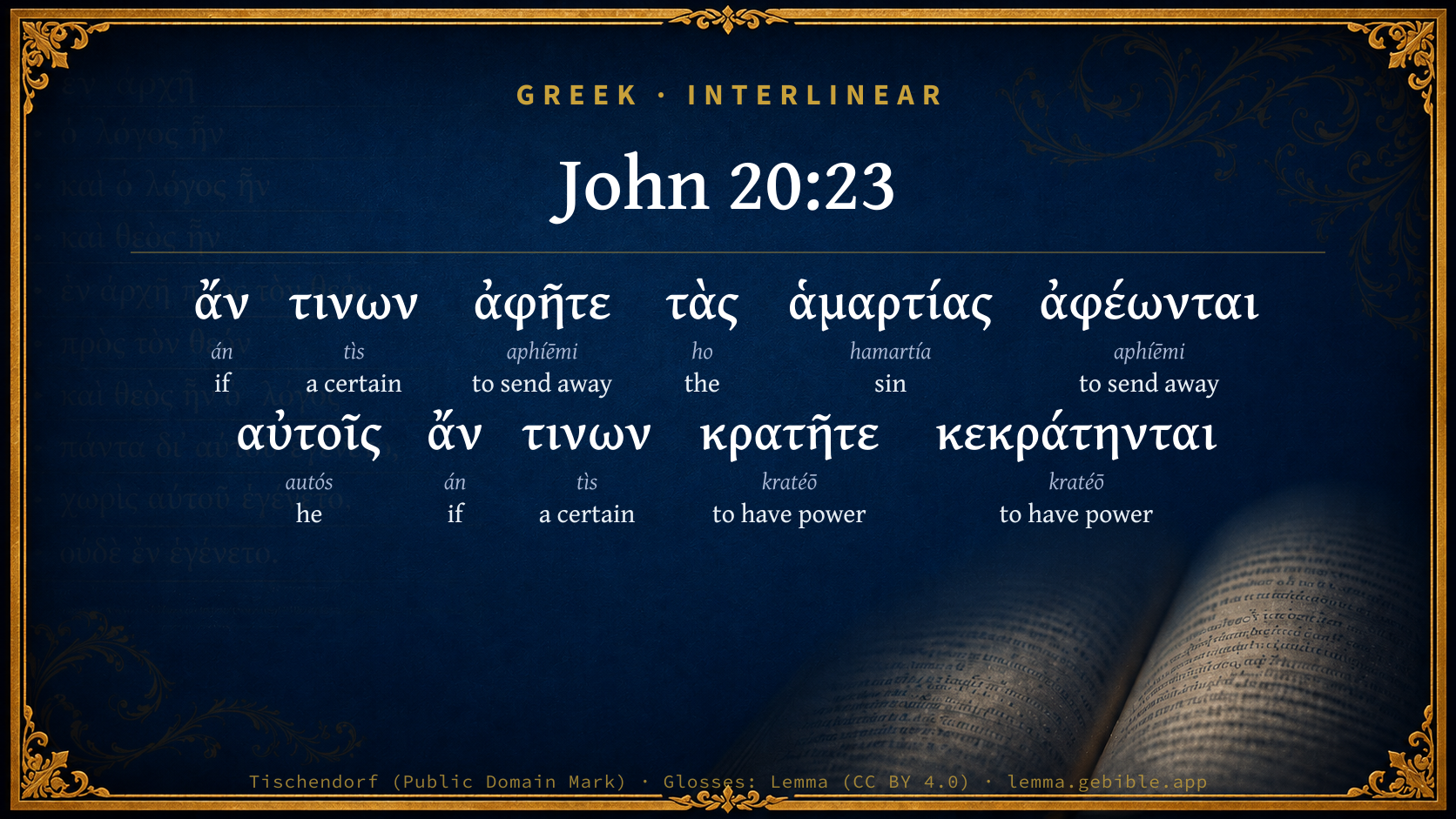
Greek (Tischendorf 8th ed.) John 20:23 appears in the Greek New Testament. The text above is from the Tischendorf 8th edition. Each word links to its Strong’s number and a concise gloss. Click any word for its full Thayer’s Greek Lexicon entry.
Download image
Cite this verse

John 20:23 (World English Bible). Public Domain. Lemma interlinear Bible study tool, https://lemma.gebible.app/v/john/20/23.

Show BibTeX & RIS
BibTeX
RIS
English Translation
Whoever's sins you forgive, they are forgiven them. Whoever's sins you retain, they have been retained."
World English Bible · Public Domain
Download a study sheet

One document with this verse’s original text, its word-by-word gloss line, the meaning frame, cross-references with their text, attributed commentary, and full source and license credits — printable, and it pastes into notes with its structure intact.

This verse Autodidact and up

Study sheet (.html) Plain text (.txt)

A passage Seminary Student

Up to 50 verses in one chapter. A passage sheet keeps up to 6 commentary sources and 12 cross-references per verse, in the order this page ranks them, and says so on the sheet whenever that leaves anything out. Ask for a single verse and you get the Autodidact verse sheet above.

Everything on this page stays free to read, with no account — the sheet is a download of what is already on screen, not access to it.

Want to remove ads? Support Godless Engineer
Compare translations 3

The same verse in 3 English versions, stacked beneath the original-language interlinear above. Click any original word for its lexicon entry.

Each is an independent rendering of the whole verse — the interlinear is not word-aligned to these translations.

Highlighted words mark where these versions differ — a whole-verse word diff, not a word-by-word alignment.

  • World English Bible Public Domain
    Whoever's sins you forgive, they are forgiven them. Whoever's sins you retain, they have been retained."
  • King James Version Public Domain
    Whose soever sins ye remit, they are remitted unto them; and whose soever sins ye retain, they are retained.
  • unfoldingWord Literal Text CC BY-SA 4.0
    Whoever’s sins you forgive, they have been forgiven for them; whoever’s you retain, they have been retained.”

unfoldingWord Literal Text — © unfoldingWord, licensed CC BY-SA 4.0. Word-aligned USFM3 via Door43 (git.door43.org/unfoldingWord/en_ult).

Versions to compare (up to 4)

3 of 4 selected

Show all 19 translations

Every available English version of this verse, each an independent rendering of the whole verse.

  • World English Bible Public Domain
    Whoever's sins you forgive, they are forgiven them. Whoever's sins you retain, they have been retained."
  • Berean Standard Bible Public Domain
    If you forgive anyone his sins, they are forgiven; if you withhold forgiveness from anyone, it is withheld.”
  • Majority Standard Bible Public Domain
    If you forgive anyone his sins, they are forgiven; if you withhold forgiveness from anyone, it is withheld.”
  • King James Version Public Domain
    Whose soever sins ye remit, they are remitted unto them; and whose soever sins ye retain, they are retained.
  • American Standard Version (1901) Public Domain
    whose soever sins ye forgive, they are forgiven unto them; whose soever `sins' ye retain, they are retained.
  • Revised Version (1885) Public Domain
    whose soever sins ye forgive, they are forgiven unto them; whose soever sins ye retain, they are retained.
  • Geneva Bible (1599) Public Domain
    Whosoeuers sinnes ye remit, they are remitted vnto them: and whosoeuers sinnes ye reteine, they are reteined.
  • Douay-Rheims (1899) Public Domain
    Whose sins you shall forgive, they are forgiven them; and whose sins you shall retain, they are retained.
  • Young's Literal Translation Public Domain
    if of any ye may loose the sins, they are loosed to them; if of any ye may retain, they have been retained.'
  • Literal Standard Version CC BY-SA 4.0
    if you may forgive the sins of any, they are forgiven them; if you may retain of any, they have been retained.”
  • Unlocked Literal Bible CC BY-SA 4.0
    Whoever's sins you forgive, they are forgiven; whoever's sins you keep back, they are kept back.”
  • unfoldingWord Literal Text CC BY-SA 4.0
    Whoever’s sins you forgive, they have been forgiven for them; whoever’s you retain, they have been retained.”
  • Darby Bible Public Domain
    whose soever sins ye remit, they are remitted to them; whose soever [sins] ye retain, they are retained.
  • World Messianic Bible Public Domain
    If you forgive anyone’s sins, they have been forgiven them. If you retain anyone’s sins, they have been retained.”
  • Webster's Bible Public Domain
    Whose soever sins ye remit, they are remitted to them; and whose soever sins ye retain, they are retained.
  • Free Bible Version CC BY-SA 4.0
    If you forgive anyone's sins, they are forgiven; if you hold them unforgiven, unforgiven they remain.”
  • Bible in Basic English Public Domain
    Any to whom you give forgiveness, will be made free from their sins; and any from whom you keep back forgiveness, will still be in their sins.
  • Text-Critical English NT CC BY 4.0
    If you remit the sins of any, their sins are remitted; if you retain the sins of any, their sins are retained.”
  • Tyndale New Testament (1534) Public Domain
    Whosoevers synnes ye remyt they are remitted vnto the. And whosoevers synnes ye retayne they are retayned.

Literal Standard Version (2020), Covenant Press — licensed CC BY-SA 4.0. Text via the HelloAO Bible API (eBible.org). Unlocked Literal Bible (unfoldingWord) — licensed CC BY-SA 4.0. Text via the HelloAO Bible API (eBible.org). unfoldingWord Literal Text — © unfoldingWord, licensed CC BY-SA 4.0. Word-aligned USFM3 via Door43 (git.door43.org/unfoldingWord/en_ult). Free Bible Version, Dr. Jonathan Gallagher — licensed CC BY-SA 4.0. Text via the HelloAO Bible API (eBible.org).

Word by word

More ways to search: Search by grammar → Find every occurrence → Compare this word →

Practice this passage: Drill this verse → Learn its vocabulary →

κρατῆτε
kratéō
G2902
“to have power”
Verb, Present, Active, Subjunctive, 2nd person, Plural
Part of Speech
Verb
Tense
Present
Voice
Active
Mood
Subjunctive
Person
2nd person
Number
Plural
Full Thayer's Definition

Origin: from G2904

TDNT: 18:10,5

1. to have power, be powerful a. to be chief, be master of, to rule 2. to get possession of a. to become master of, to obtain b. to take hold of c. to take hold of, take, seize 1. to lay hands on one in order to get him into one's power 3. to hold a. to hold in the hand b. to hold fast, i.e. not discard or let go 1. to keep carefully and faithfully c. to continue to hold, to retain 1. of death continuing to hold one 2. to hold in check, restrain
  1. ἄν án G302 “if” Particle
  2. τινων tìs G5100 “a certain” Indefinite pronoun, Genitive, Plural, Masculine
  3. ἀφῆτε aphíēmi G863 “to send away” Verb, Aorist, Active, Subjunctive, 2nd person, Plural
  4. τὰς ho G3588 “the” Article, Accusative, Plural, Feminine
  5. ἁμαρτίας hamartía G266 “sin” Noun, Accusative, Plural, Feminine
  6. ἀφέωνται aphíēmi G863 “to send away” Verb, Perfect, Passive, Indicative, 3rd person, Plural
  7. αὐτοῖς autós G846 “he” Personal pronoun, Dative, Plural, Masculine
  8. ἄν án G302 “if” Particle
  9. τινων tìs G5100 “a certain” Indefinite pronoun, Genitive, Plural, Masculine
  10. κεκράτηνται kratéō G2902 “to have power” Verb, Perfect, Passive, Indicative, 3rd person, Plural

About this verse

These counts appear in no published source. They are computed here, from the morphology-tagged text and Lemma’s own curated glosses. What Lemma adds →

11
words
7
distinct lemmas
Gospels
section

Shared distinctive vocabulary

κρατῆτε to have power G2902 occurs in 46 verses of the Greek New Testament. Also found in:
Repetition

Words recur within this verse:

  • τινων a certain G5100 ×2
  • ἀφῆτε to send away G863 ×2
  • κρατῆτε to have power G2902 ×2
  • ἄν if G302 ×2

Cross-references

10

Topical passages linked to John 20:23 in the Treasury of Scripture Knowledge — connected by theme and wording, ordered by reader-vote popularity; previews shown in the World English Bible.

  • Matthew 18:18 Most assuredly I tell you, whatever things you will bind on earth will be bound in heaven, and whatever things you will release on earth will be released in heaven.
  • Matthew 16:19 I will give to you the keys of the Kingdom of Heaven, and whatever you bind on earth will be bound in heaven; and whatever you release on earth will be released in heaven."
  • Mark 2:5–10 Jesus, seeing their faith, said to the paralytic, "Son, your sins are forgiven you."
  • Acts 13:38–39 Be it known to you therefore, brothers, that through this man is proclaimed to you remission of sins,
  • Acts 10:43 All the prophets testify about him, that through his name everyone who believes in him will receive remission of sins."
  • Acts 2:38 Peter said to them, "Repent, and be baptized, everyone of you, in the name of Jesus Christ for the forgiveness of sins, and you will receive the gift of the Holy Spirit.
  • 2 Corinthians 2:6–10 Sufficient to such a one is this punishment which was inflicted by the many;
  • 1 Timothy 1:20 of whom is Hymenaeus and Alexander; whom I delivered to Satan, that they might be taught not to blaspheme.
  • 1 Corinthians 5:4 In the name of our Lord Jesus Christ, you being gathered together, and my spirit, with the power of our Lord Jesus Christ,
  • Ephesians 2:20 being built on the foundation of the apostles and prophets, Christ Jesus himself being the chief cornerstone;

Cross-references courtesy of OpenBible.info (CC BY 4.0).

Commentary

Notes on John 20:23 from classic Christian and Jewish commentators (each source and its license shown beneath its notes). The classic Christian expositions comment on the surrounding passage and are grouped to its opening verse, so a note may address several verses; the Jewish commentaries on the Tanakh (Rashi and others) are per-verse, so they appear only where the commentator wrote on this verse.

Lemma curates 59 commentaries, every one of them public domain or Creative Commons licensed, each selected and text-cleaned for this edition rather than reprinted as found. About our sources →

Tyndale Open Study Notes

Tyndale Open Resources

20:23 If you forgive anyone’s sins: The ongoing work of Christ’s followers parallels the work of Christ. Christ’s followers do not distribute and withdraw God’s forgiveness on a whim, but they follow Jesus’ prompting through the Spirit (15:5), just as Jesus obeyed his Father (14:31).

Tyndale Open Study Notes — © Tyndale Open Resources, licensed CC BY-SA 4.0. Text via the HelloAO Bible API.

Bengel's Gnomon

Johann Albrecht Bengel

Joh 20:23. Ἄν τινων) if of certain persons [“Whosesoever”].—ἀφῆτε· κρατῆτε, ye remit—ye retain) See note on Mat 16:19, “The binding and loosing,” and “the keys,” are given to Peter alone. [Comp. Mat 18:18, ‘Loose,’ and ‘bind,’ where subsequently, after the transfiguration, (1) the binding and (2) loosing are given also to the disciples in common; the loosing to be exercised chiefly by prayer in the name of Christ (John 20). Now, after the resurrection, the order is reversed since the gate of salvation is opened, and the power is given (1) to remit, (2) to retain. See Hos 13:12].—ἀφίενται—κεκράτηνται, are remitted—have been retained) The former is present: the latter, preterite [a distinction lost in the Engl. Vers.] The world IS under sin; comp. ch. Joh 3:18; Joh 3:36, “He that believeth not is condemned already:” “The wrath of God abideth on him;” Joh 15:6, “If a man abide not in Me, he is cast forth—and withered [viz. already, ἐβλήθη, ἐξηράνθη; not merely, he shall be]. No prophet of the Old Testament ever received so comprehensive a power as the apostles received in this place. [These latter, on account of their profound power of searching into minds, and on account of the extraordinary measure of that power imparted to them,—there being added besides manifest miracles, and these such miracles as strike the senses,—were able in a manner altogether peculiar to themselves either to remit or to retain. Nor, however, is power of this kind not applicable to (nor does it not belong to) all, who are endued with the Holy Spirit, whether they discharge the public duty of the ministry of the word, or do not. Nay, but the word of the Gospel can be available for the remission of sins to those who yield themselves up to the influence of the Holy Spirit, even though it be not applied by the mediation of ministers: Mar 16:16, “He that believeth and is baptized, shall be saved, but he that believeth not, shall be damned;” and Luk 24:47, “That repentance and remission of sins should be preached in His name,” are parallel to this passage.[399]—V. g.]

[399] Which therefore is not to be interpreted of sacerdotal absolution and penance.—E. and T.

Bengel's Gnomon of the New Testament — English translation (T&T Clark, Edinburgh, 1860) — public domain. Text from a community e-Sword module.

Meyer's Critical & Exegetical Commentary

Heinrich August Wilhelm Meyer

Joh_20:23. The peculiar authority of the apostolical office, for the exercise of which they were fitted and empowered by this impartation of the Spirit. It was therefore an individual and specific charismatic endowment, the bestowal of which the Lord knew must be still connected with His personal presence, and was not to be deferred until after His ascension,[268] namely, that of the valid remission of sins, and of the opposite, that of the moral disciplinary authority, consisting not merely in the authorization to receive into the Church and to expel therefrom,[269] but also in the authorization of pardoning or of inflicting penal discipline on their fellow-members. The apostles exercised both authorizations, and it is without reason to understand only the former, since both essentially belonged to the mission (πέμπω, Joh_20:21) of the apostles. The promise, Mat_16:19; Mat_18:18, is similar, but not equivalent. The apostolic power of the keys in the sense of the Church is contained directly in the present passage, in Matt. only indirectly. It had its regulator in the Holy Spirit, who separated its exercise from all human arbitrariness, so that the apostles were therein organs of the Spirit. That was the divine guarantee, as the consecration of moral certainty through the illumination and sanctification of the judgment in the performance of its acts.

On ἄν. instead of ἐάν, see Hermann, ad Viger. pp. 812, 822; frequently also in the Greek prose writers.

ἀφίενται] They are remitted, that is, by God.

κρατῆτε] He abides by the figure; opposite of loosing: hold fast (Polyb. viii. 20. 8; Act_2:24).

κεκράτ] They are held fast, by God. Here the perf.; for the κρατεῖν is on the part of God no commencing act (such is the ἀφιέναι).

That to Thomas, who was at that time absent (Joh_20:24), the same full authority under the impartation of the Spirit was further particularly and supplementarily (after Joh_20:29) bestowed, is, indeed, not related, but must be assumed, in accordance with the relation of the necessity contained in the equality of his position.

The objections of Luthardt against our interpretation of this verse are unimportant, since in reality the eleven are thought of as assembled together (Joh_20:19; Joh_20:24); and since the assertion, that all charismatic endowments first date from Pentecost onwards, is devoid of proof, and is overthrown precisely by the present passage; comp. also already Luk_9:55. Calovius well says: ut antea jam acceperant Spiritum ratione sanctificationis, ita nunc accipiunt ratione ministerii evangelici. The full outpouring with its miraculous gifts, but on behalf of the collective church, then follows Pentecost.

[268] Hence the objection: they required at present no such impartation (Hofmann), is precipitate. They made use of it first at a future time, but the bestowal was still to take place face to face, in this last sacred fellowship, in which a quite peculiar distinction and consecration was given for this gift.

[269] This in answer to De Wette and several others, including Ahrens (Amt d. Schlüssel, 1864, p. 31), who explains it of the reception or non-reception to baptism, and to the forgiveness of sins therewith connected. So also Steitz in the Stud. u. Krit. 1866, p. 480. But baptism is here, without any indication of the text, imported from the institution, which is non-relevant here, in Mat_28:18 ff. On the apostolic penal discipline, in virtue of the κρατεῖν τὰς ἁμαρτίας, on church members, comp. the apostolic handing over to Satan, and see on 1Co_5:5.

Meyer — Critical and Exegetical Commentary on the New Testament — English translation by Peter Christie, edited by Frederick Crombie (T&T Clark, 1880) — public domain. Text from a community e-Sword module.

Expositor's Greek Testament

ed. W. Robertson Nicoll

Joh 20:23 . The authorisation of the Apostles is completed in the words: ἄν τινων … κεκράτηνται . “Whosesoever sins ye forgive, they are forgiven to them: whosesoever ye retain, they are retained.” The meaning of κεκράτηνται is determined by the opposed ἀφέωνται [the better reading]. The announcement is unexpected. Yet if they were to represent Him, they must be empowered to continue a function which He constantly exercised and set in the forefront of His ministry. They must be able in His name to pronounce forgiveness, and to threaten doom. This indeed formed the main substance of their ministry, and it was by receiving His Spirit they were fitted for it. The burden was laid upon them of determining who should be forgiven, and who held by their sin. Cf. Act 3:26 ; Act 5:4 .

The Expositor's Greek Testament, edited by W. Robertson Nicoll (1897–1910) — public domain. Text from a community e-Sword module.

International Critical Commentary

23. ἄν τινων ἀφῆτε τὰς ἁμαρτίας ἀφέωνται αὐτοῖς. ἄν is used, as often, for ἐάν. ἀφέωνται is the reading of אcADL, as against the rec. ἀφίενται. B* has ἀφείονται. ἀφιέναι in the sense of “forgive” (sin) does not appear elsewhere in the Fourth Gospel, but cf. 1Jn 2:12 ἀφέωνται ὑμῖν αἱ ἁμαρτίαι. In the Synoptists, Jesus declares to individuals “thy sins are forgiven” (Mar 2:5 and parallels, Luk 7:48); but here He seemingly commits, to those to whom He had imparted His Spirit, authority to use the like words.

“Whose soever sins you forgive, they are forgiven unto them.” The meaning of this passage in its context must be sought quite apart from the inferences that have been drawn from it in later ages. As it stands, it is the parting commission of Jesus to the apostles, to whom He had previously promised the Holy Spirit, and to whom He had now imparted that Divine gift. Jn. says nothing about the authority of those who received it to impart the Spirit in their turn to others. That may be a legitimate inference, but it is an inference for the validity of which we must seek evidence elsewhere.

That the apostles interpreted their evangelical mission as giving them authority to hand it on is, indeed, not doubtful. The terms of their commission as described in Mat 28:19, Mat 28:20 (cf. [Mk.] 16:15) imply that it was to last “to the end of the world,” the apostolate being established in permanence. Clement of Rome, whose Epistle is contemporary with the Fourth Gospel, expresses the accepted view: “Jesus Christ was sent forth from God … the apostles are from Christ … preaching everywhere, they appointed their firstfruits, when they had proved them by the Spirit, to be bishops and deacons to them that should believe” (Clem. Rom. 42). And it would appear in like manner that, as early as the time of Origen1 at any rate, the bishops were regarded as having succeeded to the powers of binding and loosing committed to the apostles in Mat 18:18.

But, whether these developments were legitimate or not, we are here concerned only with the meaning of the commission to the apostles as recorded in vv. 22, 23; and confining ourselves strictly to this, we start from the presupposition—common to Jews and Christians—that no one can “forgive” sin but God (Mar 2:7). But God is always ready to forgive (1Jn 1:9); and the assurance of God’s forgiveness can always be given confidently to repentant sinners. This assurance may be given by any one; it needs no authority to give it, for it is a fundamental principle of the Gospel. But, then, no one can give this assurance in an individual case, without being certain that this individual sinner is, indeed, repentant in his heart. And to be sure of this, he who says “thy sins are forgiven” must be able to read men’s hearts. Jesus claimed that He could do this: “the Son of Man hath power on earth to forgive sins” (Mar 2:10). Of this the explanation is found in Joh 3:34, “He whom God hath sent speaketh the words of God, for He giveth not the Spirit by measure.” To Jesus, and to Him alone, was the Spirit given in its fullness, and so He alone could infallibly discern the secrets of the human heart (Joh 2:25). He could say, therefore, “thy sins are forgiven thee” (Mar 2:5) with a complete authority.

Now a main theme of the Fourth Gospel is that Jesus promised that He would send (14:16, 16:7-13), and did in fact impart (20:22), the Spirit to the apostles. It was not confined to them, but was for every believing disciple (7:38) But it was more largely promised, and more explicitly bestowed, on them than on any one else. And it was in the power of this Spirit of God that they were authorised not only to proclaim universally the message of God’s forgiveness (Act 10:43), but to say in individual cases “thy sins are forgiven.” Among the gifts of the Spirit was the gift of insight (cf. διακρίσεις πνευμάτων, 1Co 12:10 and see Joh 16:8). Hence the words λάβετε πνεῦμα ἅγιον govern the words giving the apostles authority to forgive or not to forgive. In so far as the Spirit was theirs, so far was their judgment of men’s hearts a true judgment.

Lk. does not tell of so explicit an authority being conferred upon the apostles; but the parting commission for him too is “that repentance and remission of sins should be preached to all the nations”; and the authority is described as “the promise of the Father” which is presently to be granted (Luk 24:47, Luk 24:49). The parting commission to the Eleven in Mat 28:18f. has one point of similarity with Joh 20:23, viz. that it rests the command to make disciples upon the universal authority of Christ. “All authority hath been given to me in heaven and on earth. Go ye therefore,” etc. Their power as evangelists would rest upon their being His disciples; just as in Jn. 22:23 their power of absolving is made dependent upon their assimilation of His Spirit. It is to be observed that Jn. makes no mention of any commission to baptize.

The passages in Mt., however, which are specially recalled by Jn. 22:23 are Mat 16:19, Mat 18:18, in both of which we find “What things soever you shall bind (δήσητε) on earth shall be bound in heaven ; and what things soever you shall loose (λύσητε) on earth shall be loosed in heaven.” In Mat 16:19 these words are addressed to Peter, as having the keys of the kingdom of heaven; in Mat 18:18 they are (seemingly) addressed to the Twelve. To “bind” and to “loose” are Rabbinical expressions signifying to “prohibit” and to “permit” (many illustrations are given in Lightfoot’s Hor. Hebr. on Mat 16:19)1; and the use of these verbs would suggest to Jews a form of ecclesiastical discipline (cf. 1Co 5:4, and esp. Act 15:29, Act 16:4). In Mat 18:18 the context shows that something of this sort is indicated; the Divine ratification being promised of the Church’s action. The words refer to the “loosing” of “sin,” and may imply forgiveness as well as discipline. To forgive sins is to loose; cf. τῷ λύσαντι ἡμᾶς ἐκ τῶν ἀμαρτιῶν ἠμῶν (Rev 1:5; see also Job 42:9, LXX).

Mat 16:19 and Mat 18:18 are passages which have marks of lateness; they are, e.g., the only two passages in the Gospels where the word “Church” is found; and the tradition preserved in them of the Lord’s commission to the Apostles is more likely to be dependent on that of Jn. 22:23 than vice versa. Indeed Jn.’s brief narrative here is clearly an original statement, and does not betray any acquaintance with Mat 16:19, Mat 18:18.

ἄν τινων κρατῆτε κεκράτηνται. The Sinai Syriac renders “whom ye shall shut your door against, it shall be shut”; i.e. it takes κρατῆτε as governing τινῶν, rather than τὰς ἁμαρτίας. κρατεῖν does not occur elsewhere in Jn., but it generally takes the accusative, and the parallelism of the sentence would suggest that ἀφῆτε and κρατῆτε both govern τὰς ἁμαρτίας here. The two verbs are contrasted similarly in Mar 7:8, ἀφέντες τὴν ἐντολὴν τοῦ θεοῦ, κρατεῖτε τὴν παράδοσιν τῶν ἀνθρώπων.

The broad, unqualified form of this great assurance to the apostles is characteristic of many of the sayings of Jesus as recorded in the Gospels, e.g. “Whatsoever you shall ask of the Father in my name, He will give it you” (15:16). He did not stay to explain the limitations or conditions of such a promise. It is a mark of every great teacher, confident in himself, that he does not weaken the force of his teaching by pointing out, at every stage, possible exceptions to the maxims which he has enunciated; and it was a mark of the greatest Teacher of all.

The Incredulity of Thomas (vv. 24, 25) and Its Removal (vv. 26-29)

International Critical Commentary — older volumes (1896–1929), various authors — public domain. Text from a community e-Sword module.

Geneva Bible (1599)

Geneva Bible translators

The publishing of the forgiveness of sins by faith in Christ, and the setting forth and denouncing the wrath of God in retaining the sins of the unbelievers, is the sum of the preaching of the Gospel.

Geneva Bible (1599) marginal notes — public domain. Text via Bolls.life.

Jamieson, Fausset & Brown

Robert Jamieson, A. R. Fausset & David Brown

Whose soever sins ye remit, they are remitted unto them, &c.--In any literal and authoritative sense this power was never exercised by one of the apostles, and plainly was never understood by themselves as possessed by them or conveyed to them. (See on Mat 16:19). The power to intrude upon the relation between men and God cannot have been given by Christ to His ministers in any but a ministerial or declarative sense--as the authorized interpreters of His word, while in the actings of His ministers, the real nature of the power committed to them is seen in the exercise of church discipline.

Jamieson, Fausset & Brown — Commentary Critical and Explanatory on the Whole Bible (1871) — public domain (CC PDM 1.0). Text via the HelloAO Bible API.

Adam Clarke's Commentary

Verse 23. Whose soever sins ye remit] See the notes on Mt 16:19; Mt 18:18. It is certain God alone can forgive sins; and it would not only be blasphemous, but grossly absurd, to say that any creature could remit the guilt of a transgression which had been committed against the Creator. The apostles received from the Lord the doctrine of reconciliation, and the doctrine of condemnation. They who believed on the Son of God, in consequence of their preaching, had their sins remitted; and they who would not believe were declared to lie under condemnation. The reader is desired to consult the note referred to above, where the custom to which our Lord alludes is particularly considered. Dr. Lightfoot supposes that the power of life and death, and the power of delivering over to Satan, which was granted to the apostles, is here referred to. This was a power which the primitive apostles exclusively possessed.

Adam Clarke's Commentary on the Bible (1810–1826) — public domain. Text from a community e-Sword/MySword module.

John Calvin's Commentaries

23. To all whose sins you shall remit. Here, unquestionably, our Lord has embraced, in a few words, the sum of the Gospel; for we must not separate this power of forgiving sins from the office of teaching, with which it is closely connected in this passage. Christ had said a little before, As the living Father hath sent me, so I also send you He now makes a declaration of what is intended and what is meant by this embassy, only he interwove with that declaration what was necessary, that he gave to them his Holy Spirit, in order that they might have nothing from themselves.

The principal design of preaching the Gospel is, that men may be reconciled to God, and this is accomplished by the unconditional pardon of sins; as Paul also informs us, when he calls the Gospel, on this account, the ministry of reconciliation, (2 Corinthians 5:18.) Many other things, undoubtedly, are contained in the Gospel, but the principal object which God intends to accomplish by it is, to receive men into favor by not imputing their sins. If, therefore, we wish to show that we are faithful ministers of the Gospel, we must give our most earnest attention to this subject; for the chief point of difference between the Gospel and heathen philosophy lies in this, that the Gospel makes the salvation of men to consist in the forgiveness of sins through free grace. This is the source of the other blessings which God bestows, such as, that God enlightens and regenerates us by his Spirit, that he forms us anew to his image, that he arms us with unshaken firmness against the world and Satan. Thus the whole doctrine of godliness, and the spiritual building of the Church, rests on this foundation, that God, having acquitted us from all sins, adopts us to be his children by free grace.

While Christ enjoins the Apostles to forgive sins, he does not convey to them what is peculiar to himself. It belongs to him to forgive sins. This honor, so far as it belongs peculiarly to himself, he does not surrender to the Apostles, but enjoins them, in his name, to proclaim the forgiveness of sins, that through their agency he may reconcile men to God. In short, properly speaking, it is he alone who forgives sins through his apostles and ministers.

But it may be asked, Since he appoints them to be only the witnesses or heralds of this blessing, and not the authors of it, why does he extol their power in such lofty terms? I reply, he did so in order to confirm their faith. Nothing is of more importance to us, than to be able to believe firmly, that our sins do not come into remembrance before God. Zacharias, in his song, calls it the knowledge of salvation, (Luke 1:77;) and, since God employs the testimony of men to prove it, consciences will never yield to it, unless they perceive God himself speaking in their person. Paul accordingly says,

We exhort you to be reconciled to God, as if Christ besought you by us, (2 Corinthians 5:20.)

We now see the reason why Christ employs such magnificent terms, to commend and adorn that ministry which he bestows and enjoins on the Apostles. It is, that believers may be fully convinced, that what they hear concerning the forgiveness of sins is ratified, and may not less highly value the reconciliation which is offered by the voice of men, than if God himself stretched out his hand from heaven. And the Church daily receives the most abundant benefit from this doctrine, when it perceives that her pastors are divinely ordained to be sureties for eternal salvation, and that it must not go to a distance to seek the forgiveness of sins, which is committed to their trust.

Nor ought we to esteem less highly this invaluable treasure, because it is exhibited in earthen vessels; but we have ground of thanksgiving to God, who hath conferred on men so high an honor, as to make them the ambassadors and deputies of God, and of his Son, in declaring the forgiveness of sins. There are fanatics who despise this embassy; but let us know, that, by doing so, they trample under foot the blood of Christ.

Most absurdly do the Papists, on the other hand, torture this passage, to support their magical absolutions. If any person do not confess his sins in the ear of the priest, he has no right, in their opinion, to expect forgiveness; for Christ intended that sins should be forgiven through the Apostles, and they cannot absolve without having examined the matter; therefore, confession is necessary. Such is their beautiful argument. But they fall into a strange blunder, when they pass by the most important point of the matter; namely, that this right was granted to the Apostles, in order to maintain the credit of the Gospel, which they had been commissioned to preach. For Christ does not here appoint confessors, to inquire minutely into each sin by means of low mutterings, but preachers of his Gospel, who shall cause their voice to be heard, and who shall seal on the hearts of believers the grace of the atonement obtained through Christ. We ought, therefore, to keep by the manner of forgiving sins, so as to know what is that power which has been granted to the apostles.

And to those whose sins you retain. Christ adds this second clause, in order to terrify the despisers of his Gospel, that they may know that they will not escape punishment for this pride. As the embassy of salvation and of eternal life has been committed to the apostles, so, on the other hand, they have been armed with vengeance against all the ungodly, who reject the salvation offered to them, as Paul teaches, (2 Corinthians 10:6.) But this is placed last in order, because it was proper that the true and real design of preaching the Gospel should be first exhibited. That we are reconciled to God belongs to the nature of the Gospel; that believers are ad-judged to eternal life may be said to be accidentally connected with it. For this reason, Paul, in the passage which I lately quoted, when he threatens vengeance against unbelievers, immediately adds,

after that your obedience shall have been fulfilled, (2 Corinthians 10:6;)

for he means, that it belongs peculiarly to the Gospel to invite all to salvation, but that it is accidental to it that it brings destruction to any.

It ought to be observed, however, that every one who hears the voice of the Gospel, if he do not embrace the forgiveness of sins which is there promised to him, is liable to eternal damnation; for, as it is a living savior to the children of God, so to those who perish it is the savour of death to death, (2 Corinthians 2:16.) Not that the preaching of the Gospel is necessary for condemning the reprobate, for by nature we are all lost, and, in addition to the hereditary curse, every one draws down on himself additional causes of death, but because the obstinacy of those who knowingly and willingly despise the Son of God deserves much severer punishment.

John Calvin's Commentaries (1540-1563) — public domain. Text from the Calvin Translation Society English edition (1840s-50s) via the Christian Classics Ethereal Library (ccel.org). Calvin's coverage is partial (roughly two-thirds of the Bible); uncommented books and verses are honest gaps, never fabricated. The 19th-century editor's footnotes and remarks are omitted so the notes are faithfully Calvin's own voice.

Ellicott's Commentary for English Readers

(23) Whose soever sins ye remit, they are remitted unto them . . .—Comp. for the “power of the keys,” the Notes on Mat_16:19; Mat_18:18. Assuming what has there been said, it will be sufficient to add that this power is here immediately connected with the representative character of the disciples as apostles sent by Christ, as He was Himself sent by the Father (Joh_20:21), and that its validity is dependent upon their reception of the Holy Ghost (Joh_20:22), by whom Christ Himself is present in them (Joh_14:18; Joh_16:7-11). Sent as He was sent, they are not sent to condemn the world, but that the world through Him might be saved; but in their work, as in His, men are condemned because the light is come into the world, and men love darkness rather than light.

The ultimate principles upon which this power rests are those stated above—the being sent by Christ, and the reception of the Holy Ghost. God has promised forgiveness wherever there is repentance; He has not promised repentance wherever there is sin. It results from every declaration of forgiveness made in the name of the Father through Jesus Christ, that hearts which in penitence accept it receive remission of their sins, and that the hardness of the hearts which wilfully reject it is by their rejection increased, and the very words by which their sins would be remitted become the words by which they are retained. (Comp. especially Notes on Joh_3:17 et seq.; Joh_16:8 et seq.; and 2Co_2:15-16.)

On individual words in this verse it is important to note that in the better text the tense of that rendered “are remitted” is a strict present, while that rendered “are retained” is in the perfect-present. The difference is not easy to preserve in English, but the thought seems to be, “Whose soever sins ye remit—a change in their condition is taking place—their sins are being remitted by God; whose soever ye retain—their condition remains unchanged—they have been, and are retained.”

A Bible Commentary for English Readers, edited by Charles John Ellicott (1878–1897) — public domain. Text from a community e-Sword module.

The Cambridge Bible for Schools and Colleges

gen. ed. J. J. S. Perowne

23. Whose soever sins, &c.] This power accompanies the gift of the Spirit just conferred. It must be noticed (1) that it is given to the whole company present; not to the Apostles alone. Of the Apostles one was absent, and there were others who were not Apostles present: no hint is given that this power is confined to the Ten. The commission therefore in the first instance is to the Christian community as a whole, not to the Ministry alone.

It follows from this (2) that the power being conferred on the community and never revoked, the power continues so long as the community continues. While the Christian Church lasts it has the power of remitting and retaining along with the power of spiritual discernment which is part of the gift of the Spirit. That is, it has the power to declare the conditions on which forgiveness is granted and the fact that it has or has not been granted.

It should be noted (3) that the expression throughout is plural on both sides. As it is the community rather than individuals that is invested with the power, so it is classes of men rather than individuals on whom it is exercised. God deals with mankind not in the mass but with personal love and knowledge soul by soul. His Church in fulfilling its mission from Him, while keeping this ideal in view, is compelled for the most part to minister to men in groups and classes. The plural here seems to indicate not what must always or ought to be the case, but what generally is.

are remitted … are retained] Both verbs are perfects, though there is some doubt about the reading as regards the former. The force of the perfect is—‘are ipso facto remitted’—‘are ipso facto retained.’ When the community under the guidance of the Spirit has spoken, the result is complete.

retain] i.e. ‘hold fast,’ so that they do not depart from the sinner. The word occurs here only in this Gospel. In Revelation it is used of ‘holding fast doctrine,’ &c. (Joh_2:14-15; Joh_2:25, Joh_3:11; comp. 2Th_2:15).

The Cambridge Bible for Schools and Colleges (gen. ed. J. J. S. Perowne; Cambridge University Press, 1878–1918) — public domain. Text from a community e-Sword module.

John Gill's Exposition

Whose soever sins ye remit,.... God only can forgive sins, and Christ being God, has a power to do so likewise; but he never communicated any such power to his apostles; nor did they ever assume any such power to themselves, or pretend to exercise it; it is the mark of antichrist, to attempt anything of the kind; who, in so doing, usurps the divine prerogative, places himself in his seat, and shows himself as if he was God: but this is to be understood only in a doctrinal, or ministerial way, by preaching the full and free remission of sins, through the blood of Christ, according to the riches of God's grace, to such as repent of their sins, and believe in Christ; declaring, that all such persons as do so repent and believe, all their sins are forgiven for Christ's sake: and accordingly,

they are remitted unto them; in agreement with Christ's own words, in his declaration and commission to his disciples; see Mar 16:16. On the other hand he signifies, that

whose soever sins ye retain, they are retained: that is, that whatsoever sins ye declare are not forgiven, they are not forgiven; which is the case of all final unbelievers, and impenitent sinners; who dying without repentance towards God, and faith in the Lord Jesus Christ, according to the Gospel declaration, shall be damned, and are damned; for God stands by, and will stand by and confirm the Gospel of his Son, faithfully preached by his ministering servants; and all the world will sooner or later be convinced of the validity, truth, and certainty, of the declarations on each of these heads, made by them.

John Gill's Exposition of the Whole Bible (1746–1763) — public domain (CC PDM 1.0). Text via the HelloAO Bible API.

Trapp's Complete Commentary

John Trapp

23 Whose soever sins ye remit, they are remitted unto them; and whose soever sins ye retain, they are retained.

Ver. 23. Whose soever sins ye remit, &c.] Remission of sin is the chief benefit of the gospel: and for the creed (which is the sum of the gospel) all the former articles are perfected in that of "remission of sins;" and all the following articles are effects of it. Now none can remit sins, but God; to speak properly. Papists tell us of one that could remove mountains, but to remit sins is peculiar to God alone. Man may remit the trespass, but God only the transgression. Howbeit ministers may, and in some cases must, "declare unto man his righteousness," Job 33:23; pronounce, in Christ’s name, the truly penitent righteous in God’s sight, by Christ’s righteousness freely imputed and given unto them. They must also retain, by the same authority, and bind upon impenitent sinners (so continuing) their sins to destruction, "Having in a readiness to revenge all disobedience," 2Co 10:6. This we may do, as ministers, and more we claim not.

John Trapp, A Commentary or Exposition upon All the Books of the Old and New Testament (1647–1656) — public domain. Text from a community e-Sword module.

Albert Barnes' Notes on the Bible

Whose soever sins ... - See the notes at Mat 16:19; Mat 18:18. It is worthy of remark here that Jesus confers the same power on all the apostles. He gives to no one of them any special authority. If Peter, as the Papists pretend, had been appointed to any special authority, it is wonderful that the Saviour did not here hint at any such pre-eminence. This passage conclusively proves that they were invested with equal power in organizing and governing the church. The authority which he had given Peter to preach the gospel first to the Jews and the Gentiles, does not militate against this. See the notes at Mat 16:18-19. This authority given them was full proof that they were inspired. The meaning of the passage is not that man can forgive sins that belongs only to God Isa 43:23 but that they should be inspired; that in founding the church, and in declaring the will of God, they should be taught by the Holy Spirit to declare on what terms, to what characters, and to what temper of mind God would extend forgiveness of sins. It was not authority to forgive individuals, but to establish in all the churches the terms and conditions on which men might be pardoned, with a promise that God would confirm all that they taught; that all might have assurance of forgiveness who would comply with those terms; and that those who did not comply should not be forgiven, but that their sins should be retained. This commission is as far as possible from the authority which the Roman Catholic claims of remitting sin and of pronouncing pardon.

Albert Barnes' Notes on the Bible (1834–1885) — public domain. Text from a community e-Sword/MySword module.

Haydock's Catholic Bible Commentary

Whose sins you shall forgive,[2] &c. These words clearly express the power of forgiving sins, which, as God, he gave to his apostles, and to their successors, bishops and priests, to forgive sins in his name, as his ministers, and instruments, even though they are sinners themselves. For in this, they act not by their own power, nor in their own name, but in the name of God, who as the principal cause, always remitteth sins. This is generally allowed to be done by God’s ministers in the sacrament of baptism, as to the remission of original sin; and the Catholic Church has always held the same of God’s ministers, in the sacrament of penance. (See the Protestant Common Prayer Book, in the Visitation of the Sick.) --- Whose sins you shall retain, they are retained: by which we see, that to priests is given a power to be exercised, not only by forgiving, but also by retaining; not only by absolving and loosing, but also by binding, by refusing, or deferring absolution, according to the dispositions that are found in sinners, when they accuse themselves of their sins. From hence must needs follow an obligation on the sinner’s part, to declare, and confess their sins in particular, to the ministers of God, who are appointed the spiritual judges, and physicians of their souls. A judge must know the cause, and a physician the distemper: the one to pronounce a just sentence, the other to prescribe suitable remedies. (Witham) --- See here the commission, stamped by the broad seal of heaven, by virtue of which, the pastors of Christ’s Church absolve repenting sinners upon their confession. (Challoner)

===============================

[BIBLIOGRAPHY]

[27.] Whose sins you shall forgive, &c. See St. Cyril, lib. xii. in Joan. p. 1101, Greek: metanoousi sugginoskontes. St. John Chrysostom, hom. lxxxvi. p. 517. nov. Ed., Magna est sacerdotum dignitas, quorum remiseritis peccata, &c. See also lib. iii. de sacerd. t. 1. p. 383. nov. Ed. Ibid., noli esse incredulus, sed fidelis, Greek: kai me ginou apistos, alla pistos.

====================

George Leo Haydock (1774–1849), Haydock's Catholic Family Bible and Commentary, 1859 edition — public domain. Excludes Psalms (Douay-Rheims chapter numbering differs from Protestant) and Deuterocanonical books (Catholic canon only).

Matthew Poole's English Annotations

Whether Mat 18:18 be a parallel text to this, I doubt: See Poole on "Mat 18:18". Our Lord here speaks of the sins of persons,

Whose soever sins remit, & c.; he saith there, Whatsoever ye shall bind or loose. This text hath caused a great deal of contest. All remission of sins is either authoritative; so it is most true, that none can forgive sin but God; and if we had no Scripture to prove it, yet reason will tell us none can discharge the debtor but the creditor, to whom the debt is owing: or else ministerial; thus he who is not the creditor (amongst men) may remit a debt by virtue of a letter of attorney made to him, authorizing him so to do. The question therefore amongst divines is, Whether Christ in this text hath given authority to his ministers actually to discharge men of the guilt of their sins; or only to declare unto them, that if their repentance and faith be true, their sins are really forgiven them? The former is by many contended for; but it doth not seem reasonable,

1. That God should entrust men with such a piece of his prerogative.

2. That God, who knoweth the falsehood of men’s hearts, and the inability in the best ministers to judge of the truth of any man’s faith or repentance, as also the passions to which they are subject, should give unto any of the sons of men an absolute power under him, and in his name, to discharge any from the guilt of sin; for certain it is, that without true repentance and faith in Christ no man hath his sins forgiven; so as no minister, that knoweth not the hearts of men, can possibly speak with any certainty to any man, saying, his sins are forgiven.

What knowledge the apostles might have by the Spirit of discerning, we cannot say. But certain it is, none hath any such certainty of knowledge now of the truth of any man, declaring his faith and true repentance; from whence it is to me apparent, that no man hath any further power from Christ, than to declare to them, that if indeed they truly believe and repent, their sins are really forgiven. Only the minister, being Christ’s interpreter and ambassador, and better able to judge of true faith and repentance than others, (though not certainly and infallibly), such declarations from a faithful, able minister, are of more weight and authority than from others. And this is the most I can conceive should be in this matter; and that if by those words any further power be granted to the apostles, it was by reason of that power of discerning of spirits, 1Co 12:10, which ordinary ministers since the apostles’ times, or in latter ages, cannot with any modesty pretend unto.

Matthew Poole's English Annotations on the Holy Bible (1683–1685) — public domain. Text from a community e-Sword/MySword module.

Whedon's Commentary on the Bible

Daniel D. Whedon

23. Sins ye remit—The medium by which they would remit sins is the Gospel committed unto them, for the efficient ministration of which they are now empowered by the Holy Ghost breathed upon them by their Divine Master. Through that Gospel they would remit the sins of all who accept it by faith. Our Lord in these words declares the efficacy of the Gospel for this purpose.

Ye retain—By the same Gospel the true minister condemns the rejecting sinner. The apostolic hand holds the instrument by which it is enabled to dispense release from the power and guilt of sin to all those who are penitent, and to retain under its condemnation those who are incorrigible. Thus with it in their hands apostles would go forth discharging the souls of men from sin, or confirming them under its condemnation.

Daniel D. Whedon (gen. ed.), Commentary on the Old and New Testaments (1874–1909) — public domain. Text from a community e-Sword module.

John Wesley's Explanatory Notes

Whosoever sins ye remit - (According to the tenor of the Gospel, that is, supposing them to repent and believe) they are remitted, and whosoever sins ye retain (supposing them to remain impenitent) they are retained. So far is plain. But here arises a difficulty. Are not the sins of one who truly repents, and unfeignedly believes in Christ, remitted, without sacerdotal absolution? And are not the sins of one who does not repent or believe, retained even with it? What then does this commission imply? Can it imply any more than,

1. A power of declaring with authority the Christian terms of pardon; whose sins are remitted and whose retained? As in our daily form of absolution; and

2. A power of inflicting and remitting ecclesiastical censures? That is, of excluding from, and re-admitting into, a Christian congregation.

John Wesley, Explanatory Notes Upon the Whole Bible (1754–1765) — public domain. Text via the GEBible commentary corpus.

The People's New Testament

B. W. Johnson

23. Whosesoever sins ye remit, they are remitted unto them, etc. It will be seen at once, by a comparison with Matt. 16:19, that the keys then promised to Peter are now given to all the apostles, and all have similar power to open and shut, to remit sin, and to bind. The meaning is plain when we consider, first, the charge that the Savior was making, and, secondly, look forward and see how that charge was carried out; or, in other words, observe the apostles “remitting sins” and retaining them. It is the Great Commission to preach the gospel that the Savior gives for the first time in verse 21. It is with reference to carrying out that Commission that he speaks in verse 23. It was in order that they might present the terms of that Commission infallibly to the world that the baptism of the Holy Spirit was imparted, of which there is a foreshadowing in verse 22. The great end of that Commission was to declare to men “repentance and remission of sins” in the name of Christ. The following facts are manifest: (1) The Savior gave to his apostles his Commission that they might make known his will. (2) He bade them preach “remission of sins.” (3) He gave them a measure of the Holy Spirit, and bade them wait until “endued with power from on high” by the baptism of the Holy Spirit. (4) When the Holy Spirit fell, they spoke as it “gave them utterance” (Acts 2:4). (5) They then declared, under the influence of the Holy Spirit, the terms on which “sins could be remitted.” To anxious sinners they answer, “Repent and be baptized, every one of you, in the name of Jesus Christ, for the remission of sins.” Here, then, they, directed by the Holy Spirit, “remit” and “retain” sins by declaring the terms on which Christ will pardon. Thus, also, they do in their preaching recorded through the Acts of the Apostles the very thing that the Savior gave them power to do. This power was not imparted to a hierarchy, nor to any ecclesiastical body, but to the apostles, and was fulfilled by them in declaring to the world the conditions of pardon and condemnation under the Commission of our Lord.

B. W. Johnson's The People's New Testament with Notes (1889–1891) — public domain. Electronic text from the Christian Classics Ethereal Library (CCEL) ThML edition.

Cambridge Greek Testament for Schools and Colleges

23. ἄν τινων ἀφῆτε. Comp. ἄφες in the Lord’s Prayer. This power accompanies the gift of the Spirit just conferred. It must be noticed (1) that it is given to the whole company present; not to the Apostles alone. Of the Apostles one was absent, and there were others present who were not Apostles: no hint is given that this power is confined to the Ten. The commission in the first instance is to the community as a whole, not to the Ministry alone. Of course this does not imply that all present were raised to the rank of Apostles; which would contradict the plain narrative of the Acts; nor that the commission could not be delegated to the Ministry; which would contradict the history of the Church.

It follows from this (2) that the power being conferred on the community and never revoked, the power continues so long as the community continues. While the Christian Church lasts it has the power of remitting and retaining along with the power of spiritual discernment which is part of the gift of the Spirit. That is, it has the power to declare the conditions on which forgiveness is granted and the fact that it has or has not been granted.

It should be noted (3) that the expression throughout is plural on both sides. As it is the community rather than individuals that is invested with the power, so it is classes of men rather than individuals on whom it is exercised. God deals with mankind not in the mass but with personal love and knowledge soul by soul. His Church in fulfilling its mission from Him, while keeping this ideal in view, is compelled for the most part to minister to men in groups and classes. The plural here seems to indicate not what must always be or ought to be the case, but what generally is.

ἀφέωνται … κεκράτηνται. The force of the perfect is—‘are ipso facto remitted’—‘are ipso facto retained.’ But ἀφέωνται is not a secure reading: ἀφίενται is strongly supported; and there are other variations. When the community under the guidance of the Spirit has spoken, the result is complete. The meaning of κρατῆτε is ‘hold fast,’ so that they do not depart from the sinner. The word occurs here only in this Gospel. In Revelation it is used of ‘holding fast doctrine,’ &c. (Joh 2:14-15; Joh 2:25, Joh 3:11; comp. 2Th 2:15).

Cambridge Greek Testament for Schools and Colleges (Cambridge University Press, 1896; 21 vols, various authors incl. Carr, Maclear, Plummer, Farrar, Lumby, Moule, M. R. James, Simcox) — public domain. Text from a community e-Sword module.

Alford’s Greek Testament

Henry Alford

23.] The present meaning of these words has been spoken of above. They reach forward however beyond that, and extend the grant which they re-assure to all ages of the Church. The words, closely considered, amount to this: that with the gift and real participation of the Holy Spirit, comes the conviction, and therefore the knowledge, of sin, of righteousness, and judgment;—and this knowledge becomes more perfect, the more men are filled with the Holy Ghost. Since this is so, they who are pre-eminently filled with His presence are pre-eminently gifted with the discernment of sin and repentance in others, and hence by the Lord’s appointment authorized to pronounce pardon of sin and the contrary. The Apostles had this in an especial manner, and by the full indwelling of the Spirit were enabled to discern the hearts of men, and to give sentence on that discernment: see Act 5:1-11; Act 8:21; Act 13:9. And this gift belongs to the Church in all ages, and especially to those who by legitimate appointment are set to minister in the Churches of Christ: not by successive delegation from the Apostles,—of which fiction I find in the N.T. no trace,—but by their mission from Christ, the Bestower of the Spirit for their office, when orderly and legitimately conferred upon them by the various Churches. Not however to them exclusively,—though for decency and order it is expedient that the outward and formal declaration should be so:—but in proportion as any disciple shall have been filled with the Holy Spirit of wisdom, is the inner discernment, the κρίσις, his.

κρατεῖν here (see ref.) corresponds to δέειν in Mat 16:19 (see the distinction there); 18:18, ἀφιέναι to λύειν.

Henry Alford, The Greek Testament (1849–1861) — public domain. Text from a community e-Sword module.

Vincent's Word Studies in the New Testament

Marvin R. Vincent

Remit [αφητε] . Only here in this Gospel in connection with sins. Often in the Synoptists (Mt 6:12; Mt 9:5; Mr 2:5; Luk 5:23, etc.).

Marvin R. Vincent, Word Studies in the New Testament (1887–1900) — public domain. Text from a community e-Sword/MySword module.

Godet's Commentaries

Frédéric Louis Godet

Ver. 23. The new work which is intrusted to them is here displayed in all its greatness; the matter in question is nothing less than giving or refusing salvation to every human being; to open and close heaven—this is their task. The old covenant had a provisional pardon and a revocable rejection. With the coming of the Holy Spirit, the world enters into the domain of unchangeable realities. This power of pardoning sins (Mat 9:6) or of retaining them (Joh 9:41; Joh 15:22; Joh 15:24), which the Son of man had exercised, will be theirs for the future by virtue of His Spirit who will accompany them.

The expressions which Jesus employs indicate more than an offer of pardon or a threatening of condemnation, more even than a declaration of salvation or of perdition by means of the preaching of the Gospel. Jesus speaks of a word which is accompanied by efficacy, either for taking away the guilt from the guilty or for binding it eternally to his person. He who is truly the organ of the Spirit (Joh 20:21) does not merely say: “Thou art saved”—he saves by his word—or “Thou art condemned”—he really condemns, and this because, at the moment when he pronounces these words by means of the Spirit, God ratifies them. The present ἀφίενται (literally, are pardoned) indicates a present effect; God pardons these sins at the very moment. The perfect ἀφέωνται, which some Mjj. read, would signify: “are and remain pardoned.” This perfect was probably introduced for the sake of the symmetry of the clause with the following (κεκράτηνται). The copyists did not understand that in the first there is a question of a present momentary fact, the passage from the state of condemnation to the state of grace, while the second relates to a state which continues, the condemnation established forever.

The order of the two propositions indicates that the first of the two results is the true aim of the mission, and that the second does not come to its realization except in the cases where the first has failed.

It does not seem to me that anything gives us the right to see here a special power conferred on the apostles as such. The question is not of right, but of force. It is the πνεῦμα which is its principle. I do not see any reason, therefore, to apply this prerogative to the apostles alone, as Keil would have it. The disciples of Joh 20:18-19 are certainly all believers taken together; the two from Emmaus were present, and many others, not apostles, with them, according to Luk 24:33. And why should the gift of the Spirit be restricted to the apostles? They certainly have a special authority. But the forces of the Spirit are common to all believers. Weiss supposes that the prerogative here conferred by Jesus is no other than that of distinguishing between venial sins and mortal sins (1Jn 5:16). But this application is much too special and foreign to the context. Besides, the similar promise made to Peter, Mat 16:19, had already been extended, in a certain measure, to the whole Church, Mat 18:18.

Frédéric Louis Godet — Commentaries on Luke, John, Romans, and 1 Corinthians — English translation (T&T Clark, Edinburgh, 1870s–1890s) — public domain. Text from a community e-Sword module.

Lesson kit

Teaching starters — assembled from the data on this page, not authored interpretation. Every prompt links to the verse data it draws on. Edit before teaching.

John, in the Gospels, opens this verse with 11 words (7 distinct Greek lemmas). Its most distinctive word is kratéō (“to have power”). A historical commentator’s framing appears above. Read the whole chapter for the surrounding context.

Discussion questions

  1. How does “to have power” (kratéō) shape what this verse is saying?
  2. Matthew 9:25 shares the word «to have power» with this verse. How do the two illuminate each other?
  3. “a certain” occurs 2× in this one verse. What is the effect of the repetition?
  4. These translations render this verse differently; the difference is in the English rendering, not the original. What questions does that raise?
  5. Reading how Tyndale Open Study Notes and Bengel's Gnomon read this verse, where do the two commentators agree and where do they part?

Things to notice

  • These translations choose different wording for 11 words in this verse.
  • “a certain” occurs 2× in this single verse.
  • 7 distinct Greek lemmas span 11 words in this verse.

Reading settings

Reading text

Shown beneath each verse's original-language words.

Old Testament
Old Testament edition

Read the OT as the Masoretic Hebrew (MT) or the Greek Septuagint (LXX).

English shown for the Greek Septuagint (in the Hebrew ↔ Greek comparison).

Comparing translations? Open the Compare panel on any verse page to stack up to four side by side.