

Hebrews 11:25
Greek (Tischendorf 8th ed.) Hebrews 11:25 appears in the Greek New Testament. The text above is from the Tischendorf 8th edition. Each word links to its Strong’s number and a concise gloss. Click any word for its full Thayer’s Greek Lexicon entry.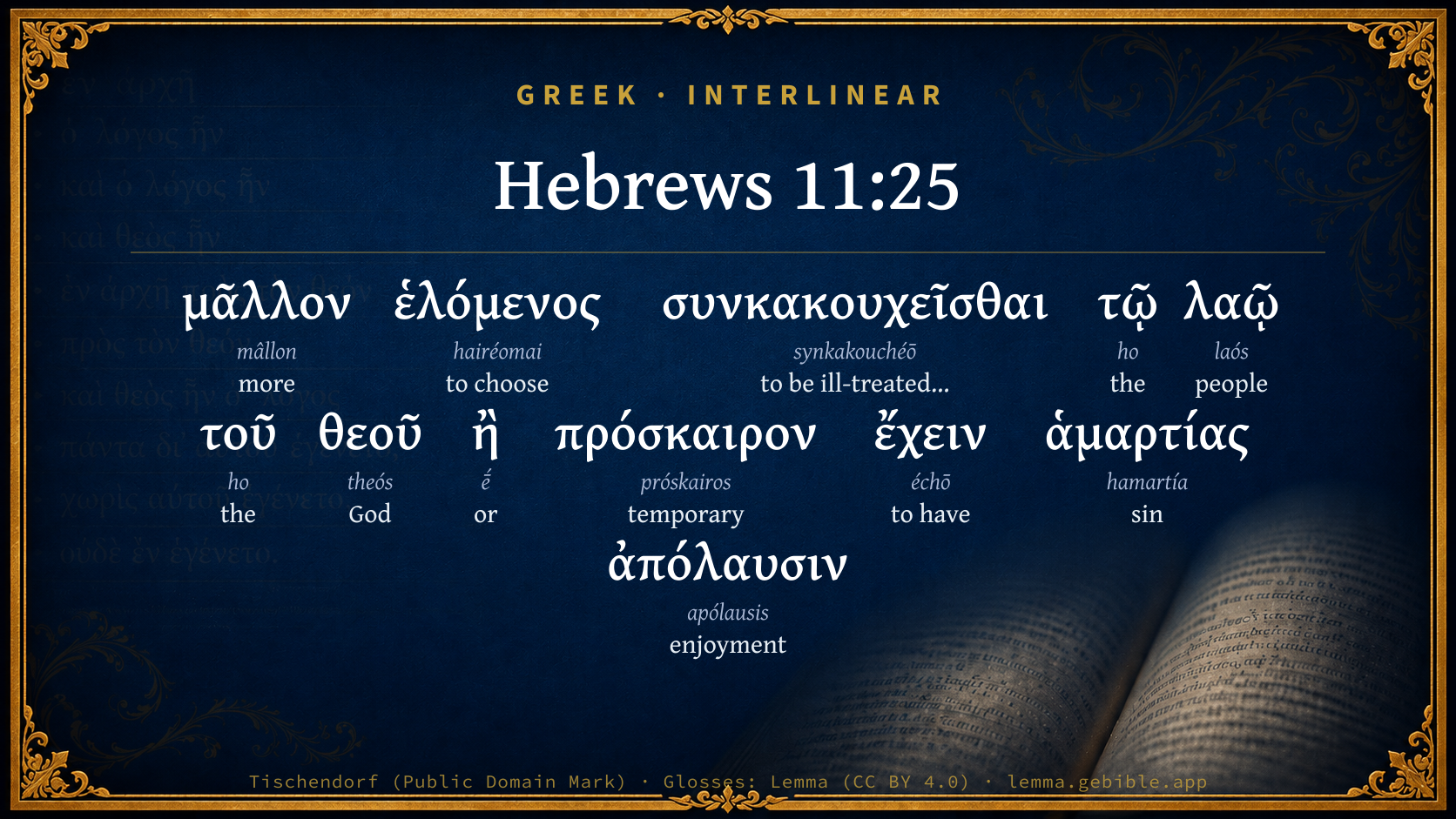
choosing rather to share ill treatment with God's people, than to enjoy the pleasures of sin for a time;
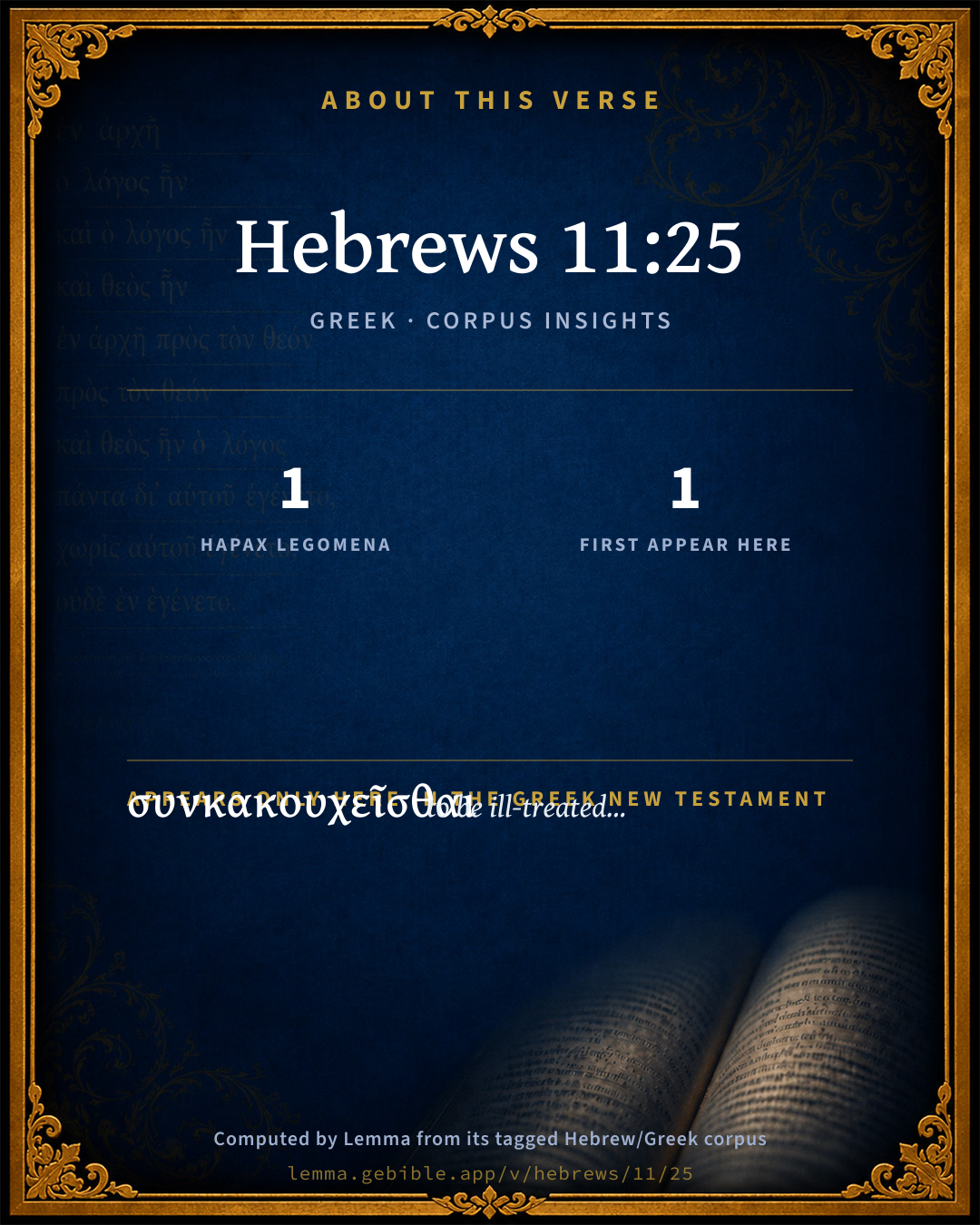
- 1 hapax legomenon — only here in the Greek New Testament
- 1 first appearance in the Greek New Testament
Download a study sheet
One document with this verse’s original text, its word-by-word gloss line, the meaning frame, cross-references with their text, attributed commentary, and full source and license credits — printable, and it pastes into notes with its structure intact.
This verse Autodidact and up
A passage Seminary Student
Up to 50 verses in one chapter. A passage sheet keeps up to 6 commentary sources and 12 cross-references per verse, in the order this page ranks them, and says so on the sheet whenever that leaves anything out. Ask for a single verse and you get the Autodidact verse sheet above.
Everything on this page stays free to read, with no account — the sheet is a download of what is already on screen, not access to it.
Compare translations 3
The same verse in 3 English versions, stacked beneath the original-language interlinear above. Click any original word for its lexicon entry.
Each is an independent rendering of the whole verse — the interlinear is not word-aligned to these translations.
Highlighted words mark where these versions differ — a whole-verse word diff, not a word-by-word alignment.
-
World English Bible Public Domain
choosing rather to share ill treatment with God's people, than to enjoy the pleasures of sin for a time;
-
King James Version Public Domain
Choosing rather to suffer affliction with the people of God, than to enjoy the pleasures of sin for a season;
-
unfoldingWord Literal Text CC BY-SA 4.0
Rather, he chose to suffer evil together with the people of God than to have the temporary enjoyment of sin.
unfoldingWord Literal Text — © unfoldingWord, licensed CC BY-SA 4.0. Word-aligned USFM3 via Door43 (git.door43.org/unfoldingWord/en_ult).
Show all 19 translations
Every available English version of this verse, each an independent rendering of the whole verse.
-
World English Bible Public Domain
choosing rather to share ill treatment with God's people, than to enjoy the pleasures of sin for a time;
-
Berean Standard Bible Public Domain
He chose to suffer oppression with God’s people rather than to experience the fleeting enjoyment of sin.
-
Majority Standard Bible Public Domain
He chose to suffer oppression with God’s people rather than to experience the fleeting enjoyment of sin.
-
King James Version Public Domain
Choosing rather to suffer affliction with the people of God, than to enjoy the pleasures of sin for a season;
-
American Standard Version (1901) Public Domain
choosing rather to share ill treatment with the people of God, than to enjoy the pleasures of sin for a season;
-
Revised Version (1885) Public Domain
choosing rather to be evil entreated with the people of God, than to enjoy the pleasures of sin for a season;
-
Geneva Bible (1599) Public Domain
And chose rather to suffer aduersitie with the people of God, then to enioy the pleasures of sinnes for a season,
-
Douay-Rheims (1899) Public Domain
Rather choosing to be afflicted with the people of God, than to have the pleasure of sin for a time,
-
Young's Literal Translation Public Domain
having chosen rather to be afflicted with the people of God, than to have sin's pleasure for a season,
-
Literal Standard Version CC BY-SA 4.0
having chosen rather to be afflicted with the people of God, than to have sin’s pleasure for a season,
-
Unlocked Literal Bible CC BY-SA 4.0
Instead, he chose to suffer with the people of God, rather than to enjoy the pleasures of sin for a while.
-
unfoldingWord Literal Text CC BY-SA 4.0
Rather, he chose to suffer evil together with the people of God than to have the temporary enjoyment of sin.
-
Darby Bible Public Domain
choosing rather to suffer affliction along with the people of God than to have [the] temporary pleasure of sin;
-
World Messianic Bible Public Domain
choosing rather to share ill treatment with God’s people than to enjoy the pleasures of sin for a time,
-
Webster's Bible Public Domain
Choosing rather to suffer affliction with the people of God, than to enjoy the pleasures of sin for a season;
-
Free Bible Version CC BY-SA 4.0
Instead he chose to share in the sufferings of God's people rather than to enjoy the temporary pleasures of sin.
-
Bible in Basic English Public Domain
Feeling that it was better to undergo pain with the people of God, than for a short time to have a taste of the pleasures of sin;
-
Text-Critical English NT CC BY 4.0
choosing to be mistreated with the people of God rather than to enjoy the fleeting pleasure of sin.
-
Tyndale New Testament (1534) Public Domain
and chose rather to suffre adversitie with the people of God then to enioye the pleasurs of synne for a ceason
Literal Standard Version (2020), Covenant Press — licensed CC BY-SA 4.0. Text via the HelloAO Bible API (eBible.org). Unlocked Literal Bible (unfoldingWord) — licensed CC BY-SA 4.0. Text via the HelloAO Bible API (eBible.org). unfoldingWord Literal Text — © unfoldingWord, licensed CC BY-SA 4.0. Word-aligned USFM3 via Door43 (git.door43.org/unfoldingWord/en_ult). Free Bible Version, Dr. Jonathan Gallagher — licensed CC BY-SA 4.0. Text via the HelloAO Bible API (eBible.org).
Word by word
More ways to search: Search by grammar → Find every occurrence → Compare this word →
Practice this passage: Drill this verse → Learn its vocabulary →
- Appears 1× in the Greek New Testament
- First appears here
- Part of Speech
- Verb
- Tense
- Present
- Voice
- Middle or Passive deponent
- Mood
- Infinitive
Full Thayer's Definition
- μᾶλλον mâllon G3123 “more” Adverb
- ἑλόμενος hairéomai G138 “to choose” Verb, Aorist, Middle, Participle, Nominative, Singular, Masculine
- συνκακουχεῖσθαι synkakouchéō G4778 “to be ill-treated together” Verb, Present, Middle or Passive deponent, Infinitive
- τῷ ho G3588 “the” Article, Dative, Singular, Masculine
- λαῷ laós G2992 “people” Noun, Dative, Singular, Masculine
- τοῦ ho G3588 “the” Article, Genitive, Singular, Masculine
- θεοῦ theós G2316 “God” Noun, Genitive, Singular, Masculine
- ἢ ḗ G2228 “or” Particle
- πρόσκαιρον próskairos G4340 “temporary” Adjective, Accusative, Singular, Feminine
- ἔχειν échō G2192 “to have” Verb, Present, Active, Infinitive
- ἁμαρτίας hamartía G266 “sin” Noun, Genitive, Singular, Feminine
- ἀπόλαυσιν apólausis G619 “enjoyment” Noun, Accusative, Singular, Feminine
About this verse
These counts appear in no published source. They are computed here, from the morphology-tagged text and Lemma’s own curated glosses. What Lemma adds →
- 12
- words
- 11
- distinct lemmas
- General Epistles
- section
Notable vocabulary
1 hapax legomenon — a word that appears only here in the entire Greek New Testament:
- συνκακουχεῖσθαι to be ill-treated together G4778
First appearance in Scripture
This word makes its first canonical appearance in the Greek New Testament here:
- συνκακουχεῖσθαι to be ill-treated together G4778
Shared distinctive vocabulary
ἀπόλαυσιν enjoyment G619 occurs in 2 verses of the Greek New Testament. Also found in:
Repetition
A word recurs within this verse:
- τῷ the G3588 ×2
Cross-references
32Topical passages linked to Hebrews 11:25 in the Treasury of Scripture Knowledge — connected by theme and wording, ordered by reader-vote popularity; previews shown in the World English Bible.
- Psalms 84:10 For a day in your courts is better than a thousand. I would rather be a doorkeeper in the house of my God, Than to dwell in the tents of wickedness.
- 2 Timothy 2:3–10 You therefore must endure hardship, as a good soldier of Christ Jesus.
- Job 36:21 Take heed, don't regard iniquity; For this you have chosen rather than affliction.
- 2 Corinthians 5:17 Therefore if anyone is in Christ, he is a new creation. The old things have passed away. Behold, all things have become new.
- Job 20:5 That the triumphing of the wicked is short, The joy of the godless but for a moment?
- 1 Peter 4:12–16 Beloved, don't be astonished at the fiery trial which has come upon you, to test you, as though a strange thing happened to you.
- 1 Peter 1:6–7 Wherein you greatly rejoice, though now for a little while, if need be, you have been put to grief in various trials,
- Psalms 73:18–20 Surely you set them in slippery places. You throw them down to destruction.
- 2 Thessalonians 1:3–6 We are bound to always give thanks to God for you, brothers, even as it is appropriate, because your faith grows exceedingly, and the love of each and every one of you towards one another abounds;
- 1 Peter 2:10 who in time past were no people, but now are God's people, who had not obtained mercy, but now have obtained mercy.
- Revelation 18:7 However much she glorified herself, and grew wanton, so much give her of torment and mourning. For she says in her heart, 'I sit a queen, and am no widow, and will in no way see mourning.'
- Isaiah 47:8–9 Now therefore hear this, you who are given to pleasures, who sit securely, who say in your heart, I am, and there is none else besides me; I shall not sit as a widow, neither shall I know the loss of children:
- Matthew 5:10–12 Blessed are those who have been persecuted for righteousness' sake, For theirs is the Kingdom of Heaven.
- Luke 16:25 "But Abraham said, 'Son, remember that you, in your lifetime, received your good things, and Lazarus, in like manner, bad things. But now here he is comforted and you are in anguish.
- Acts 7:24–25 Seeing one of them suffer wrong, he defended him, and avenged him who was oppressed, striking the Egyptian.
- Acts 20:23–24 except that the Holy Spirit testifies in every city, saying that bonds and afflictions wait for me.
- Romans 5:3 Not only this, but we also rejoice in our sufferings, knowing that suffering works perseverance;
- Romans 8:35–39 Who shall separate us from the love of Christ? Could oppression, or anguish, or persecution, or famine, or nakedness, or peril, or sword?
- Colossians 1:24 Now I rejoice in my sufferings for your sake, and fill up on my part that which is lacking of the afflictions of Christ in my flesh for his body's sake, which is the assembly;
- 2 Timothy 1:8 Therefore don't be ashamed of the testimony of our Lord, nor of me his prisoner; but endure hardship for the Gospel according to the power of God,
- 2 Timothy 3:11–12 persecutions, and sufferings: those things that happened to me at Antioch, Iconium, and Lystra. I endured those persecutions. Out of them all the Lord delivered me.
- Hebrews 10:32 But remember the former days, in which, after you were enlightened, you endured a great struggle with sufferings;
- James 1:20 for the anger of man doesn't produce the righteousness of God.
- James 5:5 You have lived delicately on the earth, and taken your pleasure. You have nourished your hearts as in a day of slaughter.
- Job 21:11–13 They send forth their little ones like a flock. Their children dance.
- Psalms 47:9 The princes of the peoples are gathered together, The people of the God of Abraham. For the shields of the earth belong to God. He is greatly exalted!
- Isaiah 21:4 My heart flutters, horror has frightened me; the twilight that I desired has been turned into trembling to me.
- Matthew 13:21 yet he has no root in himself, but endures for a while. When oppression or persecution arises because of the word, immediately he stumbles.
- Hebrews 4:9 There remains therefore a Sabbath rest for the people of God.
- Hebrews 11:37 They were stoned. They were sawn apart. They were tempted. They were slain with the sword. They went around in sheep skins and in goat skins; being destitute, afflicted, ill-treated
- Luke 12:19–20 I will tell my soul, "Soul, you have many goods laid up for many years. Take your ease, eat, drink, be merry."'
- Romans 8:17–18 and if children, then heirs; heirs of God, and joint-heirs with Christ; if indeed we suffer with him, that we may also be glorified with him.
Cross-references courtesy of OpenBible.info (CC BY 4.0).
Lesson kit
Teaching starters — assembled from the data on this page, not authored interpretation. Every prompt links to the verse data it draws on. Edit before teaching.
Hebrews, in the General Epistles, opens this verse with 12 words (11 distinct Greek lemmas). Its most distinctive word is synkakouchéō (“to be ill-treated together”). A historical commentator’s framing appears above. Read the whole chapter for the surrounding context.
Discussion questions
- How does “to be ill-treated together” (synkakouchéō) shape what this verse is saying?
- 1 word here appears nowhere else in the Greek New Testament. Why might the author reach for such rare wording?
- This is the first place “to be ill-treated together” appears in Scripture (first appears here). What does its debut here establish?
- How does 1 Timothy 6:17, which shares the word «enjoyment», read alongside this verse?
- What does the repetition of “the” (2× in this one verse) do in this verse?
- These translations render this verse differently. What is at stake in choosing one wording over another?
- Compare how Bengel's Gnomon and Meyer's Critical & Exegetical Commentary read this verse. Where do they agree or differ?
Things to notice
- 1 word in this verse appears nowhere else in the Greek New Testament.
- 1 word makes its first canonical appearance in Scripture here.
- These translations choose different wording for 18 words in this verse.
- “the” occurs 2× in this single verse.
- 11 distinct Greek lemmas span 12 words in this verse.
Commentary
Notes on Hebrews 11:25 from classic Christian and Jewish commentators (each source and its license shown beneath its notes). The classic Christian expositions comment on the surrounding passage and are grouped to its opening verse, so a note may address several verses; the Jewish commentaries on the Tanakh (Rashi and others) are per-verse, so they appear only where the commentator wrote on this verse.
Lemma curates 59 commentaries, every one of them public domain or Creative Commons licensed, each selected and text-cleaned for this edition rather than reprinted as found. About our sources →
Bengel's Gnomon
Johann Albrecht Bengel
Bengel's Gnomon of the New Testament — English translation (T&T Clark, Edinburgh, 1860) — public domain. Text from a community e-Sword module.
Meyer's Critical & Exegetical Commentary
Heinrich August Wilhelm Meyer
Meyer — Critical and Exegetical Commentary on the New Testament — English translation by Peter Christie, edited by Frederick Crombie (T&T Clark, 1880) — public domain. Text from a community e-Sword module.
Geneva Bible (1599)
Geneva Bible translators
Geneva Bible (1599) marginal notes — public domain. Text via Bolls.life.
Jamieson, Fausset & Brown
Robert Jamieson, A. R. Fausset & David Brown
Jamieson, Fausset & Brown — Commentary Critical and Explanatory on the Whole Bible (1871) — public domain (CC PDM 1.0). Text via the HelloAO Bible API.
Ellicott's Commentary for English Readers
A Bible Commentary for English Readers, edited by Charles John Ellicott (1878–1897) — public domain. Text from a community e-Sword module.
The Cambridge Bible for Schools and Colleges
gen. ed. J. J. S. Perowne
The Cambridge Bible for Schools and Colleges (gen. ed. J. J. S. Perowne; Cambridge University Press, 1878–1918) — public domain. Text from a community e-Sword module.
John Gill's Exposition
John Gill's Exposition of the Whole Bible (1746–1763) — public domain (CC PDM 1.0). Text via the HelloAO Bible API.
Trapp's Complete Commentary
John Trapp
John Trapp, A Commentary or Exposition upon All the Books of the Old and New Testament (1647–1656) — public domain. Text from a community e-Sword module.
Albert Barnes' Notes on the Bible
Albert Barnes' Notes on the Bible (1834–1885) — public domain. Text from a community e-Sword/MySword module.
Matthew Poole's English Annotations
Matthew Poole's English Annotations on the Holy Bible (1683–1685) — public domain. Text from a community e-Sword/MySword module.
Whedon's Commentary on the Bible
Daniel D. Whedon
Daniel D. Whedon (gen. ed.), Commentary on the Old and New Testaments (1874–1909) — public domain. Text from a community e-Sword module.
Scofield Reference Notes
C. I. Scofield
The Scofield Reference Bible (1917 edition), notes by C. I. Scofield — public domain. Text from a community e-Sword module.
Burkitt's Expository Notes on the New Testament
William Burkitt
William Burkitt's Expository Notes on the New Testament (1700–1703) — public domain. Text from a community e-Sword module.
The People's New Testament
B. W. Johnson
B. W. Johnson's The People's New Testament with Notes (1889–1891) — public domain. Electronic text from the Christian Classics Ethereal Library (CCEL) ThML edition.
Cambridge Greek Testament for Schools and Colleges
Cambridge Greek Testament for Schools and Colleges (Cambridge University Press, 1896; 21 vols, various authors incl. Carr, Maclear, Plummer, Farrar, Lumby, Moule, M. R. James, Simcox) — public domain. Text from a community e-Sword module.
Alford’s Greek Testament
Henry Alford
Henry Alford, The Greek Testament (1849–1861) — public domain. Text from a community e-Sword module.
Vincent's Word Studies in the New Testament
Marvin R. Vincent
Marvin R. Vincent, Word Studies in the New Testament (1887–1900) — public domain. Text from a community e-Sword/MySword module.
Westcott on Hebrews & the Epistles of John
Brooke Foss Westcott
Brooke Foss Westcott (1825–1901), The Epistle to the Hebrews (1889) and The Epistles of St John (1883) — public domain (pre-1929). Text recovered from Internet Archive / Google Books OCR scans. Westcott’s Gospel of John commentary is not included (its OCR lost the chapter running-heads required for reliable verse-keying). Some Greek quoted in the Hebrews volume is imperfectly rendered by the OCR.