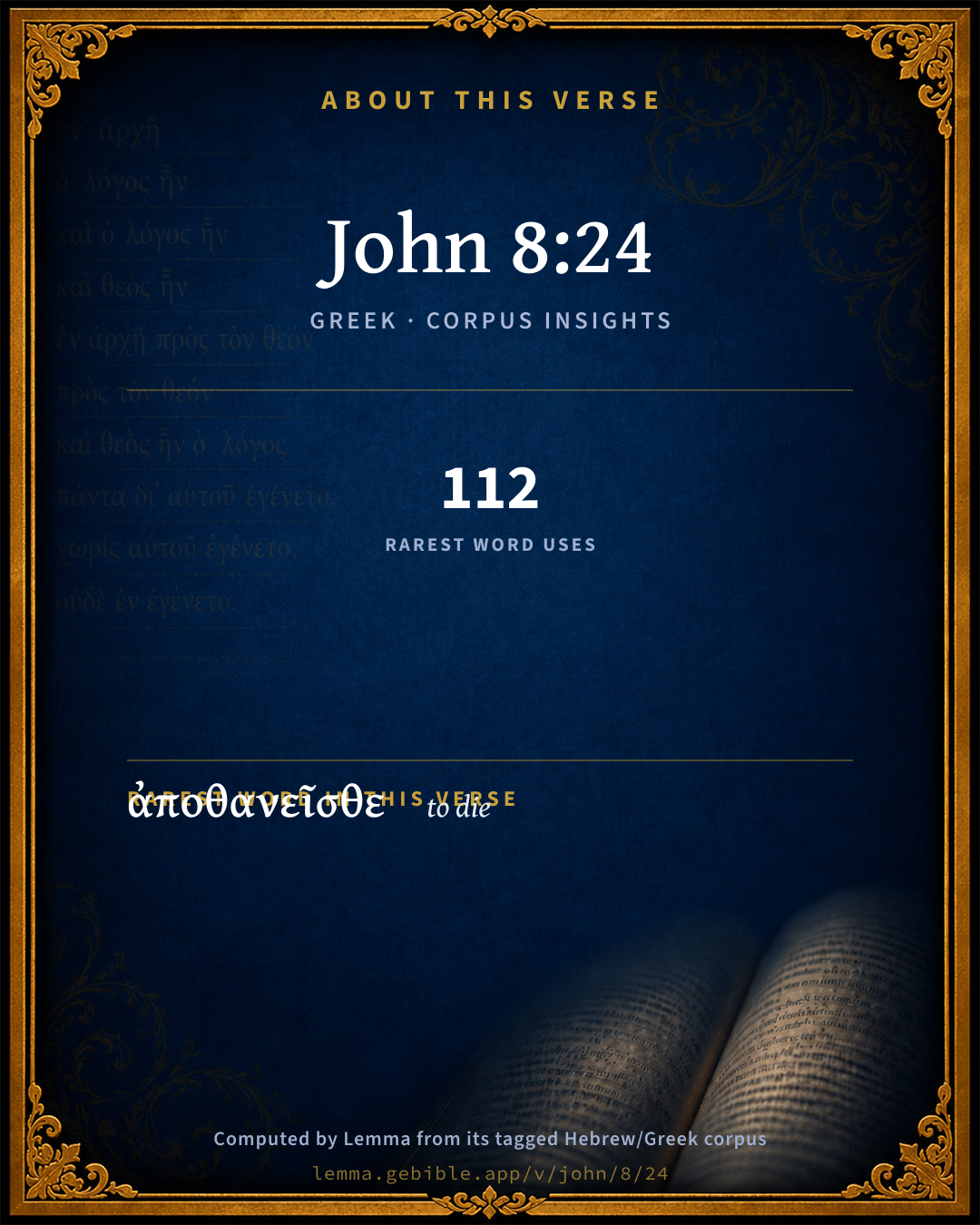
John 8:24

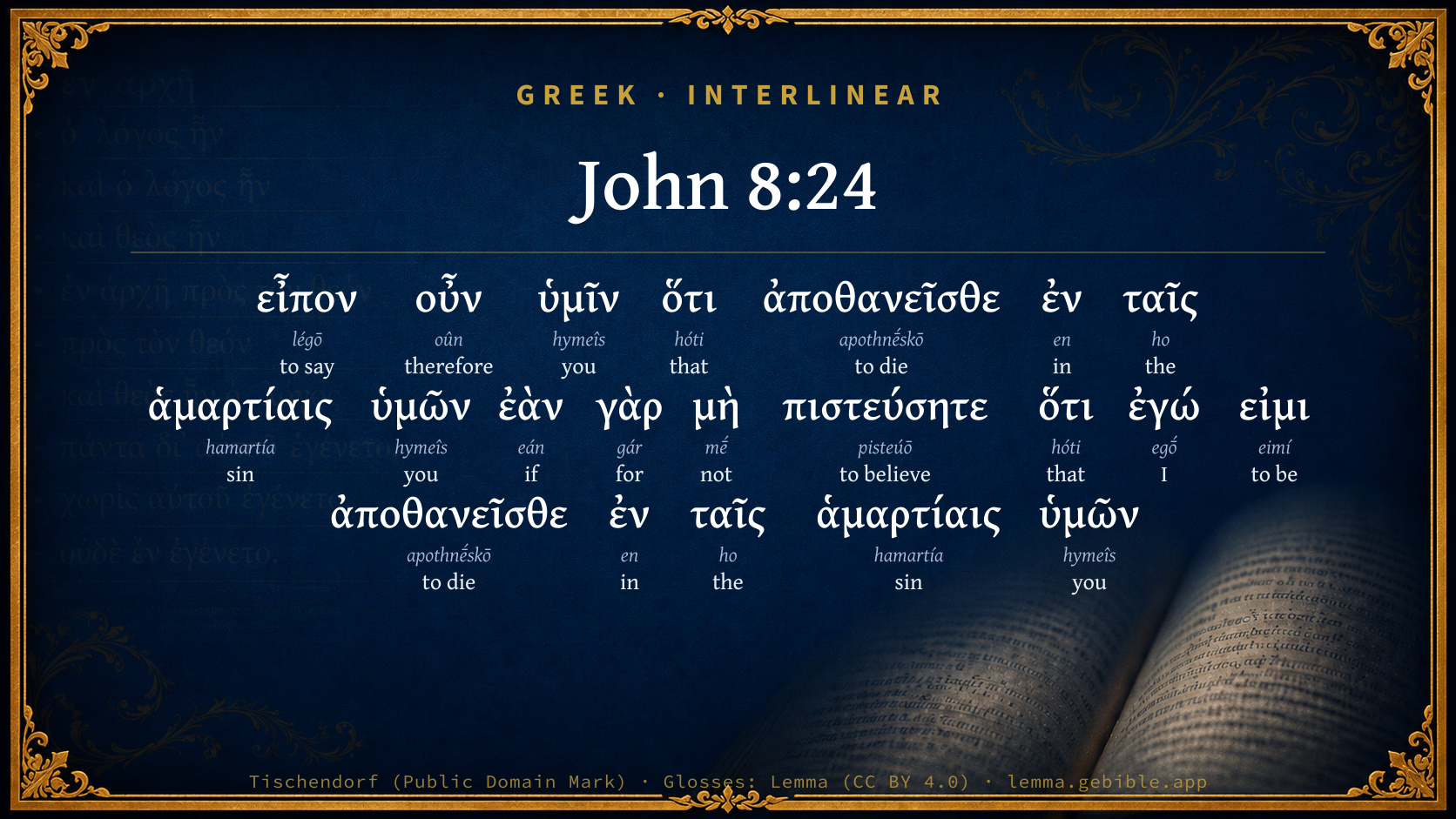
Greek (Tischendorf 8th ed.) John 8:24 appears in the Greek New Testament. The text above is from the Tischendorf 8th edition. Each word links to its Strong’s number and a concise gloss. Click any word for its full Thayer’s Greek Lexicon entry.
Download image
Cite this verse

John 8:24 (World English Bible). Public Domain. Lemma interlinear Bible study tool, https://lemma.gebible.app/v/john/8/24.

Show BibTeX & RIS
BibTeX
RIS
English Translation
I said therefore to you that you will die in your sins; for unless you believe that I am he, you will die in your sins."
World English Bible · Public Domain
Download a study sheet

One document with this verse’s original text, its word-by-word gloss line, the meaning frame, cross-references with their text, attributed commentary, and full source and license credits — printable, and it pastes into notes with its structure intact.

This verse Autodidact and up

Study sheet (.html) Plain text (.txt)

A passage Seminary Student

Up to 50 verses in one chapter. A passage sheet keeps up to 6 commentary sources and 12 cross-references per verse, in the order this page ranks them, and says so on the sheet whenever that leaves anything out. Ask for a single verse and you get the Autodidact verse sheet above.

Everything on this page stays free to read, with no account — the sheet is a download of what is already on screen, not access to it.

Want to remove ads? Support Godless Engineer
Compare translations 3

The same verse in 3 English versions, stacked beneath the original-language interlinear above. Click any original word for its lexicon entry.

Each is an independent rendering of the whole verse — the interlinear is not word-aligned to these translations.

Highlighted words mark where these versions differ — a whole-verse word diff, not a word-by-word alignment.

  • World English Bible Public Domain
    I said therefore to you that you will die in your sins; for unless you believe that I am he, you will die in your sins."
  • King James Version Public Domain
    I said therefore unto you, that ye shall die in your sins: for if ye believe not that I am he, ye shall die in your sins.
  • unfoldingWord Literal Text CC BY-SA 4.0
    Therefore, I said to you that you will die in your sins. For unless you believe that I am, you will die in your sins.”

unfoldingWord Literal Text — © unfoldingWord, licensed CC BY-SA 4.0. Word-aligned USFM3 via Door43 (git.door43.org/unfoldingWord/en_ult).

Versions to compare (up to 4)

3 of 4 selected

Show all 19 translations

Every available English version of this verse, each an independent rendering of the whole verse.

  • World English Bible Public Domain
    I said therefore to you that you will die in your sins; for unless you believe that I am he, you will die in your sins."
  • Berean Standard Bible Public Domain
    That is why I told you that you would die in your sins. For unless you believe that I am He, you will die in your sins.”
  • Majority Standard Bible Public Domain
    That is why I told you that you would die in your sins. For unless you believe that I am He, you will die in your sins.”
  • King James Version Public Domain
    I said therefore unto you, that ye shall die in your sins: for if ye believe not that I am he, ye shall die in your sins.
  • American Standard Version (1901) Public Domain
    I said therefore unto you, that ye shall die in your sins: for except ye believe that I am `he', ye shall die in your sins.
  • Revised Version (1885) Public Domain
    I said therefore unto you, that ye shall die in your sins: for except ye believe that I am he, ye shall die in your sins.
  • Geneva Bible (1599) Public Domain
    I said therefore vnto you, That ye shall die in your sinnes: for except ye beleeue, that I am he, ye shall die in your sinnes.
  • Douay-Rheims (1899) Public Domain
    Therefore I said to you, that you shall die in your sins. For if you believe not that I am he, you shall die in your sin.
  • Young's Literal Translation Public Domain
    I said, therefore, to you, that ye shall die in your sins, for if ye may not believe that I am `he', ye shall die in your sins.'
  • Literal Standard Version CC BY-SA 4.0
    I said, therefore, to you, that you will die in your sins, for if you may not believe that I AM, you will die in your sins.”
  • Unlocked Literal Bible CC BY-SA 4.0
    Therefore, I said to you that you will die in your sins. For unless you believe that I AM, you will die in your sins.”
  • unfoldingWord Literal Text CC BY-SA 4.0
    Therefore, I said to you that you will die in your sins. For unless you believe that I am, you will die in your sins.”
  • Darby Bible Public Domain
    I said therefore to you, that ye shall die in your sins; for unless ye shall believe that I am [he], ye shall die in your sins.
  • World Messianic Bible Public Domain
    I said therefore to you that you will die in your sins; for unless you believe that I am he, you will die in your sins.”
  • Webster's Bible Public Domain
    I said therefore to you, that ye will die in your sins: for if ye believe not that I am he, ye will die in your sins.
  • Free Bible Version CC BY-SA 4.0
    That is why I told you that you'll die in your sins. For if you don't trust in me, the ‘I am,’ you'll die in your sins.”
  • Bible in Basic English Public Domain
    For this reason I said to you that death will overtake you in your sins: for if you have not faith that I am he, death will come to you while you are in your sins.
  • Text-Critical English NT CC BY 4.0
    Therefore I said to you that you will die in your sins, for if you do not believe that I am he, you will die in your sins.”
  • Tyndale New Testament (1534) Public Domain
    Then sayde they vnto him who arte thou? And Iesus sayde vnto them: even the very same thinge that I saye vnto you.

Literal Standard Version (2020), Covenant Press — licensed CC BY-SA 4.0. Text via the HelloAO Bible API (eBible.org). Unlocked Literal Bible (unfoldingWord) — licensed CC BY-SA 4.0. Text via the HelloAO Bible API (eBible.org). unfoldingWord Literal Text — © unfoldingWord, licensed CC BY-SA 4.0. Word-aligned USFM3 via Door43 (git.door43.org/unfoldingWord/en_ult). Free Bible Version, Dr. Jonathan Gallagher — licensed CC BY-SA 4.0. Text via the HelloAO Bible API (eBible.org).

Word by word

More ways to search: Search by grammar → Find every occurrence → Compare this word →

Practice this passage: Drill this verse → Learn its vocabulary →

ἀποθανεῖσθε
apothnḗskō
G599
“to die”
Verb, Future, Middle deponent, Indicative, 2nd person, Plural
Part of Speech
Verb
Tense
Future
Voice
Middle deponent
Mood
Indicative
Person
2nd person
Number
Plural
Full Thayer's Definition

Origin: from G575 and G2348

TDNT: 03:07,3

1. to die a. of the natural death of man b. of the violent death of man or animals c. to perish by means of something d. of trees which dry up, of seeds which rot when planted e. of eternal death, to be subject to eternal misery in hell
  1. εἶπον légō G3004 “to say” Verb, Aorist, Active, Indicative, 1st person, Singular
  2. οὖν oûn G3767 “therefore” Conjunction
  3. ὑμῖν hymeîs G5210 “you” Personal pronoun, 2nd person, Dative, Plural
  4. ὅτι hóti G3754 “that” Conjunction
  5. ἐν en G1722 “in” Preposition
  6. ταῖς ho G3588 “the” Article, Dative, Plural, Feminine
  7. ἁμαρτίαις hamartía G266 “sin” Noun, Dative, Plural, Feminine
  8. ὑμῶν hymeîs G5210 “you” Personal pronoun, 2nd person, Genitive, Plural
  9. ἐὰν eán G1437 “if” Conditional
  10. γὰρ gár G1063 “for” Conjunction
  11. μὴ mḗ G3361 “not” Particle, Negative
  12. πιστεύσητε pisteúō G4100 “to believe” Verb, Aorist, Active, Subjunctive, 2nd person, Plural
  13. ὅτι hóti G3754 “that” Conjunction
  14. ἐγώ egṓ G1473 “I” Personal pronoun, 1st person, Nominative, Singular
  15. εἰμι eimí G1510 “to be” Verb, Present, Active, Indicative, 1st person, Singular
  16. ἀποθανεῖσθε apothnḗskō G599 “to die” Verb, Future, Middle deponent, Indicative, 2nd person, Plural
  17. ἐν en G1722 “in” Preposition
  18. ταῖς ho G3588 “the” Article, Dative, Plural, Feminine
  19. ἁμαρτίαις hamartía G266 “sin” Noun, Dative, Plural, Feminine
  20. ὑμῶν hymeîs G5210 “you” Personal pronoun, 2nd person, Genitive, Plural

About this verse

These counts appear in no published source. They are computed here, from the morphology-tagged text and Lemma’s own curated glosses. What Lemma adds →

21
words
14
distinct lemmas
Gospels
section

Repetition

Words recur within this verse:

  • ἀποθανεῖσθε to die G599 ×2
  • ἁμαρτίαις sin G266 ×2
  • ὑμῖν you G5210 ×3
  • ὅτι that G3754 ×2
  • ἐν in G1722 ×2
  • ταῖς the G3588 ×2

Cross-references

13

Topical passages linked to John 8:24 in the Treasury of Scripture Knowledge — connected by theme and wording, ordered by reader-vote popularity; previews shown in the World English Bible.

  • John 3:36 One who believes in the Son has eternal life, but one who disobeys the Son won't see life, but the wrath of God remains on him."
  • Mark 16:16 He who believes and is baptized will be saved; but he who disbelieves will be condemned.
  • John 3:18 He who believes in him is not judged. He who doesn't believe has been judged already, because he has not believed in the name of the one and only Son of God.
  • Hebrews 10:26–29 For if we sin willfully after we have received the knowledge of the truth, there remains no more a sacrifice for sins,
  • Hebrews 12:25 See that you don't refuse him who speaks. For if they didn't escape when they refused him who warned on the Earth, how much more will we not escape who turn away from him who warns from heaven,
  • Proverbs 8:36 But he who sins against me wrongs his own soul. All those who hate me love death."
  • John 4:26 Jesus said to her, "I am he, the one who speaks to you."
  • John 13:19 From now on, I tell you before it happens, that when it happens, you may believe that I AM.
  • Hebrews 2:3 how will we escape if we neglect so great a salvation-- which at the first having been spoken through the Lord, was confirmed to us by those who heard;
  • John 8:21 Jesus said therefore again to them, "I am going away, and you will seek me, and you will die in your sins. Where I go, you can't come."
  • Acts 4:12 There is salvation in none other, for neither is there any other name under heaven, that is given among men, by which we must be saved!"
  • Mark 13:6 For many will come in my name, saying, 'I am he!' and will lead many astray.
  • Luke 21:8 He said, "Watch out that you don't get led astray, for many will come in my name, saying, 'I AM,' and, 'The time is at hand.' Therefore don't follow them.

Cross-references courtesy of OpenBible.info (CC BY 4.0).

Commentary

Notes on John 8:24 from classic Christian and Jewish commentators (each source and its license shown beneath its notes). The classic Christian expositions comment on the surrounding passage and are grouped to its opening verse, so a note may address several verses; the Jewish commentaries on the Tanakh (Rashi and others) are per-verse, so they appear only where the commentator wrote on this verse.

Lemma curates 59 commentaries, every one of them public domain or Creative Commons licensed, each selected and text-cleaned for this edition rather than reprinted as found. About our sources →

Tyndale Open Study Notes

Tyndale Open Resources

8:24 unless you believe that I Am who I claim to be: Jesus used God’s divine name (see 4:26; Exod 3:14), but the listeners missed the nuance (John 8:25). • die in your sins: Jesus’ presence in the world, as the light penetrating the darkness, is the world’s only chance for salvation.

Tyndale Open Study Notes — © Tyndale Open Resources, licensed CC BY-SA 4.0. Text via the HelloAO Bible API.

Bengel's Gnomon

Johann Albrecht Bengel

Joh 8:24.[222] Ἀποθανεῖσθε, ye shall die) The Jews had neglected the weightier words of Joh 8:21, “Ye shall seek Me, and shall die in your sins:” all the rest they had taken up at Joh 8:22 [viz. that part of His words, “Whither I go, ye cannot come”]: therefore now those weightier and more severe words are repeated.

[222] ἐὰν γὰρ μὴ πιστεύσητε, for unless ye shall believe) They who believe attach themselves to Christ, and through Him alone they attain to that, to which they could not attain otherwise.—V. g.

Bengel's Gnomon of the New Testament — English translation (T&T Clark, Edinburgh, 1860) — public domain. Text from a community e-Sword module.

Expositor's Greek Testament

ed. W. Robertson Nicoll

Joh 8:24 . εἶπον οὖν … ὑμῶν . “Therefore said I unto you, ye shall die in your sins.” The emphatic word is now ἀποθανεῖσθε ( cf. Joh 8:12 ); the destruction is itself put in the foreground (Meyer, Holtzmann). “For unless ye believe that I am He, ye shall, etc.” What they were required to believe is not explicitly stated (see their question, Joh 8:15 ), it is ὅτι ἐγώ εἰμι “that I am,” which Westcott supposes has the pregnant meaning “that I am, that in me is the spring of life and light and strength”; but this scarcely suits the context. Meyer supposes that He means “that I am the Messiah”. But surely it must refer directly to what He has just declared Himself to be, “I am not of this world but of the things above” [“nämlich der ἄνωθεν Stammende; die allentscheidende Persönlichkeit,” Holtzmann]. This belief was necessary because only by attaching themselves to His teaching and person could they be delivered from their identification with this world.

The Expositor's Greek Testament, edited by W. Robertson Nicoll (1897–1910) — public domain. Text from a community e-Sword module.

Cambridge Greek Testament for Schools and Colleges

24. ἀποθανεῖσθε. This is the emphatic word here, not ἐν τ. ἁμαρτ., as in Joh 8:21 The plural expresses the separate sins of each. “No reckoning made, but sent to your account with all your imperfections on your head.” But the sentence is not irreversible; it is pronounced conditionally, unless ye believe. Comp. Joh 1:12, Joh 3:15-18, Joh 6:40.

ὅτι ἐγώ εἰμι. That I am, implying the self-existence of Divinity. Here and in Joh 8:24; Joh 8:28; Joh 8:58, Joh 13:19, the context supplies no predicate; elsewhere (Joh 4:26, Joh 9:9, Joh 18:5-6; Joh 18:8) it does. I AM is the great Name, which every Jew understood; Exo 3:14; Deu 32:39; Isa 43:10.

Cambridge Greek Testament for Schools and Colleges (Cambridge University Press, 1896; 21 vols, various authors incl. Carr, Maclear, Plummer, Farrar, Lumby, Moule, M. R. James, Simcox) — public domain. Text from a community e-Sword module.

Jamieson, Fausset & Brown

Robert Jamieson, A. R. Fausset & David Brown

if ye believe not that I am he, ye shall die in your sins--They knew well enough what He meant (Mar 13:6, Greek; compare Mat 24:5). But He would not, by speaking it out, give them the materials for a charge for which they were watching. At the same time, one is irresistibly reminded by such language, so far transcending what is becoming in men, of those ancient declarations of the God of Israel, "I AM HE" (Deu 32:39; Isa 43:10, Isa 43:13; Isa 46:4; Isa 48:12). See on Joh 6:20.

Jamieson, Fausset & Brown — Commentary Critical and Explanatory on the Whole Bible (1871) — public domain (CC PDM 1.0). Text via the HelloAO Bible API.

John Calvin's Commentaries

24. You shall die in your sins. Having formerly employed the singular number, in your sin, he now resorts to the plural number, in your sins; but the meaning is the same, except that in the former passage he intended to point out that unbelief is the source and cause of all evils. Not that there are no other sins but unbelief, or that it is unbelief alone which subjects us to the condemnation of eternal death before God, as some men too extravagantly talk; but because it drives us away from Christ, and deprives us of his grace, from which we ought to expect deliverance from all our sins. That the Jews reject the medicine with obstinate malice, is their mortal disease; and hence it arises that the slaves of Satan do not cease to heap up sins on sins, and continually to bring down upon themselves fresh condemnations. And, therefore, he immediately adds, —

If you do not believe that I am. For there is no other way for lost men to recover salvation, but to betake themselves to Christ. The phrase, that I am, is emphatic; for, in order to make the meaning complete, we must supply all that the Scripture ascribes to the Messiah, and all that it bids us expect from him. But the sum and substance is — the restoration of the Church, the commencement of which is the light of faith, from which proceed righteousness and a new life. Some of the ancient writers have deduced from this passage the Divine essence of Christ; but that is a mistake, for he speaks of his office towards us. This statement is worthy of observation; for men never consider sufficiently the evils in which they are plunged; and though they are constrained to acknowledge their destruction, yet they neglect Christ, and look around them, in every direction, for useless remedies. Wherefore we ought to believe that, until the grace of Christ be manifested to deliver us, nothing but a boundless mass of all evils reigns perpetually in us.

John Calvin's Commentaries (1540-1563) — public domain. Text from the Calvin Translation Society English edition (1840s-50s) via the Christian Classics Ethereal Library (ccel.org). Calvin's coverage is partial (roughly two-thirds of the Bible); uncommented books and verses are honest gaps, never fabricated. The 19th-century editor's footnotes and remarks are omitted so the notes are faithfully Calvin's own voice.

Ellicott's Commentary for English Readers

(24) I said therefore unto you, that ye shall die in your sins.—He now further explains what He meant by these words in Joh_8:21. The words, as they are twice repeated in this verse, differ in two particulars from their earlier form. One is, that the singular substantive “sin” has given place to the plural “sins.” He brings home to them the definite and known acts of sin which resulted from their sinful state. Another is, that the order of the words is changed. It is not so easy to preserve this in English; but we may read in Joh_8:21 “In your sin ye shall die,” and here “Ye shall die in your sins.” The believing not is itself a state of sin. (Comp. Joh_16:9.) It is a separation from the only source of life, and is necessarily accompanied by death.

If ye believe not that I am he.—The word “He” is not found in the Greek text, and this is marked by the italics in English; but they have been thinking and speaking of the Messiah, though the name has not been mentioned since Joh_7:42. It was the name ever first in their thoughts, and our version represents the generally received interpretation. It may, however, be doubted whether this interpretation gives to us the full meaning of the words “I am,” as used in this absolute way by our Lord, and as recorded in this Gospel. Within this same chapter they meet us again in Joh_8:28; Joh_8:58, and in the account of the arrest in the Garden of Gethsemane we find them repeated. (See Notes on Joh_18:5 et seq.) The words had a sacred history which told of the revelation of Jehovah to Moses (Exo_3:14). Uttered as they were by Him who had just claimed to be “from above” and to be “not of this world,” and uttered as they were within the precincts of Jehovah’s Temple, and in the presence of His priests and people, they may well have carried to their minds this deeper meaning, and have been intended as a declaration of His divine existence. The meaning then would be, “If ye believe not that I am, that in Me there is existence which is the life of all who receive it, ye must die in your sins.”

A Bible Commentary for English Readers, edited by Charles John Ellicott (1878–1897) — public domain. Text from a community e-Sword module.

The Cambridge Bible for Schools and Colleges

gen. ed. J. J. S. Perowne

24. ye shall die in your sins] Here ‘die’ is emphatic, not ‘sin’ as in Joh_8:21. Moreover the plural is here correct; it is no longer the state of sin generally, but the separate sins of each that are spoken of. Before it was ‘in your sin shall ye die;’ here it is ‘ye shall die in your sins.’

for if ye believe not] This is the only way in which they can be delivered—faith in Him. Comp. Joh_1:12, Joh_3:15-18, Joh_6:40.

that I am he] Better, that I am. It not merely means ‘that I am the Messiah,’ but is the great name, which every Jew at once understood, I AM. Comp. Joh_8:28; Joh_8:58, Joh_13:19, Joh_18:5; Exo_3:14; Deu_32:39; Isa_43:10.

The Cambridge Bible for Schools and Colleges (gen. ed. J. J. S. Perowne; Cambridge University Press, 1878–1918) — public domain. Text from a community e-Sword module.

John Gill's Exposition

I have many things to say, and to judge of you,.... Being God omniscient, he knew their persons and actions, their lives and conversations, and all their sins and transgressions, which he could justly have complained of, and charged them with, and proved against them, and judged and condemned them for; but this was not his present business, he came not to judge and condemn, but to save: wherefore he waved these things, and took no notice of them, leaving them to his Father, who would call them to an account, and punish them for them:

but he that sent me is true; as to his promises concerning the mission of his Son, to be the Saviour of sinners; so to his threatenings, to bring down vengeance on those that disbelieve him, and reject him:

and I speak to the world, or "in the world",

those things which I have heard of him; as concerning his love, grace, and mercy to those that should believe in him, so of the destruction of the despisers and rejecters of him; which things he spoke not in secret, in a corner, but publicly and openly, before all the world, to Jews and Gentiles, and to as many as were in the treasury, in the temple at this time; see Joh 18:20.

John Gill's Exposition of the Whole Bible (1746–1763) — public domain (CC PDM 1.0). Text via the HelloAO Bible API.

Trapp's Complete Commentary

John Trapp

24 I said therefore unto you, that ye shall die in your sins: for if ye believe not that I am he, ye shall die in your sins.

Ver. 24. For if ye believe not, &c.] And yet Venator the Arminian saith, Nego hanc propositionem, Nemo potest salvus fieri, qui Christo per veram fidem non est insitus. Is not this to contradict Christ to his face; what an os durum hard speech is this!

John Trapp, A Commentary or Exposition upon All the Books of the Old and New Testament (1647–1656) — public domain. Text from a community e-Sword module.

Albert Barnes' Notes on the Bible

That I am he - That I am the Messiah.

Albert Barnes' Notes on the Bible (1834–1885) — public domain. Text from a community e-Sword/MySword module.

Matthew Poole's English Annotations

In the Greek it is only, if ye believe not that I am. Some refer this to Christ’s Divine nature; (I am, is the name of God, Exo 3:14); but others rather think that Christ here speaketh of himself as the Messiah and Mediator, and so the object of people’s faith; and he out of whom there is no salvation: the latter indeed includes the former; for cursed is he that trusteth in man, and maketh flesh his arm, Jer 17:5. The text plainly holds forth an impossibility of salvation for those who, under the revelations of the gospel, receive not and believe not in Christ as Mediator.

Matthew Poole's English Annotations on the Holy Bible (1683–1685) — public domain. Text from a community e-Sword/MySword module.

Whedon's Commentary on the Bible

Daniel D. Whedon

24. I am he—The italic word he is unnecessarily supplied by the translators. The words are,

If ye believe not that I am—If they believe not that his avowed nature was his real nature; that the being, the I he claimed to be, was true and actual. Jesus was careful not to assume to these Jews the name of Messiah, for they would forthwith expect that he would be the hero Messiah of their fancy.

Ye shall die in your sins—They would perish in sin because they reject the only redemption from sin.

Daniel D. Whedon (gen. ed.), Commentary on the Old and New Testaments (1874–1909) — public domain. Text from a community e-Sword module.

The Pulpit Commentary

Therefore I said unto you, Ye shall die in your sins: for if ye shall not have believed that I am (HE), ye will die in your sins. This last clause, "for," etc., gives our Lord"s reason in full for the terrific fact. It is a virtual reference of the unregenerate, earthly, low-born condition of his hearers to the fact of their unbelief in him. This fleshly, worldly state may be, might be, reversed by their faith in his essential character, an adequate moral surrender to his claims. Let them believe him to be that which he really is, the separation would then cease, and, like himself, they too might be "called out of the world." They might be "born of the Spirit," enter into the fellowship of the Son of God, become "not of this world," "even as he is not of this world." They might "arise, and go to their Father." There is no impassable chasm between them, though it is an appalling one to be crossed only by a faith which is itself the form and essence of regeneration. The faith is especially defined. Three times in this chapter our Lord represents the object of faith, the central focus of the Divine revelation, to be "I AM." The predicate is unexpressed here, and the same may be said in ver. 28 and ver. 58. Elsewhere the predicate may easily be gathered from the context. (Joh_9:9 Joh_18:5, Joh_18:6, 8 Mar_13:6 Luk_21:8) Meyer and many others have said, "The true predicate here is "the Christ:" "I am the coming One," "the promised One," "the Sent of God. It is a somewhat dubious proceeding to draw the central idea of this chapter from an unexpressed ellipsis. The I am" of these passages cannot be regarded as equivalent to the "I am that I am" of Exodus, or to the incommunicable name of the eternal One, but it is analogous to it. Throughout the prophets the unique and solitary grandeur of the Divine nature in its special covenant relations with Israel is expressed by the phrase, "I AM HE." This was the sum of the object of the Old Testament faith. (Deu_32:39 Isa_41:13 Isa_43:10, etc.) In like manner, the fulness of the Divine Ego in the incarnate Word is inexpressible by any one predicate. His entire revelation of himself had given this amplitude and indefinable breadth to his Personality. He had called himself the Son of God, the living Water, the veritable Bread, the Bread of God and of heaven, the Light of the world. He was indefinitely more than the current, popular idea of the Christ, immeasurably different from that which they persisted in expecting. Faith in that he is, in what he is, and in what he has revealed to them, is the germ of the life eternal. To refuse this faith is to refuse the hope that breaks over the gloom of Sheol, and to leave the full burden of sin upon the conscience. Compare St. Paul"s words, (1Co_15:17, 1Co_15:18) "If Christ be not risen... ye are yet in your sins."

The Pulpit Commentary (1880–1919), ed. H.D.M. Spence-Jones & Joseph S. Exell — public domain. Text from a community e-Sword module.

John Wesley's Explanatory Notes

If ye believe not that I AM - Here (as in ver. 58) our Lord claims the Divine name, I AM, Exod. iii, 14. But the Jews, as if he had stopped short, and not finished the sentence, answered, Who art thou?

John Wesley, Explanatory Notes Upon the Whole Bible (1754–1765) — public domain. Text via the GEBible commentary corpus.

Scofield Reference Notes

C. I. Scofield

sins

Sin. (See Scofield "Rom 3:23").

The Scofield Reference Bible (1917 edition), notes by C. I. Scofield — public domain. Text from a community e-Sword module.

Alford’s Greek Testament

Henry Alford

24.] Since this (ver. 23) is the case,—if ye do not believe that I am He, the Deliverer,—and be renewed by Faith, ye shall die in your sins (plural here, as struck nearer home to their consciences, and implying individual acts of sin, the results of the carnal state). On ἐγώ εἰμι see note, ver. 58.

Henry Alford, The Greek Testament (1849–1861) — public domain. Text from a community e-Sword module.

International Critical Commentary

24. εἰπον οὖν ὑμῖν, sc. at v. 21, where see note.

ἀποθανεῖσθε ἐν ταῖς ἁμαρτίαις ὑμῶν, the singular τῇ ἁμαρτίᾳ being changed to the plural. To this no significance is to be attached, as when phrases are repeated in Jn., there are generally slight verbal alterations (see on 3:16).

ἐὰν γὰρ μὴ πιστεύσητε ὅτι ἐγώ εἰμι, ἀποθανεῖσθε κτλ. Jesus repeats with an awful solemnity that if His hearers do not accept Him for what He is, they will die in their sins. ὅτι ἐγώ εἰμι may mean “that I am from above,” as He had just asserted of Himself, ἐγὼ ἐκ τῶν ἄνω εἰμί. But if this be the construction, it is very elliptical. It is more probable that we should take ἐγώ εἰμι absolutely, “I am He,” i.e. “I am the Divine Deliverer,” as at vv. 28, 58, and 13:19. For this use of ἐγώ εἰμι as the equivalent of the Hebrew אֲנִי־הוּא, see Introd., p. cxx, where the expression is more fully discussed. We may here particularly compare Isa 43:10 ἳνα πιστεύσητε … ὃτι ἐγώ εἰμι (see on v. 18). Jesus had uttered His message; henceforth they had no excuse for their sin (15:22).

International Critical Commentary — older volumes (1896–1929), various authors — public domain. Text from a community e-Sword module.

Vincent's Word Studies in the New Testament

Marvin R. Vincent

I am he [εγω ειμι] . He is inserted in the versions and is not in the text. By retaining it, we read, I am the Messiah. But the words are rather the solemn expression of His absolute divine being, as in ver 58 "If ye believe not that I am." See Deu 32:39; Isa 43:10; and compare vv. 28, 58 of this chapter, and Joh 13:19.

Marvin R. Vincent, Word Studies in the New Testament (1887–1900) — public domain. Text from a community e-Sword/MySword module.

Lesson kit

Teaching starters — assembled from the data on this page, not authored interpretation. Every prompt links to the verse data it draws on. Edit before teaching.

John, in the Gospels, opens this verse with 21 words (14 distinct Greek lemmas). Its most distinctive word is apothnḗskō (“to die”). A historical commentator’s framing appears above. Read the whole chapter for the surrounding context.

Discussion questions

  1. The word apothnḗskō carries the sense “to die.” How does it shape the verse?
  2. How does John 3:36, which shares this passage’s theme, read alongside this verse?
  3. What does the repetition of “to die” (2× in this one verse) do in this verse?
  4. These translations render this verse differently; the difference is in the English rendering, not the original. What questions does that raise?
  5. Compare how Tyndale Open Study Notes and Bengel's Gnomon read this verse. Where do they agree or differ?

Things to notice

  • These translations choose different wording for 3 words in this verse.
  • “to die” occurs 2× in this single verse.
  • 14 distinct Greek lemmas span 21 words in this verse.

Reading settings

Reading text

Shown beneath each verse's original-language words.

Old Testament
Old Testament edition

Read the OT as the Masoretic Hebrew (MT) or the Greek Septuagint (LXX).

English shown for the Greek Septuagint (in the Hebrew ↔ Greek comparison).

Comparing translations? Open the Compare panel on any verse page to stack up to four side by side.