Romans 7:17

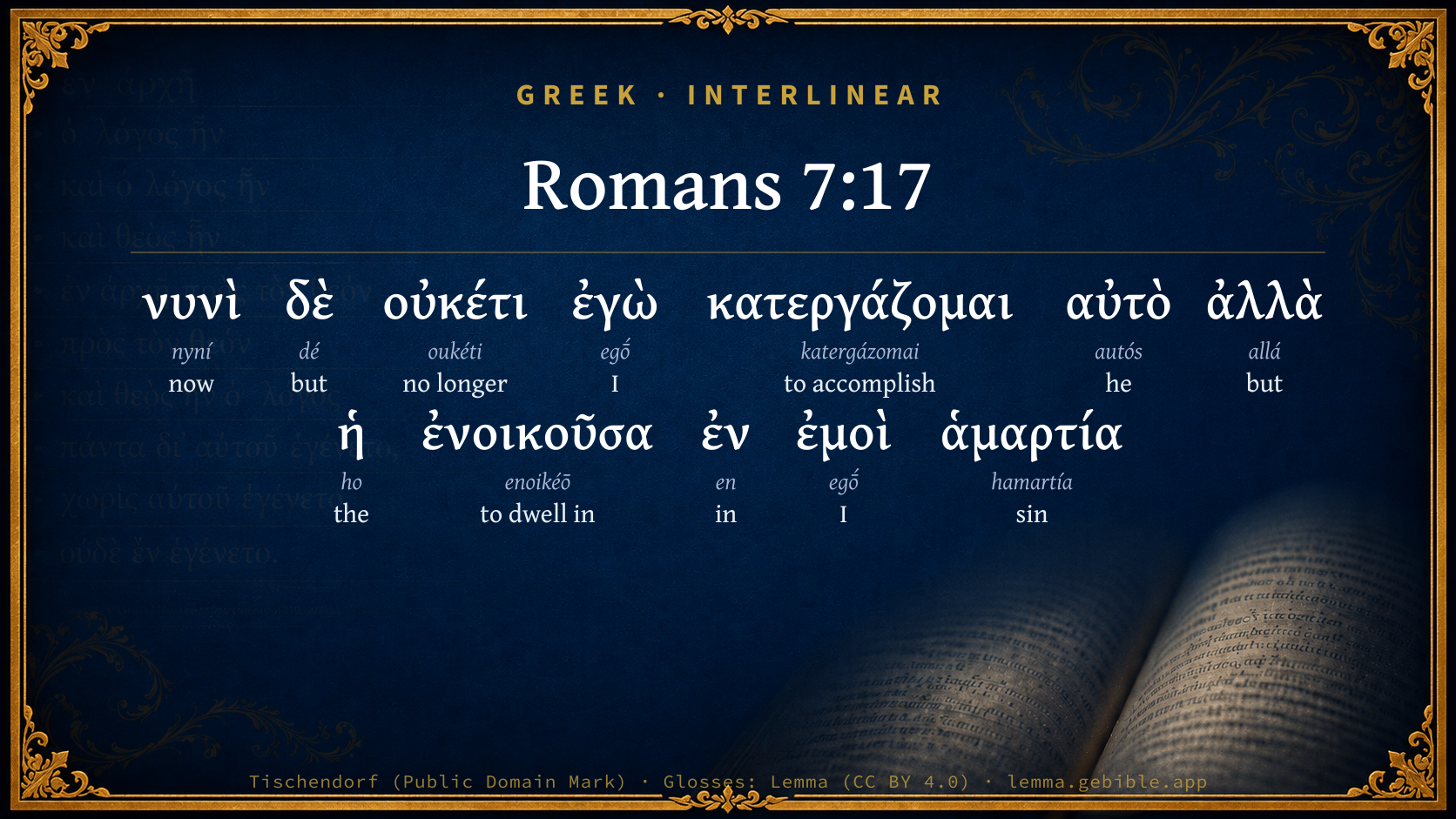
Greek (Tischendorf 8th ed.) Romans 7:17 appears in the Greek New Testament. The text above is from the Tischendorf 8th edition. Each word links to its Strong’s number and a concise gloss. Click any word for its full Thayer’s Greek Lexicon entry.
Download image
Cite this verse

Romans 7:17 (World English Bible). Public Domain. Lemma interlinear Bible study tool, https://lemma.gebible.app/v/romans/7/17.

Show BibTeX & RIS
BibTeX
RIS
English Translation
So now it is no more I that do it, but sin which dwells in me.
World English Bible · Public Domain
Highlights
  • 1 first appearance in the Greek New Testament
Full analysis ↓
Download a study sheet

One document with this verse’s original text, its word-by-word gloss line, the meaning frame, cross-references with their text, attributed commentary, and full source and license credits — printable, and it pastes into notes with its structure intact.

This verse Autodidact and up

Study sheet (.html) Plain text (.txt)

A passage Seminary Student

Up to 50 verses in one chapter. A passage sheet keeps up to 6 commentary sources and 12 cross-references per verse, in the order this page ranks them, and says so on the sheet whenever that leaves anything out. Ask for a single verse and you get the Autodidact verse sheet above.

Everything on this page stays free to read, with no account — the sheet is a download of what is already on screen, not access to it.

Want to remove ads? Support Godless Engineer
Compare translations 3

The same verse in 3 English versions, stacked beneath the original-language interlinear above. Click any original word for its lexicon entry.

Each is an independent rendering of the whole verse — the interlinear is not word-aligned to these translations.

Highlighted words mark where these versions differ — a whole-verse word diff, not a word-by-word alignment.

  • World English Bible Public Domain
    So now it is no more I that do it, but sin which dwells in me.
  • King James Version Public Domain
    Now then it is no more I that do it, but sin that dwelleth in me.
  • unfoldingWord Literal Text CC BY-SA 4.0
    But now no longer I myself produce it, but the sin living in me!

unfoldingWord Literal Text — © unfoldingWord, licensed CC BY-SA 4.0. Word-aligned USFM3 via Door43 (git.door43.org/unfoldingWord/en_ult).

Versions to compare (up to 4)

3 of 4 selected

Show all 19 translations

Every available English version of this verse, each an independent rendering of the whole verse.

  • World English Bible Public Domain
    So now it is no more I that do it, but sin which dwells in me.
  • Berean Standard Bible Public Domain
    In that case, it is no longer I who do it, but it is sin living in me that does it.
  • Majority Standard Bible Public Domain
    In that case, it is no longer I who do it, but it is sin living in me that does it.
  • King James Version Public Domain
    Now then it is no more I that do it, but sin that dwelleth in me.
  • American Standard Version (1901) Public Domain
    So now it is no more I that do it, but sin which dwelleth in me.
  • Revised Version (1885) Public Domain
    So now it is no more I that do it, but sin which dwelleth in me.
  • Geneva Bible (1599) Public Domain
    Nowe then, it is no more I, that doe it, but sinne that dwelleth in me.
  • Douay-Rheims (1899) Public Domain
    Now then it is no more I that do it, but sin that dwelleth in me.
  • Young's Literal Translation Public Domain
    and now it is no longer I that work it, but the sin dwelling in me,
  • Literal Standard Version CC BY-SA 4.0
    and now it is no longer I that work it, but sin dwelling in me,
  • Unlocked Literal Bible CC BY-SA 4.0
    But now it is no longer I who do it, but the sin that lives in me.
  • unfoldingWord Literal Text CC BY-SA 4.0
    But now no longer I myself produce it, but the sin living in me!
  • Darby Bible Public Domain
    Now then [it is] no longer *I* [that] do it, but the sin that dwells in me.
  • World Messianic Bible Public Domain
    So now it is no more I that do it, but sin which dwells in me.
  • Webster's Bible Public Domain
    Now then it is no more I that do it, but sin that dwelleth in me.
  • Free Bible Version CC BY-SA 4.0
    So it's no longer me who does this, but sin living in me—
  • Bible in Basic English Public Domain
    So it is no longer I who do it, but the sin living in me.
  • Text-Critical English NT CC BY 4.0
    But now it is no longer I who do it, but sin that dwells in me.
  • Tyndale New Testament (1534) Public Domain
    So then nowe it is not I that do it but synne that dwelleth in me.

Literal Standard Version (2020), Covenant Press — licensed CC BY-SA 4.0. Text via the HelloAO Bible API (eBible.org). Unlocked Literal Bible (unfoldingWord) — licensed CC BY-SA 4.0. Text via the HelloAO Bible API (eBible.org). unfoldingWord Literal Text — © unfoldingWord, licensed CC BY-SA 4.0. Word-aligned USFM3 via Door43 (git.door43.org/unfoldingWord/en_ult). Free Bible Version, Dr. Jonathan Gallagher — licensed CC BY-SA 4.0. Text via the HelloAO Bible API (eBible.org).

Word by word

More ways to search: Search by grammar → Find every occurrence → Compare this word →

Practice this passage: Drill this verse → Learn its vocabulary →

About this verse

These counts appear in no published source. They are computed here, from the morphology-tagged text and Lemma’s own curated glosses. What Lemma adds →

12
words
11
distinct lemmas
Pauline Epistles
section

Notable vocabulary

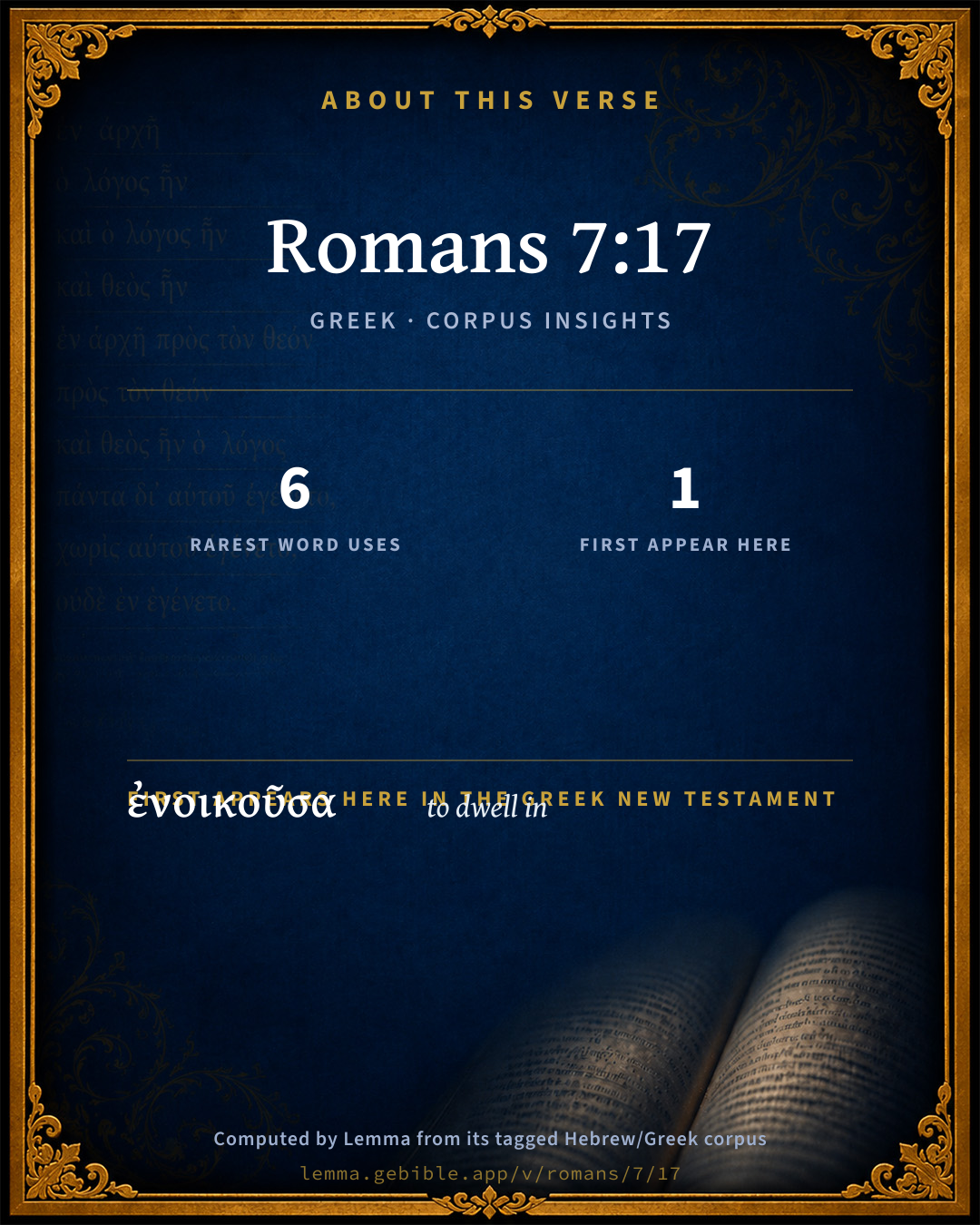
The rarest word here is ἐνοικοῦσα to dwell in G1774 — appearing just 6 times in the whole Greek New Testament.

First appearance in Scripture

This word makes its first canonical appearance in the Greek New Testament here:

  • ἐνοικοῦσα to dwell in G1774

Shared distinctive vocabulary

ἐνοικοῦσα to dwell in G1774 occurs in 6 verses of the Greek New Testament. Also found in:

Repetition

A word recurs within this verse:

Cross-references

7

Topical passages linked to Romans 7:17 in the Treasury of Scripture Knowledge — connected by theme and wording, ordered by reader-vote popularity; previews shown in the World English Bible.

  • Romans 7:20 But if what I don't desire, that I do, it is no more I that do it, but sin which dwells in me.
  • Romans 7:18 For I know that in me, that is, in my flesh, dwells no good thing. For desire is present with me, but I don't find it doing that which is good.
  • Philippians 3:8–9 Yes most assuredly, and I count all things to be loss for the excellency of the knowledge of Christ Jesus, my Lord, for whom I suffered the loss of all things, and count them nothing but refuse, that I may gain Christ
  • James 4:5–6 Or do you think that the Scripture says in vain, "The Spirit who lives in us yearns jealously"?
  • Romans 4:7–8 "Blessed are they whose iniquities are forgiven, Whose sins are covered.
  • Romans 7:23 but I see a different law in my members, warring against the law of my mind, and bringing me into captivity under the law of sin which is in my members.
  • 2 Corinthians 8:12 For if the readiness is there, it is acceptable according to what you have, not according to what you don't have.

Cross-references courtesy of OpenBible.info (CC BY 4.0).

Commentary

Notes on Romans 7:17 from classic Christian and Jewish commentators (each source and its license shown beneath its notes). The classic Christian expositions comment on the surrounding passage and are grouped to its opening verse, so a note may address several verses; the Jewish commentaries on the Tanakh (Rashi and others) are per-verse, so they appear only where the commentator wrote on this verse.

Lemma curates 59 commentaries, every one of them public domain or Creative Commons licensed, each selected and text-cleaned for this edition rather than reprinted as found. About our sources →

Tyndale Open Study Notes

Tyndale Open Resources

7:17 I am not the one doing wrong: Paul is not evading responsibility for his sin (see also 7:20). Rather, he is saying that because he genuinely wants to do what the law commands, some other factor must be causing him to do just the opposite. That factor is sin living in me. Paul experiences a divide between his will and his actions.

Tyndale Open Study Notes — © Tyndale Open Resources, licensed CC BY-SA 4.0. Text via the HelloAO Bible API.

Bengel's Gnomon

Johann Albrecht Bengel

Rom 7:17. Οὐκ ἔτι, no longer) These words are repeated, Rom 7:20.—οἰκοῦσα, dwelling) Rom 7:18; Rom 7:20. This word is afterwards used concerning the Spirit, ch. Rom 8:9.

Bengel's Gnomon of the New Testament — English translation (T&T Clark, Edinburgh, 1860) — public domain. Text from a community e-Sword module.

Meyer's Critical & Exegetical Commentary

Heinrich August Wilhelm Meyer

Rom_7:17. Νυνὶ δέ] does not introduce a minor proposition attaching itself with a but now (Reithmayr and Hofmann)a view which is unsuitable to the antithetical form of the expression; nor is to be taken, with Augustine, as nunc in statu gratiae; but it is the quite common and, in Pauls writings especially, very frequent as it is, however (see on Rom_3:21), that is, in this actual state of the case, however; namely, since my θέλειν, notwithstanding my conduct, is not opposed to the law, but on the contrary confirms it. In connection with this view οὐκέτι also is not, possibly, temporal, pointing back to a time in which it was otherwise with the speaker (Hofmann), namely, to what is related in Rom_7:7-11, but logical, as in Rom_7:20; Rom_11:6; Gal_3:18. What is indicated by νυνὶ δέ stands to ἐγὼ κατεργ. αὐτό in an excluding relation, so that after the former there can be no mention of the latter. It is the dialectic non jam, non item (Bornemann ad Xen. Cyr. i. 6. 27; Winer, p. 547 f. [E. T. 772]; comp. Ellendt, Lex. Soph. II. p. 432).

ἐγά] with emphasis: my personality proper, my self-consciousness, which is my real, morally wishing Ego. It is not this I that performs the evil (αὐτό, i.e. ὃ οὐ θέλω, Rom_7:16), but the principle of sin, which has its dwelling-place in me (the phenomenal man), enslaving my betterbut against its power too weakwill, and not allowing it to attain accomplishment. That ἐν ἐμοί is not, like ἐγώ, to be taken of the moral self-conscious I, is affirmed by Paul himself in Rom_7:18. But it is erroneous to infer, from what he here says of the ἐγώ, the necessity of the explanation in the sense of the regenerate person (see especially Calvin and Philippi); for if the power practising the evil be not the I, but the potentiality of sin, this accords perfectly with the state of the σαρκικός, ψυχικός (1Co_2:14), ὑπὸ τὴν ἁμαρτίαν πεπραμένος (Rom_7:14), consequently of the unregenerate, in whom sin rules, and not the grace and power of the Holy Spirit leading the moral Ego to victory. In the regenerate man dwells the Spirit (Rom_8:8; Gal_5:16 f.; 1Co_3:16), who aids the I in conquering the sin-power of the flesh (Rom_8:13 ff.; Gal_5:24).

Meyer — Critical and Exegetical Commentary on the New Testament — English translation by Peter Christie, edited by Frederick Crombie (T&T Clark, 1880) — public domain. Text from a community e-Sword module.

Expositor's Greek Testament

ed. W. Robertson Nicoll

Rom 7:17 . Νυνὶ δὲ οὐκέτι ἐγὼ κατεργάζομαι αὐτό . ἐγὼ is the true I, and emphatic. As things are, in view of the facts just explained, it is not the true self which is responsible for this line of conduct, but the sin which has its abode in the man: contrast Rom 8:11 τὸ ἐνοικοῦν αὐτοῦ πνεῦμα ἐν ὑμῖν . “Paul said, ‘It is no more I that do it, but sin that dwelleth in me,’ and ‘I live, yet not I; but Christ that liveth in me’; and both these sayings of his touch on the unsayable” (Dr. John Duncan). To be saved from sin, a man must at the same time own it and disown it; it is this practical paradox which is reflected in this verse. It is safe for a Christian like Paul it is not safe for everybody to explain his failings by the watchword, Not I, but indwelling sin. That might be antinomian, or manichean, as well as evangelical. A true saint may say it in a moment of passion, but a sinner had better not make it a principle.

The Expositor's Greek Testament, edited by W. Robertson Nicoll (1897–1910) — public domain. Text from a community e-Sword module.

Hodge's Commentary on Romans, Ephesians & First Corinthians

Charles Hodge

Rom_7:17

Now then it is no more I that do it, but sin that dwelleth in me. Now then, νυνὶ δέ, that is, under these circumstances, or, this being the case. Or the meaning may be but now, i.e., since I became a Christian. The former explanation is to be preferred on account of the connection of this verse with Rom_7:15, from which this passage is an inference. If the case be so, that I am sold under sin and am its unwilling slave; if I do what I disapprove, and fail to accomplish what I love; it is clear that it is not properly and fully I that do it, my real self; my better feelings or renovated nature is opposed to what the law forbids. Ego quidem in utroque, sed magis ego in eo, quod approbabam, quam in eo quod in me improbabam. Augustine, Confess. Lib. 8. ch. 5. This is not said as an exculpation, but to exhibit the extent and power of indwelling sin, which it is beyond our own power, and beyond the power of the law, to eradicate or effectually control. This feeling of helplessness is not only consistent with a sense and acknowledgment of accountability, but is always found united with genuine self-condemnation and penitence. There are, in general, few stronger indications of ignorance of the power and evil of sin, than the confident assertion of our ability to resist and subdue it. Paul groaned beneath its bondage, as if held in the loathsome embrace of a body of death. The apostles object, therefore, is not to apologize for sin, but to show that the experience detailed in Rom_7:15, is consistent with his being a Christian. If it is true that I really approve and love the law, and desire to be conformed to it, I am no longer the willing slave of sin; to the depth and power of the original evil is to be attributed the fact that I am not entirely delivered from its influence. This is obviously connected with the main object of the whole passage. For if sin remains and exerts its power, notwithstanding our disapprobation, and in despite of all our efforts, it is clear that we must look for deliverance to something out of ourselves, and that the mere perceptive power of the law cannot remove the evil.

Charles Hodge — Commentary on Romans (1835), First Corinthians (1857), and Ephesians (1856) — public domain. Text from a community e-Sword module.

Geneva Bible (1599)

Geneva Bible translators

That natural corruption, which cleaveth fast even to them that are regenerate, and not clean conquered.

Geneva Bible (1599) marginal notes — public domain. Text via Bolls.life.

Jamieson, Fausset & Brown

Robert Jamieson, A. R. Fausset & David Brown

Now then it is no more I--my renewed self.

that do it--"that work it."

but sin which dwelleth in me--that principle of sin that still has its abode in me. To explain this and the following statements, as many do (even BENGEL and THOLUCK), of the sins of unrenewed men against their better convictions, is to do painful violence to the apostle's language, and to affirm of the unregenerate what is untrue. That coexistence and mutual hostility of "flesh" and "spirit" in the same renewed man, which is so clearly taught in Rom 8:4, &c., and in Gal 5:16, &c., is the true and only key to the language of this and the following verses. (It is hardly necessary to say that the apostle means not to disown the blame of yielding to his corruptions, by saying, "it is not he that does it, but sin that dwelleth in him." Early heretics thus abused his language; but the whole strain of the passage shows that his sole object in thus expressing himself was to bring more vividly before his readers the conflict of two opposite principles, and how entirely, as a new man--honoring from his inmost soul the law of God--he condemned and renounced his corrupt nature, with its affections and lusts, its stirrings and its outgoings, root and branch).

Jamieson, Fausset & Brown — Commentary Critical and Explanatory on the Whole Bible (1871) — public domain (CC PDM 1.0). Text via the HelloAO Bible API.

Adam Clarke's Commentary

Verse 17. Now then it is no more I] It is not that I which constitutes reason and conscience, but sin-corrupt and sensual inclinations, that dwelleth in me-that has the entire domination over my reason, darkening my understanding, and perverting my judgment; for which there is condemnation in the law, but no cure. So we find here that there is a principle in the unregenerate man stronger than reason itself; a principle which is, properly speaking, not of the essence of the soul, but acts in it, as its lord, or as a tyrant. This is inbred and indwelling sin-the seed of the serpent; by which the whole soul is darkened, confused, perverted, and excited to rebellion against God.

Adam Clarke's Commentary on the Bible (1810–1826) — public domain. Text from a community e-Sword/MySword module.

John Calvin's Commentaries

17. Now it is no more I who do it, etc. This is not the pleading of one excusing himself, as though he was blameless, as the case is with many triflers who think that they have a sufficient defense to cover all their wickedness, when they cast the blame on the flesh; but it is a declaration, by which he shows how very far he dissented from his own flesh in his spiritual feeling; for the faithful are carried along in their obedience to God with such fervour of spirit that they deny the flesh.

This passage also clearly shows, that Paul speaks here of none but of the godly, who have been already born again; for as long as man remains like himself, whatsoever he may be, he is justly deemed corrupt; but Paul here denies that he is wholly possessed by sin; nay, he declares himself to be exempt from its bondage, as though he had said, that sin only dwelt in some part of his soul, while with an earnest feeling of heart he strove for and aspired after the righteousness of God, and clearly proved that he had the law of God engraven within him.

John Calvin's Commentaries (1540-1563) — public domain. Text from the Calvin Translation Society English edition (1840s-50s) via the Christian Classics Ethereal Library (ccel.org). Calvin's coverage is partial (roughly two-thirds of the Bible); uncommented books and verses are honest gaps, never fabricated. The 19th-century editor's footnotes and remarks are omitted so the notes are faithfully Calvin's own voice.

Ellicott's Commentary for English Readers

(17) This, then, appears to be the true explanation of the difficulty. There is really a dualism in the soul. I am not to be identified with that lower self which is enthralled by sin.

A Bible Commentary for English Readers, edited by Charles John Ellicott (1878–1897) — public domain. Text from a community e-Sword module.

The Cambridge Bible for Schools and Colleges

gen. ed. J. J. S. Perowne

17. Now] i.e. in this state of the case.

it is no more I] The Gr. is lit. but now no longer I do it, &c. The “no longer” is noteworthy, as implying (in the natural and common meaning of the words) a different previous state. It is possible indeed for the Gr. phrase to mean “no longer” with a logical reference only: q. d., “you can no longer maintain, after this statement, that I, &c.” But the large majority of New Testament parallels are for the time-reference: q. d., “it was once my true self, it is now no longer my true self, which works the will of sin.” Divine grace has now so altered the inner balance that the conscious will hates sin as sin and loves holiness as holiness.—See meanwhile note on Rom_7:9; where it is pointed out that even before grace self and sin are not, in strictness, to be identified. But the present verse goes further; indicating a real antagonism now between sin and the (regenerated) self.

The Cambridge Bible for Schools and Colleges (gen. ed. J. J. S. Perowne; Cambridge University Press, 1878–1918) — public domain. Text from a community e-Sword module.

John Gill's Exposition

Now then, it is no more I that do it,.... This is another inference, deduced from what is before said, that since he did not approve, but hated what he did, and willed the contrary, it was not he as spiritual, as born again, as a new man, a new creature, that did it; see Jo1 3:9. He says,

But sin that dwelleth in me; the old man, the carnal I, the evil present with him, the law in his members; which not only existed in him, and wrought in him, and that at times very strongly, but dwelt in him, had its abode in him, as it has in all regenerate persons, and will have, as long as they are in the body.

John Gill's Exposition of the Whole Bible (1746–1763) — public domain (CC PDM 1.0). Text via the HelloAO Bible API.

Trapp's Complete Commentary

John Trapp

17 Now then it is no more I that do it, but sin that dwelleth in me.

Ver. 17. It is no more I] Mr Bradford, martyr, in a certain letter thus comforteth his friend: At this present, my dear heart in the Lord, you are in a blessed estate, although it seem otherwise to you, or rather to your old Adam; the which I dare now be bold to discern from you, because you would have it not only discerned, but also utterly destroyed. God (saith another reverend man) puts a difference between us and sin in us, as between poison and the box that holds it.

Sin that dwelleth in me] An ill inmate that will not leave, till the house falleth on tho head of it; as the fretting leprosy in the walls of a house would not leave till the house itself were demolished. Sin, as Hagar, will dwell with grace, as Sarah, till death beat it out of doors.

John Trapp, A Commentary or Exposition upon All the Books of the Old and New Testament (1647–1656) — public domain. Text from a community e-Sword module.

Albert Barnes' Notes on the Bible

It is no more I that do it - This is evidently figurative language, for it is really the man that sins when evil is committed. But the apostle makes a distinction between sin and what he intends by the pronoun “I”. By the former he evidently means his corrupt nature. By the latter he refers to his renewed nature, his Christian principles. He means to say that he does not approve or love it in his present state, but that it is the result of his native propensities and passions. In his heart, and conscience, and habitual feeling, he did not choose to commit sin, but abhorred it. Thus, every Christian can say that he does not choose to do evil, but would wish to be perfect; that he hates sin, and yet that his corrupt passions lead him astray.

But sin - My corrupt passions and native propensities.

That dwelleth in me - Dwelling in me as its home. This is a strong expression, denoting that sin had taken up its habitation in the mind, and abode there. It had not been yet wholly dislodged. This expression stands in contrast with another that occurs, where it is said that “the Spirit of God dwells” in the Christian, Rom 8:9; 1Co 3:16. The sense is, that he is strongly influenced by sin on the one hand, and by the Spirit on the other. From this expression has arisen the phrase so common among Christians, in-dwelling sin.

Albert Barnes' Notes on the Bible (1834–1885) — public domain. Text from a community e-Sword/MySword module.

Haydock's Catholic Bible Commentary

Now then it is no more I that do it: To will good is present with me. These expressions all shew that he speaks of temptations that affect the sense only, the imagination, or the members of the body, but to which the mind and the will give no consent, but retain an aversion to them; and so long they never can be truly and properly sins, which must be with full deliberation and consent. (Witham) --- The apostle here means to say, that he knew by experience that evil and not good dwelt within him, according to the flesh. He does not contradict this passage when he says elsewhere, that our members are the temples of the Holy Ghost: (1 Corinthians iii. 6. &c.) for good cannot be found in our flesh, inasmuch as it is corrupted by sin;; whence our Saviour says, "What is born of flesh, is flesh." (John iii.) But good is in our body, when our members under the influence of the soul, renewed by the Holy Ghost residing in it, are employed in good works. The meaning of this passage is, that although now healed and renewed by grace, he could have a perfect desire of doing good; yet still on account of the evil of concupiscence dwelling in his flesh, he found not himself able to perform all the good he wished, because concupiscence was always urging him on to evil against his will. (Estius)

George Leo Haydock (1774–1849), Haydock's Catholic Family Bible and Commentary, 1859 edition — public domain. Excludes Psalms (Douay-Rheims chapter numbering differs from Protestant) and Deuterocanonical books (Catholic canon only).

Matthew Poole's English Annotations

It is no more I that do it; i.e. it is not I as spiritual or renewed, it is not my whole self, but it is sin that dwelleth in me, that inhabits in me as a troublesome inmate, that I cannot get rid of, that will not out so long as the house stands; as the fretting leprosy in the walls of a house would not out till the house itself were demolished. It is such an inhabitant as is never from home; it is not in us as a stranger for a season, but it makes its constant abode with us.

Matthew Poole's English Annotations on the Holy Bible (1683–1685) — public domain. Text from a community e-Sword/MySword module.

Whedon's Commentary on the Bible

Daniel D. Whedon

17. No more I—So completely nullified and robbed of my moral personality am I that the carnal, self, indwelling sin is the real agent, absorbing for the time being the whole man.

Daniel D. Whedon (gen. ed.), Commentary on the Old and New Testaments (1874–1909) — public domain. Text from a community e-Sword module.

John Wesley's Explanatory Notes

It is no more I that can properly be said to do it, but rather sin that dwelleth in me - That makes, as it were, another person, and tyrannizes over me.

John Wesley, Explanatory Notes Upon the Whole Bible (1754–1765) — public domain. Text via the GEBible commentary corpus.

Scofield Reference Notes

C. I. Scofield

sin

Sin. (See Scofield "Rom 5:21").

The Scofield Reference Bible (1917 edition), notes by C. I. Scofield — public domain. Text from a community e-Sword module.

Godbey's Commentary on the New Testament

William B. Godbey

17. “It is no longer I that do it, but sin that dwelleth in me.” Enoikousa is from en, “in,” and oikos, “a house.” Hence it means the housed-up sin, i. e., the old sin born in him, and still to his sorrow living in him, though under his bitter protest. Hence you see the source of all the trouble. Despite his will and intelligence to the contrary, this old enemy still occupies the citadel in the deep interior of his heart, never having been dislodged in his miraculous conversion, though so stunned and paralyzed that Paul thought he was gone, and went to preaching heroically in Damascus. Soon the enemy stirs so discernibly that recognition is inevitable. Paul is too intense and thorough-going to wink at the Stygian monster and enter into a compromise. He calls to witness heaven, earth and hell, that this vexatious problem must reach a final solution. He quits the ministry and goes away to the Arabian desert to settle the matter with God. He is determined to strike bottom rock before he leaves the lonely wilderness. Hence he keeps company with the wild beasts three years, but he settles the matter for time and eternity, coming back to Damascus a cyclone of fire. So he moved a flaming tornado through Asia and Europe till he laid down his head on Nero’s block. Instead of being identified with the sin, he meets the charge with a flat denial: “It is not at all I that do it, but him that dwelleth in me.” Light had shone in, revealing to him that indwelling enemy. He enters the conflict like a hero, and is determined to have it out with him. So he wages a three years’ war with Adam the First, and achieves a complete victory, which lasts him to the end of his life.

William B. Godbey, Commentary on the New Testament (1896–1900) — public domain. Text from a community e-Sword module.

McGarvey & Pendleton's Commentaries

J. W. McGarvey

So now it is no more I that do it, but sin which dwelleth in me . [From what I have said it is apparent that it is not my spiritual or better self, uninfluenced by the flesh, which does the evil; but it is sin which dwells in my flesh that does it. If I were left to my spiritual self, uninfluenced by the flesh, I would do as the law requires; but sin excites and moves my fleshly nature, and thus prompts me to break the law. The apostle is not arguing for the purpose of showing that he is not responsible for his own conduct; the establishment of such a fact would have no bearing whatever on the question in hand. He is arguing that the law is good, and he seeks to prove this by showing that his better, regenerated, spiritual nature loves it, and strives to fulfill it, and never in any way rebels against it; and that any seeming rebellion found in him is due to his fleshly, sinful nature--that part of himself which he himself repudiates as vile and unworthy, and which he would fain disown.]

J. W. McGarvey (with Philip Y. Pendleton), Commentaries on the New Testament (The Fourfold Gospel, 1914; Acts; and the epistles) — public domain. Text from a community e-Sword/MySword module.

The People's New Testament

B. W. Johnson

17. Now then it is no more I. Not Paul as a freeman who sins, but Paul as the bond-servant of sin (see verse 15), and hence it is sin who reigns over him, who sins in him, as the instrument. He describes the sinful state as one of bondage. How often a man does what he “would not!”

B. W. Johnson's The People's New Testament with Notes (1889–1891) — public domain. Electronic text from the Christian Classics Ethereal Library (CCEL) ThML edition.

unfoldingWord translationNotes

Door43 World Missions Community

the sin that lives in me

Paul describes sin as a living being that has the power to influence him. (See: Personification)

my flesh

Here "flesh" is a metonym for the sinful nature. AT: "my sinful nature" (See: Metonymy)

translationWords

sin

life

flesh

good

unfoldingWord translationNotes — © Distant Shores Media and the Door43 World Missions Community, licensed CC BY-SA 4.0. Source: git.door43.org/Door43/en_tn.

Cambridge Greek Testament for Schools and Colleges

17. νυνὶ δὲ. But, in this case, this being so.

οὐκέτι ἐγὼ. It is, when this point is reached, no longer my true self that is producing these effects, but the indwelling and alien tyrant.

Cambridge Greek Testament for Schools and Colleges (Cambridge University Press, 1896; 21 vols, various authors incl. Carr, Maclear, Plummer, Farrar, Lumby, Moule, M. R. James, Simcox) — public domain. Text from a community e-Sword module.

Alford’s Greek Testament

Henry Alford

17.] Now however (‘quod autem quum ita sit,’ not of time, as Grot., ‘nunc post legem datam,’—or Koppe, ‘ex quo Christianus factus sum’) it is no longer (not a chronological, but a logical sequence, ‘it can no more be said, that;’see reff.) I that perform it (κατεργ. as recalling vv. 8-15), but sin that dwelleth in me. Here the ἐγώ is not the complex responsible self, by which the evil deed is wrought, and which incurs the guilt of working it: but the self of the will in its higher sense, the ἔσω ἄνθρωπος of ver. 22. The not bearing this in mind has led to error in interpretation and doctrine: e.g. when it is supposed that the Christian is not responsible for his sins committed against his spiritual will and higher judgment; whereas we are all responsible for the ἔργα of the sin that dwelleth in us, and it is in this very subjection to and involution with the law of sin in our members, that the misery consists, which leads to the cry in ver. 24.

Henry Alford, The Greek Testament (1849–1861) — public domain. Text from a community e-Sword module.

International Critical Commentary

17. νυνὶ δέ: ‘as it is,’ ‘as the case really lies’; the contrast is logical, not temporal.

ἡ οἰκοῦσα ἐν ἐμοὶ ἁμαρτία. [Read ἐνοικοῦσα with א B, Method. (ap. Phot. cod., non autem ap. Epiph.)] This indwelling Sin corresponds to the indwelling Spirit of the next chapter: a further proof that the Power which exerts so baneful an influence is not merely an attribute of the man himself but has an objective existence.

International Critical Commentary — older volumes (1896–1929), various authors — public domain. Text from a community e-Sword module.

Vincent's Word Studies in the New Testament

Marvin R. Vincent

Now - no more [νυνι - ουκετι] . Not temporal, pointing back to a time when it was otherwise, but logical, pointing to an inference. After this statement you can no more maintain that, etc.

I [εγω] . My personality proper; my moral self - consciousness which has approved the law (ver. 16) and has developed vague desires for something better. 40

Marvin R. Vincent, Word Studies in the New Testament (1887–1900) — public domain. Text from a community e-Sword/MySword module.

Lesson kit

Teaching starters — assembled from the data on this page, not authored interpretation. Every prompt links to the verse data it draws on. Edit before teaching.

Romans, in the Pauline Epistles, opens this verse with 12 words (11 distinct Greek lemmas). Its most distinctive word is enoikéō (“to dwell in”). A historical commentator’s framing appears above. Read the whole chapter for the surrounding context.

Discussion questions

  1. The word enoikéō carries the sense “to dwell in.” How does it shape the verse?
  2. This is the first place “to dwell in” appears in Scripture (first appears here). What does its debut here establish?
  3. How does Romans 8:11, which shares the word «to dwell in», read alongside this verse?
  4. What does the repetition of “I” (2× in this one verse) do in this verse?
  5. These translations render this verse differently; the difference is in the English rendering, not the original. What questions does that raise?
  6. Compare how Tyndale Open Study Notes and Bengel's Gnomon read this verse. Where do they agree or differ?

Things to notice

  • 1 word makes its first canonical appearance in Scripture here.
  • These translations choose different wording for 9 words in this verse.
  • “I” occurs 2× in this single verse.
  • 11 distinct Greek lemmas span 12 words in this verse.

Reading settings

Reading text

Shown beneath each verse's original-language words.

Old Testament
Old Testament edition

Read the OT as the Masoretic Hebrew (MT) or the Greek Septuagint (LXX).

English shown for the Greek Septuagint (in the Hebrew ↔ Greek comparison).

Comparing translations? Open the Compare panel on any verse page to stack up to four side by side.