
Ezra 6:17

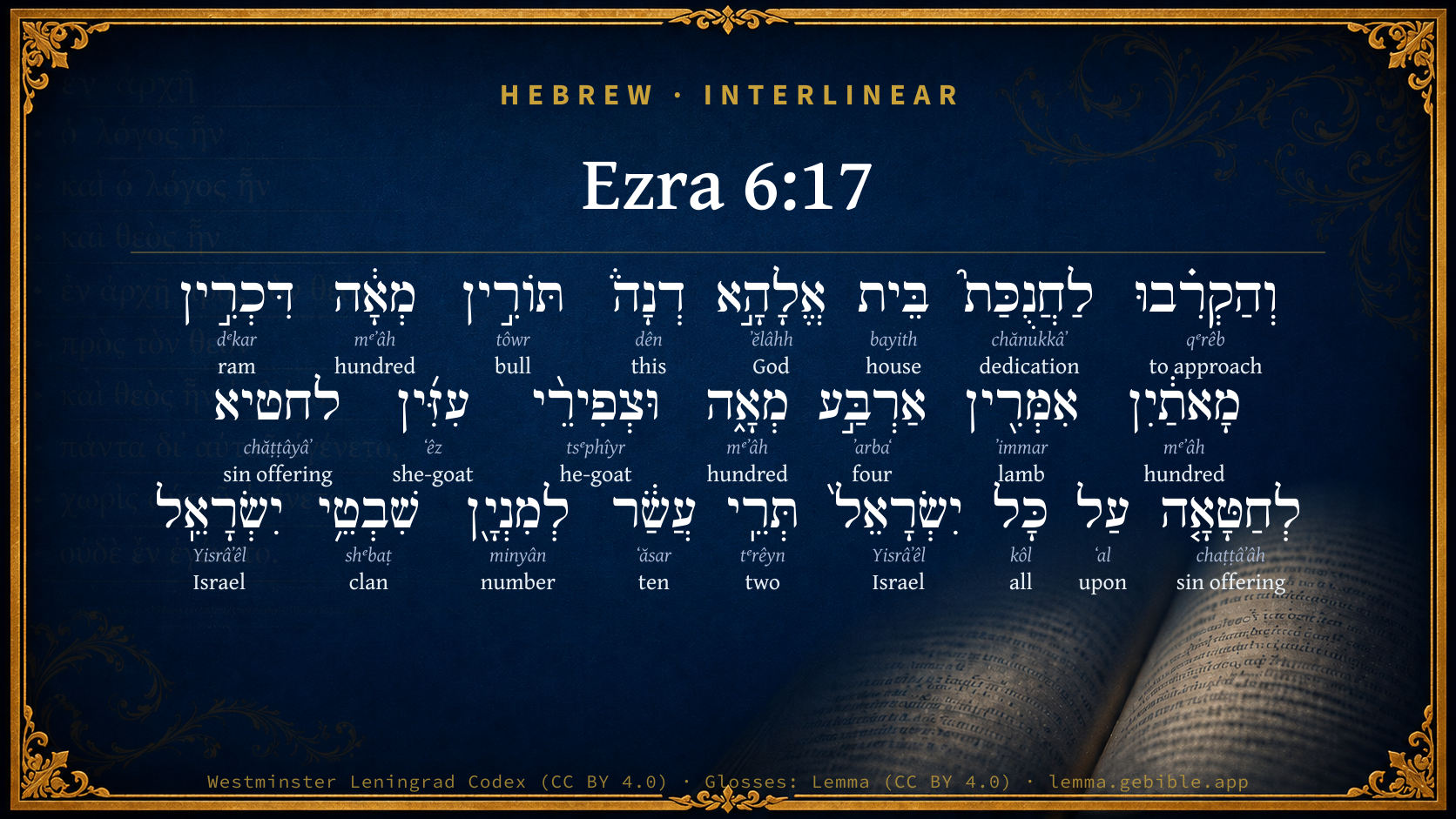
Hebrew (Westminster Leningrad Codex) Ezra 6:17 appears in the Hebrew Old Testament. The text above is from the Westminster Leningrad Codex. Each word links to its Strong’s number, a concise gloss, and parsing drawn from the Open Scriptures Hebrew Bible morphology. Click any word for its full Brown-Driver-Briggs (BDB) entry.
Download image
Cite this verse

Ezra 6:17 (World English Bible). Public Domain. Lemma interlinear Bible study tool, https://lemma.gebible.app/v/ezra/6/17.

Show BibTeX & RIS
BibTeX
RIS
English Translation
They offered at the dedication of this house of God one hundred bulls, two hundred rams, four hundred lambs; and for a sin-offering for all Israel, twelve male goats, according to the number of the tribes of Israel.
World English Bible · Public Domain
Highlights
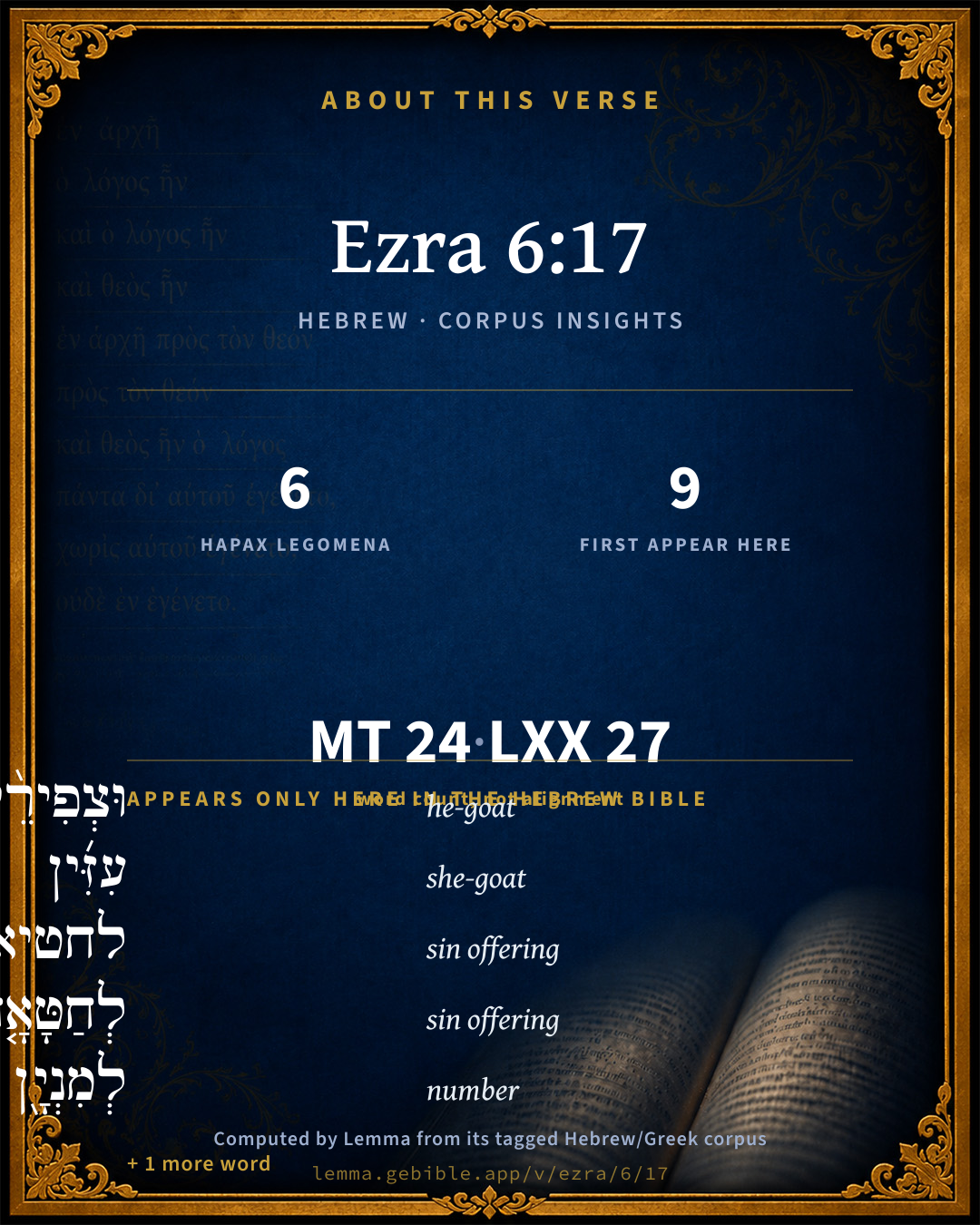
  • 6 hapax legomena — only here in the Hebrew Bible
  • 9 first appearances in the Hebrew Bible
Full analysis ↓
Download a study sheet

One document with this verse’s original text, its word-by-word gloss line, the meaning frame, cross-references with their text, attributed commentary, and full source and license credits — printable, and it pastes into notes with its structure intact.

This verse Autodidact and up

Study sheet (.html) Plain text (.txt)

A passage Seminary Student

Up to 50 verses in one chapter. A passage sheet keeps up to 6 commentary sources and 12 cross-references per verse, in the order this page ranks them, and says so on the sheet whenever that leaves anything out. Ask for a single verse and you get the Autodidact verse sheet above.

Everything on this page stays free to read, with no account — the sheet is a download of what is already on screen, not access to it.

Want to remove ads? Support Godless Engineer
Compare translations 3

The same verse in 3 English versions, stacked beneath the original-language interlinear above. Click any original word for its lexicon entry.

Each is an independent rendering of the whole verse — the interlinear is not word-aligned to these translations.

Highlighted words mark where these versions differ — a whole-verse word diff, not a word-by-word alignment.

  • World English Bible Public Domain
    They offered at the dedication of this house of God one hundred bulls, two hundred rams, four hundred lambs; and for a sin-offering for all Israel, twelve male goats, according to the number of the tribes of Israel.
  • King James Version Public Domain
    And offered at the dedication of this house of God an hundred bullocks, two hundred rams, four hundred lambs; and for a sin offering for all Israel, twelve he goats, according to the number of the tribes of Israel.
  • unfoldingWord Literal Text CC BY-SA 4.0
    And they offered for the dedication of this house of God 100 bulls, 200 rams, 400 lambs, and 12 bucks of goats for a sin offering for all Israel, according to the number of the tribes of Israel.

unfoldingWord Literal Text — © unfoldingWord, licensed CC BY-SA 4.0. Word-aligned USFM3 via Door43 (git.door43.org/unfoldingWord/en_ult).

Versions to compare (up to 4)

3 of 4 selected

Show all 18 translations

Every available English version of this verse, each an independent rendering of the whole verse.

  • World English Bible Public Domain
    They offered at the dedication of this house of God one hundred bulls, two hundred rams, four hundred lambs; and for a sin-offering for all Israel, twelve male goats, according to the number of the tribes of Israel.
  • Berean Standard Bible Public Domain
    For the dedication of the house of God they offered a hundred bulls, two hundred rams, four hundred lambs, and a sin offering for all Israel of twelve male goats, one for each tribe of Israel.
  • Majority Standard Bible Public Domain
    For the dedication of the house of God they offered a hundred bulls, two hundred rams, four hundred lambs, and a sin offering for all Israel of twelve male goats, one for each tribe of Israel.
  • King James Version Public Domain
    And offered at the dedication of this house of God an hundred bullocks, two hundred rams, four hundred lambs; and for a sin offering for all Israel, twelve he goats, according to the number of the tribes of Israel.
  • American Standard Version (1901) Public Domain
    And they offered at the dedication of this house of God a hundred bullocks, two hundred rams, four hundred lambs; and for a sin-offering for all Israel, twelve he-goats, according to the number of the tribes of Israel.
  • Revised Version (1885) Public Domain
    And they offered at the dedication of this house of God an hundred bullocks, two hundred rams, four hundred lambs; and for a sin offering for all Israel, twelve he-goats, according to the number of the tribes of Israel.
  • Geneva Bible (1599) Public Domain
    And offred at the dedication of this house of God an hundreth bullockes, two hundreth rams, foure hundreth lambes, and twelue goates, for the sinne of all Israel, according to the nomber of the tribes of Israel.
  • Douay-Rheims (1899) Public Domain
    And they offered at the dedication of the house of God, a, hundred calves, two hundred rams, four hundred lambs, and for a sin offering for all Israel twelve he goats, according to the number of the tribes of Israel.
  • Young's Literal Translation Public Domain
    and have brought near for the dedication of this house of God, bullocks a hundred, rams two hundred, lambs four hundred; and young he-goats for a sin-offering for all Israel, twelve, according to the number of the tribes of Israel;
  • Literal Standard Version CC BY-SA 4.0
    and have brought near for the dedication of this house of God: one hundred bullocks, two hundred rams, four hundred lambs; and twelve young male goats for a sin-offering for all Israel according to the number of the tribes of Israel;
  • Unlocked Literal Bible CC BY-SA 4.0
    They offered one hundred bulls, one hundred rams, and four hundred lambs for the dedication of God's house. Twelve male goats were also offered as a sin offering for all Israel, one for each tribe in Israel.
  • unfoldingWord Literal Text CC BY-SA 4.0
    And they offered for the dedication of this house of God 100 bulls, 200 rams, 400 lambs, and 12 bucks of goats for a sin offering for all Israel, according to the number of the tribes of Israel.
  • Darby Bible Public Domain
    and they presented at the dedication of this house of God a hundred bullocks, two hundred rams, four hundred lambs, and for a sin-offering for all Israel, twelve he-goats, according to the number of the tribes of Israel.
  • World Messianic Bible Public Domain
    They offered at the dedication of this house of God one hundred bulls, two hundred rams, four hundred lambs; and for a sin offering for all Israel, twelve male goats, according to the number of the tribes of Israel.
  • Webster's Bible Public Domain
    And offered at the dedication of this house of God a hundred bullocks, two hundred rams, four hundred lambs; and for a sin-offering for all Israel, twelve he-goats, according to the number of the tribes of Israel.
  • Free Bible Version CC BY-SA 4.0
    To dedicate God's Temple they sacrificed one hundred bulls, two hundred rams, four hundred lambs, and a sin offering for the whole of Israel comprising twelve male goats, one for each Israelite tribe.
  • Bible in Basic English Public Domain
    And they gave as offerings at the opening of this house of God a hundred oxen, two hundred sheep, four hundred lambs; and for a sin-offering for all Israel, twelve he-goats, being the number of the tribes of Israel.
  • JPS Tanakh (1917) Public Domain
    And they offered at the dedication of this house of God a hundred bullocks, two hundred rams, four hundred lambs; and for a sin-offering for all Israel, twelve he-goats, according to the number of the tribes of Israel.

Literal Standard Version (2020), Covenant Press — licensed CC BY-SA 4.0. Text via the HelloAO Bible API (eBible.org). Unlocked Literal Bible (unfoldingWord) — licensed CC BY-SA 4.0. Text via the HelloAO Bible API (eBible.org). unfoldingWord Literal Text — © unfoldingWord, licensed CC BY-SA 4.0. Word-aligned USFM3 via Door43 (git.door43.org/unfoldingWord/en_ult). Free Bible Version, Dr. Jonathan Gallagher — licensed CC BY-SA 4.0. Text via the HelloAO Bible API (eBible.org).

Word by word

More ways to search: Search by grammar → Find every occurrence → Compare this word →

Practice this passage: Drill this verse → Learn its vocabulary →

וּצְפִירֵ֨י
tsᵉphîyr
H6841
“and · he-goats of”
Adjective, C + Noun, Common, Masculine, Plural, Construct
Part of Speech
Adjective + Noun
Type
Common
Gender
Masculine
Number
Plural
State
Construct
Full BDB Definition

Origin: corresponding to H6842

TWOT: 2963

he-goat
  1. וְהַקְרִ֗בוּ qᵉrêb H7127 “and · to approach” Adjective, C + Verb, Hiphil, Perfect, 3rd Person, Masculine, Plural
  2. לַחֲנֻכַּת֮ chănukkâʼ H2597 “to/for · dedication of” Adjective, R + Noun, Common, Feminine, Singular, Construct
  3. בֵּית bayith H1005 “house of” Adjective, N, Common
  4. אֱלָהָ֣א ʼĕlâhh H426 “God · the” Adjective, N, Common + Particle, Definite Article
  5. דְנָה֒ dên H1836 “this” Adjective, P
  6. תּוֹרִ֣ין tôwr H8450 “bulls” Adjective, N, Common
  7. מְאָ֔ה mᵉʼâh H3969 “hundred” Adjective, A, Common
  8. דִּכְרִ֣ין dᵉkar H1798 “rams” Adjective, N, Common
  9. מָאתַ֔יִן mᵉʼâh H3969 “hundred” Adjective, A, Common, Determined
  10. אִמְּרִ֖ין ʼimmar H563 “lambs” Adjective, N, Common
  11. אַרְבַּ֣ע ʼarbaʻ H703 “four” Adjective, A, Common
  12. מְאָ֑ה mᵉʼâh H3969 “hundred” Adjective, A, Common
  13. עִזִּ֜ין ʻêz H5796 “she-goats” Adjective, N, Common
  14. לחטיא chăṭṭâyâʼ H2409 “to/for · sin offering” Adjective, R + Verb, Piel, Infinitive Construct
  15. לְחַטָּאָ֤ה chaṭṭâʼâh H2402 “to/for · sin offering” Adjective, R + Verb, Piel, Infinitive Construct
  16. עַל ʻal H5922 “upon” Adjective, R
  17. כָּל kôl H3606 “all of” Adjective, N, Common
  18. יִשְׂרָאֵל֙ Yisrâʼêl H3479 “Israel” Adjective, N
  19. תְּרֵֽי tᵉrêyn H8648 “two” Adjective, A, Common
  20. עֲשַׂ֔ר ʻăsar H6236 “ten” Adjective, A, Common
  21. לְמִנְיָ֖ן minyân H4510 “to/for · number of” Adjective, R + Noun, Common, Masculine, Singular, Construct
  22. שִׁבְטֵ֥י shᵉbaṭ H7625 “clans of” Adjective, N, Common
  23. יִשְׂרָאֵֽל Yisrâʼêl H3479 “Israel” Adjective, N

About this verse

These counts appear in no published source. They are computed here, from the morphology-tagged text and Lemma’s own curated glosses. What Lemma adds →

24
words
21
distinct lemmas
Historical
section

Notable vocabulary

6 hapax legomena — words that appear only here in the entire Hebrew Bible:

  • וּצְפִירֵ֨י he-goat H6841
  • עִזִּ֜ין she-goat H5796
  • לחטיא sin offering H2409
  • לְחַטָּאָ֤ה sin offering H2402
  • לְמִנְיָ֖ן number H4510
  • שִׁבְטֵ֥י clan H7625

First appearance in Scripture

These words make their first canonical appearance in the Hebrew Bible here (9 in total — showing 8):

  • מְאָ֔ה hundred H3969
  • אַרְבַּ֣ע four H703
  • וּצְפִירֵ֨י he-goat H6841
  • עִזִּ֜ין she-goat H5796
  • לחטיא sin offering H2409
  • לְחַטָּאָ֤ה sin offering H2402
  • עֲשַׂ֔ר ten H6236
  • לְמִנְיָ֖ן number H4510

Shared distinctive vocabulary

דִּכְרִ֣ין ram H1798 occurs in 3 verses of the Hebrew Bible. Also found in:

Grammatical profile

  • 3 verbs
  • 3 nouns
  • 17 adjectives
  • 1 particle

Verb forms

  • וְהַקְרִ֗בוּ Hiphil · Perfect
  • לחטיא Piel · Infinitive Construct
  • לְחַטָּאָ֤ה Piel · Infinitive Construct

Repetition

Words recur within this verse — often emphatic in Hebrew:

  • מְאָ֔ה hundred H3969 ×3
  • יִשְׂרָאֵל֙ Israel H3479 ×2

Hebrew & Septuagint length

In English translation the verse runs 38 words from the Hebrew and 40 from the Septuagint (LXX English) — closely comparable.

A rough comparison of the two English renderings, which tokenize alike — not a word-level alignment.

Word counts can differ between the Hebrew and the Greek without any difference in meaning — e.g. the Hebrew direct-object marker אֵת has no separate Greek word, and Greek often adds the article ὁ.

In the original languages it is 24 Hebrew tokens and 27 Greek tokens — but the two are counted differently (Hebrew bundles its prefixes and suffixes into one token; the Greek is in lemma form), so that isn’t a like-for-like length.

Cross-references

15

Topical passages linked to Ezra 6:17 in the Treasury of Scripture Knowledge — connected by theme and wording, ordered by reader-vote popularity; previews shown in the World English Bible.

  • Ezra 8:35 The children of the captivity, who had come out of exile, offered burnt offerings to the God of Israel, twelve bulls for all Israel, ninety-six rams, seventy-seven lambs, and twelve male goats for a sin-offering: all this was a burnt offering to Yahweh.
  • 2 Chronicles 29:21–23 They brought seven bulls, and seven rams, and seven lambs, and seven male goats, for a sin-offering for the kingdom and for the sanctuary and for Judah. He commanded the priests the sons of Aaron to offer them on the altar of Yahweh.
  • Revelation 7:4–8 I heard the number of those who were sealed, one hundred forty-four thousand, sealed out of every tribe of the children of Israel:
  • 2 Chronicles 7:5 King Solomon offered a sacrifice of twenty-two thousand oxen, and a hundred and twenty thousand sheep. So the king and all the people dedicated the house of God.
  • 2 Chronicles 29:31–35 Then Hezekiah answered, Now you have consecrated yourselves to Yahweh; come near and bring sacrifices and thank-offerings into the house of Yahweh. The assembly brought in sacrifices and thank-offerings; and as many as were of a willing heart [brought] burnt offerings.
  • Leviticus 4:3 if the anointed priest sins so as to bring guilt on the people, then let him offer for his sin, which he has sinned, a young bull without blemish to Yahweh for a sin offering.
  • Leviticus 4:13–14 "'If the whole congregation of Israel sins, and the thing is hidden from the eyes of the assembly, and they have done any of the things which Yahweh has commanded not to be done, and are guilty;
  • Leviticus 4:22–23 "'When a ruler sins, and unwittingly does any one of all the things which Yahweh his God has commanded not to be done, and is guilty;
  • Leviticus 4:28 if his sin, which he has sinned, is made known to him, then he shall bring for his offering a goat, a female without blemish, for his sin which he has sinned.
  • Numbers 7:2–89 that the princes of Israel, the heads of their fathers' houses, offered. These were the princes of the tribes. These are they who were over those who were numbered:
  • 1 Kings 8:63–64 Solomon offered for the sacrifice of peace-offerings, which he offered to Yahweh, two and twenty thousand oxen, and one hundred twenty thousand sheep. So the king and all the children of Israel dedicated the house of Yahweh.
  • 1 Kings 18:31 Elijah took twelve stones, according to the number of the tribes of the sons of Jacob, to whom the word of Yahweh came, saying, Israel shall be your name.
  • 1 Chronicles 16:1–3 They brought in the ark of God, and set it in the midst of the tent that David had pitched for it: and they offered burnt offerings and peace-offerings before God.
  • Luke 22:30 that you may eat and drink at my table in my Kingdom. You will sit on thrones, judging the twelve tribes of Israel."
  • Revelation 21:12 having a great and high wall; having twelve gates, and at the gates twelve angels; and names written on them, which are the names of the twelve tribes of the children of Israel.

Cross-references courtesy of OpenBible.info (CC BY 4.0).

Hebrew and Greek witnesses Masoretic Hebrew ↔ Greek Septuagint

The same verse in the two great witnesses to the Old Testament, shown verse-for-verse.

These are two independent witnesses, not word-aligned to each other, and the Septuagint is shown in lemma (dictionary) form.

Hebrew Ezra 6:17 Masoretic · Westminster Leningrad Codex

וְהַקְרִ֗בוּ לַחֲנֻכַּת֮ בֵּית אֱלָהָ֣א דְנָה֒ תּוֹרִ֣ין מְאָ֔ה דִּכְרִ֣ין מָאתַ֔יִן אִמְּרִ֖ין אַרְבַּ֣ע מְאָ֑ה וּצְפִירֵ֨י עִזִּ֜ין לחטיא לְחַטָּאָ֤ה עַל כָּל יִשְׂרָאֵל֙ תְּרֵֽי עֲשַׂ֔ר לְמִנְיָ֖ן שִׁבְטֵ֥י יִשְׂרָאֵֽל

They offered at the dedication of this house of God one hundred bulls, two hundred rams, four hundred lambs; and for a sin-offering for all Israel, twelve male goats, according to the number of the tribes of Israel.

World English Bible · Public Domain

Greek LXX Ezra 6:17 Septuagint · lemma form

καί προςφέρω εἰς ὁ ἐγκαίνια ὁ οἶκος ὁ θεός μόσχος ἑκατόν κριός διακόσιοι ἀμνός τετρακόσιοι χίμαρος αἴξ περί ἁμαρτία ὑπέρ πᾶς ἰσραήλ δώδεκα εἰς ἀριθμός φυλή ἰσραήλ

And they offered for the dedication of the house of God one hundred calves, two hundred rams, four hundred lambs, twelve kids of the goats for a sin-offering for all Israel, according to the number of the tribes of Israel.

LXX2012 (modern English Septuagint) · Public Domain

In the Septuagint this is one book — Esdras B (2 Esdras): Ezra is chapters 1–10, Nehemiah 11–23.

Hebrew: Westminster Leningrad Codex (CC BY 4.0). Greek: Septuagint (public domain); English from LXX2012 (modern English Septuagint) (Public Domain). How the Septuagint differs from the Hebrew →

Commentary

Notes on Ezra 6:17 from classic Christian and Jewish commentators (each source and its license shown beneath its notes). The classic Christian expositions comment on the surrounding passage and are grouped to its opening verse, so a note may address several verses; the Jewish commentaries on the Tanakh (Rashi and others) are per-verse, so they appear only where the commentator wrote on this verse.

Lemma curates 59 commentaries, every one of them public domain or Creative Commons licensed, each selected and text-cleaned for this edition rather than reprinted as found. About our sources →

Trapp's Complete Commentary

John Trapp

Ezr 6:17 And offered at the dedication of this house of God an hundred bullocks, two hundred rams, four hundred lambs; and for a sin offering for all Israel, twelve he goats, according to the number of the tribes of Israel.

Ver. 17. An hundred bullocks, &c.] This little (in comparison of what was done at Solomon’s dedication, 1Ki 8:63) was highly accepted in heaven: as was likewise Noah’s sacrifice, which yet could not be great: because that after a great trial of affliction, "the abundance of their joy, and their deep poverty abounded unto the riches of their liberality," 2Co 8:2; which, saith Aristotle, is not to be measured by the worth of the gift, but by the will of the giver, Oυ τω πληθει των διδομενων, αλλα τη του διδοντος εξει (Arist. Ethic. lib. 4). {See Trapp on "Ezr 2:6"}

Twelve he-goats] A fit creature for a sin offering, because nasty, unruly, &c.

According to the number of the tribes of Israel] All whom (wheresoever dispersed) they remember in their prayers; as we should likewise do all the Israel of God, in all places.

John Trapp, A Commentary or Exposition upon All the Books of the Old and New Testament (1647–1656) — public domain. Text from a community e-Sword module.

Joseph Benson's Commentary

Ezr 6:17. And offered a hundred bullocks, &c. — Few in number in comparison of those which Solomon had offered at the dedication of his temple. But, being according to their present ability, their offering was accepted, for it was made after a great trial of affliction, and in the midst of deep poverty, as the apostle speaks in another case, 2Co 8:2. Indeed, these hundreds were more to them than Solomon’s thousands to him. And they offered them willingly and cheerfully, for this service was performed with joy, all being glad to see the temple built, and the concerns of it in so good a posture. For a sin-offering for all Israel, twelve he-goats — One for every tribe, to make atonement for their sins, which they looked upon as necessary in order to the acceptance of their services. It appears from many passages of Scripture, that though Shalmaneser had carried captive the ten tribes, yet many of them had remained in their country, and were carried away by Nebuchadnezzar, together with Judah and Benjamin, with whom they returned out of Babylon, as many others of the ten tribes did, who were carried away at the taking of Samaria.

Joseph Benson's Commentary on the Old and New Testaments (1811–1818) — public domain. Text from a community e-Sword module.

Tyndale Open Study Notes

Tyndale Open Resources

6:17 12 male goats . . . a sin offering: This blood sacrifice brought God’s forgiveness for unintentional sins, ceremonial uncleanness, or thoughtless wrong acts (Lev 4–5). Similar sacrifices were offered when Moses dedicated the Tabernacle (Num 7) and when Solomon dedicated the first Temple (2 Chr 7:1, 4). • for the twelve tribes of Israel: Although most returnees were from Judah and Benjamin (Ezra 1:5; 4:1), people from the priestly tribe of Levi are also mentioned (1:5; 2:40, 70). It is also likely that there were returnees from some of the ten northern tribes of Israel. Even if all tribes were not physically represented, the twelve sacrifices emphasized the desire for God to maintain his covenant relationship with all Israel.

Tyndale Open Study Notes — © Tyndale Open Resources, licensed CC BY-SA 4.0. Text via the HelloAO Bible API.

Jamieson, Fausset & Brown

Robert Jamieson, A. R. Fausset & David Brown

twelve he-goats--as at the dedication of the tabernacle (Num 7:87; Num 8:17).

Jamieson, Fausset & Brown — Commentary Critical and Explanatory on the Whole Bible (1871) — public domain (CC PDM 1.0). Text via the HelloAO Bible API.

Adam Clarke's Commentary

Verse 17. Twelve he-goats] This was a sin-offering for every tribe.

Adam Clarke's Commentary on the Bible (1810–1826) — public domain. Text from a community e-Sword/MySword module.

Ellicott's Commentary for English Readers

(17) Twelve he goats.—The people are not now “Judah” or “Judah and Benjamin,” but “all Israel.” On the Day of Atonement, on the new moons, and on all the great feasts the kid was the sin-offering for the people. But only here is one offered for each tribe.

A Bible Commentary for English Readers, edited by Charles John Ellicott (1878–1897) — public domain. Text from a community e-Sword module.

The Cambridge Bible for Schools and Colleges

gen. ed. J. J. S. Perowne

17. and offered] R.V. And they offered. A fresh sentence: Ezr_6:16 treated of the general festivities: this verse describes the special sacrificial offerings.

at the dedication of this house] These words evidently imply a comparison between the modest sacrifices offered at this dedication and the enormous number offered by Solomon at the dedication of the firs Temple (1Ki_8:5; 1Ki_8:63). Solomon offered then for ‘the sacrifice of peace-offerings … two and twenty thousand oxen, and an hundred and twenty thousand sheep’. The numbers also mentioned in connexion with the dedication-festivals of Hezekiah (2Ch_30:24) and Josiah (2Ch_35:7) very largely exceed the offerings of Zerubbabel and his companions.

The decay of material wealth and splendour must have vividly impressed itself upon the mind of many a patriot Jew, who looked only for a renewal of worldly empire. To them it must have seemed ‘a day of small things’ (Zec_4:10) by the side of the recollections of the kingdom.

a sin offering for all Israel, twelve he goats &c.] Compare Num_7:87, ‘and the males of the goats for a sin-offering twelve’, at the dedication of the altar. It is noticeable that in the reign of Hezekiah, at the purification of the Temple, we are told ‘they brought seven bullocks, and seven rams, and seven lambs, and seven he-goats, for a sin offering for the kingdom and for the sanctuary and for Judah’ (2Ch_29:21). The number ‘seven’ there denotes the consecration, the number ‘twelve’ here denotes the ideal unity, of the community. The sin offering ‘of twelve he-goats according to the number of the tribes of Israel’, was an incident full of deep religious pathos. The remnant who had returned make solemn confession of sin in the name of the whole scattered and dispersed race. They acknowledge the essential unity of Israel’s tribes alike in the consequences of sin, in the possibilities of restoration, and in the renewed consecration to God’s service.

The symbolical representation of a restored and ideal Israel is thus indicated by the verse (cf. Ezr_2:2; Ezr_2:70, Ezr_8:35). We need not necessarily assume (as some commentators) that each tribe was literally represented upon the occasion. Compare the prophet’s picture of a reunited Israel (Eze_37:15-28) and Elijah’s offering on Mt. Carmel, 1Ki_18:31.

The Cambridge Bible for Schools and Colleges (gen. ed. J. J. S. Perowne; Cambridge University Press, 1878–1918) — public domain. Text from a community e-Sword module.

John Gill's Exposition

And they set the priests in their divisions, and the Levites in their courses, for the service of God which is at Jerusalem,.... All in their proper classes and courses, to do the work of the temple at Jerusalem in their turns:

as it is written in the book of Moses; see Num 3:6, from hence it is plain the Pentateuch was not written by Ezra, as suspected by Spinosa (m), but by Moses; see the argument of the book of Genesis. See Gill on Gen 1:1.

(m) Tract. Theolog. Polit. c. 8. p. 163.

John Gill's Exposition of the Whole Bible (1746–1763) — public domain (CC PDM 1.0). Text via the HelloAO Bible API.

Albert Barnes' Notes on the Bible

Compare with this modest sacrifice, which suits well “the day of small things” Zec 4:10, the lavish offering of Solomon (see the marginal reference “n”).

Albert Barnes' Notes on the Bible (1834–1885) — public domain. Text from a community e-Sword/MySword module.

Haydock's Catholic Bible Commentary

CHAPTER VI.

Goats, which had not left off sucking. (Menochius) (Numbers vii. 87.) --- Israel. The Samaritan Chronicles assert that the tribes returned, as the prophets had foretold, and the sacred history seems to suppose: (Calmet) which may be true of many, (Haydock) though the greatest part remained in captivity. (Calmet)

George Leo Haydock (1774–1849), Haydock's Catholic Family Bible and Commentary, 1859 edition — public domain. Excludes Psalms (Douay-Rheims chapter numbering differs from Protestant) and Deuterocanonical books (Catholic canon only).

Whedon's Commentary on the Bible

Daniel D. Whedon

17. A hundred bullocks — Compare the far larger offering of Solomon at the dedication of the first temple. 1Ki_8:63. But the present offering was large and liberal, according to the circumstances of the worshippers.

According to the number of the tribes — The chastisements of the exile had thoroughly subdued these Jews, and the Israelites that had returned with them, and now, at this feast of dedication, they seek to wipe out their ancient schism, making an atonement for it by a sin offering, and, by the offering of twelve he goats, present themselves before Jehovah as the representatives of all the tribes who had been one people and one nation at the dedication five hundred years before. Thus was fulfilled the prophecy of Jeremiah, (l, 4, 5,) that Judah and Israel should return together, going and weeping, and join themselves in a perpetual covenant.

Daniel D. Whedon (gen. ed.), Commentary on the Old and New Testaments (1874–1909) — public domain. Text from a community e-Sword module.

The Pulpit Commentary

And offered a hundred bullocks, two hundred rams, four hundred lambs. A poor offering, if it be compared, not alone with Solomon"s, (1Ki_8:63) but even with Hezekiah"s, (2Ch_30:24) or Josiah"s (ibid. 35:7). Hundreds now take the place of the thousands offered under the old monarchy. A sin offering for all Israel. See comment on ver. 16. We may assume that some of every tribe had returned with Zerubbabel, and that consequently it was possible to regard the re-established people as "Israel" (comp. Neh_11:20; Zec_8:13; Mal_1:1) though, since the great majority were Jews, they were more commonly spoken of as "Judah" (Ezr_4:1, Ezr_4:6, 23 5:1, 5 6:7, 14; Zec_8:15, etc.) Zerubbabel, desirous of emphasising the nobler and grander view, made this solemn sin offering of twelve he-goats, one for each of the tribes. Ezra acted similarly when he brought the second colony. (infra, Ezr_8:35)

The Pulpit Commentary (1880–1919), ed. H.D.M. Spence-Jones & Joseph S. Exell — public domain. Text from a community e-Sword module.

Rashi

Rabbi Shlomo Yitzchaki (Rashi)

And they offered up for the dedication They offered up for the dedication of this House these sacrifices, and it was a temporary ruling.

Rashi on the Tanakh — English translations: “The Judaica Press complete Tanach with Rashi, translated by A. J. Rosenberg” (CC BY 4.0); “Pentateuch with Rashi's commentary by M. Rosenbaum and A.M. Silbermann, 1929-1934” (public domain); “The Metsudah Tanach series, Lakewood, N.J” (CC BY 4.0); and “The Book of Joshua, Metsudah Publications, 1997” (CC BY 4.0). Text via Sefaria.

Lesson kit

Teaching starters — assembled from the data on this page, not authored interpretation. Every prompt links to the verse data it draws on. Edit before teaching.

Ezra, in the Historical, opens this verse with 24 words (21 distinct Hebrew lemmas). Its most distinctive word is tsᵉphîyr (“he-goat”). A historical commentator’s framing appears above. Read the whole chapter for the surrounding context.

Discussion questions

  1. How does “he-goat” (tsᵉphîyr) shape what this verse is saying?
  2. This verse holds 6 words here found nowhere else in the Hebrew Bible. What might the rare words draw attention to?
  3. 9 words here appear for the first time in Scripture. What is being introduced at this debut?
  4. Ezra 6:9 shares the word «ram» with this verse. How do the two illuminate each other?
  5. “hundred” occurs 3× in this one verse. What is the effect of the repetition?
  6. These translations render this verse differently; the difference is in the English rendering, not the original. What questions does that raise?
  7. The verb «וְהַקְרִ֗בוּ» is Hiphil Perfect. How does its form color the action?
  8. Reading how Trapp's Complete Commentary and Joseph Benson's Commentary read this verse, where do the two commentators agree and where do they part?

Things to notice

  • 6 words in this verse appear nowhere else in the Hebrew Bible.
  • 9 words make their first canonical appearance in Scripture here.
  • This verse counts 24 Hebrew ↔ 27 Greek words.
  • These translations choose different wording for 16 words in this verse.
  • “hundred” occurs 3× in this single verse.

Reading settings

Reading text

Shown beneath each verse's original-language words.

Old Testament
Old Testament edition

Read the OT as the Masoretic Hebrew (MT) or the Greek Septuagint (LXX).

English shown for the Greek Septuagint (in the Hebrew ↔ Greek comparison).

Comparing translations? Open the Compare panel on any verse page to stack up to four side by side.