
Romans 4:8

Greek (Tischendorf 8th ed.) Romans 4:8 appears in the Greek New Testament. The text above is from the Tischendorf 8th edition. Each word links to its Strong’s number and a concise gloss. Click any word for its full Thayer’s Greek Lexicon entry.
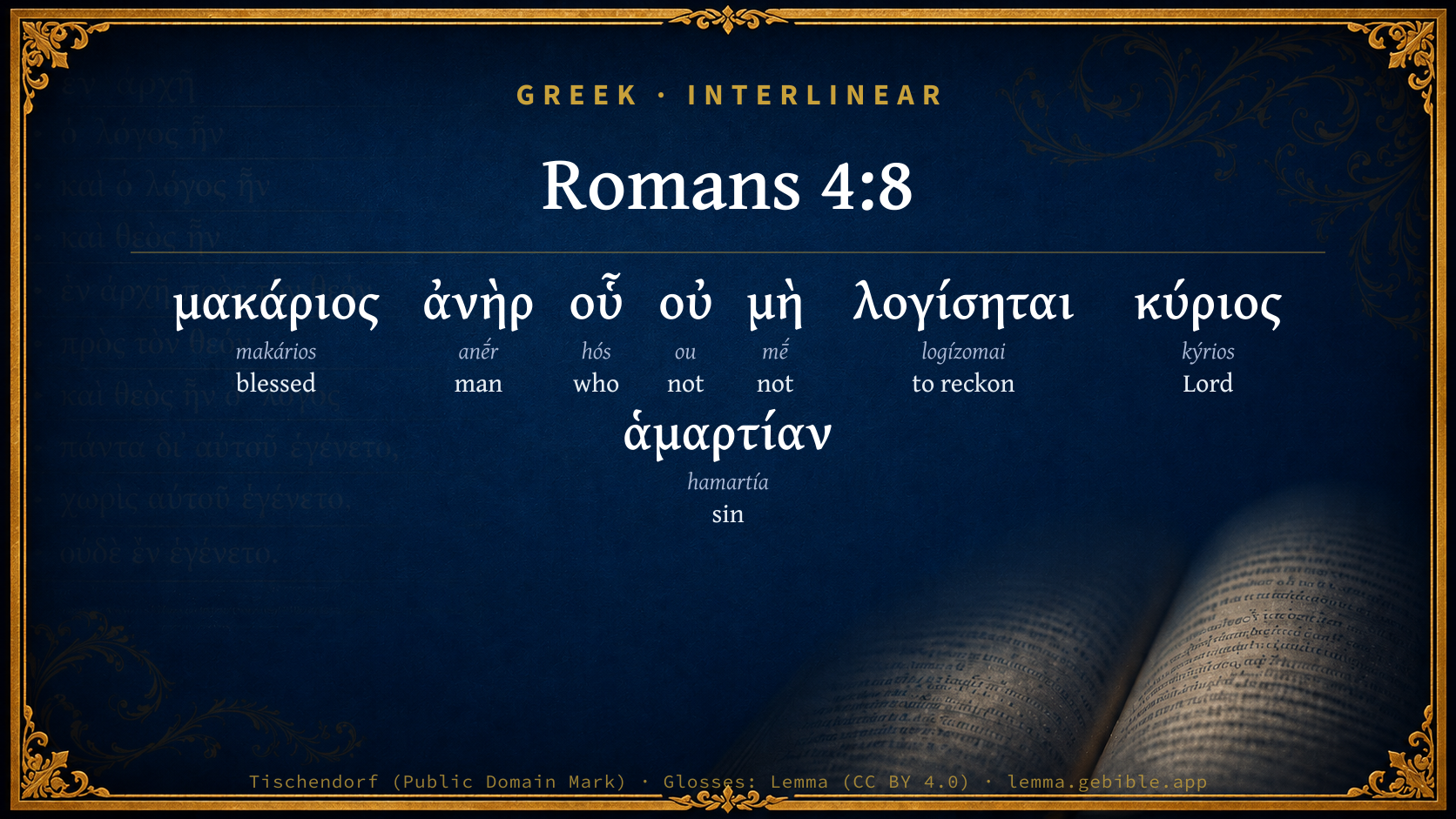
Download image
Cite this verse

Romans 4:8 (World English Bible). Public Domain. Lemma interlinear Bible study tool, https://lemma.gebible.app/v/romans/4/8.

Show BibTeX & RIS
BibTeX
RIS
English Translation
Blessed is the man whom the Lord will by no means charge with sin."
World English Bible · Public Domain
Download a study sheet

One document with this verse’s original text, its word-by-word gloss line, the meaning frame, cross-references with their text, attributed commentary, and full source and license credits — printable, and it pastes into notes with its structure intact.

This verse Autodidact and up

Study sheet (.html) Plain text (.txt)

A passage Seminary Student

Up to 50 verses in one chapter. A passage sheet keeps up to 6 commentary sources and 12 cross-references per verse, in the order this page ranks them, and says so on the sheet whenever that leaves anything out. Ask for a single verse and you get the Autodidact verse sheet above.

Everything on this page stays free to read, with no account — the sheet is a download of what is already on screen, not access to it.

Want to remove ads? Support Godless Engineer
Compare translations 3

The same verse in 3 English versions, stacked beneath the original-language interlinear above. Click any original word for its lexicon entry.

Each is an independent rendering of the whole verse — the interlinear is not word-aligned to these translations.

Highlighted words mark where these versions differ — a whole-verse word diff, not a word-by-word alignment.

  • World English Bible Public Domain
    Blessed is the man whom the Lord will by no means charge with sin."
  • King James Version Public Domain
    Blessed is the man to whom the Lord will not impute sin.
  • unfoldingWord Literal Text CC BY-SA 4.0
    Blessed a man whose sin the Lord does certainly not count.”

unfoldingWord Literal Text — © unfoldingWord, licensed CC BY-SA 4.0. Word-aligned USFM3 via Door43 (git.door43.org/unfoldingWord/en_ult).

Versions to compare (up to 4)

3 of 4 selected

Show all 19 translations

Every available English version of this verse, each an independent rendering of the whole verse.

  • World English Bible Public Domain
    Blessed is the man whom the Lord will by no means charge with sin."
  • Berean Standard Bible Public Domain
    Blessed is the man whose sin the Lord will never count against him.”
  • Majority Standard Bible Public Domain
    Blessed is the man whose sin the Lord will never count against him.”
  • King James Version Public Domain
    Blessed is the man to whom the Lord will not impute sin.
  • American Standard Version (1901) Public Domain
    Blessed is the man to whom, the Lord will not reckon sin.
  • Revised Version (1885) Public Domain
    Blessed is the man to whom the Lord will not reckon sin.
  • Geneva Bible (1599) Public Domain
    Blessed is the man, to whom the Lord imputeth not sinne.
  • Douay-Rheims (1899) Public Domain
    Blessed is the man to whom the Lord hath not imputed sin.
  • Young's Literal Translation Public Domain
    happy the man to whom the Lord may not reckon sin.'
  • Literal Standard Version CC BY-SA 4.0
    Blessed [is] the man || To whom the LORD may not reckon sin.”
  • Unlocked Literal Bible CC BY-SA 4.0
    Blessed is the man against whom the Lord will not count sin.”
  • unfoldingWord Literal Text CC BY-SA 4.0
    Blessed a man whose sin the Lord does certainly not count.”
  • Darby Bible Public Domain
    blessed [the] man to whom [the] Lord shall not at all reckon sin.
  • World Messianic Bible Public Domain
    Blessed is the man whom the Lord will by no means charge with sin.”
  • Webster's Bible Public Domain
    Blessed is the man to whom the Lord will not impute sin.
  • Free Bible Version CC BY-SA 4.0
    How happy are those the Lord does not consider sinful.”
  • Bible in Basic English Public Domain
    Happy is the man against whom no sin is recorded by the Lord.
  • Text-Critical English NT CC BY 4.0
    Blessed is the man against whom the Lord will never count sin.”
  • Tyndale New Testament (1534) Public Domain
    Blessed is that man to whom the Lorde imputeth not synne.

Literal Standard Version (2020), Covenant Press — licensed CC BY-SA 4.0. Text via the HelloAO Bible API (eBible.org). Unlocked Literal Bible (unfoldingWord) — licensed CC BY-SA 4.0. Text via the HelloAO Bible API (eBible.org). unfoldingWord Literal Text — © unfoldingWord, licensed CC BY-SA 4.0. Word-aligned USFM3 via Door43 (git.door43.org/unfoldingWord/en_ult). Free Bible Version, Dr. Jonathan Gallagher — licensed CC BY-SA 4.0. Text via the HelloAO Bible API (eBible.org).

Word by word

More ways to search: Search by grammar → Find every occurrence → Compare this word →

Practice this passage: Drill this verse → Learn its vocabulary →

λογίσηται
logízomai
G3049
“to reckon”
Verb, Aorist, Middle deponent, Subjunctive, 3rd person, Singular
Part of Speech
Verb
Tense
Aorist
Voice
Middle deponent
Mood
Subjunctive
Person
3rd person
Number
Singular
Full Thayer's Definition

Origin: middle voice from G3056

TDNT: 08:44,5

1. to reckon, count, compute, calculate, count over a. to take into account, to make an account of 1. metaph. to pass to one's account, to impute 2. a thing is reckoned as or to be something, i.e. as availing for or equivalent to something, as having the like force and weight b. to number among, reckon with c. to reckon or account 2. to reckon inward, count up or weigh the reasons, to deliberate 3. by reckoning up all the reasons, to gather or infer a. to consider, take into account, weigh, meditate on b. to suppose, deem, judge c. to determine, purpose, decide This word deals with reality. If I "logizomai" or reckon that my bank book has $25 in it, it has $25 in it. Otherwise I am deceiving myself. This word refers to facts not suppositions.
  1. μακάριος makários G3107 “blessed” Adjective, Nominative, Singular, Masculine
  2. ἀνὴρ anḗr G435 “man” Noun, Nominative, Singular, Masculine
  3. οὗ hós G3739 “who” Relative pronoun, Genitive, Singular, Masculine
  4. οὐ ou G3756 “not” Particle, Negative
  5. μὴ mḗ G3361 “not” Particle, Negative
  6. κύριος kýrios G2962 “Lord” Noun, Nominative, Singular, Masculine
  7. ἁμαρτίαν hamartía G266 “sin” Noun, Accusative, Singular, Feminine

About this verse

These counts appear in no published source. They are computed here, from the morphology-tagged text and Lemma’s own curated glosses. What Lemma adds →

8
words
8
distinct lemmas
Pauline Epistles
section

Shared distinctive vocabulary

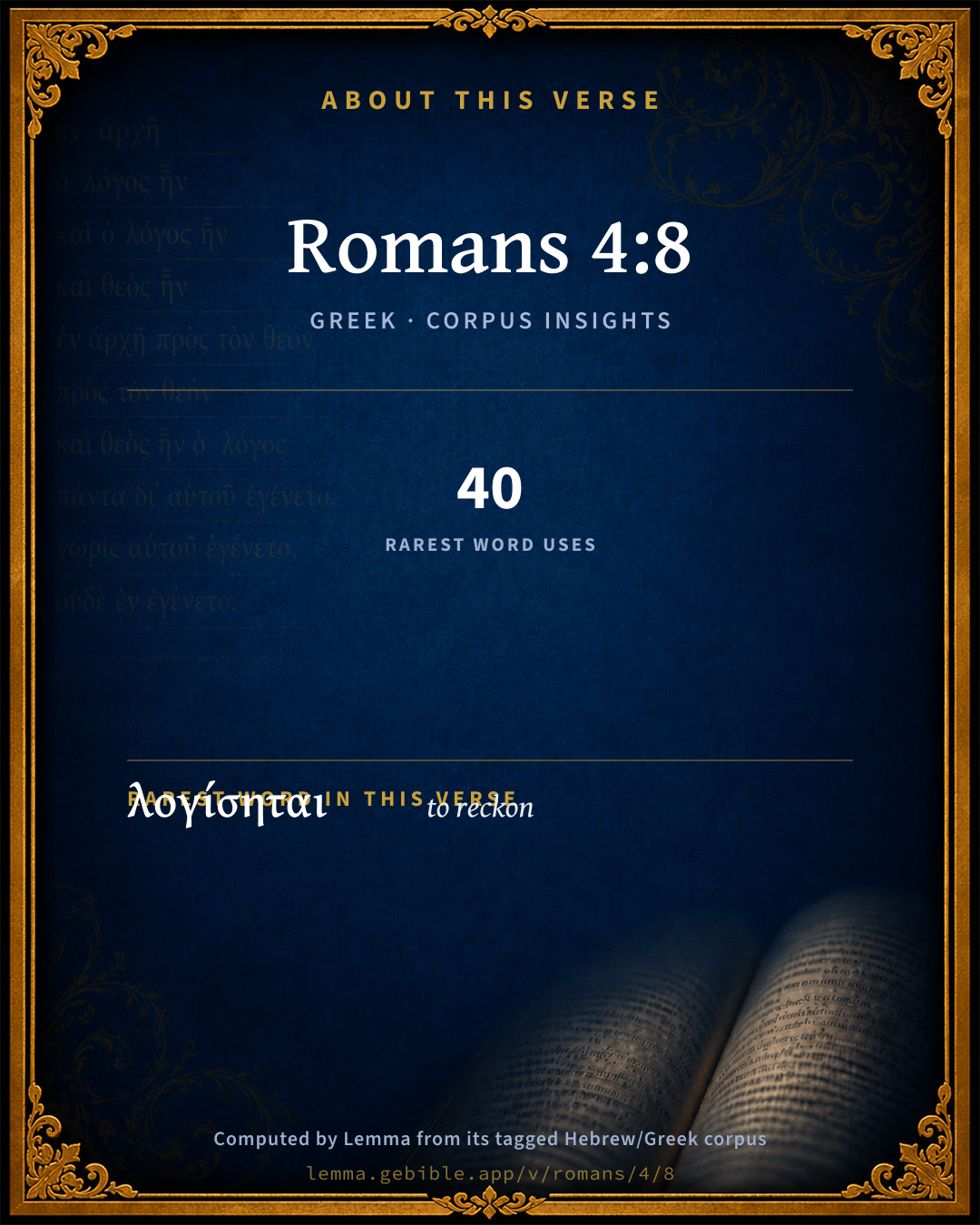
λογίσηται to reckon G3049 occurs in 39 verses of the Greek New Testament. Also found in:
Cross-references

5

Topical passages linked to Romans 4:8 in the Treasury of Scripture Knowledge — connected by theme and wording, ordered by reader-vote popularity; previews shown in the World English Bible.

  • Psalms 32:2 Blessed is the man to whom Yahweh doesn't impute iniquity, In whose spirit there is no deceit.
  • 1 Peter 2:24 who his own self bore our sins in his body on the tree, that we, having died to sins, might live to righteousness; by whose stripes you were healed.
  • 2 Corinthians 5:19–20 namely, that God was in Christ reconciling the world to himself, not reckoning to them their trespasses, and having committed to us the word of reconciliation.
  • 1 Peter 3:18 Because Christ also suffered for sins once, the righteous for the unrighteous, that he might bring you to God; being put to death in the flesh, but made alive in the spirit;
  • Isaiah 53:10–12 Yet it pleased Yahweh to bruise him; he has put him to grief: when you shall make his soul an offering for sin, he shall see [his] seed, he shall prolong his days, and the pleasure of Yahweh shall prosper in his hand.

Cross-references courtesy of OpenBible.info (CC BY 4.0).

Commentary

Notes on Romans 4:8 from classic Christian and Jewish commentators (each source and its license shown beneath its notes). The classic Christian expositions comment on the surrounding passage and are grouped to its opening verse, so a note may address several verses; the Jewish commentaries on the Tanakh (Rashi and others) are per-verse, so they appear only where the commentator wrote on this verse.

Lemma curates 59 commentaries, every one of them public domain or Creative Commons licensed, each selected and text-cleaned for this edition rather than reprinted as found. About our sources →

Scofield Reference Notes

C. I. Scofield

Lord Jehovah. Rom 4:7; Rom 4:8.

impute Or, reckoned, or imputed, i.e. put to the account of. See Phm 1:18, same word:

The Scofield Reference Bible (1917 edition), notes by C. I. Scofield — public domain. Text from a community e-Sword module.

Bengel's Gnomon

Johann Albrecht Bengel

Rom 4:8. Ὧ, to whom) Greater force is given to the sense, by the transition from the plural in the preceding, to the singular in this verse; as also the more express mention of the man and of the Lord lends additional force.

Bengel's Gnomon of the New Testament — English translation (T&T Clark, Edinburgh, 1860) — public domain. Text from a community e-Sword module.

Adam Clarke's Commentary

Verse 8. Blessed is the man to whom the Lord will not impute sin.] That man is truly happy to whose charge God does not reckon sin; that is, they alone are happy who are redeemed from the curse of the law and the consequence of their ungodly life, by having their sins freely forgiven, through the mercy of God.

Adam Clarke's Commentary on the Bible (1810–1826) — public domain. Text from a community e-Sword/MySword module.

The Cambridge Bible for Schools and Colleges

gen. ed. J. J. S. Perowne

8. will not impute] i.e. at any time of enquiry and judgment that may arise. They “shall not come into condemnation.” (Joh_5:24.)

The Cambridge Bible for Schools and Colleges (gen. ed. J. J. S. Perowne; Cambridge University Press, 1878–1918) — public domain. Text from a community e-Sword module.

John Gill's Exposition

Blessed is the man to whom the Lord will not impute sin. As he does not to those whom he justifies in Christ, and by his righteousness; for the sins of such he has imputed to his Son, as their surety; and he has bore them, took them away, having made full satisfaction for them; so that these persons will never be charged with them: they now appear before the throne without fault, and are blameless and irreproveable in the sight of God, and therefore must be eternally happy; for he will never think of their sins any more to their hurt; he will remember them no more; he "will never reckon them to them", but acquit them from them, justify and accept them; wherefore they must be secure from wrath and condemnation, enjoy much peace and comfort now, and be happy hereafter.

Blessed is the man to whom the Lord will not impute sin. As he does not to those whom he justifies in Christ, and by his righteousness; for the sins of such he has imputed to his Son, as their surety; and he has bore them, took them away, having made full satisfaction for them; so that these persons will never be charged with them: they now appear before the throne without fault, and are blameless and irreproveable in the sight of God, and therefore must be eternally happy; for he will never think of their sins any more to their hurt; he will remember them no more; he "will never reckon them to them", but acquit them from them, justify and accept them; wherefore they must be secure from wrath and condemnation, enjoy much peace and comfort now, and be happy hereafter.

Romans 4:9

rom 4:9

rom 4:9

rom 4:9Cometh this blessedness then upon the circumcision only?.... That is, upon the circumcised Jews; are they the only persons that partake of this happiness? the word "only" is rightly supplied, and is in the Claromontane exemplar used by Beza, and in the Vulgate Latin and Ethiopic versions:

or upon the uncircumcision also? upon the uncircumcised Gentiles; do not they likewise share in this blessedness?

for we say, that faith was reckoned to Abraham for righteousness. The design of these words with the following, is to prove that the blessing of justification belongs to Gentiles as well as Jews, and that it is by faith, and not by circumcision; which is done by observing the state and condition Abraham was in when justified.

John Gill's Exposition of the Whole Bible (1746–1763) — public domain (CC PDM 1.0). Text via the HelloAO Bible API.

Trapp's Complete Commentary

John Trapp

8 Blessed is the man to whom the Lord will not impute sin.

Ver. 8. Imputeth not] Chargeth it not, setteth it not upon his score, 2Co 5:19.

John Trapp, A Commentary or Exposition upon All the Books of the Old and New Testament (1647–1656) — public domain. Text from a community e-Sword module.

Albert Barnes' Notes on the Bible

Will not impute sin - On whom the Lord will not charge his sins; or who shall not be reckoned or regarded as guilty. This shows clearly what the apostle meant by imputing faith without works. It is to pardon sin, and to treat with favor; not to reckon or charge a man’s sin to him; but to treat him, though personally undeserving and ungodly Rom 4:5, as though the sin had not been committed. The word “impute” here is used in its natural and appropriate sense, as denoting to charge on man what properly belongs to him. See the note at Rom 4:3.

Albert Barnes' Notes on the Bible (1834–1885) — public domain. Text from a community e-Sword/MySword module.

Haydock's Catholic Bible Commentary

Blessed is the man to whom the Lord hath not imputed sin. That is, blessed is the man who hath retained his baptismal innocence, that no grievous sin can be imputed to him. And likewise, blessed is the man who, after falling into sin hath done penance, and leads a virtuous life by frequenting the sacraments necessary for obtaining the grace to prevent a relapse, that sin is no more imputed to him. (Challoner)

George Leo Haydock (1774–1849), Haydock's Catholic Family Bible and Commentary, 1859 edition — public domain. Excludes Psalms (Douay-Rheims chapter numbering differs from Protestant) and Deuterocanonical books (Catholic canon only).

Matthew Poole's English Annotations

The same thing is expressed three several ways; there are three things in sin to be considered:

1. There is an offence against God, which is said to be forgiven.

2. There is a filthiness in sin, which is said to be covered.

3. There is guilt in it, which is said not to be imputed.

Matthew Poole's English Annotations on the Holy Bible (1683–1685) — public domain. Text from a community e-Sword/MySword module.

McGarvey & Pendleton's Commentaries

J. W. McGarvey

Blessed is the man to whom the Lord will not reckon sin . [The quotation from David does not show a positive imputation of righteousness, but a negative one--a refusal to reckon the unrighteous. "It is implied," says Alford, "by Paul, that the remission of sin is equivalent to the imputation of righteousness, that there is no negative state of innocence, none intermediate between acceptance for righteousness and rejection for sin." This accords with the entire trend of Scripture, which recognizes but two great classes: those who shall stand upon the right, and those who shall pass to the left in the judgment. Paul has now concluded his first point in the test case of Abraham--he has shown that he was justified by faith, and that such a justification was recognized by David, and pronounced blessed. He now takes up the second point, and shows that if Abraham was not justified by the doing of the law, neither was he by the rite of circumcision. In this part of the argument it should be borne in mind that God declared Abraham justified by faith at least thirteen years before Abraham submitted to the rite of circumcision. Moreover, he unites Abraham with all the uncircumcised, and tries the case of all in Abraham.]

J. W. McGarvey (with Philip Y. Pendleton), Commentaries on the New Testament (The Fourfold Gospel, 1914; Acts; and the epistles) — public domain. Text from a community e-Sword/MySword module.

The People's New Testament

B. W. Johnson

8. Blessed is the man to whom the Lord will not impute sin. This is another form of the thought of verse 7. One whose sins have been forgiven will not find them imputed to him at judgment. We obtain this blessedness by a faith in Christ which leads us to accept the gospel.

B. W. Johnson's The People's New Testament with Notes (1889–1891) — public domain. Electronic text from the Christian Classics Ethereal Library (CCEL) ThML edition.

Alford’s Greek Testament

Henry Alford

8.] οὐ μὴ λογίσηται, as the same construction usually in the N. T., is future (Winer, edn. 6, § 56. 3), and must be referred to the great final judgment. Or we may say with Olsh. that the expression is an O. T. one, regarding sin as lying covered by the divine long-suffering till the completion of the work of Christ, at which time first real forgiveness of sins was imparted to the ancient believers; compare Mat 27:53; 1Pe 3:18. In this last view the future will only refer to all such cases as should arise.

Henry Alford, The Greek Testament (1849–1861) — public domain. Text from a community e-Sword module.

Hodge's Commentary on Romans, Ephesians & First Corinthians

Charles Hodge

Rom_4:6-8

Even as David also describeth the blessedness of the man to whom God imputeth righteousness without works. Pauls first argument in favor of gratuitous justification was from the case of Abraham; his second is from the testimony of David. The immediate connection of this verse is with Rom_4:5. At the conclusion of that verse, it was said, to him who had no works, faith is imputed, in order to his justification, i.e., he is justified gratuitously, even as David speaks of the blessedness of him whom, although destitute of merit, God regards and treats as righteous. Describeth the blessedness, i.e., pronounces blessed. The words are λέγει τὸν μακαρισμόν, utters the declaration of blessedness concerning the man, etc. To whom God imputeth righteousness without works, that is, whom God regards and treats as righteous, although he is not in himself righteous. The meaning of this clause cannot be mistaken. To impute sin, is to lay sin to the charge of any one, and to treat him accordingly, as is universally admitted; so to impute righteousness, is to set righteousness to ones account, and to treat him accordingly. This righteousness does not, of course, belong antecedently to those to whom it is imputed, for they are ungodly, and destitute of works. Here then is an imputation to men of what does not belong to them, and to which they have in themselves no claim. To impute righteousness is the apostles definition of the term to justify. It is not making men inherently righteous, or morally pure, but it is regarding and treating them as just. This is done, not on the ground of personal character or works, but on the ground of the righteousness of Christ. As this is dealing with men, not according to merit, but in a gracious manner, the passage cited from Psa_32:1, Psa_32:2, is precisely in point: Blessed are they whose iniquities are forgiven, and whose sins are covered. Blessed is the man to whom the Lord will not impute sin. That is, blessed is the man who, although a sinner, is regarded and treated as righteous. As the remission of sin is necessarily connected with restoration to Gods favor, the apostle speaks of it as the whole of justification; not that the idea of remission exhausts the whole idea of justification, but it necessarily implies the rest. In like manner, in Eph_1:7, it is said, in whom we have redemption … the forgiveness of sins; which does not imply that forgiveness is the whole of redemption, that the gift of the Spirit, the glorification of the body, and eternal life, which are so constantly spoken of as fruits of Christs work, as parts of the purchased inheritance, are to be excluded.

Here again the doctrine of a personal, inherent righteousness, which it is the special object of the apostle to exclude, is introduced by the modern mystical or transcendental theologians. On the declaration that righteousness is imputed without works, Olshausen remarks: No matter how abundant or pure works may be, the ground of blessedness is not in them, but in the principle whence they flow; that is, not in man, but in God. The whole doctrine of the apostle is made to be, that men are justified (made holy,) not by themselves, but by God; thus confounding, as Romanists do, justification with sanctification. In Psa_32:1, Psa_32:2, as quoted by Paul from the lxx, ἀφίεναι (to remit,) and ἐπικαλύπτειν (to cover,) are interchanged. Olshausen says the former expresses the New Testament idea of forgiveness (die reale Hinwegschaffung der Sunde) i.e., the real removal of sin; the latter, the Old Testament idea of non-imputation of sin the sin remaining, but being overlooked. This view of the nature of remission, and of the difference between the Old and the New Testament, is purely Romish.

Charles Hodge — Commentary on Romans (1835), First Corinthians (1857), and Ephesians (1856) — public domain. Text from a community e-Sword module.

Lesson kit

Teaching starters — assembled from the data on this page, not authored interpretation. Every prompt links to the verse data it draws on. Edit before teaching.

Romans, in the Pauline Epistles, opens this verse with 8 words (8 distinct Greek lemmas). Its most distinctive word is logízomai (“to reckon”). A historical commentator’s framing appears above. Read the whole chapter for the surrounding context.

Discussion questions

  1. The word logízomai carries the sense “to reckon.” How does it shape the verse?
  2. Luke 22:37 shares the word «to reckon» with this verse. How do the two illuminate each other?
  3. These translations render this verse differently; the difference is in the English rendering, not the original. What questions does that raise?
  4. Reading how Scofield Reference Notes and Bengel's Gnomon read this verse, where do the two commentators agree and where do they part?

Things to notice

Reading settings

Reading text

Shown beneath each verse's original-language words.

Old Testament
Old Testament edition

Read the OT as the Masoretic Hebrew (MT) or the Greek Septuagint (LXX).

English shown for the Greek Septuagint (in the Hebrew ↔ Greek comparison).

Comparing translations? Open the Compare panel on any verse page to stack up to four side by side.