

Hebrews 9:26
Greek (Tischendorf 8th ed.) Hebrews 9:26 appears in the Greek New Testament. The text above is from the Tischendorf 8th edition. Each word links to its Strong’s number and a concise gloss. Click any word for its full Thayer’s Greek Lexicon entry.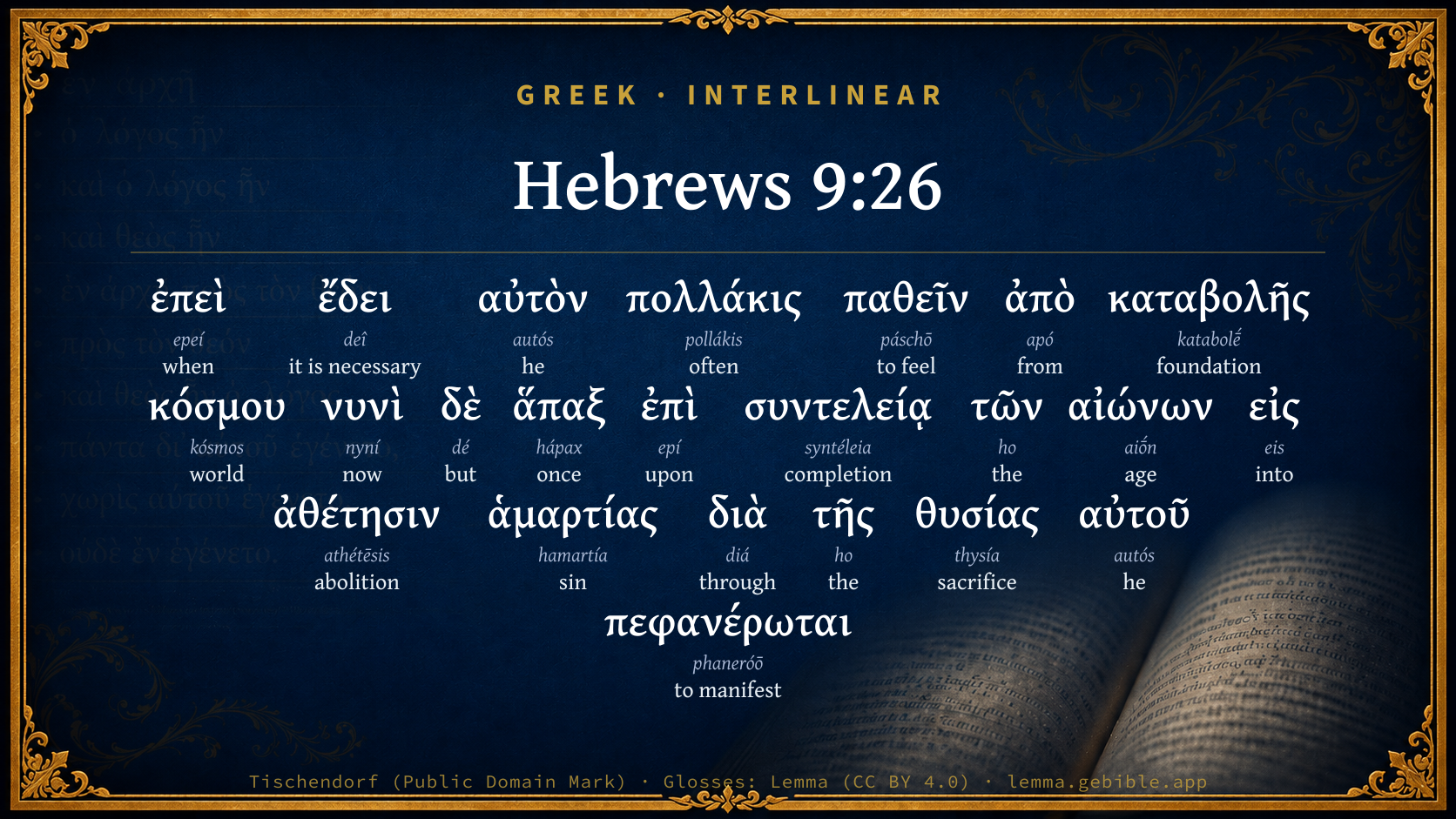
or else he must have suffered often since the foundation of the world. But now once at the end of the ages, he has been revealed to put away sin by the sacrifice of himself.
Download a study sheet
One document with this verse’s original text, its word-by-word gloss line, the meaning frame, cross-references with their text, attributed commentary, and full source and license credits — printable, and it pastes into notes with its structure intact.
This verse Autodidact and up
A passage Seminary Student
Up to 50 verses in one chapter. A passage sheet keeps up to 6 commentary sources and 12 cross-references per verse, in the order this page ranks them, and says so on the sheet whenever that leaves anything out. Ask for a single verse and you get the Autodidact verse sheet above.
Everything on this page stays free to read, with no account — the sheet is a download of what is already on screen, not access to it.
Compare translations 3
The same verse in 3 English versions, stacked beneath the original-language interlinear above. Click any original word for its lexicon entry.
Each is an independent rendering of the whole verse — the interlinear is not word-aligned to these translations.
Highlighted words mark where these versions differ — a whole-verse word diff, not a word-by-word alignment.
-
World English Bible Public Domain
or else he must have suffered often since the foundation of the world. But now once at the end of the ages, he has been revealed to put away sin by the sacrifice of himself.
-
King James Version Public Domain
For then must he often have suffered since the foundation of the world: but now once in the end of the world hath he appeared to put away sin by the sacrifice of himself.
-
unfoldingWord Literal Text CC BY-SA 4.0
since it was necessary for him to suffer many times from the foundation of the world. But now he has been revealed once at the end of the ages for the annulment of sin through the sacrifice of himself.
unfoldingWord Literal Text — © unfoldingWord, licensed CC BY-SA 4.0. Word-aligned USFM3 via Door43 (git.door43.org/unfoldingWord/en_ult).
Show all 19 translations
Every available English version of this verse, each an independent rendering of the whole verse.
-
World English Bible Public Domain
or else he must have suffered often since the foundation of the world. But now once at the end of the ages, he has been revealed to put away sin by the sacrifice of himself.
-
Berean Standard Bible Public Domain
Otherwise, Christ would have had to suffer repeatedly since the foundation of the world. But now He has appeared once for all at the end of the ages to do away with sin by the sacrifice of Himself.
-
Majority Standard Bible Public Domain
Otherwise, Christ would have had to suffer repeatedly since the foundation of the world. But now He has appeared once for all at the end of the ages to do away with sin by the sacrifice of Himself.
-
King James Version Public Domain
For then must he often have suffered since the foundation of the world: but now once in the end of the world hath he appeared to put away sin by the sacrifice of himself.
-
American Standard Version (1901) Public Domain
else must he often have suffered since the foundation of the world: but now once at the end of the ages hath he been manifested to put away sin by the sacrifice of himself.
-
Revised Version (1885) Public Domain
else must he often have suffered since the foundation of the world: but now once at the end of the ages hath he been manifested to put away sin by the sacrifice of himself.
-
Geneva Bible (1599) Public Domain
(For then must he haue often suffred since the foundation of the world) but now in the end of the world hath he bene made manifest, once to put away sinne by the sacrifice of him selfe.
-
Douay-Rheims (1899) Public Domain
For then he ought to have suffered often from the beginning of the world: but now once at the end of ages, he hath appeared for the destruction of sin, by the sacrifice of himself.
-
Young's Literal Translation Public Domain
since it had behoved him many times to suffer from the foundation of the world, but now once, at the full end of the ages, for putting away of sin through his sacrifice, he hath been manifested;
-
Literal Standard Version CC BY-SA 4.0
otherwise it was necessary for Him to suffer many times from the foundation of the world, but now He has been revealed once, at the full end of the ages, for [the] annulling of sin through His sacrifice;
-
Unlocked Literal Bible CC BY-SA 4.0
If that had been the case, then he would have had to suffer many times since the beginning of the world. But now he has appeared at the end of the ages to do away with sin by the sacrifice of himself.
-
unfoldingWord Literal Text CC BY-SA 4.0
since it was necessary for him to suffer many times from the foundation of the world. But now he has been revealed once at the end of the ages for the annulment of sin through the sacrifice of himself.
-
Darby Bible Public Domain
since he had [then] been obliged often to suffer from the foundation of the world. But now once in the consummation of the ages he has been manifested for [the] putting away of sin by his sacrifice.
-
World Messianic Bible Public Domain
or else he must have suffered often since the foundation of the world. But now once at the end of the ages, he has been revealed to put away sin by the sacrifice of himself.
-
Webster's Bible Public Domain
For then must he often have suffered since the foundation of the world: but now once in the end of the world hath he appeared to put away sin by the sacrifice of himself.
-
Free Bible Version CC BY-SA 4.0
Otherwise Christ would have had to suffer many times since the creation of the world. No: just this one time at the end of the present age he came to remove sin by sacrificing himself.
-
Bible in Basic English Public Domain
For then he would have undergone a number of deaths from the time of the making of the world: but now he has come to us at the end of the old order, to put away sin by the offering of himself.
-
Text-Critical English NT CC BY 4.0
for then he would have had to suffer again and again since the foundation of the world. But as it is, he has appeared once for all at the end of the ages to remove sin by the sacrifice of himself.
-
Tyndale New Testament (1534) Public Domain
for then must he have often suffered sence the worlde began. But now in the ende of the worlde hath he appered once to put synne to flyght by the offerynge vp of him silfe.
Literal Standard Version (2020), Covenant Press — licensed CC BY-SA 4.0. Text via the HelloAO Bible API (eBible.org). Unlocked Literal Bible (unfoldingWord) — licensed CC BY-SA 4.0. Text via the HelloAO Bible API (eBible.org). unfoldingWord Literal Text — © unfoldingWord, licensed CC BY-SA 4.0. Word-aligned USFM3 via Door43 (git.door43.org/unfoldingWord/en_ult). Free Bible Version, Dr. Jonathan Gallagher — licensed CC BY-SA 4.0. Text via the HelloAO Bible API (eBible.org).
Word by word
More ways to search: Search by grammar → Find every occurrence → Compare this word →
Practice this passage: Drill this verse → Learn its vocabulary →
- Appears 2× in the Greek New Testament
- First appears at Hebrews 7:18
- Part of Speech
- Noun
- Case
- Accusative
- Number
- Singular
- Gender
- Feminine
Full Thayer's Definition
- ἐπεὶ epeí G1893 “when” Conjunction
- ἔδει deî G1163 “it is necessary” Verb, Imperfect, Active, Indicative, 3rd person, Singular
- αὐτὸν autós G846 “he” Personal pronoun, Accusative, Singular, Masculine
- πολλάκις pollákis G4178 “often” Adverb
- παθεῖν páschō G3958 “to feel” Verb, Aorist, Active, Infinitive
- ἀπὸ apó G575 “from” Preposition
- καταβολῆς katabolḗ G2602 “foundation” Noun, Genitive, Singular, Feminine
- κόσμου kósmos G2889 “world” Noun, Genitive, Singular, Masculine
- νυνὶ nyní G3570 “now” Adverb
- δὲ dé G1161 “but” Conjunction
- ἅπαξ hápax G530 “once” Adverb
- ἐπὶ epí G1909 “upon” Preposition
- συντελείᾳ syntéleia G4930 “completion” Noun, Dative, Singular, Feminine
- τῶν ho G3588 “the” Article, Genitive, Plural, Masculine
- αἰώνων aiṓn G165 “age” Noun, Genitive, Plural, Masculine
- εἰς eis G1519 “into” Preposition
- ἀθέτησιν athétēsis G115 “abolition” Noun, Accusative, Singular, Feminine
- ἁμαρτίας hamartía G266 “sin” Noun, Genitive, Singular, Feminine
- διὰ diá G1223 “through” Preposition
- τῆς ho G3588 “the” Article, Genitive, Singular, Feminine
- θυσίας thysía G2378 “sacrifice” Noun, Genitive, Singular, Feminine
- αὐτοῦ autós G846 “he” Personal pronoun, Genitive, Singular, Masculine
- πεφανέρωται phaneróō G5319 “to manifest” Verb, Perfect, Passive, Indicative, 3rd person, Singular
About this verse
These counts appear in no published source. They are computed here, from the morphology-tagged text and Lemma’s own curated glosses. What Lemma adds →
- 23
- words
- 21
- distinct lemmas
- General Epistles
- section
Cross-references
31Topical passages linked to Hebrews 9:26 in the Treasury of Scripture Knowledge — connected by theme and wording, ordered by reader-vote popularity; previews shown in the World English Bible.
- Hebrews 9:12 nor yet through the blood of goats and calves, but through his own blood, entered in once for all into the Holy Place, having obtained eternal redemption.
- 1 Peter 1:20 who was foreknown indeed before the foundation of the world, but was revealed at the end of times for your sake,
- Hebrews 1:2 has at the end of these days spoken to us by his Son, whom he appointed heir of all things, through whom also he made the worlds.
- Matthew 25:34 Then the King will tell those on his right hand, 'Come, blessed of my Father, inherit the Kingdom prepared for you from the foundation of the world;
- Hebrews 10:4 For it is impossible that the blood of bulls and goats should take away sins.
- 1 Peter 3:18 Because Christ also suffered for sins once, the righteous for the unrighteous, that he might bring you to God; being put to death in the flesh, but made alive in the spirit;
- Hebrews 7:27 who doesn't need, like those high priests, to daily offer up sacrifices, first for his own sins, and then for the sins of the people. For this he did once for all, when he offered up himself.
- Hebrews 9:14 how much more will the blood of Christ, who through the eternal Spirit offered himself without blemish to God, cleanse your conscience from dead works to serve the living God?
- 1 Peter 2:24 who his own self bore our sins in his body on the tree, that we, having died to sins, might live to righteousness; by whose stripes you were healed.
- 1 John 3:5 You know that he was revealed to take away our sins, and in him is no sin.
- Hebrews 10:12 but he, when he had offered one sacrifice for sins for ever, sat down on the right hand of God;
- Hebrews 10:10 by which will we have been sanctified through the offering of the body of Jesus Christ once for all.
- Ephesians 1:10 to an administration of the fullness of the times, to sum up all things in Christ, the things in the heavens, and the things on the earth, in him;
- Ephesians 5:2 Walk in love, even as Christ also loved you, and gave himself up for us, an offering and a sacrifice to God for a sweet-smelling fragrance.
- Titus 2:14 who gave himself for us, that he might redeem us from all iniquity, and purify for himself a people for his own possession, zealous for good works.
- Hebrews 4:3 For we who have believed do enter into that rest, even as he has said, "As I swore in my wrath, they will not enter into my rest;" although the works were finished from the foundation of the world.
- Micah 4:1 But in the latter days, It will happen that the mountain of Yahweh's temple will be established on the top of the mountains, And it will be exalted above the hills; And peoples will stream to it.
- John 1:29 The next day, he saw Jesus coming to him, and said, "Behold, the Lamb of God, who takes away the sin of the world!
- 1 Corinthians 10:11 Now all these things happened to them by way of example, and they were written for our admonition, on whom the ends of the ages have come.
- Revelation 17:8 The beast that you saw was, and is not; and is about to come up out of the abyss and to go into destruction. Those who dwell on the earth and whose names have not been written in the book of life from the foundation of the world will marvel when they see that the beast was, and is not, and shall be present.
- Leviticus 16:21–22 Aaron shall lay both his hands on the head of the live goat, and confess over him all the iniquities of the children of Israel, and all their transgressions, even all their sins; and he shall put them on the head of the goat, and shall send him away into the wilderness by the hand of a man who is in readiness.
- 2 Samuel 12:13 David said to Nathan, "I have sinned against Yahweh." Nathan said to David, "Yahweh also has put away your sin. You will not die.
- 2 Samuel 24:10 David's heart struck him after that he had numbered the people. David said to Yahweh, I have sinned greatly in that which I have done: but now, Yahweh, put away, I beg you, the iniquity of your servant; for I have done very foolishly.
- Job 7:21 Why do you not pardon my disobedience, and take away my iniquity? For now shall I lie down in the dust. You will seek me diligently, but I shall not be."
- Isaiah 2:2 It shall happen in the latter days, that the mountain of Yahweh's house shall be established on the top of the mountains, And shall be raised above the hills; And all nations shall flow to it.
- Daniel 9:24 Seventy weeks are decreed on your people and on your holy city, to finish disobedience, and to make an end of sins, and to make reconciliation for iniquity, and to bring in everlasting righteousness, and to seal up vision and prophecy, and to anoint the most holy.
- Daniel 10:14 Now I have come to make you understand what shall happen to your people in the latter days; for the vision is yet for [many] days:
- John 17:24 Father, I desire that they also whom you have given me be with me where I am, that they may see my glory, which you have given me, for you loved me before the foundation of the world.
- Hebrews 10:26 For if we sin willfully after we have received the knowledge of the truth, there remains no more a sacrifice for sins,
- Revelation 13:8 All who dwell on the earth will worship him, everyone whose name has not been written from the foundation of the world in the book of life of the Lamb who has been killed.
- Galatians 4:1 But I say that so long as the heir is a child, he is no different from a bondservant, though he is lord of all;
Cross-references courtesy of OpenBible.info (CC BY 4.0).
Lesson kit
Teaching starters — assembled from the data on this page, not authored interpretation. Every prompt links to the verse data it draws on. Edit before teaching.
Hebrews, in the General Epistles, opens this verse with 23 words (21 distinct Greek lemmas). Its most distinctive word is athétēsis (“abolition”). A historical commentator’s framing appears above. Read the whole chapter for the surrounding context.
Discussion questions
- How does “abolition” (athétēsis) shape what this verse is saying?
- How does Hebrews 7:18, which shares the word «abolition», read alongside this verse?
- What does the repetition of “he” (2× in this one verse) do in this verse?
- These translations render this verse differently. What is at stake in choosing one wording over another?
- Compare how Jamieson, Fausset & Brown and Tyndale Open Study Notes read this verse. Where do they agree or differ?
Things to notice
- These translations choose different wording for 19 words in this verse.
- “he” occurs 2× in this single verse.
- 21 distinct Greek lemmas span 23 words in this verse.
Commentary
Notes on Hebrews 9:26 from classic Christian and Jewish commentators (each source and its license shown beneath its notes). The classic Christian expositions comment on the surrounding passage and are grouped to its opening verse, so a note may address several verses; the Jewish commentaries on the Tanakh (Rashi and others) are per-verse, so they appear only where the commentator wrote on this verse.
Lemma curates 59 commentaries, every one of them public domain or Creative Commons licensed, each selected and text-cleaned for this edition rather than reprinted as found. About our sources →
Jamieson, Fausset & Brown
Robert Jamieson, A. R. Fausset & David Brown
Jamieson, Fausset & Brown — Commentary Critical and Explanatory on the Whole Bible (1871) — public domain (CC PDM 1.0). Text via the HelloAO Bible API.
Tyndale Open Study Notes
Tyndale Open Resources
Tyndale Open Study Notes — © Tyndale Open Resources, licensed CC BY-SA 4.0. Text via the HelloAO Bible API.
Bengel's Gnomon
Johann Albrecht Bengel
Bengel's Gnomon of the New Testament — English translation (T&T Clark, Edinburgh, 1860) — public domain. Text from a community e-Sword module.
Meyer's Critical & Exegetical Commentary
Heinrich August Wilhelm Meyer
Meyer — Critical and Exegetical Commentary on the New Testament — English translation by Peter Christie, edited by Frederick Crombie (T&T Clark, 1880) — public domain. Text from a community e-Sword module.
Expositor's Greek Testament
ed. W. Robertson Nicoll
The Expositor's Greek Testament, edited by W. Robertson Nicoll (1897–1910) — public domain. Text from a community e-Sword module.
Geneva Bible (1599)
Geneva Bible translators
Geneva Bible (1599) marginal notes — public domain. Text via Bolls.life.
Adam Clarke's Commentary
Adam Clarke's Commentary on the Bible (1810–1826) — public domain. Text from a community e-Sword/MySword module.
John Calvin's Commentaries
John Calvin's Commentaries (1540-1563) — public domain. Text from the Calvin Translation Society English edition (1840s-50s) via the Christian Classics Ethereal Library (ccel.org). Calvin's coverage is partial (roughly two-thirds of the Bible); uncommented books and verses are honest gaps, never fabricated. The 19th-century editor's footnotes and remarks are omitted so the notes are faithfully Calvin's own voice.
Ellicott's Commentary for English Readers
A Bible Commentary for English Readers, edited by Charles John Ellicott (1878–1897) — public domain. Text from a community e-Sword module.
The Cambridge Bible for Schools and Colleges
gen. ed. J. J. S. Perowne
The Cambridge Bible for Schools and Colleges (gen. ed. J. J. S. Perowne; Cambridge University Press, 1878–1918) — public domain. Text from a community e-Sword module.
John Gill's Exposition
John Gill's Exposition of the Whole Bible (1746–1763) — public domain (CC PDM 1.0). Text via the HelloAO Bible API.
Trapp's Complete Commentary
John Trapp
John Trapp, A Commentary or Exposition upon All the Books of the Old and New Testament (1647–1656) — public domain. Text from a community e-Sword module.
Albert Barnes' Notes on the Bible
Albert Barnes' Notes on the Bible (1834–1885) — public domain. Text from a community e-Sword/MySword module.
Haydock's Catholic Bible Commentary
George Leo Haydock (1774–1849), Haydock's Catholic Family Bible and Commentary, 1859 edition — public domain. Excludes Psalms (Douay-Rheims chapter numbering differs from Protestant) and Deuterocanonical books (Catholic canon only).
Matthew Poole's English Annotations
Matthew Poole's English Annotations on the Holy Bible (1683–1685) — public domain. Text from a community e-Sword/MySword module.
Whedon's Commentary on the Bible
Daniel D. Whedon
Daniel D. Whedon (gen. ed.), Commentary on the Old and New Testaments (1874–1909) — public domain. Text from a community e-Sword module.
John Wesley's Explanatory Notes
John Wesley, Explanatory Notes Upon the Whole Bible (1754–1765) — public domain. Text via the GEBible commentary corpus.
Scofield Reference Notes
C. I. Scofield
The Scofield Reference Bible (1917 edition), notes by C. I. Scofield — public domain. Text from a community e-Sword module.
The People's New Testament
B. W. Johnson
B. W. Johnson's The People's New Testament with Notes (1889–1891) — public domain. Electronic text from the Christian Classics Ethereal Library (CCEL) ThML edition.
Cambridge Greek Testament for Schools and Colleges
Cambridge Greek Testament for Schools and Colleges (Cambridge University Press, 1896; 21 vols, various authors incl. Carr, Maclear, Plummer, Farrar, Lumby, Moule, M. R. James, Simcox) — public domain. Text from a community e-Sword module.
Alford’s Greek Testament
Henry Alford
Henry Alford, The Greek Testament (1849–1861) — public domain. Text from a community e-Sword module.
Vincent's Word Studies in the New Testament
Marvin R. Vincent
Marvin R. Vincent, Word Studies in the New Testament (1887–1900) — public domain. Text from a community e-Sword/MySword module.