Revelation 18:5

Greek (Tischendorf 8th ed.) Revelation 18:5 appears in the Greek New Testament. The text above is from the Tischendorf 8th edition. Each word links to its Strong’s number and a concise gloss. Click any word for its full Thayer’s Greek Lexicon entry.
Download image
Cite this verse

Revelation 18:5 (World English Bible). Public Domain. Lemma interlinear Bible study tool, https://lemma.gebible.app/v/revelation/18/5.

Show BibTeX & RIS
BibTeX
RIS
English Translation
for her sins have reached to the sky, and God has remembered her iniquities.
World English Bible · Public Domain
Download a study sheet

One document with this verse’s original text, its word-by-word gloss line, the meaning frame, cross-references with their text, attributed commentary, and full source and license credits — printable, and it pastes into notes with its structure intact.

This verse Autodidact and up

Study sheet (.html) Plain text (.txt)

A passage Seminary Student

Up to 50 verses in one chapter. A passage sheet keeps up to 6 commentary sources and 12 cross-references per verse, in the order this page ranks them, and says so on the sheet whenever that leaves anything out. Ask for a single verse and you get the Autodidact verse sheet above.

Everything on this page stays free to read, with no account — the sheet is a download of what is already on screen, not access to it.

Want to remove ads? Support Godless Engineer
Compare translations 3

The same verse in 3 English versions, stacked beneath the original-language interlinear above. Click any original word for its lexicon entry.

Each is an independent rendering of the whole verse — the interlinear is not word-aligned to these translations.

Highlighted words mark where these versions differ — a whole-verse word diff, not a word-by-word alignment.

  • World English Bible Public Domain
    for her sins have reached to the sky, and God has remembered her iniquities.
  • King James Version Public Domain
    For her sins have reached unto heaven, and God hath remembered her iniquities.
  • unfoldingWord Literal Text CC BY-SA 4.0
    For her sins have been heaped as far as heaven, and God has remembered her offenses.

unfoldingWord Literal Text — © unfoldingWord, licensed CC BY-SA 4.0. Word-aligned USFM3 via Door43 (git.door43.org/unfoldingWord/en_ult).

Versions to compare (up to 4)

3 of 4 selected

Show all 19 translations

Every available English version of this verse, each an independent rendering of the whole verse.

  • World English Bible Public Domain
    for her sins have reached to the sky, and God has remembered her iniquities.
  • Berean Standard Bible Public Domain
    For her sins are piled up to heaven, and God has remembered her iniquities.
  • Majority Standard Bible Public Domain
    For her sins are piled up to heaven, and God has remembered her iniquities.
  • King James Version Public Domain
    For her sins have reached unto heaven, and God hath remembered her iniquities.
  • American Standard Version (1901) Public Domain
    for her sins have reached even unto heaven, and God hath remembered her iniquities.
  • Revised Version (1885) Public Domain
    for her sins have reached even unto heaven, and God hath remembered her iniquities.
  • Geneva Bible (1599) Public Domain
    For her sinnes are come vp into heauen, and God hath remembred her iniquities.
  • Douay-Rheims (1899) Public Domain
    For her sins have reached unto heaven, and the Lord hath remembered her iniquities.
  • Young's Literal Translation Public Domain
    because her sins did follow -- unto the heaven, and God did remember her unrighteousness.
  • Literal Standard Version CC BY-SA 4.0
    because her sins have reached up to Heaven, and God remembered her unrighteousness.
  • Unlocked Literal Bible CC BY-SA 4.0
    Her sins have piled up as high as heaven, and God has remembered her evil actions.
  • unfoldingWord Literal Text CC BY-SA 4.0
    For her sins have been heaped as far as heaven, and God has remembered her offenses.
  • Darby Bible Public Domain
    for her sins have been heaped on one another up to the heaven, and God has remembered her unrighteousnesses.
  • World Messianic Bible Public Domain
    for her sins have reached to the sky, and God has remembered her iniquities.
  • Webster's Bible Public Domain
    For her sins have reached to heaven, and God hath remembered her iniquities.
  • Free Bible Version CC BY-SA 4.0
    Her sins have piled up all the way to heaven, and God is very much aware of her wickedness.
  • Bible in Basic English Public Domain
    For her sins have gone up even to heaven, and God has taken note of her evil-doing.
  • Text-Critical English NT CC BY 4.0
    for her sins are heaped as high as heaven, and God has remembered her unrighteous acts.
  • Tyndale New Testament (1534) Public Domain
    For her synnes are gon vp to heven and God hath remembred her wyckednes.

Literal Standard Version (2020), Covenant Press — licensed CC BY-SA 4.0. Text via the HelloAO Bible API (eBible.org). Unlocked Literal Bible (unfoldingWord) — licensed CC BY-SA 4.0. Text via the HelloAO Bible API (eBible.org). unfoldingWord Literal Text — © unfoldingWord, licensed CC BY-SA 4.0. Word-aligned USFM3 via Door43 (git.door43.org/unfoldingWord/en_ult). Free Bible Version, Dr. Jonathan Gallagher — licensed CC BY-SA 4.0. Text via the HelloAO Bible API (eBible.org).

Word by word

More ways to search: Search by grammar → Find every occurrence → Compare this word →

Practice this passage: Drill this verse → Learn its vocabulary →

ἀδικήματα
adíkēma
G92
“misdeed”
Noun, Accusative, Plural, Neuter
Part of Speech
Noun
Case
Accusative
Number
Plural
Gender
Neuter
Full Thayer's Definition

Origin: from G91

TDNT: 03:41,2

1. a misdeed, evil doing, iniquity
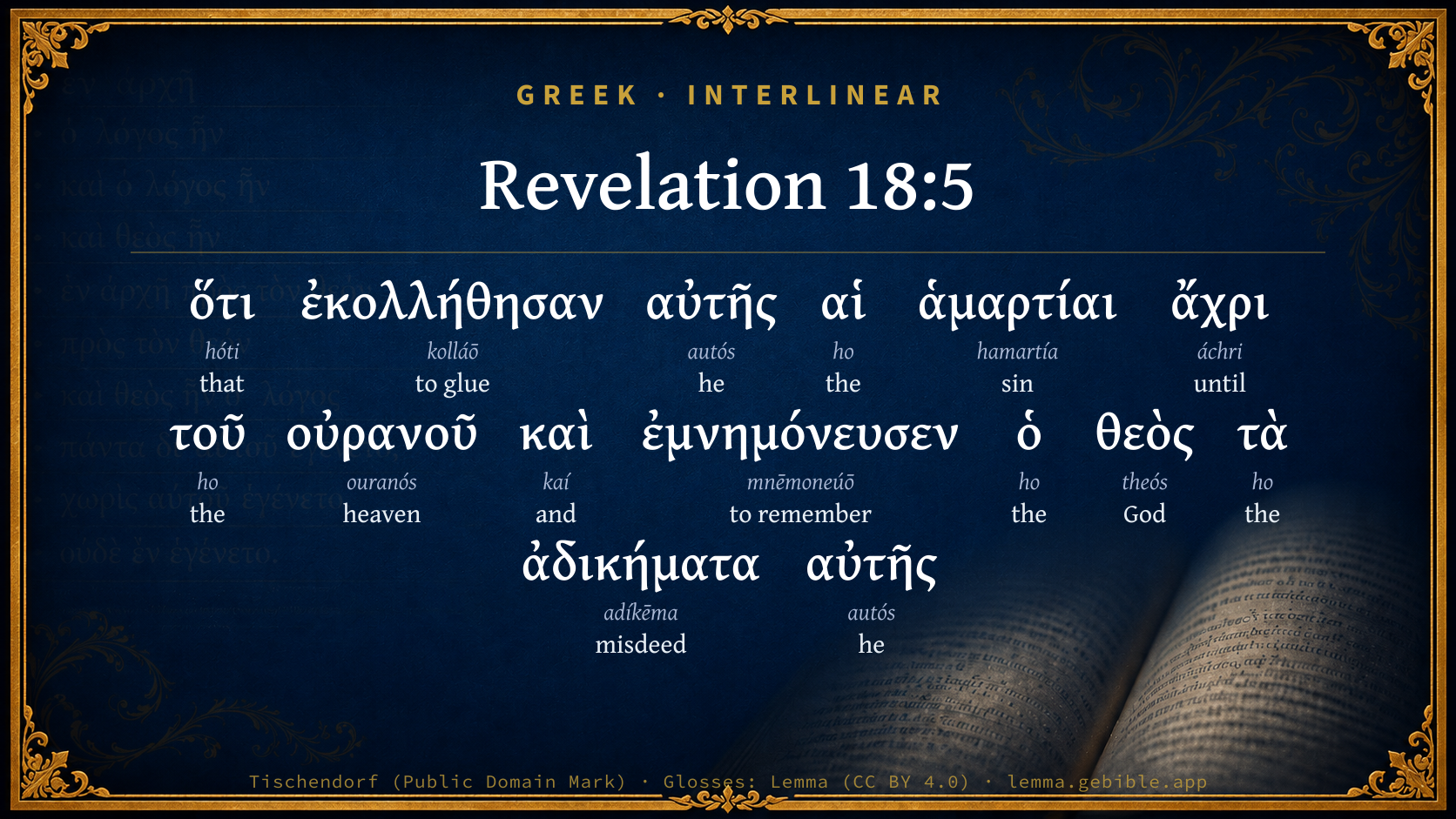
  1. ὅτι hóti G3754 “that” Conjunction
  2. ἐκολλήθησαν kolláō G2853 “to glue” Verb, Aorist, Passive, Indicative, 3rd person, Plural
  3. αὐτῆς autós G846 “he” Personal pronoun, Genitive, Singular, Feminine
  4. αἱ ho G3588 “the” Article, Nominative, Plural, Feminine
  5. ἁμαρτίαι hamartía G266 “sin” Noun, Nominative, Plural, Feminine
  6. ἄχρι áchri G891 “until” Adverb
  7. τοῦ ho G3588 “the” Article, Genitive, Singular, Masculine
  8. οὐρανοῦ ouranós G3772 “heaven” Noun, Genitive, Singular, Masculine
  9. καὶ kaí G2532 “and” Conjunction
  10. ἐμνημόνευσεν mnēmoneúō G3421 “to remember” Verb, Aorist, Active, Indicative, 3rd person, Singular
  11. ὁ ho G3588 “the” Article, Nominative, Singular, Masculine
  12. θεὸς theós G2316 “God” Noun, Nominative, Singular, Masculine
  13. τὰ ho G3588 “the” Article, Accusative, Plural, Neuter
  14. αὐτῆς autós G846 “he” Personal pronoun, Genitive, Singular, Feminine

About this verse

These counts appear in no published source. They are computed here, from the morphology-tagged text and Lemma’s own curated glosses. What Lemma adds →

15
words
11
distinct lemmas
Revelation
section

Notable vocabulary

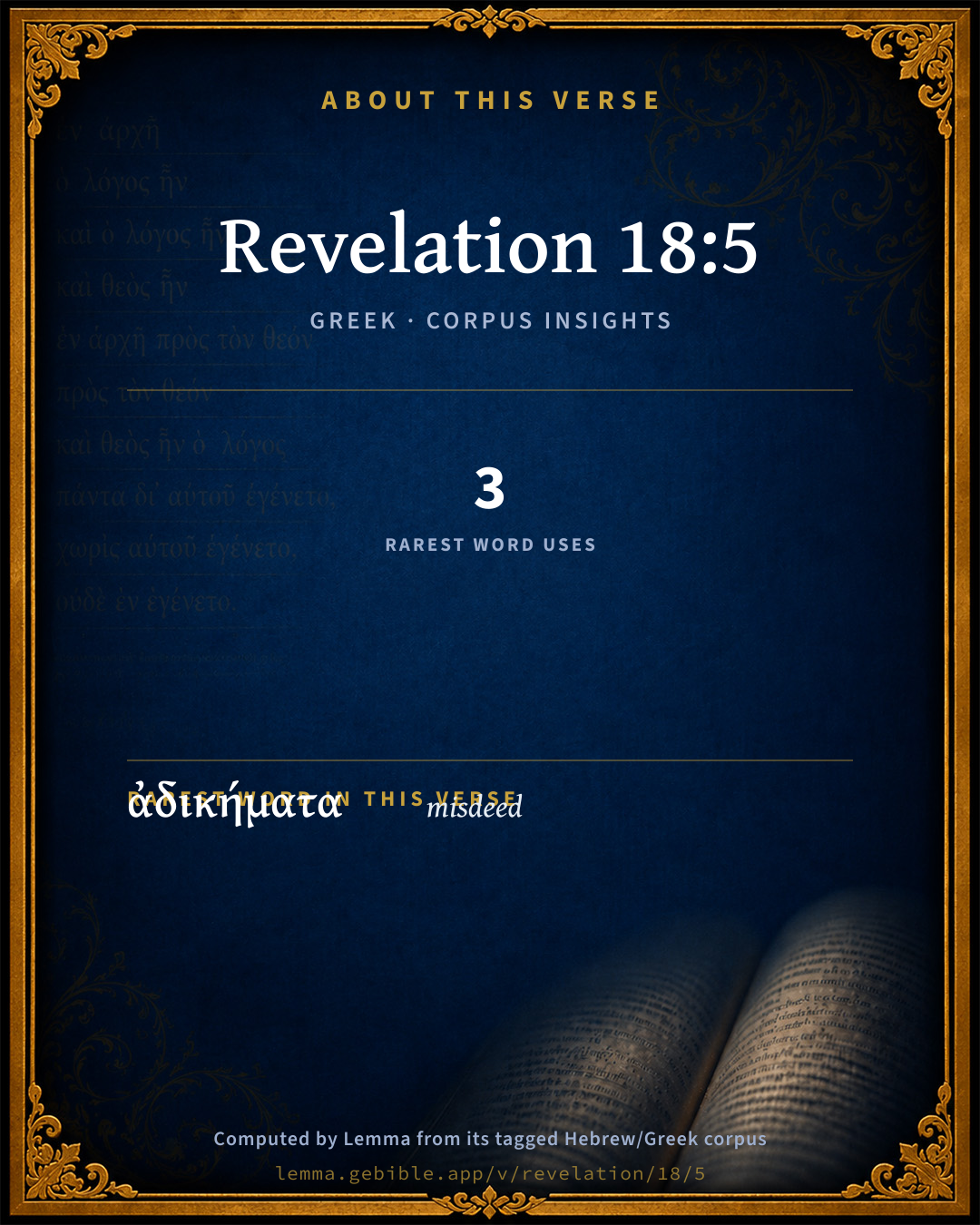
The rarest word here is ἀδικήματα misdeed G92 — appearing just 3 times in the whole Greek New Testament.

Shared distinctive vocabulary

ἀδικήματα misdeed G92 occurs in 3 verses of the Greek New Testament. Also found in:

Repetition

Words recur within this verse:

  • αἱ the G3588 ×4
  • αὐτῆς he G846 ×2

Cross-references

6

Topical passages linked to Revelation 18:5 in the Treasury of Scripture Knowledge — connected by theme and wording, ordered by reader-vote popularity; previews shown in the World English Bible.

  • Genesis 18:20–21 Yahweh said, "Because the cry of Sodom and Gomorrah is great, and because their sin is very grievous,
  • Ezra 9:6 and I said, my God, I am ashamed and blush to lift up my face to you, my God; for our iniquities are increased over our head, and our guiltiness is grown up to the heavens.
  • Jeremiah 51:9 We would have healed Babylon, but she is not healed: forsake her, and let us go everyone into his own country; for her judgment reaches to heaven, and is lifted up even to the skies.
  • Revelation 16:19 The great city was divided into three parts, and the cities of the nations fell. Babylon the great was remembered in the sight of God, to give to her the cup of the wine of the fierceness of his wrath.
  • Jonah 1:2 "Arise, go to Nineveh, that great city, and preach against it, for their wickedness has come up before me."
  • 2 Chronicles 28:9 But a prophet of Yahweh was there, whose name was Oded: and he went out to meet the host that came to Samaria, and said to them, Behold, because Yahweh, the God of your fathers, was angry with Judah, he has delivered them into your hand, and you have slain them in a rage which has reached up to heaven.

Cross-references courtesy of OpenBible.info (CC BY 4.0).

Where the printed editions differ

1 variant

Places in this verse where the major printed Greek editions disagree on the wording in a way that affects the translation — a comparison of editions, not a manuscript-by-manuscript collation. The editions are the modern critical texts (Nestlé-Aland 28/27, SBL, Westcott-Hort, Tregelles, Tyndale House) and the traditional texts behind the KJV (the Textus Receptus and the Byzantine/Majority text). It is not a claim about which reading is original.

  1. Different wording
    ἐκολλήθησαν

    “they were heaped”

    In NA28NA27TynSBLWHTregByz Not in TR

    ἠκολούθησαν (ēkolouthēsan) 'they reached' occurs in traditional manuscripts (TR) instead of ἐκολλήθησαν (ekollēthēsan) 'they were heaped' in older manuscripts (NA28+NA27+Tyn+SBL+WH+Treg+Byz)

Textual data: Translators Amalgamated Greek New Testament (STEPBible TAGNT) · CC BY 4.0.

Commentary

Notes on Revelation 18:5 from classic Christian and Jewish commentators (each source and its license shown beneath its notes). The classic Christian expositions comment on the surrounding passage and are grouped to its opening verse, so a note may address several verses; the Jewish commentaries on the Tanakh (Rashi and others) are per-verse, so they appear only where the commentator wrote on this verse.

Lemma curates 59 commentaries, every one of them public domain or Creative Commons licensed, each selected and text-cleaned for this edition rather than reprinted as found. About our sources →

Tyndale Open Study Notes

Tyndale Open Resources

18:5 God remembers: His response may seem slow (Ps 103:8; 145:8; Joel 2:13; Jon 4:2), but God is not weak, and he does not forget either good or evil (Rev 16:19; Gen 19:29; 1 Sam 1:19).

Tyndale Open Study Notes — © Tyndale Open Resources, licensed CC BY-SA 4.0. Text via the HelloAO Bible API.

Bengel's Gnomon

Johann Albrecht Bengel

Rev 18:5. [197] Ἐκολλήθησαν) Wolf says, this reading is suspected by me.[198] For the verb κολλᾶσθαι is said only of those, who adhere to any object or person, as pleasing to themselves; but I do not perceive how this can be said of sins, and moreover of sinners, with reference to the heavens. But the verb κολλᾶσθαι is used in a wider sense, Zec 14:5, Καὶ ἐγκολληθήσεται φάραγξ ἓως Ἀσαής. Lam 2:2, Τὰ ὀχυρώματα τῆς θυγατρὸς Ἰούδα ἐκόλλησεν (Κύριος) εἰς τὴς γῆν. Passages might be added, in which דבק and κολλᾶσθαι correspond with each other. But the two former passages prove the matter: for ἕως and εἰς in them, and ἄχρι in the Apocalypse, render the expression altogether similar; and the word הגיע is found in them, which word is used, 2Ch 28:9, to denote a slaughter reaching to the heaven: LXX., ἜΦΘΑΚΕ. The Apocalyptic phrase answers to that passage of Jeremiah 51 (in the Greek 28) 9, ὍΤΙ ἬΓΓΙΣΕΝ ΕἸς ΟὐΡΑΝῸΝ ΤῸ ΚΡΊΜΑ ΑὐΤῆς (ΒΑΒΥΛῶΝΟς); in Hebr. it is נגע, of which word John undoubtedly had an idea in his mind. But ἈΚΟΛΟΥΘΈΩ is never used to express this word; the synonymous words, ΦΘΆΝΕΙΝ, ἘΓΓΊΖΕΙΝ, ΚΟΛΛᾶΣΘΑΙ, are used. The MSS., with general consent, have ἘΚΟΛΛΉΘΗΣΑΝ: Erasmus, ἠκολούθησαν, from mere conjecture, as it seems; for not even does Andreas thus read it. Whether ΑἹ ἉΜΑΡΤΊΑΙ here denote sins, or rather punishments, the passage in Ap. ch. Rev 16:13 is different; for the works follow with those who die in the Lord the sins do not follow with Babylon even to the heaven.

[197] Ver. 4. Ἐξέλθρτε, come out) This coming out will be enjoined immediately before the infliction of the plagues of Babylon.—V. g.

[198] ABC read ἐκολλήθησαν. Vulg. h Cypr. 316 have “pervenerunt:” Rec. Text. ἠκολούθησαν, without good authority.—E.

Bengel's Gnomon of the New Testament — English translation (T&T Clark, Edinburgh, 1860) — public domain. Text from a community e-Sword module.

Expositor's Greek Testament

ed. W. Robertson Nicoll

Rev 18:5 . Plutarch ( de sera uindict . 15) is strong upon the solidarity of a city, which is liable to be punished at any time for past offences. κολλᾶσθαι (“Heaped up to the sky are her sins”) in the familiar sense of haerere = to follow close upon, or to cleave, the idea being that the mass of sins actually presses on the roof of heaven. The figure would be different if, as Holtzm. conjectures, κολλ . referred to the gluing together of the leaves composing a roll; the record of Rome’s sins would form so immense a volume that when unrolled it would reach the very heavens. “Etascendit contumelia tua ad altissimum, et superbia tua ad fortem” (4 Esd. 11:43).

The Expositor's Greek Testament, edited by W. Robertson Nicoll (1897–1910) — public domain. Text from a community e-Sword module.

Geneva Bible (1599)

Geneva Bible translators

He useth a word which signifieth the following of sins one after another, and rising one another in such sort, that they grew at length to such an heap that they came up even to heaven.

Geneva Bible (1599) marginal notes — public domain. Text via Bolls.life.

Jamieson, Fausset & Brown

Robert Jamieson, A. R. Fausset & David Brown

her sins--as a great heap.

reached--Greek, "reached so far as to come into close contact with, and to cleave unto."

Jamieson, Fausset & Brown — Commentary Critical and Explanatory on the Whole Bible (1871) — public domain (CC PDM 1.0). Text via the HelloAO Bible API.

Adam Clarke's Commentary

Verse 5. Her sins have reached unto heaven] They are become so great and enormous that the long-suffering of God must give place to his justice.

Adam Clarke's Commentary on the Bible (1810–1826) — public domain. Text from a community e-Sword/MySword module.

Ellicott's Commentary for English Readers

(5) For her sins have reached . . .—Better, For her sins have reached as far as heaven. The idea is of a great heap firmly fastened, and towering, like another Babel, as far as heaven. (Comp. 2Ch_28:9, and Ezr_9:6.) The idea is more than that of the cry of sin reaching heaven, as in the case of Sodom (Gen_18:20-21); the sins themselves, many and imperial, have touched the face of heaven. God hath remembered her. (Comp. Rev_16:19). Sometimes the oppressed have thought that God had forgotten the voice of the enemy (Psa_74:10-23); but the long-suffering of the Lord is salvation (2Pe_3:8-18.

A Bible Commentary for English Readers, edited by Charles John Ellicott (1878–1897) — public domain. Text from a community e-Sword module.

The Cambridge Bible for Schools and Colleges

gen. ed. J. J. S. Perowne

5. have reached] Lit., have cleaved together.

The Cambridge Bible for Schools and Colleges (gen. ed. J. J. S. Perowne; Cambridge University Press, 1878–1918) — public domain. Text from a community e-Sword module.

John Gill's Exposition

For her sins have reached unto heaven,.... Or "have followed unto heaven"; one after another, in one age after another, until they have been as it were heaped up together, and have reached the heavens; the phrase denotes the multitude of them, God's knowledge and notice of them, and the cry of them to him; see Gen 18:20 the Alexandrian copy and Complutensian edition read, "have cleaved", or "glued", and so the Syriac and Arabic versions seem to have read; her sins were as it were soldered together, and stuck fast to her, and being joined and linked together, made a long chain, and reached to heaven, and cleaved to that, and cried for vengeance:

and God hath remembered her iniquities; and is about to punish her for them; for as forgiveness of sin is signified by a non-remembrance of it, so punishment of sin by a remembrance of it, and of the persons that commit it; see Rev 16:19.

John Gill's Exposition of the Whole Bible (1746–1763) — public domain (CC PDM 1.0). Text via the HelloAO Bible API.

Trapp's Complete Commentary

John Trapp

5 For her sins have reached unto heaven, and God hath remembered her iniquities.

Ver. 5. For her sins have reached] Gr. ηκολουθησαν, have followed thick or been thwacked one upon another, thick and threefold, as they say: there hath been a concatenation, or a continued series of them, εκολληθησαν. Others read, Her sins are glued and soldered together; or they cleave and are glued to heaven. Matthew Paris speaking of the court of Rome, saith, Huius foetor usque ad nubes fumum teterrimum exhalabat: Her filthiness hath sent up a most noisome stench to the very clouds of heaven, as Sodom’s did; therefore shall Babel (the glory of kingdoms) be as the destruction of God in Sodom and Gomorrha, Isa 13:19.

John Trapp, A Commentary or Exposition upon All the Books of the Old and New Testament (1647–1656) — public domain. Text from a community e-Sword module.

Albert Barnes' Notes on the Bible

For her sins have reached unto heaven - So in Jer 51:9, speaking of Babylon, it is said, “For her judgment reacheth unto heaven, and is lifted up even to the skies.” The meaning is not that the sins of this mystical Babylon were like a mass or pile so high as to reach to heaven, but that it had become so prominent as to attract the attention of God. Compare Gen 4:10, “The voice of thy brother’s blood crieth unto me from the ground.” See also Gen 18:20.

And God hath remembered her iniquities - He had seemed to forget them, or not to notice them, but now he acted as if they had come to his recollection. See the notes on Rev 16:19.

Albert Barnes' Notes on the Bible (1834–1885) — public domain. Text from a community e-Sword/MySword module.

Matthew Poole's English Annotations

For her sins have reached unto heaven; that is, the cry of her sins; according to what is said of Sodom, (one of the types of antichrist), Gen 18:20,21.

And God hath remembered her iniquities; the time is come when God will punish her for her idolatry and persecution, and all the abominable things done and committed by her.

Matthew Poole's English Annotations on the Holy Bible (1683–1685) — public domain. Text from a community e-Sword/MySword module.

Whedon's Commentary on the Bible

Daniel D. Whedon

5. Reached unto heaven—Not merely in their “cry,” or rumor, but in their accumulating heap, rising, like the tower of Babel, with a “top unto heaven.” Gen_11:4.

Remembered—A clear reference to Rev_16:19; another reference to the past event.

Daniel D. Whedon (gen. ed.), Commentary on the Old and New Testaments (1874–1909) — public domain. Text from a community e-Sword module.

The Pulpit Commentary

For her sins have reached unto heaven, and God hath remembered her iniquities. That is, the accumulation of sin is so great as to reach up to the heaven. Exactly the description of the judgment of Babylon given in Jer_51:9, "Forsake her, and let us go every one into his own country; for her judgment reacheth unto heaven, and is lifted up even to the skies." The last part of the verse is a repetition of Rev_16:19.

The Pulpit Commentary (1880–1919), ed. H.D.M. Spence-Jones & Joseph S. Exell — public domain. Text from a community e-Sword module.

John Wesley's Explanatory Notes

Even to heaven - An expression which implies the highest guilt.

John Wesley, Explanatory Notes Upon the Whole Bible (1754–1765) — public domain. Text via the GEBible commentary corpus.

Scofield Reference Notes

C. I. Scofield

sins

Sin

(See Scofield Rom 3:23).

The Scofield Reference Bible (1917 edition), notes by C. I. Scofield — public domain. Text from a community e-Sword module.

Burkitt's Expository Notes on the New Testament

William Burkitt

Observe here, 1. The reason assigned why Almighty God inflicted such severe punishments upon Babylon, because her sins, that is, the cry and clamour of her sins, had reached up to heaven, the measure of her sins was filled up, and God had remembered her iniquities, that is, manifested his rememberance of them, by inflicting on her so great, so just, a punishment for them, viz. for her idolatry and persecution.

Learn hence, That although sins be transient actions, yet they have a permanent pleading before the Lord’s tribunal, to bring down judgments upon incorrigible sinners.

And, 2. That although the justice of God may be thought to be asleep, and he may seem to be forgetful of sin and sinners, yet he will take his own time to manifest that he remembers them, by inflicting the heaviest of his judgments upon obdurate sinners: Her sins reached unto heaven, and God hath remembered her iniquities.

Observe, 2. The injunction and command given by God unto his people, to every one of them in their place and station, to contribute regularly all they can towards Babylon’s downfall and destruction, Reward her as she rewarded you, yea, double; this is required, not from a private spirit of revenge, which Christianity expressly forbids, but as a public work, in an authoritative way and manner, out of an ardent zeal for the glory of God, and from a just indignation against her tyranny and idolatry; and the command to double unto her double, implies that a double punishment is due unto her, yea, a just one, according to her works.

Behold here! what bloody persecutors may at length expect, namely, to receive at the Lord’s hand double for all their sins. Babylon’s punishment shall be double, respecting what she has acted, but not double in respect of what she has deserved; if possible, let her have as much blood again to drink as ever she spilt, for one drop of the blood of Sion is more worth than an ocean of the blood of Babylon: give her therefore double, for though it be more in quantity, it is nothing so much in value.

Observe, 3. How suitable and unanswerable Babylon’s punishment inflicted will be to her sin committed; her sins were pride and insolence, luxury and voluptuousness.

Note, 1. Her pride; she said in her heart, I sit as a queen.

Mark, she did not barely say, I am a queen, but I sit as a queen; as if she had said, "I am not only in a high place, but in a sure place: I have a warm and a firm seat, I am well settled, I have a great command, yea, an uncontrollable command, I am no widow; no desolate widow, no disconsolate widow, for I have many children to comfort me, many sons and daughters to support me; I shall see no sorrow, I neither feel nor fear any." Behold how worldly men fancy to themselves an everlastingness in worldly things; they fancy themselves sitting as upon down pillows for ease and softness, and as upon rocks of adamant for sureness and unmovableness, I sit as a queen, and shall see no sorrow.

Note, 2. Her luxury and voluptuousness, she lived deliciously, in pompous palaces, pleasantly situated, plentifully furnished, and her judgment bears a strict proportion to her sin, How much she hath glorified herself, and lived deliciously, so much torment and sorrow give her; the justice of God will exact all the arrears of abused mercy. Sinners that now fare deliciously every day, shall pass from their good things here, to the flames which live by the breath of God’s revenging wrath. Ah! doleful exchange! one hour’s feeling of that fire will be more tormenting than an age’s enjoyment of this world’s delight can be pleasing.

Observe, 4. The equity, the celerity, and multiplicity of Babylon’s punishments; their equity is intimated in the illative particle therefore, that is, because of her former sins her plagues shall come; the celerity and swiftness of her punishment is intimated, they shall come upon her in one day, as did Sodom’s plagues, suddenly and unexpectedly; and the multiplicity and variety of her plagues is particularly here expressed; death, for putting the saints to death; mourning, for her former rejoicing; famine, for famishing God’s people; and burning, for having burnt so many of the bodies of the holy martyrs to a coal. Righteous art thou, O Lord, and just are thy judgments.

Observe lastly, The reason here assigned for the unavoidableness of all these plagues coming upon Babylon-- for strong is the Lord who judgeth her. True, Babylon has all natural power and all civil strength on her side; but the strong God is against her, it is his controversy with her, and he is able to effect what he pleaseth, how incredible soever the thing may seem to us: sooner may the ark and Dagon be reconciled, and cease to be adverse, than God can be at peace with Babylon; Strong is the Lord who judgeth her.

William Burkitt's Expository Notes on the New Testament (1700–1703) — public domain. Text from a community e-Sword module.

The People's New Testament

B. W. Johnson

5. Her sins have reached unto heaven. They call therefore for God's remembrance of her iniquities in judgments.

B. W. Johnson's The People's New Testament with Notes (1889–1891) — public domain. Electronic text from the Christian Classics Ethereal Library (CCEL) ThML edition.

Cambridge Greek Testament for Schools and Colleges

5. ἐκολλήθησαν. Vg[643] Cyp[644] Primas[645] read pervenerunt, Tyc[646] adscenderunt, Text. Rec[647] ἠκολούθησαν.

[643] Vulgate.

[644] St Cyprian as quoted by Haussleiter.

[645] Primasius, edited by Haussleiter.

[646] Tyconius.

[647] Rec. Textus Receptus as printed by Scrivener.

5. ἐκολλήθησαν. Lit. “were compacted,” “clave together,” i.e. mounted up in a solid mass.

Cambridge Greek Testament for Schools and Colleges (Cambridge University Press, 1896; 21 vols, various authors incl. Carr, Maclear, Plummer, Farrar, Lumby, Moule, M. R. James, Simcox) — public domain. Text from a community e-Sword module.

Vincent's Word Studies in the New Testament

Marvin R. Vincent

Have reached [ηκολουθησαν] . Lit., followed. But the best texts read ejkollhqhsan clave. Compare Jer 51:9. For different applications of the verb see on Mt 19:5; Luk 14:15; Act 5:13. Compare the classical phrase for following up closely a fleeing foe, hoerere in terga hostium, to cleave to the backs of the enemy. See also Zec 14:5 (Sept.), "The valley of the mountains shall reach [εγκολληθησεται] unto Azal." The radical idea of the metaphor is that of following or reaching after so as to be joined to.

Marvin R. Vincent, Word Studies in the New Testament (1887–1900) — public domain. Text from a community e-Sword/MySword module.

Lesson kit

Teaching starters — assembled from the data on this page, not authored interpretation. Every prompt links to the verse data it draws on. Edit before teaching.

Revelation, in the Revelation, opens this verse with 15 words (11 distinct Greek lemmas). Its most distinctive word is adíkēma (“misdeed”). A historical commentator’s framing appears above. Read the whole chapter for the surrounding context.

Discussion questions

  1. How does “misdeed” (adíkēma) shape what this verse is saying?
  2. How does Acts 18:14, which shares the word «misdeed», read alongside this verse?
  3. What does the repetition of “the” (4× in this one verse) do in this verse?
  4. These translations render this verse differently. What is at stake in choosing one wording over another?
  5. Compare how Tyndale Open Study Notes and Bengel's Gnomon read this verse. Where do they agree or differ?

Things to notice

Reading settings

Reading text

Shown beneath each verse's original-language words.

Old Testament
Old Testament edition

Read the OT as the Masoretic Hebrew (MT) or the Greek Septuagint (LXX).

English shown for the Greek Septuagint (in the Hebrew ↔ Greek comparison).

Comparing translations? Open the Compare panel on any verse page to stack up to four side by side.