

1 Peter 2:24
Greek (Tischendorf 8th ed.) 1 Peter 2:24 appears in the Greek New Testament. The text above is from the Tischendorf 8th edition. Each word links to its Strong’s number and a concise gloss. Click any word for its full Thayer’s Greek Lexicon entry.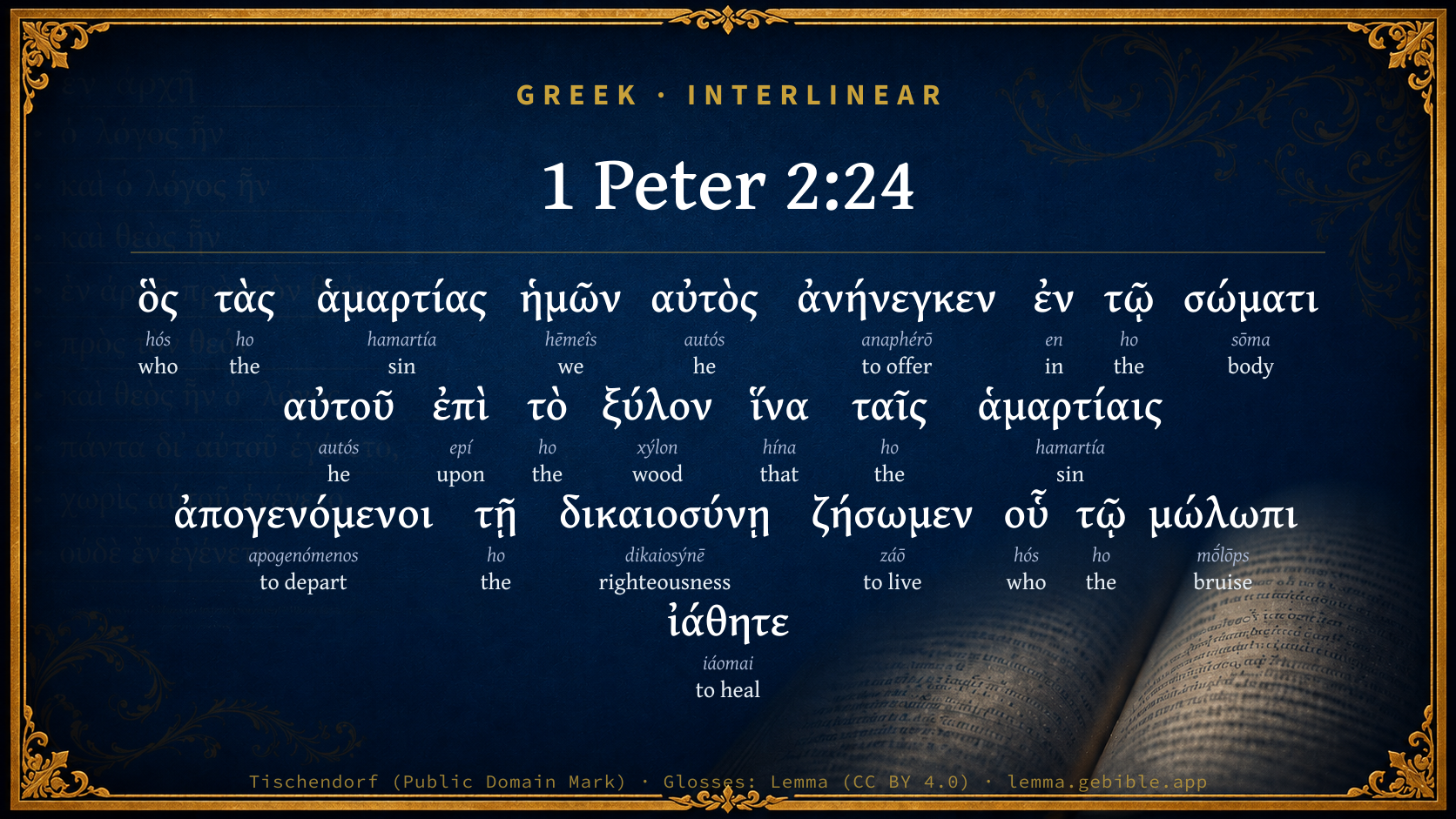
who his own self bore our sins in his body on the tree, that we, having died to sins, might live to righteousness; by whose stripes you were healed.
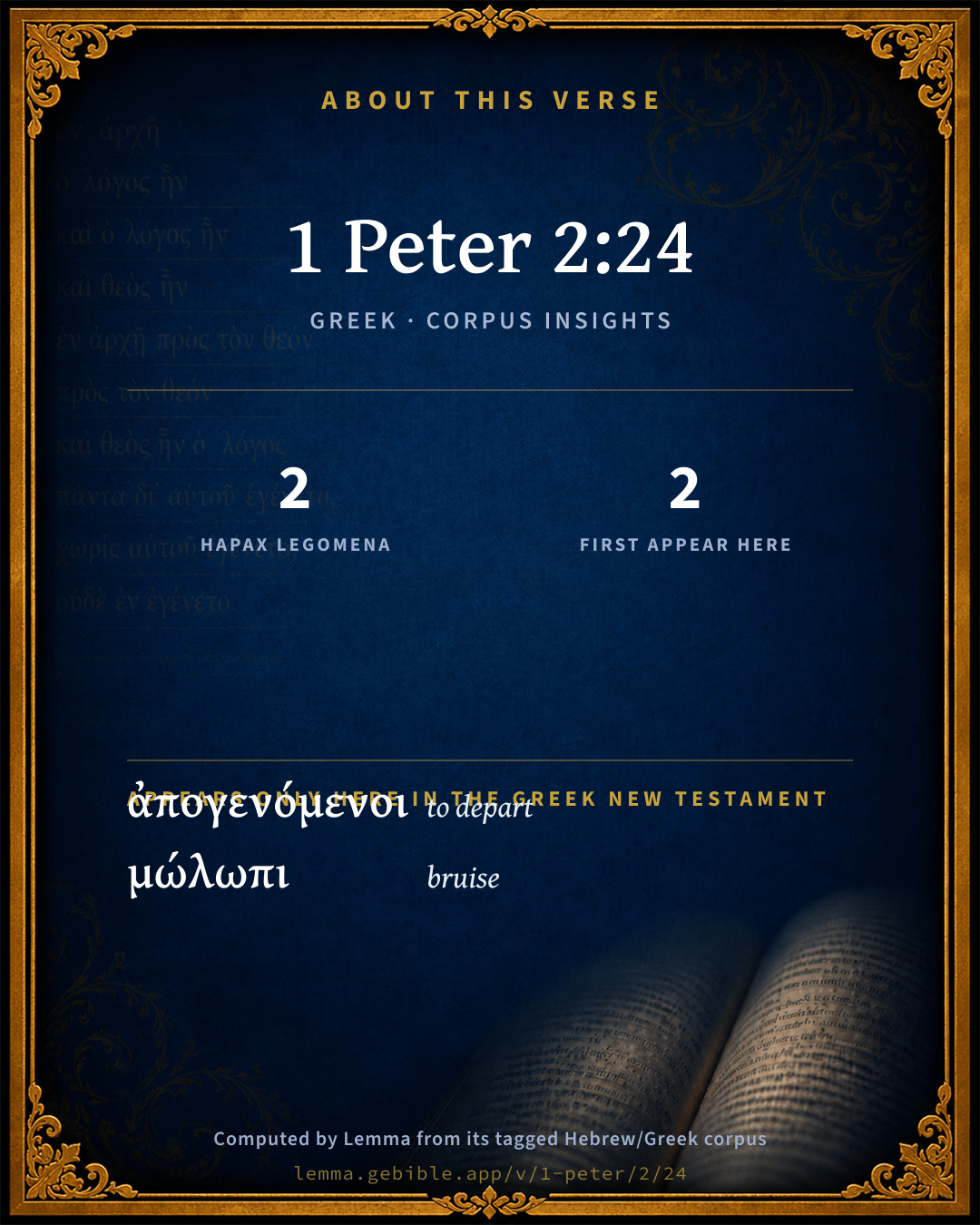
- 2 hapax legomena — only here in the Greek New Testament
- 2 first appearances in the Greek New Testament
Download a study sheet
One document with this verse’s original text, its word-by-word gloss line, the meaning frame, cross-references with their text, attributed commentary, and full source and license credits — printable, and it pastes into notes with its structure intact.
This verse Autodidact and up
A passage Seminary Student
Up to 50 verses in one chapter. A passage sheet keeps up to 6 commentary sources and 12 cross-references per verse, in the order this page ranks them, and says so on the sheet whenever that leaves anything out. Ask for a single verse and you get the Autodidact verse sheet above.
Everything on this page stays free to read, with no account — the sheet is a download of what is already on screen, not access to it.
Compare translations 3
The same verse in 3 English versions, stacked beneath the original-language interlinear above. Click any original word for its lexicon entry.
Each is an independent rendering of the whole verse — the interlinear is not word-aligned to these translations.
Highlighted words mark where these versions differ — a whole-verse word diff, not a word-by-word alignment.
-
World English Bible Public Domain
who his own self bore our sins in his body on the tree, that we, having died to sins, might live to righteousness; by whose stripes you were healed.
-
King James Version Public Domain
Who his own self bare our sins in his own body on the tree, that we, being dead to sins, should live unto righteousness: by whose stripes ye were healed.
-
unfoldingWord Literal Text CC BY-SA 4.0
who himself bore our sins in his body on the tree so that, having died to the sins, we might live for righteousness, by whose wounds you were healed.
unfoldingWord Literal Text — © unfoldingWord, licensed CC BY-SA 4.0. Word-aligned USFM3 via Door43 (git.door43.org/unfoldingWord/en_ult).
Show all 19 translations
Every available English version of this verse, each an independent rendering of the whole verse.
-
World English Bible Public Domain
who his own self bore our sins in his body on the tree, that we, having died to sins, might live to righteousness; by whose stripes you were healed.
-
Berean Standard Bible Public Domain
He Himself bore our sins in His body on the tree, so that we might die to sin and live to righteousness. “By His stripes you are healed.”
-
Majority Standard Bible Public Domain
He Himself bore our sins in His body on the tree, so that we might die to sin and live to righteousness. “By His stripes you are healed.”
-
King James Version Public Domain
Who his own self bare our sins in his own body on the tree, that we, being dead to sins, should live unto righteousness: by whose stripes ye were healed.
-
American Standard Version (1901) Public Domain
who his own self bare our sins in his body upon the tree, that we, having died unto sins, might live unto righteousness; by whose stripes ye were healed.
-
Revised Version (1885) Public Domain
who his own self bare our sins in his body upon the tree, that we, having died unto sins, might live unto righteousness; by whose stripes ye were healed.
-
Geneva Bible (1599) Public Domain
Who his owne selfe bare our sinnes in his body on the tree, that we being dead to sinne, should liue in righteousnesse: by whose stripes ye were healed.
-
Douay-Rheims (1899) Public Domain
Who his own self bore our sins in his body upon the tree: that we, being dead to sins, should live to justice: by whose stripes you were healed.
-
Young's Literal Translation Public Domain
who our sins himself did bear in his body, upon the tree, that to the sins having died, to the righteousness we may live; by whose stripes ye were healed,
-
Literal Standard Version CC BY-SA 4.0
who Himself bore our sins in His body on the tree that having died to sins, we may live to righteousness; by whose stripes you were healed;
-
Unlocked Literal Bible CC BY-SA 4.0
He himself carried our sins in his body to the tree, so that we would have no more part in sin, and so that we would live for righteousness. By his bruises you have been healed.
-
unfoldingWord Literal Text CC BY-SA 4.0
who himself bore our sins in his body on the tree so that, having died to the sins, we might live for righteousness, by whose wounds you were healed.
-
Darby Bible Public Domain
who himself bore our sins in his body on the tree, in order that, being dead to sins, we may live to righteousness: by whose stripes ye have been healed.
-
World Messianic Bible Public Domain
He himself bore our sins in his body on the tree, that we, having died to sins, might live to righteousness. You were healed by his wounds.
-
Webster's Bible Public Domain
Who himself bore our sins in his own body on the tree, that we, being dead to sins, should live to righteousness; by whose stripes ye were healed.
-
Free Bible Version CC BY-SA 4.0
He took the consequences of our sins on himself in his body on the cross, so that we could die to sin and live rightly. “By his wounds you are healed.”
-
Bible in Basic English Public Domain
He took our sins on himself, giving his body to be nailed on the tree, so that we, being dead to sin, might have a new life in righteousness, and by his wounds we have been made well.
-
Text-Critical English NT CC BY 4.0
He himself bore our sins in his body on the cross, so that we might die to our sins and live for righteousness. By his wounds you have been healed.
-
Tyndale New Testament (1534) Public Domain
which his awne silfe bare oure synnes in his body on the tree that we shuld be delyvered from synne and shuld lyve in rightewesnes. By whose strypes ye were healed.
Literal Standard Version (2020), Covenant Press — licensed CC BY-SA 4.0. Text via the HelloAO Bible API (eBible.org). Unlocked Literal Bible (unfoldingWord) — licensed CC BY-SA 4.0. Text via the HelloAO Bible API (eBible.org). unfoldingWord Literal Text — © unfoldingWord, licensed CC BY-SA 4.0. Word-aligned USFM3 via Door43 (git.door43.org/unfoldingWord/en_ult). Free Bible Version, Dr. Jonathan Gallagher — licensed CC BY-SA 4.0. Text via the HelloAO Bible API (eBible.org).
Word by word
More ways to search: Search by grammar → Find every occurrence → Compare this word →
Practice this passage: Drill this verse → Learn its vocabulary →
- Appears 1× in the Greek New Testament
- First appears here
- Part of Speech
- Verb
- Tense
- Aorist
- Voice
- Middle deponent
- Mood
- Participle
- Case
- Nominative
- Number
- Plural
- Gender
- Masculine
Full Thayer's Definition
- ὃς hós G3739 “who” Relative pronoun, Nominative, Singular, Masculine
- τὰς ho G3588 “the” Article, Accusative, Plural, Feminine
- ἁμαρτίας hamartía G266 “sin” Noun, Accusative, Plural, Feminine
- ἡμῶν hēmeîs G2249 “we” Personal pronoun, 1st person, Genitive, Plural
- αὐτὸς autós G846 “he” Personal pronoun, Nominative, Singular, Masculine
- ἀνήνεγκεν anaphérō G399 “to offer” Verb, Aorist, Active, Indicative, 3rd person, Singular
- ἐν en G1722 “in” Preposition
- τῷ ho G3588 “the” Article, Dative, Singular, Neuter
- σώματι sōma G4983 “body” Noun, Dative, Singular, Neuter
- αὐτοῦ autós G846 “he” Personal pronoun, Genitive, Singular, Masculine
- ἐπὶ epí G1909 “upon” Preposition
- τὸ ho G3588 “the” Article, Accusative, Singular, Neuter
- ξύλον xýlon G3586 “wood” Noun, Accusative, Singular, Neuter
- ἵνα hína G2443 “that” Conjunction
- ταῖς ho G3588 “the” Article, Dative, Plural, Feminine
- ἁμαρτίαις hamartía G266 “sin” Noun, Dative, Plural, Feminine
- ἀπογενόμενοι apogenómenos G581 “to depart” Verb, Aorist, Middle deponent, Participle, Nominative, Plural, Masculine
- τῇ ho G3588 “the” Article, Dative, Singular, Feminine
- δικαιοσύνῃ dikaiosýnē G1343 “righteousness” Noun, Dative, Singular, Feminine
- ζήσωμεν záō G2198 “to live” Verb, Aorist, Active, Subjunctive, 1st person, Plural
- οὗ hós G3739 “who” Relative pronoun, Genitive, Singular, Masculine
- τῷ ho G3588 “the” Article, Dative, Singular, Masculine
- μώλωπι mṓlōps G3468 “bruise” Noun, Dative, Singular, Masculine
- ἰάθητε iáomai G2390 “to heal” Verb, Aorist, Passive, Indicative, 2nd person, Plural
About this verse
These counts appear in no published source. They are computed here, from the morphology-tagged text and Lemma’s own curated glosses. What Lemma adds →
- 24
- words
- 16
- distinct lemmas
- General Epistles
- section
Notable vocabulary
2 hapax legomena — words that appear only here in the entire Greek New Testament:
First appearance in Scripture
These words make their first canonical appearance in the Greek New Testament here:
Shared distinctive vocabulary
ἀνήνεγκεν to offer G399 occurs in 8 verses of the Greek New Testament. Also found in:
Cross-references
43Topical passages linked to 1 Peter 2:24 in the Treasury of Scripture Knowledge — connected by theme and wording, ordered by reader-vote popularity; previews shown in the World English Bible.
- Isaiah 53:4–6 Surely he has borne our sickness, and carried our suffering; yet we considered him plagued, struck by God, and afflicted.
- Matthew 8:17 that it might be fulfilled which was spoken through Isaiah the prophet, saying: "He took our infirmities, and bore our diseases."
- Romans 6:11 Thus also consider yourselves also to be dead to sin, but alive to God in Christ Jesus our Lord.
- Revelation 22:2 in the middle of its street. On this side of the river and on that was the tree of life, bearing twelve kinds of fruits, yielding its fruit every month. The leaves of the tree were for the healing of the nations.
- 1 John 2:29 If you know that he is righteous, you know that everyone who practices righteousness is born of him.
- James 5:16 Confess your offenses to one another, and pray one for another, that you may be healed. The effective, earnest prayer of a righteous man is powerfully effective.
- Hebrews 9:28 so Christ also, having been once offered to bear the sins of many, will appear a second time, without sin, to those who are eagerly waiting for him for salvation.
- Isaiah 53:11 He shall see of the travail of his soul, [and] shall be satisfied: by the knowledge of himself shall my righteous servant justify many; and he shall bear their iniquities.
- Galatians 3:13 Christ redeemed us from the curse of the law, having become a curse for us. For it is written, "Cursed is everyone who hangs on a tree,"
- Romans 6:2 May it never be! We who died to sin, how could we live in it any longer?
- Colossians 3:3 For you died, and your life is hidden with Christ in God.
- Romans 6:13 Neither present your members to sin as instruments of unrighteousness, but present yourselves to God, as alive from the dead, and your members as instruments of righteousness to God.
- John 1:29 The next day, he saw Jesus coming to him, and said, "Behold, the Lamb of God, who takes away the sin of the world!
- Psalms 147:3 He heals the broken in heart, And binds up their wounds.
- Romans 7:6 But now we have been discharged from the law, having died to that in which we were held; so that we serve in newness of the spirit, and not in oldness of the letter.
- 1 John 3:7 Little children, let no one lead you astray. He who does righteousness is righteous, even as he is righteous.
- Romans 6:7 For he who has died has been freed from sin.
- Deuteronomy 21:22–23 If a man have committed a sin worthy of death, and he be put to death, and you hang him on a tree;
- Luke 1:74–75 To grant to us that we, being delivered out of the hand of our enemies, should serve him without fear,
- 1 Peter 4:1–2 Forasmuch then as Christ suffered for us in the flesh, arm yourselves also with the same mind; for he who has suffered in the flesh has ceased from sin;
- Malachi 4:2 But to you who fear my name shall the sun of righteousness arise with healing in its wings. You will go out, and leap like calves of the stall.
- Matthew 5:20 For I tell you that unless your righteousness exceeds that of the scribes and Pharisees, there is no way you will enter into the Kingdom of Heaven.
- Luke 4:18 "The Spirit of the Lord is on me, Because he has anointed me to preach good news to the poor. He has sent me to heal the brokenhearted, To proclaim release to the captives, Recovering of sight to the blind, To deliver those who are crushed,
- Acts 5:30 The God of our fathers raised up Jesus, whom you killed, hanging him on a tree.
- 2 Corinthians 6:17 Therefore, "'Come out from among them, And be separate,' says the Lord, 'Touch no unclean thing. I will receive you.
- Psalms 38:4 For my iniquities have gone over my head. As a heavy burden, they are too heavy for me.
- Acts 10:35 but in every nation he who fears him and works righteousness is acceptable to him.
- Acts 13:29 When they had fulfilled all things that were written about him, they took him down from the tree, and laid him in a tomb.
- Romans 6:16 Don't you know that to whom you present yourselves as servants to obedience, his servants you are whom you obey; whether of sin to death, or of obedience to righteousness?
- Hebrews 12:13 and make straight paths for your feet, so that which is lame may not be dislocated, but rather be healed.
- Exodus 28:38 It shall be on Aaron's forehead, and Aaron shall bear the iniquity of the holy things, which the children of Israel shall make holy in all their holy gifts; and it shall be always on his forehead, that they may be accepted before Yahweh.
- Leviticus 16:22 The goat shall carry all their iniquities on himself to a solitary land, and he shall let the goat go in the wilderness.
- Numbers 18:22 Henceforth the children of Israel shall not come near the tent of meeting, lest they bear sin, and die.
- Matthew 27:26 Then he released to them Barabbas, but Jesus he flogged and delivered to be crucified.
- Acts 10:39 We are witnesses of everything he did both in the country of the Jews, and in Jerusalem; whom they also killed, hanging him on a tree.
- Colossians 2:20 If you died with Christ from the elements of the world, why, as though living in the world, do you subject yourselves to ordinances,
- Hebrews 7:26 For such a high priest was fitting for us: holy, guiltless, undefiled, separated from sinners, and made higher than the heavens;
- Leviticus 22:9 "'They shall therefore keep my charge, lest they bear sin for it, and die therein, if they profane it. I am Yahweh who sanctifies them.
- John 19:1 So Pilate then took Jesus, and flogged him.
- Romans 6:22 But now, being made free from sin, and having become servants of God, you have your fruit of sanctification, and the result of eternal life.
- Ephesians 5:9 for the fruit of the Spirit is in all goodness and righteousness and truth,
- Philippians 1:11 being filled with the fruits of righteousness, which are through Jesus Christ, to the glory and praise of God.
- Mark 15:15 Pilate, wishing to please the multitude, released Barabbas to them, and handed over Jesus, when he had flogged him, to be crucified.
Cross-references courtesy of OpenBible.info (CC BY 4.0).
Lesson kit
Teaching starters — assembled from the data on this page, not authored interpretation. Every prompt links to the verse data it draws on. Edit before teaching.
1 Peter, in the General Epistles, opens this verse with 24 words (16 distinct Greek lemmas). Its most distinctive word is apogenómenos (“to depart”). A historical commentator’s framing appears above. Read the whole chapter for the surrounding context.
Discussion questions
- How does “to depart” (apogenómenos) shape what this verse is saying?
- 2 words here appear nowhere else in the Greek New Testament. Why might the author reach for such rare wording?
- 2 words make their first appearance in Scripture here. What does this debut establish?
- How does Matthew 17:1, which shares the word «to offer», read alongside this verse?
- What does the repetition of “sin” (2× in this one verse) do in this verse?
- These translations render this verse differently; the difference is in the English rendering, not the original. What questions does that raise?
- Compare how Jamieson, Fausset & Brown and Joseph Benson's Commentary read this verse. Where do they agree or differ?
Things to notice
- 2 words in this verse appear nowhere else in the Greek New Testament.
- 2 words make their first canonical appearance in Scripture here.
- These translations choose different wording for 14 words in this verse.
- “sin” occurs 2× in this single verse.
- 16 distinct Greek lemmas span 24 words in this verse.
Commentary
Notes on 1 Peter 2:24 from classic Christian and Jewish commentators (each source and its license shown beneath its notes). The classic Christian expositions comment on the surrounding passage and are grouped to its opening verse, so a note may address several verses; the Jewish commentaries on the Tanakh (Rashi and others) are per-verse, so they appear only where the commentator wrote on this verse.
Lemma curates 59 commentaries, every one of them public domain or Creative Commons licensed, each selected and text-cleaned for this edition rather than reprinted as found. About our sources →
Jamieson, Fausset & Brown
Robert Jamieson, A. R. Fausset & David Brown
Jamieson, Fausset & Brown — Commentary Critical and Explanatory on the Whole Bible (1871) — public domain (CC PDM 1.0). Text via the HelloAO Bible API.
Joseph Benson's Commentary
Joseph Benson's Commentary on the Old and New Testaments (1811–1818) — public domain. Text from a community e-Sword module.
Tyndale Open Study Notes
Tyndale Open Resources
Tyndale Open Study Notes — © Tyndale Open Resources, licensed CC BY-SA 4.0. Text via the HelloAO Bible API.
Bengel's Gnomon
Johann Albrecht Bengel
Bengel's Gnomon of the New Testament — English translation (T&T Clark, Edinburgh, 1860) — public domain. Text from a community e-Sword module.
Meyer's Critical & Exegetical Commentary
Heinrich August Wilhelm Meyer
Meyer — Critical and Exegetical Commentary on the New Testament — English translation by Peter Christie, edited by Frederick Crombie (T&T Clark, 1880) — public domain. Text from a community e-Sword module.
Expositor's Greek Testament
ed. W. Robertson Nicoll
The Expositor's Greek Testament, edited by W. Robertson Nicoll (1897–1910) — public domain. Text from a community e-Sword module.
Geneva Bible (1599)
Geneva Bible translators
Geneva Bible (1599) marginal notes — public domain. Text via Bolls.life.
Adam Clarke's Commentary
Adam Clarke's Commentary on the Bible (1810–1826) — public domain. Text from a community e-Sword/MySword module.
John Calvin's Commentaries
John Calvin's Commentaries (1540-1563) — public domain. Text from the Calvin Translation Society English edition (1840s-50s) via the Christian Classics Ethereal Library (ccel.org). Calvin's coverage is partial (roughly two-thirds of the Bible); uncommented books and verses are honest gaps, never fabricated. The 19th-century editor's footnotes and remarks are omitted so the notes are faithfully Calvin's own voice.
Ellicott's Commentary for English Readers
A Bible Commentary for English Readers, edited by Charles John Ellicott (1878–1897) — public domain. Text from a community e-Sword module.
The Cambridge Bible for Schools and Colleges
gen. ed. J. J. S. Perowne
The Cambridge Bible for Schools and Colleges (gen. ed. J. J. S. Perowne; Cambridge University Press, 1878–1918) — public domain. Text from a community e-Sword module.
John Gill's Exposition
John Gill's Exposition of the Whole Bible (1746–1763) — public domain (CC PDM 1.0). Text via the HelloAO Bible API.
Trapp's Complete Commentary
John Trapp
John Trapp, A Commentary or Exposition upon All the Books of the Old and New Testament (1647–1656) — public domain. Text from a community e-Sword module.
Albert Barnes' Notes on the Bible
Albert Barnes' Notes on the Bible (1834–1885) — public domain. Text from a community e-Sword/MySword module.
Matthew Poole's English Annotations
Matthew Poole's English Annotations on the Holy Bible (1683–1685) — public domain. Text from a community e-Sword/MySword module.
Whedon's Commentary on the Bible
Daniel D. Whedon
Daniel D. Whedon (gen. ed.), Commentary on the Old and New Testaments (1874–1909) — public domain. Text from a community e-Sword module.
The Pulpit Commentary
The Pulpit Commentary (1880–1919), ed. H.D.M. Spence-Jones & Joseph S. Exell — public domain. Text from a community e-Sword module.
John Wesley's Explanatory Notes
John Wesley, Explanatory Notes Upon the Whole Bible (1754–1765) — public domain. Text via the GEBible commentary corpus.
Scofield Reference Notes
C. I. Scofield
The Scofield Reference Bible (1917 edition), notes by C. I. Scofield — public domain. Text from a community e-Sword module.
Godbey's Commentary on the New Testament
William B. Godbey
William B. Godbey, Commentary on the New Testament (1896–1900) — public domain. Text from a community e-Sword module.
The People's New Testament
B. W. Johnson
B. W. Johnson's The People's New Testament with Notes (1889–1891) — public domain. Electronic text from the Christian Classics Ethereal Library (CCEL) ThML edition.
unfoldingWord translationNotes
Door43 World Missions Community
unfoldingWord translationNotes — © Distant Shores Media and the Door43 World Missions Community, licensed CC BY-SA 4.0. Source: git.door43.org/Door43/en_tn.
Cambridge Greek Testament for Schools and Colleges
Cambridge Greek Testament for Schools and Colleges (Cambridge University Press, 1896; 21 vols, various authors incl. Carr, Maclear, Plummer, Farrar, Lumby, Moule, M. R. James, Simcox) — public domain. Text from a community e-Sword module.
Alford’s Greek Testament
Henry Alford
Henry Alford, The Greek Testament (1849–1861) — public domain. Text from a community e-Sword module.
Vincent's Word Studies in the New Testament
Marvin R. Vincent
Marvin R. Vincent, Word Studies in the New Testament (1887–1900) — public domain. Text from a community e-Sword/MySword module.