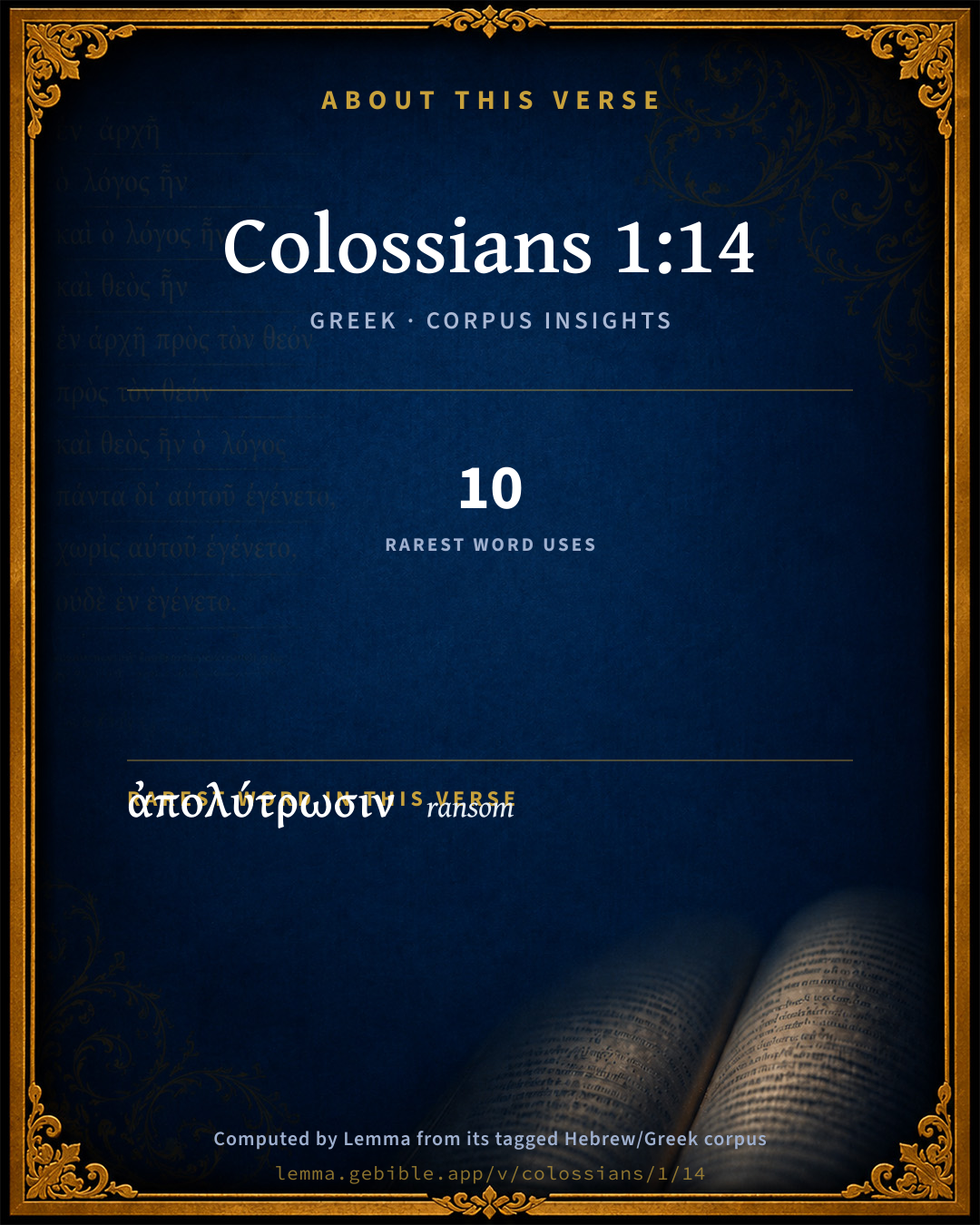
Colossians 1:14

Greek (Tischendorf 8th ed.) Colossians 1:14 appears in the Greek New Testament. The text above is from the Tischendorf 8th edition. Each word links to its Strong’s number and a concise gloss. Click any word for its full Thayer’s Greek Lexicon entry.
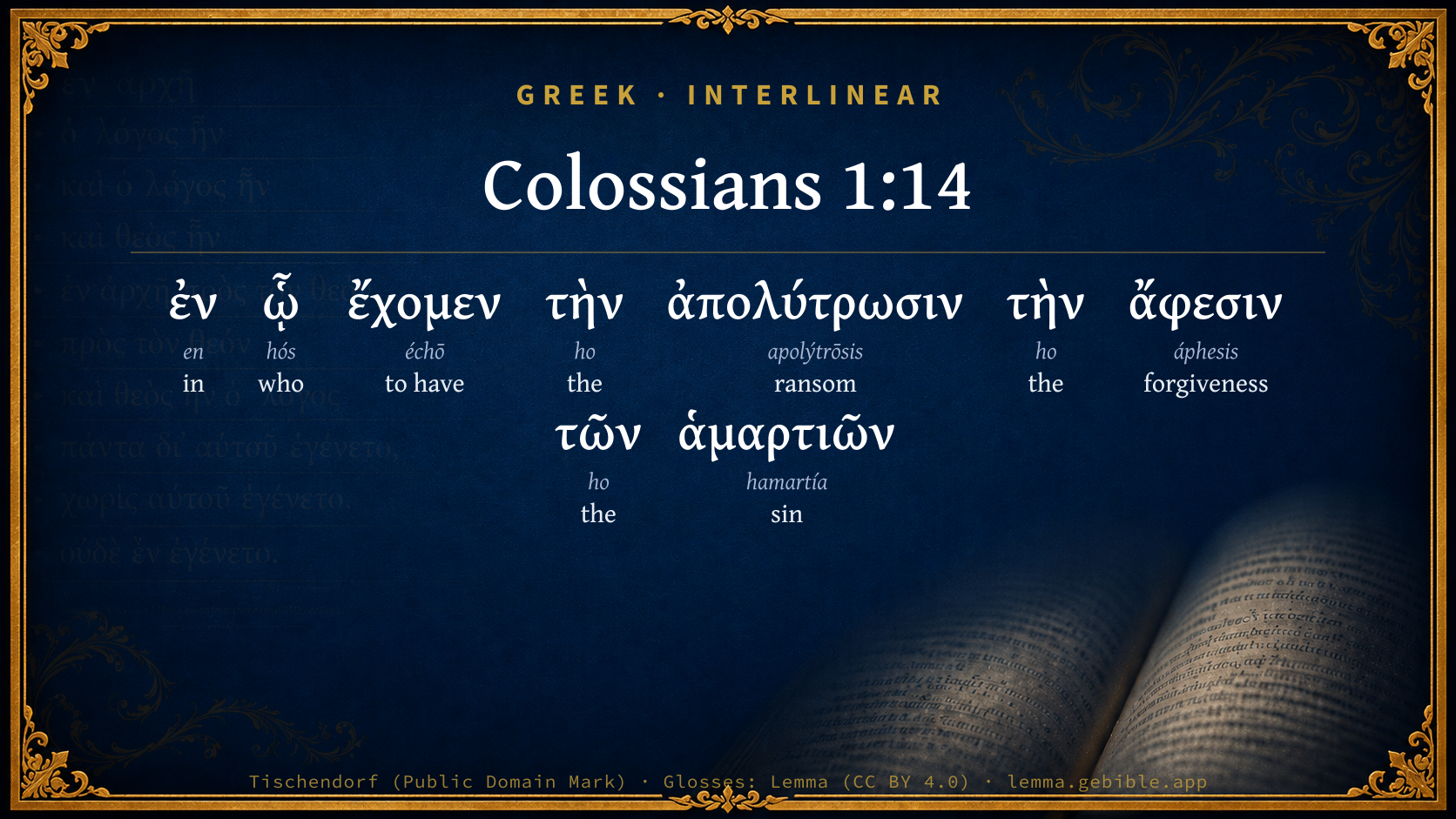
Download image
Cite this verse

Colossians 1:14 (World English Bible). Public Domain. Lemma interlinear Bible study tool, https://lemma.gebible.app/v/colossians/1/14.

Show BibTeX & RIS
BibTeX
RIS
English Translation
in whom we have our redemption, the forgiveness of our sins;
World English Bible · Public Domain
Download a study sheet

One document with this verse’s original text, its word-by-word gloss line, the meaning frame, cross-references with their text, attributed commentary, and full source and license credits — printable, and it pastes into notes with its structure intact.

This verse Autodidact and up

Study sheet (.html) Plain text (.txt)

A passage Seminary Student

Up to 50 verses in one chapter. A passage sheet keeps up to 6 commentary sources and 12 cross-references per verse, in the order this page ranks them, and says so on the sheet whenever that leaves anything out. Ask for a single verse and you get the Autodidact verse sheet above.

Everything on this page stays free to read, with no account — the sheet is a download of what is already on screen, not access to it.

Want to remove ads? Support Godless Engineer
Compare translations 3

The same verse in 3 English versions, stacked beneath the original-language interlinear above. Click any original word for its lexicon entry.

Each is an independent rendering of the whole verse — the interlinear is not word-aligned to these translations.

Highlighted words mark where these versions differ — a whole-verse word diff, not a word-by-word alignment.

  • World English Bible Public Domain
    in whom we have our redemption, the forgiveness of our sins;
  • King James Version Public Domain
    In whom we have redemption through his blood, even the forgiveness of sins:
  • unfoldingWord Literal Text CC BY-SA 4.0
    in whom we have redemption, the forgiveness of sins.

unfoldingWord Literal Text — © unfoldingWord, licensed CC BY-SA 4.0. Word-aligned USFM3 via Door43 (git.door43.org/unfoldingWord/en_ult).

Versions to compare (up to 4)

3 of 4 selected

Show all 19 translations

Every available English version of this verse, each an independent rendering of the whole verse.

  • World English Bible Public Domain
    in whom we have our redemption, the forgiveness of our sins;
  • Berean Standard Bible Public Domain
    in whom we have redemption, the forgiveness of sins.
  • Majority Standard Bible Public Domain
    in whom we have redemption, the forgiveness of sins.
  • King James Version Public Domain
    In whom we have redemption through his blood, even the forgiveness of sins:
  • American Standard Version (1901) Public Domain
    in whom we have our redemption, the forgiveness of our sins:
  • Revised Version (1885) Public Domain
    in whom we have our redemption, the forgiveness of our sins:
  • Geneva Bible (1599) Public Domain
    In whome we haue redemption through his blood, that is, the forgiuenesse of sinnes,
  • Douay-Rheims (1899) Public Domain
    In whom we have redemption through his blood, the remission of sins;
  • Young's Literal Translation Public Domain
    in whom we have the redemption through his blood, the forgiveness of the sins,
  • Literal Standard Version CC BY-SA 4.0
    in whom we have the redemption [[through His blood]], the forgiveness of sins,
  • Unlocked Literal Bible CC BY-SA 4.0
    In his Son we have redemption, the forgiveness of sins.
  • unfoldingWord Literal Text CC BY-SA 4.0
    in whom we have redemption, the forgiveness of sins.
  • Darby Bible Public Domain
    in whom we have redemption, the forgiveness of sins;
  • World Messianic Bible Public Domain
    in whom we have our redemption, the forgiveness of our sins.
  • Webster's Bible Public Domain
    In whom we have redemption through his blood, even the forgiveness of sins:
  • Free Bible Version CC BY-SA 4.0
    through whom we have been set free and our sins forgiven.
  • Bible in Basic English Public Domain
    In whom we have our salvation, the forgiveness of sins:
  • Text-Critical English NT CC BY 4.0
    in whom we have redemption, the remission of sins.
  • Tyndale New Testament (1534) Public Domain
    in whom we have redempcion thurow his bloud that is to saye the forgevenes of sinnes

Literal Standard Version (2020), Covenant Press — licensed CC BY-SA 4.0. Text via the HelloAO Bible API (eBible.org). Unlocked Literal Bible (unfoldingWord) — licensed CC BY-SA 4.0. Text via the HelloAO Bible API (eBible.org). unfoldingWord Literal Text — © unfoldingWord, licensed CC BY-SA 4.0. Word-aligned USFM3 via Door43 (git.door43.org/unfoldingWord/en_ult). Free Bible Version, Dr. Jonathan Gallagher — licensed CC BY-SA 4.0. Text via the HelloAO Bible API (eBible.org).

Word by word

More ways to search: Search by grammar → Find every occurrence → Compare this word →

Practice this passage: Drill this verse → Learn its vocabulary →

About this verse

These counts appear in no published source. They are computed here, from the morphology-tagged text and Lemma’s own curated glosses. What Lemma adds →

9
words
7
distinct lemmas
Pauline Epistles
section

Notable vocabulary

The rarest word here is ἀπολύτρωσιν ransom G629 — appearing just 10 times in the whole Greek New Testament.

Shared distinctive vocabulary

ἀπολύτρωσιν ransom G629 occurs in 10 verses of the Greek New Testament. Also found in:

Repetition

A word recurs within this verse:

Cross-references

31

Topical passages linked to Colossians 1:14 in the Treasury of Scripture Knowledge — connected by theme and wording, ordered by reader-vote popularity; previews shown in the World English Bible.

  • Ephesians 1:7 in whom we have our redemption through his blood, the forgiveness of our trespasses, according to the riches of his grace,
  • Romans 3:24–25 being justified freely by his grace through the redemption that is in Christ Jesus;
  • 1 Peter 1:19–20 but with precious blood, as of a lamb without spot, the blood of Christ;
  • Hebrews 9:12 nor yet through the blood of goats and calves, but through his own blood, entered in once for all into the Holy Place, having obtained eternal redemption.
  • Hebrews 9:22 According to the law, nearly everything is cleansed with blood, and apart from shedding of blood there is no remission.
  • Revelation 5:9 They sang a new song, saying, "You are worthy to take the book, And to open its seals: For you were killed, And bought us for God with your blood, Out of every tribe, language, people, and nation,
  • Acts 13:38–39 Be it known to you therefore, brothers, that through this man is proclaimed to you remission of sins,
  • Galatians 3:13 Christ redeemed us from the curse of the law, having become a curse for us. For it is written, "Cursed is everyone who hangs on a tree,"
  • Matthew 20:28 even as the Son of Man came not to be served, but to serve, and to give his life as a ransom for many."
  • Ephesians 5:2 Walk in love, even as Christ also loved you, and gave himself up for us, an offering and a sacrifice to God for a sweet-smelling fragrance.
  • Revelation 1:5 and from Jesus Christ, the faithful witness, the firstborn of the dead, and the ruler of the kings of the earth. To him who loves us, and washed us from our sins by his blood;
  • Psalms 130:4 But there is forgiveness with you, Therefore you are feared.
  • Hebrews 10:12–14 but he, when he had offered one sacrifice for sins for ever, sat down on the right hand of God;
  • 1 Peter 3:18 Because Christ also suffered for sins once, the righteous for the unrighteous, that he might bring you to God; being put to death in the flesh, but made alive in the spirit;
  • 1 John 2:2 And he is the atoning sacrifice for our sins, and not for ours only, but also for the whole world.
  • Acts 10:43 All the prophets testify about him, that through his name everyone who believes in him will receive remission of sins."
  • Acts 20:28 Take heed, therefore, to yourselves, and to all the flock, in which the Holy Spirit has made you overseers, to shepherd the assembly of the Lord and God which he purchased with his own blood.
  • Romans 4:6–8 Even as David also pronounces blessing on the man to whom God counts righteousness apart from works,
  • Ephesians 4:32 And be kind to one another, tenderhearted, forgiving each other, just as God also in Christ forgave you.
  • Colossians 2:13 You were dead through your trespasses and the uncircumcision of your flesh. He made you alive together with him, having forgiven us all our trespasses,
  • 1 Timothy 2:6 who gave himself as a ransom for all; the testimony in its own times;
  • Titus 2:14 who gave himself for us, that he might redeem us from all iniquity, and purify for himself a people for his own possession, zealous for good works.
  • 1 John 2:12 I write to you, little children, because your sins are forgiven you for his name's sake.
  • Acts 2:38 Peter said to them, "Repent, and be baptized, everyone of you, in the name of Jesus Christ for the forgiveness of sins, and you will receive the gift of the Holy Spirit.
  • Colossians 3:13 bearing with one another, and forgiving each other, if any man has a complaint against any; even as Christ forgave you, so you also do.
  • Psalms 32:1–2 Blessed is he whose disobedience is forgiven, Whose sin is covered.
  • Luke 7:47–50 Therefore I tell you, her sins, which are many, are forgiven, for she loved much. But to whom little is forgiven, the same loves little."
  • 1 John 1:9 If we confess our sins, he is faithful and righteous to forgive us the sins, and to cleanse us from all unrighteousness.
  • Revelation 14:4 These are those who were not defiled with women, for they are virgins. These are those who follow the Lamb wherever he goes. These were redeemed by Jesus from among men, the first fruits to God and to the Lamb.
  • Acts 26:18 to open their eyes, that they may turn from darkness to light and from the power of Satan to God, that they may receive remission of sins and an inheritance among those who are sanctified by faith in me.'
  • Luke 5:20 Seeing their faith, he said to him, "Man, your sins are forgiven you."

Cross-references courtesy of OpenBible.info (CC BY 4.0).

Where the printed editions differ

1 variant

Places in this verse where the major printed Greek editions disagree on the wording in a way that affects the translation — a comparison of editions, not a manuscript-by-manuscript collation. The editions are the modern critical texts (Nestlé-Aland 28/27, SBL, Westcott-Hort, Tregelles, Tyndale House) and the traditional texts behind the KJV (the Textus Receptus and the Byzantine/Majority text). It is not a claim about which reading is original.

  1. Extra text
    διὰ τοῦ αἵματος αὐτοῦ,

    “through the blood of him”

    In TR Not in NA28NA27TynSBLWHTregByz

    διὰ τοῦ αἵματος αὐτοῦ, (dia tou aimatos autou) 'through the blood of him' is only in traditional manuscripts (TR)

Textual data: Translators Amalgamated Greek New Testament (STEPBible TAGNT) · CC BY 4.0.

Commentary

Notes on Colossians 1:14 from classic Christian and Jewish commentators (each source and its license shown beneath its notes). The classic Christian expositions comment on the surrounding passage and are grouped to its opening verse, so a note may address several verses; the Jewish commentaries on the Tanakh (Rashi and others) are per-verse, so they appear only where the commentator wrote on this verse.

Lemma curates 59 commentaries, every one of them public domain or Creative Commons licensed, each selected and text-cleaned for this edition rather than reprinted as found. About our sources →

Matthew Poole's English Annotations

In whom; i.e. in the person of Christ alone God-man, deputed of his Father to die for our salvation, Act 4:12; 20:28.

We; as we are in him, made meet, Col 1:12.

Have redemption; we have eternal deliverance, Heb 9:12, effected by a full ransom paid, 1Co 6:20; 7:23; 1Pe 1:18,19. For the freeing us indeed out of a state of sin and misery, Joh 8:36, or eternal death the wages of sin, Rom 6:23; 16:20; so that by redemption here is not meant barely laying down the price, Luk 2:38, nor consummate redemption at the last, Eph 1:14; 4:30, but efficacious redemption.

Through his blood; upon the account of Christ’s offering himself an expiatory sacrifice to God, without which is no remission, Heb 9:22; Rev 5:9; effusion of his blood, by a synecdoche, takes in his humiliation to the death of the cross, and the pains of the second death he underwent for us, Isa 53:5,6; Ac 2:24; Gal 3:13; Phi 2:8.

Even the forgiveness of sins; plenary remission of offences is by apposition to, or follows, redemption as a necessary effect, Col 2:13; Luk 1:77; Act 10:43, by a metonymy transferring the cause to the effect: to see more: See Poole on "Eph 1:7".

Matthew Poole's English Annotations on the Holy Bible (1683–1685) — public domain. Text from a community e-Sword/MySword module.

The Biblical Illustrator

Joseph S. Exell

Col_1:14-20

In Whom.

The deity of Christ

Christ is Divine because--

I. He has redeemed us.

II. He is the creator of all things.

III. All things were created for His glory.

IV. His eternal pre-existence.

V. By Him all things consist. (B. W. Noel, M. A.)

Christ first

I. In the metaphysical order.

1. He is the image of the invisible God.

2. It pleased God that in Him should all fulness (of the Divine attributes) dwell. He is therefore the Mediator of the knowledge of God.

II. In the physical order. The first thesis determined the relation of Christ to God; this establishes His relation to Nature.

1. He is before all things, the firstborn (heir) of all creation.

2. He is the Author of all that exists. Consequently He is the Mediator of existence or natural life.

III. In the theological order, which, as does the following, refers to His relations with men.

1. He is the Redeemer.

2. The reconciler. Thus He is the Mediator of the restoration of the normal relation of man to God.

IV. In the moral order. He is the head of the spiritual body--the Church--and therefore is the Mediator of the new life or the spiritual creation.

V. In the apocalyptic order, i.e., of the order of the things to come. He has died, as all men die, but He has also risen, and in that He has taken precedence of all, and His own will follow Him. Consequently He is the Mediator of life eternal. (Professor Reuss.)

Jesus Christ the end of the creation

(text in conjunction with Eph_1:9-10; Eph_3:9-11.)

I. Statement.

1. The creation looked forward to the Christ from the beginning. Without Him for its goal it were purposeless. Not that he was latent in nature to be evolved, but it was the plan of creation that it should reach its consummation in Him.

2. In Him the universe subsists, is banded together because it completes itself in Him. Without Him it would disintegrate and be a chaos instead of a cosmos.

3. Although sin has disturbed the scheme of things and would wreck all, the original plan holds in Christ. The injury will be repaired and the universe attain its end.

II. Plan of creation.

1. Matter is brought into being (Gen_1:1), and is rudimental (Gen_1:2). The Holy Ghost whoso province is evolution and organization broods over the elemental abyss. At length light becomes with, doubtless, its kindred agents, heat, electricity. Processes go on, and the atmosphere is constituted. The new agents become additional forces, and there results the mineral kingdom (Gen_1:3-10).

2. This is a preparation for higher planes of being. The floral world has a becoming, assimilating all that has gone before, and transforming them into the living organisms of root, trunk, bough, fruit, dec.

3. The vegetable world is a prophecy of something higher. In due time the animal world gathers up the elements of all below it, and exalts them into more complex and nobler organisms.

4. There is a pause. The eternal Three-in-One sit in council (Gen_1:26; Gen_2:7).

(1) The creation has been in travail with man as to his bodily nature in all the preceding formations. Man is the compendium, the apex of physical nature.

(2) In his creation another department of the spiritual world comes in view. It seeks to ally itself with the physical. It also would complete itself in man. By the inbreathing of the Almighty man becomes a living soul. The two realms thus meet in him, and invest him with unique dignity and prerogative. He is the microcosm of the universe.

(3) Of what man is this ideal true? Of the first Adam? He is man inchoate, in germ and possibilities only, not in the fulness of perfection. Can he raise himself and put all nature under him as its head? The tree of life blossoms with promise, but he cannot bridge the chasm between the Infinite and the finite. There must be a higher sphere than nature or man to bring out their meaning. If the Eternal Word will become man the problem is solved--the mighty void between God and man will be filled up.

5. The Son of God did become man. He passed through every ordeal triumphantly, and was glorified at the right hand of God. The universe is glorified in Him. Thus did He sum up in Himself the creation. It tended towards Him from the first, and finds its last, deepest sense and full satisfaction in Him the true, archetypal Man.

III. Corollaries.

1. The creation is a unity, not a granulated mass of things having no other relation but mechanical juxtaposition; but an organic whole, having one Head who fills all things from Himself, and sends energy and direction through the whole. Each several part has its due relation to the others, and the whole to Christ.

2. The Incarnation belongs to creation. It is its crown, and is essential to its order and perfection. It is not an intrusion. It is sin that is the innovation in the order of the universe. And the Incarnation carries in it plenary resources for the overmastering of sin. By His obedience unto death the Head of the universe rendered satisfaction for human guilt; and by the powers of the Incarnation He will cast out sin. Somewhere, in the outer darkness, some cesspool shall receive all the filth of the universe and hide it for ever.

3. There is suggested a solution of the problem of miracles. They are no violations of the plan of creation. Each succeeding system bore in itself higher forces and methods than the preceding, but without disturbance. So humanity imported into the world methods and powers supreme over all beneath it, but in entire harmony therewith. That such ascendency should show itself in our Lords miracles there is nothing contranatural. Sin being foreign has brought an unnatural condition of things, and our Lords hushing of the storm, expulsion of demons, healing the sick, and raising the dead, were but foretokenings of the coming restitution of all things to their natural state of purity, health, and life. To put creation back again into its regular condition is not to do violence to nature. As Augustine says, A miracle is not a contradiction of nature, but of nature as man knows it.

4. Here is the solution of the astronomical objection to Christianity. Astronomy is supposed to demonstrate mans extreme littleness, and to show that his actions good or bad are beneath the notice of God. But man in Christ is the end of the universe. In Him man stands in closest union with the Infinite centre of all being. All things are His (1Co_3:21-23). It is quality, not quantity, that counts in the trancendental calculus. Man must be intrinsically of greater value than all that went to prepare the way for him. This will serve to explain the interest of angels in him. The Incarnation signifies that man has an inherent dignity no hugeness of the physical world and no grandeur of angels can equal. He has no superior but God, and to Him alone his knee should bow.

5. If the all is one organic unity, the lower joined to the higher, and looking forward to it, then there must be a correspondence between the lower and the higher. The natural will be a parable of the supernatural, and all types must sum themselves up in Christ their prototype. Science will yet see the harmony of reason and faith.

6. Christ being the Firstborn and Head of the creation, He is the Priest of the universe (Heb_5:7). All other priesthood must be derived from Him. All worship must be offered through Him. All blessing will return from God through Him.

7. Christ is the end of history. The movement of our race is a process towards manhood in Christ. Sin has distracted the current, but has not arrested it. The religions, philosophies, and governments of the old world prepared the way for the first advent. A mighty impulse was thrilled through the nation from that day directing all movements towards the second advent.

8. Seeing that Christ is head over all, all things must become subject to Him. We see not yet all things put under Him. Sin has disnaturalized man, but it shall be overruled and made to serve the very ends it sought to frustrate (1Co_15:24-28; 2Ti_2:19). Evil does not inhere in matter. Matter will be transformed (Rom_8:19-22).

9. The Incarnation must needs be perpetual. Were the Son of God to lay aside His humanity, the creation would fail of its end and complement. It confers upon the creation supreme blessing; to relinquish it would entail a deep curse.

10. Men must needs come into full and permanent union with Christ. Severed from Him they can do nothing. Sin, the discord in the everlasting order, must be renounced. Christ must abide in men and they in Him, in order that sin may be eliminated. Only thus can they attain the Divine Ideal transformation into true manhood in the image of God. (C. P. Jennings.)

The witness of creation to the gospel

1. The subject of the chapter is the glory of the Son of God.

(1) In His essential relation to God He is the true eikon basilike--only image which it is not idolatry to worship.

(2) His relation to the universe is that of immediate Creator.

(3) His permanent relation to every creature is that of a central point for all phenomena.

(4) His headship over the new redeemed humanity is that of the first-born among the dead, the source of risen life to all the body.

(5) His central pre-eminence in the whole spiritual world lies in the fact that He is Peacemaker by blood, the sole Reconciler to God. Never did John soar higher or sweep a wider horizon than this.

2. To confine ourselves to one thought here. Christ is the only link of connection between created minds and the unapproachable, unknowable Godhead. Image of the invisible God is parallel with Johns No man hath seen God at any time, etc., with Heb_1:1-2, and with the Masters He that hath seen Me, hath seen the Father. The function of Revealer, however, does not attach to Christs incarnate life only; He was the Word of God before, and revealed God in creation. From this follows that God the Revealer, when He tells of God in Nature and in Redemption must speak in harmonious terms. Both discoveries must agree, and hence we expect to find certain lines in physics leading up to Christianity, certain thoughts of the Divine mind which grow clearer when I cast back fresh light from redemption.

3. What, then, is there in nature to fit into the representation of Deity which we gather from--

I. The incarnation.

1. This stands on the threshold of the Christian system, and has no parallel in history, and at first sight none in nature. Yet look a little closer, and you will find that it rests upon the fact that man was made in the image of his Maker. For the Son and perfect Image of Godhead to become man--making the thoughts, emotions, and activities of our nature a glass wherein to mirror the heart of Deity--implies some affinity between the Divine and human, or some previous resemblance of man to God. Reason must, in some fashion, reflect the thoughts of God, and virtue His holiness, and points of moral and intellectual contact must bind the human spirit to that of the Incarnate Redeemer. How else could God become incarnate to redeem?

2. Now nature is alive with thoughts that are very human. God utters His mind in His works, and that mind is like our own. If that were not so science would be impossible. The worlds Maker and its observer must have something in common, if the observer is to understand the Makers meaning. A world put together by a Being whose notions of truth, utility, purpose, etc., bore no relation to mine would be a world unintelligible to me. But the world satisfies the reason and gratifies the taste of the human student, who detects in it with joy another mind at work similar to his own.

(1) You know how keen is the pleasure many take in mechanical contrivance, but the pages of modern books of science are full of beautiful contrivances.

(2) Equally human is the parsimony of nature. He who made this world does not overcome difficulties by inventing some fresh force for every occasion; He will rather go round about to make existing instruments answer a new purpose. To the same economical habit it is due that through the organized tribes of being certain radical types are perseveringly adhered to. A few governing ideas, modified in details only as far as needful, are made to do service, and give rise to endless diversity. This is just the style of workmanship that workmen admire.

(3) Very human, too, is the place occupied in the works of God by beauty and utility. In mans productions decoration is always subordinated to convenience, and wise men will sacrifice the ornamental without remorse when it can be gained only at the expense of human well-being. Now the original school of all art is the handiwork of God. So lavish is His decoration of the most unnoticed Objects that He must do it because He loves it; yet it is never put before utility. Nay, some animals have been made unlovely to suit their convenience; but even in them ornament is introduced where it can do no harm.

3. Nature, then, betrays in its Creator a mind so like our own as to lay a foundation for the Incarnation. The Son in impressing on all things His stamp, as Gods image left a signature so human-like that we can well credit the old Scripture when it says man wears the likeness of the Son of God; and we see a propriety in the announcement of the new scripture that the same Son wears the nature which He had on purpose made so correspondent with His own. Creation of mans mind in Gods image; incarnation of Gods image in manhood--these are two answering facts, the one witnessed by science, the other by the gospel.

II. The atonement.

1. In so far as this is a moral fact, whereas in nature there is neither sin nor retribution, and therefore no need of atonement, we cannot expect to find there any suggestion of reconciliation with God. Nevertheless nature indicates that the Creator possesses moral qualities, and is a character as well as an intellect,

2. Some particulars of this.

(1) Thinkers have been startled by the gospel declaration that God cares for so insignificant a creature as man. But does He appear to the student as a person likely to overlook any interest because it is minute. Remember what pains the scientists tell us have been expended on the most tiny and obscure piece of organized matter to perfect its adaptation to its place, and to elaborate every organ of it for its proper purpose. It is for investigators to tell us whether they do not find traces of kindness in this such as bespeak a benevolent heart as well as a contriving intellect. If they do, then the love of God, which seeks and saves one lost soul, is but the crown of a character patient, considerate, which has left its traces on the lower creation.

(2) But there are facts of an opposite order. Violence, death, extinction have always obtained. But whatever difficulties attend this frightful havoc of life, the sacrifice ministers always to some upward movement. Lower life feeds higher life, or the individual becomes a victim to some agency needful for the general good, the gale, the flood, the lightning: or, as the earth grows fit to bear nobler forms, the earlier ones pass away. We read here the law of sacrifice--unconscious and involuntary, indeed, because these creatures have no power of moral choice; but true, nevertheless, because sacrificed for some nobler good and more enduring end. See how beasts of prey have to make room for population, and serviceable animals are slaughtered for mans use. When I pass from this scene to Golgotha I am not conscious of any violent shock. There is pain for the good of others, and death as the price of life. The Maker of the suffering creation is not afraid to suffer for others. He obeys His own law, and the cross would have been a far more surprising spectacle had it stood upon an earth where no creature ever bled to advance creations good.

(3) The only key we can find to the Atonement lies in the inviolability of Divine law. To magnify that God gave His Son to die. Now it would have been surprising had the Son as Creator betrayed any indifference to the violence of natural law, and yet come as Redeemer to die to vindicate moral law. No such inconsistency appears. Physical students insist on the constancy with which the former avenges transgression; and so the latter decrees death for disobedience. And it could so little be set aside in favour of mercy, that not until the Lawgiver had Himself honoured His own statute, and suffered His own penalty, did He forgive.

3. As far, then, as such indications go, the face of God, as traced indistinctly in Creation, answers to His face as its glory shines in the gospel of Christ. (J. O. Dykes, D. D.)

We have redemption through His blood.

I. Redemption. Deliverance--

1. From the guilt of sin, original or actual, of omission or commission.

2. From the power and prevalence of sin (Rom_6:14; Heb_9:13-14; Act_3:26; lPe 1:18; Mat_1:21; Tit_2:14).

3. From the tyranny of Satan (Col_1:13; 1Jn_3:8; Luk_22:31-32).

4. From the curse of the law (Gal_3:13; Gal_4:5).

5. From the wrath of God.

(1) In this world (Rom_5:1; Luk_2:14).

(2) In the next (1Th_1:10; Act_4:12).

II. Its means: His blood.

1. It was necessary that our Redeemer should be man as well as God (1Ti_2:5; Heb_2:14-17), that He might mediate between both parties (Job_9:33).

2. That He should suffer (Heb_8:5; Luk_24:26) a bloody death (Heb_9:22).

(1) To expiate our sins (1Jn_2:2; Isa_53:5-6).

(2) To conquer Satan (Heb_2:14).

(3) To reconcile God to us and us to God (Rom_5:10-11; Eph_2:16).

III. Its benefit. Forgiveness of sins.

1. The names in Scripture given to it.

(1) Remission (Act_2:38),

(2) dismission, releasing (Isa_61:1).

2. Mercifulness to our sins (Heb_8:12; Luk_18:13).

(1) Passing over sin (Rom_3:25).

(2) Purging from sin (Psa_51:7).

(3) Not remembering our sins (Jer_31:34; Heb_8:12).

(4) Covering sin (Psa_32:1; Psa_85:2; Psa_51:9).

(5) Taking away and removing sin (Psa_103:10-12; Exo_34:7; Lev_16:20-22).

(6) Casting behind Gods back (Isa_38:17; Psa_90:8).

(7) Blotting out sin (Isa_43:25; Isa_44:22).

(8) Not imputing sin (Psa_32:1-2; Rom_4:7-8).

(9) Casting it in the depth of the sea (Mic_7:18-19).

2. The nature of it: an act of Gods grace, whereby He absolves us from the obligation to those punishments, which by His law are due to us for those sins.

(1) In general it is an act of Gods grace.

(a) Of God. It is ascribed to Him alone (Exo_34:7; Mar_2:7). We are to ask it of Him only (Mat_6:12). He alone justifies (Rom_8:33). Our sins are only against Him (Psa_51:4).

(b) Of His grace--not wisdom, power, justice (Isa_43:25)--in Christ (Eph_1:7).

(2) The specific difference.

(a) We are obliged to bear the punishments due by Gods law to sin (Gal_3:10).

(b) God takes off that obligation (2Sa_12:13; Mar_3:28-29).

IV. This benefit is only by Christs death.

1. All mankind is guilty before God, and so obnoxious to His wrath and everlasting punishment (Rom_3:19; Gal_3:22).

2. The eternal Son was pleased to take mans nature upon Him so as to become both God and man in one person (Isa_7:14; Rom_9:5; Php_2:6-7).

3. Christ in this nature was pleased to suffer disgrace, the curses of the law (Gal_3:13). The wrath of God (Mat_27:46). An ignominious, accursed, painful, and bloody death; and all for sin, the only cause of death (Heb_10:12).

4. Christ suffered all this, not for Himself (1Pe_2:22; 1Pe_3:18; Heb_7:26), but for us who partake of that nature in which He suffered (Isa_53:5-6; Rom_4:25; Gal_1:4; 1Co_15:3).

5. These sufferings were of greater worth than if all men had suffered eternal death (Act_20:28).

6. Hence God was pleased to accept of them as a sufficient price of our redemption, and satisfaction to His justice for our sins (Mat_20:28; 1Ti_2:6; Eph_1:6).

7. Gods justice being thus satisfied, He is reconciled unto us, and takes off our obligations to punishment, by reason of what His Son underwent for us; and therefore for His sake is said to pardon our sins (Rom_5:10; Col_1:20; 2Co_5:21).

V. Use.

1. Hence you may learn what ground we have to trust in Christ for pardon (Rom_8:34).

2. Hence be advised to make it your business to get your sins forgiven: considering--

(1) How miserable you are without it: God is angry (Psa_7:11); hell is threatened.

(2) How happy with it (Psa_32:1-2). Your persons accepted and justified (Psa_32:1-2; Rom_4:6-7); God reconciled and become your friend (Rom_5:1; Rom_9:1-33; Rom_10:3. All things working for your good, and glory for your reward. (Bishop Beveridge.)

Redemption

The liberty for which the slave longs is, perhaps, the sweetest earthly cup man drinks. Health has been often said to be the greatest earthly blessing. What are money, luxury, titles, a crown even, without it; but what is health without liberty. We sympathize with the instinctive love of freedom in animals--the noisy joy of the dog when he gets off his chain; the noble eagle chained to the perch, strangling in its struggles to escape. Much more do we sympathize with our fellow-creatures, whether slaves or citizens, who have made the altars of liberty red with their blood, preferring death to bondage. But them is a more degrading and dreadful slavery, that of the slaves of Satan, who are sold under sin. Would that we set the same price on spiritual as we do on earthly liberty! What struggles would then be made and prayers offered for salvation! And when saved ourselves, how anxious we should be for the salvation of others.

I. We all need redemption. To a man who knows he is nigh unto death offer a medicine that will cure him, and he will buy it at any price; but offer the same to one who believes himself in health and he holds it cheap. For a similar reason are Christ and His redemption rejected of men. So the great work of Gods Spirit is to rouse a man from the torpor induced by the poison of sin. And blessed the book, preacher, or providence that sends the conviction into our hearts. For to a soul convinced of misery who so welcome as the Saviour?

1. The slavery of sin is natural to man, We pity the mother as robbed of one of her best joys, who knows that the little creature on her bosom is a slave. But that calamity is ours. In sin did my mother conceive me. I am carnal, sold under sin. Ye were the slaves of sin--not one hired for a period, but branded with the mark of a perpetual bondage.

2. This slavery is the universal state of man. Slavery is the worst and oldest of human institutions. At an early period, in Cain, he who should have been his brothers keeper, became his murderer; and when man did become his brothers keeper, it was too often as an owner. But, wherever slavery obtained, some were free. It is not so with sin. The king and the beggar are both slaves; every mans heart is black, whatever his face may be.

3. This slavery is the state of all unconverted men.

(1) Some are slaves of gold. What bondage is equal to that? for a man to harden his heart to the claims of pity, to deny his own flesh and blood, to lie and cheat, or, if not, throw his soul away for money.

(2) Some are slaves of lust. To what base society and acts of villainy do their tyrant passions condemn them. The thief that steals my money is a man of honour compared with him who steals a womans virtue.

(2) Some are slaves of drunkenness. Of all slavery this is the most helpless and hopeless. Other sins drown conscience, this season as well.

(3) Some are slaves to the opinions of the world. The Macedonian boasted that he had conquered the world; the world can boast that it has conquered them. Theirs the miserable condition of a servant who has to bear in some ill-governed household the caprices, not of one mistress, but of many.

II. Our redemption is not a simple matter of time. Every fifty years, and in certain cases, seven, redeemed the Hebrew. Everywhere time works changes, the young grow old, the poor get rich, the rich poor. Time alters the form of the globe. But amid these changes the condition of the sinner alters not. The longer you live in sin the more hopeless is salvation. Do you say, But what am I to do? Can I redeem myself? Assuredly not. But are we to sit still as though redemption would come like a jubilee in the common course of providence? No, we are to be up and doing. I do not say that we are to rise like an oppressed nation which wrings its liberties from a tyrant hand; nor that we can purchase redemption; nor that through works of righteousness we can lay any claim to its blessings. And yet I say, Labour for the meat that endureth unto everlasting life. There are various ways of being diligent. Though men call him idle the poor beggar is as diligent as others; and such as that suppliants, along with the use of other means, are the labours to which Gods mercy and your own necessities call you. Unable to save yourself, besiege the throne of grace.

III. Christ is the redeemer. There is no other. His types and symbols teach this. There was but one ark in the flood, and all perished save those who sailed in it. There was but one altar in the Temple, one way through the Red Sea, one Mediator between God and man.

1. Christ does not redeem us by simply revealing the truth. Were He a Saviour only in this sense there are others. From the Sun of Righteousness He changes into a star, one of a constellation which is formed of Moses and the prophets. Many of them, indeed, had more to do in revealing Gods will than Christ. No book bears His name, and the truths which fell from Him form but a fraction of Scripture. Yet who but He is set forth as the Redeemer, in whose name else are we commanded to believe and be baptized?

2. Christ does not redeem us by His example. That man is in a sense my saviour who leads me safely along any dangerous path, and in a corresponding way some say Christ redeemed us. He set us such an example, that by following His steps we may enter the kingdom of heaven. Alas for safety if it turn on that I Walk as He walked! Who is sufficient for that? We should certainly attempt to follow Jesus, yet our best attempts will leave us more and more convinced that our only hope for redemption lies in the mercy of the Father and the merits of the Son.

3. Christ has redeemed us by suffering in our room and stead. Without shedding of blood is no remission. The blood of Jesus Christ cleanseth from all sin. (T. Guthrie, D. D.)

I. What remission of sins is.

1. Sin is a violation of the law of God (1Jn_3:4). In this law there is the precept which is the rule of duty, and the sanction or penalty which shows what God might do if He dealt with us according to our merit. Accordingly in sin there is--

(1) The fault. Man, Gods subject, and obliged to Him by His benefits, swerves from the rule of his duty and exposes himself to Gods judgment.

(2) The guilt, which is liableness to punishment.

2. Forgiveness is a dissolving the obligation to punishment, a freedom in Gods way from the consequences of sin.

(1) It is not a disannulling of the act as a natural action. What is done cannot be undone.

(2) Nor is it abolished as a criminal action. Forgiveness does not make a fault to be no fault. The innocent are acquitted, but the guilty are pardoned as sinners.

(3) Nor is the merit of the sinful act lessened, it still deserves punishment.

(4) Forgiveness therefore is a passing by the fault so that it shall not rise up in judgment against us. The fault is the sinners, the punishment the Judges, which He may fashion on certain terms stated in the law of grace.

I prove it

(1) from the nature of the thing, for there is such a relation between the fault and the guilt, the sin and punishment; that the one cannot be without the other. Therefore, if the Judge will not impute the fault there will be an immunity from punishment.

(2) From the common rule of speaking among men. He cannot be said to forgive a fault who exacts punishment; and what do men mean when they pray for pardon but that they may be exempted from punishment?

(3) It would impeach the justice and mercy of God were He to punish where He has pardoned.

(4) Scripture phrases show that God blots out our sins (Psa_71:2; Psa_32:1; Isa_38:17; Mic_7:19; Jer_31:34).

II. The nature of redemption.

1. Our being redeemed supposes a captivity and bondage.

(1) Unrenewed men are slaves to sin (Tit_3:3; Joh_8:34). Men imagine a life of vanity to be a very good life, and it were so if liberty consisted in doing what we list rather than what we ought. But it is not, and experience shows that men cannot leave their base satisfactions.

(2) As they are under sin so they are under Satan (Eph_2:2; 2Ti_2:26).

(3) For this they are under the curse of God.

2. To recover us there was a price to be paid by way of ransom to God. We are not delivered by prayer, nor mere force, nor out of pity, but by just satisfaction to provoked justice. The price was not paid to Satan, who is a usurper--from him we are delivered by force--but to God. Man had not sinned against Satan, but God, to whom belong condemnation or pardon. And God being satisfied, Satan has no power over us. That redemption implies payment of a price is clear (Mat_20:28; 1Ti_2:6). Christ in recovering men in dealing with God is set forth as a Lamb slain (Rev_5:5-6); in dealing with Satan as a lion recovering the prey. A ransom was necessary because God had made a former covenant which was not to be quit but upon valuable consideration, lest His moral attributes should fall to the ground.

(1) The honour of His justice was to be secured (Rom_3:5-6; Gen_18:25). If God should pardon without satisfaction how should He be reverenced as the holy Governor of the world? Hence Rom_3:25-26.

(2) His wisdom. If the law should be recalled, the Lawgiver would run the hazard of levity.

(3) His holy nature would not permit it. Some way must be found to signify His hatred of sin (Psa_11:6).

(4) His authority. It would be a derogation to the authority of His law if it might be broken with impunity.

(5) His truth. Gods word is not to be regarded as a scarecrow (Gen_3:5; Deu_29:19-20).

3. None was fit to give this ransom but Jesus Christ, the God-man. He was man to undertake it in our name, God to perform it in His own strength; a man that He might be under the law and die, God that He might put the stamp upon the metal and make it current coin. By taking human nature a price was put into His hands, to which His Divine nature gave the requisite value (Act_20:28; Heb_9:13).

4. Nothing performed by Christ could be a sufficient ransom but His death.

(1) To answer the types wherein without shedding of blood was no remission.

(2) In the nature of the thing (Joh_8:20). Death was threatened to sin, and feared by the sinner, and must be borne, therefore, for deliverance.

5. From this ransom there is a liberty resulting to us; but not a liberty to sin (Rom_6:22). Christ came not to free us from the duty of the law, but its penalty, otherwise it would promote the devils interest. He redeemed us that we might serve God.

6. We are not partakers of this liberty till we are united to Christ by faith in whom.

III. Remission of sins is a principal part of redemption.

1. How a part.

(1) Redemption is taken for the laying down of the price. That was done on the cross (Heb_9:12).

(2) In its application. Besides the ransom there is actual deliverance. Complete redemption we shall enjoy at the last day (Rom_8:23; Eph_4:30; Eph_1:14). Begun deliverance, which we now enjoy by faith, consists of justification (Eph_1:7), where sin is freely pardoned, and we delivered from evil and wrath; and sanctification (1Pe_1:18; Tit_2:14).

2. A principal part, for--

(1) The power of Satan is destroyed (Act_26:18).

(2) The reign of sin is broken. The gift of the sanctifying Spirit is part of our pardon applied (Col_2:13).

(3) We are eased of our tormenting fears.

(4) Death is unstinged (1Co_15:56).

(5) The obligation to, eternal punishment ceases.

IV. Use. To persuade you to seek after this benefit.

1. We all once needed it. Nothing but pardon will serve your turn.

(1) Not forbearance on Gods part.

(2) Not senseless forgetfulness or baseless hope on yours.

2. The best of us still need it. Renewed sins need new pardon; daily infirmities daily repentance. (T. Manton, D. D.)

1. The apostle had been speaking of Christian privileges as being matters of present enjoyment--meetness for heaven; deliverance from sin, dec., are in the actual possession of the Christian.

2. There are two methods proposed by which men hope to secure Gods favour. Thousands consider it presumption to profess to have it, but hope to do so after they have prayed more and done more good deeds. Gods method is the reverse. What man places at the end He places at the beginning; what man says work for, He says work from. Turning away our thoughts from self He fixes them on Christ.

3. The different results on feeling resulting are immense. The man who works for future forgiveness has at best the spirit of a servant; he who takes forgiveness now as Gods free gift in Christ enjoys reconciliation and sonship.

I. Redemption as identical with forgiveness of sins.

1. Redemption is something more than rescue. If you see a man in danger and pluck him out you save but not redeem him. If you see a man oppressed and snatch him from his enemy you deliver but not redeem him. Redemption is the release of a man by the payment of ransom. We by our transgressions have exposed ourselves to Gods law, which knows no pity, holds us in its grasp, and will inflict, unless we are delivered, the fearful penalty of eternal death. But if that penalty be remitted we are redeemed, and so forgiveness is equivalent to redemption. But sin has also brought us under its own power, and so made us its slaves; and the only way of securing us and setting us free is forgiveness.

2. The one thing we absolutely require as sinners is the remission of the horrible penalty, and it is neither irrational nor immoral to be afraid of that penalty; but we must be released from the power of sin before our happiness can be secured. Tell me that I am not to be punished and you have made me glad, but you have not inspired me with love to God. But tell me that the means of forgiveness is the sacrifice of Gods dear Son, that God pardons not only as a Sovereign but as a Father, and the power of sin will be broken, and I enter on the joyful, ennobling service of love.

II. Redemption as effected through the blood of Christ.

1. In Php_2:1-30. the apostle, in speaking of Christs death, has in view Christs obedience; here in using the term blood his idea is expiation, and so elsewhere where the word is used; because in the Jewish sacrifices it was not the death of the victim, but its blood that was the typical instrument of expiation.

2. Such a redemption is necessary to meet the demands of the heart and to produce a changed feeling towards God.

(1) Forgiveness must be a righteous forgiveness; not a mere easy, weak-minded passing over of transgression. Redemption by the blood of Christ meets this demand of the awakened conscience, for in the cross God appears more awful than elsewhere in His hatred of sin and His determination to punish it.

(2) But it is also the forgiveness of a Father we want, and nowhere have we such an exhibition of Gods love as in the cross. Conclusion.--This redemption is only to be had in Christ. Out of Him, however respectable and moral, we are slaves of sin and exposed to the curse. (G. Calthrop, M. A.)

Plan of redemption

Suppose a large graveyard surrounded by a high wall, with only one entrance by a large iron gate which is fast bolted. Within these wails are tens of thousands of human beings, by one disease descending to the grave. There is no balm to relieve them, no physician there: they must perish. This is the condition of man as a sinner. All have sinned, and the soul that sinneth shall die. While man was in this deplorable state, Mercy, an attribute of Deity, came down and stood at the gate, looked at the scene, and wept over it, exclaiming, Oh, that I might enter! I would bind up their wounds; I would relieve their sorrows; I would save their souls. While Mercy stood weeping at the gate, an embassy of angels, commissioned from the court of heaven to some other world, passing over, paused at the sight, and Heaven forgave that pause. Seeing Mercy standing there, they cried, Mercy, Mercy, can you not enter can you look upon this scene, and not pity? can you pity, and not relieve? Mercy replied, I can see; and in her tears she added, I pity, but cannot relieve.--Why can you not enter?--Oh! said Mercy, Justice has barred the gate against me, and I cannot, must not, unbar it. At this moment Justice himself appeared, as it were to watch the gate. The angels inquired of him, Why will you not let Mercy in? Justice replied, My law is broken, and it must be honoured: die they or Justice must. At this there appeared a form among the angelic band, like unto the Son of God, who, addressing Himself to Justice, said, What are thy demands? Justice replied, My terms are stern and rigid. I must have sickness for their health; I must have ignominy for their honour; I must have death for life; without the shedding of blood there is no remission.--Justice, said the Son of God, I accept thy terms. On Me be this wrong, and let Mercy enter.--When, said Justice, will you perform this promise? Jesus replied, Four thousand years hence, upon the hill of Calvary, without the gates of Jerusalem, I will perform it in My own person. The deed was prepared and signed in the presence of the angels of God. Justice was satisfied; and Mercy entered, preaching salvation in the name of Jesus. The deed was committed to the patriarchs; by them to the kings of Israel and the prophets; by them it was preserved till Daniels seventy weeks were accomplished; and, at the appointed time, Justice appeared on the hill of Calvary, and Mercy presented to him the important deed. Where, said Justice, is the Son of God? Mercy answered, Behold Him at the bottom of the hill, bearing His own cross; and then he departed, and stood aloof at the hour of trial. Jesus ascended the hill, while in His train followed His weeping Church. Justice immediately presented Him with the important deed, saying, This is the day when this bond is to be executed. When He received it, did He tear it in pieces, and give it to the winds of heaven? No: He nailed it to His cross, exclaiming, It is finished! Justice called on holy fire to come down, and consume the sacrifice. Holy fire descended: it swallowed His humanity; but, when it touched His divinity, it expired, and there was darkness over the whole heavens; but, glory to God in the highest! on earth peace, and good-will to men. (Christmas Evans.)

The greatness of redemption

If that a king should empty all his coffers, and alienate all his crown land to rescue his subjects, he should show himself a natural prince: but what is this to that ransom which our King hath tendered? (P. Bayne, B. D.)

Redemption incomplete until accepted by faith in Christ

Suppose there were twenty traitors in the Tower lay condemned; say again, the prince should yield his father such satisfaction for some whom he would save, wherewith the king his father should be contented, and give him their pardon thereupon; here the thing is done betwixt the king and his son, yet till the prince send to them, write to the keeper to deliver such and such to him, they are in the state they were in, and so continue. So it is with God, Christ, and us: the redemption is all concluded betwixt God and His beloved Son; yet till this is effectually made known to our hearts, so that they believe on this grace of Christ, we are as we were, in hold, in the fear of our condemnation. We are justified through the redemption in Christ, but so that before it can be applied in us we must have faith in His blood, being set forth unto us in the word preached. Can we have the strength of bread without eating bread? No more can we have any benefit by the bread of life without believing on Him. In Christ by faith we have these things. (P. Bayne, B. D.)

Redemption partial and complete

We have that redemption which consists in the forgiveness of sins, and having obtained it are delivered from the bondage of the devil, of sin, and of hell. The devil cannot any longer detain us as captives, rule us as his slaves, and drive us here and there as he pleases; sin itself which cleaves to us cannot reign in us; finally, even hell cannot torment us with perpetual fear, or claim any lordship over us. For, our sins being remitted, the power of the devil is broken, the wrath of God is removed, the condemnation of eternal death is taken away. From all these things, therefore, we have redemption at the same time that we have forgiveness of sins. But there is yet another bondage, viz., that of the corruption of our bodies, and of eternal sufferings, from which the elect are not yet redeemed, but shall be redeemed at the coming of Christ (Luk_21:28). The apostle calls this the redemption of the purchased possession (Eph_1:14). This also Christ merited for us: but He would not bestow upon believers at once this incorruption of their bodies, and deliverance from present external miseries, and from the remains of sin, for the following reasons.

1. Lest the condition of the Head and of the members should be plainly dissimilar. For Christ Himself was a Man of sorrows: He did not at once sit down at the right hand of the Father in glory, but first underwent hunger, thirst, crucifixion, and death: it is therefore but consistent that the members of Christ should pass likewise through sufferings and death itself to glory.

2. They are not fully redeemed from these bodily afflictions, neither from the remains of sin, that they may have matter for glorifying God, whilst they endure them with the greatest constancy and patience, whilst they resist with all their might all the lusts of sin; that God, even as a just Judge, may confer upon them, after having well fought this fight, the unfading crown.

3. He would not straightway deliver the faithful from this bodily misery instantly, lest Christians should seem to embrace Christ on account of this temporal deliverance, rather than on account of that spiritual one. (Bishop Davenant.)

Redemption Gods forgiveness as King and Father

Suppose that a son had sinned grievously against a parent who was also a king. By the sons breach of the laws he has exposed himself to a certain penalty; but he has also alienated himself from his father- produced in his heart a spirit of distrust and aversion which becomes deeper and more intense the longer he holds aloof. There are two things then to be considered: the punishment to which the son is liable; and the depraving, alienating influence which his transgression exercises over his mind. Now, if the breach is ever to be healed, it will not be enough for the father to say, I remit the penalty of your transgression: I forbear to strike: you may go. The son may, will, be glad to escape suffering, but he will not be drawn thereby in love towards his father. The old alienation will rankle still, and will break out presently in fresh offences. Something more, then, is needed, viz., the exhibition of the fathers love towards the erring son; there is needed that it be said, I not only release you from merited suffering; but I forgive you: I open my heart to you, and take you back into it. I am only too glad to welcome you to my heart and home, with the feeling that my child is no longer a wanderer and an alien, but has given me back his love. Then the power of the transgression will be broken, and the interrupted relation between father and child will be restored. Precisely in the same way, if forgiveness of sin meant simply the remission of penalties, there would be in the heart of the sinner nothing but a cold and selfish thankfulness and self-congratulation for escape from pain. But our sins are forgiven us in such a way that the heart of a loving Father is displayed in the act. (G. Calthrop, M. A.)

Redemption atonement for and remission of sin

It is the Day of Atonement. Two young kids of the goats are presented before the Lord at the door of the tabernacle. Those young spotless creatures are a double type of Jesus when in the councils of eternity He presented Himself before Jehovah, saying, Lo, I come to do Thy will, O God. The lot is cast--one for the Lord, the other for the scapegoat--to deter mine which shall represent our Saviour in the act of His death, and which in the fruit of His death, viz., the bearing of the sins of the people. The first falls as a sin-offering. The high priest having caught its flowing blood in a golden bowl, enters within the veil, and, alone, sprinkles it upon the mercy-seat. Coming forth, he goes up to the living goat; standing over it, he lays his hands upon its head; and, amid solemn silence, confesses over the dumb creature all the sins of the people. The prayer finished, that goat bears on its devoted head the guilt of the people. And now observe the act which foreshadowed how Jesus by taking our sins bore them away. The congregation opens, forming a lane that stretches away from the tabernacle to the boundless desert. While every lip is sealed, and every eye intent, a fit man steps forth, and taking hold of the victim, he leads it on and away through the parted crowd. Amid the haze of the burning sands and distant horizon their forms grow less and less, and at length vanish from sight. He and that goat are now alone. They travel on and further on, till, removed beyond the reach of any human eye, far off in the distant wilderness, he casts loose the sin-laden creature. And when, after the lapse of hours, the people descry a speck in the distance, which draws nearer and nearer, until they recognize the fit man, the people see, and we in figure see also, how our Lord, when He was made an offering for sin, took the load of our guilt upon Him, bearing it away, as it were, to a land that was not known. As far as the east is from the west, so far hath He removed our transgressions from us. (T. Guthrie, D. D.)

Pardon, not justice, wanted

A French girl of fourteen appeared before Napoleon, and casting herself at his feet, cried, Pardon, sire! pardon for my father! And who is your father? asked Napoleon, and who are you? My name is Lajolia, she said, and with flowing tears added, but, sire, my father is doomed to die. Ah, young lady, replied Napoleon, I can do nothing for you. It is the second time your father has been found guilty against the State. Alas! exclaimed the poor girl, I know it, sire; but I do not ask for justice, I implore pardon. I beseech you to forgive my father! After a momentary struggle of feeling, Napoleon gently took the hand of the young maiden, and said, Well, my child, for your sake I will pardon your father. That is enough. Now leave me.

The value of pardon

A man named John Welsh lay in prison in Chicago under sentence of death. His friends tried to get his sentence commuted to imprisonment for life. The day before that fixed for his execution arrived without any favourable reply being received. The prisoner sat in his cell listening and longing earnestly for a respite. Presently he heard the rumbling of a car. It brought the materials for the scaffold, and soon he heard the stroke of the hammers, and pictured himself hanging on the scaffold he could hear them raising. The sound almost drove him frantic, and he begged that he might be taken anywhere away from the dreadful noise. He was taken to a distant cell, and there he sat on the edge of his bed, haunted with gloomy thoughts, all hope gone. He was startled from his reverie by a hurried step along the corridor. The key was thrust into the lock, and one of the officers of the prison stood before him. He held in his hand a paper signed by the Governor of the State of Illinois. It was a commutation of his sentence. How the truth burst upon his mind! When the paper was handed to him he could not read it for tears, but it was a paper bringing him his life, and he hugged it and kissed it. (H. W. Taylor.)

Forgiveness and remission of sins

Strictly speaking it is not sins that are forgiven, but their penalty. All men know what to give is; but what is it to for-give? To forth-give or give forth. When a man in ancient times forgave, he gave forth from himself something he was entitled to retain. When a man does injury to another he is liable to a penalty, and formerly every penalty short of death consisted of valuable material such as live cattle or money; and it was that, laid at the injured persons feet, that was given forth from the receiver, when he was willing to forgive the injurer. Precisely speaking it was not the injury that was forth-given; the injury was never at the disposal of the injured person. It was the penalty incurred by the injury that was forth-given. And whatever the penalty might be, though death itself, if it was not exacted it was forgiven. So when God forgives He generously refrains from exacting the penalty we have incurred. Another word is remission, which is a beautiful variation. There is mission in it. When any one is sent forth some end is contemplated. That end is his mission. Re of course means back. To remit is to send back. In ancient times when the material of the penalty of a transgression was sent to the injured person, he had it in his option graciously to send it back. That was the remission of the penalty of the sin. The phrase is now condensed, and we speak not only of the remission of the penalty, but of the remission of the sin. The expression is practically equivalent in Biblical representation to the word redemption, so that the two phrases reciprocally throw light on each other. In this light it is seen that, as a matter of principle, it must always be a difficulty in moral government to give scope to the forgiveness of crimes, or the remission of the penalty of transgressions. No wonder, therefore, that there should be difficulty in the Divine government. (J. Morison, D. D.)

The Biblical Illustrator, edited by Joseph S. Exell (c. 1880s–1900s) — public domain. Text from a community e-Sword module.

The Pulpit Commentary

In whom we have (or, had) our redemption, the forgiveness of our sins (Eph_1:7; Gal_3:10-13; Rom_3:19 trwsiv 2Co_5:18-21 1Pe_3:18, 1Pe_3:19) Eph_1:7 suggested to some later copyists the interpolation "through his blood," words highly suitable in the Ephesian doxology. This verse is the complement of the last: there salvation appears as a rescue by sovereign power, here as a release by legal ransom (ajpo lu) The ransom price Christ had declared beforehand. (Mat_20:28 Mat_26:28; comp. Rom_3:24-26; Gal_2:20; 1Ti_2:6; Heb_9:12-14; 1Pe_1:18; Rev_1:5, R.V; Rev_5:9) "We have redemption" (had it," according to a few ancient witnesses) in present experience in "the forgiveness of our sins". (vers. 21, 22; (Col_2:13, 14 3:13; 2Co_5:21; Rom_4:25 Rom_5:1 Rom_8:1; Tit_2:14; Heb_9:14 Heb_10:1-18 1Pe_2:24; 1Jn_1:7-10; 1Jn_2:1-2 1Jn_4:10) Rom_3:24 gives its objective ground. The "redemption of the body" (also bought by the same price, (1Co_6:20) will make the work complete (Eph_1:13, Eph_1:14; Rom_8:19-23; 1Co_1:30) Lightfoot suggests that the apostle intends to contradict the doctrine of redemption taught by the Gnostics, who made it consist in initiation into their "mysteries" (see note on ver. 27); and supposes that this notion may already have existed at Colossae in some incipient form. But such an abuse of the term seems to imply a well established and familiar Christian use. Philo, who speaks the language of the Jewish philosophic mysticism of the first century, has no such usage. In firm, clear lines the apostle has retraced, in vers. 12-14 (comp. vers. 20-23; Col_2:11-14) the teaching of his earlier Epistles on the doctrines of salvation. Here he assumes, in brief and comprehensive terms, what in writing to the Galatians and Romans he had formerly been at so much pains to prove.

Redemption through the blood of Christ.

whom we have our redemption, the forgiveness of our sins." (See homiletical hints on (Eph_1:7) T. C.

Redemption. (See on Eph_1:7) W.F.A.

The Pulpit Commentary (1880–1919), ed. H.D.M. Spence-Jones & Joseph S. Exell — public domain. Text from a community e-Sword module.

Bengel's Gnomon

Johann Albrecht Bengel

Col 1:14. Ἐν ᾧ, in Whom) the Son, Eph 1:7.—τὴν ἀπολύτρωσιν, the redemption) This is treated of, Col 1:18 (from the middle) and in the following verse.

Bengel's Gnomon of the New Testament — English translation (T&T Clark, Edinburgh, 1860) — public domain. Text from a community e-Sword module.

Meyer's Critical & Exegetical Commentary

Heinrich August Wilhelm Meyer

Col_1:14. Not a preliminary condition of the υἱοθεσία (de Wette), nor the benefit of which Christians become partakers in the kingdom of the Son of God (Huther; against which it may be urged that the βασιλεία does not denote the kingdom of the church); nor yet a mark of the deliverance from darkness having taken place (Ritschl in the Jahrb. f. Deutsche Theol. 1863, p. 513), since this deliverance necessarily coincides with the translation into the kingdom; but it is the abiding (ἔχομεν, habemus, not accepimus) relation, in which that transference into the kingdom of God has its causal basis. The ransoming (from the punishment of sin, see the explanatory τὴν ἄφεσιν τῶν ἁμαρτ.) we have in Christ, inasmuch as He, by the shedding of His blood as the purchase-price (see on 1Co_6:20; Gal_3:13; Gal_4:5), has given Himself as a λύτρον (Mat_20:28; Mar_10:45; 1Ti_2:6); and this redemption, effected by His ἱλαστήριον (Rom_3:21 ff.), remains continually in subsistence and efficacy. Hence: ἐν ᾧ, which specifies wherein the subjective ἔχομεν is objectively based, as its causa meritoria (Rom_3:24). Comp., moreover, on Eph_1:7, whence διὰ τοῦ αἵματος αὐτοῦ has found its way hither as a correct gloss. But the deleting of this addition by no means implies that we should make τῶν ἁμαρτιῶν also belong to τὴν ἀπολύτρωσιν (Hofmann), as in Heb_9:15, especially as Paul elsewhere only uses ἀπολύτρωσις either absolutely (Rom_3:24; 1Co_1:30; Eph_1:7; Eph_4:30) or with the genitive of the subject (Rom_8:23; Eph_1:14). The expression ἄφεσις τ. ἁμαρτ. is not used by him elsewhere in the epistles (comp., however, Rom_4:7), but at Act_13:38; Act_26:28. Holtzmann too hastily infers that the writer had read the Synoptics.

Meyer — Critical and Exegetical Commentary on the New Testament — English translation by Peter Christie, edited by Frederick Crombie (T&T Clark, 1880) — public domain. Text from a community e-Sword module.

Expositor's Greek Testament

ed. W. Robertson Nicoll

Col 1:14 . This verse is parallel to Eph 1:7 . ἐν ᾧ : not by whom, but in whom; if we possess Christ, we possess in Him our deliverance. ἔχομεν : (present) we have as an abiding possession. ἀπολύτρωσιν : “deliverance”. The word is generally interpreted as ransom by payment of a price, for which Mar 10:45 , δοῦναι τὴν ψυχὴν αὐτοῦ λύτρον ἀντὶ πολλῶν , may be compared. But it is not certain that the word ever has this meaning. It is very rare in Greek writers (see reff.). The passage from Plutarch refers to pirates holding cities to ransom. But obviously the word here does not mean that we procure release by paying a ransom. The word is often used simply in the sense of “deliverance,” the idea of ransom having disappeared. (So in Rom 8:23 , Eph 4:30 , Luk 21:28 .) It is best therefore to translate “deliverance” here, especially as this suits better the definition in the following words. The remission of sins is itself our deliverance, whereas it stands to the payment of the ransom as effect to cause. The elaborate discussion in Oltramare may be referred to for fuller details, with the criticism in Sanday and Headlam’s note on Rom 3:24 ; also Abbott on Eph 1:7 ; Westcott on Heb., pp. 295, 296; Ritschl, Rechtf. und Versöhn . ii., 222 sq. τὴν ἄφεσιν τῶν ἁμαρτιῶν . The similar definition of ἀπολ . in Eph 1:7 tells against Lightfoot’s view that it is added here against erroneous definitions by the false teachers, who very probably did not employ the term. The precise phrase does not occur elsewhere in Paul. τ . ἁμ . depends simply on τ . ἀφ ., not, as Hofmann thinks, on it and τ . ἀπολ ., for the latter is not used with the object from which deliverance is effected.

The Expositor's Greek Testament, edited by W. Robertson Nicoll (1897–1910) — public domain. Text from a community e-Sword module.

Cambridge Greek Testament for Schools and Colleges

14. ἔχομεν אCDG, etc. (A defective); ἔσχομεν B alone of MSS. Boh. In || Eph 1:7 ἔχομεν is read by only א*D*gr Boh. The reading is not certain. One tendency to assimilate the tense to the accompanying aorists is at least balanced by another to insist on the present possession of redemption. Compare Phm 1:7.

14. This verse = Eph 1:7, save that there we find the addition after ἀπολύτρωσιν of διὰ τοῦ αἵματος αὐτοῦ, and the substitution of παραπτωμάτων for ἁμαρτιῶν.

ἐν ᾧ, cf. Col 2:3; more than διʼ οὗ, and expressing that only in spiritual and real union with Christ, as members in the body (1Co 12:27) or as branches in the vine (Joh 15:4), do we possess τὴν ἀπολύτρωσιν. Severance from Him would mean loss of the blessings ensured in Him. St Paul is doubtless already thinking of the effect of the False Teaching (cf. Col 2:19).

ἔχομεν. See notes on Textual Criticism.

The marginal reading ἔσχομεν is ingressive, “we got” (see Moulton, Gram. Proleg. 1906, pp. 110, 145) our privileges. We entered on them at the time of our baptism (cf. Col 2:11-14; see also ἔσχον, Phm 1:7). The text, ἔσχομεν (cf. Col 1:4 note), lays stress on the present possession of the Colossians and all believers, thus reminding them again of their privileges in Christ. The thought is taken up and enlarged in Col 1:21 b, 22a

τὴν ἀπολύτρωσιν. The force of the article is perhaps possessive “our redemption,” cf. Heb 11:35, but more probably by way of definition, perhaps expressed idiomatically for us by “Redemption,” as contrasted with “redemption.” Compare ἡ σωτηρία. Act 4:12.

The meaning that ἀπολύτρωσις presented here to St Paul is not quite certain. In derivation, of course, the thought is of “redemption” in the strict sense, the payment of something by which the captive is set free. So λύτρον, Mat 20:28 || Mar 10:45†. But even in λυτρόομαι, λύτρωσις, λυτρωτής, the sense of ransom may be very weak (Luk 24:21; Luk 1:68; Act 7:35), and, in the compound word, ἀπό lays still more stress on release than on ransom. Compare the only place in the LXX. where ἀπολύτρωσις occurs, Dan 4:33 (= 30c Swete, not Theod.), and also ἀπολυτροῦν in Exo 21:8, Zep 3:2 (1)†.

Hence in the case of ἀπολύτρωσις it is even more imperative than usual to avoid the special temptation of every expositor of Scripture, interpreting words by their derivation rather than their usage. For the context alone can decide which was the thought really in the Apostle’s mind. Apparently in Rom 3:24, 1Co 1:30 (?) and perhaps Eph 1:7 (because of the additional διὰ τοῦ αἵματος αὐτοῦ), compare also Heb 9:15, he lays stress on the thought of ransom and the price paid; but on that of release, “emancipation” (Robinson), in Eph 1:14; Eph 4:30, Rom 8:23; compare Luk 21:28; Heb 11:35.

In our present passage ἀπολύτρωσις seems only to carry on the thought of release (begun in Col 1:13), while the thought of redemption in the strict sense does not appear till Col 1:20-21. For a full discussion of the meaning of ἀπολύτρωσις see Abbott on Eph 1:7. Compare also J. A. R. on Eph 1:14, Westcott, Hebrews, pp. 295 sqq., Hort on 1Pe 1:19.

If it be asked what that is from which we are released, the answer, judging by the context, is, surely, not “punishment and Divine wrath” (Ell.), but the authority of darkness (Col 1:13) and the claim of sin (vide infra). This corresponds to the bondage of Egypt, to which λυτρόομαι often refers in the O.T.

The addition in T.R. of διὰ τοῦ αἵματος αὐτοῦ from Eph 1:7 spoils the connexion here, for St Paul is about to treat emphatically of the Divinity of Christ, and does not come to any thought that involves His humiliation till Col 1:20. In Eph 1:8 sqq. there is no such difficulty, for the stress of the argument falls on the grace of God towards us.

τὴν ἄφεσιν κ.τ.λ. Epexegetic of τὴν ἀπολύτρωσιν, bringing out not the positive side of salvation, final endowment with all moral and spiritual graces, but its negative side, release from the claims of sin. This is here mentioned as the primary character of redemption, in which indeed all else is involved.

Observe that in the LXX. ἄφεσις seems to be never used of the forgiveness of sins as such, but usually of the Jubilee (יוֹבֶל 20/50 times) and the liberty (דְּרוֹר 6/50 times) connected with it, and also of the release (שְׁמִטָּה 7/50 times) every seven years for land and creditors. Similarly in Egyptian papyri it is used of remission of taxes, or exemption from them (cf. Deissmann, Bible Studies, pp. 100 sqq., Nägeli, Wortschatz d. Ap. Paul, 1905, p. 56). Compare too 1Ma 13:34; 1Ma 13:39, and perhaps Est 2:18.

Thus the idea of forgiveness must probably be supplemented by that of remission of claims, our sins being regarded as debts. Cf. the variants in the Lord’s Prayer, Mat 6:12; Mat 6:14; Luk 11:4.

It should be noticed that ἄφεσις occurs in St Paul’s writings only here and Eph 1:7. It is found also in his speeches (Act 13:38; Act 26:18), but in view of the fact that it occurs only once in Matt. (Mat 26:28), twice in Mark (Mar 1:4; Mar 3:29), twice in Heb. (Heb 9:22; Heb 10:18), and ten times in the writings of St Luke, it may be due in both these cases to the narrator.

τῶν ἁμαρτιῶν. This general and all-embracing word is perhaps chosen as suggesting the power of ἁμαρτία (Rom 3:9; Rom 5:21; Rom 6:17-22), while it would be impossible to have the singular itself here. In Eph 1:7 on the contrary τ. παραπτωμάτων refers only to specific “transgressions” as infra Col 2:13 bis.

Cambridge Greek Testament for Schools and Colleges (Cambridge University Press, 1896; 21 vols, various authors incl. Carr, Maclear, Plummer, Farrar, Lumby, Moule, M. R. James, Simcox) — public domain. Text from a community e-Sword module.

Geneva Bible (1599)

Geneva Bible translators

The matter itself of our salvation, is Christ the Son of God, who hath obtained remission of sins for us by the offering up of himself.

Geneva Bible (1599) marginal notes — public domain. Text via Bolls.life.

Jamieson, Fausset & Brown

Robert Jamieson, A. R. Fausset & David Brown

(Eph 1:7.)

redemption--rather as Greek, "our redemption."

through his blood--omitted in the oldest manuscripts; probably inserted from Eph 1:7.

sins--Translate as Greek, "our sins." The more general term: for which Eph 1:7, Greek, has, "our transgressions," the more special term.

Jamieson, Fausset & Brown — Commentary Critical and Explanatory on the Whole Bible (1871) — public domain (CC PDM 1.0). Text via the HelloAO Bible API.

Adam Clarke's Commentary

Verse 14. In whom we have redemption] Who has paid down the redemption price, even his own blood, that our sins might be cancelled, and we made fit to be partakers of the inheritance among the saints in light.

The clause, δια του αιματος αυτου, Through his blood, is omitted by ABCDEFG, and by most others of weight and importance; by the Syriac, Arabic of Erpen, Coptic, AEthiopic, Sahidic, some copies of the Vulgate and by the Itala; and by most of the Greek fathers. Griesbach has left it out of the text. It is likely that the reading here is not genuine; yet that we have redemption any other way than through the sacrifice of Christ, the Scriptures declare not. The same phrase is used Eph 1:7, where there is no various reading in any of the MSS., versions, or fathers.

The forgiveness of sins] αφεσιν των αμαρτιων. The taking away of sins; all the power, guilt, and infection of sin. All sin of every kind, with all its influence and consequences.

Adam Clarke's Commentary on the Bible (1810–1826) — public domain. Text from a community e-Sword/MySword module.

John Calvin's Commentaries

14. In whom we have redemption. He now proceeds to set forth in order, that all parts of our salvation are contained in Christ, and that he alone ought to shine forth, and to be seen conspicuous above all creatures, inasmuch as he is the beginning and end of all things. In the first place, he says that we have redemption and immediately explains it as meaning the remission of sins; for these two things agree together by apposition For, unquestionably, when God remits our transgressions, he exempts us from condemnation to eternal death. This is our liberty, this our glorying in the face of death — that our sins are not imputed to us. He says that this redemption was procured through the blood of Christ, for by the sacrifice of his death all the sins of the world have been expiated. Let us, therefore, bear in mind, that this is the sole price of reconciliation, and that all the trifling of Papists as to satisfactions is blasphemy.

John Calvin's Commentaries (1540-1563) — public domain. Text from the Calvin Translation Society English edition (1840s-50s) via the Christian Classics Ethereal Library (ccel.org). Calvin's coverage is partial (roughly two-thirds of the Bible); uncommented books and verses are honest gaps, never fabricated. The 19th-century editor's footnotes and remarks are omitted so the notes are faithfully Calvin's own voice.

The Cambridge Bible for Schools and Colleges

gen. ed. J. J. S. Perowne

14. redemption through his blood] Omit the words “through His blood,” on clear documentary evidence.—They stand unchallenged in the parallel verse, Eph_1:7. And the truth they express comes out explicitly below, Col_1:20; Col_1:22.

“Redemption:”—lit., “the redemption,” here fairly represented by our redemption, as R.V. The word “redemption” (like its Greek equivalent) points by derivation to the idea of a rescue by ransom, whatever the ransom may be. This meaning often in usage vanishes, or at least retires, as where a deliverance by mere power is called a redemption (e.g. Exo_6:6). But it is always ready to reappear when the context favours; and certainly does so here, in view of the parallel passage in Eph. and Col_1:20 below. Cp. esp. Rom_8:23; and for illustration Mat_20:28; Heb_9:15; 1Pe_1:18-19. And see our notes on Eph_1:7.

the forgiveness of sins] Lit., of the (our) sins.—Eph_1:7 has “(our) trespasses.”—Observe this account of our Redemption in Christ. It is primarily Forgiveness, Remission. It involves indeed immensely more both for soul (Tit_2:14) and body (Rom_8:23); but all else is so inseparably bound up with Forgiveness as its sine quâ non that the whole is expressed by this great part. See further on Eph_1:7.

Bp Lightfoot thinks that the “studied precision” both here and in Eph. of this description of Redemption may “point to some false conception of Redemption put forth by the heretical teachers.” And he shews that “the later Gnostics certainly perverted the term, applying it to their own formularies of initiation.” With them it would mean a “redemption” as remote as possible from ideas of forgiveness; a release of the mystic from the bondage of matter into the liberty of esoteric “knowledge.” Lightfoot asserts no direct connexion between these later Gnostics and the Colossian heretics; but he sees in the later teaching a hint of possible similar aberrations earlier. See further, Introd., ch. 3.

Before quitting Col_1:13, observe the phrase, “in whom,” not “through, or by, whom.” The idea thus given is that of union with Christ (see on Col_1:2 above). The Remission, won by the Redeemer’s dying Work, is for those who by faith are incorporated into the Redeemer’s mystical Person.—The editor ventures to refer to his Thoughts on Union with Christ, pp. 104, 124, etc.

The Cambridge Bible for Schools and Colleges (gen. ed. J. J. S. Perowne; Cambridge University Press, 1878–1918) — public domain. Text from a community e-Sword module.

John Gill's Exposition

In whom we have redemption,.... Which is an excellent and wonderful blessing of grace saints have in and by Christ; and lies in a deliverance from sin, all sin, original and actual, under which they are held captive, in a state of nature, and by which they are made subject to the punishment of death; but through the sacrifice of Christ it is taken, and put away, finished, and made an end of; and they are freed from the damning power of it, or any obligation to punishment for it; and in consequence of this are delivered from the enslaving governing power of it by his grace and Spirit, and will hereafter be entirely rid of the very being of it: it consists also of a deliverance from the law, the curse and bondage of it, under which they are held on account of sin, the transgression of it; but being delivered from sin, they are also from the law, its accusations, charges, menaces, curses, and condemnation; as likewise out of the hands of Satan, by whom they are led captive; for through the ransom price paid by Christ they are ransomed out of the hands of him that was stronger than they, the prey is taken from the mighty, and the lawful captive delivered by him that has led captivity captive: in short, this redemption is a deliverance out of the hands of all their enemies, and from all evils and misery, the effects of sin, from death, and hell, and wrath to come. The author of it is Christ, the Son of God, the Son of his love, his dear Son: he was called to this work in the council of peace, in which the affair of redemption was consulted; and he agreed to undertake it in the covenant of grace, of which this is a principal article; and being in his constitution, as Mediator, every way fit and proper for it: as man, the right of redemption belonged to him, being the near kinsman of his people, and, as God, he was mighty and able to perform it; as man he had something to offer, and, as God, could make that sacrifice valuable and effectual to all saving purposes; as man, he had compassion on human nature, and, as God, was concerned for things pertaining to his honour and glory. And thus being every way qualified, he was sent, and came on this errand, and has obtained a redemption, which is precious, plenteous, complete and eternal: it is now with him, and "in him"; and he is made this, and everything else to his people, that they want. The subjects of this blessing are, not angels, but men; and not all men, but some that are redeemed from among men, out of every kindred, tongue, people, and nation; who are called by the name of Jacob, the people of Christ, a peculiar people, and the church of God; and evidentially are such, who have faith in Christ, love to the saints, and good hope of eternal life; who know the grace of God in truth, are made meet to be partakers of the eternal inheritance, being delivered from the power of darkness, and translated into the kingdom of Christ, and are designed by the we in this text: the means by which this blessing is procured, it

through his blood. This phrase is left out indeed in the Syriac and Ethiopic versions, and in the Complutensian edition, and in some copies; but rightly stands here, as it does in Eph 1:7, where there is another clause added, which is here omitted, at the end of the verse, "according to the riches of his grace". This is the blood of Christ, his own blood, and not the blood of bulls and goats, and the same with that of the persons he redeems, but untainted with sin; the blood of Christ, as of a lamb without spot and blemish, of original or actual sin, otherwise it would not have been a sufficient redemption price for his people; nor even then, were it not as it was the blood of the Son of God, of one that was God as well as man, whereby it came to have a proper value and efficacy in it to obtain this blessing: Christ's shedding his blood freely on this account is a proof of his great love to his redeemed ones; the efficacy that was in it to answer this purpose shows the dignity and greatness of his person; and it not being to be effected without it, demonstrates the strictness of divine justice, and that the redemption of men is brought about in a way entirely consistent with the righteousness and holiness of God. A particular branch of this blessing follows, and which serves, in some sense, to illustrate and explain it,

even the forgiveness of sins; of all sin, original and actual; of heart, lip, and life, secret and open, past, present, and to come; which lies in a non-imputation of sin, a remembrance of it no more, a removing of it entirely out of the way, a covering and blotting it out of sight, so as to be no more visible and legible: this is in Christ, where all spiritual blessings are; nor is it to be had or expected from an absolute God, but from God in Christ, and through him, through his propitiatory sacrifice; for as redemption, so forgiveness of sin is through his blood, which was shed for it; so that it proceeds upon the foot of satisfaction made to the justice of God by a price paid, and is an act of justice as well as grace, and belongs to the same persons as redemption does; hence those that are redeemed are represented as without fault before the throne; and indeed, the reason why their iniquities are blotted out, and will be remembered no more against them, is, because they are redeemed.

John Gill's Exposition of the Whole Bible (1746–1763) — public domain (CC PDM 1.0). Text via the HelloAO Bible API.

Trapp's Complete Commentary

John Trapp

14 In whom we have redemption through his blood, even the forgiveness of sins:

Ver. 14. Even the forgiveness, &c.] {See Trapp on "Mat 1:21"} Sin is the greatest evil; as that which sets us farthest from God the chiefest good; and as that which procureth and embittereth all other evils that befall us. Christ therefore redeemeth his "Israel from their iniquities," Psa 130:8; he crosseth out of God’s debtbook the black lines of their sins with the red lines of his own blood, and so "redeemeth his Israel out of all their troubles," Psa 25:22.

John Trapp, A Commentary or Exposition upon All the Books of the Old and New Testament (1647–1656) — public domain. Text from a community e-Sword module.

Albert Barnes' Notes on the Bible

In whom we have redemption; - See this explained in the notes at Eph 1:7. The passage here proves that we obtain forgiveness of sins through the blood of Christ; but it does not prove that this is all that we obtain through that blood.

Albert Barnes' Notes on the Bible (1834–1885) — public domain. Text from a community e-Sword/MySword module.

Haydock's Catholic Bible Commentary

It is through the blood of Christ, and not by the law of Moses, that we are freed from the power of death. If the law could have saved us, the coming of Christ would have been useless. See then, he says, if it be proper to engage under a law which is so inefficacious. (Calmet) --- From this verse and from ver. 12, et alibi passim, we are taught that we are not only by imputation made partakers of Christ’s benefits, but are by his grace made worthy thereof, and deserve our salvation condignly, ex condigno. (Bristow)

George Leo Haydock (1774–1849), Haydock's Catholic Family Bible and Commentary, 1859 edition — public domain. Excludes Psalms (Douay-Rheims chapter numbering differs from Protestant) and Deuterocanonical books (Catholic canon only).

Whedon's Commentary on the Bible

Daniel D. Whedon

14. In whom—All human redemption from deserved punishment and wrath is in Christ; in what he is and has done, and only in union with him, is it possessed. The Redeemer, whose shed blood is the ransom price, is Lord and King in this kingdom, in which he reigns supreme. In this verse we have a transition to a grand description of the person and work of our Lord. Its statement, that in the Son of God’s love we have the redemption, is, we conceive, the fundamental thought and theme of the epistle. Upon this proposition are based the pointed warnings against the errors which furnished the occasion of writing. The phrase through his Blood, has no ancient authority: it is plainly borrowed from Eph_1:7.

Daniel D. Whedon (gen. ed.), Commentary on the Old and New Testaments (1874–1909) — public domain. Text from a community e-Sword module.

John Wesley's Explanatory Notes

In whom we have redemption - This is treated of from the middle of Colossians i, 18. The voluntary passion of our Lord appeased the Father's wrath, obtained pardon and acceptance for us, and, consequently, dissolved the dominion and power which Satan had over us through our sins. So that forgiveness is the beginning of redemption, as the resurrection is the completion of it.

John Wesley, Explanatory Notes Upon the Whole Bible (1754–1765) — public domain. Text via the GEBible commentary corpus.

Scofield Reference Notes

C. I. Scofield

redemption

(See Scofield "Rom 3:24").

The Scofield Reference Bible (1917 edition), notes by C. I. Scofield — public domain. Text from a community e-Sword module.

Burkitt's Expository Notes on the New Testament

William Burkitt

Here our apostle further declares how we are made meet for the inheritance of heaven, and delivered from the power of darkness, namely, by our redemption in Christ from sin, Satan, death and wrath; by a price paid by the Mediator, to the justice of God his Father. In whom we have redemption, that is, the fruit and benefit of Christ’s redemption, which eminently consists in remission of sin.

Note here, 1. The deplorable state into which the whole race of mankind was brought by sin, namely, a state of slavery, and spiritual captivity unto sin; redemption supposes this; slaves and captives need a Redeemer, none else.

2. That there was no delivery from this slavery, but by a price paid down to the justice of God: Redemption is a delivery by ransom and price.

3. That no other price did, or could redeem us from our miserable captivity, but the blood of Christ; we have redemption through his blood.

4. That although Christ did pay this ransom unto God, and not to Satan, whose enslaved captives we are, yet, by virtue of the ransom paid, we are delivered from Satan’s slavery, and sin’s dominion; when God the judge was once satisfied, Satan and the gaoler had nothing to do to detain and keep us any longer in prison.

5. That forgiveness of sin, or a full and final discharge from sin’s guilt, and from all obnoxiousness to God’s wrath, was one special fruit of Christ’s redemption; he died to deliver us from the wrath of God, and from the rage of our lusts too, otherwise he had but sealed us a patent to sin with impunity.

William Burkitt's Expository Notes on the New Testament (1700–1703) — public domain. Text from a community e-Sword module.

The People's New Testament

B. W. Johnson

14. In whom we have redemption. We are redeemed from sin. We were in bondage, but have been purchased. Satan holds us under bondage until our sins are blotted out. The price paid is his blood. Compare Eph. 1:7.

B. W. Johnson's The People's New Testament with Notes (1889–1891) — public domain. Electronic text from the Christian Classics Ethereal Library (CCEL) ThML edition.

Alford’s Greek Testament

Henry Alford

14-20.] Description, introduced by the foregoing, of the pre-eminence and majesty of the Son of God, our Redeemer.

14.] In whom (as its conditional element: as in the frequent expressions, ἐν χριστῷ, ἐν κυρίῳ, &c.: see the parallel, Eph 1:7) we have (see note, ibid.) Redemption (this is perhaps better, taking the art. as the idiomatic way of expressing the abstract subst., than our Redemption as in my earlier editions. See Ellic.), the remission (“on the distinction between ἄφεσις and πάρεσις, see Trench, Synon. § 33.” Ellic.) of our sins (note, Eph., ut supra. παραπτωμάτων, the more special word, is here replaced by ἁμαρτιῶν the more general: the meaning being the same):

Henry Alford, The Greek Testament (1849–1861) — public domain. Text from a community e-Sword module.

International Critical Commentary

14. ἐν ᾧ ἔχομεν κ.τ.λ. = Eph 1:7.

The words διὰ τοῦ αὐματος of the Rec. Text are interpolation from Eph 1:7. They are found in many minuscules, and in Vulg-Clem., Demid., Syr-Pesh, Arm, Theodoret, Oec.; but apparently not in any uncial nor in the other versions.

For ἔχομεν B, Boh., Arab. (Lips, Bedwell) read ἔσχομεν. In the parallel passage, Eph 1:7, א* D* (not the Latin d) Boh., Eth., Iren. (transl.) have ἔσχομεν. Lightfoot thinks that this reading in Eph. was a harmonistic change to conform to the text which these authorities or their predecessors found in Col., and judges that ἔσχομεν. is possibly the correct reading here. WH. also give it a place in the margin. Yet it is hard to suppose that St. Paul wrote different tenses in the two places. Moreover, ἕσχομεν does not appear to be a suitable tense; if past time were to be expressed, we should expect ἐσχήκαμεν (cf. Rom 5:2). Weiss rejects it.

τὴν ἄφεσιν τῶν ἁμαρτιῶν. This expression does not occur in the Epistles of St. Paul elsewhere, but twice in his speeches in Acts (13:38, 26:18). In Eph 1:7 we have the equivalent, ἄφεσιν τῶν παραπτωμάτων; generally in the Epp. he prefers the more positive δικαιοσύνη. Lightfoot suggests that the studied precision in the definition of ἀπολύτρωσις points to some false conception of ἀπολ. put forward by the heretical teachers. Later Gnostics certainly did pervert the meaning of the term. Irenaeus relates of the Marcosians that they held εἶναι τελείαν ἀπολύτρωσιν αὐτὴν τὴν ἐπίγνωσιν τοῦ ἀρρήτου μεγέθους (1. 21. 4). Hippolytus says: λέγουσί τι φωνῇ ἀρρήτῳ ἐπιτιθέντες χεῖρα τῷ τὴν ἀπολύτρωσιν λαβόντι, κ.τ.λ. (Haer. vi. 41). In the baptismal formula of the Marcosians are the words: εἰς ἕνωσιν καὶ ἀπολύτρωσιν καὶ κοινωνίαν τῶν δυνάμεων (Iren. i. 21. 3), where the last words “surely mean communion with the (spiritual) powers.” In an alternative formula, also given by Irenaeus, the words are εἰς λύτρωσιν ἀγγελικήν, which is explained by Clem. Alex. (Exc. Theod. P. 974) as ἣν καὶ ἄγγελοι ἔχουσιν. It is not likely that there was any historical connexion between these later Gnostics and the Colossian heretics; but, as Lightfoot observes, “the passages quoted will serve to show how a false idea of ἀπολύτρωσις would naturally be associated with an esoteric doctrine of angelic powers.”

International Critical Commentary — older volumes (1896–1929), various authors — public domain. Text from a community e-Sword module.

Vincent's Word Studies in the New Testament

Marvin R. Vincent

Redemption [απολυτρωσιν] . See on Rom 3:24. Continuing the image of an enslaved and ransomed people. Omit through His blood.

Forgiveness [αφεσιν] . See on remission, Rom 3:25; forgiven, Jas 5:15. Forgiveness defines redemption. Lightfoot's suggestion is very interesting that this precise definition may convey an allusion to the perversion of the term ajpolutrwsiv by the Gnostics of a later age, and which was possibly foreshadowed in the teaching of the Colossian heretics. The Gnostics used it to signify the result of initiation into certain mysteries. Lightfoot quotes from Irenaeus the baptismal formula of the Marcosians 186 "into unity and redemption [απολυτρωσιν] and communion of powers." The idea of a redemption of the world, and (in a perverted form) of the person and work of Christ as having part in it, distinctively marked the Gnostic schools. That from which the world was redeemed, however; was not sin, in the proper sense of the term, but something inherent in the constitution of the world itself, and therefore due to its Creator.

In the following passage the person of Christ is defined as related to God and to creation; and absolute supremacy is claimed for Him. See Introduction to this volume, and compare Eph 1:20 - 23, and Phi 2:6 - 11.

Marvin R. Vincent, Word Studies in the New Testament (1887–1900) — public domain. Text from a community e-Sword/MySword module.

Lightfoot's Colossians and Philemon

J. B. Lightfoot

14. ἔχομεν] For the reading ἔσχομεν, which is possibly correct here, and which carries out the idea enforced in the last note, see the detached note on the various readings. In the parallel passage, Ephes. i. 7, there is the same variation of reading.

τὴν ἀπολύτρωσιν] ‘ransom, redemption.’ The image of a captive and enslaved people is still continued: Philo Omn. prob. lib. 17 (II. p. 463) αἰχμάλωτος ἀπήχθη ... ἀπογνοὺς ἀπολύτρωσιν, Plut. Vit. Pomp. 24 πόλεων αἰχμαλώτων ἀπολυτρώσεις. The metaphor however has changed from the victor who rescues the captive by force of arms (ver. 13 ἐρύσατο) to the philanthropist who releases him by the payment of a ransom. The clause which follows in the received text, διὰ τοῦ ἁίματος αὐτοῦ, is interpolated from the parallel passage, Ephes. i. 7.

τὴν ἄφεσιν τῶν ἁμαρτιῶν] So in the parallel passage Ephes. i. 7 the Apostle defines τὴν ἀπολύτρωσιν as τὴν ἄφεσιν τῶν παραπτωμάτων. May not this studied precision point to some false conception of ἀπολύτρωσις put forward by the heretical teachers? Later Gnostics certainly perverted the meaning of the term, applying it to their own formularies of initiation. This is related of the Marcosians by Irenæus i. 13. 6 διὰ τὴν ἀπολύτρωσιν ἀκρατήτους καὶ ἀοράτους γίνεσθαι τῷ κριτῇ κ.τ.λ., i. 21. 1 ὅσοι γάρ εἰσι ταύτης τῆς γνώμης μυσταγωγοί, τοσαῦται καὶ ἀπολυτρώσεις, ib. § 4 εἶναι δὲ τελείαν ἀπολύτρωσιν αὐτὴν τὴν ἐπίγνωσιν τοῦ ἀρρήτου μεγέθους (with the whole context), and Hippolytus Hær. vi. 41 λέγουσί τι φωνῇ ἀρρήτῳ, ἐπιτιθέντες χεῖρα τῷ τὴν ἀπολύτρωσιν λαβόντι κ.τ.λ. (comp. ix. 13). In support of their nomenclature they perverted such passages as the text, Iren. i. 21. 2 τὸν Παῦλον ῥητῶς φάσκουσι τὴν ἐν Χριστῷ Ἰησοῦ ἀπολύτρωσιν πολλάκις μεμηνυκέναι. It seems not improbable that the communication of similar mystical secrets, perhaps connected with their angelology (ii. 18), was put forward by these Colossian false teachers as an ἀπολύτρωσις. Compare the words in the baptismal formula of the Marcosians as given in Iren. i. 21. 3 (comp. Theodt. Hær. Fab. i. 9) εἰς ἕνωσιν καὶ ἀπολύτρωσιν καὶ κοινωνίαν τῶν δυνάμεων, where the last words (which have been differently interpreted) must surely mean ‘communion with the (spiritual) powers.’ Thus it is a parallel to εἰς λύτρωσιν ἀγγελικήν, which appears in an alternative formula of these heretics given likewise by Irenæus in the context; for this latter is explained in Clem. Alex. Exc. Theod. p. 974, εἰς λύτρωσιν ἀγγελικήν, τουτέστιν, ἣν καὶ ἄγγελοι ἔχουσιν. Any direct historical connexion between the Colossian heretics and these later Gnostics of the Valentinian school is very improbable; but the passages quoted will serve to show how a false idea of ἀπολύτρωσις would naturally be associated with an esoteric doctrine of angelic powers. See the note on i. 28 ἵνα παραστήσωμεν πάντα ἄνθρωπον τέλειον.

J. B. Lightfoot, St Paul's Epistles to the Colossians and Philemon: a revised text with introductions, notes and dissertations (London: Macmillan, 1875) — public domain. Electronic text from Project Gutenberg (ebook #50857). Covers Colossians and Philemon only (the verse-by-verse notes; introductions and dissertations are omitted); Lightfoot's companion Galatians and Philippians volumes are not included, as the available public-domain scans carry garbled Greek that cannot be faithfully reproduced.

Lesson kit

Teaching starters — assembled from the data on this page, not authored interpretation. Every prompt links to the verse data it draws on. Edit before teaching.

Colossians, in the Pauline Epistles, opens this verse with 9 words (7 distinct Greek lemmas). Its most distinctive word is apolýtrōsis (“ransom”). A historical commentator’s framing appears above. Read the whole chapter for the surrounding context.

Discussion questions

  1. How does “ransom” (apolýtrōsis) shape what this verse is saying?
  2. Luke 21:28 shares the word «ransom» with this verse. How do the two illuminate each other?
  3. “the” occurs 3× in this one verse. What is the effect of the repetition?
  4. The translations on this page render this verse differently — a whole-verse word diff, not a word-by-word alignment. What might account for the different wordings?
  5. Reading how Matthew Poole's English Annotations and The Biblical Illustrator read this verse, where do the two commentators agree and where do they part?

Things to notice

  • These translations choose different wording for 3 words in this verse.
  • “the” occurs 3× in this single verse.
  • 7 distinct Greek lemmas span 9 words in this verse.

Reading settings

Reading text

Shown beneath each verse's original-language words.

Old Testament
Old Testament edition

Read the OT as the Masoretic Hebrew (MT) or the Greek Septuagint (LXX).

English shown for the Greek Septuagint (in the Hebrew ↔ Greek comparison).

Comparing translations? Open the Compare panel on any verse page to stack up to four side by side.