

2 Peter 2:14
Greek (Tischendorf 8th ed.) 2 Peter 2:14 appears in the Greek New Testament. The text above is from the Tischendorf 8th edition. Each word links to its Strong’s number and a concise gloss. Click any word for its full Thayer’s Greek Lexicon entry.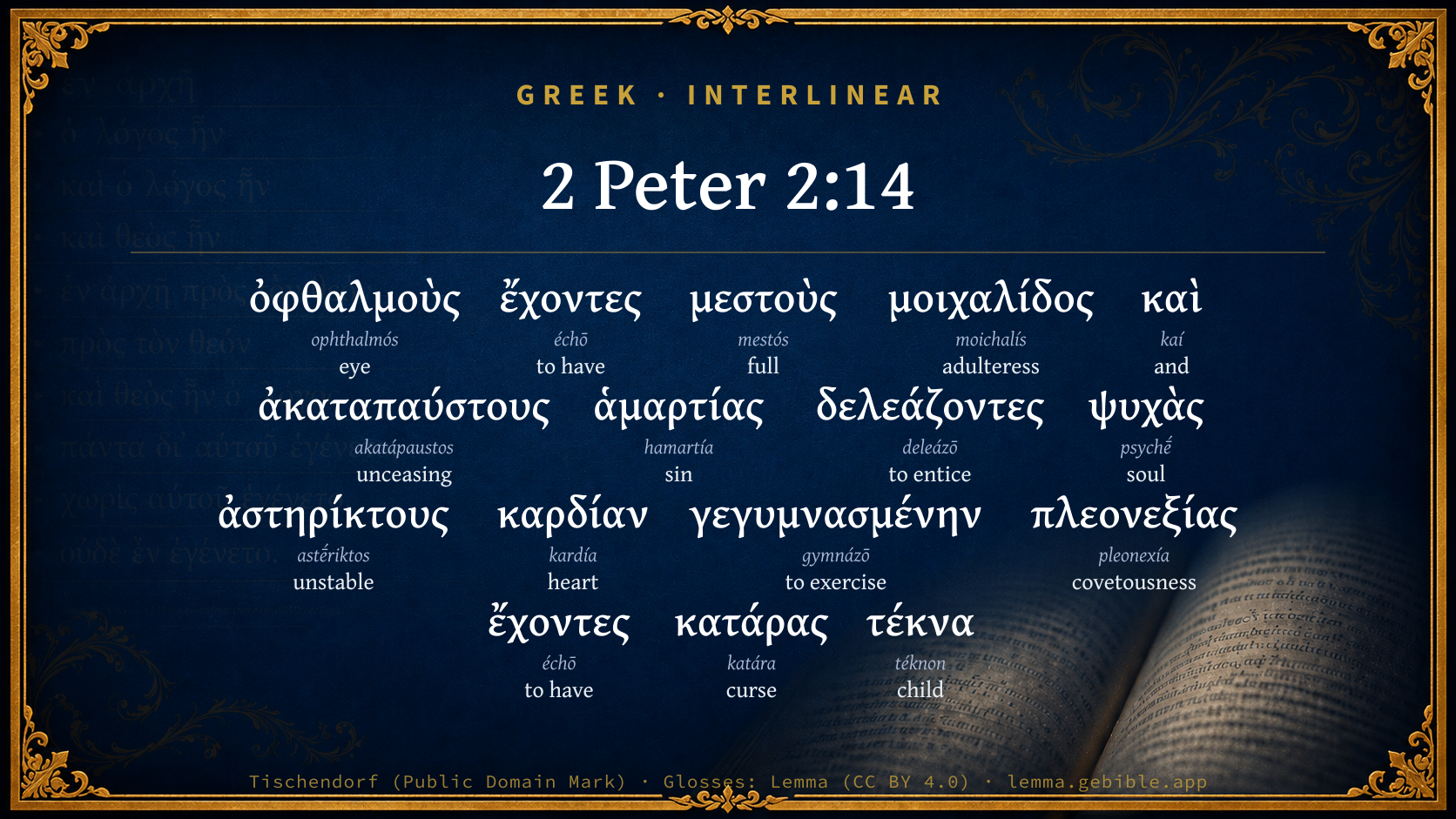
having eyes full of adultery, and who can't cease from sin; enticing unsettled souls; having a heart trained in greed; children of cursing;
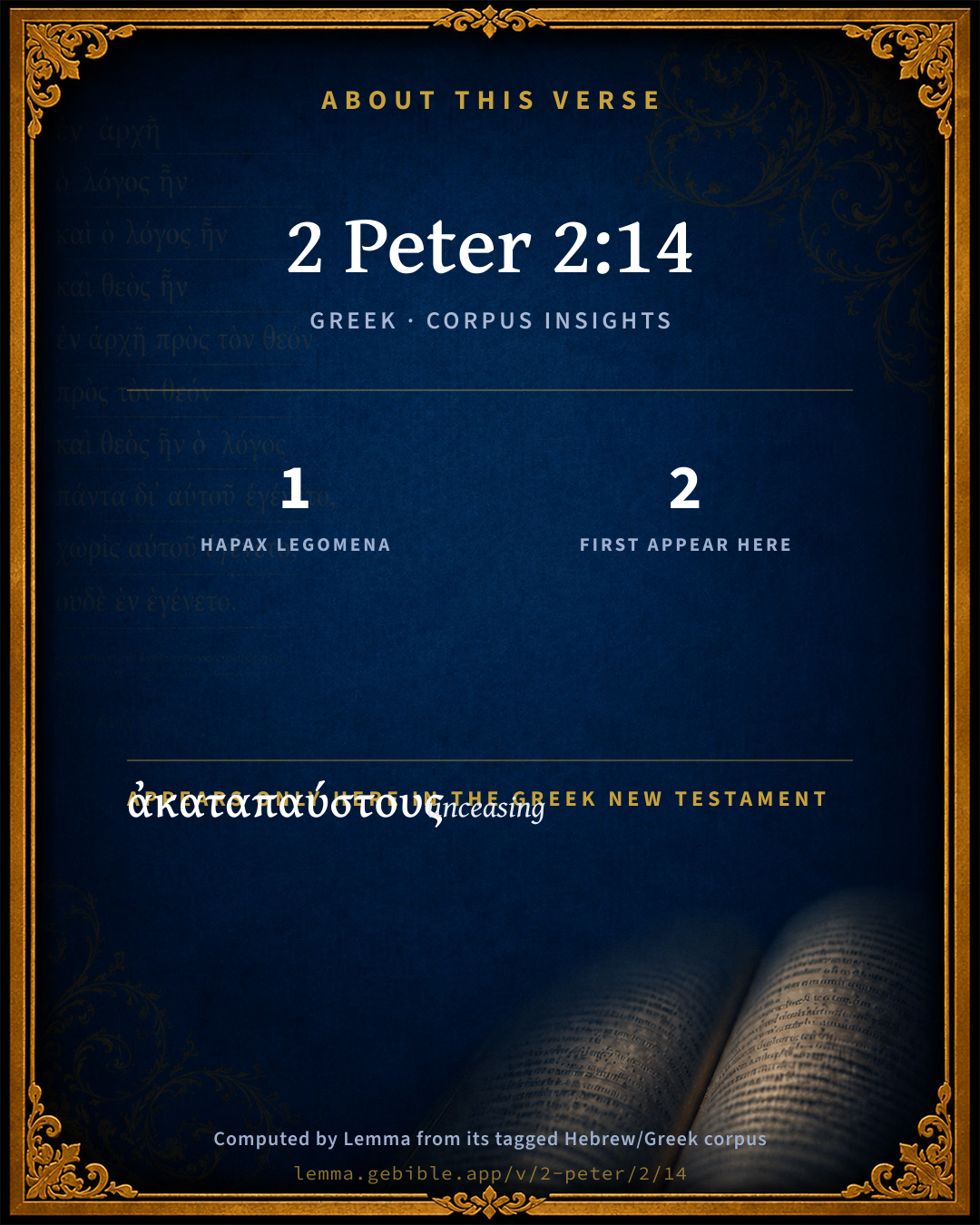
- 1 hapax legomenon — only here in the Greek New Testament
- 2 first appearances in the Greek New Testament
Download a study sheet
One document with this verse’s original text, its word-by-word gloss line, the meaning frame, cross-references with their text, attributed commentary, and full source and license credits — printable, and it pastes into notes with its structure intact.
This verse Autodidact and up
A passage Seminary Student
Up to 50 verses in one chapter. A passage sheet keeps up to 6 commentary sources and 12 cross-references per verse, in the order this page ranks them, and says so on the sheet whenever that leaves anything out. Ask for a single verse and you get the Autodidact verse sheet above.
Everything on this page stays free to read, with no account — the sheet is a download of what is already on screen, not access to it.
Compare translations 3
The same verse in 3 English versions, stacked beneath the original-language interlinear above. Click any original word for its lexicon entry.
Each is an independent rendering of the whole verse — the interlinear is not word-aligned to these translations.
Highlighted words mark where these versions differ — a whole-verse word diff, not a word-by-word alignment.
-
World English Bible Public Domain
having eyes full of adultery, and who can't cease from sin; enticing unsettled souls; having a heart trained in greed; children of cursing;
-
King James Version Public Domain
Having eyes full of adultery, and that cannot cease from sin; beguiling unstable souls: an heart they have exercised with covetous practices; cursed children:
-
unfoldingWord Literal Text CC BY-SA 4.0
having eyes full of an adulteress, and never ceasing from sin, enticing unstable souls, having hearts trained in covetousness, children of cursing.
unfoldingWord Literal Text — © unfoldingWord, licensed CC BY-SA 4.0. Word-aligned USFM3 via Door43 (git.door43.org/unfoldingWord/en_ult).
Show all 19 translations
Every available English version of this verse, each an independent rendering of the whole verse.
-
World English Bible Public Domain
having eyes full of adultery, and who can't cease from sin; enticing unsettled souls; having a heart trained in greed; children of cursing;
-
Berean Standard Bible Public Domain
Their eyes are full of adultery; their desire for sin is never satisfied; they seduce the unstable. They are accursed children with hearts trained in greed.
-
Majority Standard Bible Public Domain
Their eyes are full of adultery; their desire for sin is never satisfied; they seduce the unstable. They are accursed children with hearts trained in greed.
-
King James Version Public Domain
Having eyes full of adultery, and that cannot cease from sin; beguiling unstable souls: an heart they have exercised with covetous practices; cursed children:
-
American Standard Version (1901) Public Domain
having eyes full of adultery, and that cannot cease from sin; enticing unstedfast souls; having a heart exercised in covetousness; children of cursing;
-
Revised Version (1885) Public Domain
having eyes full of adultery, and that cannot cease from sin; enticing unstedfast souls; having a heart exercised in covetousness; children of cursing;
-
Geneva Bible (1599) Public Domain
Hauing eyes full of adulterie, and that can not cease to sinne, beguiling vnstable soules: they haue heartes exercised with couetousnesse, they are the children of curse:
-
Douay-Rheims (1899) Public Domain
Having eyes full of adultery and of sin that ceaseth not: alluring unstable souls, having their heart exercised with covetousness, children of malediction:
-
Young's Literal Translation Public Domain
having eyes full of adultery, and unable to cease from sin, enticing unstable souls, having an heart exercised in covetousnesses, children of a curse,
-
Literal Standard Version CC BY-SA 4.0
having eyes full of adultery, and unable to cease from sin, enticing unstable souls, having a heart exercised in covetousnesses, children of a curse,
-
Unlocked Literal Bible CC BY-SA 4.0
They have eyes full of adultery, they are never satisfied with sin. They entice unstable souls into wrongdoing, and they have their hearts trained in covetousness. They are cursed children!
-
unfoldingWord Literal Text CC BY-SA 4.0
having eyes full of an adulteress, and never ceasing from sin, enticing unstable souls, having hearts trained in covetousness, children of cursing.
-
Darby Bible Public Domain
having eyes full of adultery, and that cease not from sin, alluring unestablished souls; having a heart practised in covetousness, children of curse;
-
World Messianic Bible Public Domain
having eyes full of adultery, and who can’t cease from sin, enticing unsettled souls, having a heart trained in greed, accursed children!
-
Webster's Bible Public Domain
Having eyes full of adultery, and that cannot cease from sin; beguiling unstable souls: they have a heart exercised with covetous practices; cursed children:
-
Free Bible Version CC BY-SA 4.0
They're always on the lookout for adulterous relationships—they just can't stop sinning. They seduce the vulnerable; they have trained themselves in greed; they are offspring under a curse.
-
Bible in Basic English Public Domain
Having eyes full of evil desire, never having enough of sin; turning feeble souls out of the true way; they are children of cursing, whose hearts are well used to bitter envy;
-
Text-Critical English NT CC BY 4.0
They have eyes full of adultery, insatiable for sin. They entice unstable souls. They are accursed children with hearts trained in greed.
-
Tyndale New Testament (1534) Public Domain
havinge eyes full of advoutrie and that cannot cease to synne begylynge vnstable soules. Hertes they have exercised with coveteousnes. They are cursed chyldren
Literal Standard Version (2020), Covenant Press — licensed CC BY-SA 4.0. Text via the HelloAO Bible API (eBible.org). Unlocked Literal Bible (unfoldingWord) — licensed CC BY-SA 4.0. Text via the HelloAO Bible API (eBible.org). unfoldingWord Literal Text — © unfoldingWord, licensed CC BY-SA 4.0. Word-aligned USFM3 via Door43 (git.door43.org/unfoldingWord/en_ult). Free Bible Version, Dr. Jonathan Gallagher — licensed CC BY-SA 4.0. Text via the HelloAO Bible API (eBible.org).
Word by word
More ways to search: Search by grammar → Find every occurrence → Compare this word →
Practice this passage: Drill this verse → Learn its vocabulary →
- Appears 1× in the Greek New Testament
- First appears here
- Part of Speech
- Adjective
- Case
- Accusative
- Number
- Plural
- Gender
- Masculine
Full Thayer's Definition
- ὀφθαλμοὺς ophthalmós G3788 “eye” Noun, Accusative, Plural, Masculine
- ἔχοντες échō G2192 “to have” Verb, Present, Active, Participle, Nominative, Plural, Masculine
- μεστοὺς mestós G3324 “full” Adjective, Accusative, Plural, Masculine
- μοιχαλίδος moichalís G3428 “adulteress” Noun, Genitive, Singular, Feminine
- καὶ kaí G2532 “and” Conjunction
- ἀκαταπαύστους akatápaustos G180 “unceasing” Adjective, Accusative, Plural, Masculine
- ἁμαρτίας hamartía G266 “sin” Noun, Genitive, Singular, Feminine
- δελεάζοντες deleázō G1185 “to entice” Verb, Present, Active, Participle, Nominative, Plural, Masculine
- ψυχὰς psychḗ G5590 “soul” Noun, Accusative, Plural, Feminine
- ἀστηρίκτους astḗriktos G793 “unstable” Adjective, Accusative, Plural, Feminine
- καρδίαν kardía G2588 “heart” Noun, Accusative, Singular, Feminine
- γεγυμνασμένην gymnázō G1128 “to exercise” Verb, Perfect, Passive, Participle, Accusative, Singular, Feminine
- πλεονεξίας pleonexía G4124 “covetousness” Noun, Genitive, Singular, Feminine
- ἔχοντες échō G2192 “to have” Verb, Present, Active, Participle, Nominative, Plural, Masculine
- κατάρας katára G2671 “curse” Noun, Genitive, Singular, Feminine
- τέκνα téknon G5043 “child” Noun, Nominative, Plural, Neuter
About this verse
These counts appear in no published source. They are computed here, from the morphology-tagged text and Lemma’s own curated glosses. What Lemma adds →
- 16
- words
- 15
- distinct lemmas
- General Epistles
- section
Notable vocabulary
1 hapax legomenon — a word that appears only here in the entire Greek New Testament:
- ἀκαταπαύστους unceasing G180
First appearance in Scripture
These words make their first canonical appearance in the Greek New Testament here:
Shared distinctive vocabulary
ἀστηρίκτους unstable G793 occurs in 2 verses of the Greek New Testament. Also found in:
Repetition
A word recurs within this verse:
- ἔχοντες to have G2192 ×2
Cross-references
24Topical passages linked to 2 Peter 2:14 in the Treasury of Scripture Knowledge — connected by theme and wording, ordered by reader-vote popularity; previews shown in the World English Bible.
- 2 Peter 2:3 In covetousness they will exploit you with deceptive words: whose sentence now from of old doesn't linger, and their destruction will not slumber.
- 2 Peter 2:18 For, uttering great swelling words of emptiness, they entice in the lusts of the flesh, by licentiousness, those who are indeed escaping from those who live in error;
- Ephesians 2:3 among whom we also all once lived in the lust of our flesh, doing the desires of the flesh and of the mind, and were by nature children of wrath, even as the rest.
- Romans 16:18 For those who are such don't serve our Lord, Jesus Christ, but their own belly; and by their smooth and flattering speech, they deceive the hearts of the innocent.
- Ephesians 4:14 that we may no longer be children, tossed back and forth and carried about with every wind of doctrine, by the trickery of men, in craftiness, after the wiles of error;
- 2 Peter 3:16 as also in all of his letters, speaking in them of these things. In those are some things hard to be understood, which the ignorant and unsettled twist, as they also do to the other Scriptures, to their own destruction.
- Matthew 12:34 You offspring of vipers, how can you, being evil, speak good things? For out of the abundance of the heart, the mouth speaks.
- John 5:44 How can you believe, who receive glory from one another, and you don't seek the glory that comes from the only God?
- 1 Corinthians 11:19 For there also must be factions among you, that those who are approved may be revealed among you.
- Jeremiah 13:23 Can the Ethiopian change his skin, or the leopard his spots? then may you also do good, who are accustomed to do evil.
- Mark 13:22 For there will arise false christs and false prophets, and will show signs and wonders, that they may lead astray, if possible, even the chosen ones.
- 1 John 2:16 For all that is in the world, the lust of the flesh, the lust of the eyes, and the pride of life, isn't the Father's, but is the world's.
- Colossians 2:18 Let no one rob you of your prize by a voluntary humility and worshipping of the angels, dwelling in the things which he has not seen, vainly puffed up by his fleshly mind,
- James 1:8 He is a double-minded man, unstable in all his ways.
- 2 Samuel 11:2–4 It happened at evening, that David arose from off his bed, and walked on the roof of the king's house: and from the roof he saw a woman bathing; and the woman was very beautiful to look on.
- Jude 1:11 Woe to them! For they went in the way of Cain, and ran riotously in the error of Balaam for hire, and perished in Korah's rebellion.
- Isaiah 34:5 For my sword has drunk its fill in the sky: behold, it shall come down on Edom, and on the people of my curse, to judgment.
- Job 31:7 If my step has turned out of the way, If my heart walked after my eyes, If any defilement has stuck to my hands,
- Job 31:9 "If my heart has been enticed to a woman, And I have laid wait at my neighbor's door;
- Proverbs 6:25 Don't lust after her beauty in your heart, Neither let her captivate you with her eyelids.
- Isaiah 1:16 Wash yourselves, make yourself clean. Put away the evil of your doings from before my eyes; Cease to do evil.
- Isaiah 65:20 There shall be no more there an infant of days, nor an old man who has not filled his days; for the child shall die one hundred years old, and the sinner being one hundred years old shall be accursed.
- Matthew 5:28 but I tell you that everyone who gazes at a woman to lust after her has committed adultery with her already in his heart.
- Matthew 25:41 Then he will say also to those on the left hand, 'Depart from me, you cursed, into the eternal fire which is prepared for the devil and his angels;
Cross-references courtesy of OpenBible.info (CC BY 4.0).
Where the printed editions differ
1 variantPlaces in this verse where the major printed Greek editions disagree on the wording in a way that affects the translation — a comparison of editions, not a manuscript-by-manuscript collation. The editions are the modern critical texts (Nestlé-Aland 28/27, SBL, Westcott-Hort, Tregelles, Tyndale House) and the traditional texts behind the KJV (the Textus Receptus and the Byzantine/Majority text). It is not a claim about which reading is original.
-
Different wording
πλεονεξίας
“in craving”
In NA28NA27TynSBLWHTregByz Not in TRπλεονεξίαις (pleonexiais) 'in cravings' occurs in traditional manuscripts (TR) instead of πλεονεξίας (pleonexias) 'in craving' in older manuscripts (NA28+NA27+Tyn+SBL+WH+Treg+Byz)
Textual data: Translators Amalgamated Greek New Testament (STEPBible TAGNT) · CC BY 4.0.
Lesson kit
Teaching starters — assembled from the data on this page, not authored interpretation. Every prompt links to the verse data it draws on. Edit before teaching.
2 Peter, in the General Epistles, opens this verse with 16 words (15 distinct Greek lemmas). Its most distinctive word is akatápaustos (“unceasing”). A historical commentator’s framing appears above. Read the whole chapter for the surrounding context.
Discussion questions
- How does “unceasing” (akatápaustos) shape what this verse is saying?
- 1 word here appears nowhere else in the Greek New Testament. Why might the author reach for such rare wording?
- 2 words make their first appearance in Scripture here. What does this debut establish?
- How does 2 Peter 3:16, which shares the word «unstable», read alongside this verse?
- What does the repetition of “to have” (2× in this one verse) do in this verse?
- These translations render this verse differently; the difference is in the English rendering, not the original. What questions does that raise?
- Compare how The Biblical Illustrator and Bengel's Gnomon read this verse. Where do they agree or differ?
Things to notice
- 1 word in this verse appears nowhere else in the Greek New Testament.
- 2 words make their first canonical appearance in Scripture here.
- These translations choose different wording for 23 words in this verse.
- “to have” occurs 2× in this single verse.
- 15 distinct Greek lemmas span 16 words in this verse.
Commentary
Notes on 2 Peter 2:14 from classic Christian and Jewish commentators (each source and its license shown beneath its notes). The classic Christian expositions comment on the surrounding passage and are grouped to its opening verse, so a note may address several verses; the Jewish commentaries on the Tanakh (Rashi and others) are per-verse, so they appear only where the commentator wrote on this verse.
Lemma curates 59 commentaries, every one of them public domain or Creative Commons licensed, each selected and text-cleaned for this edition rather than reprinted as found. About our sources →
The Biblical Illustrator
Joseph S. Exell
The Biblical Illustrator, edited by Joseph S. Exell (c. 1880s–1900s) — public domain. Text from a community e-Sword module.
Bengel's Gnomon
Johann Albrecht Bengel
Bengel's Gnomon of the New Testament — English translation (T&T Clark, Edinburgh, 1860) — public domain. Text from a community e-Sword module.
Meyer's Critical & Exegetical Commentary
Heinrich August Wilhelm Meyer
Meyer — Critical and Exegetical Commentary on the New Testament — English translation by Peter Christie, edited by Frederick Crombie (T&T Clark, 1880) — public domain. Text from a community e-Sword module.
Expositor's Greek Testament
ed. W. Robertson Nicoll
The Expositor's Greek Testament, edited by W. Robertson Nicoll (1897–1910) — public domain. Text from a community e-Sword module.
Geneva Bible (1599)
Geneva Bible translators
Geneva Bible (1599) marginal notes — public domain. Text via Bolls.life.
Jamieson, Fausset & Brown
Robert Jamieson, A. R. Fausset & David Brown
Jamieson, Fausset & Brown — Commentary Critical and Explanatory on the Whole Bible (1871) — public domain (CC PDM 1.0). Text via the HelloAO Bible API.
Adam Clarke's Commentary
Adam Clarke's Commentary on the Bible (1810–1826) — public domain. Text from a community e-Sword/MySword module.
John Calvin's Commentaries
John Calvin's Commentaries (1540-1563) — public domain. Text from the Calvin Translation Society English edition (1840s-50s) via the Christian Classics Ethereal Library (ccel.org). Calvin's coverage is partial (roughly two-thirds of the Bible); uncommented books and verses are honest gaps, never fabricated. The 19th-century editor's footnotes and remarks are omitted so the notes are faithfully Calvin's own voice.
Ellicott's Commentary for English Readers
A Bible Commentary for English Readers, edited by Charles John Ellicott (1878–1897) — public domain. Text from a community e-Sword module.
The Cambridge Bible for Schools and Colleges
gen. ed. J. J. S. Perowne
The Cambridge Bible for Schools and Colleges (gen. ed. J. J. S. Perowne; Cambridge University Press, 1878–1918) — public domain. Text from a community e-Sword module.
John Gill's Exposition
John Gill's Exposition of the Whole Bible (1746–1763) — public domain (CC PDM 1.0). Text via the HelloAO Bible API.
Trapp's Complete Commentary
John Trapp
John Trapp, A Commentary or Exposition upon All the Books of the Old and New Testament (1647–1656) — public domain. Text from a community e-Sword module.
Albert Barnes' Notes on the Bible
Albert Barnes' Notes on the Bible (1834–1885) — public domain. Text from a community e-Sword/MySword module.
Haydock's Catholic Bible Commentary
George Leo Haydock (1774–1849), Haydock's Catholic Family Bible and Commentary, 1859 edition — public domain. Excludes Psalms (Douay-Rheims chapter numbering differs from Protestant) and Deuterocanonical books (Catholic canon only).
Matthew Poole's English Annotations
Matthew Poole's English Annotations on the Holy Bible (1683–1685) — public domain. Text from a community e-Sword/MySword module.
Whedon's Commentary on the Bible
Daniel D. Whedon
Daniel D. Whedon (gen. ed.), Commentary on the Old and New Testaments (1874–1909) — public domain. Text from a community e-Sword module.
The Pulpit Commentary
The Pulpit Commentary (1880–1919), ed. H.D.M. Spence-Jones & Joseph S. Exell — public domain. Text from a community e-Sword module.
Scofield Reference Notes
C. I. Scofield
The Scofield Reference Bible (1917 edition), notes by C. I. Scofield — public domain. Text from a community e-Sword module.
The People's New Testament
B. W. Johnson
B. W. Johnson's The People's New Testament with Notes (1889–1891) — public domain. Electronic text from the Christian Classics Ethereal Library (CCEL) ThML edition.
Cambridge Greek Testament for Schools and Colleges
Cambridge Greek Testament for Schools and Colleges (Cambridge University Press, 1896; 21 vols, various authors incl. Carr, Maclear, Plummer, Farrar, Lumby, Moule, M. R. James, Simcox) — public domain. Text from a community e-Sword module.
Alford’s Greek Testament
Henry Alford
Henry Alford, The Greek Testament (1849–1861) — public domain. Text from a community e-Sword module.
Vincent's Word Studies in the New Testament
Marvin R. Vincent
Marvin R. Vincent, Word Studies in the New Testament (1887–1900) — public domain. Text from a community e-Sword/MySword module.