
1 John 1:9

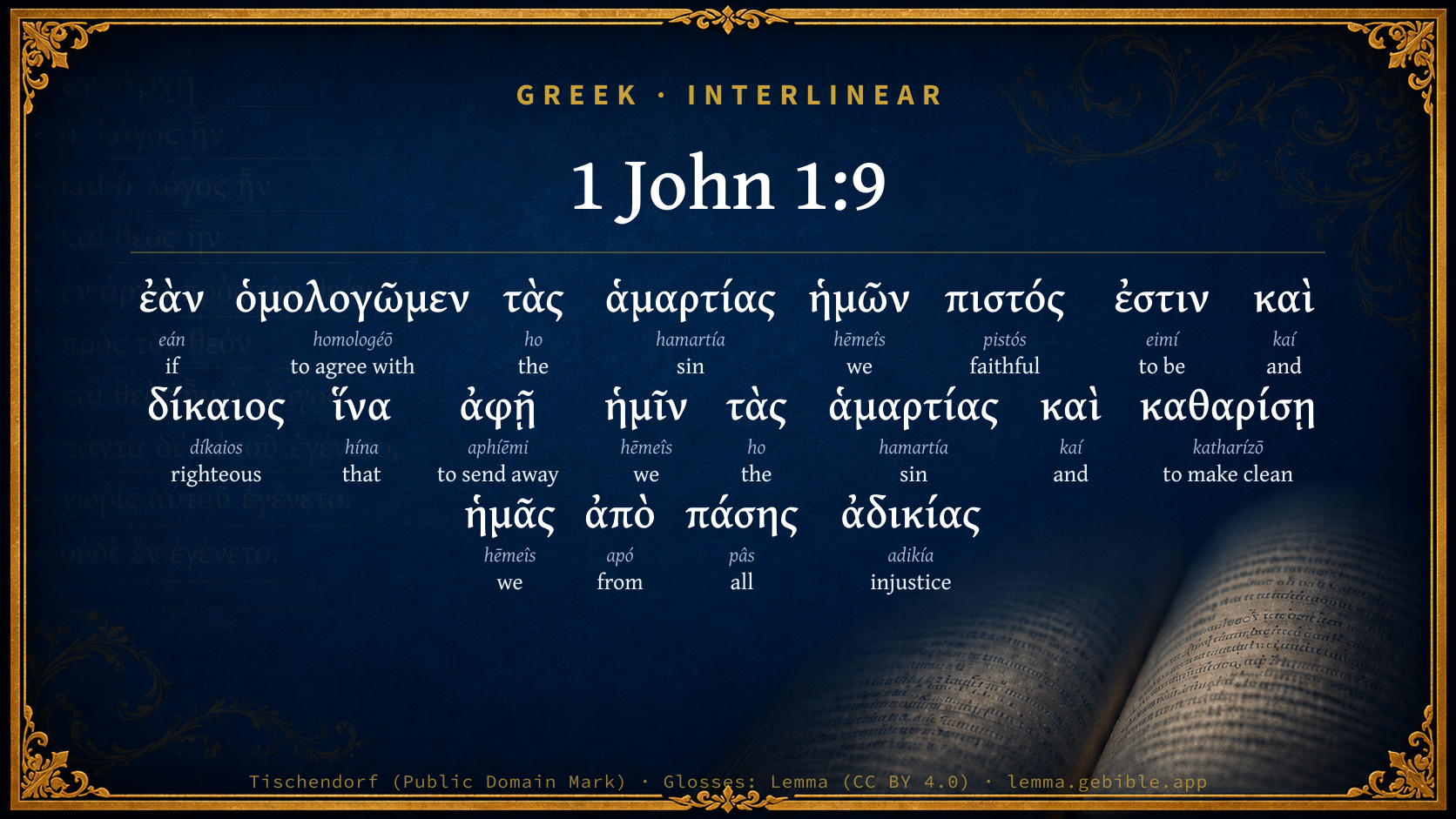
Greek (Tischendorf 8th ed.) 1 John 1:9 appears in the Greek New Testament. The text above is from the Tischendorf 8th edition. Each word links to its Strong’s number and a concise gloss. Click any word for its full Thayer’s Greek Lexicon entry.
Download image
Cite this verse

1 John 1:9 (World English Bible). Public Domain. Lemma interlinear Bible study tool, https://lemma.gebible.app/v/1-john/1/9.

Show BibTeX & RIS
BibTeX
RIS
English Translation
If we confess our sins, he is faithful and righteous to forgive us the sins, and to cleanse us from all unrighteousness.
World English Bible · Public Domain
Download a study sheet

One document with this verse’s original text, its word-by-word gloss line, the meaning frame, cross-references with their text, attributed commentary, and full source and license credits — printable, and it pastes into notes with its structure intact.

This verse Autodidact and up

Study sheet (.html) Plain text (.txt)

A passage Seminary Student

Up to 50 verses in one chapter. A passage sheet keeps up to 6 commentary sources and 12 cross-references per verse, in the order this page ranks them, and says so on the sheet whenever that leaves anything out. Ask for a single verse and you get the Autodidact verse sheet above.

Everything on this page stays free to read, with no account — the sheet is a download of what is already on screen, not access to it.

Want to remove ads? Support Godless Engineer
Compare translations 3

The same verse in 3 English versions, stacked beneath the original-language interlinear above. Click any original word for its lexicon entry.

Each is an independent rendering of the whole verse — the interlinear is not word-aligned to these translations.

Highlighted words mark where these versions differ — a whole-verse word diff, not a word-by-word alignment.

  • World English Bible Public Domain
    If we confess our sins, he is faithful and righteous to forgive us the sins, and to cleanse us from all unrighteousness.
  • King James Version Public Domain
    If we confess our sins, he is faithful and just to forgive us our sins, and to cleanse us from all unrighteousness.
  • unfoldingWord Literal Text CC BY-SA 4.0
    If we confess our sins, he is faithful and righteous, that he should forgive us our sins and cleanse us from all unrighteousness.

unfoldingWord Literal Text — © unfoldingWord, licensed CC BY-SA 4.0. Word-aligned USFM3 via Door43 (git.door43.org/unfoldingWord/en_ult).

Versions to compare (up to 4)

3 of 4 selected

Show all 19 translations

Every available English version of this verse, each an independent rendering of the whole verse.

  • World English Bible Public Domain
    If we confess our sins, he is faithful and righteous to forgive us the sins, and to cleanse us from all unrighteousness.
  • Berean Standard Bible Public Domain
    If we confess our sins, He is faithful and just to forgive us our sins and to cleanse us from all unrighteousness.
  • Majority Standard Bible Public Domain
    If we confess our sins, He is faithful and just to forgive us our sins and to cleanse us from all unrighteousness.
  • King James Version Public Domain
    If we confess our sins, he is faithful and just to forgive us our sins, and to cleanse us from all unrighteousness.
  • American Standard Version (1901) Public Domain
    If we confess our sins, he is faithful and righteous to forgive us our sins, and to cleanse us from all unrighteousness.
  • Revised Version (1885) Public Domain
    If we confess our sins, he is faithful and righteous to forgive us our sins, and to cleanse us from all unrighteousness.
  • Geneva Bible (1599) Public Domain
    If we acknowledge our sinnes, he is faithfull and iust, to forgiue vs our sinnes, and to clense vs from all vnrighteousnes.
  • Douay-Rheims (1899) Public Domain
    If we confess our sins, he is faithful and just, to forgive us our sins, and to cleanse us from all iniquity.
  • Young's Literal Translation Public Domain
    if we may confess our sins, stedfast He is and righteous that He may forgive us the sins, and may cleanse us from every unrighteousness;
  • Literal Standard Version CC BY-SA 4.0
    if we may confess our sins, He is steadfast and righteous that He may forgive us the sins, and may cleanse us from every unrighteousness;
  • Unlocked Literal Bible CC BY-SA 4.0
    But if we confess our sins, he is faithful and just to forgive us our sins and cleanse us from all unrighteousness.
  • unfoldingWord Literal Text CC BY-SA 4.0
    If we confess our sins, he is faithful and righteous, that he should forgive us our sins and cleanse us from all unrighteousness.
  • Darby Bible Public Domain
    If we confess our sins, he is faithful and righteous to forgive us [our] sins, and cleanse us from all unrighteousness.
  • World Messianic Bible Public Domain
    If we confess our sins, he is faithful and righteous to forgive us the sins and to cleanse us from all unrighteousness.
  • Webster's Bible Public Domain
    If we confess our sins, he is faithful and just to forgive us our sins, and to cleanse us from all unrighteousness.
  • Free Bible Version CC BY-SA 4.0
    But if we confess our sins, he is trustworthy and right so that he can forgive us our sins and make us clean from all that is not right in us.
  • Bible in Basic English Public Domain
    If we say openly that we have done wrong, he is upright and true to his word, giving us forgiveness of sins and making us clean from all evil.
  • Text-Critical English NT CC BY 4.0
    If we confess our sins, he is faithful and just to forgive us our sins and cleanse us from all unrighteousness.
  • Tyndale New Testament (1534) Public Domain
    Yf we knowledge oure synnes he is faythfull and iust to forgeve vs oure synnes and to clense vs from all vnrightewesnes.

Literal Standard Version (2020), Covenant Press — licensed CC BY-SA 4.0. Text via the HelloAO Bible API (eBible.org). Unlocked Literal Bible (unfoldingWord) — licensed CC BY-SA 4.0. Text via the HelloAO Bible API (eBible.org). unfoldingWord Literal Text — © unfoldingWord, licensed CC BY-SA 4.0. Word-aligned USFM3 via Door43 (git.door43.org/unfoldingWord/en_ult). Free Bible Version, Dr. Jonathan Gallagher — licensed CC BY-SA 4.0. Text via the HelloAO Bible API (eBible.org).

Word by word

More ways to search: Search by grammar → Find every occurrence → Compare this word →

Practice this passage: Drill this verse → Learn its vocabulary →

ὁμολογῶμεν
homologéō
G3670
“to agree with”
Verb, Present, Active, Subjunctive, 1st person, Plural
Part of Speech
Verb
Tense
Present
Voice
Active
Mood
Subjunctive
Person
1st person
Number
Plural
Full Thayer's Definition

Origin: from a compound of the base of G3674 and G3056

TDNT: 08:19,7

1. to say the same thing as another, i.e. to agree with, assent 2. to concede a. not to refuse, to promise b. not to deny 1. to confess 2. declare 3. to confess, i.e. to admit or declare one's self guilty of what one is accused of 3. to profess a. to declare openly, speak out freely b. to profess one's self the worshipper of one 4. to praise, celebrate
  1. ἐὰν eán G1437 “if” Conditional
  2. τὰς ho G3588 “the” Article, Accusative, Plural, Feminine
  3. ἁμαρτίας hamartía G266 “sin” Noun, Accusative, Plural, Feminine
  4. ἡμῶν hēmeîs G2249 “we” Personal pronoun, 1st person, Genitive, Plural
  5. πιστός pistós G4103 “faithful” Adjective, Nominative, Singular, Masculine
  6. ἐστιν eimí G1510 “to be” Verb, Present, Active, Indicative, 3rd person, Singular
  7. καὶ kaí G2532 “and” Conjunction
  8. δίκαιος díkaios G1342 “righteous” Adjective, Nominative, Singular, Masculine
  9. ἵνα hína G2443 “that” Conjunction
  10. ἀφῇ aphíēmi G863 “to send away” Verb, Aorist, Active, Subjunctive, 3rd person, Singular
  11. ἡμῖν hēmeîs G2249 “we” Personal pronoun, 1st person, Dative, Plural
  12. τὰς ho G3588 “the” Article, Accusative, Plural, Feminine
  13. ἁμαρτίας hamartía G266 “sin” Noun, Accusative, Plural, Feminine
  14. καὶ kaí G2532 “and” Conjunction
  15. καθαρίσῃ katharízō G2511 “to make clean” Verb, Aorist, Active, Subjunctive, 3rd person, Singular
  16. ἡμᾶς hēmeîs G2249 “we” Personal pronoun, 1st person, Accusative, Plural
  17. ἀπὸ apó G575 “from” Preposition
  18. πάσης pâs G3956 “all” Adjective, Genitive, Singular, Feminine
  19. ἀδικίας adikía G93 “injustice” Noun, Genitive, Singular, Feminine

About this verse

These counts appear in no published source. They are computed here, from the morphology-tagged text and Lemma’s own curated glosses. What Lemma adds →

20
words
15
distinct lemmas
General Epistles
section

Shared distinctive vocabulary

ὁμολογῶμεν to agree with G3670 occurs in 23 verses of the Greek New Testament. Also found in:
Repetition

Words recur within this verse:

  • ἁμαρτίας sin G266 ×2
  • ἡμῶν we G2249 ×3
  • τὰς the G3588 ×2
  • καὶ and G2532 ×2

Cross-references

32

Topical passages linked to 1 John 1:9 in the Treasury of Scripture Knowledge — connected by theme and wording, ordered by reader-vote popularity; previews shown in the World English Bible.

  • Psalms 32:5 I acknowledged my sin to you. I didn't hide my iniquity. I said, I will confess my transgressions to Yahweh, And you forgave the iniquity of my sin. Selah.
  • Proverbs 28:13 He who conceals his sins doesn't prosper, But whoever confesses and renounces them finds mercy.
  • Jeremiah 33:8 I will cleanse them from all their iniquity, by which they have sinned against me; and I will pardon all their iniquities, by which they have sinned against me, and by which they have transgressed against me.
  • Psalms 51:2–5 Wash me thoroughly from my iniquity. Cleanse me from my sin.
  • 1 John 1:7 But if we walk in the light, as he is in the light, we have fellowship with one another, and the blood of Jesus Christ, his Son, cleanses us from all sin.
  • Ezekiel 36:25 I will sprinkle clean water on you, and you shall be clean: from all your filthiness, and from all your idols, will I cleanse you.
  • Hebrews 10:23 let us hold fast the confession of our hope unyieldingly. For he who promised is faithful.
  • 1 Timothy 1:15 The saying is faithful and worthy of all acceptance, that Christ Jesus came into the world to save sinners; of whom I am chief.
  • Nehemiah 1:6 Let your ear now be attentive, and your eyes open, that you may listen to the prayer of your servant, which I pray before you at this time, day and night, for the children of Israel your servants while I confess the sins of the children of Israel, which we have sinned against you. Yes, I and my father's house have sinned:
  • Ezekiel 37:23 neither shall they defile themselves any more with their idols, nor with their detestable things, nor with any of their transgressions; but I will save them out of all their dwelling-places, in which they have sinned, and will cleanse them: so shall they be my people, and I will be their God.
  • 1 Corinthians 1:9 God is faithful, through whom you were called into the fellowship of his Son, Jesus Christ, our Lord.
  • Lamentations 3:23 They are new every morning; great is your faithfulness.
  • Deuteronomy 7:9 Know therefore that Yahweh your God, he is God, the faithful God, who keeps covenant and loving kindness with them who love him and keep his commandments to a thousand generations,
  • Psalms 19:12 Who can discern his errors? Forgive me from hidden errors.
  • Acts 19:18 Many also of those who had believed came, confessing, and declaring their deeds.
  • Titus 2:14 who gave himself for us, that he might redeem us from all iniquity, and purify for himself a people for his own possession, zealous for good works.
  • Job 33:27–28 He sings before men, and says, 'I have sinned, and perverted that which was right, And it didn't profit me.
  • Leviticus 26:40–42 "'If they confess their iniquity, and the iniquity of their fathers, in their trespass which they trespassed against me, and also that, because they walked contrary to me,
  • Nehemiah 9:2–37 The seed of Israel separated themselves from all foreigners, and stood and confessed their sins, and the iniquities of their fathers.
  • Mark 1:5 All the country of Judea and all those of Jerusalem went out to him. They were baptized by him in the Jordan river, confessing their sins.
  • 1 Corinthians 6:11 Such were some of you, but you were washed. But you were sanctified. But you were justified in the name of the Lord Jesus, and in the Spirit of our God.
  • Hebrews 6:10 For God is not unrighteous, so as to forget your work and the labor of love which you showed toward his name, in that you served the saints, and still do serve them.
  • Revelation 15:3 They sang the song of Moses, the servant of God, and the song of the Lamb, saying, "Great and marvelous are your works, Lord God, the Almighty; Righteous and true are your ways, you King of the nations.
  • Isaiah 45:21 Declare you, and bring [it] forth; yes, let them take counsel together: who has shown this from ancient time? who has declared it of old? Haven't I, Yahweh? and there is no God else besides me, a just God and a Savior; there is no one besides me.
  • 1 Kings 8:47 yet if they shall repent themselves in the land where they are carried captive, and turn again, and make supplication to you in the land of those who carried them captive, saying, We have sinned, and have done perversely, we have dealt wickedly;
  • Matthew 3:6 They were baptized by him in the Jordan, confessing their sins.
  • Hebrews 11:11 By faith, even Sarah herself received power to conceive, and she bore a child when she was past age, since she counted him faithful who had promised.
  • 2 Chronicles 6:37–38 yet if they shall repent themselves in the land where they are carried captive, and turn again, and make supplication to you in the land of their captivity, saying, We have sinned, we have done perversely, and have dealt wickedly;
  • Daniel 9:4–20 I prayed to Yahweh my God, and made confession, and said, Oh, Lord, the great and dreadful God, who keeps covenant and loving kindness with those who love him and keep his commandments,
  • Ephesians 5:26 that he might sanctify it, having cleansed it by the washing of water with the word,
  • Romans 3:26 to demonstrate his righteousness at this present time; that he might himself be just, and the justifier of him who has faith in Jesus.
  • Zechariah 9:9 Rejoice greatly, daughter of Zion! Shout, daughter of Jerusalem! Behold, your king comes to you! He is righteous, and having salvation; Lowly, and riding on a donkey, Even on a colt, the foal of a donkey.

Cross-references courtesy of OpenBible.info (CC BY 4.0).

Commentary

Notes on 1 John 1:9 from classic Christian and Jewish commentators (each source and its license shown beneath its notes). The classic Christian expositions comment on the surrounding passage and are grouped to its opening verse, so a note may address several verses; the Jewish commentaries on the Tanakh (Rashi and others) are per-verse, so they appear only where the commentator wrote on this verse.

Lemma curates 59 commentaries, every one of them public domain or Creative Commons licensed, each selected and text-cleaned for this edition rather than reprinted as found. About our sources →

Tyndale Open Study Notes

Tyndale Open Resources

1:9 To maintain continual fellowship with God, we need to confess our sins to him. Forgiveness and cleansing are guaranteed because God is faithful to his promises and because he acts on the basis of his justice. Christ’s death for our sins fulfills God’s justice and acquits us of our guilt.

Tyndale Open Study Notes — © Tyndale Open Resources, licensed CC BY-SA 4.0. Text via the HelloAO Bible API.

Bengel's Gnomon

Johann Albrecht Bengel

1Jn 1:9. Ἐὰν ὁμολογῶμεν τὰς ἁμαρτίας ἡμῶν, if we confess our sins) This verse is placed between two antithetical sentences, as ch. 1Jn 2:10. For it is antithetical to say, I have no sin, and, I have not sinned, 1Jn 1:8; 1Jn 1:10. The former is concerning the guilt of sin, which still remains; the latter is concerning the actual commission. By the former, we deceive ourselves; by the latter, we make Him a liar. It is the best plan to confess before God, who holds us guilty as sinners, 1Jn 1:10; and the universal necessity of this confession is here asserted: so that John not only says, that if we have sinned we must confess; but that all have reason to say, I have sin, and I have sinned, and ought to confess that, although with different degrees: otherwise we should not need cleansing by the blood of Jesus Christ.—πιστὸς, faithful) He makes good all things, which we promise ourselves respecting the goodness of God.—ἔστι, is) so that we experience it, and do not make Him a liar.—καὶ δίκαιος, and just) so as to spare the sinner, and abolish the sins. Thus also Jesus Christ is called the righteous, ch. 1Jn 2:1.—ἀφῇ, to remit) while He takes away the guilt.—καθαρίσῃ, to cleanse) so that we sin no more.

Bengel's Gnomon of the New Testament — English translation (T&T Clark, Edinburgh, 1860) — public domain. Text from a community e-Sword module.

Meyer's Critical & Exegetical Commentary

Heinrich August Wilhelm Meyer

1Jn_1:9. Not a mere antithesis of the previous verse, but an expansion of the thought; there follows as conclusion not merely this, that we are then true, but the incomparably greater and surprisingly glorious thought that God then proves Himself actually towards us as the True, as the πιστὸς καὶ δίκαιος (Ebrard).

ἐὰν ὁμολογῶμεν τὰς ἁμαρτίας ἡμῶν] ὁμολογεῖν does not mean to recognise (Socinus: confiteri significat interiorem ac profundam suorum peccatorum agnitionem),[63] but to confess; of course it is manifest that the confession is not here spoken of as a purely outward act; still, at the same time, it is not sufficient to regard it merely as an inward fact, which is founded on the whole internal tendency of the mind (Neander); it is rather the real (even if not always vocal) expression of sins recognised within and confessed to oneself; here also it is the word in which the inner life has to operate.[64]

What are to be confessed are αἱ ἀμαρτίαι ἡμῶν, i.e. the sins of Christians, which are the particular manifestations of ἁμαρτίαν ἔχειν (so also Braune); therefore the plural.[65]

Ebrard rightly calls attention to the fact that John here mentions, as the subject of the confession, not the abstract ἁμαρτίαν ἔχειν, but ΤᾺς ἉΜΑΡΤΊΑς, i.e. the definite, concrete, single sins committed; the mere confession in the abstract that we have sin would not have truth without the acknowledgment of the concrete particular sins, but would shrivel up into a mere phrase.

πιστός ἐστι καὶ δίκαιος] It is true God is both in Himself, He does not become so only when we confess our sins; but this confession is the condition on which He actually proves Himself to us as πίστος καὶ δίκαιος.[66] These two epithets are indeed not of the same signification, but still, as their combination proves, of cognate meaning. God is called ΠΙΣΤΌς, inasmuch as He, as the promise-maker, also fulfils what He has promised, Heb_10:23 : ΠΙΣΤῸς Ὁ ἘΠΑΓΓΕΙΛΆΜΕΝΟς; Heb_11:11; especially as He accomplishes in believers the promise of blessing, which lies for them in the fact of their call, by conducting them through manifestation of His grace to the goal of their calling (according to Ewald, inasmuch as He keeps His promise already repeatedly given in the O. T.), 1Co_1:9 : ΠΙΣΤῸς Ὁ ΘΕΌς, ΔΙʼ ΟὟ ἘΚΛΉΘΗΤΕ ΕἸς ΚΟΙΝΩΝΊΑΝ ΤΟῦ ΥἹΟῦ ΑὐΤΟῦ; 1Co_10:13; 2Co_1:18-21; 1Th_5:24 : ΠΙΣΤῸς Ὁ ΚΑΛῶΝ ὙΜᾶς, Ὃς ΚΑῚ ΠΟΙΉΣΕΙ; 2Th_3:3. ΠΙΣΤΌς has this meaning here also, as results from the following ἽΝΑ Κ.Τ.Λ. Ebrard incorrectly calls the reference of the faithfulness of God here to His promises and prophecies an introduction of foreign ideas, and says the subject here is faithfulness to the nature of truth and light, akin to His own nature, and which prevails in us, inasmuch as we confess our sins.

God is described as ΔΊΚΑΙΟς in the N. T., inasmuch as He, for the realization of His kingdom of grace, gives to every onewithout ΠΡΟΣΩΠΟΛΗΨΊΑwhat is due to him, according to the righteous judgment of God, in proportion to the position which he occupies toward God (or toward the kingdom of God), God being in this regarded as the Judge; the idea of the righteousness of God and that of His judicial activity are very closely connected; God is ὁ δίκαιος κριτής, 2Ti_4:8; He judges ἘΝ ΔΙΚΑΙΟΣΎΝῌ, Act_17:31 (Rev_19:11), or ΔΙΚΑΊΩς, 1Pe_2:23; His ΚΡΊΣΙς is a ΚΡΊΣΙς ΔΙΚΑΊΑ, 2Th_1:5. The relation of the ΔΙΚΑΙΟΣΎΝΗ of God to His judicial activity is found throughout in the N. T., even where the former is the subject without the latter being expressly mentioned with it. As the manifestation of the ΔΙΚΑΊΑ ΚΡΊΣΙς of God consists in the righteous distribution of punishment and of blessing, it follows that ΔΙΚΑΙΟΣΎΝΗ is referred to not only where both of these are mentioned together (as in 2Th_1:5 seq.), but also where only one of the two is spoken of. God punishes as the δίκαιος, but He blesses also as the δίκαιος, no doubt in view of the realization of His kingdom, which depends upon the good obtaining the complete victory over the evil. Towards him who walks ἘΝ Τῷ ΣΚΌΤΕΙ, God shows Himself ΔΊΚΑΙΟς in that He ΚΑΤΑΚΡΊΝΕΙ him; towards him who walks ἘΝ Τῷ ΦΩΤΊ, by ever more and more removing from him everything that hinders his perfect ΚΟΙΝΩΝΊΑ ΜΕΤᾺ ΤΟῦ ΘΕΟῦ (namely, both his consciousness of guilt, and the ἈΔΙΚΊΑ which still clings to him), and by finally permitting him to inherit the perfect happiness which is prepared for those who love God (comp. 2Ti_4:8). Here God is called ΔΊΚΑΙΟς, inasmuch as His purpose is directed to allotting to those who, walking in light, confess their sins, that which is suitable for them, namely, the blessing mentioned in the following ἽΝΑ Κ.Τ.Λ. The meaning of ΔΊΚΑΙΟς is rightly stated by Baumgarten-Crusius, Düsterdieck, Brückner, and Braune;[67] on the other hand, it is incorrect to refer ΔΊΚΑΙΟς here to the punitive activity (Drusius: justus, quia vere punivit peccata nostra in filio suo), but also to explain it = bonis, lenis, aequus (Grotius, Lange, Carpzov, etc.), for δίκαιος never has this meaning in the N. T.; it is here of cognate meaning with ΠΙΣΤΌς,[68] because the allotment of blessing bestowed in accordance with the δικαιοσύνη of God has been promised by Him, and is accomplished according to His promise; yet it must not therefore be regarded as synonymous with it (Hornejus: = in promissis servandis integer). Following Rom_3:26, some commentators have here interpreted it = δικαιῶν; but this is so much the more unjustifiable, as that very passage by the juxtaposition of the two ideas proves their different meaning.[69] According to the Roman Catholic view, πιστός refers to the peccata mortalia, δίκαιος to the peccata venialia.[70]

ἵνα ἀφῇ ἡμῖν τὰς ἁμαρτίας] ἵνα, not = so that (Castellio: ita Justus, ut condonet), has here (as in other passages of the N. T.) not retained strictly its idea of purpose, (hence not: in order that), but it states what is the aim of the divine faithfulness and justice to attain which these qualities operate on men; Luther therefore translates correctly: that. De Wettes explanation, with which Braune agrees: in the divine faithfulness lies the law or the will of forgiving sins, is unsatisfactory, inasmuch as ἀφιέναι κ.τ.λ. is not merely the will, but the operation of the divine faithfulness and justice.

τὰς ἁμαρτίας refers back to ὁμολογῶμεν τὰς ἁμαρτίας, thus: the sins confessed by us. The remission, i.e. the forgiveness, of sins is therefore, by virtue of the faithfulness of God, the first result of the confession; the second John describes by the words: καὶ καθαρίσῃ[71] ἡμᾶς ἀπὸ πάσης ἀδικίας. Here the first thought is not repeated epexegetically (Semler), or only in figurative manner (Lange); but the words express the same thing as the corresponding words of the 7th verse, with which the 8th and 9th verses are in closest connection (Düsterdieck, Braune; Brückner does not explain himself definitely); καθαρίζειν has here the same meaning as there, and ἀδικία (not = poena peccati, Socinus) is synonymous with ἁμαρτία; they are two different names for the same thing; comp. chap. 1Jn_5:17.[72] The order in which the two clauses that express the redemptive operations of God are connected together (Myrberg: ordo verborum ponit remissionem ante abrogationem), points to the fact that purification takes place by means of forgiveness.

The context is quite decisive in favour of regarding as the subject of πιστός ἐστι κ.τ.λ. not Χριστός, but (with Lücke, de Wette, Düsterdieck, Braune, etc.) ὁ Θεός; for even though in 1Jn_1:7 the καθαρίζειν is described as the operation of the αἷμα Ἰησοῦ Χριστοῦ, and in chap. 1Jn_2:2, Ἰ. Χρ. is the subject, yet in this section ὁ Θεός is the principal subject; 1Jn_1:5, ὁ Θεός; 1Jn_1:6, αὐτός, even in 1Jn_1:7, τοῦ υἱοῦ αὐτοῦ; the blood of Christ, therefore, is regarded as the means by which God produces purification from sins. To hold, with Sander, that God and Christ together form the subject,[73] is quite as inappropriate here as in 1Jn_1:5 to understand by αὐτοῦ both together. Though, with John, God and Jesus Christ approach very close to a unity, yet they are always distinguished by him, and never represented as one subject.

[63] Similarly Baumgarten-Crusius says: ὁμολογεῖν is not exactly to confess, but to recognise, perceive, become conscious of, as opposed to the εἰπεῖν μὴ ἔχειν ἐμαρτίαν; but it is just to εἰπεῖν that ὁμολογεῖν is exactly opposed only when it is taken in its natural signification.

[64] It is quite clear that confession to God is meant; when, however, Braune adds: and indeed a confession so fervent and deep that it becomes public and regulated by the church, he introduces an element which nothing here suggests. In genuine Catholic fashion a Lapide says: Quam confessionem exigit Johannes? Haeretici solam generalem quae fit Deo admittunt; Catholici etiam specialem requirunt. Respondeo: Johannem utramque exigere, generalem pro peccatis levibus, specialem pro gravibus.

[65] Even here Socinus, Grotius (Si fatemur nos in gravibus peccatis vixisse ante notitiam evangelii), and others understand ἁμαρτίαι of sins before conversion.

[66] Semlers interpretation is not satisfactory: logice intelligendum est; nec enim in Deo jam demun oritur nova ratio tanti praedicati, sed in his christianis succrescit nova cognitio tantae rei. The subject is not our perception, but the actual manifestation of God.

[67] Ewalds explanation is unsatisfactory, according to which God is here called just because He knows well and considers that He alone is the Creator, whilst we are His creation exposed to error and sin, and acts according to this just consideration.

[68] In the passage Rom_3:3-5, πίστις and δικαιοσύνη are also used as cognate ideas, but even here in such a way that δικαιοσύνη has not lost its reference to the judicial activity of God; Meyer on this passage explains δικαιοσύνη, on account of the contrast with ἀδικία, generally by justice; but the former reference appears both in μὴ ἄδικος ὁ Θεὸς ὁ ἐπιφέρων τὴν ὀργήν, and also in ver. 6 πῶς κρινεῖ ὁ Θεὸς τὸν κόσμον.

[69] Not less inexact is it for Ebrard to say: God manifests Himself towards as as the δίκαιος, inasmuch as He is not only just, but also makes just, since δικαιοῦν does not mean to make just. His assertion is also inappropriate, that here and in Rom_1:17 to Rom_3:26, the justice of God appears as the source in Him from which His saving, sin-forgiving, and sin-overcoming action flows. This source is rather Gods ἀγάπη manifesting itself as χάρις towards the guilt of men; there is a reference to that in chap. 1Jn_3:24 of the passage in Romans, but here the source of the salvation is not mentioned.The interpretation of Calov: justa est haec peccatorum remissio et ex justitia debita, sed Christo non nobis, and that of Sander: the Lord is just, inasmuch as He remits the sin of the sinner who appeals to the ransom paid in the blood of Christ, because it would be unjust to demand the payment twice, introduce references into this passage which are foreign to it.

[70] Suarez: Fidelis est Deus, cum condonat poenitentibus peccata mortalia; justus, cum justis condonat venialia, quia, sc. justi per opera (!) poenitentiae, charitatis, etc., merentur de condigno hanc condonationem.

[71] The Rec. καθαρίσει corresponds to the passage Luk_22:30, where, according to the best attested Rec., ἵνα is followed both by the subjunctive first, and then by the indicative; but not to the passage Joh_6:40, cited by Ebrard, where the indicative is not regarded as dependent on ἵνα. On ἵνα with the indicative, comp. A. Buttmanns Gramm. p. 202. Winer, p. 258 ff., VII. p. 271 ff.

[72] While Weiss also interprets both expressions of the forgiveness of sins, he tries to repel the reproach of tautology by saying: If sin committed is regarded as a stain, it is quite correct that God forgives us the sin, and thus purifies us from all unrighteousness, since by the very fact that God forgives it, sin has ceased to exist before Him, and at the same time also to stain us; true though this may be, however, it cannot serve to refute that objection, for as καθαρίζειν in this sense is not the result of ἀφιέναι, but the former consists in the latter, both clauses express only one and the same thought.

[73] In favour of conjoining Christ as the subject, Sander adduces the fact that just in the following chapter Christ is called δίκαιος; but in this he overlooks altogether the different meanings which the word has in the two passages; for in the verse before us δίκαιος is used of a relation to men, but in chap. 1Jn_2:1 of the relation of Christ to the divine will; and when Sander further says that in Heb_9:14 it is precisely stated of Christ that He purges the consciences, this is incorrect, since τὸ αἷμα τοῦ Χριστοῦ is the subject there just as here in ver. 7; and there even more expressly than here God is specified as the author of the purification, for the αἷμα τ. Χρ. purges, because it is offered as a sacrifice τῷ Θεῷ. Moreover, it is not meant by this that forgiveness and cleansing could not be ascribed to Christ quite as much as to God, only it does not follow from this that ὁ Χριστός is the subject here.

Meyer — Critical and Exegetical Commentary on the New Testament — English translation by Peter Christie, edited by Frederick Crombie (T&T Clark, 1880) — public domain. Text from a community e-Sword module.

Geneva Bible (1599)

Geneva Bible translators

Therefore the beginning of salvation is to acknowledge our wickedness, and to require pardon from him who freely forgiveth all sins, because he hath promised so to do, and he is faithful and just.

So then our salvation hangeth upon the free promise of God, who because he is faithful and just, will perform that which he hath promised.

Where are then our merits? for this is our true felicity.

Geneva Bible (1599) marginal notes — public domain. Text via Bolls.life.

Jamieson, Fausset & Brown

Robert Jamieson, A. R. Fausset & David Brown

confess--with the lips, speaking from a contrite heart; involving also confession to our fellow men of offenses committed against them.

he--God.

faithful--to His own promises; "true" to His word.

just--Not merely the mercy, but the justice or righteousness of God is set forth in the redemption of the penitent believer in Christ. God's promises of mercy, to which He is faithful, are in accordance with His justice.

to--Greek, "in order that." His forgiving us our sins and cleansing us, &c., is in furtherance of the ends of His eternal faithfulness and justice.

forgive--remitting the guilt.

cleanse--purify from all filthiness, so that henceforth we more and more become free from the presence of sin through the Spirit of sanctification (compare Heb 9:14; and above, see on Jo1 1:7).

unrighteousness--offensive to Him who "is just" or righteous; called "sin," Jo1 1:7, because "sin is the transgression of the law," and the law is the expression of God's righteousness, so that sin is unrighteousness.

Jamieson, Fausset & Brown — Commentary Critical and Explanatory on the Whole Bible (1871) — public domain (CC PDM 1.0). Text via the HelloAO Bible API.

Adam Clarke's Commentary

Verse 9. If we confess our sins] If, from a deep sense of our guilt, impurity, and helplessness, we humble ourselves before God, acknowledging our iniquity, his holiness, and our own utter helplessness, and implore mercy for his sake who has died for us; he is faithful, because to such he has promised mercy, Ps 32:5; Pr 28:13; and just, for Christ has died for us, and thus made an atonement to the Divine justice; so that God can now be just, and yet the justifier of him who believeth in Jesus.

And to cleanse us from all unrighteousness.] Not only to forgive the sin, but to purify the heart.

OBSERVE here, 1. Sin exists in the soul after two modes or forms: (1.) In guilt, which requires forgiveness or pardon. (2.) In pollution, which requires cleansing.

2. Guilt, to be forgiven, must be confessed; and pollution, to be cleansed, must be also confessed. In order to find mercy, a man must know and feel himself to be a sinner, that he may fervently apply to God for pardon; in order to get a clean heart, a man must know and feel its depravity, acknowledge and deplore it before God, in order to be fully sanctified.

3. Few are pardoned, because they do not feel and confess their sins; and few are sanctified or cleansed from all sin, because they do not feel and confess their own sore, and the plague of their hearts.

4. As the blood of Jesus Christ, the merit of his passion and death, applied by faith, purges the conscience from all dead works, so the same cleanses the heart from all unrighteousness.

5. As all unrighteousness is sin, so he that is cleansed from all unrighteousness is cleansed from all sin. To attempt to evade this, and plead for the continuance of sin in the heart through life, is ungrateful, wicked, and even blasphemous; for as he who says he has not sinned, 1Jo 1:10, makes God a liar, who has declared the contrary through every part of his revelation; so he that says the blood of Christ either cannot or will not cleanse us from all sin in this life, gives also the lie to his Maker, who has declared the contrary, and thus shows that the word-the doctrine of God is not in him.

Reader, it is the birthright of every child of God to be cleansed from all sin, to keep himself unspotted from the world, and so to live as never more to offend his Maker. All things are possible to him that believeth; because all things are possible to the infinitely meritorious blood and energetic Spirit of the Lord Jesus. See the notes on the parallel passages in the margin; and particularly in St. John's gospel, John 1.

Adam Clarke's Commentary on the Bible (1810–1826) — public domain. Text from a community e-Sword/MySword module.

John Calvin's Commentaries

9 If we confess He again promises to the faithful that God will be propitious to them, provided they acknowledge themselves to be sinners. It is of great moment to be fully persuaded, that when we have sinned, there is a reconciliation with God ready and prepared for us: we shall otherwise carry always a hell within us. Few, indeed, consider how miserable and wretched is a doubting conscience; but the truth is, that hell reigns where there is no peace with God. The more, then, it becomes us to receive with the whole heart this promise which offers free pardon to all who confess their sins. Moreover, this is founded even on the justice of God, because God who promises is true and just. For they who think that he is called just, because he justifies us freely, reason, as I think, with too much refinement, because justice or righteousness here depends on fidelity, and both are annexed to the promise. For God might have been just, were he to deal with us with all the rigor of justice; but as he has bound himself to us by his word, he would not have himself deemed just, except he forgives.

But this confession, as it is made to God, must be in sincerity; and the heart cannot speak to God without newness of life. It then includes true repentance. God, indeed, forgives freely, but in such a way, that the facility of mercy does not become an enticement to sin.

And to cleanse us The verb, to cleanse, seems to be taken in another sense than before; for he had said, that we are cleansed by the blood of Christ, because through him sins are not imputed; but now, having spoken of pardon, he also adds, that God cleanses us from iniquity: so that this second clause is different from the preceding. Thus he initiates that a twofold fruit comes to us from confession, — that God being reconciled by the sacrifice of Christ, forgives us, — and that he renews and reforms us.

Were any one to object and say, that as long as we sojourn in the world, we are never cleansed from all unrighteousness, with regard to our reformation: this is indeed true; but John does not refer to what God now performs in us. He is faithful, he says, to cleanse us, not today or tomorrow; for as long as we are surrounded with flesh, we ought to be in a continual state of progress; but what he has once begun, he goes on daily to do, until he at length completes it. So Paul says, that we are chosen, that we may appear without blame before God, (Colossians 1:22;) and in another place he says, that the Church is cleansed, that it might be without spot or wrinkle. (Ephesians 5:27.)

If yet any one prefers another explanation, that he says the same thing twice over, I shall not object.

John Calvin's Commentaries (1540-1563) — public domain. Text from the Calvin Translation Society English edition (1840s-50s) via the Christian Classics Ethereal Library (ccel.org). Calvin's coverage is partial (roughly two-thirds of the Bible); uncommented books and verses are honest gaps, never fabricated. The 19th-century editor's footnotes and remarks are omitted so the notes are faithfully Calvin's own voice.

The Cambridge Bible for Schools and Colleges

gen. ed. J. J. S. Perowne

9. If we confess our sins] The opposite hypothesis is now taken and expanded, as in 1Jn_1:7; see note there. But there is no conjunction, no ‘but’, as in 1Jn_1:7; and the asyndeton is telling. Greek has such a wealth of connecting particles, that in that language asyndeton is specially remarkable. Here there is expansion and progress, not only in the second half of the verse where ‘He is faithful and righteous’ takes the place of ‘we are true’; but in the first half also; where ‘confess our sins’ takes the place of ‘say we have sin’. The latter admission costs us little: the confession of the particular sins which we have committed costs a good deal, and is a guarantee of sincerity. He who refuses to confess, may perhaps desire, but certainly does not seek forgiveness. ‘He that covereth his sins shall not prosper: but whoso confesseth and forsaketh them shall have mercy’ (Pro_28:13). Obviously confession to Him who is ‘faithful and righteous’, and to those ‘selves’ whom we should otherwise ‘lead astray’, is all that is meant. The passage has nothing to do with the question of confession to our fellow-men.

faithful and just] Better, faithful and righteous, to bring out the contrast with ‘unrighteousness’ and the connexion with ‘Jesus Christ the righteous’ (1Jn_2:1), where the same word (δίκαιος) is used. The Greek ‘and’ (καί) sometimes means ‘and yet’, and frequently does so in S. John: see on Joh_1:10. It is possible that it has this meaning here. ‘God is faithful (to His promises to us) and yet righteous (in hating and punishing sin)’. He keeps His promise of mercy to the penitent without losing His character for righteousness and justice. In any case beware of making ‘righteous’ a vague equivalent for ‘kind, gentle, merciful’. It means ‘just’ (which is to some extent the opposite of ‘merciful’), and affirms that God in keeping His word gives to each his due. The distinction which refers ‘faithful’ to mortal sins and ‘righteous’ to venial ones is frivolous. For ‘faithful’ in the sense of keeping promises comp. ‘He is faithful that promised’ (Heb_10:23); ‘She counted Him faithful who had promised’ (Heb_11:11): and for ‘righteous’ in the sense of giving just awards comp. ‘Righteous art Thou … because Thou didst thus judge … True and righteous are Thy judgments’ (Rev_16:5-7).

to forgive us our sins] In spite of what some eminent scholars have said to the contrary, it is perhaps true that the Greek for these words includes to some extent the idea of intention and aim. Thus the Vulgate, fidelis est et justus, ut remittat nobis peccata nostra; and Wiclif, ‘He is feithful and just that He forgeve to us oure synnes’; and the Rhemish, ‘He is faithful and just, for to forgive us our sinnes’. In S. John we find the conviction deeply rooted that all things happen in accordance with the decrees of God: events are the results of His purposes. And this conviction influences his language: so that constructions (ἵνα) which originally indicated a purpose, and which even in late Greek do not lose this meaning entirely, are specially frequent in his writings: see on Joh_5:36. It is God’s decree and aim that His faithfulness and righteousness should appear in His forgiving us and cleansing us. Comp. ‘Against Thee, Thee only, have I sinned … that Thou mightest be justified when Thou speakest, and be clear when Thou judgest’ (Psa_51:4).

our sins] Those particular acts of sin which we have confessed, and from the punishment due for which we are thus set free. ‘I said, I will confess my transgressions unto the Lord; and Thou forgavest the iniquity of my sin’ (Psa_32:5). ‘He that covereth his sins shall not prosper: but whoso confesseth and forsaketh them shall have mercy’ (Pro_28:13).

and to cleanse us] This is not a repetition in different words; it is a second and distinct result of our confession: 1. We are absolved from sin’s punishment; 2. We are freed from sin’s pollution. The forgiveness is the averting of God’s wrath; the cleansing is the beginning of holiness.

The Cambridge Bible for Schools and Colleges (gen. ed. J. J. S. Perowne; Cambridge University Press, 1878–1918) — public domain. Text from a community e-Sword module.

John Gill's Exposition

If we confess our sins,.... Not to one other; for though it is our duty to confess our faults to our fellow creatures and fellow Christians which are committed against them, yet are under no obligation to confess such as are more immediately against God, and which lie between him and ourselves; or at least it is sufficient to confess and acknowledge in general what sinful creatures we are, without entering into particulars; for confession of sin is to be made to God, against whom it is committed, and who only can pardon: and a man that truly confesses his sin is one that the Spirit of God has convinced of it, and has shown him its exceeding sinfulness, and filled him with a godly sorrow for it, and given him repentance unto salvation, that needeth not to be repented of; and who, under such a sight and sense of sin, and concern for it, comes and acknowledges it before the Lord, humbly imploring, for Christ's sake, his pardoning grace and mercy; and such obtain it:

he is faithful and just to forgive us our sins: forgiveness of sin here intends not the act of forgiveness, as in God, proceeding upon the bloodshed and sacrifice of Christ, which is done at once, and includes all sin, past, present, and to come; but an application of pardoning grace to a poor sensible sinner, humbled under a sense of sin, and confessing it before the Lord; and confession of sin is not the cause or condition of pardon, nor of the manifestation of it, but is descriptive of the person, and points him out, to whom God will and does make known his forgiving love; for to whomsoever he grants repentance, he gives the remission of sin; in doing of which he is faithful to his word of promise; such as in Pro 28:13; "and just"; in being "true", as the Arabic version adds, to his word; and showing a proper regard to the blood and sacrifice of his Son; for his blood being shed, and hereby satisfaction made to the law and justice of God, it is a righteous thing in him to justify from sin, and forgive the sinner for whom Christ has shed his blood, and not impute it to him, or punish him for it; though the word here used may answer to the Hebrew word which sometimes carries in it the notion and idea of mercy and beneficence; hence mercy to the poor is sometimes expressed by righteousness; and the righteous acts of God intend his mercies and benefits unto men; see Dan 4:27; and so forgiveness of sin springs from the tender mercies of our God, and is both an act of justice and of mercy; of justice, with respect to the blood of Christ, and of pure grace and mercy to the pardoned sinner: the following clause,

and to cleanse us, from all unrighteousness, is but the same thing expressed in different words; for all unrighteousness is sin, and to cleanse from sin is to remove the guilt of it, by an application of the blood of Christ for pardon. The antecedent to the relative "he" in the text, is either God, who is light, and with whom the saints have fellowship; or his Son Jesus Christ, who is the nearest antecedent, and who, being truly God, has a power to forgive sin.

John Gill's Exposition of the Whole Bible (1746–1763) — public domain (CC PDM 1.0). Text via the HelloAO Bible API.

Trapp's Complete Commentary

John Trapp

9 If we confess our sins, he is faithful and just to forgive us our sins, and to cleanse us from all unrighteousness.

Ver. 9. If we confess] Homo agnoscit, Deus ignoscit. Man acknowledges, God forgives. And Confessio peccati est vomitus sordium animae. Confession of sin is the vomit of the filthy soul. (Aug.) Judah (his name signifies confession) got the kingdom from Reuben. No man was ever kept out of God’s kingdom for his confessed badness; many are for their supposed goodness; as those justitiaries in the former verse, whose hearts are big swollen with high conceit of themselves; and whose lips are held close by the devil; who knows well there is no way to purge the sick soul but upwards.

He is faithful] And yet Bellarmine saith that he cannot find in all the book of God any promise made to confession of sin to God. (De Justific. i. 21.) He might have seen (besides other places not a few) Pro 28:13; Psa 32:5, &c., that this very text is a most heavenly promise of mercy to those that confess heartily, and not hollowly. The word faithful also refers to God’s promises, as just doth to the blood of Christ (the ransom received) whereby the saints are cleansed, and it stands not with God’s justice to demand the same debt twice, viz. of the surety and of the debtor.

From all unrighteousness] All without exception; why then should we put in conditions, and as it were interline God’s covenant? He is a sin pardoning God, Neh 9:31; no God like him for that in heaven and earth, Mic 7:18; he multiplieth pardon, as we multiply sin, Isa 55:7; he doth it freely, for his own sake, naturally, Exo 34:6; constantly, Psa 130:4, and here. The blood of Jesus Christ cleanseth (not, he hath cleansed or will cleanse, but he doth it) daily and duly, constantly and continually. This should be as a perpetual picture in our hearts.

John Trapp, A Commentary or Exposition upon All the Books of the Old and New Testament (1647–1656) — public domain. Text from a community e-Sword module.

Albert Barnes' Notes on the Bible

If we confess our sins - Pardon in the Scriptures, always supposes that there is confession, and there is no promise that it will be imparted unless a full acknowledgment has been made. Compare Ps. 51; Psa 32:1-11;; Luk 15:18 ff; Luk 7:41 ff; Pro 28:13.

He is faithful - To his promises. He will do what he has assured us he will do in remitting them.

And just to forgive us our sins - The word “just” here cannot be used in a strict and proper sense, since the forgiveness of sins is never an act of justice, but is an act of mercy. If it were an act of justice it could be demanded or enforced, and that is the same as to say that it is not forgiveness, for in that case there could have been no sin to be pardoned. But the word “just” is often used in a larger sense, as denoting upright, equitable, acting properly in the circumstances of the case, etc. Compare the notes at Mat 1:19. Here the word may be used in one of the following senses:

Either as referring to his general excellence of character, or his disposition to do what is proper; that is, he is one who will act in every way as becomes God; or,

(2)That he will be just in the sense that he will be true to his promises; or that, since he has promised to pardon sinners, he will be found faithfully to adhere to those engagements; or perhaps,

(3)That he will be just to his Son in the covenant of redemption, since, now that an atonement has been made by him, and a way has been opened through his sufferings by which God can consistently pardon, and with a view and an understanding that he might and would pardon, it would be an act of injustice to him if he did not pardon those who believe on him.

Viewed in either aspect, we may have the fullest assurance that God is ready to pardon us if we exercise true repentance and faith. No one can come to God without finding him ready to do all that is appropriate for a God to do in pardoning transgressors; no one who will not, in fact, receive forgiveness if he repents, and believes, and makes confession; no one who will not find that God is just to his Son in the covenant of redemption, in pardoning and saving all who put their trust in the merits of his sacrifice.

And to cleanse us from all unrighteousness - By forgiving all that is past, treating us as if we were righteous, and ultimately by removing all the stains of guilt from the soul.

Albert Barnes' Notes on the Bible (1834–1885) — public domain. Text from a community e-Sword/MySword module.

Matthew Poole's English Annotations

But on the contrary, if we confess our sins, if we apply ourselves to him suitably to the condition of sinners, confessing ourselves such, with that self-abasing sense of sin which may dispose us to accept and apply his offered remedy, (upon which it is implied we will do it),

he is faithful, so true to his promise,

and just, fidelity being a part of justice; or there is with him that equity and righteousness, (which sometimes signify goodness, or clemency, 1Sa 12:7; Psa 112:9, and which, more strictly taken, permit him not to exact from us the satisfaction which he hath accepted in the atonement made by his Son, in his own way applied, and upon his own terms to be reckoned unto us), that he will not fail

to forgive us our sins.

And to cleanse us from all unrighteousness; which may either be added as a further expression of the same thing; or may, moreover, signify his vouchsafing that purifying influence of the Spirit of Christ, (obtained also by his blood), which shall both purge away, and prevent, the defilements that would render us incapable of his own holy communion.

Matthew Poole's English Annotations on the Holy Bible (1683–1685) — public domain. Text from a community e-Sword/MySword module.

Whedon's Commentary on the Bible

Daniel D. Whedon

9. If—In 1Jn_1:7 St. John, beginning with the final result of unity with the divine light, ends with the instrument by which that unity is accomplished, namely, Christ. He now states the condition, once for all, by which that instrumentality becomes available, namely, reliant confession of our sins in view of the blood. That is, the flinging ourselves as confessed sinners upon Christ and his propitiation for pardon and purity.

Confess our sins— Confess not only that we have done wrong, but that all our wrong-doings are sins. St. John, in specifying the faith-condition of salvation, emphasizes confession, because the uttered denial of sins, even though they committed misdeeds, was the fatal error of his opponents. That confession, however, includes a faith in view of the atonement and justification for which the confession is made. And this faith-confession, it must never be forgotten, underlies this whole epistle, as it does the whole gospel. He—God; who is the pardoner of sins, as Christ is the mediator of the pardon.

Faithful—As having promised. No confessor need ever doubt the divine trueness. Or, we may say that pardon, justification, as the invariable sequent of true faith-confession, is the law of God’s spiritual kingdom, and to it he will be faithful.

Just—But in what sense can God be called just in forgiving the confessor? Not, certainly, because justice requires that a transgressor should be forgiven because he is penitent. No human or divine law holds a guilty man to become innocent because he repents. Indeed, true repentance acknowledges the permanent justice of penalty. God is called just in forgiving in this passage because the atonement makes satisfaction, so that God can be “just, and the justifier of him which believeth in Jesus.” Rom_3:26. Alford is strenuous in maintaining that such an idea does not fairly lie in the present current of thought. But Huther well remarks, that “God punishes as just, but he also blesses as just, and, indeed, the aim of realizing his kingdom is, that he should assign victory to goodness over badness.”

Forgive—Forgiveness holds the transgressor constructively as if he had never sinned, so far as penalty is concerned.

Sins—Transgressions of God’s law in thought, word, or act, as well as those permanent states of mind voluntarily retained adverse to the law. These are pardoned in our justification.

Cleanse us—Under the image that unrighteousness (that is, an inward preference for that which violates the law) is an impurity impregnating our being, the blood, through the Spirit, is said to cleanse the impurity away. By the Spirit, that is, the love of God is poured into the soul, and the love of the unlawful is neutralized by the power of that holy affection. Yet our free agency for sin, our sensitivities to temptation, our need of vigilant exertion of power over sin, our capabilities of apostasy, are never removed until we attain paradise.

The distinction between the forgive and the cleanse should be carefully retained. Forgiveness removes guilt and penalty for past sins; sanctification inspires to future sinlessness. One looks back, and the other looks forward. One says, “Thy sins be forgiven thee;” the other says, “Go, sin no more.”

A father may forgive a wicked son, and the son remain as wicked as before. But when our heavenly Father pardons us, he breathes into our hearts a spirit of obedience, which, if we obey, we never need incur his displeasure.

Daniel D. Whedon (gen. ed.), Commentary on the Old and New Testaments (1874–1909) — public domain. Text from a community e-Sword module.

The Pulpit Commentary

As in verse 7, we have the opposite hypothesis stated, and the thought advanced a stage. Not the exact opposite, "if we confess that we have sin; but "if we confess our sins." It is easy to say, "I am a sinner;" but if confession is to have value it must state the definite acts of sin. The context ("deceive ourselves he is faithful") shows that confession at the bar of the conscience and of God is meant. Circumstances must decide whether confession to man is required also, and this St. John neither forbids nor enjoins. Note the asyndeton; there is no de, as in verse 7. He is faithful and righteous, Dikaiov must be rendered "righteous" rather than "just," to mark the contrast with unrighteousness ajdikiti, and the connexion with "Jesus Christ the Righteous. (1Jn_2:1) To forgive to cleanse. As explained in verse 7, the one refers to freeing us from the penalties of sin, justification; the other to freeing us from its contamination, sanctification. The sense of purpose is not wholly to be surrendered. No doubt ina, like other particles, becomes weakened in later Greek; but even in later classical Greek the notion of purpose is mixed up with that of consequence. Much more is this the case in the New Testament, and especially in St. John, where what seems to us to be mere result is really design; and this higher aspect of the sequence of facts is indicated by ina. It is God"s nature to be faithful and righteous; but it is also his purpose to exhibit these attributes towards us; and this purpose is expressed in ina ajfh hJmin.

The Pulpit Commentary (1880–1919), ed. H.D.M. Spence-Jones & Joseph S. Exell — public domain. Text from a community e-Sword module.

John Wesley's Explanatory Notes

But if with a penitent and believing heart, we confess our sins, he is faithful - Because he had promised this blessing, by the unanimous voice of all his prophets. Just - Surely then he will punish: no; for this very reason he will pardon. This may seem strange; but upon the evangelical principle of atonement and redemption, it is undoubtedly true; because, when the debt is paid, or the purchase made, it is the part of equity to cancel the bond, and consign over the purchased possession. Both to forgive us our sins - To take away all the guilt of them. And to cleanse us from all unrighteousness - To purify our souls from every kind and every degree of it.

John Wesley, Explanatory Notes Upon the Whole Bible (1754–1765) — public domain. Text via the GEBible commentary corpus.

Burkitt's Expository Notes on the New Testament

William Burkitt

Behold here, 1. A double blessing promised and insured, namely, justification and sanctification, forgiveness of sin, and cleansing from it, yea, from all iniquity; when God pardons sin, no sin is left unpardoned; the sea can as easily drown a thousand men as a single man; God’s act of pardoning grace is free and full.

Observe, 2. The certainty of the mercy promised, God is faithful and just to forgive: not merciful and gracious, though so he is in himself, but faithful with respect to his promise to us, and just with respect to the satisfaction given by Christ for us. Almighty God in pardoning sin performs an act of strict justice with respect to Christ, as well as an act of grace and mercy, in regard of us; he is faithful and just, as well as gracious and merciful.

Observe, 3. The indispensible duty required on our part, and that is confession of sin, If we confess. Now confession of sin is a penitent sinner’s voluntary accusing himself to God, and condemning himself before God, with hatred of, shame and sorrow for, and a full resolution against his sin, together with an earnest desire of, and some good hope in divine mercy.

Observe, 4. What relation confession stands in to remission, not as a meritorious cause; satisfaction, not confession, merits pardon, but it is an exclusive condition; there is no remission without confession; God will not pardon without it: And it is an inclusive condition; God will, certainly will, forgive them that confess: There is not only a possibility or probability, but an infallible certainty of obtaining remission upon confession.

William Burkitt's Expository Notes on the New Testament (1700–1703) — public domain. Text from a community e-Sword module.

The People's New Testament

B. W. Johnson

9. If we confess our sins. Instead of affirming that we are sinless we should confess our sins. Faithful and just. If we confess our sins the Lord will be faithful to his promise of mercy, and just in requiring us to have the atonement of Christ, to forgive us our sins.

B. W. Johnson's The People's New Testament with Notes (1889–1891) — public domain. Electronic text from the Christian Classics Ethereal Library (CCEL) ThML edition.

Cambridge Greek Testament for Schools and Colleges

9. ἐὰν ὁμολ. τὰς ἁμαρτ. ἡμῶν. The opposite case is now taken and developed, as in 1Jn 1:7: see note there. But here we have no δέ, and the asyndeton is telling. Greek has such a wealth of connecting particles, that in that language asyndeton is specially remarkable. Here there is expansion and progress, not only in the second half of the verse where ‘He is faithful and righteous’ takes the place of ‘we are true’; but in the first half also; where ‘confess our sins’ takes the place of ‘say we have sin.’ The latter admission costs us little: the confession of the particular sins which we have committed costs a good deal, and is a guarantee of sincerity. He who refuses to confess, may perhaps desire, but certainly does not seek forgiveness. ‘He that covereth his transgressions shall not prosper: but whoso confesseth and forsaketh them shall obtain mercy’ (Pro 28:13). Obviously confession to Him who is ‘faithful and righteous,’ and to those ‘selves’ whom we should otherwise ‘lead astray,’ is all that is meant. The passage has nothing to do with the question of confession to our fellowmen. Elsewhere S. John uses ὁμολογεῖν only of confessing Christ (1Jn 2:23; 1Jn 4:2-3; 1Jn 4:15; 2Jn 1:7; Joh 1:20; Joh 9:22; Joh 12:42; Rev 3:5).

πιστός ἐστιν κ. δίκαιος. He is faithful and righteous, to bring out the contrast with πάσης ἀδικίας here and the connexion with Ἰησ. Χρ. δίκαιον (1Jn 2:1). God is πιστός because He keeps His word, and δίκαιος because in doing so He gives to each his due. Comp. πιστὸς γὰρ ὁ ἐπαγγειλάμενος (Heb 10:23); πιστὸν ἡγήσατο τὸν ἐπαγγειλάμενον (Heb 11:11). Δίκαιος εἶ ὁ ὢν … ὅτι ταῦτα ἔκρινας … ἀληθιναὶ καὶ δίκαιαι αἱ κρίσεις σου (Rev 16:5-7). Beware of watering down δίκαιος into a vague expression for ‘kind, gentle, merciful.’ ‘The Lord be a true and faithful witness between us’ (Jer 42:5) in LXX. is Ἔστω κύριος ἐν ἡμῖν εἰς μάρτυρα δίκαιον καὶ πιστόν.

ἵνα ἀφῇ. In spite of what some eminent scholars have said to the contrary, it is perhaps true that the Greek for these words includes to some extent the idea of intention and aim. Comp. 1Jn 3:1; Joh 4:34; Joh 6:29; Joh 6:40; Joh 12:23; Joh 13:1. Thus the Vulgate and Beza, fidelis est et justus, ut remittat nobis peccata nostra; and Wiclif, ‘He is feithful and just that He forgeve to us oure synnes’; and the Rhemish, ‘He is faithful and just, for to forgive us our sinnes.’ In S. John we find the conviction deeply rooted that all things happen in accordance with the decrees of God: events are the results of His purposes. And this conviction influences his language: so that constructions (ἵνα) which originally indicated a purpose, and which even in late Greek do not lose this meaning entirely, are specially frequent in his writings: see on Joh 5:36. It is God’s decree and aim that His faithfulness and righteousness should appear in His forgiving us and cleansing us from sin. “Forgiveness and cleansing are ends to which God, being what He is, has regard” (Westcott). See Haupt’s note and Winer, 577. Those particular acts of which we are conscious and which we have confessed are indicated by τὰς ἁμαρτίας: ἁμαρτία in the singular may be either sin in the abstract (Joh 16:9) or a single act of sin (1Jn 5:16); ἁμαρτίαι in the plural must mean particular sinful acts (1Jn 2:2; 1Jn 2:12; 1Jn 3:5; 1Jn 5:10). Comp. Psa 32:5; Pro 28:13, where the doctrine, that confession of sins (not admission of sinfulness) leads to forgiveness, is plainly stated.

καθαρίσῃ ἡμ. ἀπὸ π. ἀδικίας. Not a repetition in other words of ἀφῇ τὰς ἁμ. It is a second and distinct result of our confession: 1. We are absolved from sin’s punishment; 2. We are freed from sin’s pollution. The reference to the phraseology of the Temple is obvious (Heb 9:23; Joh 2:6; Joh 3:25). The one affects our peace, the other our character. The forgiveness is the averting of God’s wrath; the cleansing is the beginning of holiness. “He takes from thee an evil security, and puts in a useful fear” (Augustine). Possibly, as in 1Jn 1:6, there is exact correspondence between the two clauses. There, ψευδόμεθα evidently refers to εἴπωμεν, ποιοῦμεν to περιπατῶμεν. Here, ἀφῇ may look back to πιατός, καθαρίσῃ to δίκαιος. God is ‘faithful’ in forgiving our sins, because He has promised to do so, ‘righteous’ in cleansing us from unrighteousness, because reunion with Him banishes what is contrary to Him. Light must expel darkness.

Cambridge Greek Testament for Schools and Colleges (Cambridge University Press, 1896; 21 vols, various authors incl. Carr, Maclear, Plummer, Farrar, Lumby, Moule, M. R. James, Simcox) — public domain. Text from a community e-Sword module.

International Critical Commentary

9. The existence of sin, even in those who have entered the Christian community, is a patent fact. But it does not make impossible that fellowship with God which sin interrupts. In those who acknowledge the fact, God has provided for its forgiveness and removal.

πιστὸς καὶ δίκαιος] Not “faithful because He is just,” and justice in His relation to men includes the necessity of His fulfilling the promises which He has made. The two adjectives are co-ordinate. God’s faithfulness is shown in the fulfilment of His promises. He is just, in that, in spite of men’s failures to fulfil their obligations, He remains true to the covenant which He made with them; and this includes forgiveness on certain conditions. It is probable that throughout the Bible this idea of faithfulness to His covenant in spite of man’s unfaithfulness, is the primary signification of δικαιοσύνη θεοῦ. Cf. Heb 10:23, πιστὸς ὁ ἐπαγγειλάμενος, and Rom 3:25, εἰς ἔνδειξιν τῆς δικαιοσύνης αὐτοῦ διὰ τὴν πάρεσιν τῶν προγεγονότων ἁμαρτημάτων ἐν τῇ ἀνοχῇτοῦ θεοῦ.ἵνα] Defines the sphere in which the faithfulness and the justice are shown. In view of the usage of the writer, and the frequency of the definitive ἵνα in papyrus documents, it is difficult to maintain the “telic” force of ἵνα throughout the N.T. It may be worth while to collect (roughly) the passages in the Johannine books where the “telic” force has given way to the definitive: Joh 1:27, ἄξιος ἴνα λύσω:2:25, οὐ χρείαν εἶχεν ἵνα τις μαρτυρήσῃ: 4:47, ἠρώτα ἵνα καταβῇ:5:7, ἄνθρωπον οὐκ ἔχω … ἵνα βάλῃ:6:29, τοῦτό ἐστι τὸ ἔργον ἵνα πιστεύητε 39, τοῦτο ἐστὶν τὸ θέλημα … ἵνα … μὴ ἀπολέσω: cf. 40; 8:56, ἠγαλλιάσατο ἵνα ἴδῃ:9:22, συνετέθειντο … ἵνα ἐάν τις αὐτὸν ὁμολογήσῃ Χριστὸν ἀποσυνάγωγος γένηται:11:50, συμφέρει … ἵνα ἀποθάνῃ:57, δεδώκεισαν … ἐντολὰς ἵνα ἐάν τις γνῷ … μηνύσῃ: 12:23, ἐλήλυθεν ἡ ὥρα ἵνα δοξασθῇ:13:1, ἦλθεν αὐτοῦ ἡ ὥρα ἵνα μεταβῇ: 2, βεβληκότος εἰς τὴν καρδίαν ἵνα παραδοῖ: 29, λέγειαὐτῷ … ἵνα δῷ: 34, ἐντολὴν καινὴν δίδωμι ἵνα ἀγαπᾶτε: 15:12, αὕτη ἐστὶν ἡ ἐντολὴ … ἵνα ἀγαπᾶτε: 13, μείζονα ταύτης … ἵνα … τὴν ψυχὴν … θῇ: 16:2, ἔρχεται ὥρα ἵνα πᾶς ὁ ἀποκτείνας ὑμᾶς δόξῃ: 7, συμφέρει … ἵνα … ἀπέλθω:30, οὐχρείαν ἔχεις ἵνα … ἐρωτᾶ: 32, ἔρχεται ὥρα καὶ ἐλήλυθεν ἵνα σκορπισθῆτε:17:3, αὕτη ἐστὶν ἡ αἰώνιος ζωὴ ἵνα γινώσκωσιν:15, ἐρωτῶ ἵνα ἄρῃς: 24, θέλω ἵνα … ὦσιν:18:39, ἔστι δὲ συνήθεια … ἵνα … ἀπολύσω:19:31, ἠρώτησαν … ἴνα κατεαγῶσιν: 38, ἠρώτησεν … ἵνα ἄρῃ. 1Jn 2:27, οὐ χρείαν ἔχετε ἵνα τις διδάσκῃ:3:1, ποταπὴν ἀγάπην δέδωκεν … ἵνα κληθῶμεν:11, αὕτη ἐστὶν ἡ ἀγγελία … ἵνα ἀγαπῶμεν: 23, αὕτη ἐστὶν ἡ ἐντολὴ αὐτοῦ ἵνα πιστεύσωμεν:4:17, ἐν τούτῳ τετελείωται … ἵνα παρρησίαν ἔχωμεν: 21, ταύτην τὴν ἐντολὴν ἔχομεν … ἵνα … ἀγαπᾷ:5:3, αὕτη ἐστὶν ἡ ἀγάπη … ἵνα … τηρῶμεν:16, οὐ … λέγω ἵνα ἐρωτήσῃ. 2Jn 1:6, αὕτη ἐστὶν ἡ ἀγάπη, ἵνα περιπατῶμεν, αὕτη ἡ ἐντολή ἐστιν … ἵνα περιπατῆτε. 3Jn 1:4, μειζοτέραν τούτων οὐκ ἔχω χαράν, ἵνα ἀκούω. Apoc. vi. 11, ἐρρέθη αὐτοῖς ἵνα ἀναπαύσωνται:13:12, ποιεῖ … ἵνα προσκυνήσουσιν:13, ποιεῖ σημεῖα μεγάλα, ἵνα πῦρ ποιῇ … καταβαίνειν:15, ποιήσῃ [ἵνα] … ἀποκτανθῶσιν:16, ποιεῖ πάντας … ἵνα δῶσιν αὐτοῖς [καὶ] ἵνα μή τις δύνηται ἀγοράσαι: 19:8, ἐδόθη αὐτῇ ἵνα περιβάληται. Though a few of them might possibly be interpreted differently, there is abundant evidence to establish the usage.ἀφῇ] The determination of the meaning of this word from the sense of “send away” is tempting but unsound. Those who can remember the light which was thrown, at least for themselves, on the whole subject of forgiveness, by F. D. Maurice’s insistence on the view that ἀφιέναι means to “send away,” and not to let off a penalty or to cancel a debt, will always be grateful for what he said on the subject. But though right in substance, it must be confessed that linguistically his interpretation cannot be defended. The application of the word to “sin” is almost certainly suggested by the metaphor of the remission or cancelling of debts. At the same time it must be remembered that, as in the case of most metaphorical expressions which are used to emphasize some particular point of similarity, in respect of which comparison is possible, it is confusing to transfer all the associations of the metaphor to the new subject which it is used to illustrate. As applied to “sins” it suggests the cancelling of the outstanding debt, the removal of that barrier to intercourse between man and God which is set up by sin. And the transaction must be real and not imaginary. God cannot treat it as non-existent, unless it has been actually or potentially removed or destroyed. ἀφιέναι is used in the N.T. in the sense of “remission” in the following passages: with ὀφείλημα or ὀφειλή, Mat 6:12, Mat 18:32: with παράπτωμα, Mat 6:14, Mat 6:15; Mar 11:26: with ἁμαρτία or ἁμάρτημα, Mat 9:2, Mat 9:5, Mat 9:6, Mat 9:12:31; Mar 2:5, Mar 2:7, Mar 2:9, Mar 2:10, Mar 2:3:28, Mar 2:4:12; Luk 5:20-21; Luk 5:23-24; Luk 7:47-49; Luk 11:4; Luk 17:3-4; Joh 20:23; Jas 5:15; 1Jn 2:12: with τὸ δάνιον, Mat 18:27; without a direct object (or subject), Mat 12:32, Mat 12:18:21, Mat 12:35; Luk 23:34, also in Mar 11:25, Luk 12:10; with ἡ ἐπίνοια τῆς καρδίας, Act 8:22; with ἀνομία, Rom 4:7 ( = Psa 32:1). The use of κρατεῖν in Joh 20:23 must be interpreted in the light of this usage of ἀφιέναι. It stands by itself in the N.T.

καθαρίσῃ … ἀδικίας] Cf. Jer 40:8, καὶ καθαριῶ αὐτοὺς ἀπὸ πασῶν τῶν ἀδικιῶν αὐτῶν ὧν ἡμάρτοσάν μοι. In ἀφιέναι the metaphor is borrowed from the cancelling of debt, but the idea which the metaphor is used to illustrate is ethical. There is therefore no need to equate the meaning of καθαρίζειν to that of ἀφιέναι. It should certainly be interpreted in an ethical sense.

πάσης ἀδικίας] Cf. πάσης ἁμαρτίας. Injustice in whatever form it may manifest itself. ἀδικία denotes injustice, failure to maintain right relations with other men or with God. If God is faithful to forgive sins according to His promise, He is also “just,” not only to fulfil the terms of His covenant, but also to provide for the cleansing or removal of those injustices of which men have been guilty in their relations with God or with other men.

εαν] + δε Ia 551 (216).

ημιν] om. arm-codd. sah.

αμαρτιας (20) A B C K L P al. pler. m tol. vgmg Cyp. Hier. Aug. Thphyl. Oec.]+ ημων א C 5. 26. 68. 69. 98 ascr jscr vg. syrutr sah. boh- txt. arm. aeth. Dam. Aug. Hier.: ea boh-cod.: + πασας Ia 1402 (219).

ημας] om. C | αδικιας] pr. αμαρτιας καὶ O46 (154).

International Critical Commentary — older volumes (1896–1929), various authors — public domain. Text from a community e-Sword module.

Lesson kit

Teaching starters — assembled from the data on this page, not authored interpretation. Every prompt links to the verse data it draws on. Edit before teaching.

1 John, in the General Epistles, opens this verse with 20 words (15 distinct Greek lemmas). Its most distinctive word is homologéō (“to agree with”). A historical commentator’s framing appears above. Read the whole chapter for the surrounding context.

Discussion questions

  1. The word homologéō carries the sense “to agree with.” How does it shape the verse?
  2. Matthew 7:23 shares the word «to agree with» with this verse. How do the two illuminate each other?
  3. “sin” occurs 2× in this one verse. What is the effect of the repetition?
  4. These translations render this verse differently; the difference is in the English rendering, not the original. What questions does that raise?
  5. Reading how Tyndale Open Study Notes and Bengel's Gnomon read this verse, where do the two commentators agree and where do they part?

Things to notice

Reading settings

Reading text

Shown beneath each verse's original-language words.

Old Testament
Old Testament edition

Read the OT as the Masoretic Hebrew (MT) or the Greek Septuagint (LXX).

English shown for the Greek Septuagint (in the Hebrew ↔ Greek comparison).

Comparing translations? Open the Compare panel on any verse page to stack up to four side by side.