
1 John 3:5

Greek (Tischendorf 8th ed.) 1 John 3:5 appears in the Greek New Testament. The text above is from the Tischendorf 8th edition. Each word links to its Strong’s number and a concise gloss. Click any word for its full Thayer’s Greek Lexicon entry.
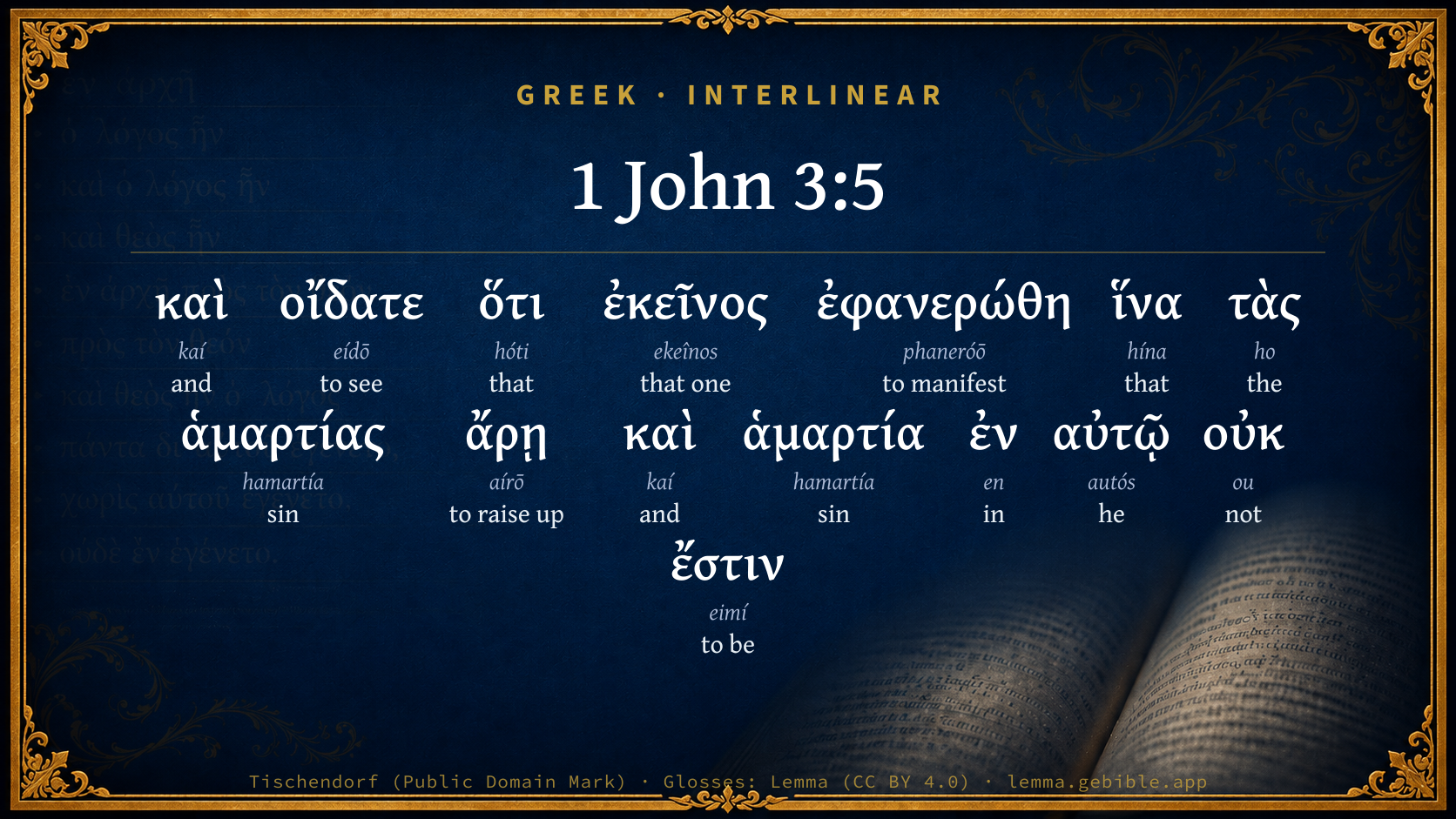
Download image
Cite this verse

1 John 3:5 (World English Bible). Public Domain. Lemma interlinear Bible study tool, https://lemma.gebible.app/v/1-john/3/5.

Show BibTeX & RIS
BibTeX
RIS
English Translation
You know that he was revealed to take away our sins, and in him is no sin.
World English Bible · Public Domain
Download a study sheet

One document with this verse’s original text, its word-by-word gloss line, the meaning frame, cross-references with their text, attributed commentary, and full source and license credits — printable, and it pastes into notes with its structure intact.

This verse Autodidact and up

Study sheet (.html) Plain text (.txt)

A passage Seminary Student

Up to 50 verses in one chapter. A passage sheet keeps up to 6 commentary sources and 12 cross-references per verse, in the order this page ranks them, and says so on the sheet whenever that leaves anything out. Ask for a single verse and you get the Autodidact verse sheet above.

Everything on this page stays free to read, with no account — the sheet is a download of what is already on screen, not access to it.

Want to remove ads? Support Godless Engineer
Compare translations 3

The same verse in 3 English versions, stacked beneath the original-language interlinear above. Click any original word for its lexicon entry.

Each is an independent rendering of the whole verse — the interlinear is not word-aligned to these translations.

Highlighted words mark where these versions differ — a whole-verse word diff, not a word-by-word alignment.

  • World English Bible Public Domain
    You know that he was revealed to take away our sins, and in him is no sin.
  • King James Version Public Domain
    And ye know that he was manifested to take away our sins; and in him is no sin.
  • unfoldingWord Literal Text CC BY-SA 4.0
    And you know that that one appeared so that he might take away sins, and sin is not in him.

unfoldingWord Literal Text — © unfoldingWord, licensed CC BY-SA 4.0. Word-aligned USFM3 via Door43 (git.door43.org/unfoldingWord/en_ult).

Versions to compare (up to 4)

3 of 4 selected

Show all 19 translations

Every available English version of this verse, each an independent rendering of the whole verse.

  • World English Bible Public Domain
    You know that he was revealed to take away our sins, and in him is no sin.
  • Berean Standard Bible Public Domain
    But you know that Christ appeared to take away sins, and in Him there is no sin.
  • Majority Standard Bible Public Domain
    But you know that Christ appeared to take away our sins, and in Him there is no sin.
  • King James Version Public Domain
    And ye know that he was manifested to take away our sins; and in him is no sin.
  • American Standard Version (1901) Public Domain
    And ye know that he was manifested to take away sins; and in him is no sin.
  • Revised Version (1885) Public Domain
    And ye know that he was manifested to take away sins; and in him is no sin.
  • Geneva Bible (1599) Public Domain
    And ye knowe that hee was made manifest, that he might take away our sinnes, and in him is no sinne.
  • Douay-Rheims (1899) Public Domain
    And you know that he appeared to take away our sins, and in him there is no sin.
  • Young's Literal Translation Public Domain
    and ye have known that he was manifested that our sins he may take away, and sin is not in him;
  • Literal Standard Version CC BY-SA 4.0
    and you have known that He appeared that He may take away our sins, and sin is not in Him;
  • Unlocked Literal Bible CC BY-SA 4.0
    You know that Christ was revealed in order to take away sins, and in him there is no sin.
  • unfoldingWord Literal Text CC BY-SA 4.0
    And you know that that one appeared so that he might take away sins, and sin is not in him.
  • Darby Bible Public Domain
    And ye know that *he* has been manifested that he might take away our sins; and in him sin is not.
  • World Messianic Bible Public Domain
    You know that he was revealed to take away our sins, and no sin is in him.
  • Webster's Bible Public Domain
    And ye know that he was manifested to take away our sins; and in him is no sin.
  • Free Bible Version CC BY-SA 4.0
    But of course you know that Jesus came to take away sins, and that there is no sin in him.
  • Bible in Basic English Public Domain
    And you have knowledge that he came to take away sin: and in him there is no sin.
  • Text-Critical English NT CC BY 4.0
    But you know that he appeared in order to take away our sins, and in him there is no sin.
  • Tyndale New Testament (1534) Public Domain
    And ye knowe that he appered to take awaye oure synnes and in him is no synne.

Literal Standard Version (2020), Covenant Press — licensed CC BY-SA 4.0. Text via the HelloAO Bible API (eBible.org). Unlocked Literal Bible (unfoldingWord) — licensed CC BY-SA 4.0. Text via the HelloAO Bible API (eBible.org). unfoldingWord Literal Text — © unfoldingWord, licensed CC BY-SA 4.0. Word-aligned USFM3 via Door43 (git.door43.org/unfoldingWord/en_ult). Free Bible Version, Dr. Jonathan Gallagher — licensed CC BY-SA 4.0. Text via the HelloAO Bible API (eBible.org).

Word by word

More ways to search: Search by grammar → Find every occurrence → Compare this word →

Practice this passage: Drill this verse → Learn its vocabulary →

ἐφανερώθη
phaneróō
G5319
“to manifest”
Verb, Aorist, Passive, Indicative, 3rd person, Singular
Part of Speech
Verb
Tense
Aorist
Voice
Passive
Mood
Indicative
Person
3rd person
Number
Singular
Full Thayer's Definition

Origin: from G5318

TDNT: 09:03,1

1. to make manifest or visible or known what has been hidden or unknown, to manifest, whether by words, or deeds, or in any other way a. make actual and visible, realised b. to make known by teaching c. to become manifest, be made known d. of a person 1. expose to view, make manifest, to show one's self, appear e. to become known, to be plainly recognised, thoroughly understood 1. who and what one is
  1. καὶ kaí G2532 “and” Conjunction
  2. οἴδατε eídō G1492 “to see” Verb, Perfect, Active, Indicative, 2nd person, Plural
  3. ὅτι hóti G3754 “that” Conjunction
  4. ἐκεῖνος ekeînos G1565 “that one” Demonstrative pronoun, Nominative, Singular, Masculine
  5. ἵνα hína G2443 “that” Conjunction
  6. τὰς ho G3588 “the” Article, Accusative, Plural, Feminine
  7. ἁμαρτίας hamartía G266 “sin” Noun, Accusative, Plural, Feminine
  8. ἄρῃ aírō G142 “to raise up” Verb, Aorist, Active, Subjunctive, 3rd person, Singular
  9. καὶ kaí G2532 “and” Conjunction
  10. ἁμαρτία hamartía G266 “sin” Noun, Nominative, Singular, Feminine
  11. ἐν en G1722 “in” Preposition
  12. αὐτῷ autós G846 “he” Personal pronoun, Dative, Singular, Masculine
  13. οὐκ ou G3756 “not” Particle, Negative
  14. ἔστιν eimí G1510 “to be” Verb, Present, Active, Indicative, 3rd person, Singular

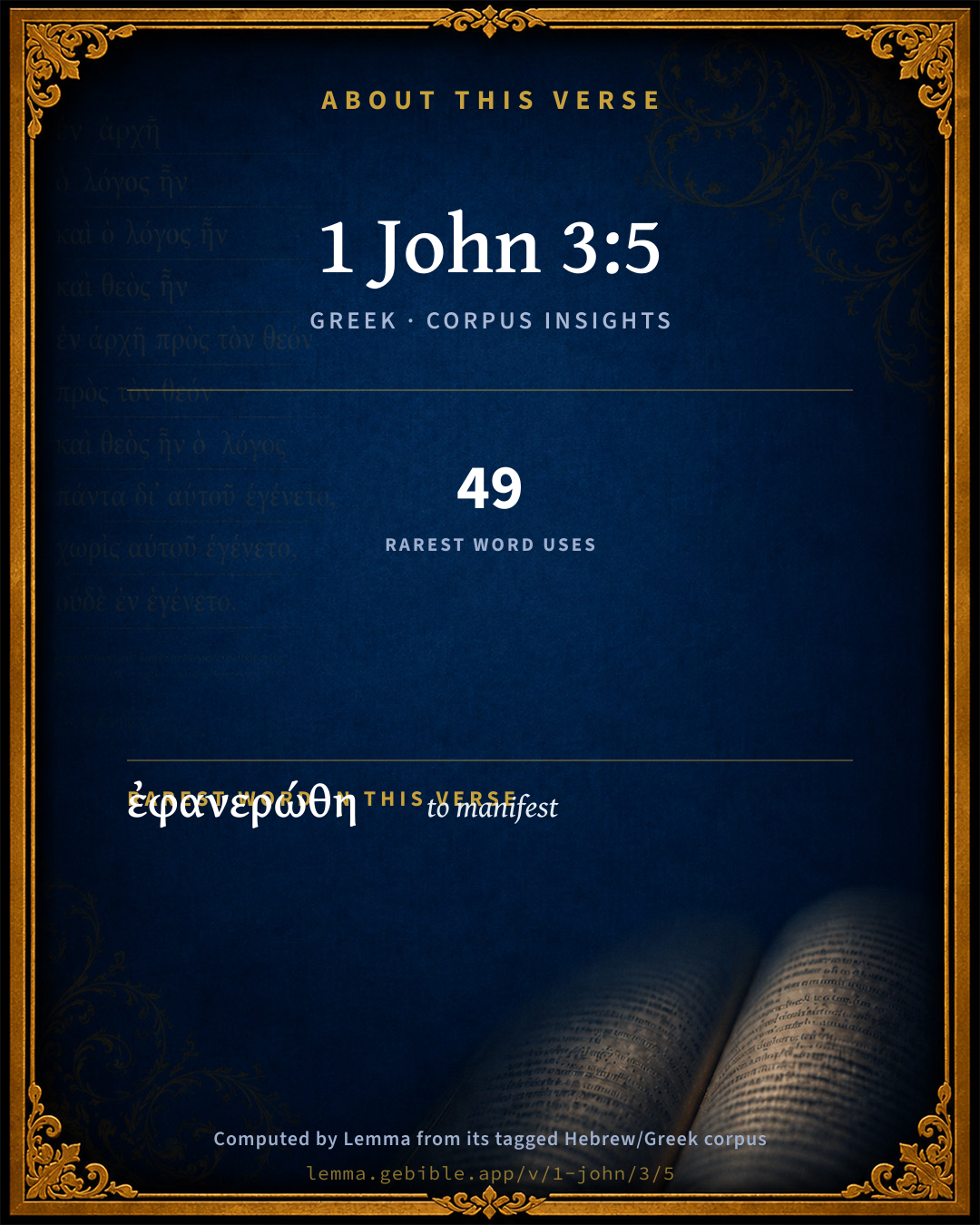
About this verse

These counts appear in no published source. They are computed here, from the morphology-tagged text and Lemma’s own curated glosses. What Lemma adds →

15
words
13
distinct lemmas
General Epistles
section

Shared distinctive vocabulary

ἐφανερώθη to manifest G5319 occurs in 43 verses of the Greek New Testament. Also found in:
Repetition

Words recur within this verse:

  • ἁμαρτίας sin G266 ×2
  • καὶ and G2532 ×2

Cross-references

29

Topical passages linked to 1 John 3:5 in the Treasury of Scripture Knowledge — connected by theme and wording, ordered by reader-vote popularity; previews shown in the World English Bible.

  • 2 Corinthians 5:21 For him who knew no sin he made to be sin on our behalf; so that in him we might become the righteousness of God.
  • Hebrews 9:28 so Christ also, having been once offered to bear the sins of many, will appear a second time, without sin, to those who are eagerly waiting for him for salvation.
  • 1 Peter 2:24 who his own self bore our sins in his body on the tree, that we, having died to sins, might live to righteousness; by whose stripes you were healed.
  • 1 Peter 3:18 Because Christ also suffered for sins once, the righteous for the unrighteous, that he might bring you to God; being put to death in the flesh, but made alive in the spirit;
  • Hebrews 9:26 or else he must have suffered often since the foundation of the world. But now once at the end of the ages, he has been revealed to put away sin by the sacrifice of himself.
  • John 1:29 The next day, he saw Jesus coming to him, and said, "Behold, the Lamb of God, who takes away the sin of the world!
  • Isaiah 53:4–12 Surely he has borne our sickness, and carried our suffering; yet we considered him plagued, struck by God, and afflicted.
  • Titus 2:14 who gave himself for us, that he might redeem us from all iniquity, and purify for himself a people for his own possession, zealous for good works.
  • 1 John 1:7 But if we walk in the light, as he is in the light, we have fellowship with one another, and the blood of Jesus Christ, his Son, cleanses us from all sin.
  • 1 John 4:9–14 By this was God's love revealed in us, that God has sent his one and only Son into the world that we might live through him.
  • Revelation 1:5 and from Jesus Christ, the faithful witness, the firstborn of the dead, and the ruler of the kings of the earth. To him who loves us, and washed us from our sins by his blood;
  • Matthew 1:21 She shall bring forth a son. You shall call his name Jesus, for it is he who shall save his people from their sins."
  • 1 Timothy 1:15 The saying is faithful and worthy of all acceptance, that Christ Jesus came into the world to save sinners; of whom I am chief.
  • Hebrews 1:3 His Son is the radiance of his glory, the very image of his substance, and upholding all things by the word of his power, when he had by himself made purification for our sins, sat down on the right hand of the Majesty on high;
  • 1 Peter 2:22 who did not sin, "neither was deceit found in his mouth."
  • 1 John 1:2 (and the life was revealed, and we have seen, and testify, and declare to you the life, the eternal life, which was with the Father, and was revealed to us);
  • Romans 3:24–26 being justified freely by his grace through the redemption that is in Christ Jesus;
  • Ephesians 5:25–27 Husbands, love your wives, even as Christ also loved the assembly, and gave himself up for it;
  • Hebrews 4:15 For we don't have a high priest who can't be touched with the feeling of our infirmities, but one who has been in all points tempted like we are, yet without sin.
  • 1 Peter 1:20 who was foreknown indeed before the foundation of the world, but was revealed at the end of times for your sake,
  • 1 John 2:1 My little children, I write these things to you so that you may not sin. If anyone sins, we have a Counselor with the Father, Jesus Christ, the righteous.
  • John 8:46 Which of you convicts me of sin? If I tell the truth, why do you not believe me?
  • Hebrews 7:26 For such a high priest was fitting for us: holy, guiltless, undefiled, separated from sinners, and made higher than the heavens;
  • Hosea 14:2 Take words with you, and return to Yahweh. Tell him, "Forgive all our sins, And accept that which is good: So we offer like bulls our lips.
  • Luke 23:41 And we indeed justly, for we receive the due reward for our deeds, but this man has done nothing wrong."
  • Luke 23:47 When the centurion saw what was done, he glorified God, saying, "Certainly this was a righteous man."
  • John 1:31 I didn't know him, but for this reason I came baptizing in water: that he would be revealed to Israel."
  • John 14:30 I will no more speak much with you, for the prince of the world comes, and he has nothing in me.
  • 1 Timothy 3:16 Without controversy, the mystery of godliness is great: God was revealed in the flesh, Justified in the spirit, Seen by angels, Preached among the nations, Believed on in the world, And received up in glory.

Cross-references courtesy of OpenBible.info (CC BY 4.0).

Where the printed editions differ

1 variant

Places in this verse where the major printed Greek editions disagree on the wording in a way that affects the translation — a comparison of editions, not a manuscript-by-manuscript collation. The editions are the modern critical texts (Nestlé-Aland 28/27, SBL, Westcott-Hort, Tregelles, Tyndale House) and the traditional texts behind the KJV (the Textus Receptus and the Byzantine/Majority text). It is not a claim about which reading is original.

  1. Extra text
    ἡμῶν

    “of us”

    In TRByz Not in NA28NA27TynSBLWHTreg

    ἡμῶν (hēmōn) 'of us' is only in traditional manuscripts (TR+Byz)

Textual data: Translators Amalgamated Greek New Testament (STEPBible TAGNT) · CC BY 4.0.

Commentary

Notes on 1 John 3:5 from classic Christian and Jewish commentators (each source and its license shown beneath its notes). The classic Christian expositions comment on the surrounding passage and are grouped to its opening verse, so a note may address several verses; the Jewish commentaries on the Tanakh (Rashi and others) are per-verse, so they appear only where the commentator wrote on this verse.

Lemma curates 59 commentaries, every one of them public domain or Creative Commons licensed, each selected and text-cleaned for this edition rather than reprinted as found. About our sources →

The Biblical Illustrator

Joseph S. Exell

1Jn_3:5

And in Him is no sin

The personal history and character of Christ: the influence of character

It has always been felt, even by men who did not view the matter from the Christian standpoint, that the immediate effects of the mission of Christ must be largely ascribed to the influence of that Divine personality which He allied with human nature, and which brought Him into contact, at every stage of His earthly sojourn, with the sorrows, the necessities, and the sympathies of life.

The same feeling has brought it to pass that the love of Christ, rather than any other form of the religious sentiment, represents the very heart and centre of the Christian character. The love of Christ constraineth us, says the apostle; and the love of Christ alone supplies the strong and overruling motive which can conquer the unrighteousness, the impurity, the selfish darkness of the world. It is a leading principle thus suggested by the history of Christ that the power of individual character, with all the special force of sympathy, self-sacrifice, and love, is the most essential element in every kind of influence which has ever brought about great movements or given a right direction to the impulse of change. It is true that the influence must be followed up and perpetuated by a wise organisation; but the best organisation will go for little or nothing if it is not permanently actuated by this individual power. Never has this fruitful principle received so grand an illustration as when the Word was made flesh and dwelt amongst us. The amazing power which our Lord exerted lay not so much in His words and deeds as in the character from which they sprang, not so much in His maxims of charity as in His life of love. This is a more than sufficient answer to the cavils of some who have endeavoured to depreciate the greatness of our Saviours teaching by trying to prove that it has no new message that He brought into the world. Be that as it may, it was something greater then a new message--it was above all things a new life. When Gibbon mockingly wrote that he had read the golden rule of doing as we would be done by in a moral treatise of Isocrates, written four hundred years before the publication of the Gospel, his words were true enough, but perfectly irrelevant. No one need be in the least surprised to hear it. He might have found much that sounds like the golden rule in a hundred places; hut what he would have found was the shadow, not the power. The mere precept was nothing better than a well-sounding phrase till it was lifted into life and energy by the quickening influence and example of the love of Christ. The power of Christ was both Divine and human--exerted by One who was the Son of Man aa well as the only begotten Son of God. Consider how these two elements were always blended together to constitute the unprecedented manifestation of the Gospel. The life of Christ, then, is the noblest example of the power of influence, just as the Church of Christ is the grandest illustration of the value of system, that have ever yet been made known among mankind. Here we are dealing with a law of universal application. For the two things, influence and system, are the elements which meet in all great institutions; the one to give force and impetus; the other to supply a preservative and perpetuating power. In God Himself these two principles are united in completeness and perfection. His power is as supreme as though no such thing as law existed. His order is so perfect that He is a law unto Himself and to all other things besides. While both of these are illustrated in the life of Christ and in the Church, both of them rank among the best gifts which God has bestowed on His creatures for the discharge of their work and the improvement of their race. The life of influence is indispensable to give vigour to system; the protection of system is just as requisite to prevent the life of a new impulse from evaporating and loving itself when the motive power has been withdrawn. For such as ourselves the strongest element of personal influence will be found in the sympathy of simple human fellowship--a sympathy which will lead us, in spite of all differences of education and position, to lay mind to mind and heart to heart in dealing with those whom influence can reach, so that, lowly as may be the object which we seek to elevate, a loving and unselfish sympathy may enable us, if the word be not too bold, and if only we may be so highly privileged to lift their nought to value by our side. There never was a time when it was more important to realise this great social gift of sympathy. (Archdeacon Hannah.)

The secret of sinlessness--abiding in the Sinless One as manifested to take away our sins

I. Consider, first, for what end He was manifested. It was to take away our sins. John has just described sin as the transgression of the law (verse 4). He has fastened upon this as constituting the essence of sin. He is of the same mind with Paul (Rom_8:7). His, like Paul, knows that as our sins are against the law, so the law is against our sins. In the grasp and under the power of the law, as condemned criminals, we are fettered; and can no more get rid of our sins than a doomed felon can shake off his irons. An impotent sense of failure deadens and depresses us, while the feeling of our prostrate bondage in our sins irritates our natural enmity against God. And if we do not relapse into indifference, or take refuge in formality, or sink into sullen gloom, we are shut up to the one only effectual way of ending this miserable struggle between the law and our sinful nature--the way of free grace and sovereign mercy; the way of embracing Him whom God hath set forth to be a propitiation through faith in His blood. Then indeed sin shall no more have dominion over us, when we are not under the law, but under grace; when there is now to us no condemnation because we are in Christ Jesus. All this, I think, must be held to be comprehended in the fact stated--He was manifested to take away our sins. And it is all consistent with the object for which John reminds us of it: our purifying ourselves, as He is pure. He was manifested to take away our sins, root and branch. Their power to condemn us He takes away; and so He takes away also their power to rule over us. Nor is this all. In virtue of His being manifested to take away our sins, we receive the Holy Ghost. The obstacle which our sin, as a breach of the law, interposed to His being graciously present with us and in us is taken away. A new nature, a new heart, a new spirit, as respects the law of God and God the lawgiver, a new character as well as a new state, is the result of Christ being manifested to take away our sins. We know that, personally, practically, experimentally, and our knowledge of it is what enables as well as moves us to purify ourselves as Christ is pure. It is so all the rather because, secondly, we are to consider that He is manifested as Himself the Sinless One--In Him is no sin.

II. With this sinless person we are one, abiding in Him as the Sinless One manifested to take away our sins. And that is our security against sinning--Whosoever abideth in Him sinneth not. This is the statement of a fact. Between abiding in Christ and sinning there is such an absolute incompatibility that whosoever sinneth is for the time not merely in the position of not abiding in Christ, but in the position of not having seen or known Him.

1. We abide in Christ by faith; by that faith, wrought in us by the Spirit, which unites us to Christ. Our abiding in Him by this faith implies oneness, real and actual oneness. When we sin, when we suffer any such thought, or feeling, or wish to find harbour in our breasts, we cease for the time to be abiding in Him.

2. We abide in Christ by His Spirit abiding in us. That is a filial spirit--the Spirit of Gods Son in us crying Abba Father--the Spirit of adoption in us whereby we cry Abba Father. (R. S. Candlish, D. D.)

The Biblical Illustrator, edited by Joseph S. Exell (c. 1880s–1900s) — public domain. Text from a community e-Sword module.

Bengel's Gnomon

Johann Albrecht Bengel

1Jn 3:5. Ἐφανερώθη, was manifested) in the flesh.—τὰς ἁμαρτίας ἡμῶν, our sins) inasmuch as they are especially displeasing to Him.—ἄρῃ, He might take away) Joh 1:29, note.—ἐν αὐτῷ, in Him) The sentence, He is righteous, 1Jn 3:7, has reference to this.

Bengel's Gnomon of the New Testament — English translation (T&T Clark, Edinburgh, 1860) — public domain. Text from a community e-Sword module.

Meyer's Critical & Exegetical Commentary

Heinrich August Wilhelm Meyer

1Jn_3:5 contains a new proof of the incompatibility of the Christian life with sin; this exists in Christ, to whose example the apostle has already pointed in 1Jn_3:3. Of Christ John states two things, while he appeals to the consciousness of his readers (οἴδατε; the same is the case with the reading of א: οἴδαμεν)(1) that His manifestation (ἐφανερώθη, an expression which refers to the previously unrevealed existence of Christ in heaven) had this purpose: ἵνα τὰς ἁμαρτίας ἄρῃ; and (2) that He is without sin.

τὰς ἁμαρτίας αἴρειν may, of course, mean in itself to bear our sins, i.e. as the atoning sacrifice, in order thereby to procure their forgiveness, but here it means to take away, to remove our sins; for even although the Hebrew expression נָשָׂא עָוֹן signifies both, yet the LXX. translates this in the second sense only by αἴρειν, but in the first sense by φέρειν (comp. Meyer on Joh_1:29, and my comm. on 1Pe_2:24); moreover, αἴρειν with John constantly means to take away; comp. Joh_11:48, Joh_15:2, Joh_17:15, Joh_19:31; Joh_19:38; and the context is also decisive in favour of this meaning, for even though in the thought that Christ bore our sins, inasmuch as He suffered for them, there lies a mighty impulse to avoid sins, yet the antagonism of the Christian life to sin appears more directly and more strongly if the taking away of sins is described as the purpose of the manifestation of Christ. Köstlin (p. 180) rightly says: the expression signifies to take away the sins themselves, but not their guilt or their punishment, for it is added: καὶ ἁμ. ἐν αὐτῷ οὐκ ἔστιν, and in 1Jn_3:8 : ἔργα τοῦ διαβόλου. This interpretation in Calvin, Luther, Russmeyer, Paulus, Baumgarten-Crusius, Neander, Frommann (p. 449), Düsterdieck, Myrberg, Ebrard, Braune, etc., contrary to which Lücke, de Wette, Erdmann, etc., explain αἴρειν = to bear; Lücke: the object of the manifestation of Christ is the bearing of sins as a holy offering in His death; while others, as Bede (tollit et dimittendo quae facta sunt et adjuvando ne fiant et perducendo ad vitam, ubi fieri omnino non possint), Socinus, a Lapide, Spener, Sander, Besser (also Lücke in his 1st ed.[204]), combine both meanings. Weiss, it is true, interprets ΑἼΡΕΙΝ correctly, but thinks that the plural ἉΜΑΡΤΊΑς can only signify actually existing sins which Christ takes away, inasmuch as His blood cleanses us from their guilt; but in the whole context the subject is not the guilt of sins, but the sins themselves. The plural, however, by no means renders that interpretation compulsory.

The pronoun ἡμῶν after ΤᾺς ἉΜΑΡΤΊΑς (see the critical notes) is regarded by Lücke and de Wette as genuine; Lücke: because John would otherwise have written ΤῊΝ ἉΜΑΡΤΊΑΝ; de Wette: because its omission appears to be occasioned by the interpretation of ΑἼΡΕΙΝ = to remove; Düsterdieck remarks against ἡμῶν, that in the whole section 1Jn_3:4-10 there is no direct application expressed; from internal grounds it cannot be decided, inasmuch as ΤᾺς ἉΜΑΡΤ. ἩΜῶΝ can be taken quite as generally as the simple ΤᾺς ἉΜΑΡΤΊΑς. In regard to the plural ΤᾺς ἉΜΑΡΤΊΑς, Düsterdieck rightly says that thereby the form of representation is made so much the more vivid, as the whole mass of all individual sins is taken into view. It is to be observed that John does not regard Christ, according to the Pelagian mode of thought, only as the motive for the free self-determination of man, but as the active living cause of sanctification determining the will of man. It is His crucifixion especially from which proceeds, not only the forgiveness of sins, but also (in and with this) the new life, in which the believer purifies himself (ἁγνίζει), even as He is pure (ἉΓΝΌς).

The second thing which John states of Christ is: ΚΑῚ ἉΜΑΡΤΊΑ ἘΝ ΑὐΤῷ ΟὐΚ ἜΣΤΙ. The meaning of these words is not that in those who are in Christ there is no sin (Calvin, Paulus), but that Christ Himself is without sin; comp. 1Jn_3:3; 1Jn_2:29. This clause is not meant to confirm the preceding one (a Lapide: ideo Christus potens fuit tollere peccatum, quia carebat omni peccato, imo potestate peccandi; so also Oecumenius, Lorinus, Baumgarten-Crusius, Sander, Neander); but it is co-ordinate with it (Lücke, de Wette-Brückner, Düsterdieck, Braune), in order to serve as a basis for the following statement.

The present ἘΣΤΊ is not used instead of the preterite (Grotius), nor is it to be explained in this way, with Winer (p. 239, VII. 251), that the sinlessness of Jesus is considered as still present in faith; but it rather denotes, as in 1Jn_3:3, the character of Christ in its eternal existence.

[204] Αἴρειν τ. ἁμ. ἡμῶν corresponds to the καθαρίζειν ἀπὸ πάσης ἁμ., 1Jn_1:7, and signifies the whole extent of the redemptive activity of Christ, His office of taking away sin, both in the ideal sense by the act of forgiving sin, and also in the real sense by the act of sanctifying the saved.

Meyer — Critical and Exegetical Commentary on the New Testament — English translation by Peter Christie, edited by Frederick Crombie (T&T Clark, 1880) — public domain. Text from a community e-Sword module.

Expositor's Greek Testament

ed. W. Robertson Nicoll

1Jn 3:5 . The purpose of the Incarnation was to “take away the sins” atone for the sins of the past and prevent sins in the future, αἴρειν , properly “lift up and carry away” ( cf. Mar 6:29 ; Joh 2:16 ), but the idea of expiation is involved since it is “the Lamb of God” that “taketh away the sins”. ἐκεῖνος , see note on 1Jn 2:6 . ἁμαρτία , “sin,” i.e. the sinful principle: see note on 1Jn 1:8 .

The Expositor's Greek Testament, edited by W. Robertson Nicoll (1897–1910) — public domain. Text from a community e-Sword module.

Vincent's Word Studies in the New Testament

Marvin R. Vincent

Ye know. John's characteristic appeal to Christian knowledge. Compare 1Jo 2:20, 21; 1Jo 4:2, 14, 16; 1Jo 5:15, 18; 3Jo 1:12.

He [εκεινος] . Christ, as always in this Epistle. See on Joh 1:18. Was manifested. See on Joh 21:1. Including Christ 's whole life on earth and its consequences. The idea of manifestation here assumes the fact of a previous being. John various terms to describe the incarnation. He conceives it with reference to the Father, as a sending, a mission. Hence oJ pemyav me He that sent me (Joh 4:34; Joh 6:38; Joh 9:4; Joh 12:44, etc.) : oJ pemyav me pathr the Father that sent me (Joh 5:37; Joh 8:18; Joh 12:49, etc.) : with the verb ajpostellw to send as an envoy, with a commission; God sent [απεστειλεν] His Son (Joh 3:17; Joh 10:36; 1Jo 4:10; conpare Joh 6:57; Joh 7:29; Joh 17:18). With reference to the Son, as a coming, regarded as a historic fact and as an abiding fact. As a historic event, He came (h=lqen, Joh 1:11); this is He that came (oJ ejlqwn, 1Jo 5:6). Came forth (ejxhlqon; Joh 8:42; Joh 16:27, 28; Joh 27:8). As something abiding in its effects, am come, hath come, is come, marked by the perfect tense : Light is come (ejlhluqen, Joh 3:19). Jesus Christ is come (ejlhluqota, 1Jo 4:2). Compare Joh 5:43; Joh 12:46; Joh 18:37). In two instances with hkw I am come, Joh 8:42; 1Jo 5:20. Or with the present tense, as describing a coming realized at the moment : whence I come (ercomai, Joh 8:14); compare Joh 14:3, 18, 28; also Jesus Christ coming (ejrcomenon, 2 John 7). With reference to the form : in flesh [σα. ρξ] . See Joh 1:14; 1Jo 4:2; 2 John 7. With reference to men, Christ was manifested (1Jo 1:2; 1Jo 3:5, 8; Joh 1:31; Joh 21:1, 14). 66 To take away [ινα αρη] . See on Joh 1:29.

Our sins [τας αμαρτιας ημων] . Omit hJuwn our. Compare Joh 1:29, thn aJmartian, the sin. The plural here regards all that is contained in the inclusive term the sin : all manifestations or realizations of sin.

In Him is no sin [αμαρτια εν αυτω ουκ εστιν] . Lit., in Him sin is not. He is essentially and forever without sin. Compare Joh 7:18.

Marvin R. Vincent, Word Studies in the New Testament (1887–1900) — public domain. Text from a community e-Sword/MySword module.

Geneva Bible (1599)

Geneva Bible translators

An argument taken from the material cause of our salvation: Christ in himself is most pure, and he came to take away our sins, by sanctifying us with the holy Ghost. Therefore, whosoever is truly partaker of Christ doth not give himself to sin: and so contrariwise he that giveth himself to sin knoweth not Christ.

Geneva Bible (1599) marginal notes — public domain. Text via Bolls.life.

Jamieson, Fausset & Brown

Robert Jamieson, A. R. Fausset & David Brown

Additional proof of the incompatibility of sin and sonship; the very object of Christ's manifestation in the flesh was to take away (by one act, and entirely, aorist) all sins, as the scapegoat did typically.

and--another proof of the same.

in him is no sin--not "was," but "is," as in Jo1 3:7, "He is righteous," and Jo1 3:3, "He is pure." Therefore we are to be so.

Jamieson, Fausset & Brown — Commentary Critical and Explanatory on the Whole Bible (1871) — public domain (CC PDM 1.0). Text via the HelloAO Bible API.

Adam Clarke's Commentary

Verse 5. And ye know that he was manifested to take away our sins] He came into the world to destroy the power, pardon the guilt, and cleanse from the pollution of sin. This was the very design of his manifestation in the flesh. He was born, suffered, and died for this very purpose; and can it be supposed that he either cannot or will not accomplish the object of his own coming?

In him is no sin.] And therefore he is properly qualified to be the atoning sacrifice for the sins of men.

Adam Clarke's Commentary on the Bible (1810–1826) — public domain. Text from a community e-Sword/MySword module.

John Calvin's Commentaries

5 And ye know that he was manifested, or, hath appeared. He shews by another argument how much sin and faith differ from one another; for it is the office of Christ to take away sins, and for this end was he sent by the Father; and it is by faith we partake of Christ’s virtue. Then he who believes in Christ is necessarily cleansed from his sins. But it is said in John 1:29, that Christ takes away sins, because he atoned for them by the sacrifice of his death, that they may not be imputed to us before God: John means in this place that Christ really, and, so to speak, actually takes away sins, because through him our old man is crucified, and his Spirit, by means of repentance, mortifies the flesh with all its lusts. For the context does not allow us to explain this of the remission of sins; for, as I have said, he thus reasons, “They who cease not to sin, render void the benefits derived from Christ, since he came to destroy the reigning power of sin.” This belongs to the sanctification of the Spirit.

And in him is no sin He does not speak of Christ personally, but of his whole body. Wherever Christ diffuses his efficacious grace, he denies that there is any more room for sin. He, therefore, immediately draws this inference, that they sin not who remain in Christ. For if he dwells in us by faith, he performs his own work, that is, he cleanses us from sins. It hence appears what it is to sin For Christ by his Spirit does not perfectly renew us at once, or in an instant, but he continues our renovation throughout life. It cannot then be but that the faithful are exposed to sin as long as they live in the world; but as far as the kingdom of Christ prevails in them, sin is abolished. In the meantime they are designated according to the prevailing principle, that is, they are said to be righteous and to live righteously, because they sincerely aspire to righteousness.

They are said not to sin, because they consent not to sin, though they labor under the infirmity of the flesh; but, on the contrary, they struggle with groaning, so that they can truly testify with Paul that they do the evil they would not.

He says that the faithful abide in Christ, because we are by faith united to him, and made one with him.

John Calvin's Commentaries (1540-1563) — public domain. Text from the Calvin Translation Society English edition (1840s-50s) via the Christian Classics Ethereal Library (ccel.org). Calvin's coverage is partial (roughly two-thirds of the Bible); uncommented books and verses are honest gaps, never fabricated. The 19th-century editor's footnotes and remarks are omitted so the notes are faithfully Calvin's own voice.

The Cambridge Bible for Schools and Colleges

gen. ed. J. J. S. Perowne

5. That sin is incompatible with Divine birth is still further enforced by two facts respecting the highest instance of Divine birth. The Son of God (1) entered the world of sense to put away all sin, (2) was Himself absolutely free from sin.

ye know] The Apostle once more (1Jn_2:21, 1Jn_3:2) appeals to the knowledge which as Christians they must possess.

that he was manifested] See on 1Jn_2:28 : the rendering here should govern the rendering there and in 1Jn_3:2. Here, as in 1Jn_3:8 and 1Jn_1:2, the manifestation of the Word in becoming visible to human eyes is meant; the Incarnation. The expression necessarily implies that He existed previous to being made manifest.

to take away our sins] Literally, to take away the sins, i.e. all the sins that there are. If ‘our sins’ means ‘the sins of us men’ and not ‘the sins of us Christians’, the rendering is admissible, even if the addition ‘of us’ (אC Thebaic) is not genuine. As already stated, the article is often used in Greek where in English we use a possessive pronoun. ‘To take away’ (αἴρειν) is the safest rendering; for this is all that the Greek word necessarily means (see on Joh_1:29). Yet it is not improbable that the meaning of ‘to bear’ is included: He took the sins away by bearing them Himself (1Pe_2:24). This, however, is not S. John’s point. His argument is that the Son’s having become incarnate in order to abolish sin shews that sin is inconsistent with sonship: the way in which He abolished it is not in question.

in him is no sin] This is an independent proposition and must not be connected with ‘ye know that’. The order of the Greek is impressive; sin in Him does not exist. Christ not merely was on earth, but is in heaven, the eternally sinless One. He is the perfect pattern of what a son of God should be. This, therefore, is yet another proof that sin and sonship are incompatible. Comp. Joh_7:18.

The Cambridge Bible for Schools and Colleges (gen. ed. J. J. S. Perowne; Cambridge University Press, 1878–1918) — public domain. Text from a community e-Sword module.

John Gill's Exposition

And ye know that he was manifested,.... This is a truth of the Gospel the saints were well instructed in and acquainted with; that Jesus Christ, the Word and Son of God, who is here meant, who was with the Father, and lay in his bosom from all eternity, was in the fulness of time made manifest in the flesh, or human nature, by assuming it into union with his divine person; in which he came and dwelt among men, and became visible to them: the end of which manifestation was,

to take away our sins; as the antitype of the scape goat, making reconciliation and satisfaction for them, through the sacrifice of himself; which was doing what the blood of bulls and goats, or any legal sacrifices or moral performances, could never do: and this he did by taking the sins of his people upon himself, by carrying them up to the cross, and there bearing them, with all the punishment due unto them, in his body; by removing them quite away, and utterly destroying them, finishing and making an end of them: and by causing them to pass away from them, from off their consciences, through the application of his blood by his Spirit:

and in him is no sin; neither original, nor actual; no sin inherent; there was sin imputed to him, but none in him, nor done by him; and hence he became a fit person to be a sacrifice for the sins of others, and by his unblemished sacrifice to take the away; and answered the typical sacrifices under the law, which were to be without spot and blemish: and this shows that he did not offer himself for any sins of his own, for there were none in him, but for the sins of others; and which consideration, therefore, is a strong dissuasive from sinning, and as such is mentioned by the apostle; for, since sin is of such a nature that nothing could atone for it but the blood and sacrifice of Christ, an innocent, as well as a divine person, it should be abhorred by us; and since Christ has taken it away by the sacrifice of himself, it should not be continued and encouraged by us; and since in him is no sin, we ought to imitate him in purity of life and conversation; the end of Christ's bearing our sins was, that we might live unto righteousness, and to purify to himself a peculiar people, zealous of good works; and his love herein should constrain us to obedience to him: so the Jews (l) speak of a man after the image of God, and who is the mystery, of the name Jehovah; and in that man, they say, there is no sin, neither shall death rule over him; and this is that which is said, Psa 5:4; neither shall evil dwell with thee.

(l) Sepher Tikkunim, fol. 112. 1. apud Rittangel, de ver. Rel. Christ, p. 68.

John Gill's Exposition of the Whole Bible (1746–1763) — public domain (CC PDM 1.0). Text via the HelloAO Bible API.

Trapp's Complete Commentary

John Trapp

5 And ye know that he was manifested to take away our sins; and in him is no sin.

Ver. 5. To take away our sins] Shall sin live that killed Christ? Shall I drink the blood of these men? said David of those that but ventured their lives for him. Oh that each Christian would turn Jew to himself, and kill the red cow, &c.; present himself a whole burnt sacrifice to God; not going about to frustrate the end of Christ’s incarnation and passion, by retaining that sin that he came to take away, lest that doleful sentence be passed upon him, that was once upon the stubborn Jews, "Ye shall die in your sins," Joh 8:21; Joh 8:24.

John Trapp, A Commentary or Exposition upon All the Books of the Old and New Testament (1647–1656) — public domain. Text from a community e-Sword module.

Albert Barnes' Notes on the Bible

And ye know that he was manifested - The Lord Jesus, the Son of God. “You know that he became incarnate, or appeared among people, for the very purpose of putting an end to sin,” Mat 1:21. Compare the notes at 1Ti 3:16. This is the “second” argument in this paragraph, 1Jo 3:4-10, by which the apostle would deter us from sin. The argument is a clear one, and is perhaps the strongest that can be made to bear on the mind of a true Christian - that the Lord Jesus saw sin to be so great an evil, that he came into our world, and gave himself to the bitter sorrows of death on the cross, to redeem us from it.

To take away our sins - The essential argument here is, that the whole work of Christ was designed to deliver us from the dominion of sin, not to furnish us the means of indulgence in it; and that, therefore, we should be deterred from it by all that Christ has done and suffered for us. He perverts the whole design of the coming of the Saviour who supposes that his work was in any degree designed to procure for his followers the indulgences of sin, or who so interprets the methods of his grace as to suppose that it is now lawful for him to indulge his guilty passions. The argument essentially is this:

That we profess to be the followers of Christ, and should carry out his ends and views in coming into the world;

(2)That the great and leading purpose of his coming was to set us free from the bondage of transgression;

(3)That in doing this he gave himself up to a life of poverty, and shame, and sorrow, and to a most bitter death on the cross; and,

(4)That we should not indulge in that from which he came to deliver us, and which cost him so much toil and such a death. How could we indulge in that which has brought heavy calamity upon the head of a father, or which has pierced a sister’s heart with many sorrows? Still more, how can we be so ungrateful and hardhearted as to indulge in that which crushed our Redeemer in death?

And in him is no sin - An additional consideration to show that we should be holy. As he was perfectly pure and spotless, so should all his followers aim to be; and none can truly pretend to be his who do not desire and design to become like him. On the personal holiness of the Lord Jesus, see the Heb 7:26 note, and 1Pe 2:23 note.

Albert Barnes' Notes on the Bible (1834–1885) — public domain. Text from a community e-Sword/MySword module.

Matthew Poole's English Annotations

Implying how great an absurdity it were, to expect salvation and blessedness by our sinless Saviour, and yet indulge ourselves in sin, against his design, not only to expiate our sins, but make us sinless like himself.

Matthew Poole's English Annotations on the Holy Bible (1683–1685) — public domain. Text from a community e-Sword/MySword module.

Whedon's Commentary on the Bible

Daniel D. Whedon

5. Ye know—By the old apostolic teaching from Christ himself, that so far is our Christianity from admitting that transgression is consistent with regeneration, he was manifested for this very purpose, to take away our sins—our violations of law—whether in single act or permanent state.

No sin—Either of act or character. He violated not God’s law, but was in perfect conformity to it.

Daniel D. Whedon (gen. ed.), Commentary on the Old and New Testaments (1874–1909) — public domain. Text from a community e-Sword module.

The Pulpit Commentary

Two additional reasons for the absolute separation of the children of God from sin.

(1) They know well that the Son of God was manifested in the flesh to put away the sins; (of the world, Joh_1:29) not mere "sins," one here and one there, but "the sins" taav, whatever sins exist. Hmwn, though strongly supported, is probably not genuine. Ai]ren in itself means not "to take on himself, or bear," but "to take away;" it expresses the removal rather than the manner of removal. But it may represent the Hebrew nasa, which combines the two meanings (Lev_10:17; Isa_53:12)

(2) The Son of God was absolutely separated from sin.

The Pulpit Commentary (1880–1919), ed. H.D.M. Spence-Jones & Joseph S. Exell — public domain. Text from a community e-Sword module.

John Wesley's Explanatory Notes

And ye know that he - Christ. Was manifested - That he came into the world for this very purpose. To take away our sins - To destroy them all, root and branch, and leave none remaining. And in him is no sin - So that he could not suffer on his own account, but to make us as himself.

John Wesley, Explanatory Notes Upon the Whole Bible (1754–1765) — public domain. Text via the GEBible commentary corpus.

The People's New Testament

B. W. Johnson

5. Was manifested to take away our sins. Christ came, not only to take away our sins by their remission, but to take away our disposition to sin.

B. W. Johnson's The People's New Testament with Notes (1889–1891) — public domain. Electronic text from the Christian Classics Ethereal Library (CCEL) ThML edition.

Cambridge Greek Testament for Schools and Colleges

5. After ἁμαρτίας omit ἡμῶν with [598][599] and most Versions against [600][601][602][603] and the Thebaic. [604] and the Thebaic have οἴδαμεν for οἴδατε.

[598] 5th century. Brought by Cyril Lucar, Patriarch of Constantinople, from Alexandria, and afterwards presented by him to Charles I. in 1628. In the British Museum. All three Epistles.

[599] 4th century. Brought to Rome about 1460. It is entered in the earliest catalogue of the Vatican Library, 1475. All three Epistles.

[600] 4th century. Discovered by Tischendorf in 1859 at the monastery of S. Catherine on Mount Sinai, and now at Petersburg. All three Epistles.

[601] 5th century. A palimpsest: the original writing has been partially rubbed out and the works of Ephraem the Syrian have been written over it. In the National Library at Paris. Part of the First and Third Epistles; 1Jn 1:1 to 1Jn 4:2; 3Jn 1:3-14. Of the whole N.T. the only Books entirely missing are 2 John and 2 Thessalonians.

[602] 9th century. All three Epistles.

[603] 9th century. All three Epistles.

[604] 4th century. Discovered by Tischendorf in 1859 at the monastery of S. Catherine on Mount Sinai, and now at Petersburg. All three Epistles.

5. That sin is incompatible with Divine birth is further enforced by two facts respecting the highest instance of Divine birth. The Son of God (1) entered the world of sense in order to put away sin; and therefore those who sin thwart His work: (2) was Himself absolutely free from sin; and therefore those who sin disregard His example.

οἴδατε. [696] and the Thebaic read οἴδαμεν. As in 1Jn 3:2 and 1Jn 2:21, the Apostle appeals to that knowledge which as Christians they must possess. The translation of ἐφανερώθη here must govern the translation in 1Jn 3:2 and 1Jn 2:28, where see note. Here, as in 1Jn 3:8 and 1Jn 1:2, the manifestation of the Λόγος in becoming visible to human eyes is meant,—the Incarnation. The expression necessarily implies that He existed previous to being made manifest.

[696] 4th century. Discovered by Tischendorf in 1859 at the monastery of S. Catherine on Mount Sinai, and now at Petersburg. All three Epistles.

ἵνα τὰς ἁμαρτ. ἄρῃ. Literally, that He might take away the sins, i.e. all the sins that there are. If ‘our sins’ means ‘the sins of us men’ and not ‘the sins of us Christians,’ the rendering is admissible, even if the addition ἡμῶν ([697][698] Thebaic) is not genuine. As already stated, the article is often used in Greek where in English we use a possessive pronoun. ‘To take away’ is the safest rendering; for this is all that the Greek word necessarily means (see on Joh 1:29). Vulgate, tolleret; Augustine, auferat. Yet it is not improbable that the meaning of ‘to bear’ is included: He took the sins away by bearing them Himself (1Pe 2:24). This, however, is not S. John’s point. His argument is that the Son’s having become incarnate in order to abolish sin shews that sin is inconsistent with sonship: the way in which He abolished it is not in question.

[697] 4th century. Discovered by Tischendorf in 1859 at the monastery of S. Catherine on Mount Sinai, and now at Petersburg. All three Epistles.

[698] 5th century. A palimpsest: the original writing has been partially rubbed out and the works of Ephraem the Syrian have been written over it. In the National Library at Paris. Part of the First and Third Epistles; 1Jn 1:1 to 1Jn 4:2; 3Jn 1:3-14. Of the whole N.T. the only Books entirely missing are 2 John and 2 Thessalonians.

καὶ ἁμ.… οὐκ ἔστιν. This is an independent proposition and must not be connected with οἴδατε ὅτι. The order of the Greek is impressive; sin in Him does not exist. And the tense is significant. Christ not merely was on earth, but is in heaven, the eternally sinless One. He is the perfect pattern of what a son of God should be. This, therefore, is yet another proof that sin and sonship are incompatible. Comp. Joh 7:18. Nemo tollit peccata, quae nec lex quamvis sancta et justa et bona potuit aujerre, nisi ille in quo peccatum non est (Bede).

Cambridge Greek Testament for Schools and Colleges (Cambridge University Press, 1896; 21 vols, various authors incl. Carr, Maclear, Plummer, Farrar, Lumby, Moule, M. R. James, Simcox) — public domain. Text from a community e-Sword module.

Alford’s Greek Testament

Henry Alford

5.] Additional argument for the incompatibility of sin with the life of God’s children; that He, Christ, in and by whom we have this adoption (Joh 1:12), and by being in whose likeness alone we can be perfectly like God, was manifested to take away all sins, being Himself sinless. And ye know (the Apostle assumes it as known by those who had an anointing from the Holy One and knew all things, ch. 2:20) that He (now clearly Christ, from the context, which (see above on ἐκεῖνος, ver. 3) can alone decide the reference in each case) was manifested (viz. by His appearing in the flesh, and all that He openly and visibly did and taught in it, or may be known, by the Spirit, to have done and taught) in order that He may (might) take away (aor. “take away by one act and entirely”. The meaning, “take away,” and not “bear,” is necessitated here by the context. Sin is altogether alien from Christ. He became incarnate that He might blot it out: He has no stain of it on Himself. If we render ἄρῃ “bear,” this coherence is lost. Of course this fact is in the background, that He took them away by bearing them Himself: but it is not brought out, only the antagonism between Him and sin. See, on the word, the note on ref. John) sins (τὰς ἁμαρτ., all sins, not merely certain sins. The object of his manifestation is stated not only categorically, but definitively. Compare the striking parallel Heb 9:26, εἰς ἀθέτησιν ἁμαρτίας διὰ τῆς θυσίας αὐτοῦ πεφανέρωται); and in Him sin is not (as His work, in being manifested, was, altogether to take away sin, so likewise is He himself free from all spot of sin. The καί serves to co-ordinate the last clause with the first, not to subordinate it, as many Commentators have supposed, and even Aug.: “In quo non est peccatum, ipse venit auferre peccatum: nam si esset et in illo peccatum, auferendum esset illi, non ipse auferret:” and Œc., τὸ καὶ ἀντὶ τοῦ διότι: and afterwards, ἵνα ὡς μὴ ἁμαρτίαν ποιὴσας τὰς ἁμαρτίας ἡμῶν ἄρῃ: so also Corn.-a-lap., Lorinus, Baumg.-Crus., Sander, Neander. This interpretation is confuted by the ἐστιν, which should have been ἦν: and by the following context, in which this fact of the sinlessness of Christ serves as the foundation for what is said, verse 6. The most palpable violations of the construction and sense are made by the rationalists, of whom Grotius may serve as an example: “præsens pro præterito: peccatum in eo non erat, nempe cum vitam mortalem viveret.” Socinus, feeling that this could not be, tries to explain away peccatum, as meaning “non vitium aliquid in moribus,” but the consequences of sin, “omnia mala, omnesque perpessiones, una cum ipsa morte,” from which Christ is now (hodie) for ever free, “utpote beatissimus, et impatibilis atque immortalis.” And strange to say, Calvin so far misunderstands what is here said as to write “non de Christi persona hic agit, sed de toto corpora. Quocunque vim suam diffundit Christus, negat amplius locum esse peccato.” This would deprive ἐν αὐτῷ μένων, verse 6, of all its meaning as referring back to the ἐν αὐτῷ here, and make it merely tautological. It is only by holding fast here the personal reference to Christ in himself, that we keep the logical coherence between that verse and this: the reasoning from that which He is not, and cannot be, to that which they that abide in Him are not and cannot be).

Henry Alford, The Greek Testament (1849–1861) — public domain. Text from a community e-Sword module.

International Critical Commentary

5. καὶ οἴδατε κ.τ.λ.] Not only does he who commits sin break a Divine law, but he stultifies the whole purpose of the Incarnation. Christ was manifested to men in His earthly life in order to take away sin, to destroy and remove it. And being sinless Himself, it was in His power to do so. To these two great incentives to self-cleansing, the purpose of the Incarnation, and the power of the Incarnate Christ, the writer can appeal as to part of the normal Christian consciousness, whether he includes himself (οἴδαμεν) or speaks only of his readers (οἴδατε).

ἐκεῖνος] Cf. ver. 3. The writer apparently sees no difficulty in using ἐκεῖνος and αὐτός in the same verse with reference to the same subject: though, of course, the case where ἐκεῖνος stands first is not strictly parallel to those in which it follows the use of αὐτός, as in ver. 3.

ἐφανερώθη] The word is used more frequently, as here, by the writer with reference to Christ’s first coming, or manifestation, in the flesh. Cf. 1Ti 3:16; 1Ti_1 P. 1:20.

ἄρῃ] Take away, i.e. destroy. The Hebrew נשׂא is used in both senses of taking away and bearing. But it is differently translated into Greek in the two cases. Αἴρειν expresses the former, φέρειν the latter. Cf. Isa 53:11, τὰς ἁμαρτίας αὐτῶναὐτὸς ἀνοίσει.τὰς ἁμαρτίας] whether used absolutely, or with the addition of ἡμῶν, denotes the many acts in which the sin of humanity is expressed. The concrete expression is more forcible than the absolute (τὴν ἁμαρτίαν).

ἁμαρτία ἐν αὐτῷ οὐκ ἔστιν] cf. Joh 7:18, ἀδικία ἐν αὐτῷ οὐκ ἔστιν. The statement is made of the whole human life of the Christ (ἔστιν), and is not confined to the earthly part of it. In virtue of His sinlessness He can accomplish the purpose of the Incarnation; and the thought also suggests the means by which it can be accomplished, a thought which is further developed in the next verse. Cf. Augustine, “In quo non est peccatum ipse uenit auferre peccatum. Nam si esset in illo peccatum, auferendum est illi, non ipse auferret.”

οιδατε A B C K L al. pler. vg. boh-codd. syr. aeth. Tert. Aug.] οιδαμεν א 40, 98 tol. sah. arm. boh-ed. Fulg.

τας αμαρτιας A B P 5. 13. 27. 66**, 81 am. fu. demid. harl. tol. cop. syr. aeth. Tert. Aug. Fulg.] + ημων א C K L al. pler. cat. vg. sah. syr. Ath. Thphyl. Oec.

εν αυτω] post εστιν א sah. cop. aeth.

International Critical Commentary — older volumes (1896–1929), various authors — public domain. Text from a community e-Sword module.

Lesson kit

Teaching starters — assembled from the data on this page, not authored interpretation. Every prompt links to the verse data it draws on. Edit before teaching.

1 John, in the General Epistles, opens this verse with 15 words (13 distinct Greek lemmas). Its most distinctive word is phaneróō (“to manifest”). A historical commentator’s framing appears above. Read the whole chapter for the surrounding context.

Discussion questions

  1. How does “to manifest” (phaneróō) shape what this verse is saying?
  2. Mark 4:22 shares the word «to manifest» with this verse. How do the two illuminate each other?
  3. “sin” occurs 2× in this one verse. What is the effect of the repetition?
  4. The translations on this page render this verse differently — a whole-verse word diff, not a word-by-word alignment. What might account for the different wordings?
  5. Reading how The Biblical Illustrator and Bengel's Gnomon read this verse, where do the two commentators agree and where do they part?

Things to notice

Reading settings

Reading text

Shown beneath each verse's original-language words.

Old Testament
Old Testament edition

Read the OT as the Masoretic Hebrew (MT) or the Greek Septuagint (LXX).

English shown for the Greek Septuagint (in the Hebrew ↔ Greek comparison).

Comparing translations? Open the Compare panel on any verse page to stack up to four side by side.