
Romans 6:16

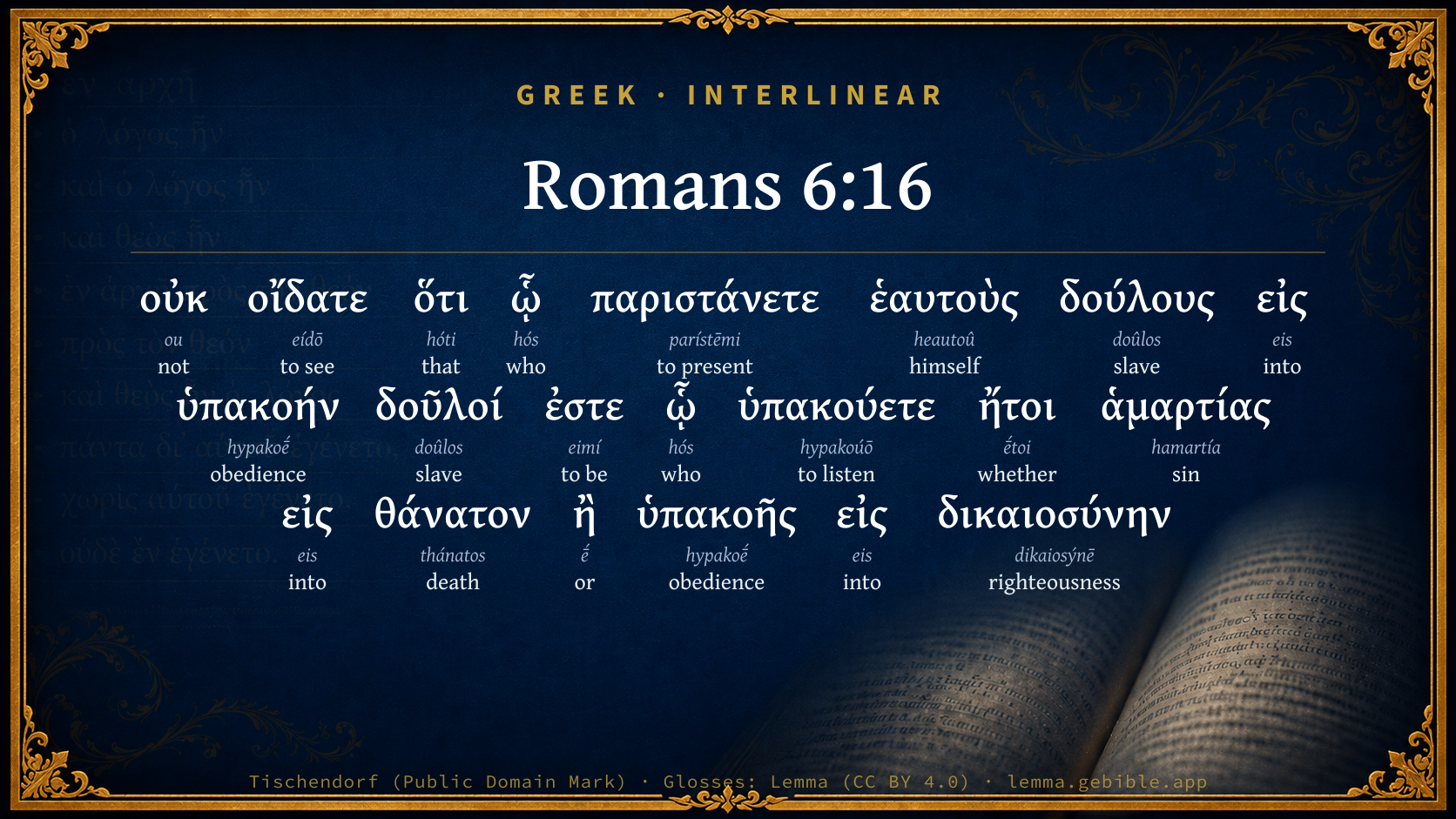
Greek (Tischendorf 8th ed.) Romans 6:16 appears in the Greek New Testament. The text above is from the Tischendorf 8th edition. Each word links to its Strong’s number and a concise gloss. Click any word for its full Thayer’s Greek Lexicon entry.
Download image
Cite this verse

Romans 6:16 (World English Bible). Public Domain. Lemma interlinear Bible study tool, https://lemma.gebible.app/v/romans/6/16.

Show BibTeX & RIS
BibTeX
RIS
English Translation
Don't you know that to whom you present yourselves as servants to obedience, his servants you are whom you obey; whether of sin to death, or of obedience to righteousness?
World English Bible · Public Domain
Highlights
  • 1 hapax legomenon — only here in the Greek New Testament
  • 1 first appearance in the Greek New Testament
Full analysis ↓
Download a study sheet

One document with this verse’s original text, its word-by-word gloss line, the meaning frame, cross-references with their text, attributed commentary, and full source and license credits — printable, and it pastes into notes with its structure intact.

This verse Autodidact and up

Study sheet (.html) Plain text (.txt)

A passage Seminary Student

Up to 50 verses in one chapter. A passage sheet keeps up to 6 commentary sources and 12 cross-references per verse, in the order this page ranks them, and says so on the sheet whenever that leaves anything out. Ask for a single verse and you get the Autodidact verse sheet above.

Everything on this page stays free to read, with no account — the sheet is a download of what is already on screen, not access to it.

Want to remove ads? Support Godless Engineer
Compare translations 3

The same verse in 3 English versions, stacked beneath the original-language interlinear above. Click any original word for its lexicon entry.

Each is an independent rendering of the whole verse — the interlinear is not word-aligned to these translations.

Highlighted words mark where these versions differ — a whole-verse word diff, not a word-by-word alignment.

  • World English Bible Public Domain
    Don't you know that to whom you present yourselves as servants to obedience, his servants you are whom you obey; whether of sin to death, or of obedience to righteousness?
  • King James Version Public Domain
    Know ye not, that to whom ye yield yourselves servants to obey, his servants ye are to whom ye obey; whether of sin unto death, or of obedience unto righteousness?
  • unfoldingWord Literal Text CC BY-SA 4.0
    Do you not know that to what you keep presenting yourselves slaves for obedience, you become slaves to what you obey—whether of sin to death, or of obedience to righteousness?

unfoldingWord Literal Text — © unfoldingWord, licensed CC BY-SA 4.0. Word-aligned USFM3 via Door43 (git.door43.org/unfoldingWord/en_ult).

Versions to compare (up to 4)

3 of 4 selected

Show all 19 translations

Every available English version of this verse, each an independent rendering of the whole verse.

  • World English Bible Public Domain
    Don't you know that to whom you present yourselves as servants to obedience, his servants you are whom you obey; whether of sin to death, or of obedience to righteousness?
  • Berean Standard Bible Public Domain
    Do you not know that when you offer yourselves as obedient slaves, you are slaves to the one you obey, whether you are slaves to sin leading to death, or to obedience leading to righteousness?
  • Majority Standard Bible Public Domain
    Do you not know that when you offer yourselves as obedient slaves, you are slaves to the one you obey, whether you are slaves to sin leading to death, or to obedience leading to righteousness?
  • King James Version Public Domain
    Know ye not, that to whom ye yield yourselves servants to obey, his servants ye are to whom ye obey; whether of sin unto death, or of obedience unto righteousness?
  • American Standard Version (1901) Public Domain
    Know ye not, that to whom ye present yourselves `as' servants unto obedience, his servants ye are whom ye obey; whether of sin unto death, or of obedience unto righteousness?
  • Revised Version (1885) Public Domain
    Know ye not, that to whom ye present yourselves as servants unto obedience, his servants ye are whom ye obey; whether of sin unto death, or of obedience unto righteousness?
  • Geneva Bible (1599) Public Domain
    Knowe ye not, that to whomsoeuer yee giue your selues as seruats to obey, his seruants ye are to whom ye obey, whether it be of sinne vnto death, or of obedience vnto righteousnesse?
  • Douay-Rheims (1899) Public Domain
    Know you not, that to whom you yield yourselves servants to obey, his servants you are whom you obey, whether it be of sin unto death, or of obedience unto justice.
  • Young's Literal Translation Public Domain
    have ye not known that to whom ye present yourselves servants for obedience, servants ye are to him to whom ye obey, whether of sin to death, or of obedience to righteousness?
  • Literal Standard Version CC BY-SA 4.0
    Have you not known that to whom you present yourselves servants for obedience, servants you are to him to whom you obey, whether of sin to death, or of obedience to righteousness?
  • Unlocked Literal Bible CC BY-SA 4.0
    Do you not know that the one to whom you present yourselves as slaves is the one to which you are obedient, the one you must obey? This is true whether you are slaves to sin which leads to death, or slaves to obedience which leads to righteousness.
  • unfoldingWord Literal Text CC BY-SA 4.0
    Do you not know that to what you keep presenting yourselves slaves for obedience, you become slaves to what you obey—whether of sin to death, or of obedience to righteousness?
  • Darby Bible Public Domain
    Know ye not that to whom ye yield yourselves bondmen for obedience, ye are bondmen to him whom ye obey, whether of sin unto death, or of obedience unto righteousness?
  • World Messianic Bible Public Domain
    Don’t you know that when you present yourselves as servants and obey someone, you are the servants of whomever you obey, whether of sin to death, or of obedience to righteousness?
  • Webster's Bible Public Domain
    Know ye not, that to whom ye yield yourselves servants in obedience, his servants ye are whom ye obey; whether of sin to death, or of obedience to righteousness?
  • Free Bible Version CC BY-SA 4.0
    Don't you realize that if you make yourselves someone's slaves, obeying their orders, then you are slaves to the one you obey? If you are slaves of sin, the result is death; if you obey God, the result is you are made right with him.
  • Bible in Basic English Public Domain
    Are you not conscious that you are the servants of him to whom you give yourselves to do his desire? if to sin, the end being death, or if to do the desire of God, the end being righteousness.
  • Text-Critical English NT CC BY 4.0
    Do you not know that when you present yourselves to someone as obedient slaves, you are slaves of the one whom you obey, either of sin leading to death, or of obedience leading to righteousness?
  • Tyndale New Testament (1534) Public Domain
    Remember ye not how that to whom soever ye comit youre selves as servautes to obey his servauntes ye are to whom ye obey: whether it be of synne vnto deeth or of obedience vnto rightewesnes?

Literal Standard Version (2020), Covenant Press — licensed CC BY-SA 4.0. Text via the HelloAO Bible API (eBible.org). Unlocked Literal Bible (unfoldingWord) — licensed CC BY-SA 4.0. Text via the HelloAO Bible API (eBible.org). unfoldingWord Literal Text — © unfoldingWord, licensed CC BY-SA 4.0. Word-aligned USFM3 via Door43 (git.door43.org/unfoldingWord/en_ult). Free Bible Version, Dr. Jonathan Gallagher — licensed CC BY-SA 4.0. Text via the HelloAO Bible API (eBible.org).

Word by word

More ways to search: Search by grammar → Find every occurrence → Compare this word →

Practice this passage: Drill this verse → Learn its vocabulary →

ἤτοι
ḗtoi
G2273
“whether”
Conjunction
Part of Speech
Conjunction
Full Thayer's Definition

Origin: from G2228 and G5104

TDNT: None

1. whether, either
  1. οὐκ ou G3756 “not” Particle, Negative
  2. οἴδατε eídō G1492 “to see” Verb, Perfect, Active, Indicative, 2nd person, Plural
  3. ὅτι hóti G3754 “that” Conjunction
  4. ᾧ hós G3739 “who” Relative pronoun, Dative, Singular, Neuter
  5. παριστάνετε parístēmi G3936 “to present” Verb, Present, Active, Indicative, 2nd person, Plural
  6. ἑαυτοὺς heautoû G1438 “himself” Reflexive pronoun, 2nd person, Accusative, Plural, Masculine
  7. δούλους doûlos G1401 “slave” Noun, Accusative, Plural, Masculine
  8. εἰς eis G1519 “into” Preposition
  9. ὑπακοήν hypakoḗ G5218 “obedience” Noun, Accusative, Singular, Feminine
  10. δοῦλοί doûlos G1401 “slave” Noun, Nominative, Plural, Masculine
  11. ἐστε eimí G1510 “to be” Verb, Present, Active, Indicative, 2nd person, Plural
  12. ᾧ hós G3739 “who” Relative pronoun, Dative, Singular, Neuter
  13. ὑπακούετε hypakoúō G5219 “to listen” Verb, Present, Active, Indicative, 2nd person, Plural
  14. ἁμαρτίας hamartía G266 “sin” Noun, Genitive, Singular, Feminine
  15. εἰς eis G1519 “into” Preposition
  16. θάνατον thánatos G2288 “death” Noun, Accusative, Singular, Masculine
  17. ἢ ḗ G2228 “or” Particle
  18. ὑπακοῆς hypakoḗ G5218 “obedience” Noun, Genitive, Singular, Feminine
  19. εἰς eis G1519 “into” Preposition
  20. δικαιοσύνην dikaiosýnē G1343 “righteousness” Noun, Accusative, Singular, Feminine

About this verse

These counts appear in no published source. They are computed here, from the morphology-tagged text and Lemma’s own curated glosses. What Lemma adds →

21
words
16
distinct lemmas
Pauline Epistles
section

Notable vocabulary

1 hapax legomenon — a word that appears only here in the entire Greek New Testament:

  • ἤτοι whether G2273

First appearance in Scripture

This word makes its first canonical appearance in the Greek New Testament here:

  • ἤτοι whether G2273

Shared distinctive vocabulary

ὑπακοήν obedience G5218 occurs in 14 verses of the Greek New Testament. Also found in:
Repetition

Words recur within this verse:

  • εἰς into G1519 ×3
  • δούλους slave G1401 ×2
  • ὑπακοήν obedience G5218 ×2
  • ᾧ who G3739 ×2

Cross-references

7

Topical passages linked to Romans 6:16 in the Treasury of Scripture Knowledge — connected by theme and wording, ordered by reader-vote popularity; previews shown in the World English Bible.

  • John 8:34 Jesus answered them, "Most assuredly I tell you, everyone who commits sin is the bondservant of sin.
  • Matthew 6:24 "No one can serve two masters, for either he will hate the one and love the other; or else he will be devoted to one and despise the other. You can't serve both God and Mammon.
  • 2 Peter 2:19 promising them liberty, while they themselves are bondservants of corruption; for by whom a man is overcome, by the same is he also brought into bondage.
  • Joshua 24:15 If it seem evil to you to serve Yahweh, choose you this day whom you will serve; whether the gods which your fathers served that were beyond the River, or the gods of the Amorites, in whose land you dwell: but as for me and my house, we will serve Yahweh.
  • Romans 6:12–13 Therefore don't let sin reign in your mortal body, that you should obey it in its lusts.
  • Romans 6:19–23 I speak in human terms because of the weakness of your flesh, for as you presented your members as servants to uncleanness and to wickedness upon wickedness, even so now present your members as servants to righteousness for sanctification.
  • Romans 6:17 But thanks be to God, that, whereas you were bondservants of sin, you became obedient from the heart to that form of teaching whereunto you were delivered.

Cross-references courtesy of OpenBible.info (CC BY 4.0).

Commentary

Notes on Romans 6:16 from classic Christian and Jewish commentators (each source and its license shown beneath its notes). The classic Christian expositions comment on the surrounding passage and are grouped to its opening verse, so a note may address several verses; the Jewish commentaries on the Tanakh (Rashi and others) are per-verse, so they appear only where the commentator wrote on this verse.

Lemma curates 59 commentaries, every one of them public domain or Creative Commons licensed, each selected and text-cleaned for this edition rather than reprinted as found. About our sources →

Albert Barnes' Notes on the Bible

Know ye not ... - The objection noticed in Rom 6:15, the apostle answers by a reference to the known laws of servitude or slavery, Rom 6:16-20, and by showing that Christians, who had been the slaves of sin, have now become the servants of righteousness, and were therefore bound by the proper laws of servitude to obey their new master: as if he had said, “I assume that you know: you are acquainted with the laws of servitude; you know what is required in such cases.” This would be known to all who had been either masters or slaves, or who had observed the usual laws and obligations of servitude.

To whom ye yield yourselves - To whom ye give up yourselves for servitude or obedience. The apostle here refers to voluntary servitude; but where this existed, the power of the master over the time and services of the servant was absolute. The argument of the apostle is, that Christians had become the voluntary servants of God, and were therefore bound to obey him entirely. Servitude among the ancients, whether voluntary or involuntary, was rigid, and gave the master an absolute right over his slave, Luk 17:9; Joh 8:34; Joh 15:15. To obey. To be obedient; or for the purpose of obeying his commands.

To whom ye obey - To whom ye come under subjection. That is, you are bound to obey his requirements.

Whether of sin - The general law of servitude the apostle now applies to the case before him. If people became the servants of sin, if they gave themselves to its indulgence, they would obey it, let the consequences be what they might. Even with death, and ruin, and condemnation before them; they would obey sin. They give indulgence to their evil passions and desires, and follow them as obedient servants even if they lead them down to hell. Whatever be the consequences of sin. yet he who yields to it must abide by them, even if it leads him down to death and eternal woe.

Or of obedience ... - The same law exists in regard to holiness or obedience. The man who becomes the servant of holiness will feel himself bound by the law of servitude to obey, and to pursue it to its regular consequences.

Unto righteousness - Unto justification; that is, unto eternal life. The expression stands contrasted with “death,” and doubtless means that he who thus becomes the voluntary servant of holiness, will feel himself bound to obey it, unto complete and eternal justification and life; compare Rom 6:21-22. The argument is drawn from what the Christian would feel of the nature of obligation. He would obey him to Whom he had devoted himself.

(This would seem to imply that justification is the effect of obedience. Δικαιοσυνη Dikaiosunē, however, does not signify justification, but righteousness, that is, in this case, personal holiness. The sense is, that while the service of sin leads to death, that of obedience issues in holiness or righteousness. It is no objection to this view that it does not preserve the antithesis, since “justification” is not the opposite of “death,” any more than holiness. “There is no need,” says Mr. Haldane, “that there should be such an exact correspondence in the parts of the antithesis, as is supposed. And there is a most obvious reason why it could not be so. Death is the wages of sin, but life is not the wages of obedience.”)

Albert Barnes' Notes on the Bible (1834–1885) — public domain. Text from a community e-Sword/MySword module.

The Biblical Illustrator

Joseph S. Exell

Rom_6:16-18

Know ye not that to whom ye yield yourselves servants to obey.

The service of sin and the service of righteousness

I. The criterion of both--obedience. A disobedient servant is a contradiction in terms. Disobedience vitiates service and ensures formal dismissal from it. By obedience to the behests of sin sinners are to be distinguished. Sins code is the ten commandments with the nots omitted; and the world swarms with men and women who yield the most constant and earnest obedience to each. From these the servants of righteousness are distinguished not by their profession, garb, postures, ritual, and shibboleth of righteousness, but by their obedience to the commands of righteousness. Many will present themselves before the Great Tribunal on other grounds, but the King of Righteousness will judge them exclusively by this criterion. Not everyone that said unto the Lord, Lord, etc.

II. The characteristics of the two services.

1. The service of sin is--

(1) Wrong. A usurper is served in a way which wrongs the lawful master and the rightful law; and inasmuch as men were made for righteousness they wrong themselves.

(2) Fruitless (Rom_6:21). Sins service is disappointing, and sinners are deluded in it. Apart from what it ends in, the way of transgressors, is hard.

(3) Ruinous--sin unto death (see also Rom_6:23).

2. The service of righteousness is

(1) As the name implies, right. That should settle the matter. Only when a man yields to it does he put himself right with God, the law, his own conscience, the universe.

(2) Fruitful. Its ways are ways of pleasantness, etc. Even in this life it is worth all it costs. Righteousness is a good master and pays as it goes along.

(3) Eternally profitable--life is the guerdon of righteousness.

III. The change from one service to the other.

1. All men are servants. Man was not made, and will never become independent. Servitude is the law of his nature, and of the two masters he must serve one.

2. All men have been the servants of sin. They are born in it and continue in it; some all their lives, others up to a certain point.

3. All men may become servants of righteousness.

(1) By a definite act of self-devotion.

(2) By a precious act of Divine acceptance. (J. W. Burn.)

Master or servant

One day a Mr. Charles was about to start from home to fulfil a preaching appointment, when rough weather set in, and he hesitated whether he ought to brave the storm. He consulted a Mr. John Evans on the point. Tell Mr. Charles, was the message returned, that if he is a master he may stay at home, but if a servant he ought to keep his appointment. (Christian Journal.)

Obedience to Christ

Come to Him. I do not know what it is to come, says one. Well, coming to Christ is simply the trusting Him. You are guilty, trust Him to save you. But if I do that, says one, may I then go on and live as I did before? No, that you cannot. If a ship at sea needed to be brought into harbour, and they took a pilot on board, he would say to the captain, Captain, if you trust me I will get you into the harbour all right; let that sail be taken down. But they do not reef it. Here, says he, attend to the tiller and steer as I bid you. But they did not attend. Well, says the pilot, I thought you said you trusted me. Yes, says the captain, and you said that if we trusted you you would get into port and we are not into port. No, but I understood if you trusted me you would do as I bade you. It cannot be a true trust that is disobedient to my command. If then you trust Christ you must do as He bid you, take up His cross and follow Him, and then that trust of yours shall surely have its reward. You shall be saved now, and saved forever.

The devils slaves

If a pirate, or, worse, the master of a slave ship, has made a good thing of his unlawful traffic, I do not see why he should reluctate about going into a lawful traffic on the ocean, because he does not know what the ocean will do to him. If a man is safe in sailing against Gods laws and everything that is good, how much more will God prosper him if he applies to legitimate commerce the same skill and enterprise and industry that he is now applying to that which is illegitimate. I have seen men work ten times as hard to be villains as they would have been obliged to work to be honest men. The greatest slaves I know anything about are those whom the devil has got the upper hand of, and whom he is compelling to dodge between the supreme law of God and their worldly prosperity. They may secure some sort of prosperity, but, you may depend upon it, they work hard for it. (H. W. Beecher.)

Moral slavery

James II, on his death bed, thus addressed his son, There is no slavery like sin and no liberty like Gods service. Was not the dethroned monarch right? What think you of the fetters of bad habits? What think you of the chains of indulged lust? The drunkard who cannot resist the craving for the wine--know you a more thorough captive? The covetous man who toils night and day for wealth--what is he but a slave? The sensual man, the ambitious man, the worldly man, those who, in spite of the remonstrances of conscience, cannot break away from enthralment--what are they, if not the subjects of a tyranny than which there is none sterner, and none more degrading? (H. Melvill, B. D.)

Ye have obeyed from the heart that form of doctrine.--

The apostolical form of doctrine

I. What is it?

II. How should it be received?

III. What is its effect?

IV. What feelings ought this result to inspire? (J. Lyth, D. D.)

Obedience to the form of doctrine

1. The question, Whose servants are ye? resolves itself into a matter of fact. The apostle, on looking to his disciples, pronounces them by the test of obedience to have become the servants of righteousness. And he not only affirms this change, but he assigns the cause of it. They obeyed from the heart. There might have been the form of a yielding; but some latent duplicity brought a flaw unto it by which it was invalidated, Now God be thanked, says the apostle, this is not the way with you. I look at your fruit, and I find it the fruit of holiness. I look at your life, and I find it to be the life of the servants of God.

2. But what is it that they are said here to obey from the heart? The term doctrine in the original may signify the thing taught, or the process of teaching--a process which may embrace many items, and consist of several distinct parts, to obey which from the heart is just to take them all in with the simplicity and good faith in which a child believingly reads its task book. This last view is very much confirmed by the import of the Greek equivalent for form, viz., a mould that impresses its own shape to the yielding substance whereunto it is applied. And it would be still more accordant with the original if we render the whole sentence. The mould or model of doctrine into which ye have been delivered. Christian truth, in its various parts and various prominences, is likened unto a mould, into which the heart or soul of man is cast that it may come out a precise transcript.

3. It should be obedient to every touch, and yield itself to every character that is graven thereupon. It should feel the impression, not from one of its truths only, but from all of them, else, like the cast which is in contact with the mould bat at a single point, it will shake and fluctuate, and be altogether wanting in settled conformity to that with the likeness of which it ought to be everywhere encompassed. You know how difficult it is to poise one body upon another when it has only got one narrow place to stand upon, and that, to secure a position of stability, there must at least be three points of support provided. There is something akin to this ere the mind of an inquirer is rightly grounded and settled on the basis of Gods revealed testimony. How it veers and fluctuates, when holding only by one article and fails of a sufficiently extended grasp on the truths of Christianity! How those who talk, e.g., of the bare fact of faith vacillate and give way in the hour of temptation. How those who admit both the righteousness of Christ and the regeneration of their own characters to be alike indispensable, have nevertheless been brought to shipwreck; and that just because, though adhering in words to these two generalities, they have never spread them abroad over their whole history in the living applications of prayer and watchfulness. They need the filling up of their lives and hearts with the whole transcript of revelation. One doctrine does not suffice for this, for God in His wisdom has thought fit that there shall be a form or scheme of doctrine. The obedience of the heart unto the faith is obedience unto all that God proposes for the belief and acceptance of those who have entered on the scholarship of eternity; and for this purpose there must be not a mere assent of the understanding to any given number of articles, but a broad coalescence of the mind with the whole expanse and magnitude of the book of Gods testimony.

4. A scheme of doctrine, then, implies more truths than one; and St. Paul has now gone beyond the announcement of his one individual item. He was very full on Christ as the propitiation for sin, and on the righteousness of Christ as the plea of acceptance for sinners; and then, when he came to the question, Shall they who are partakers of this benefit continue in sin that they may get still more of the benefit? he pronounces a negative. Here there was not one truth, but a compound of truths; a mould graven on both sides of it with certain various characters, and the softened metal that is poured therein yields to it all round and takes the varied impression from it. And so of him who obeys from the heart the form of doctrine into which he is delivered. He does not yield to one article and present a side of hardness and of resistance to another article. He is thoroughly softened and humbled under a sense of sinfulness, and most willingly takes the salvation of the gospel on the terms of the gospel. He does not, like the sturdy controversialist, cull out from the Word his own favourite position; but, like the little child, he follows on to know the Lord, just as the revealed things offer themselves to his docility and notice on that inscribed tablet which the Lord hath placed before him.

5. The way for you to make good the transition from sin to righteousness is to have the same obedience of faith. It is to spread out the tablet of your heart for the pressure thereupon of all the characters that are graven on the tablet of revelation; it is to incorporate in your creed the necessity of a holy life, in imitation and at the will of the Lord Jesus, along with a humble reliance on His merits as your alone meritorious plea for acceptance with the Father; it is to give up the narrow, intolerant, and restrictive system of theology which, by vesting a right of monopoly in a few of its favourite positions, acts like the corresponding system of trade in impeding the full circulation of its truths and of its treasure through that world within itself, which is made up of the powers and affections. Be your faith as broad and as long as is the record of all those communications that are addressed to it--and be very sure that it is only when you yield yourselves up in submission to all its truths that you can be made free from sin by sharing in the fulfilment of all its promises.

6. You often hear of the power of the truth. It is a just and expressive phrase, and is adverted to in the text. But this power of the truth is the power of the whole truth. Mutilate the truth and you cripple it. Pare it down and you paralyse its energies. And thus, as you hope to be rescued from the tyranny of sin by the power of Christian truth, you must foster the whole of it. Divide, and you darken. The whole of that light which one truth reflects upon another is extinguished when the inquirer, instead of looking fearlessly abroad over the rich and varied landscape of revelation, fastens his intent regards on one narrow portion of the territory and shuts out the rest from the eye of his contemplation. Yet let us not think that we, of our proper energy, can supply as it were the first condition on which our deliverance from sin is made to turn. The glory of this is due to grace, which has softened your hearts under the impression of the truth, which has moved you to an aspiring obedience thereto, which will lead you, I trust, to carry out the principle into practice, which will vent itself upward to the sanctuary in prayer, and bring down that returning force which can unchain you from the bondage of corruption and give you impulse and strength for all the services of righteousness. (T. Chalmers, D. D.)

The form of teaching

There is room for difference of opinion as to what Paul precisely means by form here. It signifies originally a mark made by pressure or impact; then a mould, pattern or example, then the copy of such an example or pattern, or the cast from such a mould. It also means the general outline which preserves the distinguishing characteristics of a thing. Now we may choose between these two meanings in our text. If the apostle means type in the latter sense of the word, then the rendering form is adequate, and he is thinking of the Christian teaching which had been given to the Roman Christians as possessing certain well-defined characteristics which distinguished it from other kinds of teaching--such, for instance, as Jewish or heathen. But if we take the other meaning, then he is, in true Pauline fashion, bringing in a vivid and picturesque metaphor to enforce his thought, and is thinking of the teaching which the Roman Christians had received as being a kind of mould into which they were thrown, a pattern to which they were to be conformed.

I. Pauls gospel was a definite body of teaching. The gospel in its first form as it comes to men fresh from God is not a set of propositions, but a history of deeds that were done upon earth. And, therefore, is it fitted to be the mould of every character. Jesus Christ did not come and talk to men about God, and say to them what His apostles afterwards said, God is love, but He lived and died, and that mainly was His teaching about God. He did not come to men and lay down a theory of atonement or a doctrine of propitiation, or theology about sin and its relations to God, but He went to the Cross and gave Himself for us, and that was His teaching about sacrifice. He did not say to men, There is a future life, and it is of such and such a sort, but He came out of the grave and He said, Touch Me, and handle Me. A spirit hath not flesh and bones, and therefore He brought life and immortality to light, by no empty words but by the solid realities of facts. He did not lecture upon ethics, but He lived a perfect human life out of which all moral principles that will guide human conduct may be gathered. And so, instead of presenting us with a botanic collection of scientifically arranged and dead propositions, He led us into the meadow where the flowers grow, living and fair. His life and death, with all that they imply, are the teaching. Let us not forget, on the other hand, that the history of a fact is not the mere statement of the outward thing that has happened. Christian teaching is the facts plus their explanation; and it is that which differentiates it from the mere record which is of no avail to anybody. So Paul Himself in one of His other letters puts it. This is his gospel: Jesus of Nazareth died for our sins according to the Scriptures, and He was buried, and rose again the third day, according to the Scriptures. That is what turns the bald story of the facts into teaching, which is the mould for life.

II. This teaching is in Pauls judgment a mould or pattern according to which mens lives are to be conformed. There can be no question but that, in that teaching as set forth in Scripture, there does lie the mightiest formative power for shaping our lives, and emancipating us from our evil. Christ is the type, the mould into which men are to be cast. The gospel, as presented in Scripture, gives us three things. It gives us the perfect mould; it gives us the perfect motive; it gives us the perfect power. And in all three things appears its distinctive glory, apart from and above all other systems that have ever tried to affect the conduct or to mould the character of man. We have in the Christ the one type, the one mould and pattern for all striving, the glass of form, the perfect Man. And that likeness is not reproduced in us by pressure or by a blow, but by the slow and blessed process of gazing until we become like, beholding the glory until we are changed into the glory. It is no use having a mould and metal unless you have a fire. It is no use having a perfect Pattern unless you have motive to copy it. If we can say, He loved me, and gave Himself for me, then the sum of all morality, the old commandment that ye love one another, receives a new stringency, and a fresh motive as well as a deepened interpretation, when His love is our pattern. The one thing that will make men willing to be as Christ is their faith that Christ is their Sacrifice and their Saviour. Still further, the teaching is a power to fashion life, inasmuch as it brings with it a gift which secures the transformation of the believer into the likeness of his Lord. Part of the teaching is the fact of Pentecost; part of the teaching is the fact of the ascension; and the consequence of the ascension and the sure promise of the Pentecost is that all who love Him, and wait upon Him, shall receive into their hearts the spirit of life in Christ Jesus, which shall make them free from the law of sin and death.

III. This mould demands obedience. By the very nature of the teaching, assent drags after it submission. You can please yourself whether you let Jesus Christ into your minds or not, but if you do let Him in, He will be Master. There is no such thing as taking Him in and not obeying. And so the requirement of the gospel which we call faith has in it quite as much of the element of obedience as of the element of trust. And the presence of that element is just what makes the difference between a sham and a real faith. (A. Maclaren, D. D.)

Moulded by the truth

The gospel here is compared to a mould into which the soul is delivered. We take our character from the truth we receive. Our affections are moulded, formed, fashioned, directed by the gospel we obey. Sometimes it is compared to a mirror (2Co_3:8). The gospel reveals to us Jesus, and as we look into that glass the light falls upon our souls and assimilates us to Him. Here it is a mould. We are cast into the mould of the truth which from the heart we obey. The gospel is not only a directing power, but a transforming influence; you cannot believe it without being moulded by it. Any man who says he believes it, whose character is not moulded by it, is deceiving himself. How, then, can this be corrected? Not by poring over the thoughts and feelings of our own poor hearts, but by examining the testimony God has given us concerning Christ, by mixing faith with the promises given us, that by them we might be partakers of the Divine nature. The entrance of His Word will not only give light to our understandings, but it will transform us into His image; and as we receive the doctrine into our hearts, we shall be delivered into it as into a mould, and our tastes and character and desires and ways and aims, will be fashioned thereby. This is the constant teaching of Scripture (Eph_2:10; Luk_1:74; Tit_2:11). (M. Rainsford, B. A.)

Branded with the truth

It was the custom to impress a distinctive mark or brand on the slaves belonging to different masters. A slave might thus, by no uncommon metonymy, be spoken of as belonging to a certain mark, the mark being put for the master whose mark it was; and when a slave was transferred from one master to another, as being delivered over to a new mark or brand, that is, to a new proprietor or master, to whom, or, by the same figure, to whose mark he was then to consider his person attached and his service and obedience due. This is probably the true meaning, Ye have obeyed from the heart that mark [or brand] of doctrine to which ye have been delivered over; this translation giving every word its full and proper effect. They passed from one service to another, distinguished by a new mark, to which, as reminding them of their new master, and the appropriate symbol of his property in them and his power over them, they were thenceforward to render their obedient service. The doctrine of Christ is the distinguishing badge, or appropriate mark, of all His servants. They bear the profession and impress of His truth; and, under the influence of that truth, they serve Him as the Master who has stamped its impression upon them, in a spirit of reverential love. (R. Wardlaw, D. D.)

Transformation of grace

A short time ago the manufacturers of lighting gas were puzzled to know how to dispose of the coal tar left in the retorts. A more useless, nauseous substance was hardly known to exist. Chemistry came to the rescue, and today not less than thirty-six marketable articles are produced from this black, vile, sticky slime--solvents, oils, salts, colours, flavours. You eat a bit of delicious confectionery, happily unconscious that the exquisite taste which you enjoy so keenly comes from coal tar; you buy at the druggists a tiny phial of what is labelled Otto of Roses, little dreaming that the delicious perfume is wafted, not from the fields of Araby, but from the foul gas retort. Christianity is a moral chemistry. Well were it for nations if it held a higher place among their social economics. Tar saving is all well enough, but soul saving is better. Grace transforms a villain into an honest man, a harlot into a holy woman, a thief into a saint. Where foetid exhalations of vice alone ascended, prayer and praise are to be found; where moral miasmata had their lair, righteousness and temperance pitch their tent. Every sort of good thing is produced by godliness, and that too in hearts once reeking with all manner of foulness. Should not this stay every persecuting hand, hush every railing tongue, and incite every sanctified spirit to continued and increasing energy. (C. H. Spurgeon.)

Being then made free from sin, ye became the servants of righteousness.--

Freedom from sin and subjection to righteousness

I. The bondage supposed. Those only can be made free who were the subjects of bondage. Many resent this charge and exclaim, as the Jews did, We were never in bondage to any man. And so long as men remain under the infatuation that they are free, they will never welcome the tidings of a deliverance. We are in bondage--

1. To a law which we have violated. A perfect nature was capable of performing the requirements of a perfect law; but an imperfect nature never can meet these requirements. Those, therefore, who are seeking acceptance with God by the works of the law, are under the curse--bound and sentenced by it.

2. To a God whom we have displeased. Perfectly sensible that God is love, we also believe that He is a God of justice. Gods character, regarded as a whole, demands that He should maintain the honour of His law; and therefore He is bound by every principle of His nature, and by every qualification of His office as the Ruler of the universe, to punish the sinner.

3. To corruptions which he has indulged.

(1) Man has fallen under the government of the passions, of which there are three classes--the animal, which lead to all manner of impurity; the malevolent, which lead to all manner of cruelty; and the secular, which go to make men altogether base and sordid.

(2) There are also intellectual sins under which men are bound, and even sold--pride, a presumptuous obtrusion into things sacred and prohibited, and infidelity in rejecting the testimony which God has given of His Son. But whether men are bound by the intellectual or sensual sins, they are alike slaves.

4. To the world which we have idolised. There are some who would not for worlds rebel against the laws of fashion. They would rather commit an enormous sin against God than they would violate the etiquette of this world. The man who is devoted to the love of money is just as much bound as ever one who was fastened to the galleys for life. The man who loves the pleasures of this world, though he turns from them with disgust again and again, yet tomorrow it is just the same thing over and over again. And as to the ambitious, see what slaves they are--how servile when they have an object to accomplish; how insolent when that object is once attained; and how dissatisfied with the highest pinnacle to which human ambition can soar.

5. To a death which we cannot shun. Some are all their lifetime subject to bondage through fear of death, either the act itself or the consequences.

II. The freedom that is bestowed.

1. From the guilt of sin by virtue of the expiatory death and all-atoning sacrifice of the Divine Redeemer.

2. From the punishment of sin. The chain is broken--the debt is cancelled--the indictment is rebutted, and the justified believer can say, Who shall lay anything to the charge of Gods elect?

3. From the dominion of sin. How can I love that which crucified the Saviour?

4. Ultimately from the presence of sin. There shall in no wise enter into the heavenly Jerusalem anything that defileth or that worketh abomination.

III. The subsequent subjection or subordination. Ye became the servants of righteousness!

1. By faith in the doctrine of righteousness (verse 17). All the doctrines of the gospel are according to godliness. They fix salvation on the great principles of eternal rectitude; for God does not forgive merely by an act of clemency; but by an act of equity.

2. Love to the principle of righteousness.

3. Submission to the rule of righteousness--Gods will--not our opinion--not the laws of our fellow creatures.

4. Studious determination and constant aim towards the practice of universal righteousness. (C. Bradley, M. A.)

Our change of masters

1. Man was made to rule. He was intended for a king, who should have dominion over the beasts of the field, etc. Yet is it equally true that he was made to serve. He was placed in the garden to keep it, and to dress it, and to serve his Maker. Throwing off his allegiance to his rightful Master, he has become the slave of evil passions.

2. When God of His infinite mercy visits man by His Spirit, that Spirit does not come as a neutral power, but enters with full intent to reign. Man cannot serve two masters, but he must serve one. Alexander conquered the world, and yet he became the captive of drunkenness and his passionate temper. Rome had many slaves, but he who wore her purple was the most in bonds. High rank does not save a man from being under a mastery: neither does learning nor philosophy. Solomon, the most sagacious ruler of his age, became completely subject to his fleshly desires.

3. Who, then, shall be mans master? Our text speaks of being made free from sin, and in the same breath it adds, Ye became the servants of righteousness. There is no interregnum. Man passes from one master to another, but he is always in subjection. Consider--

I. Our change of masters.

1. In describing this revolution we will begin with a word or two upon our old master sin. We were not all alike enslaved, but we were all under bondage.

(1) Sin has its liveried servants. If you want to see these dressed out in their best or their worst, go to the prison, or to the places of vicious amusement. Many of them wear the badge of the devils drudgery upon their backs in rags, upon their faces in the blotches born of drunkenness, and in their very bones in the consequences of their vice.

(2) But great folks have many servants who are out of livery, and so has sin. We were not all open transgressors. Selfish caution restrains from overt acts of transgression. Hypocrites are worse slaves than others, because they are laid under the restraints of religion without their consolations, and practise sins without their pleasures.

(3) The servants of sin are not all outdoor servants. Many keep their sin to themselves. They are excellent in their outward deportment; but they are the indoor servants of Satan for all that.

(4) There are, however, many who were once outdoor servants, sinning openly and in defiance of all law.

2. Believers are made free from sin.

(1) From the condemnation of sin (Rom_8:1).

(2) From the guilt of sin. As you cannot be condemned so does the truth go further, you cannot even be accused. Who shall lay anything to the charge of Gods elect?

(3) From the punishment of sin.

(4) From its reigning power.

3. How came we to be free?

(1) By purchase, for our Saviour has paid the full redemption money.

(2) By power. Just as the Israelites were the Lords own people, but He had to bring them out of Egypt, so has the Lord by power broken the neck of sin and brought us up from the dominion of the old Pharaoh of evil and set us free.

(3) By privilege. Unto as many as believed Him, to them gave He the privilege to become the sons of God. His own royal, majestic, and Divine decree has bidden the prisoners go forth.

(4) By death. If a slave dies his masters possession in him is ended. He that is dead is free from sin.

(5) By resurrection. A new life has been given to us; we are new creatures in Christ Jesus.

4. Ye became the servants of righteousness. A righteous God has made us die to sin; a new and righteous life has been infused into us, and now righteousness rules and reigns in us. The text says we are enslaved to righteousness, and so we wish to be.

II. The reasons for our change.

1. We changed our old master because we were illegally detained by him. Sin did not make us, does not feed us, has no right to us whatever. Besides, our old master was as bad as bad could be. We ran away from him Because we had never any profit at his hands. What fruit had ye then? Ask the drunkard, the spendthrift, any man that lives in sin, what he has gained by it, and we will find it is all loss. Beside that, our old master brought shame. Those things whereof ye are now ashamed. Moreover, its wages are death.

2. But why did we take up with our new Master? In the first place, we owe ourselves wholly to Him; and in the next place, if we did not, He is so altogether lovely, that if we had a free choice of masters we would choose Him a thousand times over. His service is perfect freedom and supreme delight. He gives us even now a payment in His service.

III. The consequences of this change.

1. That you belong wholly to your Lord. Numbers of professing Christians seem mostly to belong to themselves, for they never gave God anything that cost them a self-denial. But if you are really saved, not a hair of your heads belongs to yourselves; Christs blood has either bought you or it has not, and if it has, then you are altogether Christs. Just as a negro used to belong to the maw that bought him, every inch of him, so you are the slave of Christ; you bear in your body the brand of the Lord Jesus, and your glory and your freedom lie therein.

2. Because you are Christs His very name is dear to you. You are not so His slave that you would escape from His service if you could; you want to be more and more the Lords. Where there is anything of Christ there your love goes forth. Haydn one day turned into a music sellers, and asked for some select and beautiful music, and was offered some of his own. Oh, said Haydn, Ill have nothing to do with that. Why, sir, what fault can you find with it? I can find a great deal of fault with it, but I will not argue with you, I do not want any of his music. Then, said the shopkeeper, I have other music, but it is not for such as you. A thorough enthusiast grows impatient of those who do not appreciate what he so much admires. You can be no friend of mine if you are not a friend of Christs.

3. All your members are henceforth reserved for Christ. When Satan was your master you did not care about Christ, you went wholly in for evil. You did not require to be egged on to it. Now you ought not to want your ministers or Christian friends to stir you up to good works; you ought to be just as eager after holiness as you were after sin. As you have given the devil first-rate service, let Christ have the same. Some of you never stood at any expense--I wish we could serve Christ thus unstintedly. The poor slaves of sin not only do not stop at expense, but they are not frightened by any kind of loss. See how many lose their characters for the sake of one short hour of sin. They ruin their peace and think nothing of it. They will lose their health, too; nay, they will destroy their souls for the sake of sins brief delights. In the same way should we serve our Lord. Be willing to lose character, health, life, all, if by any means you may glorify Him whose servant you have become. Oh, who will be my Masters servant? Do you not see Him? He wears upon His head no diadem but the crown of thorns; His feet are still rubied with their wounds, and His hands are still bejewelled with the marks of the nails. This is your Master, and these are the insignia of His love for you. What service will you render Him? That of a mere professor, who names His name but loves Him not? That of a cold religionist, who renders unwilling service out of fear? Do not so dishonour Him. (C. H. Spurgeon.)

The strictness of the law of Christ

1. The apostle is not content with speaking half the truth; he does not merely say that we are set free from guilt and misery, but he adds, that we have become the slaves of Christ. He has not bought us, and then set us loose upon the world. He has given us that only liberty which is really such, bond service to Himself, lest if left to ourselves we should fall back again to the cruel bondage from which He redeemed us.

2. This needs insisting on; for a number of persons think that they are not bound to any real service at all, now that Christ has set them free. Men often speak as if the perfection of human happiness lay in our being free to choose and to reject. Now we are indeed free, if we do not choose to be Christs servants, to go back to the old bondage. We may choose our master, but God or mammon we must serve. We cannot possibly be in a neutral state. Yet a number of persons think their Christian liberty lies in being free from all law, even from the law of God. In opposition to this great mistake, St. Paul reminds his brethren in the text that when they were made free from sin, they became the servants of righteousness. He says the same in other Epistles (1Co_7:22-23; Col_3:22; Col_3:24; 1Co_9:21).

3. Religion, then, is a necessary service; of course it is a privilege too, but it becomes more and more of a privilege, the more we exercise ourselves in it. The perfect Christian state is that in which our duty and our pleasure are the same, it is the state in which the angels stand; but it is not so with us, except in part. Upon our regeneration indeed, we have a seed of truth and holiness planted within us, a new law introduced into our nature; but still we have that old nature to subdue, a work, a conflict all through life.

4. Now most Christians will allow in general terms that they are under a law, but they admit it with a reserve; they claim for themselves some dispensing power.

I. What is the sort of man whom the world accounts respectable and religious? At best he is such as this. He has a number of good points to his character, but some of these he has by nature, others he has acquired because outward circumstances compelled him to acquire them. He has acquired a certain self-command, because no one is respected without it. He has been forced into habits of diligence, punctuality, and honesty. He is courteous and obliging; and has learned not to say all he thinks and feels, or to do all he wishes to do on all occasions. The great mass of men, of course, are far from this; but I am supposing the best--viz., those who only now and then will feel inclinations or interest to run counter to duty. Such times constitute a mans trial; they are just the times on which he is apt to consider that he has a leave to dispense with the law, when it is simply the law of God, without being also the law of self, and of the world. He does what is right, while the road of religion runs along the road of the world; when they part company awhile he chooses the world, and calls his choice an exception. For instance--

1. He generally comes to church, it is his practice; but some urgent business or scheme of pleasure tempts him--he omits his attendance; he knows this is wrong, and says so, but it is only once in a way.

2. He is strictly honest in his dealings; it is his rule to speak the truth, but if hard pressed, he allows himself now and then to say a slight falsehood. He knows he should not lie, he confesses it; but he thinks it cannot be helped.

3. He has learned to curb his temper and his tongue; but on some unusual provocation they get the better of him. But are not all men subject to be overtaken with ill temper? That is not the point; the point is this--that he does not feel compunction afterward, he does not feel he has done any thing which needs forgiveness.

4. He is in general temperate; but he joins a party of friends and is tempted to exceed. Next day he says that it is a long time since such a thing happened to him. He does not understand he has any sin to repent of, because it is but once in a way. Such men, being thus indulgent to themselves, are indulgent to each other. Conscious of what might be said against themselves they are cautious what they say against others. These are a few out of a multitude of traits which mark an easy religion--the religion of the world; which would cast in its lot with Christian truth, were not that truth so very strict, and quarrels with it--because it will not suit itself to emergencies, and to the tastes of individuals.

II. This is the kind of religion which St. Paul virtually warns us against, as often as he speaks of the gospel as being a law and a servitude.

1. He indeed glories in its being such; for, as the happiness of all creatures lies in their performing their parts well, where God has placed them, so mans greatest good lies in obedience to Gods law and in imitation of Gods perfections. Therefore Paul insists on the necessity of Christians fulfilling the righteousness of the law. Hence James says, Whosoever shall keep the whole law, and yet offend in one point, he is guilty of all. And our Saviour assures us that, Whosoever shall break one of these least commandments, etc., and that Except our righteousness shall exceed the righteousness of the Scribes and Pharisees, which was thus partial and circumscribed, we shall in no case enter into the kingdom of heaven. And when the young man came to Him, He pointed out the one thing wanting in him. Let us not then deceive ourselves; what God demands of us is to he content with nothing short of perfect obedience--to avail ourselves of the aids given us, and throw ourselves on Gods mercy for our shortcomings.

2. But the state of multitudes of men is this--their hearts are going the wrong way, and their real quarrel with religion is not that it is strict, but that it is religion. If I want to travel north, and all the roads are cut to the east, of course I shall complain of the roads. So men who try to reach Babylon by roads which run to Mount Sion necessarily meet with thwartings, crossings, disappointments, and failure. They go mile after mile, watching in vain for the turrets of the city of Vanity, because they are on the wrong road; and, unwilling to own what they are really seeking, they find fault with the road as circuitous and wearisome.

3. But religion is a bondage only to those who have not the heart to like it. Accordingly, in verse 17, St. Paul thanks God that his brethren had obeyed from the heart that form of teaching, into which they had been delivered. We Christians are cast into a certain mould. So far as we keep within it, we are not sensible that it is a mould. It is when our hearts would overflow in some evil direction, then we consider ourselves in prison. It is the law in our members warring against the law of the Spirit which brings us into a distressing bondage. Let us then see where we stand, and what we must do. Heaven cannot change; God is without variableness or shadow of turning. His law is from everlasting to everlasting. We must change. We must go over to the side of heaven. Never had a soul true happiness but in conformity to God. We must have the law of the Spirit of life in our hearts, that the righteousness of the law may be fulfilled in us.

4. Some men, instead of making excuses, such as I have been considering, and of professing to like religion, all but its service, boldly object that religion is unnatural, and therefore cannot be incumbent. Men are men, and the world is the world, and that life was not meant to be a burden, and that God sent us here for enjoyment, and that He will never punish us for following the law of our nature. I answer, doubtless this life was meant to be enjoyment; but why not a rejoicing in the Lord? We were meant to follow the law of our nature; but why of our old nature and not of our new? Now that God has opened the doors of our prison house, if men are still carnal, and the world sinful, and the life of angels a burden, and the law of our nature not the law of God, whose fault is it? We Christians are indeed under the law, but it is the new law, the law of the Spirit of Christ. We are under grace. That law, which to nature is a grievous bondage, is to those who live under the power of Gods presence, what it was meant to be, a rejoicing. (J. H. Newman, D. D.)

True liberty

Is it your opinion, said Socrates, that liberty is a fair and valuable possession? So valuable, replied Euthydemus, that I know of nothing more precious. But he who is so far overcome by sensual pleasure that he is not able to practise what is best, and consequently the most eligible--do you count this more free, Euthydemus? Far from it, replied the other. You think, then, said Socrates, that freedom consists in being able to do what is right, and slavery, in not being able; whatever may be the cause that deprives us of the power? I do, most certainly. The debauchee, then, you must suppose is in this state of slavery? I do, and with good reason. (Xenophon.)

True liberty

You think the charter would make you free--would to God it would. The charter is not bad if the men who use it are not bad. But will the charter make you free? Will it free you from slavery to ten-pound bribes? Slavery to gin and beer? Slavery to every spouter who flatters your self-conceit, and stirs up bitterness and headlong rage in you? That, I guess, is real slavery; to be a slave to ones own stomach, ones own pocket, ones own temper. Will the charter cure that? Friends, you want more than Ac of Parliament can give. Englishmen! Saxons! Workers of the great cool-headed, strong-handed nation of England, the workshop of the world, the leader of freedom for seven hundred years; men, you say you have common sense! then do not humbug yourselves into meaning license when you cry for liberty. Who would dare refuse you freedom? for the Almighty God and Jesus Christ, the poor man who died for poor men, will bring it about for you, though all the mammonites of the earth were against you. A nobler day is dawning for England--a day of freedom, science, industry. But there will be no true freedom without virtue, no true science without religion, no true industry without the fear of God and love to your fellow citizens. Workers of England, be wise, and then you must be free, for you will be fit to be free. (C. Kingsley, M. A.)

The liberty of the believer

The liberty of the subject could never be preserved in a lawless state of society, but violence and tyranny would reduce to a slavish obedience the weak and the timid. The palladium of civil liberty is law; law well defined, excluding the fluctuations of caprice on one side, and of aggression on the other; law rigorously executed also, for the best code is a dead letter if it be not accompanied by a living and firm executive. So the liberty of the believer is secured by the law of God, when brought under its guidance and government. While living under the misrule of his fallen nature, he is the sport of every capricious imagination, and successively the slave of his predominant passions (verse 16.) But let Christs government be set up, and he becomes Christs freeman; sin has no more dominion over him; he is no longer its wretched captive, but is under gracious law, for where the Spirit of the Lord is, there is liberty. (G. H. Salter.)

The Biblical Illustrator, edited by Joseph S. Exell (c. 1880s–1900s) — public domain. Text from a community e-Sword module.

Tyndale Open Study Notes

Tyndale Open Resources

6:16 righteous living (Greek dikaiosunē, “righteousness”): In the first part of Romans, Paul uses this Greek word in a judicial sense, referring (1) to the activity of God to set people in a right relationship with himself or (2) to the righteous standing that believers enjoy as a result of Christ’s work (see, e.g., 1:17; 3:21-22; 4:3, 5). Here, Paul uses the same word as it is often used in the Old Testament, meaning the right behavior that God demands from his people.

Tyndale Open Study Notes — © Tyndale Open Resources, licensed CC BY-SA 4.0. Text via the HelloAO Bible API.

Bengel's Gnomon

Johann Albrecht Bengel

Rom 6:16. Δούλους, servants) Servitude is here denoted, from which obedience follows as a consequence.—δοῦλοι, servants) The state of servitude, which follows as the consequence of obedience, is signified, 2Pe 2:19.—εἰς, unto) εἰς, unto, occurs twice in this verse, and in both cases it depends on servants.—ὑπακοῆς, of obedience) Obedience, used absolutely, is taken in a good sense. Righteousness, too, promptly claims as her own, those who act obediently to her.—εἰς δικαιοσύνην, unto righteousness) Supply, and of righteousness unto life: as appears from the antithesis [death], with which comp. the similar antithesis, Rom 6:20; Rom 6:22; Rom 3:20, note.

Bengel's Gnomon of the New Testament — English translation (T&T Clark, Edinburgh, 1860) — public domain. Text from a community e-Sword module.

Meyer's Critical & Exegetical Commentary

Heinrich August Wilhelm Meyer

Rom_6:16. Paul begins the detailed illustration of the μὴ γένοιτο with an appeal to the consciousness of his readers, the tenor of which corresponds to the saying of Christ: No man can serve two masters. This appeal forms the propositio major; the minor then follows in Rom_6:17 f., after which the conclusion is obvious of itself.Know ye not, that, to whom ye yield yourselves as slaves for obedience, ye are slaves of him whom ye obey? Here the emphasis is not on ἐστε (slaves ye are in reality, as de Wette and others think), or even on the relative clause ᾧ ὑπακούετε (Hofmann), but, as is required by the order of the words, and the correlation with παριστ. ἑαυτούς, on δοῦλοι. Whosoever places himself at the disposal of another for obedience as a slave, is no longer free and independent, but is just the slave of him whom he obeys.

παριστάνετε] The present, as expressing the general proposition which continues to hold good. See Kühner, II. 1, p. 115.

ᾧ ὑπακούετε] whom ye obey (erroneously rendered by Reiche and Baumgarten-Crusius: have to obey). By this, instead of the simple αὐτοῦ or τούτου, the relation of subjection, which was already expressed in the protasis, is once more vividly brought into view: that ye are slaves of him, whom ye, in consequence of that παριστάνειν ἑαυτοὺς δούλους to him, obey. The circumstantiality has a certain earnestness and solemnity. If ye yield yourselves as slaves for obedience, then ye are nothing else than slaves in the service of him whom ye obey. The less reason is there for attaching εἰς ὑπακ. to the apodosis (Th. Schott, Hofmann).

ἤτοι ἁμαρτίας] sc[1458] δοῦλοι.[1459] Respecting the disjunctive ἬΤΟΙ, aut sane, found nowhere else in N. T., see especially Klotz, a[1460] Devar. p. 609, Baeumlein, Partik. p. 244. It lays strong emphasis on the first alternative. Very frequently thus used in Greek authors. Comp Wis_11:18.

ΕἸς ΘΆΝΑΤΟΝ] result, to which this relation of slavery leads. The ΘΆΝΑΤΟς cannot be physical death (Reiche, Fritzsche, van Hengel), since that is not the consequence of individual[1462] sin (see on Rom_5:12), and is not averted from the δοῦλος ὑπακοῆς; nor is it, either generally, the misery of sin (de Wette), or specially spiritual death, alienation from the true ζωή, an idea which Paul never conveys by θάνατος; but rather, seeing that θάνατος, as is more precisely indicated in Rom_6:21, and is placed beyond doubt by the contrast of ζωὴ αἰώνιος, must be conceived as the τέλος of the bondage of sin; eternal death (Chrysostom, Theophylact, and others, including Rückert, Reithmayr, and Tholuck). Comp Rom_1:32. This is not at variance with the antithesis εἰς δικαιοσύνην, which is not to be taken (as in Rom_6:13) in the sense of moral righteousness (Philippi and others); for this is not the result, but is itself the essence of the δοῦλον εἶναι ὑπακοής (comp Rom_5:19), since ὑπακοή, in contradistinction to the ἁμαρτία, is obedience to the divine will. On the contrary δικαιοσύνη, antithetically correlative with the θάνατος, must be conceived as the final result of that δοῦλον εἶναι ὑπακοῆς, and apply to the time of final perfection in the αἰὼν μέλλων, when the faithful, who have not relapsed into the service of sin, but in their faith have been servants of obedience, on account of the death of Christ δίκαιοι κατασταθήσονται, Rom_6:19. It is therefore the righteousness which is awarded to them in the judgment.[1465] If it were the righteousness of faith even now attained (Th. Schott), ὑπακοῆς would need to be taken, with Schott, of becoming a believer (Rom_1:5), which is contextually inadmissible, since what is spoken of is the state of grace already existing (Rom_6:15), in which service is rendered to the obedience of God only, and not to sin. In accordance with the misconceptions of Hofmann, already noticed in detail (see above), there results as his sense of the whole: To whom ye place yourselves as servants at his disposal, ye are servants for the purpose of obedience; ye are so to him whom ye obey, servants eitherfor there is no third alternativewho act contrary to their masters will and thereby merit death, or such as live in obedience and are therefore righteous in the presence of their master. What kind of a θάνατος, and in what sense ΔΙΚΑΙΟΣΎΝΗ is meant, is supposed accordingly to be self-evident. And by the following thanksgiving, Rom_6:17, the Apostle is alleged as it were half to take back his question, Whether they do not know etc., so that the medium of transition to Rom_6:17 is why yet still the question? A series of gratuitously imported fancies.

[1458] c. scilicet.

[1459] Consequently servants of sin, who are serviceable to that which is sin; and then: servants of obedience, who are in the service of the opposite of ἁμαρτία, in the service of divine obedience. Hofmann erroneously takes the genitives as genitives of quality (servants who sin and who obey); see Winer, p. 222 [E. T. 297]. What reader could, after δοῦλοι (comp. Joh_8:34), have stumbled on this singular relation of quality; the assumption of which ought to have been precluded by vv. 17, 20. Comp. 2Pe_2:19.

[1460] d refers to the note of the commentator or editor named on the particular passage.

[1462] Philippi here observes, with the view of including bodily death also in the idea, that it is personally appropriated and merited by the individual through his own act. This is not Pauline, and is at variance with the true interpretation of the ἐφʼ ᾦ πάντες ἥμαρτον in v. 12. It is not with death as it is with the atonement, which is objectively there for all, but must be appropriated by something subjective. Comp. 1Co_15:22. Moreover, such personal appropriation would be inconceivable in the case of all children dying without actual sin.

[1465] Köstlin has also justly directed attention in the Jahrb. f. Deutsche Theol. 1856, p. 127, to the sensus forensis of δικαιοσύνη in our passage.

Meyer — Critical and Exegetical Commentary on the New Testament — English translation by Peter Christie, edited by Frederick Crombie (T&T Clark, 1880) — public domain. Text from a community e-Sword module.

Expositor's Greek Testament

ed. W. Robertson Nicoll

Rom 6:16 . οὐκ οἴδατε : It is excluded by the elementary principle that no man can serve two masters (Mat 6:24 ). The δοῦλους is the exclusive property of one , and he belongs to that one εἰς ὑπακοὴν , with obedience in view; nothing else than obedience to his master alone is contemplated. The masters here are ἁμαρτία whose service ends in death, and ὑπακοὴ ( cf. Rom 5:19 ) whose service ends in righteousness. δικαιοσύνη here cannot be “justification,” but righteousness in the sense of the character which God approves. ἤτοι here only in N.T. = of course these are the only alternatives.

The Expositor's Greek Testament, edited by W. Robertson Nicoll (1897–1910) — public domain. Text from a community e-Sword module.

Cambridge Greek Testament for Schools and Colleges

16–23. These verses answer the question put in Rom 6:15. The complexity of the passage is due to the fact that S. Paul wishes to explain that the Christian life is subject to law, but that the subjection differs from that of the Jew both in the character of the law and the nature of the subjection. (1) This new law is not a code of precepts but GOD’s righteousness revealed in the life of Christ: the life of Christ is the model to which the Christian life must conform. And that, not merely because it is an external standard, but because the living Christ is the source, and naturally therefore determines the character, of the Christian life. This thought gets full and fearless expression in Rom 8:2, ὁ νομος τοῦ πνεύματος τῆς ζωῆς ἐν Χρ. Ἰ.: but by that time the true place and character of preceptual law have been expounded, and there is no longer danger of confusion. (2) The nature of the subjection corresponds to the nature of the law: it is a whole-hearted self-surrender to GOD and to the life which embodies and reproduces, in those who so offer themselves, His righteousness. ὑπακοή here is very closely allied to πίστις, and might almost be described as ‘faith in action’; cf. πίστις δι’ ἀγάπης ἐνεργουμένη, Gal 5:6.

It is this complexity of the subject which occasions the inaccurate antithesis in Rom 6:16; the parenthetic explanation of Rom 6:19-21, and the multiplication of phrase (ὑπακοῆς, δικαιοσύνης … τύπον … θεῷ (22)).

16. οὐκ οἴδατε ὅτι, appeal to recognised principle.

ᾧ, neut.: the case is stated as generally as possible.

εἰς ὑπακοήν = with a view to obeying, for obedience—the proper attitude of the δοῦλος.

ἤ ὑπακοῆς εἰς δικαιοσύνην, the antithesis fails: we expect ἤ δικαιοσύνης εἰς ζωήν. The reason for the change appears to be that the latter phrase could not yet be used without risk of misunderstanding: δοῦλοι δικαιοσύνης εἰς ζωήν could be fully accepted by a Jew as describing his state under law: consequently it is necessary to bring out the meaning both of ὑπακοή and of δικαιοσύνη; and this is done first by substituting these words, in spite of the inexact antithesis; and then by explaining their meaning in 17–18.

ὑπακοῆς. Consequently the gen. here is not objective after δοῦλοι but descriptive = slaves who obey.

εἰς δικαιοσύνην, with a view to righteousness—to secure and maintain righteousness. Righteousness here as generally = GOD’s righteousness as revealed in Christ and made known in the gospel. Hence it can be used alternatively with τῷ θεῷ, Rom 6:18; Rom 6:22.

Cambridge Greek Testament for Schools and Colleges (Cambridge University Press, 1896; 21 vols, various authors incl. Carr, Maclear, Plummer, Farrar, Lumby, Moule, M. R. James, Simcox) — public domain. Text from a community e-Sword module.

Hodge's Commentary on Romans, Ephesians & First Corinthians

Charles Hodge

Rom_6:16

Know ye not, that to whom ye yield yourselves servants to obey, his servants ye are to whom ye obey, etc. Know ye not that those who obey sin are its slaves; hurried on from one degrading service to another, until it works their ruin; but those who serve holiness are constrained, though sweetly, to constancy and fidelity, until the glorious consummation of their course? As a servant or slave is under an influence which secures the continuance of his obedience, and he who serves holiness is under an influence which effectually secures the constancy of his service. This being the case, it is not possible for the Christian or servant of holiness to be found engaged in the service of sin. The language and the construction are here nearly the same as in Rom_6:13. Here, as there, we have παριστάνετε in the sense of giving up to the power and disposal of. Paul says, that those who give themselves up to another as δούλους εἰς ὑπακοὴν, slaves to obedience, are the δοῦλοι of him whom they thus obey. It enters into the idea of slavery, that the subjection is absolute and continued. The slave does not obey his own will, but his masterí. He is subject not for a time, but for life. He is under an influence which secures obedience. This is as true in spiritual as in external relations. He who serves sin is the slave of sin. He is under its power. He cannot free himself from its dominion. He may hate his bondage; his reason and conscience may protest against it; his will may resist it; but he is still constrained to obedience. This is the doctrine of our Lord, as taught in Joh_8:34 : He that committeth sin is the slave of sin. This remains true, although this service is unto death: The wages of sin is death. The death intended is spiritual and eternal. It is the absolute loss of the life of the soul, which consists in the favor and fellowship of God, and conformity to his image. What is true of sin is true of holiness. He who by virtue of union with Christ is made obedient to God, becomes, as Paul says, a δοῦλος ὑπακοῆς, a slave of obedience. Obedience (personified) is the master to whom he is now subject. He is not only bound to obey, but he is made to obey in despite of the resistance of his still imperfectly sanctified nature. He cannot but obey. The point of analogy to which reference is here made, is the certainty of the effect, and the constraining influence by which that effect is secured. In the case both of sin and of holiness, obedience is certain; and it is rendered certain by a power superior to the will of man. The great difference is, that in the one case this subjection is abnormal and destructive, in the other it is normal and beneficent. A wise man is free in being subject to his reason. The more absolute and constant the authority of reason, the more exalted and free is the soul. In like manner, the more completely God reigns in us, the more completely we are subject to his will, so much the more are we free; that is, so much the more do we act in accordance with the laws of our nature and the end of our being. Servants of obedience unto righteousness; δικαιοσύνη must here be taken in its subjective sense. It is inward righteousness, or holiness. And in this sense it is eternal life, and therefore antithetical to θάνατος, which is spiritual and eternal death. The service of sin results in death, the service of God results in righteousness; that is, in our being right, completely conformed to the image of God, in which the life of the soul consists.

Charles Hodge — Commentary on Romans (1835), First Corinthians (1857), and Ephesians (1856) — public domain. Text from a community e-Sword module.

Jamieson, Fausset & Brown

Robert Jamieson, A. R. Fausset & David Brown

that to whom ye yield yourselves servants to obey--with the view of obeying him.

his servants ye are to whom ye obey--to whom ye yield that obedience.

whether of Sin unto death--that is, "issuing in death," in the awful sense of Rom 8:6, as the sinner's final condition.

or of Obedience unto righteousness--that is, obedience resulting in a righteous character, as the enduring condition of the servant of new Obedience (Jo1 2:17; Joh 8:34; Pe2 2:19; Mat 6:24).

Jamieson, Fausset & Brown — Commentary Critical and Explanatory on the Whole Bible (1871) — public domain (CC PDM 1.0). Text via the HelloAO Bible API.

Adam Clarke's Commentary

Verse 16. To whom ye yield yourselves] Can you suppose that you should continue to be the servants of Christ if ye give way to sin? Is he not the master who exacts the service, and to whom the service is performed? Sin is the service of Satan; righteousness the service of Christ. If ye sin ye are the servants of Satan, and not the servants of God.

The word δουλος, which we translate servant, properly signifies slave; and a slave among the Greeks and Romans was considered as his master's property, and he might dispose of him as he pleased. Under a bad master, the lot of the slave was most oppressive and dreadful; his ease and comfort were never consulted; he was treated worse than a beast; and, in many cases, his life hung on the mere caprice of the master. This state is the state of every poor, miserable sinner; he is the slave of Satan, and his own evil lusts and appetites are his most cruel task-masters. The same word is applied to the servants of Christ, the more forcibly to show that they are their Master's property; and that, as he is infinitely good and benevolent, therefore his service must be perfect freedom. Indeed, he exacts no obedience from them which he does not turn to their eternal advantage; for this master has no self-interest to secure. See Clarke on Ro 1:1.

Adam Clarke's Commentary on the Bible (1810–1826) — public domain. Text from a community e-Sword/MySword module.

John Calvin's Commentaries

16. By no means: know ye not? This is not a bare denial as some think, as though he preferred to express his abhorrence of such a question rather than to disprove it: for a confutation immediately follows, derived from a contrary supposition, and to this purpose, “Between the yoke of Christ and that of sin there is so much contrariety, that no one can bear them both; if we sin, we give ourselves up to the service of sin; but the faithful, on the contrary have been redeemed from the tyranny of sin, that they may serve Christ: it is therefore impossible for them to remain bound to sin.” But it will be better to examine more closely the course of reasoning, as pursued by Paul.

To whom we obey, etc. This relative may be taken in a causative sense, as it often is; as when one says, — there is no kind of crime which a parricide will not do, who has not hesitated to commit the greatest crime of all, and so barbarous as to be almost abhorred even by wild beasts. And Paul adduces his reason partly from the effects, and partly from the nature of correlatives. For first, if they obey, he concludes that they are servants, for obedience proves that he, who thus brings one into subjection to himself, has the power of commanding. This reason as to service is from the effect, and from this the other arises. “If you be servants, then of course sin has the dominion.”

Or of obedience, etc. The language is not strictly correct; for if he wished to have the clauses correspondent, he would have said, “or of righteousness unto life” But as the change in the words does not prevent the understanding of the subject, he preferred to express what righteousness is by the word obedience; in which however there is a metonymy, for it is to be taken for the very commandments of God; and by mentioning this without addition, he intimated that it is God alone, to whose authority consciences ought to be subject. Obedience then, though the name of God is suppressed, is yet to be referred to him, for it cannot be a divided obedience.

John Calvin's Commentaries (1540-1563) — public domain. Text from the Calvin Translation Society English edition (1840s-50s) via the Christian Classics Ethereal Library (ccel.org). Calvin's coverage is partial (roughly two-thirds of the Bible); uncommented books and verses are honest gaps, never fabricated. The 19th-century editor's footnotes and remarks are omitted so the notes are faithfully Calvin's own voice.

Ellicott's Commentary for English Readers

(16) Know ye not.—An apparent tautology, but one which really teaches a deep ethical truth. Don’t you know that what you make yourselves that you become? The habit which you form ends by becoming your “second nature.”

A Bible Commentary for English Readers, edited by Charles John Ellicott (1878–1897) — public domain. Text from a community e-Sword module.

The Cambridge Bible for Schools and Colleges

gen. ed. J. J. S. Perowne

16. Know ye not] As a self-evident truth, that bond-service, once accepted, becomes binding. This general principle is at once applied to the special cases of Sin and Obedience regarded as personified Masters. The clauses to the end of Rom_6:18 may be thus summarized:—“All bond-service, once accepted, is binding, and forbids divided servitude;—this is as true of the obligations of Pardon as of those of Condemnation; of Justification as of Death. And you, thank God, have now passed from the latter to the former. Remember then, that in the very act of leaving the bond-service of sin you entered that of Pardon as taught in the Gospel, and are thus bound to obey as much as ever, though in the opposite direction.”

unto death—unto righteousness] The results (“death,” “righteousness”) of the respective “servitudes” are not necessary to the immediate statement, but are brought in as inseparable from the whole subject.

obedience] This is here the personified Master, the antithesis of Sin. The context, (Rom_6:17,) and Rom_10:3, (see also 1Pe_1:2,) shew its meaning here to be the act of submission to the Divine terms of pardon. It is thus the practical equivalent of those terms, which are to be the ruling principle of the new life.

righteousness] The Gr. may here be paraphrased (not translated) by Justification. In such a paraphrase we are far from shutting a moral meaning out of the word; but a careful collation of passages in this Epistle makes it reasonably clear that its ruling reference in this argument is to the legal side of righteousness; i.e. to what the Law will view as righteous, and so to the persons whom it will view as possessing righteousness. Such a possession, in the case of “the ungodly” (Rom_4:5), is explained by St Paul as wholly due to the righteousness of their Representative. In other words they are justified for His sake.—Thus “righteousness” is used as a summary for the process of justification, though strictly applicable only to one part of the subject. Here we may paraphrase: “Ye became the bond-servants of God’s Terms of Pardon, to which you submitted with a submission that resulted in your being reckoned righteous in the eye of His Law.”

The Cambridge Bible for Schools and Colleges (gen. ed. J. J. S. Perowne; Cambridge University Press, 1878–1918) — public domain. Text from a community e-Sword module.

John Gill's Exposition

Know ye not, that to whom ye yield yourselves,.... The apostle goes on with his answer to the above objection, by making use of an argument from the nature of servants and their obedience, a thing well known to everyone, and which none could be ignorant of; which he delivers by way of distribution, that such who yield themselves

servants to obey, his servants ye are to whom ye obey, whether of sin unto death, or obedience unto righteousness: such who obey sin, are the servants of sin; they are at the beck and command of sin; they give up themselves to the service of it with delight and diligence, and are perfect drudges to it: this is a very unhappy situation; their service is very unreasonable; and they are rendered incapable of serving God, for no man can serve two masters; they are hereby brought into the drudgery of the devil; into a state of bondage, out of which nothing but grace can extricate them; into a very mean and contemptible condition, and even a deplorable one; for if grace prevent not, they will have the wages of sin paid them, which is death, for their obedience is "of sin unto death"; which will lie in an eternal separation from Father, Son, and Spirit, in a sense of divine wrath, and in the company of devils and damned spirits: now this is added, to show the malignant nature and just demerit of sin, and to deter and dissuade persons from the service of it: on the other hand, such as obey the Lord, are the servants "of obedience unto righteousness": but why is not this obedience, which is the obedience of faith to the Gospel, of Christ, and of the new man to God or Christ, said to be "unto life", as the antithesis seems to require? because though death is the fruit of sin, yet life is not the fruit of obedience, but the fruit of obedience is righteousness; by which is meant, nor a justifying one before God, but righteousness before men; or a course of living soberly and righteously, which is the effect of being under grace; and hence it appears, that true believers can make no such ill use of their privilege, as is suggested in the objection.

John Gill's Exposition of the Whole Bible (1746–1763) — public domain (CC PDM 1.0). Text via the HelloAO Bible API.

Trapp's Complete Commentary

John Trapp

16 Know ye not, that to whom ye yield yourselves servants to obey, his servants ye are to whom ye obey; whether of sin unto death, or of obedience unto righteousness?

Ver. 16. His servants ye are] Sinners, though not drunk, yet are not their own men, but at Satan’s beck and check, whom they seem to defy, but indeed deify.

John Trapp, A Commentary or Exposition upon All the Books of the Old and New Testament (1647–1656) — public domain. Text from a community e-Sword module.

Matthew Poole's English Annotations

He refutes the aforementioned cavil by a common axiom, that every one knows and apprehends.

Of obedience unto righteousness; which will be rewarded with eternal life. But why doth he not say of obedience unto life? Then the antithesis had been more plain and full. Because though sin be the cause of death, yet obedience is not the cause of life, {as Rom 6:23} but only the way to it.

Matthew Poole's English Annotations on the Holy Bible (1683–1685) — public domain. Text from a community e-Sword/MySword module.

Whedon's Commentary on the Bible

Daniel D. Whedon

16. His servants ye are—There is no compromise. Serving sin, even under pretext of grace, makes us the genuine slaves of sin even unto death. Serving sin professedly under grace brings us under the terrible penalty of law. So that, then, we are truly not under grace.

Daniel D. Whedon (gen. ed.), Commentary on the Old and New Testaments (1874–1909) — public domain. Text from a community e-Sword module.

Scofield Reference Notes

C. I. Scofield

sin Sin.

(See Scofield "Rom 3:23").

The Scofield Reference Bible (1917 edition), notes by C. I. Scofield — public domain. Text from a community e-Sword module.

Burkitt's Expository Notes on the New Testament

William Burkitt

Two things are here intimated by the apostle;

1. That all men really are, and ought to be reputed servants to that master whose works they do, and whose commands they obey: Whom ye obey his servants ye are.

Learn thence, That we may infallibly know whose servants we are, and what master we serve, Christ or Satan, by examining and inquiring whose commands they are, which we execute and obey.

2. The apostle intimates, that every person or servant shall receive a reward suitable to the master he serves, and proportionable to the work he does. If Satan be our master, sin is our work, and death our wages; if we be the servants of God, obedience is our work, and eternal life will be our reward: There is a reward for the righteous, and wages for the workers of iniquity.

The devil’s drudges shall have full pay, but no content; the wages of sin is death; there’s pay, such as it is, woeful pay, a black penny.

God’s servants, though they do not work for wages, yet they shall not work for nothing! Verily there is a reward for the righteous; a reward of mercy, not of merit; a reward of grace, not of debt:

And accordingly, the apostle says here, His servants ye are whom ye obey, whether of sin unto death, or of obedience unto righteousness.

But why doth he not say of obedience unto life, as well as of sin unto death? then the antithesis had been more plain and full.

Ans. Because though sin be the cause of death, yet obedience is not the cause of life, but only the way to it: Via ad regnum, non causa regnandi.

William Burkitt's Expository Notes on the New Testament (1700–1703) — public domain. Text from a community e-Sword module.

Godbey's Commentary on the New Testament

William B. Godbey

16. “Do you not know that to whom ye present yourselves slaves to obedience, ye are slaves to whom ye obey, whether of sin unto death, or of obedience unto righteousness?” Man is a dependency by nature, All attempts to assume independence have collapsed and ultimated in ruin; i. e., the Eden independence winding up in the Fall, the Antediluvian in the Flood, the Patriarchal in Egyptian slavery, the Jewish in destruction by the Roman armies; and in the clear light of prophecy the Gentile destined to go the same way, ending in the great tribulation. Man would have stood under any or all of these dispensations if he had been true to God. Human independence is but another name for Satanic slavery. Entire sanctification makes you God’s slave. This is the identical word applied by the Holy Ghost to God’s apostles and saints throughout the Bible. God’s slavery means perfect liberty. If you were a slave on earth, and your master were perfectly good, infinitely rich, and loved you enough to die for you, in that case you would be free and happy as an angel.

William B. Godbey, Commentary on the New Testament (1896–1900) — public domain. Text from a community e-Sword module.

McGarvey & Pendleton's Commentaries

J. W. McGarvey

Know ye not, that to whom ye present yourselves as servants unto obedience, his servants ye are whom ye obey; whether of sin unto death, or of obedience unto righteousness? ["I take it for granted that ye know and believe" (Stuart) the principles, that no man can serve two masters ( Mat_6:24 ), and that no matter what profession he makes to the contrary, a man is truly the servant of that master to whom he habitually and continually yields a slavish obedience ( Joh_8:34 ). These things which are true in the ordinary walks of life are equally true in spiritual matters, whether this obedience be rendered unto sin, which compensates with the wages of eternal death, or whether it be rendered unto God, so as to be rewarded with righteousness or justification (which is a prerequisite to eternal life). Thus it appears that, while we are not under law, we are under God; and hence under obligation to foster and preserve our relation to him as his servants, a relationship which is not lost by a single act of weakness, but which is lost if we continue in sin. "The apostle," says Scott, "demanded whether it might not be proved what master any one served by observing the constant tenor of any one's conduct. A person may do an occasional service for any one to whom he is not servant; but no doubt he is the servant of that man to whom he habitually yields and addicts himself, and in whose work he spends his time, and strength, and skill, and abilities, day after day, and year after year."]

J. W. McGarvey (with Philip Y. Pendleton), Commentaries on the New Testament (The Fourfold Gospel, 1914; Acts; and the epistles) — public domain. Text from a community e-Sword/MySword module.

The People's New Testament

B. W. Johnson

16. Know ye not? This is utterly impossible, as they will see if they will remember one principle. His servants ye are to whom ye obey. If we obey sin, we are sin's servants, under his reign, and will receive, not grace, but sin's wages, which is death; or, on the other hand, if we obey Christ, we are his servants, and enjoy his righteousness. None enjoy this blessedness but those who turn from sin and obey Christ.

B. W. Johnson's The People's New Testament with Notes (1889–1891) — public domain. Electronic text from the Christian Classics Ethereal Library (CCEL) ThML edition.

Alford’s Greek Testament

Henry Alford

16.] ‘You are the servants either of God or of sin,—there is no third course.’ The former part of the verse as far as ὑπακούετε reminds them merely of an universal truth,—that the yielding ourselves servants for obedience to any one, implies the serving, being (in reality) the servants of such person. Then this is applied in the form of a dilemma, implying that there is no third service, q. d. ‘Now this must be true of you with regard either to sin or to God.’ Know ye not, that to whom ye yield yourselves servants with a view to obedience, his servants ye are to whom ye obey, (and in this case) either (ἤτοι—ἤ only occurs here in N. T. ἤτοι in alternatives is exclusive, cf. Herod. i. 11, δίδωμι αἵρεσιν, ὁκοτέρην βούλεαι τραπέσθαι … ἤτοι κεῖνόν γε τὸν ταῦτα βουλεύσαντα δεῖ ἀπόλλυσθαι, ἢ σὲ τὸν ἐμὲ.… Isocr. ἀντιδ. p. 317, ἦλθεν ἄν ἤτοι κατηγορήσων ἢ καταμαρτυρήσων, and see Hartung, Partikellehre, 2:355 f.) (servants) of sin, unto death (‘with death as the result,’—not physical death merely, nor eternal death merely, but death (by sin) in its most general sense, as the contrast to (life by) righteousness,—the state of misery induced by sin, in all its awful aspects and consequences:—and so throughout this passage and ch. 7), or of obedience (τοῦ θεοῦ, sc.—obedience to Him who alone ought to be obeyed) unto righteousness (with righteousness as its result; not imputed merely, nor implanted merely, but righteousness in its most general sense as the contrast to death,—the state of blessedness induced by holiness, and involving in it, as a less in a greater, eternal life: and so throughout this passage)?

17,

Henry Alford, The Greek Testament (1849–1861) — public domain. Text from a community e-Sword module.

International Critical Commentary

16. A general proposition to which our Lord Himself had appealed in ‘No man can serve two masters’ (Mat 6:24). There are still nearer parallels in Joh 8:34; 2Pe 2:19: passages however which do not so much prove direct dependence on St. Paul as that the thought was ‘in the air’ and might occur to more writers than one.

ἤτοι … ἤ: these disjunctives state a dilemma in a lively and emphatic way, implying that one limb or the other must be chosen (Bäumlein, Partikellehre, p. 244; Kühner, Gram. § 540. 5).

International Critical Commentary — older volumes (1896–1929), various authors — public domain. Text from a community e-Sword module.

Vincent's Word Studies in the New Testament

Marvin R. Vincent

Servants [δουλους] . Every man must choose between two ethical principles. Whichever one he chooses is master, and he is its bond - servant. Compare Mt 6:24; Mt 7:18.

Sin unto death - obedience unto righteousness. The antithesis is not direct - sin unto death, obedience unto life; but obedience is the true antithesis of sin, since sin is disobedience, and righteousness is life.

Marvin R. Vincent, Word Studies in the New Testament (1887–1900) — public domain. Text from a community e-Sword/MySword module.

Godet's Commentaries

Frédéric Louis Godet

Vv. 16-19 describe the new subjection (to righteousness) by which grace displaces the old subjection (to sin).

Vv. 16. “Know ye not, that in respect of Him to whom ye devote yourselves as servants to obey, ye are henceforth His servants who owe Him obedience; whether it be sin unto death, or obedience unto righteousness?”

The question of Rom 6:15 arose from an entirely erroneous way of understanding the relation between the moral will of man and the acts in which it is manifested. It seemed, according to the objection, that an act of liberty is merely an isolated fact in human life, and that an act of God’s grace is enough to annul it, so that not a trace of it shall remain. Thus it is that a superficial Pelagianism understands moral liberty. After the doing of each act, it can return to the state in which it was before, exactly as if nothing had passed. But a more serious study of human life proves, on the contrary, that every act of will, whether in the direction of good or of evil, as it passes into reality, creates or strengthens a tendency which drags man with increasing force, till it becomes altogether irresistible. Every free act, then, to a certain degree determines the future. It is this psychological law which the apostle here applies to the two principles: of sin on the one hand, and grace on the other. He calls attention to the fact that he is appealing to an experiment which every one can make: Know ye not that?...? Jesus had already expressed this law when He uttered the maxim: “Whosoever committeth sin is the servant [of sin],” Joh 8:34.

The words: him to whom ye devote yourselves as servants, refer to the first steps taken in one or other of the two opposite directions. At this point, man still enjoys a certain degree of moral liberty in relation to the principle which tends to master his will; he therefore devotes himself, as the apostle says. But in proportion as he yields himself to this principle by certain acts of compliance, he falls more and more under its sway: ye are the servants of him whom ye obey. These last words characterize the more advanced state of things, in which, the bond of dependence once formed, the will has lost all power of resistance, and exists only to satisfy the master of its choice. The words: ᾧ ὑπακούετε, whom ye obey, are strictly speaking a pleonasm; for this idea was already contained in the expression: δοῦλοί ἐστε, ye are servants; but yet they are not superfluous. They signify: “to whom obedience is now the order of the day, whether ye will or not.” A man does not put himself at the service of a master to do nothing for him. In other words, absolute liberty cannot be the condition of man. We are made, not to create our guiding principle, but simply to adhere to one or other of the higher moral powers which solicit us. Every concession freely made to either is a precedent which binds us to it, and of which it will avail itself to exact more. Thus there is gradually and freely established the condition of dependence spoken of by the apostle, and which issues, on the one side, in the absolute incapacity of doing evil (1Jn 3:9), the state of true liberty: on the other, in the total incapacity either to will or to do good (Mat 12:32), the state of final perdition. Since Paul is not speaking as a philosophical moralist, but as an apostle, he immediately applies this truth to the two positive principles which he is here contrasting with one another namely, as he says in the second part of the verse, sin and obedience. Of the two disjunctive particles ἤτοι (whether certainly) and ἤ (or), the first is somewhat more emphatic, as if the apostle meant to rely more strongly on the first alternative: Whether certainly of sin unto death, or, if this result do not suit you, of obedience unto righteousness.”

Sin is put first, as the master to whom we are naturally subject from infancy. It is its yoke which faith has broken; and consequently the Christian ought ever to remember that should he make any one concession to this principle, he would thereby begin to place himself anew under its dominion, and on the way which might guide him back to the goal of his previous life: death. The word death here cannot denote physical death, for the servants of righteousness die as well as the servants of sin. We are no longer in that part of the Epistle which treats of condemnation, and in which death appeared as a doom pronounced on the first sin, consequently as death strictly so called. It is the contrast between sin and holiness which prevails in this part, chap. 6-8. The matter in question, therefore, is death in the sense of moral corruption, and consequently of separation from God here and hereafter; such is the abyss which sin digs ever more deeply, every time that man, nay, that the believer, even gives himself over to it.

Why, in opposition to sin, does the apostle say in the second alternative: of obedience, and not: of holiness; and why, in opposition to: unto death, does he say: unto righteousness, and not: unto life? Obedience is frequently understood in this passage as obedience to good or to God, in a general way. Obedience in this sense is certainly opposed to sin; and if Paul were giving a course of morals, instead of an exposition of the Gospel, this meaning would be the most natural. But in the following verse there can be no doubt that the verb obey denotes the act of faith in the teaching of the Gospel. We have already seen, Rom 1:5, that the apostle calls faith an obedience. It is the same Rom 15:18, where he designates the faith of the Gentiles by the name of obedience. Faith is always an act of docility to a divine manifestation, and so an obedience. Thus, then, it is faith in the gospel which the apostle here designates by the word obedience; and he can perfectly contrast it with sin in this sense, because it is faith which terminates the revolt of sin and establishes the reign of holiness. Every time the gospel is preached to the sinner, he is challenged to decide between the obedience (of faith) or the carnal independence of sin. Man does not escape from his state of sin by the simple moral contemplation of good and evil, and their respective effects, but solely by the efficacy of faith.

The words: unto righteousness, have been applied by some

Meyer, for example—to the sentence of justification which will be passed on the sanctified Christian at the last day. This interpretation has been adopted from the contrast between this term and the preceding: unto death. But we have just seen the term righteousness used, Rom 6:13, in the sense of moral righteousness; and this is also the most suitable meaning here, where the object is to point out the holy consequences which will flow from the principle of faith. The antithesis to the term death also finds a simple explanation with this meaning. As death, the fruit of sin, is separation from God; so righteousness, the fruit of faith, is spiritual communion with God. The former contains the idea of moral corruption, as the way, and the latter includes the idea of life, as the goal. If it were wished to render the contrast completely, we should have to say: “whether of sin, unto unrighteousness which is death, or of obedience, unto righteousness which is life.” By expressing himself as he does, Paul wishes, on the one hand, to inspire a horror of sin, whose fruit is death; on the other, to bring into relief the essentially moral character of faith, the fruit of which is righteousness.

Frédéric Louis Godet — Commentaries on Luke, John, Romans, and 1 Corinthians — English translation (T&T Clark, Edinburgh, 1870s–1890s) — public domain. Text from a community e-Sword module.

Lesson kit

Teaching starters — assembled from the data on this page, not authored interpretation. Every prompt links to the verse data it draws on. Edit before teaching.

Romans, in the Pauline Epistles, opens this verse with 21 words (16 distinct Greek lemmas). Its most distinctive word is ḗtoi (“whether”). A historical commentator’s framing appears above. Read the whole chapter for the surrounding context.

Discussion questions

  1. The word ḗtoi carries the sense “whether.” How does it shape the verse?
  2. 1 word here appears nowhere else in the Greek New Testament. Why might the author reach for such rare wording?
  3. This is the first place “whether” appears in Scripture (first appears here). What does its debut here establish?
  4. How does Romans 1:5, which shares the word «obedience», read alongside this verse?
  5. What does the repetition of “into” (3× in this one verse) do in this verse?
  6. These translations render this verse differently; the difference is in the English rendering, not the original. What questions does that raise?
  7. Compare how Albert Barnes' Notes on the Bible and The Biblical Illustrator read this verse. Where do they agree or differ?

Things to notice

  • 1 word in this verse appears nowhere else in the Greek New Testament.
  • 1 word makes its first canonical appearance in Scripture here.
  • These translations choose different wording for 15 words in this verse.
  • “into” occurs 3× in this single verse.
  • 16 distinct Greek lemmas span 21 words in this verse.

Reading settings

Reading text

Shown beneath each verse's original-language words.

Old Testament
Old Testament edition

Read the OT as the Masoretic Hebrew (MT) or the Greek Septuagint (LXX).

English shown for the Greek Septuagint (in the Hebrew ↔ Greek comparison).

Comparing translations? Open the Compare panel on any verse page to stack up to four side by side.