

2 Timothy 3:6
Greek (Tischendorf 8th ed.) 2 Timothy 3:6 appears in the Greek New Testament. The text above is from the Tischendorf 8th edition. Each word links to its Strong’s number and a concise gloss. Click any word for its full Thayer’s Greek Lexicon entry.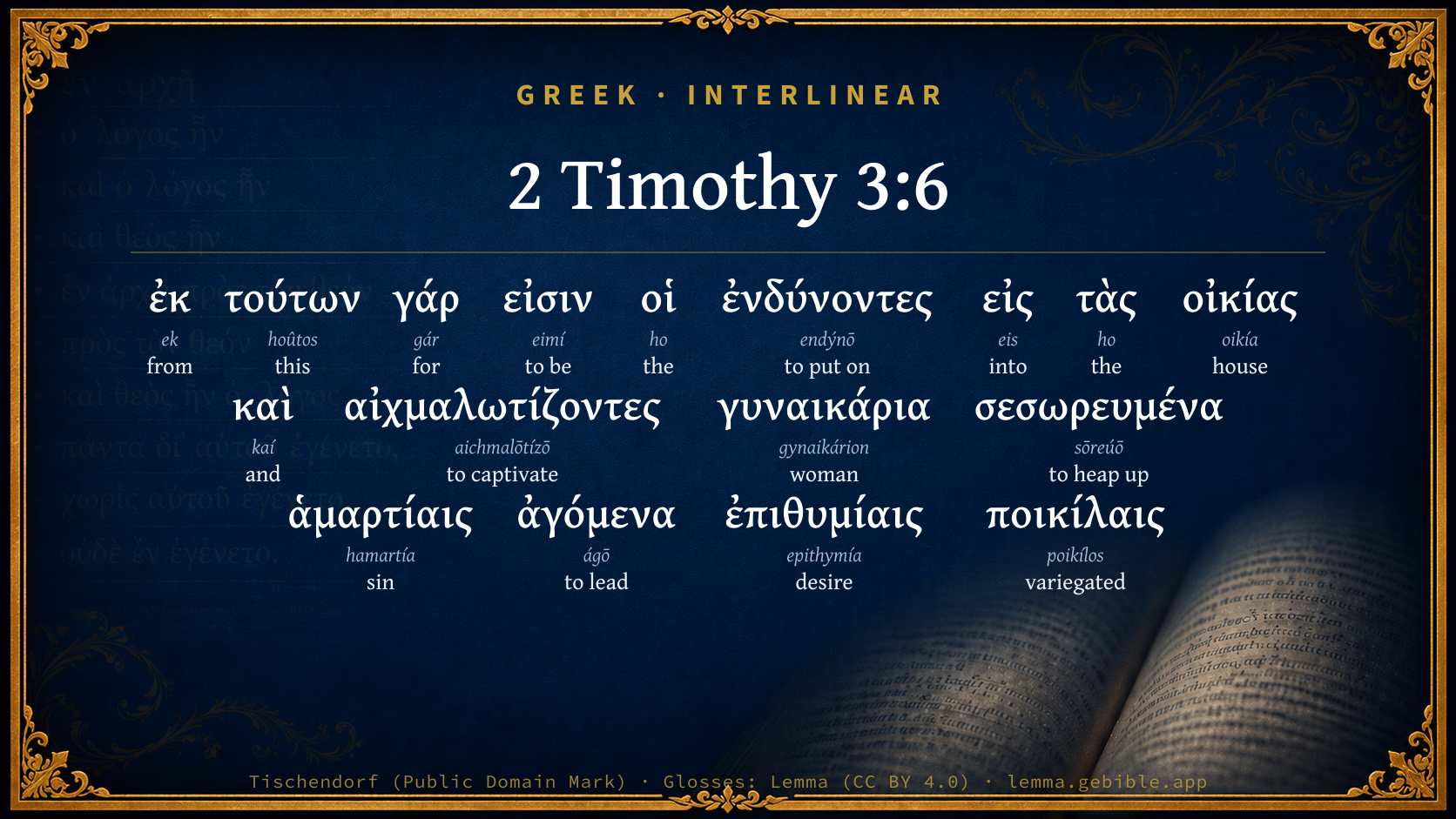
For of these are those who creep into houses, and take captive gullible women loaded down with sins, led away by various lusts,
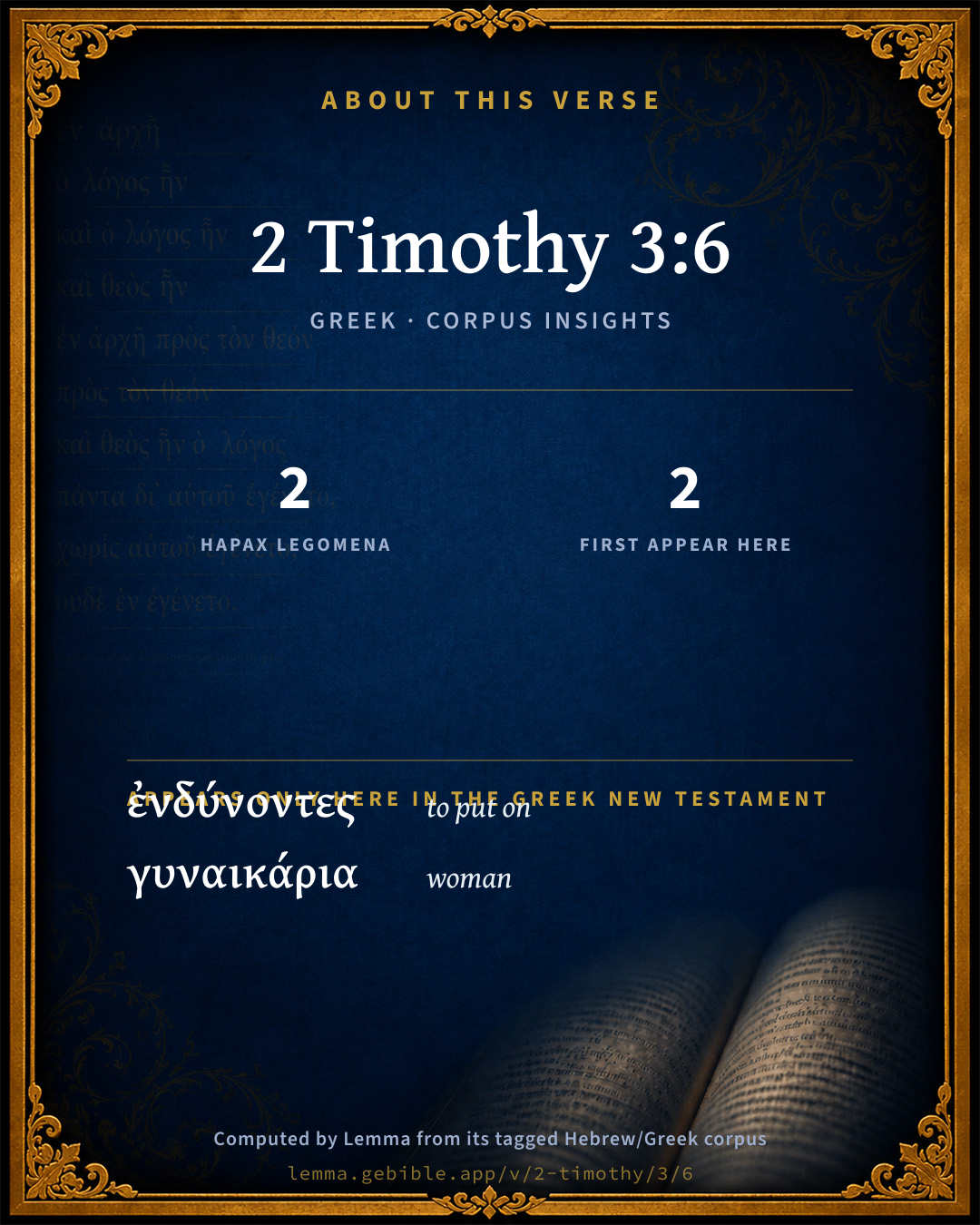
- 2 hapax legomena — only here in the Greek New Testament
- 2 first appearances in the Greek New Testament
Download a study sheet
One document with this verse’s original text, its word-by-word gloss line, the meaning frame, cross-references with their text, attributed commentary, and full source and license credits — printable, and it pastes into notes with its structure intact.
This verse Autodidact and up
A passage Seminary Student
Up to 50 verses in one chapter. A passage sheet keeps up to 6 commentary sources and 12 cross-references per verse, in the order this page ranks them, and says so on the sheet whenever that leaves anything out. Ask for a single verse and you get the Autodidact verse sheet above.
Everything on this page stays free to read, with no account — the sheet is a download of what is already on screen, not access to it.
Compare translations 3
The same verse in 3 English versions, stacked beneath the original-language interlinear above. Click any original word for its lexicon entry.
Each is an independent rendering of the whole verse — the interlinear is not word-aligned to these translations.
Highlighted words mark where these versions differ — a whole-verse word diff, not a word-by-word alignment.
-
World English Bible Public Domain
For of these are those who creep into houses, and take captive gullible women loaded down with sins, led away by various lusts,
-
King James Version Public Domain
For of this sort are they which creep into houses, and lead captive silly women laden with sins, led away with divers lusts,
-
unfoldingWord Literal Text CC BY-SA 4.0
For from these are the ones entering into households and taking captive little women having been heaped with sins, being led away by various desires,
unfoldingWord Literal Text — © unfoldingWord, licensed CC BY-SA 4.0. Word-aligned USFM3 via Door43 (git.door43.org/unfoldingWord/en_ult).
Show all 19 translations
Every available English version of this verse, each an independent rendering of the whole verse.
-
World English Bible Public Domain
For of these are those who creep into houses, and take captive gullible women loaded down with sins, led away by various lusts,
-
Berean Standard Bible Public Domain
They are the kind who worm their way into households and captivate vulnerable women who are weighed down with sins and led astray by various passions,
-
Majority Standard Bible Public Domain
They are the kind who worm their way into households and captivate vulnerable women who are weighed down with sins and led astray by various passions,
-
King James Version Public Domain
For of this sort are they which creep into houses, and lead captive silly women laden with sins, led away with divers lusts,
-
American Standard Version (1901) Public Domain
For of these are they that creep into houses, and take captive silly women laden with sins, led away by divers lusts,
-
Revised Version (1885) Public Domain
For of these are they that creep into houses, and take captive silly women laden with sins, led away by divers lusts,
-
Geneva Bible (1599) Public Domain
For of this sort are they which creepe into houses, and leade captiue simple women laden with sinnes, and led with diuers lustes,
-
Douay-Rheims (1899) Public Domain
For of these sort are they who creep into houses, and lead captive silly women laden with sins, who are led away with divers desires:
-
Young's Literal Translation Public Domain
for of these there are those coming into the houses and leading captive the silly women, laden with sins, led away with desires manifold,
-
Literal Standard Version CC BY-SA 4.0
for of these there are those coming into the houses and leading captive the weak women, loaded with sins, led away with manifold desires,
-
Unlocked Literal Bible CC BY-SA 4.0
For some of them are men who enter into households and captivate foolish women. These are women who are heaped up with sins and are led away by various desires.
-
unfoldingWord Literal Text CC BY-SA 4.0
For from these are the ones entering into households and taking captive little women having been heaped with sins, being led away by various desires,
-
Darby Bible Public Domain
For of these are they who are getting into houses, and leading captive silly women, laden with sins, led by various lusts,
-
World Messianic Bible Public Domain
For some of these are people who creep into houses and take captive gullible women loaded down with sins, led away by various lusts,
-
Webster's Bible Public Domain
For of this sort are they who creep into houses, and lead captive silly women laden with sins, led away with divers lusts;
-
Free Bible Version CC BY-SA 4.0
They're the kind of people that slip into homes and take control of vulnerable women who are burdened down by the guilt of sin and distracted by all kinds of desires.
-
Bible in Basic English Public Domain
For these are they who go secretly into houses, making prisoners of foolish women, weighted down with sin, turned from the way by their evil desires,
-
Text-Critical English NT CC BY 4.0
Among them are those who worm their way into houses and captivate vulnerable women who are overwhelmed with sins and swayed by various evil desires.
-
Tyndale New Testament (1534) Public Domain
Of this sorte are they which entre in to houses and brynge into bondage wymmen laden with synne which wemen are ledde of divers lustes
Literal Standard Version (2020), Covenant Press — licensed CC BY-SA 4.0. Text via the HelloAO Bible API (eBible.org). Unlocked Literal Bible (unfoldingWord) — licensed CC BY-SA 4.0. Text via the HelloAO Bible API (eBible.org). unfoldingWord Literal Text — © unfoldingWord, licensed CC BY-SA 4.0. Word-aligned USFM3 via Door43 (git.door43.org/unfoldingWord/en_ult). Free Bible Version, Dr. Jonathan Gallagher — licensed CC BY-SA 4.0. Text via the HelloAO Bible API (eBible.org).
Word by word
More ways to search: Search by grammar → Find every occurrence → Compare this word →
Practice this passage: Drill this verse → Learn its vocabulary →
- Appears 1× in the Greek New Testament
- First appears here
- Part of Speech
- Verb
- Tense
- Present
- Voice
- Active
- Mood
- Participle
- Case
- Nominative
- Number
- Plural
- Gender
- Masculine
Full Thayer's Definition
- ἐκ ek G1537 “from” Preposition
- τούτων hoûtos G3778 “this” Demonstrative pronoun, Genitive, Plural, Masculine
- γάρ gár G1063 “for” Conjunction
- εἰσιν eimí G1510 “to be” Verb, Present, Active, Indicative, 3rd person, Plural
- οἱ ho G3588 “the” Article, Nominative, Plural, Masculine
- ἐνδύνοντες endýnō G1744 “to put on” Verb, Present, Active, Participle, Nominative, Plural, Masculine
- εἰς eis G1519 “into” Preposition
- τὰς ho G3588 “the” Article, Accusative, Plural, Feminine
- οἰκίας oikía G3614 “house” Noun, Accusative, Plural, Feminine
- καὶ kaí G2532 “and” Conjunction
- αἰχμαλωτίζοντες aichmalōtízō G163 “to captivate” Verb, Present, Active, Participle, Nominative, Plural, Masculine
- γυναικάρια gynaikárion G1133 “woman” Noun, Accusative, Plural, Neuter
- σεσωρευμένα sōreúō G4987 “to heap up” Verb, Perfect, Passive, Participle, Accusative, Plural, Neuter
- ἁμαρτίαις hamartía G266 “sin” Noun, Dative, Plural, Feminine
- ἀγόμενα ágō G71 “to lead” Verb, Present, Passive, Participle, Accusative, Plural, Neuter
- ἐπιθυμίαις epithymía G1939 “desire” Noun, Dative, Plural, Feminine
- ποικίλαις poikílos G4164 “variegated” Adjective, Dative, Plural, Feminine
About this verse
These counts appear in no published source. They are computed here, from the morphology-tagged text and Lemma’s own curated glosses. What Lemma adds →
- 17
- words
- 16
- distinct lemmas
- Pauline Epistles
- section
Notable vocabulary
2 hapax legomena — words that appear only here in the entire Greek New Testament:
First appearance in Scripture
These words make their first canonical appearance in the Greek New Testament here:
Shared distinctive vocabulary
σεσωρευμένα to heap up G4987 occurs in 2 verses of the Greek New Testament. Also found in:
Repetition
A word recurs within this verse:
- οἱ the G3588 ×2
Cross-references
14Topical passages linked to 2 Timothy 3:6 in the Treasury of Scripture Knowledge — connected by theme and wording, ordered by reader-vote popularity; previews shown in the World English Bible.
- Jude 1:4 For there are certain men who crept in secretly, even those who were long ago written about for this condemnation: ungodly men, turning the grace of our God into lasciviousness, and denying our only Master, God, and Lord, Jesus Christ.
- Titus 3:3 For we were also once foolish, disobedient, deceived, serving various lusts and pleasures, living in malice and envy, hateful, and hating one another.
- 2 Peter 3:17 You therefore, beloved, knowing these things beforehand, beware lest, being carried away with the error of the wicked, you fall from your own steadfastness.
- Titus 1:11 whose mouths must be stopped; men who overthrow whole houses, teaching things which they ought not, for dishonest gain's sake.
- Jude 1:18 They said to you that "In the last time there will be mockers, walking after their own ungodly lusts."
- Mark 4:19 and the cares of this age, and the deceitfulness of riches, and the lusts of other things entering in choke the word, and it becomes unfruitful.
- Matthew 23:13 "Woe to you, scribes and Pharisees, hypocrites! For you devour widows' houses, and as a pretense you make long prayers. Therefore you will receive greater condemnation.
- 1 Corinthians 12:2 You know that when you were heathen, you were led away to those mute idols, however you might be led.
- 2 Peter 2:18 For, uttering great swelling words of emptiness, they entice in the lusts of the flesh, by licentiousness, those who are indeed escaping from those who live in error;
- Jude 1:16 These are murmurers and complainers, walking after their lusts (and their mouth speaks proud things), showing respect of persons to gain advantage.
- Isaiah 1:4 Ah sinful nation, A people loaded with iniquity, A seed of evil-doers, Children who deal corruptly! They have forsaken Yahweh. They have despised the Holy One of Israel. They are estranged and backward.
- Matthew 11:28 "Come to me, all you who labor and are heavily burdened, and I will give you rest.
- 1 Timothy 6:9 But those who are determined to be rich fall into a temptation and a snare and many foolish and harmful lusts, such as drown men in ruin and destruction.
- Psalms 38:4 For my iniquities have gone over my head. As a heavy burden, they are too heavy for me.
Cross-references courtesy of OpenBible.info (CC BY 4.0).
Lesson kit
Teaching starters — assembled from the data on this page, not authored interpretation. Every prompt links to the verse data it draws on. Edit before teaching.
2 Timothy, in the Pauline Epistles, opens this verse with 17 words (16 distinct Greek lemmas). Its most distinctive word is endýnō (“to put on”). A historical commentator’s framing appears above. Read the whole chapter for the surrounding context.
Discussion questions
- The word endýnō carries the sense “to put on.” How does it shape the verse?
- 2 words here appear nowhere else in the Greek New Testament. Why might the author reach for such rare wording?
- 2 words make their first appearance in Scripture here. What does this debut establish?
- How does Romans 12:20, which shares the word «to heap up», read alongside this verse?
- What does the repetition of “the” (2× in this one verse) do in this verse?
- These translations render this verse differently. What is at stake in choosing one wording over another?
- Compare how The Biblical Illustrator and Joseph Benson's Commentary read this verse. Where do they agree or differ?
Things to notice
- 2 words in this verse appear nowhere else in the Greek New Testament.
- 2 words make their first canonical appearance in Scripture here.
- These translations choose different wording for 25 words in this verse.
- “the” occurs 2× in this single verse.
- 16 distinct Greek lemmas span 17 words in this verse.
Commentary
Notes on 2 Timothy 3:6 from classic Christian and Jewish commentators (each source and its license shown beneath its notes). The classic Christian expositions comment on the surrounding passage and are grouped to its opening verse, so a note may address several verses; the Jewish commentaries on the Tanakh (Rashi and others) are per-verse, so they appear only where the commentator wrote on this verse.
Lemma curates 59 commentaries, every one of them public domain or Creative Commons licensed, each selected and text-cleaned for this edition rather than reprinted as found. About our sources →
The Biblical Illustrator
Joseph S. Exell
The Biblical Illustrator, edited by Joseph S. Exell (c. 1880s–1900s) — public domain. Text from a community e-Sword module.
Joseph Benson's Commentary
Joseph Benson's Commentary on the Old and New Testaments (1811–1818) — public domain. Text from a community e-Sword module.
The Preacher's Complete Homiletical Commentary
Joseph S. Exell (gen. ed.)
The Preacher's Complete Homiletical Commentary (gen. ed. Joseph S. Exell; Funk & Wagnalls, c. 1892) — public domain (pre-1929). A full-Bible homiletical/sermon-outline anthology covering 65 of 66 books (2 John is absent from the source module). Text from a community e-Sword module.
Tyndale Open Study Notes
Tyndale Open Resources
Tyndale Open Study Notes — © Tyndale Open Resources, licensed CC BY-SA 4.0. Text via the HelloAO Bible API.
Bengel's Gnomon
Johann Albrecht Bengel
Bengel's Gnomon of the New Testament — English translation (T&T Clark, Edinburgh, 1860) — public domain. Text from a community e-Sword module.
Meyer's Critical & Exegetical Commentary
Heinrich August Wilhelm Meyer
Meyer — Critical and Exegetical Commentary on the New Testament — English translation by Peter Christie, edited by Frederick Crombie (T&T Clark, 1880) — public domain. Text from a community e-Sword module.
Expositor's Greek Testament
ed. W. Robertson Nicoll
The Expositor's Greek Testament, edited by W. Robertson Nicoll (1897–1910) — public domain. Text from a community e-Sword module.
Jamieson, Fausset & Brown
Robert Jamieson, A. R. Fausset & David Brown
Jamieson, Fausset & Brown — Commentary Critical and Explanatory on the Whole Bible (1871) — public domain (CC PDM 1.0). Text via the HelloAO Bible API.
Adam Clarke's Commentary
Adam Clarke's Commentary on the Bible (1810–1826) — public domain. Text from a community e-Sword/MySword module.
John Calvin's Commentaries
John Calvin's Commentaries (1540-1563) — public domain. Text from the Calvin Translation Society English edition (1840s-50s) via the Christian Classics Ethereal Library (ccel.org). Calvin's coverage is partial (roughly two-thirds of the Bible); uncommented books and verses are honest gaps, never fabricated. The 19th-century editor's footnotes and remarks are omitted so the notes are faithfully Calvin's own voice.
Ellicott's Commentary for English Readers
A Bible Commentary for English Readers, edited by Charles John Ellicott (1878–1897) — public domain. Text from a community e-Sword module.
The Cambridge Bible for Schools and Colleges
gen. ed. J. J. S. Perowne
The Cambridge Bible for Schools and Colleges (gen. ed. J. J. S. Perowne; Cambridge University Press, 1878–1918) — public domain. Text from a community e-Sword module.
John Gill's Exposition
John Gill's Exposition of the Whole Bible (1746–1763) — public domain (CC PDM 1.0). Text via the HelloAO Bible API.
Trapp's Complete Commentary
John Trapp
John Trapp, A Commentary or Exposition upon All the Books of the Old and New Testament (1647–1656) — public domain. Text from a community e-Sword module.
Albert Barnes' Notes on the Bible
Albert Barnes' Notes on the Bible (1834–1885) — public domain. Text from a community e-Sword/MySword module.
Haydock's Catholic Bible Commentary
George Leo Haydock (1774–1849), Haydock's Catholic Family Bible and Commentary, 1859 edition — public domain. Excludes Psalms (Douay-Rheims chapter numbering differs from Protestant) and Deuterocanonical books (Catholic canon only).
Matthew Poole's English Annotations
Matthew Poole's English Annotations on the Holy Bible (1683–1685) — public domain. Text from a community e-Sword/MySword module.
Whedon's Commentary on the Bible
Daniel D. Whedon
Daniel D. Whedon (gen. ed.), Commentary on the Old and New Testaments (1874–1909) — public domain. Text from a community e-Sword module.
The Pulpit Commentary
The Pulpit Commentary (1880–1919), ed. H.D.M. Spence-Jones & Joseph S. Exell — public domain. Text from a community e-Sword module.
John Wesley's Explanatory Notes
John Wesley, Explanatory Notes Upon the Whole Bible (1754–1765) — public domain. Text via the GEBible commentary corpus.
Fairbairn on Ezekiel, Jonah & the Pastoral Epistles
Patrick Fairbairn
Patrick Fairbairn — An Exposition of Ezekiel (1851), Jonah (1849), and The Pastoral Epistles (1874) — public domain. Text from a community e-Sword module.
Scofield Reference Notes
C. I. Scofield
The Scofield Reference Bible (1917 edition), notes by C. I. Scofield — public domain. Text from a community e-Sword module.
Burkitt's Expository Notes on the New Testament
William Burkitt
William Burkitt's Expository Notes on the New Testament (1700–1703) — public domain. Text from a community e-Sword module.
The People's New Testament
B. W. Johnson
B. W. Johnson's The People's New Testament with Notes (1889–1891) — public domain. Electronic text from the Christian Classics Ethereal Library (CCEL) ThML edition.
Cambridge Greek Testament for Schools and Colleges
Cambridge Greek Testament for Schools and Colleges (Cambridge University Press, 1896; 21 vols, various authors incl. Carr, Maclear, Plummer, Farrar, Lumby, Moule, M. R. James, Simcox) — public domain. Text from a community e-Sword module.
Alford’s Greek Testament
Henry Alford
Henry Alford, The Greek Testament (1849–1861) — public domain. Text from a community e-Sword module.
International Critical Commentary
International Critical Commentary — older volumes (1896–1929), various authors — public domain. Text from a community e-Sword module.
Vincent's Word Studies in the New Testament
Marvin R. Vincent
Marvin R. Vincent, Word Studies in the New Testament (1887–1900) — public domain. Text from a community e-Sword/MySword module.