1 Timothy 5:24

Greek (Tischendorf 8th ed.) 1 Timothy 5:24 appears in the Greek New Testament. The text above is from the Tischendorf 8th edition. Each word links to its Strong’s number and a concise gloss. Click any word for its full Thayer’s Greek Lexicon entry.
Download image
Cite this verse

1 Timothy 5:24 (World English Bible). Public Domain. Lemma interlinear Bible study tool, https://lemma.gebible.app/v/1-timothy/5/24.

Show BibTeX & RIS
BibTeX
RIS
English Translation
Some men's sins are evident, preceding them to judgment, and some also follow later.
World English Bible · Public Domain
Highlights
  • 1 first appearance in the Greek New Testament
Full analysis ↓
Download a study sheet

One document with this verse’s original text, its word-by-word gloss line, the meaning frame, cross-references with their text, attributed commentary, and full source and license credits — printable, and it pastes into notes with its structure intact.

This verse Autodidact and up

Study sheet (.html) Plain text (.txt)

A passage Seminary Student

Up to 50 verses in one chapter. A passage sheet keeps up to 6 commentary sources and 12 cross-references per verse, in the order this page ranks them, and says so on the sheet whenever that leaves anything out. Ask for a single verse and you get the Autodidact verse sheet above.

Everything on this page stays free to read, with no account — the sheet is a download of what is already on screen, not access to it.

Want to remove ads? Support Godless Engineer
Compare translations 3

The same verse in 3 English versions, stacked beneath the original-language interlinear above. Click any original word for its lexicon entry.

Each is an independent rendering of the whole verse — the interlinear is not word-aligned to these translations.

Highlighted words mark where these versions differ — a whole-verse word diff, not a word-by-word alignment.

  • World English Bible Public Domain
    Some men's sins are evident, preceding them to judgment, and some also follow later.
  • King James Version Public Domain
    Some men's sins are open beforehand, going before to judgment; and some men they follow after.
  • unfoldingWord Literal Text CC BY-SA 4.0
    The sins of some men are evident, going ahead into judgment, but also they follow after some.

unfoldingWord Literal Text — © unfoldingWord, licensed CC BY-SA 4.0. Word-aligned USFM3 via Door43 (git.door43.org/unfoldingWord/en_ult).

Versions to compare (up to 4)

3 of 4 selected

Show all 19 translations

Every available English version of this verse, each an independent rendering of the whole verse.

  • World English Bible Public Domain
    Some men's sins are evident, preceding them to judgment, and some also follow later.
  • Berean Standard Bible Public Domain
    The sins of some men are obvious, going ahead of them to judgment; but the sins of others do not surface until later.
  • Majority Standard Bible Public Domain
    The sins of some men are obvious, going ahead of them to judgment; but the sins of others do not surface until later.
  • King James Version Public Domain
    Some men's sins are open beforehand, going before to judgment; and some men they follow after.
  • American Standard Version (1901) Public Domain
    Some men's sins are evident, going before unto judgment; and some men also they follow after.
  • Revised Version (1885) Public Domain
    Some men’s sins are evident, going before unto judgment; and some men also they follow after.
  • Geneva Bible (1599) Public Domain
    Some mens sinnes are open before hand, and goe before vnto iudgement: but some mens folowe after.
  • Douay-Rheims (1899) Public Domain
    Some men's sins are manifest, going before to judgment: and some men they follow after.
  • Young's Literal Translation Public Domain
    of certain men the sins are manifest beforehand, leading before to judgment, and certain also they follow after;
  • Literal Standard Version CC BY-SA 4.0
    the sins of certain men are evident beforehand, leading before to judgment, but some also they follow after;
  • Unlocked Literal Bible CC BY-SA 4.0
    The sins of some people are openly known, and they go before them into judgment. But some sins follow later.
  • unfoldingWord Literal Text CC BY-SA 4.0
    The sins of some men are evident, going ahead into judgment, but also they follow after some.
  • Darby Bible Public Domain
    Of some men the sins are manifest beforehand, going before to judgment, and some also they follow after.
  • World Messianic Bible Public Domain
    Some men’s sins are evident, preceding them to judgment, and some also follow later.
  • Webster's Bible Public Domain
    Some men's sins are open beforehand, going before to judgment: and some men they follow after.
  • Free Bible Version CC BY-SA 4.0
    The sins of some people are really obvious, and they are clearly guilty, but the sins of others are not seen until later.
  • Bible in Basic English Public Domain
    The sins of some men are clearly seen, going before them to be judged; but with others, their sins go after them.
  • Text-Critical English NT CC BY 4.0
    The sins of some are obvious, going before them to judgment, but the sins of others trail along behind.
  • Tyndale New Testament (1534) Public Domain
    Some mennes synnes are open before honde and goo before vnto iudgement: some mennes synnes folowe after.

Literal Standard Version (2020), Covenant Press — licensed CC BY-SA 4.0. Text via the HelloAO Bible API (eBible.org). Unlocked Literal Bible (unfoldingWord) — licensed CC BY-SA 4.0. Text via the HelloAO Bible API (eBible.org). unfoldingWord Literal Text — © unfoldingWord, licensed CC BY-SA 4.0. Word-aligned USFM3 via Door43 (git.door43.org/unfoldingWord/en_ult). Free Bible Version, Dr. Jonathan Gallagher — licensed CC BY-SA 4.0. Text via the HelloAO Bible API (eBible.org).

Word by word

More ways to search: Search by grammar → Find every occurrence → Compare this word →

Practice this passage: Drill this verse → Learn its vocabulary →

πρόδηλοί
pródēlos
G4271
“manifest”
Adjective, Nominative, Plural, Feminine
Part of Speech
Adjective
Case
Nominative
Number
Plural
Gender
Feminine
Full Thayer's Definition

Origin: from G4253 and G1212

TDNT: None

1. openly evident, known to all, manifest
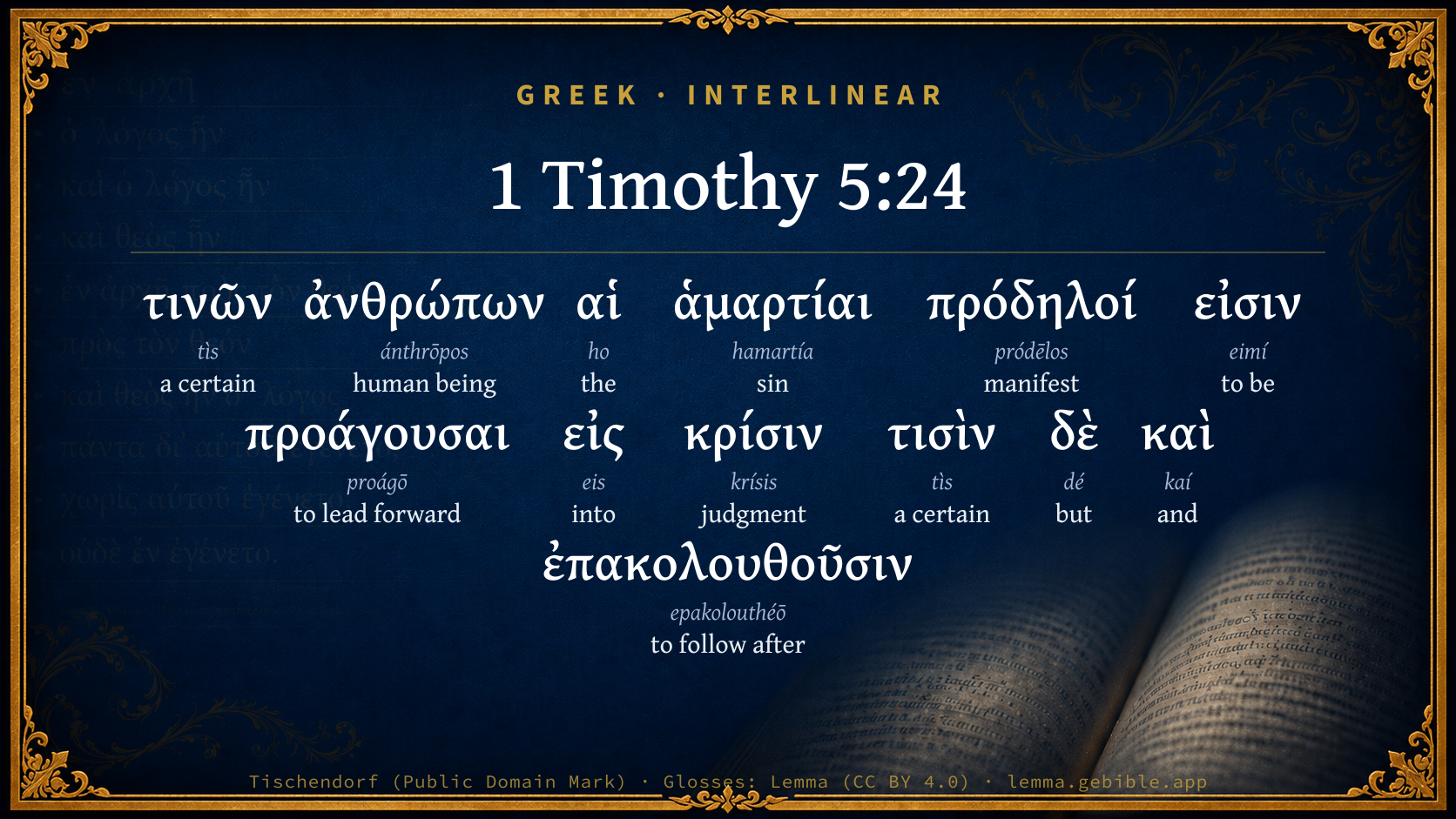
  1. τινῶν tìs G5100 “a certain” Indefinite pronoun, Genitive, Plural, Masculine
  2. ἀνθρώπων ánthrōpos G444 “human being” Noun, Genitive, Plural, Masculine
  3. αἱ ho G3588 “the” Article, Nominative, Plural, Feminine
  4. ἁμαρτίαι hamartía G266 “sin” Noun, Nominative, Plural, Feminine
  5. εἰσιν eimí G1510 “to be” Verb, Present, Active, Indicative, 3rd person, Plural
  6. προάγουσαι proágō G4254 “to lead forward” Verb, Present, Active, Participle, Nominative, Plural, Feminine
  7. εἰς eis G1519 “into” Preposition
  8. κρίσιν krísis G2920 “judgment” Noun, Accusative, Singular, Feminine
  9. τισὶν tìs G5100 “a certain” Indefinite pronoun, Dative, Plural, Masculine
  10. δὲ dé G1161 “but” Conjunction
  11. καὶ kaí G2532 “and” Conjunction
  12. ἐπακολουθοῦσιν epakolouthéō G1872 “to follow after” Verb, Present, Active, Indicative, 3rd person, Plural

About this verse

These counts appear in no published source. They are computed here, from the morphology-tagged text and Lemma’s own curated glosses. What Lemma adds →

13
words
12
distinct lemmas
Pauline Epistles
section

Notable vocabulary

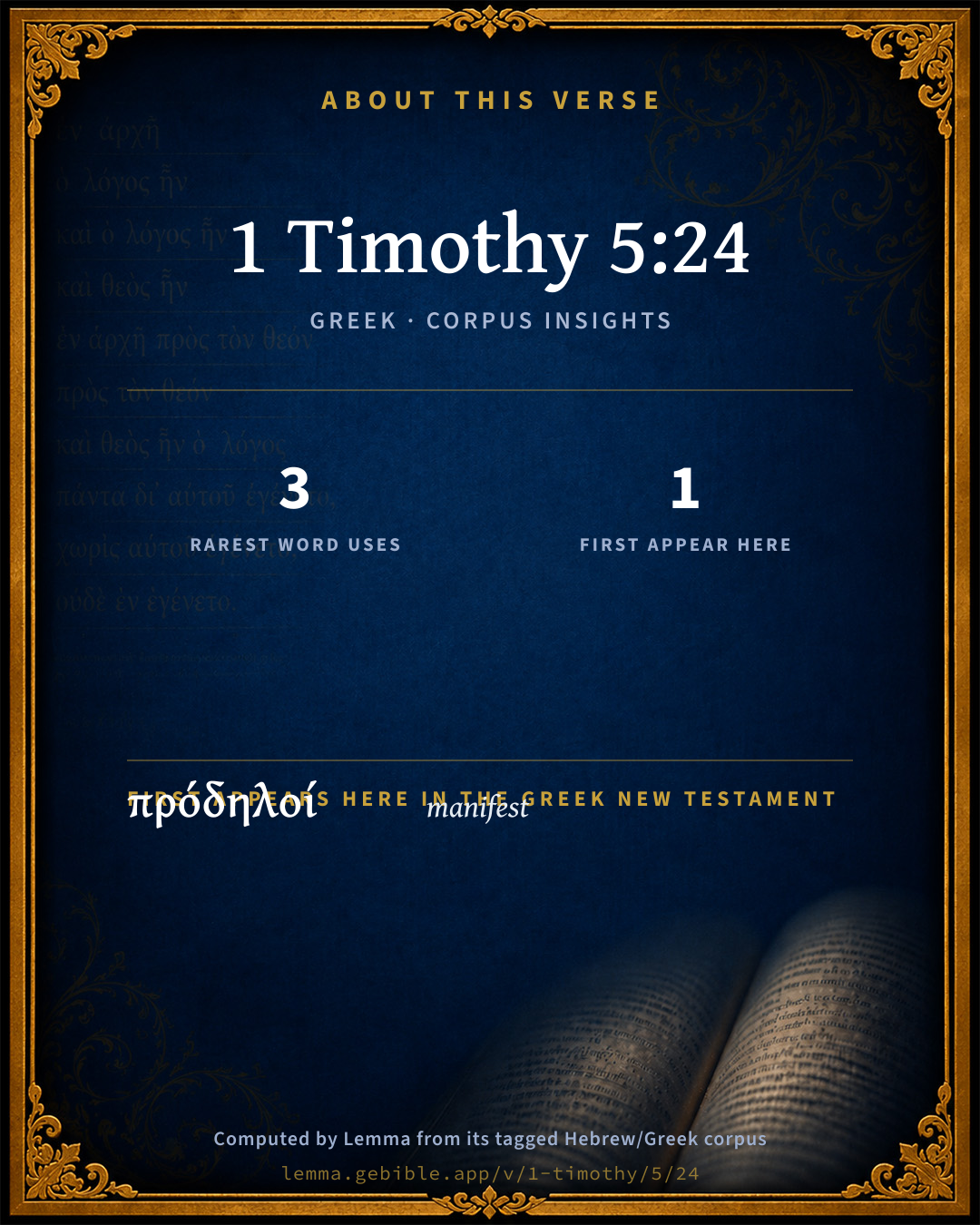
The rarest word here is πρόδηλοί manifest G4271 — appearing just 3 times in the whole Greek New Testament.

First appearance in Scripture

This word makes its first canonical appearance in the Greek New Testament here:

  • πρόδηλοί manifest G4271

Shared distinctive vocabulary

πρόδηλοί manifest G4271 occurs in 3 verses of the Greek New Testament. Also found in:

Repetition

A word recurs within this verse:

  • τινῶν a certain G5100 ×2

Cross-references

7

Topical passages linked to 1 Timothy 5:24 in the Treasury of Scripture Knowledge — connected by theme and wording, ordered by reader-vote popularity; previews shown in the World English Bible.

  • 2 Timothy 4:10 for Demas left me, having loved this present world, and went to Thessalonica; Crescens to Galatia, and Titus to Dalmatia.
  • Acts 8:18 Now when Simon saw that the Holy Spirit was given through the laying on of the apostles' hands, he offered them money,
  • 2 Peter 2:20–21 For if, after they have escaped the defilement of the world through the knowledge of the Lord and Savior Jesus Christ, they are again entangled therein and overcome, the last state has become worse with them than the first.
  • Acts 1:16–20 "Brothers, it was necessary that this Scripture should be fulfilled, which the Holy Spirit spoke before by the mouth of David concerning Judas, who was guide to those who took Jesus.
  • Acts 5:1–11 But a certain man named Ananias, with Sapphira, his wife, sold a possession,
  • Galatians 5:19–21 Now the works of the flesh are obvious, which are: adultery, sexual immorality, uncleanness, lustfulness,
  • Jeremiah 2:34 Also in your skirts is found the blood of the souls of the innocent poor: you did not find them breaking in; but it is because of all these things.

Cross-references courtesy of OpenBible.info (CC BY 4.0).

Commentary

Notes on 1 Timothy 5:24 from classic Christian and Jewish commentators (each source and its license shown beneath its notes). The classic Christian expositions comment on the surrounding passage and are grouped to its opening verse, so a note may address several verses; the Jewish commentaries on the Tanakh (Rashi and others) are per-verse, so they appear only where the commentator wrote on this verse.

Lemma curates 59 commentaries, every one of them public domain or Creative Commons licensed, each selected and text-cleaned for this edition rather than reprinted as found. About our sources →

The Cambridge Bible for Schools and Colleges

gen. ed. J. J. S. Perowne

24. It is most natural to regard 1Ti_5:24-25 as a review under a fresh aspect of the two main duties urged upon Timothy in the paragraph; just as in the former paragraph, 1Ti_5:3-16, 1Ti_5:16 is similarly related to its preceding context. The meaning thus will be; ‘I have bidden you in rebuking your presbyters “to be so merciful that you be not too remiss, so to minister discipline that you forget not mercy”; remember how quickly sometimes error stands “self-condemned,” how slow at other times its evil is in working out. Again, in rewarding your presbyters I have bidden you, as a wise and faithful servant, “give to God’s family their portion in due season,” by deserved promotion and preferment; remember how readily some clerical “good work” comes to the front, while yet the more quiet pastoral service cannot be left in the dark and cold.’

are open beforehand] Better, as R.V., are evident; the preposition in the compound adjective only signifies ‘at once’ ‘before one’s eyes;’ the word is used just as we use ‘evident’ in geometrical proof, in Heb_7:14, ‘For it is evident that our Lord sprang out of Juda.’

going before to judgment] The verb is common in the Gospels in its simple sense, e.g. Mar_11:9, ‘they that went before and they that followed;’ here, somewhat metaphorically, it describes the obtrusive forward character of ‘advanced’ teaching and ‘fast’ living; cf. 2Jn_1:9, ‘every one that goeth forward,’ ‘that advances in bold confidence beyond the limits set to the Christian Faith’ (Bp Westcott). The judgment is that of Timothy and of the Church. The clause seems to recur compressed into one word, Tit_3:11, ‘such an one sinneth, being self-condemned’ or ‘self-judged.’ Our metaphors ‘patent error,’ ‘rampant vice,’ are modern representatives of the two phrases.

some men they follow after] More exactly, some men they only follow after; the evil consequences and evil repute are slow in attaching themselves.

The Cambridge Bible for Schools and Colleges (gen. ed. J. J. S. Perowne; Cambridge University Press, 1878–1918) — public domain. Text from a community e-Sword module.

The Biblical Illustrator

Joseph S. Exell

1Ti_5:24-25

Some mens sins are open beforehand.

The law of moral recompenses

Let us proceed to a consideration of this law of recompenses, whether in relation to the bad actions of the sinner, or to the good works of the righteous,

I. And first, let us see how the text brings out the principle we have spoken of, as applied to the case of bad men,--that is of hardened and incorrigible offenders: Some mens sins are open beforehand, going before to judgment.

1. Of this one illustration is to be found in the consequences which, even in the present state, follow upon the commission of sin. That principle of our religious philosophy, laid down by Bishop Butler, that the general constitution of this worlds government is, upon the whole, favourable to virtues and adverse to wrong-doing, is in nothing more manifest, than in the unalterable connection which subsists between sin and misery. Dissipation leads to want, sensuality to enfeebled health, dishonesty drives sleep from the eyelids through the fear of being found out, and it is often literally true that bloody and deceitful men scarce live out half their days. Thus, to the end of their days, sinners are constantly finding out that they who plough iniquity and sow wickedness reap the same. In the spirit of the Psalmist, though often without his hope, they are left to cry out daily, My sin is ever before me. For their first sin haunts them with its consequences to the close of their career. They never escape from its revenges. It tracks their path like a bloodhound. In its initial forebodings the plague of retribution begins here: Their sins are gone beforehand to judgment.

2. Again, it is a part of the penalty of the transgressor in this life, and that which sends his sins before him, as it were a herald, to get his place and portion ready, that the longer he continues in a course of evil, the more violently and inevitably is he urged in the same direction. The thought is not sufficiently realized by us, that, in moral things, like produces like; that each separate act of transgression which a man commits leaves its own seminal deposit of evil in the soul, which, unless eradicated by a higher power than his own, must fructify and gather strength till the time of harvest,--till the end of life, or till the end of the world. The process of moral deterioration may be subtle and unobserved, like the stealthy creeping of a pestilence, but, in the majority of cases, it is sure and uniform. The youth determines what the man shall be. And the man determines what the grey hairs shall be. It is a righteous thing with God to let the wicked be the forger of his own fetters, and to leave him with his own hands to bind them on. Such is a law of our moral nature. Thus, while a man is continuing in sin everything is preparing for the end, and hastening the advent of the end. Each repeated act of disobedience exerts an influence upon character; tends to its consolidation and settlement in evil; helps to bring about that which, as far as can be seen, will be its final and everlasting form,--that of hatred of God, and resistance to all good. Except the final consummation of their misery, they have nothing more to wait for. Their sins are gone beforehand to judgment.

3. But further, in relation to this great law of retribution, attaching itself to sinful actions, it is added, some men their sins follow after. The thought here suggested would seem to be this, that in estimating the penalties due to transgressions we must take into the reckoning the unquestioned fact that the consequences of some mens sins follow after them, live to produce their mighty havoc and harvest of evil when the men themselves are gone. This is a law of social influences which altereth not. A bad man cannot restrict the consequences of his misdoing to himself. For the evil follows after, even unto many generations. Jeroboam, the son of Nebat, set up two calves, and the consequence was that within a few years two nations fell into the practice of idolatry. Indeed, in its consequences, and, as far as the present economy is concerned, every kind of sin may be regarded as having immortality. Infidelity and falsehood are immortal. The exposed sophistry and the ribald jest will be propagated from mouth to mouth, and from book to book, to the end of time. Thankful should we be to know that there may be an arrest laid upon the mischief, in some cases, or that the grace of God may, and often does, raise up a counteracting influence for good. But too commonly the seed of evil is left to bring forth fruit after its kind: With some men their sins follow after.

II. But I proceed to notice, in the second place, the application of this law of recompenses to the good actions of the righteous. Likewise also the good works of some are manifest beforehand, and they that are otherwise cannot be hid.

1. First, it is said that the good works of some are manifest even in the present life. Ye are the light of the world, said our Lord; a city that is set on a hill cannot be hid. Thy Father, which seeth in secret, Himself shall reward thee openly.

2. Again, his good works are manifest beforehand, because they will be sure to take the form of active benevolence, and of endeavors to promote the moral and spiritual happiness of mankind.

3. And they that are otherwise cannot be hid. What further lesson may we draw from this? why, that no good works of a righteous man can ever be altogether thrown away; can ever fail of producing fruit; can ever, whether in this world or in that which is to come, miss of its fitting and merciful reward. We know that, of vessels chosen for the Masters use, some are for greater honour, and some for less. Cannot be hid, first, because of the effect which a course of good works has upon a mans own character, and the lasting peace they leave behind, The path of the just is as the shining light, which shineth more and more unto the perfect day. Faith makes larger discoveries of God, and of the fitness and fulness of the provided atonement. Hid from the world, but not from himself, is his tranquil joy in prayer, his nearness to God in sacraments, his derived strength from Christ, his interchange of thoughts with heaven, as he meditates on the written Word. Hid from the world, but not from himself, are his peace in conflict, his supports in temptation, his thankfulness after a gained victory over the powers of evil, as to God, and to God alone, he gives the praise. Furthermore, a mans good works cannot be hid, because, in all the parts and actions of our life, there are unknown eyes upon us. We, none of us, know the extent of our own influence, how many of those who are associated with us, in the common intercourse and work of life, may be, without acknowledging it, looking up to us as patterns, or at all events are taking observant note where our practice differs from theirs. Cannot be hid, once more: because, like the bad mans sins, good works will follow after. Of every good man it may be said, as of Abel, He being dead yet speaketh;--speaketh by the memory of his virtues. Such is the rule of the Almightys procedure, whether in dealing with good men or bad. It is based on principles of everlasting rectitude. It is administered after methods of gentlest kindness. It commends itself to the conscience, as answering to the conditions of a reasonable service. It is in harmony with fact, with observation, and with the experience of our own hearts. (D. Moore, M. A.)

The method of penalty

I am certainly within the spirit of the text when I say that some sins anticipate judgment; they invoke it, and receive its sentence, and experience its penalty, apparently before the time; they run their course quickly, and incur their doom in this life. There are other sins that meet with little check; they are slow to overtake their consequences; they come upon little in this life that can be called penalty. Speaking from daily observation, we may say that the retribution of some sins begins in this world; while there are other sins that await their punishment in the next world. We shall best come to an understanding of this truth by looking a little into the method of retribution. It is, as its definition implies, a return of disobedience, or payment, when, in due time, it returns again. It is the natural and inevitable consequence of broken law. If we seek for an explanation of this law, we find none, except that it is so. We perceive its fitness and beneficence, but farther back we cannot go. The law is wrought into our moral nature, and also into our consciousness; certainly, it commands early and universal assent. We notice also that the penalty is akin to the sin; it is under the seed-law--like yielding like. We receive back the things we have done, changed only as mist is changed to water, and heat to flame. And the effect often bears so absolute resemblance to the cause as to arrest the imagination, and is called poetic justice; the murderer drinking the poison he had prepared for another. In human government it is not so, but only because of its imperfection. It is an increated principle, and cannot be superinduced to any great extent. When a man steals, all that human law has yet learned to do is to imprison, or otherwise injure him, inflicting an arbitrary, deterrent suffering. Society merely defends itself. It is seldom skilful enough to establish a natural relation between the crime and the penalty. But that part of human society which is not organized into government, the social relationship of men, is more skilful to connect evil with its natural punishment. If one sins against the conventional laws, or moral instincts, of society, he meets with exclusion or disgrace according to the nature of the offence. Cause and effect; natural order; congruity between the sin and its penalty; these are the unfailing marks that the great teacher put upon the subject. What wisdom, what truth, what justice, is the voice of universal reason and conscience. It is the weakness of human government that it does not employ this principle in the punishment of crime, so far as it might. It was a doubtful policy that abolished the whipping-post and pillory. If a brutal husband whips his wife at home, he can have no better punishment than a whipping in public; or, if this be corrupting to the people, then in private. If these suggestions be thought to imply a retrograding civilization, let me answer, they harmonize with the Divine order. There is but one sound, effective method of punishing wrong-doing, and that is to make the offender feel the evil he has inflicted. As we thus look at retribution in the mingled light of revelation and reason, we are prepared to understand why it is that some sins are punished in this world, while other sins await punishment in a future world. If we were to classify the sins that reap their painful consequences here, and those that do not, we would find that the former are offences that pertain to the body, and the order of this world; and that the latter pertain more directly to the spiritual nature. The classification is not sharp; the parts shade into one another; but it is as accurate as is the distinction between the two departments of our nature. In his physical and social nature man was made under the laws of this world. If he breaks these laws the penalty is inflicted here. It may continue hereafter, for the grave feature of penalty is that it does not tend to end, but continues to act, like force imparted to an object in a vacuum, until arrested by some outside power. But man is also under spiritual laws,--reverence, humility, love, self-denial, purity, and all that are commonly known as moral duties. If he offends against these, he may incur but little of painful consequence. There may be much of evil consequence, but the phase of suffering lies farther on. The soil and atmosphere of this world are not adapted to bring it to full fruitage. Stating our distinction again: punishment in this world follows the sins of the grosser part of our nature--that part which more especially belongs to this world--sins against the order of nature, against the body; sins of self-indulgence and sins against society. The punishment that awaits the next world is of sins pertaining to the higher nature, sins against the mind, the affections, and the spirit. The seed of evil sown in the soil of this world comes to judgment here. The seed of evil sown in the hidden places of the spirit, does not bear full fruit till the spiritual world is reached. Man is co-ordinated to two worlds. They overlap far into one another; the spiritual inter-penetrates the physical; and the physical sends unceasing influences into the spiritual. Still, each is a field whereon evil reaps its appropriate harvest. Illustrations of the first confront us on every side; judgment pronounced and executed here; sin punished here. Take the commonest but most instructive example--drunkenness. As soon as desire becomes stronger than the will, it begins to act retributively. Having sown to the flesh, he reaps to the flesh corruption. His sin works out its penalty on its own ground. I do not say that it ends here, because it is also linked with an order more enduring than this world. For, as one standing over against a mountain may fill the whole valley with the clamour of shouting, but hears at length an echo as if from another world, so these sins, having yielded their first fruits here, may stir up vaster penalties hereafter. The terrible feature of penalty, so far as any light is thrown upon it from its own nature, is that it cannot anticipate an end. The subject finds various illustration: indolence eating the scant bread of poverty; wilful youthhood begetting a fretful and sour old age; selfishness leading to isolation; ambition overreaching itself and falling into contempt; ignorance yielding endless mistake; worldly content turning first into apathy, then into disgust; these every-day facts show that if we sin against the order of this world, we are punished in this world. If we sin against the body we are punished in the body. We turn now to the other point, namely, that sins against the spiritual nature do not incur full punishment here, but await it in the spiritual world. We constantly see men going through life with little pain or misfortune, perhaps with less than the ordinary share of human suffering, yet we term them sinners. They do not love nor fear God; they have no true love for man; they reject the law of self-denial and the duty of ministration; they stand off from any direct relations to God, they do not pray; their motives are selfish; their temper is worldly; they are devoid of what are called graces except as mere germs or chance out-growths, and make no recognition of them as forming the substance of true character. Such men break the laws of God, and of their own nature, as really as does the drunkard, but they meet with little apparent punishment. There may be inward discomfort, pangs of conscience at times, a painful sense of wrongness, a dim sense of lack, but nothing that bears the stamp of penalty. These discomforts grow less, and at last leave the man quite at ease. These men seem to be sinning without punishment, and often infer that they do not deserve it. The reason of the difference is plain. They keep the laws that pertain to this world, and so do net come in the way of their penalties. They are temperate, and are blessed with health. They are shrewd and economical, and amass wealth. They are prudent and avoid calamities. They are worldly wise, and thus secure worldly advantages. But man covers two worlds, and he must settle with each before his destiny is decided: he may pass the judgment seat of one acquitted, but stand convicted before the other. It is as truly a law of our nature that we shall worship as that we shall eat. When, a half century ago, the famous Kaspar Hauser appeared in the streets of Nuremberg, having been released from a dungeon in which he had been confined from infancy, having never seen the face or heard the voice of man, nor gone without the walls of his prison, nor seen the full light of day, a distinguished lawyer in Germany wrote a legal history of the case which he entitled, A Crime against the Life of the Soul. It was well named. There is something unspeakably horrible in that mysterious page of history. To exclude a child not only from the light, but from its kind; to seal up the avenues of knowledge that are open to the most degraded savage; to force back upon itself every outgoing of the nature till the poor victim becomes a mockery before its Creator, is an unmeasurable crime; it is an attempt to undo Gods work. But it is no worse than the treatment some men bestow upon their own souls. If reverence is repressed, and the eternal heavens are walled out from view; if the sense of immortality is smothered; if the spirit is not taught to clothe itself in spiritual garments, and to walk in spiritual ways: such conduct can hardly be classed except as a crime against the life of the soul. But one thing is certain. As the poor German youth was at length thrust out into the world for which he was so unfitted, with untrained senses in a world of sense, without speech in a world of language, with a dormant mind in a world of thought--so many go out of this world--with no preparation in that part of their nature that will most be called into use. There the soul will be in its own realm; it will live unto itself, a spirit unto spiritual things. A spiritual air to breathe; spiritual works to do; a spiritual life to live, but the spirit impotent I If there has been absolute perversion of the moral nature here, it must assert itself there in the sharpest forms, but the natural penalty of the greater part of human sin is darkness. This is the condemnation, that men have loved darkness. And the penalty of loving darkness, is darkness: it soul out of keeping with its condition, and therefore bewildered, dazzled by light cannot endure, or blind from the disused sense, it matters not which; it is equally in darkness. (T. T. Munger.)

Open and hidden sins

I. We are, first, to consider who those persons are whose sins are open beforehand, going before to judgment. And, in making this inquiry, we must still keep in mind that all sin is condemning. The world makes strange distinctions between what it calls great and little sins; but the word of God simply declares the soul that sinneth, it shall die (Eze_18:4). The wages of sin, of all sin, is death (Rom_6:23). But though all sin is condemning, all sin is not equally open. Many sins which nevertheless subject the soul to eternal death, are kept hidden from man, while some are open and avowed. The unchanged nature may be restrained from exhibiting to the eye of man sins open beforehand, going before to judgment; but the evil principle of all sin is there, open to the eye of that God with whom we have to do. Causes there are which work upon the unchanged mind, from letting sin break out in the life; though the real love of sin exists fully in the heart. Such a restraint is natural conscience; such, the laws and expectations of civilized, much more of refined society. But where these restraints are broken through, then the whole body of sin and evil principles which were working in the inward soul before, now become manifest in all ungodliness. They have no fear of God before their eyes; their hearts are hardened, through the deceitfulness of sin: they set the law of God always, and the law of man when they dare do so, at defiance; and so spend their short day upon earth in sins open beforehand, going before to judgment.

II. Let us inquire, in the second place, who those are whose sins follow after. In the judgment which is formed of sin by men of the world, their minds are manifestly under a great delusion from the father of lies. They do not judge of sin as the transgression of the law of God, and therefore hateful in his sight; but they measure it according to the effects which it produces against the safety or conveniences of society. They cannot see that all sin, whether it be open beforehand, or whether it follow after to judgment, is destructive to the soul, and dishonourable to almighty God; and, consequently, that every child of Adam who dies in any unforgiven sin, is lost. But besides this kind of delusion, which comforts many in their unholy life, and so far prevents their sin from breaking out into open wickedness, there is another cause why sin is oftentimes kept from becoming open beforehand. Moral virtue, and a certain external character of religion, have still a share of the worlds permission, nay, in a measure, of the worlds approbation; provided that they do not make acknowledged reference to the power and obligations of the gospel of Jesus Christ. But all this only serves to make sin take deeper root. It is growing, though concealed from the world, in a soil congenial to it, and will increase unto all ungodliness. If, therefore, we retain sin in our heart by living in ignorance of the real state of our soul, while we succeed in establishing an outward character with men, we are passing through life deceiving and being deceived. Think, oh think, of the dreadful exposure in that day of all your secret bosom sins, hidden and unrepented of here, but then made manifest, to your shame and everlasting contempt.

III. It now remains that we consider the case of those who have neither sins going before them to judgment, nor sins following after. And who are these? where shall we find them? Not among those who have never sinned: For all have sinned, and come short of the glory of God (Rom_3:23). Not among those who sin not now: For their is not a just man on earth, that doeth good, and sinneth not, (Ecc_7:20). They will be found standing in their own peculiar lot: washed, sanctified, justified in the name of the Lord Jesus, and by the Spirit of our God (1Co_6:11); and none who are such have sins either going before to judgment, or following after. Think upon your privileges in your acceptance in the Beloved. Ye are washed from the guilt of past sins, because it is written, the blood of Jesus Christ cleanseth us from all sin (1Jn_1:7). It is the fountain opened for sin and for uncleanness (Zec_13:1). (H. Marriot,M. A.)

The open and secret sinner

This is the condition of all open and notorious sinners. They are sold as slaves to sin; everybody sees and knows them to be such; they know it themselves, and are bitterly conscious of their bondage, however they may affect to think lightly of it, or even glory in it; as there are those whose glory is in their shame, and who boast of being free from the restraints of religion, honour, and public decency. Who ever offended the general conscience of society by a great and public sin, and did not feel himself to be speedily judged, condemned, and degraded? and that not only in other mens judgment, which he would fain set aside or over-rule if he could, as partial, unreasonable, and unjust, but in the judgment of his own heart, which, in spite of himself, affirms and concurs in that of the world. For though the world itself is full of sin, yet, bad as it is, it does, in an imperfect and irregular way, respect virtue and rebuke vice. And hereby the judgment of the world becomes a token and intimation of Gods judgment, and God makes the conscience and opinion even of wicked men testify against the wickedness of others, though perhaps less wicked than themselves. All open sin goes before to judgment. But how stands the case with regard to secret sins? There is in these, we may suppose, no manifest offence against the decencies and proprieties of society: the world knows nothing of the sin, character is not lost, the sinners life may be in other respects unimpeachable. Cannot his sin be covered up? It is a vain hope; the covered sin corrupts the whole life. If open sin is like an overmastering fire, that blazes out at every window and flames up through the roof of the devoted house, secret sin is as the smouldering heat, that preys upon the main timbers, unobserved for a time, but stealthily eating its way from one to another, till at last the crash comes, and the building crumbles into dust and ashes. What calamity is so frightful and appalling as the sudden downfall of a man, long looked upon as of pure and honourable life, but found out at last to have been hiding wickedness under an outward show of virtue? And yet sad as this is, it is not so sad as if the cherished sin had passed undiscovered and unrepented of, till the sinner stood to answer for it before the great judgment-seat. I said that covered sin corrupts the whole life. And is it not so? Of course the secret sinner is ashamed of his sin; at least he is ashamed of it in reference to the effect it would produce against him, if it were known, in the minds of some people for whose opinion he cares. Then he must live in a constant disguise of false appearance. His daily life must be a lie, and he must be under a continual necessity of committing fresh sins to hide former ones. But besides the outward and visible consequence, what I may call the material penalty of sin, whether open or secret, there is an inward one of even greater severity; namely, the alienation of the mind from God, and consequent derangement of all the spiritual faculties and operations of the soul. Can a man who is consciously and designedly dishonest, or an extortioner, or a drunkard, or an adulterer, hold unreserved and refreshing communion with his Maker, who is of purer eyes than to behold iniquity? It is an old and most true remark, that nobody can go on both sinning and praying; for either praying will make him leave off sinning, or sinning will make him leave off praying. A wilful sinner might keep up the outward form, and be even all the worse for doing so, but he could not exercise the spirit of prayer. For though a person who is notoriously wicked in some particulars may, from mere worldly prudence, and a just appreciation of his own interest, be upright in others, this does not cleanse the blot of his character either to the world or to himself. The thief is not honoured by people of any discernment because he may happen to be sober, nor the adulterer because he may happen to be industrious. And much less can he, upon any reasonable estimate of his own spiritual state, appease his conscience, entertain a comfortable hope that he is in Gods favour or make it the serious business of his life to advance Gods glory. He is, by his works, a manifest enemy to the kingdom of grace. And how stands, in this particular, the case of the secret sinner? We suppose his sin not to be known to the world; his example, therefore, creates no scandal, shocks nobodys feelings; it may not even be blemished by any apparent inconsistency; but the hidden sin defiles the sinners conscience, and bars his approach to God, just as much as open wickedness does. And this is the way in which it operates. The man feels that there is a part of his habitual life that he cannot freely disclose and acknowledge to God; a condemning secret, which he would fain withdraw, if he could, even from the judgment of his own heart. The consequence is that the form of religion, which we are supposing the secret sinner to keep up, is but a deception, a hollow mask to hide the practical infidelity of his character. It is plain that the wilful sinner can have no comfort in the knowledge of God, or in approaching Him in prayer. He has chosen to set himself in opposition to God, and to be holden for an enemy by Him. It may be suggested that the law which forbids the darling sin is not Gods law, the revelation which is supposed to declare it is misstated or misrepresented, or perhaps is no real revelation at all. Nobody wonders that the man who is profligate is also irreligious; and nobody thinks of taking his opinion or his practice into account in any matter in which religion is concerned. But the secret sinner may unsettle the faith of many souls besides his own. The secret sinner, again, will have to recollect, and, so far as he may, to repair any damage that he may have done to the cause of religion by the looseness of his conversation while he was supposed to be, though he really was not, a trustworthy companion for people of sincere and unpolluted minds. But whatever may be the proper outward manifestations of penitence for either open or secret sin, the work itself must be begun and wrought out within the sinners heart. This season of Lent has been specially appointed by the Church for the work of self-examination and penitence: not but what we ought to be daily humbling ourselves for those faults which we daily commit, but because through our natural slowness and coldness to spiritual things we are apt to fall into a negligent way of performing these daily duties, and so require to be ever and anon awakened and warned to set ourselves more heartily to our painful task. Let us not, then be withheld by false shame from owning to God and to ourselves, and, if it must be so, to man also, the heinousness of those sins which we may have openly and knowingly committed; nor let us attempt to take refuge in that ignorance of our own acts and of their quality, which, in whatever degree it is wilful, is in that degree an aggravation of sin, not an excuse for what is done amiss; but let us gladly accept the light which the Word and Providence of God afford to us, that we may come to know ourselves as we are known by Him. It may be a painful, but it will be a saving knowledge. (Bp. S. Wilberforce.)

The sins that follow

I. Now there is no difficulty in fixing on the characters described under the former clause, Some mens sins are open, going before unto judgment. From the day of Pentecost until now, the Church has had to contend with a body of men who have set themselves in direct and open hostility to holiness and God; who have mocked at His counsel and would none of His reproof. Their sins have been open; all the world has acknowledged their guilt, and anticipated their condemnation. Their offences go before them invoking Gods judgment. Who are they, we will rather ask, described in the second clause of the text, whose wickednesses are not visible at the moment? In reply, we would remind you of the familiar division of all sin into ignorant and presumptuous. Indeed, indeed, it is quite possible for a man to be persuaded that he stands upright, when in Gods sight he is grovelling in the dust. We will take the case of a man who rejects from his creed one of the articles of the Christian faith. These persona live on contented with their own condition; they are not sensible of any evil from the course they pursue. Now this licensed unbelief in which people, good and amiable in the main, indulge themselves upon particular points--this free thinking upon a few of the minor dogmas of the Church, which seemingly issue in nothing, leads to no harmful result, is just of the nature of those sins which follow after. The secret scepticism, Oh! it does not go before a man, calling down upon his head general reproach; it is not as the crime of dishonesty, or avariciousness, or cruelty, or impurity, which lift up their voices and imprecate judgment; but it hangs about an individual almost without his own knowledge. Noiselessly and stealthily it dogs his steps, never perhaps to be thoroughly developed in all its offensiveness, till the disembodied soul stands shivering in the eternal world. And they are not sins of faith alone which come under the category of the text. How many are they who permit themselves in some habitual breach of Gods law, without ever realizing the fact that they are really guilty of actual sin. How many a tradesman suffers himself to take advantage of the ignorance of those with whom he deals, enlarging his profits by means not thoroughly justifiable, but which custom has sanctioned, and which, therefore, he never dreams of regarding as moral offences. So again a society, in its corporate capacity, will not hesitate to act in a manner in which its members would shrink from acting in their private capacity, as though the individual responsibility which God had stamped upon every unit of our species could be got rid of by associating together with our brethren. And what we have said with regard to things done or left undone, which men know not, and feel not, to be wrong, applies in its degree also to a variety of practices which people do know to be evil, but which yet appear too insignificant to be a cause of uneasiness. And this class of transgressions is one into which an age like the present is especially liable to fall. Men in a simple and uncivilized era are subject to gross vices, men of a refined and cultivated epoch sin small sins. Crimes of exceeding magnitude, as well as heroic virtue, belong to a nation in its infancy. Bloodshed, cruelty, incest, rapine, are the faults of a barbarous empire. Selfishness, coldness, covetousness, vanity, are the transgressions of modern times.

II. We have hitherto considered the text as indicative of two descriptions of sin. The sins that follow after are the sins which men know not, or which they pass by as of little moment. But the words imply, we believe, more than that the sins in question are secret, or insignificant; they further indicate, that we have already indirectly insinuated, that although little recked of, they do in fact pursue a man to his hurt, and even to his condemnation. What is this? It is that these unknown or unregarded transgressions are not really without effect both here and hereafter. They may bear no fruit at the moment, but their fruit is not wanting. Again and again have we heard of individuals who, after a protracted career of uprightness and integrity, have been convicted of some fraud, and overwhelmed with sudden disgrace. The world marvels that one who stood so long should at last fall, that one so regular and steady and sober, and even religious should prove so false to his principles. But could we look deeper, and see as God sees, we should, perhaps, trace the final catastrophe to some single neglect, like that of abstaining from the Lords Supper, which the mass never noticed, and if they had, would not have blamed; yea, which the unhappy one himself hardly knew. Yea, and we had almost said that it were well the result of the unknown sin should thus show itself now, even though its revelation be in the midst of dishonour and remorse. Better that the secret disease should be disclosed anyhow, whilst there is a possibility of cure, than that it should lie hid until the end. Death hath a strange power to banish delusions, and unravel self-deceit. When shaking itself free from the coil of flesh, the spirit often shakes off the former dulness of its mental sight, and begins to see things as they are. Then actions which once seemed right appear wrong, and practices once excused are perceived to be indefensible, and omissions which were thought pardonable look foul and terrible when the doors of eternity are unfolding. It is a very strong argument which we derive from the foregoing reasoning, for neglecting no means of grace, for under valuing no transgression. The effects of such neglect are not wholly removed even by repentance. (Bp. Woodford.)

The seeming record of life, not always the actual one

The Paper World informs its readers that in using postal cards they may write so that only the initiated can read the message, and write a misleading message which will disappear. The true message, it says, should be written with a gold or quill pen dipped, not in ink, but in a mixture of one part sulphuric acid and seven parts water. When dry the card bears no trace of writing, but, as a blank card might excite suspicion, it may be covered with writing in tincture of iodine. When heat is applied to the card, the writing in iodine disappears, and the writing in diluted sulphuric acid becomes legible. There is reason to fear that the same process is going on in the record of some peoples lives. In the day when all secrets are revealed and every one appears in the naked light of the great white throne, the records on the tombstones will disappear, and in their place will stand the hidden, true record of the actual life.

Fraudulent professors

A curious discovery of a diamond fraud has been made by a photographer in Boston, U.S. A diamond expert was offered a very large stone for £1,600. He applied to it all the tests used in the trade, and was satisfied that it was genuine. After he had purchased it, some circumstances occurred which led him to suspect that he had been cheated, notwithstanding the apparent genuineness of the diamond. He took the stone to a photographer, and asked him to send a ray of sunlight through it with his camera. Then it was discovered that there was an obstruction in the stone. A ray which passed through other diamonds clear and straight was stopped in the suspected stone. A powerful microscope was used upon it, and it was discovered that the obstruction was some cement which joined two small stones together, the two forming the magnificent gem the merchant had bought. The two stones were separated by chemicals, and were worth about £120 each. There are people who succeed in passing the tests of ministers and Churches who, when the light of Gods throne falls upon them in the day of judgment, will be found fraudulent professors. (Christian Herald.)

Sin and judgment

Recent discoveries have revealed the carcases of prehistoric animals thrown out at the foot of a Siberian glacier. These animals were preserved unchanged, unseen, and unknown, for untold centuries, beneath the frozen mud and the solid ice of the never-hasting, never-resting, ever-moving glacier. And when, at last, these long-preserved carcases came out to the light and warmth and sun, they sent forth their horrid stench. Thus sin may be buried under the mud of materialism, and be frozen in indifference, and hidden in oblivion for years and centuries and cycles, but the on-moving glacier of time will at last reveal them to the light and glory of the judgment day, and then will they stink in the nostrils of God, and of angels and of all the assembled multitudes. (R. S. Barrett.)

The good works of some.--

Good works which cannot be hid

I. Now it is clear that a work cannot derive its goodness from its relation to sin. Water cannot derive its sweetness from a bitter fountain. The limpid brook does not obtain its transparency from the muddy bed over which it flows. A good work, we say, must derive all its goodness from God; and, first of all, He must be its author; His Spirit must teach it; He must be its originator. In other words, a man must be taught of God before he can do aught which is pleasing in Gods sight. But, again, in order to make a deed good, God must be the doer as well as the author of it. We must be led by the Spirit, as well as taught of the Spirit; God must work in us to do as well as to will. Not that our own work is in any degree superseded--not that our diligence is rendered unnecessary, but we are fellow-workers with God. And yet the excellence of the work is not derived from our share in the work, but from Gods. And then for a work to be good God must be the aim of that work. Do all to the glory of God--that is our duty. I have created him for My glory--that is the Divine purpose.

II. Our text declares of such good works as we have described, that it is impossible to hide them. The good works of some are manifest beforehand, and they which are otherwise--that is, they which are not manifest beforehand--cannot be hid. It is therefore a mere question of time, and not of fact; all good works shall be manifest, the only difference being that some are revealed beforehand in this life whilst others are reserved till the life to come. But what is meant by this manifestation of works? Clearly not the display of a mere action whether of body or mind. It would be no sort of consolation to the teacher, or visitor, or alms-giver ii you were to tell him that his lessons, or calls, or alms will all be published. That might be a motive for the ostentatious and purse-proud pharisee, but it is no boon to the self-denying and humble child of God. What then? Why, it follows that our text declares, not that the bare works, but that the goodness of these works shall be made manifest. And what is this goodness which shall be revealed? Precisely that which attaches to the work as good in the sight of God, and which we have already described. The origin and motive of the work will be manifested. Men may misinterpret you now; they may call you a mad religious schemer; they may Say that the cross you have taken up is assumed to disguise some dishonesty of heart; they may accuse you of a thousand motives rather than the true one; but what matters it? It shall not always be thus. And then He will make manifest the works goodness of execution. He will demonstrate that it was not by might nor by power, but by the Spirit of the Lord of hosts. Men thought, and sometimes even you thought, that the good work was done in a wrong way. And, finally, He will make manifest the works goodness of aim. But how will He reveal this fact? Will He simply declare that His honour was your object, but unfortunately it failed? No such thing. In every ease He will reveal the full accomplishment of the end whereto He sent the work; in every case He will display before you the most perfect success; in every case He will make manifest goodness consummated, a purpose attained, and glory achieved. In His own way He will show it; but show it He will; there will be no doubt about the fact; the end of the work will be proved good. Sometimes God makes this aim manifest beforehand; He shows us even now that His work is prospering in our hands; He proves to us that His glory is not only our intention, but even the actual and present result of our labours. (D. F. Jarman, M. A.)

Perpetration of character

Years ago in Chicago crowded gatherings were being held in the largest hall in the city, and Mr. Moody was in command. Suddenly his shrewd, quick eye fell on one of the ushers; he looked at him for a minute, and then signalled to him to come to the vestry below. When they met there Mr. Moody said: Where do you come from--Does the senior usher know you? No, sir. What do you come here for? I wanted to be seen. Ah, said Mr. Moody, you just drop that ushers rod and take a back seat, now be smart. Mr. Moody had never seen the man before, but his wonderfully keen penetration of character had detected something wrong in him. That mans name was Guiteau, and within four years he murdered the noble Garfield, the President of the United States.

Manifest beforehand

When the Sidonians were once going to choose a king, they determined that their election should fall upon the man who should first see the sun on the following morning. All the candidates, towards the hour of sun-rise, eagerly looked towards the East, but one, who, to the astonishment of his countrymen, fixed his eyes pertinaciously on the opposite side of the horizon, where he saw the reflection of the suns orb before the orb itself was seen by those looking towards the east. The choice instantly fell upon him who had seen the reflection of the sun; and by the same reasoning, the influence of religion on the heart is frequently perceptible in the conduct, even before a person has made direct profession of the principle by which he is actuated. (Saturday Magazine.)

.

The Biblical Illustrator, edited by Joseph S. Exell (c. 1880s–1900s) — public domain. Text from a community e-Sword module.

Tyndale Open Study Notes

Tyndale Open Resources

5:24-25 These two proverbial statements summarize 5:17-23 and point to God’s judgment.

Tyndale Open Study Notes — © Tyndale Open Resources, licensed CC BY-SA 4.0. Text via the HelloAO Bible API.

Bengel's Gnomon

Johann Albrecht Bengel

1Ti 5:24. Τινῶν, of some) Not only is the aspect of the sins which are committed [i.e the footing on which they stand, the point of view from which they are to be regarded] different, but also of the men, though committing the same sins.—αἱ ἁμαρτίαι, the sins) their evil deeds, and their evil habits to be known from the former.—πρόδηλοι) manifest before any inquiry is made, or anything determined concerning the men.—προάγουσαι) going before, preceding him that commits them, so that he is immediately seen to be unworthy of the imposition of hands. The antithesis is, follow after.—εἰς κρίσιν) [Engl. Vers. to judgment] so far as concerns the judgment to be formed of the men.—τισὶ) That is more emphatic than if he had repeated τινῶν; some also their own sins follow.—ἐπακαλουθοῦσι follow after) Meanwhile we must wait patiently, till the matter fully discloses itself, and we must not inquire too harshly. God, however, directs His faithful servant to do and say what is seasonable. The preposition ἐπὶ implies no long interval.

Bengel's Gnomon of the New Testament — English translation (T&T Clark, Edinburgh, 1860) — public domain. Text from a community e-Sword module.

Meyer's Critical & Exegetical Commentary

Heinrich August Wilhelm Meyer

1Ti_5:24. This and the following verse, in close relation to one another, as ὡσαύτως shows, express a truth quite general, which the context defines more precisely.

τινῶν ἀνθρώπων αἱ ἁμαρτίαι πρόδηλοί εἰσι] πρόδηλος does not mean formerly manifest (Calvin, Beza, Leo, Mack, Matthies, and others), but manifest before all eyes (Chrysostom, Theodoret, de Wette, Wiesinger, Hofmann, and others). Comp. Heb_7:14 (see Delitzsch, comment. on the passage); Jdt_8:29; 2Ma_3:17; 2Ma_14:39; so also in the classics (comp. the Latin propalam).

προάγουσαι εἰς κρίσιν is here, as often, intransitive (opp. ἀκολουθεῖν, comp. Mat_21:9), equivalent to precede. According to the sense, we must supply as the dative of more precise definition: those who have committed the sins.

εἰς κρίσιν, equivalent to to judgment. The meaning therefore is: some men are in such a condition that their sins are not only made manifest by the κρίσις, but they are already notorious beforehand; they precede to judgment those who have practised them, and thus show in anticipation the result of the judgment.

The next clause forms the contrast to this thought: τισὶ δὲ καὶ ἐπακολουθοῦσιν] ἐπακολουθεῖν corresponds to the προάγειν, and ἄδηλοι naturally suggests itself in contrast with πρόδηλοι. The meaning is: Some men are in such a condition thatin regard to the κρίσιςtheir sins follow them, i.e. that their sins are only made manifest by their coming to judgment; the judgment alone makes their sins manifest.

Mack imports arbitrary references by his interpretation: they follow hard on their heels, so that they cannot remain unknown, except to those hasty and careless in observing.

De Wette is right in his explanation: with some they are only known afterwards; but he is wrong in his additional remark: when they have gone on a longer or shorter distance; on this point there is clearly nothing said here.

As the verse has the appearance of an aphorism, κρίσις is to be taken quite generally; but since the apostle utters this general sentence in reference to 1Ti_5:22, it is to warn Timothy that he is to lay hands on no man rashly, etc., without a κρίσις, i.e. without subjecting him to a judgment whereby sins, usually hidden, may become manifest.

As there is no good ground for interpreting 1Ti_5:22 of ordination, it is wrong to take κρίσις here as identical with δοκιμάζειν, 1Ti_3:10. For de Wettes explanation also: the ecclesiastical decision of the moral censor, there is no sufficient ground. There is as little ground for the opinion of some expositors (Wiesinger, van Oosterzee, Hofmann) who interpret the κρίσις of the judgment of God, and find the thought expressed that in the divine judgment all sins alike, whether manifest before or hidden, shall come to light. Wiesinger further assumes that thereby the exhortation to Timothy to beware of others sins as of his own, is strengthened. But, on the one hand, it is arbitrary to supply Θεοῦ with κρίσις;[196] on the other hand, the apostle is not discussing various sins, but the sins of various men. Further, it is wrong to obscure the meaning of ἘΠΑΚΟΛΟΥΘΟῦΣΙΝ, and to put in its place the thought, they are hidden. Besides, we cannot see how the thought thus taken could serve Timothy as a standard for his conduct, for those sins which are only made manifest by the last judgment must remain hidden to Timothy, in which case he could not be reproved for laying hands on those who had committed such sins.[197] To the opinion that Paul wished to strengthen his exhortation to Timothy by alluding to the last judgment there is this objection, that the only reason for drawing a distinction between manifest and hidden sins, would have been a suspicion on Pauls part that Timothy was guilty of secret sins. But how could he have such a suspicion, and how can this interpretation agree with ΤΙΝῶΝ ἈΝΘΡΏΠΩΝ and ΤΙΣῚ ΔΈ?

The ΚΡΊΣΙς here mentioned is therefore not the divine judgment, but a trial which Timothy must hold, lest the thing of which he is warned in 1Ti_5:22 should happen (so, too, Plitt).

[196] It is certainly correct to say that κρίσις, even without Θεοῦ, sometimes in the N. T. denotes the judgment of God; but this only takes place when the context gives clear indication of it, as in Jam_2:13, which is not the case here.

[197] This objection does not affect Hofmanns interpretation, for heunjustifiablyseparates vv. 24, 25 from what precedes, and wishes to regard them as introductory to what follows.

Meyer — Critical and Exegetical Commentary on the New Testament — English translation by Peter Christie, edited by Frederick Crombie (T&T Clark, 1880) — public domain. Text from a community e-Sword module.

Expositor's Greek Testament

ed. W. Robertson Nicoll

1Ti 5:24 . The connexion of this general statement is especially with 1Ti 5:22 . The solemn warning against the awful consequences of an ill-considered moral judgment on those condemned was calculated to overwhelm a weak man with anxiety. Here the apostle assures Timothy that in actual practical experience the moral diagnosis of men’s characters is not so perplexing as might be supposed antecedently. The exegesis of προάγουσαι and ἐπακολουθοῦσιν depends on the view we take of κρίσις ; vis. , whether it refers to a judgment passed by man in this world, or to the final doom pronounced by God in the next. κρίσις is used of such a judgment as man may pass, in Joh 8:16 , 2Pe 2:11 , Jud 1:9 ; though the word is more frequently used of the Great final Judgment. If, as is generally allowed, these verses, 24 and 25, are resumptive of 1Ti 5:22 , the κρίσις here indicated is that of the Church ruler, Timothy in this case, deciding for or against the admission of men to communion (or to ordination). It is evident that the final Judgment of God, which no one can certainly forecast, cannot help or hinder a decision made in this life by one man about another. The meaning, then, of the clause is as follows: In the case of some men, you have no hesitation as to your verdict; their sins are notorious and force you to an adverse judgment. With regard to others, your suspicions, your instinctive feeling of moral disapproval, comes to be confirmed and justified by subsequent revelation of sins that had been concealed. This is, in the main, the explanation adopted by Alford.

πρόδηλοι : Not open beforehand (A.V.), but evident (R.V.), manifesta sunt (Vulg.) as in Heb 7:14 (neut.). The προ is not indicative of antecedence in time, but of publicity, as in προεγράφη , Gal 3:1 .

προάγουσαι : It is best to take this in a transitive sense, as in Act 12:1 ; Act 17:5 ; Act 25:26 , of bringing a prisoner forth to trial. Here the object of the verb is understood out of τινῶν ἀνθρώπων . The men are in the custody of their sins, which also testify against them. In the other case, the witnesses the sins do not appear until the persons on trial have had sentence pronounced on them. We supply εἰς κρίσιν after ἐπακολουθοῦσιν .

The Expositor's Greek Testament, edited by W. Robertson Nicoll (1897–1910) — public domain. Text from a community e-Sword module.

Geneva Bible (1599)

Geneva Bible translators

Because hypocrites sometimes creep into the ministry although there be never so great diligence used, the Apostle willeth the Pastors not to be troubled therefore, or slack any whit of their diligence in trying and examining, because the Lord hath appointed a time to discover the faults of such men, and it is our parts to take heed that we offend not therein.

Geneva Bible (1599) marginal notes — public domain. Text via Bolls.life.

Jamieson, Fausset & Brown

Robert Jamieson, A. R. Fausset & David Brown

Two kinds of sins are specified: those palpably manifest (so the Greek for "open beforehand" ought to be translated; so in Heb 7:14, it is translated "evident"; literally, "before" the eyes, that is, notorious), further explained as "going before to judgment"; and those which follow after the men ("some men they, that is, their sins, follow after"), namely, not going beforehand, loudly accusing, but hidden till they come to the judgment: so Ti1 5:25, the good works are of two classes: those palpably manifest (translate so, instead of "manifest beforehand") and "those that are otherwise," that is, not palpably manifest. Both alike "cannot be hid"; the former class in the case of bad and good are manifest already; the latter class in the case of both are not manifest now, but shall be so at the final judgment.

going before to judgment--as heralds; crying sins which accuse their perpetrator. The connection seems to me this: He had enjoined Timothy, Ti1 5:20, "Rebuke them that sin before all": and in Ti1 5:22, "Neither be partaker of other men's sins," by ordaining ungodly men; having then by a digression at the clause, "keep thyself pure," guarded against an ascetical error of Timothy in fancying purity consisted in asceticism, and having exhorted him to use wine for strengthening him in his work, he returns to the subject of his being vigorous as an overseer in rebuking sin, whether in presbyters or people, and in avoiding participation in men's sins by ordaining ungodly candidates. He says, therefore, there are two classes of sins, as there are two classes of good works: those palpably manifest, and those not so; the former are those on which thou shouldest act decidedly at once when called on, whether to rebuke in general, or to ordain ministers in particular; as to the latter, the final judgment alone can decide; however hidden now they "cannot be hid" then. This could only be said of the final judgment (Co1 4:5; therefore, ALFORD'S reference of this verse to Timothy's judgment in choosing elders must be wrong); all judgments before then are fallible. Thus he implies that Timothy can only be responsible if he connive at manifest, or evident sins; not that those that are otherwise shall escape judgment at last: just as in the case of good works, he can only be responsible for taking into account in his judgments those which are patent to all, not those secret good works which nevertheless will not remain hidden at the final judgment.

Next: 1 Timothy Chapter 6

Jamieson, Fausset & Brown — Commentary Critical and Explanatory on the Whole Bible (1871) — public domain (CC PDM 1.0). Text via the HelloAO Bible API.

Adam Clarke's Commentary

Verse 24. Some men's sins are open beforehand] In appointing men to sacred offices in the Church, among the candidates Timothy would find,

1. Some of whom he knew nothing, but only that they professed Christianity; let such be tried before they are appointed.

2. Some of whose faith and piety he had the fullest knowledge, and whose usefulness in the Church was well known.

3. Some whose lives were not at all or but partially reformed, who were still unchanged in their hearts, and unholy in their lives.

The sins of these latter were known to all; they go before to judgment; with them he could have no difficulty. With the first class he must have more difficulty; there might have been hypocrites among them, whose sins could not be known till after they were brought into the sacred office. The characters of all should be fully investigated. The sins of some, before this investigation, might be so manifest as to lead at once εις κρισιν to condemnation. The sins of others might be found out after, or in consequence of, this investigation; and those that were otherwise could not be long hid from his knowledge, or the knowledge of the Church. On all these accounts the exhortation is necessary: Lay hands suddenly on no man.

Adam Clarke's Commentary on the Bible (1810–1826) — public domain. Text from a community e-Sword/MySword module.

John Calvin's Commentaries

24 The sins of some men are visible beforehand As there is nothing that distresses more the faithful ministers of the Church, than to see no way of correcting evils, and to be compelled to endure hypocrites, of whose wickedness they are aware and to be unable to banish from the Church many who are destructive plagues, or even to hinder them from spreading their venom by secret arts; Paul supports Timothy by this consolation, that, when it shall please God, they, will one day be brought to public view. Thus he strengthens him for the exercise of patience; because he ought calmly to await the fit time which God in his wisdom has appointed.

There is another kind of base conduct that sorely distresses good and holy pastors. When they have most conscientiously discharged their duty, they are provoked by many unfair statements, are loaded with much ill-will, and perceive that those actions which deserved praise are turned into blame. Paul meets this case also, by informing Timothy, that there are some good works which are reserved for being brought to light at a future period; and consequently that, if their praise is, as it were, buried under ground by the ingratitude of men, that also ought to be patiently endured, till the time of revelation have arrived.

Yet not only does he provide a remedy for these evils, but, because it often happens that we are mistaken in choosing ministers, unworthy persons insinuating themselves cunningly, and the good being unknown to us; and even though we do not go wrong in judging, but still cannot bring others to approve of our judgment, the most excellent being rejected, notwithstanding all our efforts to the contrary, while bad men either insinuate or force themselves forward; it is impossible that our condition and that of the Church should not occasion great anguish. Accordingly, Paul strenuously endeavors to remove, or at least to alleviate, this cause of uneasiness. The meaning may be thus summed up. “We must bear what cannot be immediately corrected; we must sigh and groan, while the time for the remedy is not fully come; and we must not apply force to diseases, till they are either ripened or laid open. On the other hand, when virtue does not receive the honor which it deserves, we must wait for the full time of revelation, and endure the stupidity of the world, and wait quietly in darkness till the day dawn.”

Hastening to judgment I now come to the words, after having given a brief illustration of the subject. When he says that the sins of some men are visible beforehand, he means that they are discovered early, and come to the knowledge of men, as it were, before the time. He expresses the same thing by another comparison, that they run, as it were, and “hasten to their judgment;” for we see that many run headlong, and, of their own accord, bring damnation on themselves, though the whole world is desirous to save them. Whenever this happens, let us remember that the reprobate are prompted by an unseen movement of Providence, to throw out their foam.

In some they follow after The rendering given by Erasmus, “Some they follow after,” I do not approve. Although it seems to be more in accordance with the Greek construction, yet the sense requires that the preposition ἐν be understood; for the change of case does not destroy the contrast. As he had said that the sins of some men hasten rapidly to their judgment; so now, on the other hand, he adds, that the sins of some men (or, of others) come slowly to be known. But instead of the genitive “of some,” he uses the dative “in some” (or “in others.”) He means that, although the sins of some men may be concealed longer than we would wish, and are slowly brought to light, yet they shall not always be concealed; for they too shall have their own time. And if the version of Erasmus be preferred, still the meaning must be the same, that, although the vengeance of God does not hasten, yet it follows slowly behind them.

John Calvin's Commentaries (1540-1563) — public domain. Text from the Calvin Translation Society English edition (1840s-50s) via the Christian Classics Ethereal Library (ccel.org). Calvin's coverage is partial (roughly two-thirds of the Bible); uncommented books and verses are honest gaps, never fabricated. The 19th-century editor's footnotes and remarks are omitted so the notes are faithfully Calvin's own voice.

Ellicott's Commentary for English Readers

(24) Some men’s sins are open beforehand, going before to judgment; and some men they follow after.—The preceding verse was parenthetic, and suggested by his fears lest the effect of his direction to his son in the faith to keep himself pure might lead Timothy to the practice of a useless and unhealthy asceticism. St. Paul now returns and closes the subject on which he had been instructing his representative at Ephesus. He tells him, in his choice of men to fill the public positions in the Church of God—in his public inquiries into their conduct and teaching—in his inquiries respecting sinners, who, having forfeited their position as members of the community, were seeking re-admission into church fellowship, not to forget there were two classes of sins: the one class public and open, heralds, so to speak, of the judgment to follow. In the case of men sinning thus, the church’s chief pastor would have no difficulty in determining upon his course of action. But there was another class of sins—silent and, as far as public and general knowledge went, unknown—only published after judgment had been given. To rightly estimate such characters will require much care and penetration, and this will be part of Timothy’s work. The judgment (krisis) here mentioned is that of Timothy as shown in the careful selection of candidates for ordination—in determining what sinners are fit for restoration to church fellowship—in pronouncing sentence in the matter of accused presbyters.

A Bible Commentary for English Readers, edited by Charles John Ellicott (1878–1897) — public domain. Text from a community e-Sword module.

John Gill's Exposition

Likewise also the good works of some are manifest before hand,.... The characters of some men, on the other hand, are so fair and bright; and it is so clear a point, that they have received the grace of God in truth; and have a rich furniture for the ministry; and are sound in the doctrine of faith; and are men of such godly lives and conversations, that they prevent any formal inquiry, examination, and judgment; and there can be no difficulty in admitting them at once: and therefore the above rule is not designed for such persons, but to guard against those with whom things do not appear so very clear and manifest:

and they that are otherwise cannot be hid; if they are men of bad principles or practices, they will be discovered in time; for there is nothing hid that shall not be revealed; time will make all things manifest; their errors and sins will break out, and be exposed: and therefore it is right to wait a while, and not to be quick in the reception of them into the Gospel ministry; for otherwise, much mischief may be done to the souls of men, and much dishonour brought on the ways and doctrines of Christ.

Next: 1 Timothy Chapter 6

John Gill's Exposition of the Whole Bible (1746–1763) — public domain (CC PDM 1.0). Text via the HelloAO Bible API.

Trapp's Complete Commentary

John Trapp

24 Some men’s sins are open beforehand, going before to judgment; and some men they follow after.

Ver. 24. Some men’s sins] The Judge of the earth keepeth his petty sessions now, letting the law pass upon some few, reserving the rest till the great assizes. Some wicked God punisheth here, lest his providence, but not all, lest his patience and promise of judgment, should be called into question, as Augustine hath observed.

John Trapp, A Commentary or Exposition upon All the Books of the Old and New Testament (1647–1656) — public domain. Text from a community e-Sword module.

Albert Barnes' Notes on the Bible

Some men’s sins are open beforehand - This declaration, though it assumes a general form, is to be taken evidently in connection with the general subject of introducing men to the ministry 1Ti 5:22; and 1Ti 5:23 is to be regarded as a parenthesis. The apostle had given Timothy a charge 1Ti 5:22 respecting the character of those whom he should ordain. He here says, in reference to that, that the character of some people was manifest. There was no disguise. It was evident to all what it was, and there could be no danger of mistake respecting it. Their conduct was apparent to all. About such people he ought not to hesitate a moment, and, no matter what their talents, or learning, or rank in the community, he ought to have no participation in introducing them to the ministry.

Going before to judgment - Their character is well understood. There is no need of waiting for the day of judgment to know what they are. Their deeds so precede their own appearance at the judgment-bar, that the record and the verdict can be made up before they arrive there, and there will be scarcely need even of the formality of a trial. The meaning here is, that there could be no doubt about the character of such people, and Timothy should not be accessory to their being introduced into the office of the ministry.

And some men they follow after - That is, their character is not fully understood here. They conceal their plans. They practice deception. They appear different from what they really are. But the character of such people will be developed, and they will be judged according to their works. They cannot hope to escape with impunity. Though they have endeavored to hide their evil deeds, yet they will follow after them to the judgment-bar, and will meet them there. The meaning, in this connection, seems to be, that there ought to be circumspection in judging of the qualifications of men for the office of the ministry. It ought not to be inferred from favorable appearances at once, or on slight acquaintance, that they are qualified for the office - for they may be of the number of those whose characters, now concealed or misunderstood, will be developed only on the final trial.

Albert Barnes' Notes on the Bible (1834–1885) — public domain. Text from a community e-Sword/MySword module.

Haydock's Catholic Bible Commentary

Some men’s sins are manifest, &c. These two verses seem connected with the admonition before given, as to ordaining ministers, some men’s sins and evil life being so manifest, that they are certain to be rejected. --- And some men they follow after: they appear not till after a trial and examination. --- In like manner also good deeds, and good lives of some men, are so manifest, that they are easily admitted. And such as are otherwise, (that is, when they are desirous to conceal their virtues) they cannot be hidden: by an examination and trial they will appear. (Witham) --- This refers to what he had said before, that he ought not easily to ordain others, but pass his judgment with scrutiny and impartiality. But there are some whom the public voice already condemns; their crimes are manifest: and there are others, though bad, whose crimes cannot be proved without examination. (Calmet) --- St. Basil thinks it refers to the general judgment. Many both good and bad actions are at present manifest: others shall not be known till the day of judgment. Hypocrites are reserved to be judged by the Lord, as we cannot pronounce upon their actions. (St. Basil, lib. de Virgin.)

George Leo Haydock (1774–1849), Haydock's Catholic Family Bible and Commentary, 1859 edition — public domain. Excludes Psalms (Douay-Rheims chapter numbering differs from Protestant) and Deuterocanonical books (Catholic canon only).

Matthew Poole's English Annotations

The sense of this verse depends upon the term κρισιν, which we translate judgment, it being doubtful whether it is to be understood of the judgment of God, or the judgment of men in ecclesiastical judicatories. If we understand the words of the judgment of God, the sense is this: Some men’s sins are punished in this life, before their persons come before God’s judgment-seat; others are more private and concealed, the punishment of which follows after. But this interpretation must suppose Paul here to run into another argument, differing from what he had before spoken upon, which though it be not unusual with the apostle, yet there being no need we should say he doth so in this place, I rather incline to think, that by judgment is in this place meant the judgement of the church, as to persons fit to be trusted with any part of the ministry of it: Some men (saith the apostle) are open, lewd, scandalous persons, whose erroneousness, or sottish life, hath been manifest before they offer themselves to the church’s judgment, to be put into the office of elders or deacons; concerning these thy way is plain, admit them not. Others discover not the erroneousness of their principles, nor the impetuousness of their lusts, before they have obtained what they aim at, and are got into office; for these, they must fall under thy judgment, when they do discover what they are, and turn them out again.

Matthew Poole's English Annotations on the Holy Bible (1683–1685) — public domain. Text from a community e-Sword/MySword module.

Whedon's Commentary on the Bible

Daniel D. Whedon

24. Some men’s sins—Refers back to other men’s sins. Yet 1Ti_5:23 is no parenthesis, being a continuation of the subject of keeping pure, that is, from other men’s sins, in promoting them to responsible positions. How shall Timothy find other men’s sins in Church judicature? Some men’s sins will appear open, that is, clear and evident; their antecedents will like witnesses, go beforehand to the ecclesiastical trial and judgment, and convict them. Some men, however, the antecedents do not convict; but they, the sins, with their evidence, will follow after the arraignment, and bring conviction by the proof adduced.

Daniel D. Whedon (gen. ed.), Commentary on the Old and New Testaments (1874–1909) — public domain. Text from a community e-Sword module.

The Pulpit Commentary

Evident for open beforehand, A.V; unto for to, A.V; men also for men, A.V Some men"s sins, etc. St. Paul is evidently here recurring to the topic which he had been dealing with ever since ver. 17, viz. Timothy"s duty as a bishop, to whom was entrusted the selection of persons for the office of elder, or presbyter, and also the maintaining of discipline among his clergy. Alford sees the connection of the precept about drinking a little wine with what went before, and with this twenty-fourth verse, in the supposed circumstance that Timothy"s weak health had somewhat weakened the vigor of his rule; and that the recommendation to leave off water-drinking was given more with a view to the firmer discharge of those duties than merely for his bodily comfort. This may be so. But there is nothing unlike St. Paul"s manner in the supposition that he had done with the subject in hand at the end of the twenty-second verse, and passed on to the friendly hint with regard to Timothy"s health, but then subjoined the fresh remarks in vers. 24 and 25, which were an afterthought. Evident (prodhloi); only found in the New Testament, in Heb_7:14 besides these two verses, and in the apocryphal books of the OldTestament. It is common, with the kindred forms, prodhlow prodhlwsiv, etc., in classical Greek. It is doubted whether pro in this compound verb has the force of "beforehand," as in the A.V, and not rather that of "before the eyes of all," and therefore only intensifies the meaning of dhlow. But the natural force of pro in composition certainly is "before" in point of time; and hence in a compound like prodhlov would mean" evident before it is examined," which of course is equivalent to "very evident." St. Paul"s meaning, therefore, would be: Some men"s sins are notorious, requiring no careful inquisition in order to find them out; nay, they of themselves go before before the sinner himself unto judgment. But there are also some whose sins follow after them. It is not till after close inquiry that they are found out. They go up to the judgment-seat apparently innocent, but after a while their sins come trooping up to their condemnation. This enforces the caution, "Lay hands hastily on no man.

Vers. 24, 25.

Final directions to Timothy respecting his attitude toward the sins and sinful works of men.

I A CAUTION AGAINST HIS BEING TOO PRECIPITATE IN ABSOLVING MEN FROM CENSURE. "The sins of some men are manifest, going before to judgment; with some again, they follow after." The judgment is God"s, without excluding man"s.

1. One class of sins is public and open. They reach the Judge before the man himself who commits them. The sins are notorious. Timothy will have no excuse for absolving such persons.

2. Another class of sins is not so manifest. Unknown for the time to all but the all-seeing eye of God, yet going leeward notwithstanding to the final judgment, where nothing can be hid. The judgment of man may have meanwhile absolved such a sinner, but the mournful secret comes out after all.

II A CAUTION AGAINST BEING TOO PRECIPITATE IN HIS CENSURES. "In like manner also the works that are good are manifest, and those that are otherwise cannot be hid." Some are open witnesses, others are secret witnesses; but there can be no effectual suppression of their testimony. God will bring works of all kinds into light. But it is the duty of Timothy and ministers in general to use due diligence to have the truth brought to light respecting such works. Therefore Timothy was not to be rash in condemning where hidden worth had not disclosed itself sufficiently to his eye. The good tree would by-and-by justify itself by its fruits. T.C.

Sins that go before.

men"s sins are open beforehand, going before to judgment; and some men they follow after." Primarily, these words refer to the ministry. Never act suddenly. You may be deceived, and lay hands on unfit men, damaging the Church and dishonoring God. Manner may deceive. Latent sins may slumber beneath specious appearances. Some sins blossom at once, and evil is unveiled. At times the poisonous springs send forth their deleterious waters at once. Sometimes they are like hidden watercourses flowing beneath the surface soil, and appearing in unexpected places. Moral government always exists, but diversity characterizes the methods of God. Justice and judgment are the habitation of his throne. Sometimes Cain and Ananias are punished at once; the one is outlawed, the other dies. But Herod and Pilate waited for a revealing day. Subject Sins that go before. They have outriders. As with a trumpet-peal attention is called to their advent. We see the evil-doers; vile in countenance, shambling in gait, dishonored in mien. These sins are revealed. We mark lost delicacy, honor, purity, peace, principle, reputation, joy!

I THIS IS SPECIAL OR EXCEPTIONAL. "Some men"s sins." Do not, in observing them, draw an argument for the necessary goodness of others.

The openness of some judgments does not give, necessarily, fair fame to others. In the most decorous life there may be secret sins. The slumbering fire may be in the hold of the stately ship. The hidden vulture may be waiting for the carrion of the soul. But here there is judgment. We look around, we see it. Our newspapers, our neighborhoods say, "Behold the hand of God here." Faith is departed; hope is blighted; beauty is destroyed; the dark outriders are here.

II THIS IS A SPECTACLE TO MEN. "They are open beforehand," and not made manifest merely in the sense of being sins, but their judgment is with them. For there are two ideas you may see a sin to be a sin, but you need not have its judgment open. But the translation here requires that we should understand that the judgment is open, as well as the sin. You see not only men"s corruption, but their misery; not only their guilt, but their shame. A child might see a poison berry, and know that it is such; or see a snake, and be told it has a sting; but how clear the judgment if, under the one tree, a little child lay dead; and beside the serpent a man was struggling in throes of agony!

III THEY ARE OPEN BEFOREHAND. That implies they are hints in this world (where there is a place for repentance) of troubles yet to come. They do not exhaust judgment; they are premonitions of it. The light of mercy plays all around even the paths of judgment here; for the Savior of men is able to deliver from every prison-house. The beforehand judgment may be a merciful thing, but let no man deal tightly with it. The gathering clouds presage the fury of the storm; the pattering drops herald the hail and rain; the reddening light of the volcano tells of the desolating lava. "Some men"s sins are open beforehand. W.M.S.

Sins that follow after.

men they follow after." Here is a revealed fact with no comment upon it, hut it is very terrible. A smooth comfortable life, and yet a life of respectable sin! No blame, no opprobrium, no ostracism from society. Men deceive themselves. They go into the streets of their Nineveh, but no prophet reproves them. The waters are rising, but no Noah warns them; all is placid and full of repose.

I THE CONNECTION BETWEEN A MAN AND HIS SINS. "And some men they follow after." Our sins are like us; they reflect our faces; they are mirrors which will one day show us ourselves; they follow after us by a moral individuality; they will each fly to their own center. Our sins are not resolvable into some generic whole as the sin of man. The blight in the summer-time is not so disastrous in defacing beauty, the locusts of the East are not so devastating in their all-devouring flight, as are our troops of sins. They follow after us, and blight our immortality.

II THE CONNECTION BETWEEN SHAME AND SIN. They follow after." That is the reason we are not ashamed of them. Shame for sin is not sorrow for sin. The Hindu is only ashamed when he is discovered. That is not grief at sin: it is horror at being found out. Sins that follow after are not much thought about. The world has given us carte blanche if we preserve our position in society. What men shrink from is exposure and shame. It" all sins were revealed, who could bear it? If the earth were a moral mirror, who could walk upon it? But detection surely comes in God"s way in God"s great day when he shall judge the secrets of men by Jesus Christ. W.M.S.

The Pulpit Commentary (1880–1919), ed. H.D.M. Spence-Jones & Joseph S. Exell — public domain. Text from a community e-Sword module.

John Wesley's Explanatory Notes

Some men's sins are manifest beforehand - Before any strict inquiry be made. Going before to judgment - So that you may immediately judge them unworthy of any spiritual office. And some they - Their sins. Follow after - More covertly.

John Wesley, Explanatory Notes Upon the Whole Bible (1754–1765) — public domain. Text via the GEBible commentary corpus.

Fairbairn on Ezekiel, Jonah & the Pastoral Epistles

Patrick Fairbairn

Ver. 24. The sins of some men are manifest—πρόδηλοί, the πρό having respect to place rather than to time, manifest before or in the sight of men—going before to judgment; with some, again, they follow after. The connection of this passage with the preceding cannot be regarded as very close. That it has respect to persons seeking ordination seems to me improbable. It may most fitly be viewed as a supplementary remark that on reflection presented itself to the apostle in respect to the sins of men, which had been the subject of discourse a little previously. Thoughts more directly personal to Timothy, yet growing out of that subject, had meanwhile been introduced by the apostle; and now he reverts to the subject itself, for the purpose of drawing a distinction between one class of sins and another. Some are so notorious, whether from their own nature or from the manner of their committal, that no doubt or uncertainty can prevail respecting them: they are unmistakeable violations of the law of God, and, as it were, herald the doers of them to judgment, crying (like the blood of Abel) for vengeance. By judgment, therefore, I would understand chiefly God’s, though not excluding man’s. It is not said how Timothy should deal with persons guilty of such offences; but the conclusion was obvious. What so manifestly defied the authority and provoked the condemnation of Heaven, must meet with an uncompromising opposition on the part of Christian pastors, and call forth merited rebuke. But besides these, there are sins of a less heinous and more covert kind, which seem rather to follow after than to go before the person who commits them, yet so follow as inevitably some time to let the mournful secret out. But as this may not be immediately, all needful precautions should be taken that the real state of things should be ascertained.

Patrick Fairbairn — An Exposition of Ezekiel (1851), Jonah (1849), and The Pastoral Epistles (1874) — public domain. Text from a community e-Sword module.

Scofield Reference Notes

C. I. Scofield

sins

Sin. (See Scofield "Rom 3:23").

The Scofield Reference Bible (1917 edition), notes by C. I. Scofield — public domain. Text from a community e-Sword module.

Burkitt's Expository Notes on the New Testament

William Burkitt

St. Paul had just before exhorted Timothy to keep himself pure from other men’s sins, whether candidates or penitents: here comes in subsequent advice, in order thereunto: as if our apostle had said, "Timothy, if thou beest diligent to observe, and not over hasty either in ordaining candidates, or absolving penitents, thou mayest in some measure perceive who are worthy, and who are unworthy. If thou layest thine hands upon those who are actually faulty, thou partakest with them, by being an occasion of their sinning; but if thou canst not discover their faultiness beforehand, though they afterwards prove wicked, it is not thy fault; God will at length detect them, yea, they will discover themselves; and when their faults are manifest, deal with them according to the discipline of the church."

Learn hence, 1. That how much soever sinners attempt the hiding, yet they cnnot actually hide themselves, or their sinnings, from God’s sight and knowledge. They cannot be hid, says St. Paul, though men labour much to hide them.

Oh! sinner, there is no way to hide thyself from God: thou mayest by repentance hide thyself in God, in the love, in the favour, in the mercy of God, but from God thou canst not be hid. As the saints’ good works are open and manifest in the sight and to the view of God, so they that are otherwise cannot be hid from him who is every where? Or what thing can be our covering from him, in whose sight all things are open? Lord! what will it avail to hide ourselves from men, when we lie open and manifest to the eye of God? They that are otherwise cannot be hid.

William Burkitt's Expository Notes on the New Testament (1700–1703) — public domain. Text from a community e-Sword module.

The People's New Testament

B. W. Johnson

24. Some men's sins are open beforehand. Discipline has been spoken of. Some men's lives are fully known, and their sins cry out, but others conceal them, and they will only be fully manifest at judgment.

B. W. Johnson's The People's New Testament with Notes (1889–1891) — public domain. Electronic text from the Christian Classics Ethereal Library (CCEL) ThML edition.

Cambridge Greek Testament for Schools and Colleges

24. To avoid a falsely favourable estimate, remember that while some men’s sins are notoriously evident (πρόδηλοι) and lead the way to judgement (i.e. they go before like heralds, as it were), the sins of other men are hidden and follow the perpetrators (i.e. their sin will find men out at last, but it does not always proclaim the impending judgement beforehand). The practical inference is that one in Timothy’s position dare not rest satisfied with formal negative evidence as to the character of those upon whom he lays hands; ‘nothing to their discredit’ is not a sufficient guarantee, unless careful and detailed enquiry has been made.

προδήλος only occurs again in N.T. at Heb 7:14, and in LXX. at Jdt 8:29; 2Ma 3:17; 2Ma 14:39.

Cambridge Greek Testament for Schools and Colleges (Cambridge University Press, 1896; 21 vols, various authors incl. Carr, Maclear, Plummer, Farrar, Lumby, Moule, M. R. James, Simcox) — public domain. Text from a community e-Sword module.

Alford’s Greek Testament

Henry Alford

24.] The same subject continued: τὸν περὶ τῆς χειροτονίας ἀναλαμβάνει λόγον. Thdrt. If my view of the last verse is correct, the connexion will be found in the fact, that the conservation of himself in health and vigour would ensure his being able to deal ably and firmly with the cases which should come before him for decision. To guide him still further in this, the Apostle subjoins this remark, indicating two classes of characters with which he would have to deal in judging, whether favourably or unfavourably.

Of some men the sins (connects with ἁμαρτίαις ἀλλοτρίαις, ver. 22) are evident (there does not seem to be any relation of time in πρόδηλοι, ‘manifest beforehand,’—for thus the meaning would be,—as in πρόδηλος πότμος, κίνδυνος, &c., that the sins were manifest before they were committed, which would reduce this case to the other (see below): but the προ- seems rather of place than of time,—πρὸ τῶν ὀφθαλμῶν,—openly manifest,—notorious by common report), going before them (so that the man’s bad report comes to the person appointed to judge, before the man himself: not transitive, as Heinrichs,—‘peccata in judicium eos vocant’) to judgment (i.e. so that when they come before thee to be judged of as candidates, their sins have arrived before them): but some men again they (their sins) follow (i.e. after-proof brings out the correctness or otherwise of the judgment. Their characters come before thee unanticipated by adverse rumour: but thou mayest by examination discover those flaws in their conduct which had been skilfully concealed—the sins which, so to speak, follow at their heels. Therefore be watchful, and do not let the mere non-existence of previous adverse rumour lead thee always to presume fitness for the sacred office).

Henry Alford, The Greek Testament (1849–1861) — public domain. Text from a community e-Sword module.

Vincent's Word Studies in the New Testament

Marvin R. Vincent

Open beforehand [προδηλοι] . A. V. wrong in giving pro a temporal force, whereas it merely strengthens dhloi evident, manifest. The meaning is openly manifested to all eyes. In N. T. only here, ver. 25, and Heb 7:14. In LXX, see Judith 8 29; 2 Macc. 3 17; 14 39.

Going before to judgment (proagousai eijv krisin). Proagein, o P. In N. T. habitually with a local meaning, either intransitive, as Mt 2:9; Mt 14:22; Mr 11:9; or transitive, as Act 12:6; Act 17:5. 1 25 The meaning here is that these open sins go before their perpetrator to the judgment - seat like heralds, proclaiming their sentence in advance. Krisin, not specifically of the judgment of men or of the final judgment of God, or of the sentence of an ecclesiastical court - but indefinitely. The writer would say : no judicial utterance is necessary to condemn them of these sins. The word in Paul, only 2Th 1:5.

They follow after (ejpakolouqousin). The verb only here, ver. 24, 1Pe 2:21, and (the disputed) Mr 16:20. The sins follow up the offender to the bar of judgment, and are first made openly manifest there.

Marvin R. Vincent, Word Studies in the New Testament (1887–1900) — public domain. Text from a community e-Sword/MySword module.

Lesson kit

Teaching starters — assembled from the data on this page, not authored interpretation. Every prompt links to the verse data it draws on. Edit before teaching.

1 Timothy, in the Pauline Epistles, opens this verse with 13 words (12 distinct Greek lemmas). Its most distinctive word is pródēlos (“manifest”). A historical commentator’s framing appears above. Read the whole chapter for the surrounding context.

Discussion questions

  1. What does “manifest” (pródēlos) contribute to the verse as a whole?
  2. The word “manifest” first appears here in Scripture. What is being introduced at this debut?
  3. 1 Timothy 5:25 shares the word «manifest» with this verse. How do the two illuminate each other?
  4. “a certain” occurs 2× in this one verse. What is the effect of the repetition?
  5. The translations on this page render this verse differently — a whole-verse word diff, not a word-by-word alignment. What might account for the different wordings?
  6. Reading how The Cambridge Bible for Schools and Colleges and The Biblical Illustrator read this verse, where do the two commentators agree and where do they part?

Things to notice

  • 1 word makes its first canonical appearance in Scripture here.
  • These translations choose different wording for 13 words in this verse.
  • “a certain” occurs 2× in this single verse.
  • 12 distinct Greek lemmas span 13 words in this verse.

Reading settings

Reading text

Shown beneath each verse's original-language words.

Old Testament
Old Testament edition

Read the OT as the Masoretic Hebrew (MT) or the Greek Septuagint (LXX).

English shown for the Greek Septuagint (in the Hebrew ↔ Greek comparison).

Comparing translations? Open the Compare panel on any verse page to stack up to four side by side.